
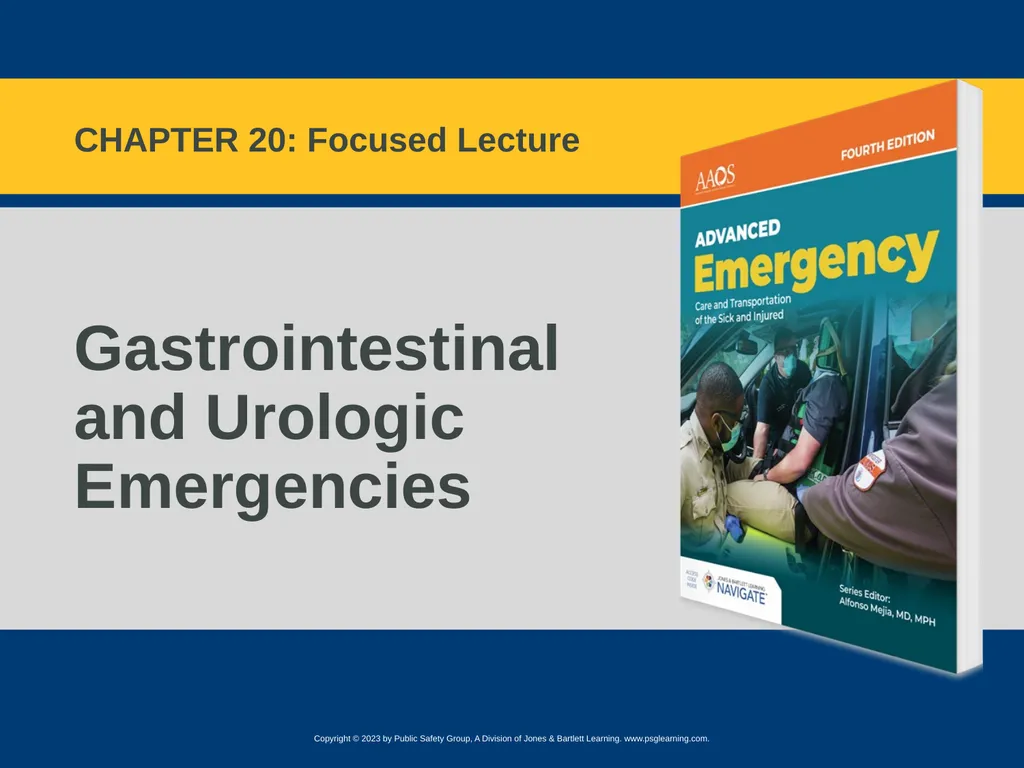
Gastrointestinal and Urologic Emergencies CHAPTER
NS
Published · 89 slides · 0 views
1 / 1






Description
Gastrointestinal and Urologic Emergencies CHAPTER 20: Focused Lecture National EMS Education Standard Competences (1 of 4) Medicine Applies fundamental knowledge to provide basic and selected advanced emergency care and transportation based
Related Topics
Share
Embed code
Download this presentation From Below
"Gastrointestinal and Urologic Emergencies CHAPTER" is the property of its rightful owner. Permission is granted to download and print the materials on this website for personal, non-commercial use only, and to display it on your personal computer provided you do not modify the materials and that you retain all copyright notices contained in the materials. By downloading content from our website, you accept the terms of this agreement.
Presentation Transcript
01
Gastrointestinal and Urologic Emergencies CHAPTER 20: Focused Lecture<br>
02
National EMS Education Standard Competences (1 of 4) Medicine
Applies fundamental knowledge to provide basic and selected advanced emergency care and transportation based on assessment findings for an acutely ill patient.<br>
Applies fundamental knowledge to provide basic and selected advanced emergency care and transportation based on assessment findings for an acutely ill patient.<br>
03
National EMS Education Standard Competences (2 of 4) Abdominal and Gastrointestinal Disorders
Anatomy, presentations, and management of shock associated with abdominal emergencies
Gastrointestinal bleeding<br>
Anatomy, presentations, and management of shock associated with abdominal emergencies
Gastrointestinal bleeding<br>
04
National EMS Education Standard Competences (3 of 4) Abdominal and Gastrointestinal Disorders (cont’d)
Anatomy, physiology, pathophysiology, assessment, and management of
Acute and chronic gastrointestinal hemorrhage
Peritonitis
Ulcerative diseases<br>
Anatomy, physiology, pathophysiology, assessment, and management of
Acute and chronic gastrointestinal hemorrhage
Peritonitis
Ulcerative diseases<br>
05
National EMS Education Standard Competences (4 of 4) Genitourinary/Renal
Blood pressure assessment in hemodialysis patients
Anatomy, physiology, pathophysiology, assessment, and management of
Complications related to
Renal dialysis
Urinary catheter management (not insertion)
Kidney stones<br>
Blood pressure assessment in hemodialysis patients
Anatomy, physiology, pathophysiology, assessment, and management of
Complications related to
Renal dialysis
Urinary catheter management (not insertion)
Kidney stones<br>
06
Introduction Abdominal pain is a common complaint.
Cause of this pain is often difficult to identify.
You do not need to determine exact cause.
You need to be able to recognize a life-threatening problem and act swiftly in response.<br>
Cause of this pain is often difficult to identify.
You do not need to determine exact cause.
You need to be able to recognize a life-threatening problem and act swiftly in response.<br>
07
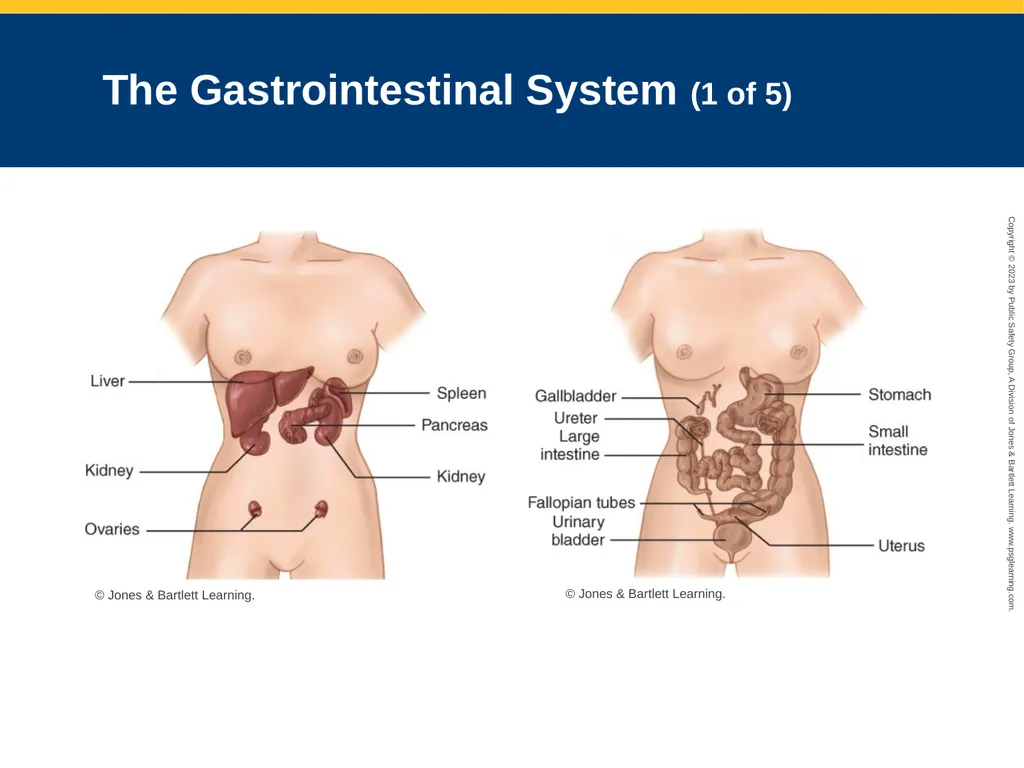
Anatomy and Physiology Abdominal cavity contains solid and hollow organs.
Solid organs include the liver, spleen, pancreas, kidneys, and ovaries.
Injury to a solid organ can cause shock and bleeding.<br>
Solid organs include the liver, spleen, pancreas, kidneys, and ovaries.
Injury to a solid organ can cause shock and bleeding.<br>
08
The Gastrointestinal System (1 of 5) © Jones & Bartlett Learning. © Jones & Bartlett Learning.<br>
09
The Gastrointestinal System (2 of 5) Entire digestion process takes 8 to 72 hours.
Salivary glands secrete saliva to help lubricate the food.
Once food is swallowed, it moves through the esophagus.
Veins around the esophagus in combination with others form the portal vein.<br>
Salivary glands secrete saliva to help lubricate the food.
Once food is swallowed, it moves through the esophagus.
Veins around the esophagus in combination with others form the portal vein.<br>
10
The Gastrointestinal System (3 of 5) Stomach
Secretes hydrochloric acid to break down the food
Stomach absorbs water, alcohol, caffeine
Liver
Secretes bile and filters toxic substances
Creates glucose stores
Produces substances for blood clotting and immune function<br>
Secretes hydrochloric acid to break down the food
Stomach absorbs water, alcohol, caffeine
Liver
Secretes bile and filters toxic substances
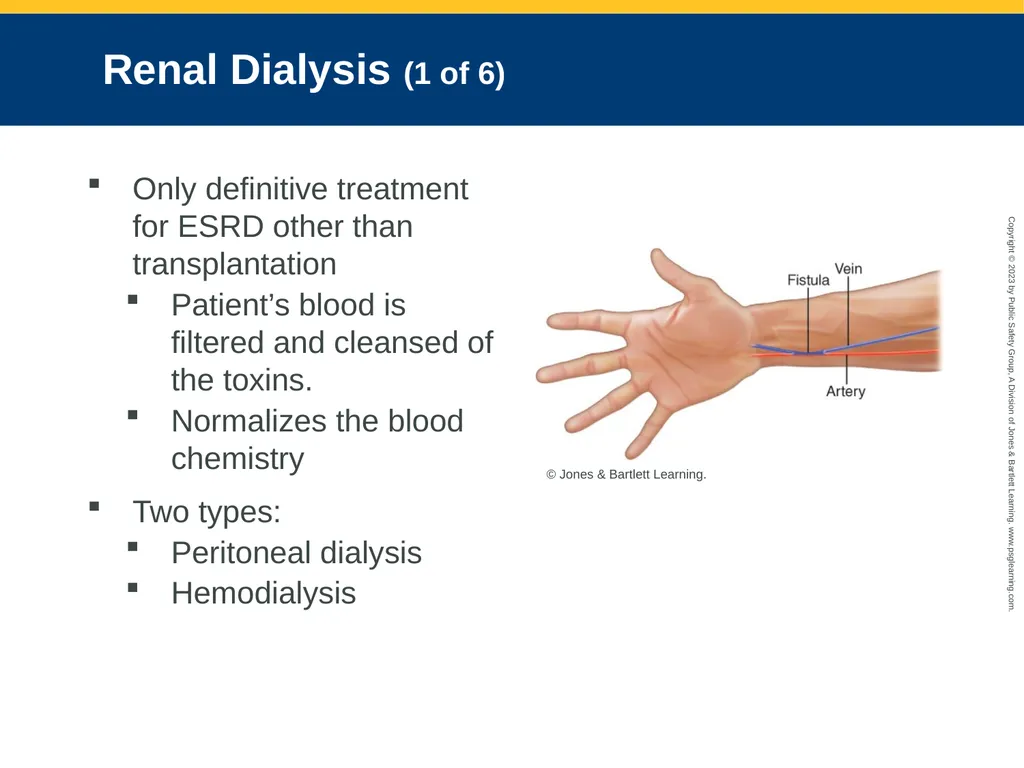
Creates glucose stores
Produces substances for blood clotting and immune function<br>
11
The Gastrointestinal System (4 of 5) Small intestine
Enzymes turn chyme into substances that can be absorbed by capillaries
Duodenum
Jejunum
Ileum<br>
Enzymes turn chyme into substances that can be absorbed by capillaries
Duodenum
Jejunum
Ileum<br>
12
The Gastrointestinal System (5 of 5) Large intestine (colon)
Substances not broken down and used for nutrients are now feces.
Primary role is reabsorption of water.
Site of bacterial digestion
Rectum
Anus<br>
Substances not broken down and used for nutrients are now feces.
Primary role is reabsorption of water.
Site of bacterial digestion
Rectum
Anus<br>
13
Additional Abdominal Organs Spleen has no digestive system function.
Part of lymphatic system
Assists in filtration of blood
Aids in the development of red blood cells, and serves as a blood reservoir
Produces antibodies to help the body fight off disease and infection<br>
Part of lymphatic system
Assists in filtration of blood
Aids in the development of red blood cells, and serves as a blood reservoir
Produces antibodies to help the body fight off disease and infection<br>
14
The Genital System Female
Ovaries
Fallopian tubes
Uterus
Cervix
Vagina Male
Testicles
Epididymis
Vasa deferentia
Seminal vesicles
Prostate gland
Penis<br>
Ovaries
Fallopian tubes
Uterus
Cervix
Vagina Male
Testicles
Epididymis
Vasa deferentia
Seminal vesicles
Prostate gland
Penis<br>
15
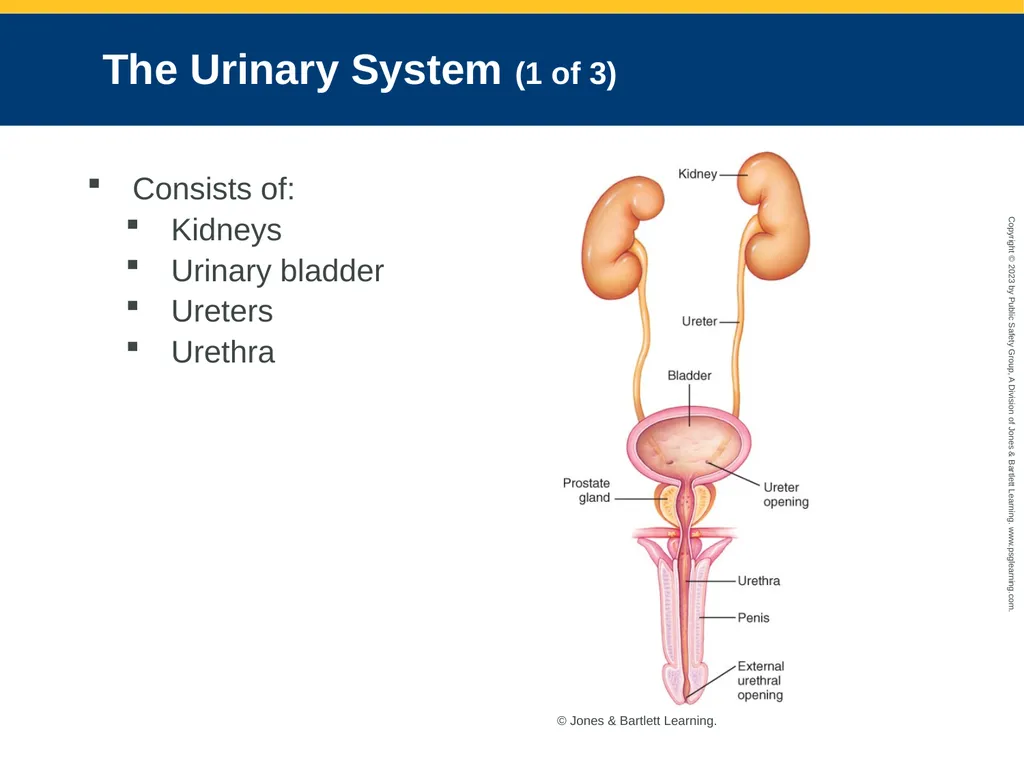
The Urinary System (1 of 3) Consists of:
Kidneys
Urinary bladder
Ureters
Urethra © Jones & Bartlett Learning.<br>
Kidneys
Urinary bladder
Ureters
Urethra © Jones & Bartlett Learning.<br>
16
The Urinary System (2 of 3) Two main functions:
Regulates electrolytes, water content, and acids of the blood
Removes metabolic wastes, drug metabolites, and excess fluids from blood
Kidneys filter 200 L of blood a day.<br>
Regulates electrolytes, water content, and acids of the blood
Removes metabolic wastes, drug metabolites, and excess fluids from blood
Kidneys filter 200 L of blood a day.<br>
17
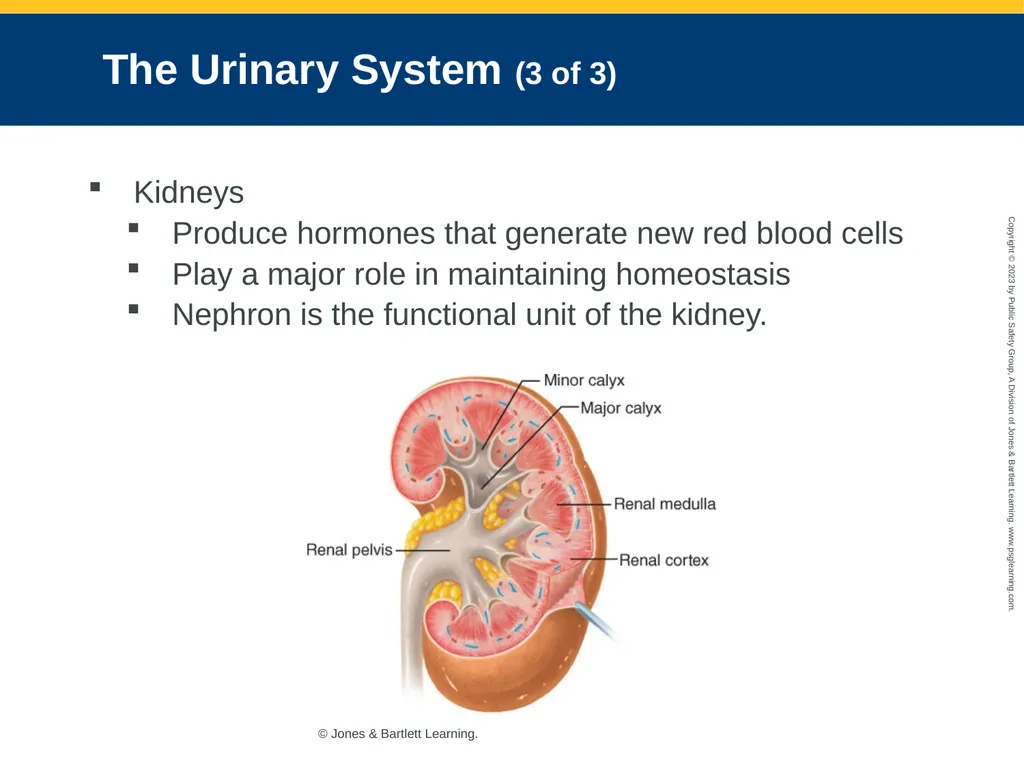
The Urinary System (3 of 3) Kidneys
Produce hormones that generate new red blood cells
Play a major role in maintaining homeostasis
Nephron is the functional unit of the kidney. © Jones & Bartlett Learning.<br>
Produce hormones that generate new red blood cells
Play a major role in maintaining homeostasis
Nephron is the functional unit of the kidney. © Jones & Bartlett Learning.<br>
18
Pathophysiology (1 of 5) Acute abdomen
Sudden onset of abdominal pain
Indicates peritonitis
Peritonitis can be caused by:
Infection
Penetrating or blunt injuries
Many diseases<br>
Sudden onset of abdominal pain
Indicates peritonitis
Peritonitis can be caused by:
Infection
Penetrating or blunt injuries
Many diseases<br>
19
Pathophysiology (2 of 5) Partial peritoneum
Lines abdominal cavity
Can perceive sensations
Visceral peritoneum
Covers the surface of organs
Supplied by the autonomic nervous system
Visceral pain
Usually occurs when receptors in the hollow structures are stimulated<br>
Lines abdominal cavity
Can perceive sensations
Visceral peritoneum
Covers the surface of organs
Supplied by the autonomic nervous system
Visceral pain
Usually occurs when receptors in the hollow structures are stimulated<br>
20
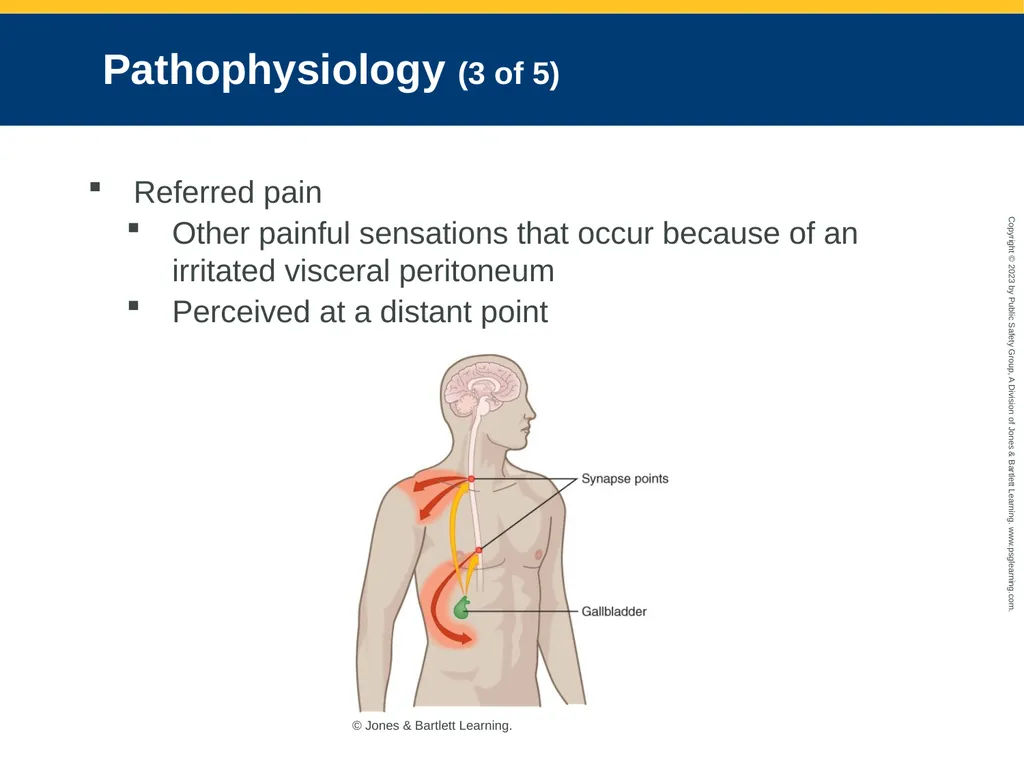
Pathophysiology (3 of 5) Referred pain
Other painful sensations that occur because of an irritated visceral peritoneum
Perceived at a distant point © Jones & Bartlett Learning.<br>
Other painful sensations that occur because of an irritated visceral peritoneum
Perceived at a distant point © Jones & Bartlett Learning.<br>
21
Pathophysiology (4 of 5) Peritonitis
Typically causes ileus
Associated with loss of body fluids into abdominal cavity
Fever may or may not be present.
Present in patients with diverticulitis or cholecystitis<br>
Typically causes ileus
Associated with loss of body fluids into abdominal cavity
Fever may or may not be present.
Present in patients with diverticulitis or cholecystitis<br>
22
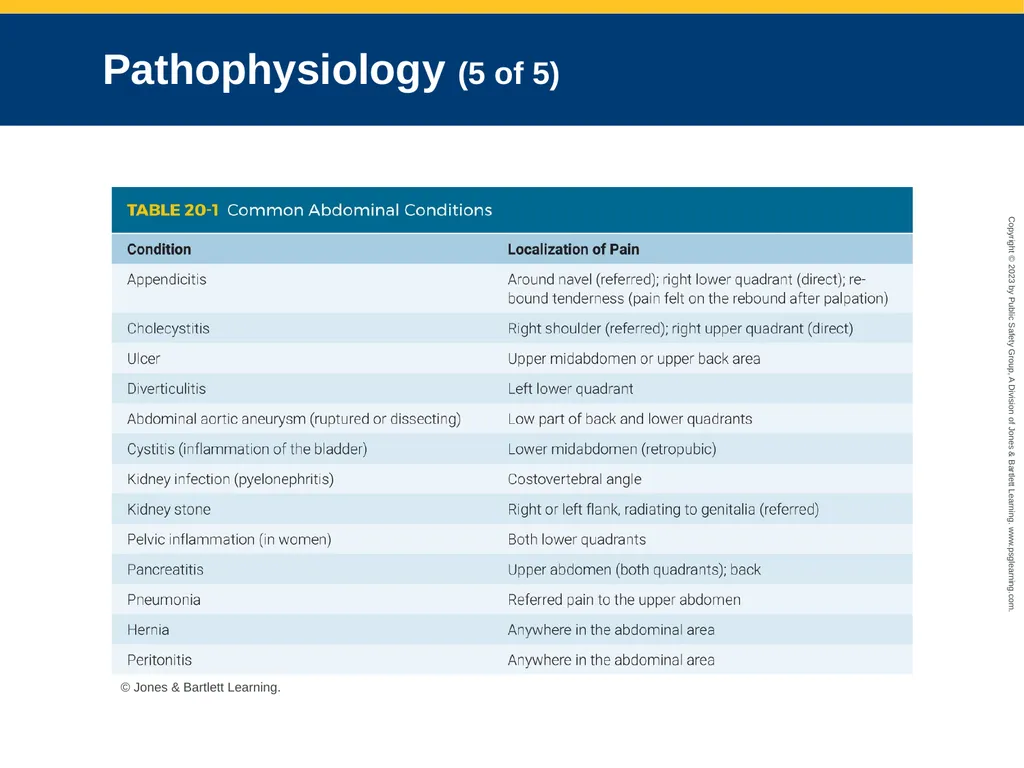
Pathophysiology (5 of 5) © Jones & Bartlett Learning.<br>
23
Causes of Acute Abdomen Any condition that allows foreign material into the abdominal cavity can result in peritonitis and acute abdomen.
Almost every kind of abdominal problem can cause acute abdomen.<br>
Almost every kind of abdominal problem can cause acute abdomen.<br>
24
Gastrointestinal Hemorrhage Bleeding within the GI tract is a symptom of a disease, not the disease itself.
Can be acute or chronic
Can occur in upper or lower GI tract
Esophagitis
Inflammation of the esophagus
Effects are irritation and swelling<br>
Can be acute or chronic
Can occur in upper or lower GI tract
Esophagitis
Inflammation of the esophagus
Effects are irritation and swelling<br>
25
Gastroesophageal Reflux Disease (GERD) Sphincter between esophagus and stomach opens, allowing stomach acid to move superiorly.
Could result in weakened portions that are more susceptible to bleeding
Heartburn is the predominant clinical finding.
Bleeding can occur if the damage is long term.<br>
Could result in weakened portions that are more susceptible to bleeding
Heartburn is the predominant clinical finding.
Bleeding can occur if the damage is long term.<br>
26
Peptic Ulcer Disease and Gastritis (1 of 2) Ulcers: Abrasions of the stomach or small intestine
In peptic ulcer disease, mucous layer erodes.
Allows acid to eat into organ
Usually result of:
Helicobacter pylori
Chronic use of nonsteroidal anti-inflammatory drugs
Alcohol and smoking<br>
In peptic ulcer disease, mucous layer erodes.
Allows acid to eat into organ
Usually result of:
Helicobacter pylori
Chronic use of nonsteroidal anti-inflammatory drugs
Alcohol and smoking<br>
27
Peptic Ulcer Disease and Gastritis (2 of 2) Affect men and women equally
More frequent in older age groups
Pain
Burning, gnawing
Upper abdomen or below sternum
Symptoms:
Nausea, vomiting
Belching
Hematemesis/melena if severe
Some heal without intervention.
Complications can occur from bleeding.<br>
More frequent in older age groups
Pain
Burning, gnawing
Upper abdomen or below sternum
Symptoms:
Nausea, vomiting
Belching
Hematemesis/melena if severe
Some heal without intervention.
Complications can occur from bleeding.<br>
28
Mallory-Weiss Tear Tear in the junction between esophagus and stomach
Primary risk factors:
Alcoholism
Eating disorders
Violent coughing and vomiting are principal causes.
Extent of bleeding can range from very minor to severe.<br>
Primary risk factors:
Alcoholism
Eating disorders
Violent coughing and vomiting are principal causes.
Extent of bleeding can range from very minor to severe.<br>
29
Boerhaave Syndrome Also occurs during vomiting, similar to a Mallory-Weiss tear
Esophagus tears longitudinally and the tear travels entirely through the wall of the esophagus.
Occurs more often in men
Presents after a large meal that included alcohol consumption<br>
Esophagus tears longitudinally and the tear travels entirely through the wall of the esophagus.
Occurs more often in men
Presents after a large meal that included alcohol consumption<br>
30
Esophageal Varices Occur when the amount of pressure within blood vessels surrounding the esophagus increases
Presentation takes two forms:
Initially, patient shows signs of liver disease.
Second presentation, rupture of varices, is far more sudden.
Damage to these vessels can be life threatening.<br>
Presentation takes two forms:
Initially, patient shows signs of liver disease.
Second presentation, rupture of varices, is far more sudden.
Damage to these vessels can be life threatening.<br>
31
Hemorrhoids Created by swelling and inflammation of blood vessels surrounding rectum
May result from conditions that increase pressure on the rectum
Present as bright-red blood during defecation
Patients may also experience itching and a small mass on the rectum.<br>
May result from conditions that increase pressure on the rectum
Present as bright-red blood during defecation
Patients may also experience itching and a small mass on the rectum.<br>
32
Gallstones (1 of 2) Gallbladder stores digestive juices and waste from liver.
Gallstones may form and block outlet.
Cause pain
Sometimes blockage will pass.
When it doesn’t, cholecystitis results.<br>
Gallstones may form and block outlet.
Cause pain
Sometimes blockage will pass.
When it doesn’t, cholecystitis results.<br>
33
Gallstones (2 of 2) In severe cases, gallbladder can rupture.
Symptoms usually appear:
30 minutes after a fatty meal
Usually at night
Symptoms:
General GI distress
Nausea
Vomiting
Indigestion
Bloating
Gas
Belching<br>
Symptoms usually appear:
30 minutes after a fatty meal
Usually at night
Symptoms:
General GI distress
Nausea
Vomiting
Indigestion
Bloating
Gas
Belching<br>
34
Pancreatitis Causes include obstructing gallstone, alcohol abuse.
Sepsis or hemorrhage may occur.
Signs/symptoms
Severe pain, often radiating
Nausea/vomiting
Abdominal distention
Tenderness<br>
Sepsis or hemorrhage may occur.
Signs/symptoms
Severe pain, often radiating
Nausea/vomiting
Abdominal distention
Tenderness<br>
35
Appendicitis Can result in an abscess, peritonitis, or shock
Signs/symptoms
Dull, diffuse pain
Nausea/vomiting
Anorexia (lack of appetite for food)
Fever
Chills
Rebound tenderness<br>
Signs/symptoms
Dull, diffuse pain
Nausea/vomiting
Anorexia (lack of appetite for food)
Fever
Chills
Rebound tenderness<br>
36
Gastroenteritis Caused by bacterial or viral organisms
Typically via contaminated food or water
May also be caused by noninfectious conditions
Symptoms include:
Diarrhea, foul odor or odorless
Abdominal cramping
Nausea/vomiting
Fever
Anorexia
Dehydration<br>
Typically via contaminated food or water
May also be caused by noninfectious conditions
Symptoms include:
Diarrhea, foul odor or odorless
Abdominal cramping
Nausea/vomiting
Fever
Anorexia
Dehydration<br>
37
Diverticulitis (1 of 2) First recognized around 1900 when the foods people ate changed dramatically
Fiber consumption decreased.
Consistency of stools became more solid.
More intestinal contractions were required.
Pressure in colon increased.<br>
Fiber consumption decreased.
Consistency of stools became more solid.
More intestinal contractions were required.
Pressure in colon increased.<br>
38
Diverticulitis (2 of 2) Bulges in colonic walls result.
Bulges become diverticula.
Fecal matter is caught.
Bacteria form.
Signs/symptoms:
Abdominal pain
Fever
Malaise
Body aches
Chills
Nausea/vomiting
Bleeding (rare)<br>
Bulges become diverticula.
Fecal matter is caught.
Bacteria form.
Signs/symptoms:
Abdominal pain
Fever
Malaise
Body aches
Chills
Nausea/vomiting
Bleeding (rare)<br>
39
Ulcerative Colitis Caused by inflammation of the colon
Cause of inflammation unclear
Inflammation causes a thinning of the intestinal wall, resulting in a weakened, dilated rectum.
Signs and symptoms
Bloody diarrhea
Joint pain and skin lesions
Mild to severe abdominal pain
Fever and fatigue<br>
Cause of inflammation unclear
Inflammation causes a thinning of the intestinal wall, resulting in a weakened, dilated rectum.
Signs and symptoms
Bloody diarrhea
Joint pain and skin lesions
Mild to severe abdominal pain
Fever and fatigue<br>
40
Irritable Bowel Syndrome Patients have abdominal pain and changes in their bowel habits.
Three main factors observed in patients:
Hypersensitivity of bowel pain receptors
Hyperresponsiveness of the smooth muscles in the bowel
Psychiatric disorder connection and IBS
Problems with bowel habits typically begin during childhood.<br>
Three main factors observed in patients:
Hypersensitivity of bowel pain receptors
Hyperresponsiveness of the smooth muscles in the bowel
Psychiatric disorder connection and IBS
Problems with bowel habits typically begin during childhood.<br>
41
Crohn Disease Can involve entire GI tract from mouth to anus
No definitive cause has been identified.
Family history and genetics play a role.
Presence of signs and symptoms outside the GI system
Disease results in a series of attacks by the immune system on the GI tract.<br>
No definitive cause has been identified.
Family history and genetics play a role.
Presence of signs and symptoms outside the GI system
Disease results in a series of attacks by the immune system on the GI tract.<br>
42
Pathophysiology of the Urinary System Conditions range from urinary tract infections to severe acute kidney injury.
Prehospital care is usually supportive.<br>
Prehospital care is usually supportive.<br>
43
Urinary Tract Infections (UTIs) (1 of 2) Usually develop in lower urinary tract when bacteria enter the urethra and grow
More common in women
Occur in upper urinary tract when lower UTI goes untreated
Can lead to pyelonephritis and abscesses
Eventually reduces kidney function
In severe cases, can lead to sepsis<br>
More common in women
Occur in upper urinary tract when lower UTI goes untreated
Can lead to pyelonephritis and abscesses
Eventually reduces kidney function
In severe cases, can lead to sepsis<br>
44
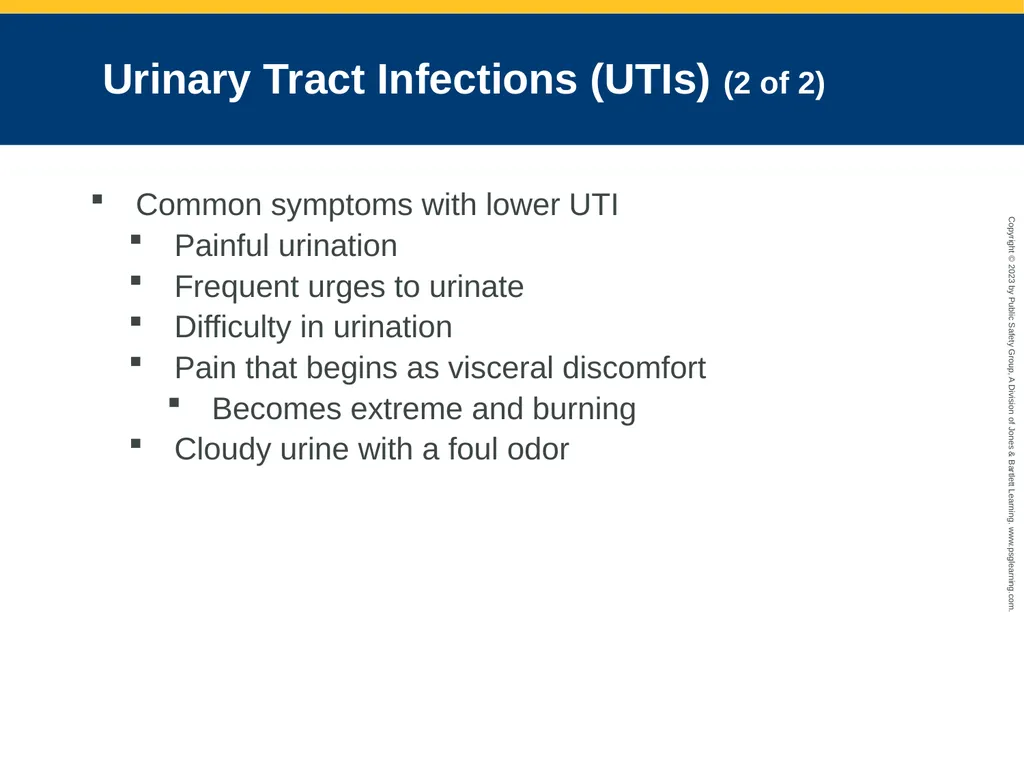
Urinary Tract Infections (UTIs) (2 of 2) Common symptoms with lower UTI
Painful urination
Frequent urges to urinate
Difficulty in urination
Pain that begins as visceral discomfort
Becomes extreme and burning
Cloudy urine with a foul odor<br>
Painful urination
Frequent urges to urinate
Difficulty in urination
Pain that begins as visceral discomfort
Becomes extreme and burning
Cloudy urine with a foul odor<br>
45
Pathophysiology of the Renal System
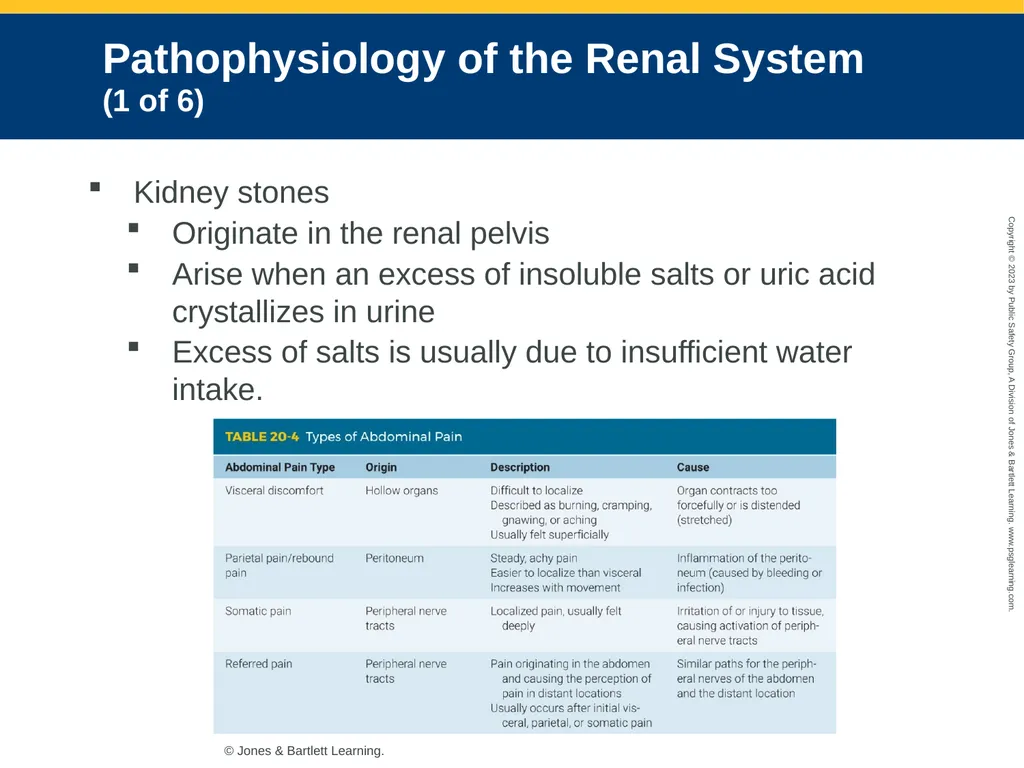
(1 of 6) Kidney stones
Originate in the renal pelvis
Arise when an excess of insoluble salts or uric acid crystallizes in urine
Excess of salts is usually due to insufficient water intake. © Jones & Bartlett Learning.<br>
Originate in the renal pelvis
Arise when an excess of insoluble salts or uric acid crystallizes in urine
Excess of salts is usually due to insufficient water intake. © Jones & Bartlett Learning.<br>
46
Pathophysiology of the Renal System
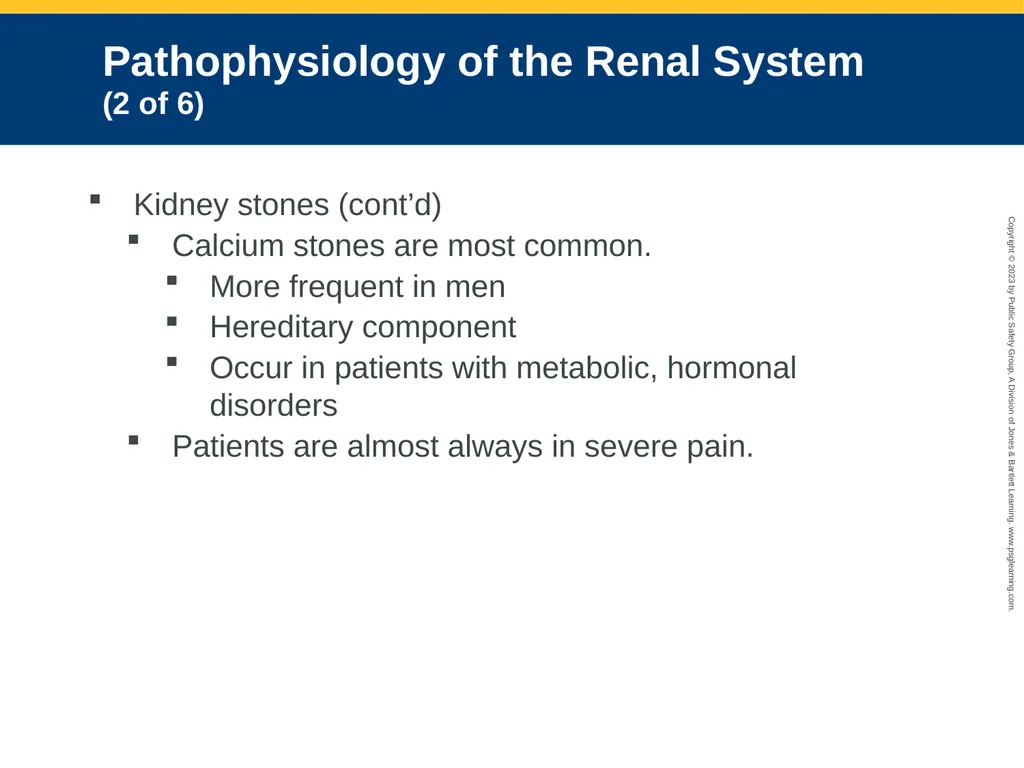
(2 of 6) Kidney stones (cont’d)
Calcium stones are most common.
More frequent in men
Hereditary component
Occur in patients with metabolic, hormonal disorders
Patients are almost always in severe pain.<br>
Calcium stones are most common.
More frequent in men
Hereditary component
Occur in patients with metabolic, hormonal disorders
Patients are almost always in severe pain.<br>
47
Pathophysiology of the Renal System
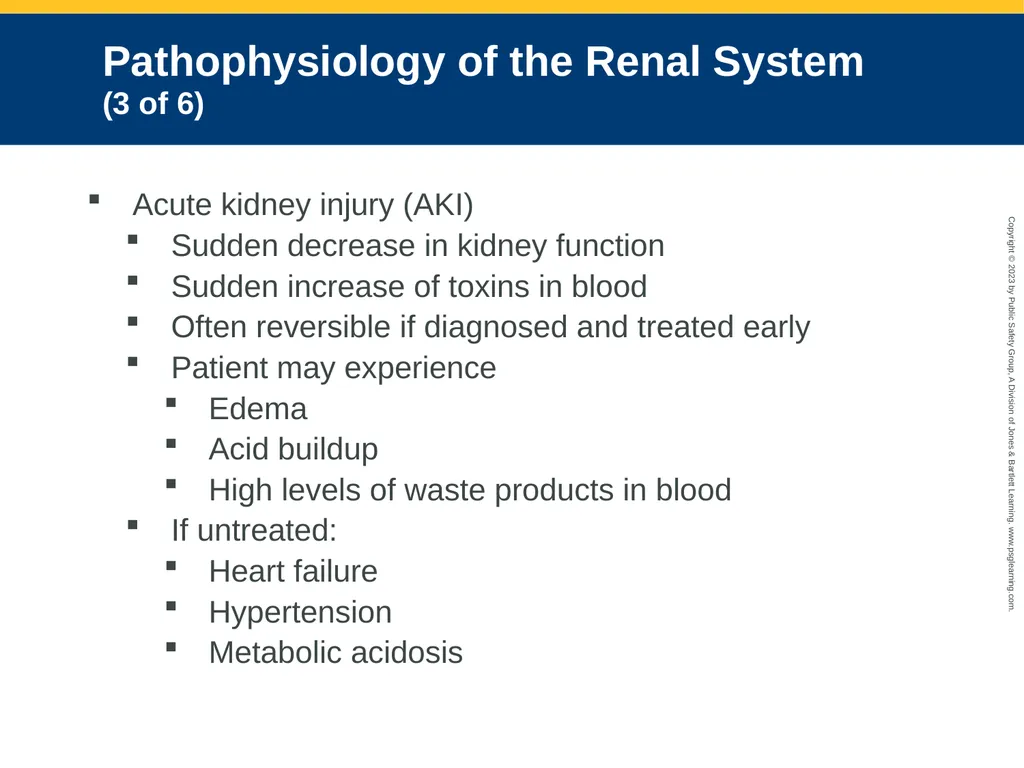
(3 of 6) Acute kidney injury (AKI)
Sudden decrease in kidney function
Sudden increase of toxins in blood
Often reversible if diagnosed and treated early
Patient may experience
Edema
Acid buildup
High levels of waste products in blood
If untreated:
Heart failure
Hypertension
Metabolic acidosis<br>
Sudden decrease in kidney function
Sudden increase of toxins in blood
Often reversible if diagnosed and treated early
Patient may experience
Edema
Acid buildup
High levels of waste products in blood
If untreated:
Heart failure
Hypertension
Metabolic acidosis<br>
48
Pathophysiology of the Renal System
(4 of 6) Chronic kidney disease
Progressive and irreversible inadequate kidney function
Often caused by systemic diseases
Can also be caused by congenital disorders or prolonged pyelonephritis, or be secondary effect of some infections<br>
Progressive and irreversible inadequate kidney function
Often caused by systemic diseases
Can also be caused by congenital disorders or prolonged pyelonephritis, or be secondary effect of some infections<br>
49
Pathophysiology of the Renal System
(5 of 6) Scarring occurs as nephrons of the kidney become damaged and cease to function.
Waste products and fluid build up in the blood.
Systemic complications can develop.<br>
Waste products and fluid build up in the blood.
Systemic complications can develop.<br>
50
Pathophysiology of the Renal System
(6 of 6) Signs and symptoms
Altered LOC
Seizures
Coma
Lethargy
Nausea
Headaches
Cramps
Signs of anemia
Uremic frost
Pale, cool, and moist skin
Jaundice
Edema
Muscle twitching
Hypotension
Tachycardia
Pericarditis
Pulmonary edema<br>
Altered LOC
Seizures
Coma
Lethargy
Nausea
Headaches
Cramps
Signs of anemia
Uremic frost
Pale, cool, and moist skin
Jaundice
Edema
Muscle twitching
Hypotension
Tachycardia
Pericarditis
Pulmonary edema<br>
51
End-Stage Renal Disease (1 of 2) In a patient with ESRD
Kidneys have lost most of their ability to function.
Toxic waste materials build up in the blood.
Fatal unless treated by dialysis or renal transplantation<br>
Kidneys have lost most of their ability to function.
Toxic waste materials build up in the blood.
Fatal unless treated by dialysis or renal transplantation<br>
52
End-Stage Renal Disease (2 of 2) Signs and symptoms
Initial signs: Confusion, shortness of breath, peripheral edema, bruising, chest pain, and bone pain
As toxins accumulate: Pruritus, nausea and vomiting, muscle twitching and tremors, and hallucinations
Pale, cool, and moist skin; edema; uremic frost
In the late stages, seizures and coma are possible.<br>
Initial signs: Confusion, shortness of breath, peripheral edema, bruising, chest pain, and bone pain
As toxins accumulate: Pruritus, nausea and vomiting, muscle twitching and tremors, and hallucinations
Pale, cool, and moist skin; edema; uremic frost
In the late stages, seizures and coma are possible.<br>
53
Pathophysiology of Female Reproductive Organs (1 of 3) Gynecologic problems are a common cause of acute abdominal pain.
Always consider that a woman with lower quadrant abdominal pain and tenderness may have a problem related to her ovaries, fallopian tubes, or uterus.
Pain may be related to the release of an egg from an ovary as part of a normal menstrual cycle.<br>
Always consider that a woman with lower quadrant abdominal pain and tenderness may have a problem related to her ovaries, fallopian tubes, or uterus.
Pain may be related to the release of an egg from an ovary as part of a normal menstrual cycle.<br>
54
Pathophysiology of Female Reproductive Organs (2 of 3) Pelvic inflammatory disease (PID)
Infection of fallopian tubes and surrounding tissues
Intense pain and tenderness in lower abdomen
High fever<br>
Infection of fallopian tubes and surrounding tissues
Intense pain and tenderness in lower abdomen
High fever<br>
55
Pathophysiology of Female Reproductive Organs (3 of 3) Ectopic pregnancy
Fertilized egg implants outside of the uterus.
Rupture can produce:
Massive internal hemorrhage
Acute abdominal pain, generally on one side<br>
Fertilized egg implants outside of the uterus.
Rupture can produce:
Massive internal hemorrhage
Acute abdominal pain, generally on one side<br>
56
Pathophysiology of the Male Genital Tract (1 of 5) Epididymitis and orchitis
Infection that causes inflammation of the epididymis
With orchitis, the infection causes one or both testes to become enlarged and tender.
Swelling may occur in the groin on the affected side.
The patient will have a fever, and the urine will have a foul odor.<br>
Infection that causes inflammation of the epididymis
With orchitis, the infection causes one or both testes to become enlarged and tender.
Swelling may occur in the groin on the affected side.
The patient will have a fever, and the urine will have a foul odor.<br>
57
Pathophysiology of the Male Genital Tract (2 of 5) Priapism
A painful, tender, persistent erection
Can result from:
Diseases such as leukemia and tumors
Blunt perineal trauma
Spinal cord injury
Use of cocaine
Maintain the patient’s privacy and do not make assumptions about the cause.<br>
A painful, tender, persistent erection
Can result from:
Diseases such as leukemia and tumors
Blunt perineal trauma
Spinal cord injury
Use of cocaine
Maintain the patient’s privacy and do not make assumptions about the cause.<br>
58
Pathophysiology of the Male Genital Tract (3 of 5) Benign prostate hypertrophy (BPH)
Age-related nonmalignant enlargement of the prostate gland
BPH may be asymptomatic, or it may lead to:
Difficulty starting urine flow
Slow weak urine flow once started
Incomplete emptying of the bladder
Increased urination at night
Urinary retention<br>
Age-related nonmalignant enlargement of the prostate gland
BPH may be asymptomatic, or it may lead to:
Difficulty starting urine flow
Slow weak urine flow once started
Incomplete emptying of the bladder
Increased urination at night
Urinary retention<br>
59
Pathophysiology of the Male Genital Tract (4 of 5) Testicular masses
Rarely require prehospital treatment
If painful, the pain may radiate up the spermatic cord or be localized to a specific scrotal point.
Most are benign cystic masses or a varicocele.
Testicular cancer usually presents as a painless solid lump on the testicle.<br>
Rarely require prehospital treatment
If painful, the pain may radiate up the spermatic cord or be localized to a specific scrotal point.
Most are benign cystic masses or a varicocele.
Testicular cancer usually presents as a painless solid lump on the testicle.<br>
60
Pathophysiology of the Male Genital Tract (5 of 5) Testicular torsion
Twisting of the testicle on the spermatic cord
Associated with sudden onset of scrotal pain and swelling
A surgical emergency because the twisting of the vessels reduces blood flow to the testis
Torsions may occur with or without blunt trauma, a testicular lump, or blood in the semen.<br>
Twisting of the testicle on the spermatic cord
Associated with sudden onset of scrotal pain and swelling
A surgical emergency because the twisting of the vessels reduces blood flow to the testis
Torsions may occur with or without blunt trauma, a testicular lump, or blood in the semen.<br>
61
Pathophysiology of Other Organ Systems (1 of 4) In older people, weak areas can develop in the wall of the aorta, resulting in an aneurysm.
Unless acutely dissecting, rarely associated with symptoms
If aneurysm tears or ruptures, massive hemorrhage may occur with signs of acute peritoneal irritation and hemorrhagic shock.<br>
Unless acutely dissecting, rarely associated with symptoms
If aneurysm tears or ruptures, massive hemorrhage may occur with signs of acute peritoneal irritation and hemorrhagic shock.<br>
62
Pathophysiology of Other Organ Systems (2 of 4) Hernia
Protrusion of an organ or tissue through a hole into a body cavity
Does not always produce a mass or lump
Can occur as a result of:
Congenital defect
Surgical wound
Natural weakness
Reducible hernias pose little risk and can be pushed back.<br>
Protrusion of an organ or tissue through a hole into a body cavity
Does not always produce a mass or lump
Can occur as a result of:
Congenital defect
Surgical wound
Natural weakness
Reducible hernias pose little risk and can be pushed back.<br>
63
Pathophysiology of Other Organ Systems (3 of 4) Strangulation is a serious medical emergency. © Jones & Bartlett Learning.<br>
64
Pathophysiology of Other Organ Systems (4 of 4) Serious hernia signs and symptoms:
A formerly reducible mass is no longer reducible
Pain at the hernia site
Tenderness when the hernia is palpated
Red or blue skin discoloration over hernia<br>
A formerly reducible mass is no longer reducible
Pain at the hernia site
Tenderness when the hernia is palpated
Red or blue skin discoloration over hernia<br>
65
Scene Size-up Ensure that the scene is safe.
Take standard precautions, using a minimum of gloves and eye protection.
Mechanism of injury/nature of illness
May be the result of violence
If several patients complain of GI symptoms, suspect release of biologic or chemical agent.<br>
Take standard precautions, using a minimum of gloves and eye protection.
Mechanism of injury/nature of illness
May be the result of violence
If several patients complain of GI symptoms, suspect release of biologic or chemical agent.<br>
66
Primary Survey (1 of 5) Common signs and symptoms of irritation or inflammation of the peritoneum:
Local or diffuse abdominal pain and/or tenderness
Quiet patient, guarding the abdomen
Rapid and shallow breathing
Referred (distant) pain
Anorexia, nausea, and vomiting
Hematemesis (bright-red or “coffee-ground” emesis)
Tense, often distended abdomen<br>
Local or diffuse abdominal pain and/or tenderness
Quiet patient, guarding the abdomen
Rapid and shallow breathing
Referred (distant) pain
Anorexia, nausea, and vomiting
Hematemesis (bright-red or “coffee-ground” emesis)
Tense, often distended abdomen<br>
67
Primary Survey (2 of 5) Patients experiencing renal or genital problems may exhibit many of the same symptoms as a patient with other abdominal problems.
Location of patient can provide clues.
Patients with urologic or renal problems may exhibit extremes of activity.<br>
Location of patient can provide clues.
Patients with urologic or renal problems may exhibit extremes of activity.<br>
68
Primary Survey (3 of 5) Evaluate ABCDEs and care for life threats.
Assess circulation.
Pulse rate and quality, as well as skin condition, may indicate shock.
Check the pulses in both arms.
Evaluate for shock.<br>
Assess circulation.
Pulse rate and quality, as well as skin condition, may indicate shock.
Check the pulses in both arms.
Evaluate for shock.<br>
69
Primary Survey (4 of 5) Orthostatic vital signs
Assessing vital signs in two different patient positions will help determine the extent of bleeding.
Take an accurate blood pressure and heart rate.
Using caution to avoid loss of consciousness, have the patient change positions and repeat measurements.<br>
Assessing vital signs in two different patient positions will help determine the extent of bleeding.
Take an accurate blood pressure and heart rate.
Using caution to avoid loss of consciousness, have the patient change positions and repeat measurements.<br>
70
Primary Survey (5 of 5) Transport decision
Integrate information from primary survey.
Rapid transport
Patients who have airway, breathing, or circulation problems
Patients with suspected internal bleeding
Patients with a poor general impression<br>
Integrate information from primary survey.
Rapid transport
Patients who have airway, breathing, or circulation problems
Patients with suspected internal bleeding
Patients with a poor general impression<br>
71
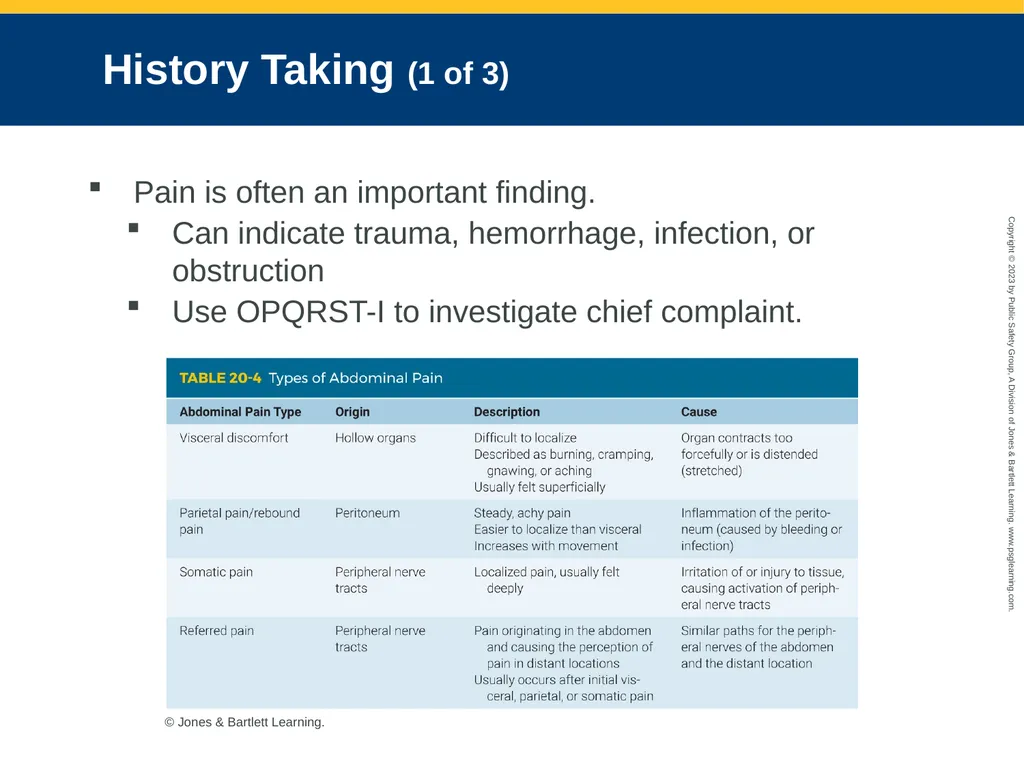
History Taking (1 of 3) Pain is often an important finding.
Can indicate trauma, hemorrhage, infection, or obstruction
Use OPQRST-I to investigate chief complaint. © Jones & Bartlett Learning.<br>
Can indicate trauma, hemorrhage, infection, or obstruction
Use OPQRST-I to investigate chief complaint. © Jones & Bartlett Learning.<br>
72
History Taking (2 of 3) SAMPLE history
Ask about:
Nausea, vomiting
Change in bowel habits and urination
Weight loss
Belching, flatulence
Pain<br>
Ask about:
Nausea, vomiting
Change in bowel habits and urination
Weight loss
Belching, flatulence
Pain<br>
73
History Taking (3 of 3) If chest pain is reported use OPQRST-I.
Ask females about last menstrual period.
Never give anything by mouth.
Check for trauma.<br>
Ask females about last menstrual period.
Never give anything by mouth.
Check for trauma.<br>
74
Secondary Assessment (1 of 3) Information may be used to focus your physical examination of the abdomen.
Pain and tenderness are most common symptoms of an acute abdomen.
Patient with peritonitis usually has abdominal pain.<br>
Pain and tenderness are most common symptoms of an acute abdomen.
Patient with peritonitis usually has abdominal pain.<br>
75
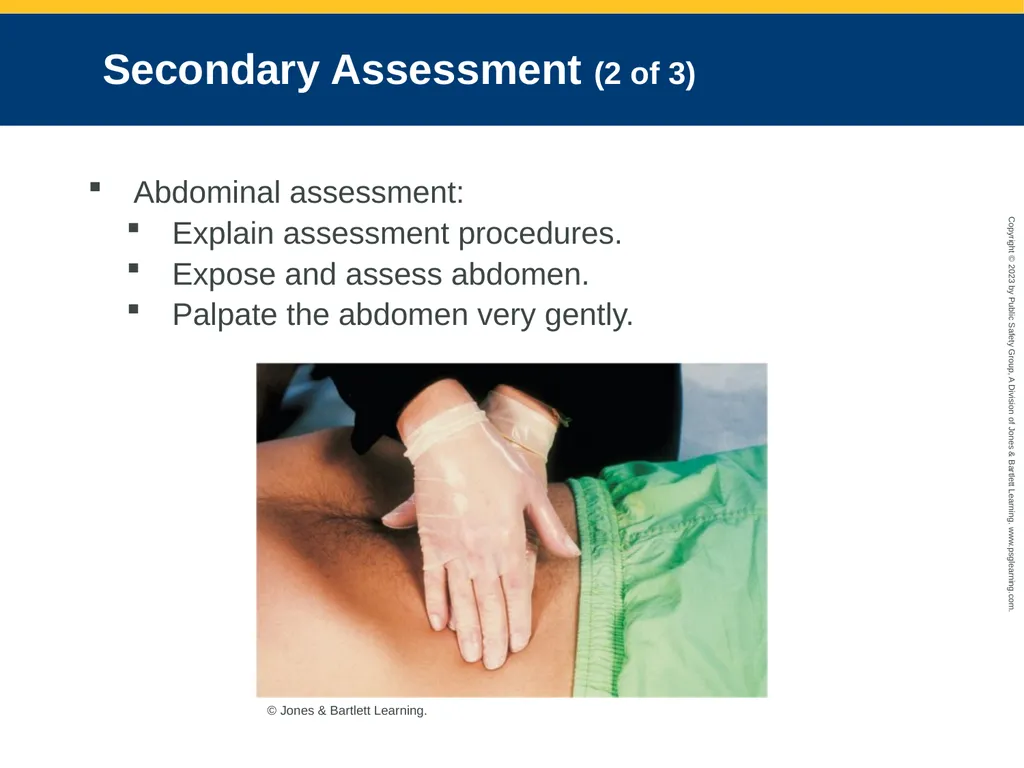
Secondary Assessment (2 of 3) Abdominal assessment:
Explain assessment procedures.
Expose and assess abdomen.
Palpate the abdomen very gently. © Jones & Bartlett Learning.<br>
Explain assessment procedures.
Expose and assess abdomen.
Palpate the abdomen very gently. © Jones & Bartlett Learning.<br>
76
Secondary Assessment (3 of 3) High respiratory rate with normal pulse rate/blood pressure may indicate ineffective ventilations due to pain.
High respiratory rate/pulse rate with signs of shock may indicate septic/hypovolemic shock.
When available, use pulse oximetry and noninvasive blood pressure devices.<br>
High respiratory rate/pulse rate with signs of shock may indicate septic/hypovolemic shock.
When available, use pulse oximetry and noninvasive blood pressure devices.<br>
77
Reassessment Frequent reassessment is vital.
Assess vital signs; compare with baseline.
Reassess the patient.
If the patient has GI bleeding, continue to assess for signs of shock.
Call for paramedic backup if the patient’s condition becomes unstable.<br>
Assess vital signs; compare with baseline.
Reassess the patient.
If the patient has GI bleeding, continue to assess for signs of shock.
Call for paramedic backup if the patient’s condition becomes unstable.<br>
78
Emergency Medical Care (1 of 6) Acute abdomen is a serious medical or surgical emergency.
Do not delay transport.
Before transport:
Do not attempt to diagnose the cause.
Clear and maintain the airway.<br>
Do not delay transport.
Before transport:
Do not attempt to diagnose the cause.
Clear and maintain the airway.<br>
79
Emergency Medical Care (2 of 6) Before transport (cont’d)
Anticipate vomiting.
Administer 100% supplemental oxygen.
Give nothing by mouth.
Document all pertinent information.
Anticipate and treat hypovolemic shock.
Establish IV access and maintain fluid.<br>
Anticipate vomiting.
Administer 100% supplemental oxygen.
Give nothing by mouth.
Document all pertinent information.
Anticipate and treat hypovolemic shock.
Establish IV access and maintain fluid.<br>
80
Emergency Medical Care (3 of 6) Before transport (cont’d)
Make the patient as comfortable as possible.
Monitor vital signs, which may change quickly.
Consider calling for paramedic backup.<br>
Make the patient as comfortable as possible.
Monitor vital signs, which may change quickly.
Consider calling for paramedic backup.<br>
81
Emergency Medical Care (4 of 6) PID
Pain may be intense and accompanied by a high fever.
Transport patient to ED immediately.
Pneumonia
May cause both ileal and abdominal pain
Inflammatory response affects the abdomen.
Treat and transport.<br>
Pain may be intense and accompanied by a high fever.
Transport patient to ED immediately.
Pneumonia
May cause both ileal and abdominal pain
Inflammatory response affects the abdomen.
Treat and transport.<br>
82
Emergency Medical Care (5 of 6) Acute signs and symptoms with shock
Could signify an aneurysm
Requires prompt transport
Avoid unnecessary and vigorous palpation of the abdomen.
Consider ectopic pregnancy in any female of childbearing age, especially with hypotension<br>
Could signify an aneurysm
Requires prompt transport
Avoid unnecessary and vigorous palpation of the abdomen.
Consider ectopic pregnancy in any female of childbearing age, especially with hypotension<br>
83
Emergency Medical Care (6 of 6) Hernia
Transport promptly to the emergency department.
AKI and chronic kidney disease
Can lead to life-threatening emergencies
Support of ABCs is imperative.
Be alert for possibility of hypotension or pulmonary edema.
Medications and fluids may be required.
Provide emergent transport and supportive care.<br>
Transport promptly to the emergency department.
AKI and chronic kidney disease
Can lead to life-threatening emergencies
Support of ABCs is imperative.
Be alert for possibility of hypotension or pulmonary edema.
Medications and fluids may be required.
Provide emergent transport and supportive care.<br>
84
Renal Dialysis (1 of 6) Only definitive treatment for ESRD other than transplantation
Patient’s blood is filtered and cleansed of the toxins.
Normalizes the blood chemistry
Two types:
Peritoneal dialysis
Hemodialysis © Jones & Bartlett Learning.<br>
Patient’s blood is filtered and cleansed of the toxins.
Normalizes the blood chemistry
Two types:
Peritoneal dialysis
Hemodialysis © Jones & Bartlett Learning.<br>
85
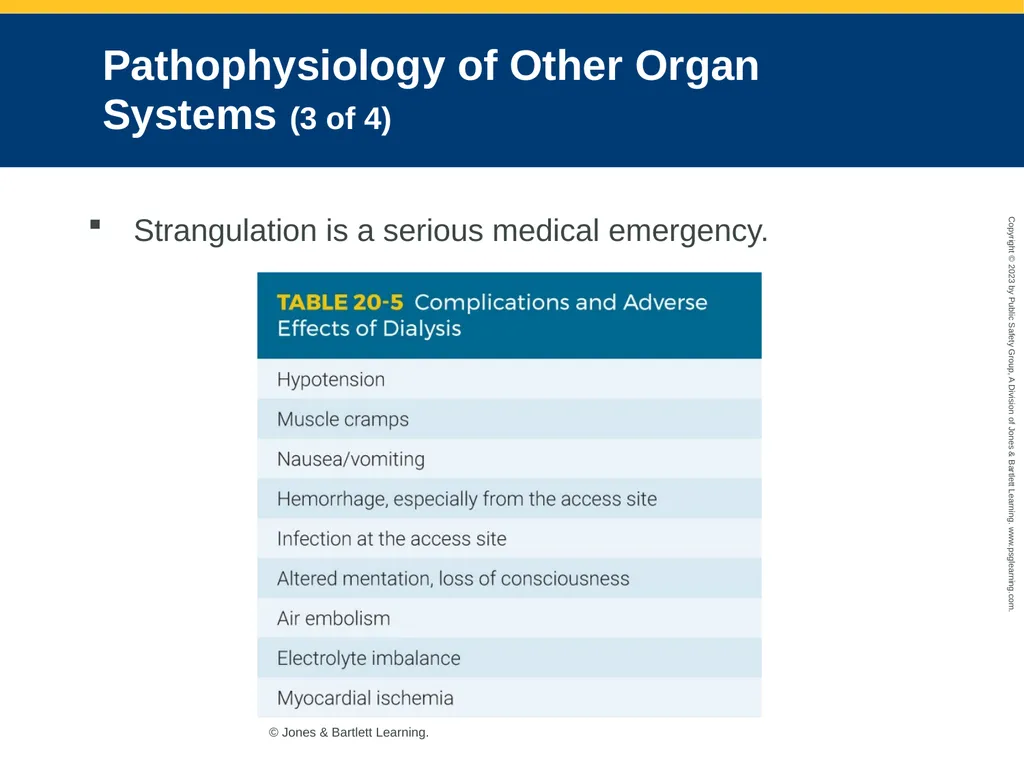
Renal Dialysis (2 of 6) Adverse effects and complications:
Hypotension, muscle cramps
Nausea/vomiting
Hemorrhage, especially from access site
Infection at access site
Altered mentation, loss of consciousness
Air embolism
Electrolyte imbalance
Myocardial ischemia<br>
Hypotension, muscle cramps
Nausea/vomiting
Hemorrhage, especially from access site
Infection at access site
Altered mentation, loss of consciousness
Air embolism
Electrolyte imbalance
Myocardial ischemia<br>
86
Renal Dialysis (3 of 6) Sudden drop in blood pressure is not uncommon during or immediately after.
If patient misses a dialysis treatment, weakness, pulmonary edema, or excesses of electrolytes may occur.<br>
If patient misses a dialysis treatment, weakness, pulmonary edema, or excesses of electrolytes may occur.<br>
87
Renal Dialysis (4 of 6) If call involves patient receiving dialysis:
Start with the ABCDEs.
Be alert for leaking shunts.
Many dialysis patients also have urinary catheters.
Make all attempts to deliver the patient to a hospital with dialysis capability.<br>
Start with the ABCDEs.
Be alert for leaking shunts.
Many dialysis patients also have urinary catheters.
Make all attempts to deliver the patient to a hospital with dialysis capability.<br>
88
Renal Dialysis (5 of 6) Disequilibrium syndrome
Water initially shifts from the bloodstream into the CSF, mildly increasing intracranial pressure.
Characterized by nausea, vomiting, headache, and confusion
After a few hours, fluid will re-equilibrate between the blood and CSF, and the patient’s symptoms will improve on their own<br>
Water initially shifts from the bloodstream into the CSF, mildly increasing intracranial pressure.
Characterized by nausea, vomiting, headache, and confusion
After a few hours, fluid will re-equilibrate between the blood and CSF, and the patient’s symptoms will improve on their own<br>
89
Renal Dialysis (6 of 6) Air embolism
If any of the fittings and connections in the dialysis system are loose, air may enter the system, producing an air embolism.
Symptoms include sudden dyspnea, hypotension, and cyanosis.
Disconnect the patient from the dialysis machine, lay the patient in a flat supine position, and transport immediately.<br>
If any of the fittings and connections in the dialysis system are loose, air may enter the system, producing an air embolism.
Symptoms include sudden dyspnea, hypotension, and cyanosis.
Disconnect the patient from the dialysis machine, lay the patient in a flat supine position, and transport immediately.<br>