
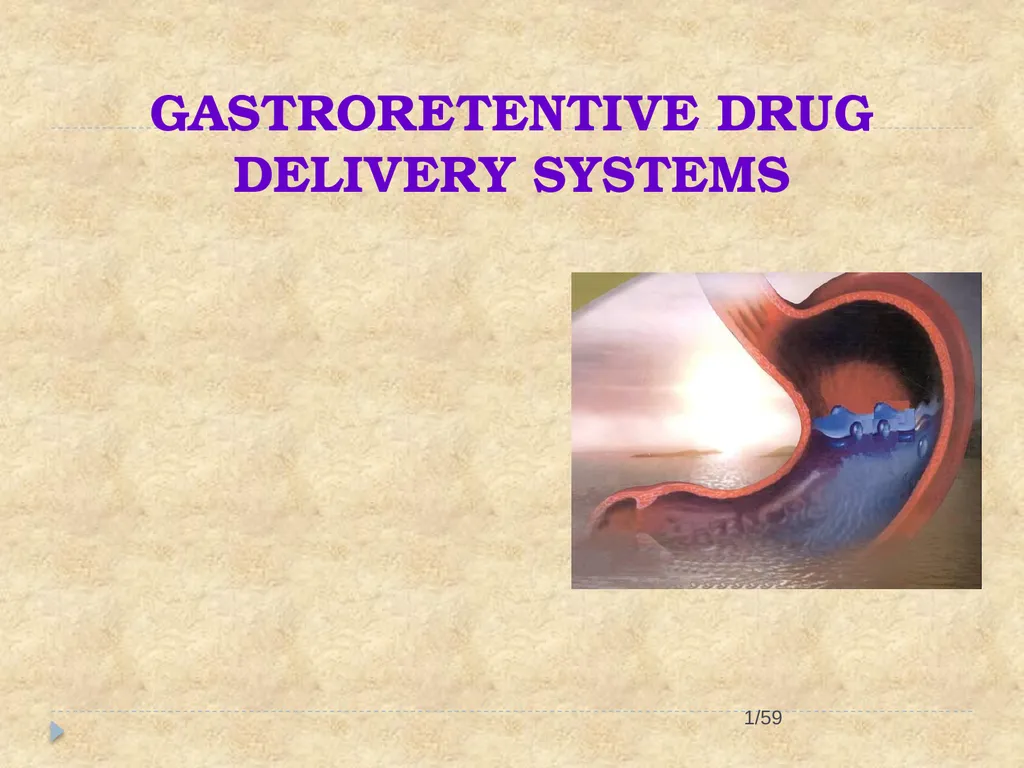
GASTRORETENTIVE DRUG DELIVERY SYSTEMS 1/59
TA
Published · 59 slides · 0 views

1 / 1

Description
GASTRORETENTIVE DRUG DELIVERY SYSTEMS 159 CONTENTS 259 INTRODUCTION APPROACHES EVALUATION CONCLUSION REFERENCES INTRODUCTION 359 The control of gastrointestinal transit of orally administered dosage forms using gastroretentive drug
Related Topics
Share
Embed code
Download this presentation From Below
"GASTRORETENTIVE DRUG DELIVERY SYSTEMS 1/59" is the property of its rightful owner. Permission is granted to download and print the materials on this website for personal, non-commercial use only, and to display it on your personal computer provided you do not modify the materials and that you retain all copyright notices contained in the materials. By downloading content from our website, you accept the terms of this agreement.
Presentation Transcript
01
GASTRORETENTIVE DRUG DELIVERY SYSTEMS 1/59<br>
02
CONTENTS 2/59 INTRODUCTION
APPROACHES
EVALUATION
CONCLUSION
REFERENCES<br>
APPROACHES
EVALUATION
CONCLUSION
REFERENCES<br>
03
INTRODUCTION 3/59 The control of gastrointestinal transit of orally administered dosage forms using gastroretentive drug delivery systems (GRDDS) can improve the bioavailability of drugs that exhibit site-specific absorption.
To overcome physiological adversities, such as short gastric residence times (GRT) and unpredictable gastric emptying times (GET).
This dosage forms will be very much useful to deliver ‘narrow absorption window’ drugs.<br>
To overcome physiological adversities, such as short gastric residence times (GRT) and unpredictable gastric emptying times (GET).
This dosage forms will be very much useful to deliver ‘narrow absorption window’ drugs.<br>
04
4/59 Need for gastroretentive drug delivery system
A controlled drug delivery system with prolonged residence time in the stomach is of particular interest for drugs
Are locally active in the stomach (misoprostol, antacids antibiotics against H.pylori).
Have an absorption window in stomach or in the upper small intestine (L-dopa, P-aminobenzoic acid, furosemide).
Are unstable in the intestine or colonic environment (captopril).
Exhibit low solubility at high pH values (diazepam, verapamil).
Alter normal flora of the colon (antibiotics).
Absorbed by transporter mechanism (paclitaxel).<br>
A controlled drug delivery system with prolonged residence time in the stomach is of particular interest for drugs
Are locally active in the stomach (misoprostol, antacids antibiotics against H.pylori).
Have an absorption window in stomach or in the upper small intestine (L-dopa, P-aminobenzoic acid, furosemide).
Are unstable in the intestine or colonic environment (captopril).
Exhibit low solubility at high pH values (diazepam, verapamil).
Alter normal flora of the colon (antibiotics).
Absorbed by transporter mechanism (paclitaxel).<br>
05
5/59 Advantages
Improved drug absorption, because of increased GRT and more time spent by the dosage form at its absorption site.
Controlled delivery of drugs.
Delivery of drugs for local action in the stomach.
Minimizing mucosal irritation by drugs, by drug releasing slowly at a controlled rate.
Treatment of gastrointestinal disorders such as gastro-esophageal reflux.
Ease of administration and better patient compliance.<br>
Improved drug absorption, because of increased GRT and more time spent by the dosage form at its absorption site.
Controlled delivery of drugs.
Delivery of drugs for local action in the stomach.
Minimizing mucosal irritation by drugs, by drug releasing slowly at a controlled rate.
Treatment of gastrointestinal disorders such as gastro-esophageal reflux.
Ease of administration and better patient compliance.<br>
06
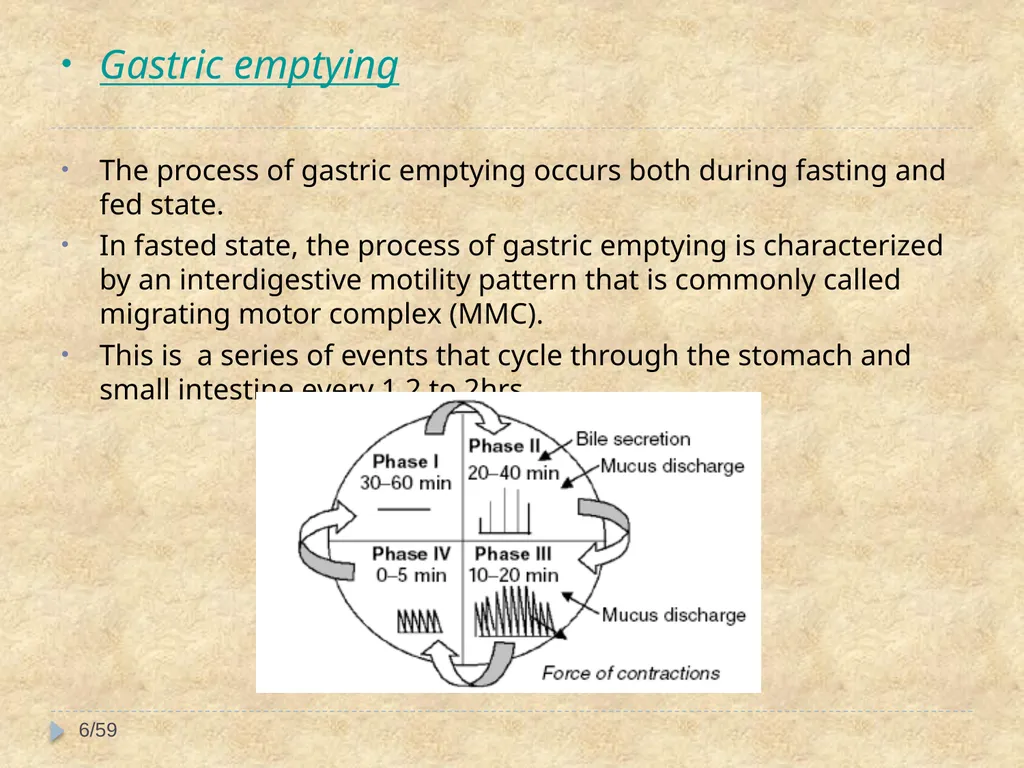
6/59 Gastric emptying
The process of gastric emptying occurs both during fasting and fed state.
In fasted state, the process of gastric emptying is characterized by an interdigestive motility pattern that is commonly called migrating motor complex (MMC).
This is a series of events that cycle through the stomach and small intestine every 1.2 to 2hrs.<br>
The process of gastric emptying occurs both during fasting and fed state.
In fasted state, the process of gastric emptying is characterized by an interdigestive motility pattern that is commonly called migrating motor complex (MMC).
This is a series of events that cycle through the stomach and small intestine every 1.2 to 2hrs.<br>
07
7/59 In the fed state, the gastric emptying rate is slowed down because the onset of MMC is delayed, i.e., the feeding state results in a lag time prior to onset of gastric emptying.
FACTORS CONTROLLING THE GASTRIC RETENTION TIME OF DOSAGE FORM
Density of dosage form.
Size of dosage form.
Food intake and nature of food.
Effects of gender, posture, and age.<br>
FACTORS CONTROLLING THE GASTRIC RETENTION TIME OF DOSAGE FORM
Density of dosage form.
Size of dosage form.
Food intake and nature of food.
Effects of gender, posture, and age.<br>
08
APPROACHES 8/59 High density system
Floating systems
Expandable systems
Superporous hydrogels
Mucoadhesive or bioadhesive systems
Magnetic systems<br>
Floating systems
Expandable systems
Superporous hydrogels
Mucoadhesive or bioadhesive systems
Magnetic systems<br>
09
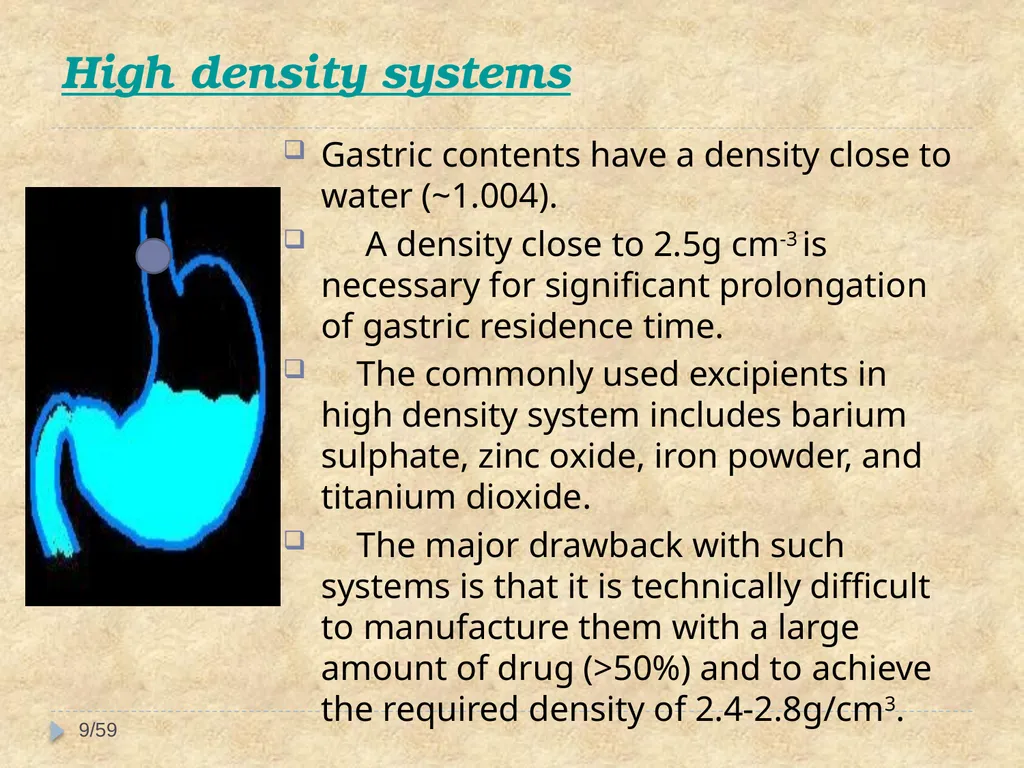
High density systems 9/59 Gastric contents have a density close to water (~1.004).
A density close to 2.5g cm-3 is necessary for significant prolongation of gastric residence time.
The commonly used excipients in high density system includes barium sulphate, zinc oxide, iron powder, and titanium dioxide.
The major drawback with such systems is that it is technically difficult to manufacture them with a large amount of drug (>50%) and to achieve the required density of 2.4-2.8g/cm3.<br>
A density close to 2.5g cm-3 is necessary for significant prolongation of gastric residence time.
The commonly used excipients in high density system includes barium sulphate, zinc oxide, iron powder, and titanium dioxide.
The major drawback with such systems is that it is technically difficult to manufacture them with a large amount of drug (>50%) and to achieve the required density of 2.4-2.8g/cm3.<br>
10
Floating Systems 10/59 Single-unit floating dosage system
Noneffervescent systems
Effervescent (gas-generating) systems
Multiple-unit floating dosage system
Noneffervescent systems
Effervescent (gas-generating) systems
Hollow microspheres
Raft-forming systems<br>
Noneffervescent systems
Effervescent (gas-generating) systems
Multiple-unit floating dosage system
Noneffervescent systems
Effervescent (gas-generating) systems
Hollow microspheres
Raft-forming systems<br>
11
11/59 Single-Unit Floating Dosage System
Noneffervescent Systems
These systems contain one or more hydrocolloids and are made into a single unit along with drug and other additives.
When coming in contact with water, the hydrocolloids at the surface of the system swell and facilitate floating.
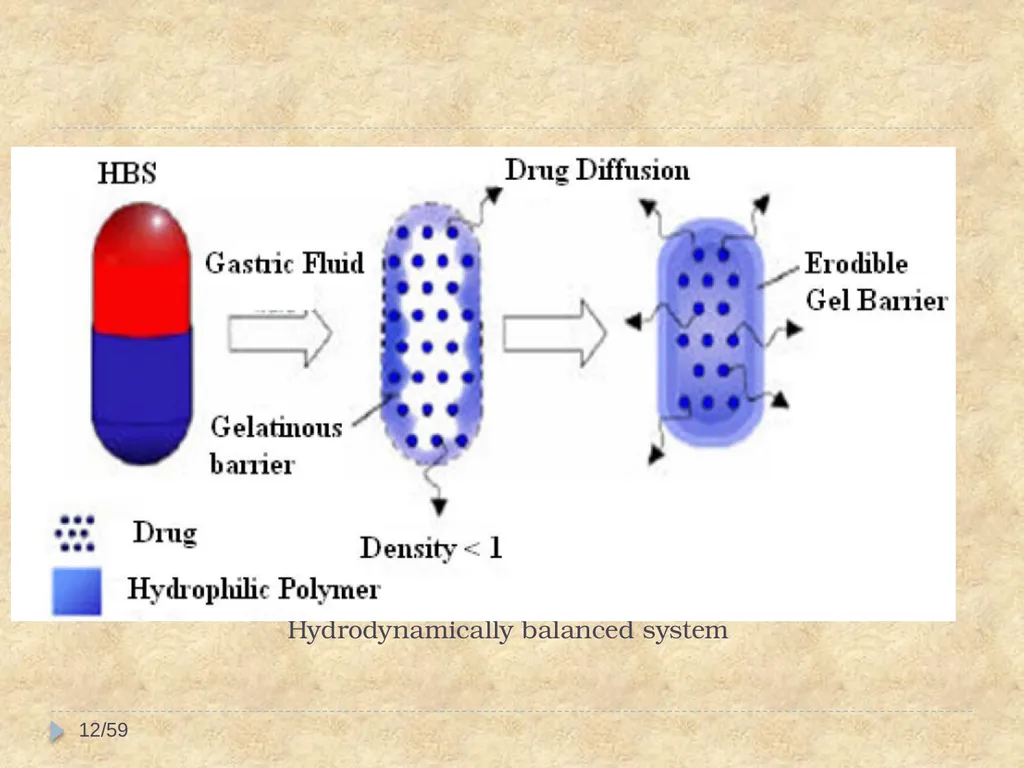
The coating forms a viscous barrier, and the inner polymer slowly gets hydrated as well, facilitating the controlled drug release. Such systems are called “hydrodynamically balanced systems (HBS)”.
The polymers used in this system includes hydroxypropylmethylcellulose,hydroxyethylcellulose, hydroxypropylcellulose, sodium carboxymethylcellulose, agar, carrageenans, and alginic acid.<br>
Noneffervescent Systems
These systems contain one or more hydrocolloids and are made into a single unit along with drug and other additives.
When coming in contact with water, the hydrocolloids at the surface of the system swell and facilitate floating.
The coating forms a viscous barrier, and the inner polymer slowly gets hydrated as well, facilitating the controlled drug release. Such systems are called “hydrodynamically balanced systems (HBS)”.
The polymers used in this system includes hydroxypropylmethylcellulose,hydroxyethylcellulose, hydroxypropylcellulose, sodium carboxymethylcellulose, agar, carrageenans, and alginic acid.<br>
12
Hydrodynamically balanced system 12/59<br>
13
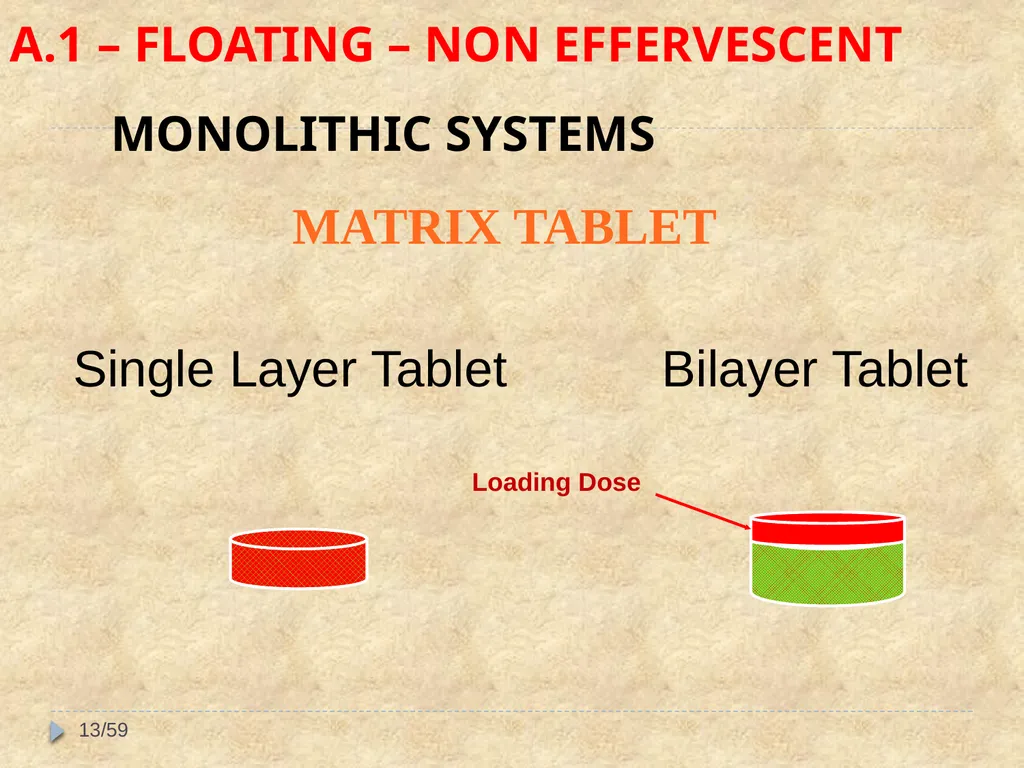
A.1 – FLOATING – NON EFFERVESCENT MONOLITHIC SYSTEMS MATRIX TABLET Single Layer Tablet Bilayer Tablet Loading Dose 13/59<br>
14
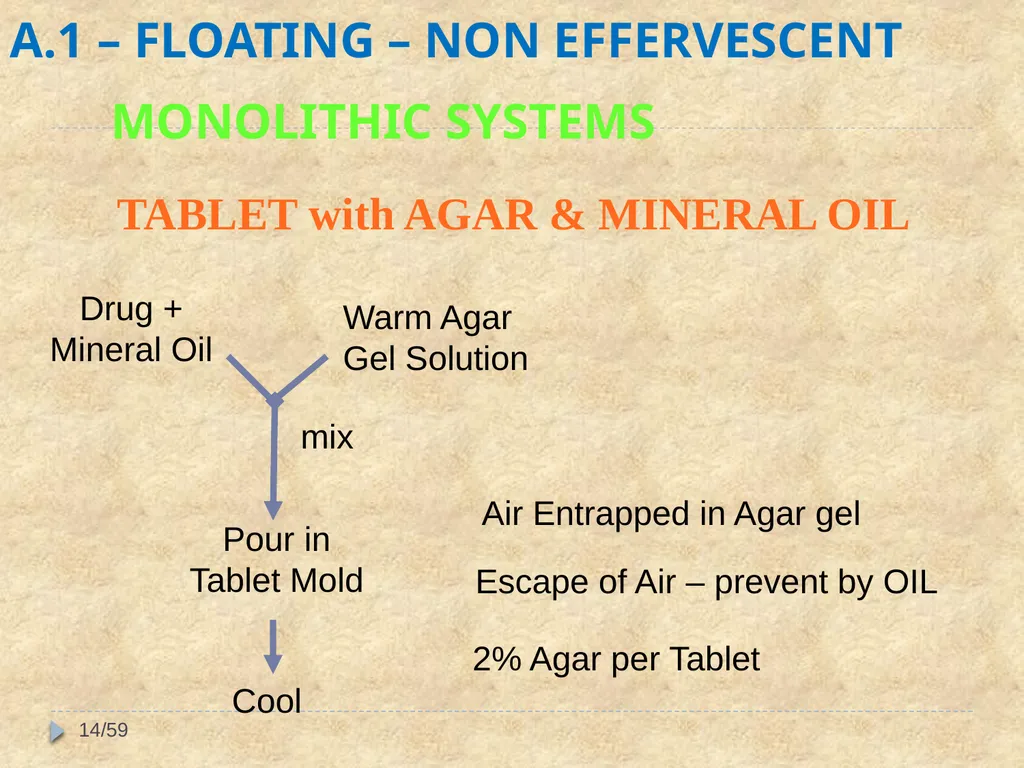
A.1 – FLOATING – NON EFFERVESCENT MONOLITHIC SYSTEMS TABLET with AGAR & MINERAL OIL Drug +
Mineral Oil mix Pour in
Tablet Mold Cool Warm Agar
Gel Solution 2% Agar per Tablet Air Entrapped in Agar gel Escape of Air – prevent by OIL 14/59<br>
Mineral Oil mix Pour in
Tablet Mold Cool Warm Agar
Gel Solution 2% Agar per Tablet Air Entrapped in Agar gel Escape of Air – prevent by OIL 14/59<br>
15
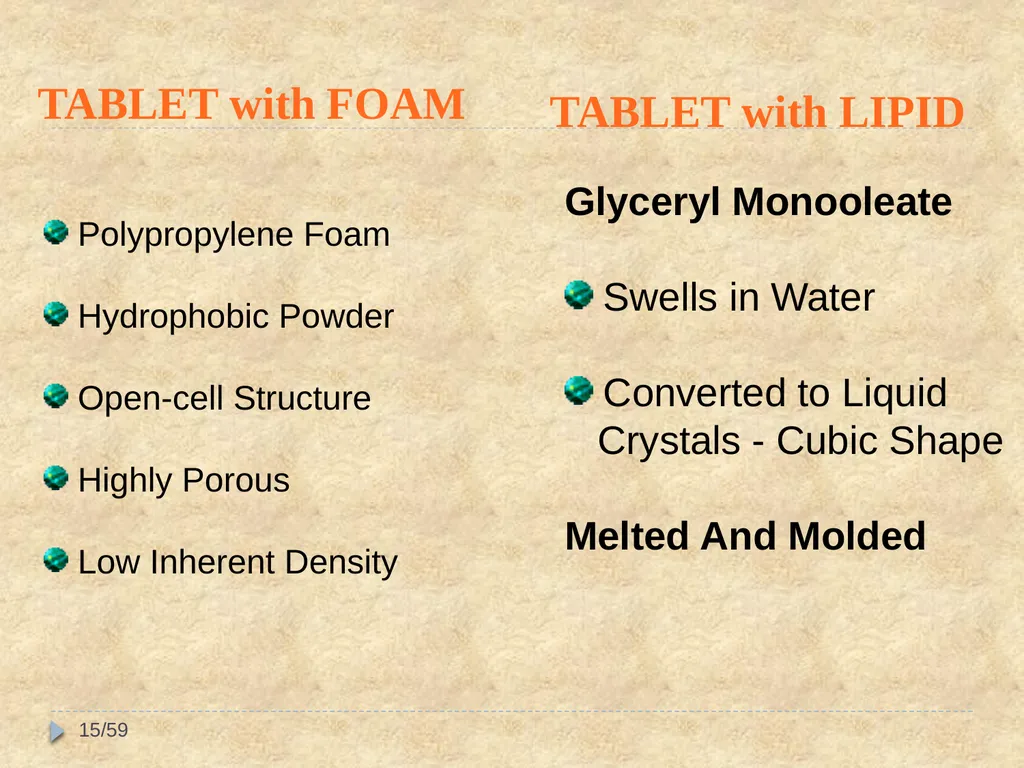
Polypropylene Foam
Hydrophobic Powder
Open-cell Structure
Highly Porous
Low Inherent Density TABLET with FOAM Glyceryl Monooleate
Swells in Water
Converted to Liquid
Crystals - Cubic Shape
Melted And Molded TABLET with LIPID 15/59<br>
Hydrophobic Powder
Open-cell Structure
Highly Porous
Low Inherent Density TABLET with FOAM Glyceryl Monooleate
Swells in Water
Converted to Liquid
Crystals - Cubic Shape
Melted And Molded TABLET with LIPID 15/59<br>
16
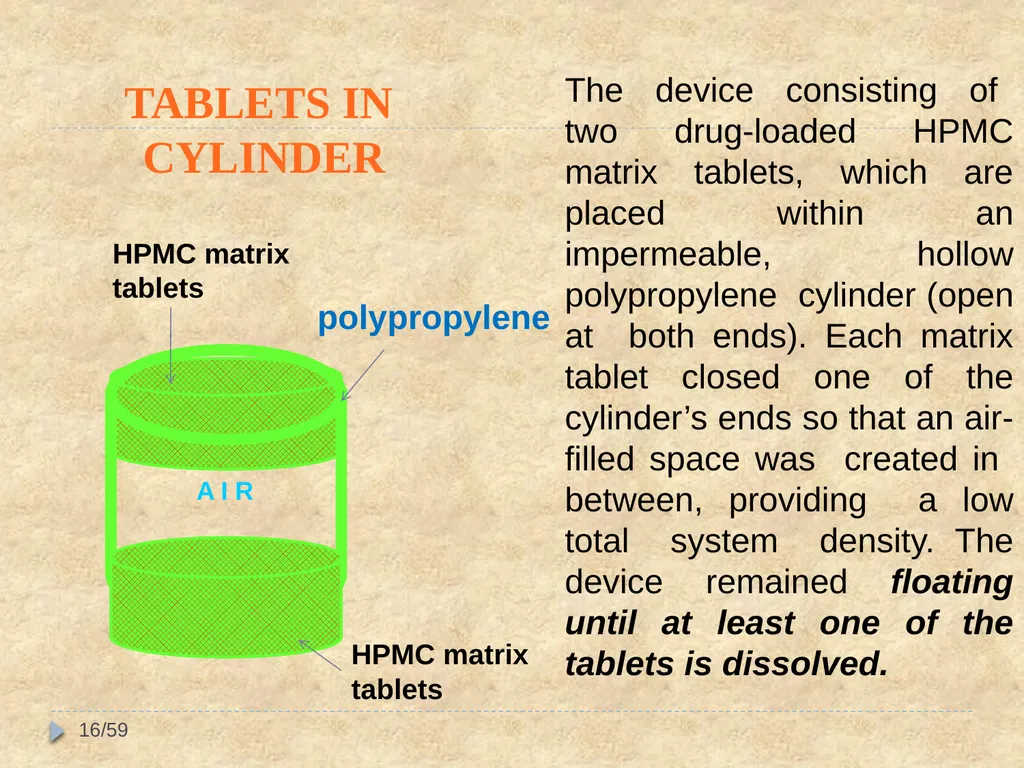
TABLETS IN
CYLINDER A I R 16/59 polypropylene The device consisting of two drug-loaded HPMC matrix tablets, which are placed within an impermeable, hollow polypropylene cylinder (open at both ends). Each matrix tablet closed one of the cylinder’s ends so that an air-filled space was created in between, providing a low total system density. The device remained floating until at least one of the tablets is dissolved. HPMC matrix tablets HPMC matrix tablets<br>
CYLINDER A I R 16/59 polypropylene The device consisting of two drug-loaded HPMC matrix tablets, which are placed within an impermeable, hollow polypropylene cylinder (open at both ends). Each matrix tablet closed one of the cylinder’s ends so that an air-filled space was created in between, providing a low total system density. The device remained floating until at least one of the tablets is dissolved. HPMC matrix tablets HPMC matrix tablets<br>
17
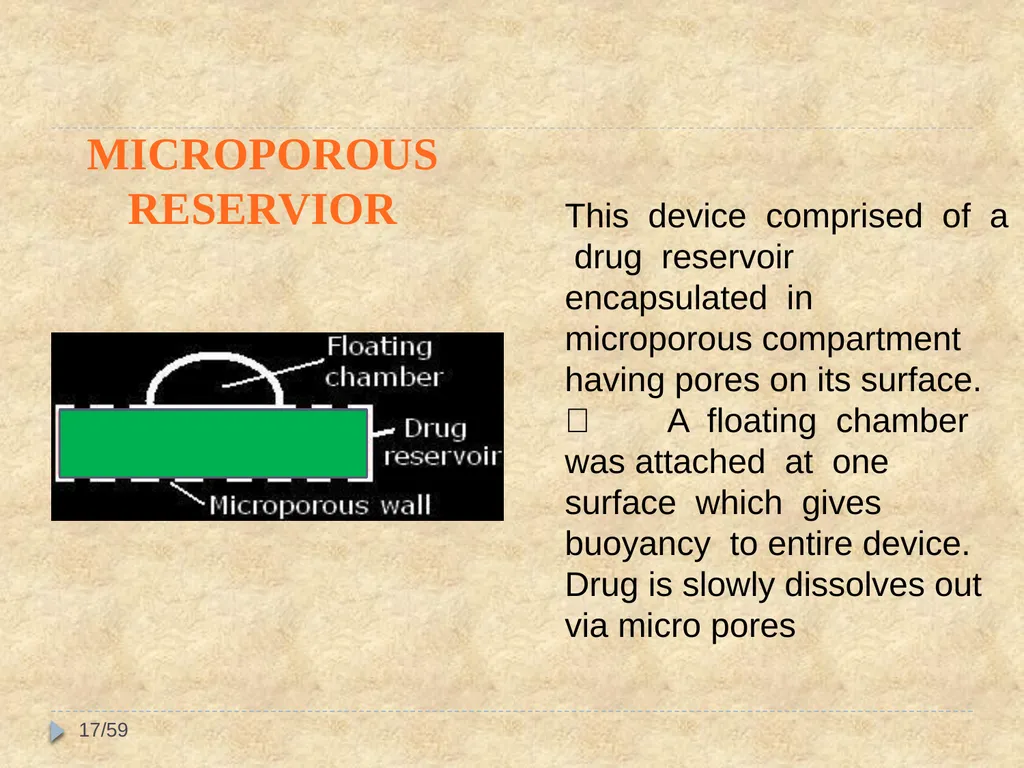
MICROPOROUS
RESERVIOR 17/59 This device comprised of a drug reservoir encapsulated in microporous compartment having pores on its surface.
A floating chamber was attached at one surface which gives buoyancy to entire device. Drug is slowly dissolves out via micro pores<br>
RESERVIOR 17/59 This device comprised of a drug reservoir encapsulated in microporous compartment having pores on its surface.
A floating chamber was attached at one surface which gives buoyancy to entire device. Drug is slowly dissolves out via micro pores<br>
18
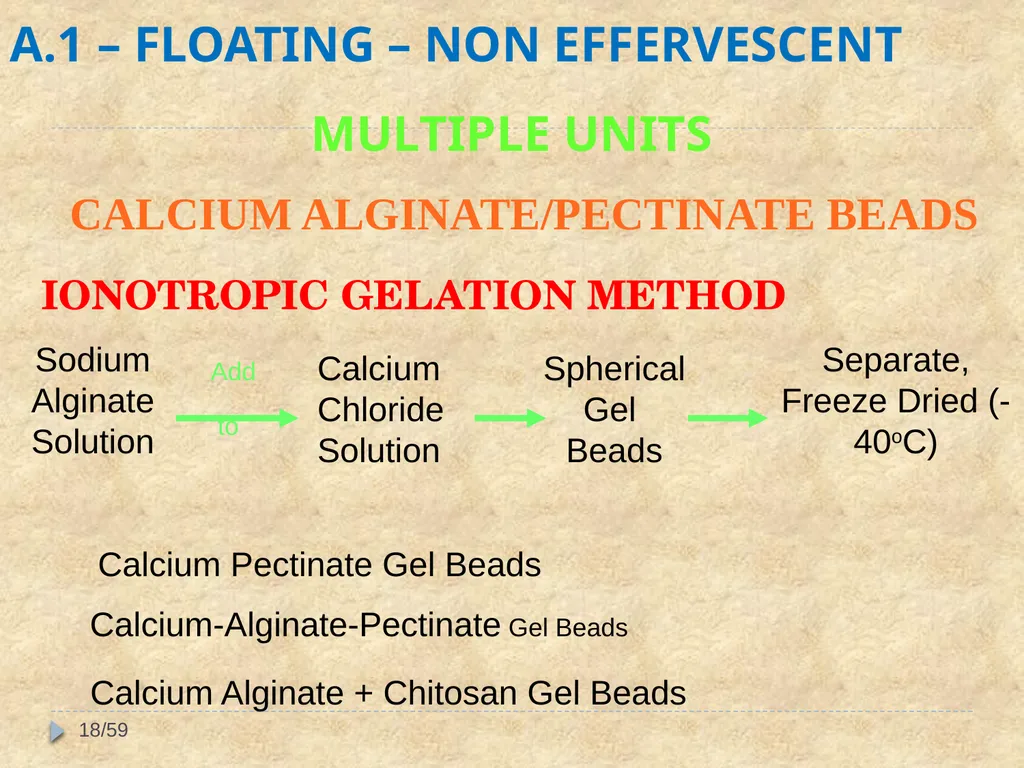
A.1 – FLOATING – NON EFFERVESCENT MULTIPLE UNITS CALCIUM ALGINATE/PECTINATE BEADS Sodium Alginate Solution Add
to Calcium Chloride Solution Spherical Gel
Beads Separate,
Freeze Dried (-40oC) IONOTROPIC GELATION METHOD Calcium Pectinate Gel Beads Calcium-Alginate-Pectinate Gel Beads Calcium Alginate + Chitosan Gel Beads 18/59<br>
to Calcium Chloride Solution Spherical Gel
Beads Separate,
Freeze Dried (-40oC) IONOTROPIC GELATION METHOD Calcium Pectinate Gel Beads Calcium-Alginate-Pectinate Gel Beads Calcium Alginate + Chitosan Gel Beads 18/59<br>
19
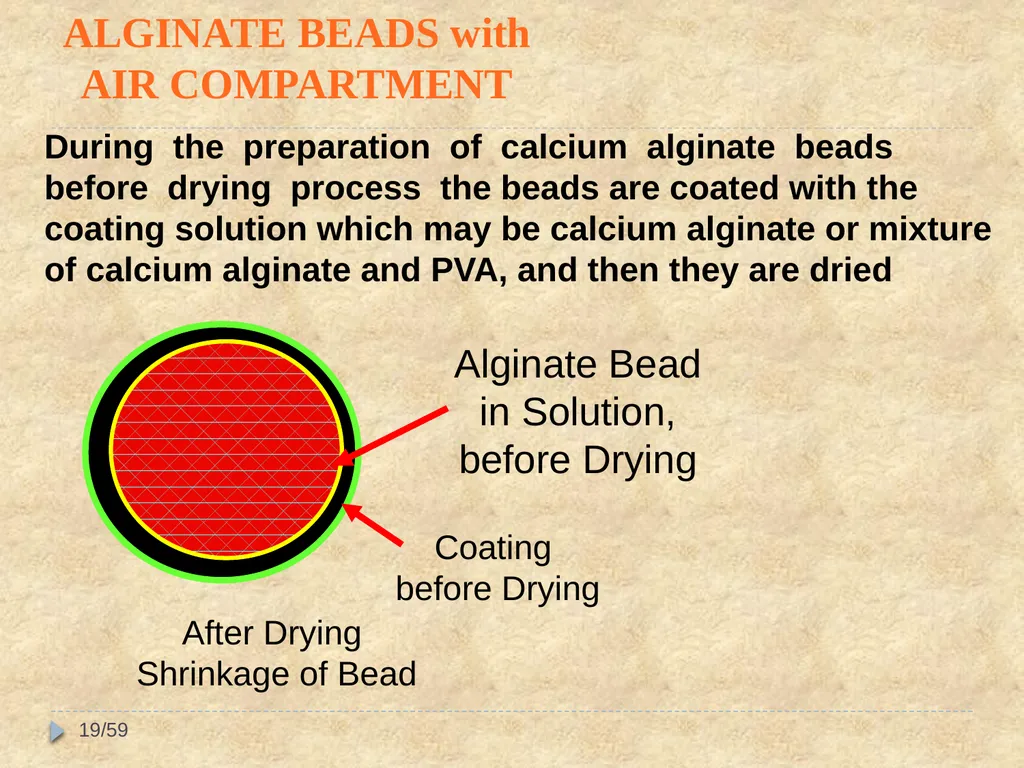
ALGINATE BEADS with
AIR COMPARTMENT Alginate Bead
in Solution,
before Drying Coating
before Drying After Drying
Shrinkage of Bead 19/59 During the preparation of calcium alginate beads before drying process the beads are coated with the coating solution which may be calcium alginate or mixture of calcium alginate and PVA, and then they are dried<br>
AIR COMPARTMENT Alginate Bead
in Solution,
before Drying Coating
before Drying After Drying
Shrinkage of Bead 19/59 During the preparation of calcium alginate beads before drying process the beads are coated with the coating solution which may be calcium alginate or mixture of calcium alginate and PVA, and then they are dried<br>
20
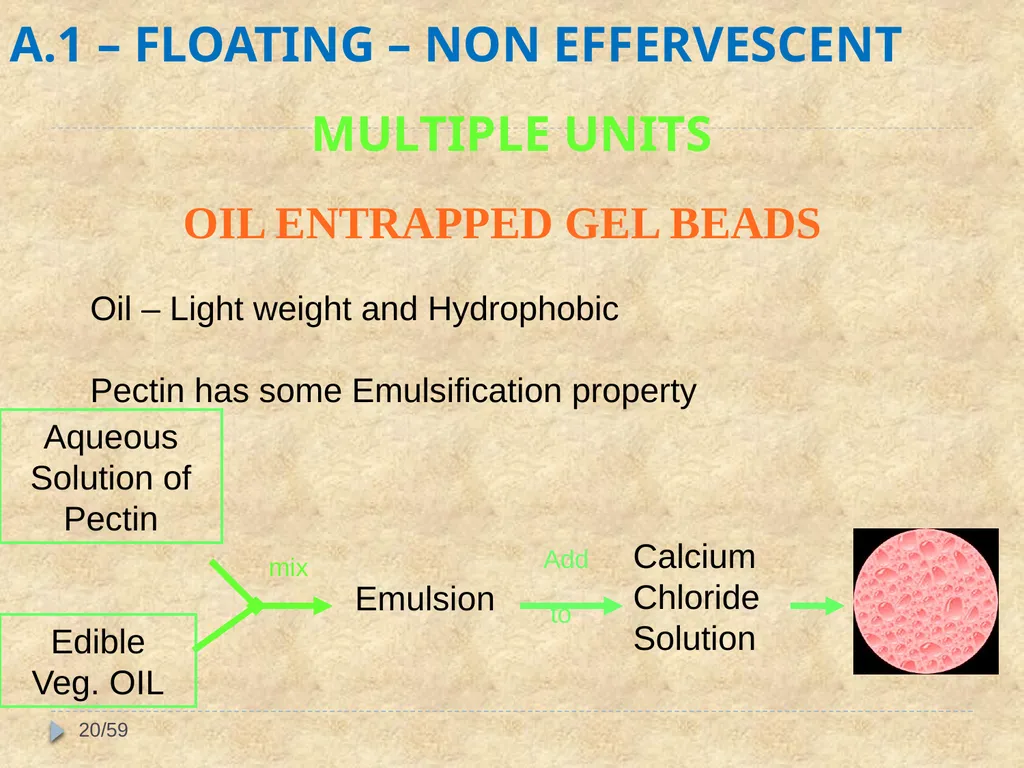
A.1 – FLOATING – NON EFFERVESCENT MULTIPLE UNITS OIL ENTRAPPED GEL BEADS Oil – Light weight and Hydrophobic
Pectin has some Emulsification property Aqueous
Solution of
Pectin mix Emulsion Edible
Veg. OIL Add
to Calcium Chloride Solution 20/59<br>
Pectin has some Emulsification property Aqueous
Solution of
Pectin mix Emulsion Edible
Veg. OIL Add
to Calcium Chloride Solution 20/59<br>
21
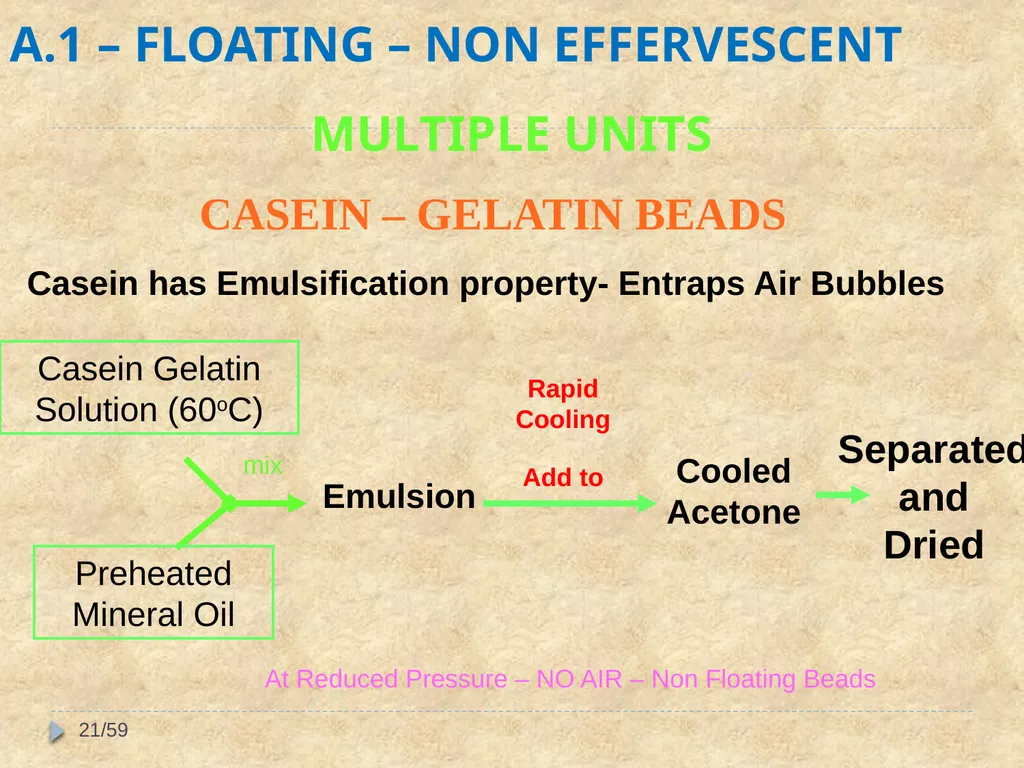
A.1 – FLOATING – NON EFFERVESCENT MULTIPLE UNITS CASEIN – GELATIN BEADS Casein has Emulsification property- Entraps Air Bubbles Casein Gelatin
Solution (60oC) mix Emulsion Preheated
Mineral Oil Rapid
Cooling
Add to Cooled
Acetone Separated
and
Dried At Reduced Pressure – NO AIR – Non Floating Beads 21/59<br>
Solution (60oC) mix Emulsion Preheated
Mineral Oil Rapid
Cooling
Add to Cooled
Acetone Separated
and
Dried At Reduced Pressure – NO AIR – Non Floating Beads 21/59<br>
22
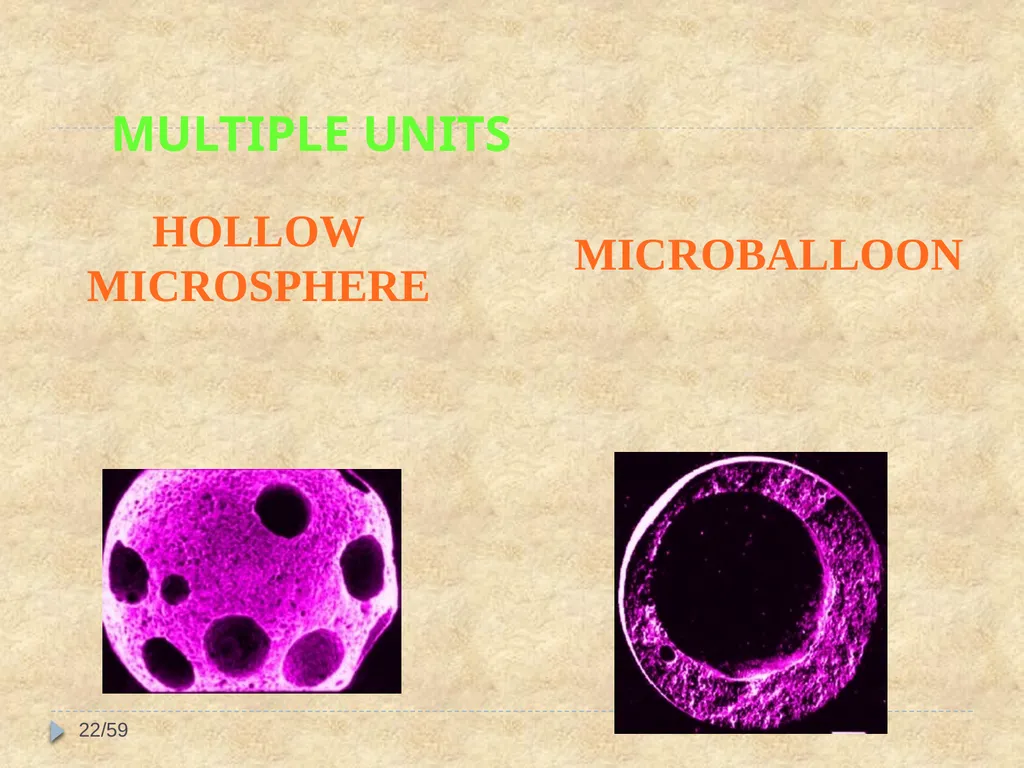
HOLLOW
MICROSPHERE MICROBALLOON MULTIPLE UNITS 22/59<br>
MICROSPHERE MICROBALLOON MULTIPLE UNITS 22/59<br>
23
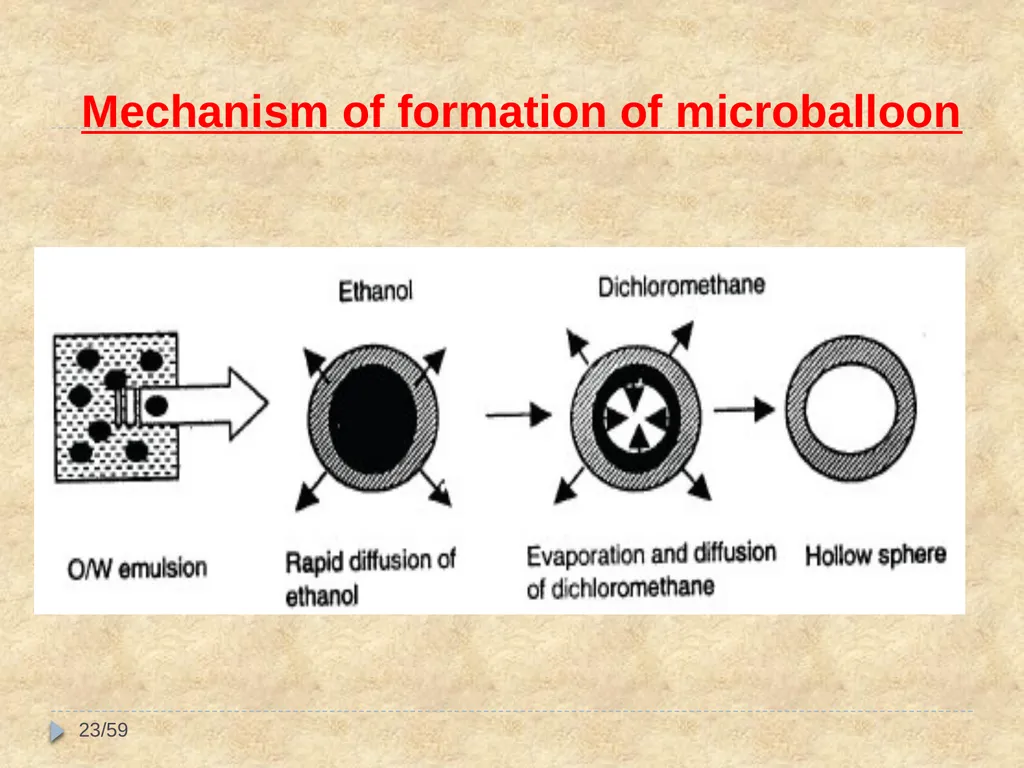
Mechanism of formation of microballoon 23/59<br>
24
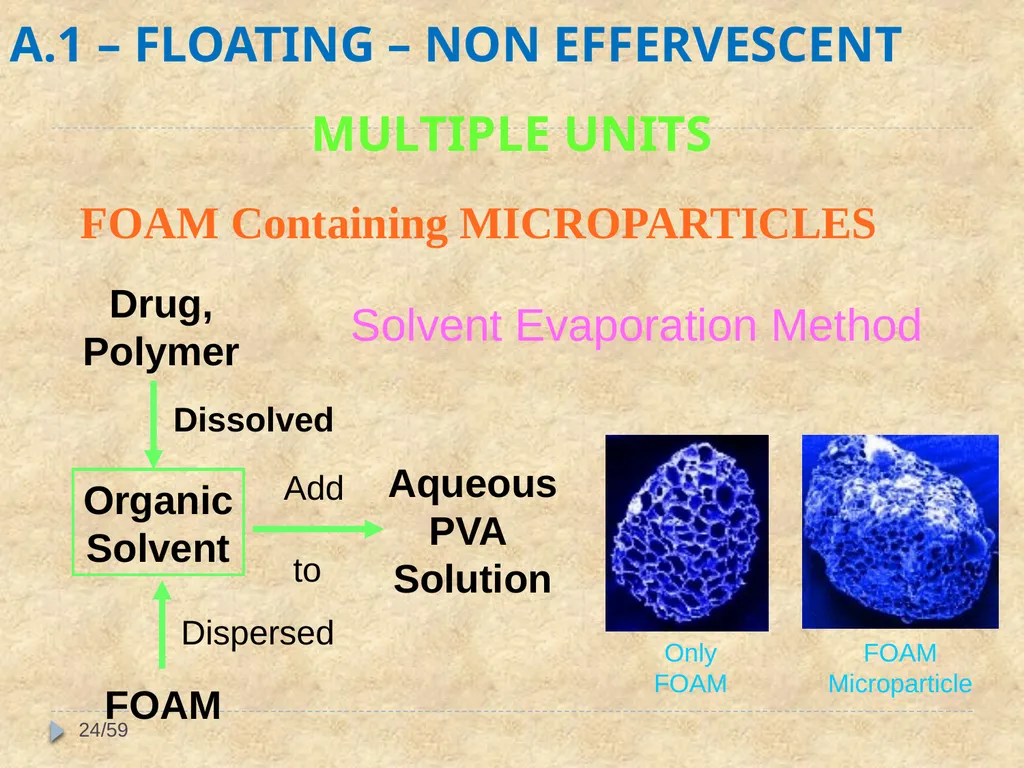
A.1 – FLOATING – NON EFFERVESCENT MULTIPLE UNITS FOAM Containing MICROPARTICLES Drug,
Polymer FOAM Organic
Solvent Dissolved Dispersed Add
to Aqueous
PVA
Solution Solvent Evaporation Method Only
FOAM FOAM
Microparticle 24/59<br>
Polymer FOAM Organic
Solvent Dissolved Dispersed Add
to Aqueous
PVA
Solution Solvent Evaporation Method Only
FOAM FOAM
Microparticle 24/59<br>
25
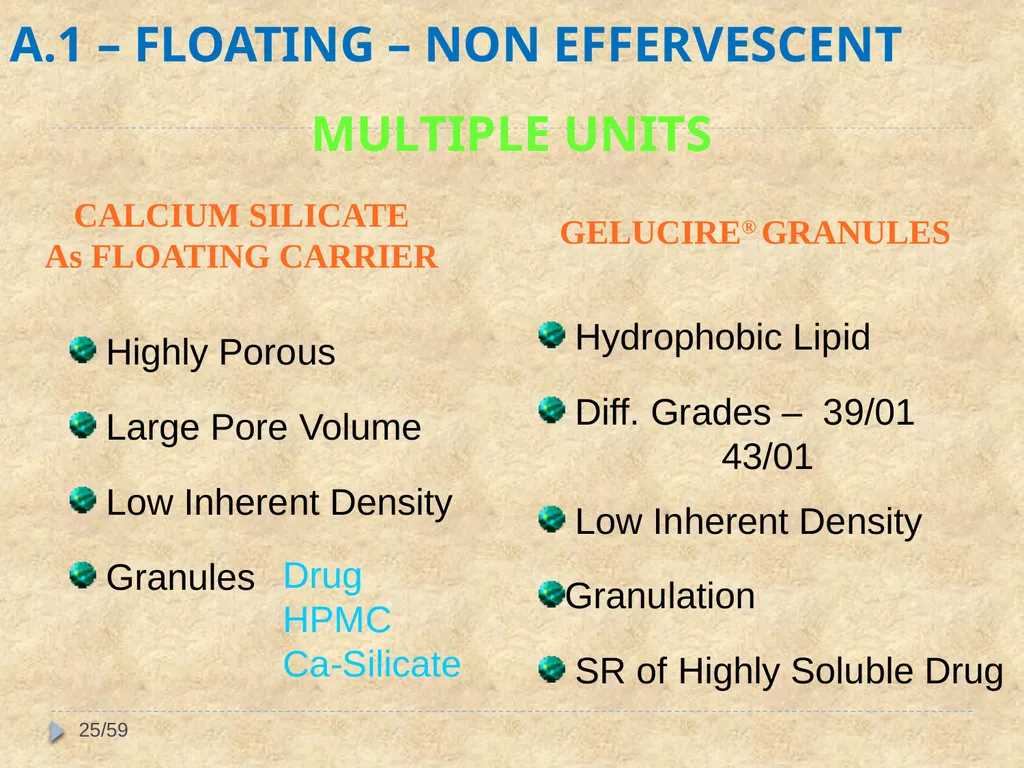
A.1 – FLOATING – NON EFFERVESCENT MULTIPLE UNITS CALCIUM SILICATE
As FLOATING CARRIER GELUCIRE® GRANULES Highly Porous
Large Pore Volume
Low Inherent Density
Granules Drug
HPMC
Ca-Silicate Hydrophobic Lipid
Diff. Grades – 39/01
43/01
Low Inherent Density
Granulation
SR of Highly Soluble Drug 25/59<br>
As FLOATING CARRIER GELUCIRE® GRANULES Highly Porous
Large Pore Volume
Low Inherent Density
Granules Drug
HPMC
Ca-Silicate Hydrophobic Lipid
Diff. Grades – 39/01
43/01
Low Inherent Density
Granulation
SR of Highly Soluble Drug 25/59<br>
26
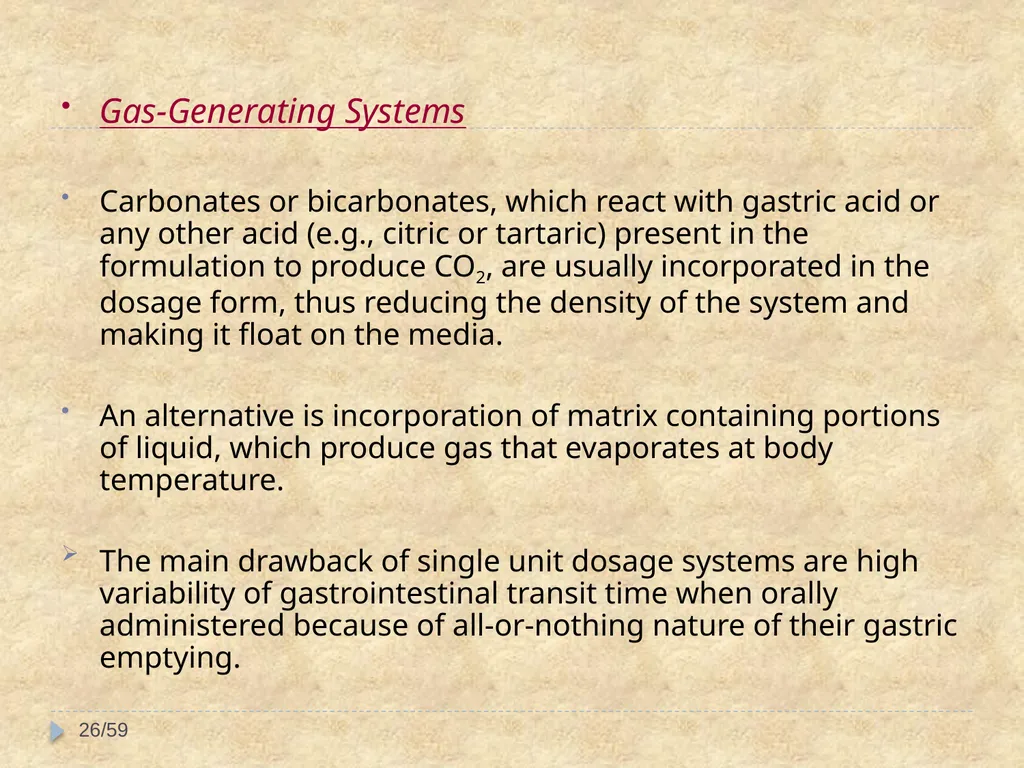
26/59 Gas-Generating Systems
Carbonates or bicarbonates, which react with gastric acid or any other acid (e.g., citric or tartaric) present in the formulation to produce CO2, are usually incorporated in the dosage form, thus reducing the density of the system and making it float on the media.
An alternative is incorporation of matrix containing portions of liquid, which produce gas that evaporates at body temperature.
The main drawback of single unit dosage systems are high variability of gastrointestinal transit time when orally administered because of all-or-nothing nature of their gastric emptying.<br>
Carbonates or bicarbonates, which react with gastric acid or any other acid (e.g., citric or tartaric) present in the formulation to produce CO2, are usually incorporated in the dosage form, thus reducing the density of the system and making it float on the media.
An alternative is incorporation of matrix containing portions of liquid, which produce gas that evaporates at body temperature.
The main drawback of single unit dosage systems are high variability of gastrointestinal transit time when orally administered because of all-or-nothing nature of their gastric emptying.<br>
27
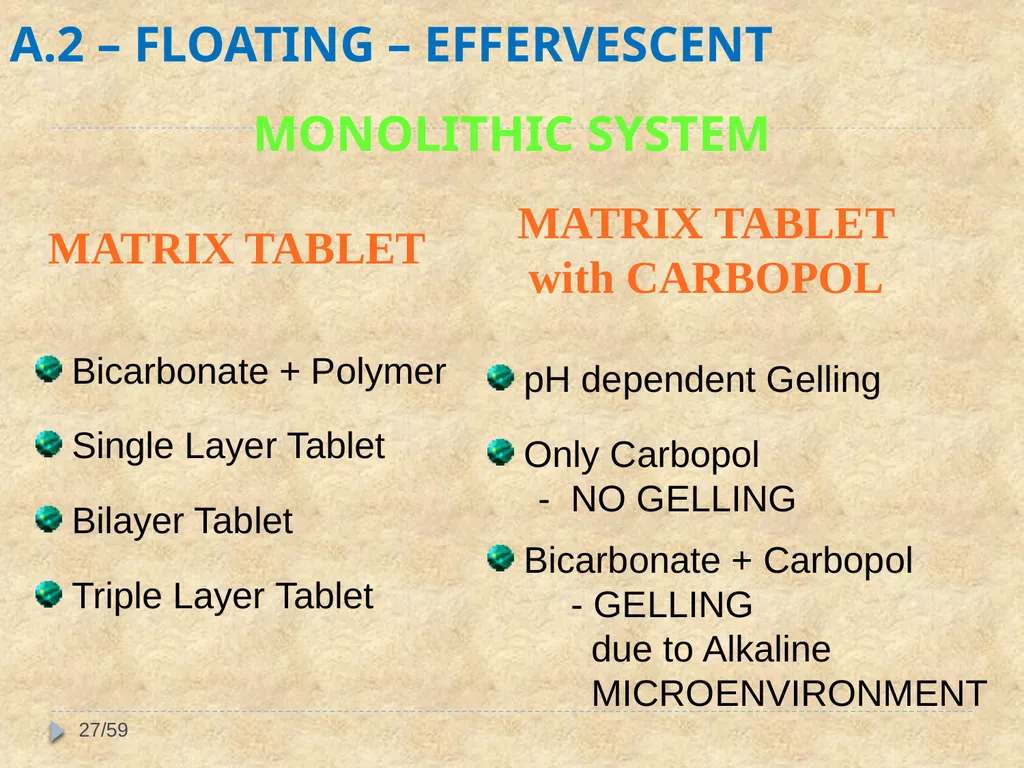
A.2 – FLOATING – EFFERVESCENT MONOLITHIC SYSTEM MATRIX TABLET MATRIX TABLET
with CARBOPOL Bicarbonate + Polymer
Single Layer Tablet
Bilayer Tablet
Triple Layer Tablet pH dependent Gelling
Only Carbopol
- NO GELLING
Bicarbonate + Carbopol
- GELLING
due to Alkaline
MICROENVIRONMENT 27/59<br>
with CARBOPOL Bicarbonate + Polymer
Single Layer Tablet
Bilayer Tablet
Triple Layer Tablet pH dependent Gelling
Only Carbopol
- NO GELLING
Bicarbonate + Carbopol
- GELLING
due to Alkaline
MICROENVIRONMENT 27/59<br>
28
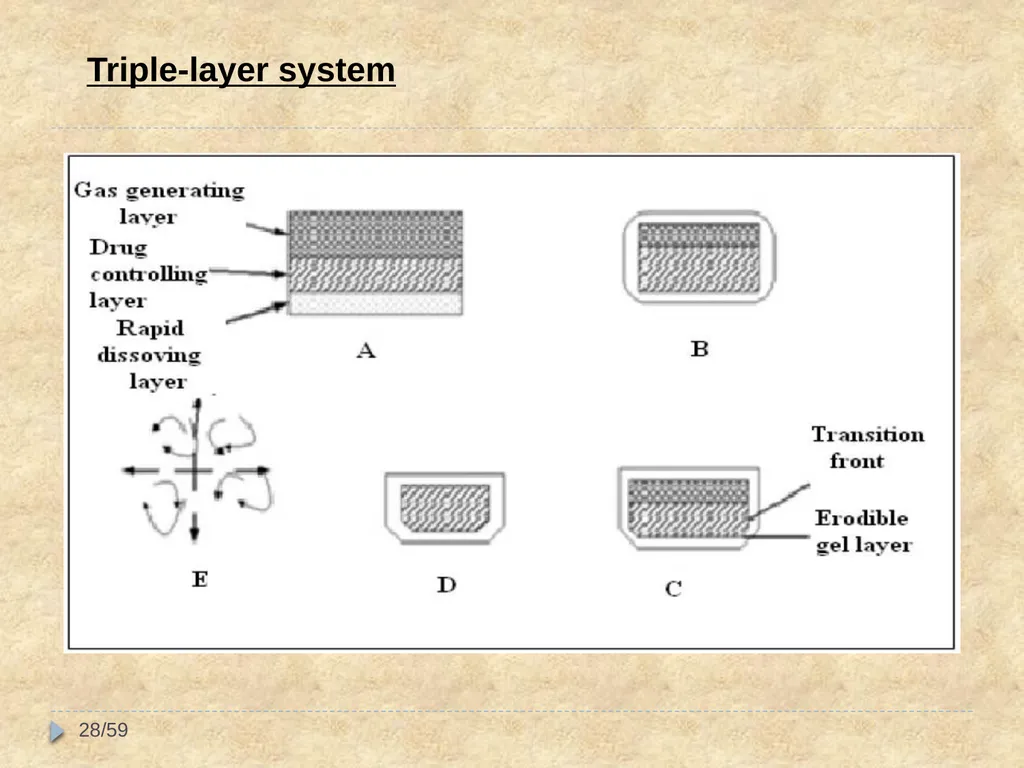
28/59 Triple-layer system<br>
29
29/59 Multiple-Unit Floating Systems
Hollow Microspheres
Hollow microspheres possess the unique advantages of multiple-unit systems and better floating properties as a result of the central hollow space inside the microsphere.
The general techniques involved in their preparation include simple solvent evaporation and solvent diffusion and evaporation.
The drug release and better floating properties mainly depend on the type of polymer, plasticizer, and solvent employed for the preparation.
Polymers such as polycarbonate, Eudragit S, and cellulose acetate were used in the preparation of hollow microspheres.<br>
Hollow Microspheres
Hollow microspheres possess the unique advantages of multiple-unit systems and better floating properties as a result of the central hollow space inside the microsphere.
The general techniques involved in their preparation include simple solvent evaporation and solvent diffusion and evaporation.
The drug release and better floating properties mainly depend on the type of polymer, plasticizer, and solvent employed for the preparation.
Polymers such as polycarbonate, Eudragit S, and cellulose acetate were used in the preparation of hollow microspheres.<br>
30
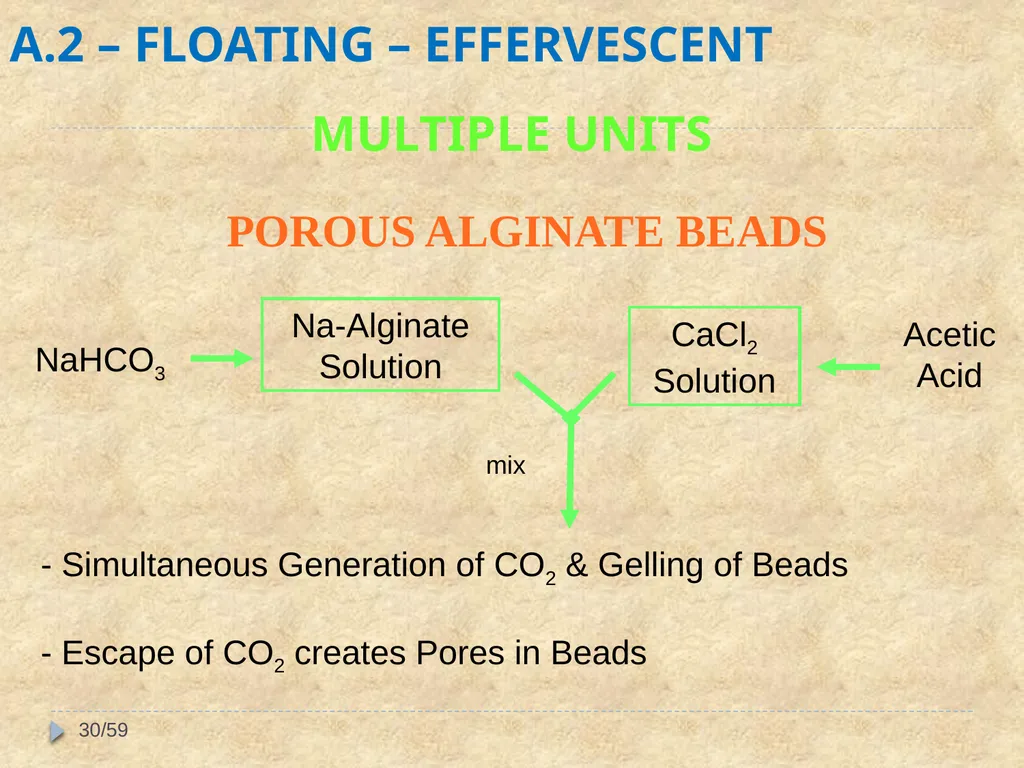
A.2 – FLOATING – EFFERVESCENT MULTIPLE UNITS POROUS ALGINATE BEADS Na-Alginate Solution mix CaCl2
Solution NaHCO3 Acetic
Acid - Simultaneous Generation of CO2 & Gelling of Beads
- Escape of CO2 creates Pores in Beads 30/59<br>
Solution NaHCO3 Acetic
Acid - Simultaneous Generation of CO2 & Gelling of Beads
- Escape of CO2 creates Pores in Beads 30/59<br>
31
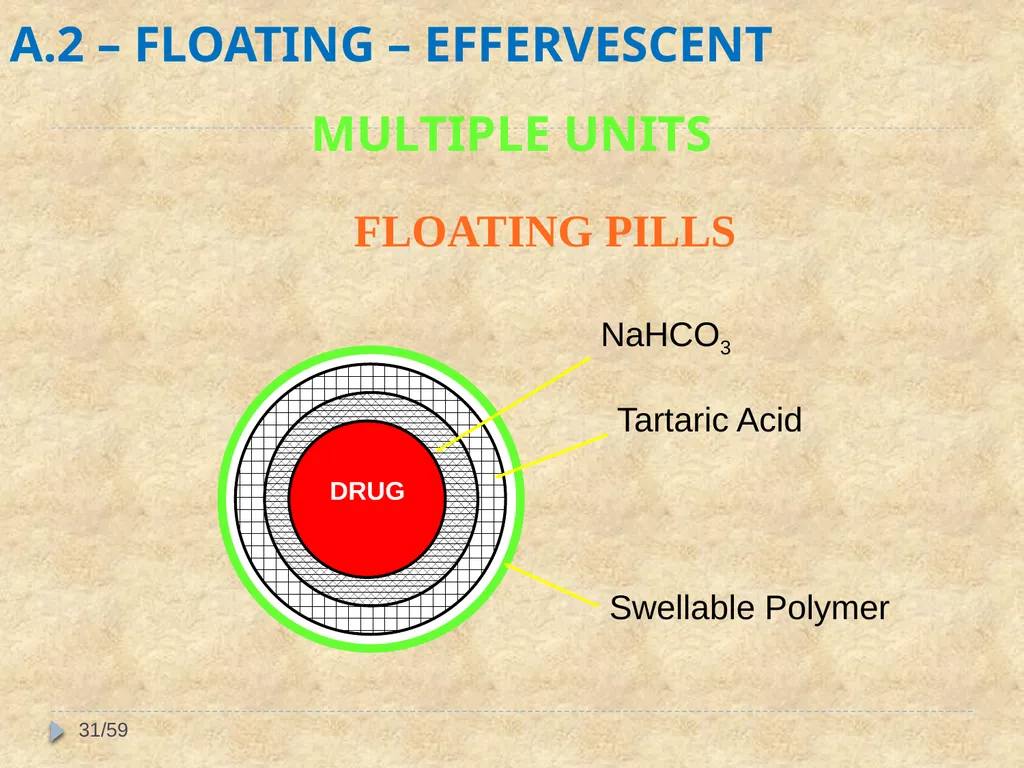
A.2 – FLOATING – EFFERVESCENT MULTIPLE UNITS FLOATING PILLS DRUG NaHCO3 Tartaric Acid Swellable Polymer 31/59<br>
32
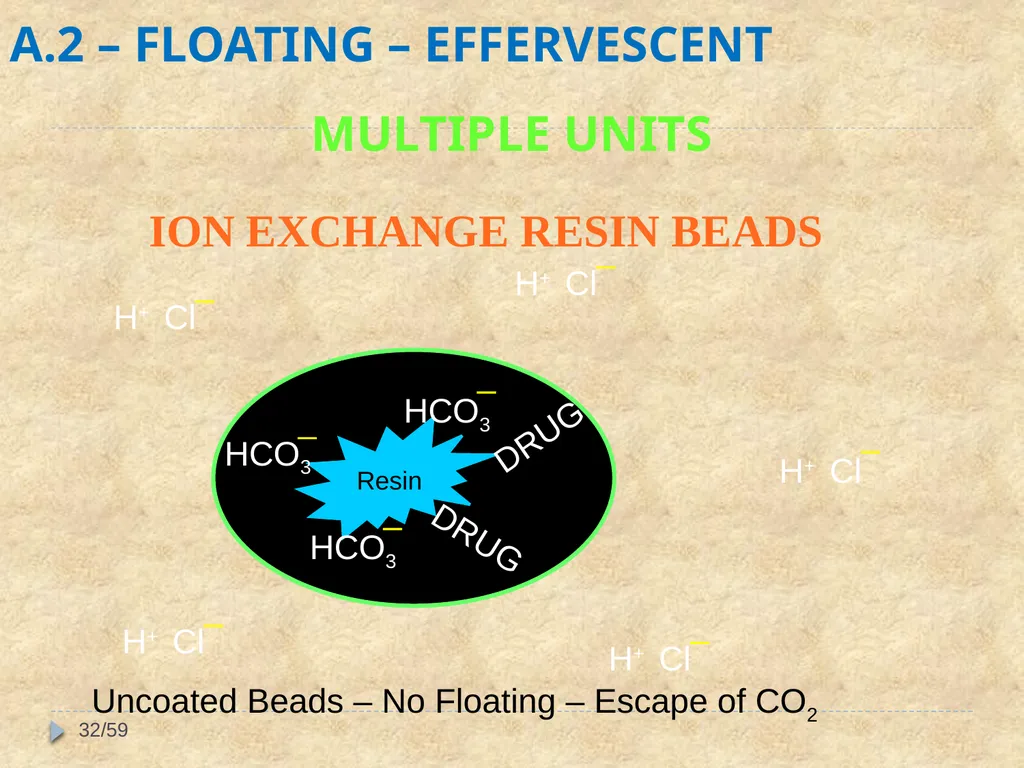
A.2 – FLOATING – EFFERVESCENT MULTIPLE UNITS ION EXCHANGE RESIN BEADS Resin HCO3 HCO3 HCO3 DRUG DRUG H+ Cl H+ Cl H+ Cl H+ Cl H+ Cl Uncoated Beads – No Floating – Escape of CO2 32/59<br>
33
This system consists of mainly two different part attached with each other, one is floating part and other is osmotic controlled part
Floating part made up of deformable polymeric bag containing liquid that gasify at body temperature.Osmotic pressure controlling part consists of two part, drug reservoir & osmotically active compartment. 33/59 Osmotically controlled DDS<br>
Floating part made up of deformable polymeric bag containing liquid that gasify at body temperature.Osmotic pressure controlling part consists of two part, drug reservoir & osmotically active compartment. 33/59 Osmotically controlled DDS<br>
34
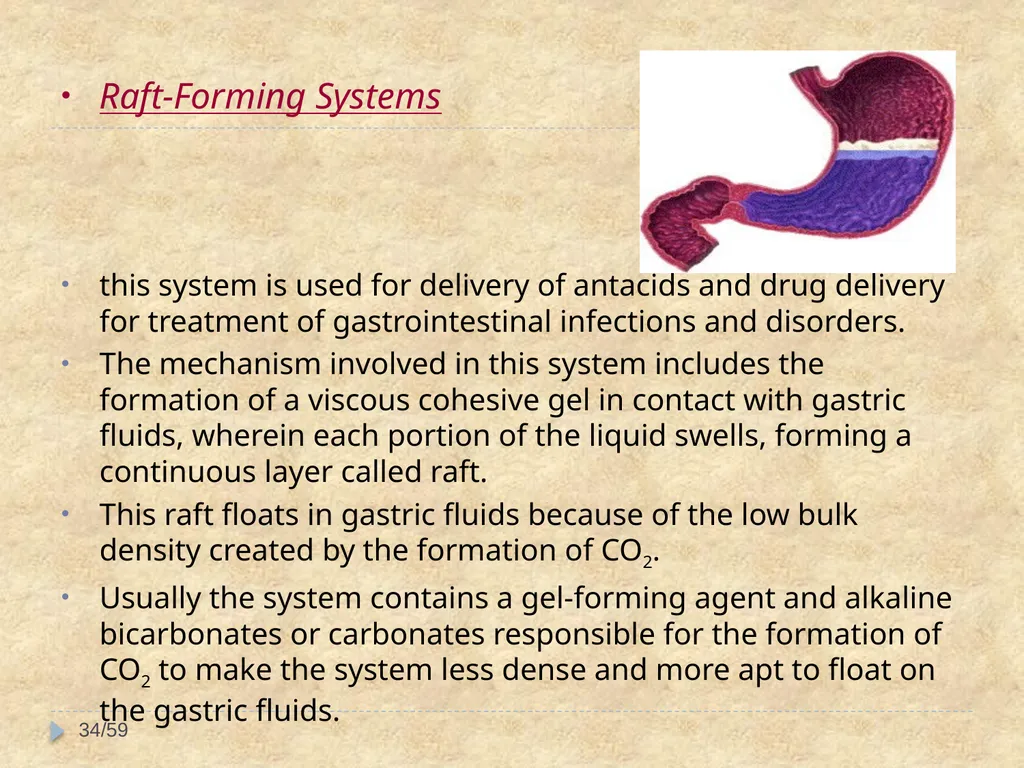
34/59 Raft-Forming Systems
this system is used for delivery of antacids and drug delivery for treatment of gastrointestinal infections and disorders.
The mechanism involved in this system includes the formation of a viscous cohesive gel in contact with gastric fluids, wherein each portion of the liquid swells, forming a continuous layer called raft.
This raft floats in gastric fluids because of the low bulk density created by the formation of CO2.
Usually the system contains a gel-forming agent and alkaline bicarbonates or carbonates responsible for the formation of CO2 to make the system less dense and more apt to float on the gastric fluids.<br>
this system is used for delivery of antacids and drug delivery for treatment of gastrointestinal infections and disorders.
The mechanism involved in this system includes the formation of a viscous cohesive gel in contact with gastric fluids, wherein each portion of the liquid swells, forming a continuous layer called raft.
This raft floats in gastric fluids because of the low bulk density created by the formation of CO2.
Usually the system contains a gel-forming agent and alkaline bicarbonates or carbonates responsible for the formation of CO2 to make the system less dense and more apt to float on the gastric fluids.<br>
35
35/59 Expandable systems
These systems include Unfoldable and Swellable systems.
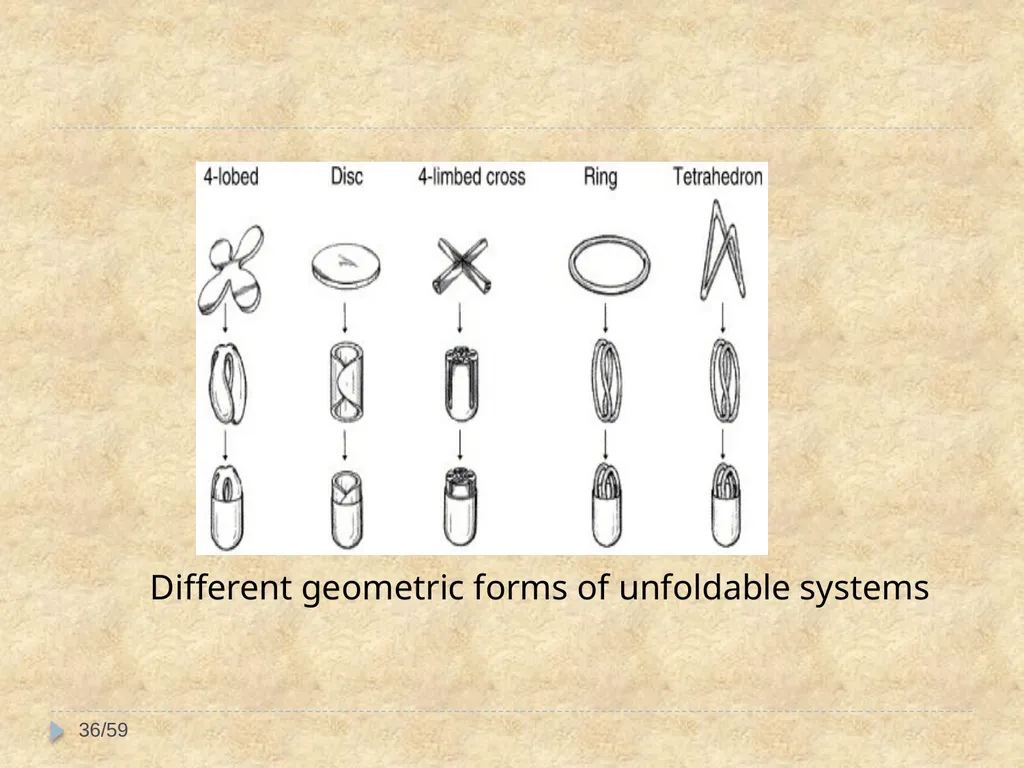
Unfoldable systems are made of biodegradable polymers. The concept is to make a carrier, such as a capsule, incorporating a compressed system which extends in the stomach.
Swellable systems are retained because of their mechanical properties. The swelling is usually results from osmotic absorption of water.
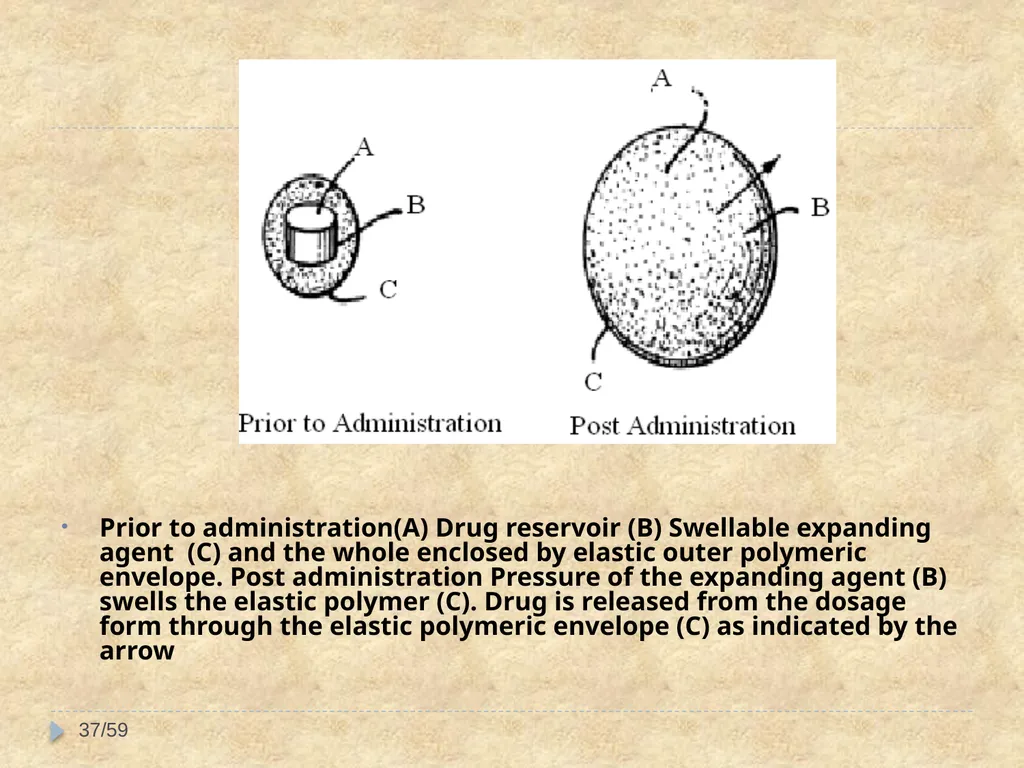
The dosage form is small enough to be swallowed, and swells in gastric liquids. The bulk enables gastric retention and maintain the stomach in fed state, suppressing housekeeper waves.
The whole system is coated by an elastic outer polymeric membrane which was permeable to both drug and body fluids and could control the drug release.
The device gradually decreases in volume and rigidity as a result depletion of drug and expanding agent and/or bioreosion of polymer layer, enabling its elimination.<br>
These systems include Unfoldable and Swellable systems.
Unfoldable systems are made of biodegradable polymers. The concept is to make a carrier, such as a capsule, incorporating a compressed system which extends in the stomach.
Swellable systems are retained because of their mechanical properties. The swelling is usually results from osmotic absorption of water.
The dosage form is small enough to be swallowed, and swells in gastric liquids. The bulk enables gastric retention and maintain the stomach in fed state, suppressing housekeeper waves.
The whole system is coated by an elastic outer polymeric membrane which was permeable to both drug and body fluids and could control the drug release.
The device gradually decreases in volume and rigidity as a result depletion of drug and expanding agent and/or bioreosion of polymer layer, enabling its elimination.<br>
36
36/59 Different geometric forms of unfoldable systems<br>
37
37/59 Prior to administration(A) Drug reservoir (B) Swellable expanding agent (C) and the whole enclosed by elastic outer polymeric envelope. Post administration Pressure of the expanding agent (B) swells the elastic polymer (C). Drug is released from the dosage form through the elastic polymeric envelope (C) as indicated by the arrow<br>
38
38/59 Superporous hydrogels
Swellable agents with pore size ranging between 10nm and 10µm, absorption of water by conventional hydrogel is very slow process and several hours may be needed to reach as equilibrium state during which premature evacuation of the dosage form may occur.
Superporous hydrogels swell to equilibrium size with in a minute, due to rapid water uptake by capillary wetting through numerous interconnected open pores.
They swell to large size and are intended to have sufficient mechanical strength to withstand pressure by the gastric contraction.
This is achieved by co-formulation of a hydrophilic particulate material, Ac-Di-Sol.<br>
Swellable agents with pore size ranging between 10nm and 10µm, absorption of water by conventional hydrogel is very slow process and several hours may be needed to reach as equilibrium state during which premature evacuation of the dosage form may occur.
Superporous hydrogels swell to equilibrium size with in a minute, due to rapid water uptake by capillary wetting through numerous interconnected open pores.
They swell to large size and are intended to have sufficient mechanical strength to withstand pressure by the gastric contraction.
This is achieved by co-formulation of a hydrophilic particulate material, Ac-Di-Sol.<br>
39
39/59 Mucoadhesive or bioadhedive system
The technique involves coating of microcapsules with bioadhesive polymer, which enables them to adhere to intestinal mucosa and remain for longer time period in the GI while the active drug is released from the device matrix.
The cationic chitosan polymers are pharmaceutically acceptable to be used in the preparation of bioadhesive formulations owing to their known ability to bind well to gastric mucosa.<br>
The technique involves coating of microcapsules with bioadhesive polymer, which enables them to adhere to intestinal mucosa and remain for longer time period in the GI while the active drug is released from the device matrix.
The cationic chitosan polymers are pharmaceutically acceptable to be used in the preparation of bioadhesive formulations owing to their known ability to bind well to gastric mucosa.<br>
40
40/59 Magnetic systems
This system is based on a simple idea: the dosage form contains a small internal magnet, and a magnet placed on the abdomen over the position of the stomach.
Although these systems seem to work, the external magnet must be positioned with a degree of precision that might compromise patient compliance.<br>
This system is based on a simple idea: the dosage form contains a small internal magnet, and a magnet placed on the abdomen over the position of the stomach.
Although these systems seem to work, the external magnet must be positioned with a degree of precision that might compromise patient compliance.<br>
41
EVALUATION OF GRDDS 41/59 For Single Unit Dosage Forms (ex: tablets)
(i)Floating lag time: It is the time taken by the tablet to emerge onto the surface of dissolution medium and is expressed in seconds or minutes.
(ii) Invitro drug release and duration of floating: This is determined by using USP II apparatus (paddle) stirring at a speed of 50 or 100 rpm at 37 ± 0.2 °c in simulated gastric fluid (pH 1.2 without pepsin). Aliquots of the samples are collected and analysed for the drug content. The time (hrs) for which the tablets remain buoyant on the surface of the dissolution medium is the duration of floating and is visually observed.
(iii) In vivo evaluation for gastro-retention: This is carried out by means of X-ray or Gamma scintigraphic monitoring of the dosage form transition in the GIT. The tablets are also evaluated for hardness, weight variation, etc.<br>
(i)Floating lag time: It is the time taken by the tablet to emerge onto the surface of dissolution medium and is expressed in seconds or minutes.
(ii) Invitro drug release and duration of floating: This is determined by using USP II apparatus (paddle) stirring at a speed of 50 or 100 rpm at 37 ± 0.2 °c in simulated gastric fluid (pH 1.2 without pepsin). Aliquots of the samples are collected and analysed for the drug content. The time (hrs) for which the tablets remain buoyant on the surface of the dissolution medium is the duration of floating and is visually observed.
(iii) In vivo evaluation for gastro-retention: This is carried out by means of X-ray or Gamma scintigraphic monitoring of the dosage form transition in the GIT. The tablets are also evaluated for hardness, weight variation, etc.<br>
42
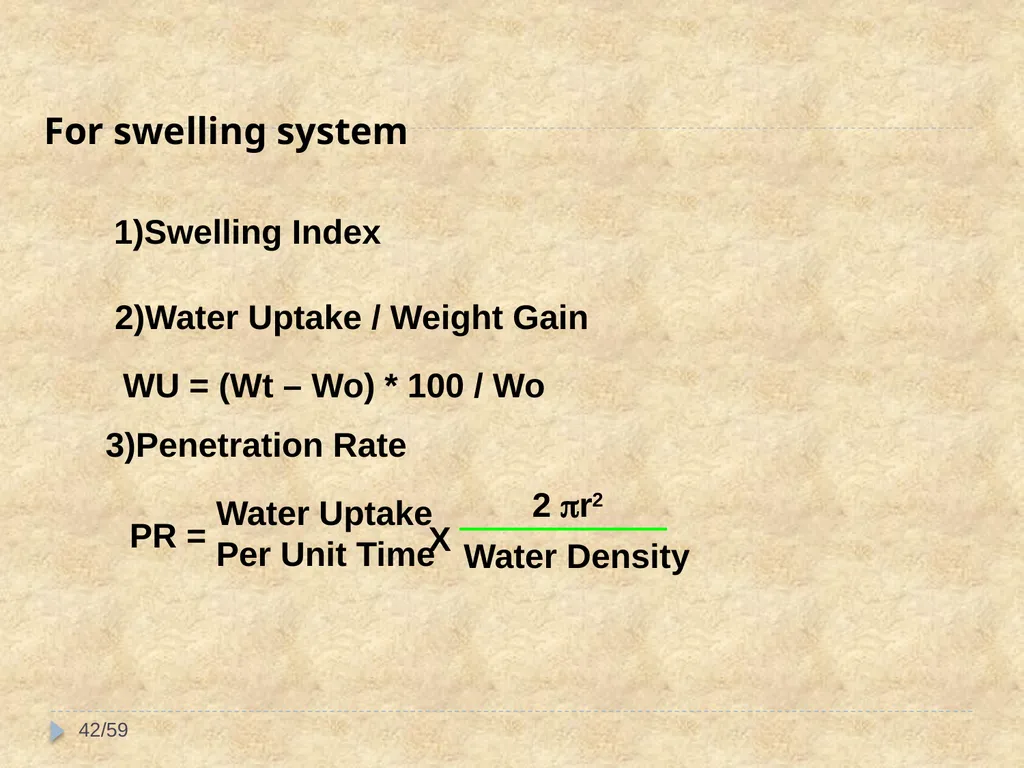
42/59 For swelling system 1)Swelling Index 2)Water Uptake / Weight Gain 3)Penetration Rate WU = (Wt – Wo) * 100 / Wo PR = Water Uptake
Per Unit Time X 2 r2 Water Density<br>
Per Unit Time X 2 r2 Water Density<br>
43
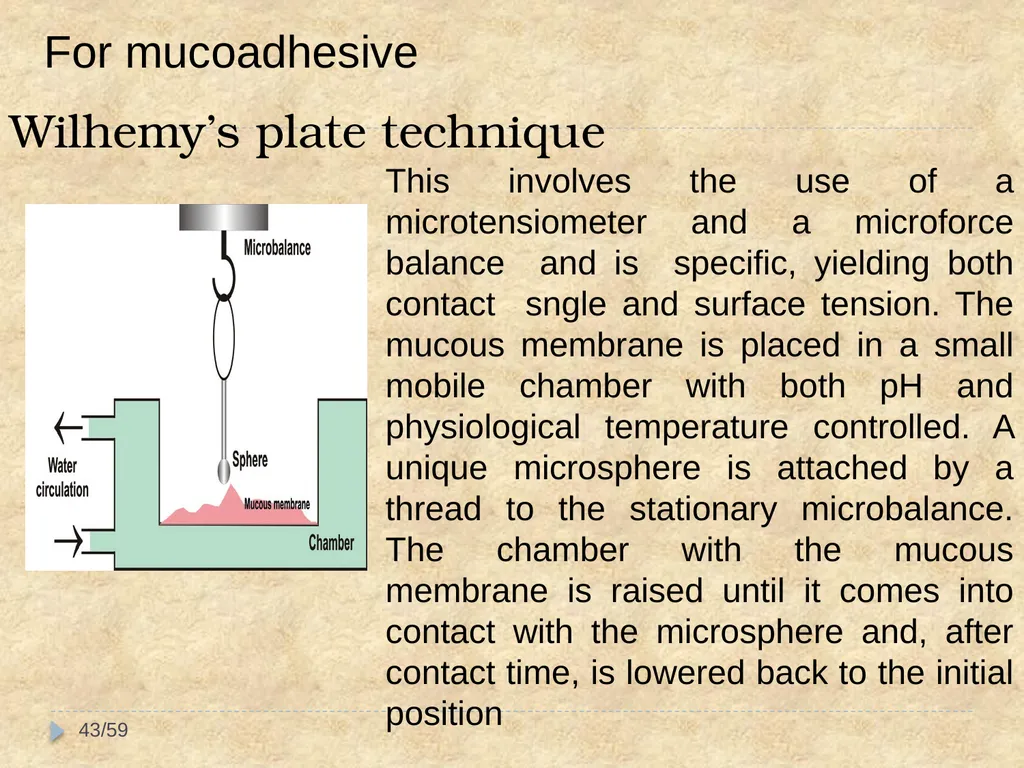
Wilhemy’s plate technique 43/59 For mucoadhesive This involves the use of a microtensiometer and a microforce balance and is specific, yielding both contact sngle and surface tension. The mucous membrane is placed in a small mobile chamber with both pH and physiological temperature controlled. A unique microsphere is attached by a thread to the stationary microbalance. The chamber with the mucous membrane is raised until it comes into contact with the microsphere and, after contact time, is lowered back to the initial position<br>
44
B. For Multiple Unit Dosage Forms (ex: microspheres) 44/59 Apart from the In vitro release, duration of floating and in
vivo gastro-retention tests, the multiple unit dosage forms
are also evaluated for –
(i) Morphological and dimensional analysis with the
aid of scanning electron microscopy (SEM). The
size can also be measured using an optical
microscope.
(ii) % yield of microspheres: This is calculated from
weight of microspheres obtained ×100
total weight of drug and polymer<br>
vivo gastro-retention tests, the multiple unit dosage forms
are also evaluated for –
(i) Morphological and dimensional analysis with the
aid of scanning electron microscopy (SEM). The
size can also be measured using an optical
microscope.
(ii) % yield of microspheres: This is calculated from
weight of microspheres obtained ×100
total weight of drug and polymer<br>
45
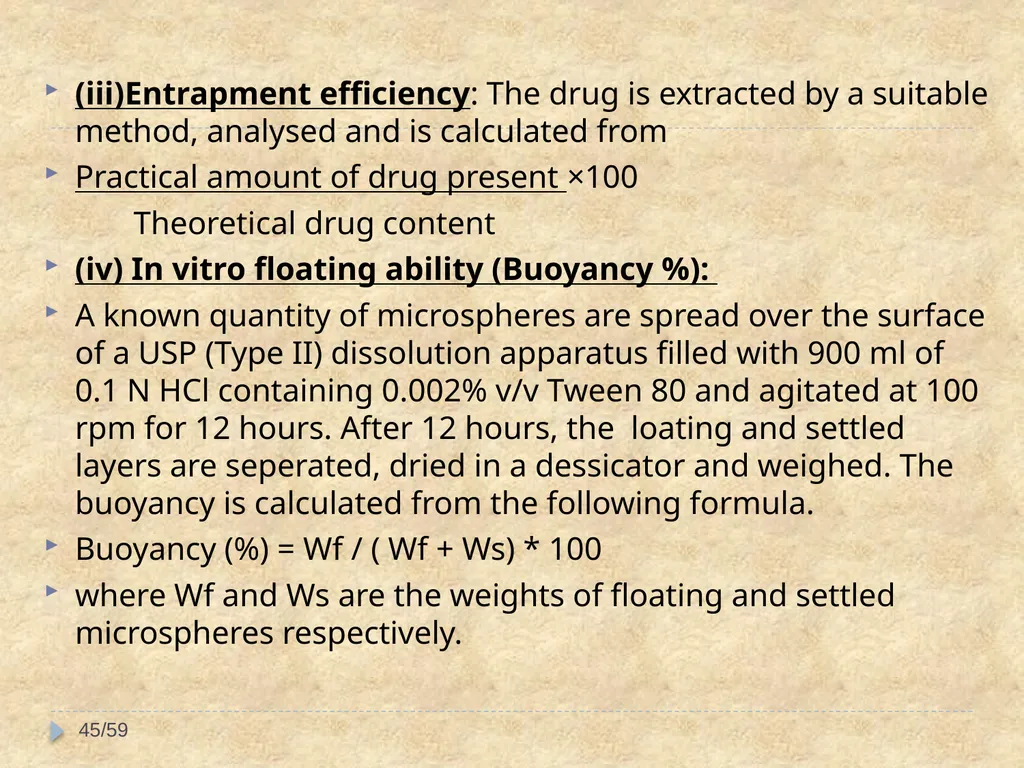
45/59 (iii)Entrapment efficiency: The drug is extracted by a suitable method, analysed and is calculated from
Practical amount of drug present ×100
Theoretical drug content
(iv) In vitro floating ability (Buoyancy %):
A known quantity of microspheres are spread over the surface of a USP (Type II) dissolution apparatus filled with 900 ml of 0.1 N HCl containing 0.002% v/v Tween 80 and agitated at 100 rpm for 12 hours. After 12 hours, the loating and settled layers are seperated, dried in a dessicator and weighed. The buoyancy is calculated from the following formula.
Buoyancy (%) = Wf / ( Wf + Ws) * 100
where Wf and Ws are the weights of floating and settled microspheres respectively.<br>
Practical amount of drug present ×100
Theoretical drug content
(iv) In vitro floating ability (Buoyancy %):
A known quantity of microspheres are spread over the surface of a USP (Type II) dissolution apparatus filled with 900 ml of 0.1 N HCl containing 0.002% v/v Tween 80 and agitated at 100 rpm for 12 hours. After 12 hours, the loating and settled layers are seperated, dried in a dessicator and weighed. The buoyancy is calculated from the following formula.
Buoyancy (%) = Wf / ( Wf + Ws) * 100
where Wf and Ws are the weights of floating and settled microspheres respectively.<br>
46
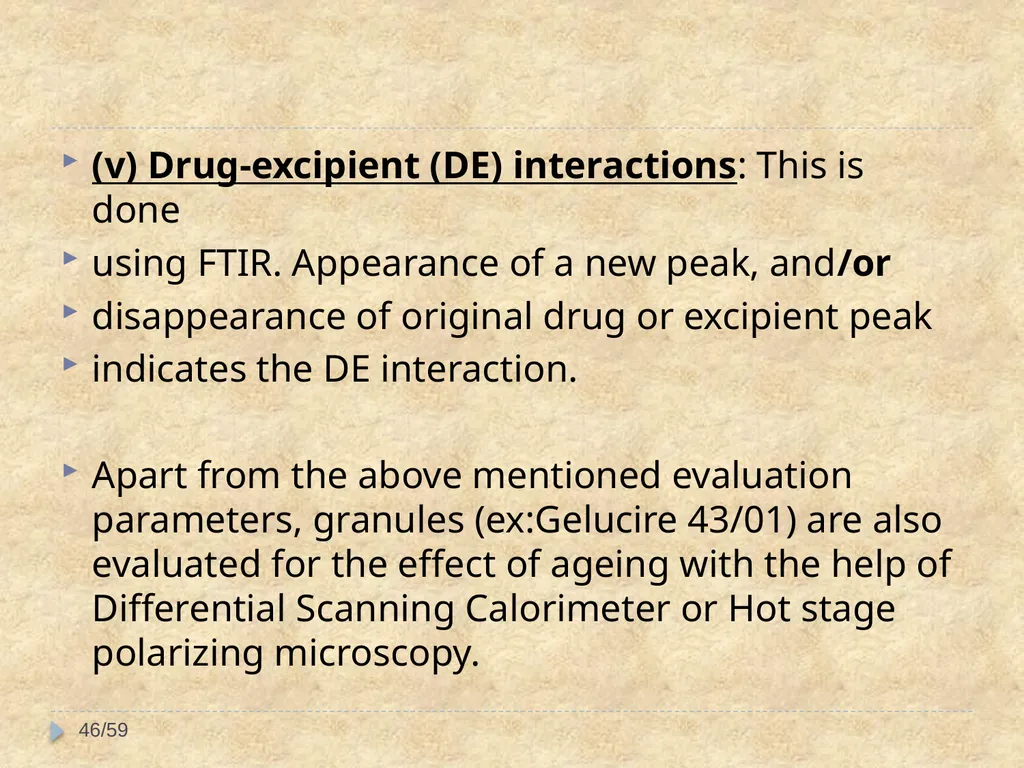
46/59 (v) Drug-excipient (DE) interactions: This is done
using FTIR. Appearance of a new peak, and/or
disappearance of original drug or excipient peak
indicates the DE interaction.
Apart from the above mentioned evaluation parameters, granules (ex:Gelucire 43/01) are also evaluated for the effect of ageing with the help of Differential Scanning Calorimeter or Hot stage polarizing microscopy.<br>
using FTIR. Appearance of a new peak, and/or
disappearance of original drug or excipient peak
indicates the DE interaction.
Apart from the above mentioned evaluation parameters, granules (ex:Gelucire 43/01) are also evaluated for the effect of ageing with the help of Differential Scanning Calorimeter or Hot stage polarizing microscopy.<br>
47
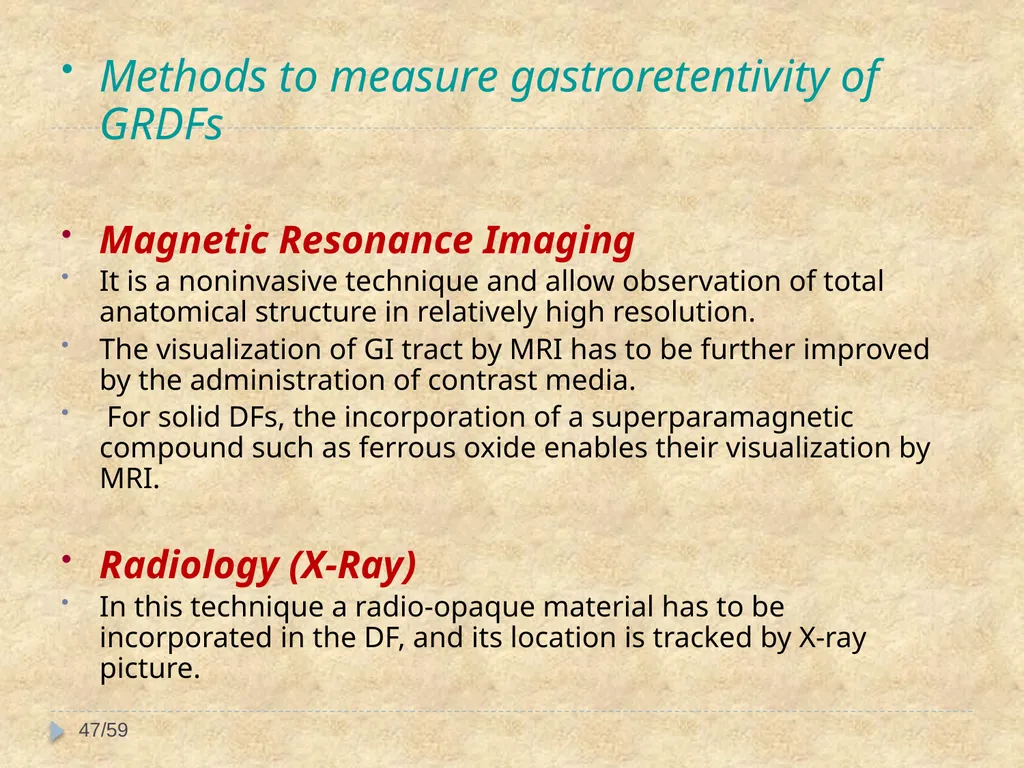
47/59 Methods to measure gastroretentivity of GRDFs
Magnetic Resonance Imaging
It is a noninvasive technique and allow observation of total anatomical structure in relatively high resolution.
The visualization of GI tract by MRI has to be further improved by the administration of contrast media.
For solid DFs, the incorporation of a superparamagnetic compound such as ferrous oxide enables their visualization by MRI.
Radiology (X-Ray)
In this technique a radio-opaque material has to be incorporated in the DF, and its location is tracked by X-ray picture.<br>
Magnetic Resonance Imaging
It is a noninvasive technique and allow observation of total anatomical structure in relatively high resolution.
The visualization of GI tract by MRI has to be further improved by the administration of contrast media.
For solid DFs, the incorporation of a superparamagnetic compound such as ferrous oxide enables their visualization by MRI.
Radiology (X-Ray)
In this technique a radio-opaque material has to be incorporated in the DF, and its location is tracked by X-ray picture.<br>
48
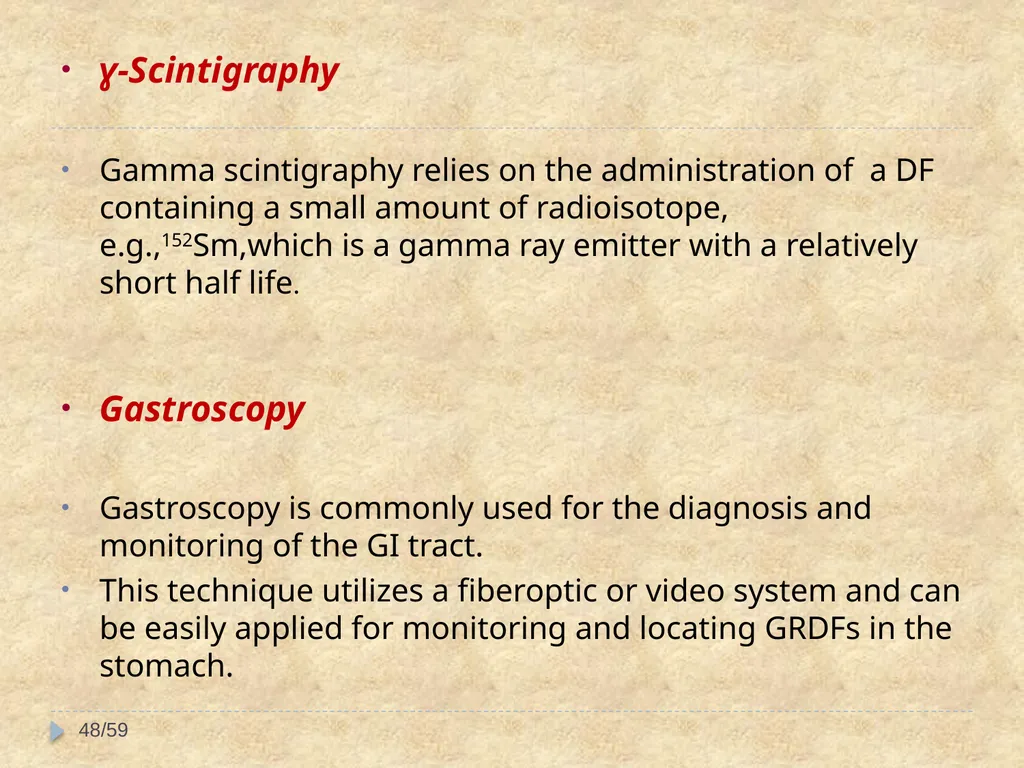
48/59 ɣ-Scintigraphy
Gamma scintigraphy relies on the administration of a DF containing a small amount of radioisotope, e.g.,152Sm,which is a gamma ray emitter with a relatively short half life.
Gastroscopy
Gastroscopy is commonly used for the diagnosis and monitoring of the GI tract.
This technique utilizes a fiberoptic or video system and can be easily applied for monitoring and locating GRDFs in the stomach.<br>
Gamma scintigraphy relies on the administration of a DF containing a small amount of radioisotope, e.g.,152Sm,which is a gamma ray emitter with a relatively short half life.
Gastroscopy
Gastroscopy is commonly used for the diagnosis and monitoring of the GI tract.
This technique utilizes a fiberoptic or video system and can be easily applied for monitoring and locating GRDFs in the stomach.<br>
49
Ultrasonography 49/59 In this technique, ultrasonic waves are reflected at substantially different acoustic impedances across an interface, enabling the imaging . By transmission of ultrasonic waves, the acoustic mismatch is traced out across the interface between dosage form and physiological surface. However, this method is not popular due to lack of ultrasound traceability at the intestine. Another drawback of this method is some of the dosage forms may not exhibit a sharp acoustic mismatch.<br>
50
13 C octanoic acid breath test 50/59 Octanoic acid is a medium chain fatty acid absorbed by the upper part of the small intestine, rapidly transported to the liver and immediately oxidised by mitochondria to form CO 2, which is exhaled out in the breath. In this method, 13 C octanoic acid is incorporated into the GRDDS.The carbon atom of octanoic acid which essentially forms CO 2 is replaced with the 13 C isotope. After ingestion of the dosage form, the time duration after which 13 CO 2 gas is observed in the breath indicates the transfer of the dosage form from the stomach to the upper part of the small intestine, which may be considered as the gastric retention time of the dosage form<br>
51
51/59 Limitations
Floating system
They require a sufficiently high level of fluids in the stomach for the drug delivery buoyancy, to float therein and to work efficiently.
Drugs which are well absorbed along the entire GI tract and which undergoes significant first- pass metabolism, may not be desirable candidates for GRDDS since the slow gastric emptying may lead to reduced systemic bioavailability.
.<br>
Floating system
They require a sufficiently high level of fluids in the stomach for the drug delivery buoyancy, to float therein and to work efficiently.
Drugs which are well absorbed along the entire GI tract and which undergoes significant first- pass metabolism, may not be desirable candidates for GRDDS since the slow gastric emptying may lead to reduced systemic bioavailability.
.<br>
52
52/59 Drugs
Unstable in Stomach / Acidic pH
Very Low Soluble / insoluble
Causes irritation
Adhesive
High Turn Over Rate of MUCUS LAYER
Thick Mucus Layer
Presence of Soluble Mucin
Swelling
Exit before Swells – Slow Swelling Rate
Capable to Resist House Keeper Waves<br>
Unstable in Stomach / Acidic pH
Very Low Soluble / insoluble
Causes irritation
Adhesive
High Turn Over Rate of MUCUS LAYER
Thick Mucus Layer
Presence of Soluble Mucin
Swelling
Exit before Swells – Slow Swelling Rate
Capable to Resist House Keeper Waves<br>
53
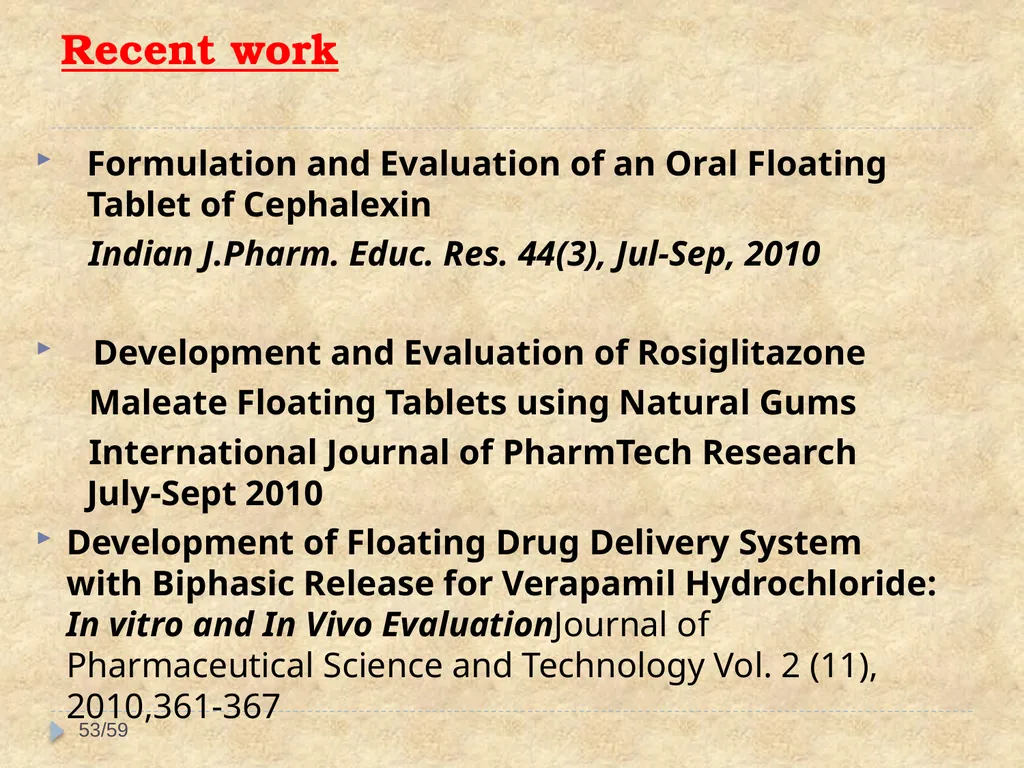
Recent work 53/59 Formulation and Evaluation of an Oral Floating Tablet of Cephalexin
Indian J.Pharm. Educ. Res. 44(3), Jul-Sep, 2010
Development and Evaluation of Rosiglitazone
Maleate Floating Tablets using Natural Gums
International Journal of PharmTech Research July-Sept 2010
Development of Floating Drug Delivery System with Biphasic Release for Verapamil Hydrochloride: In vitro and In Vivo EvaluationJournal of Pharmaceutical Science and Technology Vol. 2 (11), 2010,361-367<br>
Indian J.Pharm. Educ. Res. 44(3), Jul-Sep, 2010
Development and Evaluation of Rosiglitazone
Maleate Floating Tablets using Natural Gums
International Journal of PharmTech Research July-Sept 2010
Development of Floating Drug Delivery System with Biphasic Release for Verapamil Hydrochloride: In vitro and In Vivo EvaluationJournal of Pharmaceutical Science and Technology Vol. 2 (11), 2010,361-367<br>
54
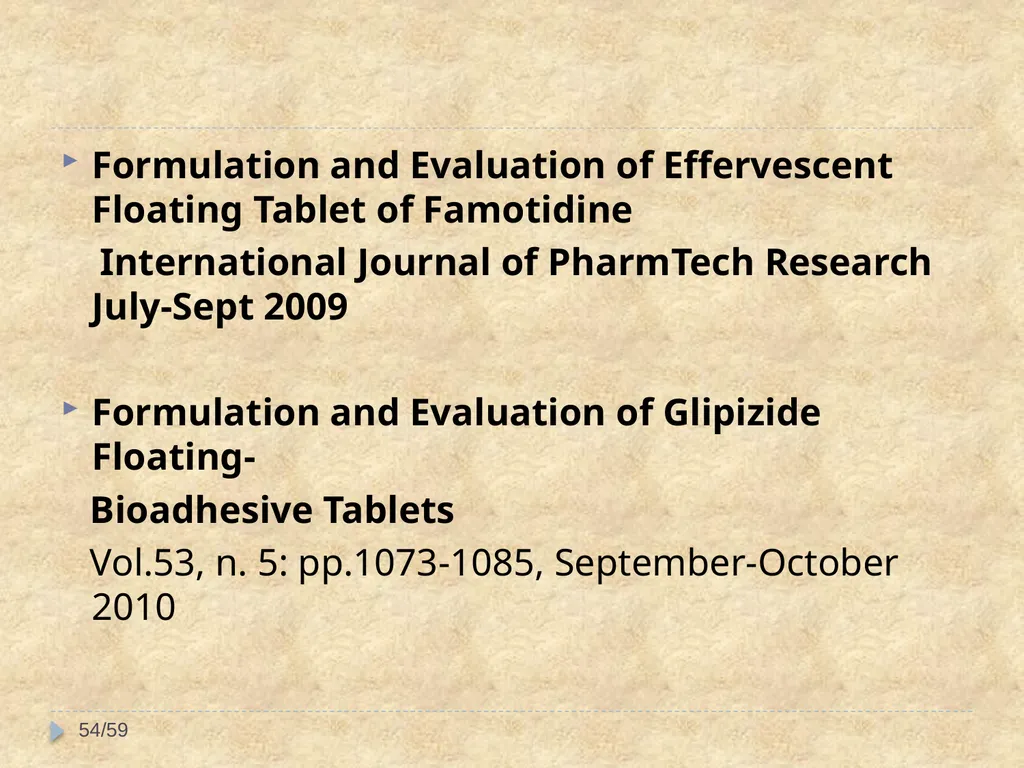
54/59 Formulation and Evaluation of Effervescent Floating Tablet of Famotidine
International Journal of PharmTech Research July-Sept 2009
Formulation and Evaluation of Glipizide Floating-
Bioadhesive Tablets
Vol.53, n. 5: pp.1073-1085, September-October 2010<br>
International Journal of PharmTech Research July-Sept 2009
Formulation and Evaluation of Glipizide Floating-
Bioadhesive Tablets
Vol.53, n. 5: pp.1073-1085, September-October 2010<br>
55
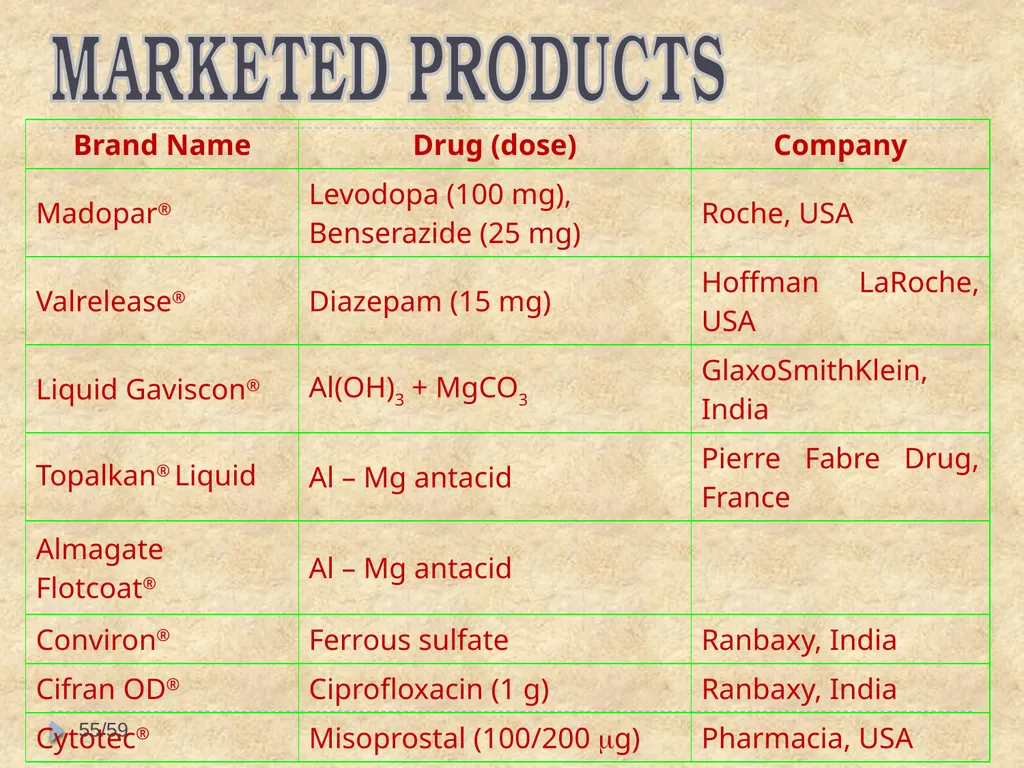
MARKETED PRODUCTS 55/59<br>
56
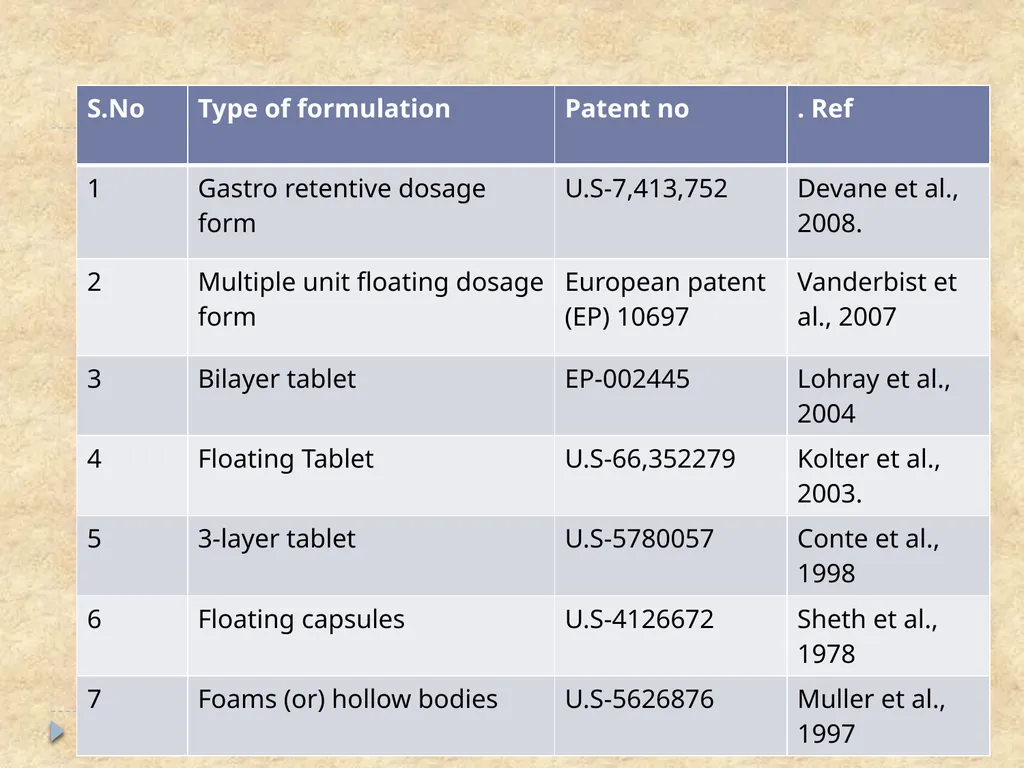
56/59<br>
57
REFERENCES 57/59 Bardonnet PL, Faivre V, Pugh WJ, Piffaretti JC, Falson F. Gatroretentive dosage forms: Overview and special case of Helicobacter pylori. J Control Release. 2006;111:1-18.
Ecyclopedia of Pharmaceutical Technology.
Hari Vardhan Reddy L and Murthy RSR. Floating Dosage Systems in Drug Delivery. Critical Revises in Therapeutic Drug Carrier Systems. 2002;19(6):553-585.
Julan UD. Floating Drug Delivery Dystem: An Approach to Gastroretension. Latest Reviews. 2007;5(1).
Shweta A, Javed A, Alka A, Roop K, and Sanjula B. Floating drug delivery systems: a review. AAPS PharmSciTech. 2005;6 (3) Article 47.<br>
Ecyclopedia of Pharmaceutical Technology.
Hari Vardhan Reddy L and Murthy RSR. Floating Dosage Systems in Drug Delivery. Critical Revises in Therapeutic Drug Carrier Systems. 2002;19(6):553-585.
Julan UD. Floating Drug Delivery Dystem: An Approach to Gastroretension. Latest Reviews. 2007;5(1).
Shweta A, Javed A, Alka A, Roop K, and Sanjula B. Floating drug delivery systems: a review. AAPS PharmSciTech. 2005;6 (3) Article 47.<br>
58
58/59 Rouge N, Buri P, Doelker E. Drug absorption sites in the gastrointestinal tract and dosage forms for site specific delivery. Int J Pharm. 1996; 136:117-139.
Wilson C.G, Washington N., Physiological Pharmaceutics: Biological Barriers to Drug Absorption, Horwood Ellis, Chichester, 1989; 47-70.
Groning R, Heun G. Oral dosage forms with controlled gastrointestinal transit. Drug Dev Ind Pharm. 1984; 10: 527-539.
Deshpande A.A., Shah N.H., Rhodes C.T., Malick W., Development of a novel controlled release system for gastric retention, Pharm. Res. 1997; 14: 815-819.<br>
Wilson C.G, Washington N., Physiological Pharmaceutics: Biological Barriers to Drug Absorption, Horwood Ellis, Chichester, 1989; 47-70.
Groning R, Heun G. Oral dosage forms with controlled gastrointestinal transit. Drug Dev Ind Pharm. 1984; 10: 527-539.
Deshpande A.A., Shah N.H., Rhodes C.T., Malick W., Development of a novel controlled release system for gastric retention, Pharm. Res. 1997; 14: 815-819.<br>
59
59/59 THANK YOU<br>