
GCDOCS # 32893862 PRESENTER SECTOR DATE TBS OCIO
JO
Published · 31 slides · 0 views

1 / 1
Description
GCDOCS 32893862 PRESENTER SECTOR DATE TBS OCIO September 2019 Updated: Sep 3019 2 Purpose of Todays Session Highlight the integrated nature of the Digital Project journey Explain the Concept Case process Explain when and why to come
Related Topics
Share
Embed code
Download this presentation From Below
"GCDOCS # 32893862 PRESENTER SECTOR DATE TBS OCIO" is the property of its rightful owner. Permission is granted to download and print the materials on this website for personal, non-commercial use only, and to display it on your personal computer provided you do not modify the materials and that you retain all copyright notices contained in the materials. By downloading content from our website, you accept the terms of this agreement.
Presentation Transcript
01
GCDOCS # 32893862 PRESENTER SECTOR DATE TBS OCIO September 2019 Updated: Sep 30/19<br>
02
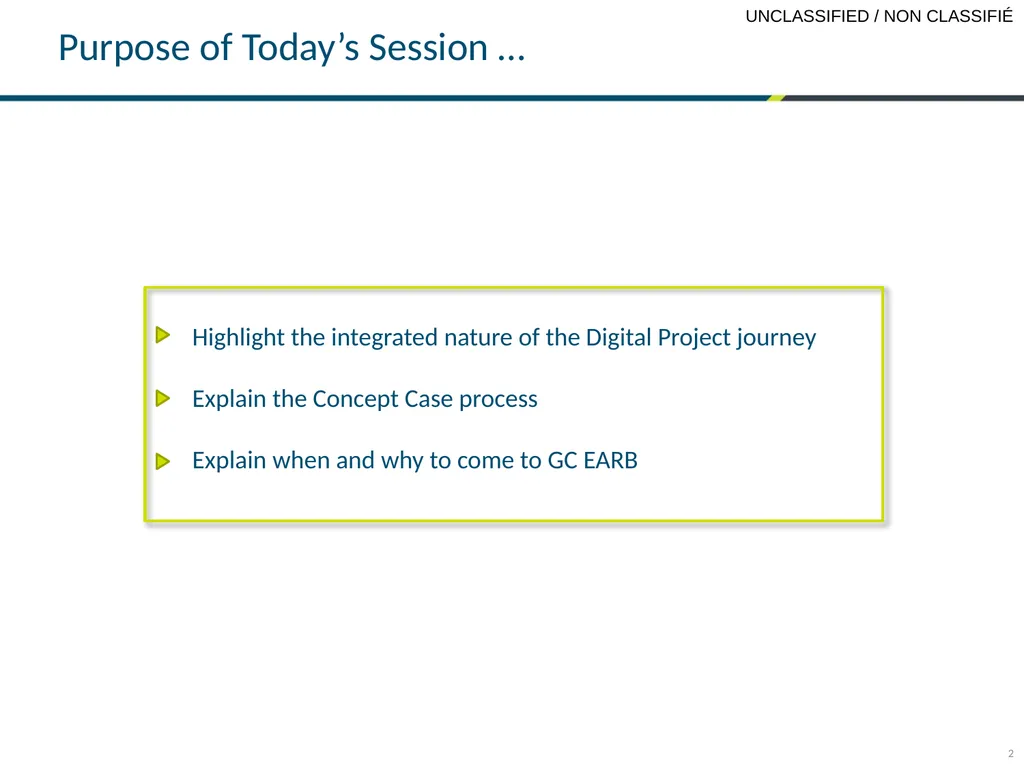
2 Purpose of Today’s Session … Highlight the integrated nature of the Digital Project journey
Explain the Concept Case process
Explain when and why to come to GC EARB<br>
Explain the Concept Case process
Explain when and why to come to GC EARB<br>
03
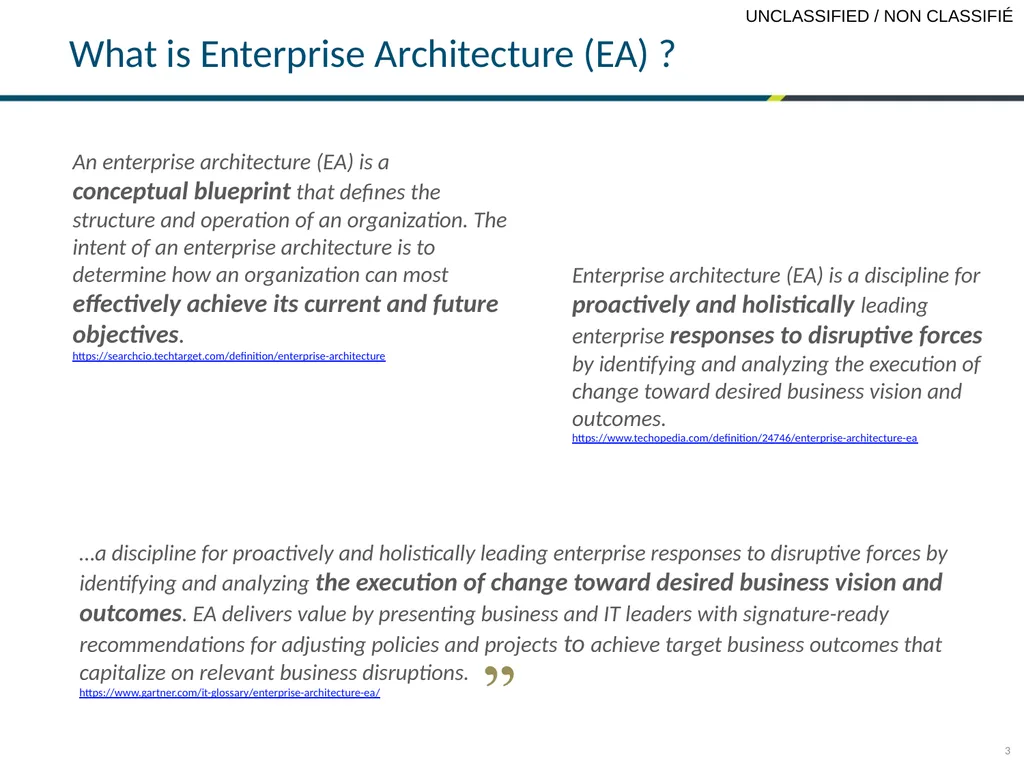
What is Enterprise Architecture (EA) ? 3 An enterprise architecture (EA) is a conceptual blueprint that defines the structure and operation of an organization. The intent of an enterprise architecture is to determine how an organization can most effectively achieve its current and future objectives.
https://searchcio.techtarget.com/definition/enterprise-architecture …a discipline for proactively and holistically leading enterprise responses to disruptive forces by identifying and analyzing the execution of change toward desired business vision and outcomes. EA delivers value by presenting business and IT leaders with signature-ready recommendations for adjusting policies and projects to achieve target business outcomes that capitalize on relevant business disruptions.
https://www.gartner.com/it-glossary/enterprise-architecture-ea/ Enterprise architecture (EA) is a discipline for proactively and holistically leading enterprise responses to disruptive forces by identifying and analyzing the execution of change toward desired business vision and outcomes.
https://www.techopedia.com/definition/24746/enterprise-architecture-ea<br>
https://searchcio.techtarget.com/definition/enterprise-architecture …a discipline for proactively and holistically leading enterprise responses to disruptive forces by identifying and analyzing the execution of change toward desired business vision and outcomes. EA delivers value by presenting business and IT leaders with signature-ready recommendations for adjusting policies and projects to achieve target business outcomes that capitalize on relevant business disruptions.
https://www.gartner.com/it-glossary/enterprise-architecture-ea/ Enterprise architecture (EA) is a discipline for proactively and holistically leading enterprise responses to disruptive forces by identifying and analyzing the execution of change toward desired business vision and outcomes.
https://www.techopedia.com/definition/24746/enterprise-architecture-ea<br>
04
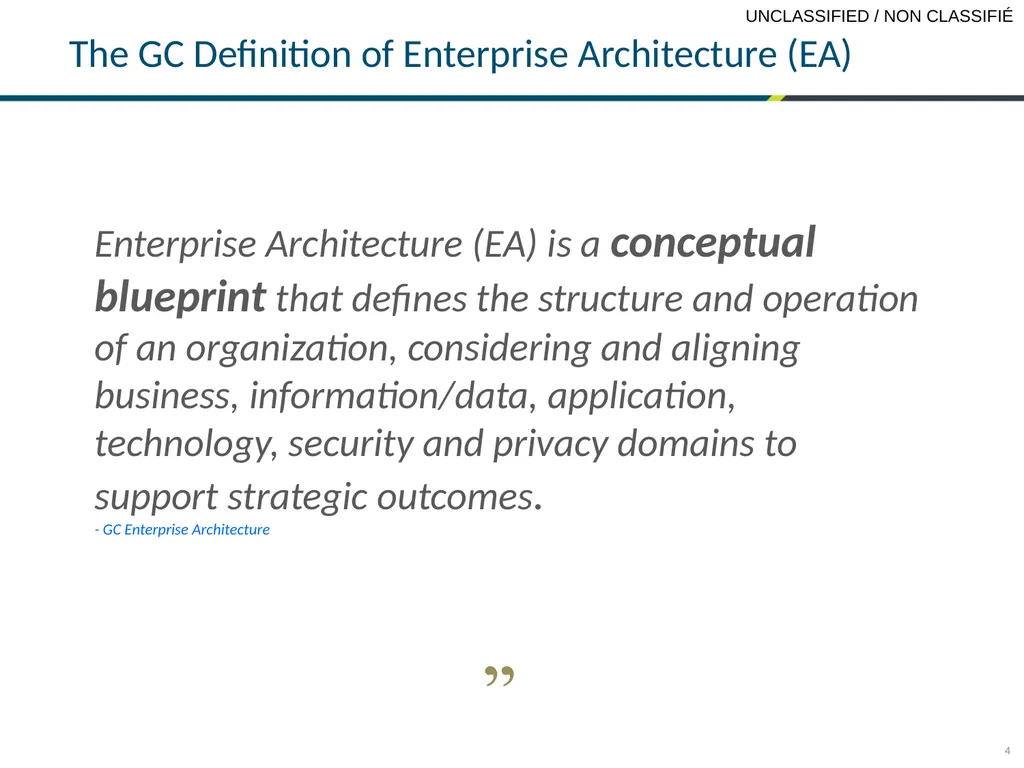
The GC Definition of Enterprise Architecture (EA) 4 Enterprise Architecture (EA) is a conceptual blueprint that defines the structure and operation of an organization, considering and aligning business, information/data, application, technology, security and privacy domains to support strategic outcomes.
- GC Enterprise Architecture<br>
- GC Enterprise Architecture<br>
05
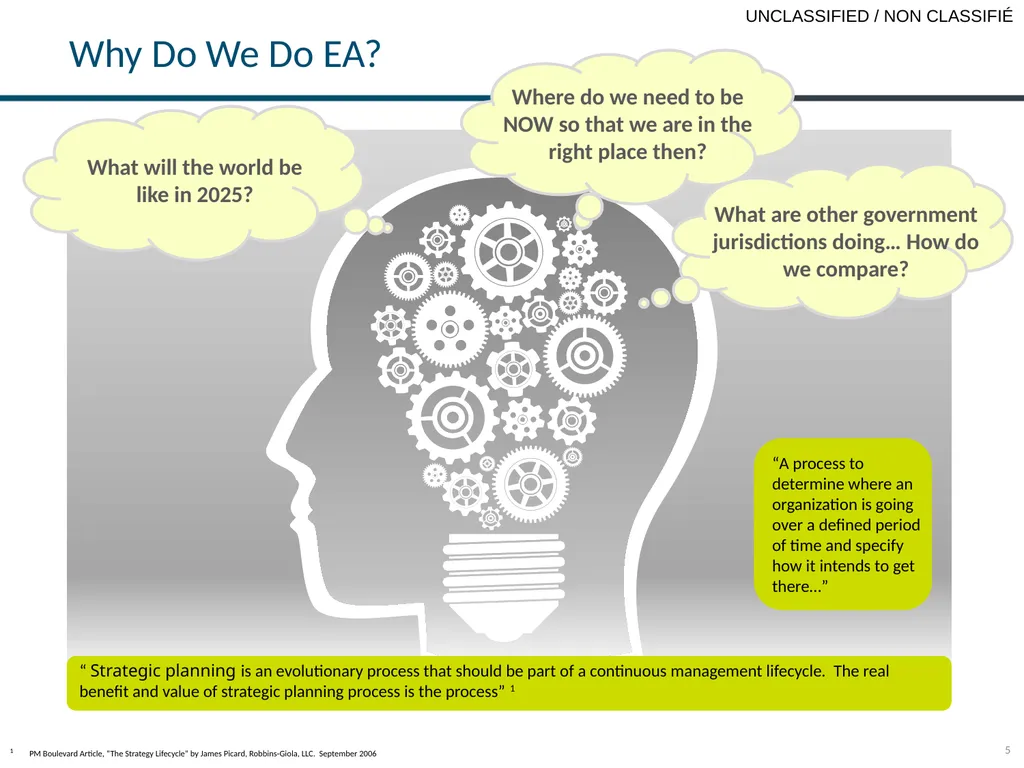
5 What will the world be like in 2025? Where do we need to be NOW so that we are in the right place then? Why Do We Do EA? What are other government jurisdictions doing… How do we compare? “A process to determine where an organization is going over a defined period of time and specify how it intends to get there…” “ Strategic planning is an evolutionary process that should be part of a continuous management lifecycle. The real benefit and value of strategic planning process is the process” 1 1 PM Boulevard Article, “The Strategy Lifecycle” by James Picard, Robbins-Giola, LLC. September 2006<br>
06
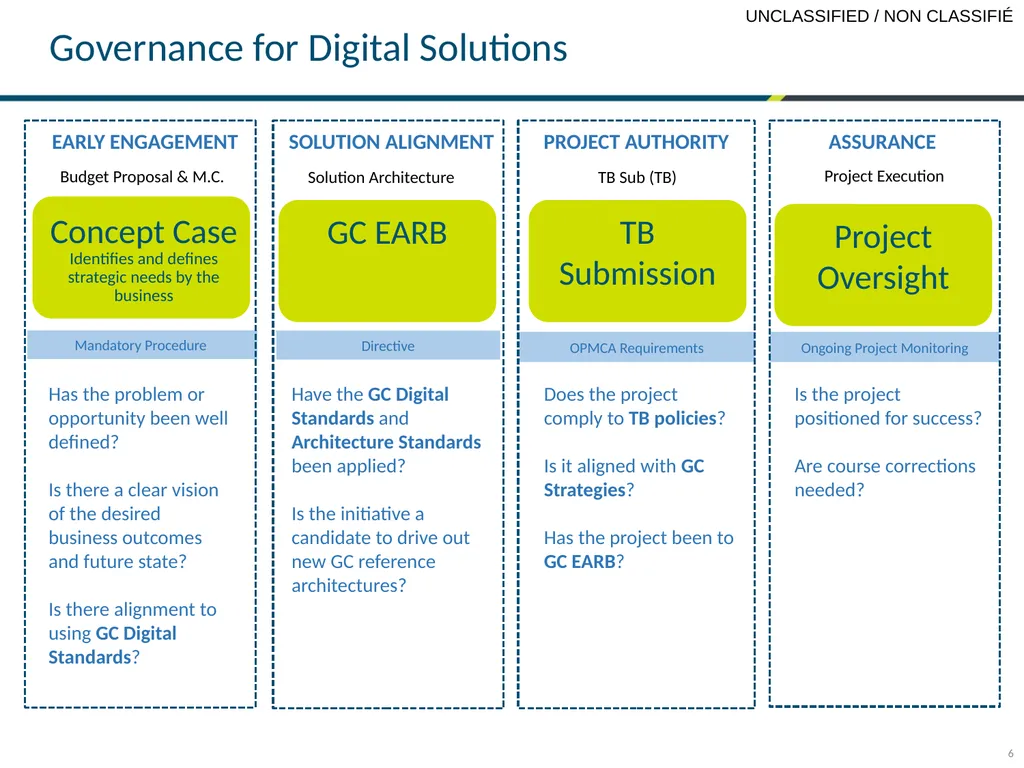
Governance for Digital Solutions 6 Directive Mandatory Procedure Ongoing Project Monitoring ASSURANCE EARLY ENGAGEMENT SOLUTION ALIGNMENT Has the problem or opportunity been well defined?
Is there a clear vision of the desired business outcomes and future state?
Is there alignment to using GC Digital Standards? Have the GC Digital Standards and Architecture Standards been applied?
Is the initiative a candidate to drive out new GC reference architectures? Is the project positioned for success?
Are course corrections needed? OPMCA Requirements PROJECT AUTHORITY Does the project comply to TB policies?
Is it aligned with GC Strategies?
Has the project been to GC EARB? Budget Proposal & M.C. Solution Architecture TB Sub (TB) Project Execution GC EARB TB Submission Project Oversight<br>
Is there a clear vision of the desired business outcomes and future state?
Is there alignment to using GC Digital Standards? Have the GC Digital Standards and Architecture Standards been applied?
Is the initiative a candidate to drive out new GC reference architectures? Is the project positioned for success?
Are course corrections needed? OPMCA Requirements PROJECT AUTHORITY Does the project comply to TB policies?
Is it aligned with GC Strategies?
Has the project been to GC EARB? Budget Proposal & M.C. Solution Architecture TB Sub (TB) Project Execution GC EARB TB Submission Project Oversight<br>
07
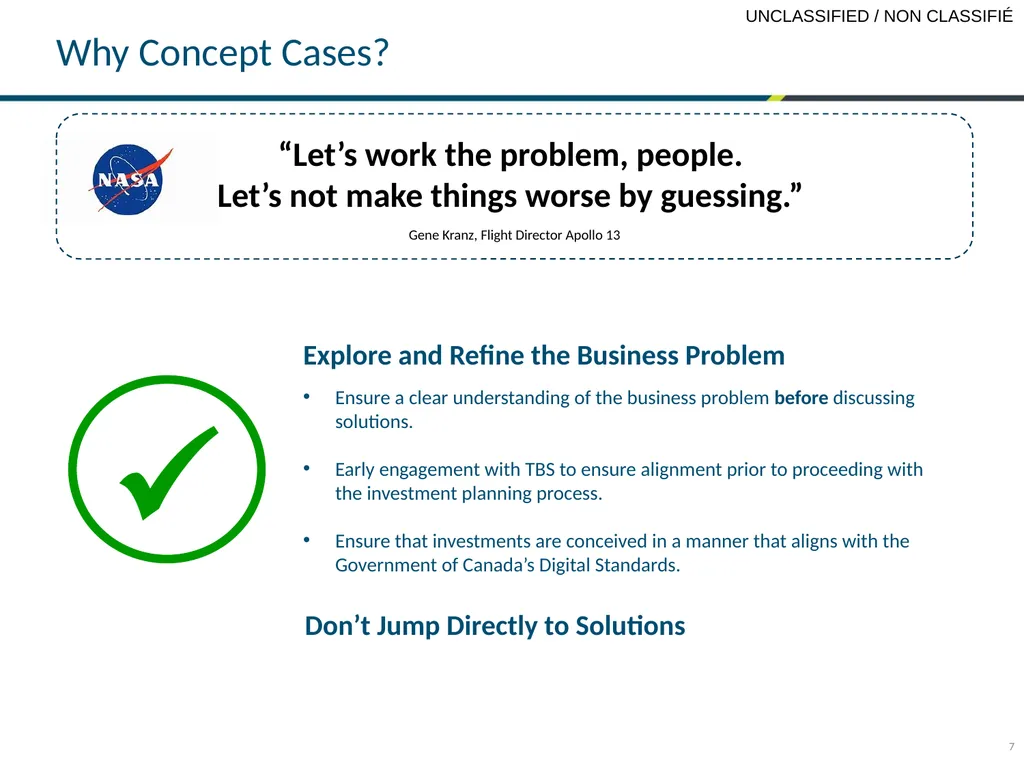
7 Why Concept Cases? Ensure a clear understanding of the business problem before discussing solutions.
Early engagement with TBS to ensure alignment prior to proceeding with the investment planning process.
Ensure that investments are conceived in a manner that aligns with the Government of Canada’s Digital Standards. “Let’s work the problem, people.
Let’s not make things worse by guessing.”
Gene Kranz, Flight Director Apollo 13 Explore and Refine the Business Problem Don’t Jump Directly to Solutions<br>
Early engagement with TBS to ensure alignment prior to proceeding with the investment planning process.
Ensure that investments are conceived in a manner that aligns with the Government of Canada’s Digital Standards. “Let’s work the problem, people.
Let’s not make things worse by guessing.”
Gene Kranz, Flight Director Apollo 13 Explore and Refine the Business Problem Don’t Jump Directly to Solutions<br>
08
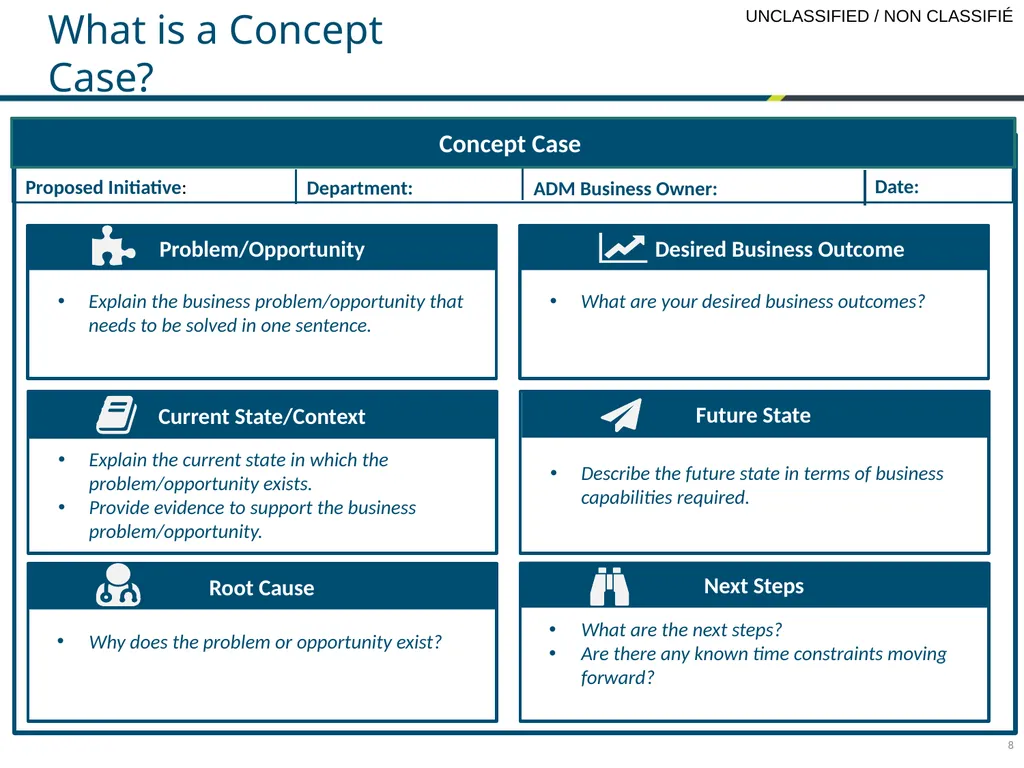
P Proposed Initiative: Department: ADM Business Owner: Date: Concept Case 8 What is a Concept Case?<br>
09
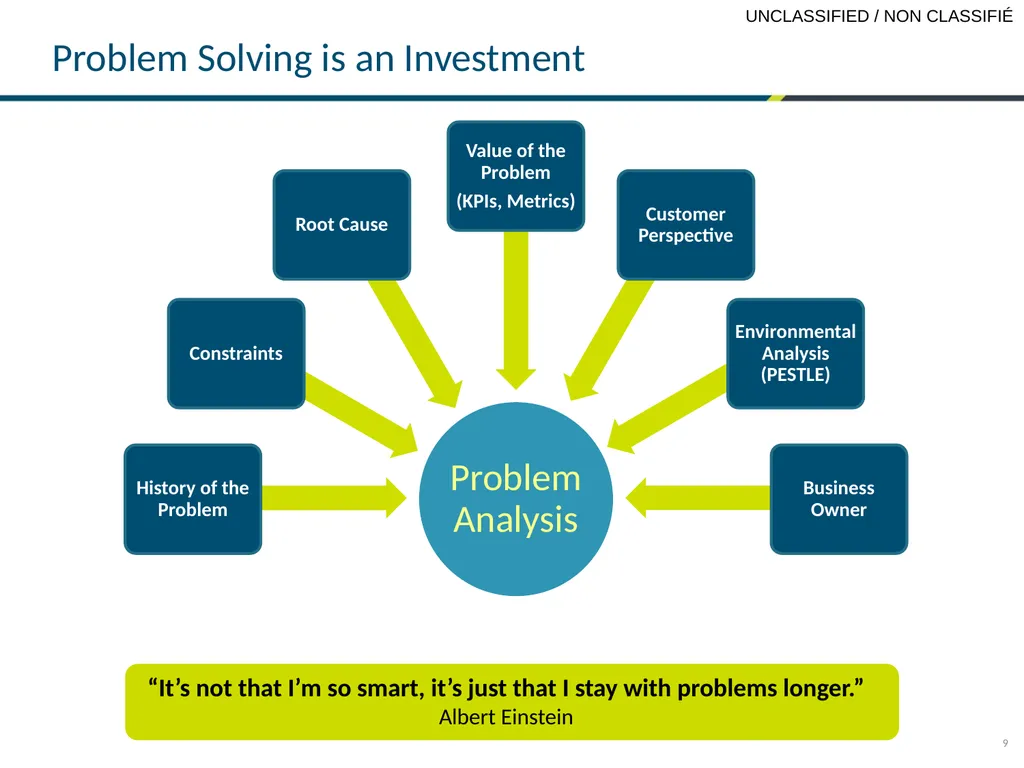
9 Problem Solving is an Investment “It’s not that I’m so smart, it’s just that I stay with problems longer.” Albert Einstein Problem Analysis History of the Problem Constraints Root Cause Value of the Problem
(KPIs, Metrics) Customer Perspective Environmental Analysis (PESTLE) Business Owner<br>
(KPIs, Metrics) Customer Perspective Environmental Analysis (PESTLE) Business Owner<br>
10
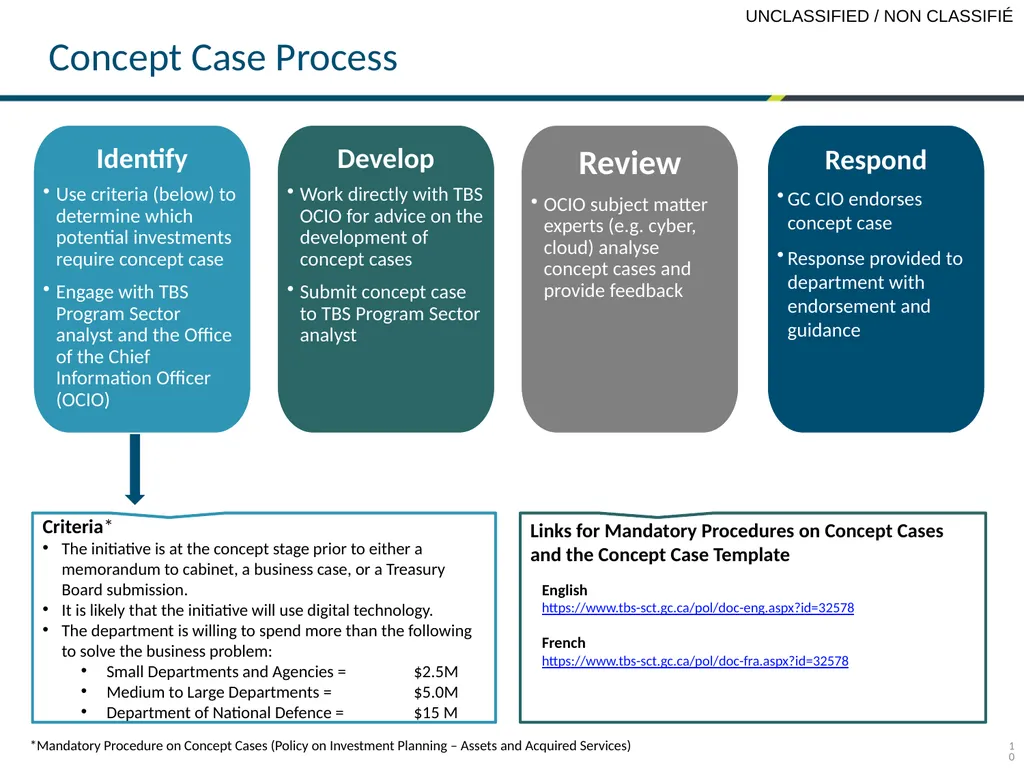
10 Concept Case Process Criteria*
The initiative is at the concept stage prior to either a memorandum to cabinet, a business case, or a Treasury Board submission.
It is likely that the initiative will use digital technology.
The department is willing to spend more than the following to solve the business problem:
Small Departments and Agencies = $2.5M
Medium to Large Departments = $5.0M
Department of National Defence = $15 M *Mandatory Procedure on Concept Cases (Policy on Investment Planning – Assets and Acquired Services) Links for Mandatory Procedures on Concept Cases and the Concept Case Template English
https://www.tbs-sct.gc.ca/pol/doc-eng.aspx?id=32578
French
https://www.tbs-sct.gc.ca/pol/doc-fra.aspx?id=32578<br>
The initiative is at the concept stage prior to either a memorandum to cabinet, a business case, or a Treasury Board submission.
It is likely that the initiative will use digital technology.
The department is willing to spend more than the following to solve the business problem:
Small Departments and Agencies = $2.5M
Medium to Large Departments = $5.0M
Department of National Defence = $15 M *Mandatory Procedure on Concept Cases (Policy on Investment Planning – Assets and Acquired Services) Links for Mandatory Procedures on Concept Cases and the Concept Case Template English
https://www.tbs-sct.gc.ca/pol/doc-eng.aspx?id=32578
French
https://www.tbs-sct.gc.ca/pol/doc-fra.aspx?id=32578<br>
11
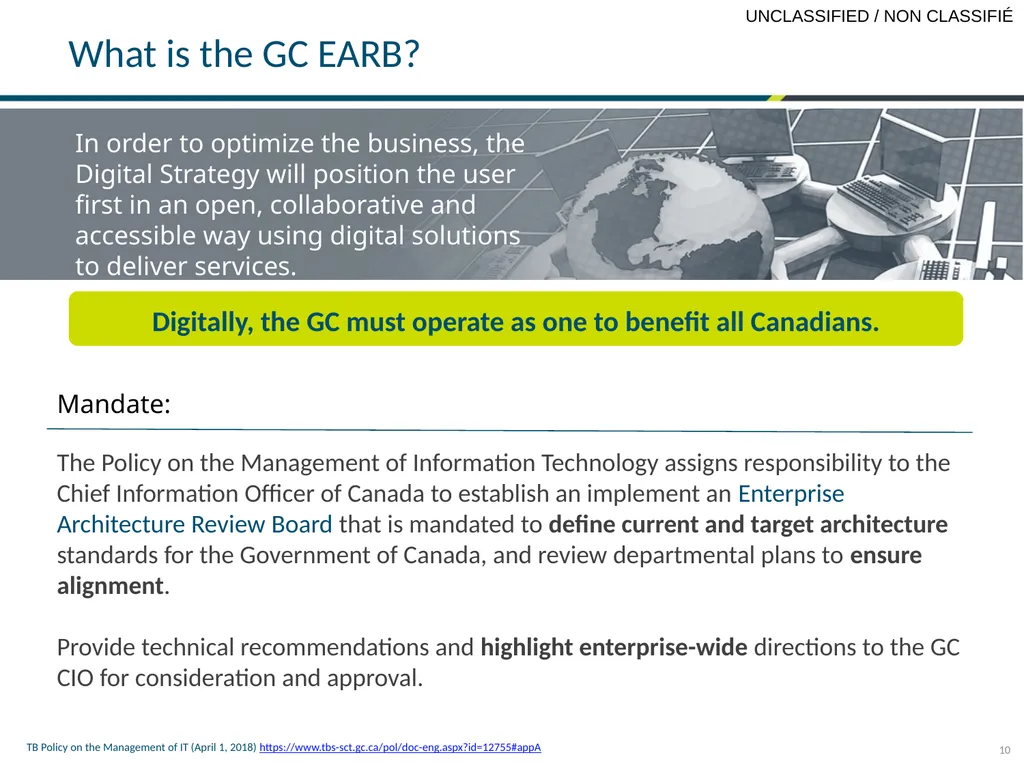
In order to optimize the business, the Digital Strategy will position the user first in an open, collaborative and accessible way using digital solutions to deliver services. What is the GC EARB? Digitally, the GC must operate as one to benefit all Canadians. Mandate: The Policy on the Management of Information Technology assigns responsibility to the Chief Information Officer of Canada to establish an implement an Enterprise Architecture Review Board that is mandated to define current and target architecture standards for the Government of Canada, and review departmental plans to ensure alignment.
Provide technical recommendations and highlight enterprise-wide directions to the GC CIO for consideration and approval. TB Policy on the Management of IT (April 1, 2018) https://www.tbs-sct.gc.ca/pol/doc-eng.aspx?id=12755#appA 10<br>
Provide technical recommendations and highlight enterprise-wide directions to the GC CIO for consideration and approval. TB Policy on the Management of IT (April 1, 2018) https://www.tbs-sct.gc.ca/pol/doc-eng.aspx?id=12755#appA 10<br>
12
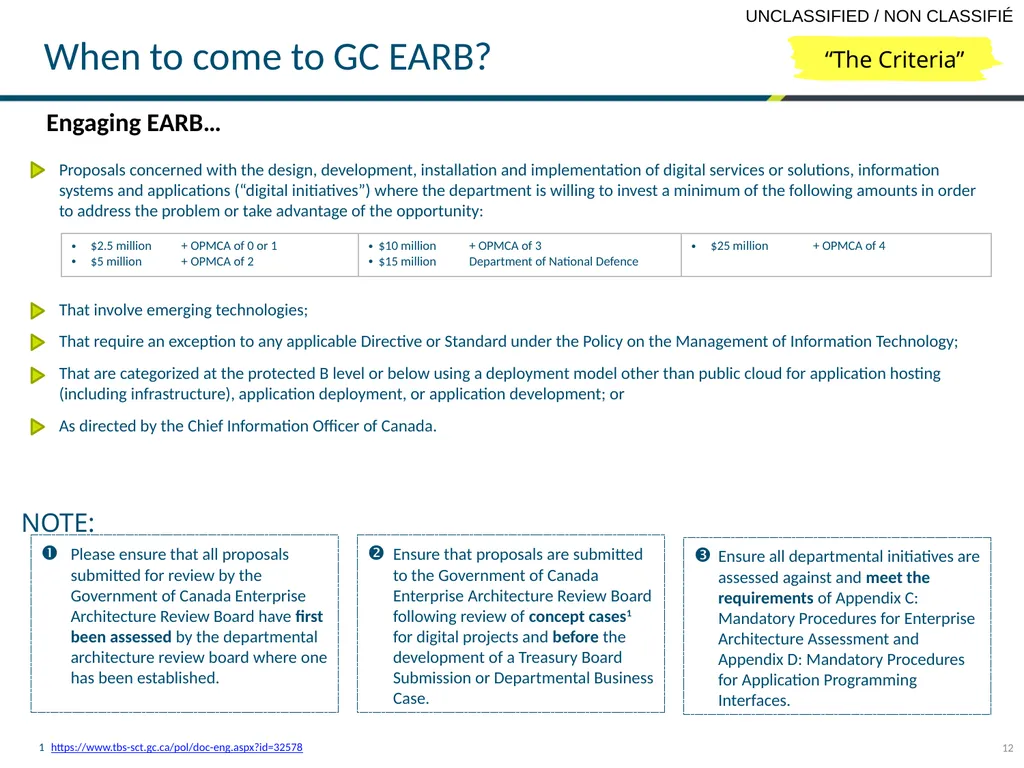
12 When to come to GC EARB? Proposals concerned with the design, development, installation and implementation of digital services or solutions, information systems and applications (“digital initiatives”) where the department is willing to invest a minimum of the following amounts in order to address the problem or take advantage of the opportunity:
That involve emerging technologies;
That require an exception to any applicable Directive or Standard under the Policy on the Management of Information Technology;
That are categorized at the protected B level or below using a deployment model other than public cloud for application hosting (including infrastructure), application deployment, or application development; or
As directed by the Chief Information Officer of Canada. Engaging EARB… “The Criteria” Please ensure that all proposals submitted for review by the Government of Canada Enterprise Architecture Review Board have first been assessed by the departmental architecture review board where one has been established. Ensure that proposals are submitted to the Government of Canada Enterprise Architecture Review Board following review of concept cases1 for digital projects and before the development of a Treasury Board Submission or Departmental Business Case. Ensure all departmental initiatives are assessed against and meet the requirements of Appendix C: Mandatory Procedures for Enterprise Architecture Assessment and Appendix D: Mandatory Procedures for Application Programming Interfaces. NOTE: https://www.tbs-sct.gc.ca/pol/doc-eng.aspx?id=32578<br>
That involve emerging technologies;
That require an exception to any applicable Directive or Standard under the Policy on the Management of Information Technology;
That are categorized at the protected B level or below using a deployment model other than public cloud for application hosting (including infrastructure), application deployment, or application development; or
As directed by the Chief Information Officer of Canada. Engaging EARB… “The Criteria” Please ensure that all proposals submitted for review by the Government of Canada Enterprise Architecture Review Board have first been assessed by the departmental architecture review board where one has been established. Ensure that proposals are submitted to the Government of Canada Enterprise Architecture Review Board following review of concept cases1 for digital projects and before the development of a Treasury Board Submission or Departmental Business Case. Ensure all departmental initiatives are assessed against and meet the requirements of Appendix C: Mandatory Procedures for Enterprise Architecture Assessment and Appendix D: Mandatory Procedures for Application Programming Interfaces. NOTE: https://www.tbs-sct.gc.ca/pol/doc-eng.aspx?id=32578<br>
13
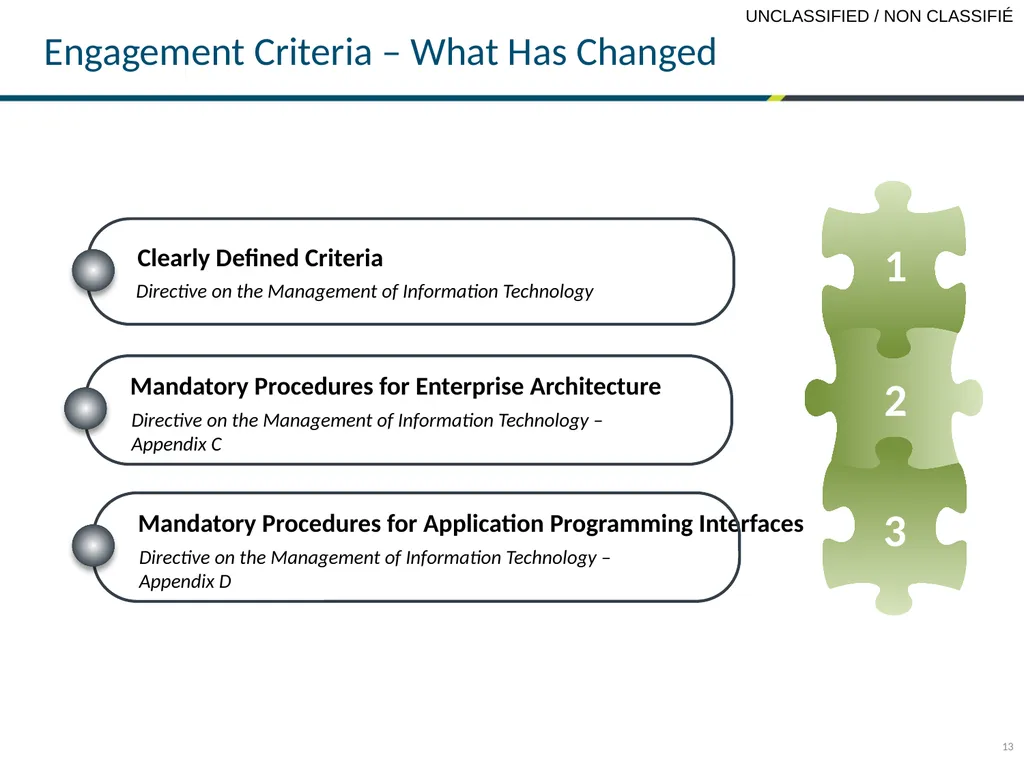
13 Engagement Criteria – What Has Changed Clearly Defined Criteria Mandatory Procedures for Enterprise Architecture Directive on the Management of Information Technology Directive on the Management of Information Technology – Appendix C Mandatory Procedures for Application Programming Interfaces Directive on the Management of Information Technology – Appendix D 1 2 3<br>
14
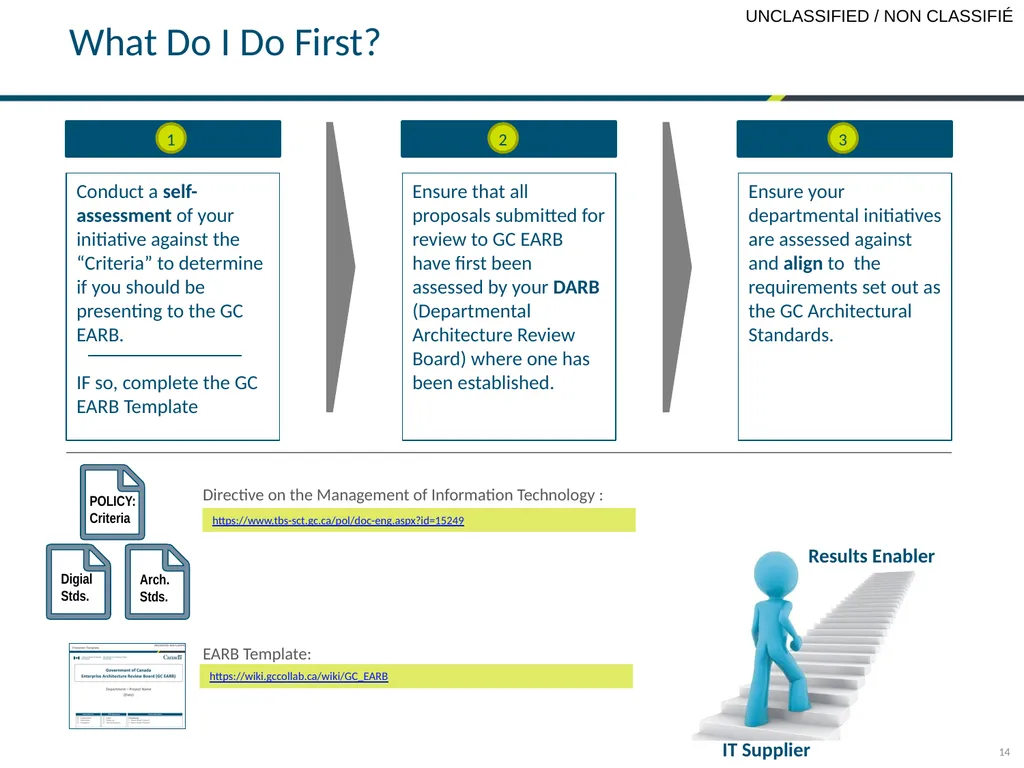
What Do I Do First? 14 Conduct a self-assessment of your initiative against the “Criteria” to determine if you should be presenting to the GC EARB.
IF so, complete the GC EARB Template Ensure that all proposals submitted for review to GC EARB have first been assessed by your DARB (Departmental Architecture Review Board) where one has been established. Ensure your departmental initiatives are assessed against and align to the requirements set out as the GC Architectural Standards. IT Supplier Results Enabler Directive on the Management of Information Technology : POLICY:
Criteria Arch.
Stds. EARB Template: https://wiki.gccollab.ca/wiki/GC_EARB https://www.tbs-sct.gc.ca/pol/doc-eng.aspx?id=15249 Digial
Stds.<br>
IF so, complete the GC EARB Template Ensure that all proposals submitted for review to GC EARB have first been assessed by your DARB (Departmental Architecture Review Board) where one has been established. Ensure your departmental initiatives are assessed against and align to the requirements set out as the GC Architectural Standards. IT Supplier Results Enabler Directive on the Management of Information Technology : POLICY:
Criteria Arch.
Stds. EARB Template: https://wiki.gccollab.ca/wiki/GC_EARB https://www.tbs-sct.gc.ca/pol/doc-eng.aspx?id=15249 Digial
Stds.<br>
15
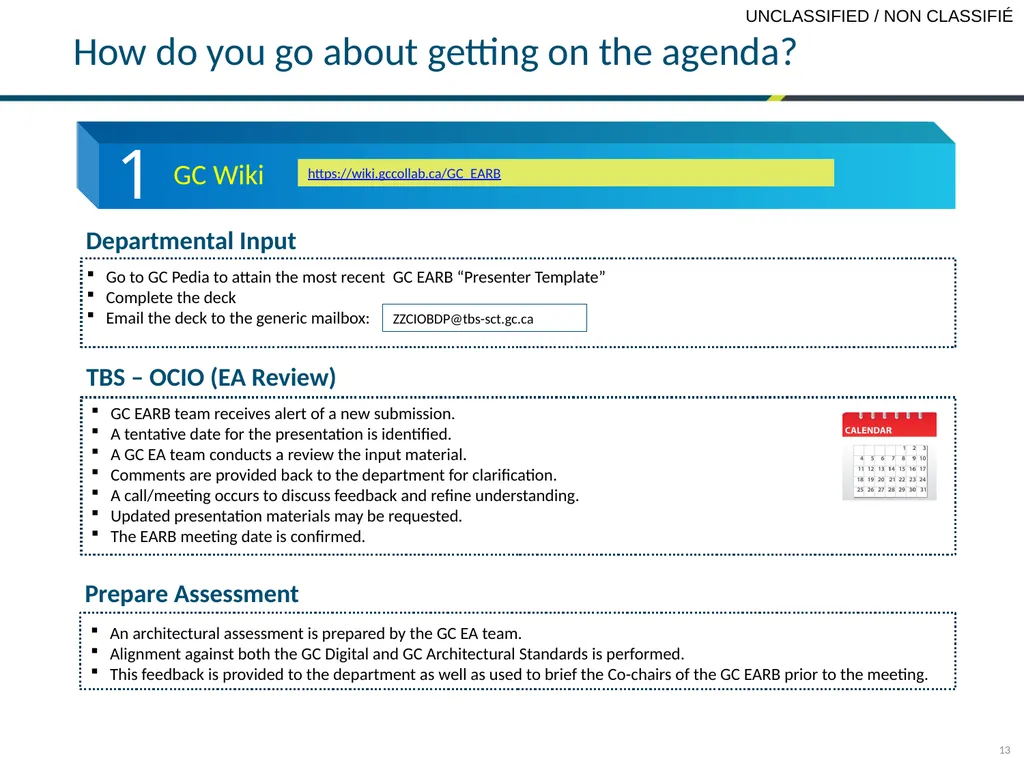
Go to GC Pedia to attain the most recent GC EARB “Presenter Template”
Complete the deck
Email the deck to the generic mailbox: How do you go about getting on the agenda? Departmental Input ZZCIOBDP@tbs-sct.gc.ca GC EARB team receives alert of a new submission.
A tentative date for the presentation is identified.
A GC EA team conducts a review the input material.
Comments are provided back to the department for clarification.
A call/meeting occurs to discuss feedback and refine understanding.
Updated presentation materials may be requested.
The EARB meeting date is confirmed. TBS – OCIO (EA Review) An architectural assessment is prepared by the GC EA team.
Alignment against both the GC Digital and GC Architectural Standards is performed.
This feedback is provided to the department as well as used to brief the Co-chairs of the GC EARB prior to the meeting. Prepare Assessment https://wiki.gccollab.ca/GC_EARB 13<br>
Complete the deck
Email the deck to the generic mailbox: How do you go about getting on the agenda? Departmental Input ZZCIOBDP@tbs-sct.gc.ca GC EARB team receives alert of a new submission.
A tentative date for the presentation is identified.
A GC EA team conducts a review the input material.
Comments are provided back to the department for clarification.
A call/meeting occurs to discuss feedback and refine understanding.
Updated presentation materials may be requested.
The EARB meeting date is confirmed. TBS – OCIO (EA Review) An architectural assessment is prepared by the GC EA team.
Alignment against both the GC Digital and GC Architectural Standards is performed.
This feedback is provided to the department as well as used to brief the Co-chairs of the GC EARB prior to the meeting. Prepare Assessment https://wiki.gccollab.ca/GC_EARB 13<br>
16
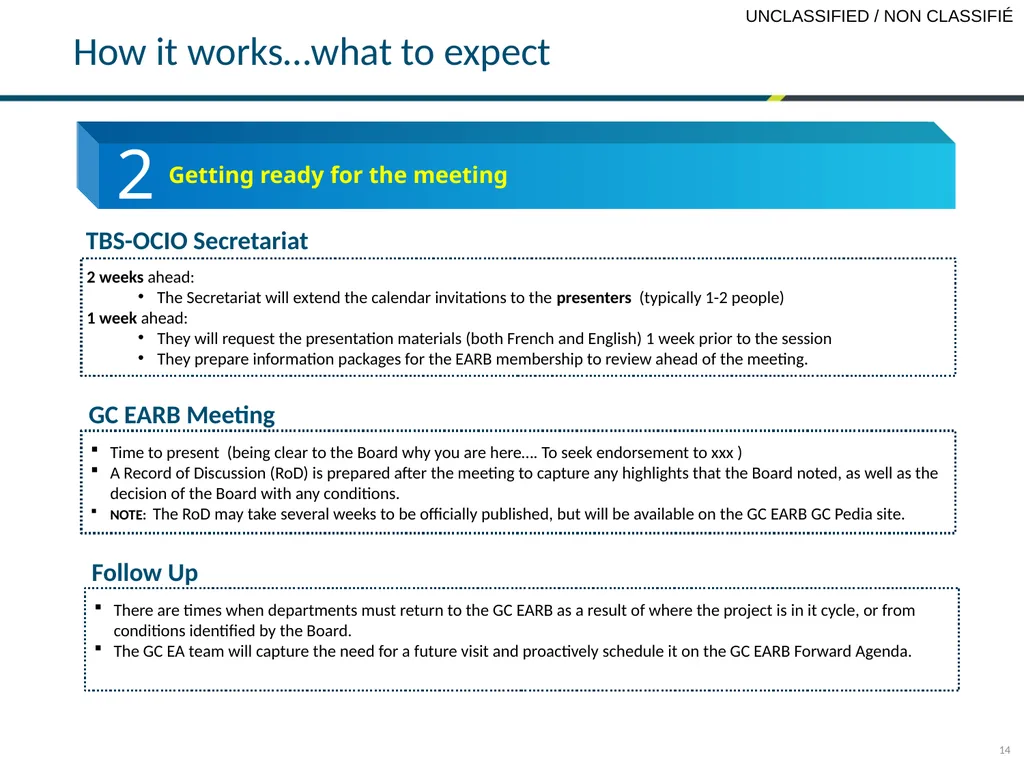
How it works…what to expect 2 weeks ahead:
The Secretariat will extend the calendar invitations to the presenters (typically 1-2 people)
1 week ahead:
They will request the presentation materials (both French and English) 1 week prior to the session
They prepare information packages for the EARB membership to review ahead of the meeting. TBS-OCIO Secretariat Time to present (being clear to the Board why you are here…. To seek endorsement to xxx )
A Record of Discussion (RoD) is prepared after the meeting to capture any highlights that the Board noted, as well as the decision of the Board with any conditions.
NOTE: The RoD may take several weeks to be officially published, but will be available on the GC EARB GC Pedia site. GC EARB Meeting There are times when departments must return to the GC EARB as a result of where the project is in it cycle, or from conditions identified by the Board.
The GC EA team will capture the need for a future visit and proactively schedule it on the GC EARB Forward Agenda. Follow Up 14<br>
The Secretariat will extend the calendar invitations to the presenters (typically 1-2 people)
1 week ahead:
They will request the presentation materials (both French and English) 1 week prior to the session
They prepare information packages for the EARB membership to review ahead of the meeting. TBS-OCIO Secretariat Time to present (being clear to the Board why you are here…. To seek endorsement to xxx )
A Record of Discussion (RoD) is prepared after the meeting to capture any highlights that the Board noted, as well as the decision of the Board with any conditions.
NOTE: The RoD may take several weeks to be officially published, but will be available on the GC EARB GC Pedia site. GC EARB Meeting There are times when departments must return to the GC EARB as a result of where the project is in it cycle, or from conditions identified by the Board.
The GC EA team will capture the need for a future visit and proactively schedule it on the GC EARB Forward Agenda. Follow Up 14<br>
17
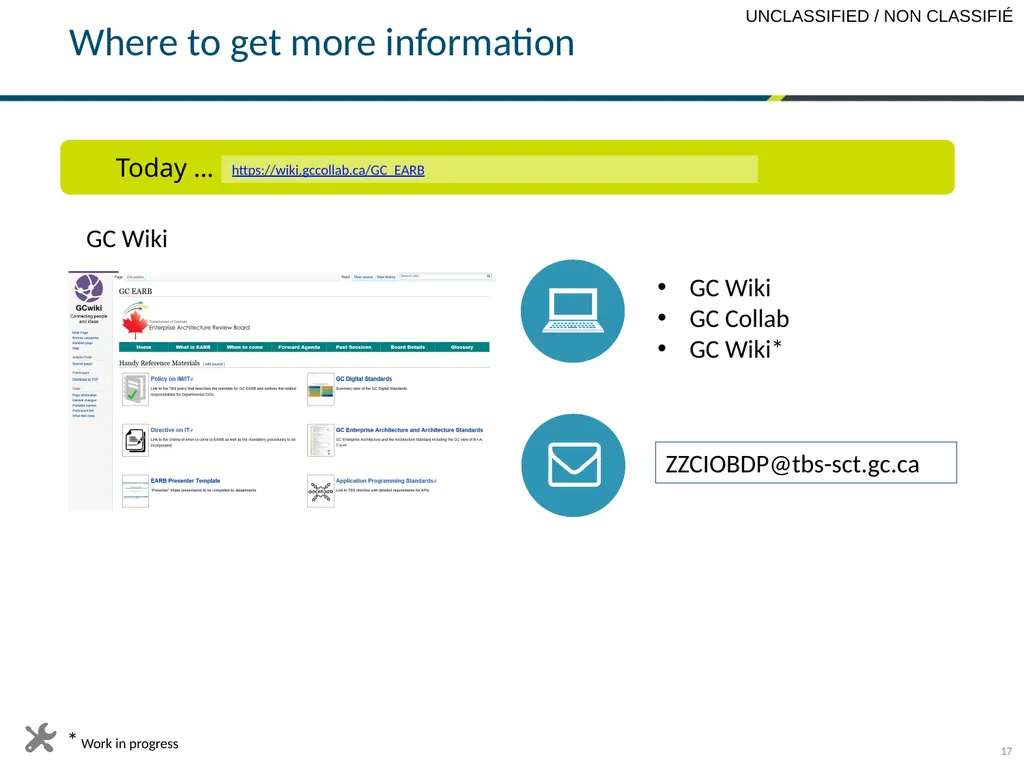
Where to get more information 17 Today … GC Wiki GC Wiki
GC Collab
GC Wiki* ZZCIOBDP@tbs-sct.gc.ca * Work in progress https://wiki.gccollab.ca/GC_EARB<br>
GC Collab
GC Wiki* ZZCIOBDP@tbs-sct.gc.ca * Work in progress https://wiki.gccollab.ca/GC_EARB<br>
18
18 APPENDIX: 1 - GC Digital Standards
2 - GC Architectural Standards
3 - High Level Process View
4 - GC EARB Assessment<br>
2 - GC Architectural Standards
3 - High Level Process View
4 - GC EARB Assessment<br>
19
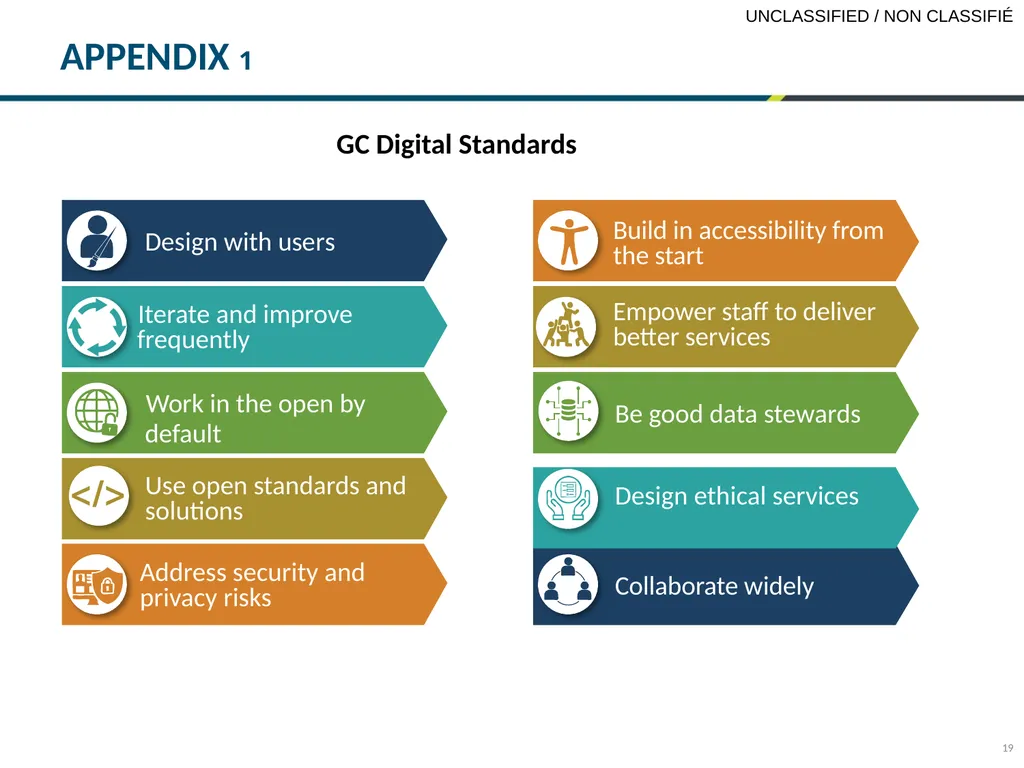
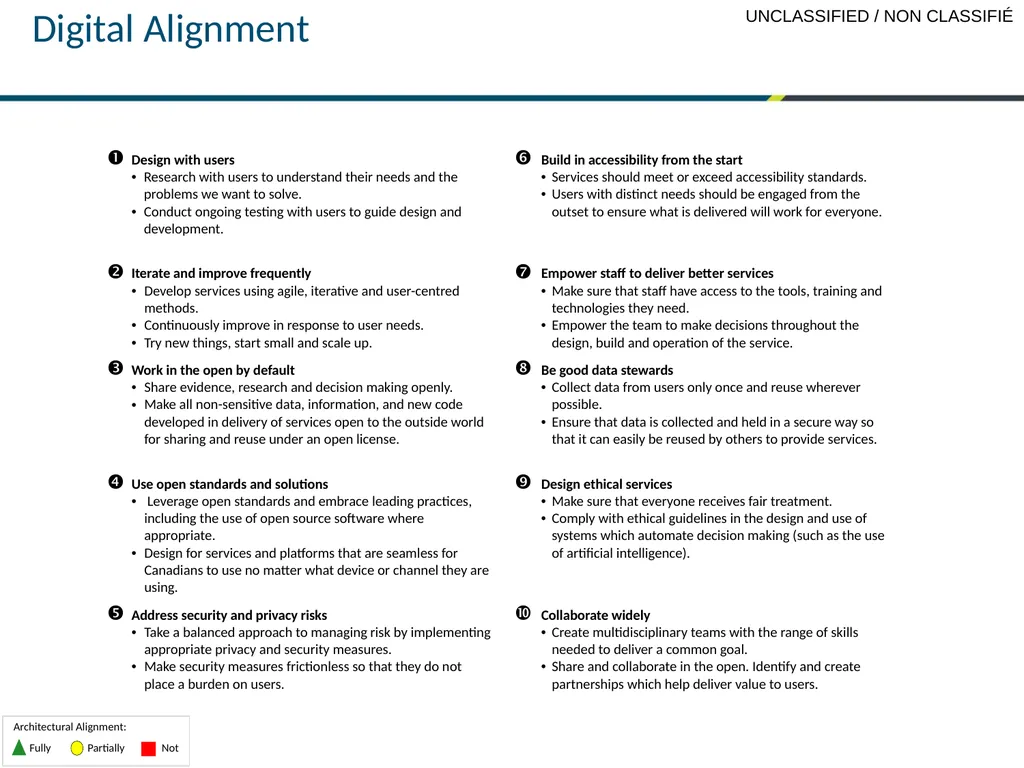
19 Design with users Iterate and improve frequently Work in the open by default Use open standards and solutions Address security and privacy risks Build in accessibility from the start Empower staff to deliver better services Be good data stewards Design ethical services Collaborate widely GC Digital Standards APPENDIX 1<br>
20
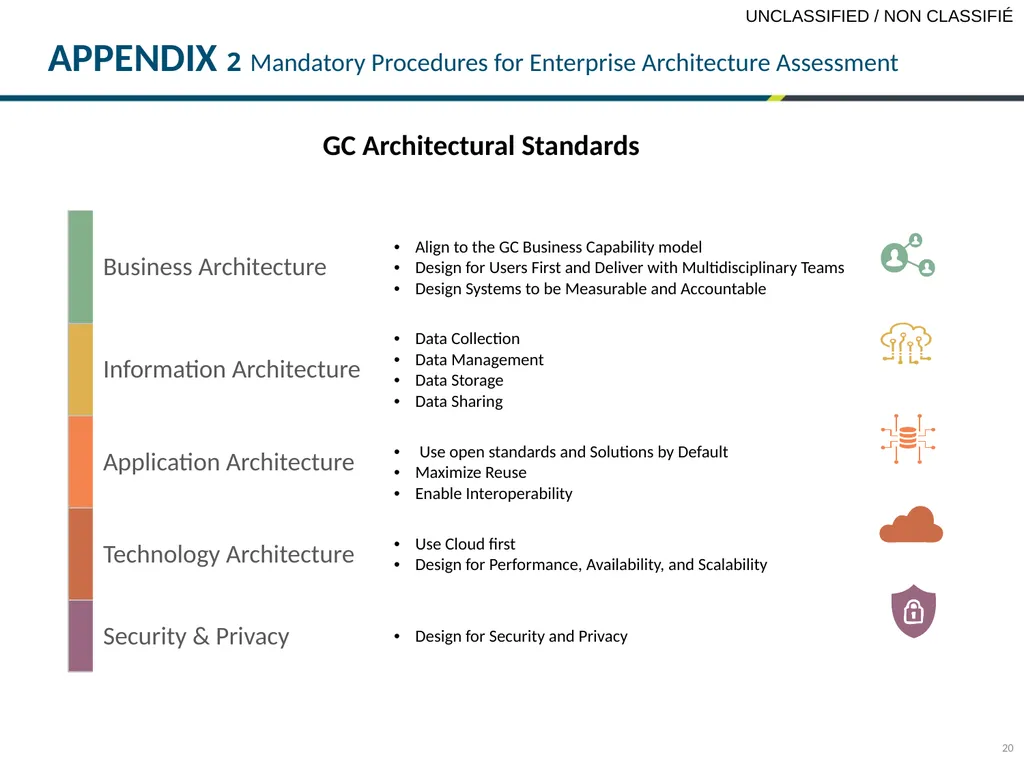
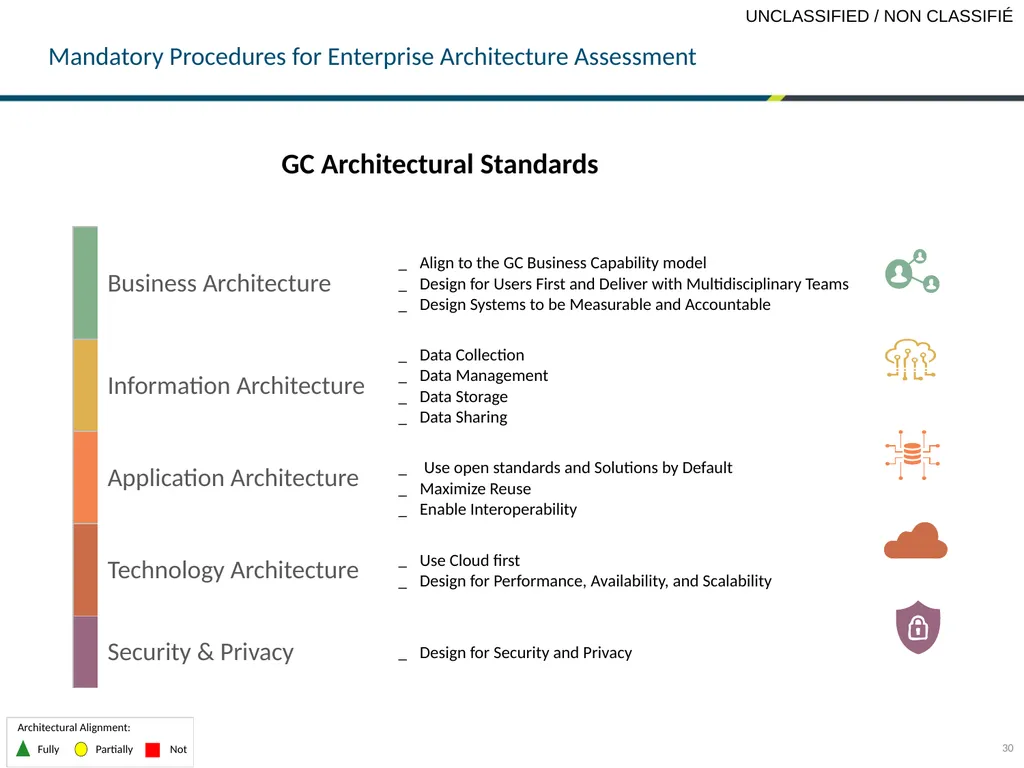
GC Architectural Standards 20 APPENDIX 2 Mandatory Procedures for Enterprise Architecture Assessment<br>
21
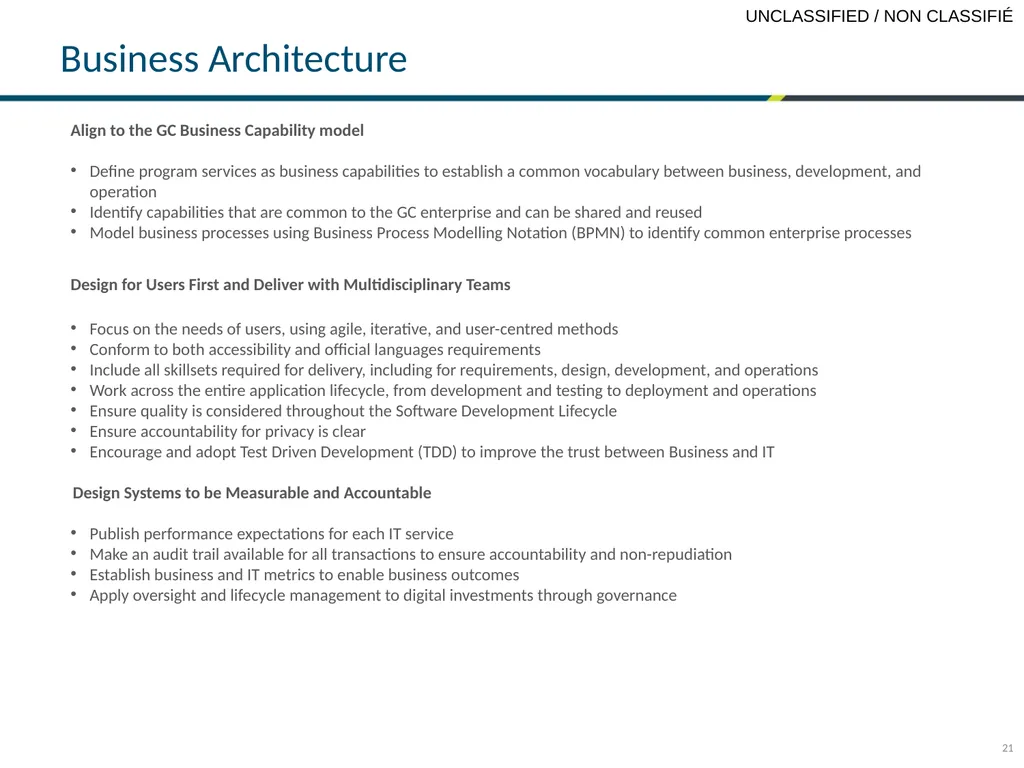
21 Business Architecture Align to the GC Business Capability model
Define program services as business capabilities to establish a common vocabulary between business, development, and operation
Identify capabilities that are common to the GC enterprise and can be shared and reused
Model business processes using Business Process Modelling Notation (BPMN) to identify common enterprise processes
Design for Users First and Deliver with Multidisciplinary Teams
Focus on the needs of users, using agile, iterative, and user-centred methods
Conform to both accessibility and official languages requirements
Include all skillsets required for delivery, including for requirements, design, development, and operations
Work across the entire application lifecycle, from development and testing to deployment and operations
Ensure quality is considered throughout the Software Development Lifecycle
Ensure accountability for privacy is clear
Encourage and adopt Test Driven Development (TDD) to improve the trust between Business and IT
Design Systems to be Measurable and Accountable
Publish performance expectations for each IT service
Make an audit trail available for all transactions to ensure accountability and non-repudiation
Establish business and IT metrics to enable business outcomes
Apply oversight and lifecycle management to digital investments through governance<br>
Define program services as business capabilities to establish a common vocabulary between business, development, and operation
Identify capabilities that are common to the GC enterprise and can be shared and reused
Model business processes using Business Process Modelling Notation (BPMN) to identify common enterprise processes
Design for Users First and Deliver with Multidisciplinary Teams
Focus on the needs of users, using agile, iterative, and user-centred methods
Conform to both accessibility and official languages requirements
Include all skillsets required for delivery, including for requirements, design, development, and operations
Work across the entire application lifecycle, from development and testing to deployment and operations
Ensure quality is considered throughout the Software Development Lifecycle
Ensure accountability for privacy is clear
Encourage and adopt Test Driven Development (TDD) to improve the trust between Business and IT
Design Systems to be Measurable and Accountable
Publish performance expectations for each IT service
Make an audit trail available for all transactions to ensure accountability and non-repudiation
Establish business and IT metrics to enable business outcomes
Apply oversight and lifecycle management to digital investments through governance<br>
22
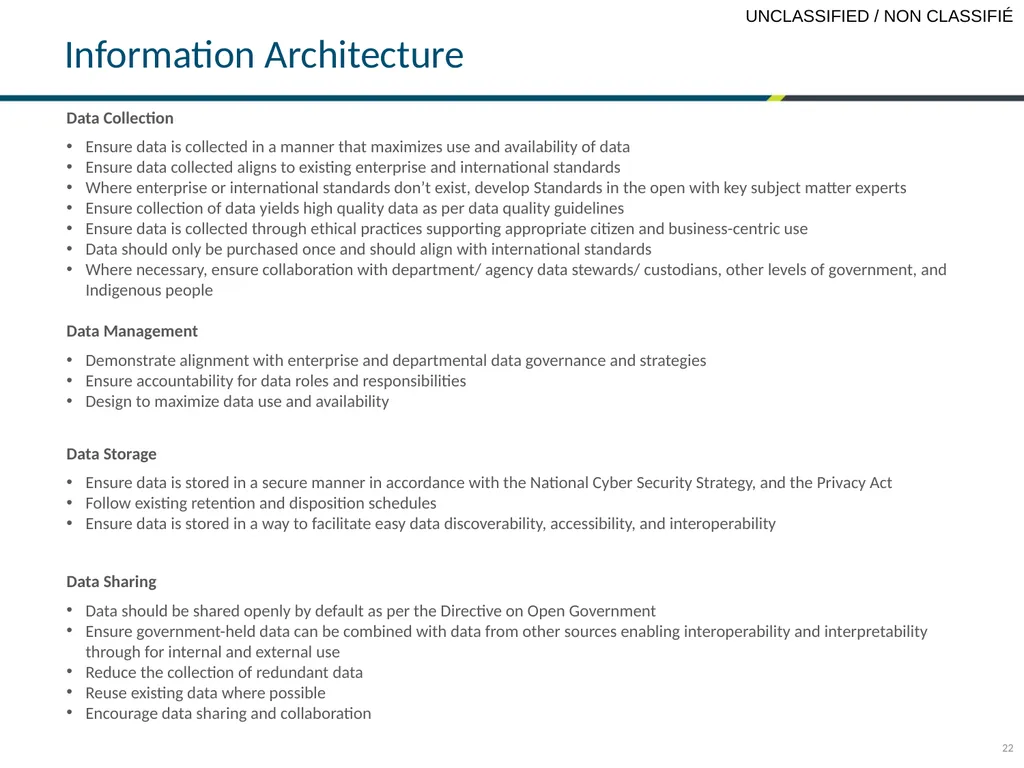
22 Information Architecture Data Collection
Ensure data is collected in a manner that maximizes use and availability of data
Ensure data collected aligns to existing enterprise and international standards
Where enterprise or international standards don’t exist, develop Standards in the open with key subject matter experts
Ensure collection of data yields high quality data as per data quality guidelines
Ensure data is collected through ethical practices supporting appropriate citizen and business-centric use
Data should only be purchased once and should align with international standards
Where necessary, ensure collaboration with department/ agency data stewards/ custodians, other levels of government, and Indigenous people
Data Management
Demonstrate alignment with enterprise and departmental data governance and strategies
Ensure accountability for data roles and responsibilities
Design to maximize data use and availability
Data Storage
Ensure data is stored in a secure manner in accordance with the National Cyber Security Strategy, and the Privacy Act
Follow existing retention and disposition schedules
Ensure data is stored in a way to facilitate easy data discoverability, accessibility, and interoperability
Data Sharing
Data should be shared openly by default as per the Directive on Open Government
Ensure government-held data can be combined with data from other sources enabling interoperability and interpretability through for internal and external use
Reduce the collection of redundant data
Reuse existing data where possible
Encourage data sharing and collaboration<br>
Ensure data is collected in a manner that maximizes use and availability of data
Ensure data collected aligns to existing enterprise and international standards
Where enterprise or international standards don’t exist, develop Standards in the open with key subject matter experts
Ensure collection of data yields high quality data as per data quality guidelines
Ensure data is collected through ethical practices supporting appropriate citizen and business-centric use
Data should only be purchased once and should align with international standards
Where necessary, ensure collaboration with department/ agency data stewards/ custodians, other levels of government, and Indigenous people
Data Management
Demonstrate alignment with enterprise and departmental data governance and strategies
Ensure accountability for data roles and responsibilities
Design to maximize data use and availability
Data Storage
Ensure data is stored in a secure manner in accordance with the National Cyber Security Strategy, and the Privacy Act
Follow existing retention and disposition schedules
Ensure data is stored in a way to facilitate easy data discoverability, accessibility, and interoperability
Data Sharing
Data should be shared openly by default as per the Directive on Open Government
Ensure government-held data can be combined with data from other sources enabling interoperability and interpretability through for internal and external use
Reduce the collection of redundant data
Reuse existing data where possible
Encourage data sharing and collaboration<br>
23
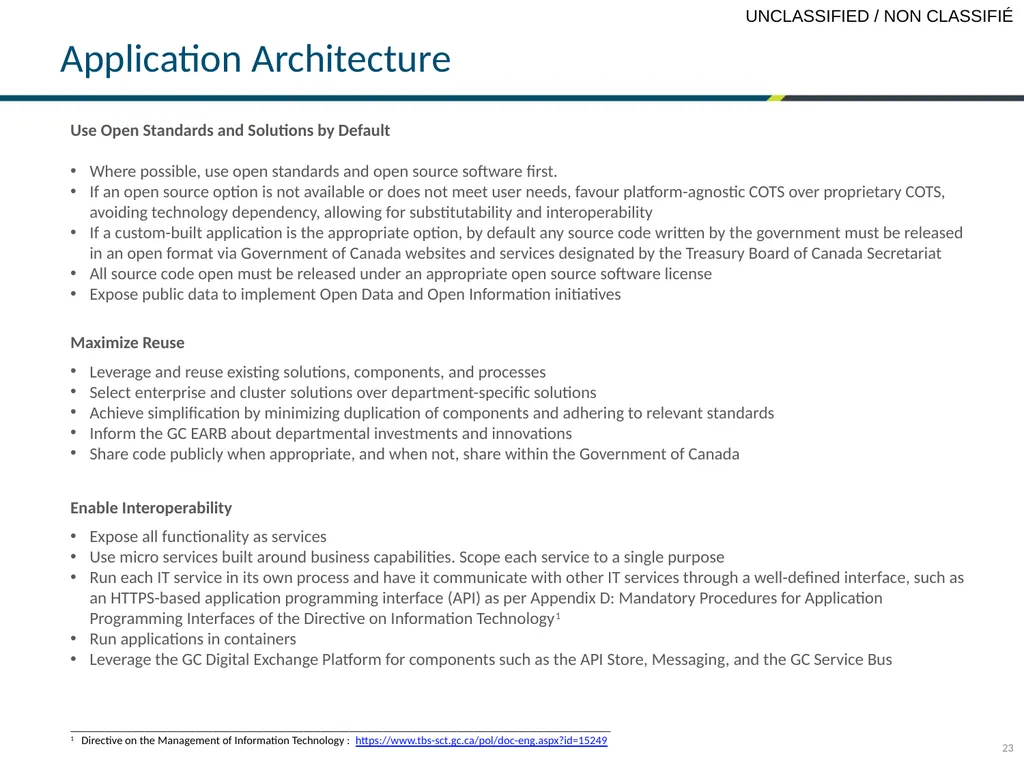
23 Use Open Standards and Solutions by Default
Where possible, use open standards and open source software first.
If an open source option is not available or does not meet user needs, favour platform-agnostic COTS over proprietary COTS, avoiding technology dependency, allowing for substitutability and interoperability
If a custom-built application is the appropriate option, by default any source code written by the government must be released in an open format via Government of Canada websites and services designated by the Treasury Board of Canada Secretariat
All source code open must be released under an appropriate open source software license
Expose public data to implement Open Data and Open Information initiatives
Maximize Reuse
Leverage and reuse existing solutions, components, and processes
Select enterprise and cluster solutions over department-specific solutions
Achieve simplification by minimizing duplication of components and adhering to relevant standards
Inform the GC EARB about departmental investments and innovations
Share code publicly when appropriate, and when not, share within the Government of Canada
Enable Interoperability
Expose all functionality as services
Use micro services built around business capabilities. Scope each service to a single purpose
Run each IT service in its own process and have it communicate with other IT services through a well-defined interface, such as an HTTPS-based application programming interface (API) as per Appendix D: Mandatory Procedures for Application Programming Interfaces of the Directive on Information Technology1
Run applications in containers
Leverage the GC Digital Exchange Platform for components such as the API Store, Messaging, and the GC Service Bus Application Architecture _______________________________________________________________________________________________
1 Directive on the Management of Information Technology : https://www.tbs-sct.gc.ca/pol/doc-eng.aspx?id=15249<br>
Where possible, use open standards and open source software first.
If an open source option is not available or does not meet user needs, favour platform-agnostic COTS over proprietary COTS, avoiding technology dependency, allowing for substitutability and interoperability
If a custom-built application is the appropriate option, by default any source code written by the government must be released in an open format via Government of Canada websites and services designated by the Treasury Board of Canada Secretariat
All source code open must be released under an appropriate open source software license
Expose public data to implement Open Data and Open Information initiatives
Maximize Reuse
Leverage and reuse existing solutions, components, and processes
Select enterprise and cluster solutions over department-specific solutions
Achieve simplification by minimizing duplication of components and adhering to relevant standards
Inform the GC EARB about departmental investments and innovations
Share code publicly when appropriate, and when not, share within the Government of Canada
Enable Interoperability
Expose all functionality as services
Use micro services built around business capabilities. Scope each service to a single purpose
Run each IT service in its own process and have it communicate with other IT services through a well-defined interface, such as an HTTPS-based application programming interface (API) as per Appendix D: Mandatory Procedures for Application Programming Interfaces of the Directive on Information Technology1
Run applications in containers
Leverage the GC Digital Exchange Platform for components such as the API Store, Messaging, and the GC Service Bus Application Architecture _______________________________________________________________________________________________
1 Directive on the Management of Information Technology : https://www.tbs-sct.gc.ca/pol/doc-eng.aspx?id=15249<br>
24
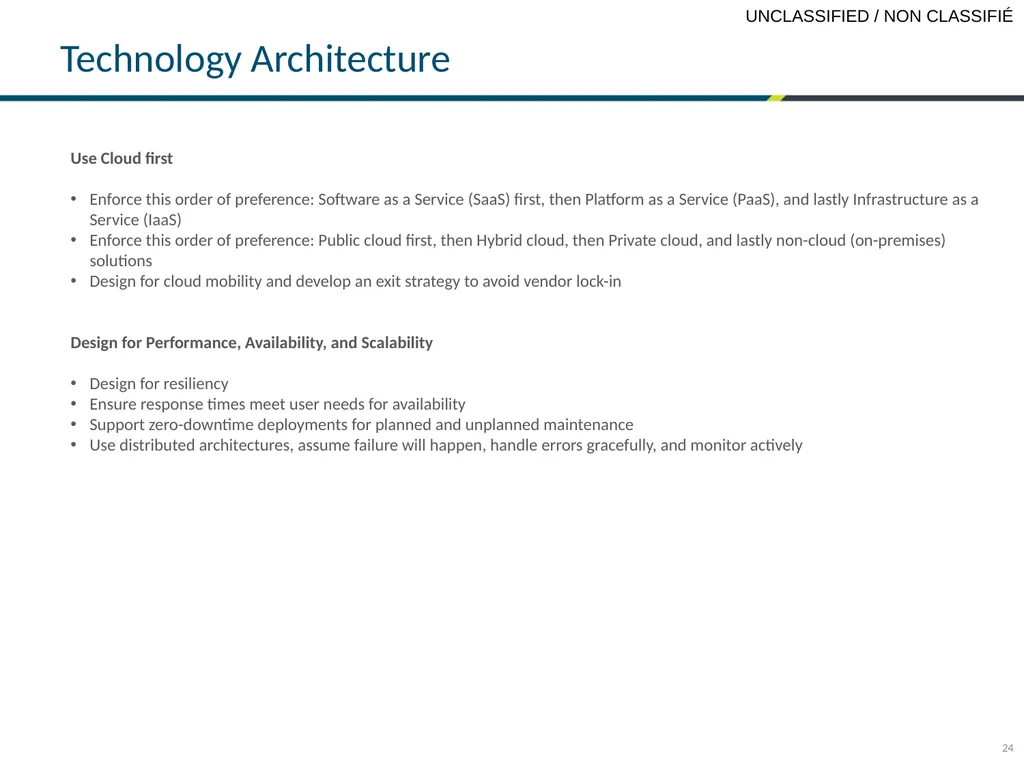
24 Use Cloud first
Enforce this order of preference: Software as a Service (SaaS) first, then Platform as a Service (PaaS), and lastly Infrastructure as a Service (IaaS)
Enforce this order of preference: Public cloud first, then Hybrid cloud, then Private cloud, and lastly non-cloud (on-premises) solutions
Design for cloud mobility and develop an exit strategy to avoid vendor lock-in
Design for Performance, Availability, and Scalability
Design for resiliency
Ensure response times meet user needs for availability
Support zero-downtime deployments for planned and unplanned maintenance
Use distributed architectures, assume failure will happen, handle errors gracefully, and monitor actively Technology Architecture<br>
Enforce this order of preference: Software as a Service (SaaS) first, then Platform as a Service (PaaS), and lastly Infrastructure as a Service (IaaS)
Enforce this order of preference: Public cloud first, then Hybrid cloud, then Private cloud, and lastly non-cloud (on-premises) solutions
Design for cloud mobility and develop an exit strategy to avoid vendor lock-in
Design for Performance, Availability, and Scalability
Design for resiliency
Ensure response times meet user needs for availability
Support zero-downtime deployments for planned and unplanned maintenance
Use distributed architectures, assume failure will happen, handle errors gracefully, and monitor actively Technology Architecture<br>
25
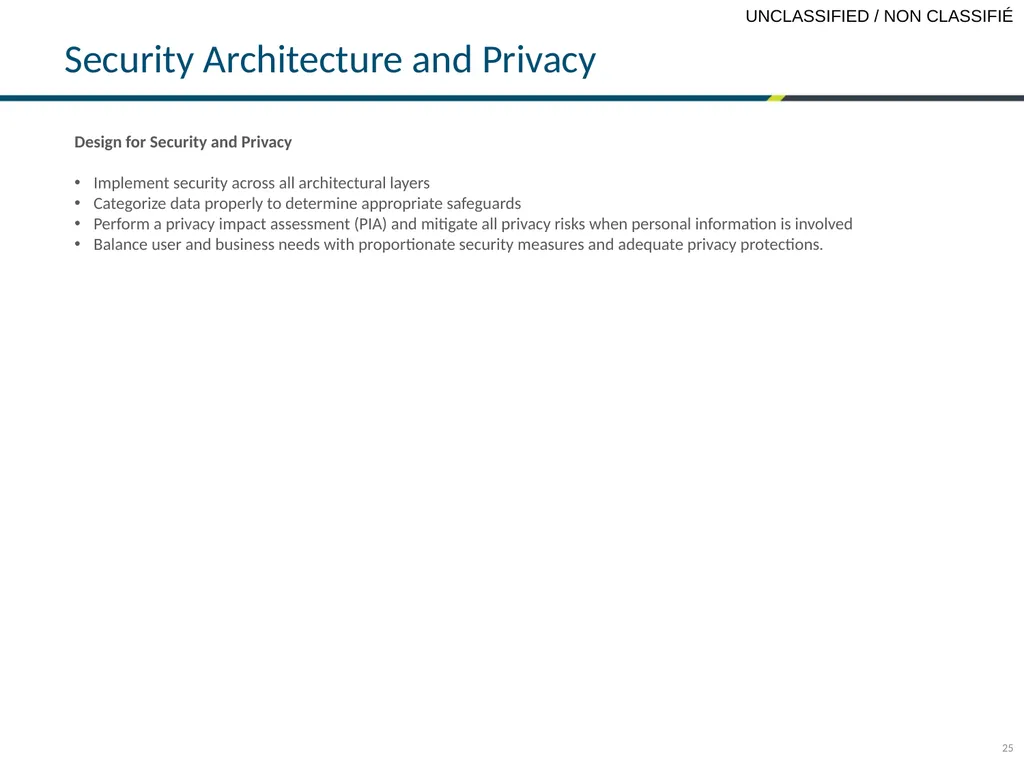
25 Security Architecture and Privacy Design for Security and Privacy
Implement security across all architectural layers
Categorize data properly to determine appropriate safeguards
Perform a privacy impact assessment (PIA) and mitigate all privacy risks when personal information is involved
Balance user and business needs with proportionate security measures and adequate privacy protections.<br>
Implement security across all architectural layers
Categorize data properly to determine appropriate safeguards
Perform a privacy impact assessment (PIA) and mitigate all privacy risks when personal information is involved
Balance user and business needs with proportionate security measures and adequate privacy protections.<br>
26
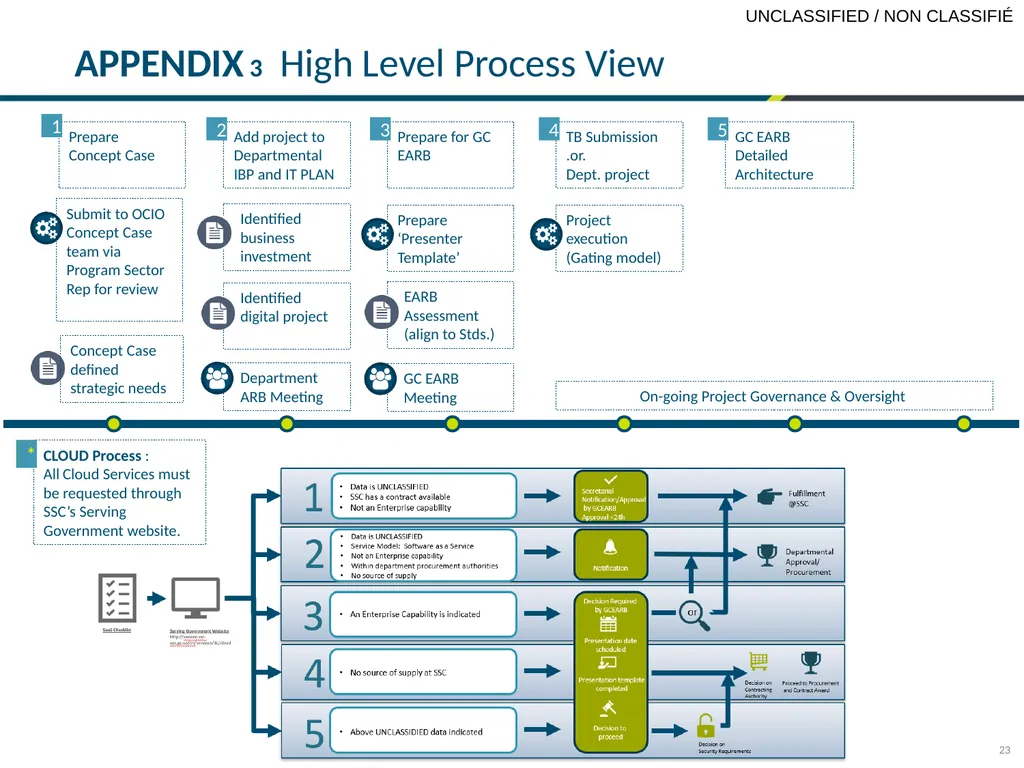
Submit to OCIO Concept Case team via Program Sector Rep for review Add project to Departmental IBP and IT PLAN 2 Prepare for GC EARB 3 TB Submission
.or.
Dept. project 4 GC EARB
Detailed Architecture 5 Prepare Concept Case 1 Identified business investment Identified digital project Concept Case defined strategic needs Prepare ‘Presenter Template’ EARB Assessment (align to Stds.) CLOUD Process :
All Cloud Services must be requested through SSC’s Serving Government website. * GC EARB Meeting Department
ARB Meeting Project execution (Gating model) APPENDIX 3 High Level Process View 23 On-going Project Governance & Oversight<br>
.or.
Dept. project 4 GC EARB
Detailed Architecture 5 Prepare Concept Case 1 Identified business investment Identified digital project Concept Case defined strategic needs Prepare ‘Presenter Template’ EARB Assessment (align to Stds.) CLOUD Process :
All Cloud Services must be requested through SSC’s Serving Government website. * GC EARB Meeting Department
ARB Meeting Project execution (Gating model) APPENDIX 3 High Level Process View 23 On-going Project Governance & Oversight<br>
27
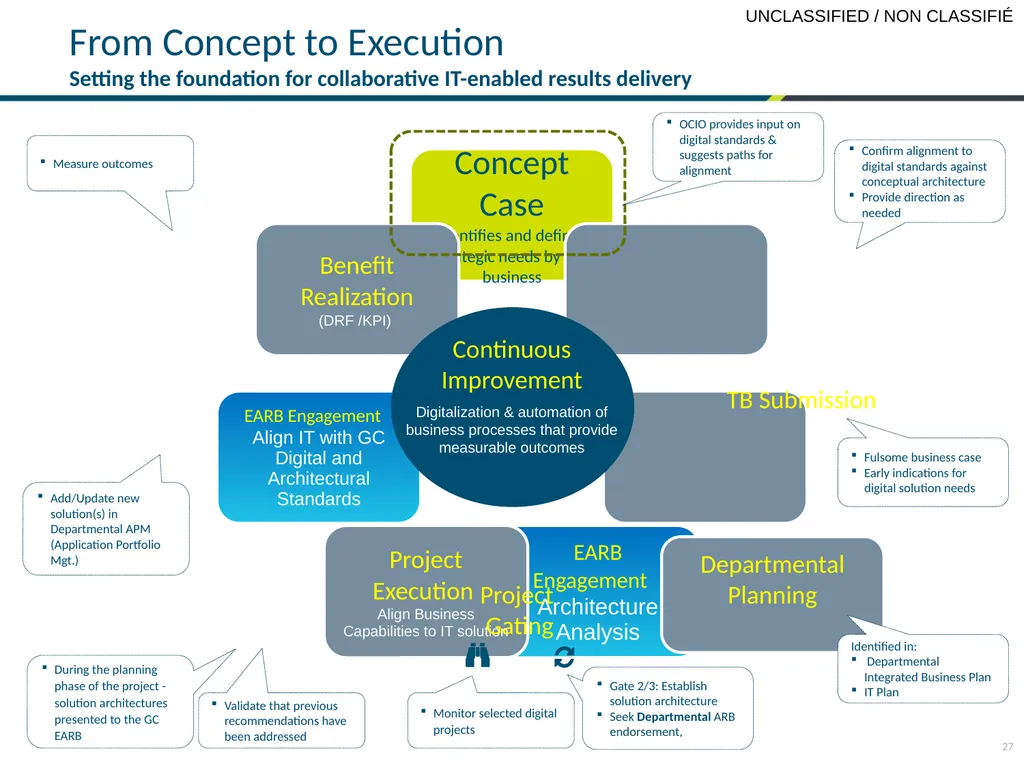
27 Continuous Improvement
Digitalization & automation of business processes that provide measurable outcomes Fulsome business case
Early indications for digital solution needs Confirm alignment to digital standards against conceptual architecture
Provide direction as needed Add/Update new solution(s) in Departmental APM (Application Portfolio Mgt.) Measure outcomes Gate 2/3: Establish solution architecture
Seek Departmental ARB endorsement, From Concept to Execution
Setting the foundation for collaborative IT-enabled results delivery TB Submission OCIO provides input on digital standards & suggests paths for alignment Project
Gating During the planning phase of the project - solution architectures presented to the GC EARB Validate that previous recommendations have been addressed Monitor selected digital projects Identified in:
Departmental Integrated Business Plan
IT Plan<br>
Digitalization & automation of business processes that provide measurable outcomes Fulsome business case
Early indications for digital solution needs Confirm alignment to digital standards against conceptual architecture
Provide direction as needed Add/Update new solution(s) in Departmental APM (Application Portfolio Mgt.) Measure outcomes Gate 2/3: Establish solution architecture
Seek Departmental ARB endorsement, From Concept to Execution
Setting the foundation for collaborative IT-enabled results delivery TB Submission OCIO provides input on digital standards & suggests paths for alignment Project
Gating During the planning phase of the project - solution architectures presented to the GC EARB Validate that previous recommendations have been addressed Monitor selected digital projects Identified in:
Departmental Integrated Business Plan
IT Plan<br>
28
28 GC EARB Assessment - 3 pages APPENDIX 4<br>
29
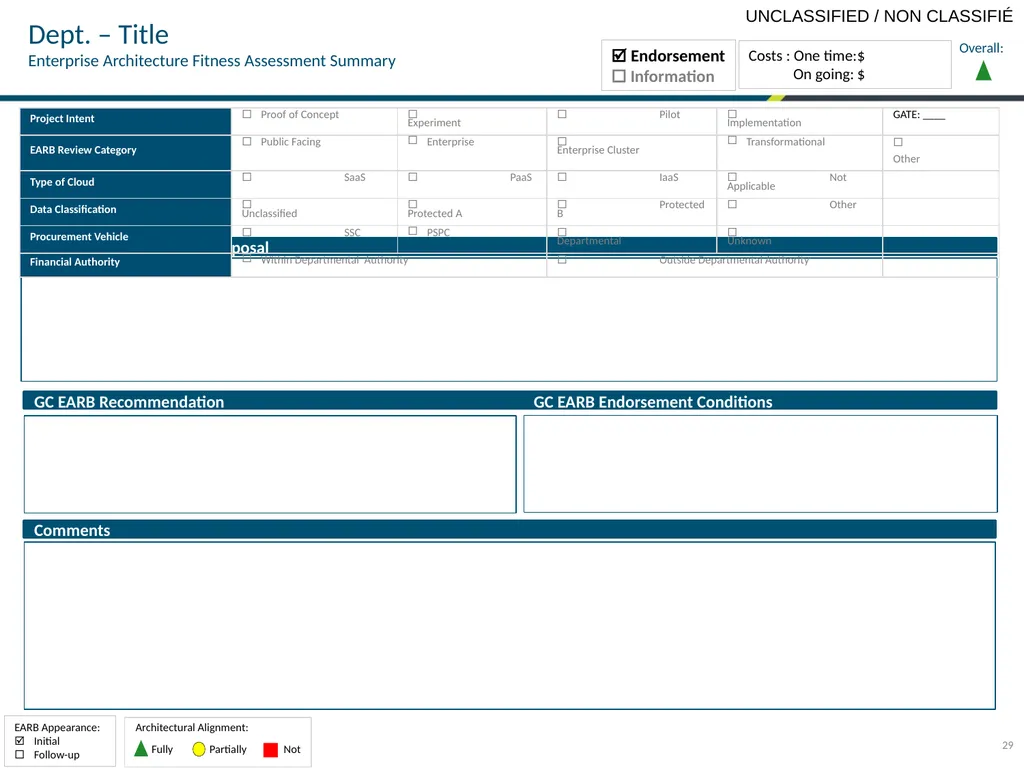
29 Dept. – Title
Enterprise Architecture Fitness Assessment Summary Endorsement
Information Costs : One time: $
On going: $ Describe the Investment Proposal Comments GC EARB Recommendation GC EARB Endorsement Conditions Overall: EARB Appearance:
Initial
Follow-up<br>
Information Costs : One time: $
On going: $ Describe the Investment Proposal Comments GC EARB Recommendation GC EARB Endorsement Conditions Overall: EARB Appearance:
Initial
Follow-up<br>
30
GC Architectural Standards 30 Mandatory Procedures for Enterprise Architecture Assessment Architectural Alignment:<br>
31
Digital Alignment<br>