01
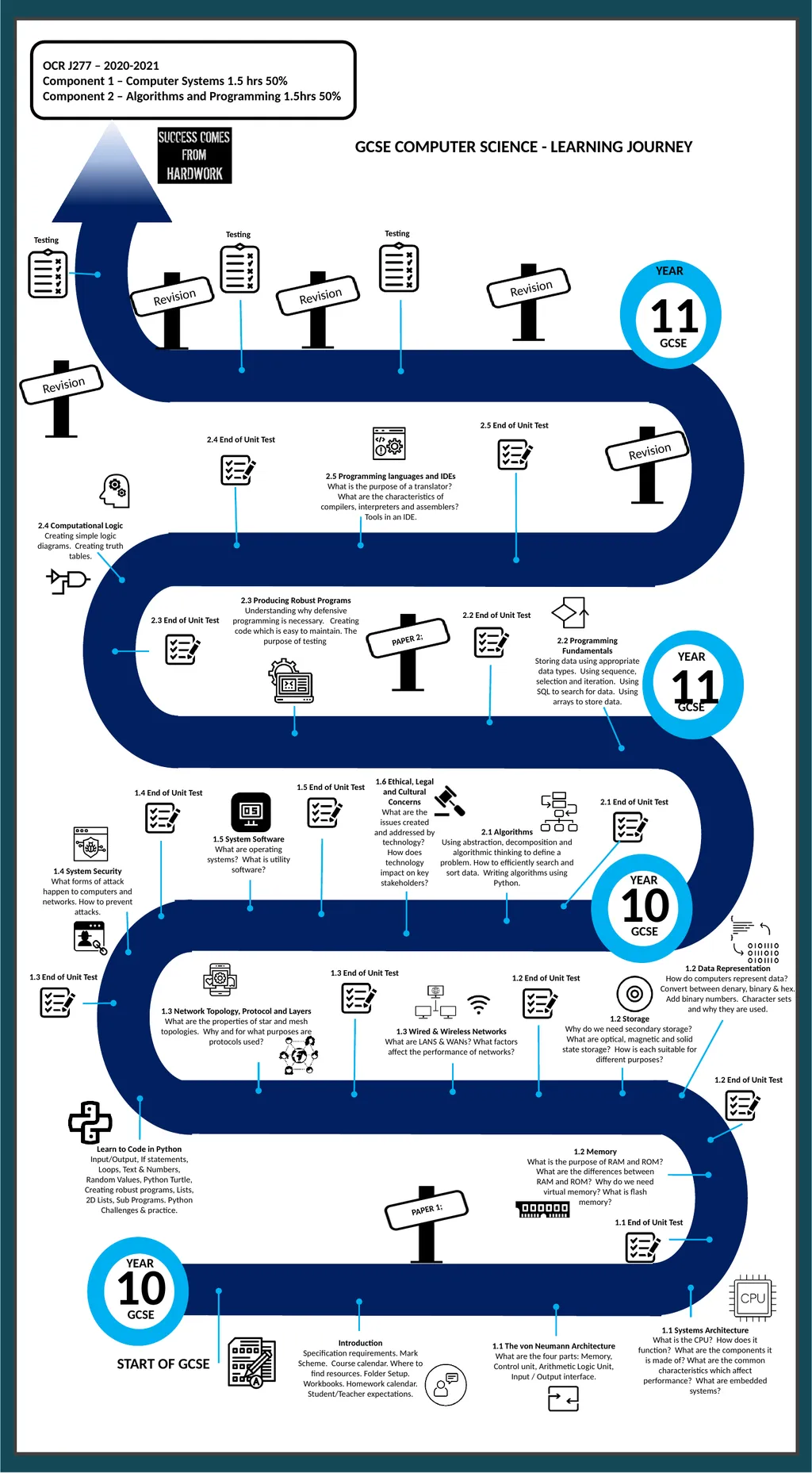
GCSE COMPUTER SCIENCE - LEARNING JOURNEY START OF GCSE 1.2 Data Representation
How do computers represent data? Convert between denary, binary & hex. Add binary numbers. Character sets and why they are used. 1.2 Memory
What is the purpose of RAM and ROM? What are the differences between RAM and ROM? Why do we need virtual memory? What is flash memory? 1.1 Systems Architecture
What is the CPU? How does it function? What are the components it is made of? What are the common characteristics which affect performance? What are embedded systems? 1.2 Storage
Why do we need secondary storage? What are optical, magnetic and solid state storage? How is each suitable for different purposes? 1.6 Ethical, Legal and Cultural Concerns
What are the issues created and addressed by technology? How does technology impact on key stakeholders? 2.1 Algorithms
Using abstraction, decomposition and algorithmic thinking to define a problem. How to efficiently search and sort data. Writing algorithms using Python. 2.2 Programming Fundamentals
Storing data using appropriate data types. Using sequence, selection and iteration. Using SQL to search for data. Using arrays to store data. 2.3 Producing Robust Programs
Understanding why defensive programming is necessary. Creating code which is easy to maintain. The purpose of testing 2.5 Programming languages and IDEs
What is the purpose of a translator? What are the characteristics of compilers, interpreters and assemblers? Tools in an IDE. 1.3 Wired & Wireless Networks
What are LANS & WANs? What factors affect the performance of networks? 1.3 Network Topology, Protocol and Layers
What are the properties of star and mesh topologies. Why and for what purposes are protocols used? 1.4 System Security
What forms of attack happen to computers and networks. How to prevent attacks. 2.4 Computational Logic
Creating simple logic diagrams. Creating truth tables. 1.5 System Software
What are operating systems? What is utility software? OCR J277 – 2020-2021
Component 1 – Computer Systems 1.5 hrs 50%
Component 2 – Algorithms and Programming 1.5hrs 50% Introduction
Specification requirements. Mark Scheme. Course calendar. Where to find resources. Folder Setup. Workbooks. Homework calendar. Student/Teacher expectations. 1.1 The von Neumann Architecture
What are the four parts: Memory, Control unit, Arithmetic Logic Unit, Input / Output interface. Learn to Code in Python
Input/Output, If statements, Loops, Text & Numbers, Random Values, Python Turtle, Creating robust programs, Lists, 2D Lists, Sub Programs. Python Challenges & practice.<br>