Gender Budgeting and Macroeconomic Policy Diane

Published  . 0 views
↓ Download
Gender Budgeting and Macroeconomic Policy Diane
1 / 1
Gender Budgeting and Macroeconomic Policy Diane - slide 1 of 8 Gender Budgeting and Macroeconomic Policy Diane - slide 2 of 8 Gender Budgeting and Macroeconomic Policy Diane - slide 3 of 8 Gender Budgeting and Macroeconomic Policy Diane - slide 4 of 8 Gender Budgeting and Macroeconomic Policy Diane - slide 5 of 8 Gender Budgeting and Macroeconomic Policy Diane - slide 6 of 8 Gender Budgeting and Macroeconomic Policy Diane - slide 7 of 8 Gender Budgeting and Macroeconomic Policy Diane - slide 8 of 8
Description: Gender Budgeting and Macroeconomic Policy Diane Elson, Chair Womens Budget Group Presentation to WBG Training Day, January 30th, 2015 Managing budget deficitssurpluses Government does not directly control deficitsurplus Controls only

Related Topics

Download Presentation

"Gender Budgeting and Macroeconomic Policy Diane" is the property of its rightful owner. Permission is granted to download and print the materials on this website for personal, non-commercial use only, and to display it on your personal computer provided you do not modify the materials and that you retain all copyright notices contained in the materials. By downloading content from our website, you accept the terms of this agreement.

Presentation Transcript

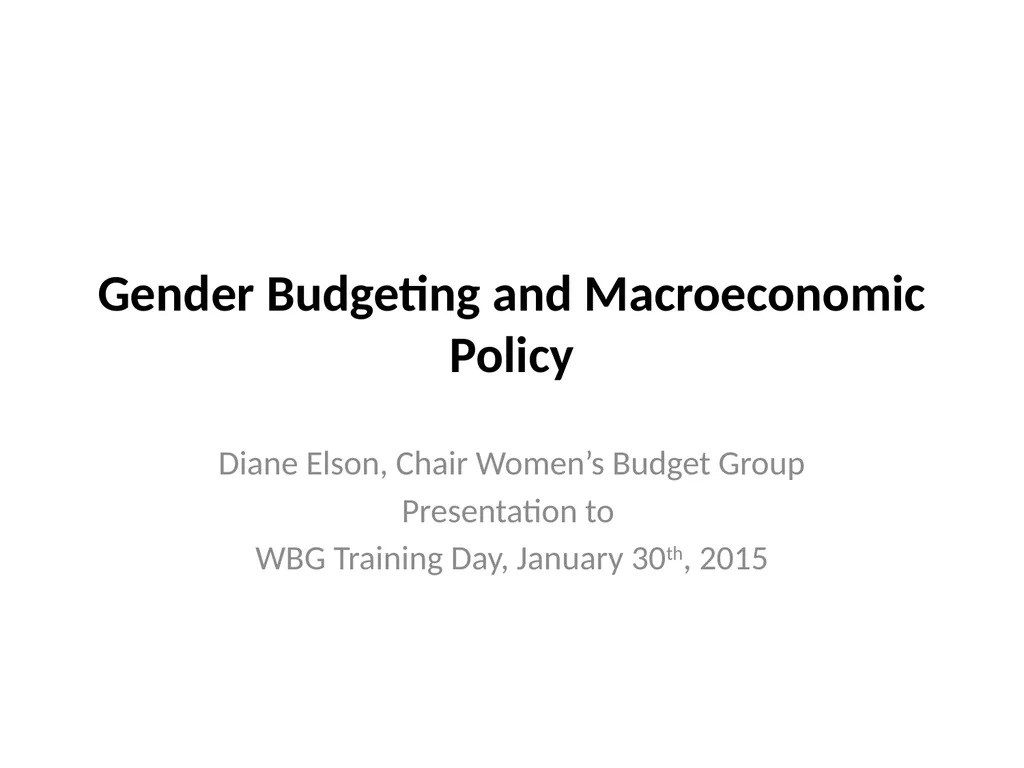
slide1. Gender Budgeting and Macroeconomic Policy Diane Elson, Chair Women’s Budget Group
Presentation to
WBG Training Day, January 30th, 2015<br>
slide2. Managing budget deficits/surpluses Government does not directly control deficit/surplus
Controls only some aspects of expenditure e.g. social security rates and conditions but not total payments
Controls only some aspects of taxation e.g. tax rates but not revenue
Expenditure cuts can cut revenue too and make deficit worse
Timing and speed of deficit reduction plan should be determined in relation to state of real economy- fast and untimely deficit reduction efforts can make a downturn worse and hamper recovery
A balanced budget or a surplus is not necessarily a good thing
Capitalist economies are inherently organized around credit and debt
Government debt may be preferable to private debt and may more easily be rolled over- depends on specific context
Currently UK government has no problem borrowing at low interest rates<br>
slide3. Recent Developments at UK level Charter for Budget Responsibility passed by House of Commons on 13th Jan 2015 , supported by Conservative, Liberal Democrat and Labour parties
Appears to commit next government to balance current account of budget by 2017/18
Implies continued and massive cuts in public expenditure
Osborne lecture to Royal Economic Society on 15th Jan 2015 set out plans for further new fiscal policy rules for period after 2017/18 requiring government to operate an overall budget surplus thereafter in ‘normal times’
Office for Budget Responsibility would decide when times are not ‘normal’
Surplus in normal times is apparently required to reduce debt levels, as high debt levels leave economy vulnerable to ‘shocks’
No recognition that likelihood of shocks depends on financial regulation and can be reduced by better regulation<br>
slide4. Gender Dimensions of Budget Deficit/ Surplus Gender differentiated impacts likely because:
Social security payments make up a greater share of women’s incomes than men’s, as women earn less in the labour market
Women pay less direct tax than men, as women earn less in labour market
Women make greater use of public services than men, linked to greater care responsibilities and greater use of care services
Higher proportion of women’s employment is in public sector than men’s
House of Commons Library research following AFS 2014 found that changes to direct taxes and social security introduced by Coalition Government since 2010 had raised £26 bn, of which £22 bn was taken from women, 85% of the total
To redress this in future:
Cut spending on social security less, raise more revenue from wealthy people and companies<br>
slide5. Impact on Different Households, Including Indirect Taxes and Cuts to Spending on Services Research by Howard Reed , member of UK Women’s Budget Group , shows total losses of for families in England as percentage of their household income , for all measures 2010-2015, are as follows:
single parents lose 15.1%, single women parents 15.6%
single pensioners lose 11.6%, single women pensioners 12.5 %
couples with children lose 9.7%,
single adults with no children lose 9.7%, single women 10.9%
couple pensioners lose 8.6%
couples with no children lose 4.1%.
The two groups in which women predominate, single parents and single pensioners, lose most.<br>
slide6. Reducing Adverse Impact on Women of Cuts to Public Services Conservative Party objective of achieving balance in budget current account by 2017/18 and aiming thereafter for an overall budget surplus means no chance of reversing the adverse impact
Care services are not ‘protected’
Labour Party objective of achieving balance in budget current account by 2017/18 but allowing a capital account deficit and borrowing for investment sounds better
But investment is defined in the budget accounts as spending on construction of fixed assets
May get more nurseries , hospitals and care homes - but no staff to operate them<br>
slide7. Challenging Definitions of Public Investment in the System of National Accounts Feminists have already challenged the System of National Account for ignoring unpaid work and the output it produces
Now we must challenge the definition of investment, which has not caught up with the growing recognition of the importance of investment in people, their health, education, and well- being
Care services do not just produce immediate benefits that are consumed as they are produced
Care services produce long lasting returns like fixed assets do
Feminist economists define care services as social infrastructure , for which borrowing should be permitted , like physical infrastructure<br>
slide8. Investing in Life or Investing in Death? SNA classifications can be changed
European System of National Accounts was revised in 2010
Among the changes is that expenditures on weapon systems (comprising vehicles and other equipment such as warships, submarines, military aircrafts, tanks, missile carriers and launchers etc.) have been classified as fixed capital formation
Implication, in relation to Charter for Budget Responsibility:
UK government can borrow to build a new Trident submarine without breaching Charter, but not to develop high quality care services
Gender budgeting requires we challenge this: we want investment in life not death<br>