GENERAL OOP CONCEPTS CHAPTER 5 OBJECT ORIENTED PROGRAMMING OBJECT is an identifiable entity with some characteristics and behavior. In OOP programming object represents a entity that can store data and has its interface through functions.
"GENERAL OOP CONCEPTS CHAPTER 5 OBJECT ORIENTED" is the property of its rightful owner. Permission is granted to
download and print the materials on this website for personal, non-commercial use only, and to display it
on your personal computer provided you do not modify the materials and that you retain all copyright
notices contained in the materials. By downloading content from our website, you accept the terms of this
agreement.
Presentation Transcript
01
GENERAL OOP CONCEPTS CHAPTER 5<br>
02
OBJECT ORIENTED
PROGRAMMING<br>
03
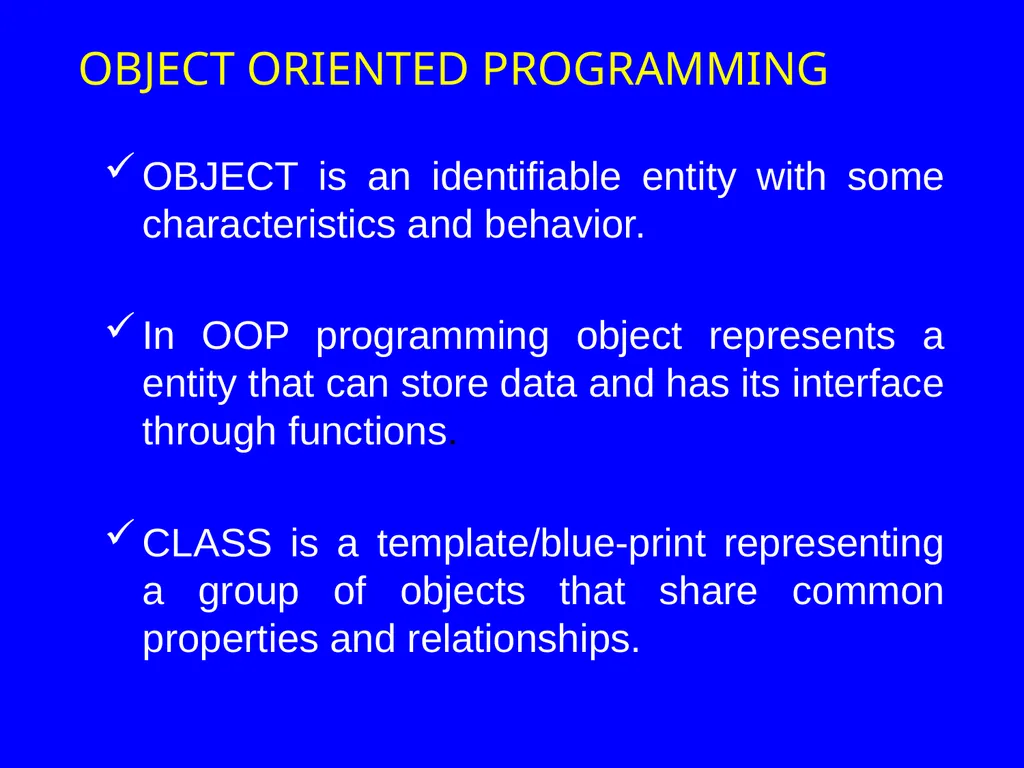
OBJECT is an identifiable entity with some characteristics and behavior.
In OOP programming object represents a entity that can store data and has its interface through functions.
CLASS is a template/blue-print representing a group of objects that share common properties and relationships. OBJECT ORIENTED PROGRAMMING<br>
04
DATA ABSTRACTION ABSTRACTION refers to the act of representing essential features without including the background details or explanations.
It focuses upon the observable behavior of an object.<br>
05
ENCAPSULATION The wrapping up of data and operations / functions (that operate on the data ) into a single unit (called class) is known as ENCAPSULATION.
Encapsulation is a way to implement data abstraction. It hides the details of the implementation of an object.
It focuses upon the implementation that gives rise to observable behavior.<br>
06
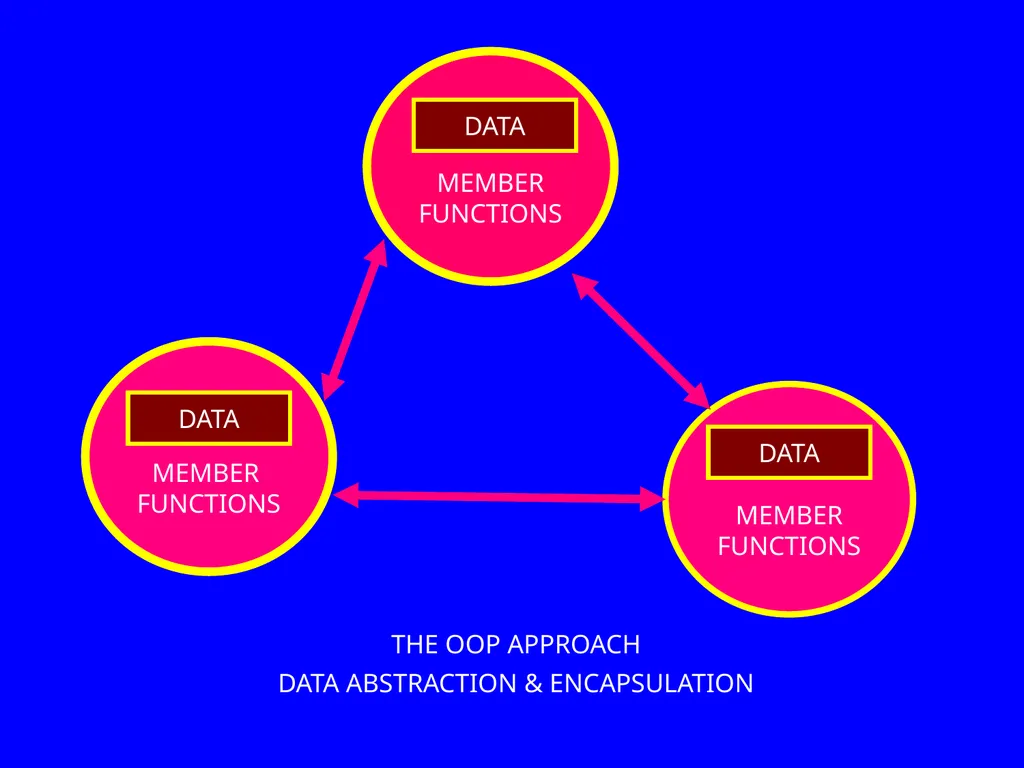
MEMBER
FUNCTIONS MEMBER
FUNCTIONS MEMBER
FUNCTIONS DATA DATA DATA THE OOP APPROACH
DATA ABSTRACTION & ENCAPSULATION<br>
07
MODULARITY It is the property of a system that has been decomposed into a set of cohesive and loosely coupled modules.
It reduces complexity of program
It Creates a number of well-defined, documented boundaries within the program.<br>
08
Inheritance is the capability of one class of things to inherit capabilities or properties from other class. Why inheritance was introduced into OO languages ? UP NEXT<br>
09
INHERITANCE + POINTS Capability to express the inheritance relationship which makes it ensure closeness with real world models.
Idea of reusability. It allows addition of additional features to an existing class without modifying it. A subclass defines only those features which are unique to it.
If a class A inherits properties of another class B, then all subclasses of A will automatically inherit the properties of B. This is called transitive nature of inheritance.<br>
10
POLYMORPHISM It is the ability for a message or data to be processed in more than one form.
It is a property by which the same message can be sent to objects of several different classes, & each object can respond in a different way depending on its class. Languages that support classes but not polymorphism are called OBJECT BASED languages.<br>
11
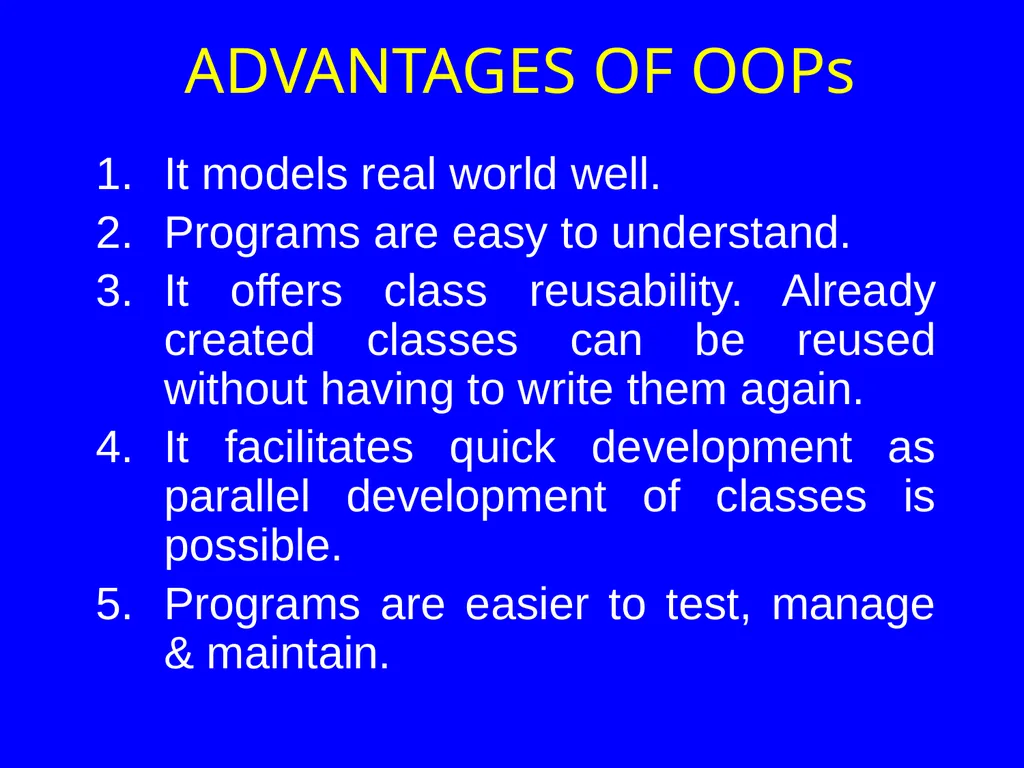
It models real world well.
Programs are easy to understand.
It offers class reusability. Already created classes can be reused without having to write them again.
It facilitates quick development as parallel development of classes is possible.
Programs are easier to test, manage & maintain. ADVANTAGES OF OOPs<br>
12
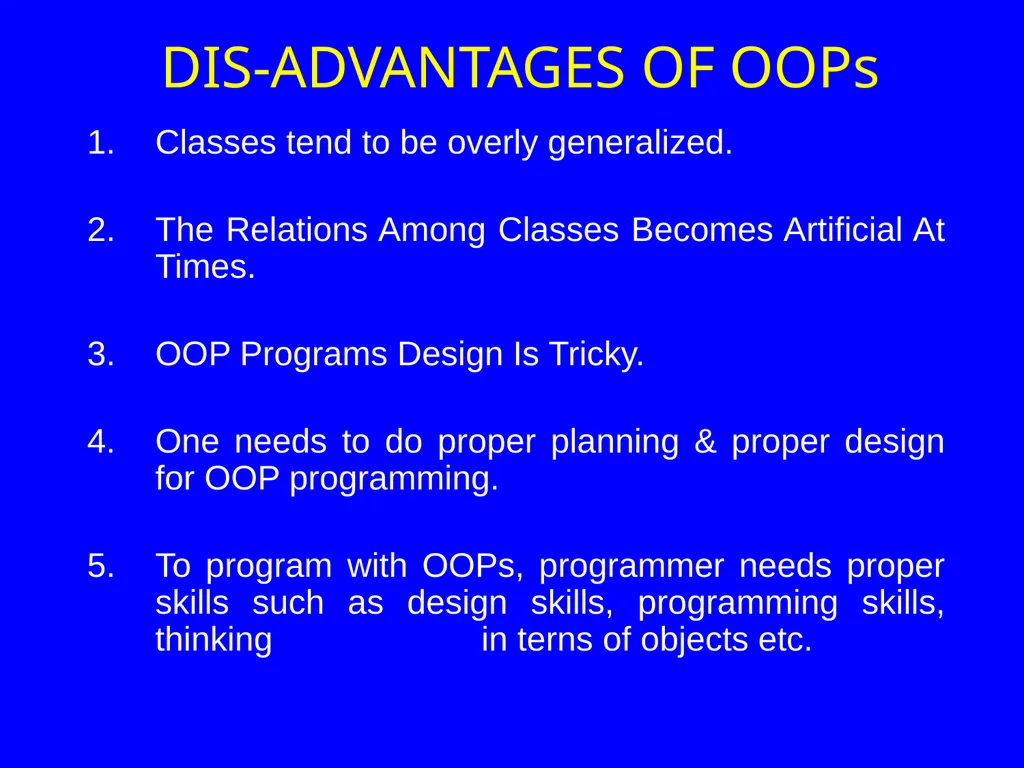
Classes tend to be overly generalized.
The Relations Among Classes Becomes Artificial At Times.
OOP Programs Design Is Tricky.
One needs to do proper planning & proper design for OOP programming.
To program with OOPs, programmer needs proper skills such as design skills, programming skills, thinking in terns of objects etc. DIS-ADVANTAGES OF OOPs<br>