
Generalising relationships using algebraic
SB
Published · 37 slides · 0 views
1 / 1
Description
Generalising relationships using algebraic statements (From 1.4 Simplifying and manipulating expressions, equations and formulae) KS3 Mastery PD Materials: Exemplified Key Ideas Materials for use in the classroom or to support professional
Related Topics
Share
Embed code
Download this presentation From Below
"Generalising relationships using algebraic" is the property of its rightful owner. Permission is granted to download and print the materials on this website for personal, non-commercial use only, and to display it on your personal computer provided you do not modify the materials and that you retain all copyright notices contained in the materials. By downloading content from our website, you accept the terms of this agreement.
Presentation Transcript
01
Generalising relationships using algebraic statements (From 1.4 Simplifying and manipulating expressions, equations and formulae) KS3 Mastery PD Materials: Exemplified Key Ideas
Materials for use in the classroom or to support professional development discussions Summer 2021<br>
Materials for use in the classroom or to support professional development discussions Summer 2021<br>
02
About this resource These slides are designed to complement the 1.4 Simplifying and manipulating expressions, equations and formulae Core Concept document and its associated Theme Overview document 1 The Structure of the number system, both found in the Secondary Mastery Professional Development pages.
These slides re-present the key examples from the Core Concept document so that the examples can be used either directly in the classroom or with a group of teachers. There are prompt questions alongside the examples, and further clarification in the notes.
These slides do not fully replicate the Core Concept document, so should be used alongside it. Reference to specific page numbers, and to other useful NCETM resources, can be found in the notes for each slide.
This slide deck is not designed to be a complete PD session, rather it is a selection of resources that you can adapt and use as needed when planning a session with a group of teachers.<br>
These slides re-present the key examples from the Core Concept document so that the examples can be used either directly in the classroom or with a group of teachers. There are prompt questions alongside the examples, and further clarification in the notes.
These slides do not fully replicate the Core Concept document, so should be used alongside it. Reference to specific page numbers, and to other useful NCETM resources, can be found in the notes for each slide.
This slide deck is not designed to be a complete PD session, rather it is a selection of resources that you can adapt and use as needed when planning a session with a group of teachers.<br>
03
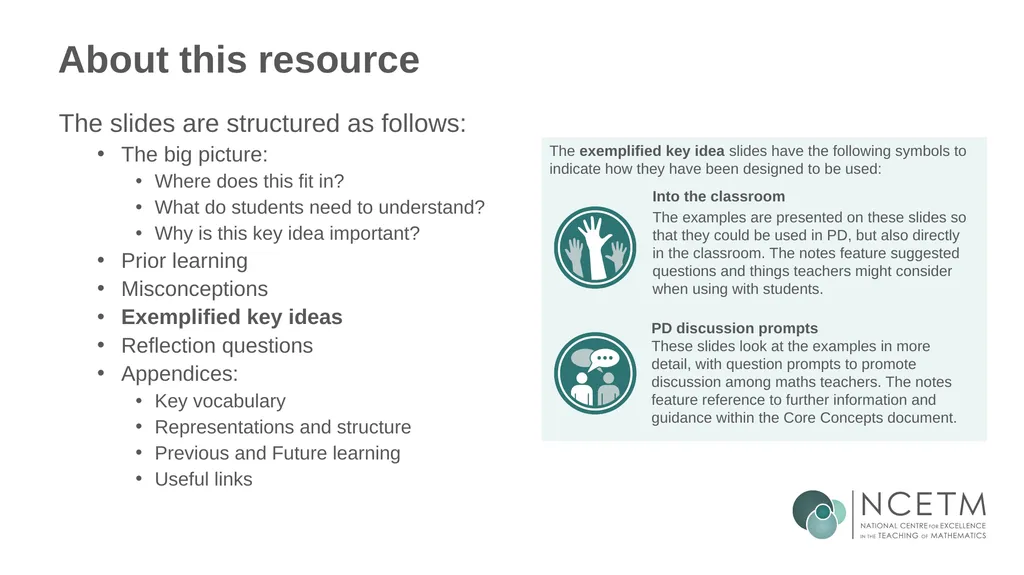
About this resource The slides are structured as follows:
The big picture:
Where does this fit in?
What do students need to understand?
Why is this key idea important?
Prior learning
Misconceptions
Exemplified key ideas
Reflection questions
Appendices:
Key vocabulary
Representations and structure
Previous and Future learning
Useful links The exemplified key idea slides have the following symbols to indicate how they have been designed to be used: Into the classroom
The examples are presented on these slides so that they could be used in PD, but also directly in the classroom. The notes feature suggested questions and things teachers might consider when using with students. PD discussion prompts
These slides look at the examples in more detail, with question prompts to promote discussion among maths teachers. The notes feature reference to further information and guidance within the Core Concepts document.<br>
The big picture:
Where does this fit in?
What do students need to understand?
Why is this key idea important?
Prior learning
Misconceptions
Exemplified key ideas
Reflection questions
Appendices:
Key vocabulary
Representations and structure
Previous and Future learning
Useful links The exemplified key idea slides have the following symbols to indicate how they have been designed to be used: Into the classroom
The examples are presented on these slides so that they could be used in PD, but also directly in the classroom. The notes feature suggested questions and things teachers might consider when using with students. PD discussion prompts
These slides look at the examples in more detail, with question prompts to promote discussion among maths teachers. The notes feature reference to further information and guidance within the Core Concepts document.<br>
04
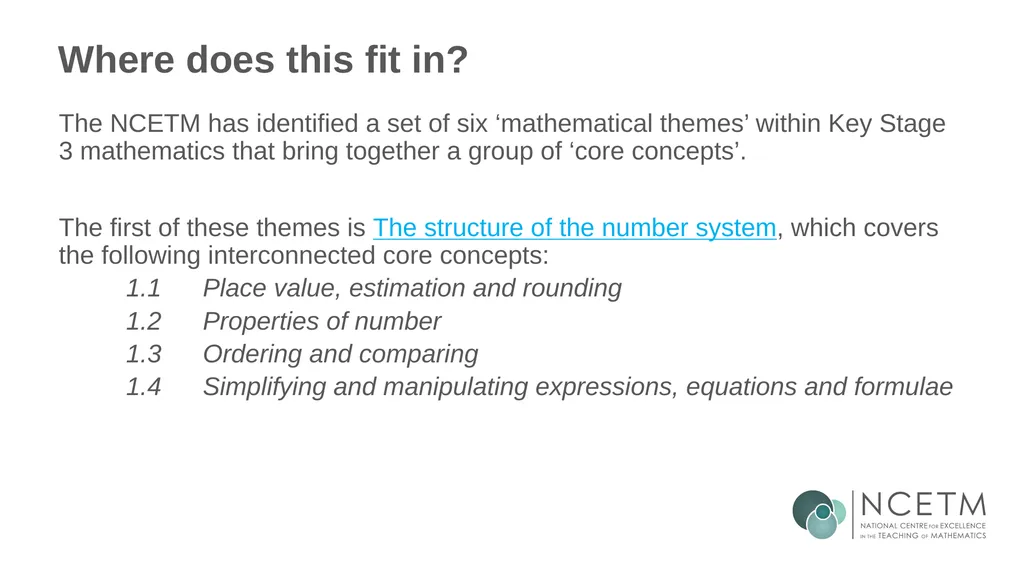
Where does this fit in? The NCETM has identified a set of six ‘mathematical themes’ within Key Stage 3 mathematics that bring together a group of ‘core concepts’.
The first of these themes is The structure of the number system, which covers the following interconnected core concepts:
1.1 Place value, estimation and rounding
1.2 Properties of number
1.3 Ordering and comparing
1.4 Simplifying and manipulating expressions, equations and formulae<br>
The first of these themes is The structure of the number system, which covers the following interconnected core concepts:
1.1 Place value, estimation and rounding
1.2 Properties of number
1.3 Ordering and comparing
1.4 Simplifying and manipulating expressions, equations and formulae<br>
05
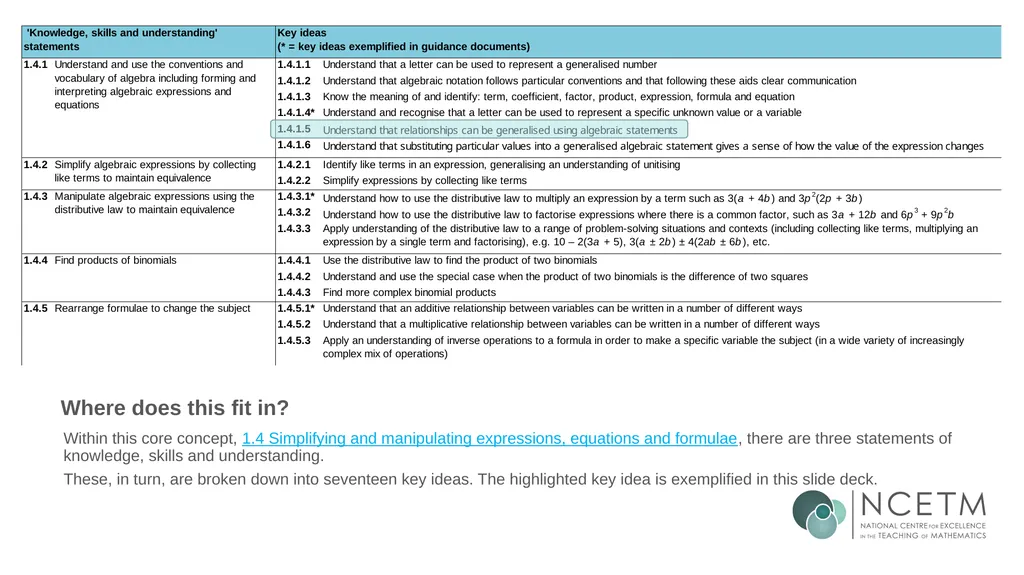
Where does this fit in? Within this core concept, 1.4 Simplifying and manipulating expressions, equations and formulae, there are three statements of knowledge, skills and understanding.
These, in turn, are broken down into seventeen key ideas. The highlighted key idea is exemplified in this slide deck.<br>
These, in turn, are broken down into seventeen key ideas. The highlighted key idea is exemplified in this slide deck.<br>
06
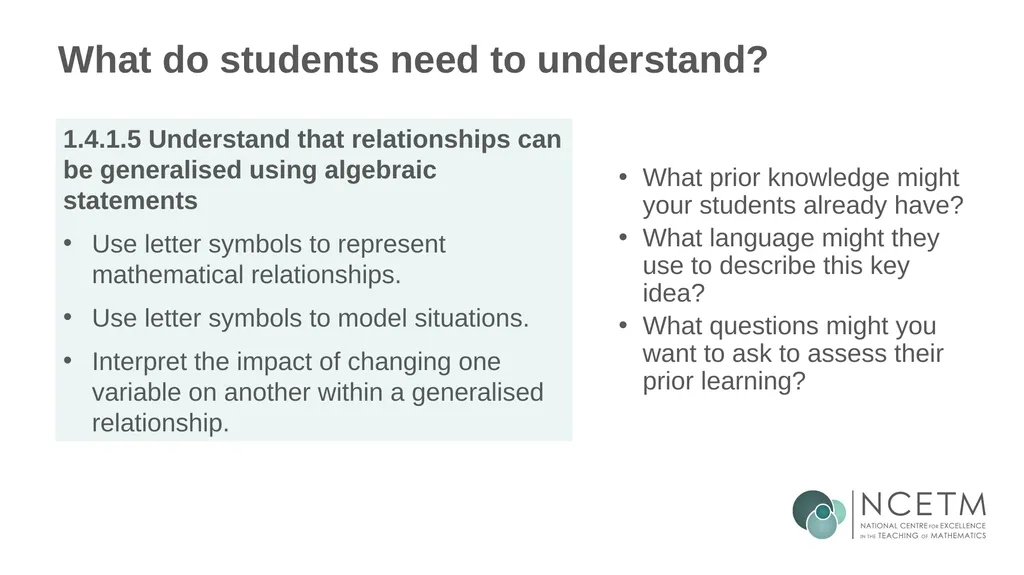
What do students need to understand? What prior knowledge might your students already have?
What language might they use to describe this key idea?
What questions might you want to ask to assess their prior learning? 1.4.1.5 Understand that relationships can be generalised using algebraic statements
Use letter symbols to represent mathematical relationships.
Use letter symbols to model situations.
Interpret the impact of changing one variable on another within a generalised relationship.<br>
What language might they use to describe this key idea?
What questions might you want to ask to assess their prior learning? 1.4.1.5 Understand that relationships can be generalised using algebraic statements
Use letter symbols to represent mathematical relationships.
Use letter symbols to model situations.
Interpret the impact of changing one variable on another within a generalised relationship.<br>
07
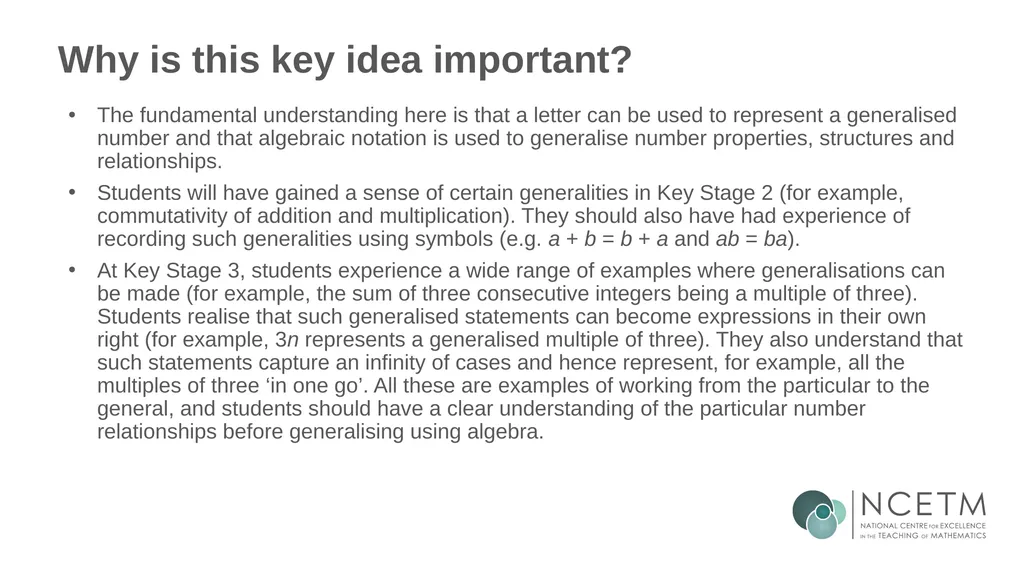
Why is this key idea important? The fundamental understanding here is that a letter can be used to represent a generalised number and that algebraic notation is used to generalise number properties, structures and relationships.
Students will have gained a sense of certain generalities in Key Stage 2 (for example, commutativity of addition and multiplication). They should also have had experience of recording such generalities using symbols (e.g. a + b = b + a and ab = ba).
At Key Stage 3, students experience a wide range of examples where generalisations can be made (for example, the sum of three consecutive integers being a multiple of three). Students realise that such generalised statements can become expressions in their own right (for example, 3n represents a generalised multiple of three). They also understand that such statements capture an infinity of cases and hence represent, for example, all the multiples of three ‘in one go’. All these are examples of working from the particular to the general, and students should have a clear understanding of the particular number relationships before generalising using algebra.<br>
Students will have gained a sense of certain generalities in Key Stage 2 (for example, commutativity of addition and multiplication). They should also have had experience of recording such generalities using symbols (e.g. a + b = b + a and ab = ba).
At Key Stage 3, students experience a wide range of examples where generalisations can be made (for example, the sum of three consecutive integers being a multiple of three). Students realise that such generalised statements can become expressions in their own right (for example, 3n represents a generalised multiple of three). They also understand that such statements capture an infinity of cases and hence represent, for example, all the multiples of three ‘in one go’. All these are examples of working from the particular to the general, and students should have a clear understanding of the particular number relationships before generalising using algebra.<br>
08
Prior learning What prior knowledge might your students already have?
What language might they use to describe this key idea?
What questions might you want to ask to assess their prior learning?<br>
What language might they use to describe this key idea?
What questions might you want to ask to assess their prior learning?<br>
09
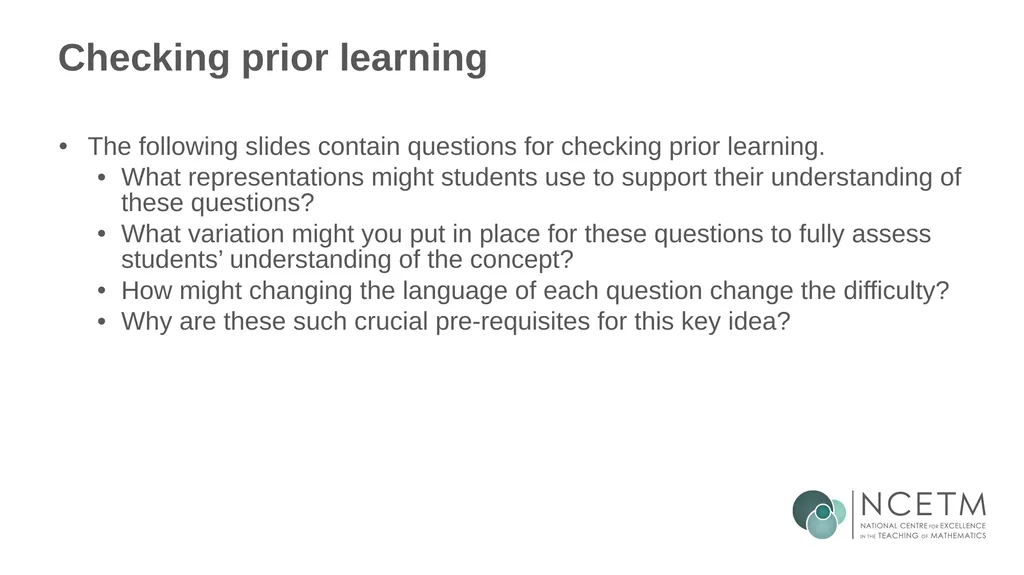
Checking prior learning The following slides contain questions for checking prior learning.
What representations might students use to support their understanding of these questions?
What variation might you put in place for these questions to fully assess students’ understanding of the concept?
How might changing the language of each question change the difficulty?
Why are these such crucial pre-requisites for this key idea?<br>
What representations might students use to support their understanding of these questions?
What variation might you put in place for these questions to fully assess students’ understanding of the concept?
How might changing the language of each question change the difficulty?
Why are these such crucial pre-requisites for this key idea?<br>
10
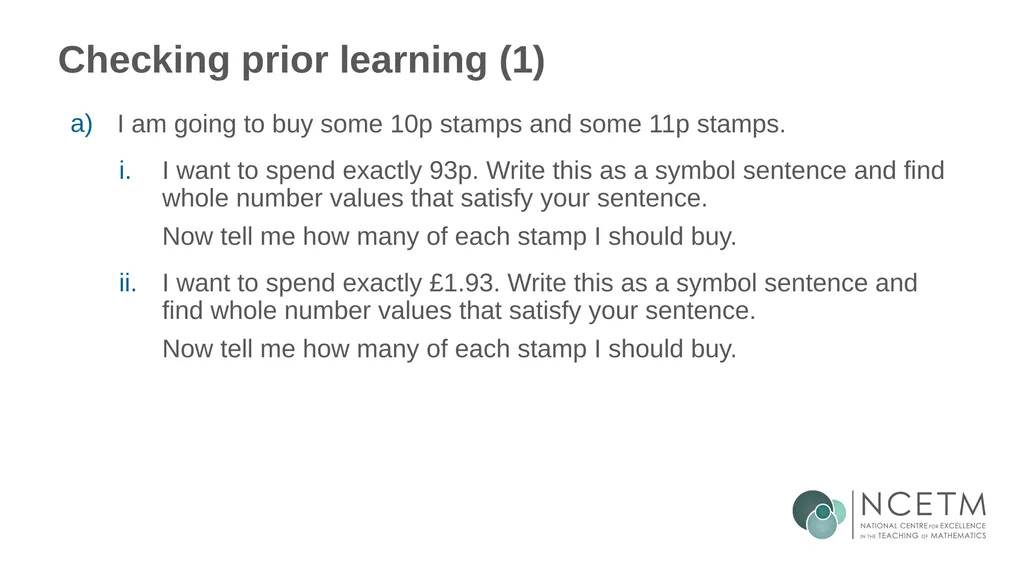
Checking prior learning (1) I am going to buy some 10p stamps and some 11p stamps.
I want to spend exactly 93p. Write this as a symbol sentence and find whole number values that satisfy your sentence.
Now tell me how many of each stamp I should buy.
I want to spend exactly £1.93. Write this as a symbol sentence and find whole number values that satisfy your sentence.
Now tell me how many of each stamp I should buy. a)<br>
I want to spend exactly 93p. Write this as a symbol sentence and find whole number values that satisfy your sentence.
Now tell me how many of each stamp I should buy.
I want to spend exactly £1.93. Write this as a symbol sentence and find whole number values that satisfy your sentence.
Now tell me how many of each stamp I should buy. a)<br>
11
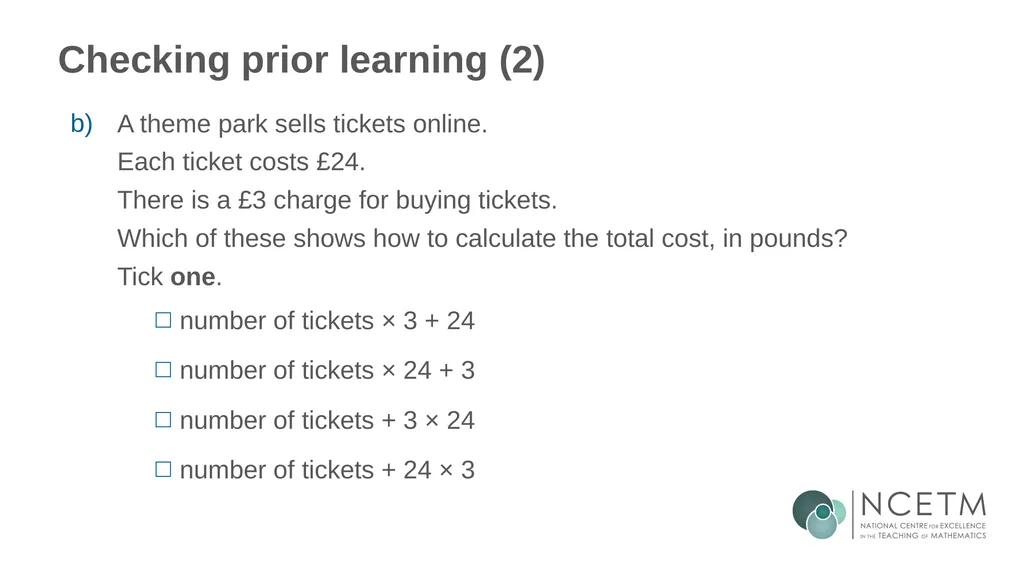
Checking prior learning (2) A theme park sells tickets online.
Each ticket costs £24.
There is a £3 charge for buying tickets.
Which of these shows how to calculate the total cost, in pounds?
Tick one.
number of tickets × 3 + 24
number of tickets × 24 + 3
number of tickets + 3 × 24
number of tickets + 24 × 3 b)<br>
Each ticket costs £24.
There is a £3 charge for buying tickets.
Which of these shows how to calculate the total cost, in pounds?
Tick one.
number of tickets × 3 + 24
number of tickets × 24 + 3
number of tickets + 3 × 24
number of tickets + 24 × 3 b)<br>
12
Common difficulties and misconceptions What aspects of this key idea might pupils find challenging?
What misconceptions might pupils have? When teaching this topic, you may find students encounter difficulties with…
Interpreting the relationships in equations or formulae
Leaving their answers as expressions or equations
More information, and some suggestions for overcoming these challenges, can be found on the following slides.<br>
What misconceptions might pupils have? When teaching this topic, you may find students encounter difficulties with…
Interpreting the relationships in equations or formulae
Leaving their answers as expressions or equations
More information, and some suggestions for overcoming these challenges, can be found on the following slides.<br>
13
Common difficulties and misconceptions (1) Students often interpret an algebraic formula or equation as a set of instructions to be followed, or as a problem to be solved, rather than understanding the symbols as a representation of a relationship. It can be useful to give them opportunities to work between different representations, including language, symbolic and graphical representations, to compare and identify equality and then to see how this relationship is captured in each representation.
Students’ intuition to use the letter symbol as shorthand may also lead to errors. For example, when asked to write a formula connecting the number of days in a week and the number of weeks, many students may write 7d = w (maybe reading this as seven days equals one week) where the correct formula should be 7w = d. Again, using specific language to describe the relationship in words can help raise awareness of this.<br>
Students’ intuition to use the letter symbol as shorthand may also lead to errors. For example, when asked to write a formula connecting the number of days in a week and the number of weeks, many students may write 7d = w (maybe reading this as seven days equals one week) where the correct formula should be 7w = d. Again, using specific language to describe the relationship in words can help raise awareness of this.<br>
14
Common difficulties and misconceptions (2) Students may feel uncomfortable leaving their ‘answer’ as an expression or equation. An error such as rewriting 7 + m as 7m might not simply be a lack of understanding of the conventions of algebra, or the relationship being recorded, but that the student has not accepted ‘lack of closure’ (Collis, 1978) and believes that their answer should be a single number or term.<br>
15
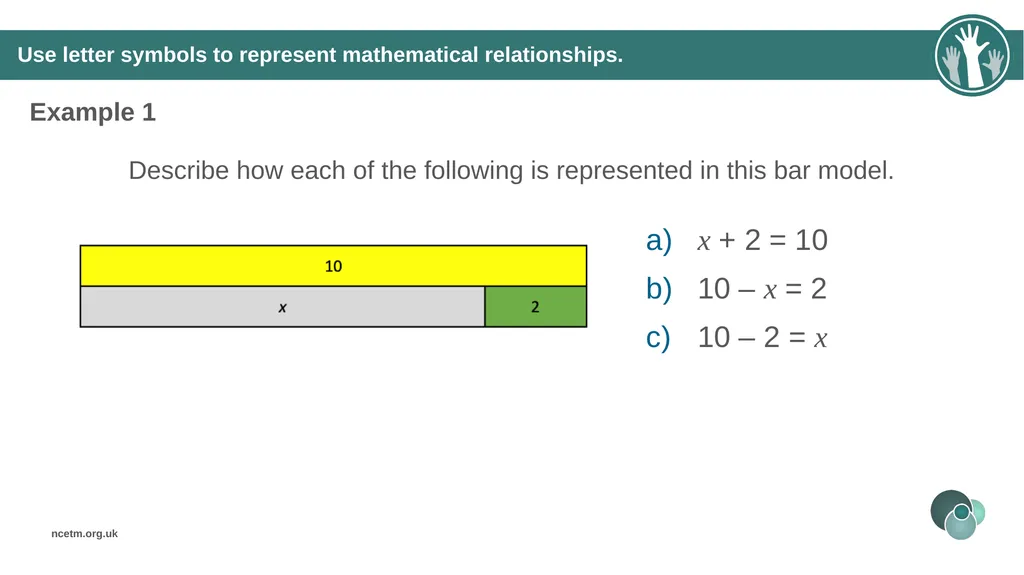
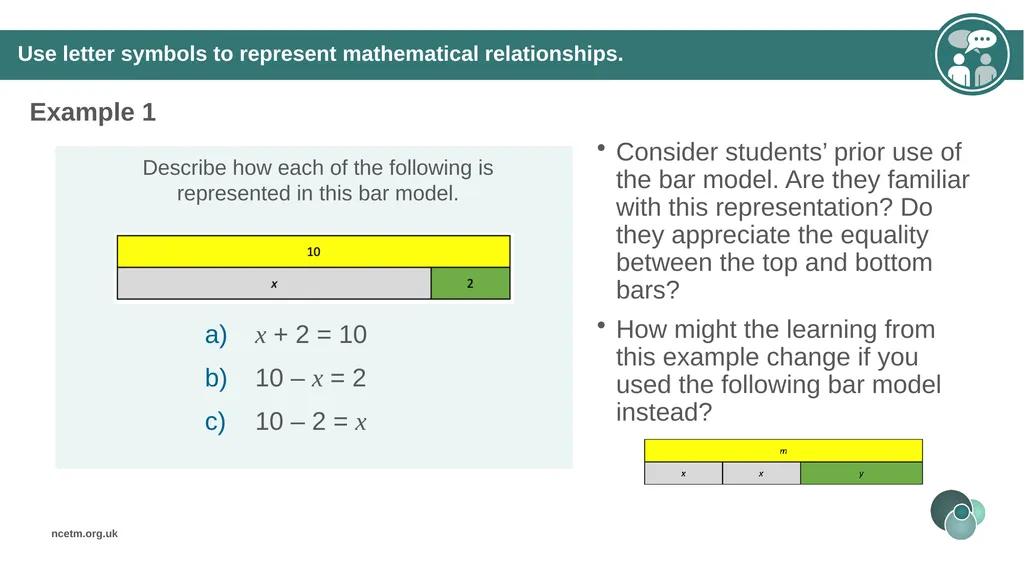
Use letter symbols to represent mathematical relationships. Example 1 Describe how each of the following is represented in this bar model. x + 2 = 10
10 – x = 2
10 – 2 = x<br>
10 – x = 2
10 – 2 = x<br>
16
Use letter symbols to represent mathematical relationships. Example 1 Consider students’ prior use of the bar model. Are they familiar with this representation? Do they appreciate the equality between the top and bottom bars?
How might the learning from this example change if you used the following bar model instead?<br>
How might the learning from this example change if you used the following bar model instead?<br>
17
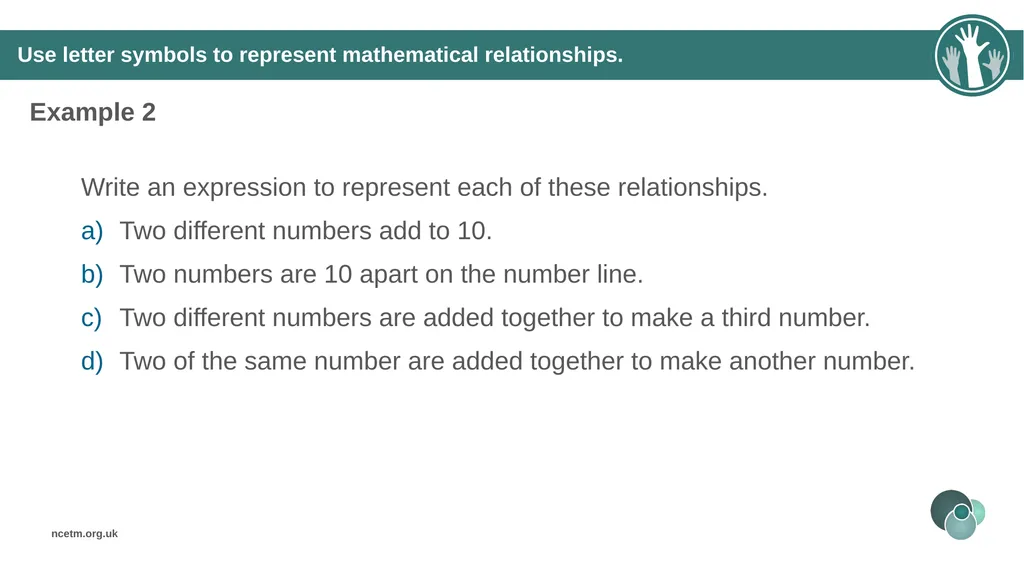
Use letter symbols to represent mathematical relationships. Example 2 Write an expression to represent each of these relationships.
Two different numbers add to 10.
Two numbers are 10 apart on the number line.
Two different numbers are added together to make a third number.
Two of the same number are added together to make another number.<br>
Two different numbers add to 10.
Two numbers are 10 apart on the number line.
Two different numbers are added together to make a third number.
Two of the same number are added together to make another number.<br>
18
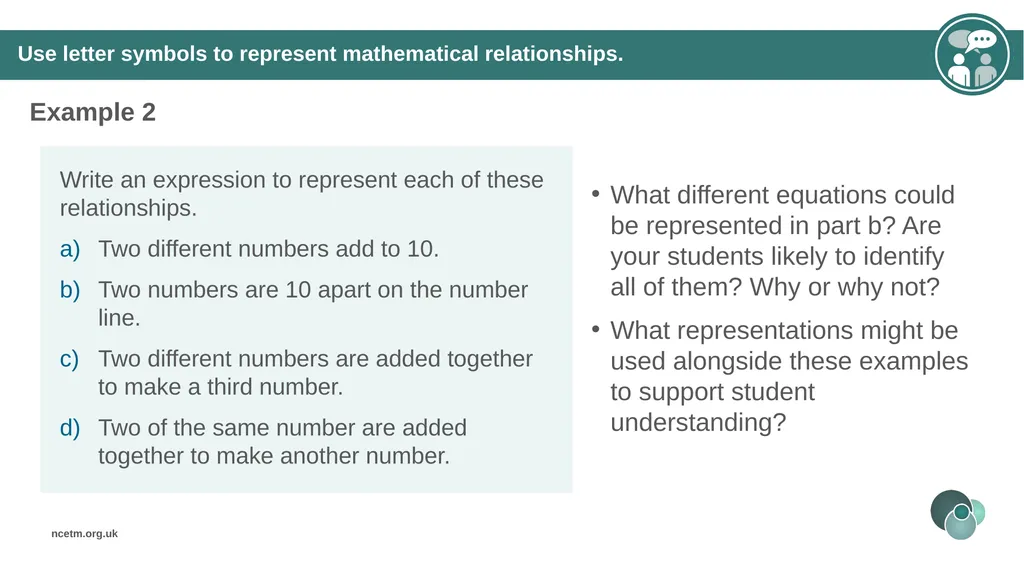
Use letter symbols to represent mathematical relationships. Example 2 What different equations could be represented in part b? Are your students likely to identify all of them? Why or why not?
What representations might be used alongside these examples to support student understanding?<br>
What representations might be used alongside these examples to support student understanding?<br>
19
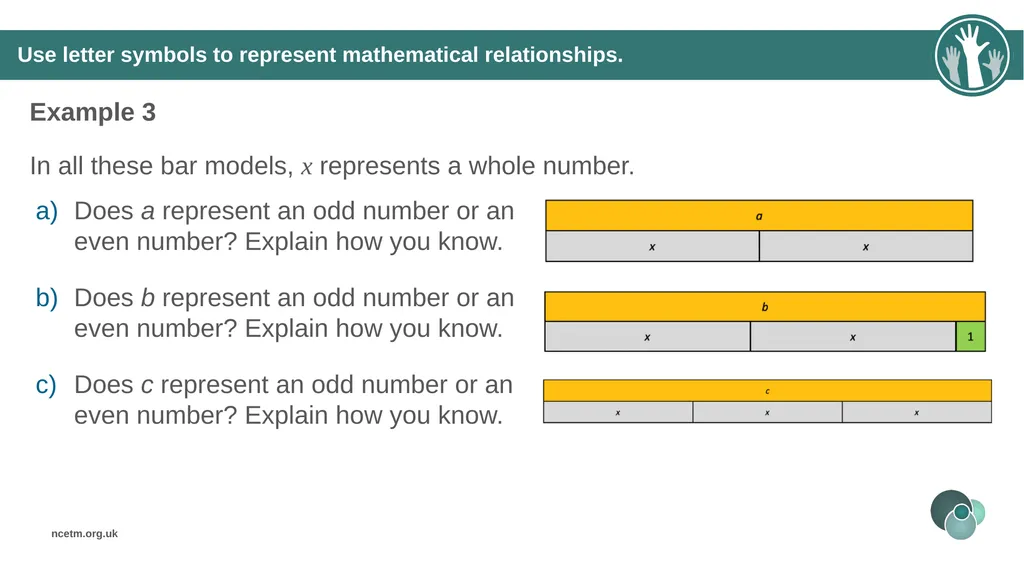
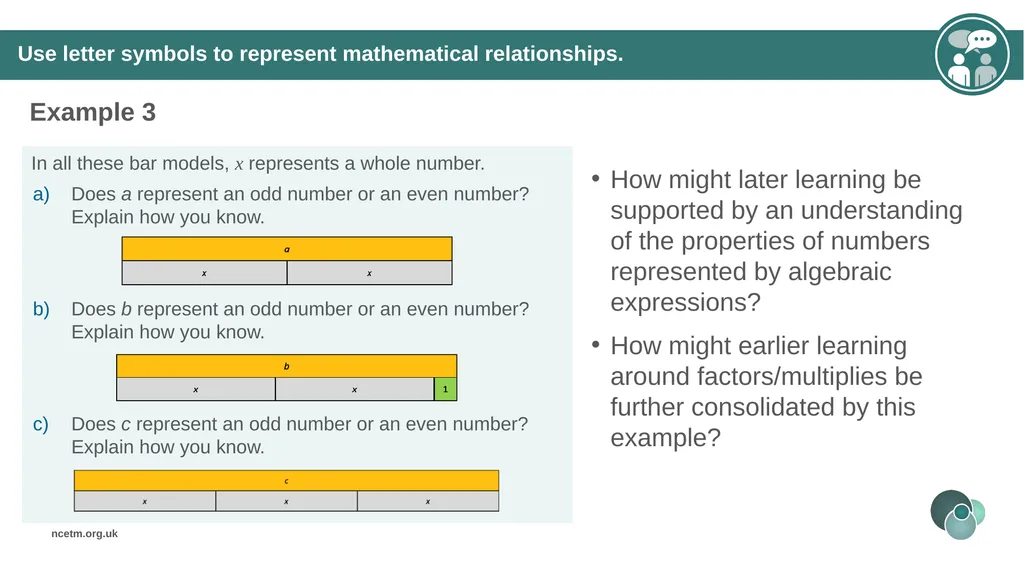
Use letter symbols to represent mathematical relationships. Example 3 In all these bar models, x represents a whole number. Does a represent an odd number or an even number? Explain how you know.
Does b represent an odd number or an even number? Explain how you know.
Does c represent an odd number or an even number? Explain how you know.<br>
Does b represent an odd number or an even number? Explain how you know.
Does c represent an odd number or an even number? Explain how you know.<br>
20
Use letter symbols to represent mathematical relationships. Example 3 How might later learning be supported by an understanding of the properties of numbers represented by algebraic expressions?
How might earlier learning around factors/multiplies be further consolidated by this example? In all these bar models, x represents a whole number. Does a represent an odd number or an even number? Explain how you know.
Does b represent an odd number or an even number? Explain how you know.
Does c represent an odd number or an even number? Explain how you know.<br>
How might earlier learning around factors/multiplies be further consolidated by this example? In all these bar models, x represents a whole number. Does a represent an odd number or an even number? Explain how you know.
Does b represent an odd number or an even number? Explain how you know.
Does c represent an odd number or an even number? Explain how you know.<br>
21
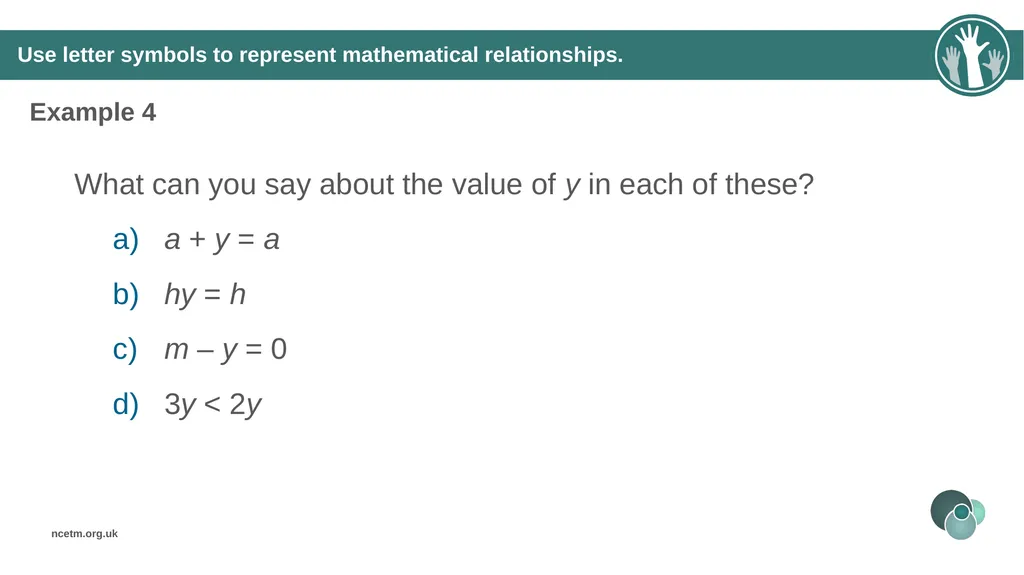
Use letter symbols to represent mathematical relationships. Example 4 What can you say about the value of y in each of these?
a + y = a
hy = h
m – y = 0
3y < 2y<br>
a + y = a
hy = h
m – y = 0
3y < 2y<br>
22
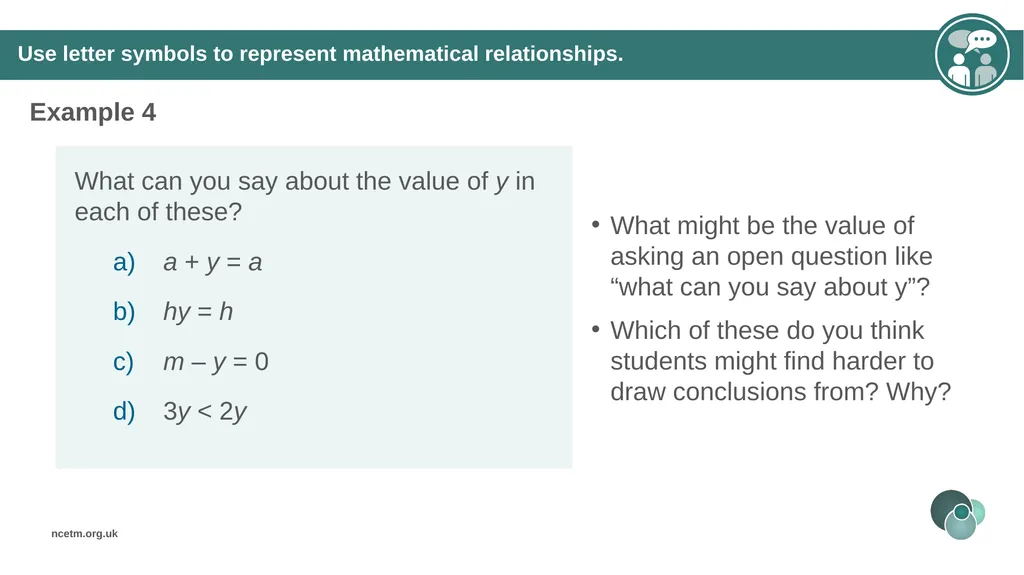
Use letter symbols to represent mathematical relationships. Example 4 What might be the value of asking an open question like “what can you say about y”?
Which of these do you think students might find harder to draw conclusions from? Why?<br>
Which of these do you think students might find harder to draw conclusions from? Why?<br>
23
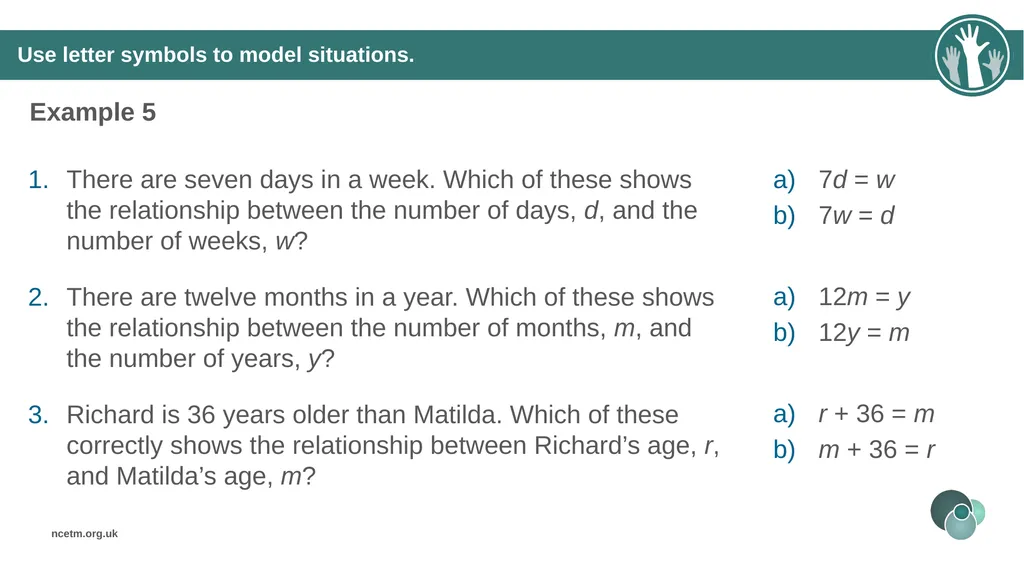
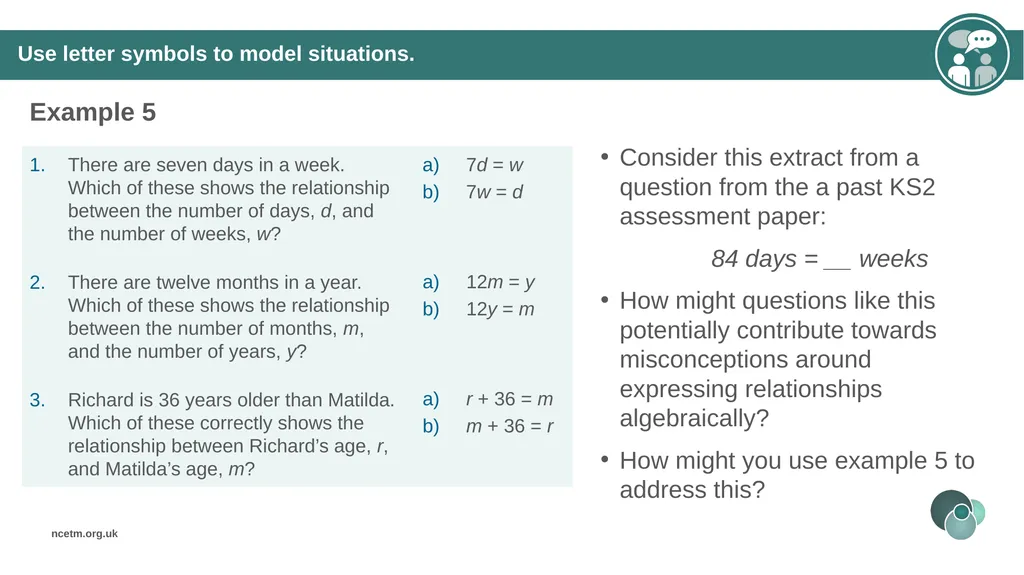
Use letter symbols to model situations. Example 5 There are seven days in a week. Which of these shows the relationship between the number of days, d, and the number of weeks, w?
There are twelve months in a year. Which of these shows the relationship between the number of months, m, and the number of years, y?
Richard is 36 years older than Matilda. Which of these correctly shows the relationship between Richard’s age, r, and Matilda’s age, m? 7d = w
7w = d 12m = y
12y = m r + 36 = m
m + 36 = r<br>
There are twelve months in a year. Which of these shows the relationship between the number of months, m, and the number of years, y?
Richard is 36 years older than Matilda. Which of these correctly shows the relationship between Richard’s age, r, and Matilda’s age, m? 7d = w
7w = d 12m = y
12y = m r + 36 = m
m + 36 = r<br>
24
Use letter symbols to model situations. Example 5 Consider this extract from a question from the a past KS2 assessment paper:
84 days = __ weeks
How might questions like this potentially contribute towards misconceptions around expressing relationships algebraically?
How might you use example 5 to address this? There are seven days in a week. Which of these shows the relationship between the number of days, d, and the number of weeks, w?
There are twelve months in a year. Which of these shows the relationship between the number of months, m, and the number of years, y?
Richard is 36 years older than Matilda. Which of these correctly shows the relationship between Richard’s age, r, and Matilda’s age, m? 7d = w
7w = d 12m = y
12y = m r + 36 = m
m + 36 = r<br>
84 days = __ weeks
How might questions like this potentially contribute towards misconceptions around expressing relationships algebraically?
How might you use example 5 to address this? There are seven days in a week. Which of these shows the relationship between the number of days, d, and the number of weeks, w?
There are twelve months in a year. Which of these shows the relationship between the number of months, m, and the number of years, y?
Richard is 36 years older than Matilda. Which of these correctly shows the relationship between Richard’s age, r, and Matilda’s age, m? 7d = w
7w = d 12m = y
12y = m r + 36 = m
m + 36 = r<br>
25
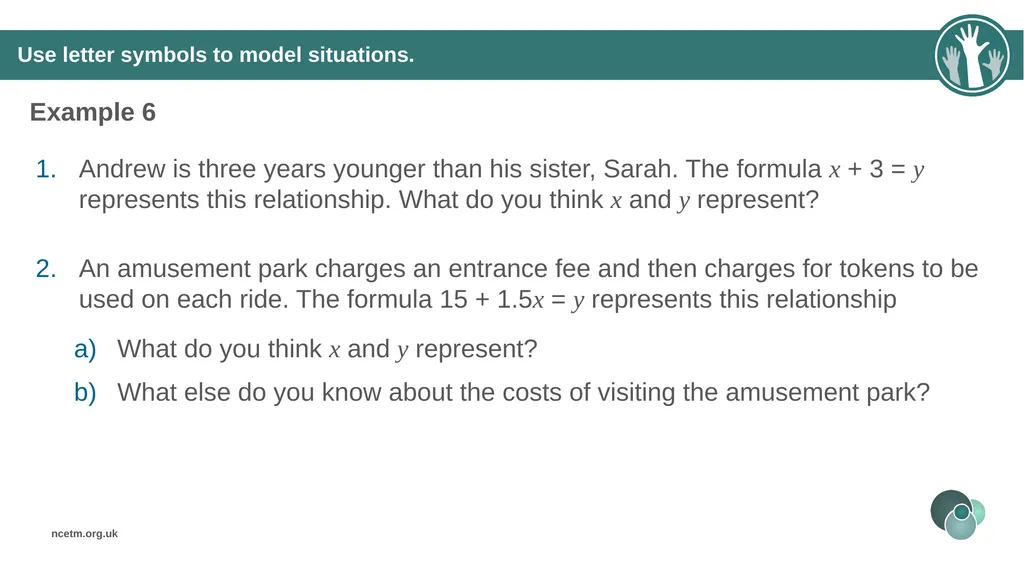
Use letter symbols to model situations. Example 6 Andrew is three years younger than his sister, Sarah. The formula x + 3 = y represents this relationship. What do you think x and y represent?
An amusement park charges an entrance fee and then charges for tokens to be used on each ride. The formula 15 + 1.5x = y represents this relationship
What do you think x and y represent?
What else do you know about the costs of visiting the amusement park?<br>
An amusement park charges an entrance fee and then charges for tokens to be used on each ride. The formula 15 + 1.5x = y represents this relationship
What do you think x and y represent?
What else do you know about the costs of visiting the amusement park?<br>
26
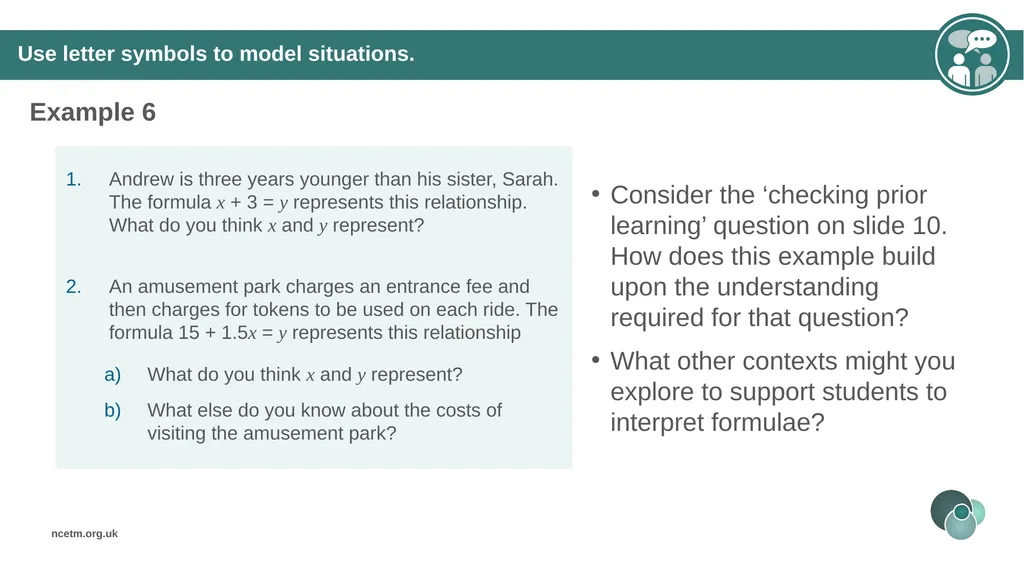
Use letter symbols to model situations. Example 6 Consider the ‘checking prior learning’ question on slide 10. How does this example build upon the understanding required for that question?
What other contexts might you explore to support students to interpret formulae?<br>
What other contexts might you explore to support students to interpret formulae?<br>
27
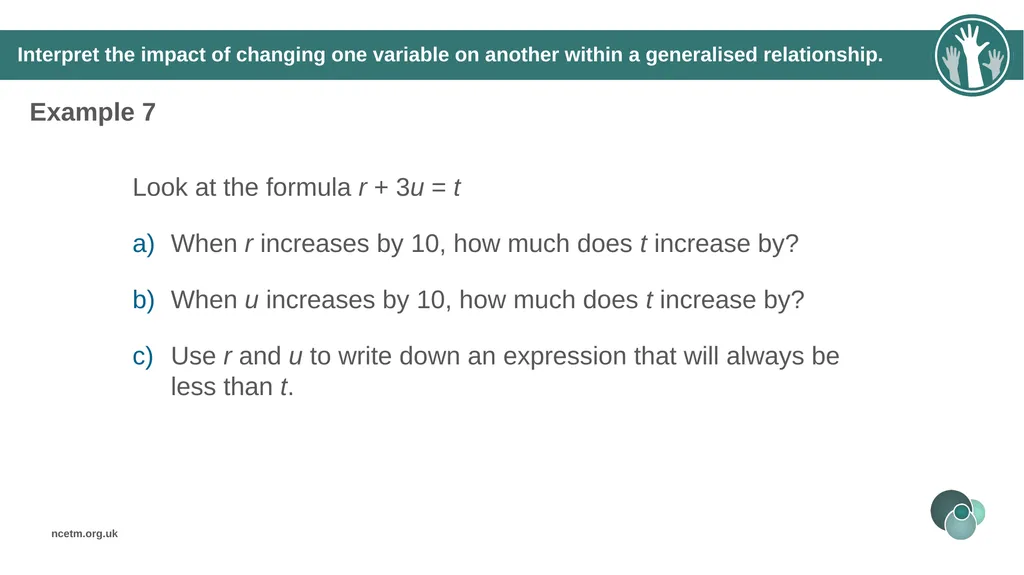
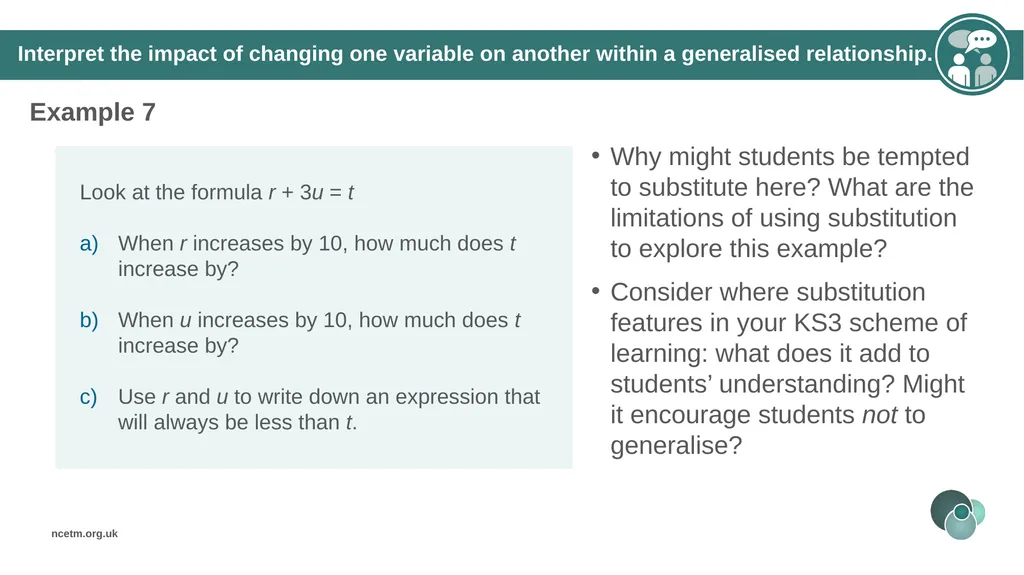
Interpret the impact of changing one variable on another within a generalised relationship. Example 7 Look at the formula r + 3u = t
When r increases by 10, how much does t increase by?
When u increases by 10, how much does t increase by?
Use r and u to write down an expression that will always be less than t.<br>
When r increases by 10, how much does t increase by?
When u increases by 10, how much does t increase by?
Use r and u to write down an expression that will always be less than t.<br>
28
Interpret the impact of changing one variable on another within a generalised relationship. Example 7 Why might students be tempted to substitute here? What are the limitations of using substitution to explore this example?
Consider where substitution features in your KS3 scheme of learning: what does it add to students’ understanding? Might it encourage students not to generalise?<br>
Consider where substitution features in your KS3 scheme of learning: what does it add to students’ understanding? Might it encourage students not to generalise?<br>
29
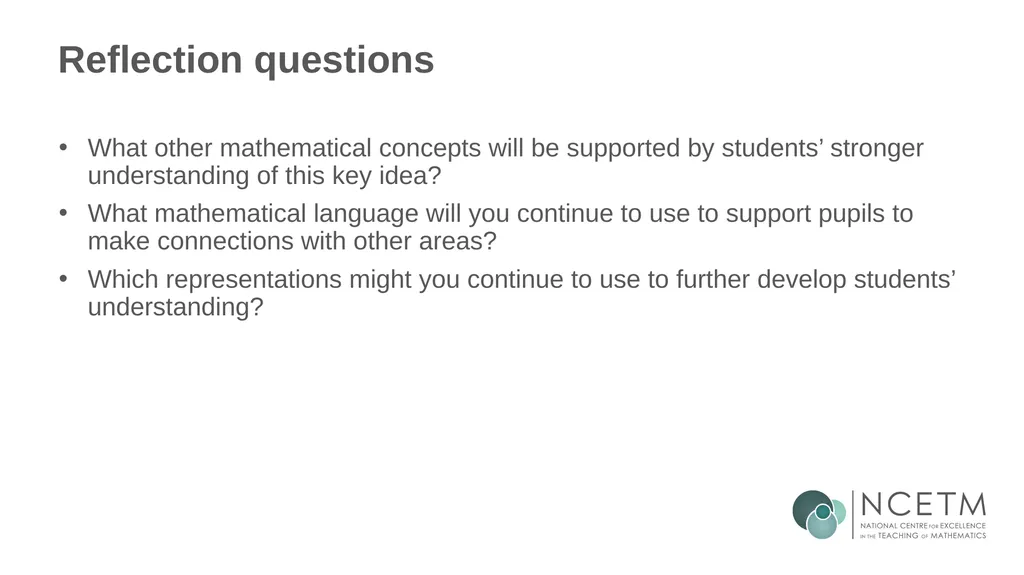
Reflection questions What other mathematical concepts will be supported by students’ stronger understanding of this key idea?
What mathematical language will you continue to use to support pupils to make connections with other areas?
Which representations might you continue to use to further develop students’ understanding?<br>
What mathematical language will you continue to use to support pupils to make connections with other areas?
Which representations might you continue to use to further develop students’ understanding?<br>
30
Appendices You may choose to use the following slides when planning or delivering a PD session. They cover:
Key vocabulary
Representations and structure
Previous learning
Future learning
Library of links<br>
Key vocabulary
Representations and structure
Previous learning
Future learning
Library of links<br>
31
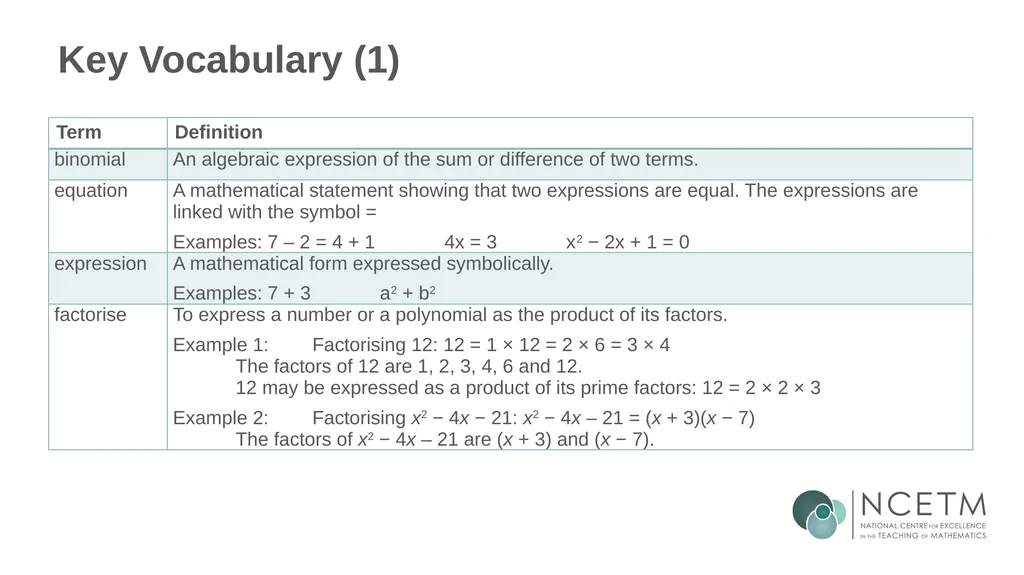
Key Vocabulary (1)<br>
32
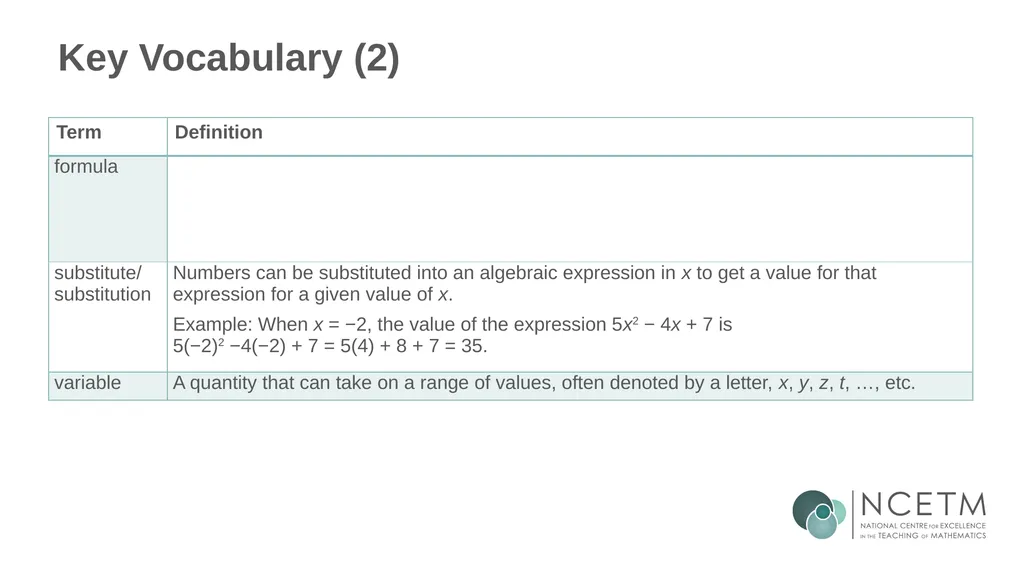
Key Vocabulary (2)<br>
33
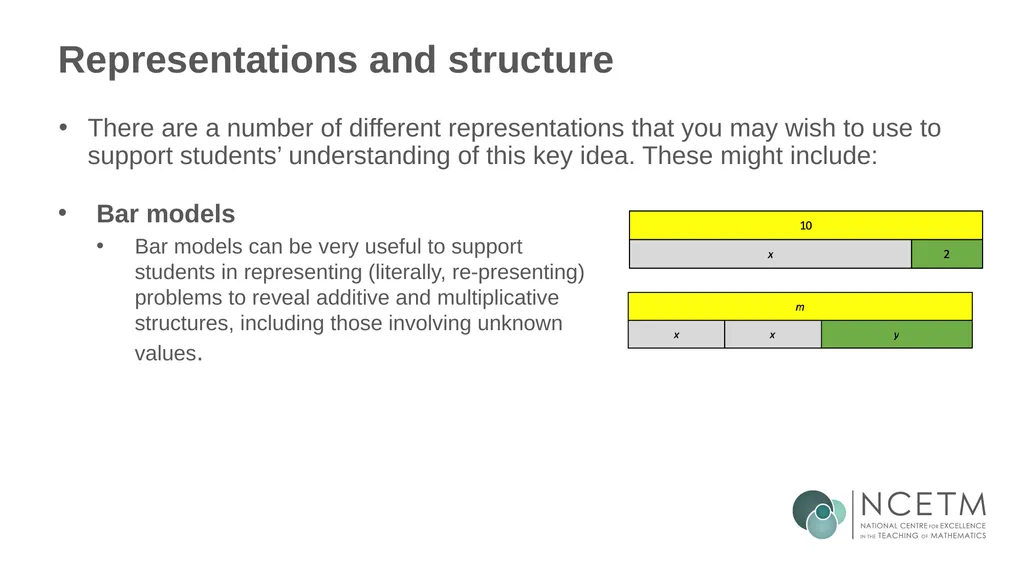
Representations and structure There are a number of different representations that you may wish to use to support students’ understanding of this key idea. These might include: Bar models
Bar models can be very useful to support students in representing (literally, re-presenting) problems to reveal additive and multiplicative structures, including those involving unknown values.<br>
Bar models can be very useful to support students in representing (literally, re-presenting) problems to reveal additive and multiplicative structures, including those involving unknown values.<br>
34
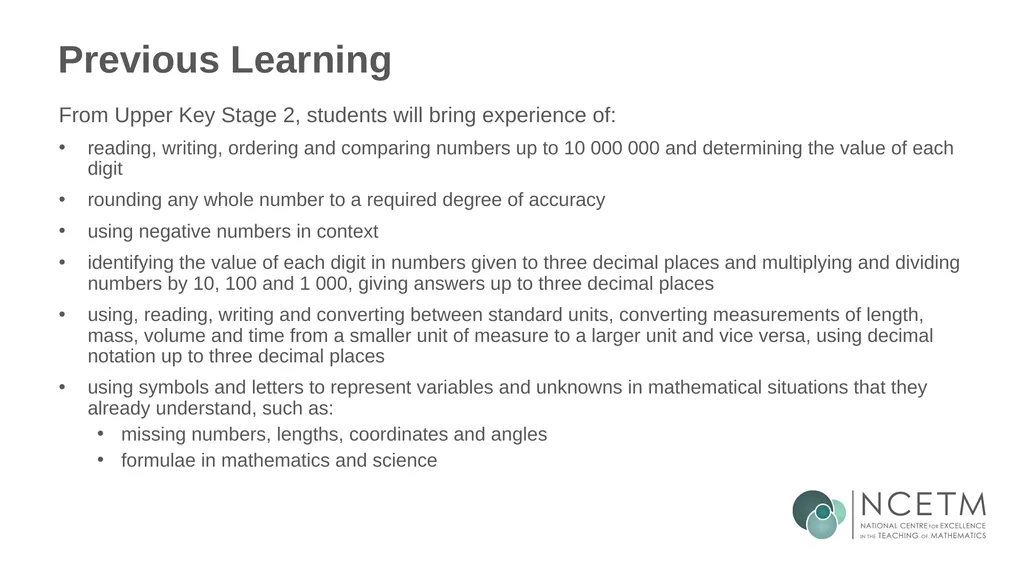
Previous Learning From Upper Key Stage 2, students will bring experience of:
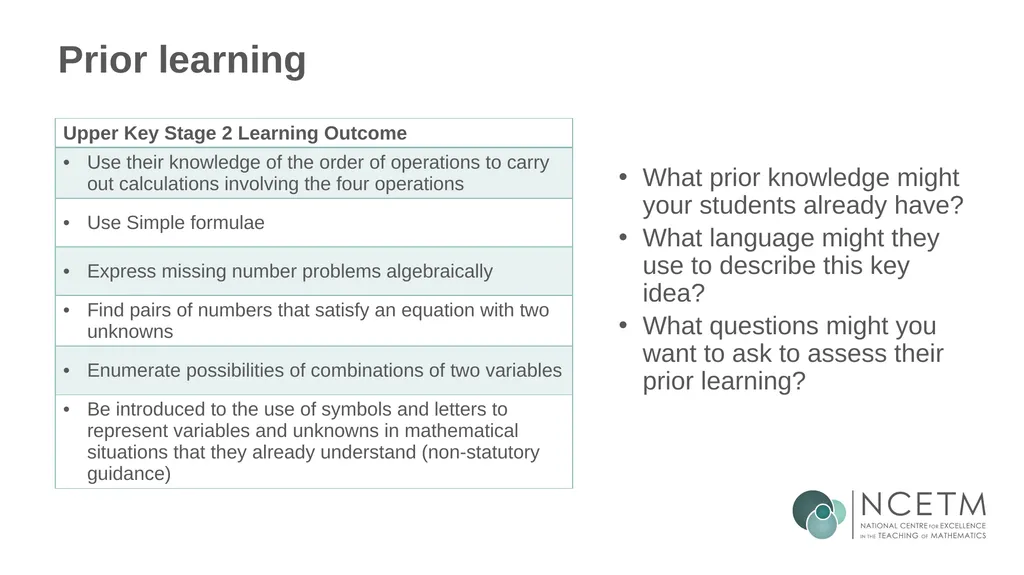
reading, writing, ordering and comparing numbers up to 10 000 000 and determining the value of each digit
rounding any whole number to a required degree of accuracy
using negative numbers in context
identifying the value of each digit in numbers given to three decimal places and multiplying and dividing numbers by 10, 100 and 1 000, giving answers up to three decimal places
using, reading, writing and converting between standard units, converting measurements of length, mass, volume and time from a smaller unit of measure to a larger unit and vice versa, using decimal notation up to three decimal places
using symbols and letters to represent variables and unknowns in mathematical situations that they already understand, such as:
missing numbers, lengths, coordinates and angles
formulae in mathematics and science<br>
reading, writing, ordering and comparing numbers up to 10 000 000 and determining the value of each digit
rounding any whole number to a required degree of accuracy
using negative numbers in context
identifying the value of each digit in numbers given to three decimal places and multiplying and dividing numbers by 10, 100 and 1 000, giving answers up to three decimal places
using, reading, writing and converting between standard units, converting measurements of length, mass, volume and time from a smaller unit of measure to a larger unit and vice versa, using decimal notation up to three decimal places
using symbols and letters to represent variables and unknowns in mathematical situations that they already understand, such as:
missing numbers, lengths, coordinates and angles
formulae in mathematics and science<br>
35
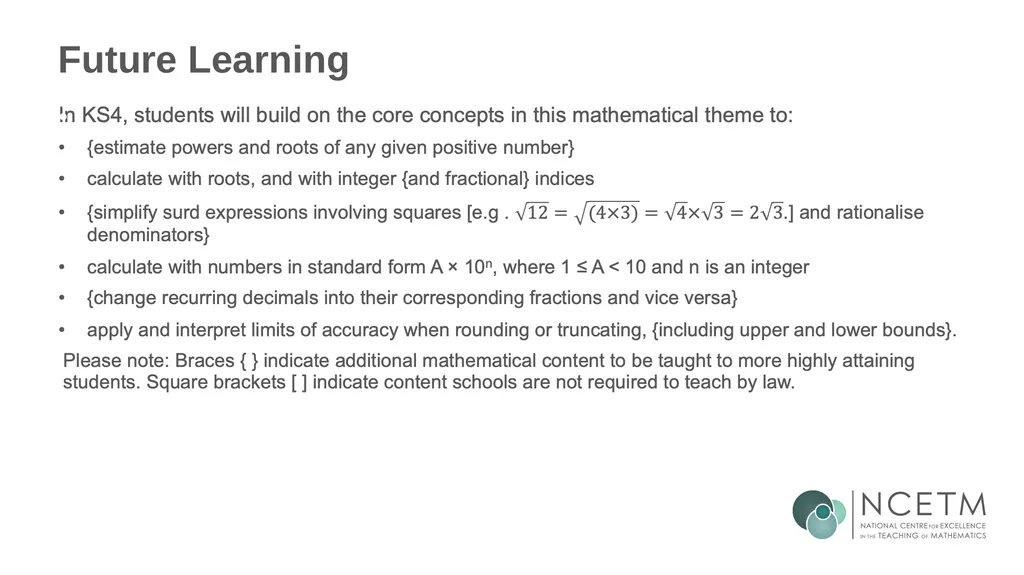
Future Learning<br>
36
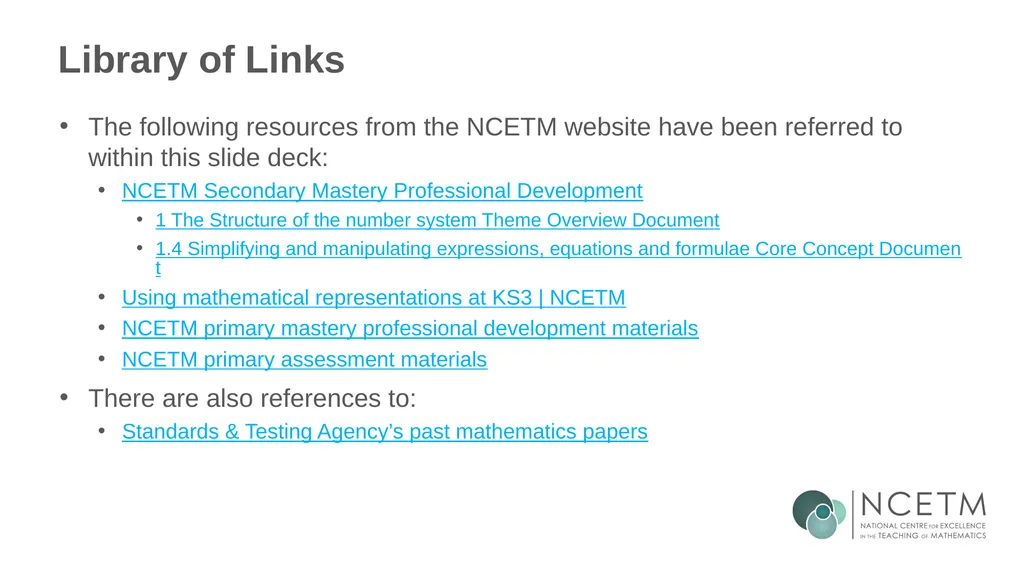
Library of Links The following resources from the NCETM website have been referred to within this slide deck:
NCETM Secondary Mastery Professional Development
1 The Structure of the number system Theme Overview Document
1.4 Simplifying and manipulating expressions, equations and formulae Core Concept Document
Using mathematical representations at KS3 | NCETM
NCETM primary mastery professional development materials
NCETM primary assessment materials
There are also references to:
Standards & Testing Agency’s past mathematics papers<br>
NCETM Secondary Mastery Professional Development
1 The Structure of the number system Theme Overview Document
1.4 Simplifying and manipulating expressions, equations and formulae Core Concept Document
Using mathematical representations at KS3 | NCETM
NCETM primary mastery professional development materials
NCETM primary assessment materials
There are also references to:
Standards & Testing Agency’s past mathematics papers<br>