Generalization Ms. Morgan What is a generalization? A generalization is a broad statement about what a group of people or things have in common. For example, using what you know and have observed you could generalize by saying, Most people
"Generalization Ms. Morgan What is a" is the property of its rightful owner. Permission is granted to
download and print the materials on this website for personal, non-commercial use only, and to display it
on your personal computer provided you do not modify the materials and that you retain all copyright
notices contained in the materials. By downloading content from our website, you accept the terms of this
agreement.
Presentation Transcript
01
Generalization Ms. Morgan<br>
02
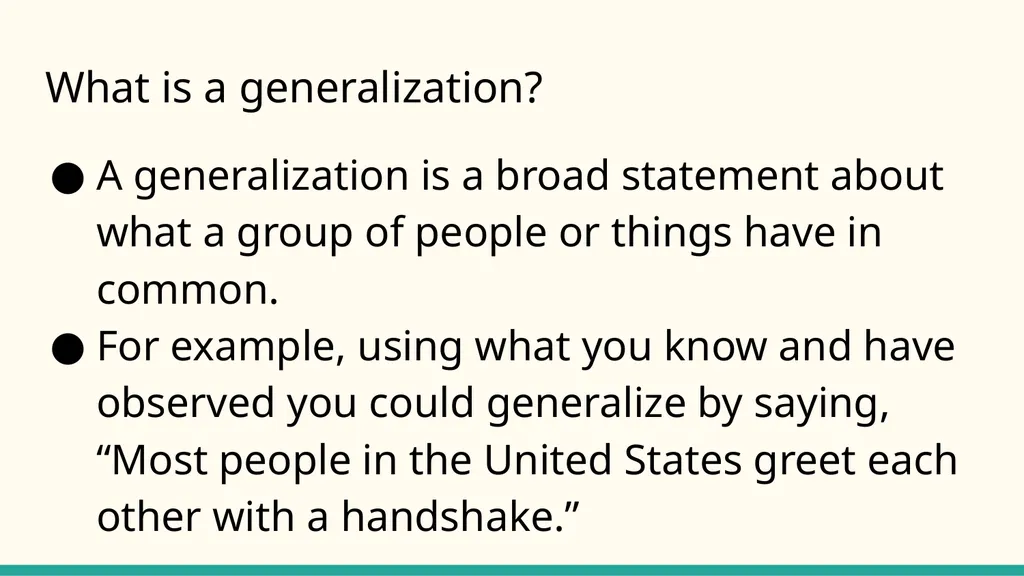
What is a generalization? A generalization is a broad statement about what a group of people or things have in common.
For example, using what you know and have observed you could generalize by saying, “Most people in the United States greet each other with a handshake.”<br>
03
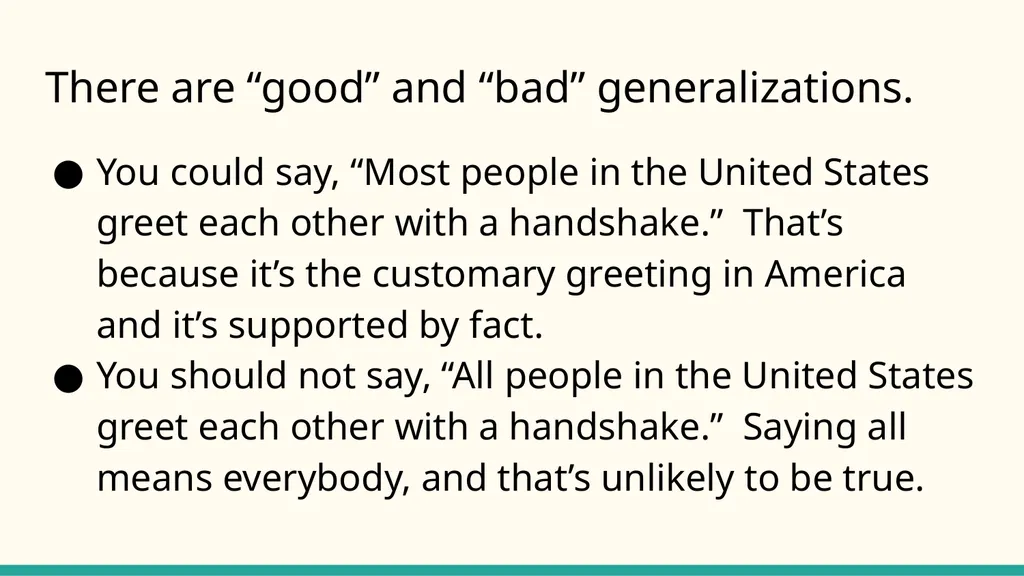
There are “good” and “bad” generalizations. You could say, “Most people in the United States greet each other with a handshake.” That’s because it’s the customary greeting in America and it’s supported by fact.
You should not say, “All people in the United States greet each other with a handshake.” Saying all means everybody, and that’s unlikely to be true.<br>
04
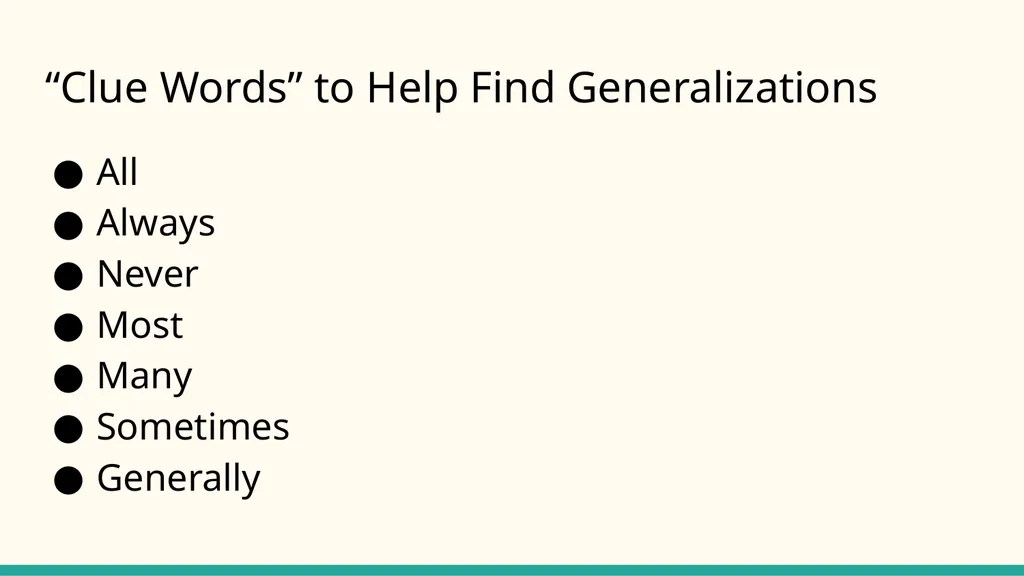
“Clue Words” to Help Find Generalizations All
Always
Never
Most
Many
Sometimes
Generally<br>
05
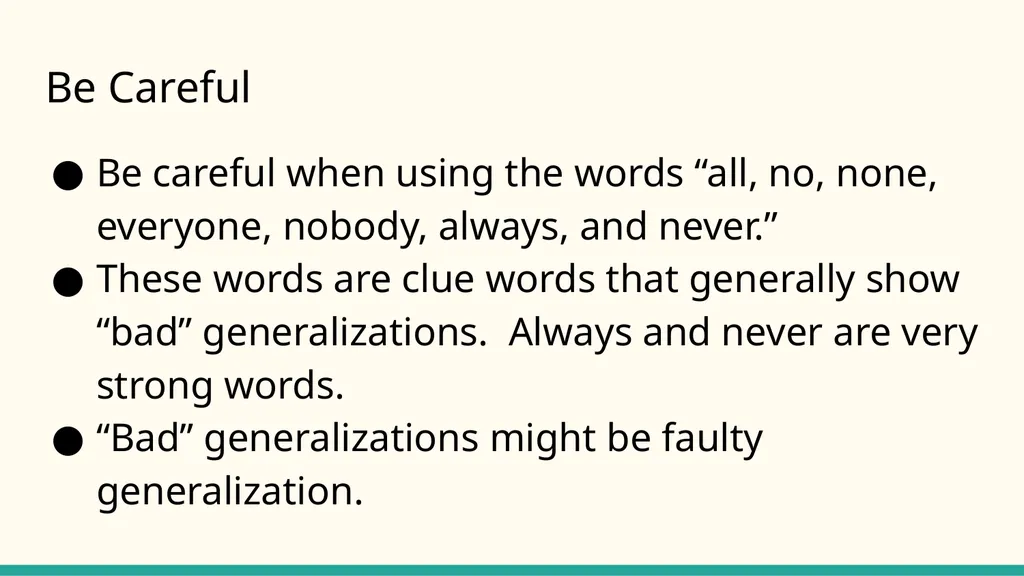
Be Careful Be careful when using the words “all, no, none, everyone, nobody, always, and never.”
These words are clue words that generally show “bad” generalizations. Always and never are very strong words.
“Bad” generalizations might be faulty generalization.<br>
06
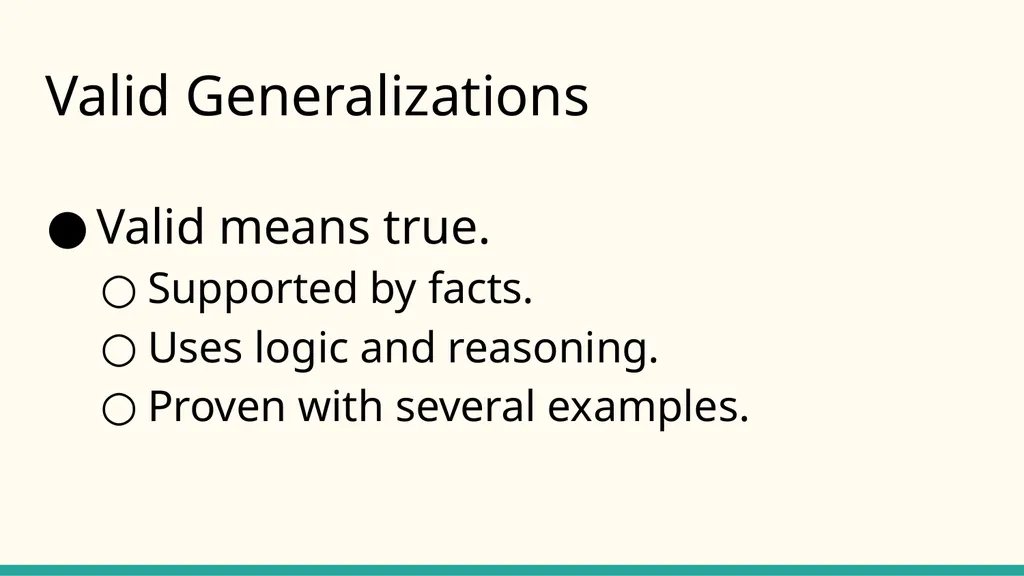
Valid Generalizations Valid means true.
Supported by facts.
Uses logic and reasoning.
Proven with several examples.<br>
07
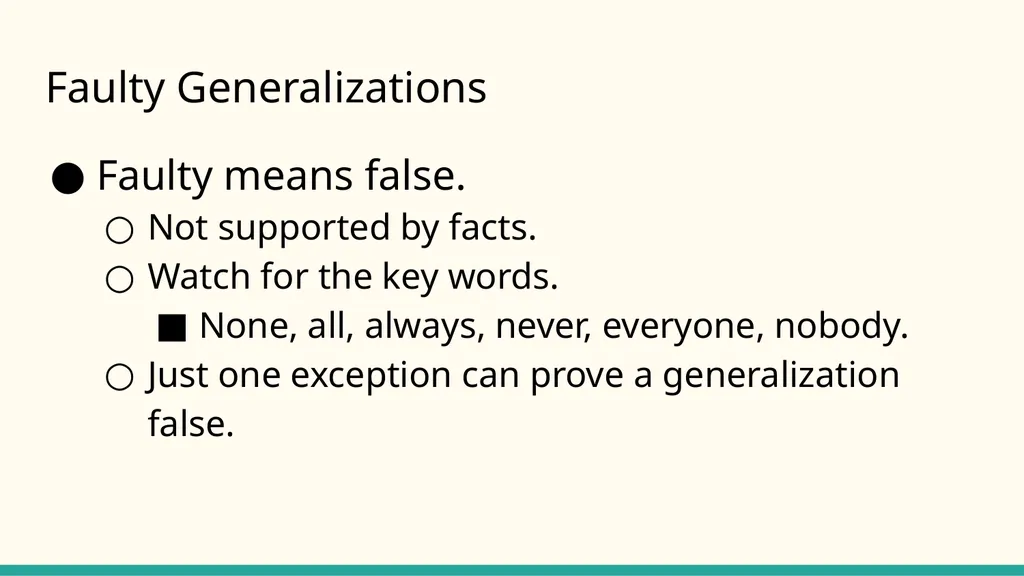
Faulty Generalizations Faulty means false.
Not supported by facts.
Watch for the key words.
None, all, always, never, everyone, nobody.
Just one exception can prove a generalization false.<br>
08
Ice cream is everyone’s favorite dessert. What is wrong with this generalization?
How could you make it a valid generalization?<br>
09
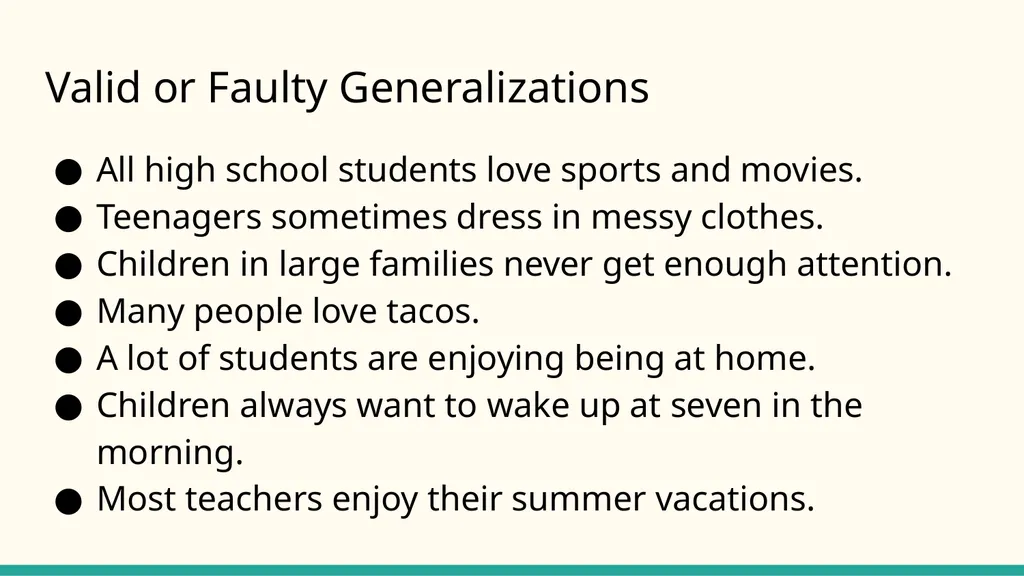
Valid or Faulty Generalizations All high school students love sports and movies.
Teenagers sometimes dress in messy clothes.
Children in large families never get enough attention.
Many people love tacos.
A lot of students are enjoying being at home.
Children always want to wake up at seven in the morning.
Most teachers enjoy their summer vacations.<br>
10
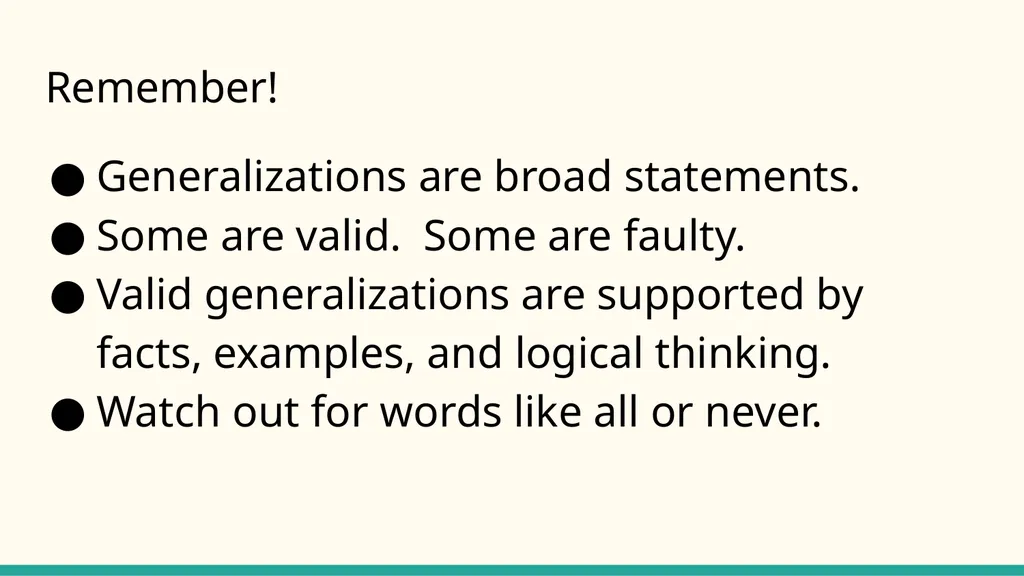
Remember! Generalizations are broad statements.
Some are valid. Some are faulty.
Valid generalizations are supported by facts, examples, and logical thinking.
Watch out for words like all or never.<br>