Generating Supplementary Travel Guides from Social Media Liu Yang1,2, Jing Jiang2, Lifu Huang1,2, Minghui Qiu2, Lizi Liao2,3 1Peking University 2Singapore Management University 3Beijing Institute of Technology Dublin Sightseeing Aug 28,
Related Topics
Share
Embed code
Download this presentation From Below
"Generating Supplementary Travel Guides from Social" is the property of its rightful owner. Permission is granted to
download and print the materials on this website for personal, non-commercial use only, and to display it
on your personal computer provided you do not modify the materials and that you retain all copyright
notices contained in the materials. By downloading content from our website, you accept the terms of this
agreement.
Presentation Transcript
01
Generating Supplementary Travel Guides from Social Media Liu Yang1,2, Jing Jiang2, Lifu Huang1,2, Minghui Qiu2, Lizi Liao2,3
1Peking University
2Singapore Management University
3Beijing Institute of Technology<br>
02
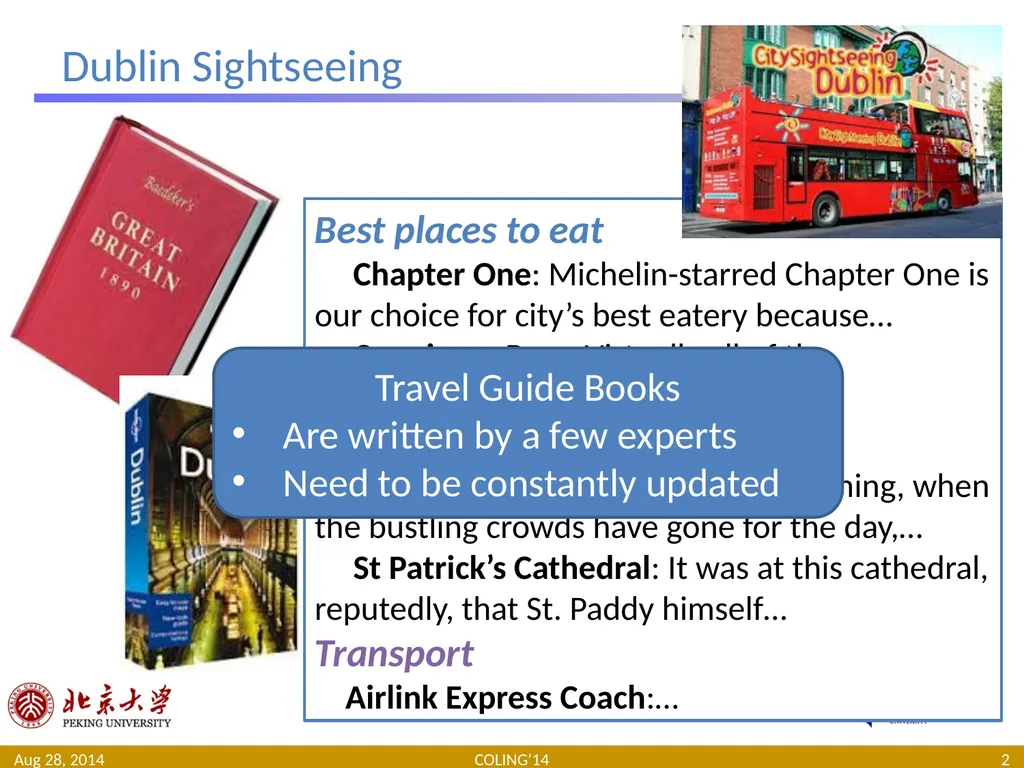
Dublin Sightseeing Aug 28, 2014 2 COLING'14 Best places to eat
Chapter One: Michelin-starred Chapter One is our choice for city’s best eatery because…
Coppinger Row: Virtually all of the Mediterranean basin is represented…
Top things to do
Trinity College: On a summer’s evening, when the bustling crowds have gone for the day,…
St Patrick’s Cathedral: It was at this cathedral, reputedly, that St. Paddy himself…
Transport
Airlink Express Coach:… Travel Guide Books
Are written by a few experts
Need to be constantly updated<br>
03
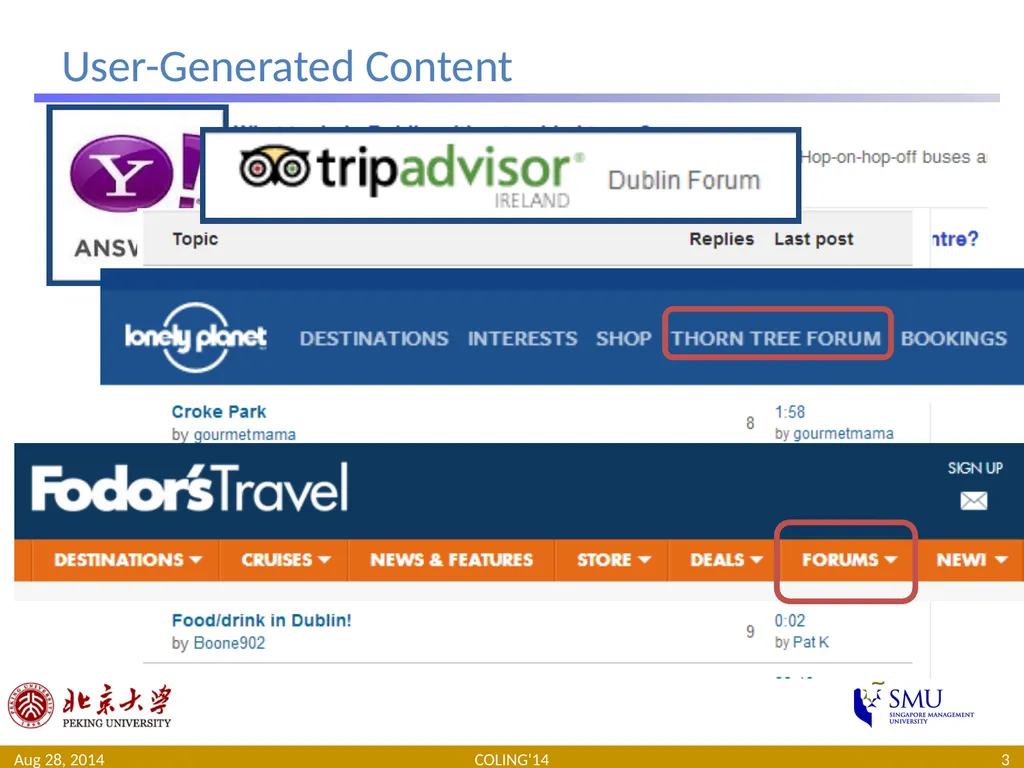
User-Generated Content Aug 28, 2014 COLING'14 3<br>
04
User-Generated Content Objective of this work: To generate travel guides from online forums to supplement official travel guide books.
We formulate this task as a multi-document text summarization problem. Aug 28, 2014 COLING'14 4 Is written by many ordinary online users
Wider coverage
Better represent popular attractions
Constantly grows
Fresh, up-to-date information<br>
05
Challenges We Face Forum threads and question/answer pairs are not well organized by topics or sections
Some threads and questions are too specific to be useful for a typical tourist
Coverage of points of interest is important but not considered in standard text summarization algorithms. Aug 28, 2014 COLING'14 5<br>
06
Roadmap Motivation
Our Method
Method Overview
Joint City Section Model
Section Specific Summarization
Experiments
Conclusions Aug 28, 2014 COLING'14 6<br>
07
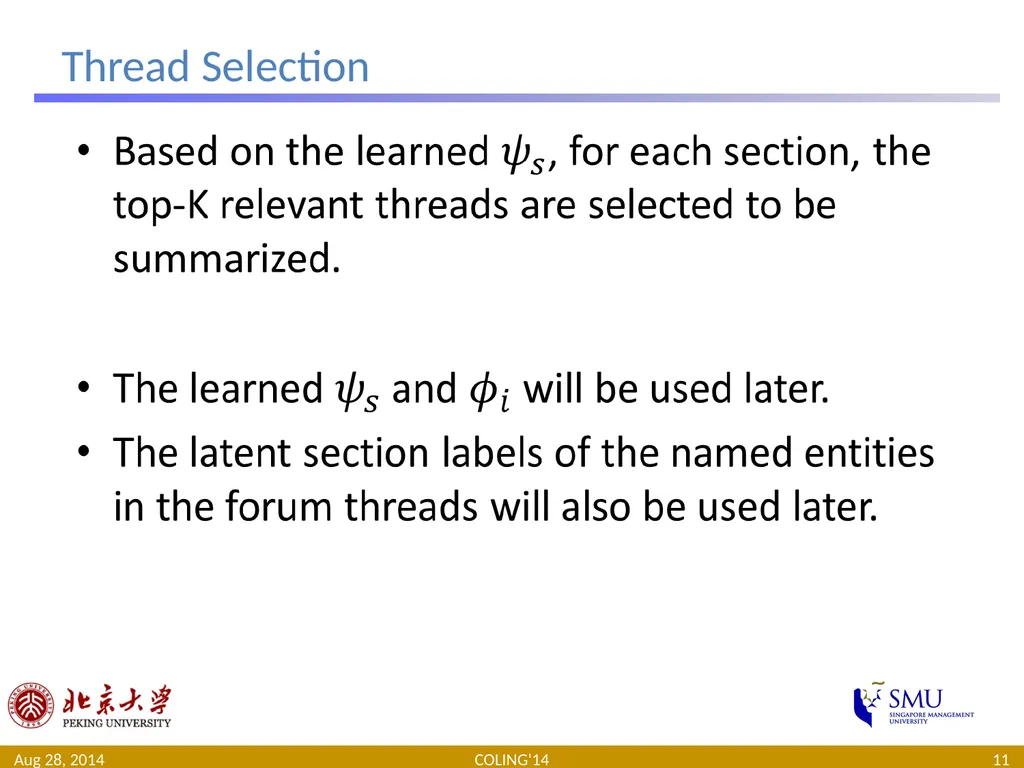
Method Overview Thread selection
Use a latent variable model that jointly models official travel guides and forum threads
Allow the latent factors to adapt to the lexical variations in user-generated content
Align forum threads with the sections
Select the most relevant threads for each section
Section-specific summarization
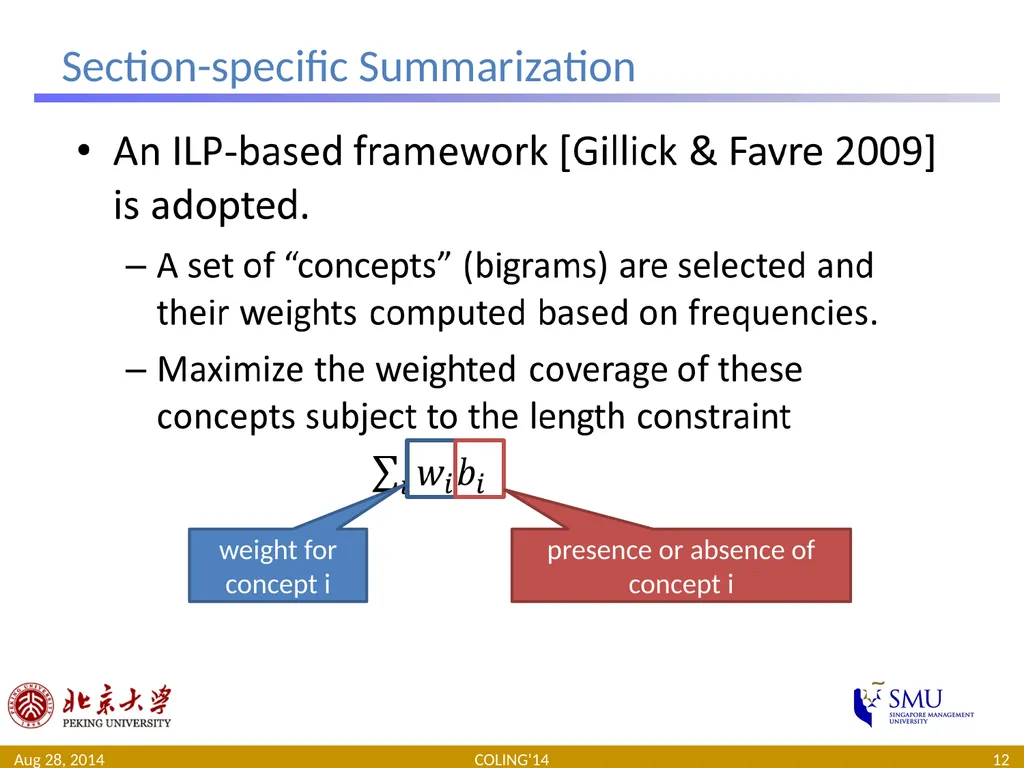
Use an ILP-based extractive summarization framework
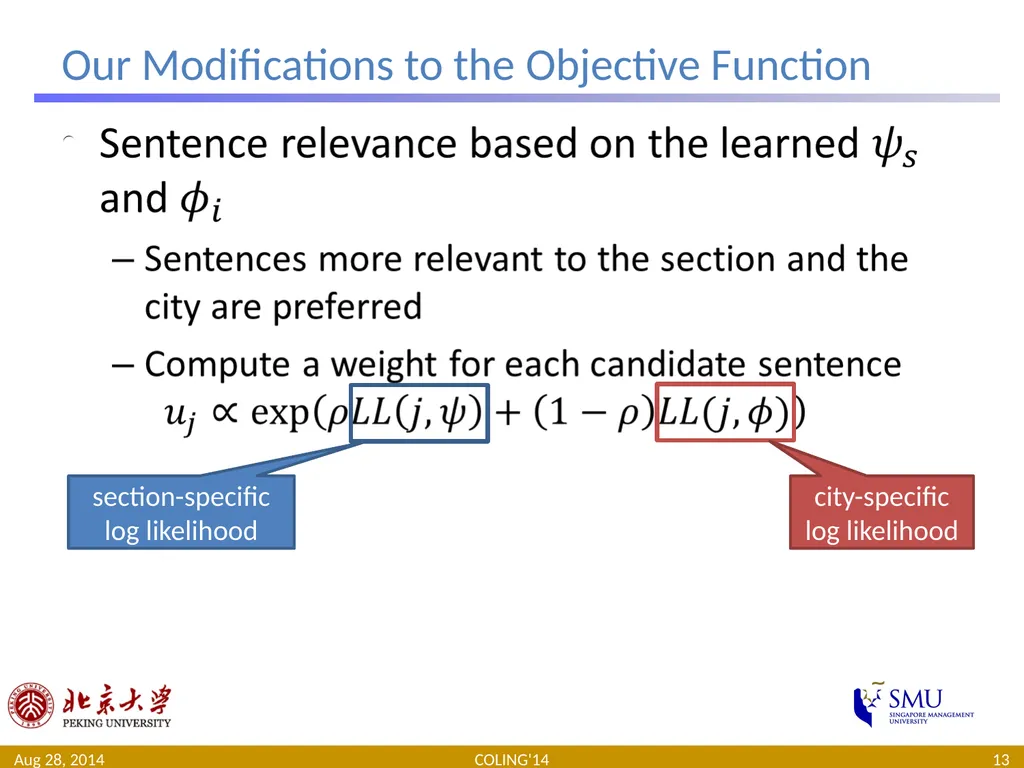
Give preference to more relevant sentences
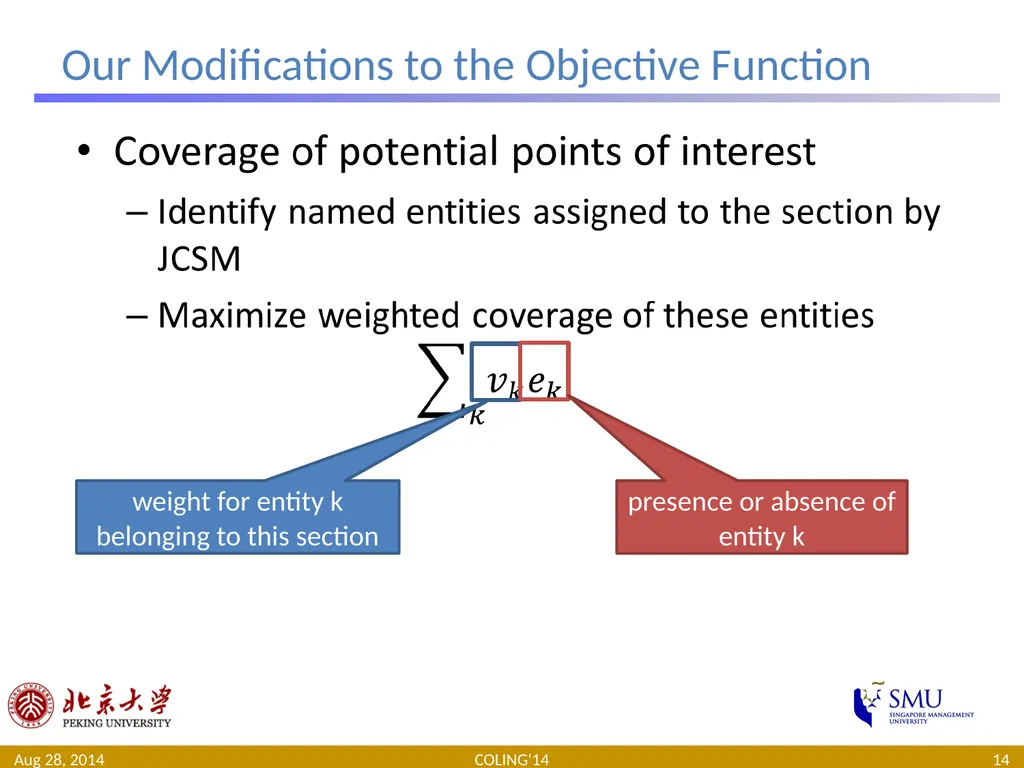
Maximize the coverage of section-specific named entities Aug 28, 2014 COLING'14 7<br>
08
Thread Selection Aug 28, 2014 COLING'14 8<br>
09
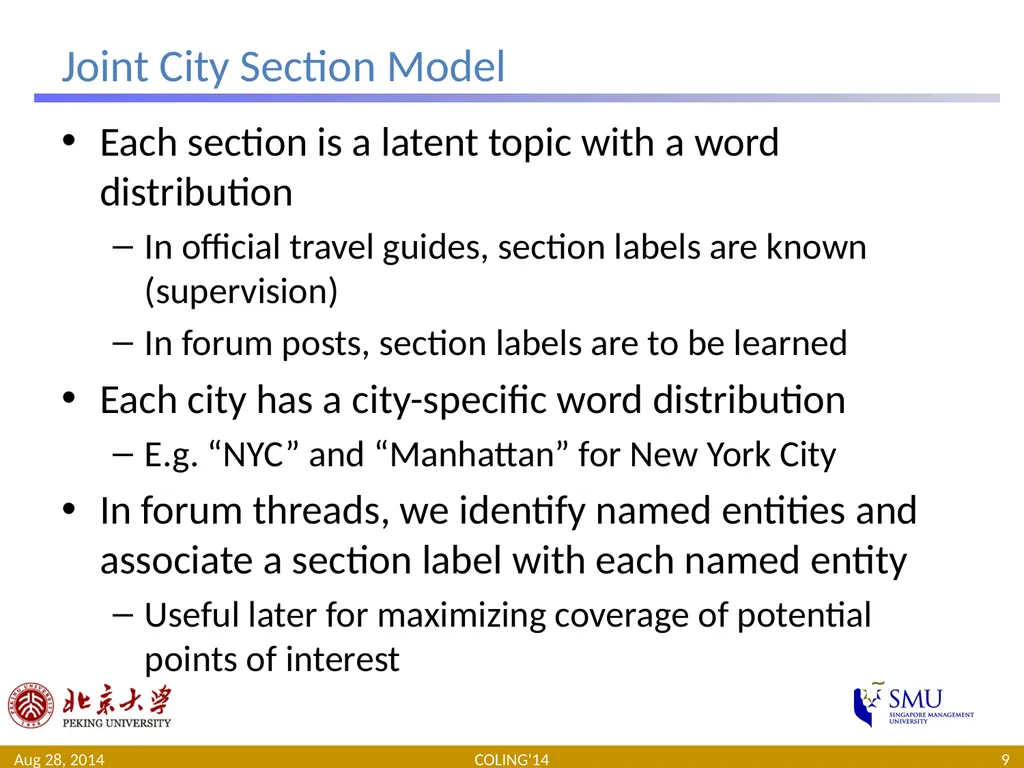
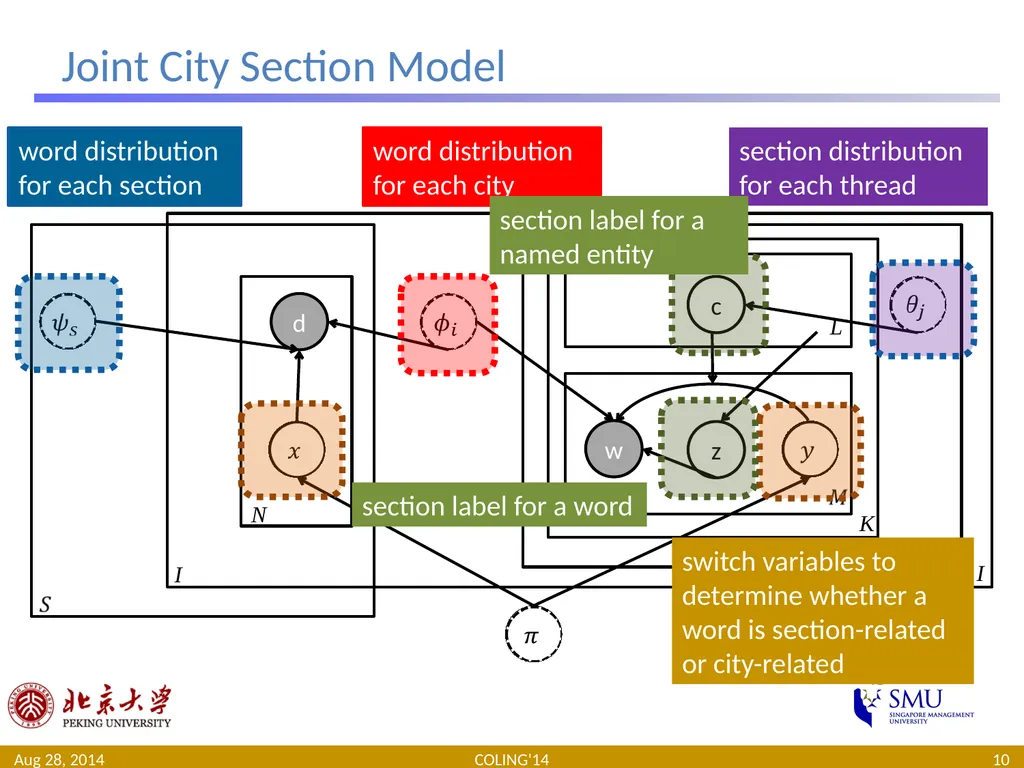
Joint City Section Model Each section is a latent topic with a word distribution
In official travel guides, section labels are known (supervision)
In forum posts, section labels are to be learned
Each city has a city-specific word distribution
E.g. “NYC” and “Manhattan” for New York City
In forum threads, we identify named entities and associate a section label with each named entity
Useful later for maximizing coverage of potential points of interest Aug 28, 2014 COLING'14 9<br>
10
Joint City Section Model Aug 28, 2014 COLING'14 10 I L z w c d N I K word distribution for each section section distribution for each thread switch variables to determine whether a word is section-related or city-related section label for a named entity section label for a word<br>
11
Thread Selection Aug 28, 2014 COLING'14 11<br>
12
Section-specific Summarization Aug 28, 2014 COLING'14 12 weight for concept i presence or absence of concept i<br>
13
Our Modifications to the Objective Function Aug 28, 2014 COLING'14 13 section-specific log likelihood city-specific log likelihood<br>
14
Our Modifications to the Objective Function Aug 28, 2014 COLING'14 14 weight for entity k belonging to this section presence or absence of entity k<br>
15
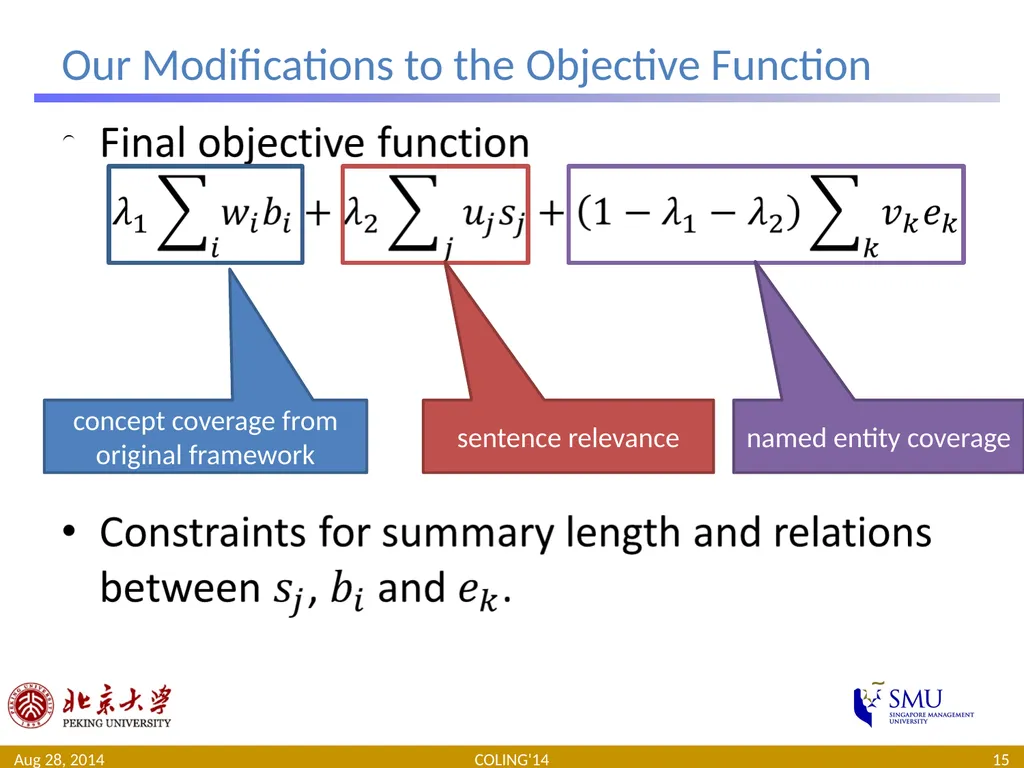
Our Modifications to the Objective Function Aug 28, 2014 COLING'14 15 concept coverage from original framework sentence relevance named entity coverage<br>
16
Roadmap Motivation
Our Method
Method Overview
Joint City Section Model
Section Specific Summarization
Experiments
Conclusions Aug 28, 2014 COLING'14 16<br>
17
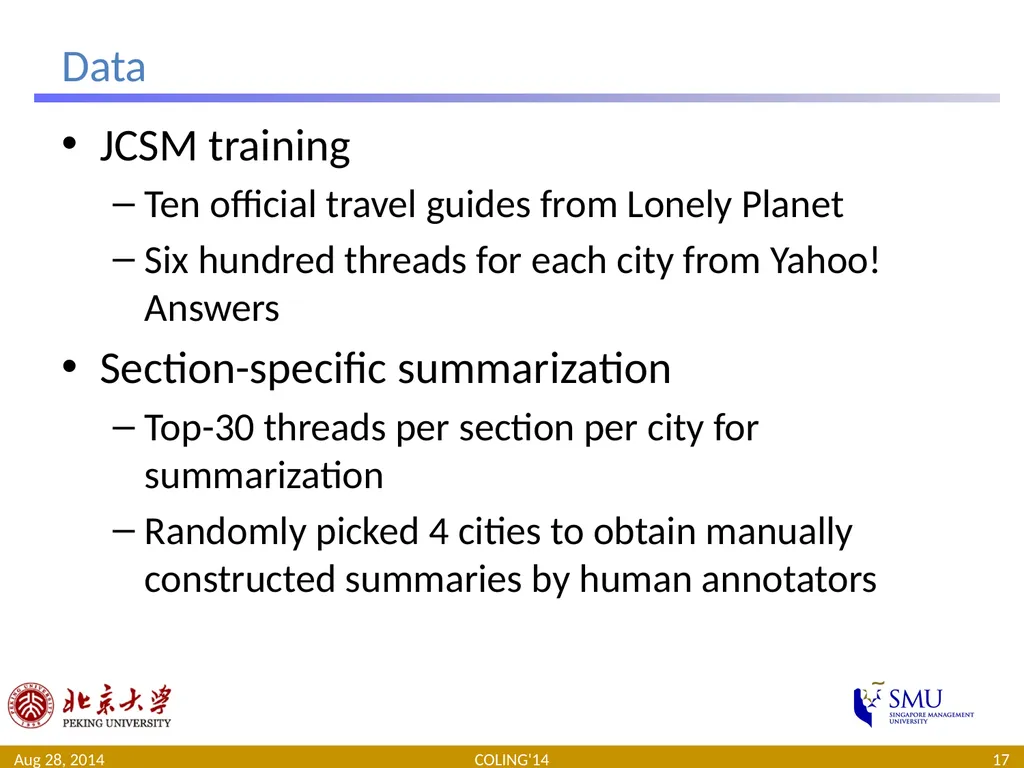
Data JCSM training
Ten official travel guides from Lonely Planet
Six hundred threads for each city from Yahoo! Answers
Section-specific summarization
Top-30 threads per section per city for summarization
Randomly picked 4 cities to obtain manually constructed summaries by human annotators Aug 28, 2014 COLING'14 17<br>
18
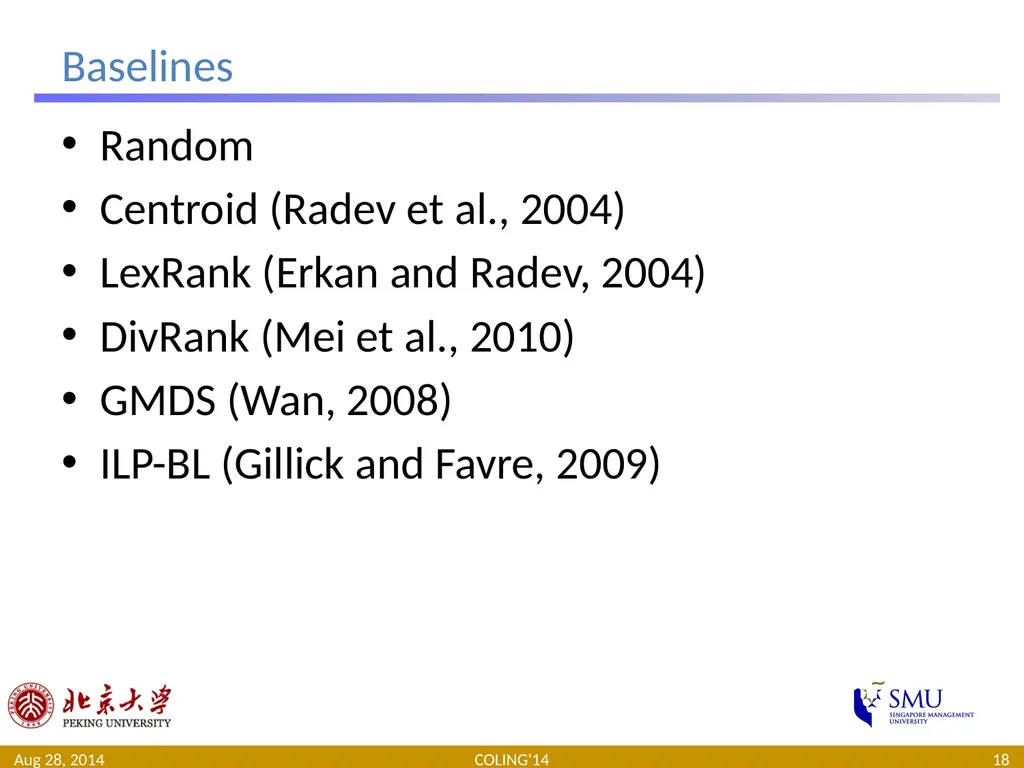
Baselines Random
Centroid (Radev et al., 2004)
LexRank (Erkan and Radev, 2004)
DivRank (Mei et al., 2010)
GMDS (Wan, 2008)
ILP-BL (Gillick and Favre, 2009) Aug 28, 2014 COLING'14 18<br>
19
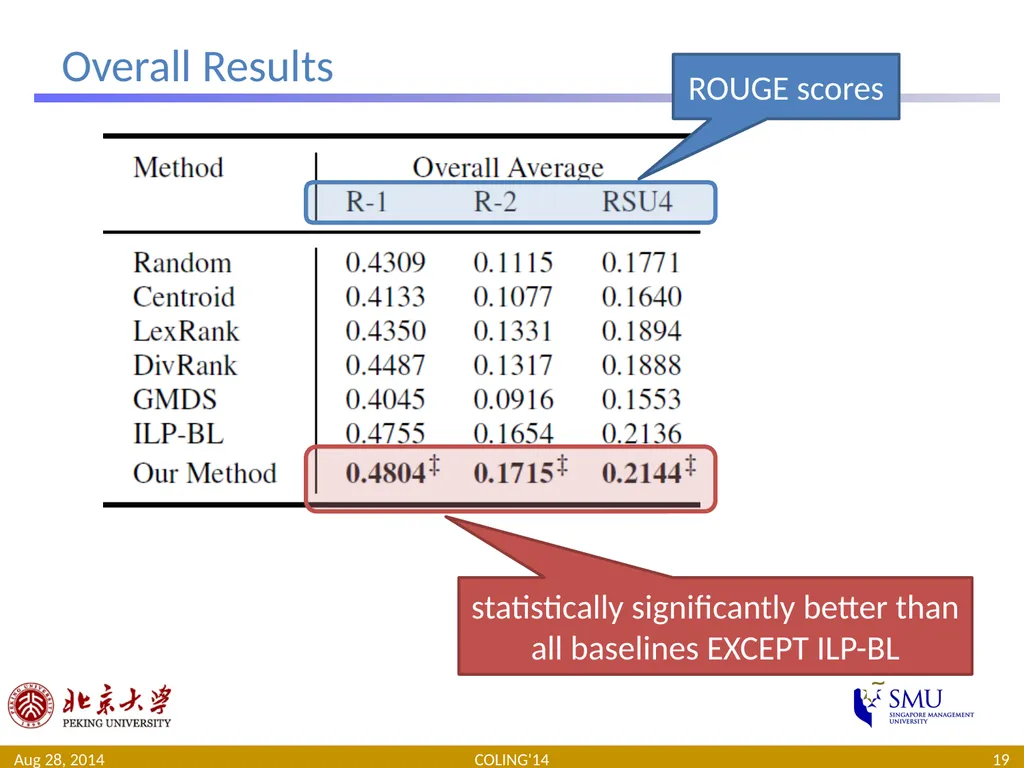
Overall Results Aug 28, 2014 COLING'14 19 statistically significantly better than all baselines EXCEPT ILP-BL ROUGE scores<br>
20
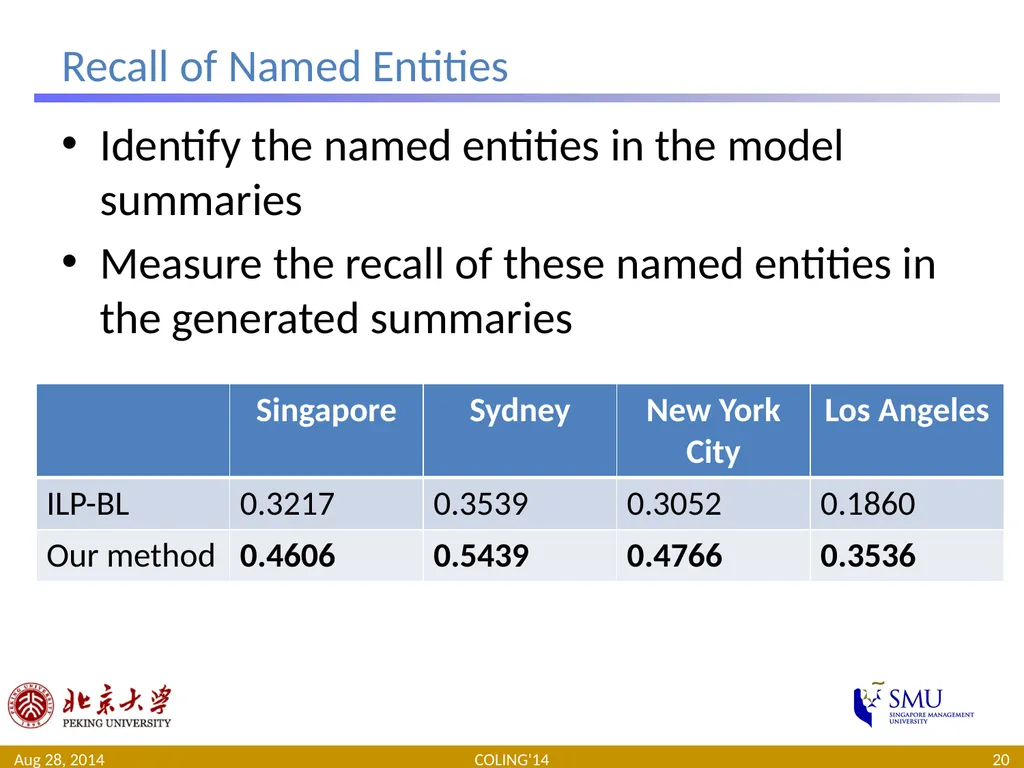
Recall of Named Entities Identify the named entities in the model summaries
Measure the recall of these named entities in the generated summaries Aug 28, 2014 COLING'14 20<br>
21
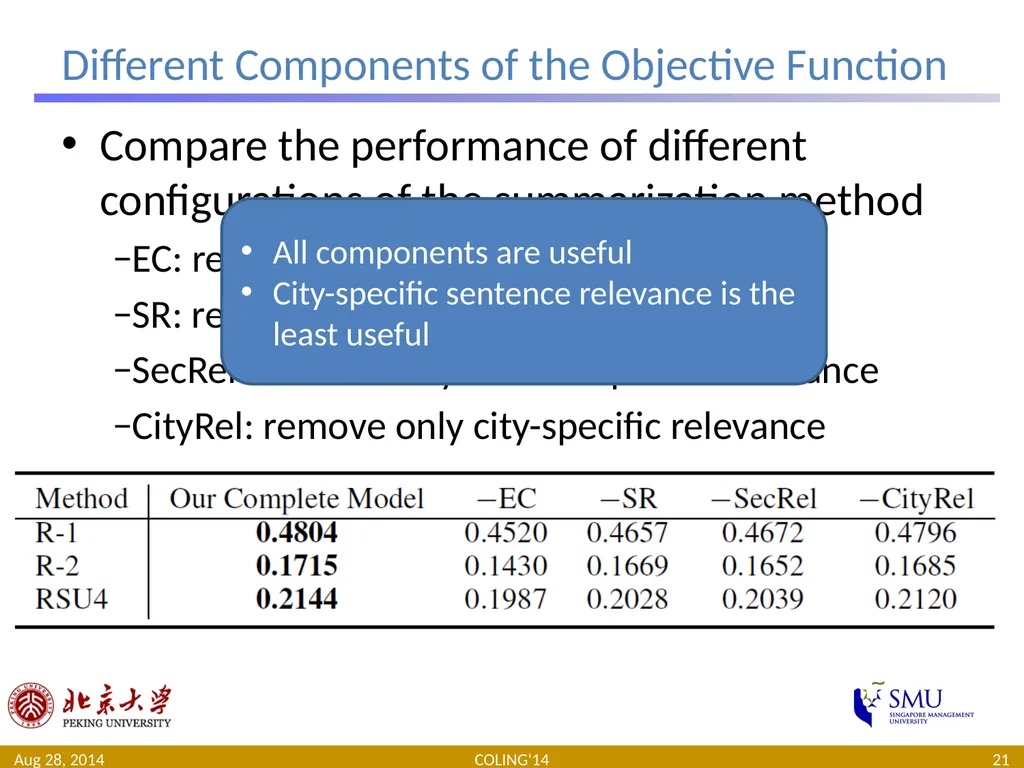
Different Components of the Objective Function Compare the performance of different configurations of the summarization method
−EC: remove entity coverage
−SR: remove sentence relevance
−SecRel: remove only section-specific relevance
−CityRel: remove only city-specific relevance Aug 28, 2014 COLING'14 21 All components are useful
City-specific sentence relevance is the least useful<br>
22
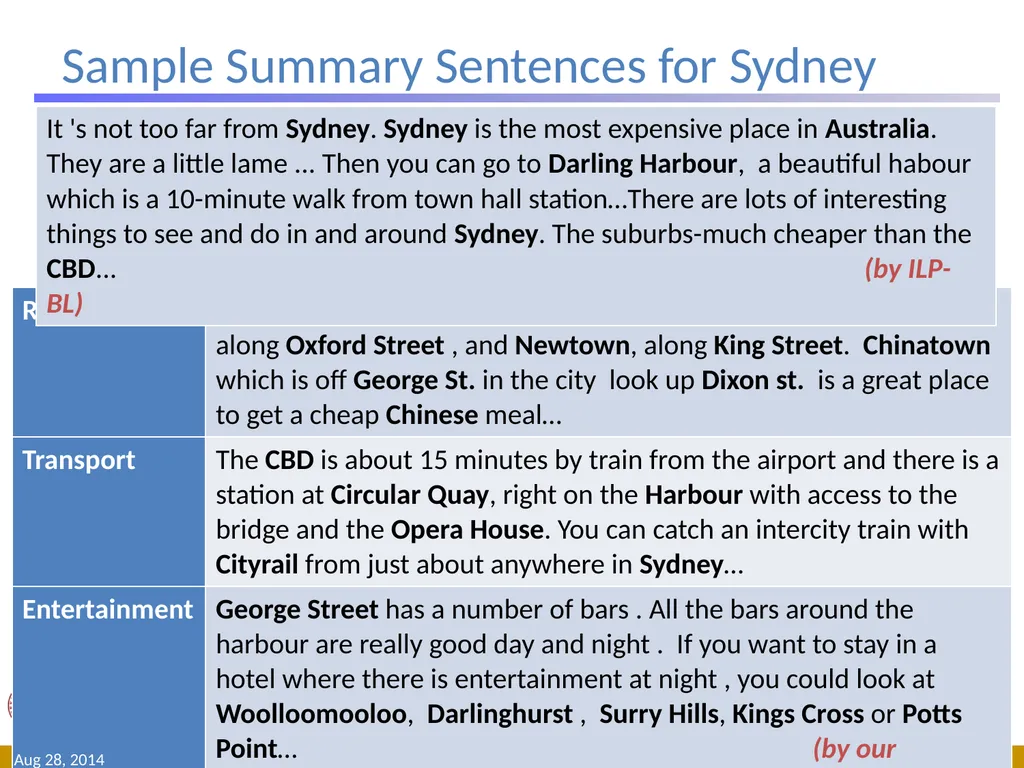
Sample Summary Sentences for Sydney Aug 28, 2014 COLING'14 22<br>
23
Roadmap Motivation
Our Method
Method Overview
Joint City Section Model
Section Specific Summarization
Experiments
Conclusions Aug 28, 2014 COLING'14 23<br>
24
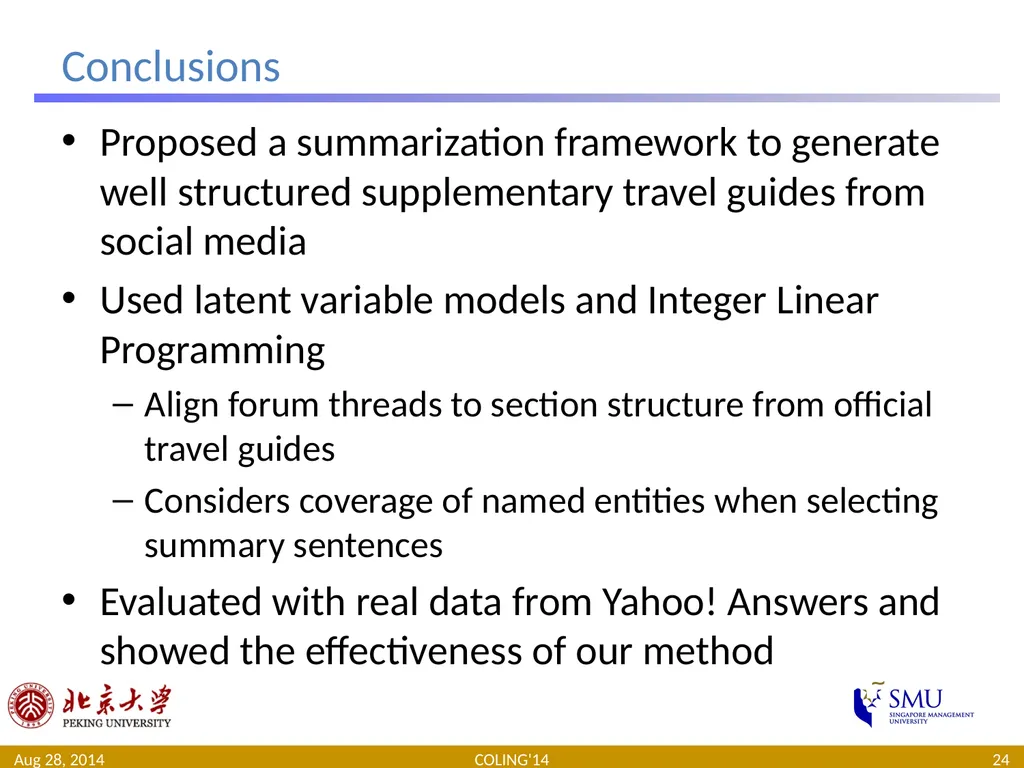
Conclusions Proposed a summarization framework to generate well structured supplementary travel guides from social media
Used latent variable models and Integer Linear Programming
Align forum threads to section structure from official travel guides
Considers coverage of named entities when selecting summary sentences
Evaluated with real data from Yahoo! Answers and showed the effectiveness of our method Aug 28, 2014 COLING'14 24<br>