
genetic course lecture (4) Lethal alleles and




Description: genetic course lecture (4) Lethal alleles and multiple alleles Dr. israa hussein hamzah email: esraahassan17yahoo.com szshuomustansiriyah.edu.iq Reference book: genetic (Conceptual-Approach) fourth edition (2012) Author: Benjamin C.
Related Topics
Download Presentation
"genetic course lecture (4) Lethal alleles and" is the property of its rightful owner. Permission is granted to download and print the materials on this website for personal, non-commercial use only, and to display it on your personal computer provided you do not modify the materials and that you retain all copyright notices contained in the materials. By downloading content from our website, you accept the terms of this agreement.
Presentation Transcript
slide1. genetic course
lecture (4)
Lethal alleles and multiple alleles
Dr. israa hussein hamzah
email: esraa_hassan17@yahoo.com
szsh@uomustansiriyah.edu.iq
Reference book: genetic (Conceptual-Approach) fourth edition (2012)
Author: Benjamin C. Pierce<br>
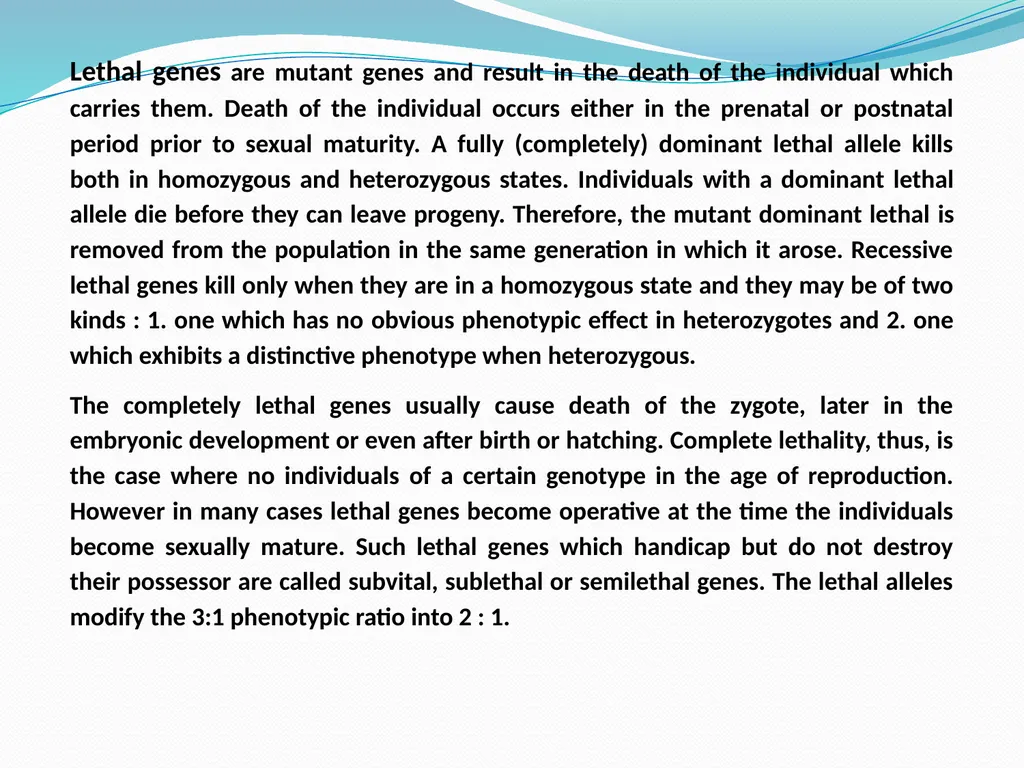
slide2. Lethal genes are mutant genes and result in the death of the individual which carries them. Death of the individual occurs either in the prenatal or postnatal period prior to sexual maturity. A fully (completely) dominant lethal allele kills both in homozygous and heterozygous states. Individuals with a dominant lethal allele die before they can leave progeny. Therefore, the mutant dominant lethal is removed from the population in the same generation in which it arose. Recessive lethal genes kill only when they are in a homozygous state and they may be of two kinds : 1. one which has no obvious phenotypic effect in heterozygotes and 2. one which exhibits a distinctive phenotype when heterozygous.
The completely lethal genes usually cause death of the zygote, later in the embryonic development or even after birth or hatching. Complete lethality, thus, is the case where no individuals of a certain genotype in the age of reproduction. However in many cases lethal genes become operative at the time the individuals become sexually mature. Such lethal genes which handicap but do not destroy their possessor are called subvital, sublethal or semilethal genes. The lethal alleles modify the 3:1 phenotypic ratio into 2 : 1.<br>
slide3. Examples of Lethal Alleles
A. Lethal alleles in plants. In plants, recessive
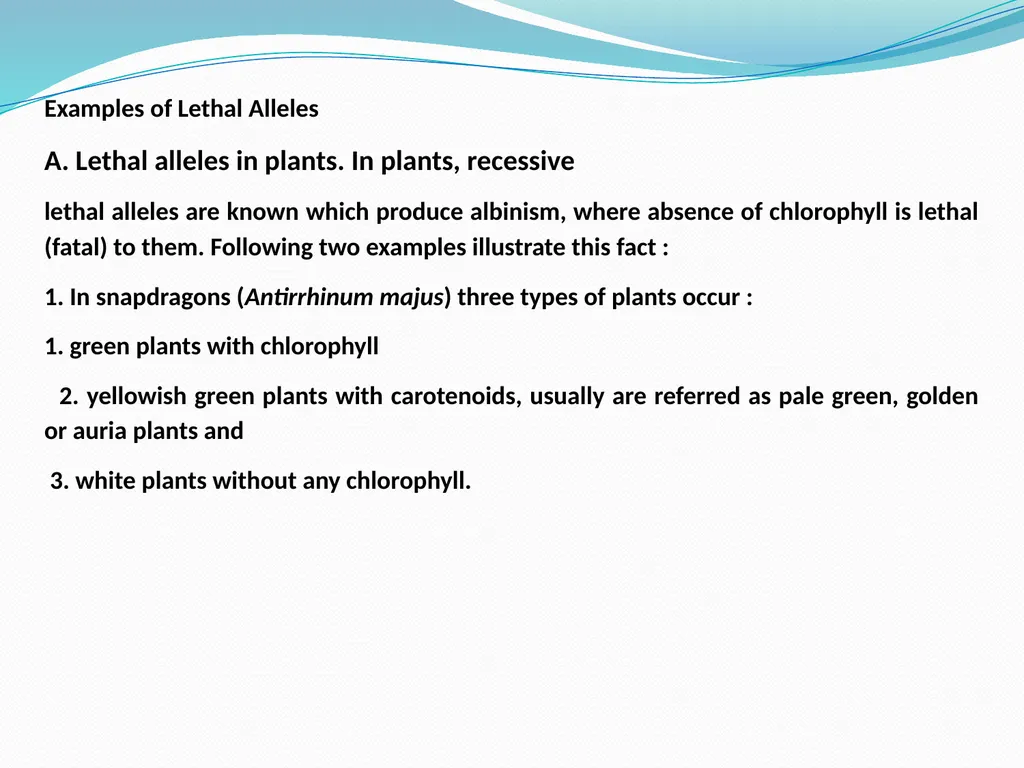
lethal alleles are known which produce albinism, where absence of chlorophyll is lethal (fatal) to them. Following two examples illustrate this fact :
1. In snapdragons (Antirrhinum majus) three types of plants occur :
1. green plants with chlorophyll
2. yellowish green plants with carotenoids, usually are referred as pale green, golden or auria plants and
3. white plants without any chlorophyll.<br>
slide4. The homozygous green plants have the genotype CC and the homozygous white plant has the genotype cc. The auria plants have the genotype Cc because they are heterozygotes of green and white plants. When two such auria plants are crossed, the F1 progeny has identical phenotypic and genotypic ratio F1 : 2 : 1 (viz., 1 green (CC) : 2 auria (Cc) : 1white (cc). But the white plants because lack chlorophyll pigment, therefore, die to modify the ratio of 1 : 2 : 1 into1 : 2 or 2 : 1. In this case the homozygous recessive genotype (cc) is lethal.
F1 heterozygote : : Auria X Auria
Cc Cc
F2 : 1 CC : 2 Cc : 1cc
Green Auria White (lethal}
.
Thus, c allele exhibits a lethal effect when homozygous and a distinctive phenotypic effect (e.g., auria) when heterozygous.<br>
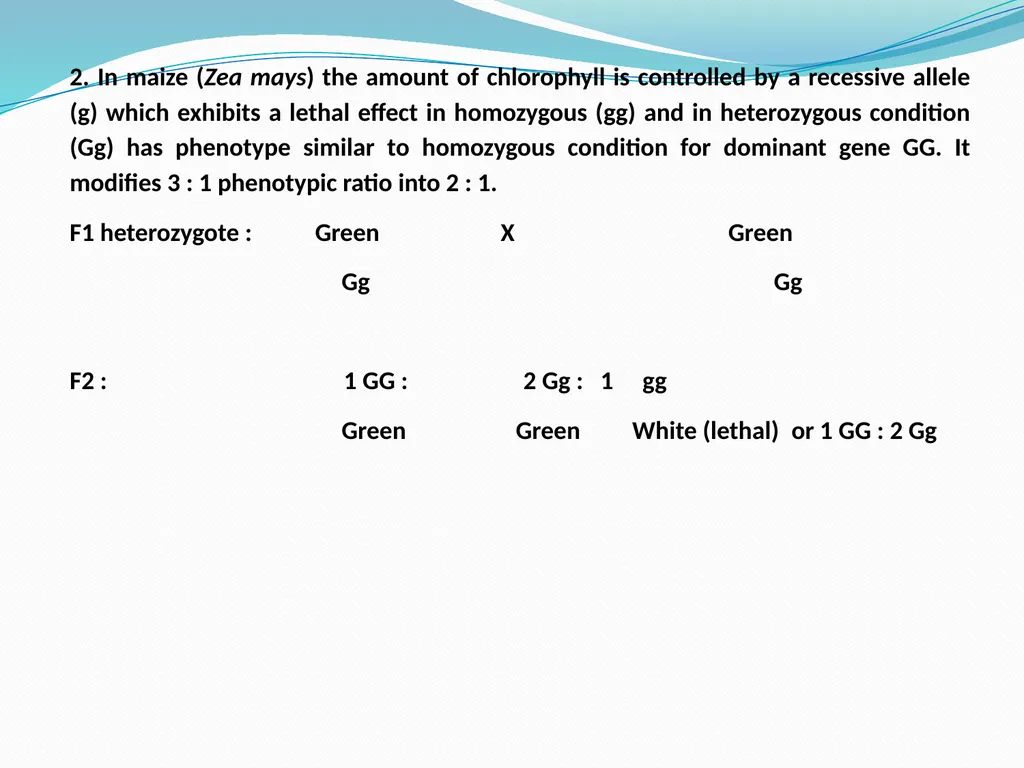
slide5. 2. In maize (Zea mays) the amount of chlorophyll is controlled by a recessive allele (g) which exhibits a lethal effect in homozygous (gg) and in heterozygous condition (Gg) has phenotype similar to homozygous condition for dominant gene GG. It modifies 3 : 1 phenotypic ratio into 2 : 1.
F1 heterozygote : Green X Green
Gg Gg
F2 : 1 GG : 2 Gg : 1 gg
Green Green White (lethal) or 1 GG : 2 Gg<br>
slide6. B. Lethal alleles in animals. Among animals, the following three
examples exhibit the role of recessive lethal alleles :
:1. The inheritance of mouse body colour was studied by the French geneticist, L. Cuenot in 1905. The coat colour of mice is governed by a multiple allelic series in which
A allele determines agouti or mousy-coloured coat
AY allele determines yellow coat and a allele forms black coat.
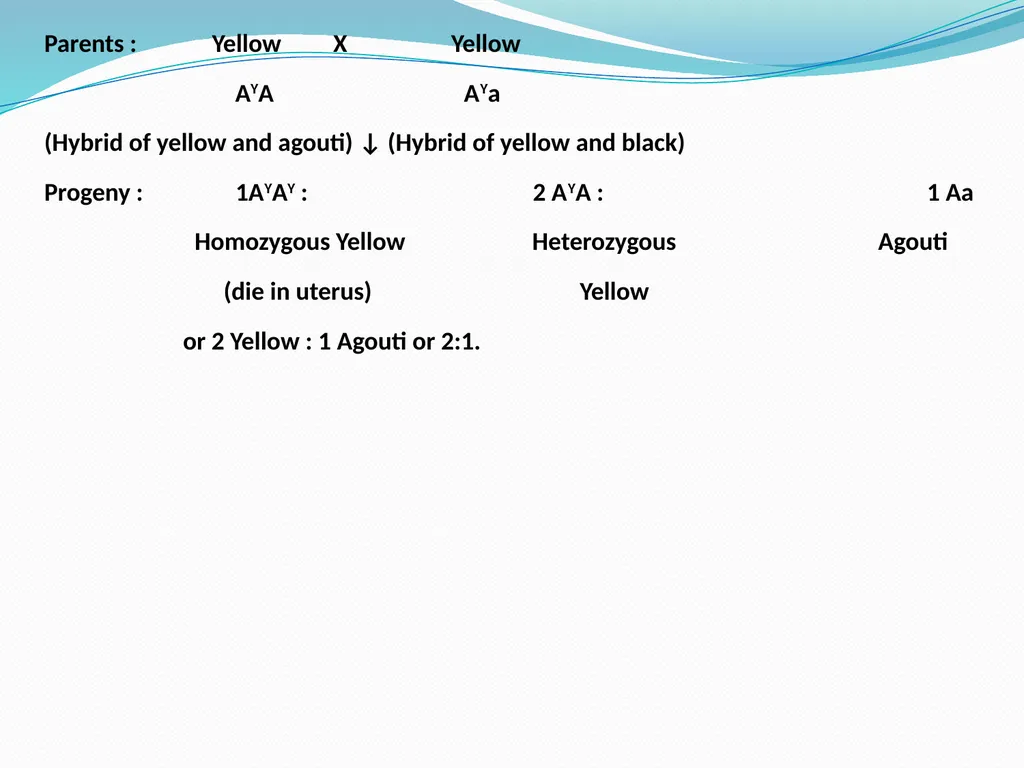
The dominance hierarchy is as follows : AY >A>a. The AY allele also acts as a recessive lethal, since in the homozygous state (AYAY), it kills the individual in early embryonic stage (i.e., during gastrulation). Thus, when two yellow coated heterozygotes (AYA) are crossed, they produce a progeny showing a ratio of 2:1 since homozygous yellow (AYAY) individuals are never borned due to lethal effect of AY gene<br>
slide7. Parents : Yellow X Yellow
AYA AYa
(Hybrid of yellow and agouti) ↓ (Hybrid of yellow and black)
Progeny : 1AYAY : 2 AYA : 1 Aa
Homozygous Yellow Heterozygous Agouti
(die in uterus) Yellow
or 2 Yellow : 1 Agouti or 2:1.<br>
slide8. One gene may contribute to several visible characteristics
Mendel derived his laws from studies in which one gene determined one trait .
The phenomenon of a single gene determining a number of distinct and seemingly unrelated characteristics is known as pleiotropy. Since genetics now know that each gene determines a specific protein and that each protein can have a cascade of effects on an organism, we can understand how can pleiotropy arises .
Some alleles may cause lethality
A significant variation of pleiotropy occur in alleles that not only produce a visible phenotype but also affect viability . Mendel assumed that all genotypes are equally viable such as representative of each genotype have an equal rate of survival. If this were not true, and a large percentage of, say, homozygous for particulare allele died before germination or birth, you would not be able to count theme after birth, and this alter the 1:2:1 genotype ratio and the phenotypic ratios predicted for the F2 generation.
.<br>
slide9. Among the aboriginal Maori people of new Zealand, for example ,many of the men develop frequent respiratory problems and are also sterile. Researchers have found that the fault lies with the recessive alleles of a single gene. the gene normal dominant allele specifies a proteins necessary for the action of cilia and flagella, both of which are hairlike structure extending from surfaces of some cells. In men who are homozygous for the recessive alleles, however ,cilia that normally clear the airways fail to work effectively and flagella that normally propel sperm fail to do their job. Thus one gene determines a protein that indirectly affects both respiratory function and reproduction<br>
slide10. Most of the genetic systems that we have examined so far consist of two alleles. In Mendel’s peas, for instance, one allele encoded round seeds and another encoded wrinkled seeds; in cats, one allele produced a black coat and another produced a gray coat. For some loci, more than two alleles are present within a group of organisms—the locus has multiple alleles. (Multiple alleles may also be referred to as an allelic series.) Although there may be more than two alleles present within a group of organisms, the genotype of each individual diploid organism still consists of only two alleles. The inheritance of characteristics encoded by multiple alleles is no different from the inheritance of characteristics encoded by two alleles, except that a greater variety of genotypes and phenotypes are possible.<br>
slide11. The ABO blood group Another multiple-allele system is at the locus for the ABO blood group. This locus determines your ABO blood type and, like the MN locus, encodes antigens on red blood cells. The three common alleles for the ABO blood group locus are: IA, which encodes the A antigen; IB, which encodes the B antigen; and i, which encodes no antigen (O). We can represent the dominance relations among the ABO alleles as follows: IA > i, IB > i, IA = IB. Both the IA and the IB alleles are dominant over i and are codominant with each other; the AB phenotype is due to the presence of an IA allele and an IB allele, which results in the production of A and B antigens on red blood cells. A person with genotype ii produces neither antigen and has blood type O. The six common genotypes at this locus and their phenotypes are shown in figure . Antibodies are produced against any foreign antigens. For instance, a person having blood-type A produces anti-B antibodies, because the B antigen is foreign. A person having blood-type B produces anti-A antibodies, and someone having blood-type AB produces neither anti- A nor anti-B antibodies, because neither A nor B antigen is foreign. A person having blood-type O possesses no A or B antigens; consequently, that person produces both anti-A<br>
slide12. Polygenic inheritance
Human features like height, eye color, and hair color come in lots of slightly different forms because they are controlled by many genes, each of which contributes some amount to the overall phenotype. For example, there are two major eye color genes, but at least 14 other genes that play roles in determining a person’s exact eye color
Looking at a real example of a human polygenic trait would get complicated, largely because we’d have to keep track of tens, or even hundreds, of different allele pairs (like the 400 involved in height!).<br>
slide13. Key terms
Term Meaning
Multiple alleles: A gene that is controlled by more than two alleles
Pleiotropy: When one gene affects multiple characteristics
Lethal allele: Allele that results in the death of an individual
Polygenic trait: Traits that are controlled by multiple genes<br>
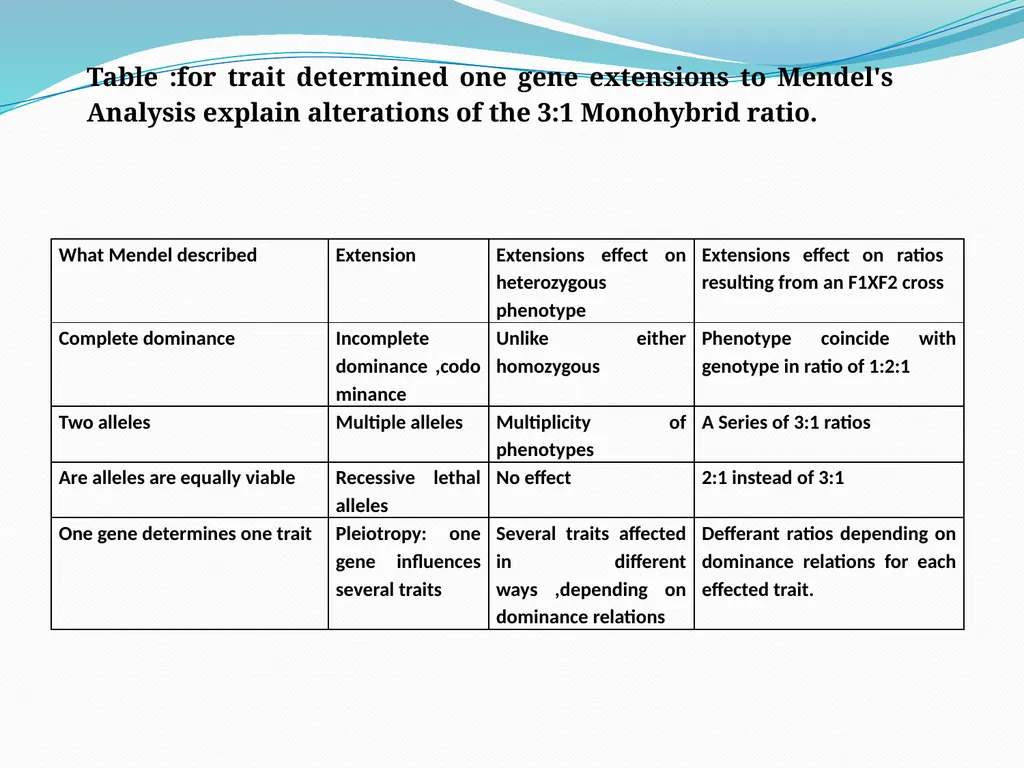
slide14. Table :for trait determined one gene extensions to Mendel's Analysis explain alterations of the 3:1 Monohybrid ratio.<br>
slide15. GENETIC INTERACTION
The gene is a chemical determiner. Whereas a phenotypic trait results from the combined action of many genes and their products constantly interacting with the environment. The environment includes not only ecological factors such as temperature and the amount or quality of light, but also internal factors such as hormones and enzymes. The enzymes are proteins and the specific molecular organization of protein is determined by genes. The enzymatic proteins perform catalytic function in various cellular chemical (metabolic) reactions and causing the splitting or union of various molecules.
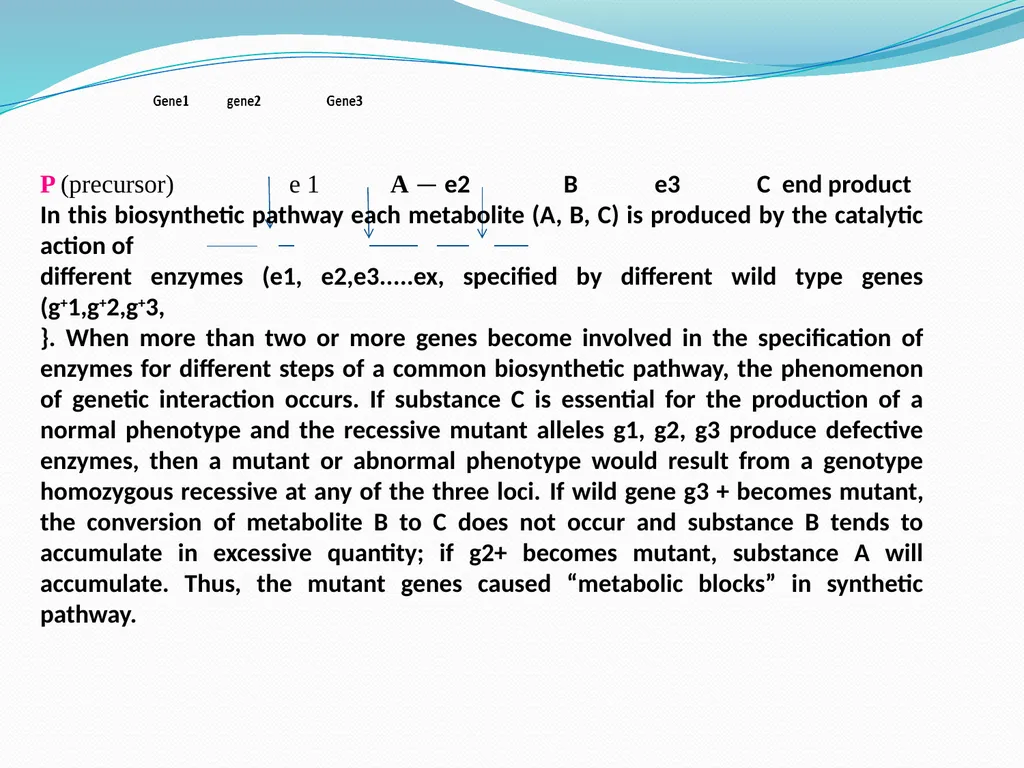
Each cellular chemical reaction involves stepwise conversion of one substance called precursor into another, called end product. Each step being mediated by a specific enzyme. All the subsequent steps of a chemical reaction constitute the biosynthetic pathway. Thus, a simplest biosynthetic pathway includes various steps, each step is catalyzed by a specific enzymatic protein and each enzymatic protein in its turn depends on a specific gene for its production. For example, we may consider a simple biosynthetic pathway which transforms a precursor substance ‘P’ into the end product ‘C’ in following three subsequent steps :<br>
slide16. P (precursor) e 1 A — e2 B e3 C end product
In this biosynthetic pathway each metabolite (A, B, C) is produced by the catalytic action of
different enzymes (e1, e2,e3.....ex, specified by different wild type genes (g+1,g+2,g+3,
}. When more than two or more genes become involved in the specification of enzymes for different steps of a common biosynthetic pathway, the phenomenon of genetic interaction occurs. If substance C is essential for the production of a normal phenotype and the recessive mutant alleles g1, g2, g3 produce defective enzymes, then a mutant or abnormal phenotype would result from a genotype homozygous recessive at any of the three loci. If wild gene g3 + becomes mutant, the conversion of metabolite B to C does not occur and substance B tends to accumulate in excessive quantity; if g2+ becomes mutant, substance A will accumulate. Thus, the mutant genes caused “metabolic blocks” in synthetic pathway.<br>
slide17. An organism with a mutation only in gene g2+ could produce a normal phenotype, if it was given either substance B or C, but an organism with a mutation in gene g3+ has a specific requirement for substance C for the production of normal phenotype. Thus, gene g3+ becomes dependent upon g2+ for its expression as a normal phenotype. If the genotype is homozygous for the recessive g2 allele, then the biosynthetic pathway ends with substance A. Neither g3+ nor its recessive allele g3 has any effect on the phenotype. Thus, genotype (g2g2) can hide or mask the phenotypic expression of alleles at the g3+ locus. Originally a gene or locus which suppressed or masked the action of a gene at another locus was termed epistatic gene.
The gene or locus which was suppressed by a epistatic gene was called hypostatic gene.
Later studies revealed the fact that both loci or genes (i.e., epistatic and hypostatic) could be epistatic to one another. Presently, the term epistasis (Greek, standing upon) is used for almost any type of allelic genetic interaction<br>
slide18. Difference Between Dominance and Epistasis
The phenomenon of dominance involves intra-allelic gene suppression, or the masking effect which one allele has upon the expression of another allele at the same locus, while the phenomenon of epistasis involves inter-allelic gene suppression or the masking effect which one gene locus has upon the expression of another. The classical phenotypic ratio of 9 : 3 : 3 : 1 observed in the progeny of dihybrid parents becomes modified by epistasis into ratios which are various combinations of the9 : 3 : 3 : 1 groupings.<br>
Lethal alleles and multiple alleles
Dr. israa hussein hamzah
email: esraa_hassan17@yahoo.com
szsh@uomustansiriyah.edu.iq
Reference book: genetic (Conceptual-Approach) fourth edition (2012)
Author: Benjamin C. Pierce<br>
slide2. Lethal genes are mutant genes and result in the death of the individual which carries them. Death of the individual occurs either in the prenatal or postnatal period prior to sexual maturity. A fully (completely) dominant lethal allele kills both in homozygous and heterozygous states. Individuals with a dominant lethal allele die before they can leave progeny. Therefore, the mutant dominant lethal is removed from the population in the same generation in which it arose. Recessive lethal genes kill only when they are in a homozygous state and they may be of two kinds : 1. one which has no obvious phenotypic effect in heterozygotes and 2. one which exhibits a distinctive phenotype when heterozygous.
The completely lethal genes usually cause death of the zygote, later in the embryonic development or even after birth or hatching. Complete lethality, thus, is the case where no individuals of a certain genotype in the age of reproduction. However in many cases lethal genes become operative at the time the individuals become sexually mature. Such lethal genes which handicap but do not destroy their possessor are called subvital, sublethal or semilethal genes. The lethal alleles modify the 3:1 phenotypic ratio into 2 : 1.<br>
slide3. Examples of Lethal Alleles
A. Lethal alleles in plants. In plants, recessive
lethal alleles are known which produce albinism, where absence of chlorophyll is lethal (fatal) to them. Following two examples illustrate this fact :
1. In snapdragons (Antirrhinum majus) three types of plants occur :
1. green plants with chlorophyll
2. yellowish green plants with carotenoids, usually are referred as pale green, golden or auria plants and
3. white plants without any chlorophyll.<br>
slide4. The homozygous green plants have the genotype CC and the homozygous white plant has the genotype cc. The auria plants have the genotype Cc because they are heterozygotes of green and white plants. When two such auria plants are crossed, the F1 progeny has identical phenotypic and genotypic ratio F1 : 2 : 1 (viz., 1 green (CC) : 2 auria (Cc) : 1white (cc). But the white plants because lack chlorophyll pigment, therefore, die to modify the ratio of 1 : 2 : 1 into1 : 2 or 2 : 1. In this case the homozygous recessive genotype (cc) is lethal.
F1 heterozygote : : Auria X Auria
Cc Cc
F2 : 1 CC : 2 Cc : 1cc
Green Auria White (lethal}
.
Thus, c allele exhibits a lethal effect when homozygous and a distinctive phenotypic effect (e.g., auria) when heterozygous.<br>
slide5. 2. In maize (Zea mays) the amount of chlorophyll is controlled by a recessive allele (g) which exhibits a lethal effect in homozygous (gg) and in heterozygous condition (Gg) has phenotype similar to homozygous condition for dominant gene GG. It modifies 3 : 1 phenotypic ratio into 2 : 1.
F1 heterozygote : Green X Green
Gg Gg
F2 : 1 GG : 2 Gg : 1 gg
Green Green White (lethal) or 1 GG : 2 Gg<br>
slide6. B. Lethal alleles in animals. Among animals, the following three
examples exhibit the role of recessive lethal alleles :
:1. The inheritance of mouse body colour was studied by the French geneticist, L. Cuenot in 1905. The coat colour of mice is governed by a multiple allelic series in which
A allele determines agouti or mousy-coloured coat
AY allele determines yellow coat and a allele forms black coat.
The dominance hierarchy is as follows : AY >A>a. The AY allele also acts as a recessive lethal, since in the homozygous state (AYAY), it kills the individual in early embryonic stage (i.e., during gastrulation). Thus, when two yellow coated heterozygotes (AYA) are crossed, they produce a progeny showing a ratio of 2:1 since homozygous yellow (AYAY) individuals are never borned due to lethal effect of AY gene<br>
slide7. Parents : Yellow X Yellow
AYA AYa
(Hybrid of yellow and agouti) ↓ (Hybrid of yellow and black)
Progeny : 1AYAY : 2 AYA : 1 Aa
Homozygous Yellow Heterozygous Agouti
(die in uterus) Yellow
or 2 Yellow : 1 Agouti or 2:1.<br>
slide8. One gene may contribute to several visible characteristics
Mendel derived his laws from studies in which one gene determined one trait .
The phenomenon of a single gene determining a number of distinct and seemingly unrelated characteristics is known as pleiotropy. Since genetics now know that each gene determines a specific protein and that each protein can have a cascade of effects on an organism, we can understand how can pleiotropy arises .
Some alleles may cause lethality
A significant variation of pleiotropy occur in alleles that not only produce a visible phenotype but also affect viability . Mendel assumed that all genotypes are equally viable such as representative of each genotype have an equal rate of survival. If this were not true, and a large percentage of, say, homozygous for particulare allele died before germination or birth, you would not be able to count theme after birth, and this alter the 1:2:1 genotype ratio and the phenotypic ratios predicted for the F2 generation.
.<br>
slide9. Among the aboriginal Maori people of new Zealand, for example ,many of the men develop frequent respiratory problems and are also sterile. Researchers have found that the fault lies with the recessive alleles of a single gene. the gene normal dominant allele specifies a proteins necessary for the action of cilia and flagella, both of which are hairlike structure extending from surfaces of some cells. In men who are homozygous for the recessive alleles, however ,cilia that normally clear the airways fail to work effectively and flagella that normally propel sperm fail to do their job. Thus one gene determines a protein that indirectly affects both respiratory function and reproduction<br>
slide10. Most of the genetic systems that we have examined so far consist of two alleles. In Mendel’s peas, for instance, one allele encoded round seeds and another encoded wrinkled seeds; in cats, one allele produced a black coat and another produced a gray coat. For some loci, more than two alleles are present within a group of organisms—the locus has multiple alleles. (Multiple alleles may also be referred to as an allelic series.) Although there may be more than two alleles present within a group of organisms, the genotype of each individual diploid organism still consists of only two alleles. The inheritance of characteristics encoded by multiple alleles is no different from the inheritance of characteristics encoded by two alleles, except that a greater variety of genotypes and phenotypes are possible.<br>
slide11. The ABO blood group Another multiple-allele system is at the locus for the ABO blood group. This locus determines your ABO blood type and, like the MN locus, encodes antigens on red blood cells. The three common alleles for the ABO blood group locus are: IA, which encodes the A antigen; IB, which encodes the B antigen; and i, which encodes no antigen (O). We can represent the dominance relations among the ABO alleles as follows: IA > i, IB > i, IA = IB. Both the IA and the IB alleles are dominant over i and are codominant with each other; the AB phenotype is due to the presence of an IA allele and an IB allele, which results in the production of A and B antigens on red blood cells. A person with genotype ii produces neither antigen and has blood type O. The six common genotypes at this locus and their phenotypes are shown in figure . Antibodies are produced against any foreign antigens. For instance, a person having blood-type A produces anti-B antibodies, because the B antigen is foreign. A person having blood-type B produces anti-A antibodies, and someone having blood-type AB produces neither anti- A nor anti-B antibodies, because neither A nor B antigen is foreign. A person having blood-type O possesses no A or B antigens; consequently, that person produces both anti-A<br>
slide12. Polygenic inheritance
Human features like height, eye color, and hair color come in lots of slightly different forms because they are controlled by many genes, each of which contributes some amount to the overall phenotype. For example, there are two major eye color genes, but at least 14 other genes that play roles in determining a person’s exact eye color
Looking at a real example of a human polygenic trait would get complicated, largely because we’d have to keep track of tens, or even hundreds, of different allele pairs (like the 400 involved in height!).<br>
slide13. Key terms
Term Meaning
Multiple alleles: A gene that is controlled by more than two alleles
Pleiotropy: When one gene affects multiple characteristics
Lethal allele: Allele that results in the death of an individual
Polygenic trait: Traits that are controlled by multiple genes<br>
slide14. Table :for trait determined one gene extensions to Mendel's Analysis explain alterations of the 3:1 Monohybrid ratio.<br>
slide15. GENETIC INTERACTION
The gene is a chemical determiner. Whereas a phenotypic trait results from the combined action of many genes and their products constantly interacting with the environment. The environment includes not only ecological factors such as temperature and the amount or quality of light, but also internal factors such as hormones and enzymes. The enzymes are proteins and the specific molecular organization of protein is determined by genes. The enzymatic proteins perform catalytic function in various cellular chemical (metabolic) reactions and causing the splitting or union of various molecules.
Each cellular chemical reaction involves stepwise conversion of one substance called precursor into another, called end product. Each step being mediated by a specific enzyme. All the subsequent steps of a chemical reaction constitute the biosynthetic pathway. Thus, a simplest biosynthetic pathway includes various steps, each step is catalyzed by a specific enzymatic protein and each enzymatic protein in its turn depends on a specific gene for its production. For example, we may consider a simple biosynthetic pathway which transforms a precursor substance ‘P’ into the end product ‘C’ in following three subsequent steps :<br>
slide16. P (precursor) e 1 A — e2 B e3 C end product
In this biosynthetic pathway each metabolite (A, B, C) is produced by the catalytic action of
different enzymes (e1, e2,e3.....ex, specified by different wild type genes (g+1,g+2,g+3,
}. When more than two or more genes become involved in the specification of enzymes for different steps of a common biosynthetic pathway, the phenomenon of genetic interaction occurs. If substance C is essential for the production of a normal phenotype and the recessive mutant alleles g1, g2, g3 produce defective enzymes, then a mutant or abnormal phenotype would result from a genotype homozygous recessive at any of the three loci. If wild gene g3 + becomes mutant, the conversion of metabolite B to C does not occur and substance B tends to accumulate in excessive quantity; if g2+ becomes mutant, substance A will accumulate. Thus, the mutant genes caused “metabolic blocks” in synthetic pathway.<br>
slide17. An organism with a mutation only in gene g2+ could produce a normal phenotype, if it was given either substance B or C, but an organism with a mutation in gene g3+ has a specific requirement for substance C for the production of normal phenotype. Thus, gene g3+ becomes dependent upon g2+ for its expression as a normal phenotype. If the genotype is homozygous for the recessive g2 allele, then the biosynthetic pathway ends with substance A. Neither g3+ nor its recessive allele g3 has any effect on the phenotype. Thus, genotype (g2g2) can hide or mask the phenotypic expression of alleles at the g3+ locus. Originally a gene or locus which suppressed or masked the action of a gene at another locus was termed epistatic gene.
The gene or locus which was suppressed by a epistatic gene was called hypostatic gene.
Later studies revealed the fact that both loci or genes (i.e., epistatic and hypostatic) could be epistatic to one another. Presently, the term epistasis (Greek, standing upon) is used for almost any type of allelic genetic interaction<br>
slide18. Difference Between Dominance and Epistasis
The phenomenon of dominance involves intra-allelic gene suppression, or the masking effect which one allele has upon the expression of another allele at the same locus, while the phenomenon of epistasis involves inter-allelic gene suppression or the masking effect which one gene locus has upon the expression of another. The classical phenotypic ratio of 9 : 3 : 3 : 1 observed in the progeny of dihybrid parents becomes modified by epistasis into ratios which are various combinations of the9 : 3 : 3 : 1 groupings.<br>