
Genetics Engineering Lecture-1 Introduction to
KB
Published · 16 slides · 0 views
1 / 1
Description
Genetics Engineering Lecture-1 Introduction to Genetics Engineering Introduction to the Fundamentals of Recombinant DNA Technology and DNA Cloning DNA Deoxyribu-Nucelic Acid DNA is a very large molecule, made up of smaller units called
Related Topics
Share
Embed code
Download this presentation From Below
"Genetics Engineering Lecture-1 Introduction to" is the property of its rightful owner. Permission is granted to download and print the materials on this website for personal, non-commercial use only, and to display it on your personal computer provided you do not modify the materials and that you retain all copyright notices contained in the materials. By downloading content from our website, you accept the terms of this agreement.
Presentation Transcript
01
Genetics Engineering Lecture-1 Introduction to Genetics Engineering<br>
02
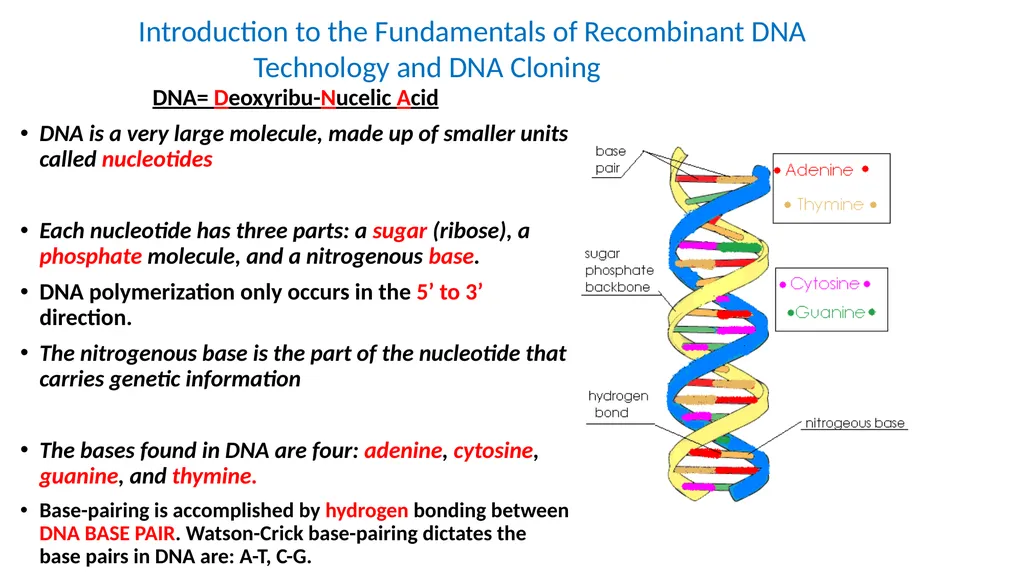
Introduction to the Fundamentals of Recombinant DNA Technology and DNA Cloning DNA= Deoxyribu-Nucelic Acid
DNA is a very large molecule, made up of smaller units called nucleotides
Each nucleotide has three parts: a sugar (ribose), a phosphate molecule, and a nitrogenous base.
DNA polymerization only occurs in the 5’ to 3’ direction.
The nitrogenous base is the part of the nucleotide that carries genetic information
The bases found in DNA are four: adenine, cytosine, guanine, and thymine.
Base-pairing is accomplished by hydrogen bonding between DNA BASE PAIR. Watson-Crick base-pairing dictates the base pairs in DNA are: A-T, C-G.<br>
DNA is a very large molecule, made up of smaller units called nucleotides
Each nucleotide has three parts: a sugar (ribose), a phosphate molecule, and a nitrogenous base.
DNA polymerization only occurs in the 5’ to 3’ direction.
The nitrogenous base is the part of the nucleotide that carries genetic information
The bases found in DNA are four: adenine, cytosine, guanine, and thymine.
Base-pairing is accomplished by hydrogen bonding between DNA BASE PAIR. Watson-Crick base-pairing dictates the base pairs in DNA are: A-T, C-G.<br>
03
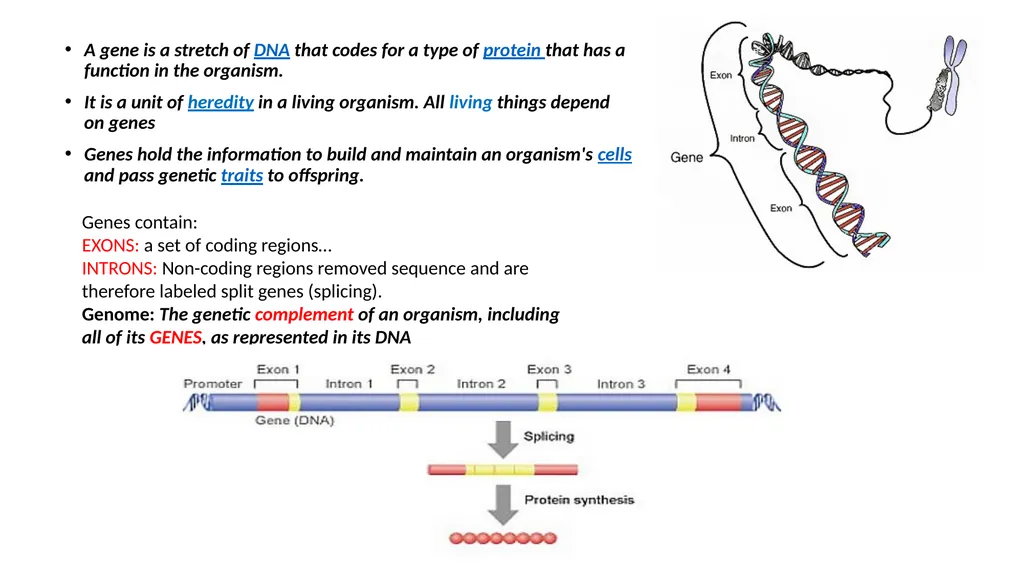
A gene is a stretch of DNA that codes for a type of protein that has a function in the organism.
It is a unit of heredity in a living organism. All living things depend on genes
Genes hold the information to build and maintain an organism's cells and pass genetic traits to offspring. Genes contain:
EXONS: a set of coding regions…
INTRONS: Non-coding regions removed sequence and are therefore labeled split genes (splicing).
Genome: The genetic complement of an organism, including all of its GENES, as represented in its DNA<br>
It is a unit of heredity in a living organism. All living things depend on genes
Genes hold the information to build and maintain an organism's cells and pass genetic traits to offspring. Genes contain:
EXONS: a set of coding regions…
INTRONS: Non-coding regions removed sequence and are therefore labeled split genes (splicing).
Genome: The genetic complement of an organism, including all of its GENES, as represented in its DNA<br>
04
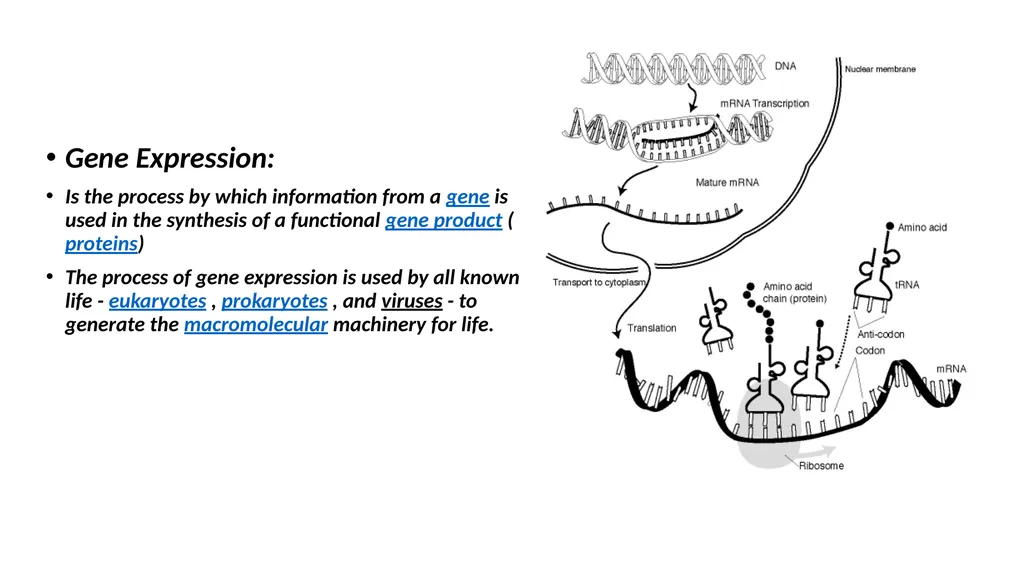
Gene Expression:
Is the process by which information from a gene is used in the synthesis of a functional gene product (proteins)
The process of gene expression is used by all known life - eukaryotes , prokaryotes , and viruses - to generate the macromolecular machinery for life.<br>
Is the process by which information from a gene is used in the synthesis of a functional gene product (proteins)
The process of gene expression is used by all known life - eukaryotes , prokaryotes , and viruses - to generate the macromolecular machinery for life.<br>
05
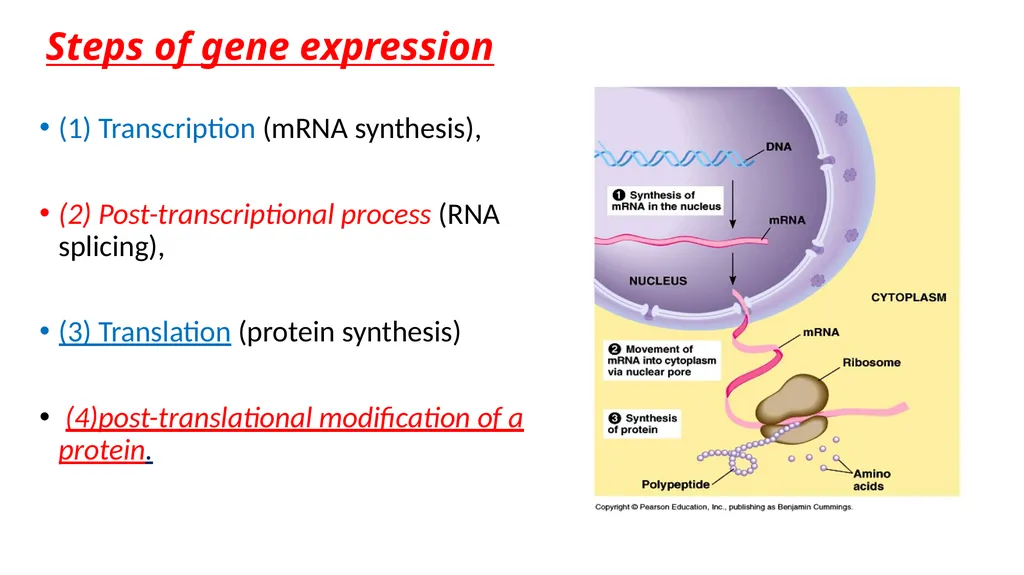
Steps of gene expression (1) Transcription (mRNA synthesis),
(2) Post-transcriptional process (RNA splicing),
(3) Translation (protein synthesis)
(4)post-translational modification of a protein.<br>
(2) Post-transcriptional process (RNA splicing),
(3) Translation (protein synthesis)
(4)post-translational modification of a protein.<br>
06
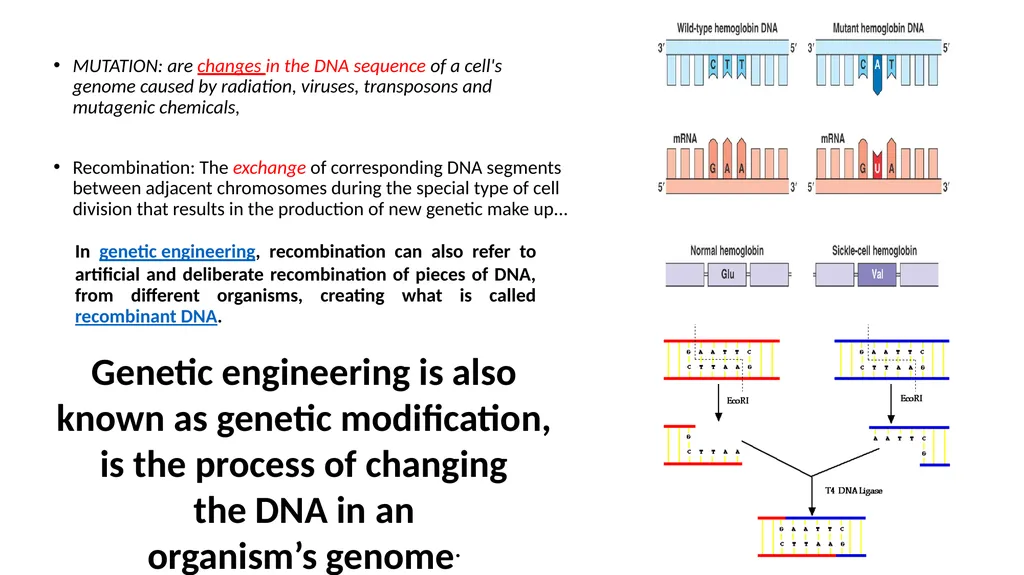
MUTATION: are changes in the DNA sequence of a cell's genome caused by radiation, viruses, transposons and mutagenic chemicals, Recombination: The exchange of corresponding DNA segments between adjacent chromosomes during the special type of cell division that results in the production of new genetic make up... In genetic engineering, recombination can also refer to artificial and deliberate recombination of pieces of DNA, from different organisms, creating what is called recombinant DNA. Genetic engineering is also known as genetic modification, is the process of changing the DNA in an organism’s genome.<br>
07
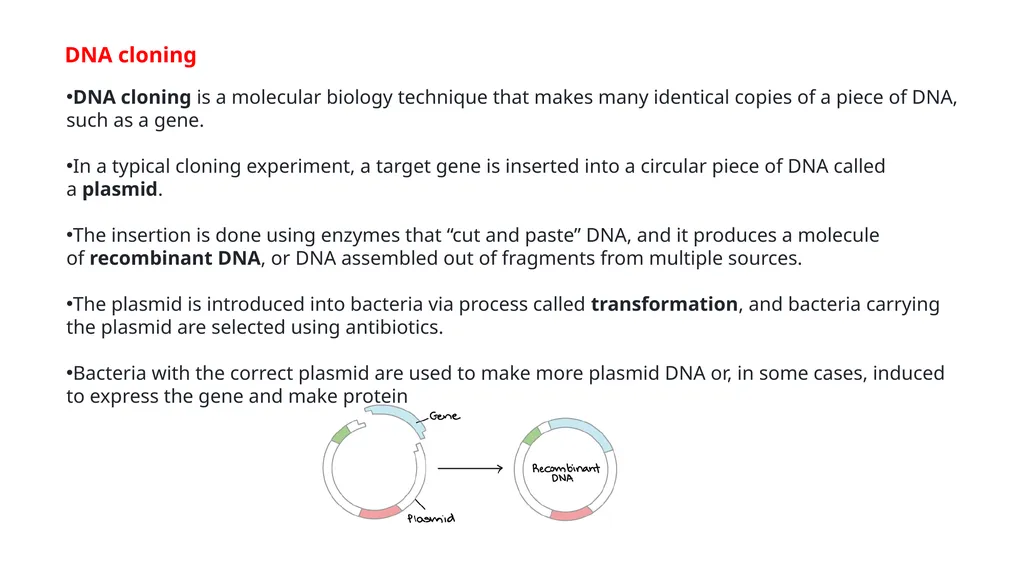
DNA cloning DNA cloning is a molecular biology technique that makes many identical copies of a piece of DNA, such as a gene.
In a typical cloning experiment, a target gene is inserted into a circular piece of DNA called a plasmid.
The insertion is done using enzymes that “cut and paste” DNA, and it produces a molecule
of recombinant DNA, or DNA assembled out of fragments from multiple sources.
The plasmid is introduced into bacteria via process called transformation, and bacteria carrying the plasmid are selected using antibiotics.
Bacteria with the correct plasmid are used to make more plasmid DNA or, in some cases, induced to express the gene and make protein<br>
In a typical cloning experiment, a target gene is inserted into a circular piece of DNA called a plasmid.
The insertion is done using enzymes that “cut and paste” DNA, and it produces a molecule
of recombinant DNA, or DNA assembled out of fragments from multiple sources.
The plasmid is introduced into bacteria via process called transformation, and bacteria carrying the plasmid are selected using antibiotics.
Bacteria with the correct plasmid are used to make more plasmid DNA or, in some cases, induced to express the gene and make protein<br>
08
Restriction enzymes & DNA ligase
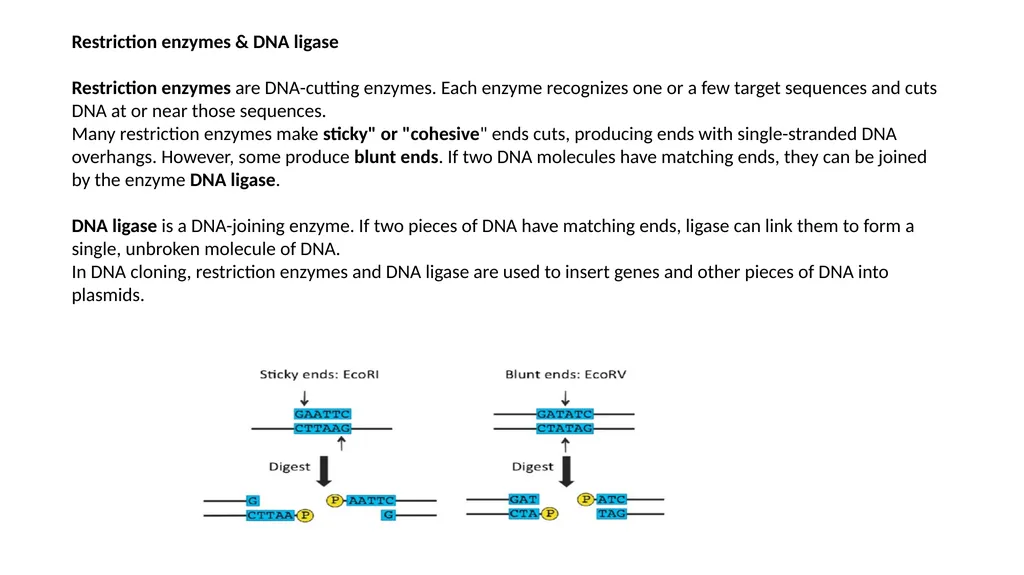
Restriction enzymes are DNA-cutting enzymes. Each enzyme recognizes one or a few target sequences and cuts DNA at or near those sequences.
Many restriction enzymes make sticky" or "cohesive" ends cuts, producing ends with single-stranded DNA overhangs. However, some produce blunt ends. If two DNA molecules have matching ends, they can be joined by the enzyme DNA ligase.
DNA ligase is a DNA-joining enzyme. If two pieces of DNA have matching ends, ligase can link them to form a single, unbroken molecule of DNA.
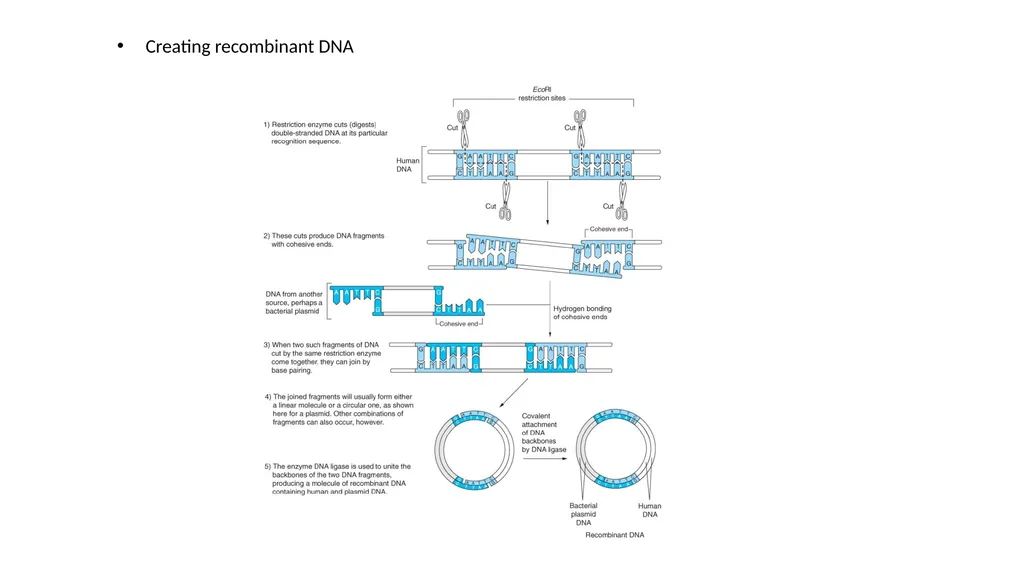
In DNA cloning, restriction enzymes and DNA ligase are used to insert genes and other pieces of DNA into plasmids.<br>
Restriction enzymes are DNA-cutting enzymes. Each enzyme recognizes one or a few target sequences and cuts DNA at or near those sequences.
Many restriction enzymes make sticky" or "cohesive" ends cuts, producing ends with single-stranded DNA overhangs. However, some produce blunt ends. If two DNA molecules have matching ends, they can be joined by the enzyme DNA ligase.
DNA ligase is a DNA-joining enzyme. If two pieces of DNA have matching ends, ligase can link them to form a single, unbroken molecule of DNA.
In DNA cloning, restriction enzymes and DNA ligase are used to insert genes and other pieces of DNA into plasmids.<br>
09
Restriction enzymes
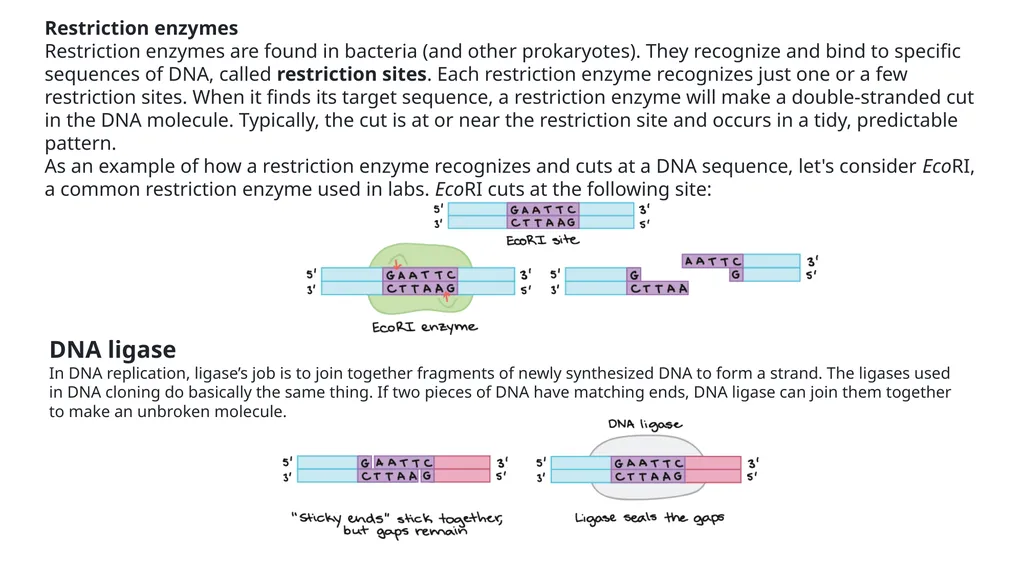
Restriction enzymes are found in bacteria (and other prokaryotes). They recognize and bind to specific sequences of DNA, called restriction sites. Each restriction enzyme recognizes just one or a few restriction sites. When it finds its target sequence, a restriction enzyme will make a double-stranded cut in the DNA molecule. Typically, the cut is at or near the restriction site and occurs in a tidy, predictable pattern.
As an example of how a restriction enzyme recognizes and cuts at a DNA sequence, let's consider EcoRI, a common restriction enzyme used in labs. EcoRI cuts at the following site: DNA ligase
In DNA replication, ligase’s job is to join together fragments of newly synthesized DNA to form a strand. The ligases used in DNA cloning do basically the same thing. If two pieces of DNA have matching ends, DNA ligase can join them together to make an unbroken molecule.<br>
Restriction enzymes are found in bacteria (and other prokaryotes). They recognize and bind to specific sequences of DNA, called restriction sites. Each restriction enzyme recognizes just one or a few restriction sites. When it finds its target sequence, a restriction enzyme will make a double-stranded cut in the DNA molecule. Typically, the cut is at or near the restriction site and occurs in a tidy, predictable pattern.
As an example of how a restriction enzyme recognizes and cuts at a DNA sequence, let's consider EcoRI, a common restriction enzyme used in labs. EcoRI cuts at the following site: DNA ligase
In DNA replication, ligase’s job is to join together fragments of newly synthesized DNA to form a strand. The ligases used in DNA cloning do basically the same thing. If two pieces of DNA have matching ends, DNA ligase can join them together to make an unbroken molecule.<br>
10
Creating recombinant DNA<br>
11
2. Bacterial transformation and selection
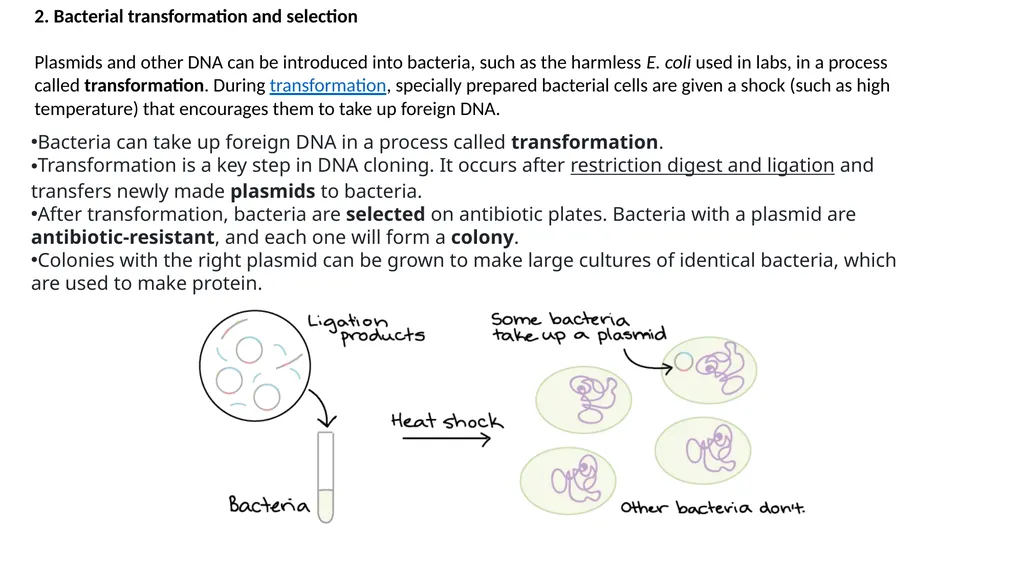
Plasmids and other DNA can be introduced into bacteria, such as the harmless E. coli used in labs, in a process called transformation. During transformation, specially prepared bacterial cells are given a shock (such as high temperature) that encourages them to take up foreign DNA. Bacteria can take up foreign DNA in a process called transformation.
Transformation is a key step in DNA cloning. It occurs after restriction digest and ligation and transfers newly made plasmids to bacteria.
After transformation, bacteria are selected on antibiotic plates. Bacteria with a plasmid are antibiotic-resistant, and each one will form a colony.
Colonies with the right plasmid can be grown to make large cultures of identical bacteria, which are used to make protein.<br>
Plasmids and other DNA can be introduced into bacteria, such as the harmless E. coli used in labs, in a process called transformation. During transformation, specially prepared bacterial cells are given a shock (such as high temperature) that encourages them to take up foreign DNA. Bacteria can take up foreign DNA in a process called transformation.
Transformation is a key step in DNA cloning. It occurs after restriction digest and ligation and transfers newly made plasmids to bacteria.
After transformation, bacteria are selected on antibiotic plates. Bacteria with a plasmid are antibiotic-resistant, and each one will form a colony.
Colonies with the right plasmid can be grown to make large cultures of identical bacteria, which are used to make protein.<br>
12
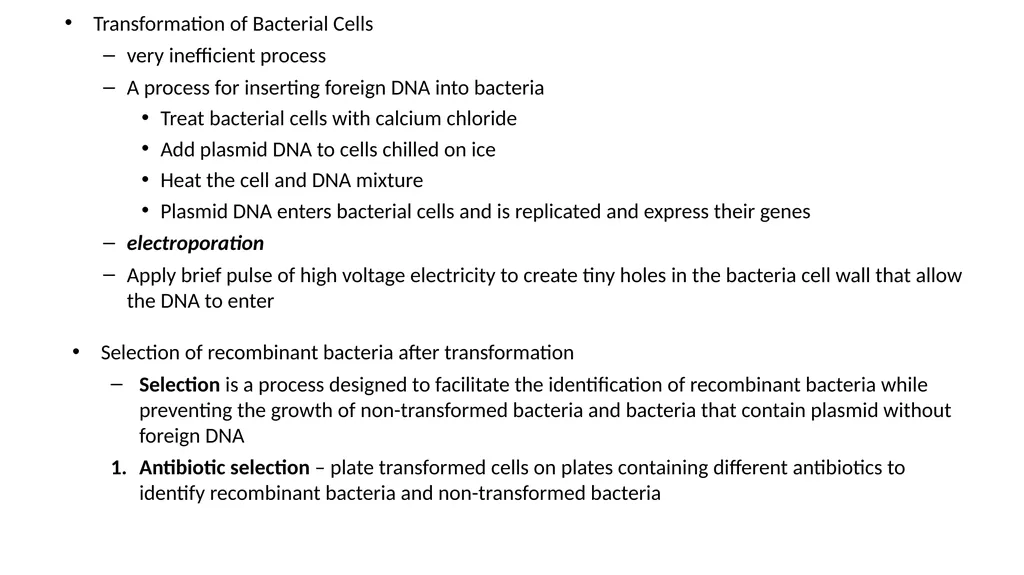
Transformation of Bacterial Cells
very inefficient process
A process for inserting foreign DNA into bacteria
Treat bacterial cells with calcium chloride
Add plasmid DNA to cells chilled on ice
Heat the cell and DNA mixture
Plasmid DNA enters bacterial cells and is replicated and express their genes
electroporation
Apply brief pulse of high voltage electricity to create tiny holes in the bacteria cell wall that allow the DNA to enter Selection of recombinant bacteria after transformation
Selection is a process designed to facilitate the identification of recombinant bacteria while preventing the growth of non-transformed bacteria and bacteria that contain plasmid without foreign DNA
Antibiotic selection – plate transformed cells on plates containing different antibiotics to identify recombinant bacteria and non-transformed bacteria<br>
very inefficient process
A process for inserting foreign DNA into bacteria
Treat bacterial cells with calcium chloride
Add plasmid DNA to cells chilled on ice
Heat the cell and DNA mixture
Plasmid DNA enters bacterial cells and is replicated and express their genes
electroporation
Apply brief pulse of high voltage electricity to create tiny holes in the bacteria cell wall that allow the DNA to enter Selection of recombinant bacteria after transformation
Selection is a process designed to facilitate the identification of recombinant bacteria while preventing the growth of non-transformed bacteria and bacteria that contain plasmid without foreign DNA
Antibiotic selection – plate transformed cells on plates containing different antibiotics to identify recombinant bacteria and non-transformed bacteria<br>
13
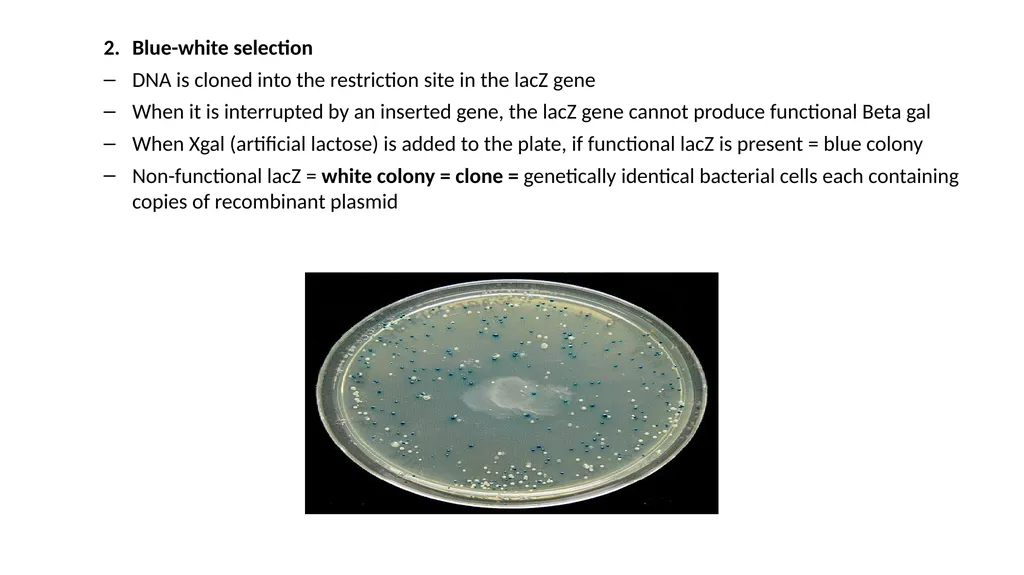
Blue-white selection
DNA is cloned into the restriction site in the lacZ gene
When it is interrupted by an inserted gene, the lacZ gene cannot produce functional Beta gal
When Xgal (artificial lactose) is added to the plate, if functional lacZ is present = blue colony
Non-functional lacZ = white colony = clone = genetically identical bacterial cells each containing copies of recombinant plasmid<br>
DNA is cloned into the restriction site in the lacZ gene
When it is interrupted by an inserted gene, the lacZ gene cannot produce functional Beta gal
When Xgal (artificial lactose) is added to the plate, if functional lacZ is present = blue colony
Non-functional lacZ = white colony = clone = genetically identical bacterial cells each containing copies of recombinant plasmid<br>
14
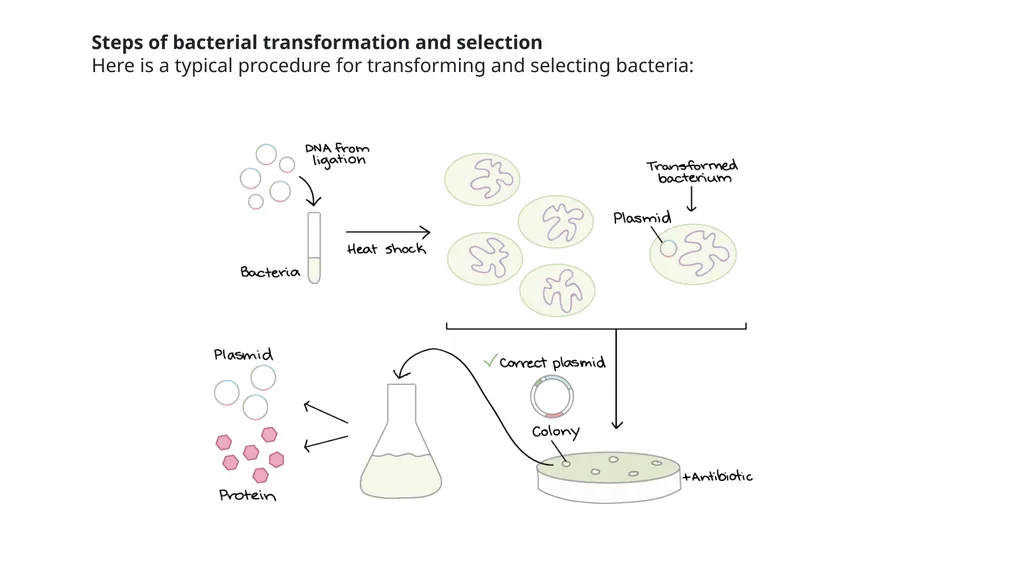
Steps of bacterial transformation and selection
Here is a typical procedure for transforming and selecting bacteria:<br>
Here is a typical procedure for transforming and selecting bacteria:<br>
15
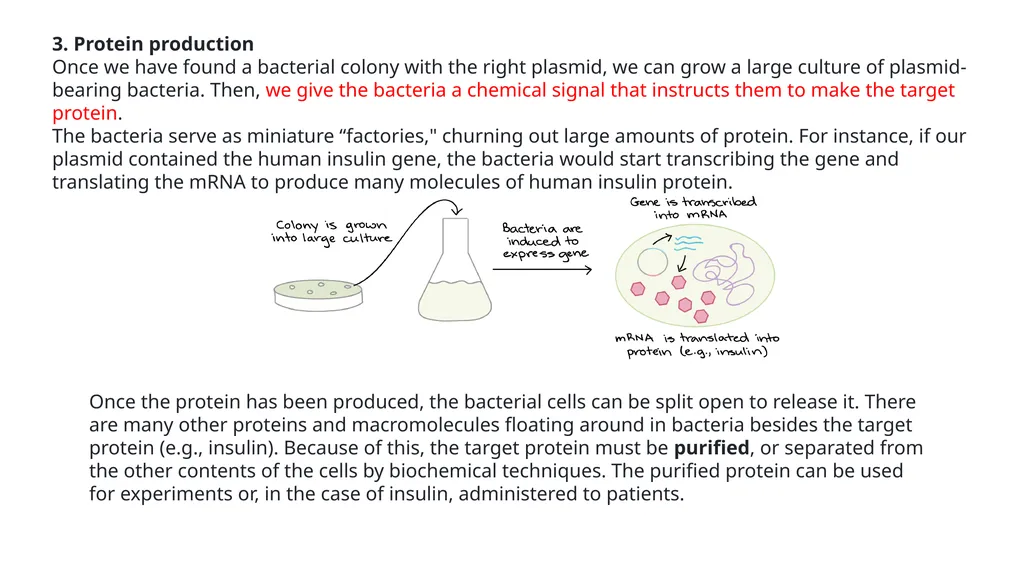
3. Protein production
Once we have found a bacterial colony with the right plasmid, we can grow a large culture of plasmid-bearing bacteria. Then, we give the bacteria a chemical signal that instructs them to make the target protein.
The bacteria serve as miniature “factories," churning out large amounts of protein. For instance, if our plasmid contained the human insulin gene, the bacteria would start transcribing the gene and translating the mRNA to produce many molecules of human insulin protein. Once the protein has been produced, the bacterial cells can be split open to release it. There are many other proteins and macromolecules floating around in bacteria besides the target protein (e.g., insulin). Because of this, the target protein must be purified, or separated from the other contents of the cells by biochemical techniques. The purified protein can be used for experiments or, in the case of insulin, administered to patients.<br>
Once we have found a bacterial colony with the right plasmid, we can grow a large culture of plasmid-bearing bacteria. Then, we give the bacteria a chemical signal that instructs them to make the target protein.
The bacteria serve as miniature “factories," churning out large amounts of protein. For instance, if our plasmid contained the human insulin gene, the bacteria would start transcribing the gene and translating the mRNA to produce many molecules of human insulin protein. Once the protein has been produced, the bacterial cells can be split open to release it. There are many other proteins and macromolecules floating around in bacteria besides the target protein (e.g., insulin). Because of this, the target protein must be purified, or separated from the other contents of the cells by biochemical techniques. The purified protein can be used for experiments or, in the case of insulin, administered to patients.<br>
16
Uses of DNA cloning
DNA molecules built through cloning techniques are used for many purposes in molecular biology. A short list of examples includes:
Biopharmaceuticals. DNA cloning can be used to make human proteins with biomedical applications, such as the insulin mentioned above. Other examples of recombinant proteins include human growth hormone, which is given to patients who are unable to synthesize the hormone, and tissue plasminogen activator (tPA), which is used to treat strokes and prevent blood clots. Recombinant proteins like these are often made in bacteria.
Gene therapy. In some genetic disorders, patients lack the functional form of a particular gene. Gene therapy attempts to provide a normal copy of the gene to the cells of a patient’s body. For example, DNA cloning was used to build plasmids containing a normal version of the gene that's nonfunctional in cystic fibrosis. When the plasmids were delivered to the lungs of cystic fibrosis patients, lung function deteriorated less quickly.
Gene analysis. In basic research labs, biologists often use DNA cloning to build artificial, recombinant versions of genes that help them understand how normal genes in an organism function. These are just a few examples of how DNA cloning is used in biology today. DNA cloning is a very common technique that is used in a huge variety of molecular biology applications.<br>
DNA molecules built through cloning techniques are used for many purposes in molecular biology. A short list of examples includes:
Biopharmaceuticals. DNA cloning can be used to make human proteins with biomedical applications, such as the insulin mentioned above. Other examples of recombinant proteins include human growth hormone, which is given to patients who are unable to synthesize the hormone, and tissue plasminogen activator (tPA), which is used to treat strokes and prevent blood clots. Recombinant proteins like these are often made in bacteria.
Gene therapy. In some genetic disorders, patients lack the functional form of a particular gene. Gene therapy attempts to provide a normal copy of the gene to the cells of a patient’s body. For example, DNA cloning was used to build plasmids containing a normal version of the gene that's nonfunctional in cystic fibrosis. When the plasmids were delivered to the lungs of cystic fibrosis patients, lung function deteriorated less quickly.
Gene analysis. In basic research labs, biologists often use DNA cloning to build artificial, recombinant versions of genes that help them understand how normal genes in an organism function. These are just a few examples of how DNA cloning is used in biology today. DNA cloning is a very common technique that is used in a huge variety of molecular biology applications.<br>