
GENETICS Lesson 2a Can Certain Traits Disappear in
Description: GENETICS Lesson 2a Can Certain Traits Disappear in a Family? Why or Why Not? Our Ideas and Questions about Inheritance Do you have any new ideas or questions to add to our class charts? Our Current Ideas about Inheritance Our Questions
Related Topics
Download Presentation
"GENETICS Lesson 2a Can Certain Traits Disappear in" is the property of its rightful owner. Permission is granted to download and print the materials on this website for personal, non-commercial use only, and to display it on your personal computer provided you do not modify the materials and that you retain all copyright notices contained in the materials. By downloading content from our website, you accept the terms of this agreement.
Presentation Transcript
slide1. GENETICS Lesson 2a Can Certain Traits Disappear in a Family? Why or Why Not?<br>
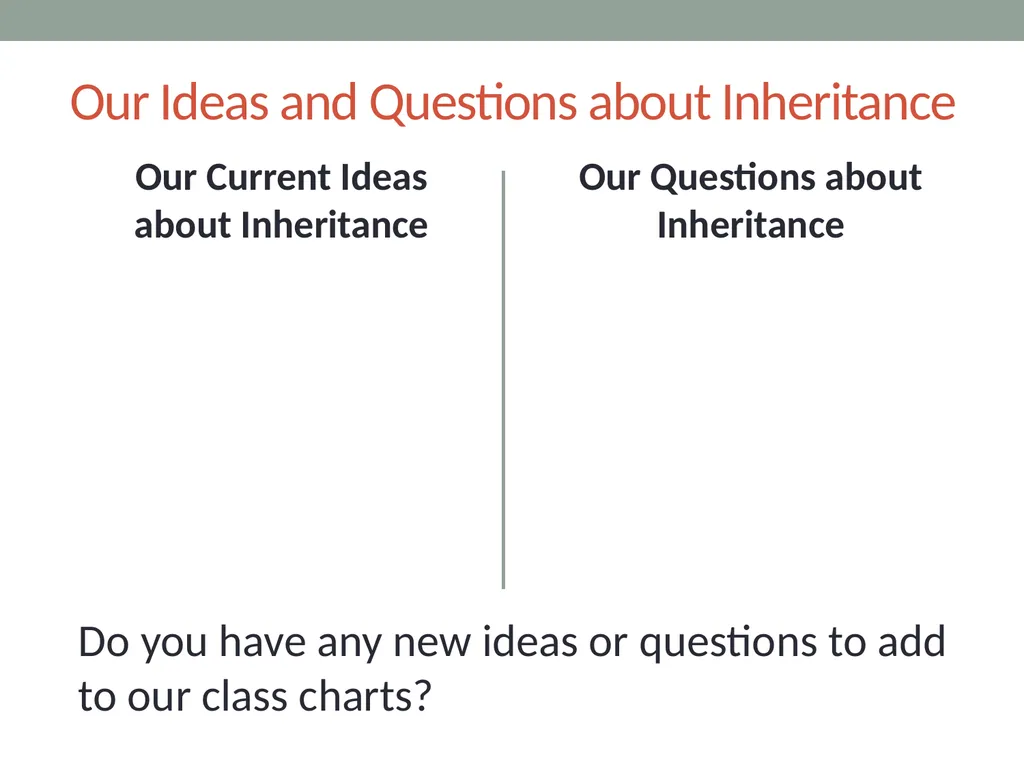
slide2. Our Ideas and Questions about Inheritance Do you have any new ideas or questions to add to our class charts? Our Current Ideas about Inheritance Our Questions about Inheritance<br>
slide3. Unit Central Question Why are individuals of a species different from one another?<br>
slide4. Lesson Focus Questions Can certain traits disappear in a family? Why or why not?<br>
slide5. Traits in the Dachshund Family Do you think the long-hair trait in the dachshund family is gone forever?
Discuss your ideas with a partner. Then write your predictions in your science notebooks.<br>
slide6. Your Predictions What did you predict about the long-hair trait in the dachshund family? Let’s see a show of hands.
How many of you think the long-hair trait is gone forever?
How many of you think the trait is NOT gone forever?<br>
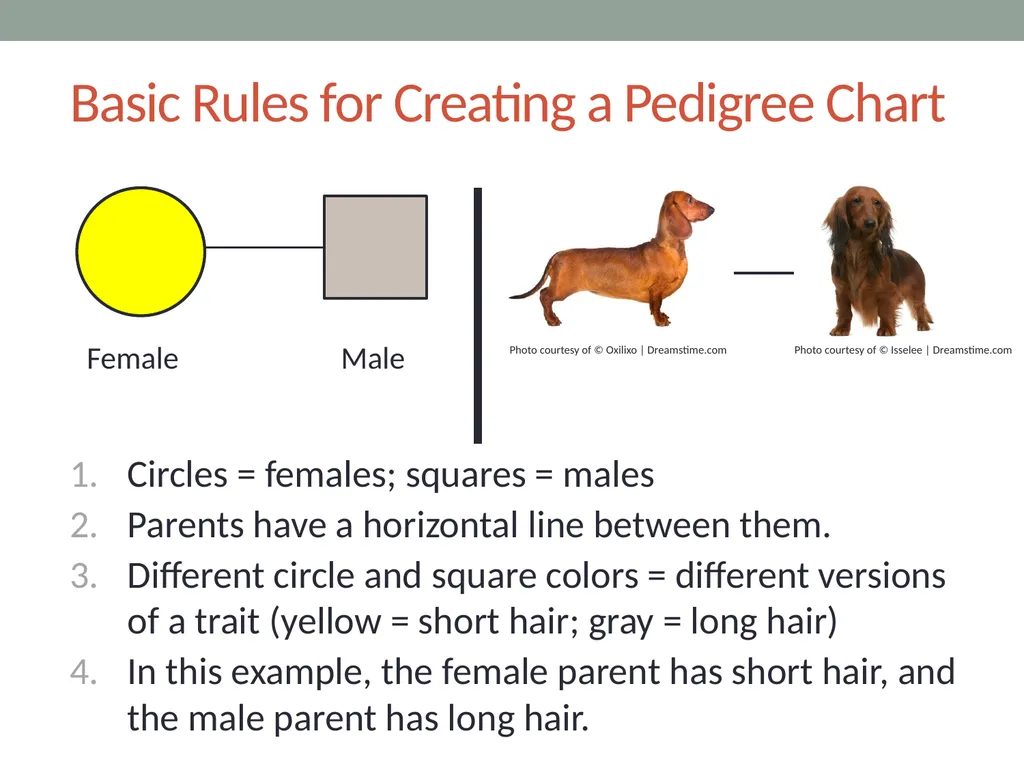
slide7. Female Male Circles = females; squares = males
Parents have a horizontal line between them.
Different circle and square colors = different versions of a trait (yellow = short hair; gray = long hair)
In this example, the female parent has short hair, and the male parent has long hair. Basic Rules for Creating a Pedigree Chart Photo courtesy of © Isselee | Dreamstime.com Photo courtesy of © Oxilixo | Dreamstime.com<br>
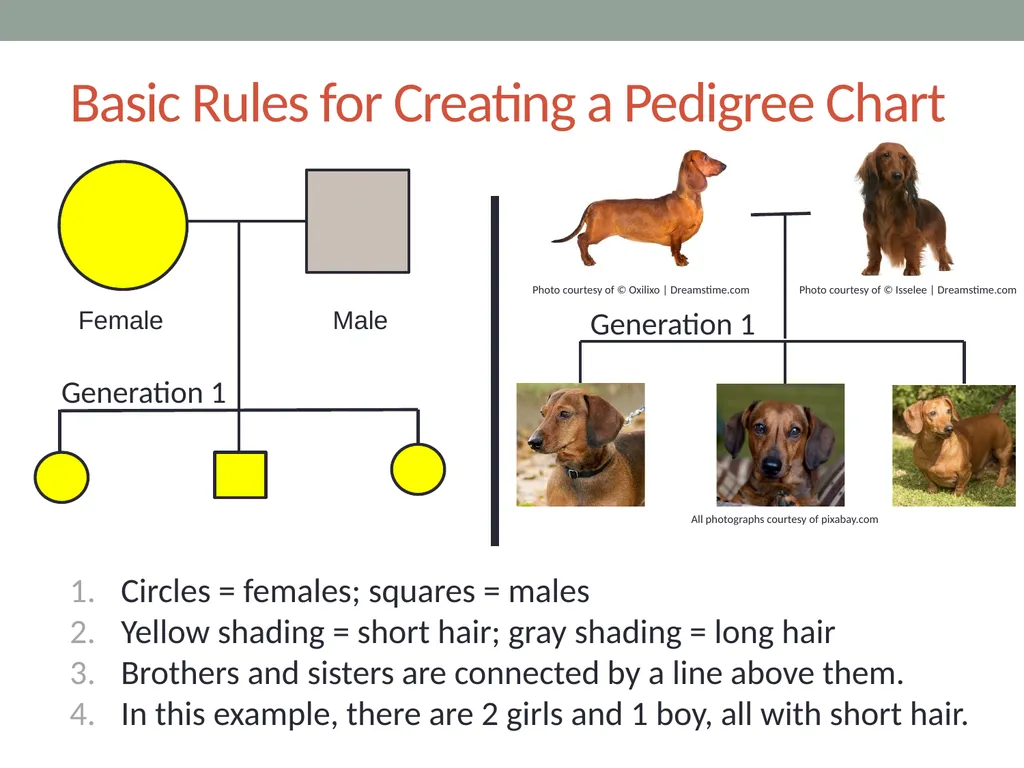
slide8. Female Male Circles = females; squares = males
Yellow shading = short hair; gray shading = long hair
Brothers and sisters are connected by a line above them.
In this example, there are 2 girls and 1 boy, all with short hair. Generation 1 All photographs courtesy of pixabay.com Basic Rules for Creating a Pedigree Chart<br>
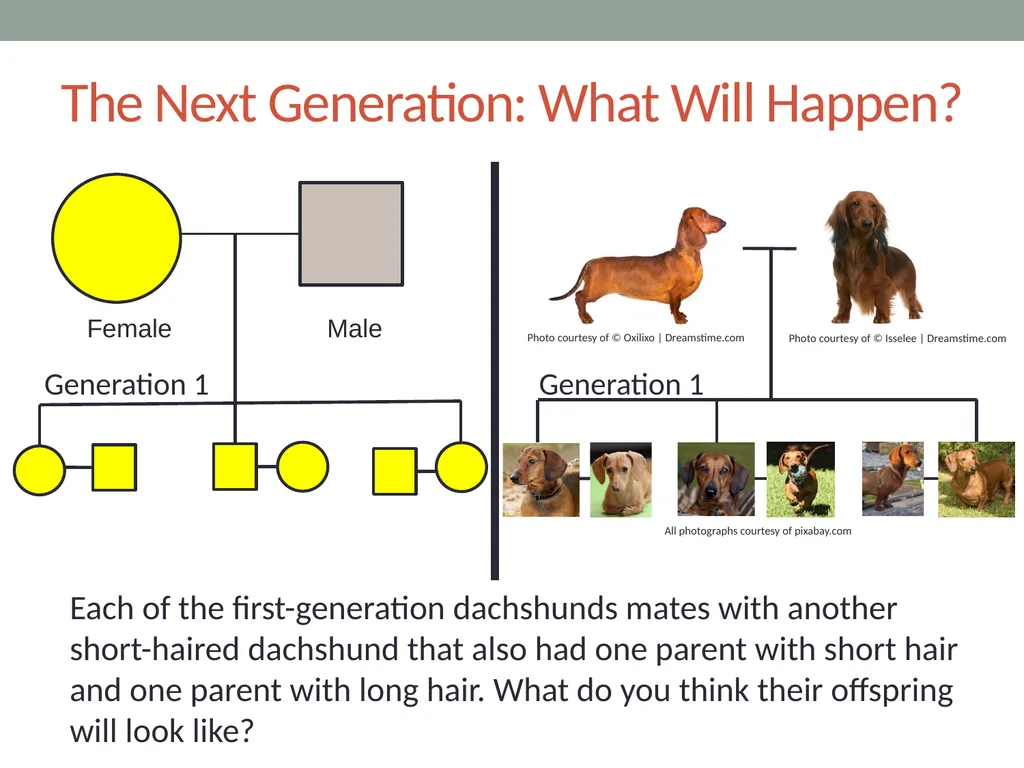
slide9. Female Male Each of the first-generation dachshunds mates with another short-haired dachshund that also had one parent with short hair and one parent with long hair. What do you think their offspring will look like? The Next Generation: What Will Happen? Generation 1 All photographs courtesy of pixabay.com<br>
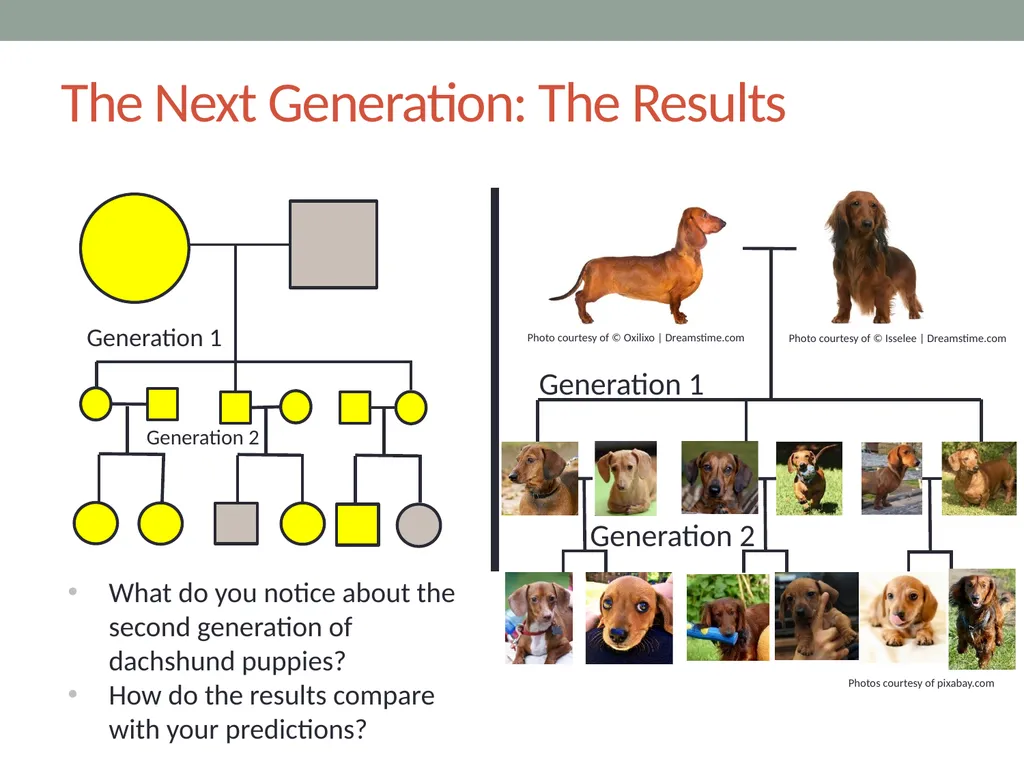
slide10. The Next Generation: The Results What do you notice about the second generation of dachshund puppies?
How do the results compare with your predictions? Generation 1 Generation 2 Generation 1 Photo courtesy of © Oxilixo | Dreamstime.com Photo courtesy of © Isselee | Dreamstime.com Photos courtesy of pixabay.com Generation 2<br>
slide11. The Dachshund Pedigree Key science ideas:
In all sets of parents, one parent had long hair, and one parent had short hair.
In the first generation of offspring, all of the puppies had short hair.
In the second generation of puppies, some had short hair, and some had long hair.
So what happened to the long-hair trait in the dachshund family?<br>
slide12. Lesson Focus Questions Can certain traits disappear in a family? Why or why not?
Discuss these questions with a partner:
Did the results of the pedigree activity change any of your ideas about these questions?
How have your ideas changed?<br>
slide13. What Happened with the Puppies? Why do you think the long-hair trait reappeared in the second generation of dachshund puppies?
What might explain this result?<br>
slide14. Let’s Summarize! Using evidence from today’s pedigree activity, review the claims of Juan, Celia, and Michael from handout 1.1 and decide whether you now agree or disagree with their ideas.
Complete these sentences in your science notebooks, and make sure to include your reasons and evidence:
I (support/don’t support) Juan’s idea because …
I (support/don’t support) Celia’s idea because …
I (support/don’t support) Michael’s idea because …<br>
slide15. Next Time Tomorrow we’ll get learn about a scientist named Gregor Mendel, who came up with some important ideas about inheritance.<br>
slide2. Our Ideas and Questions about Inheritance Do you have any new ideas or questions to add to our class charts? Our Current Ideas about Inheritance Our Questions about Inheritance<br>
slide3. Unit Central Question Why are individuals of a species different from one another?<br>
slide4. Lesson Focus Questions Can certain traits disappear in a family? Why or why not?<br>
slide5. Traits in the Dachshund Family Do you think the long-hair trait in the dachshund family is gone forever?
Discuss your ideas with a partner. Then write your predictions in your science notebooks.<br>
slide6. Your Predictions What did you predict about the long-hair trait in the dachshund family? Let’s see a show of hands.
How many of you think the long-hair trait is gone forever?
How many of you think the trait is NOT gone forever?<br>
slide7. Female Male Circles = females; squares = males
Parents have a horizontal line between them.
Different circle and square colors = different versions of a trait (yellow = short hair; gray = long hair)
In this example, the female parent has short hair, and the male parent has long hair. Basic Rules for Creating a Pedigree Chart Photo courtesy of © Isselee | Dreamstime.com Photo courtesy of © Oxilixo | Dreamstime.com<br>
slide8. Female Male Circles = females; squares = males
Yellow shading = short hair; gray shading = long hair
Brothers and sisters are connected by a line above them.
In this example, there are 2 girls and 1 boy, all with short hair. Generation 1 All photographs courtesy of pixabay.com Basic Rules for Creating a Pedigree Chart<br>
slide9. Female Male Each of the first-generation dachshunds mates with another short-haired dachshund that also had one parent with short hair and one parent with long hair. What do you think their offspring will look like? The Next Generation: What Will Happen? Generation 1 All photographs courtesy of pixabay.com<br>
slide10. The Next Generation: The Results What do you notice about the second generation of dachshund puppies?
How do the results compare with your predictions? Generation 1 Generation 2 Generation 1 Photo courtesy of © Oxilixo | Dreamstime.com Photo courtesy of © Isselee | Dreamstime.com Photos courtesy of pixabay.com Generation 2<br>
slide11. The Dachshund Pedigree Key science ideas:
In all sets of parents, one parent had long hair, and one parent had short hair.
In the first generation of offspring, all of the puppies had short hair.
In the second generation of puppies, some had short hair, and some had long hair.
So what happened to the long-hair trait in the dachshund family?<br>
slide12. Lesson Focus Questions Can certain traits disappear in a family? Why or why not?
Discuss these questions with a partner:
Did the results of the pedigree activity change any of your ideas about these questions?
How have your ideas changed?<br>
slide13. What Happened with the Puppies? Why do you think the long-hair trait reappeared in the second generation of dachshund puppies?
What might explain this result?<br>
slide14. Let’s Summarize! Using evidence from today’s pedigree activity, review the claims of Juan, Celia, and Michael from handout 1.1 and decide whether you now agree or disagree with their ideas.
Complete these sentences in your science notebooks, and make sure to include your reasons and evidence:
I (support/don’t support) Juan’s idea because …
I (support/don’t support) Celia’s idea because …
I (support/don’t support) Michael’s idea because …<br>
slide15. Next Time Tomorrow we’ll get learn about a scientist named Gregor Mendel, who came up with some important ideas about inheritance.<br>