
Genevieve Smith | Francesca LeBaron Business Case
BR
Published · 34 slides · 0 views

1 / 1




Description
Genevieve Smith Francesca LeBaron Business Case for Investing in Diversity Table of Contents Overview Directions Diversity Business Case Introduction Research Summary Business Case: Enhanced Financial Performance Improved Innovation
Related Topics
Share
Embed code
Download this presentation From Below
"Genevieve Smith | Francesca LeBaron Business Case" is the property of its rightful owner. Permission is granted to download and print the materials on this website for personal, non-commercial use only, and to display it on your personal computer provided you do not modify the materials and that you retain all copyright notices contained in the materials. By downloading content from our website, you accept the terms of this agreement.
Presentation Transcript
01
Genevieve Smith | Francesca LeBaron Business Case for Investing in Diversity<br>
02
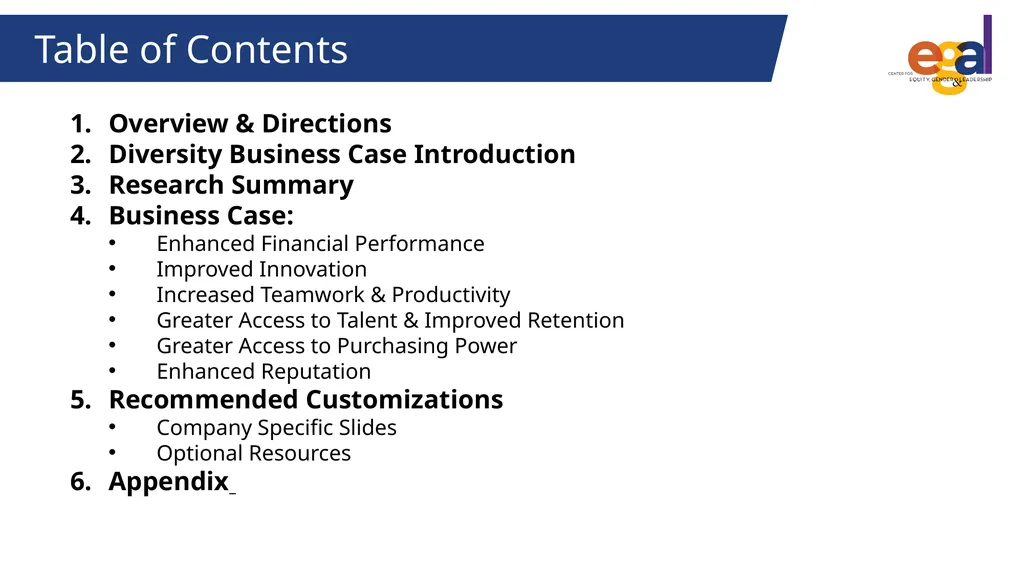
Table of Contents Overview & Directions
Diversity Business Case Introduction
Research Summary
Business Case:
Enhanced Financial Performance
Improved Innovation
Increased Teamwork & Productivity
Greater Access to Talent & Improved Retention
Greater Access to Purchasing Power
Enhanced Reputation
Recommended Customizations
Company Specific Slides
Optional Resources
Appendix<br>
Diversity Business Case Introduction
Research Summary
Business Case:
Enhanced Financial Performance
Improved Innovation
Increased Teamwork & Productivity
Greater Access to Talent & Improved Retention
Greater Access to Purchasing Power
Enhanced Reputation
Recommended Customizations
Company Specific Slides
Optional Resources
Appendix<br>
03
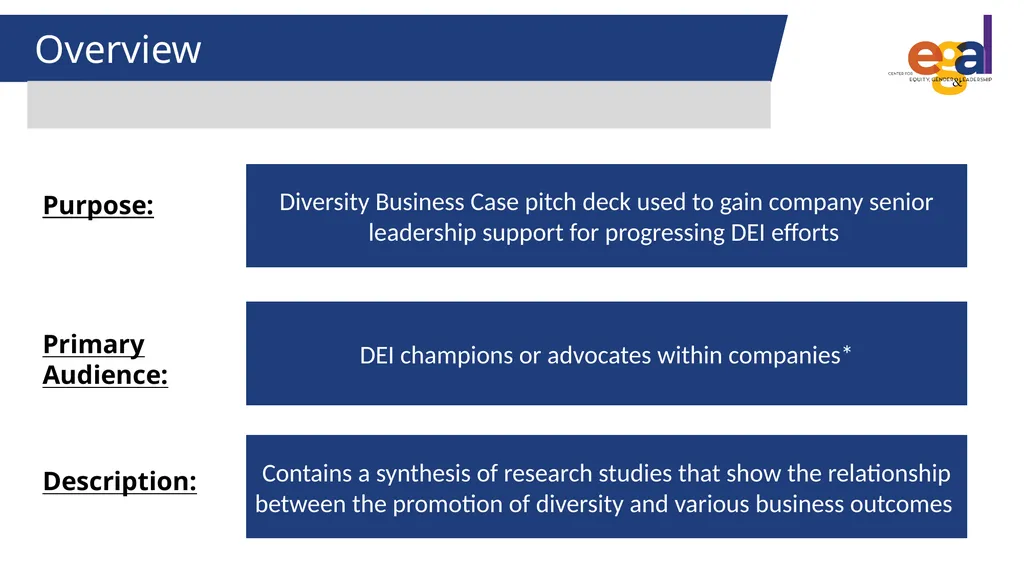
Overview Diversity Business Case pitch deck used to gain company senior leadership support for progressing DEI efforts DEI champions or advocates within companies* Contains a synthesis of research studies that show the relationship between the promotion of diversity and various business outcomes Purpose: Primary Audience: Description:<br>
04
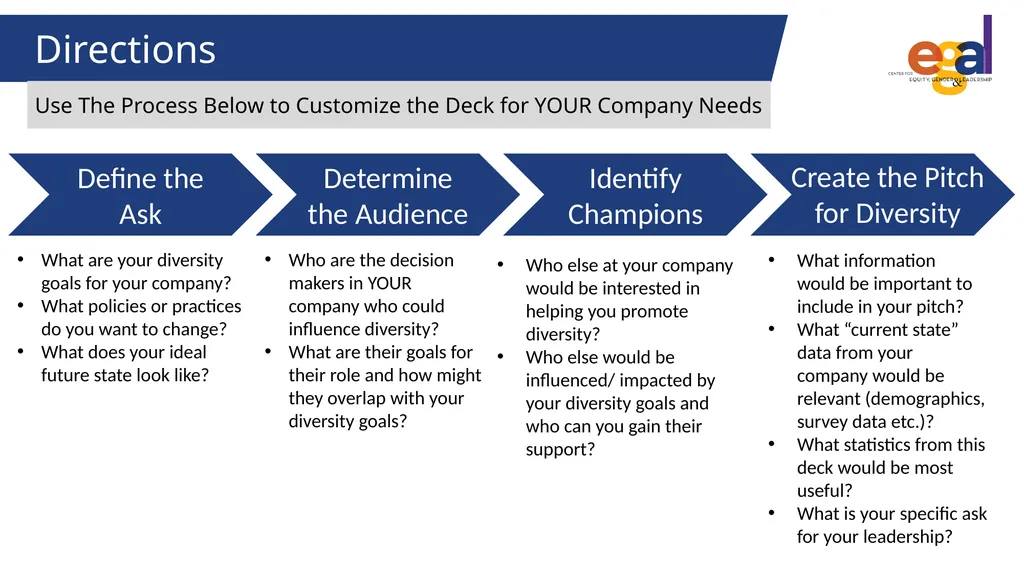
Directions Use The Process Below to Customize the Deck for YOUR Company Needs Define the Ask Determine the Audience Identify Champions What are your diversity goals for your company?
What policies or practices do you want to change?
What does your ideal future state look like? Who are the decision makers in YOUR company who could influence diversity?
What are their goals for their role and how might they overlap with your diversity goals? What information would be important to include in your pitch?
What “current state” data from your company would be relevant (demographics, survey data etc.)?
What statistics from this deck would be most useful?
What is your specific ask for your leadership? Who else at your company would be interested in helping you promote diversity?
Who else would be influenced/ impacted by your diversity goals and who can you gain their support?<br>
What policies or practices do you want to change?
What does your ideal future state look like? Who are the decision makers in YOUR company who could influence diversity?
What are their goals for their role and how might they overlap with your diversity goals? What information would be important to include in your pitch?
What “current state” data from your company would be relevant (demographics, survey data etc.)?
What statistics from this deck would be most useful?
What is your specific ask for your leadership? Who else at your company would be interested in helping you promote diversity?
Who else would be influenced/ impacted by your diversity goals and who can you gain their support?<br>
05
Diversity Business Case Introduction Background This resource organizes statistical information and research from a wide breadth of sources - including academic institutions, industry leaders and multi-lateral organizations - from the past 10 years. In compiling this information, we aim to equip individuals with the data they need to understand the business case. In a world where decisions are driven by both values and numbers, leaders consistently face one fundamental question: "What is the business case?" While decision makers might be morally committed to providing equal opportunity to all, some may remain more concerned about the unknown impact on the bottom line.<br>
06
Diversity is not just a moral imperative; it’s a Strategic Competitive Advantage<br>
07
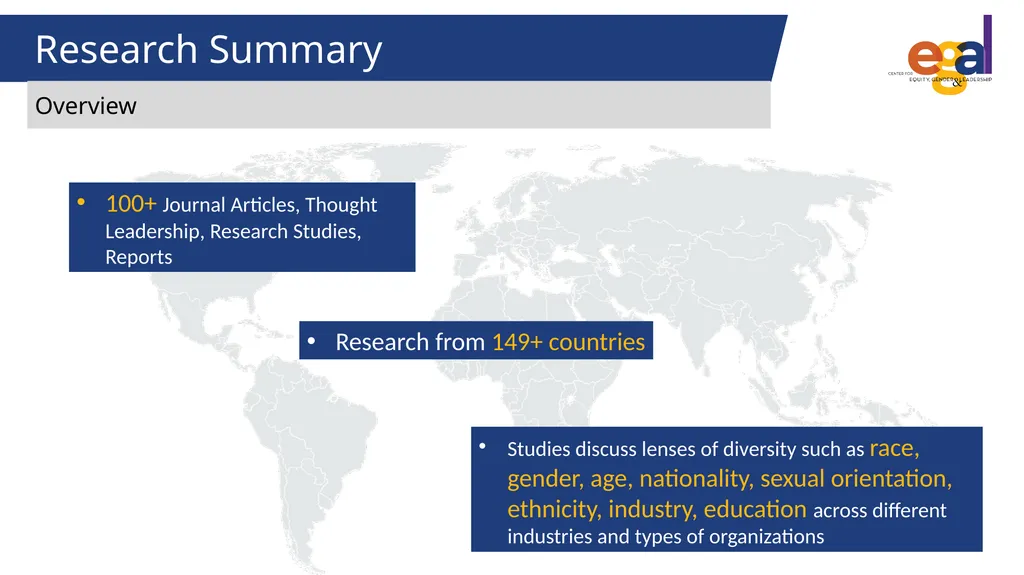
Research Summary Overview Studies discuss lenses of diversity such as race, gender, age, nationality, sexual orientation, ethnicity, industry, education across different industries and types of organizations 100+ Journal Articles, Thought Leadership, Research Studies, Reports Research from 149+ countries<br>
08
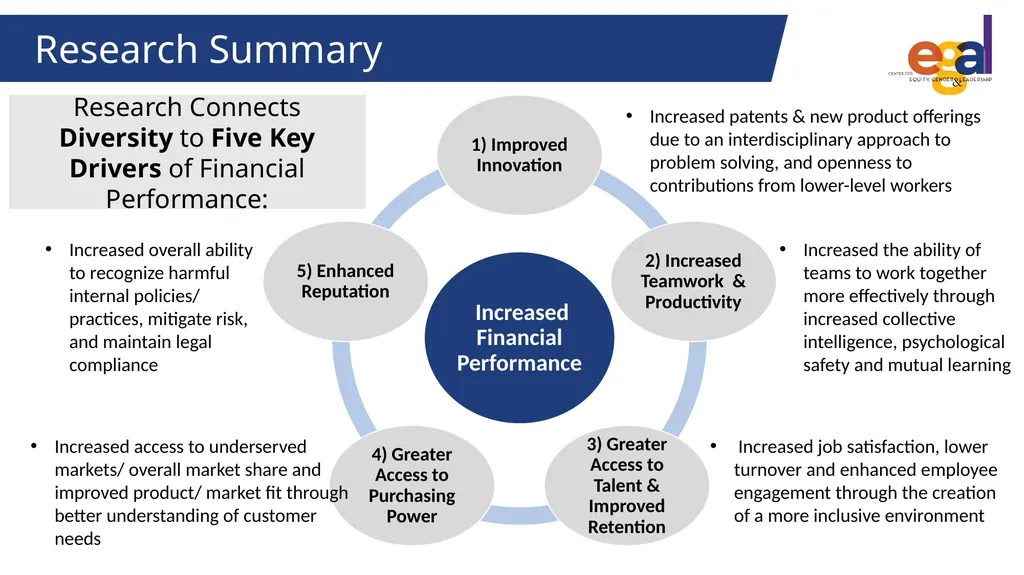
Research Summary Increased the ability of teams to work together more effectively through increased collective intelligence, psychological safety and mutual learning Increased overall ability to recognize harmful internal policies/ practices, mitigate risk, and maintain legal compliance Increased job satisfaction, lower turnover and enhanced employee engagement through the creation of a more inclusive environment Increased patents & new product offerings due to an interdisciplinary approach to problem solving, and openness to contributions from lower-level workers Increased access to underserved markets/ overall market share and improved product/ market fit through better understanding of customer needs Research Connects Diversity to Five Key Drivers of Financial Performance:<br>
09
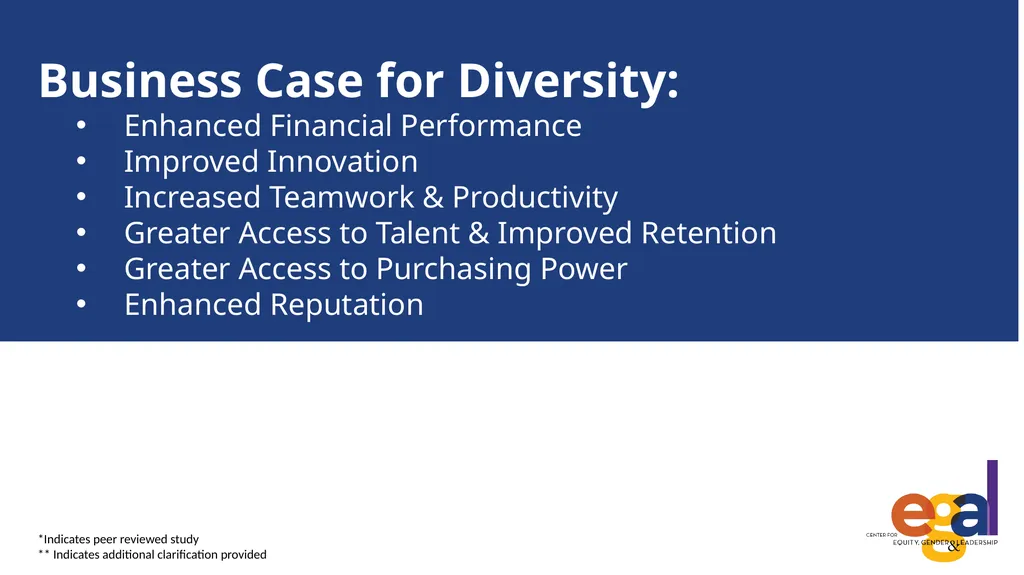
Business Case for Diversity:
Enhanced Financial Performance
Improved Innovation
Increased Teamwork & Productivity
Greater Access to Talent & Improved Retention
Greater Access to Purchasing Power
Enhanced Reputation *Indicates peer reviewed study
** Indicates additional clarification provided<br>
Enhanced Financial Performance
Improved Innovation
Increased Teamwork & Productivity
Greater Access to Talent & Improved Retention
Greater Access to Purchasing Power
Enhanced Reputation *Indicates peer reviewed study
** Indicates additional clarification provided<br>
10
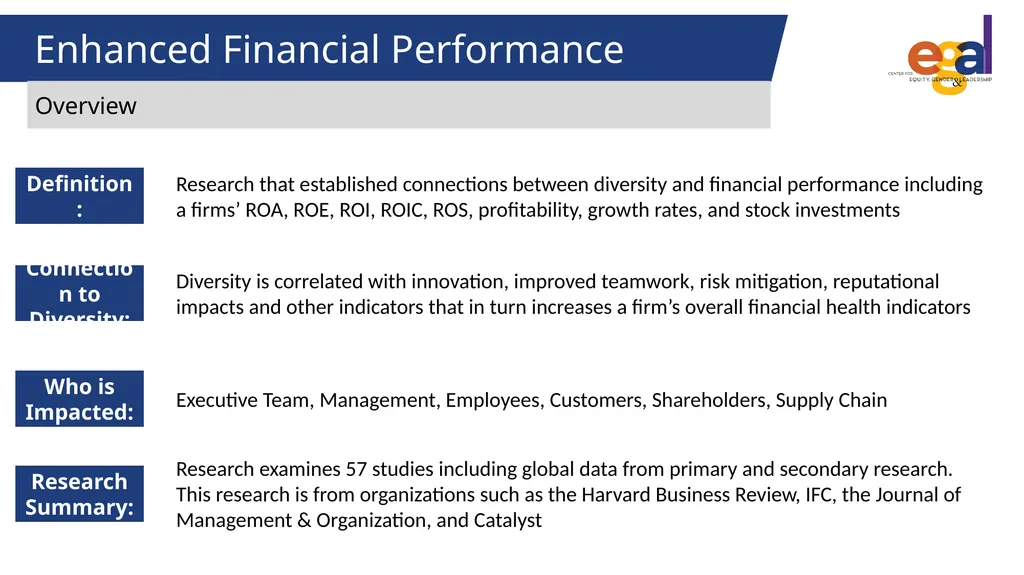
Enhanced Financial Performance Overview Research Summary: Who is Impacted: Connection to Diversity: Definition: Diversity is correlated with innovation, improved teamwork, risk mitigation, reputational impacts and other indicators that in turn increases a firm’s overall financial health indicators Research that established connections between diversity and financial performance including a firms’ ROA, ROE, ROI, ROIC, ROS, profitability, growth rates, and stock investments Executive Team, Management, Employees, Customers, Shareholders, Supply Chain Research examines 57 studies including global data from primary and secondary research. This research is from organizations such as the Harvard Business Review, IFC, the Journal of Management & Organization, and Catalyst<br>
11
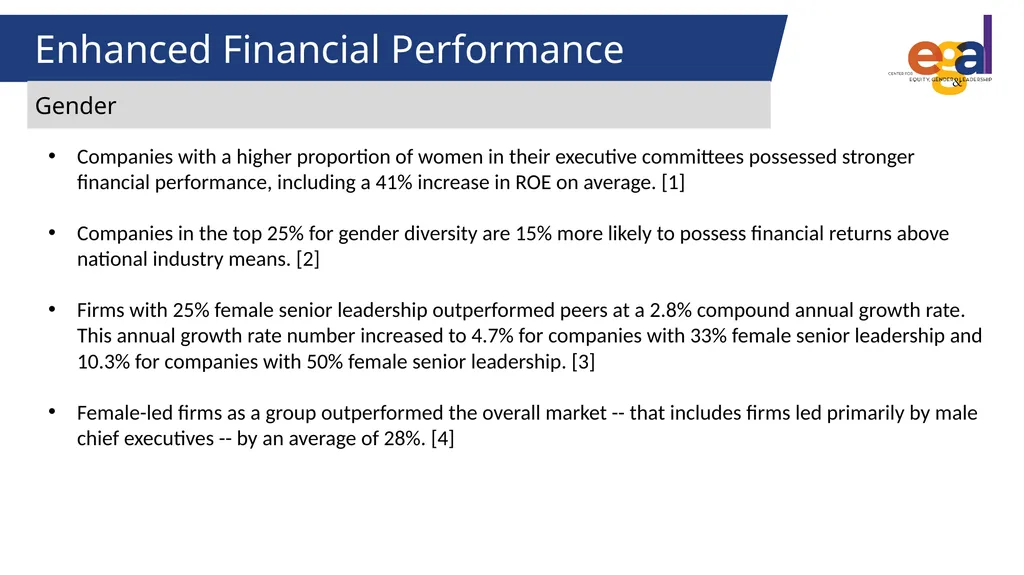
Companies with a higher proportion of women in their executive committees possessed stronger financial performance, including a 41% increase in ROE on average. [1]
Companies in the top 25% for gender diversity are 15% more likely to possess financial returns above national industry means. [2]
Firms with 25% female senior leadership outperformed peers at a 2.8% compound annual growth rate. This annual growth rate number increased to 4.7% for companies with 33% female senior leadership and 10.3% for companies with 50% female senior leadership. [3]
Female-led firms as a group outperformed the overall market -- that includes firms led primarily by male chief executives -- by an average of 28%. [4] Enhanced Financial Performance Gender<br>
Companies in the top 25% for gender diversity are 15% more likely to possess financial returns above national industry means. [2]
Firms with 25% female senior leadership outperformed peers at a 2.8% compound annual growth rate. This annual growth rate number increased to 4.7% for companies with 33% female senior leadership and 10.3% for companies with 50% female senior leadership. [3]
Female-led firms as a group outperformed the overall market -- that includes firms led primarily by male chief executives -- by an average of 28%. [4] Enhanced Financial Performance Gender<br>
12
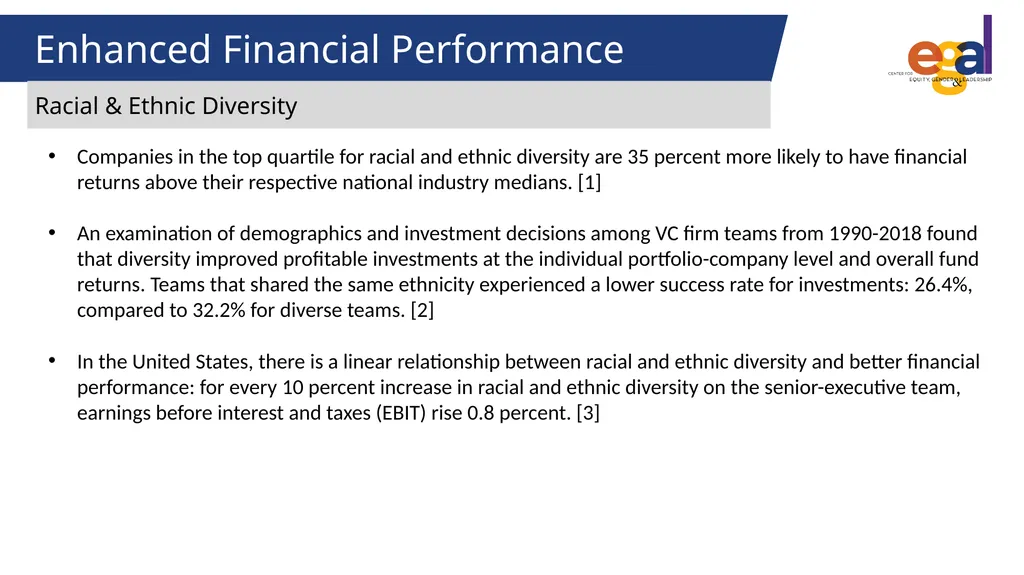
Companies in the top quartile for racial and ethnic diversity are 35 percent more likely to have financial returns above their respective national industry medians. [1]
An examination of demographics and investment decisions among VC firm teams from 1990-2018 found that diversity improved profitable investments at the individual portfolio-company level and overall fund returns. Teams that shared the same ethnicity experienced a lower success rate for investments: 26.4%, compared to 32.2% for diverse teams. [2]
In the United States, there is a linear relationship between racial and ethnic diversity and better financial performance: for every 10 percent increase in racial and ethnic diversity on the senior-executive team, earnings before interest and taxes (EBIT) rise 0.8 percent. [3] Enhanced Financial Performance Racial & Ethnic Diversity<br>
An examination of demographics and investment decisions among VC firm teams from 1990-2018 found that diversity improved profitable investments at the individual portfolio-company level and overall fund returns. Teams that shared the same ethnicity experienced a lower success rate for investments: 26.4%, compared to 32.2% for diverse teams. [2]
In the United States, there is a linear relationship between racial and ethnic diversity and better financial performance: for every 10 percent increase in racial and ethnic diversity on the senior-executive team, earnings before interest and taxes (EBIT) rise 0.8 percent. [3] Enhanced Financial Performance Racial & Ethnic Diversity<br>
13
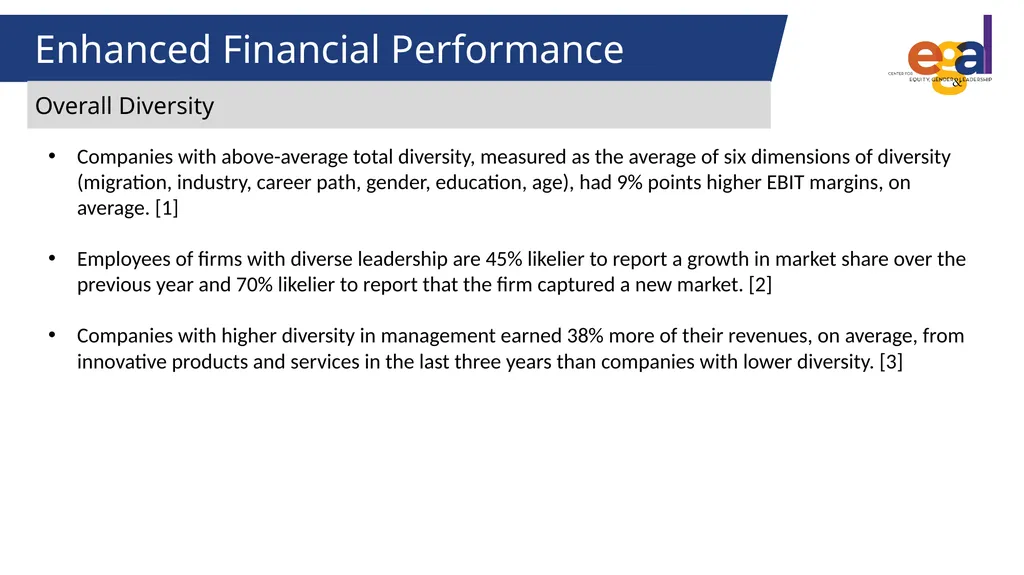
Companies with above-average total diversity, measured as the average of six dimensions of diversity (migration, industry, career path, gender, education, age), had 9% points higher EBIT margins, on average. [1]
Employees of firms with diverse leadership are 45% likelier to report a growth in market share over the previous year and 70% likelier to report that the firm captured a new market. [2]
Companies with higher diversity in management earned 38% more of their revenues, on average, from innovative products and services in the last three years than companies with lower diversity. [3] Enhanced Financial Performance Overall Diversity<br>
Employees of firms with diverse leadership are 45% likelier to report a growth in market share over the previous year and 70% likelier to report that the firm captured a new market. [2]
Companies with higher diversity in management earned 38% more of their revenues, on average, from innovative products and services in the last three years than companies with lower diversity. [3] Enhanced Financial Performance Overall Diversity<br>
14
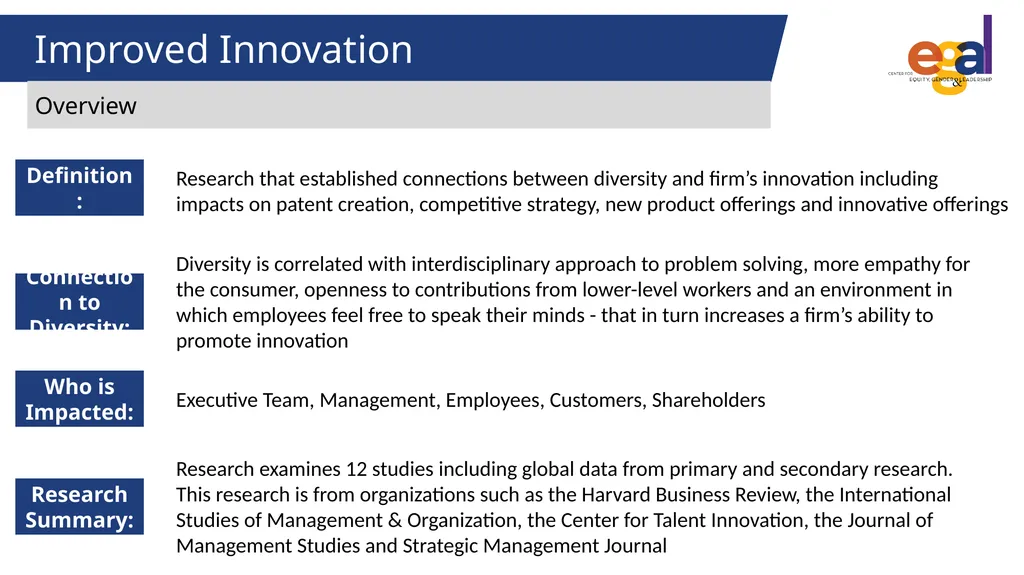
Improved Innovation Overview Research Summary: Who is Impacted: Connection to Diversity: Definition: Diversity is correlated with interdisciplinary approach to problem solving, more empathy for the consumer, openness to contributions from lower-level workers and an environment in which employees feel free to speak their minds - that in turn increases a firm’s ability to promote innovation Research that established connections between diversity and firm’s innovation including impacts on patent creation, competitive strategy, new product offerings and innovative offerings Executive Team, Management, Employees, Customers, Shareholders Research examines 12 studies including global data from primary and secondary research. This research is from organizations such as the Harvard Business Review, the International Studies of Management & Organization, the Center for Talent Innovation, the Journal of Management Studies and Strategic Management Journal<br>
15
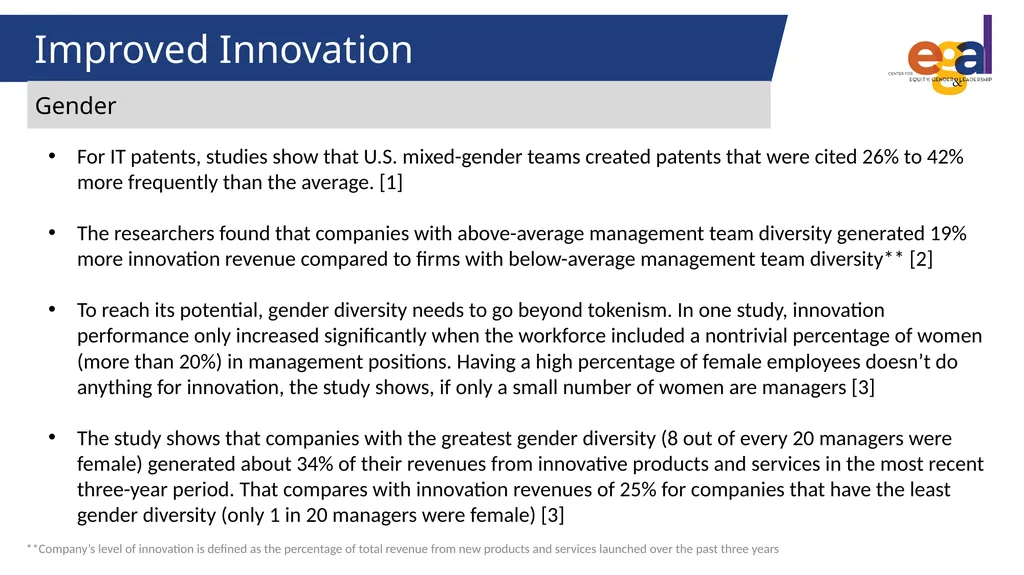
For IT patents, studies show that U.S. mixed-gender teams created patents that were cited 26% to 42% more frequently than the average. [1]
The researchers found that companies with above-average management team diversity generated 19% more innovation revenue compared to firms with below-average management team diversity** [2]
To reach its potential, gender diversity needs to go beyond tokenism. In one study, innovation performance only increased significantly when the workforce included a nontrivial percentage of women (more than 20%) in management positions. Having a high percentage of female employees doesn’t do anything for innovation, the study shows, if only a small number of women are managers [3]
The study shows that companies with the greatest gender diversity (8 out of every 20 managers were female) generated about 34% of their revenues from innovative products and services in the most recent three-year period. That compares with innovation revenues of 25% for companies that have the least gender diversity (only 1 in 20 managers were female) [3] Improved Innovation Gender **Company’s level of innovation is defined as the percentage of total revenue from new products and services launched over the past three years<br>
The researchers found that companies with above-average management team diversity generated 19% more innovation revenue compared to firms with below-average management team diversity** [2]
To reach its potential, gender diversity needs to go beyond tokenism. In one study, innovation performance only increased significantly when the workforce included a nontrivial percentage of women (more than 20%) in management positions. Having a high percentage of female employees doesn’t do anything for innovation, the study shows, if only a small number of women are managers [3]
The study shows that companies with the greatest gender diversity (8 out of every 20 managers were female) generated about 34% of their revenues from innovative products and services in the most recent three-year period. That compares with innovation revenues of 25% for companies that have the least gender diversity (only 1 in 20 managers were female) [3] Improved Innovation Gender **Company’s level of innovation is defined as the percentage of total revenue from new products and services launched over the past three years<br>
16
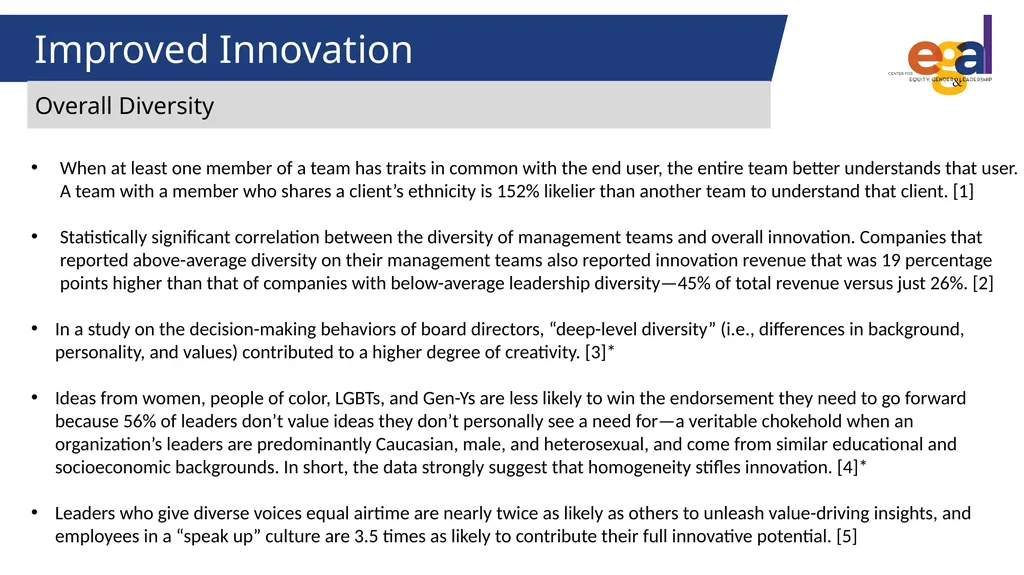
When at least one member of a team has traits in common with the end user, the entire team better understands that user. A team with a member who shares a client’s ethnicity is 152% likelier than another team to understand that client. [1]
Statistically significant correlation between the diversity of management teams and overall innovation. Companies that reported above-average diversity on their management teams also reported innovation revenue that was 19 percentage points higher than that of companies with below-average leadership diversity—45% of total revenue versus just 26%. [2]
In a study on the decision-making behaviors of board directors, “deep-level diversity” (i.e., differences in background, personality, and values) contributed to a higher degree of creativity. [3]*
Ideas from women, people of color, LGBTs, and Gen-Ys are less likely to win the endorsement they need to go forward because 56% of leaders don’t value ideas they don’t personally see a need for—a veritable chokehold when an organization’s leaders are predominantly Caucasian, male, and heterosexual, and come from similar educational and socioeconomic backgrounds. In short, the data strongly suggest that homogeneity stifles innovation. [4]*
Leaders who give diverse voices equal airtime are nearly twice as likely as others to unleash value-driving insights, and employees in a “speak up” culture are 3.5 times as likely to contribute their full innovative potential. [5] Improved Innovation Overall Diversity<br>
Statistically significant correlation between the diversity of management teams and overall innovation. Companies that reported above-average diversity on their management teams also reported innovation revenue that was 19 percentage points higher than that of companies with below-average leadership diversity—45% of total revenue versus just 26%. [2]
In a study on the decision-making behaviors of board directors, “deep-level diversity” (i.e., differences in background, personality, and values) contributed to a higher degree of creativity. [3]*
Ideas from women, people of color, LGBTs, and Gen-Ys are less likely to win the endorsement they need to go forward because 56% of leaders don’t value ideas they don’t personally see a need for—a veritable chokehold when an organization’s leaders are predominantly Caucasian, male, and heterosexual, and come from similar educational and socioeconomic backgrounds. In short, the data strongly suggest that homogeneity stifles innovation. [4]*
Leaders who give diverse voices equal airtime are nearly twice as likely as others to unleash value-driving insights, and employees in a “speak up” culture are 3.5 times as likely to contribute their full innovative potential. [5] Improved Innovation Overall Diversity<br>
17
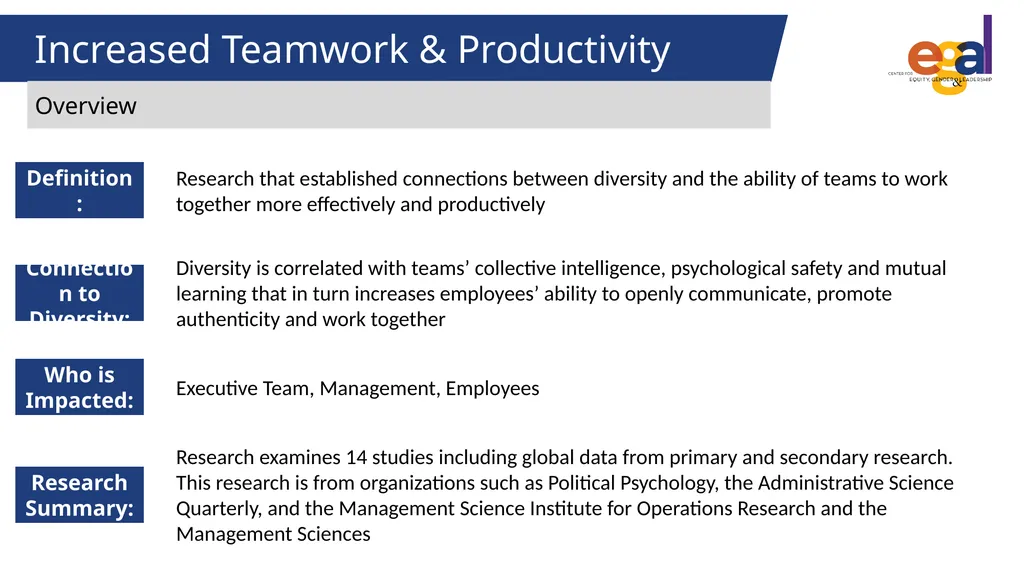
Increased Teamwork & Productivity Overview Research Summary: Who is Impacted: Connection to Diversity: Definition: Diversity is correlated with teams’ collective intelligence, psychological safety and mutual learning that in turn increases employees’ ability to openly communicate, promote authenticity and work together Research that established connections between diversity and the ability of teams to work together more effectively and productively Executive Team, Management, Employees Research examines 14 studies including global data from primary and secondary research. This research is from organizations such as Political Psychology, the Administrative Science Quarterly, and the Management Science Institute for Operations Research and the Management Sciences<br>
18
When a workforce reflects the racial/ethnic diversity of its consumer base, employee productivity increases and customer satisfaction is improved [1]*
When at least one member of a team has traits in common with the end user, the entire team better understands that user. A team with a member who shares a client’s ethnicity is 152% likelier than another team to understand that client. [2] Increased Teamwork & Productivity Racial & Ethnic Diversity<br>
When at least one member of a team has traits in common with the end user, the entire team better understands that user. A team with a member who shares a client’s ethnicity is 152% likelier than another team to understand that client. [2] Increased Teamwork & Productivity Racial & Ethnic Diversity<br>
19
Without diverse leaders, women (20%), people of color (24%), and LGBT employees (21%) are less likely to have their ideas endorsed [1]
While homogenous groups may be susceptible to groupthink, diverse teams can leverage a greater variety of perspectives and are likely to consider information more thoroughly and accurately [2]*
Companies with diverse leadership are 75% more likely (35% vs. 20%) to see their ideas move through the pipeline and make it to the marketplace. [3]
Team performance peaks when the share of women in a business team is 55%; the drivers behind the peak performance on gender diverse teams were more intense mutual monitoring and equal learning [4] Increased Teamwork & Productivity Overall Diversity<br>
While homogenous groups may be susceptible to groupthink, diverse teams can leverage a greater variety of perspectives and are likely to consider information more thoroughly and accurately [2]*
Companies with diverse leadership are 75% more likely (35% vs. 20%) to see their ideas move through the pipeline and make it to the marketplace. [3]
Team performance peaks when the share of women in a business team is 55%; the drivers behind the peak performance on gender diverse teams were more intense mutual monitoring and equal learning [4] Increased Teamwork & Productivity Overall Diversity<br>
20
Greater Access to Talent & Improved Retention Overview Research Summary: Who is Impacted: Connection to Diversity: Definition: Strong diversity climates are correlated with increased job satisfaction, lower turnover and enhanced employee engagement Research that established connections between employee attraction & retention and a firms’ ability to create an inclusive environment. Firms with strong diversity climates are characterized by an openness towards others and an appreciation of individual differences Executive Team, Management, Employees Research examines 17 studies including global data from primary and secondary research. This research is from organizations such as the Journal of Financial Economics, McKinsey & Company, the Journal of Occupational Health Psychology, and the Journal of Applied Social Psychology<br>
21
Higher gender diversity leads to lower turnover in organizations with many gender‐focused policies and practices [1]*
Moving toward equal levels of gender representation across job levels leads to a reduction in occurrences of workplace harassment [2]*
A majority (78%) of American adults consider gender diversity in the workplace important [3]*
About half of women in STEM consider discrimination a major factor behind women’s limited representation in STEM occupations [3]* Greater Access to Talent & Improved Retention Gender<br>
Moving toward equal levels of gender representation across job levels leads to a reduction in occurrences of workplace harassment [2]*
A majority (78%) of American adults consider gender diversity in the workplace important [3]*
About half of women in STEM consider discrimination a major factor behind women’s limited representation in STEM occupations [3]* Greater Access to Talent & Improved Retention Gender<br>
22
Strong diversity climates are also linked to reduced instances of interpersonal aggression and discrimination[1,2]*
Nearly two-thirds (65%) of employees feel that the respectful treatment of all employees was a very important factor in their job satisfaction [3]*
Employees report experiencing trust and increased engagement at work when they both feel included and perceive that their employer supports diversity practices, such as recruiting diverse job candidates [4]* Greater Access to Talent & Improved Retention Overall Diversity<br>
Nearly two-thirds (65%) of employees feel that the respectful treatment of all employees was a very important factor in their job satisfaction [3]*
Employees report experiencing trust and increased engagement at work when they both feel included and perceive that their employer supports diversity practices, such as recruiting diverse job candidates [4]* Greater Access to Talent & Improved Retention Overall Diversity<br>
23
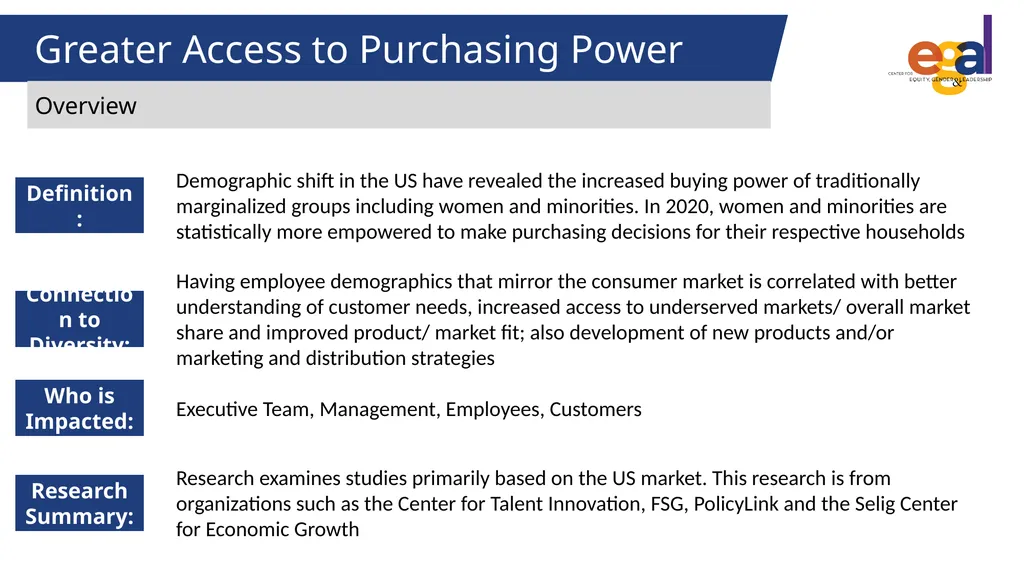
Greater Access to Purchasing Power Overview Research Summary: Who is Impacted: Connection to Diversity: Definition: Having employee demographics that mirror the consumer market is correlated with better understanding of customer needs, increased access to underserved markets/ overall market share and improved product/ market fit; also development of new products and/or marketing and distribution strategies Demographic shift in the US have revealed the increased buying power of traditionally marginalized groups including women and minorities. In 2020, women and minorities are statistically more empowered to make purchasing decisions for their respective households Executive Team, Management, Employees, Customers Research examines studies primarily based on the US market. This research is from organizations such as the Center for Talent Innovation, FSG, PolicyLink and the Selig Center for Economic Growth<br>
24
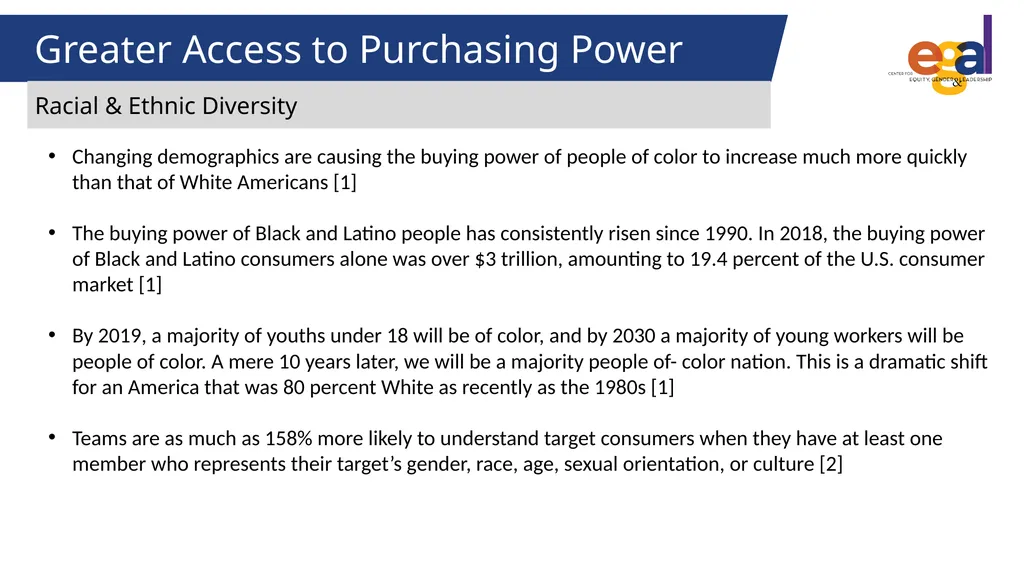
Changing demographics are causing the buying power of people of color to increase much more quickly than that of White Americans [1]
The buying power of Black and Latino people has consistently risen since 1990. In 2018, the buying power of Black and Latino consumers alone was over $3 trillion, amounting to 19.4 percent of the U.S. consumer market [1]
By 2019, a majority of youths under 18 will be of color, and by 2030 a majority of young workers will be people of color. A mere 10 years later, we will be a majority people of- color nation. This is a dramatic shift for an America that was 80 percent White as recently as the 1980s [1]
Teams are as much as 158% more likely to understand target consumers when they have at least one member who represents their target’s gender, race, age, sexual orientation, or culture [2] Greater Access to Purchasing Power Racial & Ethnic Diversity<br>
The buying power of Black and Latino people has consistently risen since 1990. In 2018, the buying power of Black and Latino consumers alone was over $3 trillion, amounting to 19.4 percent of the U.S. consumer market [1]
By 2019, a majority of youths under 18 will be of color, and by 2030 a majority of young workers will be people of color. A mere 10 years later, we will be a majority people of- color nation. This is a dramatic shift for an America that was 80 percent White as recently as the 1980s [1]
Teams are as much as 158% more likely to understand target consumers when they have at least one member who represents their target’s gender, race, age, sexual orientation, or culture [2] Greater Access to Purchasing Power Racial & Ethnic Diversity<br>
25
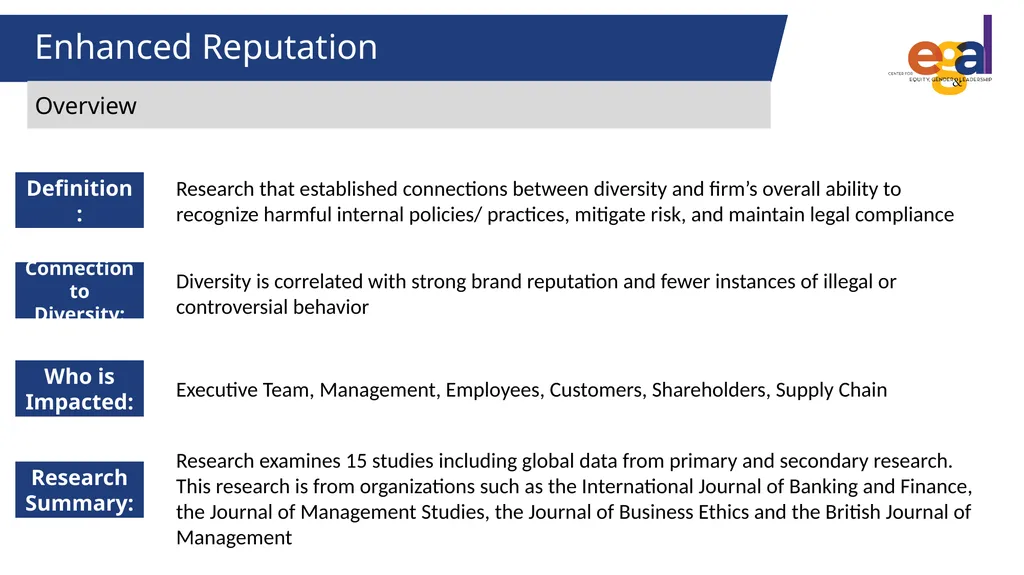
Enhanced Reputation Overview Research Summary: Who is Impacted: Connection to Diversity: Definition: Diversity is correlated with strong brand reputation and fewer instances of illegal or controversial behavior Research that established connections between diversity and firm’s overall ability to recognize harmful internal policies/ practices, mitigate risk, and maintain legal compliance Executive Team, Management, Employees, Customers, Shareholders, Supply Chain Research examines 15 studies including global data from primary and secondary research. This research is from organizations such as the International Journal of Banking and Finance, the Journal of Management Studies, the Journal of Business Ethics and the British Journal of Management<br>
26
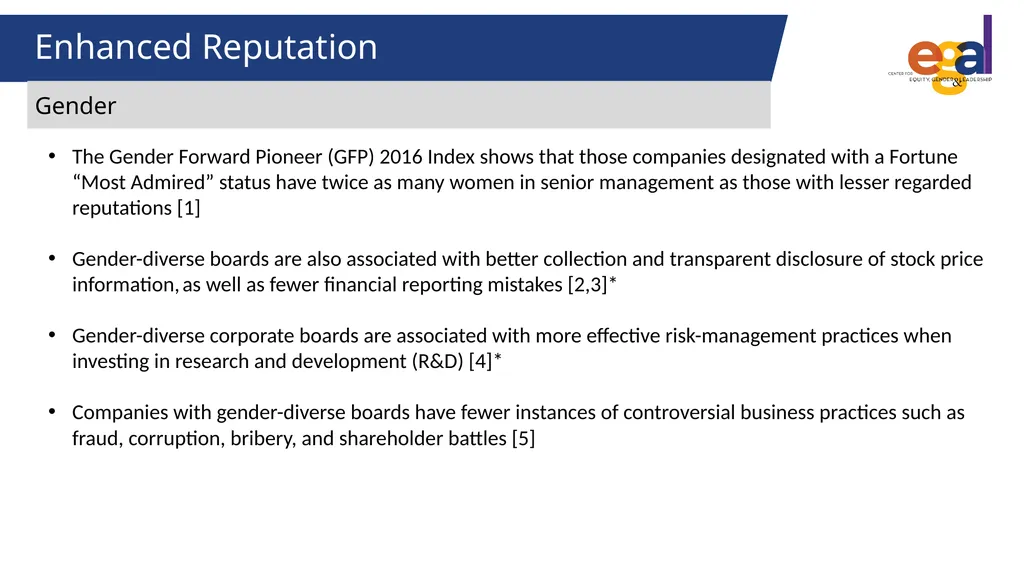
The Gender Forward Pioneer (GFP) 2016 Index shows that those companies designated with a Fortune “Most Admired” status have twice as many women in senior management as those with lesser regarded reputations [1]
Gender-diverse boards are also associated with better collection and transparent disclosure of stock price information, as well as fewer financial reporting mistakes [2,3]*
Gender-diverse corporate boards are associated with more effective risk-management practices when investing in research and development (R&D) [4]*
Companies with gender-diverse boards have fewer instances of controversial business practices such as fraud, corruption, bribery, and shareholder battles [5] Enhanced Reputation Gender<br>
Gender-diverse boards are also associated with better collection and transparent disclosure of stock price information, as well as fewer financial reporting mistakes [2,3]*
Gender-diverse corporate boards are associated with more effective risk-management practices when investing in research and development (R&D) [4]*
Companies with gender-diverse boards have fewer instances of controversial business practices such as fraud, corruption, bribery, and shareholder battles [5] Enhanced Reputation Gender<br>
27
Additional Resources Customize YOUR Business Case for Diversity for YOUR Company<br>
28
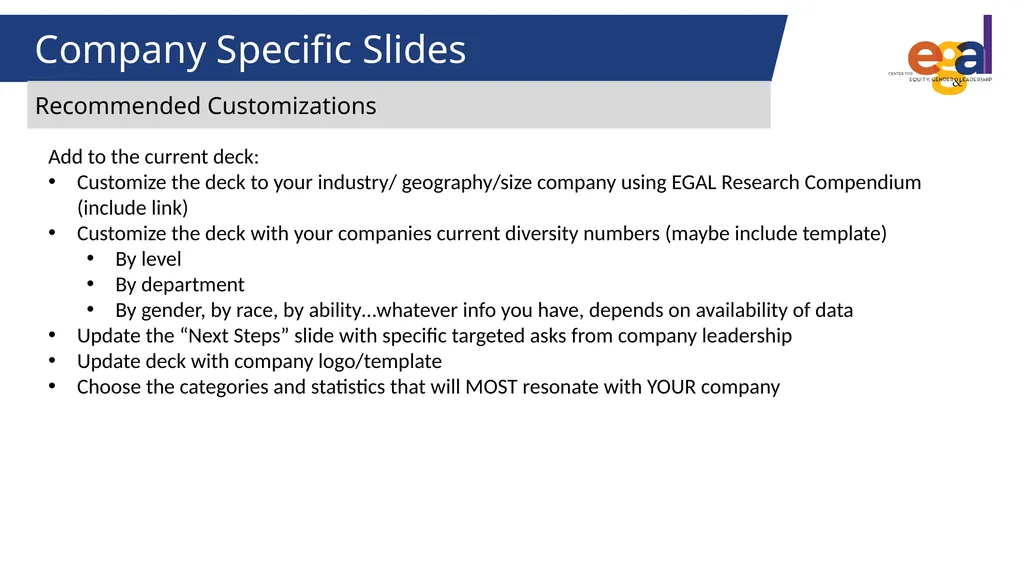
Add to the current deck:
Customize the deck to your industry/ geography/size company using EGAL Research Compendium (include link)
Customize the deck with your companies current diversity numbers (maybe include template)
By level
By department
By gender, by race, by ability…whatever info you have, depends on availability of data
Update the “Next Steps” slide with specific targeted asks from company leadership
Update deck with company logo/template
Choose the categories and statistics that will MOST resonate with YOUR company Company Specific Slides Recommended Customizations<br>
Customize the deck to your industry/ geography/size company using EGAL Research Compendium (include link)
Customize the deck with your companies current diversity numbers (maybe include template)
By level
By department
By gender, by race, by ability…whatever info you have, depends on availability of data
Update the “Next Steps” slide with specific targeted asks from company leadership
Update deck with company logo/template
Choose the categories and statistics that will MOST resonate with YOUR company Company Specific Slides Recommended Customizations<br>
29
For more resources on the business case for diversity and equity fluent leadership, go to:
https://haas.berkeley.edu/equity/industry/efl-knowledge-bank/business-case-for-diversity/<br>
https://haas.berkeley.edu/equity/industry/efl-knowledge-bank/business-case-for-diversity/<br>
30
Appendix<br>
31
Criteria for research collection and selection:
Easy to understand
Relevant to business leaders
Statistics that "stands alone" and do not requiring a lot of background information to understand
Prioritized an actual, quantifiable statistic (not "it gets better with")
Balance of peer reviewed and not peer reviewed research (ideally, one per reviewed statistic per category)
Recent research (in last 10 years)
Based on the 100+ Journal Articles, Thought Leadership, Research Studies, Reports, the most compelling 3-5 statistics were chosen per section based on the criteria listed above. The other key finders were logged in the Research Compendium for the Business Case for Diversity located here
Current Research Limitation and Opportunities for More Research:
This research does not include ALL diversity
Gender based diversity research is predominately based on binary system
Highlight the role of intersectionality
Correlation does not equal causation (most diversity research is correlation) Methodology Overview<br>
Easy to understand
Relevant to business leaders
Statistics that "stands alone" and do not requiring a lot of background information to understand
Prioritized an actual, quantifiable statistic (not "it gets better with")
Balance of peer reviewed and not peer reviewed research (ideally, one per reviewed statistic per category)
Recent research (in last 10 years)
Based on the 100+ Journal Articles, Thought Leadership, Research Studies, Reports, the most compelling 3-5 statistics were chosen per section based on the criteria listed above. The other key finders were logged in the Research Compendium for the Business Case for Diversity located here
Current Research Limitation and Opportunities for More Research:
This research does not include ALL diversity
Gender based diversity research is predominately based on binary system
Highlight the role of intersectionality
Correlation does not equal causation (most diversity research is correlation) Methodology Overview<br>
32
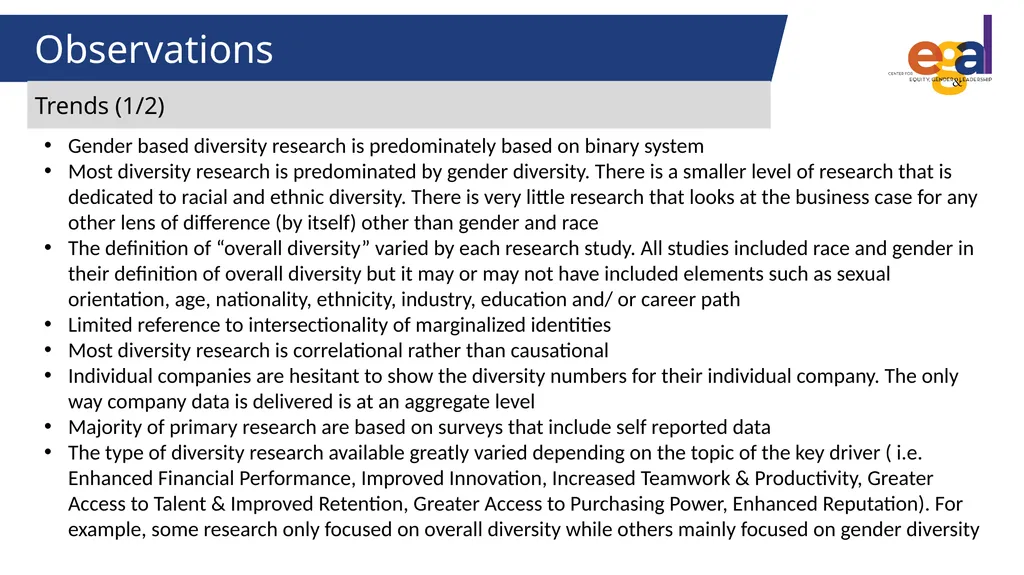
Gender based diversity research is predominately based on binary system
Most diversity research is predominated by gender diversity. There is a smaller level of research that is dedicated to racial and ethnic diversity. There is very little research that looks at the business case for any other lens of difference (by itself) other than gender and race
The definition of “overall diversity” varied by each research study. All studies included race and gender in their definition of overall diversity but it may or may not have included elements such as sexual orientation, age, nationality, ethnicity, industry, education and/ or career path
Limited reference to intersectionality of marginalized identities
Most diversity research is correlational rather than causational
Individual companies are hesitant to show the diversity numbers for their individual company. The only way company data is delivered is at an aggregate level
Majority of primary research are based on surveys that include self reported data
The type of diversity research available greatly varied depending on the topic of the key driver ( i.e. Enhanced Financial Performance, Improved Innovation, Increased Teamwork & Productivity, Greater Access to Talent & Improved Retention, Greater Access to Purchasing Power, Enhanced Reputation). For example, some research only focused on overall diversity while others mainly focused on gender diversity Observations Trends (1/2)<br>
Most diversity research is predominated by gender diversity. There is a smaller level of research that is dedicated to racial and ethnic diversity. There is very little research that looks at the business case for any other lens of difference (by itself) other than gender and race
The definition of “overall diversity” varied by each research study. All studies included race and gender in their definition of overall diversity but it may or may not have included elements such as sexual orientation, age, nationality, ethnicity, industry, education and/ or career path
Limited reference to intersectionality of marginalized identities
Most diversity research is correlational rather than causational
Individual companies are hesitant to show the diversity numbers for their individual company. The only way company data is delivered is at an aggregate level
Majority of primary research are based on surveys that include self reported data
The type of diversity research available greatly varied depending on the topic of the key driver ( i.e. Enhanced Financial Performance, Improved Innovation, Increased Teamwork & Productivity, Greater Access to Talent & Improved Retention, Greater Access to Purchasing Power, Enhanced Reputation). For example, some research only focused on overall diversity while others mainly focused on gender diversity Observations Trends (1/2)<br>
33
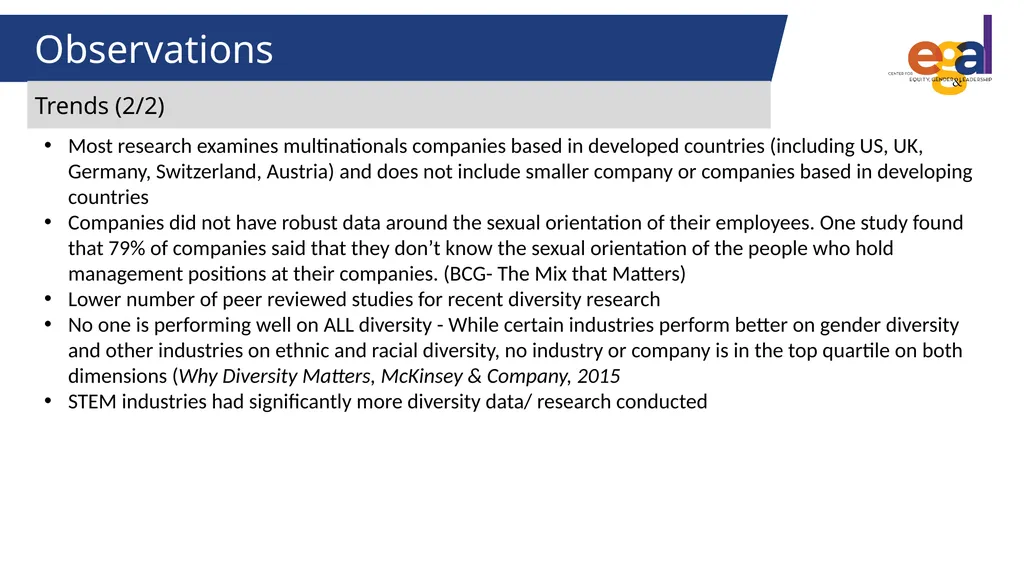
Most research examines multinationals companies based in developed countries (including US, UK, Germany, Switzerland, Austria) and does not include smaller company or companies based in developing countries
Companies did not have robust data around the sexual orientation of their employees. One study found that 79% of companies said that they don’t know the sexual orientation of the people who hold management positions at their companies. (BCG- The Mix that Matters)
Lower number of peer reviewed studies for recent diversity research
No one is performing well on ALL diversity - While certain industries perform better on gender diversity and other industries on ethnic and racial diversity, no industry or company is in the top quartile on both dimensions (Why Diversity Matters, McKinsey & Company, 2015
STEM industries had significantly more diversity data/ research conducted Observations Trends (2/2)<br>
Companies did not have robust data around the sexual orientation of their employees. One study found that 79% of companies said that they don’t know the sexual orientation of the people who hold management positions at their companies. (BCG- The Mix that Matters)
Lower number of peer reviewed studies for recent diversity research
No one is performing well on ALL diversity - While certain industries perform better on gender diversity and other industries on ethnic and racial diversity, no industry or company is in the top quartile on both dimensions (Why Diversity Matters, McKinsey & Company, 2015
STEM industries had significantly more diversity data/ research conducted Observations Trends (2/2)<br>
34
All references can be found on the Research Compendium for the Business Case for Diversity located here References<br>