
Geography NEW GCSE Why you should study Geography
TF
Published · 30 slides · 0 views

1 / 1



Description
Geography NEW GCSE Why you should study Geography Are you interested in how the world works? Literally? Fancy learning a whole range of transferable skills? Geography is the subject for you! Geography is a unique subject Geography is a
Related Topics
Share
Embed code
Download this presentation From Below
"Geography NEW GCSE Why you should study Geography" is the property of its rightful owner. Permission is granted to download and print the materials on this website for personal, non-commercial use only, and to display it on your personal computer provided you do not modify the materials and that you retain all copyright notices contained in the materials. By downloading content from our website, you accept the terms of this agreement.
Presentation Transcript
01
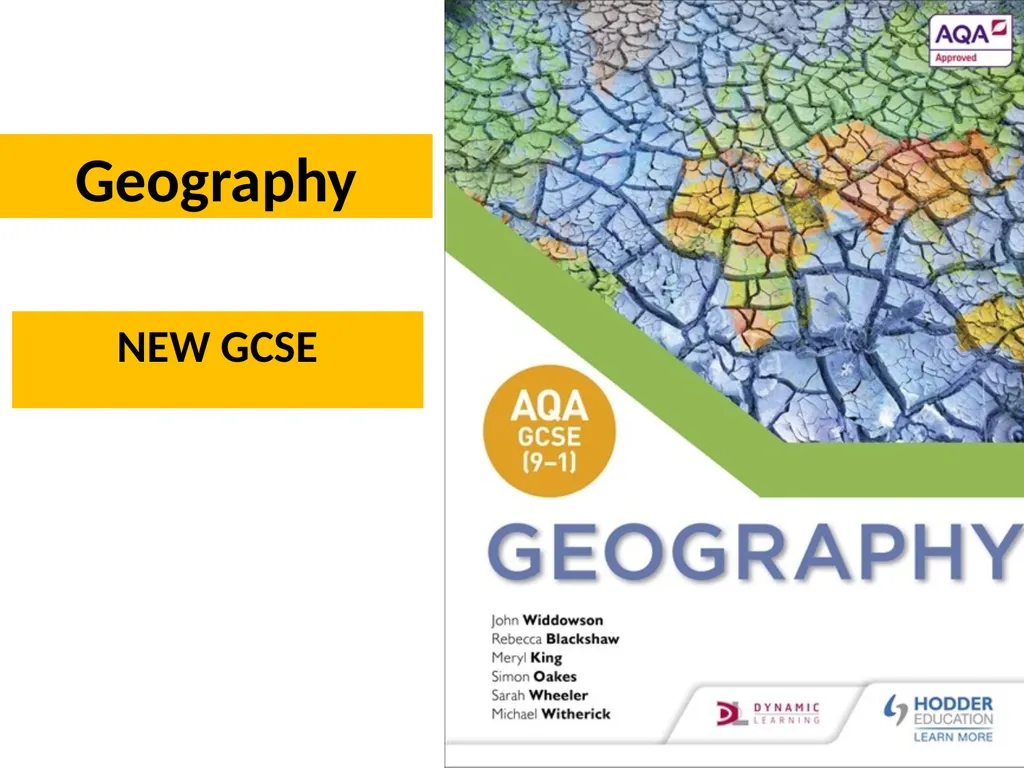
Geography NEW GCSE<br>
02
Why you should study Geography Are you interested in how the world works? Literally?
Fancy learning a whole range of transferable skills?
Geography is the subject for you!<br>
Fancy learning a whole range of transferable skills?
Geography is the subject for you!<br>
03
Geography is a unique subject Geography is a pretty unique subject because it looks at both the physical structure of the planet and how we affect our environment and how it affects us in the present and future.<br>
04
Geography can be divided into two main branches: Physical Geography: is a branch of earth science, which looks at the natural elements of the world, including the atmosphere, land and oceans. Physical geographers study things like climate, soil, how the earth was formed and how it is changing over time.<br>
05
Human Geography: is a social science that studies how humans interact with the planet and covers things like population growth, migration, how urban and rural settlements develop, and even how our economies are effected by the environment we live in.<br>
06
What skills will I get from studying Geography? Geography will help you develop your communication and teamwork skills, as you’ll often work on group projects. You’ll also develop your research and analysis skills including in IT, lab and fieldwork, which means you will be able to collect and look for patterns in data.
Employers love the mix of technical and social skills people get from studying geography, which they see as very transferable, i.e. useful for a whole range of jobs.<br>
Employers love the mix of technical and social skills people get from studying geography, which they see as very transferable, i.e. useful for a whole range of jobs.<br>
07
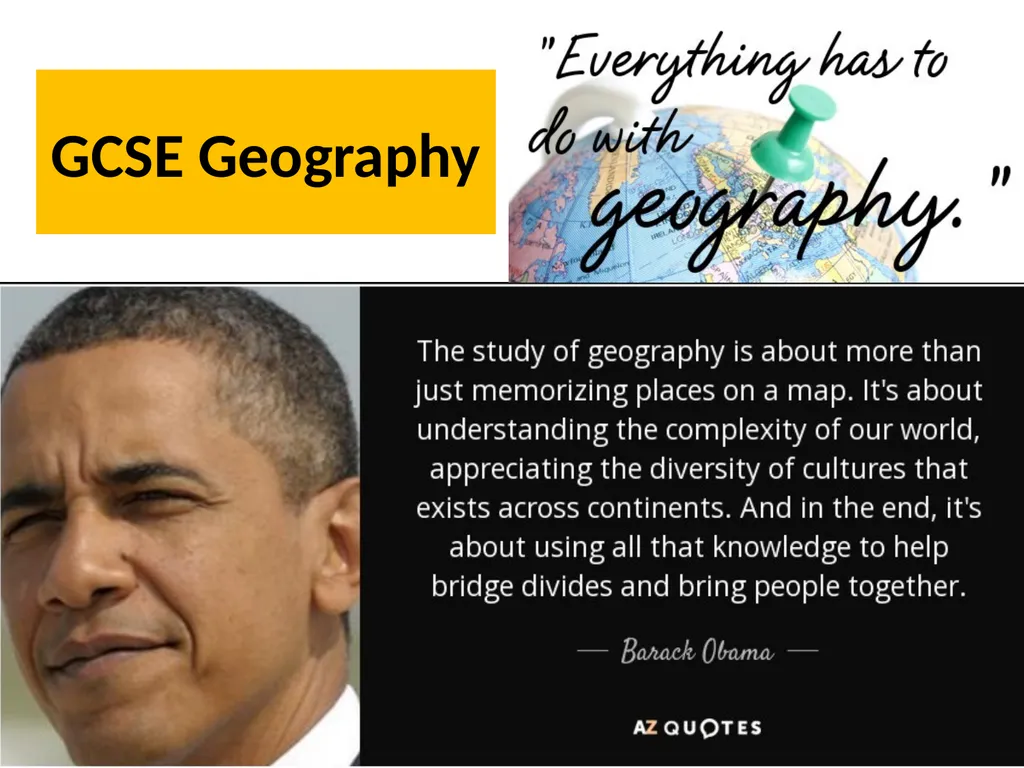
GCSE Geography A window to the world<br>
08
The challenge of natural hazards Tectonic hazards Weather hazards Climate change The living world Ecosystems Tropical rainforests Hot deserts Physical landscapes Coastal landscapes River landscapes Paper 1: Living with the physical environment Written exam: 1 hour 30 minutes Question types: multiple-choice, short answer,, extended prose<br>
09
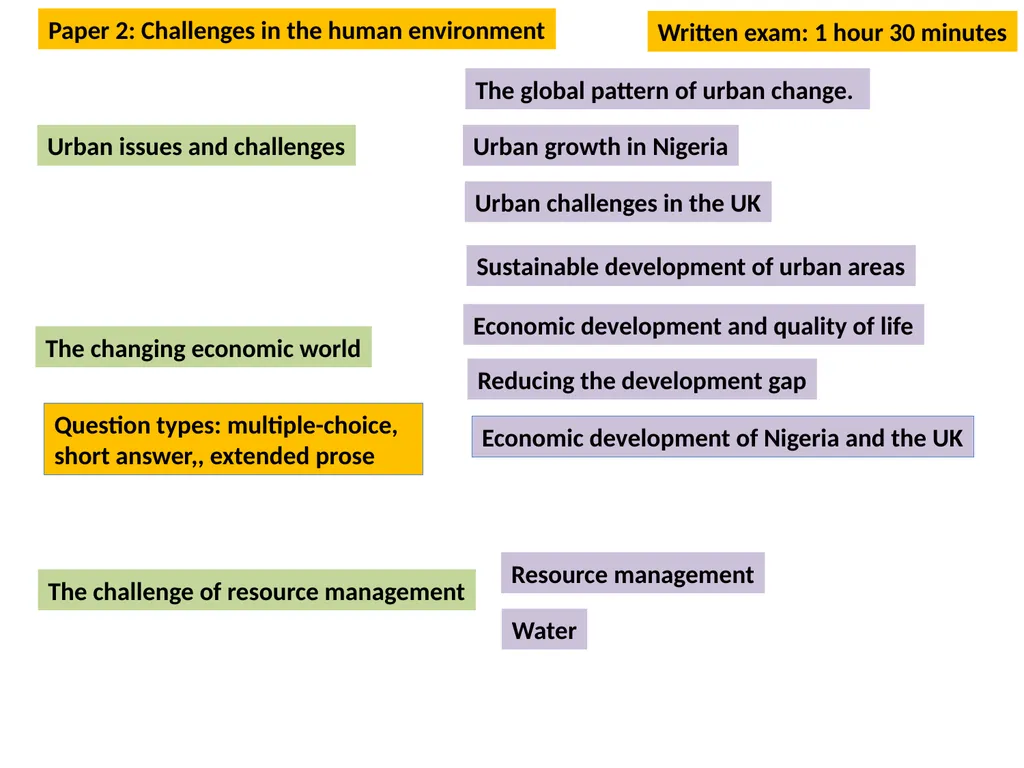
Urban issues and challenges The global pattern of urban change. Urban growth in Nigeria Urban challenges in the UK The changing economic world Economic development and quality of life Reducing the development gap Economic development of Nigeria and the UK The challenge of resource management Resource management Water Paper 2: Challenges in the human environment Written exam: 1 hour 30 minutes Question types: multiple-choice, short answer,, extended prose Sustainable development of urban areas<br>
10
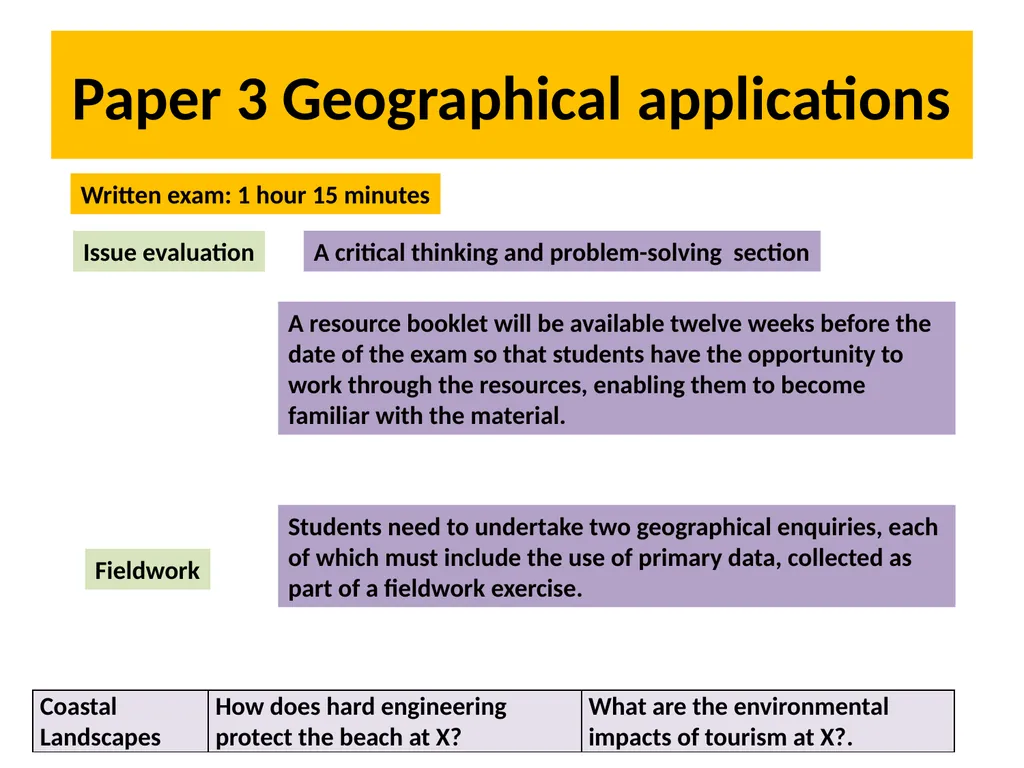
Paper 3 Geographical applications Written exam: 1 hour 15 minutes Issue evaluation A critical thinking and problem-solving section A resource booklet will be available twelve weeks before the date of the exam so that students have the opportunity to work through the resources, enabling them to become familiar with the material. Fieldwork Students need to undertake two geographical enquiries, each of which must include the use of primary data, collected as part of a fieldwork exercise.<br>
11
What Careers Can I do with Geography? According to the Royal Geographical Society, Geography graduates have some of the highest rates of graduate employment.
Geography is great for any kind of career that involves the environment, planning, or collecting and interpreting data. Popular careers for people with geography qualifications include: town or transport planning, surveying, conservation, sustainability, waste and water management, environmental planning, tourism, and weather forecasting.<br>
Geography is great for any kind of career that involves the environment, planning, or collecting and interpreting data. Popular careers for people with geography qualifications include: town or transport planning, surveying, conservation, sustainability, waste and water management, environmental planning, tourism, and weather forecasting.<br>
12
The army, police, government, research organisations, law and business world also love the practical research skills that geographers develop.
Because geographers learn about human and population development, geography can be useful for jobs in charity and international relations too.
If you're interested in pursuing a career in geography, check out the post Career Choices for Geography Students.<br>
Because geographers learn about human and population development, geography can be useful for jobs in charity and international relations too.
If you're interested in pursuing a career in geography, check out the post Career Choices for Geography Students.<br>
13
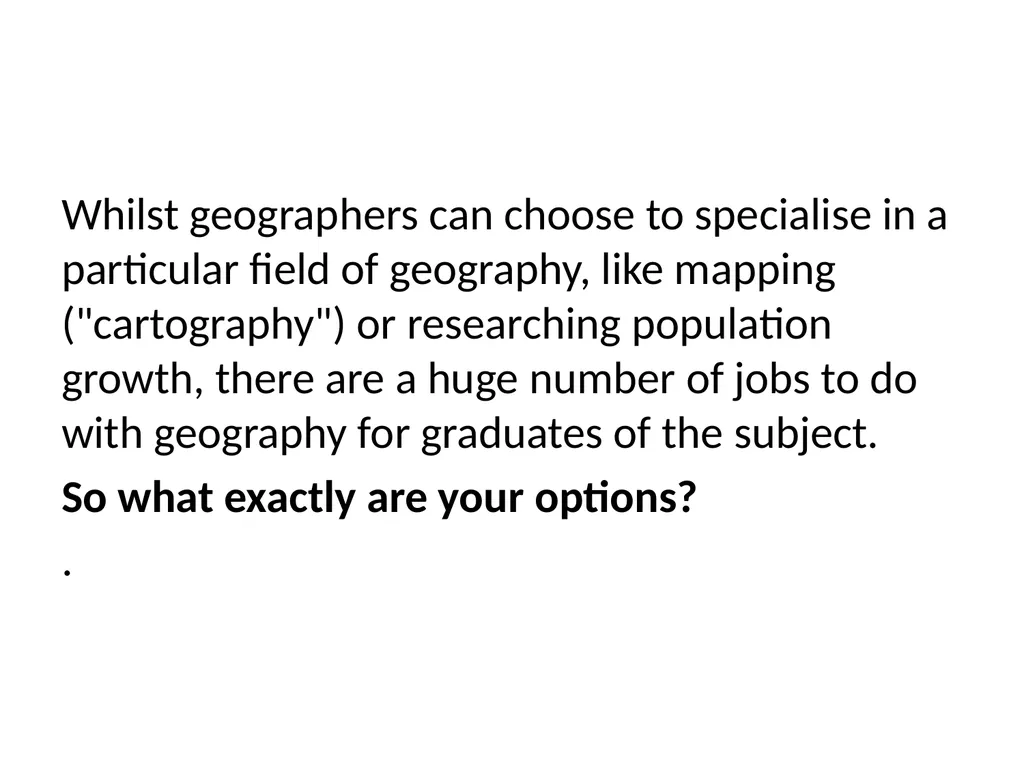
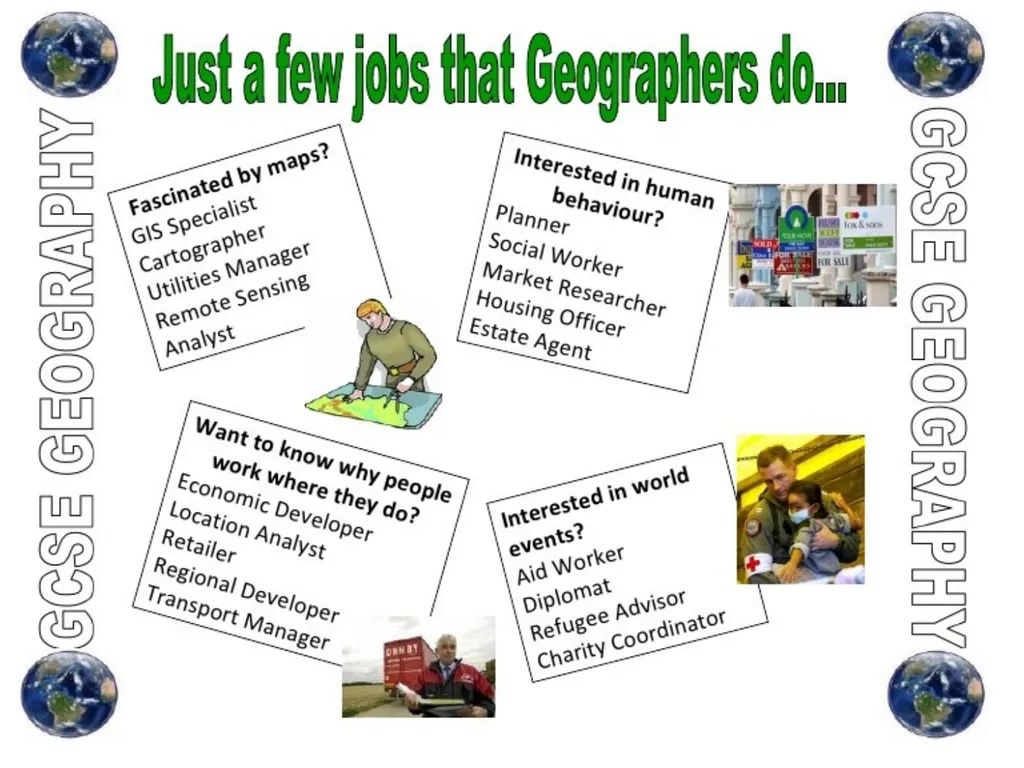
Whilst geographers can choose to specialise in a particular field of geography, like mapping ("cartography") or researching population growth, there are a huge number of jobs to do with geography for graduates of the subject.
So what exactly are your options?
.<br>
So what exactly are your options?
.<br>
14
1. Journalist If I want to be a writer I have to study journalism or media, right? Wrong. The great thing about journalism is that there's so many different fields and areas of expertise. From politics to sport, if you're knowledgeable about a subject, you're pretty much qualified to write about it.<br>
15
But how exactly does that relate to a geography degree? Although they might sound drastically different, both journalism and geography place a lot of importance on research.
What's more, your geography degree might actually help you stand out from the crowd.<br>
What's more, your geography degree might actually help you stand out from the crowd.<br>
16
If you have a geography qualification and a flair for words, why not use it to your advantage and focus on a topic directly related to geography? Love exploring other cultures? You could become a travel writer. Fascinated by climate change and environmental issues? You could carve out a niche as a science journalist.<br>
17
2. Environmental lawyer Are you passionate about the environment? Maybe you're worried about the carbon "footprint" humans are leaving on our planet. If so, you might want to consider environmental science jobs in an area like law.
Environmental lawyers typically focus on things such as climate control, energy sources, pollution, and corporate social responsibility (that's making sure businesses try to manage the impact they might have on the environment or a group of people).<br>
Environmental lawyers typically focus on things such as climate control, energy sources, pollution, and corporate social responsibility (that's making sure businesses try to manage the impact they might have on the environment or a group of people).<br>
18
3. Catastrophe modeller or emergency planner Any job that combines the words ‘catastrophe’ and ‘model’ is bound to be pretty cool.
Perhaps you're fascinated by hurricanes, earthquakes and other natural hazards?
You might make a perfect emergency planner or catastrophe modeller.<br>
Perhaps you're fascinated by hurricanes, earthquakes and other natural hazards?
You might make a perfect emergency planner or catastrophe modeller.<br>
19
Emergency planners typically play a key role in planning for and responding to threats to public safety.
By assessing risks, analysing data and carrying out safety exercises, emergency planners can help people prepare for acts of terrorism, natural disasters and global epidemics.<br>
By assessing risks, analysing data and carrying out safety exercises, emergency planners can help people prepare for acts of terrorism, natural disasters and global epidemics.<br>
20
Catastrophe modellers are responsible for using data and computer calculations to help insurance companies assess how much they stand to lose in the event of a natural disaster.
If you're good with numbers and enjoy working under pressure, this could be the career for you.<br>
If you're good with numbers and enjoy working under pressure, this could be the career for you.<br>
21
4. Landscape architect Just because you have a science-based qualification, doesn't mean you can't go for a creative career. If you're looking for jobs to do with geography that include a design element, look no further than landscape architect.
Landscape architects are responsible for helping to design sustainable outdoor environments like parks, nature reserves and industrial landscapes. Who said science couldn’t be creative?<br>
Landscape architects are responsible for helping to design sustainable outdoor environments like parks, nature reserves and industrial landscapes. Who said science couldn’t be creative?<br>
22
What Subjects go With Geography? Geography will support the study of sciences, especially health and social sciences, like Biology, Sociology and Psychology.
Geography A-level is also a facilitating subject, which means that it can be useful for a whole range of university courses and will help you keep your options open. Find out more about facilitating subjects here<br>
Geography A-level is also a facilitating subject, which means that it can be useful for a whole range of university courses and will help you keep your options open. Find out more about facilitating subjects here<br>
23
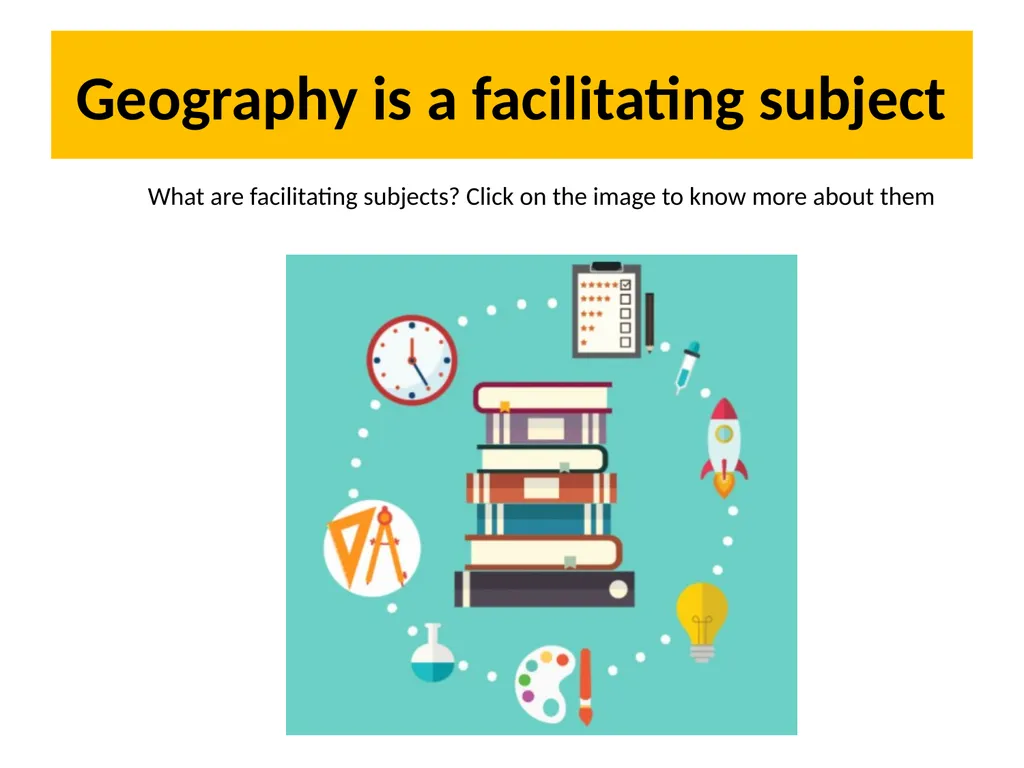
Geography is a facilitating subject What are facilitating subjects? Click on the image to know more about them<br>
24
What are facilitating subjects? Facilitating subjects are the subjects most commonly required or preferred by universities to get on to a range of degree courses. They help you keep your options open when choosing a degree, and many of the top universities will ask you to have at least one A-level in a facilitating subject when you apply.<br>
25
The top UK universities consider traditional academic subjects to be the best preparation for studying. They expect applicants to offer at least two full A levels in these subjects (although typically, applicants will apply with three or four).
Geography is on the list of common traditional academic/”generally preferred” subjects by these universities
Click to see the list for LSE
List for UCL
List for The University of Sheffield
Russel group of universities<br>
Geography is on the list of common traditional academic/”generally preferred” subjects by these universities
Click to see the list for LSE
List for UCL
List for The University of Sheffield
Russel group of universities<br>
26
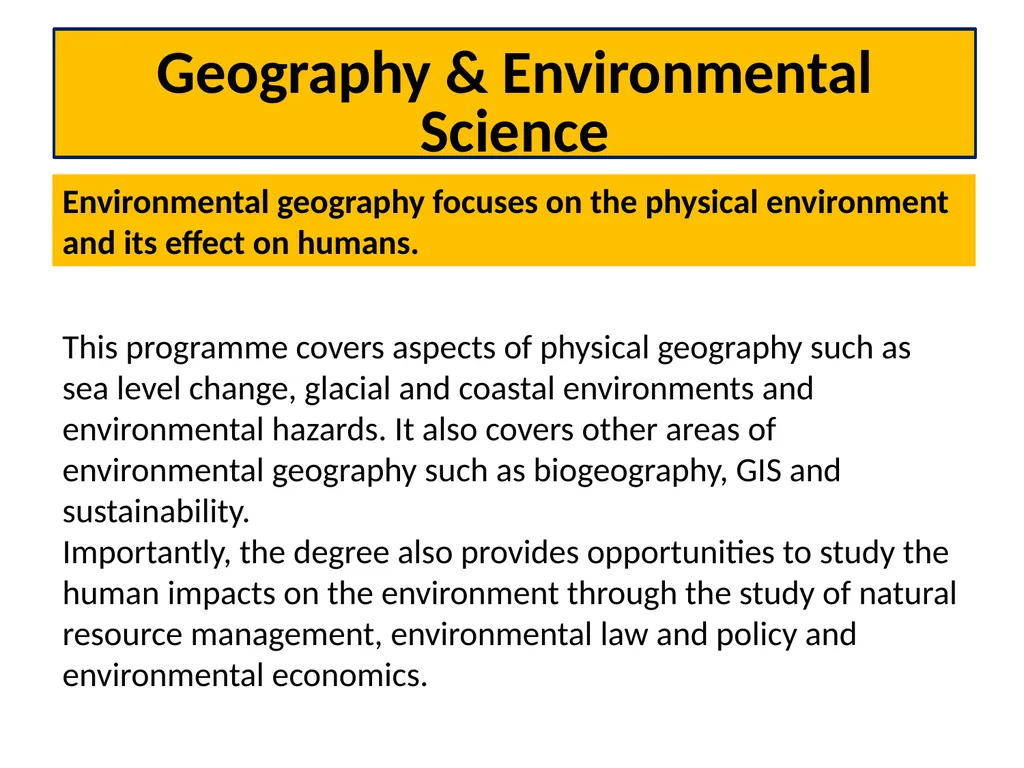
Geography & Environmental Science Environmental geography focuses on the physical environment and its effect on humans. This programme covers aspects of physical geography such as sea level change, glacial and coastal environments and environmental hazards. It also covers other areas of environmental geography such as biogeography, GIS and sustainability.
Importantly, the degree also provides opportunities to study the human impacts on the environment through the study of natural resource management, environmental law and policy and environmental economics.<br>
Importantly, the degree also provides opportunities to study the human impacts on the environment through the study of natural resource management, environmental law and policy and environmental economics.<br>
27
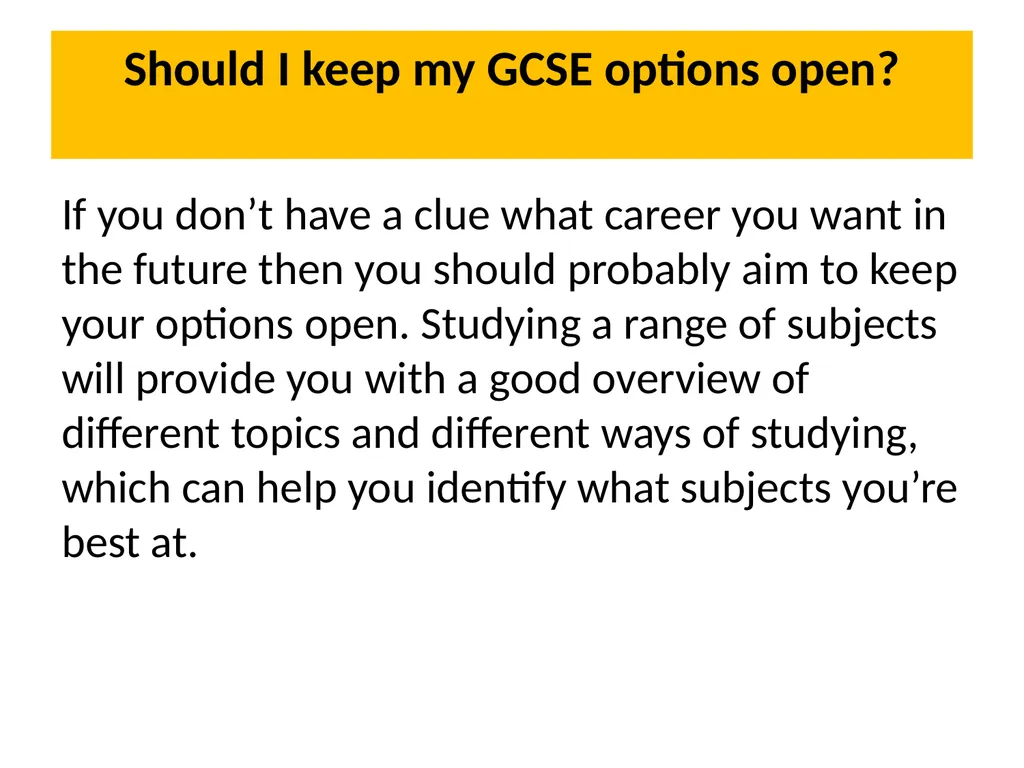
Should I keep my GCSE options open? If you don’t have a clue what career you want in the future then you should probably aim to keep your options open. Studying a range of subjects will provide you with a good overview of different topics and different ways of studying, which can help you identify what subjects you’re best at.<br>