
GIFT City Treasury Centre Positioning for growth
MT
Published · 16 slides · 0 views

1 / 1



Description
GIFT City Treasury Centre Positioning for growth in the new era Treasury Centre Trends Why MNCs require an international treasury centre: Challenges for todays Treasury and the critical role of RTC 5 Respond to opportunity to migrate to
Related Topics
Share
Embed code
Download this presentation From Below
"GIFT City Treasury Centre Positioning for growth" is the property of its rightful owner. Permission is granted to download and print the materials on this website for personal, non-commercial use only, and to display it on your personal computer provided you do not modify the materials and that you retain all copyright notices contained in the materials. By downloading content from our website, you accept the terms of this agreement.
Presentation Transcript
01
GIFT City Treasury Centre Positioning for growth in the new era<br>
02
Treasury Centre Trends<br>
03
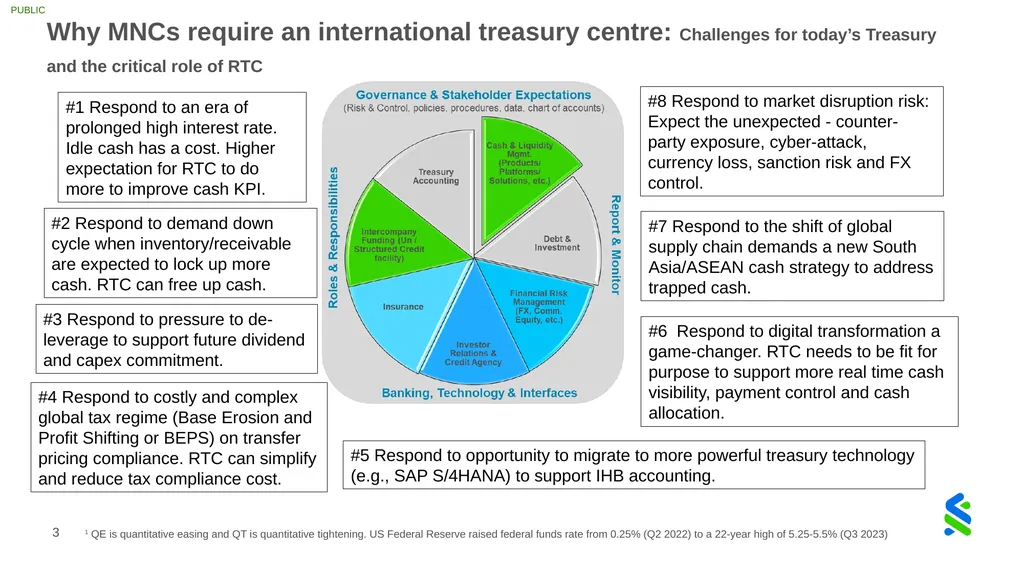
Why MNCs require an international treasury centre: Challenges for today’s Treasury and the critical role of RTC #5 Respond to opportunity to migrate to more powerful treasury technology (e.g., SAP S/4HANA) to support IHB accounting. #7 Respond to the shift of global supply chain demands a new South Asia/ASEAN cash strategy to address trapped cash. #3 Respond to pressure to de-leverage to support future dividend and capex commitment. #6 Respond to digital transformation a game-changer. RTC needs to be fit for purpose to support more real time cash visibility, payment control and cash allocation. #8 Respond to market disruption risk: Expect the unexpected - counter-party exposure, cyber-attack, currency loss, sanction risk and FX control. #4 Respond to costly and complex global tax regime (Base Erosion and Profit Shifting or BEPS) on transfer pricing compliance. RTC can simplify and reduce tax compliance cost. #1 Respond to an era of prolonged high interest rate. Idle cash has a cost. Higher expectation for RTC to do more to improve cash KPI. #2 Respond to demand down cycle when inventory/receivable are expected to lock up more cash. RTC can free up cash. 1 QE is quantitative easing and QT is quantitative tightening. US Federal Reserve raised federal funds rate from 0.25% (Q2 2022) to a 22-year high of 5.25-5.5% (Q3 2023)<br>
04
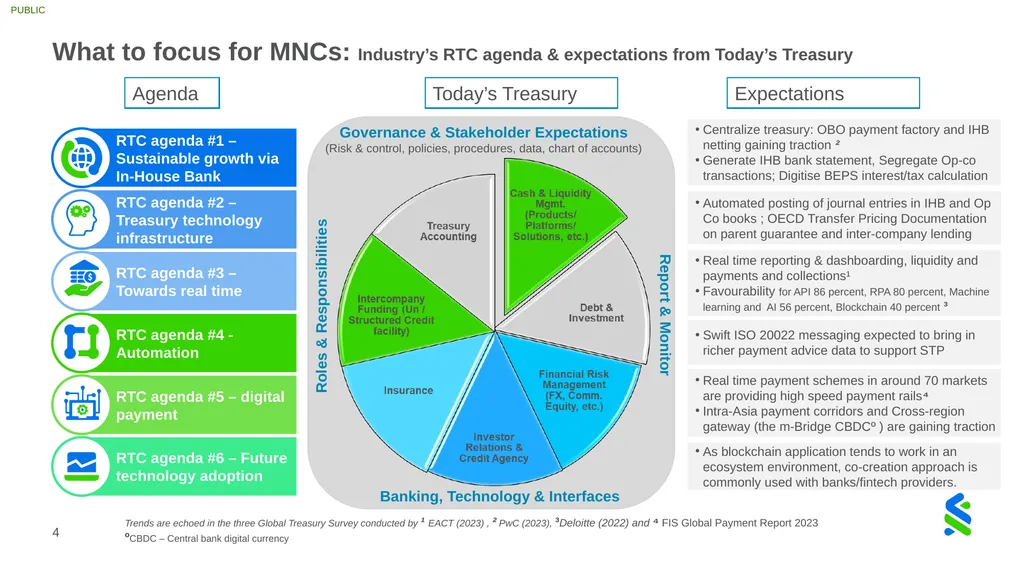
What to focus for MNCs: Industry’s RTC agenda & expectations from Today’s Treasury RTC agenda #1 – Sustainable growth via In-House Bank RTC agenda #2 – Treasury technology infrastructure RTC agenda #3 – Towards real time RTC agenda #4 - Automation RTC agenda #5 – digital payment RTC agenda #6 – Future technology adoption Centralize treasury: OBO payment factory and IHB netting gaining traction ²
Generate IHB bank statement, Segregate Op-co transactions; Digitise BEPS interest/tax calculation Real time reporting & dashboarding, liquidity and payments and collections¹
Favourability for API 86 percent, RPA 80 percent, Machine learning and AI 56 percent, Blockchain 40 percent ³ Automated posting of journal entries in IHB and Op Co books ; OECD Transfer Pricing Documentation on parent guarantee and inter-company lending Swift ISO 20022 messaging expected to bring in richer payment advice data to support STP Real time payment schemes in around 70 markets are providing high speed payment rails⁴
Intra-Asia payment corridors and Cross-region gateway (the m-Bridge CBDCº ) are gaining traction As blockchain application tends to work in an ecosystem environment, co-creation approach is commonly used with banks/fintech providers. Trends are echoed in the three Global Treasury Survey conducted by ¹ EACT (2023) , ² PwC (2023), ³Deloitte (2022) and ⁴ FIS Global Payment Report 2023
ºCBDC – Central bank digital currency Agenda Today’s Treasury Expectations Governance & Stakeholder Expectations
(Risk & control, policies, procedures, data, chart of accounts) Roles & Responsibilities Banking, Technology & Interfaces Report & Monitor<br>
Generate IHB bank statement, Segregate Op-co transactions; Digitise BEPS interest/tax calculation Real time reporting & dashboarding, liquidity and payments and collections¹
Favourability for API 86 percent, RPA 80 percent, Machine learning and AI 56 percent, Blockchain 40 percent ³ Automated posting of journal entries in IHB and Op Co books ; OECD Transfer Pricing Documentation on parent guarantee and inter-company lending Swift ISO 20022 messaging expected to bring in richer payment advice data to support STP Real time payment schemes in around 70 markets are providing high speed payment rails⁴
Intra-Asia payment corridors and Cross-region gateway (the m-Bridge CBDCº ) are gaining traction As blockchain application tends to work in an ecosystem environment, co-creation approach is commonly used with banks/fintech providers. Trends are echoed in the three Global Treasury Survey conducted by ¹ EACT (2023) , ² PwC (2023), ³Deloitte (2022) and ⁴ FIS Global Payment Report 2023
ºCBDC – Central bank digital currency Agenda Today’s Treasury Expectations Governance & Stakeholder Expectations
(Risk & control, policies, procedures, data, chart of accounts) Roles & Responsibilities Banking, Technology & Interfaces Report & Monitor<br>
05
What is the right Treasury Framework<br>
06
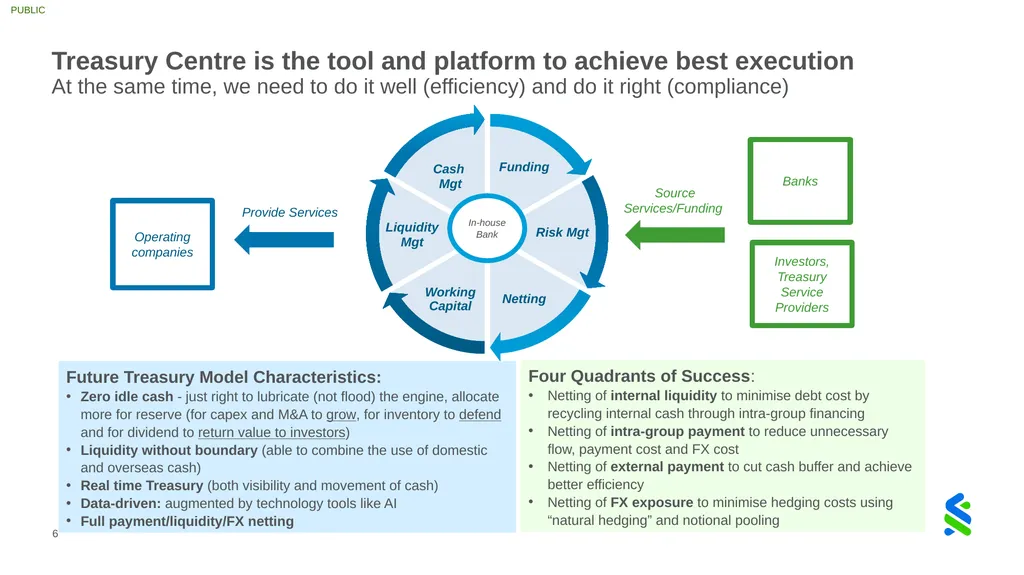
Investors, Treasury Service Providers Banks In-house Bank Provide Services Source Services/Funding Operating companies Four Quadrants of Success:
Netting of internal liquidity to minimise debt cost by recycling internal cash through intra-group financing
Netting of intra-group payment to reduce unnecessary flow, payment cost and FX cost
Netting of external payment to cut cash buffer and achieve better efficiency
Netting of FX exposure to minimise hedging costs using “natural hedging” and notional pooling Future Treasury Model Characteristics:
Zero idle cash - just right to lubricate (not flood) the engine, allocate more for reserve (for capex and M&A to grow, for inventory to defend and for dividend to return value to investors)
Liquidity without boundary (able to combine the use of domestic and overseas cash)
Real time Treasury (both visibility and movement of cash)
Data-driven: augmented by technology tools like AI
Full payment/liquidity/FX netting Treasury Centre is the tool and platform to achieve best execution
At the same time, we need to do it well (efficiency) and do it right (compliance)<br>
Netting of internal liquidity to minimise debt cost by recycling internal cash through intra-group financing
Netting of intra-group payment to reduce unnecessary flow, payment cost and FX cost
Netting of external payment to cut cash buffer and achieve better efficiency
Netting of FX exposure to minimise hedging costs using “natural hedging” and notional pooling Future Treasury Model Characteristics:
Zero idle cash - just right to lubricate (not flood) the engine, allocate more for reserve (for capex and M&A to grow, for inventory to defend and for dividend to return value to investors)
Liquidity without boundary (able to combine the use of domestic and overseas cash)
Real time Treasury (both visibility and movement of cash)
Data-driven: augmented by technology tools like AI
Full payment/liquidity/FX netting Treasury Centre is the tool and platform to achieve best execution
At the same time, we need to do it well (efficiency) and do it right (compliance)<br>
07
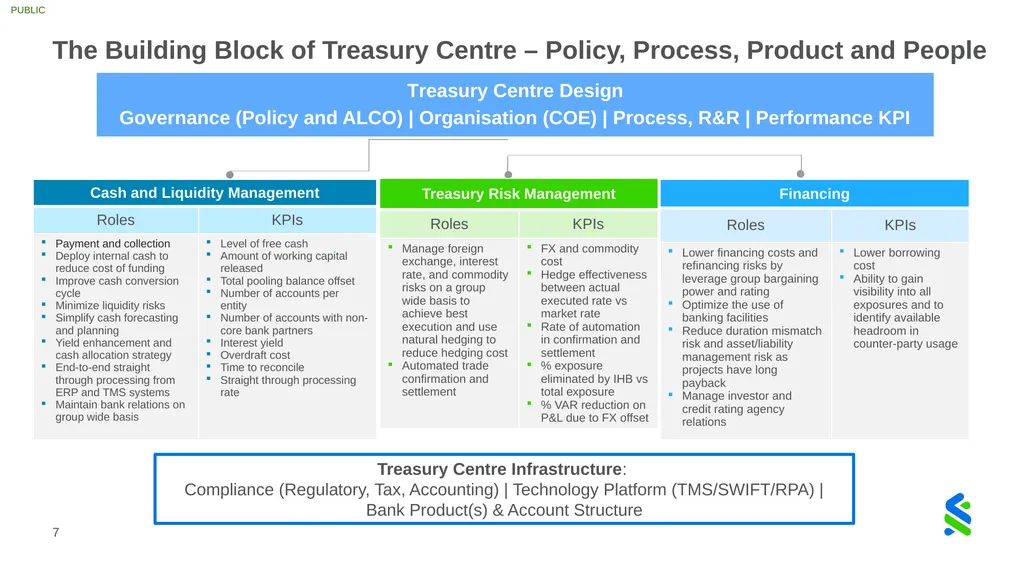
The Building Block of Treasury Centre – Policy, Process, Product and People Treasury Centre Design
Governance (Policy and ALCO) | Organisation (COE) | Process, R&R | Performance KPI Treasury Centre Infrastructure:
Compliance (Regulatory, Tax, Accounting) | Technology Platform (TMS/SWIFT/RPA) | Bank Product(s) & Account Structure<br>
Governance (Policy and ALCO) | Organisation (COE) | Process, R&R | Performance KPI Treasury Centre Infrastructure:
Compliance (Regulatory, Tax, Accounting) | Technology Platform (TMS/SWIFT/RPA) | Bank Product(s) & Account Structure<br>
08
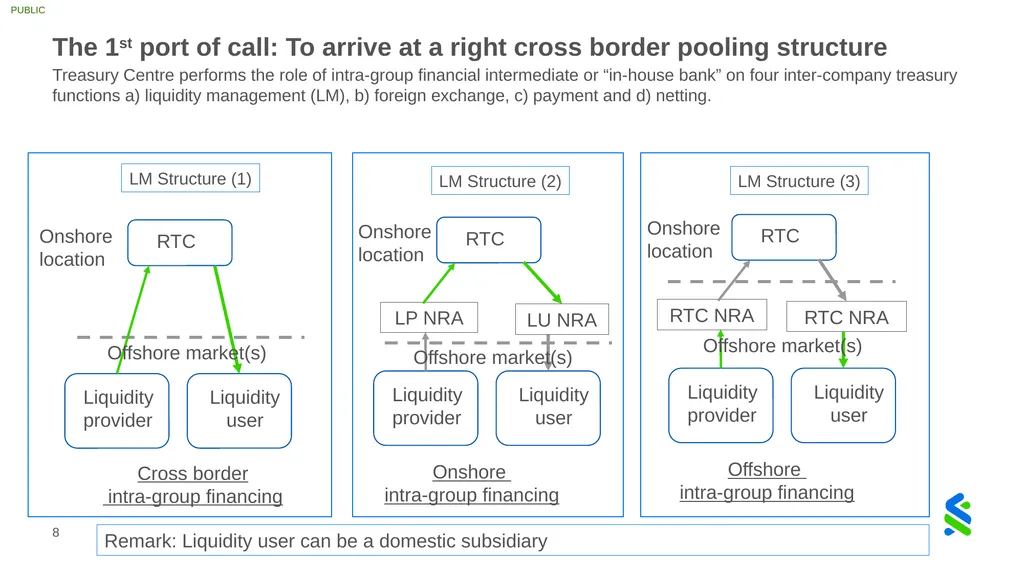
Treasury Centre performs the role of intra-group financial intermediate or “in-house bank” on four inter-company treasury functions a) liquidity management (LM), b) foreign exchange, c) payment and d) netting. The 1st port of call: To arrive at a right cross border pooling structure LM Structure (1) LM Structure (3) LM Structure (2) RTC Liquidity provider Liquidity user Cross border
intra-group financing RTC Liquidity provider Liquidity user Onshore
intra-group financing LP NRA LU NRA RTC Liquidity provider Liquidity user Offshore
intra-group financing RTC NRA RTC NRA Onshore
location Onshore
location Onshore
location Offshore market(s) Offshore market(s) Offshore market(s) Remark: Liquidity user can be a domestic subsidiary<br>
intra-group financing RTC Liquidity provider Liquidity user Onshore
intra-group financing LP NRA LU NRA RTC Liquidity provider Liquidity user Offshore
intra-group financing RTC NRA RTC NRA Onshore
location Onshore
location Onshore
location Offshore market(s) Offshore market(s) Offshore market(s) Remark: Liquidity user can be a domestic subsidiary<br>
09
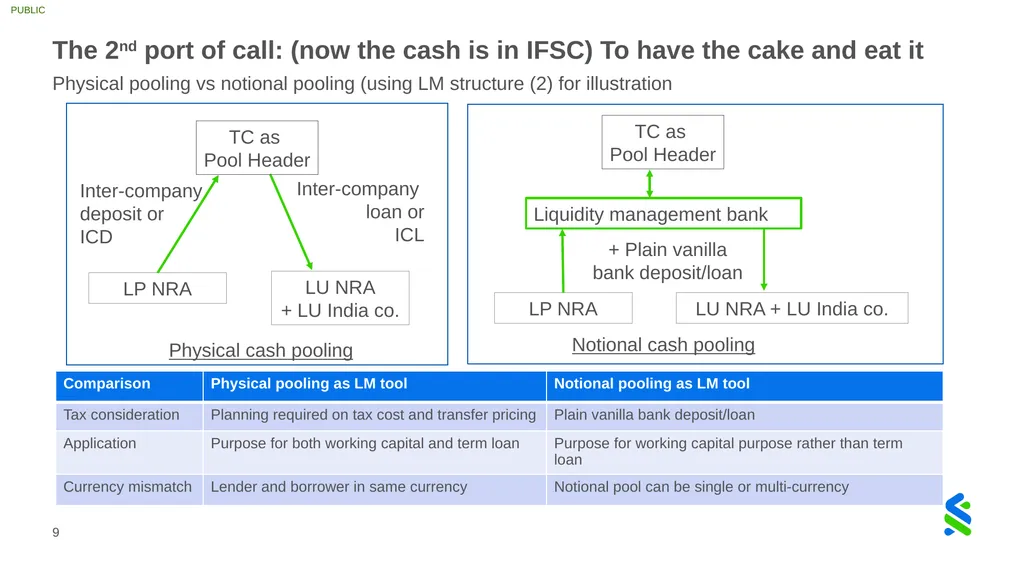
Physical pooling vs notional pooling (using LM structure (2) for illustration The 2nd port of call: (now the cash is in IFSC) To have the cake and eat it LP NRA LU NRA
+ LU India co. TC as
Pool Header Physical cash pooling LP NRA LU NRA + LU India co. TC as
Pool Header Notional cash pooling Liquidity management bank Inter-company
deposit or
ICD Inter-company
loan or
ICL + Plain vanilla
bank deposit/loan<br>
+ LU India co. TC as
Pool Header Physical cash pooling LP NRA LU NRA + LU India co. TC as
Pool Header Notional cash pooling Liquidity management bank Inter-company
deposit or
ICD Inter-company
loan or
ICL + Plain vanilla
bank deposit/loan<br>
10
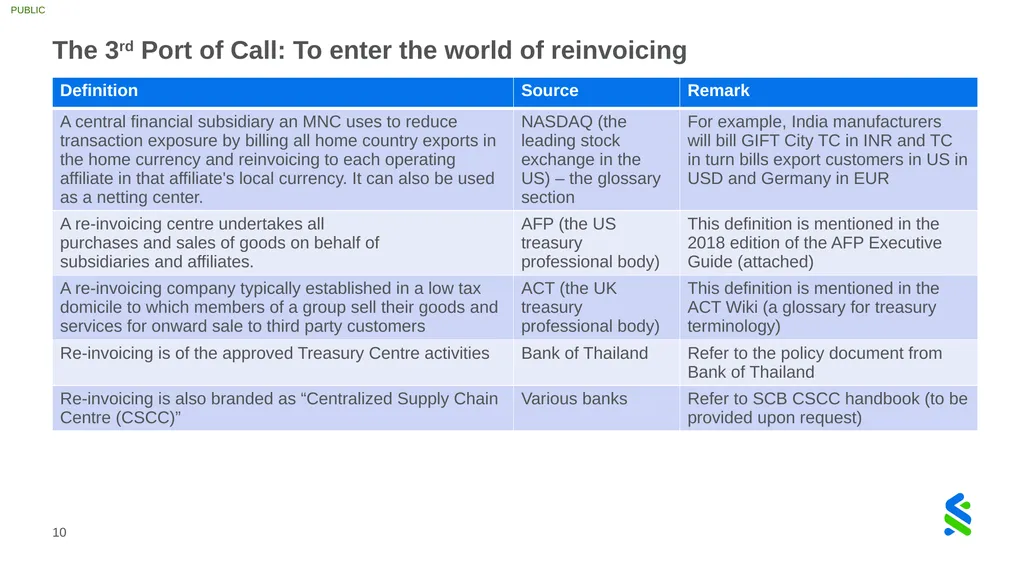
The 3rd Port of Call: To enter the world of reinvoicing<br>
11
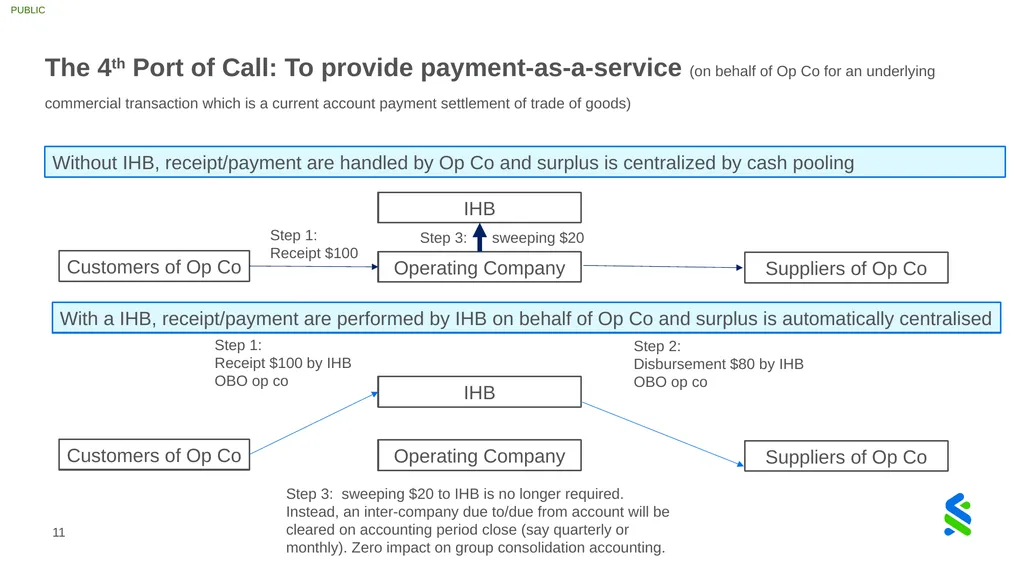
The 4th Port of Call: To provide payment-as-a-service (on behalf of Op Co for an underlying commercial transaction which is a current account payment settlement of trade of goods) Customers of Op Co Operating Company Suppliers of Op Co IHB Customers of Op Co Operating Company Suppliers of Op Co IHB Step 1:
Receipt $100 Step 2:
Disbursement $80 by IHB OBO op co Step 3: sweeping $20 Step 1:
Receipt $100 by IHB OBO op co Step 3: sweeping $20 to IHB is no longer required. Instead, an inter-company due to/due from account will be cleared on accounting period close (say quarterly or monthly). Zero impact on group consolidation accounting. Without IHB, receipt/payment are handled by Op Co and surplus is centralized by cash pooling With a IHB, receipt/payment are performed by IHB on behalf of Op Co and surplus is automatically centralised<br>
Receipt $100 Step 2:
Disbursement $80 by IHB OBO op co Step 3: sweeping $20 Step 1:
Receipt $100 by IHB OBO op co Step 3: sweeping $20 to IHB is no longer required. Instead, an inter-company due to/due from account will be cleared on accounting period close (say quarterly or monthly). Zero impact on group consolidation accounting. Without IHB, receipt/payment are handled by Op Co and surplus is centralized by cash pooling With a IHB, receipt/payment are performed by IHB on behalf of Op Co and surplus is automatically centralised<br>
12
How to take it forward<br>
13
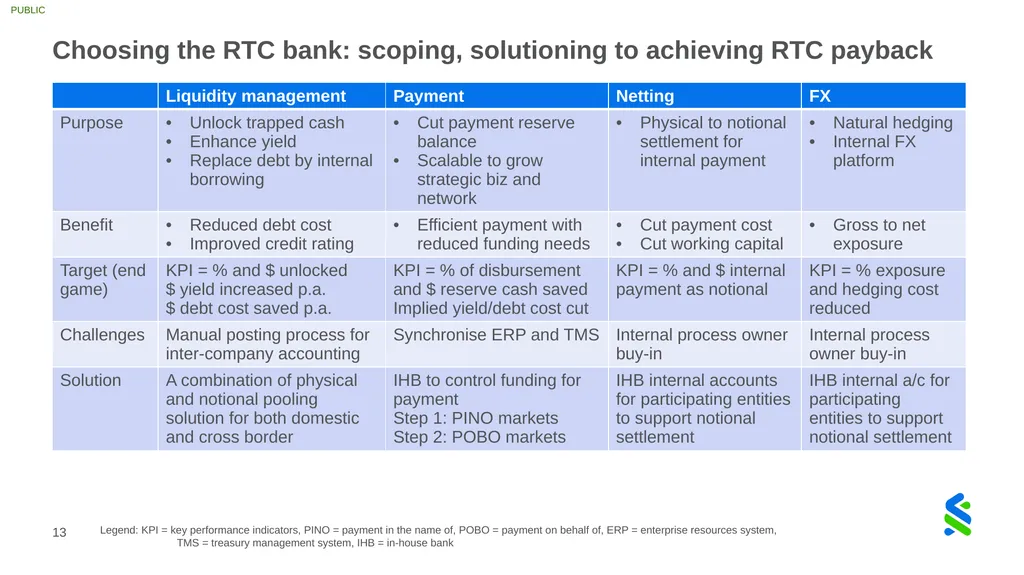
Choosing the RTC bank: scoping, solutioning to achieving RTC payback Legend: KPI = key performance indicators, PINO = payment in the name of, POBO = payment on behalf of, ERP = enterprise resources system,
TMS = treasury management system, IHB = in-house bank<br>
TMS = treasury management system, IHB = in-house bank<br>
14
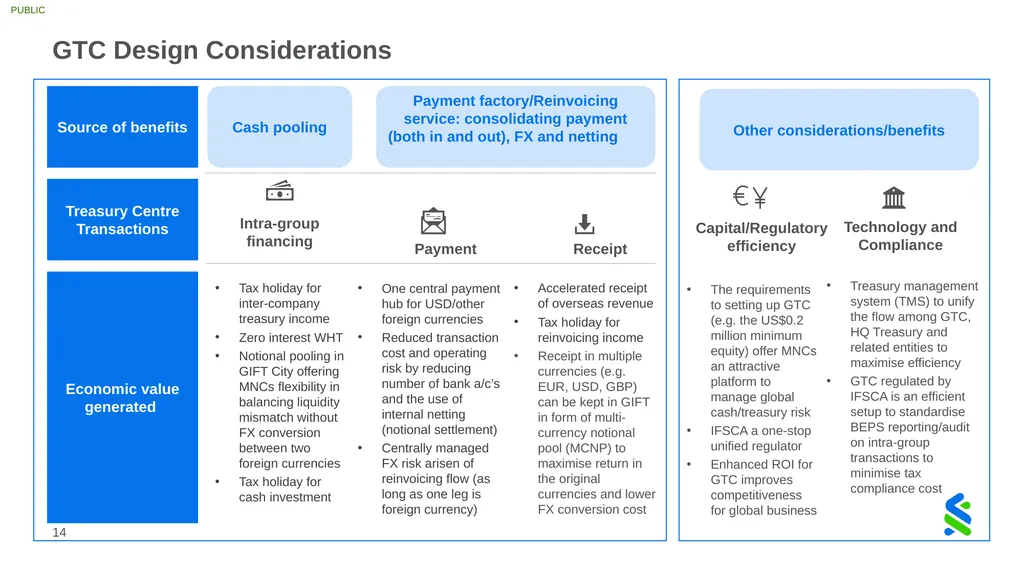
GTC Design Considerations Source of benefits Treasury Centre Transactions Economic value generated Cash pooling Payment factory/Reinvoicing service: consolidating payment (both in and out), FX and netting Intra-group financing Tax holiday for inter-company treasury income
Zero interest WHT
Notional pooling in GIFT City offering MNCs flexibility in balancing liquidity mismatch without FX conversion between two foreign currencies
Tax holiday for cash investment One central payment hub for USD/other foreign currencies
Reduced transaction cost and operating risk by reducing number of bank a/c’s and the use of internal netting (notional settlement)
Centrally managed FX risk arisen of reinvoicing flow (as long as one leg is foreign currency) Accelerated receipt of overseas revenue
Tax holiday for reinvoicing income
Receipt in multiple currencies (e.g. EUR, USD, GBP) can be kept in GIFT in form of multi-currency notional pool (MCNP) to maximise return in the original currencies and lower FX conversion cost Treasury management system (TMS) to unify the flow among GTC, HQ Treasury and related entities to maximise efficiency
GTC regulated by IFSCA is an efficient setup to standardise BEPS reporting/audit on intra-group transactions to minimise tax compliance cost Capital/Regulatory efficiency Technology and Compliance Receipt Payment The requirements to setting up GTC (e.g. the US$0.2 million minimum equity) offer MNCs an attractive platform to manage global cash/treasury risk
IFSCA a one-stop unified regulator
Enhanced ROI for GTC improves competitiveness for global business Other considerations/benefits<br>
Zero interest WHT
Notional pooling in GIFT City offering MNCs flexibility in balancing liquidity mismatch without FX conversion between two foreign currencies
Tax holiday for cash investment One central payment hub for USD/other foreign currencies
Reduced transaction cost and operating risk by reducing number of bank a/c’s and the use of internal netting (notional settlement)
Centrally managed FX risk arisen of reinvoicing flow (as long as one leg is foreign currency) Accelerated receipt of overseas revenue
Tax holiday for reinvoicing income
Receipt in multiple currencies (e.g. EUR, USD, GBP) can be kept in GIFT in form of multi-currency notional pool (MCNP) to maximise return in the original currencies and lower FX conversion cost Treasury management system (TMS) to unify the flow among GTC, HQ Treasury and related entities to maximise efficiency
GTC regulated by IFSCA is an efficient setup to standardise BEPS reporting/audit on intra-group transactions to minimise tax compliance cost Capital/Regulatory efficiency Technology and Compliance Receipt Payment The requirements to setting up GTC (e.g. the US$0.2 million minimum equity) offer MNCs an attractive platform to manage global cash/treasury risk
IFSCA a one-stop unified regulator
Enhanced ROI for GTC improves competitiveness for global business Other considerations/benefits<br>
15
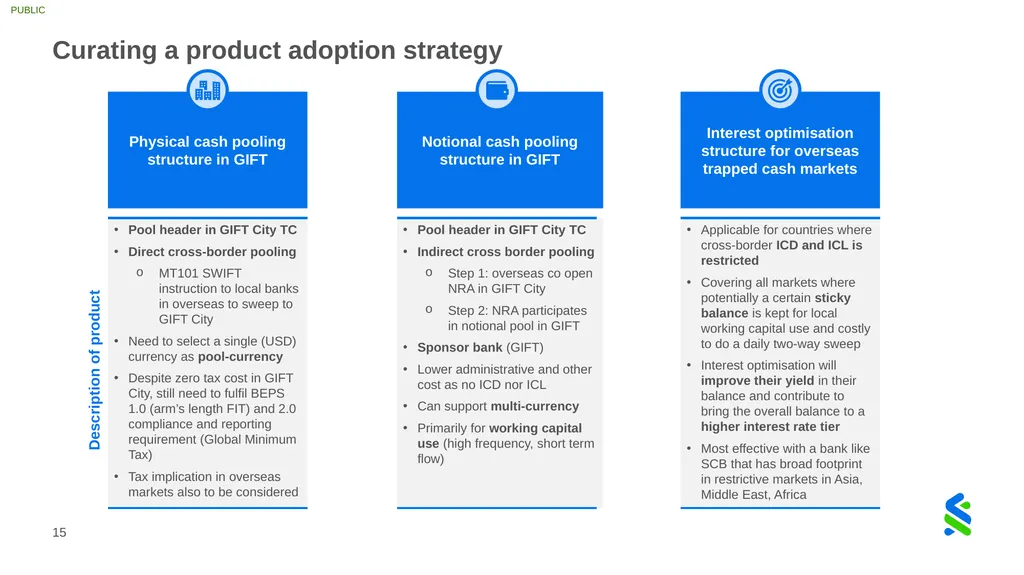
Curating a product adoption strategy Physical cash pooling structure in GIFT Notional cash pooling structure in GIFT Interest optimisation structure for overseas trapped cash markets Description of product Pool header in GIFT City TC
Direct cross-border pooling
MT101 SWIFT instruction to local banks in overseas to sweep to GIFT City
Need to select a single (USD) currency as pool-currency
Despite zero tax cost in GIFT City, still need to fulfil BEPS 1.0 (arm’s length FIT) and 2.0 compliance and reporting requirement (Global Minimum Tax)
Tax implication in overseas markets also to be considered Pool header in GIFT City TC
Indirect cross border pooling
Step 1: overseas co open NRA in GIFT City
Step 2: NRA participates in notional pool in GIFT
Sponsor bank (GIFT)
Lower administrative and other cost as no ICD nor ICL
Can support multi-currency
Primarily for working capital use (high frequency, short term flow) Applicable for countries where cross-border ICD and ICL is restricted
Covering all markets where potentially a certain sticky balance is kept for local working capital use and costly to do a daily two-way sweep
Interest optimisation will improve their yield in their balance and contribute to bring the overall balance to a higher interest rate tier
Most effective with a bank like SCB that has broad footprint in restrictive markets in Asia, Middle East, Africa<br>
Direct cross-border pooling
MT101 SWIFT instruction to local banks in overseas to sweep to GIFT City
Need to select a single (USD) currency as pool-currency
Despite zero tax cost in GIFT City, still need to fulfil BEPS 1.0 (arm’s length FIT) and 2.0 compliance and reporting requirement (Global Minimum Tax)
Tax implication in overseas markets also to be considered Pool header in GIFT City TC
Indirect cross border pooling
Step 1: overseas co open NRA in GIFT City
Step 2: NRA participates in notional pool in GIFT
Sponsor bank (GIFT)
Lower administrative and other cost as no ICD nor ICL
Can support multi-currency
Primarily for working capital use (high frequency, short term flow) Applicable for countries where cross-border ICD and ICL is restricted
Covering all markets where potentially a certain sticky balance is kept for local working capital use and costly to do a daily two-way sweep
Interest optimisation will improve their yield in their balance and contribute to bring the overall balance to a higher interest rate tier
Most effective with a bank like SCB that has broad footprint in restrictive markets in Asia, Middle East, Africa<br>
16
This material has been prepared by one or more members of SC Group, where “SC Group” refers to Standard Chartered Bank and each of its holding companies, subsidiaries, related corporations, affiliates, representative and branch offices in any jurisdiction, and their respective directors, officers, employees and/or any persons connected with them. Standard Chartered Bank is authorised by the United Kingdom’s Prudential Regulation Authority and regulated by the United Kingdom’s Financial Conduct Authority and Prudential Regulation Authority.
This material is not research material and does not represent the views of the Standard Chartered research department. This material has been produced for reference and is not independent research or a research recommendation and should therefore not be relied upon as such. It is not directed at Retail Clients in the European Economic Area as defined by Directive 2004/39/EC. It has not been prepared in accordance with legal requirements designed to promote the independence of investment research and is not subject to any prohibition on dealing ahead of the dissemination of investment research.
This material is for information and discussion purposes only and does not constitute an invitation, recommendation or offer to subscribe for or purchase any of the products or services mentioned or to enter into any transaction. The information herein is not intended to be used as a general guide to investing and does not constitute investment advice or as a source of any specific investment recommendations as it has not been prepared with regard to the specific investment objectives, financial situation or particular needs of any particular person.
Information contained herein is subject to change at any time without notice, and has been obtained from sources believed to be reliable. Some of the information herein may have been obtained from public sources and while SC Group believes such information to be reliable, SC Group has not independently verified the information. Any opinions or views of third parties expressed in this material are those of the third parties identified, and not of SC Group. While all reasonable care has been taken in preparing this material, SC Group makes no representation or warranty as to its accuracy or completeness, and no responsibility or liability is accepted for any errors of fact, omission or for any opinion expressed herein. The members of SC Group may not have the necessary licenses to provide services or offer products in all countries, and/or such provision of services or offer of products may be subject to the regulatory requirements of each jurisdiction, and you should check with your relationship manager or usual contact. This material has not been prepared with regard to the specific objectives, situation or particular needs of any particular person, and is not meant to be comprehensive. SC Group does not provide any information technology, accounting, legal, regulatory, tax or investment advice and this material should not be relied on as such. Any comments on information technology, accounting, legal, regulatory, tax or investment matters contained in this material should not be relied on or used as a basis to ascertain the various results or implications arising from the matters contained herein, and you need to exercise your own independent judgment (with the advice of your information technology, accounting, legal, regulatory, tax, investment and other professional advisers as necessary) with respect to the risks and consequences of any matter contained herein. SC Group expressly disclaims any liability and responsibility whether arising in tort or contract or otherwise for any damage or losses you may suffer from your use of or reliance of the information contained herein.
This material is not independent of the trading strategies or positions of the members of SC Group. It is possible, and you should assume, that members of SC Group may have material interests in one or more of the financial instruments mentioned herein. If specific companies are mentioned in this material, members of SC Group may at times seek to do business with the companies covered in this material; hold a position in, or have economic exposure to, such companies; and/or invest in the financial products issued by these companies. Further, members of SC Group may be involved in activities such as dealing in, holding, acting as market makers or performing financial or advisory services in relation to any of the products referred to in this material. Accordingly, SC Group may have conflicts of interest that may affect the objectivity of this material.
You may wish to refer to the incorporation details of Standard Chartered PLC, Standard Chartered Bank and their subsidiaries at http://www.sc.com/en/incorporation-details.html.
This material is not for distribution to any person to which, or any jurisdiction in which, its distribution would be prohibited.
© Copyright 2021-2023 Standard Chartered Bank. All rights reserved. All copyrights subsisting and arising out of these materials belong to Standard Chartered Bank and may not be reproduced, distributed, amended, modified, adapted, transmitted in any form, or translated in any way without the prior written consent of Standard Chartered Bank. Disclaimer<br>
This material is not research material and does not represent the views of the Standard Chartered research department. This material has been produced for reference and is not independent research or a research recommendation and should therefore not be relied upon as such. It is not directed at Retail Clients in the European Economic Area as defined by Directive 2004/39/EC. It has not been prepared in accordance with legal requirements designed to promote the independence of investment research and is not subject to any prohibition on dealing ahead of the dissemination of investment research.
This material is for information and discussion purposes only and does not constitute an invitation, recommendation or offer to subscribe for or purchase any of the products or services mentioned or to enter into any transaction. The information herein is not intended to be used as a general guide to investing and does not constitute investment advice or as a source of any specific investment recommendations as it has not been prepared with regard to the specific investment objectives, financial situation or particular needs of any particular person.
Information contained herein is subject to change at any time without notice, and has been obtained from sources believed to be reliable. Some of the information herein may have been obtained from public sources and while SC Group believes such information to be reliable, SC Group has not independently verified the information. Any opinions or views of third parties expressed in this material are those of the third parties identified, and not of SC Group. While all reasonable care has been taken in preparing this material, SC Group makes no representation or warranty as to its accuracy or completeness, and no responsibility or liability is accepted for any errors of fact, omission or for any opinion expressed herein. The members of SC Group may not have the necessary licenses to provide services or offer products in all countries, and/or such provision of services or offer of products may be subject to the regulatory requirements of each jurisdiction, and you should check with your relationship manager or usual contact. This material has not been prepared with regard to the specific objectives, situation or particular needs of any particular person, and is not meant to be comprehensive. SC Group does not provide any information technology, accounting, legal, regulatory, tax or investment advice and this material should not be relied on as such. Any comments on information technology, accounting, legal, regulatory, tax or investment matters contained in this material should not be relied on or used as a basis to ascertain the various results or implications arising from the matters contained herein, and you need to exercise your own independent judgment (with the advice of your information technology, accounting, legal, regulatory, tax, investment and other professional advisers as necessary) with respect to the risks and consequences of any matter contained herein. SC Group expressly disclaims any liability and responsibility whether arising in tort or contract or otherwise for any damage or losses you may suffer from your use of or reliance of the information contained herein.
This material is not independent of the trading strategies or positions of the members of SC Group. It is possible, and you should assume, that members of SC Group may have material interests in one or more of the financial instruments mentioned herein. If specific companies are mentioned in this material, members of SC Group may at times seek to do business with the companies covered in this material; hold a position in, or have economic exposure to, such companies; and/or invest in the financial products issued by these companies. Further, members of SC Group may be involved in activities such as dealing in, holding, acting as market makers or performing financial or advisory services in relation to any of the products referred to in this material. Accordingly, SC Group may have conflicts of interest that may affect the objectivity of this material.
You may wish to refer to the incorporation details of Standard Chartered PLC, Standard Chartered Bank and their subsidiaries at http://www.sc.com/en/incorporation-details.html.
This material is not for distribution to any person to which, or any jurisdiction in which, its distribution would be prohibited.
© Copyright 2021-2023 Standard Chartered Bank. All rights reserved. All copyrights subsisting and arising out of these materials belong to Standard Chartered Bank and may not be reproduced, distributed, amended, modified, adapted, transmitted in any form, or translated in any way without the prior written consent of Standard Chartered Bank. Disclaimer<br>