
GIM 40: IP Disposition in Sponsored Programs
Description: GIM 40: IP Disposition in Sponsored Programs December, 2024 MRAM Mike Snow, Proposal and Awards Team Manager Ari Santander, Proposal and Awards Team Manager Office of Sponsored Programs Executive Order 36 GIM 40 EO 36 - Patent, Invention,
Related Topics
Download Presentation
"GIM 40: IP Disposition in Sponsored Programs" is the property of its rightful owner. Permission is granted to download and print the materials on this website for personal, non-commercial use only, and to display it on your personal computer provided you do not modify the materials and that you retain all copyright notices contained in the materials. By downloading content from our website, you accept the terms of this agreement.
Presentation Transcript
slide1. GIM 40: IP Disposition in Sponsored Programs December, 2024 MRAM
Mike Snow, Proposal and Awards Team Manager
Ari Santander, Proposal and Awards Team Manager
Office of Sponsored Programs<br>
slide2. Executive Order 36 & GIM 40 EO 36 - Patent, Invention, and Copyright Policy:
As a condition of employment, UW employees assign their interest in inventions (Intellectual Property) to the UW
Employees report all inventions and discoveries to CoMotion
Many non-federal sponsors want IP terms in sponsored research agreements.
GIM 40 - Disposition of UW Intellectual Property in Sponsored Program Agreements:
Sets out the UW’s position on IP rights in sponsored programs. EO 36 - Patent, Invention, and Copyright Policy
GIM 40 - Disposition of UW Intellectual Property in Sponsored Program Agreements<br>
slide3. GIM 40 - Disposition of UW Intellectual Property in Sponsored Program Agreements UW IP is a state asset
Disposition must be consistent with the UW’s academic and public mission
Inventions first conceived or reduced to practice during the project by UW personnel are owned by the UW
often referred to as “Project IP”
UW may grant certain rights to the sponsor, depending on the relationship, the sponsor’s participation, and other factors GIM 40 - Disposition of UW Intellectual Property in Sponsored Program Agreements<br>
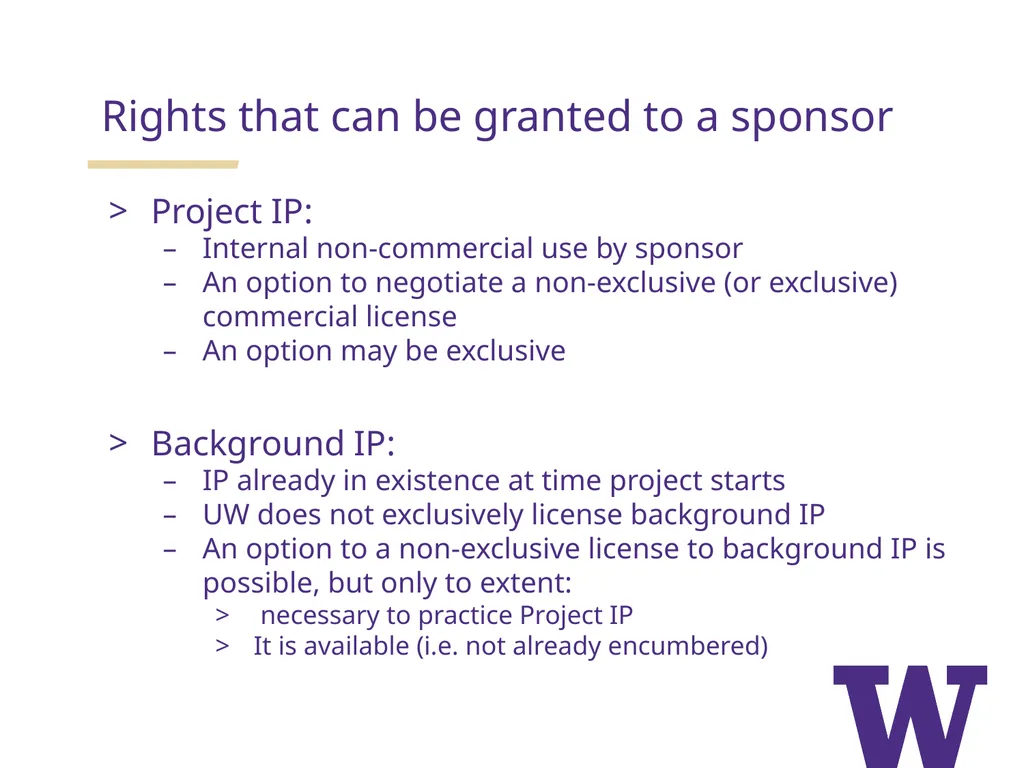
slide4. Rights that can be granted to a sponsor Project IP:
Internal non-commercial use by sponsor
An option to negotiate a non-exclusive (or exclusive) commercial license
An option may be exclusive
Background IP:
IP already in existence at time project starts
UW does not exclusively license background IP
An option to a non-exclusive license to background IP is possible, but only to extent:
necessary to practice Project IP
It is available (i.e. not already encumbered)<br>
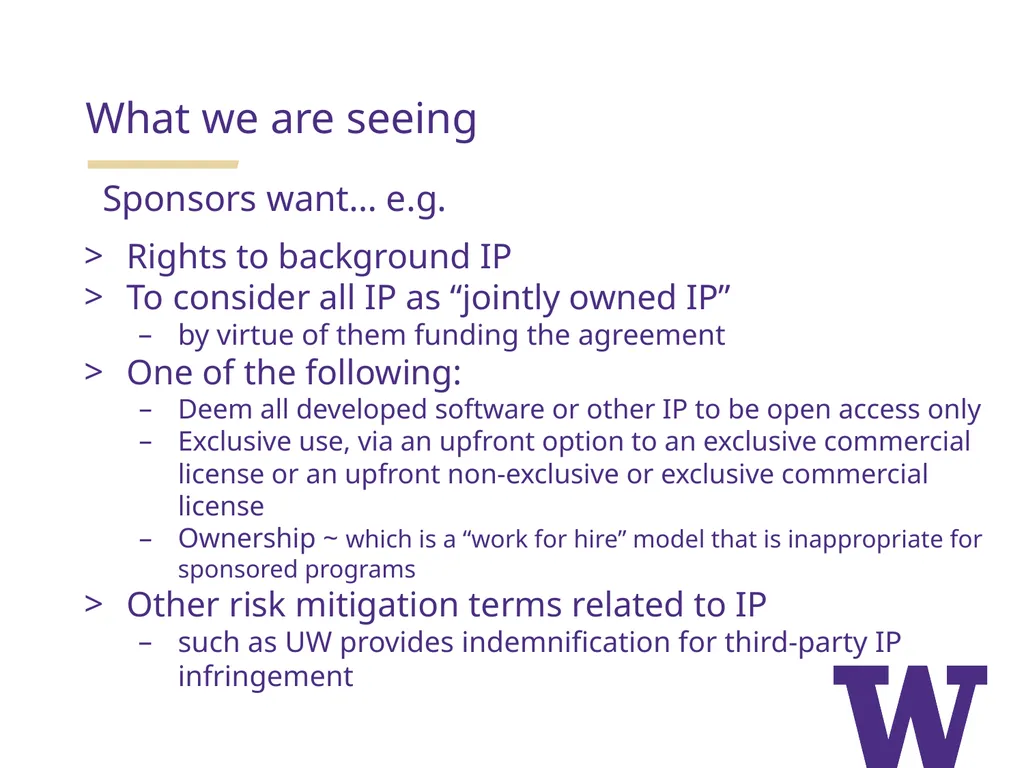
slide5. What we are seeing Rights to background IP
To consider all IP as “jointly owned IP”
by virtue of them funding the agreement
One of the following:
Deem all developed software or other IP to be open access only
Exclusive use, via an upfront option to an exclusive commercial license or an upfront non-exclusive or exclusive commercial license
Ownership ~ which is a “work for hire” model that is inappropriate for sponsored programs
Other risk mitigation terms related to IP
such as UW provides indemnification for third-party IP infringement Sponsors want… e.g.<br>
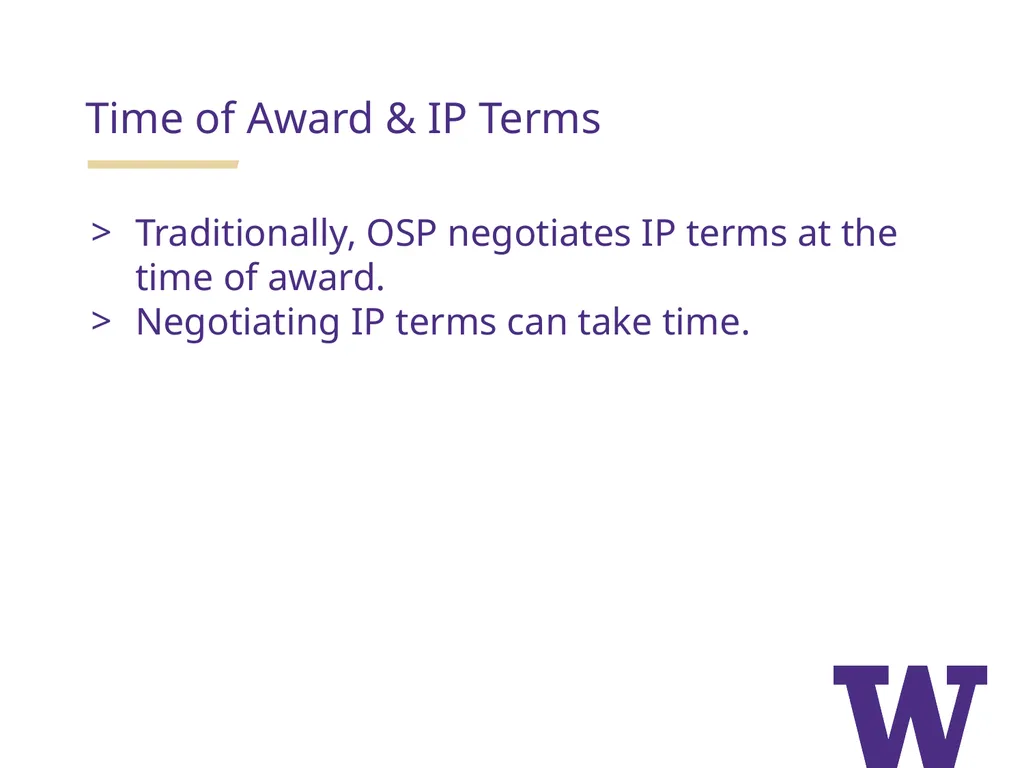
slide6. Time of Award & IP Terms Traditionally, OSP negotiates IP terms at the time of award.
Negotiating IP terms can take time.<br>
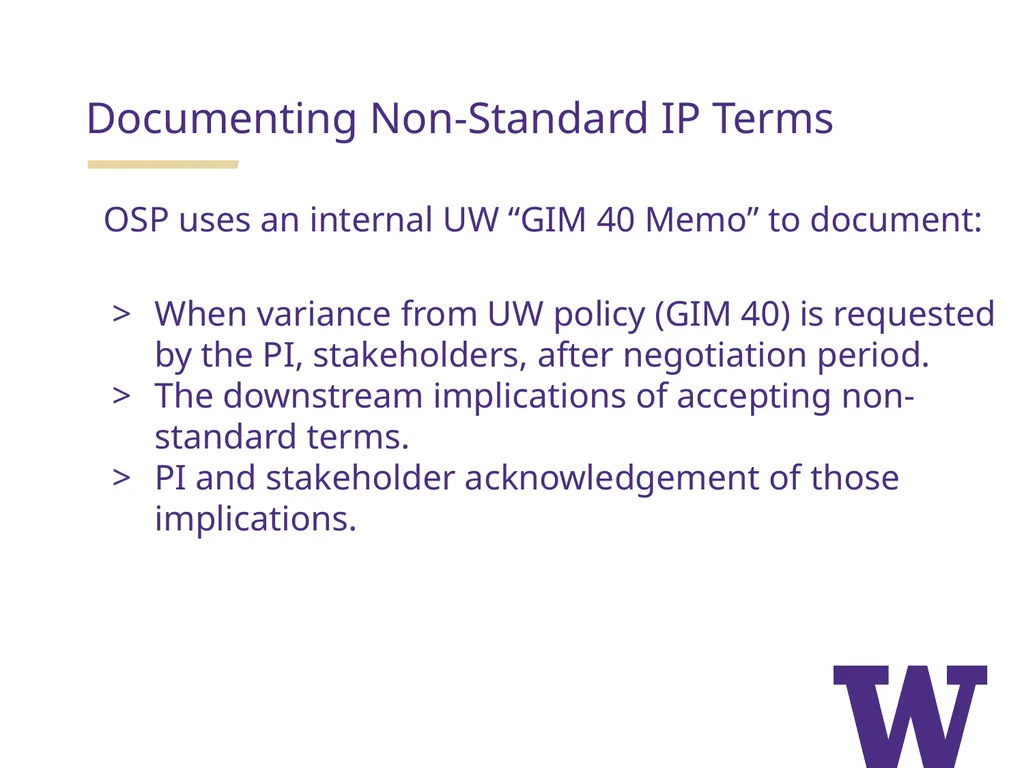
slide7. Documenting Non-Standard IP Terms OSP uses an internal UW “GIM 40 Memo” to document:
When variance from UW policy (GIM 40) is requested by the PI, stakeholders, after negotiation period.
The downstream implications of accepting non-standard terms.
PI and stakeholder acknowledgement of those implications.<br>
slide8. IP Terms at Time of Proposal Recently, OSP is seeing proposals that require agreeing to upfront IP terms to submit.
Some IP terms may not be negotiable at proposal stage:
Sponsor informs they are non-negotiable.
There isn’t time due to hard deadline.<br>
slide9. Upfront Terms at Proposal Stage OSP’s review for upfront terms & conditions (including IP terms) takes time:
Usually requires involvement of another team in OSP
May involve consulting with another office, such as Risk Services or CoMotion
DRAFT Proposals that include upfront terms and conditions, including IP terms, need to arrive in OSP at least 7 business days before a sponsor deadline to allow time for meaningful review.<br>
slide10. Results of Review After review, with adequate time, the UW may:
Be able to proceed with proposal submission with upfront terms, but only if we determine the risk can be mitigated.
In the case of IP terms, document non-standard terms, and their implications, on an internal UW GIM 40 Memo.
Acceptance of nonstandard terms must not be in conflict with the public mission of the University.
OSP maintains final decision on whether terms, including non-standard terms, are acceptable.
For more information on UW policies related to terms and conditions, see Agreement Considerations<br>
slide11. Resources and Questions EO 36 - Patent, Invention, and Copyright Policy
GIM 40 - Disposition of UW Intellectual Property in Sponsored Program Agreements
Agreement Considerations<br>
Mike Snow, Proposal and Awards Team Manager
Ari Santander, Proposal and Awards Team Manager
Office of Sponsored Programs<br>
slide2. Executive Order 36 & GIM 40 EO 36 - Patent, Invention, and Copyright Policy:
As a condition of employment, UW employees assign their interest in inventions (Intellectual Property) to the UW
Employees report all inventions and discoveries to CoMotion
Many non-federal sponsors want IP terms in sponsored research agreements.
GIM 40 - Disposition of UW Intellectual Property in Sponsored Program Agreements:
Sets out the UW’s position on IP rights in sponsored programs. EO 36 - Patent, Invention, and Copyright Policy
GIM 40 - Disposition of UW Intellectual Property in Sponsored Program Agreements<br>
slide3. GIM 40 - Disposition of UW Intellectual Property in Sponsored Program Agreements UW IP is a state asset
Disposition must be consistent with the UW’s academic and public mission
Inventions first conceived or reduced to practice during the project by UW personnel are owned by the UW
often referred to as “Project IP”
UW may grant certain rights to the sponsor, depending on the relationship, the sponsor’s participation, and other factors GIM 40 - Disposition of UW Intellectual Property in Sponsored Program Agreements<br>
slide4. Rights that can be granted to a sponsor Project IP:
Internal non-commercial use by sponsor
An option to negotiate a non-exclusive (or exclusive) commercial license
An option may be exclusive
Background IP:
IP already in existence at time project starts
UW does not exclusively license background IP
An option to a non-exclusive license to background IP is possible, but only to extent:
necessary to practice Project IP
It is available (i.e. not already encumbered)<br>
slide5. What we are seeing Rights to background IP
To consider all IP as “jointly owned IP”
by virtue of them funding the agreement
One of the following:
Deem all developed software or other IP to be open access only
Exclusive use, via an upfront option to an exclusive commercial license or an upfront non-exclusive or exclusive commercial license
Ownership ~ which is a “work for hire” model that is inappropriate for sponsored programs
Other risk mitigation terms related to IP
such as UW provides indemnification for third-party IP infringement Sponsors want… e.g.<br>
slide6. Time of Award & IP Terms Traditionally, OSP negotiates IP terms at the time of award.
Negotiating IP terms can take time.<br>
slide7. Documenting Non-Standard IP Terms OSP uses an internal UW “GIM 40 Memo” to document:
When variance from UW policy (GIM 40) is requested by the PI, stakeholders, after negotiation period.
The downstream implications of accepting non-standard terms.
PI and stakeholder acknowledgement of those implications.<br>
slide8. IP Terms at Time of Proposal Recently, OSP is seeing proposals that require agreeing to upfront IP terms to submit.
Some IP terms may not be negotiable at proposal stage:
Sponsor informs they are non-negotiable.
There isn’t time due to hard deadline.<br>
slide9. Upfront Terms at Proposal Stage OSP’s review for upfront terms & conditions (including IP terms) takes time:
Usually requires involvement of another team in OSP
May involve consulting with another office, such as Risk Services or CoMotion
DRAFT Proposals that include upfront terms and conditions, including IP terms, need to arrive in OSP at least 7 business days before a sponsor deadline to allow time for meaningful review.<br>
slide10. Results of Review After review, with adequate time, the UW may:
Be able to proceed with proposal submission with upfront terms, but only if we determine the risk can be mitigated.
In the case of IP terms, document non-standard terms, and their implications, on an internal UW GIM 40 Memo.
Acceptance of nonstandard terms must not be in conflict with the public mission of the University.
OSP maintains final decision on whether terms, including non-standard terms, are acceptable.
For more information on UW policies related to terms and conditions, see Agreement Considerations<br>
slide11. Resources and Questions EO 36 - Patent, Invention, and Copyright Policy
GIM 40 - Disposition of UW Intellectual Property in Sponsored Program Agreements
Agreement Considerations<br>