
GLAAS information module 3: GLAAS, the SDGs and


Description: GLAAS information module 3: GLAAS, the SDGs and regional monitoring initiatives GLAAS 20242025 cycle The 2030 Agenda for Sustainable Development 17 goals 169 targets 247 global indicators Goal 6: Clean water and sanitation 1 goal 8 targets
Related Topics
Download Presentation
"GLAAS information module 3: GLAAS, the SDGs and" is the property of its rightful owner. Permission is granted to download and print the materials on this website for personal, non-commercial use only, and to display it on your personal computer provided you do not modify the materials and that you retain all copyright notices contained in the materials. By downloading content from our website, you accept the terms of this agreement.
Presentation Transcript
slide1. GLAAS information module 3:
GLAAS, the SDGs and regional monitoring initiatives
GLAAS 2024/2025 cycle<br>
slide2. The 2030 Agenda for Sustainable Development 17 goals 169 targets 247 global indicators<br>
slide3. Goal 6: Clean water and sanitation 1 goal 8 targets 11 global indicators<br>
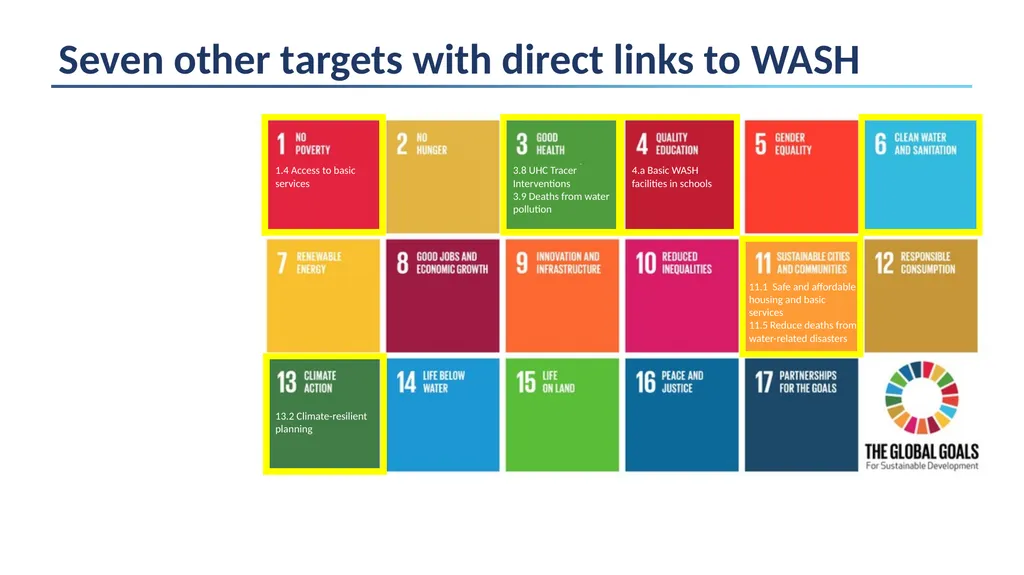
slide4. Seven other targets with direct links to WASH<br>
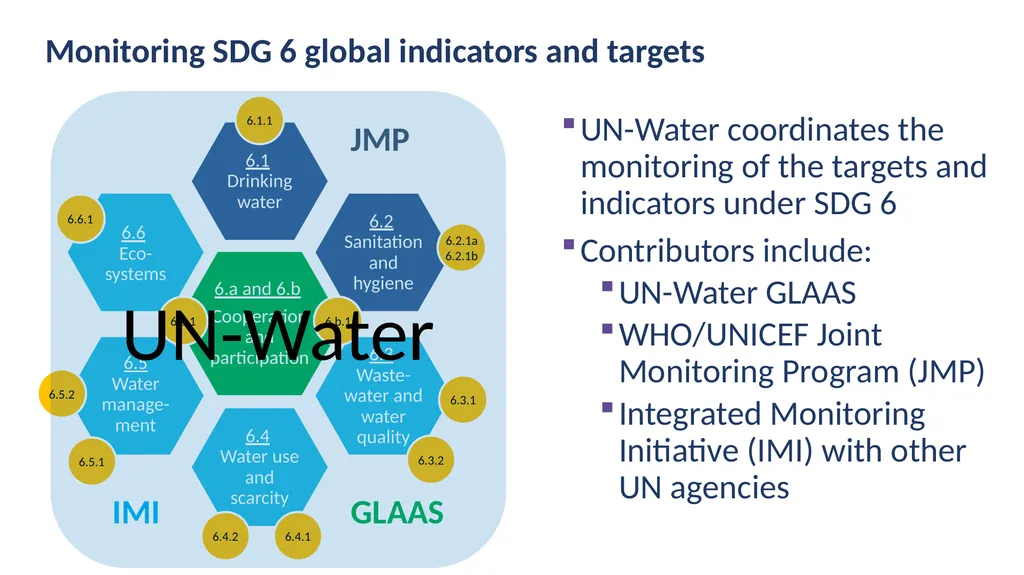
slide5. Monitoring SDG 6 global indicators and targets UN-Water coordinates the monitoring of the targets and indicators under SDG 6
Contributors include:
UN-Water GLAAS
WHO/UNICEF Joint Monitoring Program (JMP)
Integrated Monitoring Initiative (IMI) with other UN agencies JMP GLAAS IMI UN-Water<br>
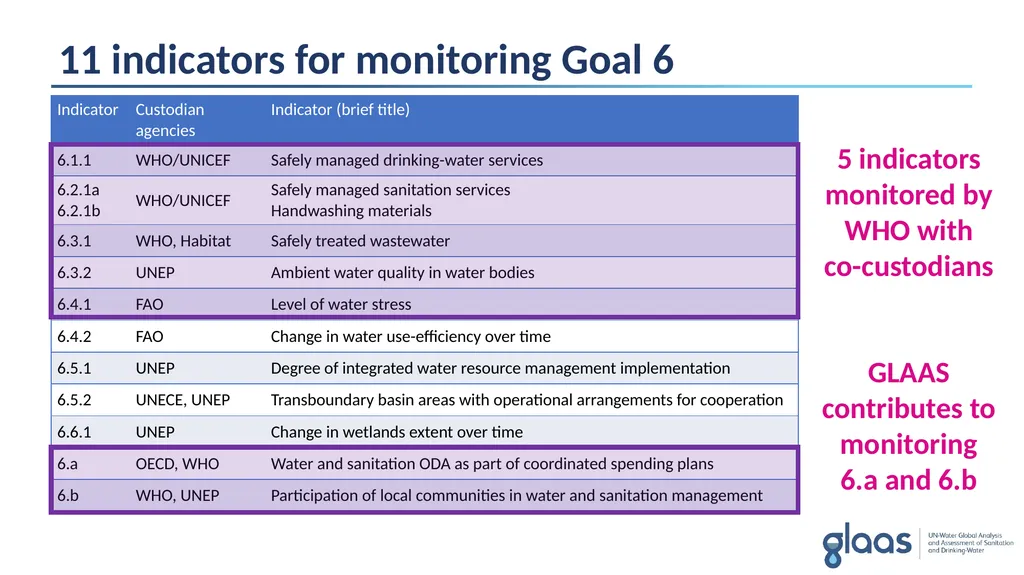
slide6. 11 indicators for monitoring Goal 6 5 indicators monitored by WHO with co-custodians GLAAS contributes to monitoring 6.a and 6.b<br>
slide7. GLAAS and SDG monitoring The GLAAS country survey contributes to monitoring 6.a and 6.b.
The GLAAS country survey covers key elements of WASH systems, such as national targets, provisions for vulnerable populations and finance, that contribute to countries making progress towards SDG 6.
Participating in GLAAS complements other SDG 6 monitoring initiatives.
The development of WASH accounts using the TrackFin methodology will also contribute to monitoring 6.a.<br>
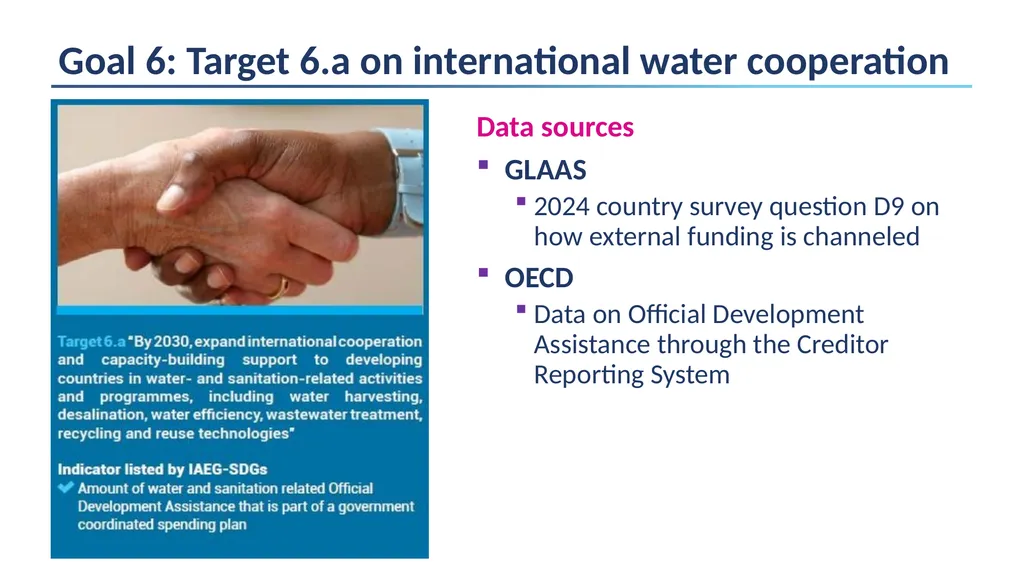
slide8. Goal 6: Target 6.a on international water cooperation Data sources
GLAAS
2024 country survey question D9 on how external funding is channeled
OECD
Data on Official Development Assistance through the Creditor Reporting System<br>
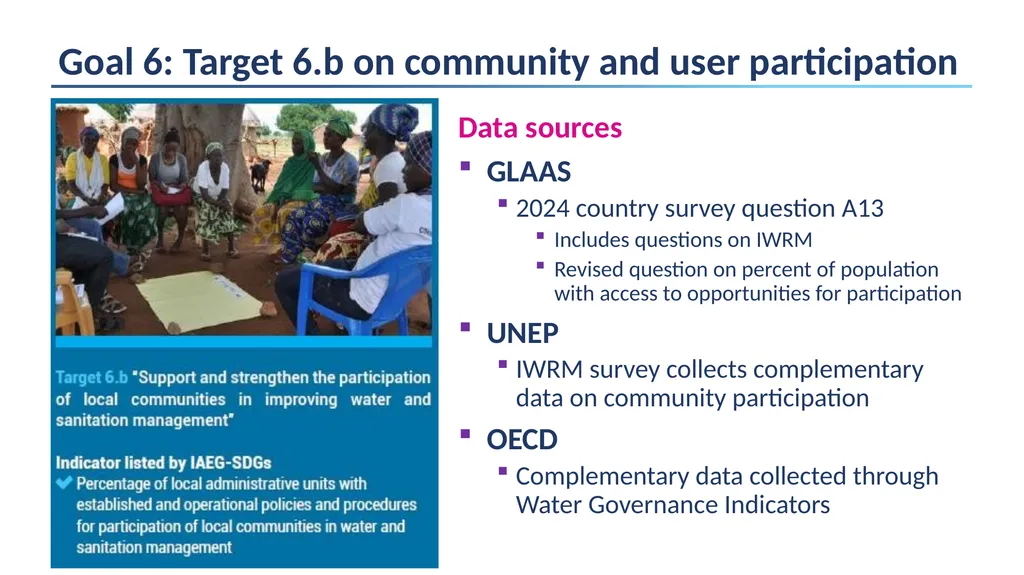
slide9. Goal 6: Target 6.b on community and user participation Data sources
GLAAS
2024 country survey question A13
Includes questions on IWRM
Revised question on percent of population with access to opportunities for participation
UNEP
IWRM survey collects complementary data on community participation
OECD
Complementary data collected through Water Governance Indicators<br>
slide10. Monitoring climate resilient WASH The GLAAS and JMP teams are working to identify indicators to monitor climate resilient WASH globally.
Questions on climate resilient WASH throughout the GLAAS 2024 survey will feed into this work.
The overall process will be:
Comprehensive, systematic, rigorous with a strong focus on measurability;
Multi-stakeholder and participatory to ensure diverse representation and inputs in both expert review and stakeholder consultation; and
Transparent with regular updates to raise awareness and build consensus among WASH sector stakeholders.
The identified indicators will be piloted in select countries before being scaled globally.
The work is expected to take place in 2024 and 2025.<br>
slide11. Core indicators for monitoring the strength of WASH systems The WASH sector is pivoting towards WASH systems strengthening rather than infrastructure-based approaches
WHO, in collaboration with partners (national, regional and global levels), is leading the development of a globally agreed set of core indicators to monitor the strength of WASH systems.
Benefits of having a globally agreed set of core indicators:
Consistent tracking of the strength of WASH systems in a country over time and across countries
Better harmonization among development partners and countries
Ultimate goal is to strengthen national monitoring and review systems and reduce reporting burden on countries
Question B2 in the GLAAS 2024 country survey on national indicators will help inform this work.<br>
slide12. Working with UNICEF to support the GLAAS cycle During the GLAAS 2024/2025 cycle, WHO and UNICEF are coming closer together to support data collection at country level and will work at all levels to disseminate findings and promote use of data.
WHO and UNICEF are core partners in supporting governments in GLAAS activities.
During the GLAAS process, it is recommended to reach out to UNICEF Country Offices and explore how best UNICEF and WHO can jointly support and facilitate GLAAS efforts.<br>
slide13. Collaboration with the Sanitation and Water for All (SWA) Partnership GLAAS is the evidence arm of the SWA partnership and provides data for the SWA results framework and helps inform SWA working groups including the systems and finance working group.
Participating in GLAAS will help with preparatory work for SWA High Level Meetings.<br>
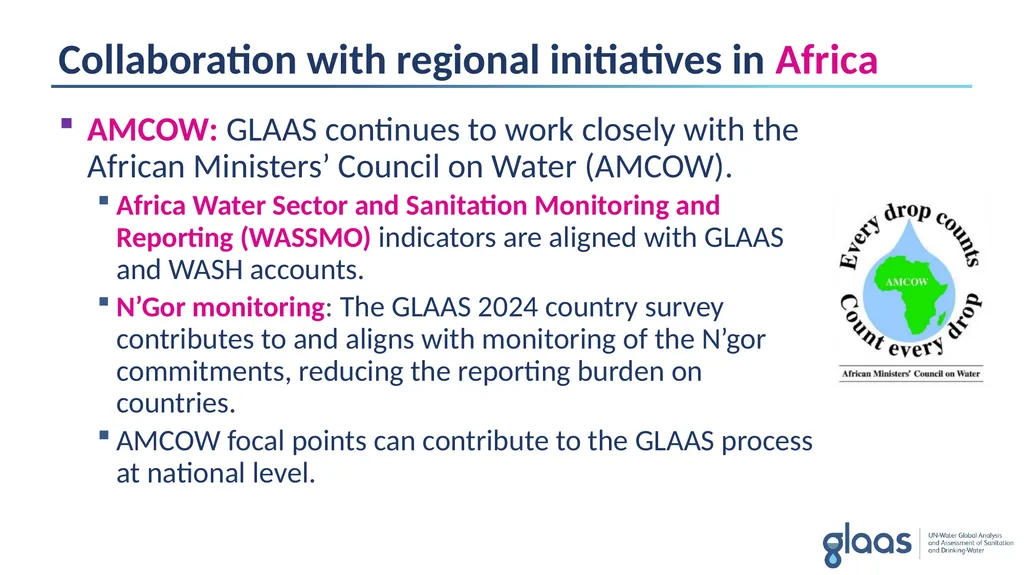
slide14. Collaboration with regional initiatives in Africa AMCOW: GLAAS continues to work closely with the African Ministers’ Council on Water (AMCOW).
Africa Water Sector and Sanitation Monitoring and Reporting (WASSMO) indicators are aligned with GLAAS and WASH accounts.
N’Gor monitoring: The GLAAS 2024 country survey contributes to and aligns with monitoring of the N’gor commitments, reducing the reporting burden on countries.
AMCOW focal points can contribute to the GLAAS process at national level.<br>
slide15. Collaboration with other regional initiatives and key partners Latin America: GLAAS findings are presented as evidence for LATINOSAN in Latin America.
South Asia: GLAAS findings have been used as part of SACOSAN in South Asia.
Europe: In Europe, GLAAS synergy with the Protocol on Water and Health supports setting baselines and identifying national targets.
Other key partners: GLAAS collaborates closely with UN-Water, the World Bank, UNEP, UNICEF, IRC, WaterAid, Water for People or other relevant partners. These partners can contribute to the GLAAS process at country level and also use GLAAS results in their work.<br>
slide2. The 2030 Agenda for Sustainable Development 17 goals 169 targets 247 global indicators<br>
slide3. Goal 6: Clean water and sanitation 1 goal 8 targets 11 global indicators<br>
slide4. Seven other targets with direct links to WASH<br>
slide5. Monitoring SDG 6 global indicators and targets UN-Water coordinates the monitoring of the targets and indicators under SDG 6
Contributors include:
UN-Water GLAAS
WHO/UNICEF Joint Monitoring Program (JMP)
Integrated Monitoring Initiative (IMI) with other UN agencies JMP GLAAS IMI UN-Water<br>
slide6. 11 indicators for monitoring Goal 6 5 indicators monitored by WHO with co-custodians GLAAS contributes to monitoring 6.a and 6.b<br>
slide7. GLAAS and SDG monitoring The GLAAS country survey contributes to monitoring 6.a and 6.b.
The GLAAS country survey covers key elements of WASH systems, such as national targets, provisions for vulnerable populations and finance, that contribute to countries making progress towards SDG 6.
Participating in GLAAS complements other SDG 6 monitoring initiatives.
The development of WASH accounts using the TrackFin methodology will also contribute to monitoring 6.a.<br>
slide8. Goal 6: Target 6.a on international water cooperation Data sources
GLAAS
2024 country survey question D9 on how external funding is channeled
OECD
Data on Official Development Assistance through the Creditor Reporting System<br>
slide9. Goal 6: Target 6.b on community and user participation Data sources
GLAAS
2024 country survey question A13
Includes questions on IWRM
Revised question on percent of population with access to opportunities for participation
UNEP
IWRM survey collects complementary data on community participation
OECD
Complementary data collected through Water Governance Indicators<br>
slide10. Monitoring climate resilient WASH The GLAAS and JMP teams are working to identify indicators to monitor climate resilient WASH globally.
Questions on climate resilient WASH throughout the GLAAS 2024 survey will feed into this work.
The overall process will be:
Comprehensive, systematic, rigorous with a strong focus on measurability;
Multi-stakeholder and participatory to ensure diverse representation and inputs in both expert review and stakeholder consultation; and
Transparent with regular updates to raise awareness and build consensus among WASH sector stakeholders.
The identified indicators will be piloted in select countries before being scaled globally.
The work is expected to take place in 2024 and 2025.<br>
slide11. Core indicators for monitoring the strength of WASH systems The WASH sector is pivoting towards WASH systems strengthening rather than infrastructure-based approaches
WHO, in collaboration with partners (national, regional and global levels), is leading the development of a globally agreed set of core indicators to monitor the strength of WASH systems.
Benefits of having a globally agreed set of core indicators:
Consistent tracking of the strength of WASH systems in a country over time and across countries
Better harmonization among development partners and countries
Ultimate goal is to strengthen national monitoring and review systems and reduce reporting burden on countries
Question B2 in the GLAAS 2024 country survey on national indicators will help inform this work.<br>
slide12. Working with UNICEF to support the GLAAS cycle During the GLAAS 2024/2025 cycle, WHO and UNICEF are coming closer together to support data collection at country level and will work at all levels to disseminate findings and promote use of data.
WHO and UNICEF are core partners in supporting governments in GLAAS activities.
During the GLAAS process, it is recommended to reach out to UNICEF Country Offices and explore how best UNICEF and WHO can jointly support and facilitate GLAAS efforts.<br>
slide13. Collaboration with the Sanitation and Water for All (SWA) Partnership GLAAS is the evidence arm of the SWA partnership and provides data for the SWA results framework and helps inform SWA working groups including the systems and finance working group.
Participating in GLAAS will help with preparatory work for SWA High Level Meetings.<br>
slide14. Collaboration with regional initiatives in Africa AMCOW: GLAAS continues to work closely with the African Ministers’ Council on Water (AMCOW).
Africa Water Sector and Sanitation Monitoring and Reporting (WASSMO) indicators are aligned with GLAAS and WASH accounts.
N’Gor monitoring: The GLAAS 2024 country survey contributes to and aligns with monitoring of the N’gor commitments, reducing the reporting burden on countries.
AMCOW focal points can contribute to the GLAAS process at national level.<br>
slide15. Collaboration with other regional initiatives and key partners Latin America: GLAAS findings are presented as evidence for LATINOSAN in Latin America.
South Asia: GLAAS findings have been used as part of SACOSAN in South Asia.
Europe: In Europe, GLAAS synergy with the Protocol on Water and Health supports setting baselines and identifying national targets.
Other key partners: GLAAS collaborates closely with UN-Water, the World Bank, UNEP, UNICEF, IRC, WaterAid, Water for People or other relevant partners. These partners can contribute to the GLAAS process at country level and also use GLAAS results in their work.<br>