
Global Education: Some Leadership Challenges Dr.
MJ
Published · 28 slides · 0 views

1 / 1
Description
Global Education: Some Leadership Challenges Dr. Laurence Peters My aim in this book is to move beyond the notion that global education is an optional extra in the curriculum. Our aim as educators is to ensure that the entire school
Related Topics
Share
Embed code
Download this presentation From Below
"Global Education: Some Leadership Challenges Dr." is the property of its rightful owner. Permission is granted to download and print the materials on this website for personal, non-commercial use only, and to display it on your personal computer provided you do not modify the materials and that you retain all copyright notices contained in the materials. By downloading content from our website, you accept the terms of this agreement.
Presentation Transcript
01
Global Education:
Some Leadership Challenges Dr. Laurence Peters<br>
Some Leadership Challenges Dr. Laurence Peters<br>
02
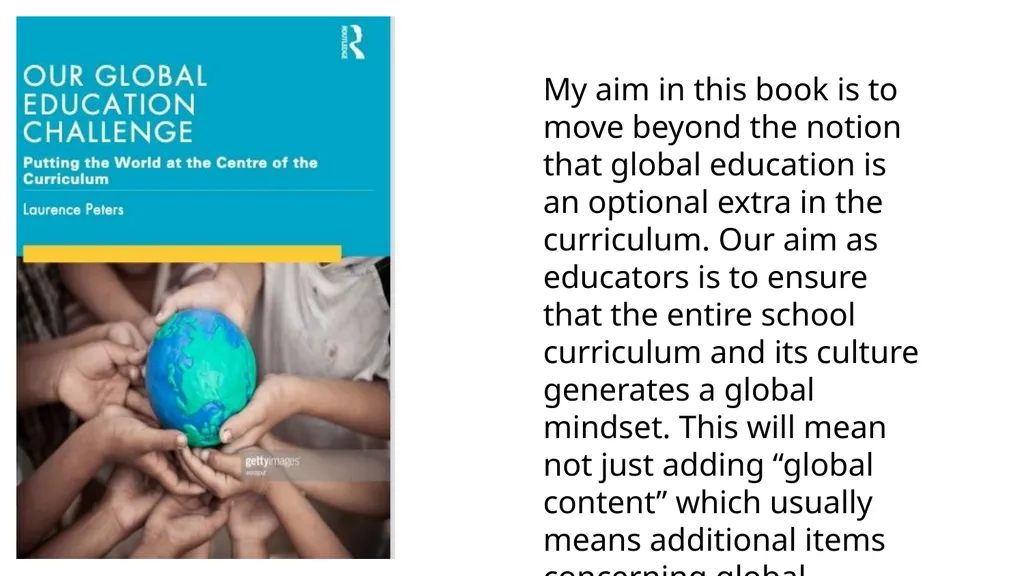
My aim in this book is to move beyond the notion that global education is an optional extra in the curriculum. Our aim as educators is to ensure that the entire school curriculum and its culture generates a global mindset. This will mean not just adding “global content” which usually means additional items concerning global warming and pandemics but to ensure that we incorporate multi perspectives into a question centric rather than an answer centric curriculum.<br>
03
What does this have to do with Global Competency? Appadurai argues that, from the point of view of any particular individual, these flows of people, money, etc. feel like stable landscapes . They are the "building blocks" that individuals and groups use to create the "imagined worlds" that they use to make sense of their lives .
In fact, however, these worlds are in constant flux; they are the products of 24/7 flows with unprecedented scope and range affecting us all.
This is also the world our students inhabit and not well represented in the curriculum that still relies on the old stories and as PISA results seem to suggest not relevant to their lives.<br>
In fact, however, these worlds are in constant flux; they are the products of 24/7 flows with unprecedented scope and range affecting us all.
This is also the world our students inhabit and not well represented in the curriculum that still relies on the old stories and as PISA results seem to suggest not relevant to their lives.<br>
04
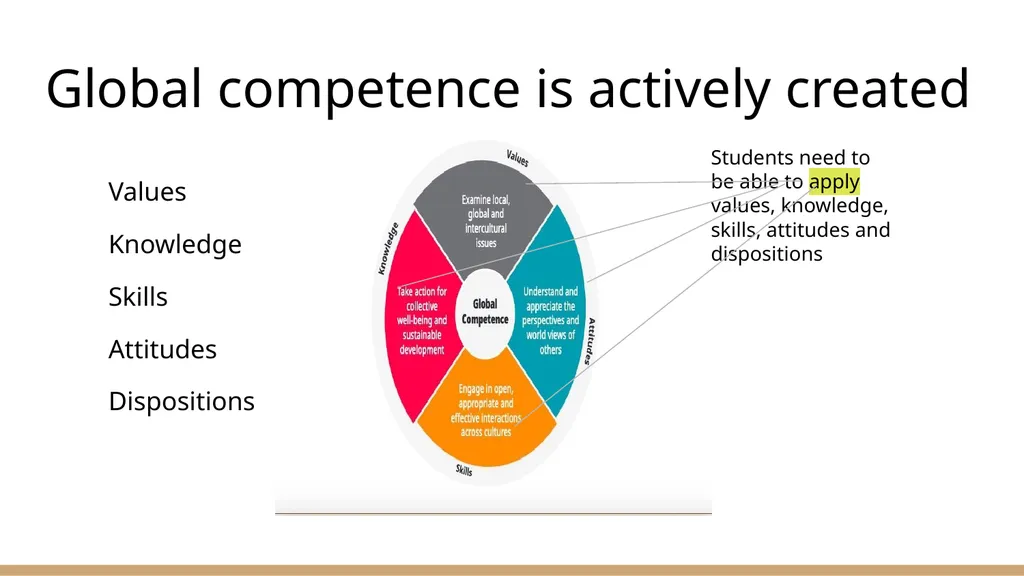
Global Competence Defined (PISA 2018) As defined in is composed of four highly interdependent dimension, the capacity depends on human interaction not the abilities of a single teacher:
To examine issues and situations of local, global and cultural significance (e.g. poverty, economic interdependence,migration, inequality, environmental risks, conflicts, cultural differences and stereotypes)
To understand and appreciate different perspectives and worldviews
To establish positive interactions with people of different national, ethnic, religious, social or cultural backgrounds or gender
Disposition to take constructive action towards sustainable development and collective well-being.<br>
To examine issues and situations of local, global and cultural significance (e.g. poverty, economic interdependence,migration, inequality, environmental risks, conflicts, cultural differences and stereotypes)
To understand and appreciate different perspectives and worldviews
To establish positive interactions with people of different national, ethnic, religious, social or cultural backgrounds or gender
Disposition to take constructive action towards sustainable development and collective well-being.<br>
05
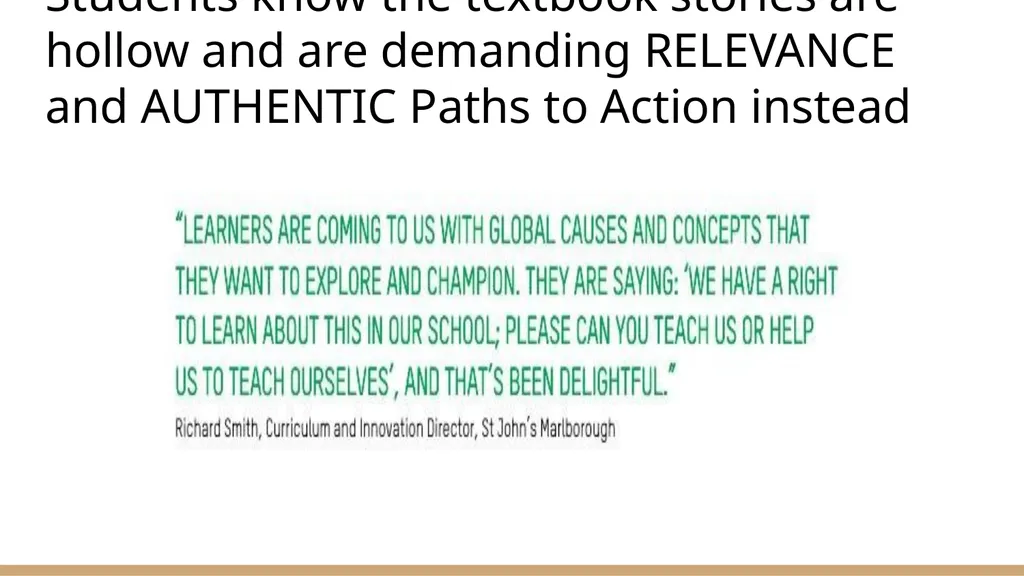
Students know the textbook stories are hollow and are demanding RELEVANCE and AUTHENTIC Paths to Action instead<br>
06
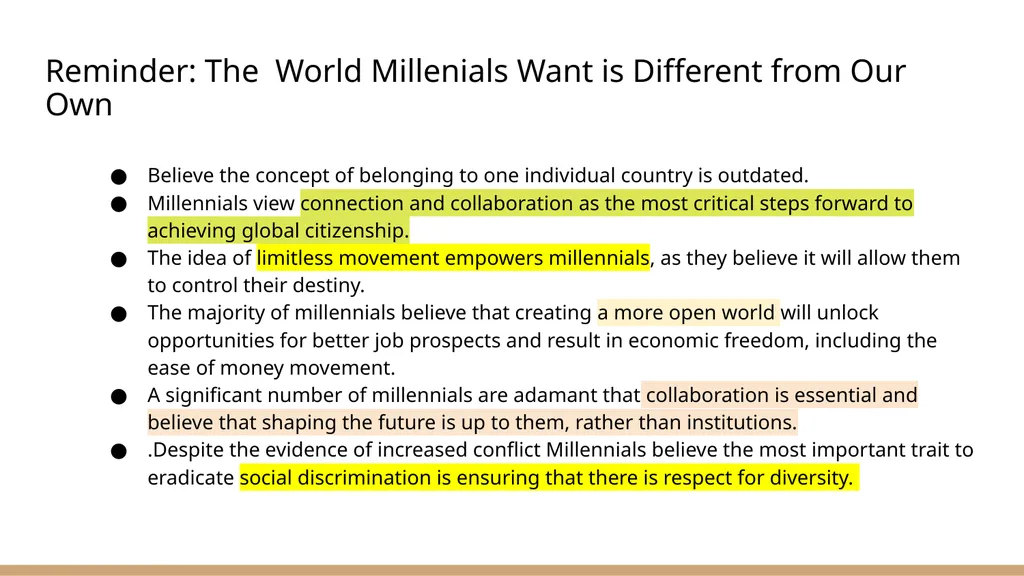
Reminder: The World Millenials Want is Different from Our Own Believe the concept of belonging to one individual country is outdated.
Millennials view connection and collaboration as the most critical steps forward to achieving global citizenship.
The idea of limitless movement empowers millennials, as they believe it will allow them to control their destiny.
The majority of millennials believe that creating a more open world will unlock opportunities for better job prospects and result in economic freedom, including the ease of money movement.
A significant number of millennials are adamant that collaboration is essential and believe that shaping the future is up to them, rather than institutions.
.Despite the evidence of increased conflict Millennials believe the most important trait to eradicate social discrimination is ensuring that there is respect for diversity.<br>
Millennials view connection and collaboration as the most critical steps forward to achieving global citizenship.
The idea of limitless movement empowers millennials, as they believe it will allow them to control their destiny.
The majority of millennials believe that creating a more open world will unlock opportunities for better job prospects and result in economic freedom, including the ease of money movement.
A significant number of millennials are adamant that collaboration is essential and believe that shaping the future is up to them, rather than institutions.
.Despite the evidence of increased conflict Millennials believe the most important trait to eradicate social discrimination is ensuring that there is respect for diversity.<br>
07
Global competence is actively created Values
Knowledge
Skills
Attitudes
Dispositions Students need to be able to apply values, knowledge, skills, attitudes and dispositions<br>
Knowledge
Skills
Attitudes
Dispositions Students need to be able to apply values, knowledge, skills, attitudes and dispositions<br>
08
Global Competence is a Developmentally Fluid Process Global competence is not a specific skill, but rather a combination of knowledge, skills, attitudes and values successfully applied both in face-to-face, virtual or mediated encounters with people who are perceived to be from a different cultural background and in individuals’ engagement with global issues (i.e. situations that require an individual to reflect upon problems that know no national borders and that have deep implications for current and future generations).
Acquiring the necessary knowledge,skills, attitudes and values is a life-long process; there is no single point at which an individual becomes completely competent in this domain. PISA assesses where 15-year-old students are situated in this process and whether their schools are effective in helping them to develop the necessary knowledge, skills and dispositions.<br>
Acquiring the necessary knowledge,skills, attitudes and values is a life-long process; there is no single point at which an individual becomes completely competent in this domain. PISA assesses where 15-year-old students are situated in this process and whether their schools are effective in helping them to develop the necessary knowledge, skills and dispositions.<br>
09
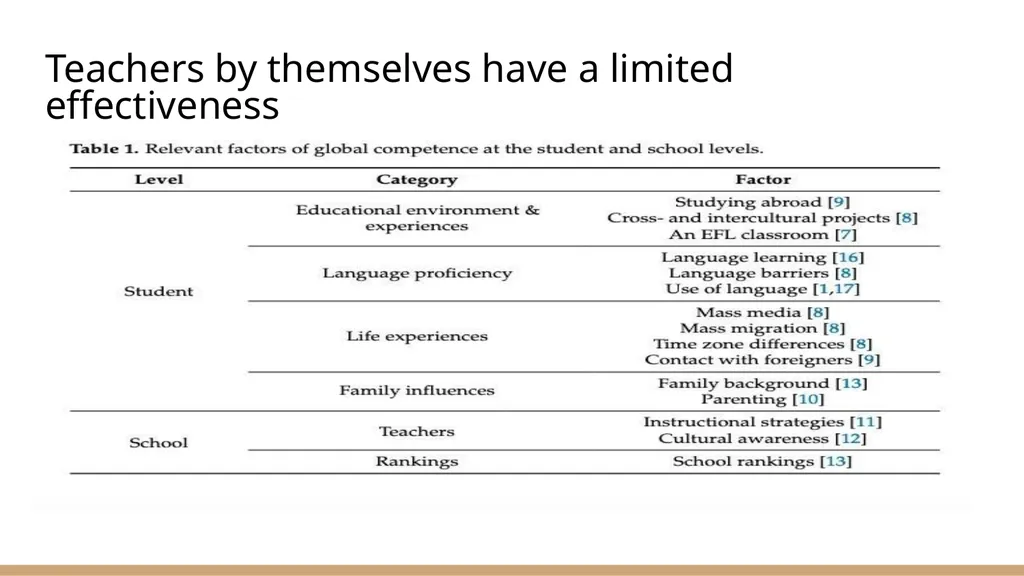
Teachers by themselves have a limited effectiveness<br>
10
Results Students who reported having contact with people or individuals from a culture different than their own, including at or through school, performed higher in numerous aspects of global competence.
These students reported having higher levels of interest in learning about and respect for other cultures, and perhaps more importantly performed higher on skills assessment of cognitive adaptability (the ability to adapt their thinking and behavior to new and challenging situations) and perspective-taking.<br>
These students reported having higher levels of interest in learning about and respect for other cultures, and perhaps more importantly performed higher on skills assessment of cognitive adaptability (the ability to adapt their thinking and behavior to new and challenging situations) and perspective-taking.<br>
11
Human Connections Overcomes Curriculum Student variables were markedly more important than the school variables.
Apart from the variable “intercultural attitudes of teachers” the most significant school variable was “school with visiting teachers from other countries” (SC159Q01HA) (ranked 10th), and “multicultural/intercultural education practices at school” (SC165Q) (ranked 15th).
In particular, the school factor “intercultural attitudes of teachers” (ST223Q) ranked in the top three<br>
Apart from the variable “intercultural attitudes of teachers” the most significant school variable was “school with visiting teachers from other countries” (SC159Q01HA) (ranked 10th), and “multicultural/intercultural education practices at school” (SC165Q) (ranked 15th).
In particular, the school factor “intercultural attitudes of teachers” (ST223Q) ranked in the top three<br>
12
Whole School Wide Approaches Needed Students need to see global values modeled in their lives,
Many school mission statements nod symbolically to prepare students for a global future but school leaders must translate these wishes and hopes to infusing the school culture.
Some Examples:
The development of a globally aware student newspaper,
School and community wide projects that are global in nature
Visitors from other countries welcomed on a regular basis
Regular discussions and debates about world issues<br>
Many school mission statements nod symbolically to prepare students for a global future but school leaders must translate these wishes and hopes to infusing the school culture.
Some Examples:
The development of a globally aware student newspaper,
School and community wide projects that are global in nature
Visitors from other countries welcomed on a regular basis
Regular discussions and debates about world issues<br>
13
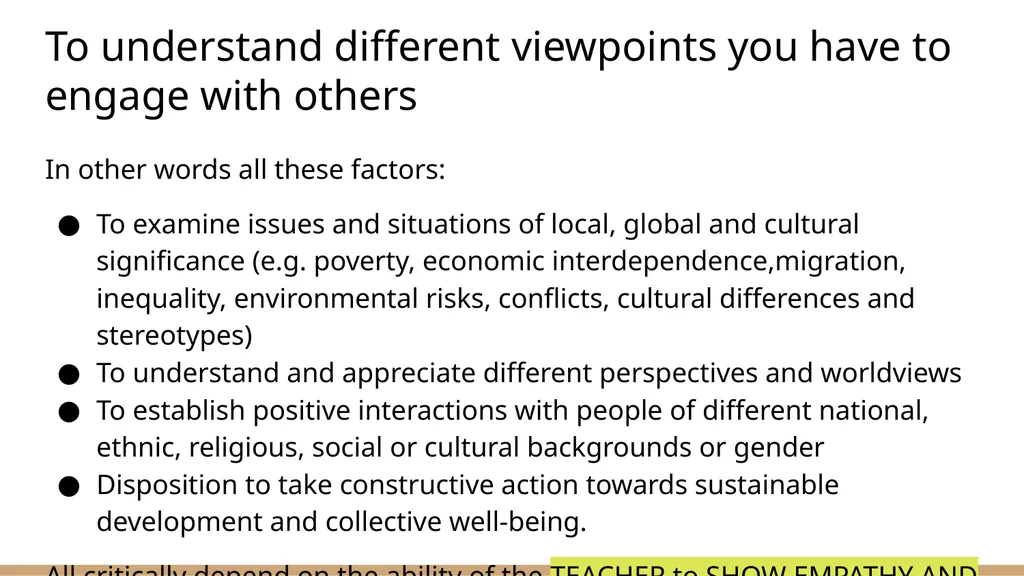
To understand different viewpoints you have to engage with others In other words all these factors:
To examine issues and situations of local, global and cultural significance (e.g. poverty, economic interdependence,migration, inequality, environmental risks, conflicts, cultural differences and stereotypes)
To understand and appreciate different perspectives and worldviews
To establish positive interactions with people of different national, ethnic, religious, social or cultural backgrounds or gender
Disposition to take constructive action towards sustainable development and collective well-being.
All critically depend on the ability of the TEACHER to SHOW EMPATHY AND CONNECTIONS WITH THOSE FROM OTHER CULTURES NOT FOR SYMBOLIC PURPOSES (food festivals etc) but involve real collaborations.<br>
To examine issues and situations of local, global and cultural significance (e.g. poverty, economic interdependence,migration, inequality, environmental risks, conflicts, cultural differences and stereotypes)
To understand and appreciate different perspectives and worldviews
To establish positive interactions with people of different national, ethnic, religious, social or cultural backgrounds or gender
Disposition to take constructive action towards sustainable development and collective well-being.
All critically depend on the ability of the TEACHER to SHOW EMPATHY AND CONNECTIONS WITH THOSE FROM OTHER CULTURES NOT FOR SYMBOLIC PURPOSES (food festivals etc) but involve real collaborations.<br>
14
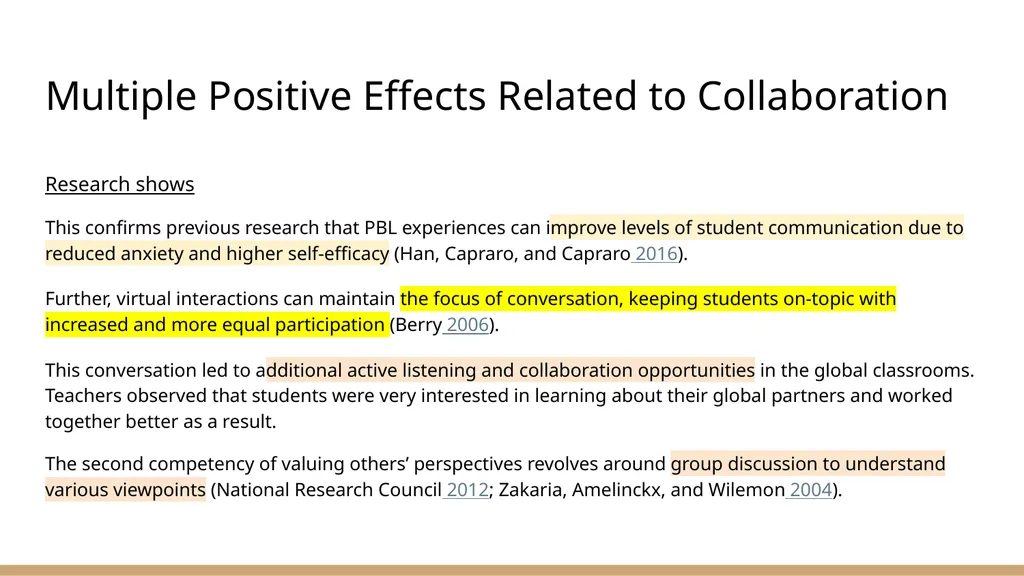
Multiple Positive Effects Related to Collaboration Research shows
This confirms previous research that PBL experiences can improve levels of student communication due to reduced anxiety and higher self-efficacy (Han, Capraro, and Capraro 2016).
Further, virtual interactions can maintain the focus of conversation, keeping students on-topic with increased and more equal participation (Berry 2006).
This conversation led to additional active listening and collaboration opportunities in the global classrooms. Teachers observed that students were very interested in learning about their global partners and worked together better as a result.
The second competency of valuing others’ perspectives revolves around group discussion to understand various viewpoints (National Research Council 2012; Zakaria, Amelinckx, and Wilemon 2004).<br>
This confirms previous research that PBL experiences can improve levels of student communication due to reduced anxiety and higher self-efficacy (Han, Capraro, and Capraro 2016).
Further, virtual interactions can maintain the focus of conversation, keeping students on-topic with increased and more equal participation (Berry 2006).
This conversation led to additional active listening and collaboration opportunities in the global classrooms. Teachers observed that students were very interested in learning about their global partners and worked together better as a result.
The second competency of valuing others’ perspectives revolves around group discussion to understand various viewpoints (National Research Council 2012; Zakaria, Amelinckx, and Wilemon 2004).<br>
15
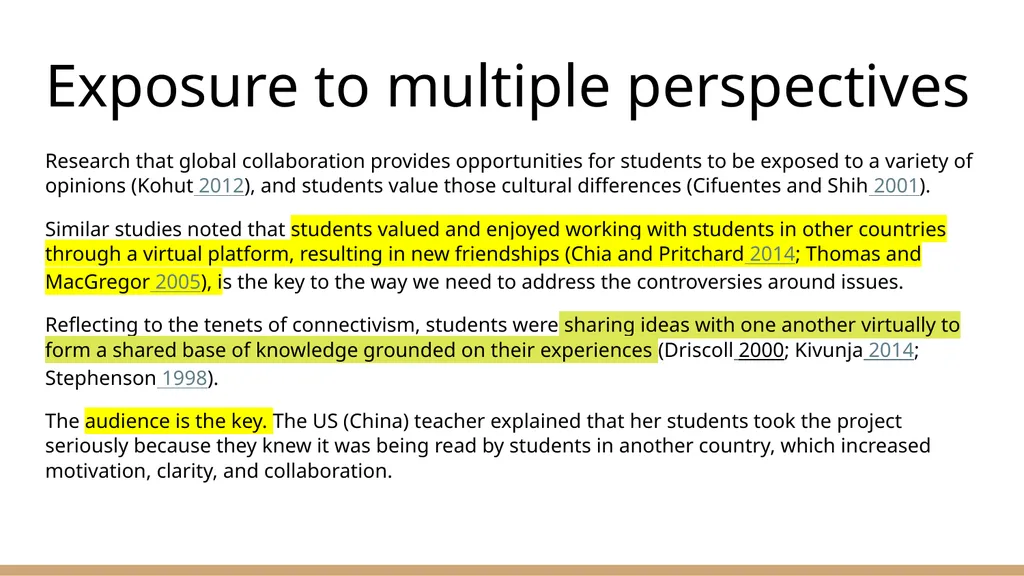
Exposure to multiple perspectives Research that global collaboration provides opportunities for students to be exposed to a variety of opinions (Kohut 2012), and students value those cultural differences (Cifuentes and Shih 2001).
Similar studies noted that students valued and enjoyed working with students in other countries through a virtual platform, resulting in new friendships (Chia and Pritchard 2014; Thomas and MacGregor 2005), is the key to the way we need to address the controversies around issues.
Reflecting to the tenets of connectivism, students were sharing ideas with one another virtually to form a shared base of knowledge grounded on their experiences (Driscoll 2000; Kivunja 2014; Stephenson 1998).
The audience is the key. The US (China) teacher explained that her students took the project seriously because they knew it was being read by students in another country, which increased motivation, clarity, and collaboration.<br>
Similar studies noted that students valued and enjoyed working with students in other countries through a virtual platform, resulting in new friendships (Chia and Pritchard 2014; Thomas and MacGregor 2005), is the key to the way we need to address the controversies around issues.
Reflecting to the tenets of connectivism, students were sharing ideas with one another virtually to form a shared base of knowledge grounded on their experiences (Driscoll 2000; Kivunja 2014; Stephenson 1998).
The audience is the key. The US (China) teacher explained that her students took the project seriously because they knew it was being read by students in another country, which increased motivation, clarity, and collaboration.<br>
16
Collaborative work Helps Develop Listening skills Students should be reaffirmed in the understanding that most of us want the same things, healthy lives, healthy children, clean water etc. Where we differ sometimes is in the means.
Through collaborative activities students should be trained in understanding others and discover through their precise questions how we go about that.
This will help not to demonize those who hold other views and to carefully listen to others
If the students are engaged in a common project the outcomes will be of higher quality<br>
Through collaborative activities students should be trained in understanding others and discover through their precise questions how we go about that.
This will help not to demonize those who hold other views and to carefully listen to others
If the students are engaged in a common project the outcomes will be of higher quality<br>
17
The Future of Global Overview
The Importance of an Authentic Mission Statement
Schools as a Moral Microcosm
Fernando Reimers vision for schools to embrace a global mindset<br>
The Importance of an Authentic Mission Statement
Schools as a Moral Microcosm
Fernando Reimers vision for schools to embrace a global mindset<br>
18
Mission Statements-Not just a mantra to hang on the wall A mission statement is not useful if it just sits in a metaphorical attic gathering dust. It must be continually discussed and critiqued against current affairs as well as lived out in the practice and instruction of teachers.<br>
19
Schools represent a moral microcosm of the globe “Schools, in particular, are places where human dignity takes on a concrete meaning, because every student deserves equal justice, equal opportunity and equal dignity.” OECD<br>
20
A word about human dignity “Today, no walls can separate humanitarian or human rights crises in one part of the world from national security crises in another. What begins with the failure to uphold the dignity of one life all too often ends with a calamity for entire nations.” – Kofi Annan
It is a connecting thread--for key topics such as--colonialism, slavery, wars. Every graduating student should know the truth of Kofi Annan’s statement and how it applies to world history, current affairs and their own lives.<br>
It is a connecting thread--for key topics such as--colonialism, slavery, wars. Every graduating student should know the truth of Kofi Annan’s statement and how it applies to world history, current affairs and their own lives.<br>
21
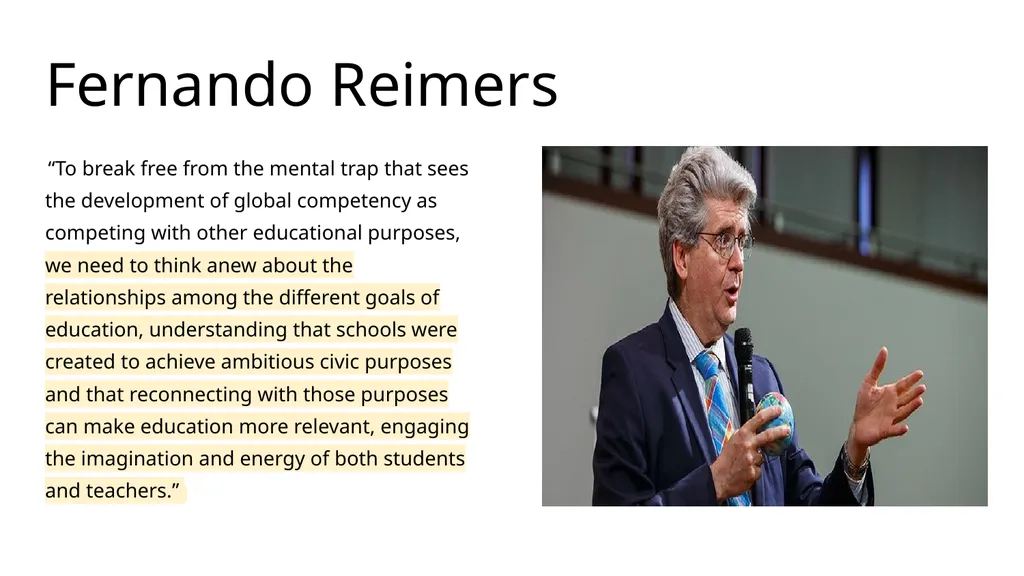
Fernando Reimers “To break free from the mental trap that sees the development of global competency as competing with other educational purposes, we need to think anew about the relationships among the different goals of education, understanding that schools were created to achieve ambitious civic purposes and that reconnecting with those purposes can make education more relevant, engaging the imagination and energy of both students and teachers.”<br>
22
Global Mindset Helps to Address Controversies Controversy is now common in education, Critical Race Theory-LGBTQ rights
The ability to thrive in an interconnected world requires engaging with controversial issues. Schools can provide a space in which students can explore complex and controversial global or intercultural issues that they encounter through the media and in their own experiences if they remember that the job of the teacher is to help students develop questions and critical abilities.<br>
The ability to thrive in an interconnected world requires engaging with controversial issues. Schools can provide a space in which students can explore complex and controversial global or intercultural issues that they encounter through the media and in their own experiences if they remember that the job of the teacher is to help students develop questions and critical abilities.<br>
23
Reimers’ Leadership Challenge Culture is upholding our core global values in everything we do. It is there in every classroom discussion; when you are working on a project; when you are walking the hall and how you treat faculty, students and visitors.
So here’s the challenge:
You can either consciously shape what values get included in your culture, or you can accept whatever makes it into your culture via osmosis.
So I go back to my original question: what actions are you taking to consciously shape your culture so that you embrace global understanding and awareness ?<br>
So here’s the challenge:
You can either consciously shape what values get included in your culture, or you can accept whatever makes it into your culture via osmosis.
So I go back to my original question: what actions are you taking to consciously shape your culture so that you embrace global understanding and awareness ?<br>
24
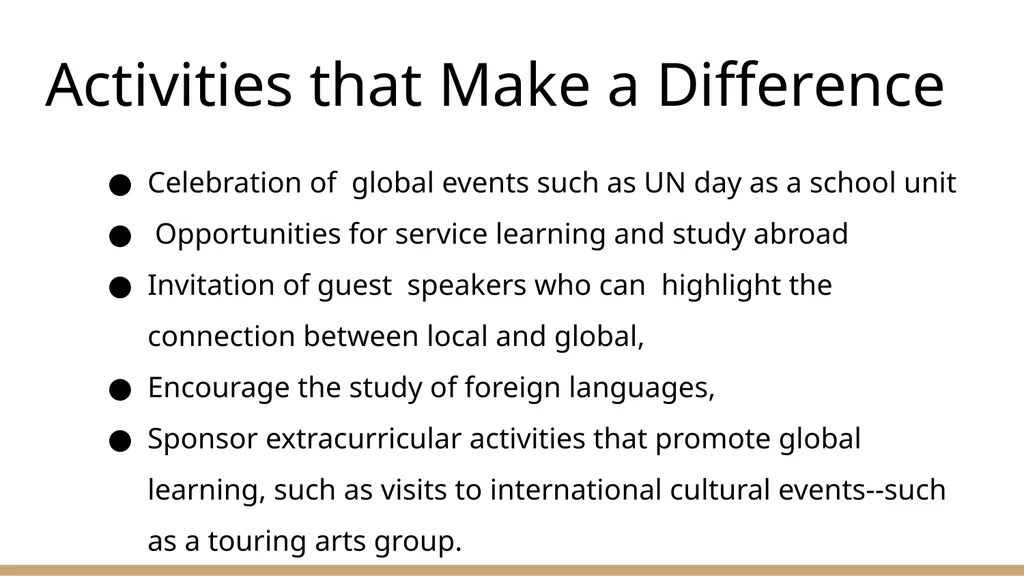
Activities that Make a Difference Celebration of global events such as UN day as a school unit
Opportunities for service learning and study abroad
Invitation of guest speakers who can highlight the connection between local and global,
Encourage the study of foreign languages,
Sponsor extracurricular activities that promote global learning, such as visits to international cultural events--such as a touring arts group.<br>
Opportunities for service learning and study abroad
Invitation of guest speakers who can highlight the connection between local and global,
Encourage the study of foreign languages,
Sponsor extracurricular activities that promote global learning, such as visits to international cultural events--such as a touring arts group.<br>
25
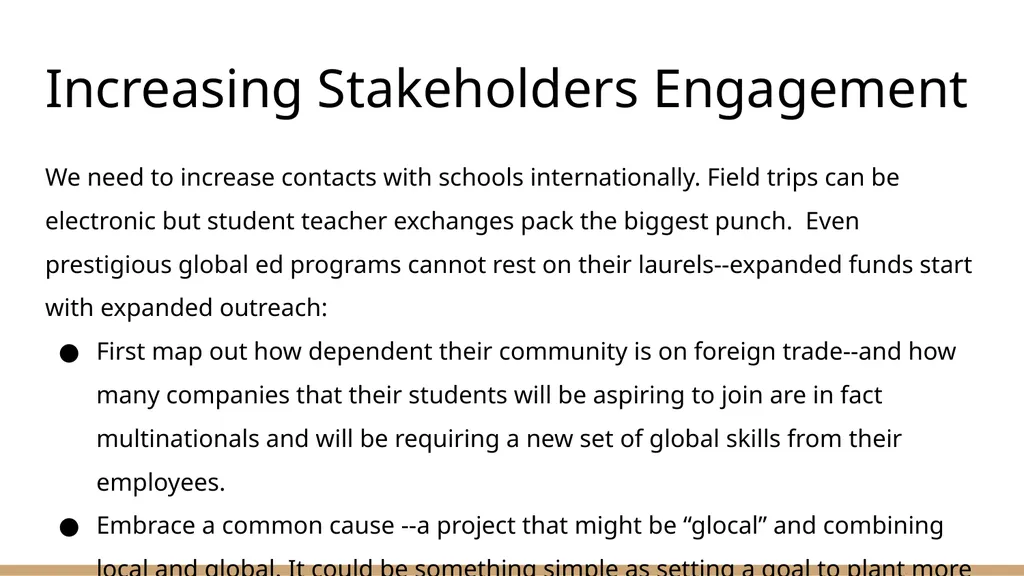
Increasing Stakeholders Engagement We need to increase contacts with schools internationally. Field trips can be electronic but student teacher exchanges pack the biggest punch. Even prestigious global ed programs cannot rest on their laurels--expanded funds start with expanded outreach:
First map out how dependent their community is on foreign trade--and how many companies that their students will be aspiring to join are in fact multinationals and will be requiring a new set of global skills from their employees.
Embrace a common cause --a project that might be “glocal” and combining local and global. It could be something simple as setting a goal to plant more trees to designing sustainable energy policies for the school and community that would include more carpooling, less use of single use plastic and even growing our own vegetables.
Adopt a family from a country with serious refugee issues (Afghanistan, Syria Ukraine etc)<br>
First map out how dependent their community is on foreign trade--and how many companies that their students will be aspiring to join are in fact multinationals and will be requiring a new set of global skills from their employees.
Embrace a common cause --a project that might be “glocal” and combining local and global. It could be something simple as setting a goal to plant more trees to designing sustainable energy policies for the school and community that would include more carpooling, less use of single use plastic and even growing our own vegetables.
Adopt a family from a country with serious refugee issues (Afghanistan, Syria Ukraine etc)<br>
26
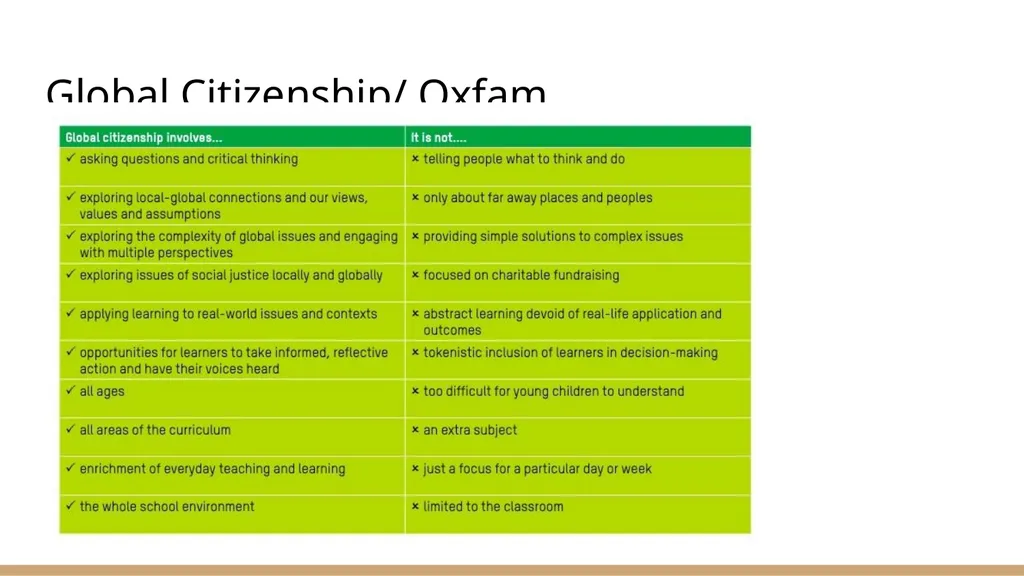
Global Citizenship/ Oxfam<br>
27
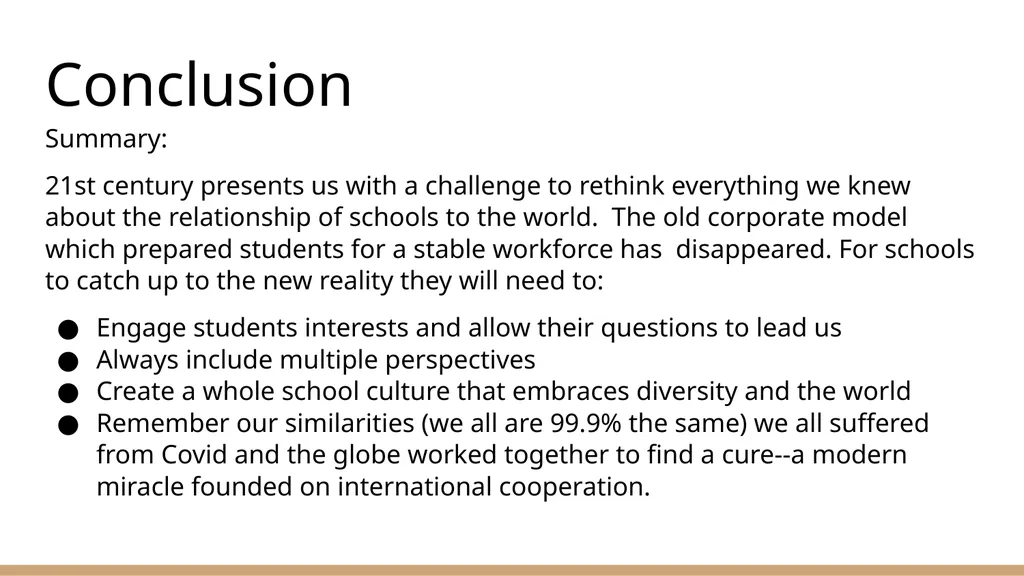
Conclusion Summary:
21st century presents us with a challenge to rethink everything we knew about the relationship of schools to the world. The old corporate model which prepared students for a stable workforce has disappeared. For schools to catch up to the new reality they will need to:
Engage students interests and allow their questions to lead us
Always include multiple perspectives
Create a whole school culture that embraces diversity and the world
Remember our similarities (we all are 99.9% the same) we all suffered from Covid and the globe worked together to find a cure--a modern miracle founded on international cooperation.<br>
21st century presents us with a challenge to rethink everything we knew about the relationship of schools to the world. The old corporate model which prepared students for a stable workforce has disappeared. For schools to catch up to the new reality they will need to:
Engage students interests and allow their questions to lead us
Always include multiple perspectives
Create a whole school culture that embraces diversity and the world
Remember our similarities (we all are 99.9% the same) we all suffered from Covid and the globe worked together to find a cure--a modern miracle founded on international cooperation.<br>