Global health labour migration: gender, global governance, social policy Nicola Yeates Professor of Social Policy, Open University Gender and Social Policy IKD seminar, Walton Hall, 30th October 2019 Nicola Yeates, Open University, 30
Related Topics
Share
Embed code
Download this presentation From Below
"Global health labour migration: gender, global" is the property of its rightful owner. Permission is granted to
download and print the materials on this website for personal, non-commercial use only, and to display it
on your personal computer provided you do not modify the materials and that you retain all copyright
notices contained in the materials. By downloading content from our website, you accept the terms of this
agreement.
Presentation Transcript
01
Global health labour migration: gender, global governance, social policy Nicola Yeates
Professor of Social Policy, Open University
Gender and Social Policy IKD seminar, Walton Hall, 30th October 2019 Nicola Yeates, Open University, 30 October 2019<br>
02
Nicola Yeates, Open University, 30 October 2019<br>
03
No health without a workforce Nicola Yeates, Open University, 30 October 2019<br>
04
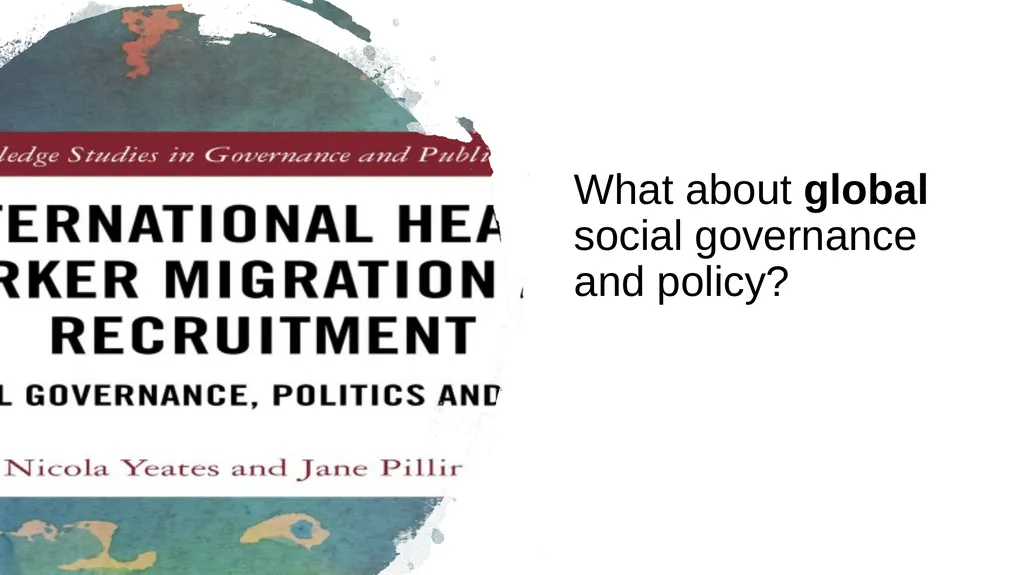
What about global social governance and policy? Nicola Yeates, Open University, 30 October 2019<br>
05
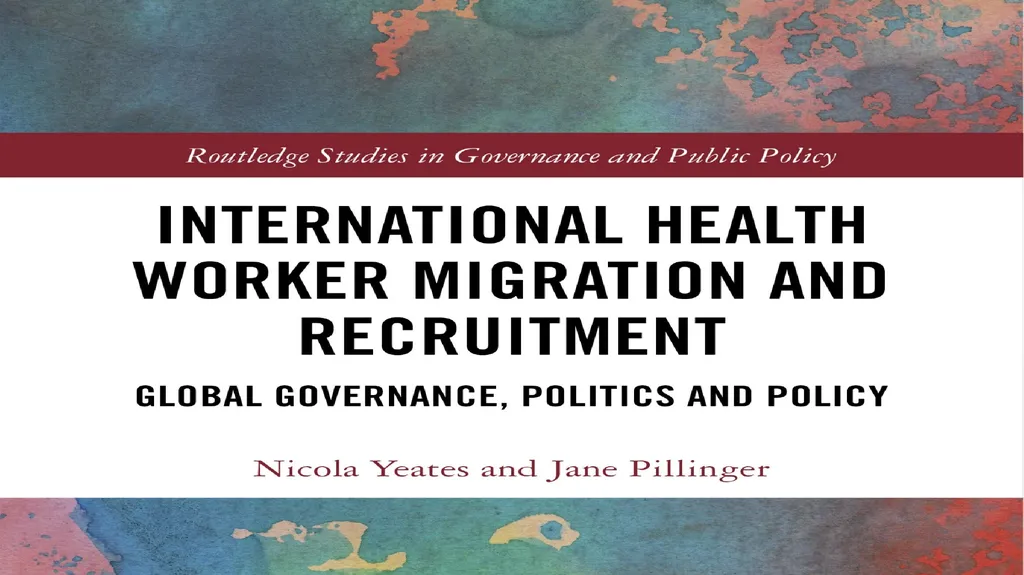
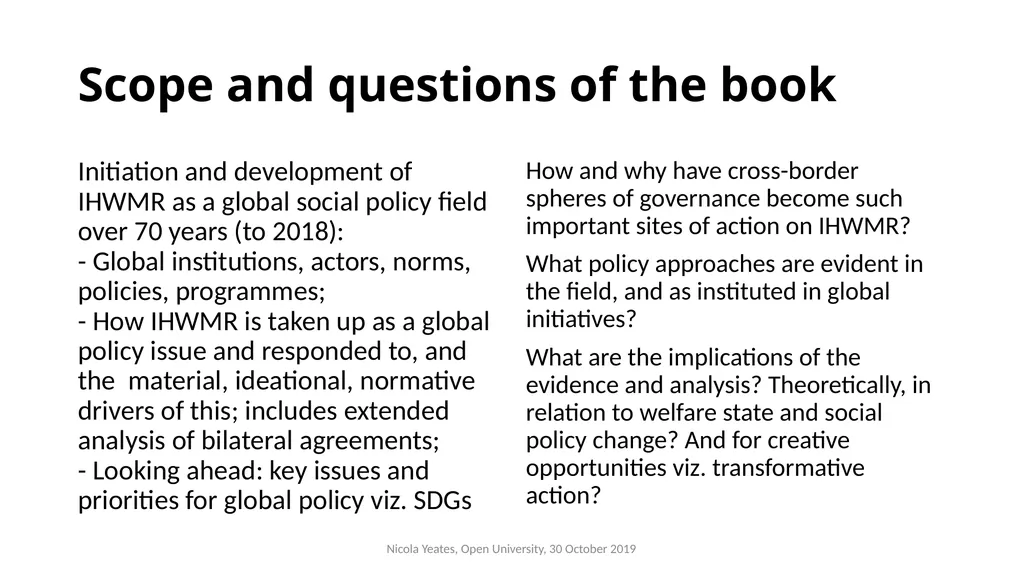
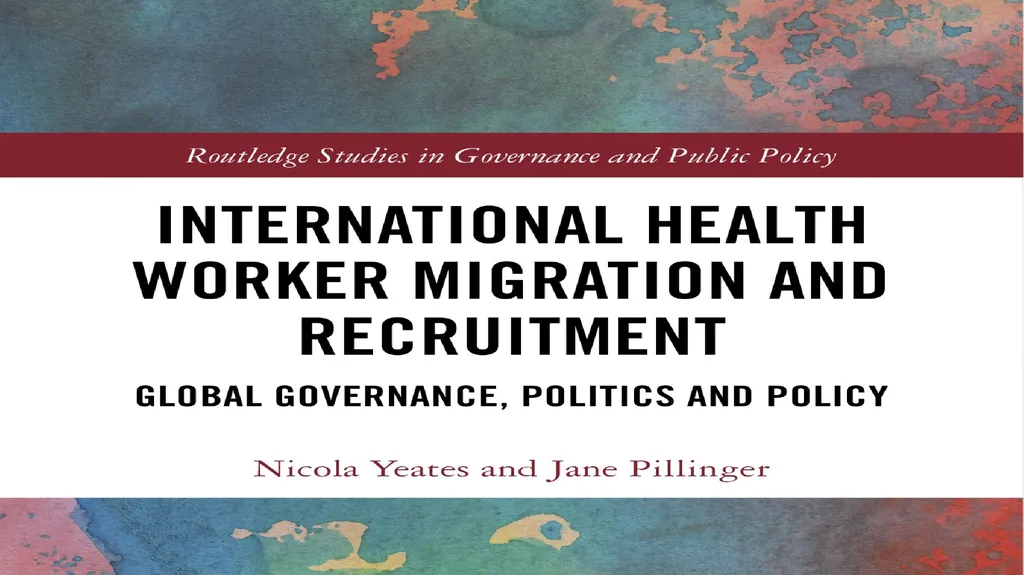
Initiation and development of IHWMR as a global social policy field over 70 years (to 2018): - Global institutions, actors, norms, policies, programmes; - How IHWMR is taken up as a global policy issue and responded to, and the material, ideational, normative drivers of this; includes extended analysis of bilateral agreements; - Looking ahead: key issues and priorities for global policy viz. SDGs How and why have cross-border spheres of governance become such important sites of action on IHWMR?
What policy approaches are evident in the field, and as instituted in global initiatives?
What are the implications of the evidence and analysis? Theoretically, in relation to welfare state and social policy change? And for creative opportunities viz. transformative action? Scope and questions of the book Nicola Yeates, Open University, 30 October 2019<br>
06
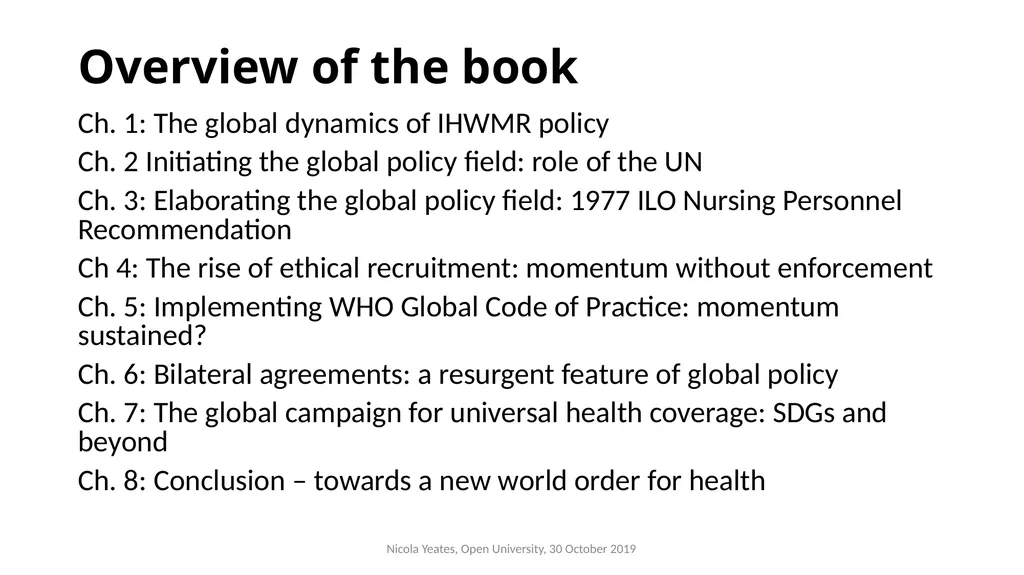
Overview of the book Ch. 1: The global dynamics of IHWMR policy
Ch. 2 Initiating the global policy field: role of the UN
Ch. 3: Elaborating the global policy field: 1977 ILO Nursing Personnel Recommendation
Ch 4: The rise of ethical recruitment: momentum without enforcement
Ch. 5: Implementing WHO Global Code of Practice: momentum sustained?
Ch. 6: Bilateral agreements: a resurgent feature of global policy
Ch. 7: The global campaign for universal health coverage: SDGs and beyond
Ch. 8: Conclusion – towards a new world order for health Nicola Yeates, Open University, 30 October 2019<br>
07
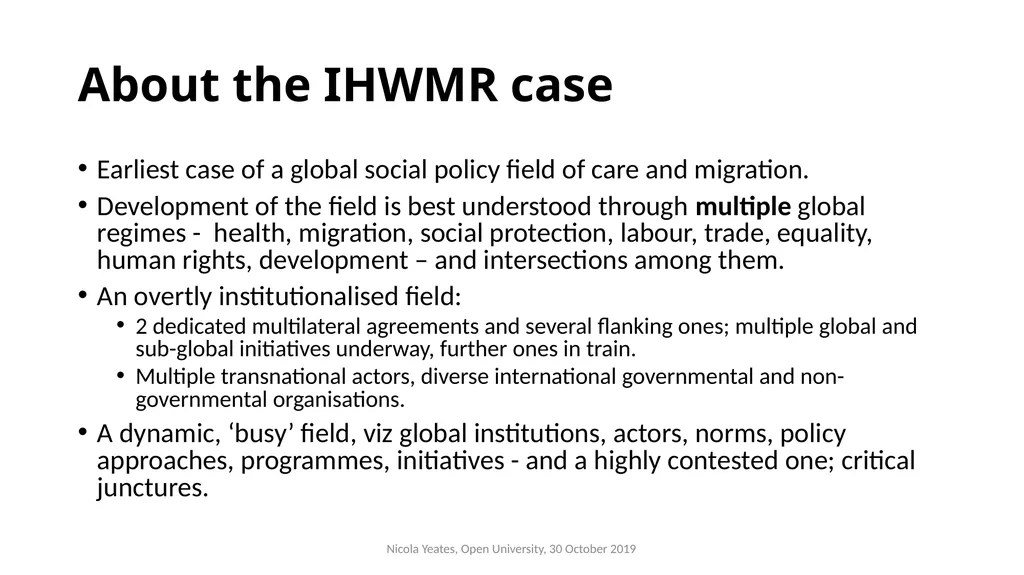
About the IHWMR case Earliest case of a global social policy field of care and migration.
Development of the field is best understood through multiple global regimes - health, migration, social protection, labour, trade, equality, human rights, development – and intersections among them.
An overtly institutionalised field:
2 dedicated multilateral agreements and several flanking ones; multiple global and sub-global initiatives underway, further ones in train.
Multiple transnational actors, diverse international governmental and non-governmental organisations.
A dynamic, ‘busy’ field, viz global institutions, actors, norms, policy approaches, programmes, initiatives - and a highly contested one; critical junctures. Nicola Yeates, Open University, 30 October 2019<br>
08
Nicola Yeates, Open University, 30 October 2019<br>
09
Gendered health inequity:
gender inequality over the lifecourse undermines global health outcomes
Gendered workforce:
70% of the health and social care workforce are women, 25% of women in this workforce occupy senior roles
Gendered migration:
female nurses are the dominant migrant health worker group; across the migration process, vulnerability to exploitation “Demographic changes and rising demands for health care are projected to drive the creation of 40 million jobs by 2030 in the global health and social sector. In parallel, there is an estimated shortfall of 18 million health workers, primarily in low- and middle-income countries, required to achieve the SDGs and universal health coverage. The global mismatch between health worker supply and demand is both a cause for concern and a potential opportunity… [but] gaps in health worker supply will not be closed without addressing the gender dynamics of the health and social workforce.”
(WHO 2019, Delivered by Women, Led by Men) Nicola Yeates, Open University, 30 October 2019<br>
10
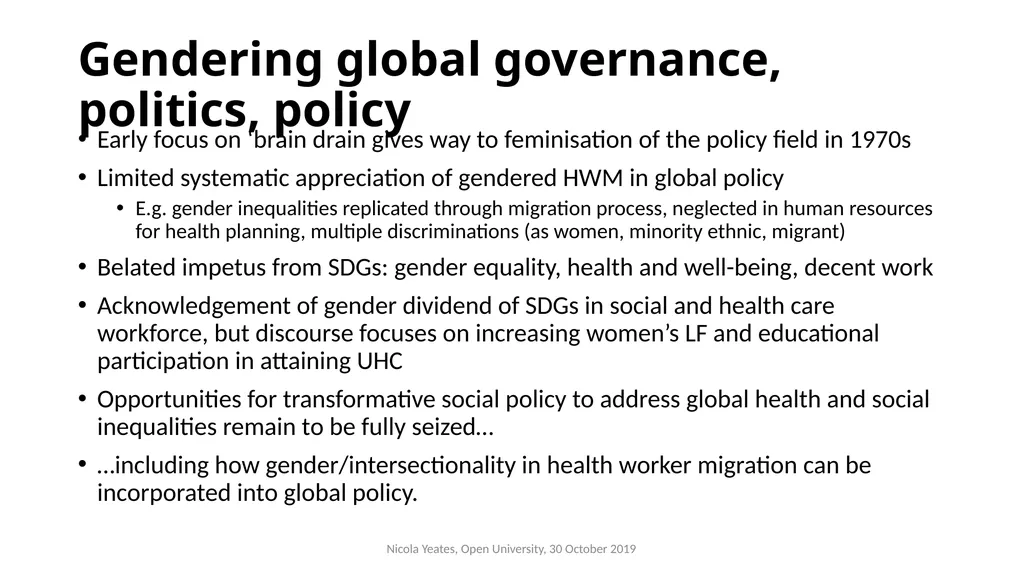
Gendering global governance, politics, policy Early focus on ‘brain drain gives way to feminisation of the policy field in 1970s
Limited systematic appreciation of gendered HWM in global policy
E.g. gender inequalities replicated through migration process, neglected in human resources for health planning, multiple discriminations (as women, minority ethnic, migrant)
Belated impetus from SDGs: gender equality, health and well-being, decent work
Acknowledgement of gender dividend of SDGs in social and health care workforce, but discourse focuses on increasing women’s LF and educational participation in attaining UHC
Opportunities for transformative social policy to address global health and social inequalities remain to be fully seized…
…including how gender/intersectionality in health worker migration can be incorporated into global policy. Nicola Yeates, Open University, 30 October 2019<br>
11
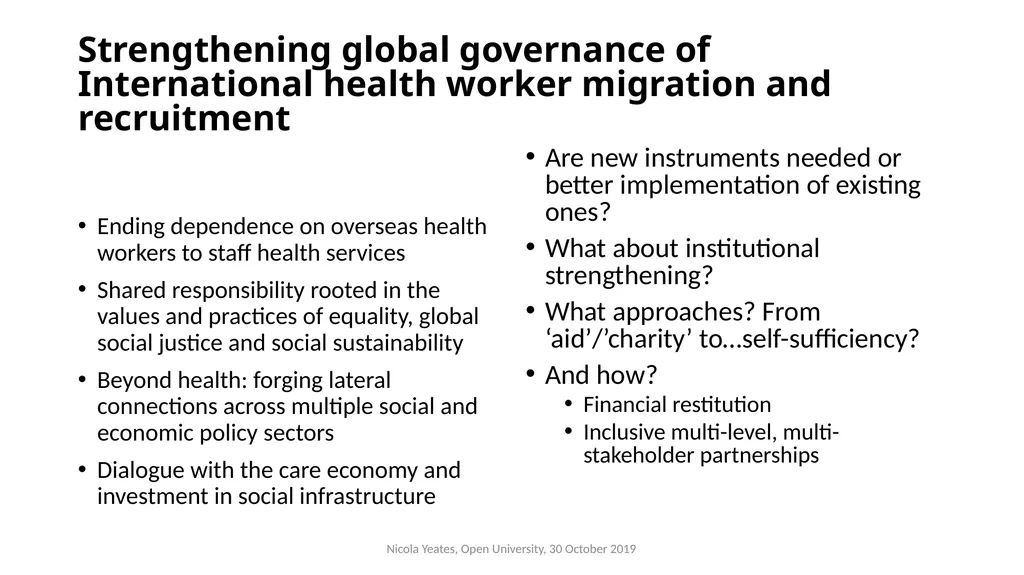
Strengthening global governance of International health worker migration and recruitment Ending dependence on overseas health workers to staff health services
Shared responsibility rooted in the values and practices of equality, global social justice and social sustainability
Beyond health: forging lateral connections across multiple social and economic policy sectors
Dialogue with the care economy and investment in social infrastructure Are new instruments needed or better implementation of existing ones?
What about institutional strengthening?
What approaches? From ‘aid’/’charity’ to…self-sufficiency?
And how?
Financial restitution
Inclusive multi-level, multi-stakeholder partnerships Nicola Yeates, Open University, 30 October 2019<br>
12
Nicola Yeates, Open University, 30 October 2019<br>