
Globalisation B1 Globalisation Draw a spider
NS
Published · 13 slides · 0 views

1 / 1



Description
Globalisation B1 Globalisation Draw a spider diagram to show possible reasons for: Targeting foreign markets Trading in foreign markets Operating in foreign markets Can you list 3 companies that do all 3? Globalisation In this topic you
Related Topics
Share
Embed code
Download this presentation From Below
"Globalisation B1 Globalisation Draw a spider" is the property of its rightful owner. Permission is granted to download and print the materials on this website for personal, non-commercial use only, and to display it on your personal computer provided you do not modify the materials and that you retain all copyright notices contained in the materials. By downloading content from our website, you accept the terms of this agreement.
Presentation Transcript
01
Globalisation B1
Globalisation Draw a spider diagram to show possible reasons for:
Targeting foreign markets
Trading in foreign markets
Operating in foreign markets
Can you list 3 companies that do all 3?<br>
Globalisation Draw a spider diagram to show possible reasons for:
Targeting foreign markets
Trading in foreign markets
Operating in foreign markets
Can you list 3 companies that do all 3?<br>
02
Globalisation In this topic you will learn about
The main features of globalisation, e.g. trading blocs, international mobility of labour and capital, international currencies, multinational corporations, international business communications, international payment systems<br>
The main features of globalisation, e.g. trading blocs, international mobility of labour and capital, international currencies, multinational corporations, international business communications, international payment systems<br>
03
Globalisation is the process of greater integration and inter-connectedness between countries
The International Monetary Fund (IMF) define globalisation as:
“The process through which an increasingly free flow of ideas, people, goods, services and capital leads to the integration of economies and societies.” What is globalisation?<br>
The International Monetary Fund (IMF) define globalisation as:
“The process through which an increasingly free flow of ideas, people, goods, services and capital leads to the integration of economies and societies.” What is globalisation?<br>
04
Globalisation usually includes the following features and characteristics:
Growth of international trade
Trade liberalisation
Enhanced mobility of labour
Enhanced mobility of capital
Increased cultural exchange
Increased international capitalism
Increased outsourcing
Falling transport costs / the “death of distance”
Growth of size and influence of multinational corporations (MNCs) Characteristics of globalisation<br>
Growth of international trade
Trade liberalisation
Enhanced mobility of labour
Enhanced mobility of capital
Increased cultural exchange
Increased international capitalism
Increased outsourcing
Falling transport costs / the “death of distance”
Growth of size and influence of multinational corporations (MNCs) Characteristics of globalisation<br>
05
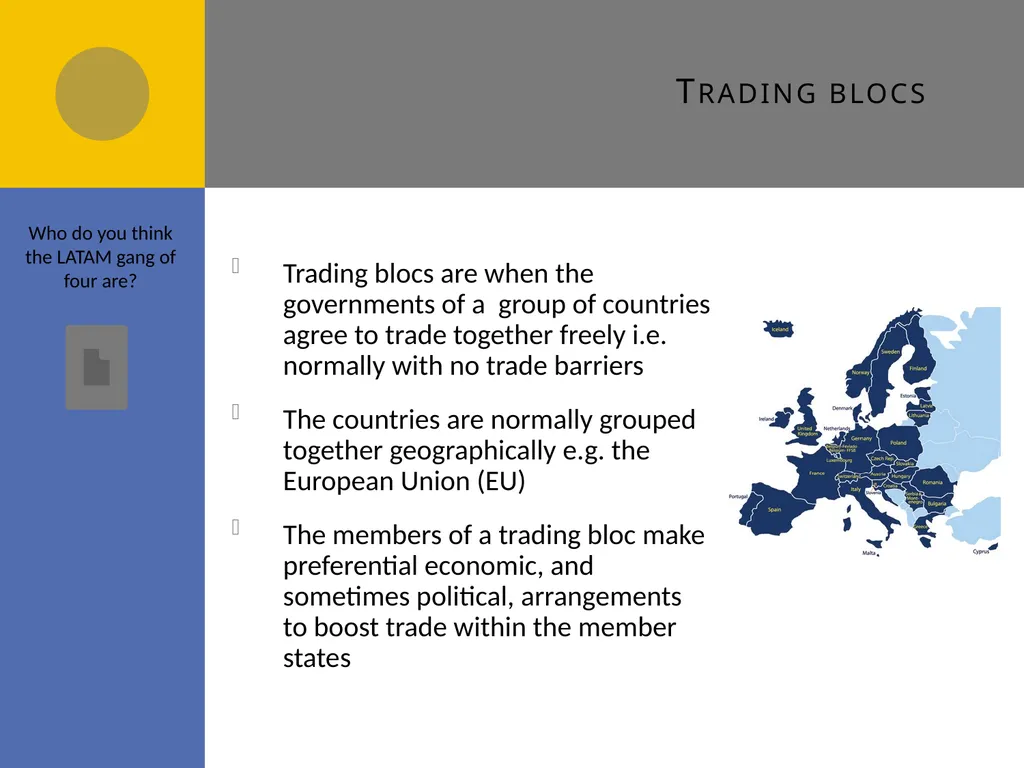
Trading blocs Trading blocs are when the governments of a group of countries agree to trade together freely i.e. normally with no trade barriers
The countries are normally grouped together geographically e.g. the European Union (EU)
The members of a trading bloc make preferential economic, and sometimes political, arrangements to boost trade within the member states Who do you think the LATAM gang of four are?<br>
The countries are normally grouped together geographically e.g. the European Union (EU)
The members of a trading bloc make preferential economic, and sometimes political, arrangements to boost trade within the member states Who do you think the LATAM gang of four are?<br>
06
Trade agreements
The World Trade Organisation (WTO) has assisted in the reduction or removal of trade barriers and there has been a greater proliferation of trade agreements across the world
Reduced tariffs and protectionism
Whilst some protectionist measures remain in place, a large number of countries with significant global economic influence have lowered protectionist measures
Expansion of global trading blocs
The growth of trading blocs such as the EU and NAFTA have reduced national barriers and promoted more trade and integration
Improved technology and communication
Advances in technology have revolutionised communications, lowered labour costs and enabled businesses to access new foreign markets It is important to have an understanding of the primary causes and on-going drivers of globalisation, especially as this has accelerated over time. Visit the WTO student page for videos, articles and a tour. Factors contributing to
globalisation in the last 50 years<br>
The World Trade Organisation (WTO) has assisted in the reduction or removal of trade barriers and there has been a greater proliferation of trade agreements across the world
Reduced tariffs and protectionism
Whilst some protectionist measures remain in place, a large number of countries with significant global economic influence have lowered protectionist measures
Expansion of global trading blocs
The growth of trading blocs such as the EU and NAFTA have reduced national barriers and promoted more trade and integration
Improved technology and communication
Advances in technology have revolutionised communications, lowered labour costs and enabled businesses to access new foreign markets It is important to have an understanding of the primary causes and on-going drivers of globalisation, especially as this has accelerated over time. Visit the WTO student page for videos, articles and a tour. Factors contributing to
globalisation in the last 50 years<br>
07
More globalised financial systems
There has been a significant relaxation on the rules and regulations surrounding the movement of capital, which can move either freely, or at very low cost, quickly across the globe
Greater labour mobility
Workers are more willing to move across national borders in search of employment
Improvements in transportation
This has made the movement of people, goods and services across the globe faster and cheaper
Growth of multinational corporations
Many large organisations have taken advantage of lower trade barriers, labour mobility and cheaper transportation to grow rapidly and enter previously untapped markets
Greater ‘openness’ of former ‘closed’ economies
Large and rapidly developing countries such as India and China which were previously largely closed to trade have become increasingly integrated into the global economy and play a vital role in the creation of new markets and the provision of low cost labour Considering carefully the different causes of globalisation, which do you think are the most significant?
Which are likely to gain increasing significance over the next 20 years? Factors contributing to
globalisation in the last 50 years<br>
There has been a significant relaxation on the rules and regulations surrounding the movement of capital, which can move either freely, or at very low cost, quickly across the globe
Greater labour mobility
Workers are more willing to move across national borders in search of employment
Improvements in transportation
This has made the movement of people, goods and services across the globe faster and cheaper
Growth of multinational corporations
Many large organisations have taken advantage of lower trade barriers, labour mobility and cheaper transportation to grow rapidly and enter previously untapped markets
Greater ‘openness’ of former ‘closed’ economies
Large and rapidly developing countries such as India and China which were previously largely closed to trade have become increasingly integrated into the global economy and play a vital role in the creation of new markets and the provision of low cost labour Considering carefully the different causes of globalisation, which do you think are the most significant?
Which are likely to gain increasing significance over the next 20 years? Factors contributing to
globalisation in the last 50 years<br>
08
Improved allocation of resources
In a world of scarce resources, greater globalisation should improve the overall allocation of resources if there is a reduction in protectionism and enhancements in efficiency
Free trade
The increased freedom of movement of goods and services increases export opportunities and can therefore have a significant effect on economic welfare
Inward investment
The greater freedom of movement of capital enables firms to invest outside their country of origin. This may lower their own costs of production and improve economic prospects and job opportunities in the invested country
Specialisation
Countries may now benefit from increased specialisation which will lower their production costs and improve efficiency
Greater competition across the globe results in lower prices, greater choice and improved quality for consumers, and the reduction in domestic monopoly power Considering carefully the positives of globalisation, which do you think are the most significant?
How do you think the advantages are different for developed and developing nations? A more global-facing UK. Impacts of
globalisation - positives<br>
In a world of scarce resources, greater globalisation should improve the overall allocation of resources if there is a reduction in protectionism and enhancements in efficiency
Free trade
The increased freedom of movement of goods and services increases export opportunities and can therefore have a significant effect on economic welfare
Inward investment
The greater freedom of movement of capital enables firms to invest outside their country of origin. This may lower their own costs of production and improve economic prospects and job opportunities in the invested country
Specialisation
Countries may now benefit from increased specialisation which will lower their production costs and improve efficiency
Greater competition across the globe results in lower prices, greater choice and improved quality for consumers, and the reduction in domestic monopoly power Considering carefully the positives of globalisation, which do you think are the most significant?
How do you think the advantages are different for developed and developing nations? A more global-facing UK. Impacts of
globalisation - positives<br>
09
Inequality
It is possible that developing countries may not benefit from globalisation to the same extent as developed countries, which will widen the inequality gap across the world. They may struggle to compete, or through specialisation get stuck producing a single primary product
Environmental impacts
The increased pace of globalisation utilises scarce resources more quickly, increasing commodity prices and can increase pollution and global warming
Different countries will have different views on the seriousness of this problem
Structural unemployment
As globalisation has accelerated, a large number of primary and secondary sector jobs have been moved to low wage economies, creating structural unemployment issues in developed countries
Movement of labour
Globalisation allows the best talent to move quickly and easily across borders, creating a ‘brain drain’
Damage to traditional cultures
Although not always visible, increased globalisation has arguably damaged traditional cultures. The proliferation of multinational companies creates a uniformity of many economies and arguably less cultural diversity Considering carefully the negatives of globalisation, which do you think are the most significant?
How do you think the disadvantages are different for developed and developing nations? Impacts of
globalisation - negatives<br>
It is possible that developing countries may not benefit from globalisation to the same extent as developed countries, which will widen the inequality gap across the world. They may struggle to compete, or through specialisation get stuck producing a single primary product
Environmental impacts
The increased pace of globalisation utilises scarce resources more quickly, increasing commodity prices and can increase pollution and global warming
Different countries will have different views on the seriousness of this problem
Structural unemployment
As globalisation has accelerated, a large number of primary and secondary sector jobs have been moved to low wage economies, creating structural unemployment issues in developed countries
Movement of labour
Globalisation allows the best talent to move quickly and easily across borders, creating a ‘brain drain’
Damage to traditional cultures
Although not always visible, increased globalisation has arguably damaged traditional cultures. The proliferation of multinational companies creates a uniformity of many economies and arguably less cultural diversity Considering carefully the negatives of globalisation, which do you think are the most significant?
How do you think the disadvantages are different for developed and developing nations? Impacts of
globalisation - negatives<br>
10
MNCs play an important role in the ongoing development of globalisation. They have had a number of key influences on the pace and scale of globalisation. These include:
Capital inflows and inward investment
MNCs are principally driven by profit motives, and if they can spot opportunities for new markets or the chance to reduce production costs by moving to low-wage economies, they may take advantage of these openings, which drives capital expenditure and investment funds into a country
Economies of scale
MNCs can seek low production costs and spread their production over greater units of output, which allows them to reduce unit prices
Employment
Create employment opportunities for local workers
Infrastructure
MNCs will often invest in training the workforce to improve their skills, and also spend money on local roads and transport infrastructure to aid their own trading opportunities and distribution
Diversification
Developing countries may have very few industries to help them generate economic growth and the arrival of MNCs may help to diversify the economy across a wider range of businesses and sectors
Standards
MNCs will often work towards the provision of minimum standards in either production for example, health and safety considerations or the improved final goods or services Study the infographic to identify the trends in MNCs. Impacts of globalisation –
multinational corporations (MNCs)<br>
Capital inflows and inward investment
MNCs are principally driven by profit motives, and if they can spot opportunities for new markets or the chance to reduce production costs by moving to low-wage economies, they may take advantage of these openings, which drives capital expenditure and investment funds into a country
Economies of scale
MNCs can seek low production costs and spread their production over greater units of output, which allows them to reduce unit prices
Employment
Create employment opportunities for local workers
Infrastructure
MNCs will often invest in training the workforce to improve their skills, and also spend money on local roads and transport infrastructure to aid their own trading opportunities and distribution
Diversification
Developing countries may have very few industries to help them generate economic growth and the arrival of MNCs may help to diversify the economy across a wider range of businesses and sectors
Standards
MNCs will often work towards the provision of minimum standards in either production for example, health and safety considerations or the improved final goods or services Study the infographic to identify the trends in MNCs. Impacts of globalisation –
multinational corporations (MNCs)<br>
11
Despite the benefits that MNCs may bring through their contribution to globalisation, their role may have some negatives. These include:
Profit motive
MNCs will be driven principally by profit, which may come at the expense of consumers and employees
Impact on small firms
It is unlikely that small, local companies will be able to compete with large MNCs, and consequently they may be unable to survive in the market place, so reducing overall competition
Environmental impact
MNCs may choose to locate in countries or regions with fewer environmental laws. Whilst this may reduce costs, it may also increase pollution and create negative externalities
Exploitation
MNCs may exploit local resources and the labour force for their own gain, whilst the shareholders of the home nation enjoy the dividends from profits
Taxation
MNCs will often move their ‘home’ for tax purposes, usually to minimise tax liability. The cases of Starbucks and Amazon demonstrate how this affects both developed and developing nations Weigh up the advantages and disadvantages of MNCs in globalisation.
To what extent do you think MNCs are a positive influence? Impacts of globalisation –
multinational corporations (MNCs)<br>
Profit motive
MNCs will be driven principally by profit, which may come at the expense of consumers and employees
Impact on small firms
It is unlikely that small, local companies will be able to compete with large MNCs, and consequently they may be unable to survive in the market place, so reducing overall competition
Environmental impact
MNCs may choose to locate in countries or regions with fewer environmental laws. Whilst this may reduce costs, it may also increase pollution and create negative externalities
Exploitation
MNCs may exploit local resources and the labour force for their own gain, whilst the shareholders of the home nation enjoy the dividends from profits
Taxation
MNCs will often move their ‘home’ for tax purposes, usually to minimise tax liability. The cases of Starbucks and Amazon demonstrate how this affects both developed and developing nations Weigh up the advantages and disadvantages of MNCs in globalisation.
To what extent do you think MNCs are a positive influence? Impacts of globalisation –
multinational corporations (MNCs)<br>
12
There are a number of currencies that can be used to buy and sell goods and services around the globe:
The US Dollar ($) is widely accepted, making it easier to complete transactions. It is used as the standard, currency for many commodities, such as oil. This makes it easier for businesses to trade with certainty about prices
The Euro, Japanese Yen and Pound Sterling are also widely accepted as currencies, making payment easier
A number of payment systems are used globally:
There are over 200 types of electronic payment systems around the world
Credit cards are widely accepted. Payments are guaranteed and once credit card information has been inputted by the customer cards can be reused easily
Bank transfers allow business to take cash out of customer accounts. Often, these are through direct debit, a monthly recurring payment
Electronic wallet systems, such as PayPal, acts as a middle party, transferring payments between buyers and sellers Impacts of globalisation –
International currencies
and payment systems<br>
The US Dollar ($) is widely accepted, making it easier to complete transactions. It is used as the standard, currency for many commodities, such as oil. This makes it easier for businesses to trade with certainty about prices
The Euro, Japanese Yen and Pound Sterling are also widely accepted as currencies, making payment easier
A number of payment systems are used globally:
There are over 200 types of electronic payment systems around the world
Credit cards are widely accepted. Payments are guaranteed and once credit card information has been inputted by the customer cards can be reused easily
Bank transfers allow business to take cash out of customer accounts. Often, these are through direct debit, a monthly recurring payment
Electronic wallet systems, such as PayPal, acts as a middle party, transferring payments between buyers and sellers Impacts of globalisation –
International currencies
and payment systems<br>
13
Discussion Considering carefully the different causes of globalisation, which do you think are the most significant?
Which are likely to gain increasing significance over the next 20 years? How important is the world’s perception of a country? What the new Panama Canal tells us about globalisation. B.P3 Explain the main features of globalisation that affect two contrasting businesses.<br>
Which are likely to gain increasing significance over the next 20 years? How important is the world’s perception of a country? What the new Panama Canal tells us about globalisation. B.P3 Explain the main features of globalisation that affect two contrasting businesses.<br>