
Golf Official Rules Level 1 Individual Skills
DJ
Published · 27 slides · 0 views
1 / 1
Description
Golf Official Rules Level 1 Individual Skills Contest Level 2 Unified Sports Team Play Level 4 Individual Stroke Play 9-Hole Events Offered Proper Attire Uniforms: Athletes must wear shirts with collars and dress shorts or pants. Golf
Related Topics
Share
Embed code
Download this presentation From Below
"Golf Official Rules Level 1 Individual Skills" is the property of its rightful owner. Permission is granted to download and print the materials on this website for personal, non-commercial use only, and to display it on your personal computer provided you do not modify the materials and that you retain all copyright notices contained in the materials. By downloading content from our website, you accept the terms of this agreement.
Presentation Transcript
01
Golf Official Rules<br>
02
Level 1 Individual Skills Contest
Level 2 Unified Sports Team Play
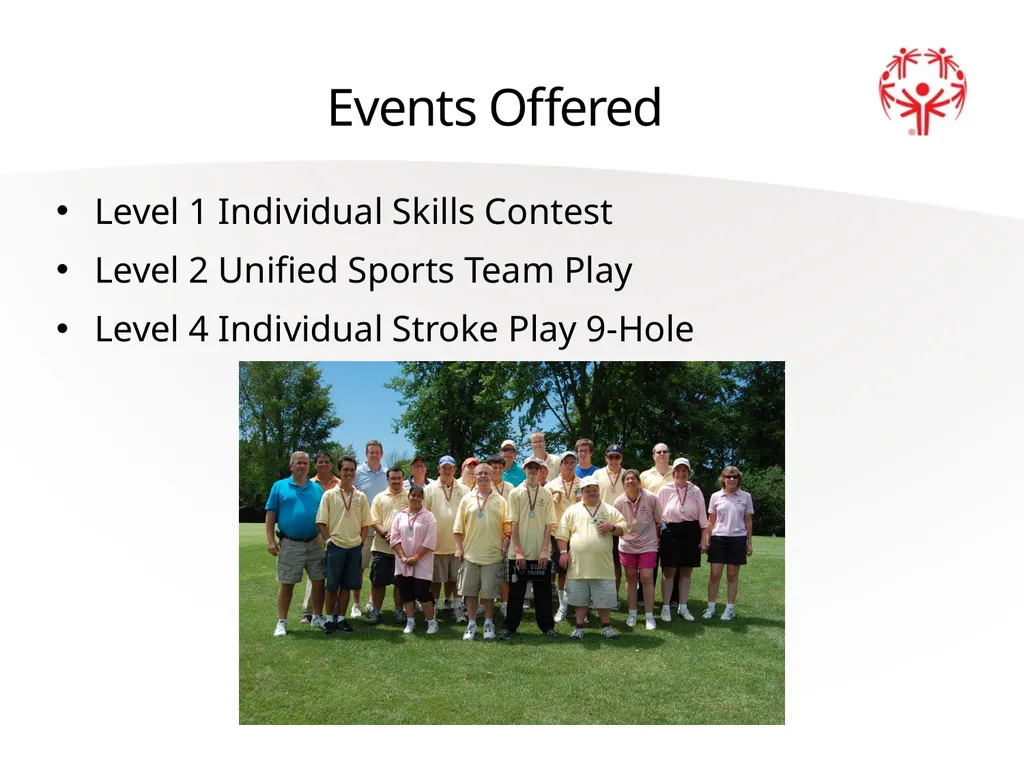
Level 4 Individual Stroke Play 9-Hole Events Offered<br>
Level 2 Unified Sports Team Play
Level 4 Individual Stroke Play 9-Hole Events Offered<br>
03
Proper Attire Uniforms: Athletes must wear shirts with collars and dress shorts or pants. Golf gloves are allowed. Demin pants are not allowed on the golf course.
Shoes: Shoes with soft, non-metal golf spikes are required. Tennis or athletic shoes are acceptable but are subject to inspection by an event official. No heeled shoes are allowed.
Hats and/or visors may be worn while on the golf course.<br>
Shoes: Shoes with soft, non-metal golf spikes are required. Tennis or athletic shoes are acceptable but are subject to inspection by an event official. No heeled shoes are allowed.
Hats and/or visors may be worn while on the golf course.<br>
04
Equipment Each Athlete or Unified Partner should have their own clubs and bag for competition. SOMI will not provide clubs or balls to golfers during competition
Athletes should not have more than 14 clubs including a putter in their bag during competition
Golfers may carry a jacket, umbrella or rain pants in their bag in the case of inclement weather on the course
Only Unified competition will utilize carts at the state event. 9-hole golfers will walk the course<br>
05
All Competition Rules Golfers should follow all courtesy guidelines (quiet during turn, no phones, putting line, etc.)
Golfers are expected to replace divots when taken
The flag should be replaced after all golfers hole their putts
All whiffs and duffs are considered 1 stroke. Whiffs are completely missed swings/balls. Duffs are topping the ball during a swing.<br>
Golfers are expected to replace divots when taken
The flag should be replaced after all golfers hole their putts
All whiffs and duffs are considered 1 stroke. Whiffs are completely missed swings/balls. Duffs are topping the ball during a swing.<br>
06
All Competition Rules A 10x score is the maximum score allowed per hole during competition. If a golfer has hit their 10th shot and has not holed out, they should record a 10x for their score and proceed to the next hole.
All players will utilize the forward tee box while teeing off.
Tie Breaker: If two players are tied after 9-holes, the player with the fewest 10x scores will be declared the winner.
To register, golfers need to submit their average of the most recent six scores over a 9-hole round.<br>
All players will utilize the forward tee box while teeing off.
Tie Breaker: If two players are tied after 9-holes, the player with the fewest 10x scores will be declared the winner.
To register, golfers need to submit their average of the most recent six scores over a 9-hole round.<br>
07
Coaching While on the course coaches should not assist or direct golfers in any way. Coaches may follow and watch their golfer(s) around the course but should keep a distance, so it is not assumed they are coaching. Unified golf pairs may assist one another, but not coaches.
Athletes are expected to carry their own clubs during competition
GPS Range finders are not to be used during competition by athletes<br>
Athletes are expected to carry their own clubs during competition
GPS Range finders are not to be used during competition by athletes<br>
08
Level 4 - Individual Stroke Play
(9-Hole) This level is designed to meet the needs of those Special Olympics golfers who wish to play individually in a tournament where the stipulated round is nine holes.
The player should be capable of playing independently and be able to walk during the entire nine-hole round.
The form of play shall be stroke play competition.
Athletes at this level should average a score of 70 or lower during a 9-hole round.<br>
The player should be capable of playing independently and be able to walk during the entire nine-hole round.
The form of play shall be stroke play competition.
Athletes at this level should average a score of 70 or lower during a 9-hole round.<br>
09
Level 4 - Individual Stroke Play
(9-Hole) Each player is responsible for providing their own equipment. A set of clubs shall include at least one wood, one iron and one putter. These clubs should be in an appropriate golf bag and should include golf balls.<br>
10
Level 2 - Unified Sports Team Play
(9-Hole) This level is designed to give the Special Olympics athlete an opportunity to play in a team format with a partner in the traditional Unified Sports model where the teammates are of similar ability.
A team shall include one Special Olympics athlete and a peer athlete without intellectual disabilities (Unified Partner). One score should be submitted per team.
The players play alternately from the teeing grounds and then alternate strokes until the ball is holed. Example: If player A plays from the tee on the odd-numbered holes, then player B would play from the tee on the even-numbered holes. Only one ball is in play per hole.<br>
11
Level 2 - Unified Sports Team Play
(9-Hole) Once the ball is in play on each hole, the players shall alternate shots until the ball is holed, or until 10 strokes have been played.
In cases where a team registers and the difference in handicaps is greater than 10, the team shall be divisioned according to a standard differential of 10 applied to the lower of the two handicaps.
Example: Player A has a handicap of 10 and Player B has a handicap of 35. For the purpose of divisioning, the tournament committee should apply the 10 stroke differential and consider player B to have a handicap of 20.<br>
12
Level 2 - Unified Sports Team Play
(9-Hole) Each player is responsible for providing their own equipment. A set of clubs shall include at least one wood, one iron and one putter. These clubs should be in an appropriate golf bag and should include golf balls.
At this level teams should shoot an average of 120 or lower on an 18-hole round.
Partners are required to fill out their VMS certification requirements prior to participation.
Partners are required to follow all rules established by the area program, which could include traveling and residing with the team.<br>
13
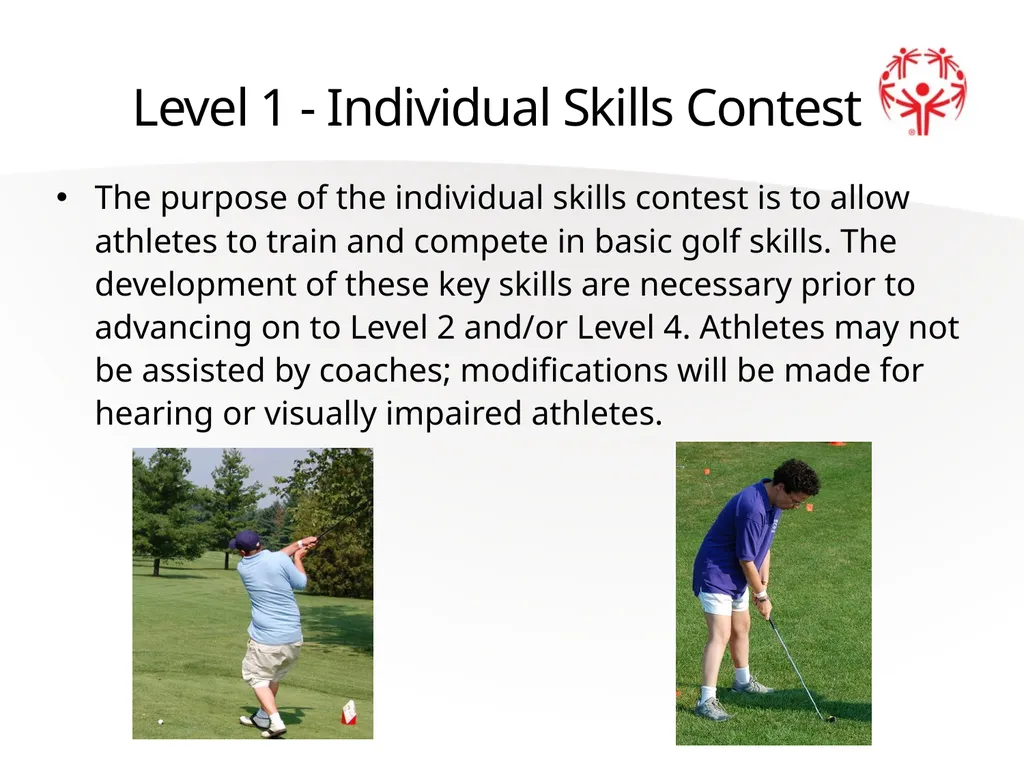
Level 1 - Individual Skills Contest The purpose of the individual skills contest is to allow athletes to train and compete in basic golf skills. The development of these key skills are necessary prior to advancing on to Level 2 and/or Level 4. Athletes may not be assisted by coaches; modifications will be made for hearing or visually impaired athletes.<br>
14
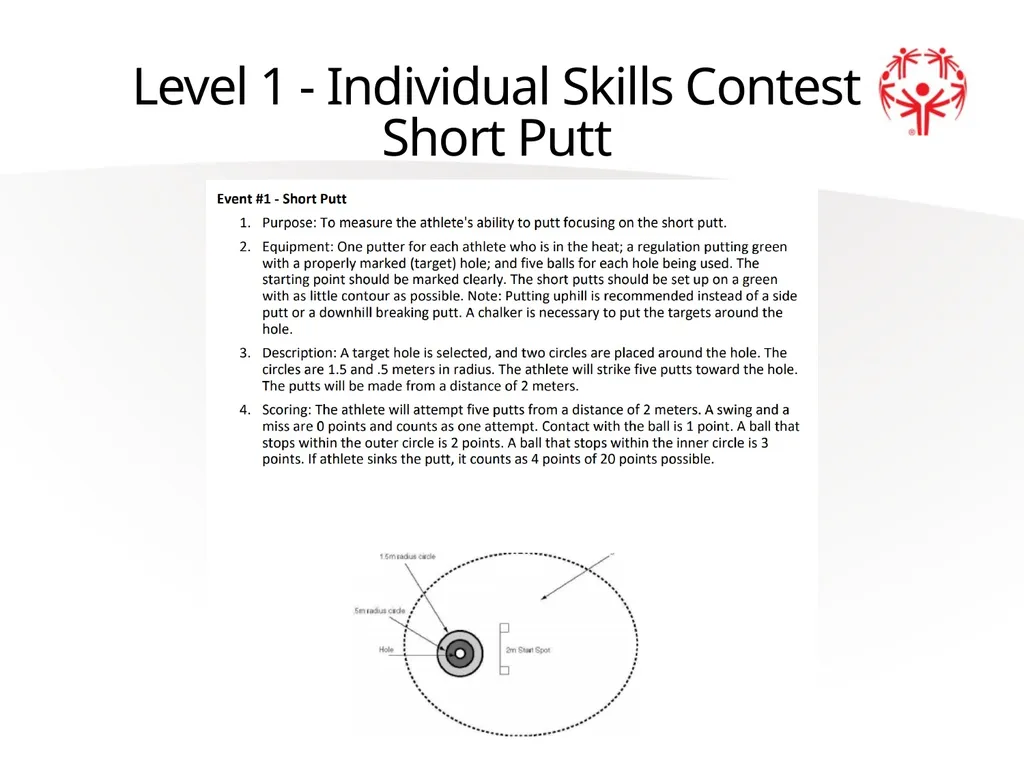
Level 1 - Individual Skills Contest
Short Putt<br>
15
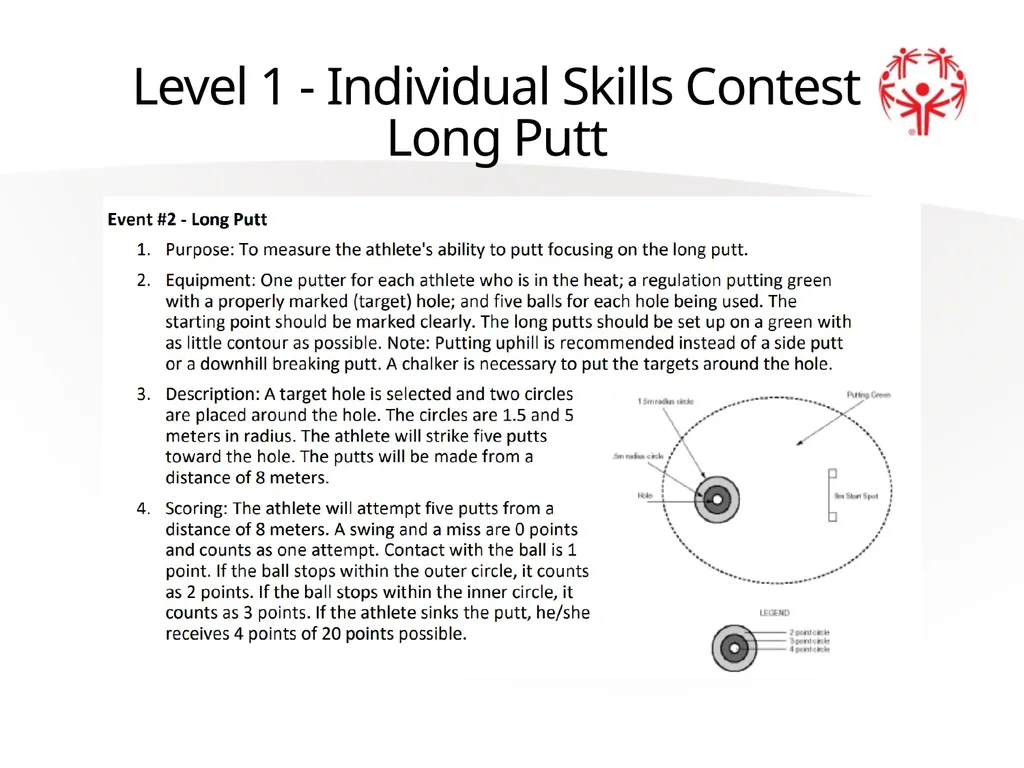
Level 1 - Individual Skills Contest
Long Putt<br>
16
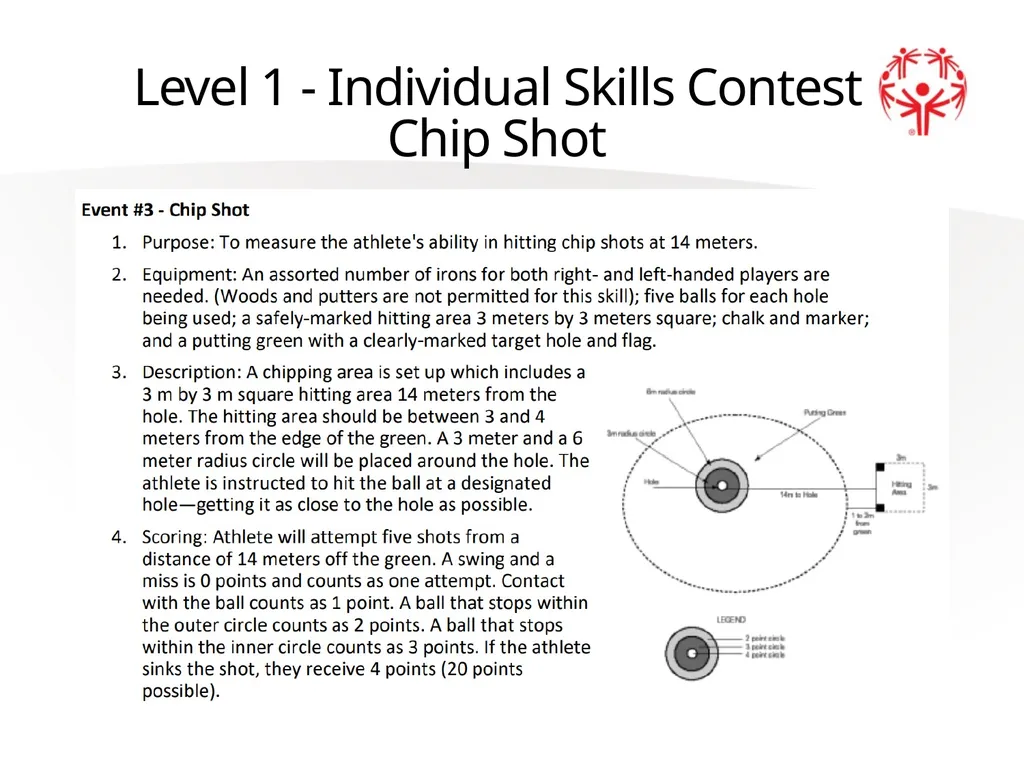
Level 1 - Individual Skills Contest Chip Shot<br>
17
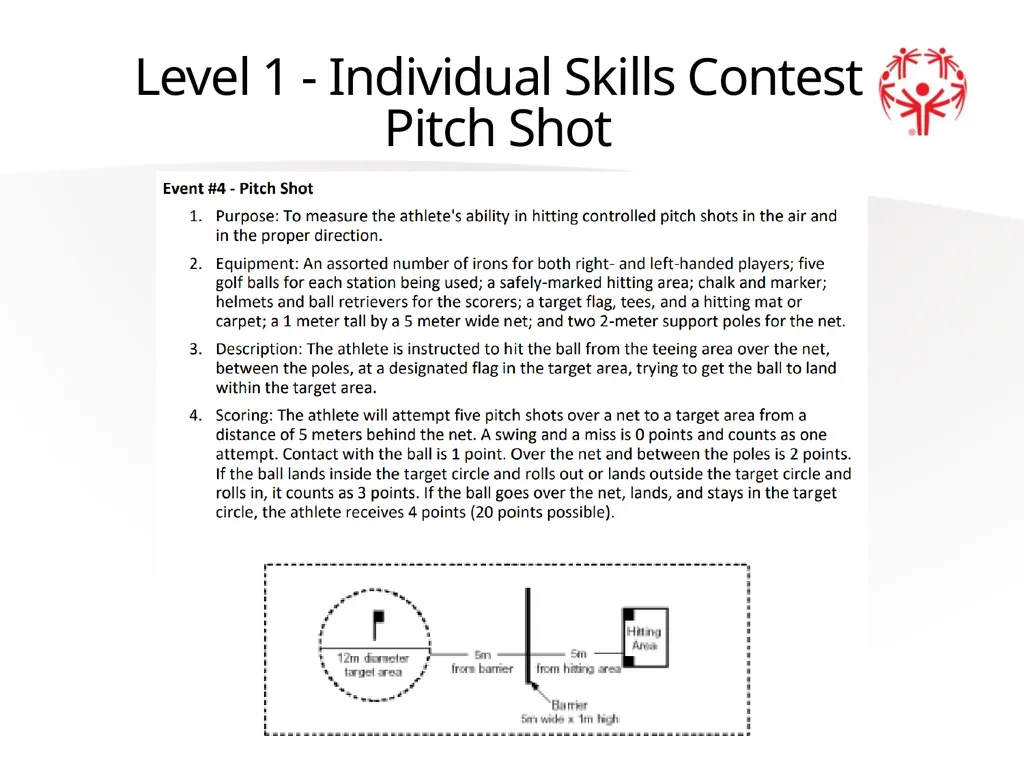
Level 1 - Individual Skills Contest Pitch Shot<br>
18
Level 1 - Individual Skills Contest
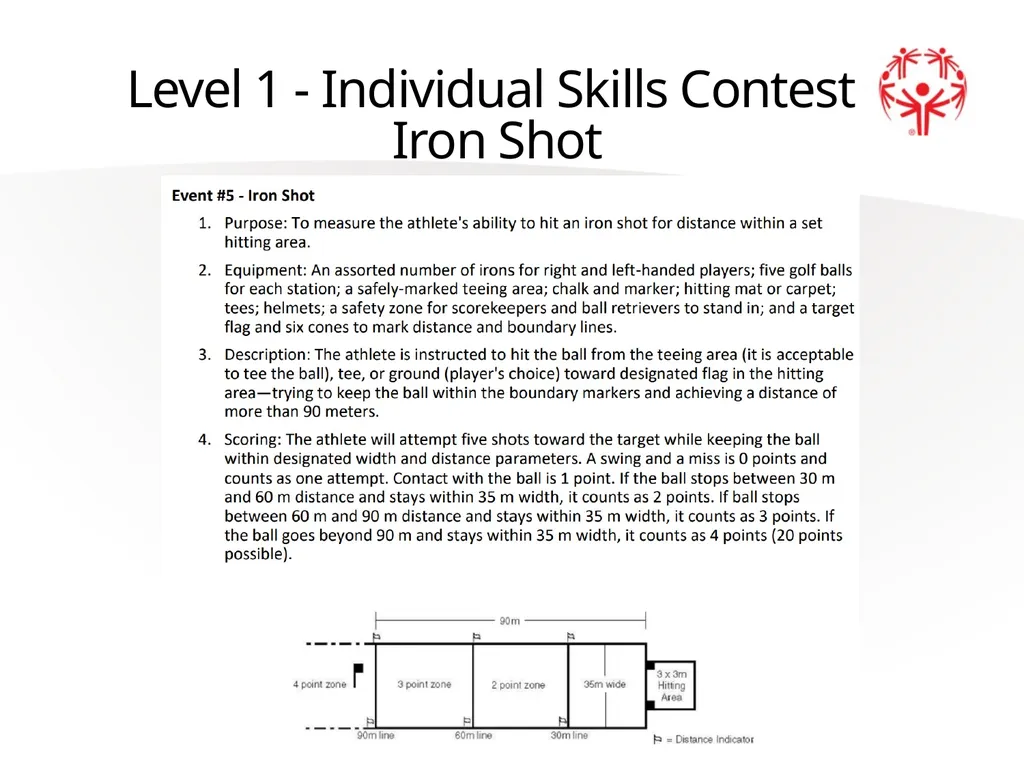
Iron Shot<br>
19
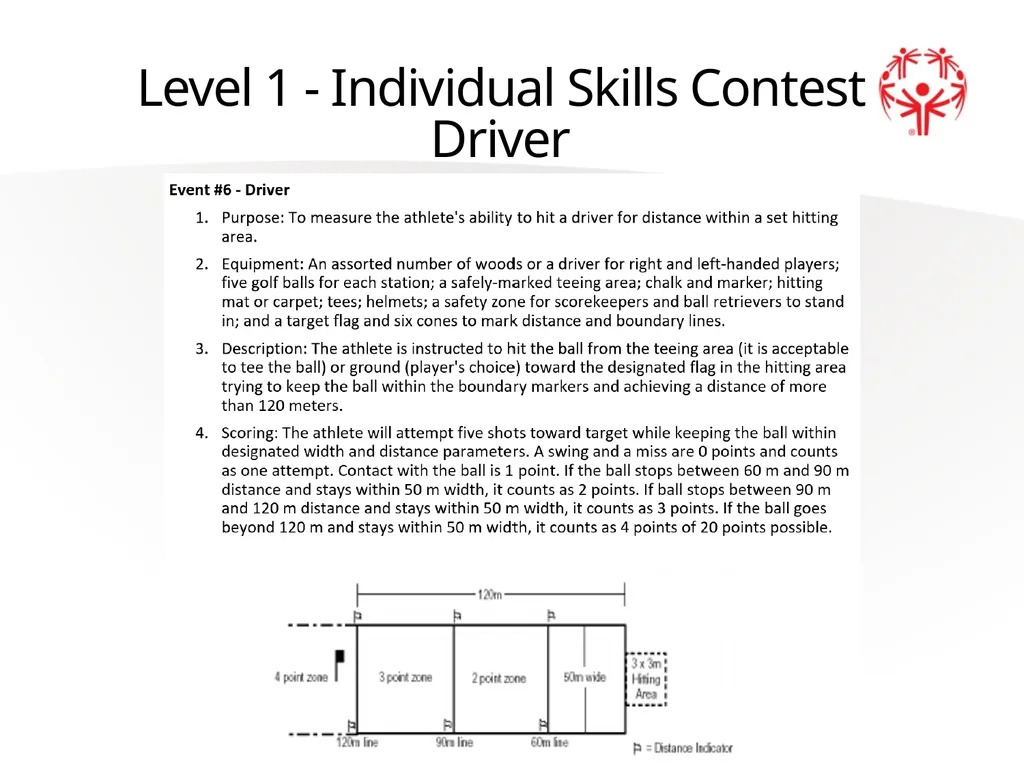
Level 1 - Individual Skills Contest Driver<br>
20
Golfing Technique: Mental MENTAL PRACTICE - (10 Minutes Each Day)
Be Goal Oriented - write down specific goals, short term and long term
Have A Vision - visualize yourself achieving these goals. Close your eyes and visualize!
Know Your Swing - focus on rhythm and timing as you swing<br>
Be Goal Oriented - write down specific goals, short term and long term
Have A Vision - visualize yourself achieving these goals. Close your eyes and visualize!
Know Your Swing - focus on rhythm and timing as you swing<br>
21
Golf Tips Putting:
ONE HANDED DRILL: Practice a straight ten foot putt with ten balls using only your trailing hand. Concentrate upon the palm of your hand moving toward the cup. Now practice the same putt with your target hand only. Concentrate on the back of your hand moving toward the cup. Be conscious of the toe of your putter in the follow through, if it points toward or away from the cup, you are turning your hand. The face of the putter should be square to the cup.
ONE EYE DRILL: Putt with the eye on the target side closed. This will help you to stop lifting your head prematurely.
LISTEN DRILL: Do not look to see if the ball goes into the cup. Listen. Hear it drop.
ALIGNMENT DRILL: Lay two clubs on the green about 6 inches apart so that they are parallel to each other. Putt from between these two clubs and check to see that your stroke is aligned at impact and steady on the back and forward stroke. Putting can be tiring on the lower back. When practicing take frequent breaks by standing tall and stretching your back muscles with gently movements that relieve the tension that can build by concentrated practice.<br>
22
Golf Tips Chipping
Did you know that your can chip with any club? Wedge...3-Iron...Even three wood!
The farther away the pin, the lower the loft. You must get the ball rolling as quickly as possible. Here's how:
Feet about a foot apart
Weight on the forward foot
Back knee pointing at the target, with almost no weight on the back foot.
This will put your hands ahead of the ball. Take the club back with your shoulders. No wrist break, hands lead the club head on the downswing. No wrist break. Let the club head do the work.<br>
23
Want to hit the ball farther? One of the most recent improvements to the golf swing is the "two-pivot swing" exemplified in players such as Tiger Woods and Nick Faldo. Thirty years ago the "two-pivot swing" would have been considered swaying. Today it is the model swing to hit it further.
During your backswing as your upper body turns, allow your left shoulder to move across and to the right so that your left shoulder is above your right foot at the top of your backswing. Your head will move behind the ball and it might feel that you have "swayed." Start your forward swing as you always do but try to finish with your right shoulder above your left foot, as if you are moving slightly ahead of the shot. You will finish in a more vertical position and look like Tiger!
It is simple, effective and you will probably start hitting it further.<br>
24
Golf Etiquette Maintaining the Course:
Replace your divots.
Turf tends to explode on impact, making it difficult, if not impossible, to replace the divot. In this case, you have two options:
You can use the toe of your shoe to kick in the turf around the edges of the divot.
Many courses often put containers of a soil/seed mixture on their carts and tees. If this is the case, simply fill in the divot with the mixture.
After hitting from a bunker, rake the area you played from, as well as all your footprints and any others within reach.
Rakes should be left either in or nearby the bunker.
Using a tee, knife, key or repair tool, repair the mark on the green by working the edges towards the center, without lifting the center of the mark. Don't tear the grass. Finish by smoothing the area with a club or your foot. Try to get the area smooth enough to putt over.
Just remember that while the Rules of Golf allow you to repair pitch marks on your putting line, you cannot repair spike marks on your putting line until after you have putted.<br>
25
Golf Etiquette On the green remember:
Don't step on your fellow players putting lines -- the imaginary line that connects the ball to the hole.
If you're ball is not furthest from the cup mark your ball, either with a plastic marker or a small, thin, dark coin such as an old penny.
Do not stand where you might distract a fellow player and don't move.
Don't make any noise when your fellow player is preparing to putt.
If you don't have a caddie and are asked to tend the flagstick, make sure you aren't standing on anyone's line.
Hold the flagstick at arm's length so the flag doesn't flutter in the breeze, and make sure your shadow doesn't fall across the hole or line. Loosen the bottom of the flagstick so it doesn't stick when you try and remove it by pulling it straight up after the other player has putted. The flagstick should be removed right after the player has hit the ball.
If you lay down the flagstick, lay it off the green to prevent doing any damage to the green.
Generally, the player closest to the hole will tend the flagstick.<br>
26
Terms Bunker: A hazard consisting of a prepared area of ground, often a hollow, from which turf or soil has been removed and replaced with sand or the like
Caddie: One who carries or handles a player’s clubs during play and otherwise assists him/her in accordance with the rules
Flagstick: a moveable straight indicator, with or without bunting or other material attached, centered in the hole to show its position
Forecaddie: One who is employed by the committee to indicate to players the position of balls during play<br>
27
Terms Honor: The side entitled to play first from the teeing ground
Referee: Appointed to accompany players to decide questions of fact and apply the rules of golf
Stance: Consists in a player placing his/her feet in position preparatory to making a stroke
Stroke: The forward movement of the club made with the intention of fairly striking the ball<br>
Referee: Appointed to accompany players to decide questions of fact and apply the rules of golf
Stance: Consists in a player placing his/her feet in position preparatory to making a stroke
Stroke: The forward movement of the club made with the intention of fairly striking the ball<br>