
Governmental Accounting Finance Budget “101”
SN
Published · 18 slides · 0 views

1 / 1

Description
Governmental Accounting Finance Budget 101 Topics Generally Accepted Accounting Principles (GAAP) Basis of Accounting Fund Accounting Governmental Budgeting Government vs Profit Business KEY DIFFERENCES BETWEEN GOVERNMENTS AND FOR PROFIT
Related Topics
Share
Embed code
Download this presentation From Below
"Governmental Accounting Finance Budget “101”" is the property of its rightful owner. Permission is granted to download and print the materials on this website for personal, non-commercial use only, and to display it on your personal computer provided you do not modify the materials and that you retain all copyright notices contained in the materials. By downloading content from our website, you accept the terms of this agreement.
Presentation Transcript
01
Governmental Accounting
Finance
Budget
“101”<br>
02
Topics Generally Accepted Accounting Principles (GAAP)
Basis of Accounting
Fund Accounting
Governmental Budgeting<br>
Basis of Accounting
Fund Accounting
Governmental Budgeting<br>
03
Government vs Profit Business KEY DIFFERENCES BETWEEN GOVERNMENTS AND FOR PROFIT BUSINESSES:
Legal structure
Political process
Lack of profit motive
Government activities - resources driven by budgets
For profit businesses - resources driven by the free market
Governments are the provider of services that are not based on fees for service (although some activities that operate as Business type activities are based on user fees such as public utilities, etc.)<br>
Legal structure
Political process
Lack of profit motive
Government activities - resources driven by budgets
For profit businesses - resources driven by the free market
Governments are the provider of services that are not based on fees for service (although some activities that operate as Business type activities are based on user fees such as public utilities, etc.)<br>
04
Government Financial Statements FINANCIAL STATEMENT USERS
Taxpayers
Citizens
Creditors
Legislative bodies
Grantors
Management
Rating agencies such as Moody’s and Fitch/S&P 500<br>
Taxpayers
Citizens
Creditors
Legislative bodies
Grantors
Management
Rating agencies such as Moody’s and Fitch/S&P 500<br>
05
Generally Accepted Accounting Principles Common standards and procedures set by policy boards used to record and report accounting information and compile financial statements.<br>
06
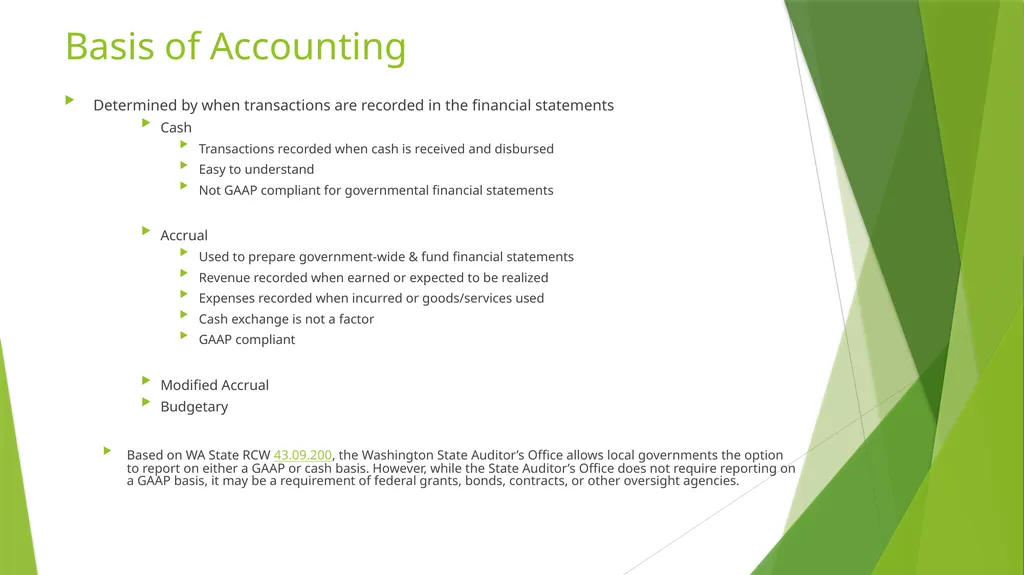
Basis of Accounting Determined by when transactions are recorded in the financial statements
Cash
Transactions recorded when cash is received and disbursed
Easy to understand
Not GAAP compliant for governmental financial statements
Accrual
Used to prepare government-wide & fund financial statements
Revenue recorded when earned or expected to be realized
Expenses recorded when incurred or goods/services used
Cash exchange is not a factor
GAAP compliant
Modified Accrual
Budgetary
Based on WA State RCW 43.09.200, the Washington State Auditor’s Office allows local governments the option to report on either a GAAP or cash basis. However, while the State Auditor’s Office does not require reporting on a GAAP basis, it may be a requirement of federal grants, bonds, contracts, or other oversight agencies.<br>
Cash
Transactions recorded when cash is received and disbursed
Easy to understand
Not GAAP compliant for governmental financial statements
Accrual
Used to prepare government-wide & fund financial statements
Revenue recorded when earned or expected to be realized
Expenses recorded when incurred or goods/services used
Cash exchange is not a factor
GAAP compliant
Modified Accrual
Budgetary
Based on WA State RCW 43.09.200, the Washington State Auditor’s Office allows local governments the option to report on either a GAAP or cash basis. However, while the State Auditor’s Office does not require reporting on a GAAP basis, it may be a requirement of federal grants, bonds, contracts, or other oversight agencies.<br>
07
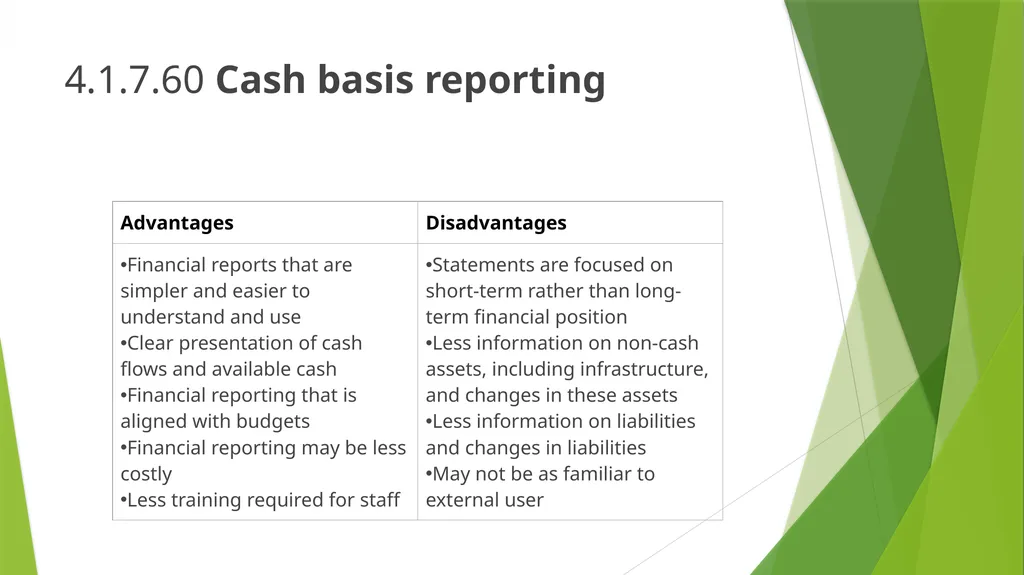
4.1.7.60 Cash basis reporting<br>
08
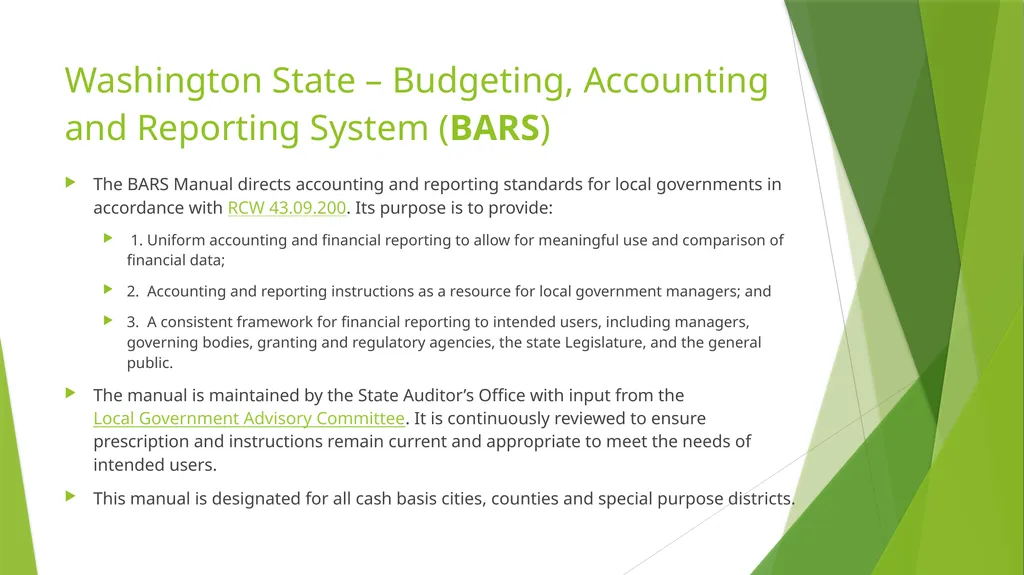
Washington State – Budgeting, Accounting and Reporting System (BARS) The BARS Manual directs accounting and reporting standards for local governments in accordance with RCW 43.09.200. Its purpose is to provide:
1. Uniform accounting and financial reporting to allow for meaningful use and comparison of financial data;
2. Accounting and reporting instructions as a resource for local government managers; and
3. A consistent framework for financial reporting to intended users, including managers, governing bodies, granting and regulatory agencies, the state Legislature, and the general public.
The manual is maintained by the State Auditor’s Office with input from the Local Government Advisory Committee. It is continuously reviewed to ensure prescription and instructions remain current and appropriate to meet the needs of intended users.
This manual is designated for all cash basis cities, counties and special purpose districts.<br>
1. Uniform accounting and financial reporting to allow for meaningful use and comparison of financial data;
2. Accounting and reporting instructions as a resource for local government managers; and
3. A consistent framework for financial reporting to intended users, including managers, governing bodies, granting and regulatory agencies, the state Legislature, and the general public.
The manual is maintained by the State Auditor’s Office with input from the Local Government Advisory Committee. It is continuously reviewed to ensure prescription and instructions remain current and appropriate to meet the needs of intended users.
This manual is designated for all cash basis cities, counties and special purpose districts.<br>
09
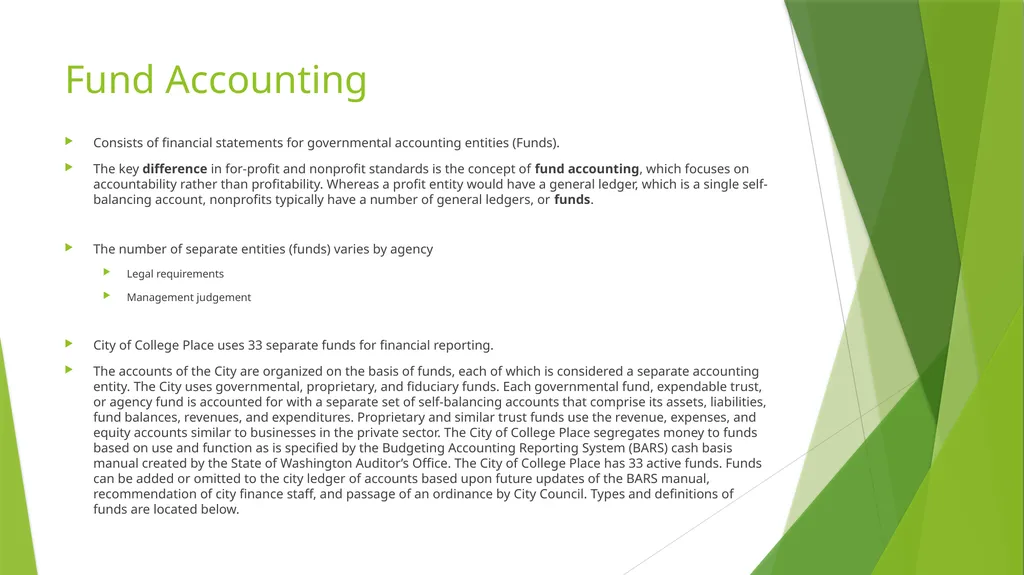
Fund Accounting Consists of financial statements for governmental accounting entities (Funds).
The key difference in for-profit and nonprofit standards is the concept of fund accounting, which focuses on accountability rather than profitability. Whereas a profit entity would have a general ledger, which is a single self-balancing account, nonprofits typically have a number of general ledgers, or funds.
The number of separate entities (funds) varies by agency
Legal requirements
Management judgement
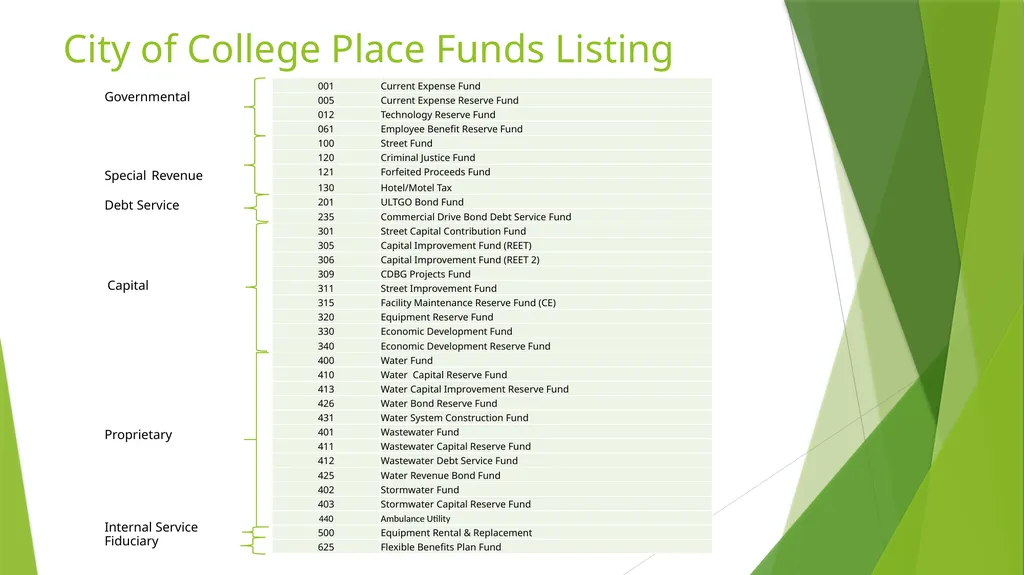
City of College Place uses 33 separate funds for financial reporting.
The accounts of the City are organized on the basis of funds, each of which is considered a separate accounting entity. The City uses governmental, proprietary, and fiduciary funds. Each governmental fund, expendable trust, or agency fund is accounted for with a separate set of self-balancing accounts that comprise its assets, liabilities, fund balances, revenues, and expenditures. Proprietary and similar trust funds use the revenue, expenses, and equity accounts similar to businesses in the private sector. The City of College Place segregates money to funds based on use and function as is specified by the Budgeting Accounting Reporting System (BARS) cash basis manual created by the State of Washington Auditor’s Office. The City of College Place has 33 active funds. Funds can be added or omitted to the city ledger of accounts based upon future updates of the BARS manual, recommendation of city finance staff, and passage of an ordinance by City Council. Types and definitions of funds are located below.<br>
The key difference in for-profit and nonprofit standards is the concept of fund accounting, which focuses on accountability rather than profitability. Whereas a profit entity would have a general ledger, which is a single self-balancing account, nonprofits typically have a number of general ledgers, or funds.
The number of separate entities (funds) varies by agency
Legal requirements
Management judgement
City of College Place uses 33 separate funds for financial reporting.
The accounts of the City are organized on the basis of funds, each of which is considered a separate accounting entity. The City uses governmental, proprietary, and fiduciary funds. Each governmental fund, expendable trust, or agency fund is accounted for with a separate set of self-balancing accounts that comprise its assets, liabilities, fund balances, revenues, and expenditures. Proprietary and similar trust funds use the revenue, expenses, and equity accounts similar to businesses in the private sector. The City of College Place segregates money to funds based on use and function as is specified by the Budgeting Accounting Reporting System (BARS) cash basis manual created by the State of Washington Auditor’s Office. The City of College Place has 33 active funds. Funds can be added or omitted to the city ledger of accounts based upon future updates of the BARS manual, recommendation of city finance staff, and passage of an ordinance by City Council. Types and definitions of funds are located below.<br>
10
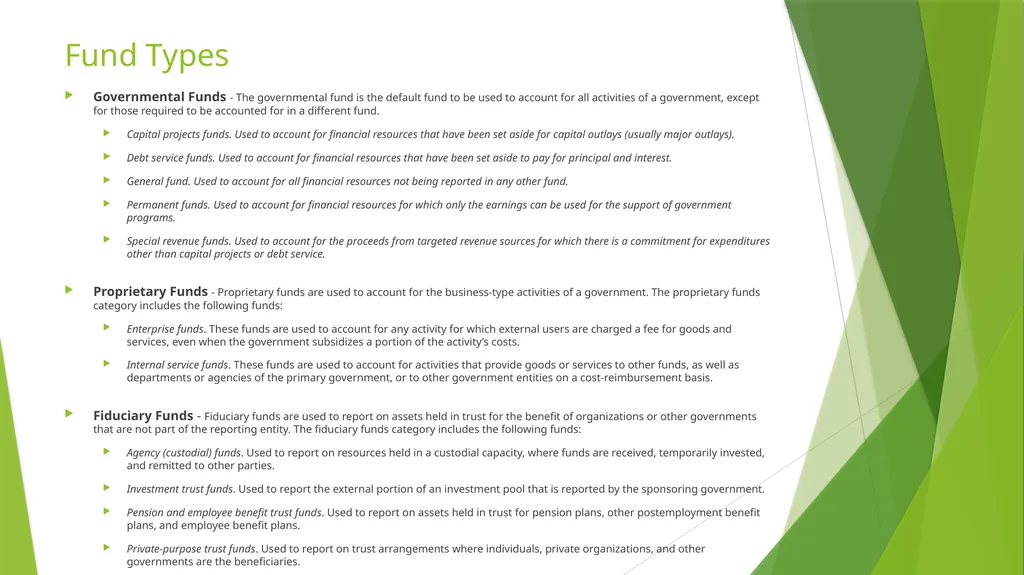
Fund Types Governmental Funds - The governmental fund is the default fund to be used to account for all activities of a government, except for those required to be accounted for in a different fund.
Capital projects funds. Used to account for financial resources that have been set aside for capital outlays (usually major outlays).
Debt service funds. Used to account for financial resources that have been set aside to pay for principal and interest.
General fund. Used to account for all financial resources not being reported in any other fund.
Permanent funds. Used to account for financial resources for which only the earnings can be used for the support of government programs.
Special revenue funds. Used to account for the proceeds from targeted revenue sources for which there is a commitment for expenditures other than capital projects or debt service.
Proprietary Funds - Proprietary funds are used to account for the business-type activities of a government. The proprietary funds category includes the following funds:
Enterprise funds. These funds are used to account for any activity for which external users are charged a fee for goods and services, even when the government subsidizes a portion of the activity’s costs.
Internal service funds. These funds are used to account for activities that provide goods or services to other funds, as well as departments or agencies of the primary government, or to other government entities on a cost-reimbursement basis.
Fiduciary Funds - Fiduciary funds are used to report on assets held in trust for the benefit of organizations or other governments that are not part of the reporting entity. The fiduciary funds category includes the following funds:
Agency (custodial) funds. Used to report on resources held in a custodial capacity, where funds are received, temporarily invested, and remitted to other parties.
Investment trust funds. Used to report the external portion of an investment pool that is reported by the sponsoring government.
Pension and employee benefit trust funds. Used to report on assets held in trust for pension plans, other postemployment benefit plans, and employee benefit plans.
Private-purpose trust funds. Used to report on trust arrangements where individuals, private organizations, and other governments are the beneficiaries.<br>
Capital projects funds. Used to account for financial resources that have been set aside for capital outlays (usually major outlays).
Debt service funds. Used to account for financial resources that have been set aside to pay for principal and interest.
General fund. Used to account for all financial resources not being reported in any other fund.
Permanent funds. Used to account for financial resources for which only the earnings can be used for the support of government programs.
Special revenue funds. Used to account for the proceeds from targeted revenue sources for which there is a commitment for expenditures other than capital projects or debt service.
Proprietary Funds - Proprietary funds are used to account for the business-type activities of a government. The proprietary funds category includes the following funds:
Enterprise funds. These funds are used to account for any activity for which external users are charged a fee for goods and services, even when the government subsidizes a portion of the activity’s costs.
Internal service funds. These funds are used to account for activities that provide goods or services to other funds, as well as departments or agencies of the primary government, or to other government entities on a cost-reimbursement basis.
Fiduciary Funds - Fiduciary funds are used to report on assets held in trust for the benefit of organizations or other governments that are not part of the reporting entity. The fiduciary funds category includes the following funds:
Agency (custodial) funds. Used to report on resources held in a custodial capacity, where funds are received, temporarily invested, and remitted to other parties.
Investment trust funds. Used to report the external portion of an investment pool that is reported by the sponsoring government.
Pension and employee benefit trust funds. Used to report on assets held in trust for pension plans, other postemployment benefit plans, and employee benefit plans.
Private-purpose trust funds. Used to report on trust arrangements where individuals, private organizations, and other governments are the beneficiaries.<br>
11
City of College Place Funds Listing Governmental Special Revenue Debt Service Capital Proprietary Internal Service Fiduciary<br>
12
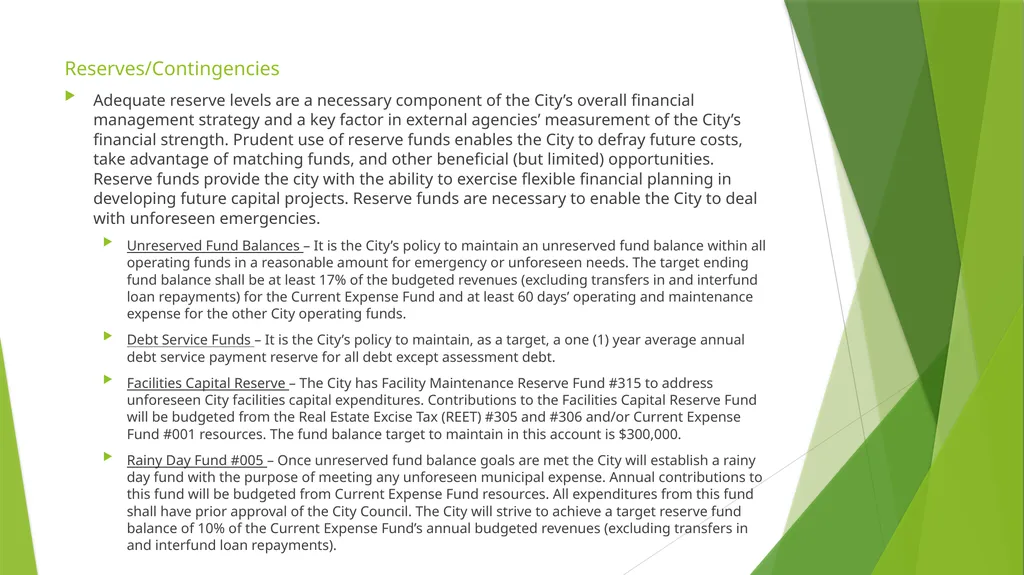
Reserves/Contingencies Adequate reserve levels are a necessary component of the City’s overall financial management strategy and a key factor in external agencies’ measurement of the City’s financial strength. Prudent use of reserve funds enables the City to defray future costs, take advantage of matching funds, and other beneficial (but limited) opportunities. Reserve funds provide the city with the ability to exercise flexible financial planning in developing future capital projects. Reserve funds are necessary to enable the City to deal with unforeseen emergencies.
Unreserved Fund Balances – It is the City’s policy to maintain an unreserved fund balance within all operating funds in a reasonable amount for emergency or unforeseen needs. The target ending fund balance shall be at least 17% of the budgeted revenues (excluding transfers in and interfund loan repayments) for the Current Expense Fund and at least 60 days’ operating and maintenance expense for the other City operating funds.
Debt Service Funds – It is the City’s policy to maintain, as a target, a one (1) year average annual debt service payment reserve for all debt except assessment debt.
Facilities Capital Reserve – The City has Facility Maintenance Reserve Fund #315 to address unforeseen City facilities capital expenditures. Contributions to the Facilities Capital Reserve Fund will be budgeted from the Real Estate Excise Tax (REET) #305 and #306 and/or Current Expense Fund #001 resources. The fund balance target to maintain in this account is $300,000.
Rainy Day Fund #005 – Once unreserved fund balance goals are met the City will establish a rainy day fund with the purpose of meeting any unforeseen municipal expense. Annual contributions to this fund will be budgeted from Current Expense Fund resources. All expenditures from this fund shall have prior approval of the City Council. The City will strive to achieve a target reserve fund balance of 10% of the Current Expense Fund’s annual budgeted revenues (excluding transfers in and interfund loan repayments).<br>
Unreserved Fund Balances – It is the City’s policy to maintain an unreserved fund balance within all operating funds in a reasonable amount for emergency or unforeseen needs. The target ending fund balance shall be at least 17% of the budgeted revenues (excluding transfers in and interfund loan repayments) for the Current Expense Fund and at least 60 days’ operating and maintenance expense for the other City operating funds.
Debt Service Funds – It is the City’s policy to maintain, as a target, a one (1) year average annual debt service payment reserve for all debt except assessment debt.
Facilities Capital Reserve – The City has Facility Maintenance Reserve Fund #315 to address unforeseen City facilities capital expenditures. Contributions to the Facilities Capital Reserve Fund will be budgeted from the Real Estate Excise Tax (REET) #305 and #306 and/or Current Expense Fund #001 resources. The fund balance target to maintain in this account is $300,000.
Rainy Day Fund #005 – Once unreserved fund balance goals are met the City will establish a rainy day fund with the purpose of meeting any unforeseen municipal expense. Annual contributions to this fund will be budgeted from Current Expense Fund resources. All expenditures from this fund shall have prior approval of the City Council. The City will strive to achieve a target reserve fund balance of 10% of the Current Expense Fund’s annual budgeted revenues (excluding transfers in and interfund loan repayments).<br>
13
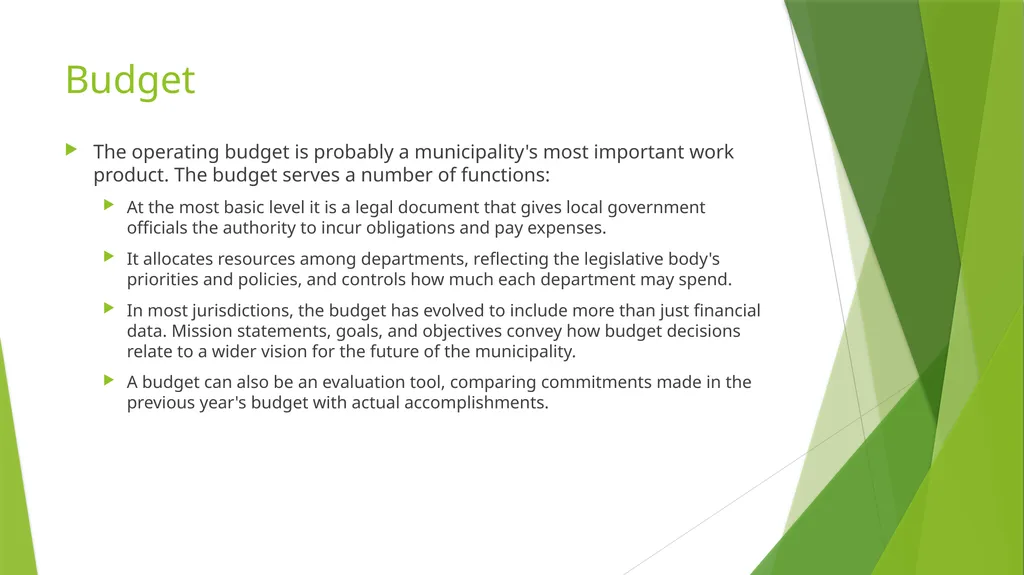
Budget The operating budget is probably a municipality's most important work product. The budget serves a number of functions:
At the most basic level it is a legal document that gives local government officials the authority to incur obligations and pay expenses.
It allocates resources among departments, reflecting the legislative body's priorities and policies, and controls how much each department may spend.
In most jurisdictions, the budget has evolved to include more than just financial data. Mission statements, goals, and objectives convey how budget decisions relate to a wider vision for the future of the municipality.
A budget can also be an evaluation tool, comparing commitments made in the previous year's budget with actual accomplishments.<br>
At the most basic level it is a legal document that gives local government officials the authority to incur obligations and pay expenses.
It allocates resources among departments, reflecting the legislative body's priorities and policies, and controls how much each department may spend.
In most jurisdictions, the budget has evolved to include more than just financial data. Mission statements, goals, and objectives convey how budget decisions relate to a wider vision for the future of the municipality.
A budget can also be an evaluation tool, comparing commitments made in the previous year's budget with actual accomplishments.<br>
14
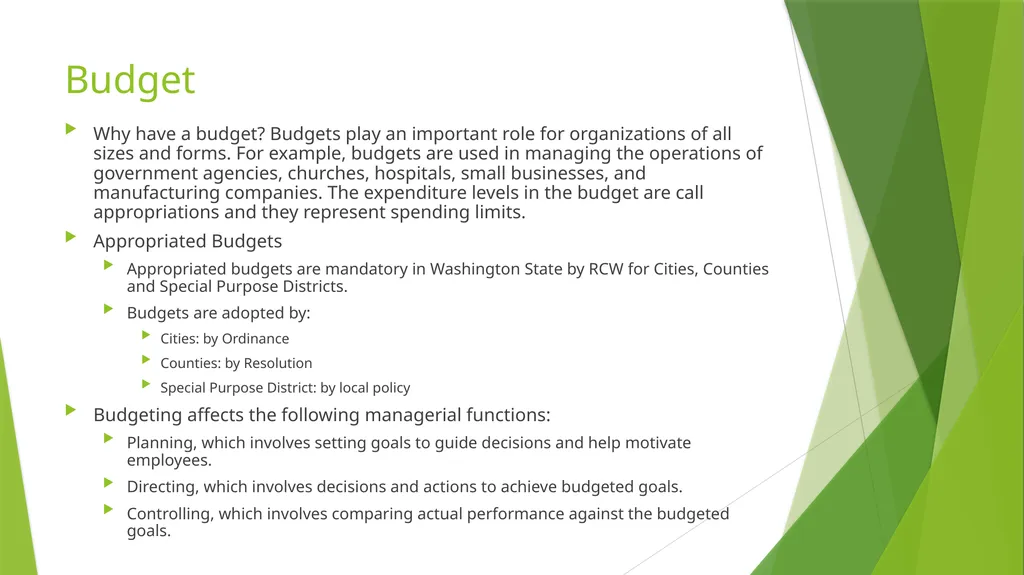
Budget Why have a budget? Budgets play an important role for organizations of all sizes and forms. For example, budgets are used in managing the operations of government agencies, churches, hospitals, small businesses, and manufacturing companies. The expenditure levels in the budget are call appropriations and they represent spending limits.
Appropriated Budgets
Appropriated budgets are mandatory in Washington State by RCW for Cities, Counties and Special Purpose Districts.
Budgets are adopted by:
Cities: by Ordinance
Counties: by Resolution
Special Purpose District: by local policy
Budgeting affects the following managerial functions:
Planning, which involves setting goals to guide decisions and help motivate employees.
Directing, which involves decisions and actions to achieve budgeted goals.
Controlling, which involves comparing actual performance against the budgeted goals.<br>
Appropriated Budgets
Appropriated budgets are mandatory in Washington State by RCW for Cities, Counties and Special Purpose Districts.
Budgets are adopted by:
Cities: by Ordinance
Counties: by Resolution
Special Purpose District: by local policy
Budgeting affects the following managerial functions:
Planning, which involves setting goals to guide decisions and help motivate employees.
Directing, which involves decisions and actions to achieve budgeted goals.
Controlling, which involves comparing actual performance against the budgeted goals.<br>
15
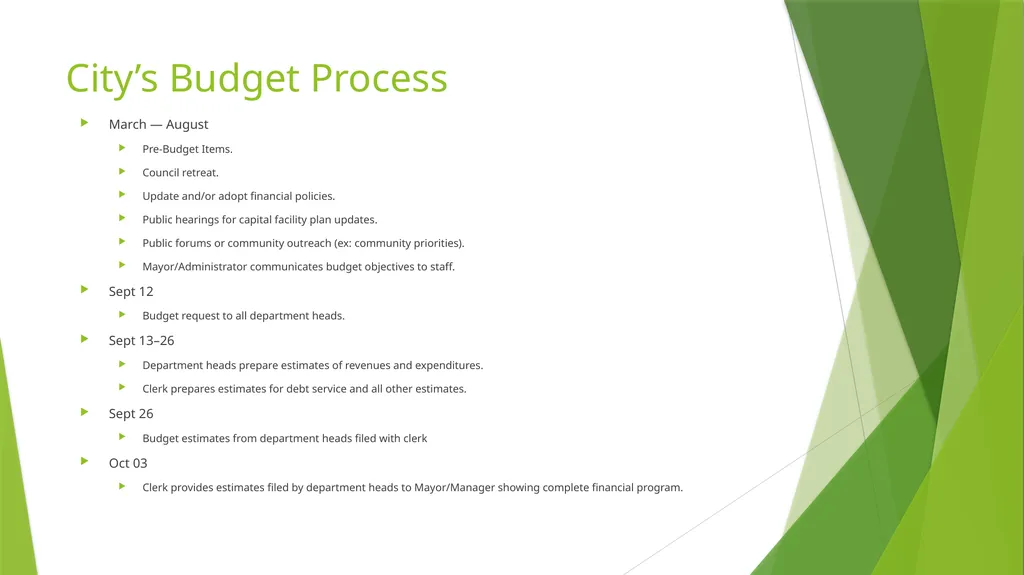
City’s Budget Process March — August
Pre-Budget Items.
Council retreat.
Update and/or adopt financial policies.
Public hearings for capital facility plan updates.
Public forums or community outreach (ex: community priorities).
Mayor/Administrator communicates budget objectives to staff.
Sept 12
Budget request to all department heads.
Sept 13–26
Department heads prepare estimates of revenues and expenditures.
Clerk prepares estimates for debt service and all other estimates.
Sept 26
Budget estimates from department heads filed with clerk
Oct 03
Clerk provides estimates filed by department heads to Mayor/Manager showing complete financial program.<br>
Pre-Budget Items.
Council retreat.
Update and/or adopt financial policies.
Public hearings for capital facility plan updates.
Public forums or community outreach (ex: community priorities).
Mayor/Administrator communicates budget objectives to staff.
Sept 12
Budget request to all department heads.
Sept 13–26
Department heads prepare estimates of revenues and expenditures.
Clerk prepares estimates for debt service and all other estimates.
Sept 26
Budget estimates from department heads filed with clerk
Oct 03
Clerk provides estimates filed by department heads to Mayor/Manager showing complete financial program.<br>
16
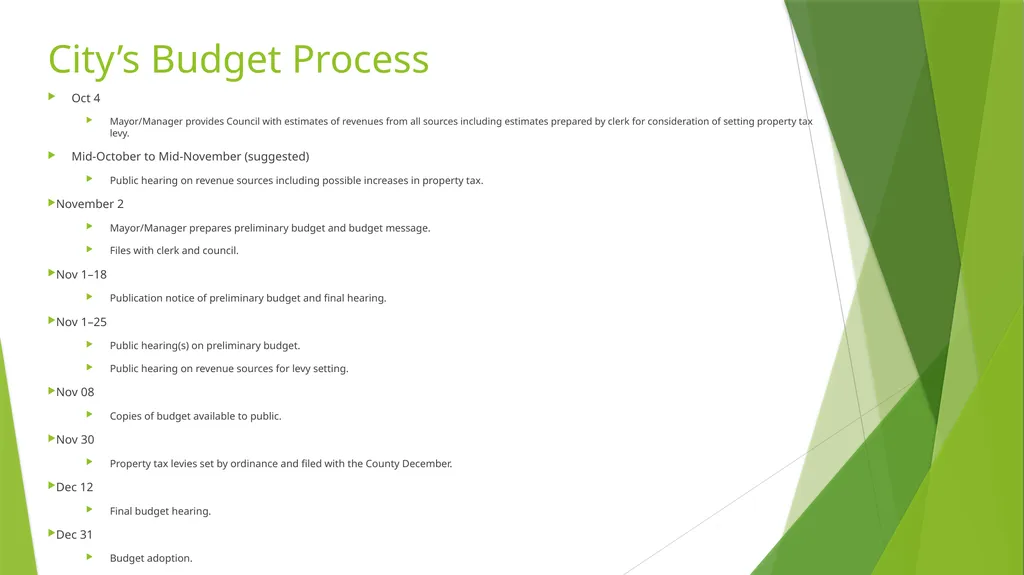
City’s Budget Process Oct 4
Mayor/Manager provides Council with estimates of revenues from all sources including estimates prepared by clerk for consideration of setting property tax levy.
Mid-October to Mid-November (suggested)
Public hearing on revenue sources including possible increases in property tax.
November 2
Mayor/Manager prepares preliminary budget and budget message.
Files with clerk and council.
Nov 1–18
Publication notice of preliminary budget and final hearing.
Nov 1–25
Public hearing(s) on preliminary budget.
Public hearing on revenue sources for levy setting.
Nov 08
Copies of budget available to public.
Nov 30
Property tax levies set by ordinance and filed with the County December.
Dec 12
Final budget hearing.
Dec 31
Budget adoption.<br>
Mayor/Manager provides Council with estimates of revenues from all sources including estimates prepared by clerk for consideration of setting property tax levy.
Mid-October to Mid-November (suggested)
Public hearing on revenue sources including possible increases in property tax.
November 2
Mayor/Manager prepares preliminary budget and budget message.
Files with clerk and council.
Nov 1–18
Publication notice of preliminary budget and final hearing.
Nov 1–25
Public hearing(s) on preliminary budget.
Public hearing on revenue sources for levy setting.
Nov 08
Copies of budget available to public.
Nov 30
Property tax levies set by ordinance and filed with the County December.
Dec 12
Final budget hearing.
Dec 31
Budget adoption.<br>
17
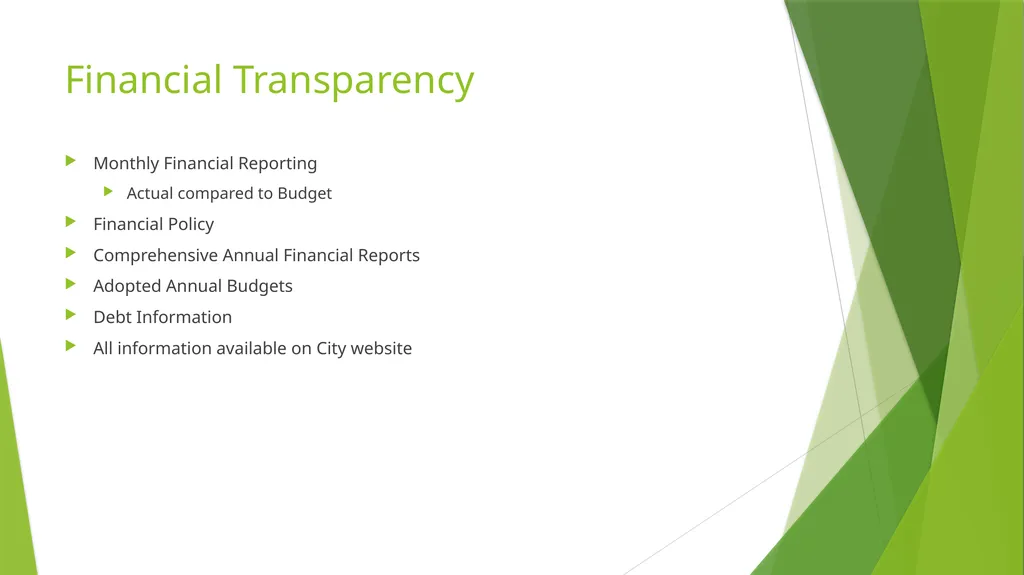
Financial Transparency Monthly Financial Reporting
Actual compared to Budget
Financial Policy
Comprehensive Annual Financial Reports
Adopted Annual Budgets
Debt Information
All information available on City website<br>
Actual compared to Budget
Financial Policy
Comprehensive Annual Financial Reports
Adopted Annual Budgets
Debt Information
All information available on City website<br>
18
Questions???<br>