Grant, Lord, that we may be kept this night without sin. Blessed are You, Lord God of our Fathers, and praised and glorified is Your name for ever. Amen. May Your mercy be upon us, Lord, just as we have hoped in You. Blessed are You, Lord,
"Grant, Lord, that we may be kept this night" is the property of its rightful owner. Permission is granted to
download and print the materials on this website for personal, non-commercial use only, and to display it
on your personal computer provided you do not modify the materials and that you retain all copyright
notices contained in the materials. By downloading content from our website, you accept the terms of this
agreement.
Presentation Transcript
01
Grant, Lord, that we may be kept this night without sin. Blessed are You, Lord God of our Fathers, and praised and glorified is Your name for ever. Amen. May Your mercy be upon us, Lord, just as we have hoped in You. Blessed are You, Lord, teach me Your judgements. Blessed are You, Master, give me understanding of Your judgements. Blessed are You, Holy One, enlighten me with Your judgements. Lord, Your mercy endures for ever, do not disregard the works of Your hands. To You is due praise, to You is due song, glory is due to You. Father, Son and Holy Spirit, now and ever and to the ages of ages. Amen. 1<br>
02
Three Stages Walking the Spiritual Path Revd Dr Doru Costache
Senior Lecturer in Patristics, SAGOTC
Kogarah Fellowship
12 / 03 / 12<br>
03
The beginning of all becoming The Christian lifestyle as a life-changing experience
The leap of faith or the beginning of the transformative process
Faith as change of mentality adopting a new, Christ-centred and Christ-like worldview 3<br>
04
Walking the path The Christian lifestyle as a dynamic process or reorientation, an ‘adventure’ (getting somewhere)
Faith is the premise of the journey but actually walking the path is what makes the journey an adventure 4<br>
05
The method The journey is impossible without guidelines or a method
Ecclesial tradition provides us with the necessary method yet the latter is useless without a genuine faith commitment 5<br>
06
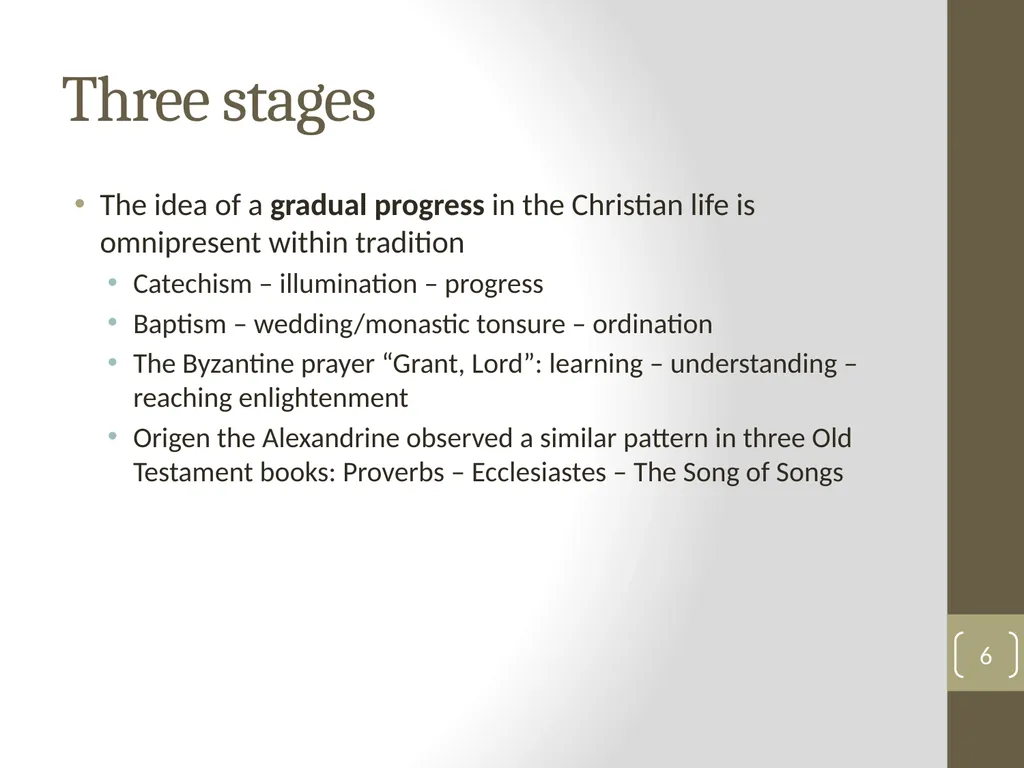
Three stages The idea of a gradual progress in the Christian life is omnipresent within tradition
Catechism – illumination – progress
Baptism – wedding/monastic tonsure – ordination
The Byzantine prayer “Grant, Lord”: learning – understanding – reaching enlightenment
Origen the Alexandrine observed a similar pattern in three Old Testament books: Proverbs – Ecclesiastes – The Song of Songs 6<br>
07
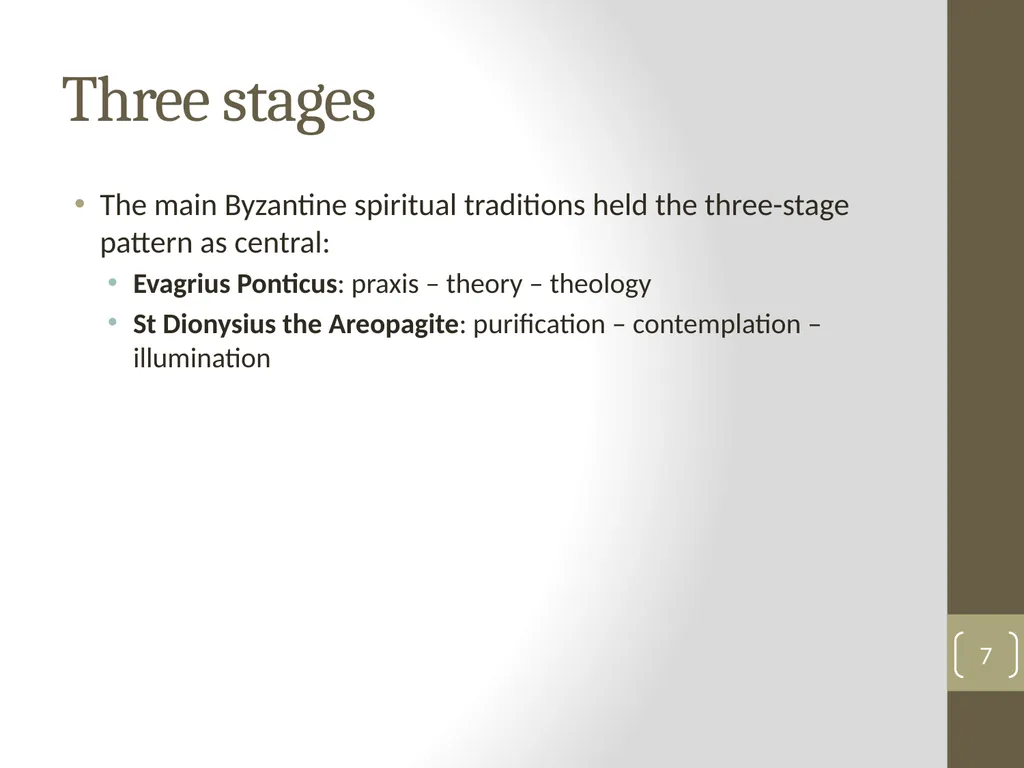
Three stages The main Byzantine spiritual traditions held the three-stage pattern as central:
Evagrius Ponticus: praxis – theory – theology
St Dionysius the Areopagite: purification – contemplation – illumination 7<br>
08
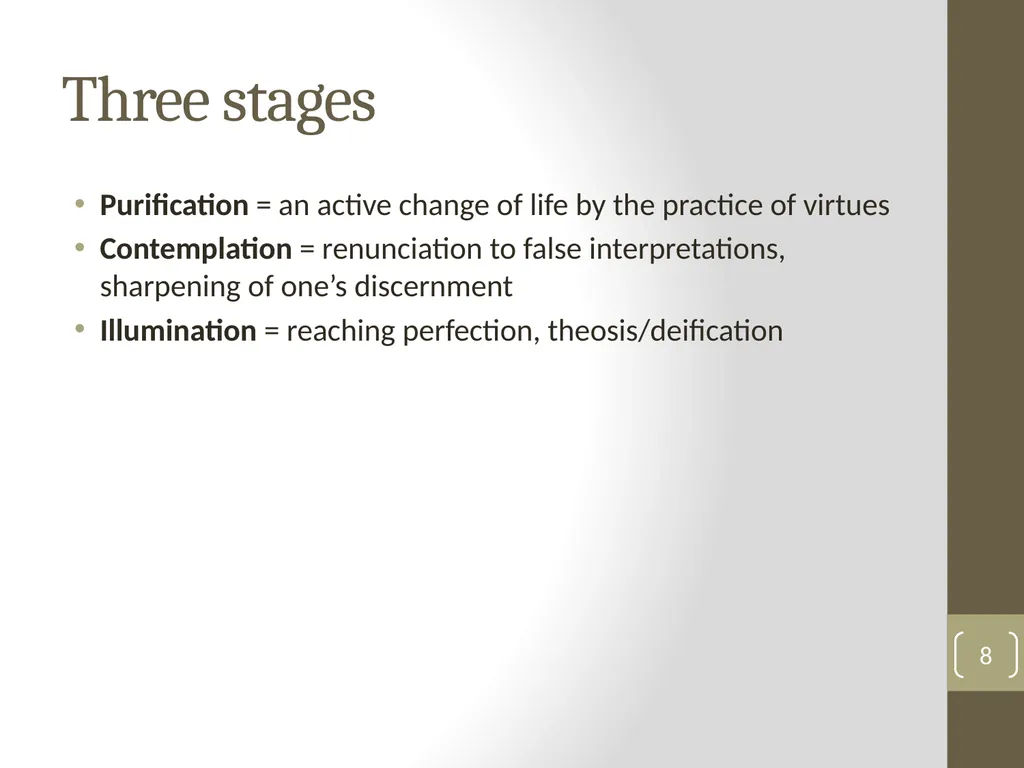
Three stages Purification = an active change of life by the practice of virtues
Contemplation = renunciation to false interpretations, sharpening of one’s discernment
Illumination = reaching perfection, theosis/deification 8<br>
09
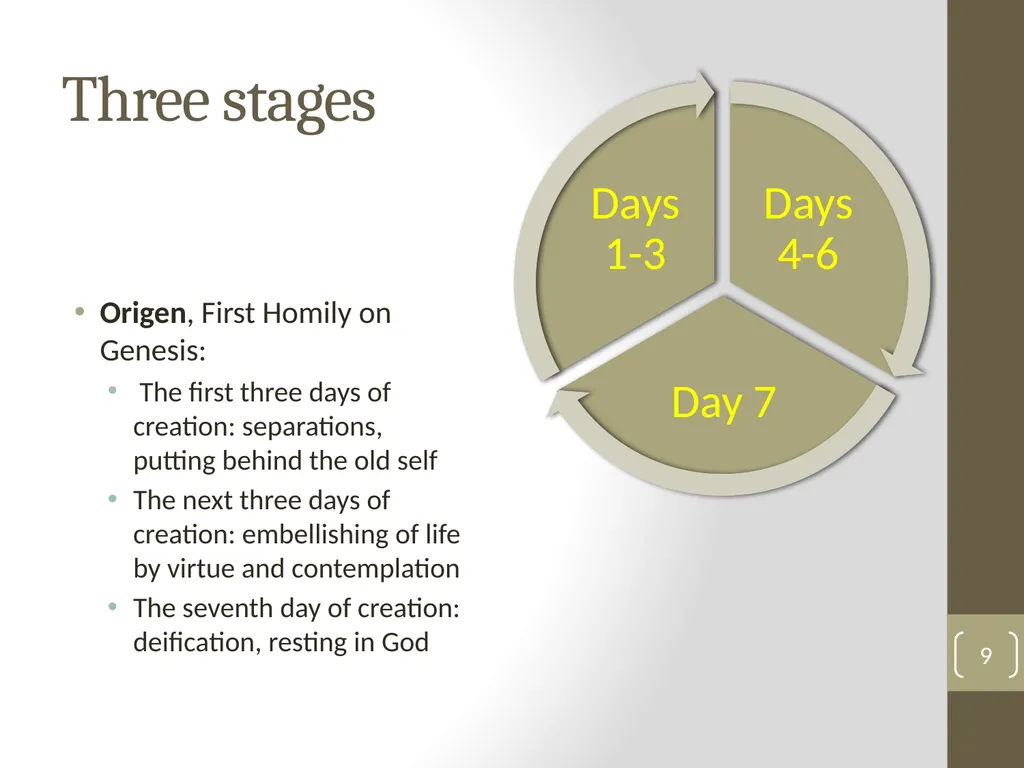
Three stages Origen, First Homily on Genesis:
The first three days of creation: separations, putting behind the old self
The next three days of creation: embellishing of life by virtue and contemplation
The seventh day of creation: deification, resting in God 9<br>
10
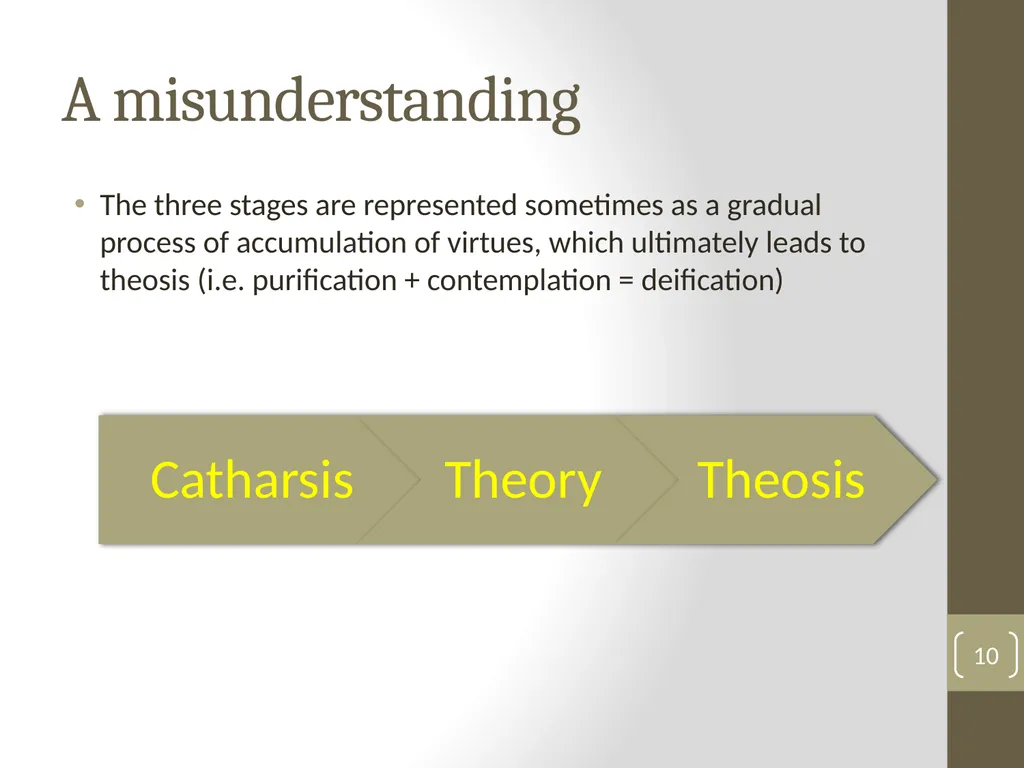
A misunderstanding The three stages are represented sometimes as a gradual process of accumulation of virtues, which ultimately leads to theosis (i.e. purification + contemplation = deification) 10<br>
11
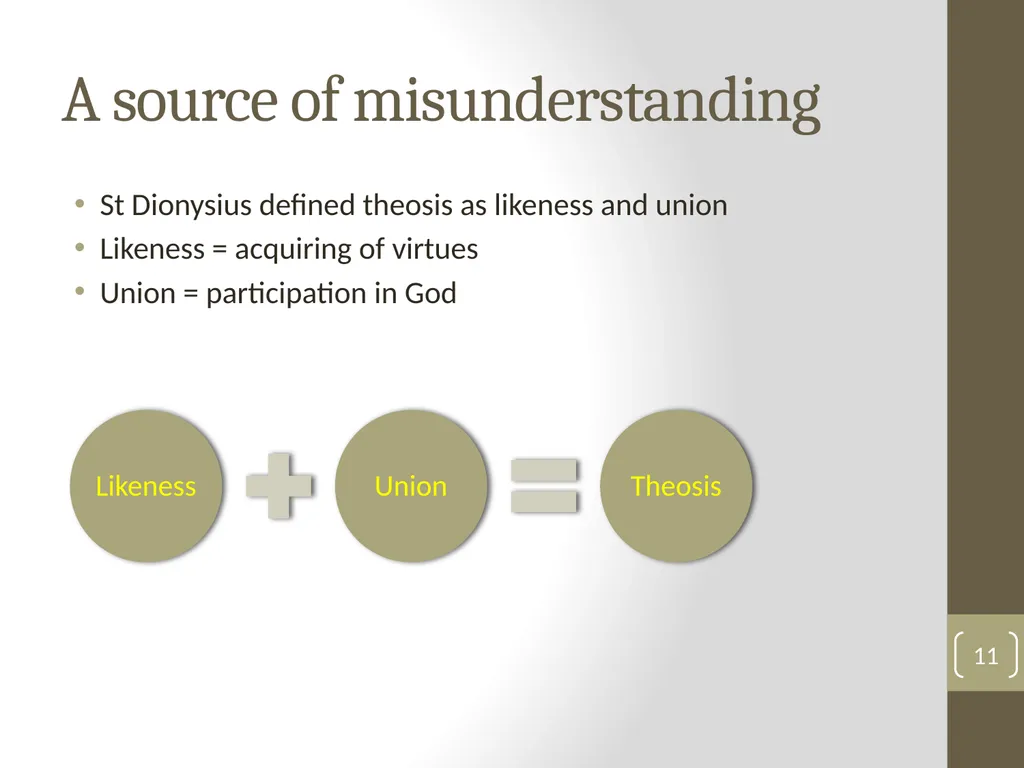
A source of misunderstanding St Dionysius defined theosis as likeness and union
Likeness = acquiring of virtues
Union = participation in God 11<br>
12
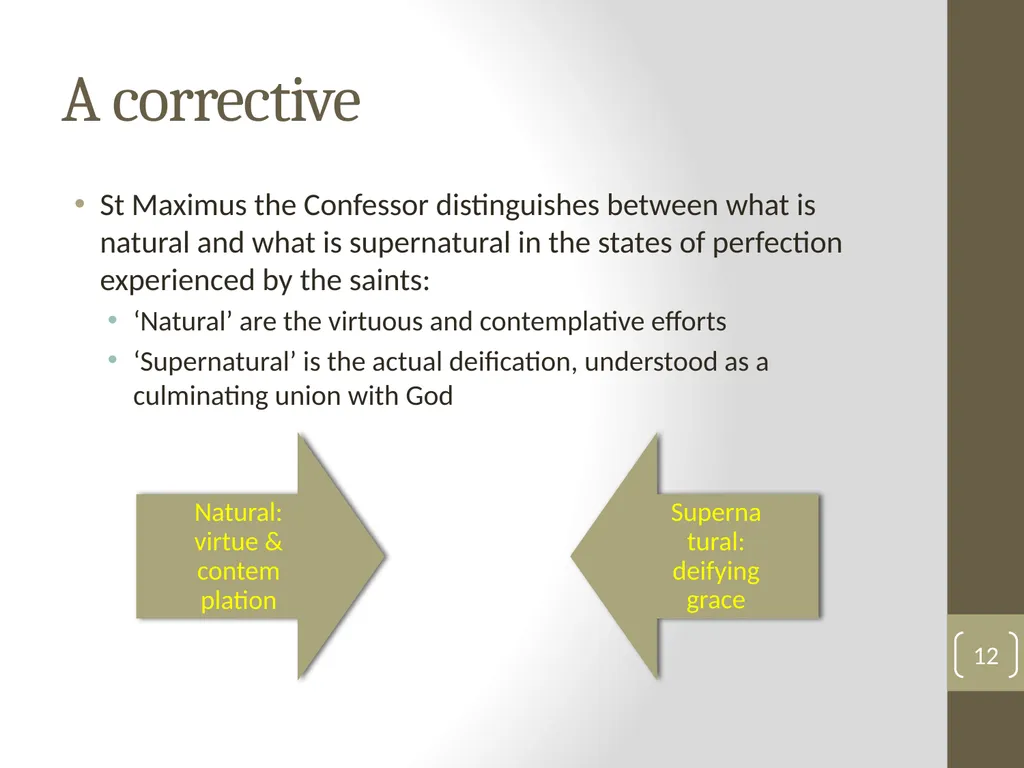
A corrective St Maximus the Confessor distinguishes between what is natural and what is supernatural in the states of perfection experienced by the saints:
‘Natural’ are the virtuous and contemplative efforts
‘Supernatural’ is the actual deification, understood as a culminating union with God 12<br>