Grant writing Lots of resources on line and in

Published  . 0 views
↓ Download
Grant writing Lots of resources on line and in
1 / 1
Grant writing Lots of resources on line and in - slide 1 of 69 Grant writing Lots of resources on line and in - slide 2 of 69 Grant writing Lots of resources on line and in - slide 3 of 69 Grant writing Lots of resources on line and in - slide 4 of 69 Grant writing Lots of resources on line and in - slide 5 of 69 Grant writing Lots of resources on line and in - slide 6 of 69 Grant writing Lots of resources on line and in - slide 7 of 69 Grant writing Lots of resources on line and in - slide 8 of 69 Grant writing Lots of resources on line and in - slide 9 of 69 Grant writing Lots of resources on line and in - slide 10 of 69 Grant writing Lots of resources on line and in - slide 11 of 69 Grant writing Lots of resources on line and in - slide 12 of 69 Grant writing Lots of resources on line and in - slide 13 of 69 Grant writing Lots of resources on line and in - slide 14 of 69 Grant writing Lots of resources on line and in - slide 15 of 69 Grant writing Lots of resources on line and in - slide 16 of 69 Grant writing Lots of resources on line and in - slide 17 of 69 Grant writing Lots of resources on line and in - slide 18 of 69 Grant writing Lots of resources on line and in - slide 19 of 69 Grant writing Lots of resources on line and in - slide 20 of 69 Grant writing Lots of resources on line and in - slide 21 of 69 Grant writing Lots of resources on line and in - slide 22 of 69 Grant writing Lots of resources on line and in - slide 23 of 69 Grant writing Lots of resources on line and in - slide 24 of 69 Grant writing Lots of resources on line and in - slide 25 of 69 Grant writing Lots of resources on line and in - slide 26 of 69 Grant writing Lots of resources on line and in - slide 27 of 69 Grant writing Lots of resources on line and in - slide 28 of 69 Grant writing Lots of resources on line and in - slide 29 of 69 Grant writing Lots of resources on line and in - slide 30 of 69 Grant writing Lots of resources on line and in - slide 31 of 69 Grant writing Lots of resources on line and in - slide 32 of 69 Grant writing Lots of resources on line and in - slide 33 of 69 Grant writing Lots of resources on line and in - slide 34 of 69 Grant writing Lots of resources on line and in - slide 35 of 69 Grant writing Lots of resources on line and in - slide 36 of 69 Grant writing Lots of resources on line and in - slide 37 of 69 Grant writing Lots of resources on line and in - slide 38 of 69 Grant writing Lots of resources on line and in - slide 39 of 69 Grant writing Lots of resources on line and in - slide 40 of 69 Grant writing Lots of resources on line and in - slide 41 of 69 Grant writing Lots of resources on line and in - slide 42 of 69 Grant writing Lots of resources on line and in - slide 43 of 69 Grant writing Lots of resources on line and in - slide 44 of 69 Grant writing Lots of resources on line and in - slide 45 of 69 Grant writing Lots of resources on line and in - slide 46 of 69 Grant writing Lots of resources on line and in - slide 47 of 69 Grant writing Lots of resources on line and in - slide 48 of 69 Grant writing Lots of resources on line and in - slide 49 of 69 Grant writing Lots of resources on line and in - slide 50 of 69 Grant writing Lots of resources on line and in - slide 51 of 69 Grant writing Lots of resources on line and in - slide 52 of 69 Grant writing Lots of resources on line and in - slide 53 of 69 Grant writing Lots of resources on line and in - slide 54 of 69 Grant writing Lots of resources on line and in - slide 55 of 69 Grant writing Lots of resources on line and in - slide 56 of 69 Grant writing Lots of resources on line and in - slide 57 of 69 Grant writing Lots of resources on line and in - slide 58 of 69 Grant writing Lots of resources on line and in - slide 59 of 69 Grant writing Lots of resources on line and in - slide 60 of 69 Grant writing Lots of resources on line and in - slide 61 of 69 Grant writing Lots of resources on line and in - slide 62 of 69 Grant writing Lots of resources on line and in - slide 63 of 69 Grant writing Lots of resources on line and in - slide 64 of 69 Grant writing Lots of resources on line and in - slide 65 of 69 Grant writing Lots of resources on line and in - slide 66 of 69 Grant writing Lots of resources on line and in - slide 67 of 69 Grant writing Lots of resources on line and in - slide 68 of 69 Grant writing Lots of resources on line and in - slide 69 of 69
Description: Grant writing Lots of resources on line and in books for how to write a successful grant. Hynda K. Kleinman hyndakkaol.com https:www.nlm.nih.govepTutorial.html https:grants.nih.govgrantswritingapplication.htm Annotated Sample R01

Related Topics

Download Presentation

"Grant writing Lots of resources on line and in" is the property of its rightful owner. Permission is granted to download and print the materials on this website for personal, non-commercial use only, and to display it on your personal computer provided you do not modify the materials and that you retain all copyright notices contained in the materials. By downloading content from our website, you accept the terms of this agreement.

Presentation Transcript

slide1. Grant writing

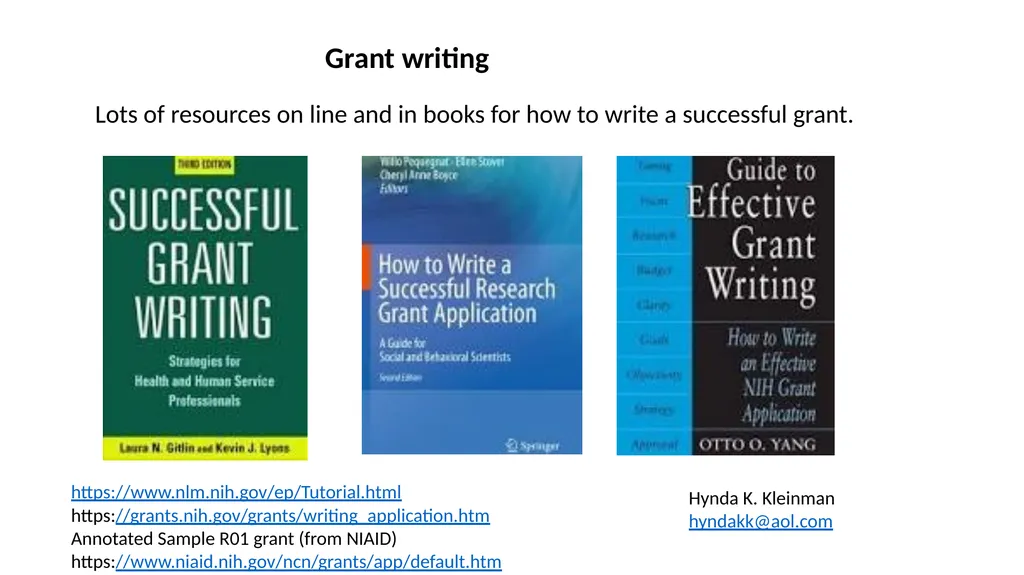
Lots of resources on line and in books for how to write a successful grant. Hynda K. Kleinman
hyndakk@aol.com https://www.nlm.nih.gov/ep/Tutorial.html https://grants.nih.gov/grants/writing_application.htm
Annotated Sample R01 grant (from NIAID) https://www.niaid.nih.gov/ncn/grants/app/default.htm<br>
slide2. Outline of talk on grant writing

1. Find a grant
2. Introduction to important aspects of grant writing, success, and failure
3. Plan your grant (before you begin writing!)
Read Instructions and follow EXACT directions
Organize your time
Be sure to have vertebrate animal/human subjects approvals
Get collaborators, their support letters, and curriculum vitae
Know review criteria of the grant
4. Writing the grant
Specific aims/summary
Title of grant
Introduction
Research Plan
Conclusion and Timeline
Personnel
Budget
Resource sharing
Vertebrate animals/human subjects
References<br>
slide3. Where to find a grant? Available on amazon!
Get your institution to buy/subscribe to it?<br>
slide4. Find grant sources

Ask the head of your lab or institution, colleagues, etc
Foundation Directory
Professional society: homepage, newsletters, meetings (go to the booths)
Companies-many have grant programs or want to have collaborations
Many grants require international collaborators (network, network, network)
Use Google to find Foundations for your area of research
Manuscript acknowledgements (Journals in your field or in pubmed)<br>
slide5. Manuscript acknowledgements as place to find funding sources
Pubmed: I typed in “Tissue repair and Italy” and looked only at papers with Italian names

Funding
This research was supported by the Italian Association for Cancer Research (to D.C. IG10341 and IG18776; to A.L. 20786), PON01–00862 from MIUR, PNR-CNR Aging Program 2012–2014, Flagship project Nanomax, “FaReBio di Qualità”, OcKey POR Campania FSE 2007/2013, PRONAT project, the SATIN POR project 2014–2020 and the Italian MIUR Cluster project Medintech (CNT01_00177_962865). A.V. and M.V. received Fellowships from the Italian Foundation for Cancer Research (FIRC, Milan, Italy).

Funding
This work was supported by grants from the Italian Ministry of Health (IT-MOH) through “Ricerca Corrente”. MG receives funding from the institutional “Ricerca Corrente”.

ACKNOWLEDGMENTS
Study supported by Associazione Federica per la Vita and the Italian Ministry of Health, Ricerca Corrente, Line 1, Project “Genetics of hereditary/familial tumors”.

Acknowledgments
This work was supported by the “Advanced Therapies for End-stage Organ Diseases” Project of UPMC International (Grant number: I00000171).

Funding: This work was supported by the Associazione Italiana per la Ricerca sul Cancro (IG 11484 to M.C.; IG 15359 and IG 20264 to E.T.) and by Fondazione Umberto Veronesi (Fellowship 2017 and 2018 to F.B.).<br>
slide6. Grant Source Examples from manuscript acknowledgements
European Science Foundation
European Research Council
European Center for Allergy Research Foundation
American Italian Cancer Foundation
Human Health Foundation
European Skin Research Foundation
Foundazione Banco di Sardegna
Italian National Research Council
International Scientific Institute “Paolo VI” (ISI)
MIUR (Ministry of Education, University & Research Pallotti Foundation
Minestero Della Salute, Ricerca Finalizzata
PRIN
Fondazione Roma
Foundation Franco & Piero Cutino
AIRC
British Heart Foundation

NovoNordisk
Minestero della Salute Progetto Finalizzato
European Foundation for the Study of Diabetes<br>
slide7. For grant sources: Think beyond your field and apply for more than one grant
Example: I am in the wound healing field ?Where to find funds?
Wound healing journals: ads and acknowledgements
Wound Healing Society: meeting, newsletter, networking
Wound healing company: grants or collaboration
Aged, diabetic, paralyzed patients all suffer impaired wound healing…go to websites, societies, foundations, journals in these research areas
Heart attack and stroke patients suffer internal wounds…go to companies, websites, societies, foundations, etc.
Eye diseases often involve damage/wounds to the eye so companies interested in eye care and organizations/foundations focused on eye diseases.
Military: combat wounds and biological warfare (sulfur mustards)…see if military has research awards.<br>
slide8. Connect your grant to the funding agency’s mission statement:
Use similar words in your grant (in the Significance section or even the title)

International Diabetes Foundation mission:
Promoting diabetes care, prevention, and a cure worldwide.

AIRC mission: Understand, prevent and cure cancer through research and outreach activities. AIRC aims to find solutions to challenges in cancer research, awarding grants to the most deserving projects, as well as supporting training fellowships.

British Heart Foundation mission: play a leading role in the fight against disease of the heart and circulation so that it is no longer a major cause of disability and premature death.
(Example: This grant will not only provide a better understanding of the mechanism by which growth factor x improves blood flow. These studies also have the potential for defining new therapeutics to prevent premature death due to heart disease.<br>
slide9. Important aspects of grant writing<br>
slide10. Overall written grant

Grant must address these questions:
What you plan to accomplish?
Why you want to do it?
How you are going to do it?

You must convince your readers that:
You have an important research idea,
You understand the relevant literature/major issues,
Your methodology is sound,
You can do the proposed study.<br>
slide11. The quality of your research grant depends not only on the quality of your proposed project, but also on the quality of your writing.

A good research project may be rejected if it is poorly written or hard to understand. The reviewers are not all experts in your research area so make everything very clear! The written document should be clear, understandable, and convincing (persuasive)<br>
slide12. Most common reasons for rejection are a surprisingly simple failures:

*Deadline for submission not met.
*Topic was not appropriate for the funding agency.
*Guidelines for proposal content, format, and/or length were not followed exactly.
*Required documentation missing.
*Proposed question, design, method were completely traditional, with nothing unusual, intriguing, or clever.
*Proposal was not absolutely clear.
*Proposal was not complete.
*Authors review of the literature indicated they did not know the field.
*Proposed study was beyond the capacity of the authors.

www.firstnonprofit.org/grant-giving/top-six-reasons-grant-applications-rejected
Adapted from: Locke, L.F., W.W. Spirduso, and S.J. Silverman. 1987. Proposals that Work. Second edition. Newbury Park, CA: Sage Publications, Inc., by the University of Montana’s Office of the Vice President for Research & Creative Scholarship.<br>
slide13. Most common reasons for grant rejection (continued)

Methods were unsuited for the research.
Budget was unrealistic
Authors were highly biased on issues.
Poor writing quality (e.g., broad claims, unclear reasoning, excessive repetitions, unreasonable length).
An unreasonable number of mechanical/technical defects that reflected carelessness and the author’s lack of attention to detail.

Because the probability of rejection is high, it is particularly important to be mindful of these items. The good news is that most on the rejections reasons are within your control!<br>
slide14. Plan your grant<br>
slide15. Plan your grant: Organize your time to complete the application 

Identify a gap in knowledge

Develop a feasible timeline. Be realistic about the time it can take to write/revise the application, incorporate feedback, and submit

Get prior approvals from your institution if needed

Get required documentation for animals, patients samples, use of core facility, etc

Missing one item such as the animal protocol number can result in rejection!<br>
slide16. Plan your grant (continued)

Make sure your specific research aims can be accomplished within the proposed time and with the resources you have.

Make sure you have adequate preliminary data if needed.

Identifying experienced investigators to review a draft of your application and provide feedback.

Find collaborators and get them to agree to read the proposal, provide a support letter, and their resume in the correct format

Submit your application well ahead of the deadline (days ahead!)<br>
slide17. Letterhead

Mayo Clinic 200 First Street SW Rochester, MN 55905
From Thomas C. Smyrk, M. D. Division of Anatomic Pathology
June 18, 2015
To: William A. Faubion, M. D. Gastroenterology and Hepatology Mayo 9 East

Dear Bill:
I am happy to provide this letter of collaboration in support of your grant proposal entitled "Inflammatory cascades disrupt Treg function through epigenetic mechanisms." As an expert GI pathologist, I look forward to our continued collaboration as it relates to interpretation of colitis in your murine models. We have used our blinded histologic scoring assay successfully in our recent collaborative papers. I look forward to our continued work in your new studies of the treatment of active colitis with Treg cellular therapy.

Note: How short the letter is.
Required: letterhead, title of grant, expertise, and agreement to work on aspect of project. Mention previous collaboration if relevant. Example: Collaboration letter<br>
slide18. Plan your grant: What to do first when writing a grant application

Read all of the instructions on the organization website (Mission statement)
Is proposal a “match for the objective of the granting organization? (Up to 80% of grant applications for some organizations are not reviewed because the proposal does not match the organization’s goals).

Follow the directions exactly for every item
Page limit for total grant & for specific sections
Font size and margins
Character limit of title
Realistic amount of money requested
Format of resumes
Etc<br>
slide19. Plan your grant: Prepare a strong and well designed grant

Address the basic principles of a solid project and include:
1) the scientific premise forming the basis of the proposed research, 2) rigorous experimental design for robust and unbiased results, 3) consideration of relevant biological variables 4) authentication of key biological and/or chemical resources. 

You are encouraged to work with your institution and contact the funding organization with specific scientific questions.<br>
slide20. Plan you proposal: Scored review criteria of many grant applications include:

Significance. Does the project address an important problem?
Investigator(s). Are the PD/PIs, collaborators, and other researchers well suited to the project?
Innovation. Are the concepts, methodologies, instrumentation, or interventions novel?
Approach. Are the overall strategy, methodology, and analyses well-reasoned/appropriate to accomplish the project? Are potential problems, alternative strategies, and benchmarks for success presented.
Environment. Will the scientific environment contribute to the probability of success? Are the institutional support, equipment, and other physical resources available to the investigators adequate for the project proposed?
Budget. Be sure justify all personnel, equipment, supplies, animals, etc.

Note: you may include these subheadings in your grant. Keep these points in mind when writing the grant!
The reviewers will rate each category on “strengths” and “weaknesses”
so you might want to use the term “strengths” in the text.<br>
slide21. Actual example of a grant scoring sheet (AIRC)

Instructions to the reviewer:
Indicate your rating on a scale of 0-100 for each of the following points
Outstanding (95-100)
Excellent (90-94)
Very Good (85-89)
Good (75-84)
Weak (74 and below) Please type in a single value and not a range of values

Write you review and score for each category:
Originality and Innovation, Score =
Project importance and implications, Score =
Adequacy of methods, Score =
Suitability of investigator’s background to the project, Score =
Summary (strengths and weaknesses)
Final Recommendation<br>
slide22. Important writing tips Think about the budget and how it relate to your research plan. Everything in the budget must be reasonable and justified.

Make sure that the personnel have appropriate scientific expertise and training. Emphasize their strengths for the grant.<br>
slide23. TIP #2:  Be Organized and Logical
Reviewers are accustomed to finding information in specific sections of the application. 

-Follow the suggested organization in the instructions

-Write clear headings.

-Use sub-headings, short paragraphs, and other techniques to make the application as easy to navigate as possible. Be specific and informative.

-Use diagrams, figures, and tables, with appropriate legends, to assist the reviewers to understand complex information. Make sure the figures/labels are readable.

-Use bullets and numbered lists for effective organization. Indents and bold print add readability. Bolding highlights the key concepts and allows reviewers to retrieve information quickly.<br>
slide24. TIP #3:  Write in Clear Concise Language  

A reviewer must often read 10-15 grants. Your grant has a better chance of being successful if it is easy-to-read.

-Write a clear topic sentence for each paragraph with one main point or idea. 

-Make your points as direct as possible. Avoid jargon or excessive language.

-Write simple and clear sentences, keeping to about 20 words or less per sentence.

-Be consistent with terms, references, and writing style.

-Use the active, rather than passive. For example, "We will develop an experiment, "not "An experiment will be developed."

-Spell out all acronyms on first reference.<br>
slide25. TIP #4:  Sell Your Idea
-Capture the reviewers’ attention by making the case for why your research be funded 

-Include enough background information to enable a reader to understand your proposal.

-Support your idea with collaborators who have expertise that benefits the project.
TIP #5:  Enlist Help
- Allow someone to check for errors, and give you feedback on whether the content flows.

-NO typographical errors, misspellings, grammatical mistakes, sloppy formatting, etc. A disorganized application may lead the reviewers to conclude that your research may be disorganized.

-Remember the Details!   There are format requirements, such as font size, margins, spacing.<br>
slide26. TIP # 6:  Share for Comments 

Request your colleagues review your first page (Specific Aims) early in the process.

Allow time for an internal review by collaborators, colleagues, mentors and make revisions/edits from that review.

Ask those who are providing a review to be critical and evaluate the application using the review criteria (Significance, Investigator, Innovation, Approach, Environment)

Look over the entire grant application one final time. You want a convincing proposal that is also formatted according to the application guidelines, punctuation error-free, clear to read, and to the point!<br>
slide27. You are ready to write the proposal Hopefully what I am going to show you in the next slides will make this process easy.

I will show you “step by step” or “sentence by sentence” how to make writing a proposal easier.<br>
slide28. Writing the proposal: start with the Specific Aims/Project Summary This section is important and will help you write the rest of the grant! It is the first thing that the reviewers see.<br>
slide29. A brief summary of approximately 300 words (usually 1 page).
Include the background, research question, the goals for the project, the rationale for the study, the hypothesis (if any), the method, the main expected findings, and significance/impact/innovation.
(where possible connect to the mission statement) Specific Aims<br>
slide30. Specific Aims
The specific aims are composed of 4 paragraphs

First Paragraph: Background knowledge, gap in knowledge, critical need

Second Paragraph: The solution: proposal objective, rationale, hypothesis, pay off

Aims: Aim title, method, outcome/impact

Final Paragraph: State innovation, expected outcomes, impact/significance (Connect to the agency mission statement)<br>
slide31. First Paragraph of the Specific Aims:

Introduce the subject to capture the reviewer’s attention. Describe the significant gap in knowledge that directly relates to the critical need of the funding organization.

First Sentence/Hook: Describe what your proposal will be about. Convey a sense of importance/urgency to your research. Explain WHAT your research topic is & WHY it is critical (i.e. saving lives, preventing cancer, etc. (?Connect to the mission statement here?).

What is Known: State what is currently known in the specific field in 3-5 sentences. Provide the reader with only the necessary details to understand why you are proposing the work.

Gap in Knowledge: What information is not known. Convey that your research will fill this gap using the funding that you are requesting. Italicize the most critical piece of the gap in knowledge.

The Critical Need: The knowledge, technique, new compound, or treatment that you propose to develop is important to increase medical knowledge/improve health care. Emphasize the significance of the problem (? Connect to mission statement here?) and how your research proposes the next logical step to advance the field.<br>
slide32. Example of a first paragraph Specific Aims (Sample grant www.niaid.nih.gov/ncn/grants/app/default.htm)

Viruses are thought to be involved in 15%-20% of human cancers worldwide, thus providing critical tools to reveal common mechanisms involved in human malignancies.  As the etiologic agent of adult T cell leukemia/lymphoma (ATLL), human T cell leukemia virus type I (HTLV-1) is just such a virus. HTLV-1 encodes a potent oncoprotein, Tax, which regulates important cellular pathways including gene expression, proliferation, apoptosis, and polarity. Over the years, Tax has proven to be a valuable model system in which to interrogate cellular processes, revealing pathways and mechanisms that play important roles in cellular transformation.  Although the Tax oncoprotein has been shown to transform cells in culture and to induce tumors in a variety of transgenic mouse models, the mechanism by which Tax transforms cells is not well understood.  A large number of Tax mutants have been generated and their biological activities have been thoroughly characterized, primarily in cell culture systems.  Currently, a major obstacle in the field is that the transforming activity of Tax mutants cannot be compared using available transgenic models due to random transgene integration sites, variable transgene copy number, and inconsistent transgene expression levels, making it difficult to link the biological activities of Tax mutants with their transforming potential.
Color Key:      Hook           Known Information           Gap in Knowledge           Critical Need<br>
slide33. Second paragraph of Specific Aims

 Introduce the solution that fills the gap in knowledge. Convince your reviewers that you can address the current knowledge gap and have the expertise to accomplish this solution. What do you want to do? Why are you doing it? How to do it?

Long-Term Goal: Ensure that your long-term goals align with the mission of your funding entity.

Hypothesis/Proposal Objectives: State your central hypothesis. Describe how your project addresses the critical need, and state the proposed solution.

Rationale/Payoff: Explain how you arrived at your central hypothesis (for example, using past studies and published literature). State what your project’s completion would make possible (e.g., new therapeutics), and tie it to the funding entity’s mission.

Qualifications: Briefly state why your experimental design and team are the best to accomplish the research goals. Mention factors (preliminary data, personnel qualifications, laboratory equipment, etc).<br>
slide34. Example of a second paragraph for Specific Aims 

To solve this problem, we will develop an innovative mouse model system in which to study Tax tumorigenesis using targeting vectors containing wild-type or mutant Tax genes that are silenced by a preceding floxed stop cassette. These vectors will be knocked in to the Rosa26 locus of recipient mice by recombination. After crossing these mice with Lck-CRE mice, the stop cassette will be specifically excised in developing thymocytes where the Lck promoter is active, allowing conditional expression of wild-type or mutant Tax proteins in T cells, the natural target of HTLV-1 infection.  The feasibility of our proposed mouse model is supported by the fact that Lck-Tax transgenic mice have been developed and produce a leukemia that closely resembles ATLL.  Thus, targeting of Tax expression in cells in which the Lck promoter is active is expected to produce a similar disease in our model.  In our improved model system, insertion into the Rosa26 locus will eliminate random integration sites and standardize gene copy number resulting in consistent levels of wild-type and mutant Tax protein expression.

Long-term Goal     Proposal Objective           Rationale           Hypothesis           Pay-off<br>
slide35. Third paragraph of Specific Aims: the Aims

Describe briefly each of the aims you will use to test your hypothesis. Ideally, the aims should be related, but not dependent, upon each other.

Using 2-4 sentences, you should describe the experimental approach and how each aim will help answer your larger hypothesis. A typical grant will have between 2 and 4 Aims.

Tips
Give your aim an active title that clearly states the objective
Give a brief summary of the experimental approach and anticipated outcomes for each aim. 
(If you have room, you may include a sub-hypothesis (the small portion of the overall hypothesis) and a small description of the pay-off of each aim. This creates the impression that each aim is valuable).
Use headings and/or bullets to delineate each specific aim.<br>
slide36. Example of Aims section of Specific Aims (third paragraph)

Aim 1 will establish an innovative mouse model for HTLV-1 Tax tumorigenesis.  Targeting vectors containing silenced wild-type or mutant Tax genes will be knocked in to the Rosa26 locus of C57BL/6 mice. These mice will then be crossed with homozygous Lck-CRE mice, thereby excising the stop cassette and generating mice that express wild-type or mutant Tax proteins specifically in T cells.

Aim 2 will examine the effect of mutations that disable specific biological functions of Tax on Tax-mediated tumorigenesis.  Tax can bind to and regulate the activity of members of the SRF, CREB, NF-kB and PBM protein families, each of which has been implicated in oncogenesis.  Mice established in Aim 1 will allow us to compare for the first time the tumorigenic potential of wild-type and mutant Tax proteins in an effort to identify pathways that are required for Tax tumorigenesis.

Color Key:      Aim Title           Experimental Strategy           Outcome or Impact<br>
slide37. Final summary (fourth) paragraph of Specific Aims

This final paragraph of the Specific Aims is vital for the impact of your proposal and creates a firm, broad base to support your entire proposal. 

The final paragraph should include:

Innovation: State what is innovative about your project. What would completion of this proposal bring to the field that is not present currently?

Expected Outcomes: State your expected outcomes for this project. What do you expect to see at the completion of each aim?

Impact: State how your project would help those who need it, (i.e. the development of a new treatment, vaccine, disease model or diagnostic tool). Connect to the mission statement of the funding agency if possible.<br>
slide38. Example of a Final Paragraph for Specific Aims:

The proposed studies will establish a new mouse model that will overcome current limitations and provide greater insight into the mechanism of HTLV-1 Tax tumorigenesis, knowledge that is currently lacking and that promises to yield novel insights into viral and cellular biology.  The new and improved mouse model for Tax tumorigenesis will provide a valuable resource for the wider scientific community to pursue a multitude of studies that have not previously been possible due to limitations of existing mouse models of Tax.

Color Key:      Innovation           Expected Outcomes           Impact<br>
slide39. Example of whole PROJECT SUMMARY/SPECIFIC AIMS: all 4 paragraphs together
The transcription factor FOXP3 is critical to the regulation of numerous debilitating human immune-mediated diseases. Very recently, the essential role for the histone methyltransferase (HMT) EZH2 in the epigenetic regulation and function of FOXP3 has been described. Inflammatory pathways modify EZH2 activity, and inflammatory signaling impairs Treg function in vivo and in vitro. The biological impact of the FOXP3-EZH2 pathway to IBD is unknown.
Our long-term goal is to dissect epigenetic mechanisms regulating Treg cellular differentiation and function, particularly within the setting of GI inflammatory diseases. These discoveries will facilitate design of human cell therapy trials for IBD. The objective of this grant is to characterize the role for EZH2 in Treg suppressive function. The central hypothesis is that EZH2 plays a critical role in the homeostasis of Treg cells, and the disruption of EZH2 function by inflammatory signaling pathways contributes to IBD. Our rationale is that identification of the mechanism(s) to restore Treg suppressive function in the setting of intestinal inflammation will offer new therapeutic opportunities.
Our specific aims will test the following hypotheses: (Aim1) Repression of immunoregulatory gene networks by FOXP3 requires the formation of a complex between this transcription factor and EZH2; (Aim 2) Inflammatory stimuli, such as IL6 lead to EZH2 phosphorylation and thereby disrupt the enzymatic activity of this epigenomic regulator; (Aim 3) Inhibition of the IL6 to EZH2 signaling pathway permits sustained Treg suppressive function in the setting of intestinal inflammation.
Upon conclusion, we will understand the role for EZH2 in Treg loss of function in the setting of active inflammation. This contribution is significant since it will establish that several pathways targeted by available therapies (ie IL1β, IL6, TNFα) have the potential to regulate EZH2 HMT activity through post- translational modifications. Furthermore, current Treg cell therapy trials, while promising have not addressed the key issue of in vivo inflammation-induced disruption of Treg function. The proposed research is innovative because we investigate the effect of inflammatory signaling pathways on epigenetic complexes in Treg cells, a heretofore-unexamined process. Insight into epigenetic mechanisms is impactful as T cell progenitor cells inherit the parent transcriptional profile and unlike genetic change, they are modifiable by currently available therapy.<br>
slide40. It is a brief summary of approximately 300 words (usually 1 page).
It should include the background, research question, the goals for the project, the rationale for the study, the hypothesis (if any), the method, the main expected findings, and significance/impact/innovation. (Connect to the mission where possible)
It is composed of 4 paragraphs
First Paragraph: Knowledge information, gap in knowledge, critical need
Second Paragraph: The solution: proposal objective, rationale, hypothesis, pay off
Aims: Aim title, method, outcome/impact
Final Paragraph: State innovation, expected outcomes, impact/significance (connect to the mission statement if possible) Specific Aims (repeated slide)
The first text that the reviewers will read<br>
slide41. Next or at a later time write the title of the grant This will be a draft title that can be changed later.<br>
slide42. Title of the grant

The title is the first thing a reviewer sees! (but NOT the first thing you should write)

It should be concise and descriptive. For example, the phrase, "An investigation of . . ." could be omitted.

An effective title not only catches the reader's interest, but also predisposes him/her favorably towards the proposal.

Point to the outcome in your title if possible (? Connect to the mission statement of the agency).<br>
slide43. Put the most important words first. The first words used in the grant proposal's title will be the first thing to paint a picture in the reviewer's mind, so it should have impact and convey the proposal's overall message.
 
Use active, forward-thinking verbs, such as predicting, mobilizing or empowering, that tell readers your project points to results, such as

-Enabling TV Meteorologists to Provide Viewers with Climate Change
-Relevant Science Education and Predicting Placebo Models Across Disease States
-Empowering Italian Universities for Discoveries at the Energy Frontier
-Inflammatory cascades disrupt Treg function through epigenetic mechanisms Title of the grant continued<br>
slide44. Title of the proposal: continued

Use results-driven words instead of those that describe your process.
— Testing Direct Effects of Reproduction on Stress and Mortality Via Ovariectomy
— Is Tolerance an Enabling Factor for Greater Alcohol Consumption?
— Neonatal Neurobehavioral Impacts of Iodine Insufficiency and Pesticide Exposures

Bad title: “A grant proposal that aims to encourage teens to exercise.”
Good title: “Improving Holistic Wellness and Self-Confidence of Teenagers through Exercise.” 
 
Bad title: Will Public Health Authorities Be Ready When and If the Horrors of Bioterrorism Unfold in Their Cities?
Good title: Public Health Preparedness and Response for Bioterrorism.
 
TIPS
-Title should be suited to the mission.
-After writing the grant proposal title, put it away for a little bit and look at it later to see if it still makes sense. Let others involved give opinions on the title.
-Be sure every word in the title is spelled correctly.<br>
slide45. Next: Write the Introduction You already have a draft version in the Summary/Specific Aims!

Again, a general format will guide you on what to include<br>
slide46. Next write the Introduction

Importance of Introduction: The introduction is one of the more difficult portions to write. Past studies are used to provide the reader with information regarding the necessity of the project. The research question must be clear and worthy of study.

Components: include four key concepts: 1) significance of the topic, 2) the information gap in the literature, 3) a literature review in support of the key questions, 4) objectives/hypotheses. Findings can be mentioned briefly.

Tips:
Stick to the topic. Avoid too broad of a literature review (50-100 references only).
Be consistent in naming of a compound, disease, etc.
Conclude Introduction with statement of purpose and hypothesis. The purpose should clearly relate to the information gap.

Statement of purpose. Example: The goal of this study is to define specific parameters important for tumor metastasis to bone. (?Connect to the mission statement)<br>
slide47. Introduction continued

The Introduction typically begins with a general statement of the problem area, with a focus on a specific research problem, to be followed by the rational or justification for the proposed study. The introduction generally covers the following elements:
-Literature review: Provide the context and set the stage for your research question in such a way as to show its necessity and importance.
-State the research problem, which is often referred to as the purpose of the study.
-Present the rationale clearly indicate why it is worth doing.
-Briefly describe the major issues and sub-problems to be addressed by your research.
-Identify the key independent and dependent variables of your experiment.
-State your hypothesis, if any. For exploratory or phenomenological research, you may not have any hypotheses.
-Significance and Innovation<br>
slide48. Literature Review/Introduction continued

The literature review is incorporated into the Introduction.

The literature review serves several important functions:
-Ensures that you are doing something that has not been done before
-Gives credits to those who have laid the groundwork for your research.
-Demonstrates your knowledge of the research problem.
-Shows your ability to critically evaluate relevant literature information.
-Provides new theoretical insights or develops a new model as the foundation of your research.
-Convinces your reader that your proposed research will make a significant contribution<br>
slide49. Literature Review/Introduction continued

Avoid these literature review problems
-Lacking organization and structure
-Lacking focus, unity and coherence
-Being repetitive and using too many words
-Failing to cite influential papers
-Failing to keep up with recent developments
-Failing to critically evaluate cited papers
-Citing irrelevant or trivial references
-Depending too much on secondary sources such as reviews

Tips:
Make use of subheadings to bring order to your review.<br>
slide50. Writing the Introduction: Suggested format/paragraphs

-Literature review/background (what is known and not known)

-State the research problem

-Present the rationale of your study and clearly indicate why it is worth doing

-Major issues and sub-problems to be addressed

-Identify the key independent and dependent variables of your experiment

-State your hypothesis

-Significance

-Innovation<br>
slide51. Research Plan/Research Design<br>
slide52. Next write the Research Plan/Research Design
Tell the reader what you will do, how you will do it, and why it will work

Format
Restate Aim 1
A. Introduction
B. Feasibility and preliminary data (can be used to show you & your collaborators have the knowledge, tools, and skills to do the study
C. Describe the methods to be used in enough detail to show the feasibility. Different experiments should be titled and listed as a sub aim (Ex. Sub aim 1.1, 1.2, 1.3)
D. Anticipated results, pitfalls, and alternative solutions
Use these terms: “Introduction”, “Feasibility/Preliminary data”, “Methods”, “Anticipated Results”, “Pitfalls and Alternative Solutions”, to identify each section. Restate Aim 2
A-D as above
Conclusion
Timeline.<br>
slide53. Research design example
Aim 3: Inhibition of the IL6 to EZH2 signaling pathway permits sustained Treg suppressive function in intestinal inflammation.
Introduction: It is established that FOXP3+ Treg cells prevent colitis more efficiently than they treat active colitis in animal model systems. Furthermore, loss of regulatory or even gain of pro- inflammatory function of FOXP3+ cells in human IBD is evident given the frequency and cytokine expression pattern of FOXP3+ cells in actively inflamed mucosa of IBD patients. The objective of this aim is to perform a pre-clinical animal trial of Treg cells engineered to function in the inflamed intestine. We will test the working hypothesis that sustained EZH2 HMT activity in Treg cells permits Treg cellular function in the setting of active inflammation. Our approach will be in vivo assays of Treg suppression in the aforementioned T cell transfer model of colitis. The rationale for this aim is that we will fill a gap in knowledge, without which we cannot understand the mechanism for sustained Treg function in the setting of active inflammation. This knowledge is critical to the development of improved cell based strategies for human IBD. When the proposed studies for Aim 3 are completed, it is our expectation that disruption of the IL6 to EZH2 signaling pathway in treg cells will lead to successful treatment of active colitis. Such a finding would be of importance, because current non-targeted, systemic anti-IL6 therapy has a poor safety profile related to impairment of epithelial cell homeostasis.
Justification, feasibility and preliminary data: Antibody blockade of the IL6R is effective in adult Rheumatoid Arthritis (RA) and has been used in very early onset IBD. Similarly, inhibition of Jak1/3 is effective in adult RA and is undergoing advanced clinical trials in IBD. Infrequent occurrences of intestinal perforation in RA patients suggest a requirement for cell subtype specific therapy over the pan-inhibition of this pleiotropic cytokine. In this aim, we look to inhibit this pathway uniquely in Treg cells in vivo to treat active colitis. Through RNA-Seq methodology<br>
slide54. Research Design example continued:
Methods
The general strategy of Aim 3 is to utilize adoptive transfer systems and genetically engineered Treg cells to demonstrate the capacity for Treg cells to function in the inflamed intestine and treat active colitis. We will use the naïve T cell into RAGnull colitis model as our model system, and we will genetically engineer Treg cells using adenoviral transduction (3.1) and TALEN methodology (3.2). Our efficient use of adenoviral constructs has been addressed above, and our genetic editing will be performed in collaboration with the Genetics and Model Systems Core with the Center for GI Signaling, Mayo Clinic (Dr. Stephen Ekker, see letter of collaboration).
3.1 Treatment of active colitis with EZH2 mutant cell lines.
We have demonstrated loss of Treg suppressor function in vitro upon treatment of co-culture assays with IL6. We now will test the effect of therapy directed to this pathway through in vivo assays of Treg function. We will use the IL6R"-deficient mice as the donor of Treg cells. We will harvest Treg cells from the FOXP3$IL6R" mouse line and test the in vivo regulatory capacity of these cells to treat colitis. As per our published data , we will inject titrations of 100-300,000 cells of WT or IL6R" mutant Treg cells into recipient RAGnull animals with established colitis (4 weeks post T effector cell transfer). We expect IL6R" mutant cells to robustly treat colitis, as compared to WT Treg cells. We will rescue FOXP3$EZH2 Treg cells with EZH2 WT, Y641E, or Y641F mutant constructs. We expect the EZH2 Y641F (gain of function) but not the EZH2 Y641E (loss of function) to effectively treat established colitis.
3.2 Treatment of active colitis with genetically edited cells.
Finally, we will test ex vivo cellular therapy with clear translational potential to human IBD. Our department of Biochemistry and Molecular Biology has extensive experience with transcription activator-like effector nucleases (TALENs) and has recently published successful genetic editing of primary T cells. We will isolate WT Treg cells from C57/BL6 mice and perform genetic editing/deletion of IL6R" using TALENs (see letter of collaboration). As per previous study, 20 mcg of TALEN construct (left arm and right arm) and pEGFP-N1 (Clontech, Mountain View, CA, USA) DNAs will be transiently nucleofected by electroporation into primary Treg cells (RFP+). Forty-eight hours after nucleofection, GFP-expressing cells will be selected by fluorescence-activated cell sorting. Deletion of the IL6R" will be confirmed by flow cytometry. The TALEN edited IL6R" null cells.<br>
slide55. Research Design example continued

will be expanded using Treg ex vivo cell expansion methods we have optimized, and injected into recipient RAGnull animals with established colitis as above. We expect genetic editing ex vivo of WT Treg cells to enhance suppressor function in the setting of active colitis, and this finding to thus provide a clear roadmap for translational cell therapy studies in patients with IBD.
As per previous study, 20 mcg of TALEN construct (left arm and right arm) and pEGFP-N1 (Clontech, Mountain View, CA, USA) DNAs will be transiently nucleofected by electroporation into primary Treg cells (RFP+). Forty-eight hours after nucleofection, GFP-expressing cells will be selected by fluorescence-activated cell sorting. Deletion of the IL6R" will be confirmed by flow cytometry. The TALEN edited IL6R" null cells will be expanded using Treg ex vivo cell expansion methods we have optimized, and injected into recipient RAGnull animals with established colitis as above. We expect genetic editing ex vivo of WT Treg cells to enhance suppressor function in the setting of active colitis, and this finding to thus provide a clear roadmap for translational cell therapy studies in patients with IBD.
Anticipated Results, potential pitfalls, and alternative approaches: We expect in 3.1 robust treatment of active colitis with FOXP3+ Treg cells impaired in IL6R to EZH2 signaling either at the level of the receptor (IL6R" KO Treg cells) or EZH2 (EZH2 Y641F mutant) when compared to WT Treg cells. We expect in 3.2 genetic editing ex vivo of WT Treg cells to enhance suppressor function in the setting of active colitis, and this finding to provide pre-clinical data for translational cell therapy studies in patients with IBD. As the Y641F mutant in whole lymphocyte populations has been associated with lymphoma, this particular mutation uniquely within the Treg subset will require extensive analysis. To test the long-term behavior of mutant Treg cells, we could perform rescue experiments of the scurfy mouse (no functional Treg cells) to study function and toxicity. A second alternative hypothesis is that impaired Treg function in the setting of inflammation results not from intrinsic Treg dysfunction but the resistance to Treg suppressive mechanisms by T effector cells.<br>
slide56. Research Design example continued
This hypothesis is readily testable using our current reagents through the treatment of colitis induced by IL6R" mutant T effector cells with WT Treg cells. We can now dissect the role for EZH2 in any cell population using tamoxifen-inducible Cre-ER(T) mutant mouse under the promotional control of actin. A third alternative hypothesis is that EZH1, not EZH2 is the primary target of IL6 signaling in Treg cells. Beyond initiation of the H3K27me3 mark (EZH2-containing Polycomb Repressor Complex 2 function), maintenance of the mark by the EZH1 HMT may well be involved in maintained Treg function. Given the strength of the preliminary data and the phenotype of the conditional EZH2 KO mouse, we have necessarily chosen to focus on EZH2; however our laboratory and collaborative partners have the necessary tools and experience to dissect additional HMT pathways should these investigations become necessary.
Conclusion: We are studying an innovative membrane to nucleus signaling pathway connecting environmental inflammatory signals (IL6R) to cell differentiation machinery (EZH2) responsible for Treg cell fate and function. Our work has clear biomedical relevance to patients with IBD. Moreover, our work represents a continuum beginning with basic mechanisms of kinase regulation of EZH2 (this proposal) to the ex vivo manipulation of Treg cells for cell therapy of IBD. The work is significant as it should lead to first-in-man studies of engineered Treg cells in human IBD.

Time line
Aim 1 months 1-14
Aim 2 months 12-24
Aim 3 months 15-24<br>
slide57. Summary of Research Design Format

Restate Aim 1
Introduction
Justification,, feasibility and preliminary data
Sub aim 1.1 Title
Method
Sub aim 1.2 title
Method
Sub aim 1.3 Title
Method
Anticipated Results, potential pitfalls, and alternative approaches
Restate Aim 2
Introduction
Justification,, feasibility and preliminary data
Sub aim 2.1 Title
Method
Sub aim 2.2 title
Method
Sub aim 2.3 Title
Method
Anticipated Results, potential pitfalls, and alternative approaches
Conclusion
Timeline<br>
slide58. Supporting information:
Personnel Budget Dissemination of information Vertebrate animals
Equipment
References<br>
slide59. Writing the Credentials of the PI and Other Staff

Each biographical sketch should connected with the proposal and display the unique background which will be valuable in working on the proposed project.

Carefully follow program guidelines about format and length of biographical sketches.

The roles of all personnel are described in the proposal itself. Having the roles of all personnel discussed within the narrative is important so that reviewers can understand their involvement, leadership, and commitment to the project.<br>
slide60. Example: PERSONNEL JUSTIFICATION (Include their expertise, role in grant, etc)

Senior/Key Personnel: Faubion, WA Jr. MD, PI. As Principal Investigator, Dr. Faubion is responsible for the daily conduct of the proposed studies. Dr. Faubion received his medical degree from the University of Texas Health Science Center, Houston, Tx, and his GI subspecialty training at Mayo Clinic, Rochester, MN. He received basic immunology training in the laboratory of Dr. Cox Terhorst, Beth Israel, Harvard, MS in 2000-2003. Dr. Faubion is an expert in cellular immunology, murine models of colitis, and specifically T regulatory cell biology, and FOXP3 gene regulation. As a member of the Epigenetic and Chromatin Dynamics Laboratory, he is intensely focused on the epigenetic regulation of FOXP3 dependent gene networks. Dr. Faubion has the expertise and his laboratory has the appropriate methodology to support the feasibility of the current proposal.
Collaborators: Urrutia, Raul A. MD, Collaborator. Dr. Urrutia, as the director of the Chromatin and Epigenetics Laboratory at Mayo Clinic, already provides intellectual input. He has provided and will continue to provide a variety of unique and critical reagents such as the EZH2 SET domain mutant and EZH2 HMT pharmacologic inhibitors. His letter of support confirms his willingness to collaborate. Other Personnel: Xiong, Y, Technician. Dr. Xiong is an MD/PhD with experience in molecular biology, ChIP assay, and DNA and RNA isolation from colonic T cell subsets. His efforts will be focused on the maintenance of the genome integrated FLP cell lines and the generation of new constructs and recombinant fusion proteins. Lastly, our laboratory is highly interactive and these individuals will collaborate on each of the specific aims. Their data is presented once a week at lab meetings and periodically at retreats as well as national and international meetings. Their high coherence and exquisite training make them among the most qualified researchers possible to participate in this grant.<br>
slide61. Include Evaluation and Dissemination Information

Discuss how you plan to collect and analyze data on the project’s impact.

Explain how you will disseminate information on the success/content of your project to other scientists. In general, setting up a Web page about the project is not considered sufficient. Mention that you will publish original research and reviews, present at national and international meetings, website, cell lines or mice available to researchers, etc.

Demonstrate that this funding is necessary to create the work, make the product available earlier, or better serve the community.<br>
slide62. RESOURCE SHARING PLAN: EXAMPLE

Sharing of Data and Model Organisms with the Broader Research Community: We will comply with all Public Access Policies including depositing peer-reviewed publications resulting from this research into National Library of Medicine PubMed Central within 12 months after the official date of publication.
Additionally, all cell and mouse lines that are generated will be made available as requested by other investigators pursuant to Sapienza guidelines.<br>
slide63. Budget

The budget should be realistic for the project, reflect the project goals, be consistent with the mission, sufficient to carry out the project, but it should not be excessively high.

Cost of the project must be realistic. Look at the organization website for average size/range of awards.

Budget information should be complete (detailed!) and unambiguous. Most reviewers look carefully at the proposed budgets to find evidence of careful and realistic project planning.
Institutional and other contributions in terms of matching funds or released time are usually looked upon by reviewers as a positive sign of institutional commitment.

Justify every person and item requested (such as equipment, travel to meetings, publication costs, use of central/core facilities, etc). For the persons to be paid under the grant, include their training, expertise, current position, and what they will do on the project.<br>
slide64. EQUIPMENT (detailed information!)

EXAMPLE: The PI’s laboratory is equipped with most items for modern biochemistry, cell and molecular biology, and cellular immunology including: list everything from water baths, freezers, incubators, make and models of microscopes, computers, PCR machines, etc.

List common use equipment in a shared facility (dark room, tissue processing, FACS facility, etc

List specialized facility where PI had access/use in the building and at other sites<br>
slide65. Animals

Mention approved protocols: Name and number and date of approval
Institutional monitoring of protocols
Where animals will be housed

Provide a detailed description of the use of animals in the research. Identify species, strains, ages, sex, and numbers of animals to be used.

EXAMPLE: Thus total mouse requirements by strain: WT=150/yr * 5yr=750 WT breeding=125 IL6mt=100/yr*5=500
IL6mt breeding=83 FOXP3ΔEZH2=100/yr*5=500
FOXP3ΔEZH2 breeding=83 RAGnull=84
RAGnull breeding=14
TOTAL=2139 mice over the 5 year period of the grant (428 mice per year).<br>
slide66. Animals continued

Justify the use and number of animals and choice of species.

Provide information on veterinary care for the animals.

Describe procedures for ensuring that discomfort, pain, and injury will be limited to what is unavoidable. Describe the use of analgesic, anesthetic, tranquilizing drugs, and restraining devices to minimize discomfort, distress, pain, and injury.

Describe any euthanasia method to be used and the reasons for its selection.<br>
slide67. References

Format all references according to the organization.
Be careful to cite the correct papers for each statement.
Limit references to less than 100 or preferably less than 50.<br>
slide68. What was presented today on grant writing

Where to find a grant
Introduction to important aspects of grant writing, success, and failure
Plan your grant (before you begin writing!)
Read Instructions and follow EXACT directions
Organize your time to get everything done by deadline
Be sure to have vertebrate animal/human subjects approvals
Get collaborators, their support letters, and curriculum vitae
Know review criteria of the grant and follow writing tips
Writing the grant (in this order)
Specific aims/summary (mission statement)
Title of grant
Introduction
Research Plan
Conclusion and Timeline
Personnel
Budget
Resource sharing
Vertebrate animals/human subjects
References<br>
slide69. Advice: Submit grant to more
than one agency but modify
as needed for each agency

Writing will get much easier
With time.

Good luck!

Hynda K. Kleinman

hyndakk@aol.com<br>