
Grantee Financial Training State FY 22-23 March
FD
Published · 57 slides · 0 views

1 / 1









Description
Grantee Financial Training State FY 22-23 March 15, 2022 Training Goals Provide financial training to grantees on: Cost guidance Cost categories Allowable costs Accrual accounting Cost allocation Reimbursement payment requestsFinancial
Related Topics
Share
Embed code
Download this presentation From Below
"Grantee Financial Training State FY 22-23 March" is the property of its rightful owner. Permission is granted to download and print the materials on this website for personal, non-commercial use only, and to display it on your personal computer provided you do not modify the materials and that you retain all copyright notices contained in the materials. By downloading content from our website, you accept the terms of this agreement.
Presentation Transcript
01
Grantee Financial Training
State FY 22-23 March 15, 2022<br>
State FY 22-23 March 15, 2022<br>
02
Training Goals Provide financial training to grantees on:
Cost guidance
Cost categories
Allowable costs
Accrual accounting
Cost allocation
Reimbursement payment requests/Financial status reports
Grant monitoring
Strengthen relationships with grantee partners<br>
Cost guidance
Cost categories
Allowable costs
Accrual accounting
Cost allocation
Reimbursement payment requests/Financial status reports
Grant monitoring
Strengthen relationships with grantee partners<br>
03
Welcome Today’s presenters
Jill Roberts (jill.roberts@state.mn.us)
DEED - Employment and Training - Finance & Contracts Director
Colleen Schwab (colleen.schwab@state.mn.us)
DEED - Employment and Training - Financial Processing Lead<br>
Jill Roberts (jill.roberts@state.mn.us)
DEED - Employment and Training - Finance & Contracts Director
Colleen Schwab (colleen.schwab@state.mn.us)
DEED - Employment and Training - Financial Processing Lead<br>
04
Cost Guidance Costs must be:
Necessary
Reasonable
Allocable
Appropriately allocated
Consistently applied<br>
Necessary
Reasonable
Allocable
Appropriately allocated
Consistently applied<br>
05
Cost Category Definitions<br>
06
Cost Categories Administrative Costs
Direct/Career Services
Direct Training
Support Services
Outreach<br>
Direct/Career Services
Direct Training
Support Services
Outreach<br>
07
Administrative Costs DEED Policy 521 based on Minnesota Statute 16B.98(1), limits state grantees’ administrative budget to no more than 10% of the award amount. If the award amount is not fully expended, the 10 % amount is based on the total expenditures for the grant.
Administrative expenses can be greater or less than 10% on a given RPR, but must not exceed 10% of the total expenditures on the final RPR.<br>
Administrative expenses can be greater or less than 10% on a given RPR, but must not exceed 10% of the total expenditures on the final RPR.<br>
08
Administrative Costs Administrative expenses are associated with functions not related to the direct provision of services to program participants. Examples of such costs are listed below:
Financial management
Facilities management
Audit
Automated systems
General legal
Human resources
Management of sub grantees
Any contract that is “administrative” in function (HR, Accounting, Audit)<br>
Financial management
Facilities management
Audit
Automated systems
General legal
Human resources
Management of sub grantees
Any contract that is “administrative” in function (HR, Accounting, Audit)<br>
09
Administrative Costs Expenditures for administrative staff (appropriately allocated and consistently applied) may include the following:
Salary/fringe for admin staff (accountant, director, etc.)
Operating costs (related to staff providing admin services)
(includes costs such as rent, phone, supplies, etc.)
Negotiated overhead rate
Travel and per diem<br>
Salary/fringe for admin staff (accountant, director, etc.)
Operating costs (related to staff providing admin services)
(includes costs such as rent, phone, supplies, etc.)
Negotiated overhead rate
Travel and per diem<br>
10
Direct Services or Career Services Direct Services or Career Services are costs associated with providing direct services to participants.
Examples of such costs are listed below (appropriately allocated and consistently applied):
Case management/navigation for participants
Assessments
Development of the participant’s Individual Employment Plan (IEP)
Counseling and career planning
Salary/fringe for staff involved in providing grant specific services to participants<br>
Examples of such costs are listed below (appropriately allocated and consistently applied):
Case management/navigation for participants
Assessments
Development of the participant’s Individual Employment Plan (IEP)
Counseling and career planning
Salary/fringe for staff involved in providing grant specific services to participants<br>
11
Direct Services or Career Services Staff travel for staff involved in provider's grant-specific services to participants
Staff training and development
Short-term prevocational services and/or work readiness skills for participants
Operating costs (related to staff providing direct/career services) (includes costs such as rent, phone, supplies, etc.)
Other participant costs
Note: If staff members are providing direct pre-vocational customer trainings, then staff time spent in the classroom and reasonable classroom preparation may be billed to this category.<br>
Staff training and development
Short-term prevocational services and/or work readiness skills for participants
Operating costs (related to staff providing direct/career services) (includes costs such as rent, phone, supplies, etc.)
Other participant costs
Note: If staff members are providing direct pre-vocational customer trainings, then staff time spent in the classroom and reasonable classroom preparation may be billed to this category.<br>
12
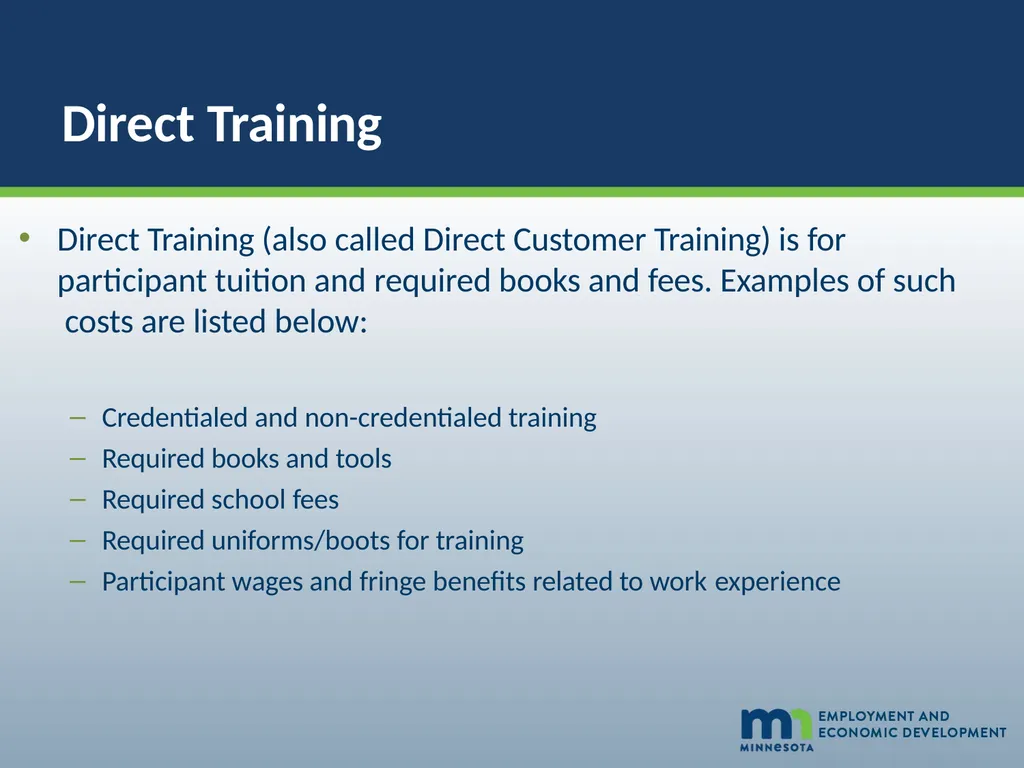
Direct Training Direct Training (also called Direct Customer Training) is for participant tuition and required books and fees. Examples of such costs are listed below:
Credentialed and non-credentialed training
Required books and tools
Required school fees
Required uniforms/boots for training
Participant wages and fringe benefits related to work experience<br>
Credentialed and non-credentialed training
Required books and tools
Required school fees
Required uniforms/boots for training
Participant wages and fringe benefits related to work experience<br>
13
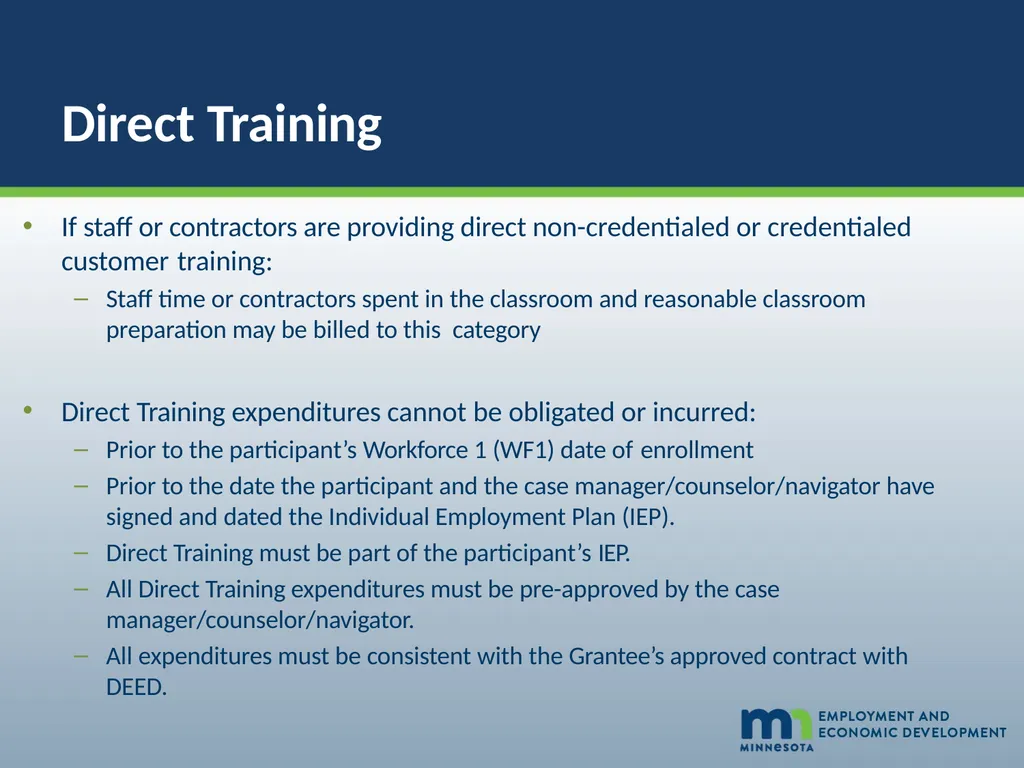
Direct Training If staff or contractors are providing direct non-credentialed or credentialed customer training:
Staff time or contractors spent in the classroom and reasonable classroom preparation may be billed to this category
Direct Training expenditures cannot be obligated or incurred:
Prior to the participant’s Workforce 1 (WF1) date of enrollment
Prior to the date the participant and the case manager/counselor/navigator have signed and dated the Individual Employment Plan (IEP).
Direct Training must be part of the participant’s IEP.
All Direct Training expenditures must be pre-approved by the case manager/counselor/navigator.
All expenditures must be consistent with the Grantee’s approved contract with DEED.<br>
Staff time or contractors spent in the classroom and reasonable classroom preparation may be billed to this category
Direct Training expenditures cannot be obligated or incurred:
Prior to the participant’s Workforce 1 (WF1) date of enrollment
Prior to the date the participant and the case manager/counselor/navigator have signed and dated the Individual Employment Plan (IEP).
Direct Training must be part of the participant’s IEP.
All Direct Training expenditures must be pre-approved by the case manager/counselor/navigator.
All expenditures must be consistent with the Grantee’s approved contract with DEED.<br>
14
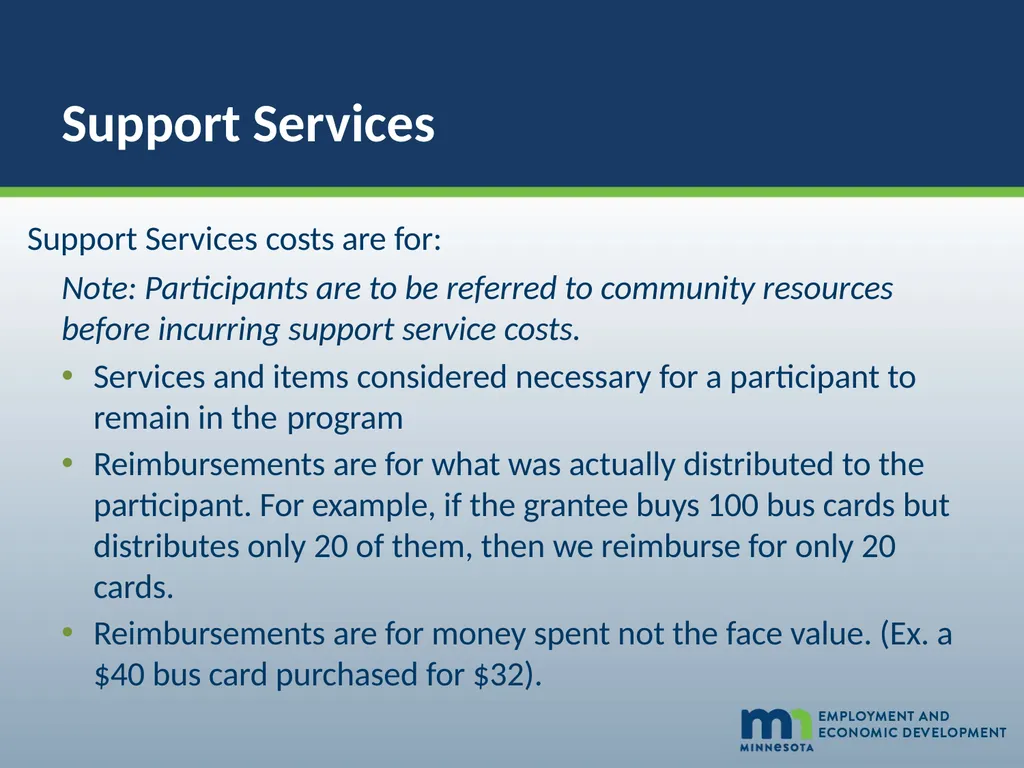
Support Services Support Services costs are for: Note: Participants are to be referred to community resources before incurring support service costs.
Services and items considered necessary for a participant to remain in the program
Reimbursements are for what was actually distributed to the participant. For example, if the grantee buys 100 bus cards but distributes only 20 of them, then we reimburse for only 20 cards.
Reimbursements are for money spent not the face value. (Ex. a $40 bus card purchased for $32).<br>
Services and items considered necessary for a participant to remain in the program
Reimbursements are for what was actually distributed to the participant. For example, if the grantee buys 100 bus cards but distributes only 20 of them, then we reimburse for only 20 cards.
Reimbursements are for money spent not the face value. (Ex. a $40 bus card purchased for $32).<br>
15
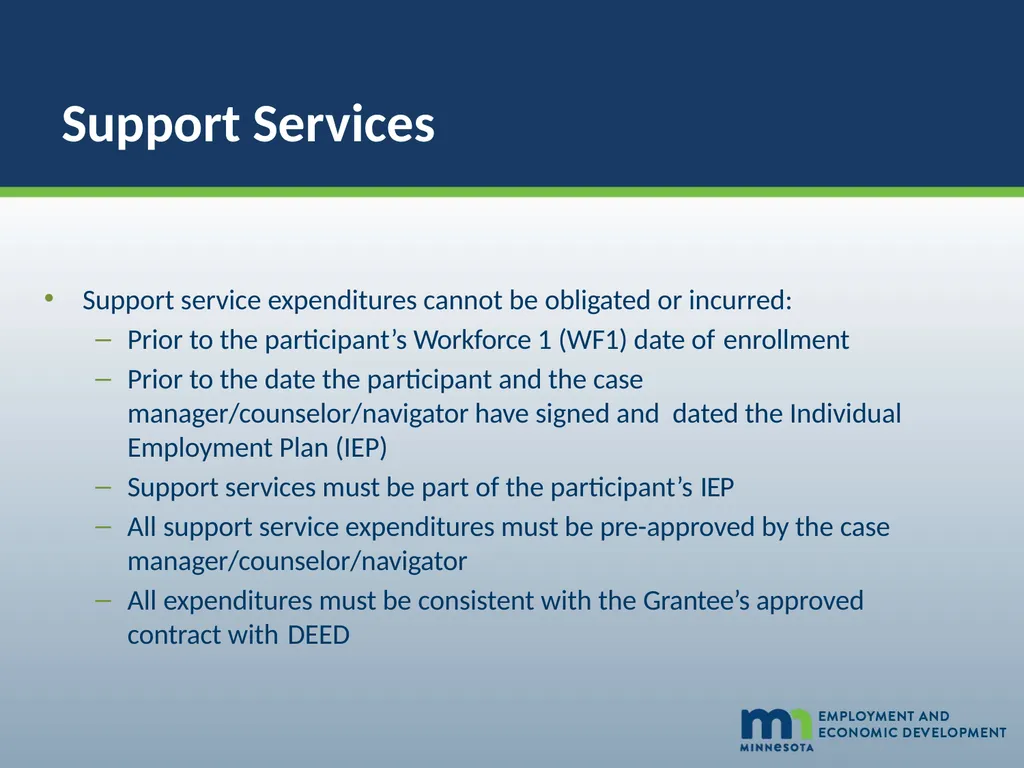
Support Services Support service expenditures cannot be obligated or incurred:
Prior to the participant’s Workforce 1 (WF1) date of enrollment
Prior to the date the participant and the case manager/counselor/navigator have signed and dated the Individual Employment Plan (IEP)
Support services must be part of the participant’s IEP
All support service expenditures must be pre-approved by the case manager/counselor/navigator
All expenditures must be consistent with the Grantee’s approved contract with DEED<br>
Prior to the participant’s Workforce 1 (WF1) date of enrollment
Prior to the date the participant and the case manager/counselor/navigator have signed and dated the Individual Employment Plan (IEP)
Support services must be part of the participant’s IEP
All support service expenditures must be pre-approved by the case manager/counselor/navigator
All expenditures must be consistent with the Grantee’s approved contract with DEED<br>
16
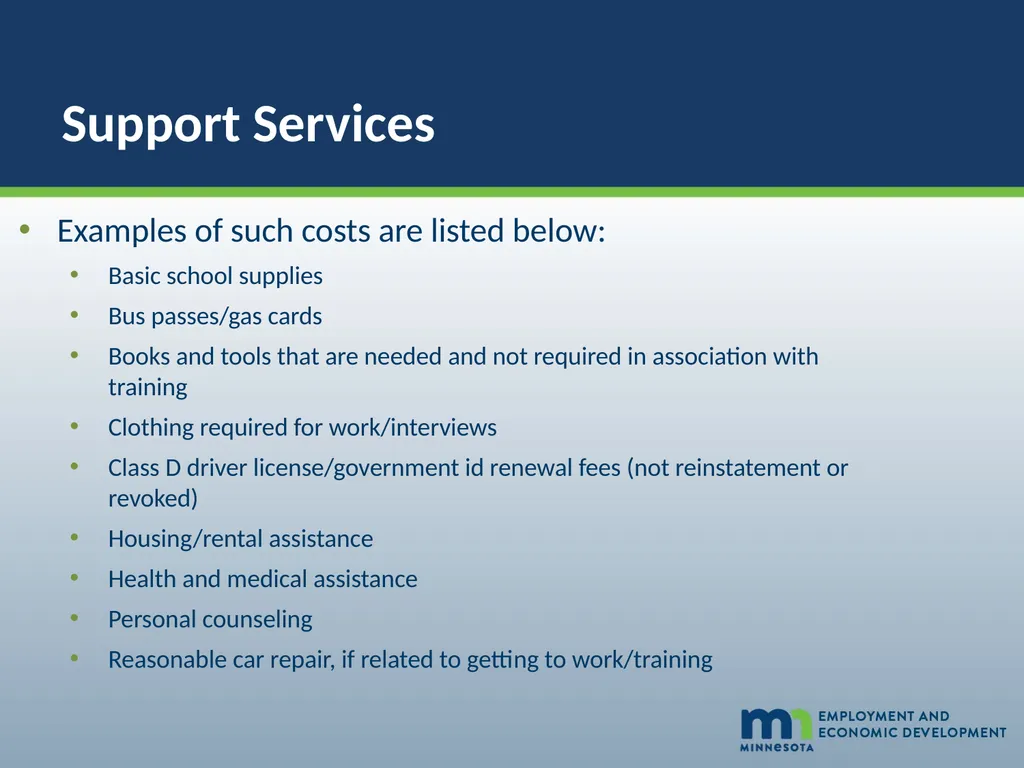
Support Services Examples of such costs are listed below:
Basic school supplies
Bus passes/gas cards
Books and tools that are needed and not required in association with training
Clothing required for work/interviews
Class D driver license/government id renewal fees (not reinstatement or revoked)
Housing/rental assistance
Health and medical assistance
Personal counseling
Reasonable car repair, if related to getting to work/training<br>
Basic school supplies
Bus passes/gas cards
Books and tools that are needed and not required in association with training
Clothing required for work/interviews
Class D driver license/government id renewal fees (not reinstatement or revoked)
Housing/rental assistance
Health and medical assistance
Personal counseling
Reasonable car repair, if related to getting to work/training<br>
17
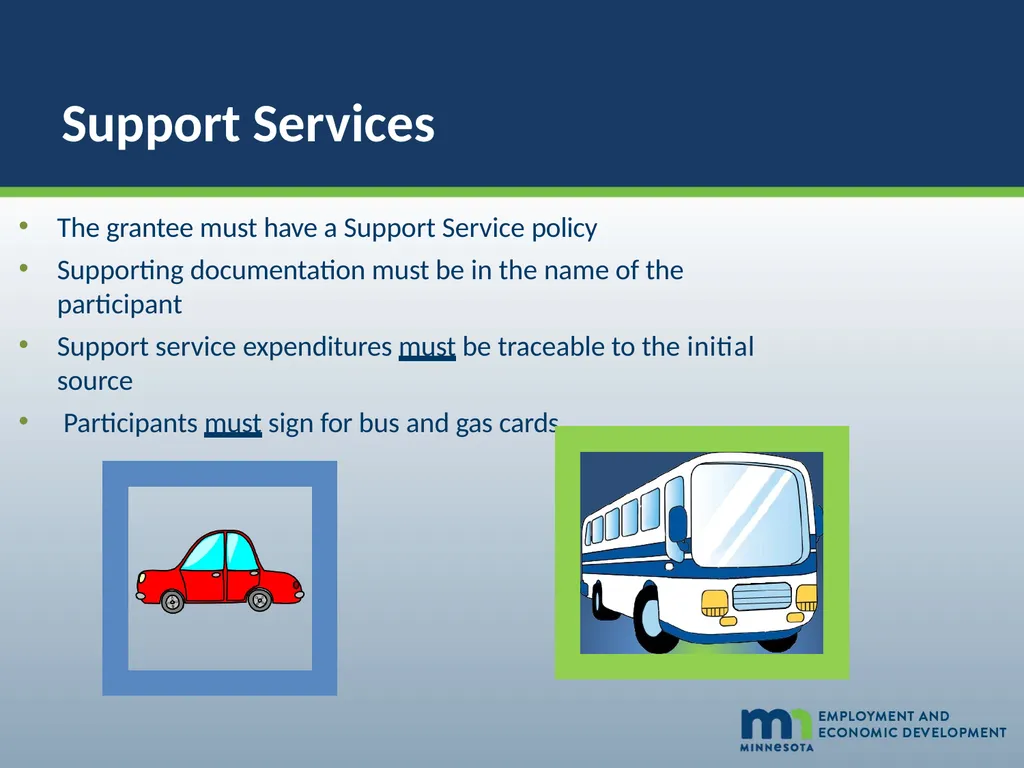
Support Services The grantee must have a Support Service policy
Supporting documentation must be in the name of the participant
Support service expenditures must be traceable to the initial source
Participants must sign for bus and gas cards<br>
Supporting documentation must be in the name of the participant
Support service expenditures must be traceable to the initial source
Participants must sign for bus and gas cards<br>
18
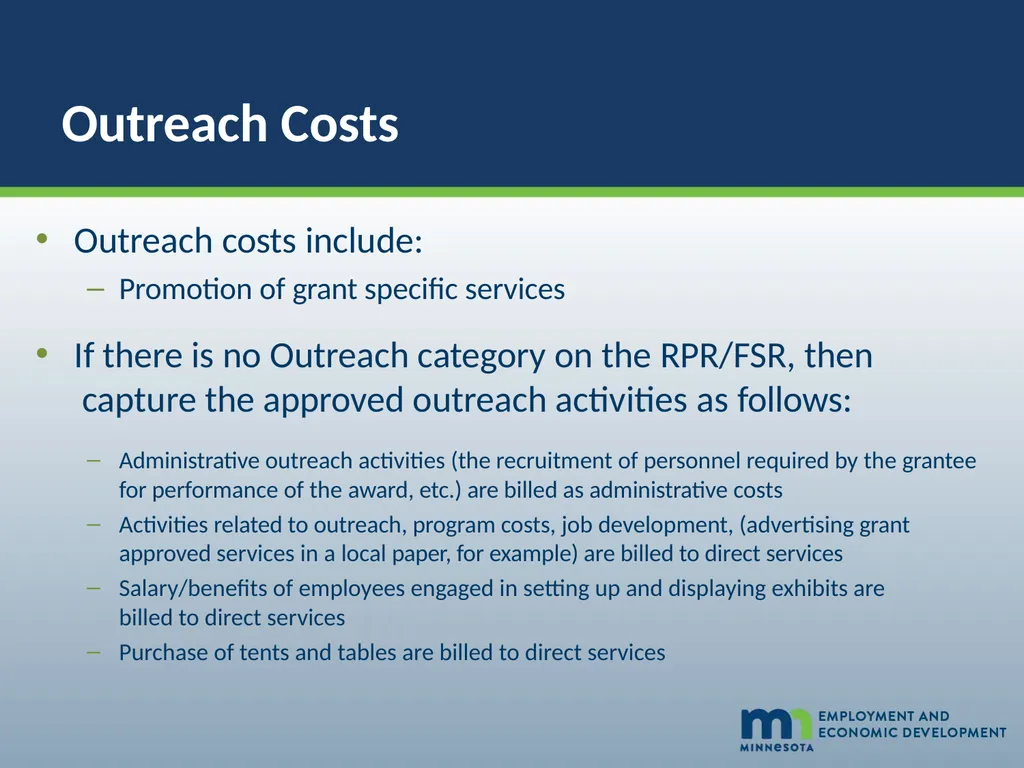
Outreach Costs Outreach costs include:
Promotion of grant specific services
If there is no Outreach category on the RPR/FSR, then capture the approved outreach activities as follows:
Administrative outreach activities (the recruitment of personnel required by the grantee for performance of the award, etc.) are billed as administrative costs
Activities related to outreach, program costs, job development, (advertising grant approved services in a local paper, for example) are billed to direct services
Salary/benefits of employees engaged in setting up and displaying exhibits are billed to direct services
Purchase of tents and tables are billed to direct services<br>
Promotion of grant specific services
If there is no Outreach category on the RPR/FSR, then capture the approved outreach activities as follows:
Administrative outreach activities (the recruitment of personnel required by the grantee for performance of the award, etc.) are billed as administrative costs
Activities related to outreach, program costs, job development, (advertising grant approved services in a local paper, for example) are billed to direct services
Salary/benefits of employees engaged in setting up and displaying exhibits are billed to direct services
Purchase of tents and tables are billed to direct services<br>
19
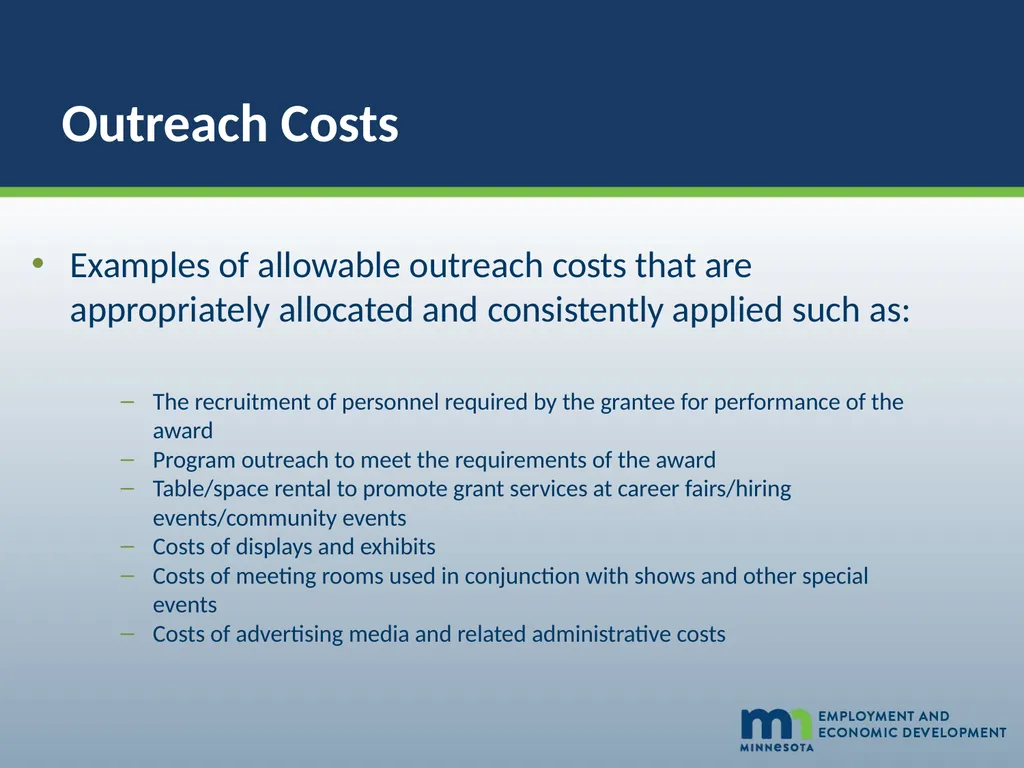
Outreach Costs Examples of allowable outreach costs that are appropriately allocated and consistently applied such as: The recruitment of personnel required by the grantee for performance of the award
Program outreach to meet the requirements of the award
Table/space rental to promote grant services at career fairs/hiring events/community events
Costs of displays and exhibits
Costs of meeting rooms used in conjunction with shows and other special events
Costs of advertising media and related administrative costs<br>
Program outreach to meet the requirements of the award
Table/space rental to promote grant services at career fairs/hiring events/community events
Costs of displays and exhibits
Costs of meeting rooms used in conjunction with shows and other special events
Costs of advertising media and related administrative costs<br>
20
Outreach Cost Examples of unallowable outreach costs are listed below:
Costs of meetings and conventions related to other activities
Costs of promotional items and memorabilia
Costs of advertising to promote the grantee<br>
Costs of meetings and conventions related to other activities
Costs of promotional items and memorabilia
Costs of advertising to promote the grantee<br>
21
Accrual Accounting<br>
22
Accrual Accounting Grantees (and sub-grantees/recipients) must separately account for receipt, obligation, and expenditure of funds by award or fund source
Obligations and expenditures must fall within the period of performance of the grant<br>
Obligations and expenditures must fall within the period of performance of the grant<br>
23
Accrual Accounting Transactions are recognized in accounting period in which they occur
Revenue is recognized when earned
Expense is recognized when incurred
may be cash disbursement
may be delivery of goods/services<br>
Revenue is recognized when earned
Expense is recognized when incurred
may be cash disbursement
may be delivery of goods/services<br>
24
Accrual Accounting Obligations
Plans and budgets are not obligations
Orders placed for property and services, contracts and subawards made, and similar transactions during a given period that require payment during the same or a future period
Legally binding
Budget authority must be available<br>
Plans and budgets are not obligations
Orders placed for property and services, contracts and subawards made, and similar transactions during a given period that require payment during the same or a future period
Legally binding
Budget authority must be available<br>
25
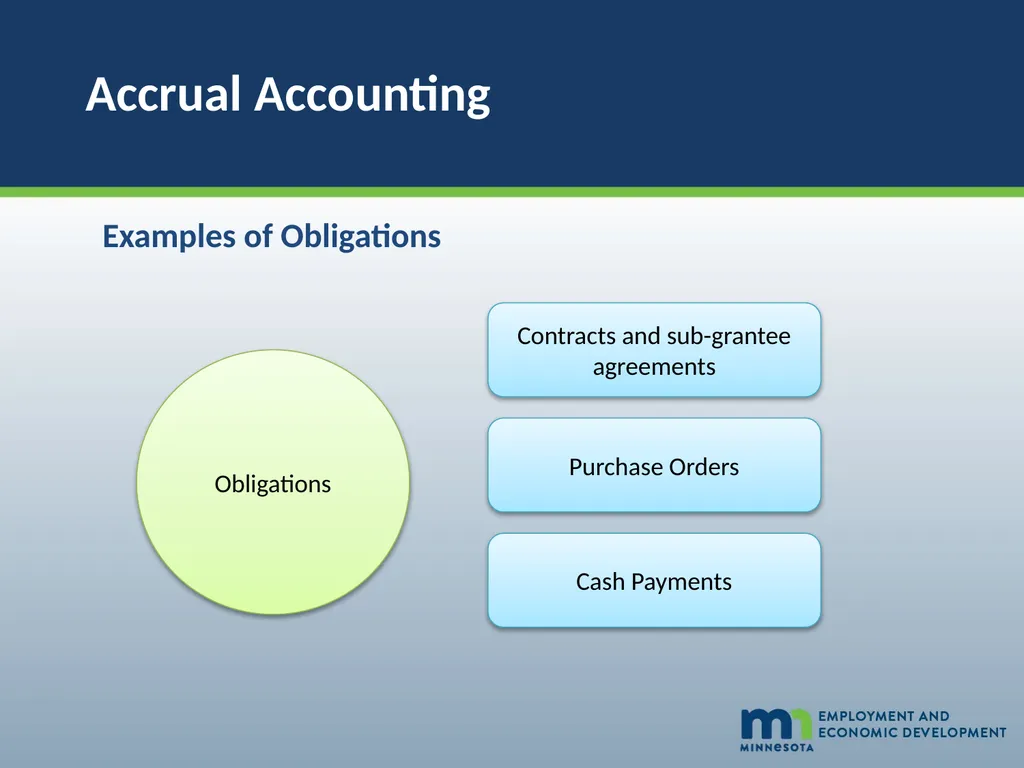
Accrual Accounting Examples of Obligations Obligations Contracts and sub-grantee agreements Purchase Orders Cash Payments<br>
26
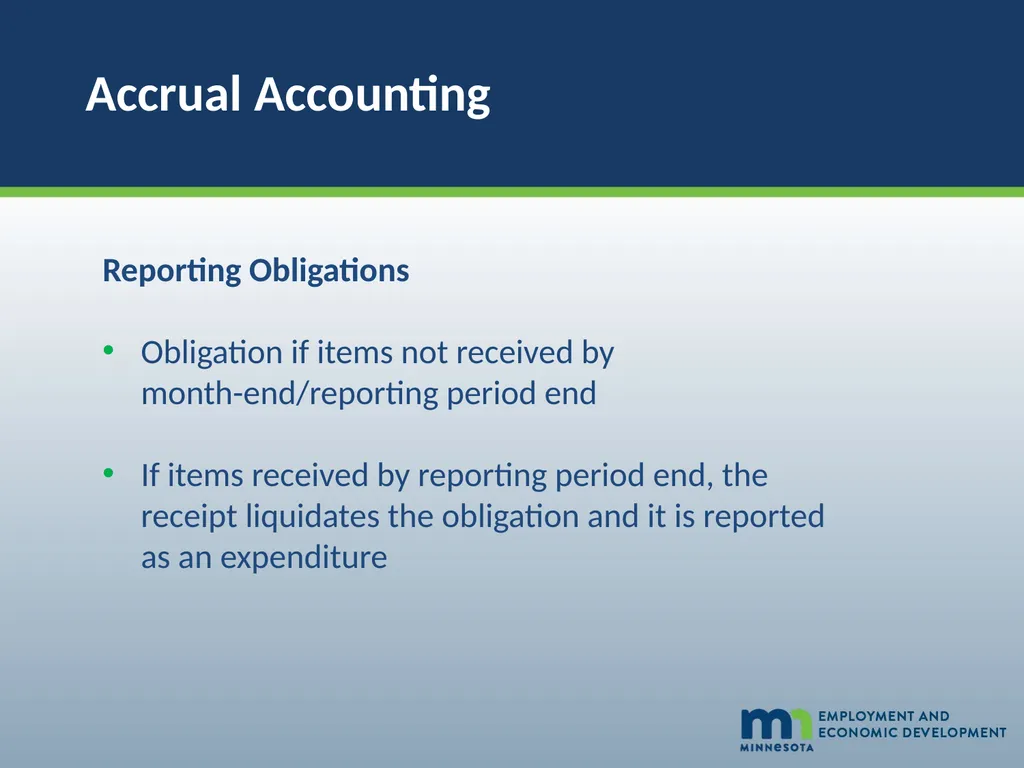
Accrual Accounting Reporting Obligations
Obligation if items not received by month-end/reporting period end
If items received by reporting period end, the receipt liquidates the obligation and it is reported as an expenditure<br>
Obligation if items not received by month-end/reporting period end
If items received by reporting period end, the receipt liquidates the obligation and it is reported as an expenditure<br>
27
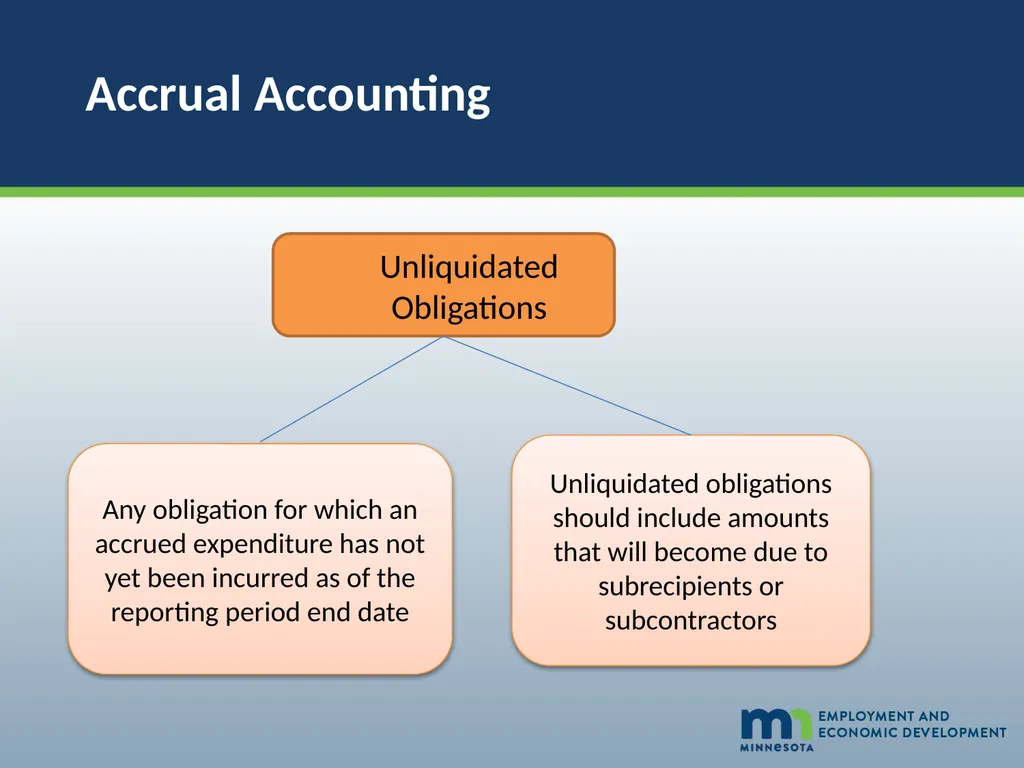
Accrual Accounting Unliquidated Obligations Unliquidated obligations should include amounts that will become due to subrecipients or subcontractors Any obligation for which an accrued expenditure has not yet been incurred as of the reporting period end date<br>
28
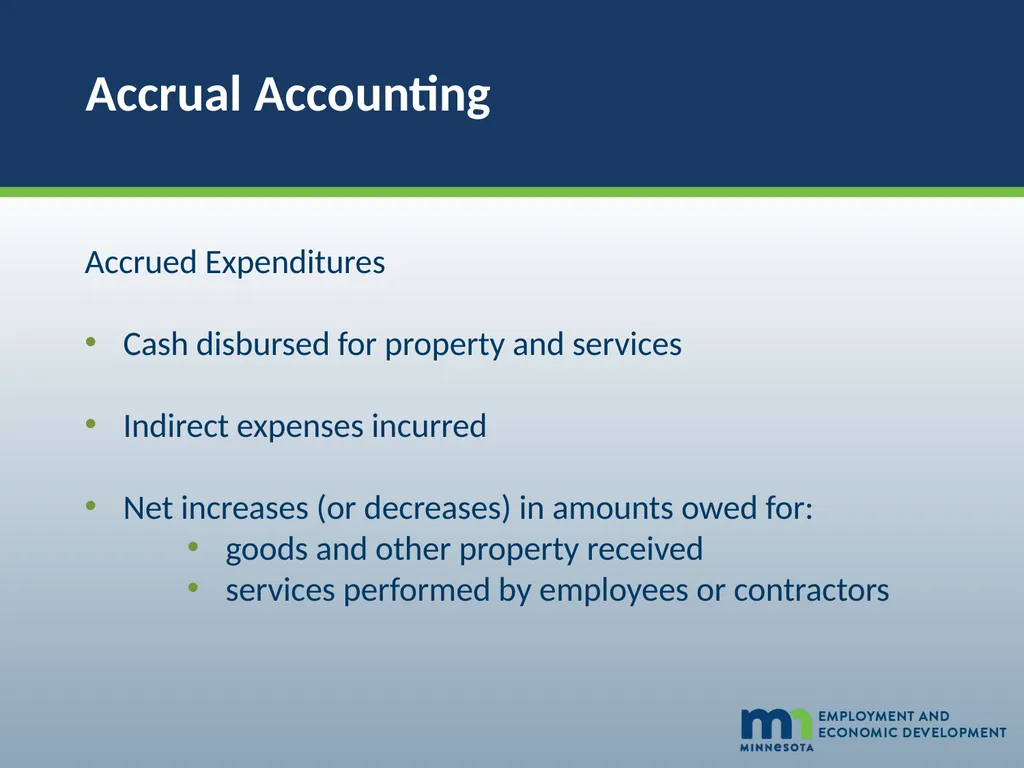
Accrual Accounting Accrued Expenditures
Cash disbursed for property and services
Indirect expenses incurred
Net increases (or decreases) in amounts owed for:
goods and other property received
services performed by employees or contractors<br>
Cash disbursed for property and services
Indirect expenses incurred
Net increases (or decreases) in amounts owed for:
goods and other property received
services performed by employees or contractors<br>
29
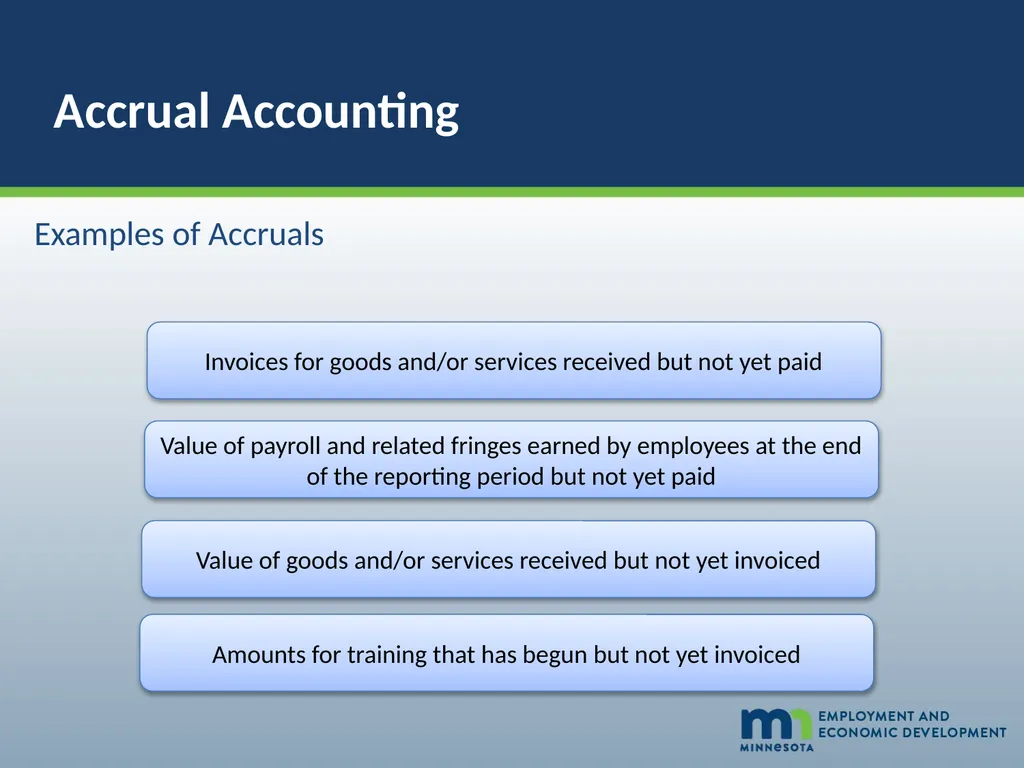
Accrual Accounting Examples of Accruals Invoices for goods and/or services received but not yet paid Value of payroll and related fringes earned by employees at the end of the reporting period but not yet paid Value of goods and/or services received but not yet invoiced Amounts for training that has begun but not yet invoiced<br>
30
Accrual Accounting Accrual accounting records revenue and expenses when they occur and matches income and related expenses in the same fiscal period, regardless of the timing of the receipt or disbursement of actual cash.
For example, if you purchase office supplies in the month of April on your credit card and pay for the purchase in May when you receive the credit card bill. Under the accrual method of accounting the expense for supplies would be recorded in April.<br>
For example, if you purchase office supplies in the month of April on your credit card and pay for the purchase in May when you receive the credit card bill. Under the accrual method of accounting the expense for supplies would be recorded in April.<br>
31
Cost Allocation<br>
32
Cost Allocation The process of assigning a cost, or a group of costs, to one or more cost objective(s), in reasonable proportion to the benefit provided or other equitable relationship.<br>
33
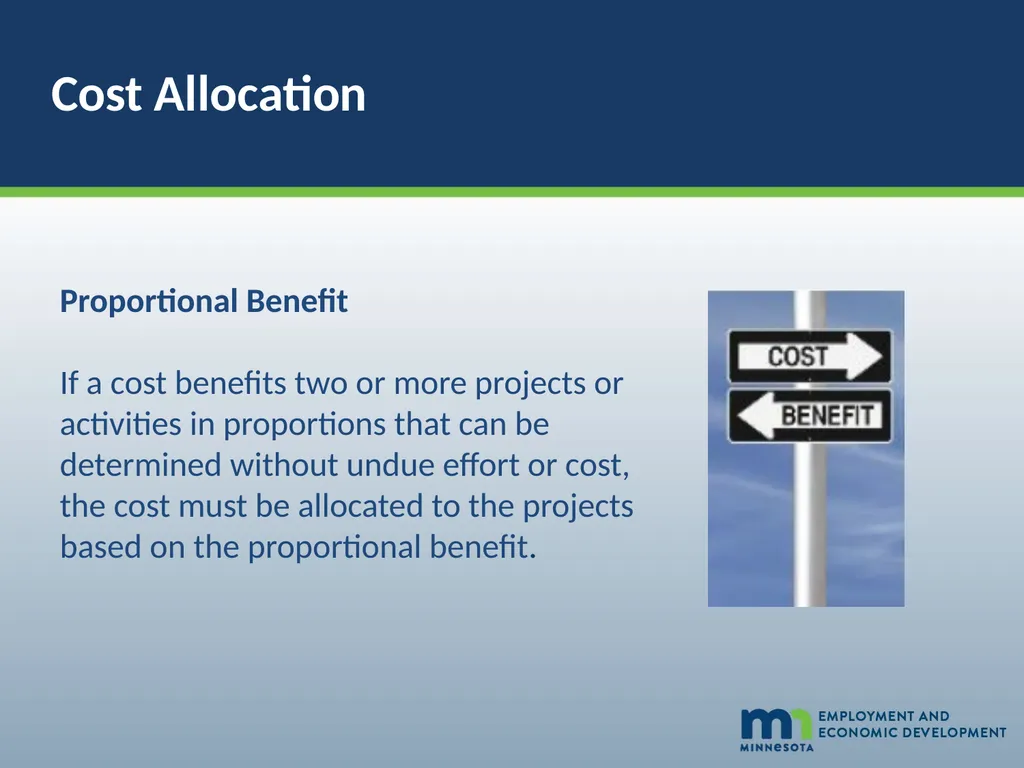
Cost Allocation Proportional Benefit
If a cost benefits two or more projects or activities in proportions that can be determined without undue effort or cost, the cost must be allocated to the projects based on the proportional benefit.<br>
If a cost benefits two or more projects or activities in proportions that can be determined without undue effort or cost, the cost must be allocated to the projects based on the proportional benefit.<br>
34
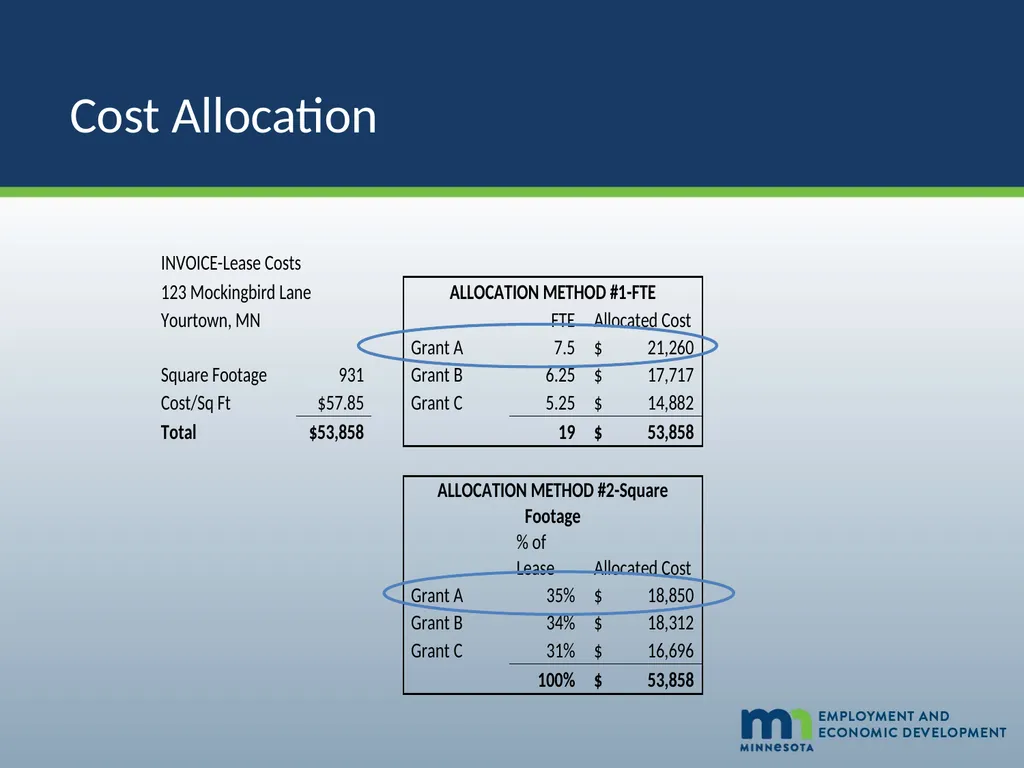
Cost Allocation Each grantee must have an approved cost allocation methodology in place. Methodologies may be based upon the type of expenditure.
Common methods include
FTE
Square Footage<br>
Common methods include
FTE
Square Footage<br>
35
Cost Allocation<br>
36
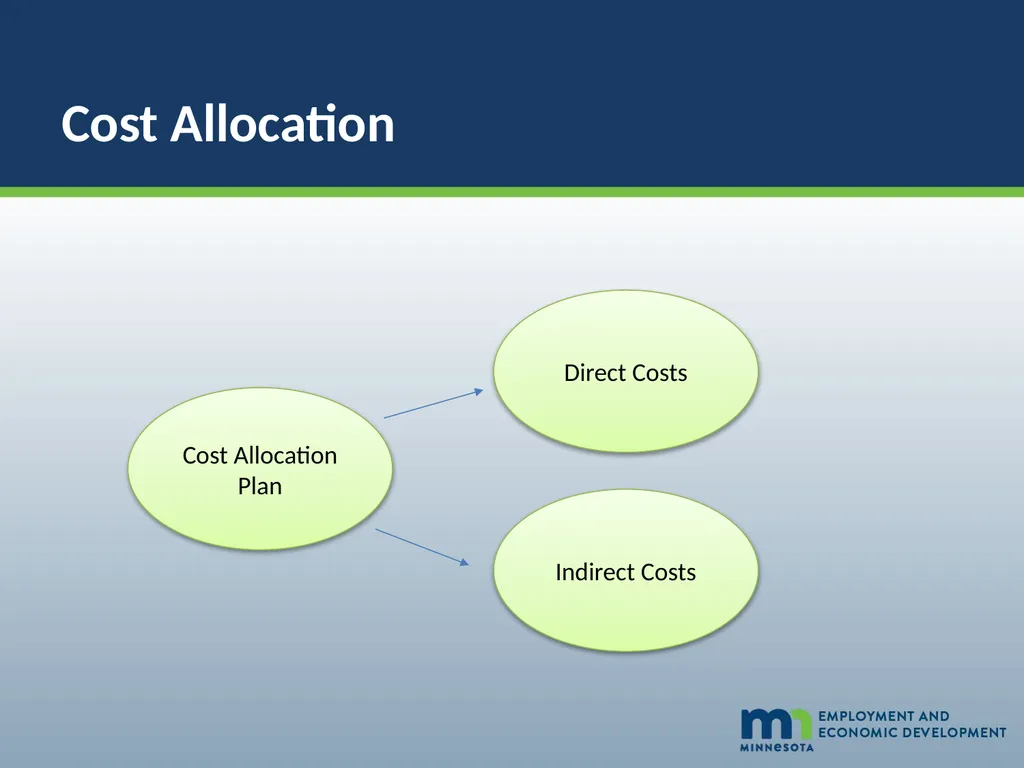
Cost Allocation Cost Allocation Plan Direct Costs Indirect Costs<br>
37
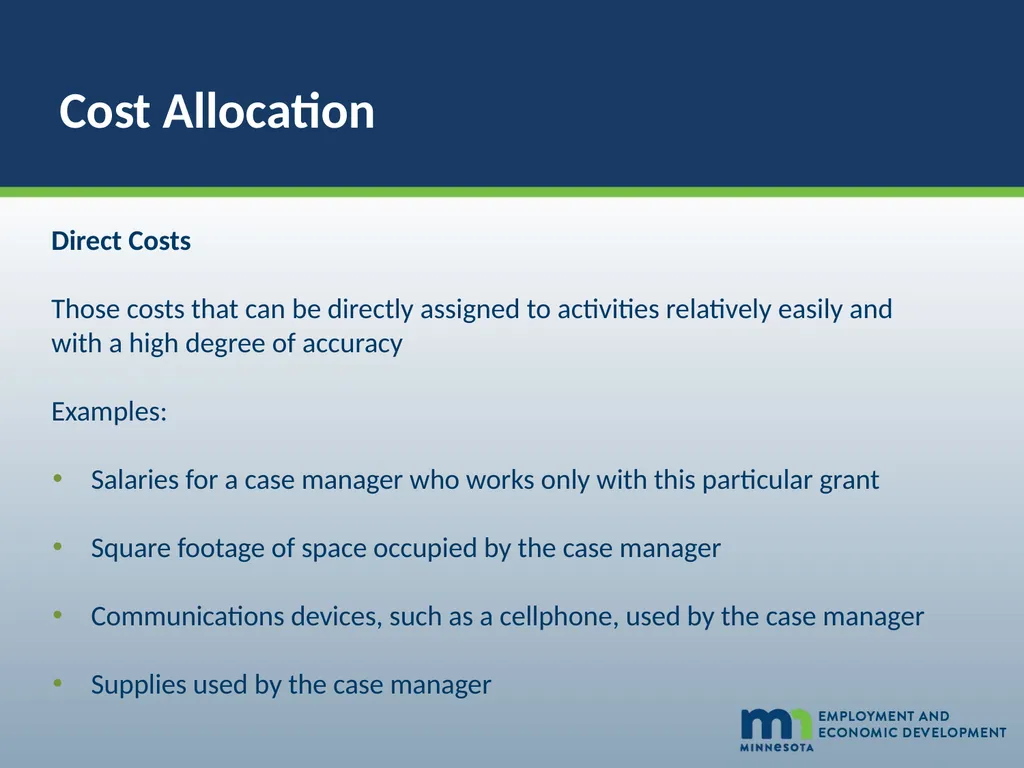
Cost Allocation Direct Costs
Those costs that can be directly assigned to activities relatively easily and with a high degree of accuracy
Examples:
Salaries for a case manager who works only with this particular grant
Square footage of space occupied by the case manager
Communications devices, such as a cellphone, used by the case manager
Supplies used by the case manager<br>
Those costs that can be directly assigned to activities relatively easily and with a high degree of accuracy
Examples:
Salaries for a case manager who works only with this particular grant
Square footage of space occupied by the case manager
Communications devices, such as a cellphone, used by the case manager
Supplies used by the case manager<br>
38
Cost Allocation INDIRECT COSTS
Administration and facilities costs incurred in support of multiple programs, but not a specific program cost
Are charged back to the program through an approved
indirect cost rate or cost allocation plan
Originate either within the recipient organization or
department or another department that supports the
overall organizational operations<br>
Administration and facilities costs incurred in support of multiple programs, but not a specific program cost
Are charged back to the program through an approved
indirect cost rate or cost allocation plan
Originate either within the recipient organization or
department or another department that supports the
overall organizational operations<br>
39
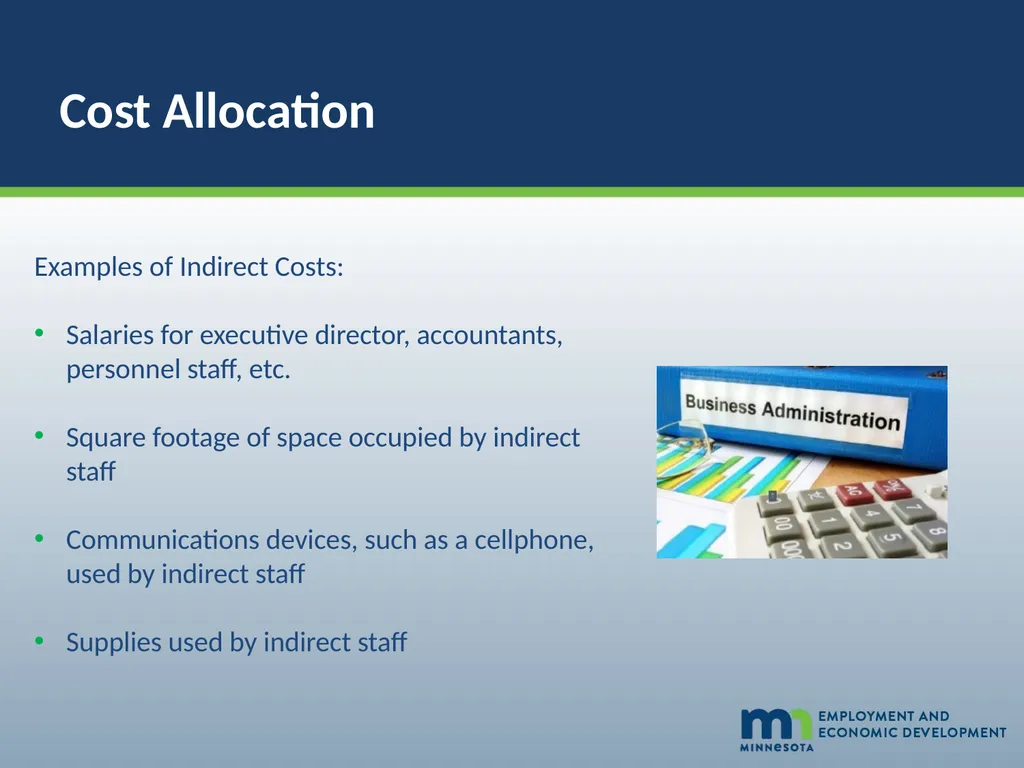
Cost Allocation Examples of Indirect Costs:
Salaries for executive director, accountants, personnel staff, etc.
Square footage of space occupied by indirect staff
Communications devices, such as a cellphone, used by indirect staff
Supplies used by indirect staff<br>
Salaries for executive director, accountants, personnel staff, etc.
Square footage of space occupied by indirect staff
Communications devices, such as a cellphone, used by indirect staff
Supplies used by indirect staff<br>
40
Cost Allocation Be Consistent with Allocations
Costs must be accorded consistent treatment. A cost may not be assigned to an award as a direct cost if any other cost incurred for the same purpose in like circumstances has been allocated to the award as an indirect cost.<br>
Costs must be accorded consistent treatment. A cost may not be assigned to an award as a direct cost if any other cost incurred for the same purpose in like circumstances has been allocated to the award as an indirect cost.<br>
41
Cost Allocation Allowability = Allocability
A cost is allocable to a particular state or federal award or other cost objective if the goods or services involved are chargeable or assignable to that award or cost objective in accordance with relative benefits received<br>
A cost is allocable to a particular state or federal award or other cost objective if the goods or services involved are chargeable or assignable to that award or cost objective in accordance with relative benefits received<br>
42
Reimbursement Payment Request (RPR)<br>
43
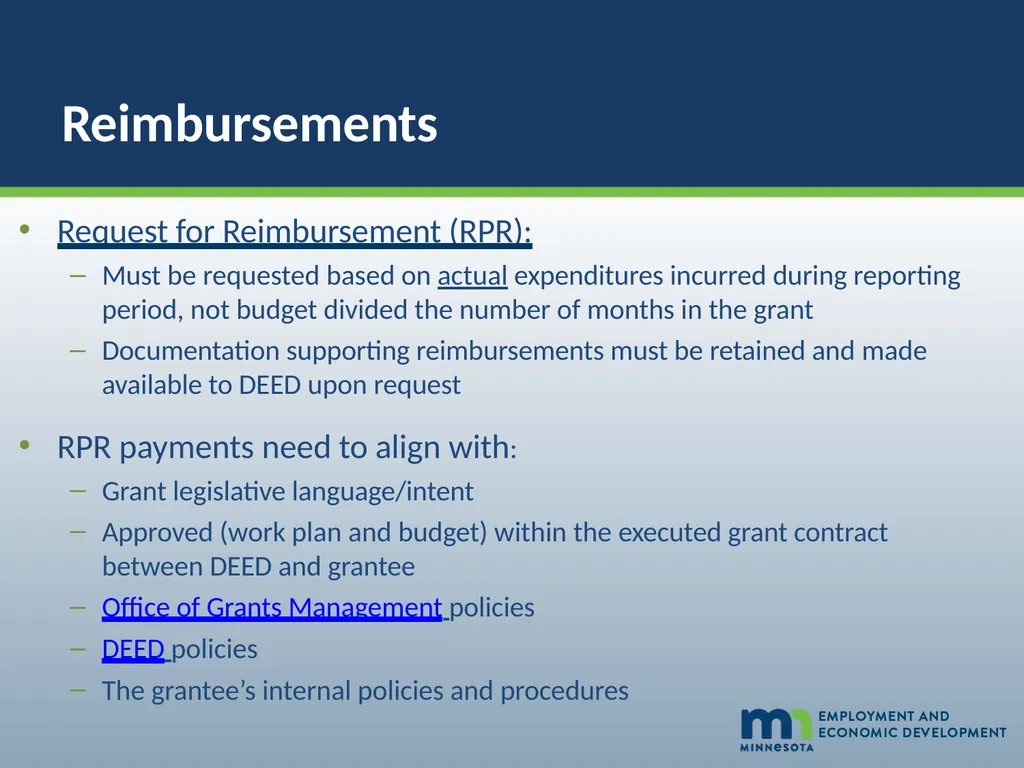
Reimbursements Request for Reimbursement (RPR):
Must be requested based on actual expenditures incurred during reporting period, not budget divided the number of months in the grant
Documentation supporting reimbursements must be retained and made available to DEED upon request
RPR payments need to align with:
Grant legislative language/intent
Approved (work plan and budget) within the executed grant contract between DEED and grantee
Office of Grants Management policies
DEED policies
The grantee’s internal policies and procedures<br>
Must be requested based on actual expenditures incurred during reporting period, not budget divided the number of months in the grant
Documentation supporting reimbursements must be retained and made available to DEED upon request
RPR payments need to align with:
Grant legislative language/intent
Approved (work plan and budget) within the executed grant contract between DEED and grantee
Office of Grants Management policies
DEED policies
The grantee’s internal policies and procedures<br>
44
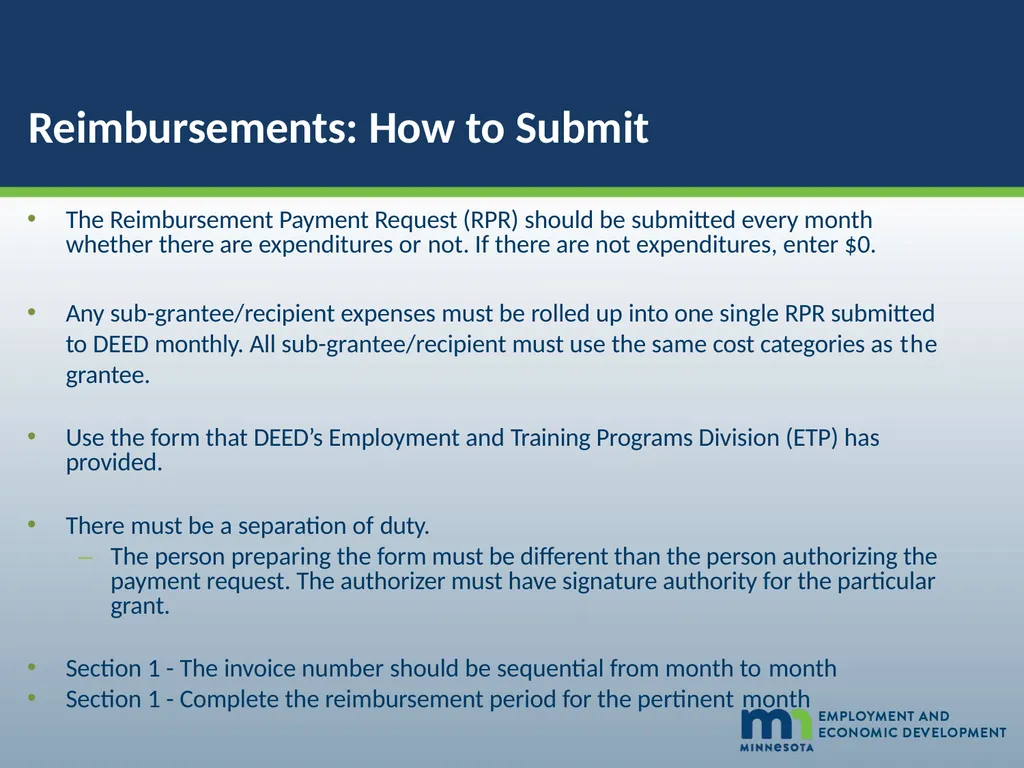
Reimbursements: How to Submit The Reimbursement Payment Request (RPR) should be submitted every month whether there are expenditures or not. If there are not expenditures, enter $0.
Any sub-grantee/recipient expenses must be rolled up into one single RPR submitted to DEED monthly. All sub-grantee/recipient must use the same cost categories as the grantee.
Use the form that DEED’s Employment and Training Programs Division (ETP) has provided.
There must be a separation of duty.
– The person preparing the form must be different than the person authorizing the payment request. The authorizer must have signature authority for the particular grant.
Section 1 - The invoice number should be sequential from month to month
Section 1 - Complete the reimbursement period for the pertinent month<br>
Any sub-grantee/recipient expenses must be rolled up into one single RPR submitted to DEED monthly. All sub-grantee/recipient must use the same cost categories as the grantee.
Use the form that DEED’s Employment and Training Programs Division (ETP) has provided.
There must be a separation of duty.
– The person preparing the form must be different than the person authorizing the payment request. The authorizer must have signature authority for the particular grant.
Section 1 - The invoice number should be sequential from month to month
Section 1 - Complete the reimbursement period for the pertinent month<br>
45
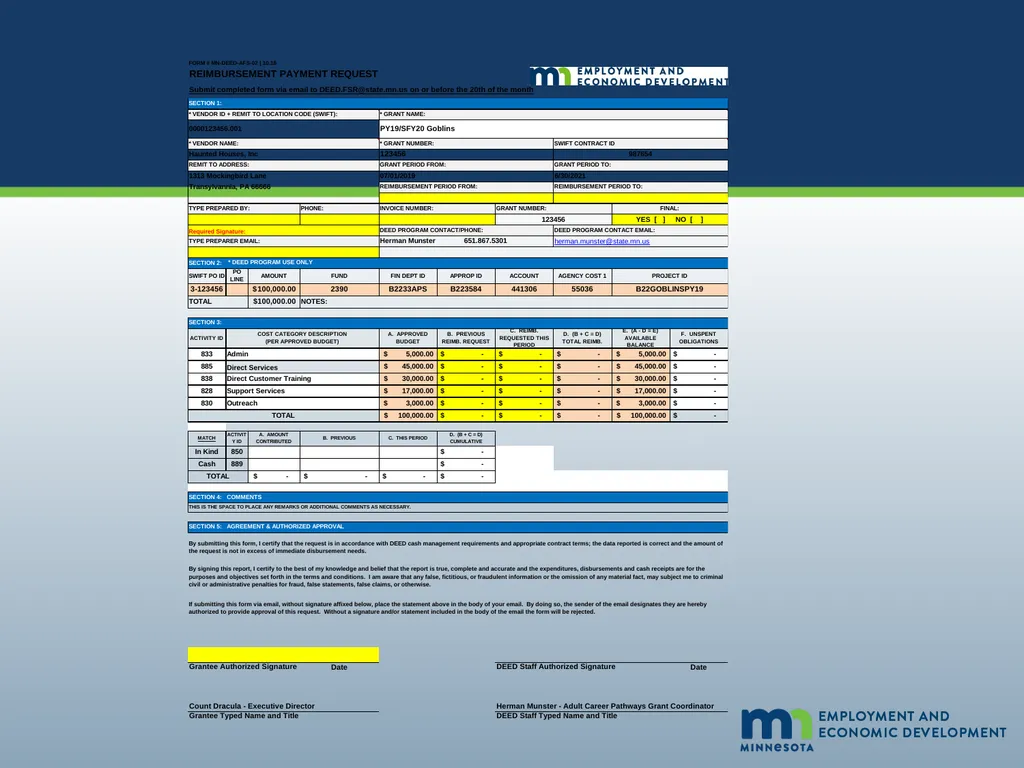
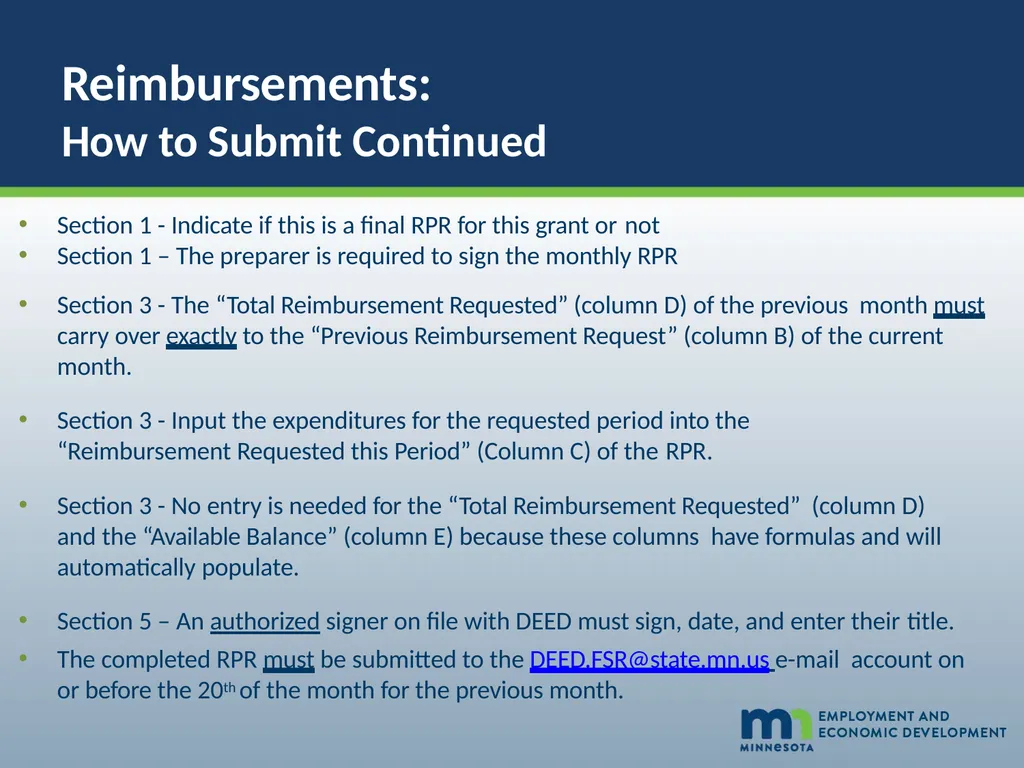
Reimbursements: How to Submit Continued Section 1 - Indicate if this is a final RPR for this grant or not
Section 1 – The preparer is required to sign the monthly RPR
Section 3 - The “Total Reimbursement Requested” (column D) of the previous month must carry over exactly to the “Previous Reimbursement Request” (column B) of the current month.
Section 3 - Input the expenditures for the requested period into the “Reimbursement Requested this Period” (Column C) of the RPR.
Section 3 - No entry is needed for the “Total Reimbursement Requested” (column D) and the “Available Balance” (column E) because these columns have formulas and will automatically populate.
Section 5 – An authorized signer on file with DEED must sign, date, and enter their title.
The completed RPR must be submitted to the DEED.FSR@state.mn.us e-mail account on or before the 20th of the month for the previous month.<br>
Section 1 – The preparer is required to sign the monthly RPR
Section 3 - The “Total Reimbursement Requested” (column D) of the previous month must carry over exactly to the “Previous Reimbursement Request” (column B) of the current month.
Section 3 - Input the expenditures for the requested period into the “Reimbursement Requested this Period” (Column C) of the RPR.
Section 3 - No entry is needed for the “Total Reimbursement Requested” (column D) and the “Available Balance” (column E) because these columns have formulas and will automatically populate.
Section 5 – An authorized signer on file with DEED must sign, date, and enter their title.
The completed RPR must be submitted to the DEED.FSR@state.mn.us e-mail account on or before the 20th of the month for the previous month.<br>
46
Common Mistakes Dates
Cumulative carry over amount
Rounding issues
Preparer and approver cannot be same person
Signature authority not on file or out of date
Mathematical/formula errors
Incorrect reimbursement period<br>
Cumulative carry over amount
Rounding issues
Preparer and approver cannot be same person
Signature authority not on file or out of date
Mathematical/formula errors
Incorrect reimbursement period<br>
47
Back-up Documentation May be required, depending on risk assessment outcome or special conditions
If requested by DEED ETP staff
New grantees will be required to submit the general ledger for the first month of the contract to ensure understanding of fiscal requirements<br>
If requested by DEED ETP staff
New grantees will be required to submit the general ledger for the first month of the contract to ensure understanding of fiscal requirements<br>
48
Grant Monitoring<br>
49
Risk Assessment-required for grants over $25,000
Monitoring visit required for grants over $50,000. Involves:
Participant file review
Financial reconciliation
Review of Workforce One data
Staff interview(s)
Program performance/expenditures
Monitoring report
Technical assistance, if needed
Annual monitoring if the grant is over $250,000. Monitoring Requirements
Office of Grants Management (OGM)<br>
Monitoring visit required for grants over $50,000. Involves:
Participant file review
Financial reconciliation
Review of Workforce One data
Staff interview(s)
Program performance/expenditures
Monitoring report
Technical assistance, if needed
Annual monitoring if the grant is over $250,000. Monitoring Requirements
Office of Grants Management (OGM)<br>
50
Grant Monitoring Monitoring visits:
The visit often happens 3-9 months after the start date of the grant
We will contact the grantee about 30 days before the intended visit to agree on a date
A fiscal and program monitoring guide are to be completed by the grantee before the visit and will be reviewed with the grantee during the visit 46<br>
The visit often happens 3-9 months after the start date of the grant
We will contact the grantee about 30 days before the intended visit to agree on a date
A fiscal and program monitoring guide are to be completed by the grantee before the visit and will be reviewed with the grantee during the visit 46<br>
51
Grant Monitoring No work can begin until grant contract/Project Specific Plan (PSP) with DEED is finalized (fully executed)
No work can begin with sub-grantees until grant contract with any sub-grantee is finalized (fully executed)
No work can begin with any independent contractor or vendor of sub-grantees until contract is finalized (fully executed)<br>
No work can begin with sub-grantees until grant contract with any sub-grantee is finalized (fully executed)
No work can begin with any independent contractor or vendor of sub-grantees until contract is finalized (fully executed)<br>
52
Grant Monitoring Grantee must diligently manage and monitor all subgrantee and contractor relationships
Subgrantee vs. contractor typically defined as the difference between performing work to benefit the grantee vs. performing work for a public purpose
Contractors must be solicited pursuant to the terms of the governing master contract
Subgrantees are often identified as compensated partners in the workplan and budget<br>
Subgrantee vs. contractor typically defined as the difference between performing work to benefit the grantee vs. performing work for a public purpose
Contractors must be solicited pursuant to the terms of the governing master contract
Subgrantees are often identified as compensated partners in the workplan and budget<br>
53
Grant Monitoring Continued All subgrantee contractual relationships are subject to:
Review, monitoring, and audit by the State
Conflict of interest policies, procurement policies, and applicable law
https://mn.gov/admin/government/grants/policies-statutes-forms/<br>
Review, monitoring, and audit by the State
Conflict of interest policies, procurement policies, and applicable law
https://mn.gov/admin/government/grants/policies-statutes-forms/<br>
54
DEED Point of Contact Your program coordinator is available to provide technical assistance for WF1, programmatic, and other grant-related questions any time.
For monitoring questions contact:
Shannon Rolf at shannon.rolf@state.mn.us
For reimbursement payment request (RPR) questions contact:
Colleen Schwab at colleen.schwab@state.mn.us<br>
For monitoring questions contact:
Shannon Rolf at shannon.rolf@state.mn.us
For reimbursement payment request (RPR) questions contact:
Colleen Schwab at colleen.schwab@state.mn.us<br>
55
Thank you for your participation today! Here is the link where we will be posting:
Financial Training PowerPoint
Cost Category Definitions
https://mn.gov/deed/programs-services/adult-career-pathways/<br>
Financial Training PowerPoint
Cost Category Definitions
https://mn.gov/deed/programs-services/adult-career-pathways/<br>