
Grazing Methods or Systems Rangeland Principles
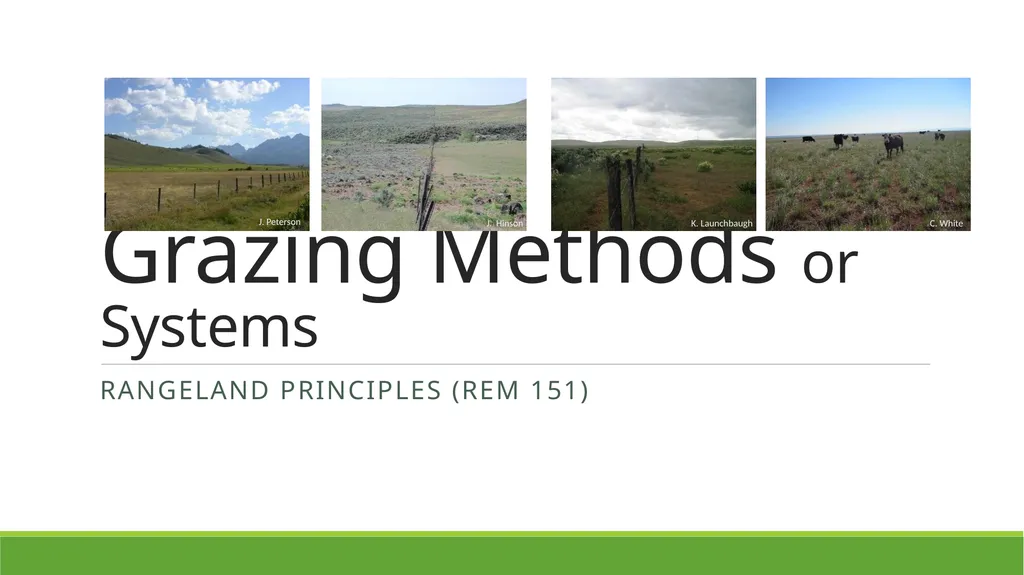
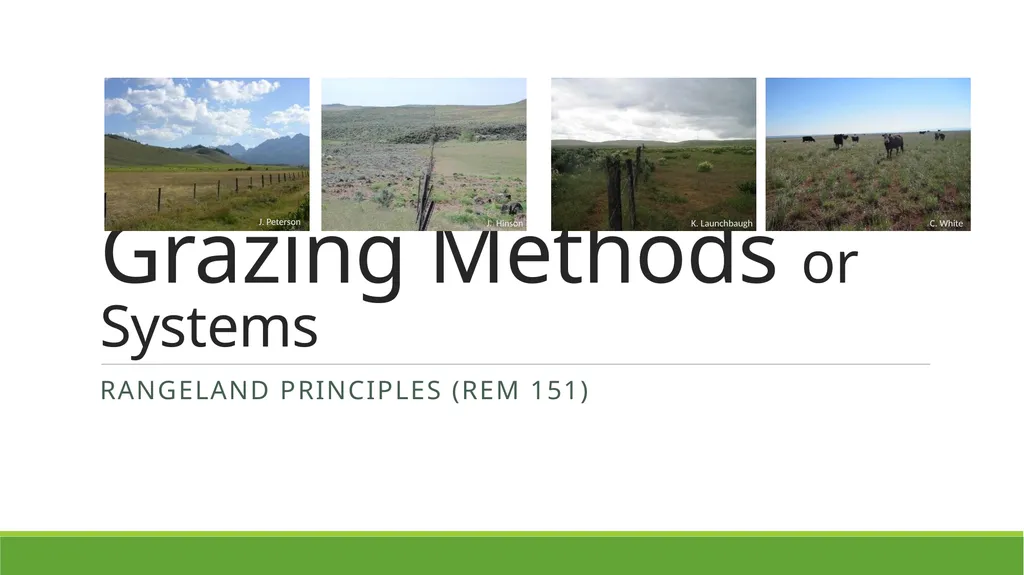
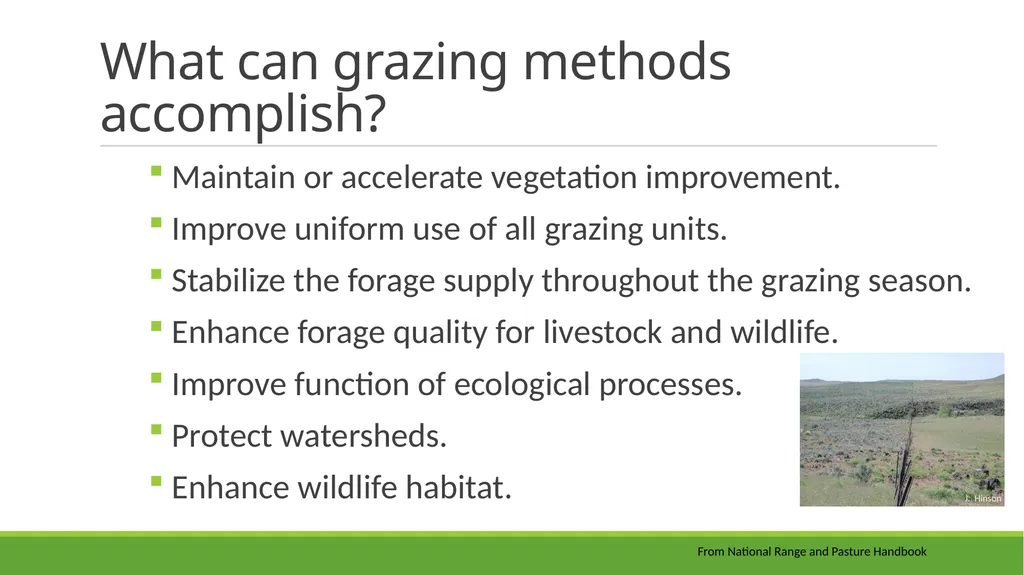
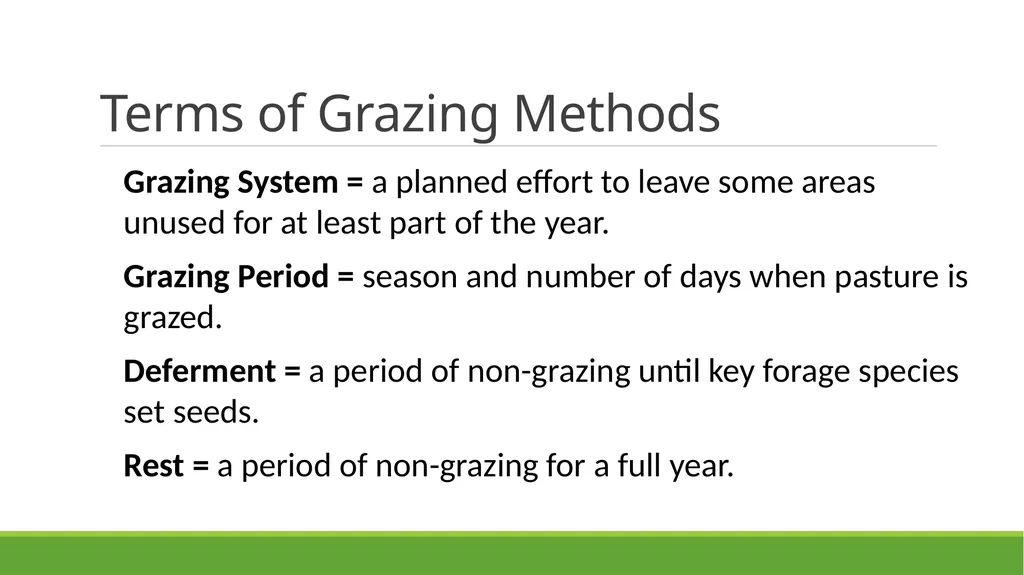
Description: Grazing Methods or Systems Rangeland Principles (Rem 151) Maintain or accelerate vegetation improvement. Improve uniform use of all grazing units. Stabilize the forage supply throughout the grazing season. Enhance forage quality for
Related Topics
Download Presentation
"Grazing Methods or Systems Rangeland Principles" is the property of its rightful owner. Permission is granted to download and print the materials on this website for personal, non-commercial use only, and to display it on your personal computer provided you do not modify the materials and that you retain all copyright notices contained in the materials. By downloading content from our website, you accept the terms of this agreement.
Presentation Transcript
slide1. Grazing Methods or Systems Rangeland Principles (Rem 151)<br>
slide2. Maintain or accelerate vegetation improvement.
Improve uniform use of all grazing units.
Stabilize the forage supply throughout the grazing season.
Enhance forage quality for livestock and wildlife.
Improve function of ecological processes.
Protect watersheds.
Enhance wildlife habitat. From National Range and Pasture Handbook What can grazing methods accomplish?<br>
slide3. Grazing System = a planned effort to leave some areas unused for at least part of the year.
Grazing Period = season and number of days when pasture is grazed.
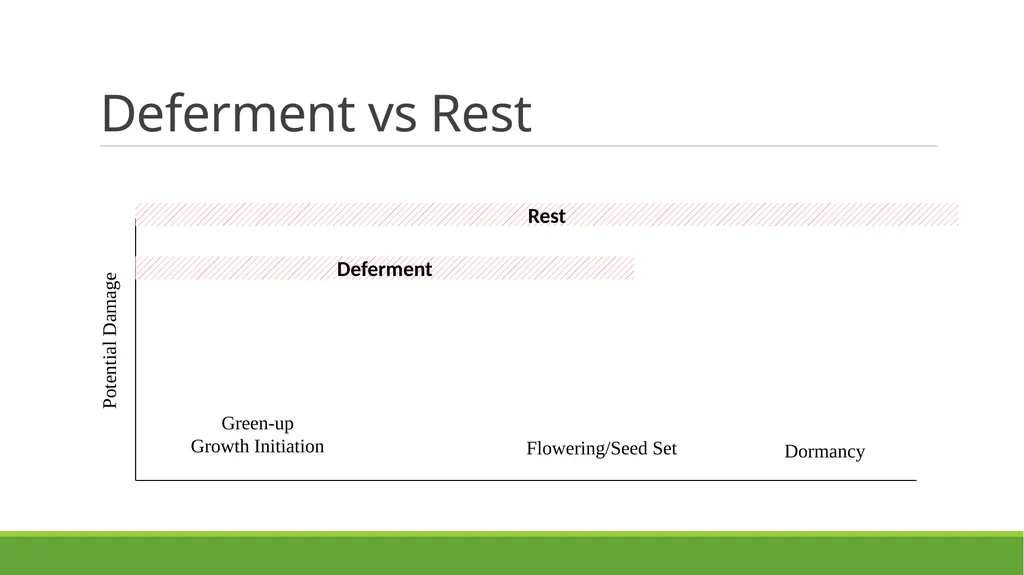
Deferment = a period of non-grazing until key forage species set seeds.
Rest = a period of non-grazing for a full year. Terms of Grazing Methods<br>
slide4. Deferment vs Rest Deferment Rest<br>
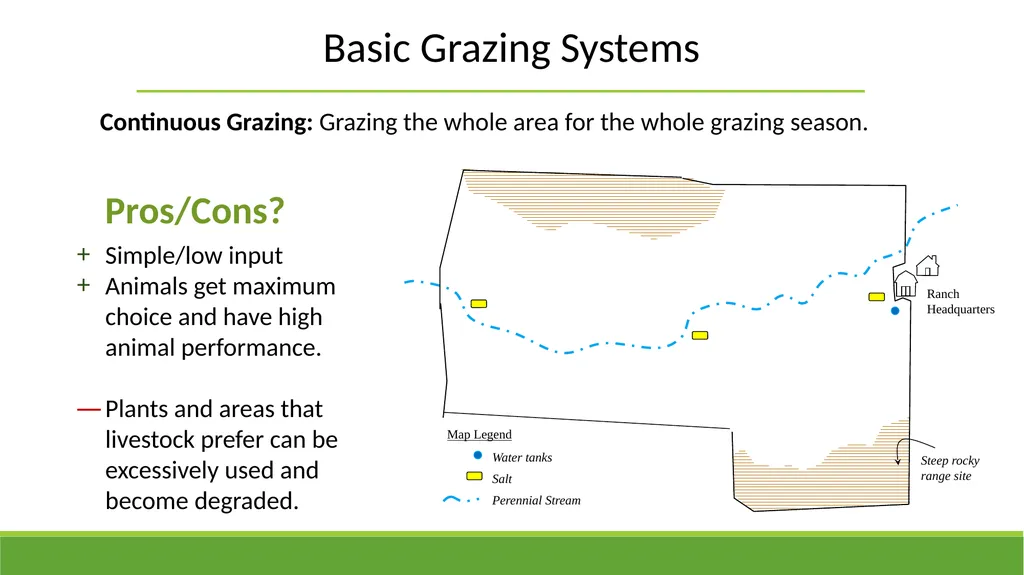
slide5. Continuous Grazing: Grazing the whole area for the whole grazing season. Simple/low input
Animals get maximum choice and have high animal performance.
Plants and areas that livestock prefer can be excessively used and become degraded. Pros/Cons? Basic Grazing Systems<br>
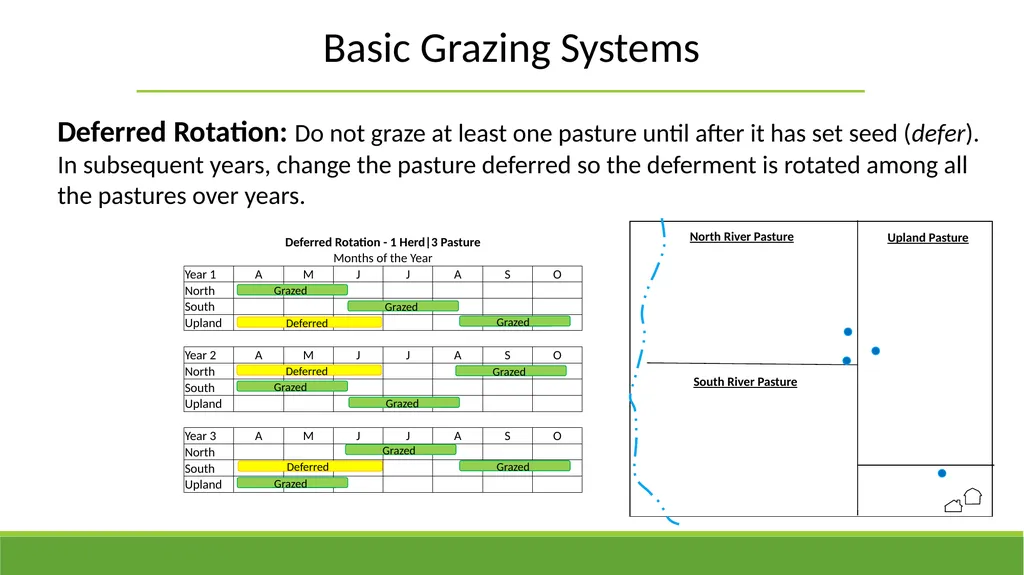
slide6. Basic Grazing Systems Deferred Rotation: Do not graze at least one pasture until after it has set seed (defer). In subsequent years, change the pasture deferred so the deferment is rotated among all the pastures over years.<br>
slide7. Basic Grazing Systems Deferred Rotation: Do not graze at least one pasture until after it has set seed (defer). In subsequent years, change the pasture deferred so the deferment is rotated among all the pastures over years. Pros/Cons? Rangeland condition can improve because pastures are occasionally not grazed when they are most sensitive to grazing.
Can reduce animal performance a little because animal opportunity to choose among plants and places is restricted.
Requires more fencing and management.<br>
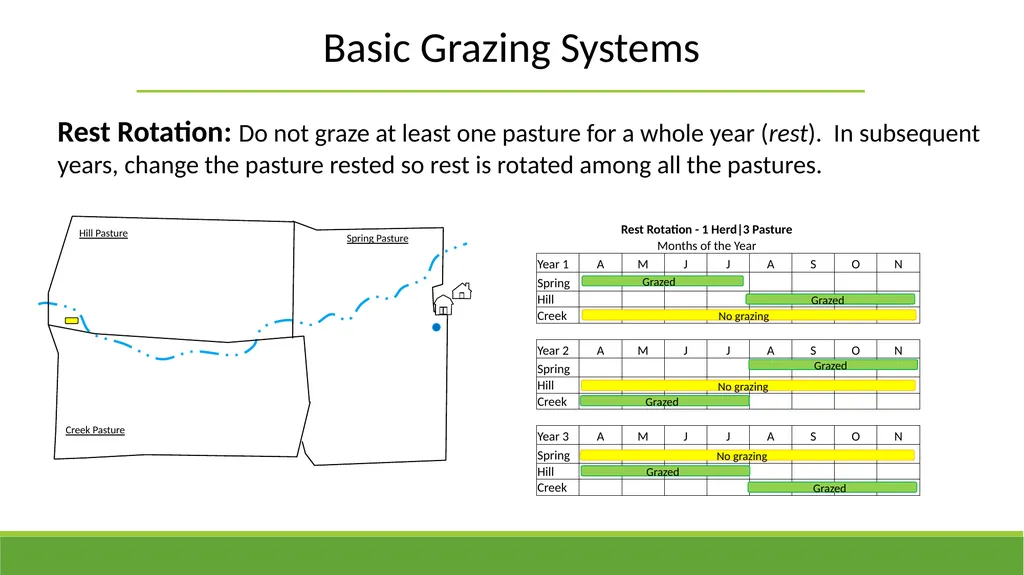
slide8. Basic Grazing Systems Rest Rotation: Do not graze at least one pasture for a whole year (rest). In subsequent years, change the pasture rested so rest is rotated among all the pastures.<br>
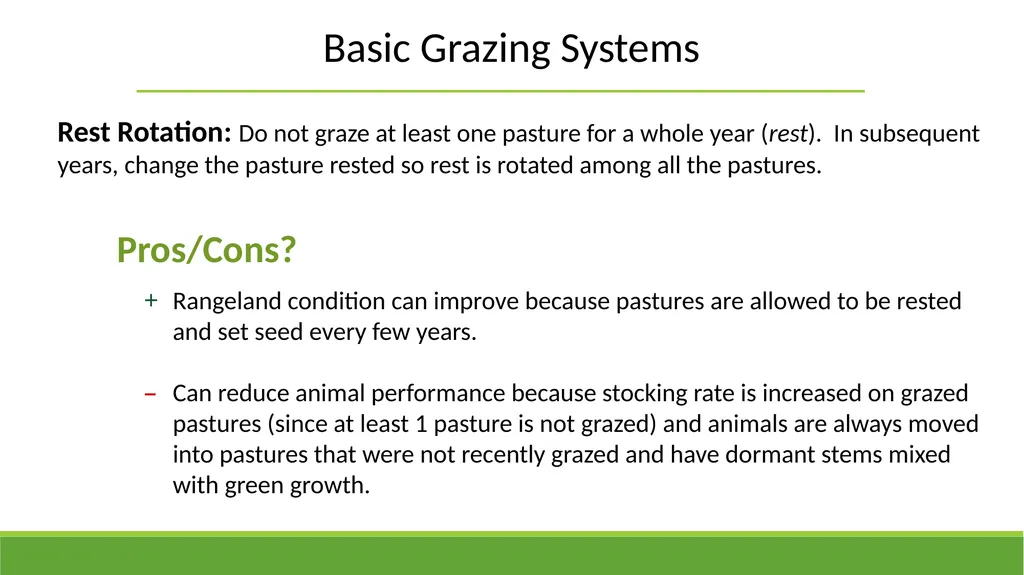
slide9. Basic Grazing Systems Rest Rotation: Do not graze at least one pasture for a whole year (rest). In subsequent years, change the pasture rested so rest is rotated among all the pastures. Pros/Cons? Rangeland condition can improve because pastures are allowed to be rested and set seed every few years.
Can reduce animal performance because stocking rate is increased on grazed pastures (since at least 1 pasture is not grazed) and animals are always moved into pastures that were not recently grazed and have dormant stems mixed with green growth.<br>
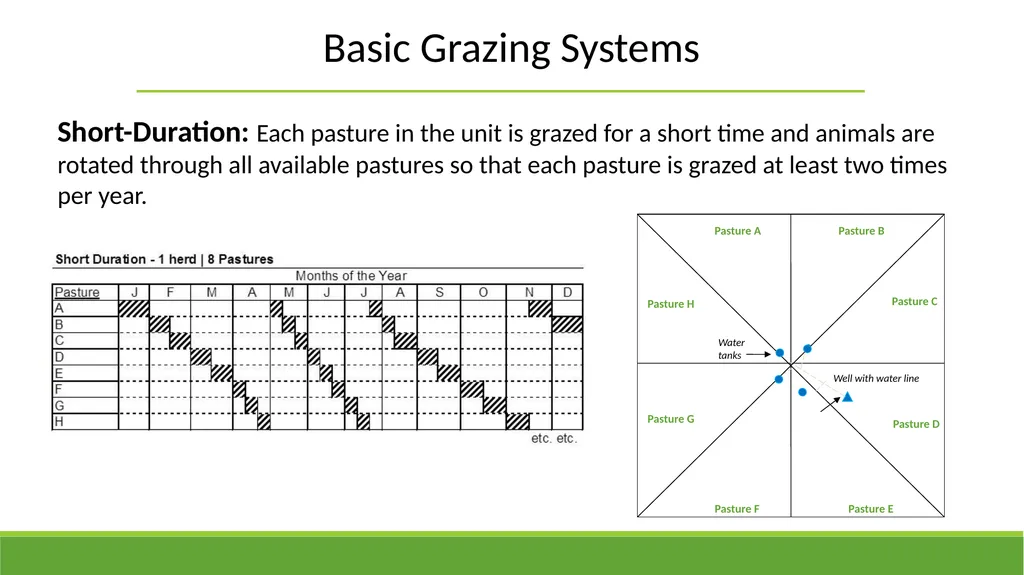
slide10. Basic Grazing Systems Short-Duration: Each pasture in the unit is grazed for a short time and animals are rotated through all available pastures so that each pasture is grazed at least two times per year.<br>
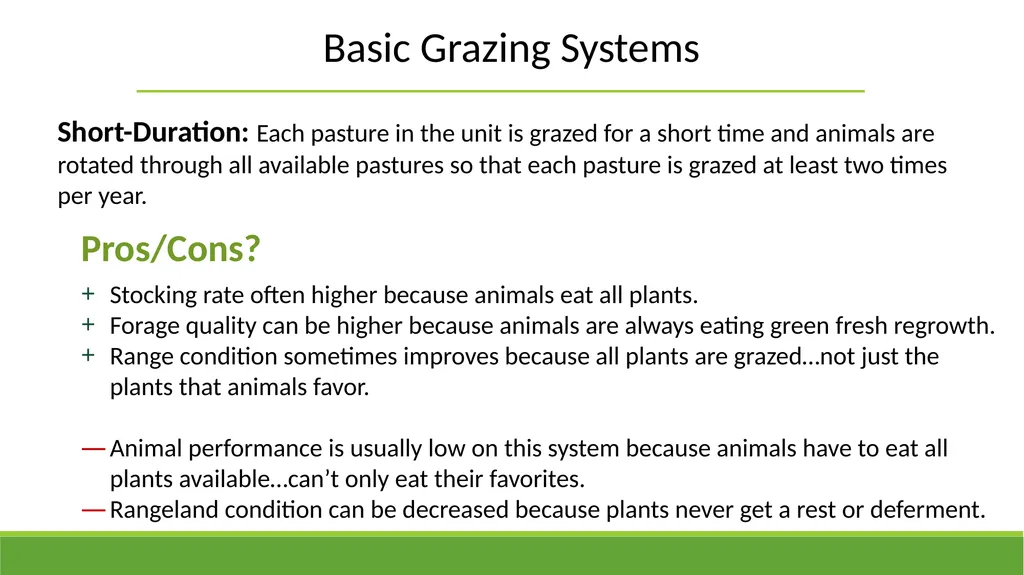
slide11. Basic Grazing Systems Short-Duration: Each pasture in the unit is grazed for a short time and animals are rotated through all available pastures so that each pasture is grazed at least two times per year. Pros/Cons? Stocking rate often higher because animals eat all plants.
Forage quality can be higher because animals are always eating green fresh regrowth.
Range condition sometimes improves because all plants are grazed…not just the plants that animals favor.
Animal performance is usually low on this system because animals have to eat all plants available…can’t only eat their favorites.
Rangeland condition can be decreased because plants never get a rest or deferment.<br>
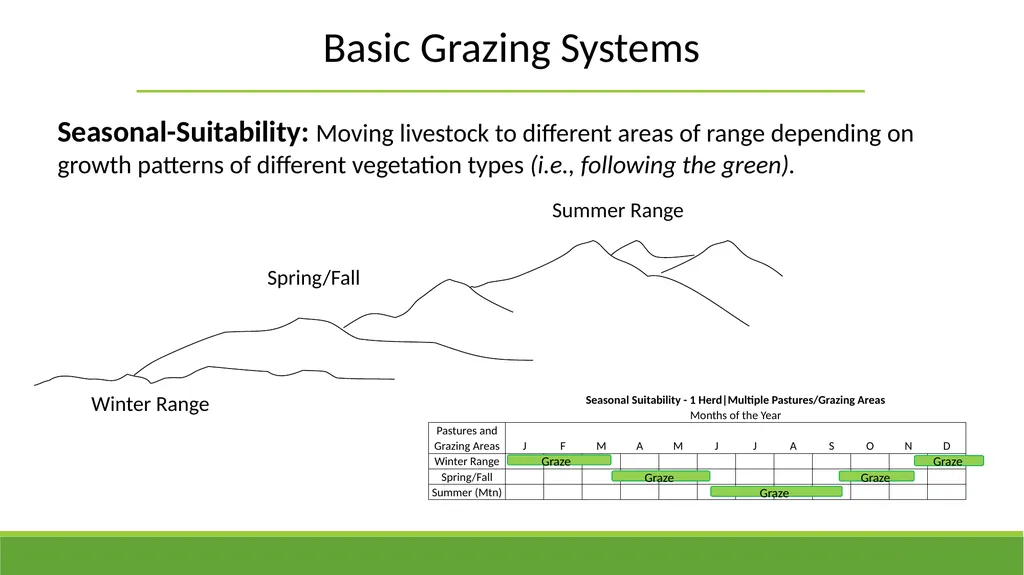
slide12. Basic Grazing Systems Seasonal-Suitability: Moving livestock to different areas of range depending on growth patterns of different vegetation types (i.e., following the green).<br>
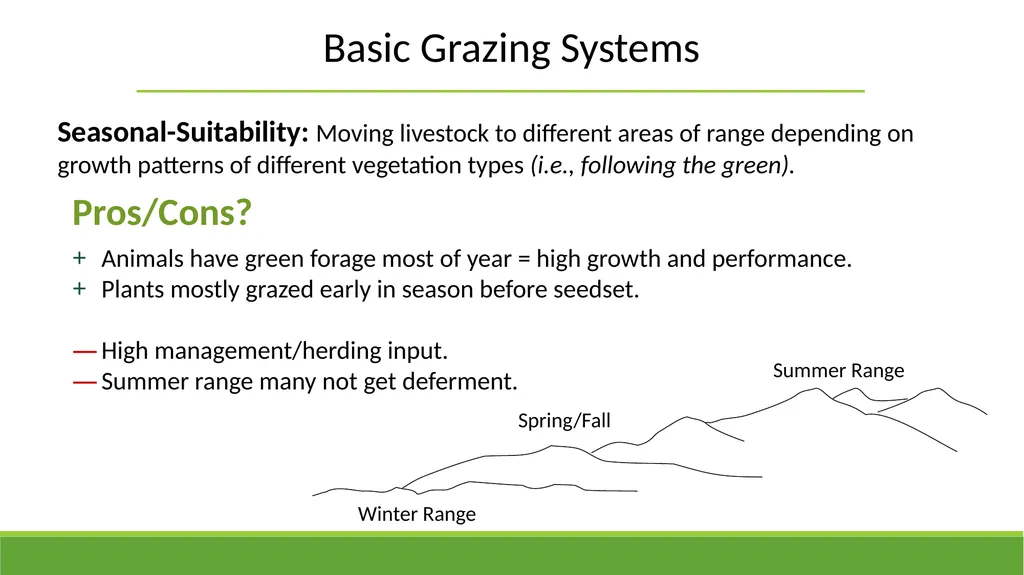
slide13. Basic Grazing Systems Seasonal-Suitability: Moving livestock to different areas of range depending on growth patterns of different vegetation types (i.e., following the green). Pros/Cons? Animals have green forage most of year = high growth and performance.
Plants mostly grazed early in season before seedset.
High management/herding input.
Summer range many not get deferment.<br>
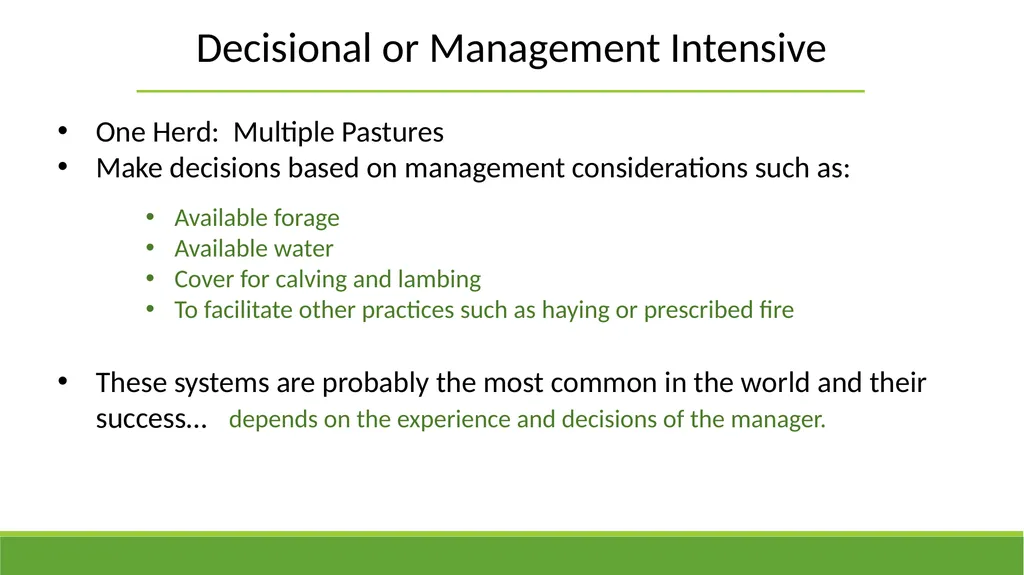
slide14. Decisional or Management Intensive One Herd: Multiple Pastures
Make decisions based on management considerations such as:
These systems are probably the most common in the world and their success… Available forage
Available water
Cover for calving and lambing
To facilitate other practices such as haying or prescribed fire depends on the experience and decisions of the manager.<br>
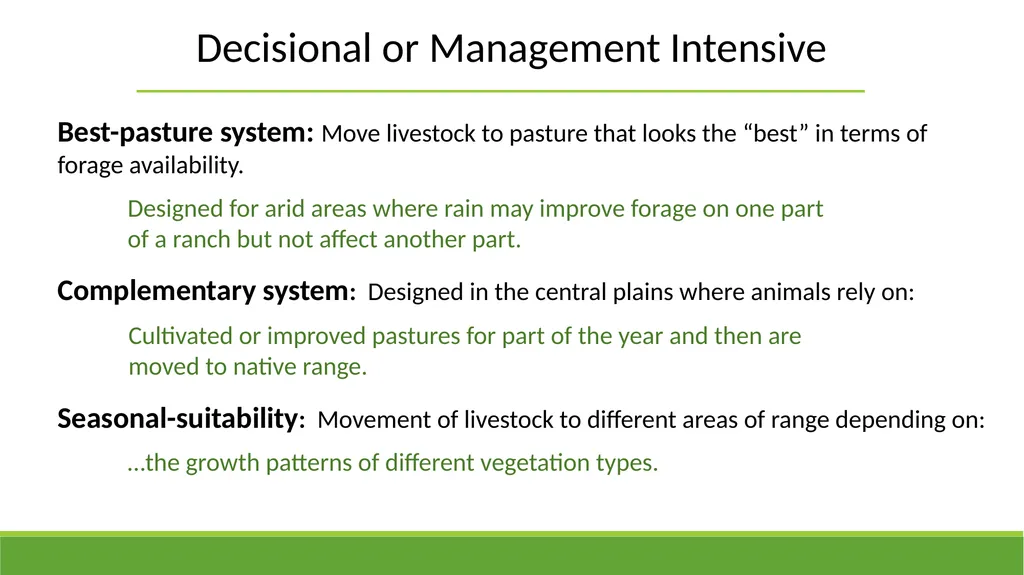
slide15. Decisional or Management Intensive Best-pasture system: Move livestock to pasture that looks the “best” in terms of forage availability.
Complementary system: Designed in the central plains where animals rely on:
Seasonal-suitability: Movement of livestock to different areas of range depending on: Designed for arid areas where rain may improve forage on one part of a ranch but not affect another part. Cultivated or improved pastures for part of the year and then are moved to native range. …the growth patterns of different vegetation types.<br>
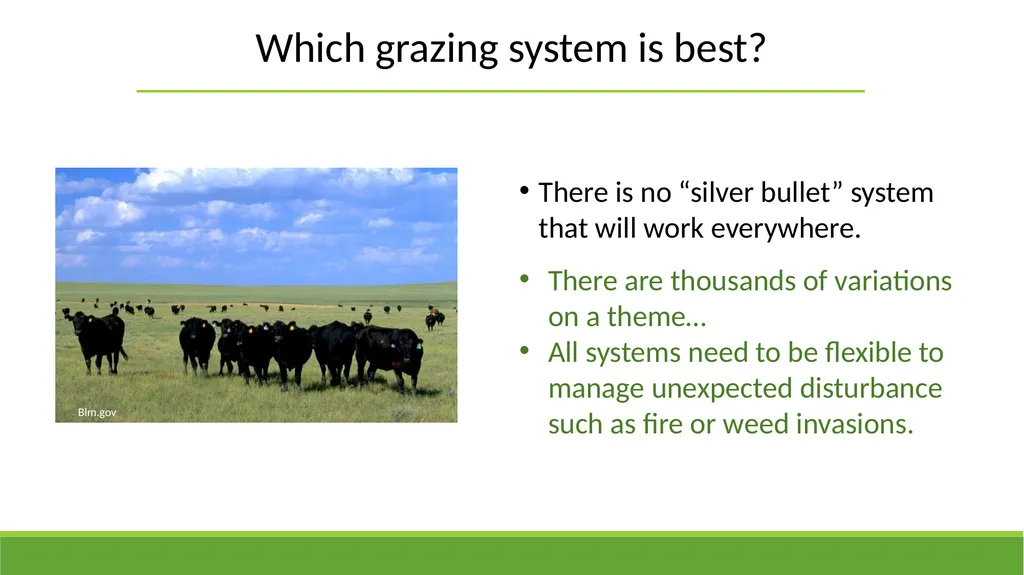
slide16. Which grazing system is best? There is no “silver bullet” system that will work everywhere. There are thousands of variations on a theme…
All systems need to be flexible to manage unexpected disturbance such as fire or weed invasions.<br>
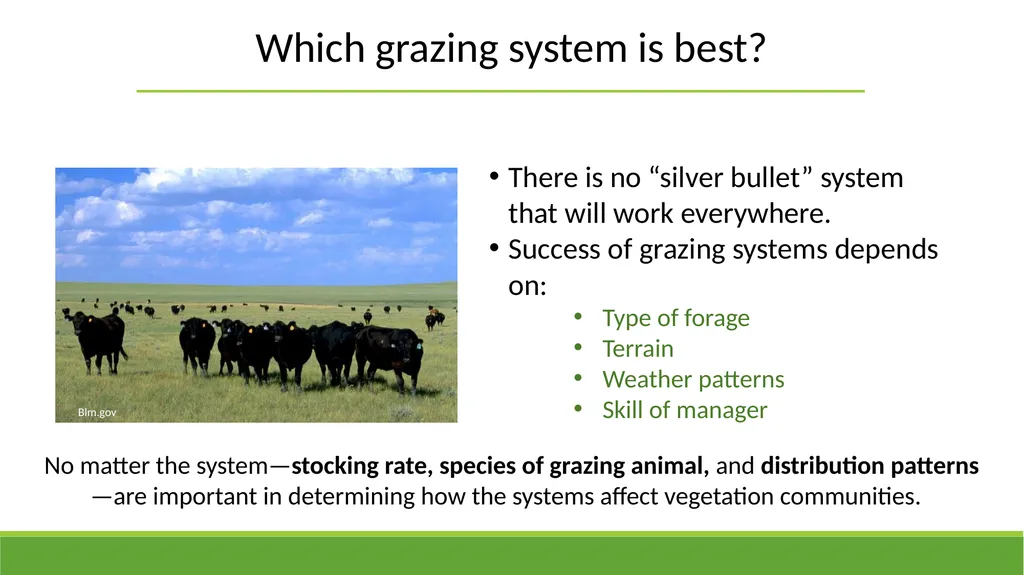
slide17. Which grazing system is best? There is no “silver bullet” system that will work everywhere.
Success of grazing systems depends on: Type of forage
Terrain
Weather patterns
Skill of manager No matter the system—stocking rate, species of grazing animal, and distribution patterns—are important in determining how the systems affect vegetation communities.<br>
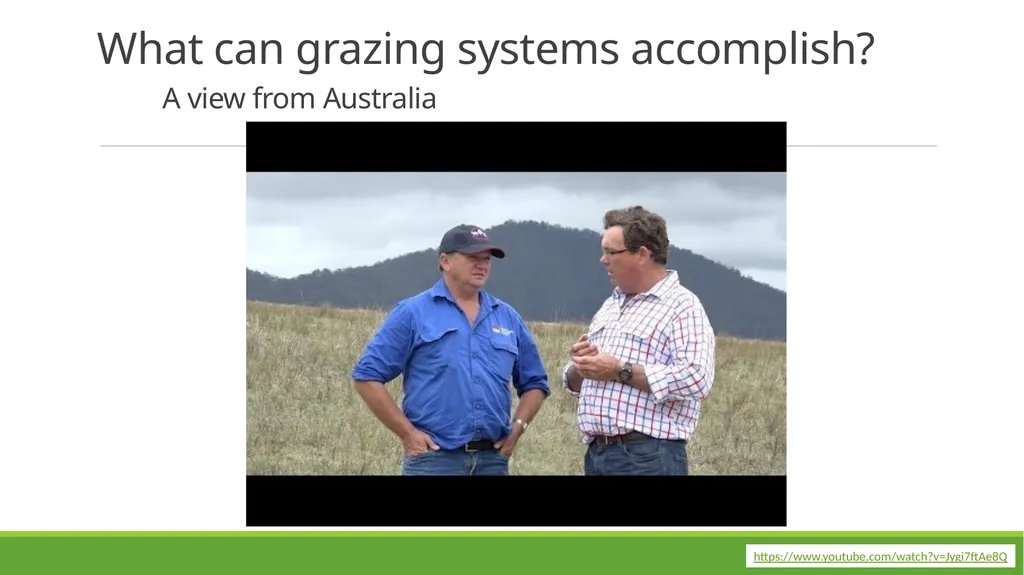
slide18. What can grazing systems accomplish? A view from Australia https://www.youtube.com/watch?v=Jygi7ftAe8Q<br>
slide19. Quiz/Exam Review Define grazing system, grazing period, deferment, rest, and stock density.
Describe the 5 basic grazing systems (continuous, deferred rotation, rest rotation, short duration, seasonal-suitability) and the pros/cons for each.
Describe best-pasture system and complementary system.
Which grazing system is best?
What can grazing systems accomplish?
What can grazing systems not accomplish?<br>
slide2. Maintain or accelerate vegetation improvement.
Improve uniform use of all grazing units.
Stabilize the forage supply throughout the grazing season.
Enhance forage quality for livestock and wildlife.
Improve function of ecological processes.
Protect watersheds.
Enhance wildlife habitat. From National Range and Pasture Handbook What can grazing methods accomplish?<br>
slide3. Grazing System = a planned effort to leave some areas unused for at least part of the year.
Grazing Period = season and number of days when pasture is grazed.
Deferment = a period of non-grazing until key forage species set seeds.
Rest = a period of non-grazing for a full year. Terms of Grazing Methods<br>
slide4. Deferment vs Rest Deferment Rest<br>
slide5. Continuous Grazing: Grazing the whole area for the whole grazing season. Simple/low input
Animals get maximum choice and have high animal performance.
Plants and areas that livestock prefer can be excessively used and become degraded. Pros/Cons? Basic Grazing Systems<br>
slide6. Basic Grazing Systems Deferred Rotation: Do not graze at least one pasture until after it has set seed (defer). In subsequent years, change the pasture deferred so the deferment is rotated among all the pastures over years.<br>
slide7. Basic Grazing Systems Deferred Rotation: Do not graze at least one pasture until after it has set seed (defer). In subsequent years, change the pasture deferred so the deferment is rotated among all the pastures over years. Pros/Cons? Rangeland condition can improve because pastures are occasionally not grazed when they are most sensitive to grazing.
Can reduce animal performance a little because animal opportunity to choose among plants and places is restricted.
Requires more fencing and management.<br>
slide8. Basic Grazing Systems Rest Rotation: Do not graze at least one pasture for a whole year (rest). In subsequent years, change the pasture rested so rest is rotated among all the pastures.<br>
slide9. Basic Grazing Systems Rest Rotation: Do not graze at least one pasture for a whole year (rest). In subsequent years, change the pasture rested so rest is rotated among all the pastures. Pros/Cons? Rangeland condition can improve because pastures are allowed to be rested and set seed every few years.
Can reduce animal performance because stocking rate is increased on grazed pastures (since at least 1 pasture is not grazed) and animals are always moved into pastures that were not recently grazed and have dormant stems mixed with green growth.<br>
slide10. Basic Grazing Systems Short-Duration: Each pasture in the unit is grazed for a short time and animals are rotated through all available pastures so that each pasture is grazed at least two times per year.<br>
slide11. Basic Grazing Systems Short-Duration: Each pasture in the unit is grazed for a short time and animals are rotated through all available pastures so that each pasture is grazed at least two times per year. Pros/Cons? Stocking rate often higher because animals eat all plants.
Forage quality can be higher because animals are always eating green fresh regrowth.
Range condition sometimes improves because all plants are grazed…not just the plants that animals favor.
Animal performance is usually low on this system because animals have to eat all plants available…can’t only eat their favorites.
Rangeland condition can be decreased because plants never get a rest or deferment.<br>
slide12. Basic Grazing Systems Seasonal-Suitability: Moving livestock to different areas of range depending on growth patterns of different vegetation types (i.e., following the green).<br>
slide13. Basic Grazing Systems Seasonal-Suitability: Moving livestock to different areas of range depending on growth patterns of different vegetation types (i.e., following the green). Pros/Cons? Animals have green forage most of year = high growth and performance.
Plants mostly grazed early in season before seedset.
High management/herding input.
Summer range many not get deferment.<br>
slide14. Decisional or Management Intensive One Herd: Multiple Pastures
Make decisions based on management considerations such as:
These systems are probably the most common in the world and their success… Available forage
Available water
Cover for calving and lambing
To facilitate other practices such as haying or prescribed fire depends on the experience and decisions of the manager.<br>
slide15. Decisional or Management Intensive Best-pasture system: Move livestock to pasture that looks the “best” in terms of forage availability.
Complementary system: Designed in the central plains where animals rely on:
Seasonal-suitability: Movement of livestock to different areas of range depending on: Designed for arid areas where rain may improve forage on one part of a ranch but not affect another part. Cultivated or improved pastures for part of the year and then are moved to native range. …the growth patterns of different vegetation types.<br>
slide16. Which grazing system is best? There is no “silver bullet” system that will work everywhere. There are thousands of variations on a theme…
All systems need to be flexible to manage unexpected disturbance such as fire or weed invasions.<br>
slide17. Which grazing system is best? There is no “silver bullet” system that will work everywhere.
Success of grazing systems depends on: Type of forage
Terrain
Weather patterns
Skill of manager No matter the system—stocking rate, species of grazing animal, and distribution patterns—are important in determining how the systems affect vegetation communities.<br>
slide18. What can grazing systems accomplish? A view from Australia https://www.youtube.com/watch?v=Jygi7ftAe8Q<br>
slide19. Quiz/Exam Review Define grazing system, grazing period, deferment, rest, and stock density.
Describe the 5 basic grazing systems (continuous, deferred rotation, rest rotation, short duration, seasonal-suitability) and the pros/cons for each.
Describe best-pasture system and complementary system.
Which grazing system is best?
What can grazing systems accomplish?
What can grazing systems not accomplish?<br>