Great Vowel Shift A major factor separating Middle English from Modern English is known as the Great Vowel Shift, a radical change in pronunciation during the 15th, 16th and 17th cc., as a result of which long vowel sounds began to be made
"Great Vowel Shift A major factor separating Middle" is the property of its rightful owner. Permission is granted to
download and print the materials on this website for personal, non-commercial use only, and to display it
on your personal computer provided you do not modify the materials and that you retain all copyright
notices contained in the materials. By downloading content from our website, you accept the terms of this
agreement.
Presentation Transcript
01
Great Vowel Shift<br>
02
A major factor separating Middle English from Modern English is known as the Great Vowel Shift, a radical change in pronunciation during the 15th, 16th and 17th cc., as a result of which long vowel sounds began to be made higher and further forward in the mouth (short vowel sounds were largely unchanged). In fact, the shift probably started very gradually some centuries before 1400, and continued long after 1700 (some subtle changes arguably continue even to this day). Many languages have undergone vowel shifts, but the major changes of the English vowel shift occurred within the relatively short space of a century or two, quite a sudden and dramatic shift in linguistic terms. It was largely during this short period of time that English lost the purer vowel sounds of most European languages, as well as the phonetic pairing between long and short vowel sounds.<br>
03
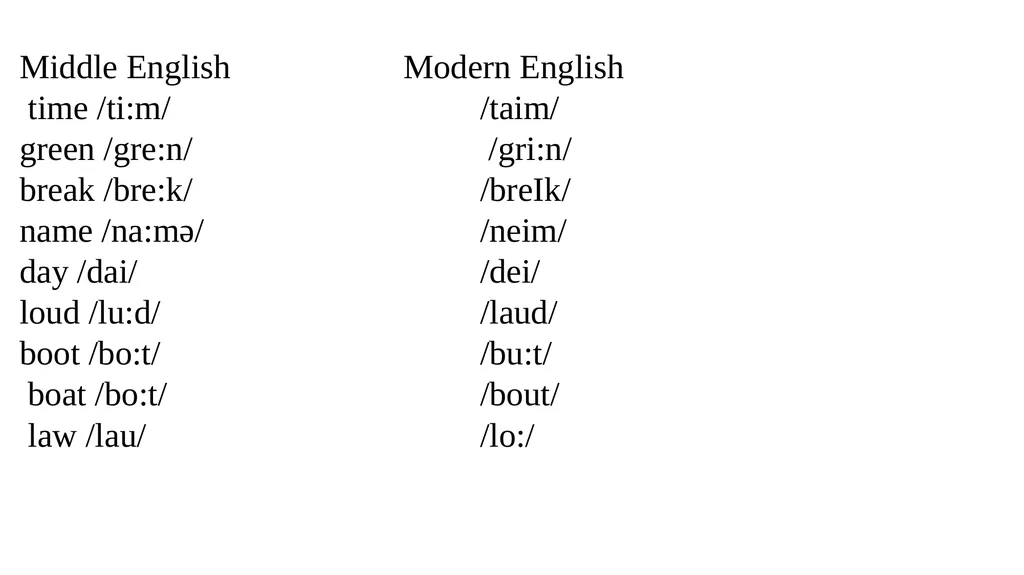
Middle English Modern English
time /ti:m/ /taim/
green /gre:n/ /gri:n/
break /bre:k/ /breIk/
name /na:mə/ /neim/
day /dai/ /dei/
loud /lu:d/ /laud/
boot /bo:t/ /bu:t/
boat /bo:t/ /bout/
law /lau/ /lo:/<br>
In Middle English (for instance in the time of Chaucer), the long vowels were generally pronounced very much like the Latin-derived Romance languages of Europe (e.g. sheep would have been pronounced more like “shape”; me as “may”; mine as “meen”; shire as “sheer”; mate as “maat”; out as “oot”; house as “hoose”; flour as “floor”; boot as “boat”;mode as “mood”; etc). William the Conqueror’s “Domesday Book”, for example, would have been pronounced “doomsday”, as indeed it is often erroneously spelled today. After the Great Vowel Shift, the pronunciations of these and similar words would have been much more like they are spoken today. The Shift comprises a series of connected changes, with changes in one vowel pushing another to change in order to "keep its distance", although there is some dispute as to the order of these movements. The changes also proceeded at different times and speeds in different parts of the country.<br>
06
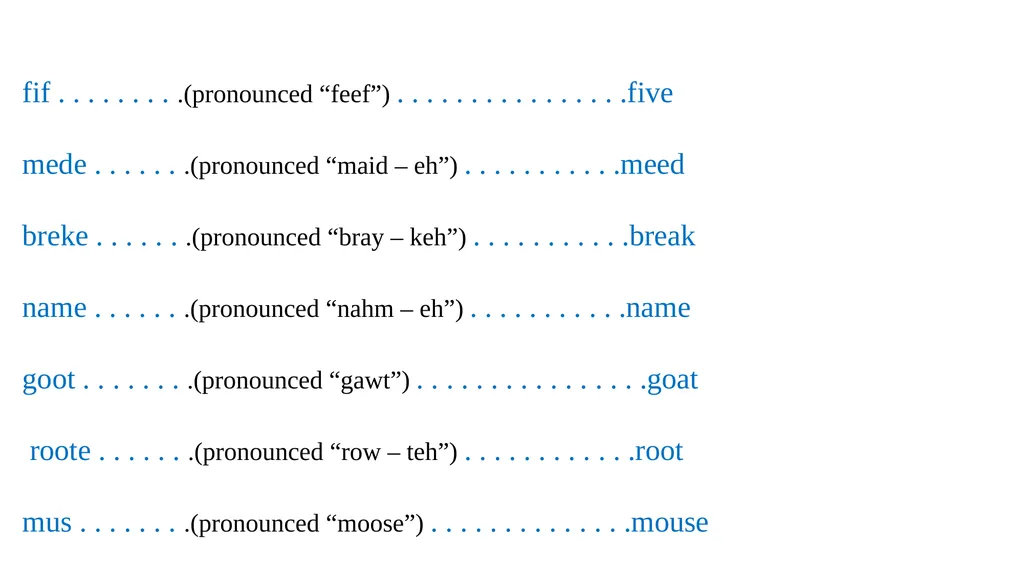
Thus, Chaucer’s word lyf (pronounced “leef”) became the modern word life, and the word five (originally pronounced “feef”) gradually acquired its modern pronunciation. Some of the changes occurred in stages: although lyf was spelled life by the time of Shakespeare in the late 16th c., it would have been pronounced more like “lafe” at that time, and only later did it acquired its modern pronunciation. It should be noted, though, that the tendency of upper-classes of southern England to pronounce a broad “a” in words like dance, bath and castle (to sound like “dahnce”, “bahth” and “cahstle”)
The Great Vowel Shift
was merely an 18th c. fashionable affectation which happened to stick, and nothing to do with a general shifting in vowel pronunciation.<br>
07
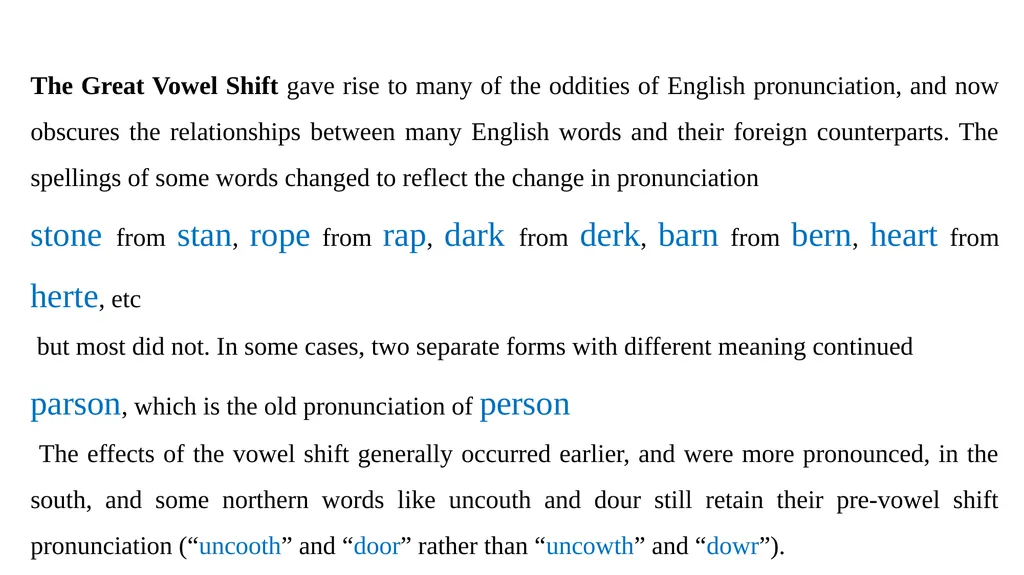
The Great Vowel Shift gave rise to many of the oddities of English pronunciation, and now obscures the relationships between many English words and their foreign counterparts. The spellings of some words changed to reflect the change in pronunciation
stone from stan, rope from rap, dark from derk, barn from bern, heart from herte, etc
but most did not. In some cases, two separate forms with different meaning continued
parson, which is the old pronunciation of person
The effects of the vowel shift generally occurred earlier, and were more pronounced, in the south, and some northern words like uncouth and dour still retain their pre-vowel shift pronunciation (“uncooth” and “door” rather than “uncowth” and “dowr”).<br>
08
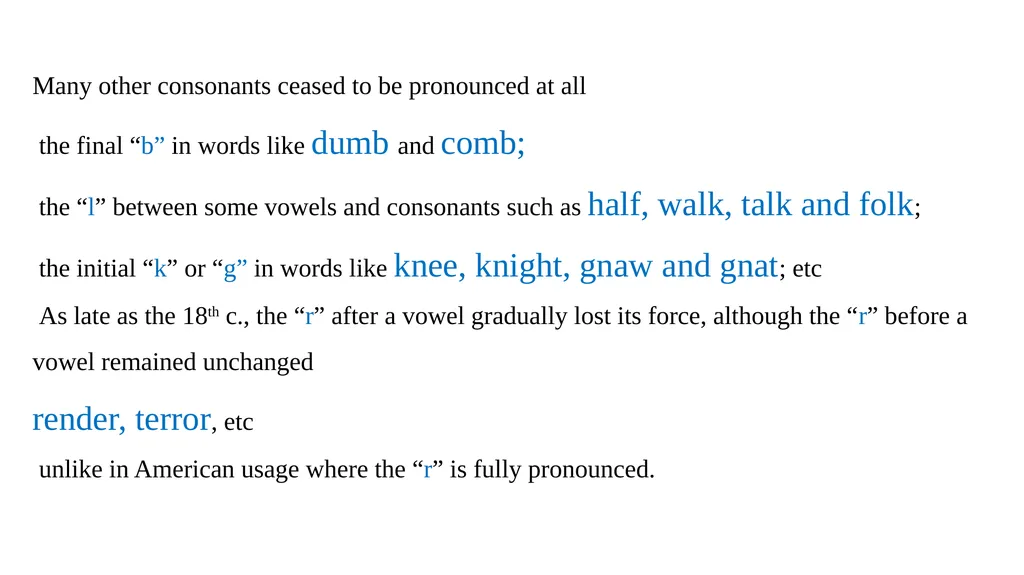
Many other consonants ceased to be pronounced at all
the final “b” in words like dumb and comb;
the “l” between some vowels and consonants such as half, walk, talk and folk;
the initial “k” or “g” in words like knee, knight, gnaw and gnat; etc
As late as the 18th c., the “r” after a vowel gradually lost its force, although the “r” before a vowel remained unchanged
render, terror, etc
unlike in American usage where the “r” is fully pronounced.<br>
09
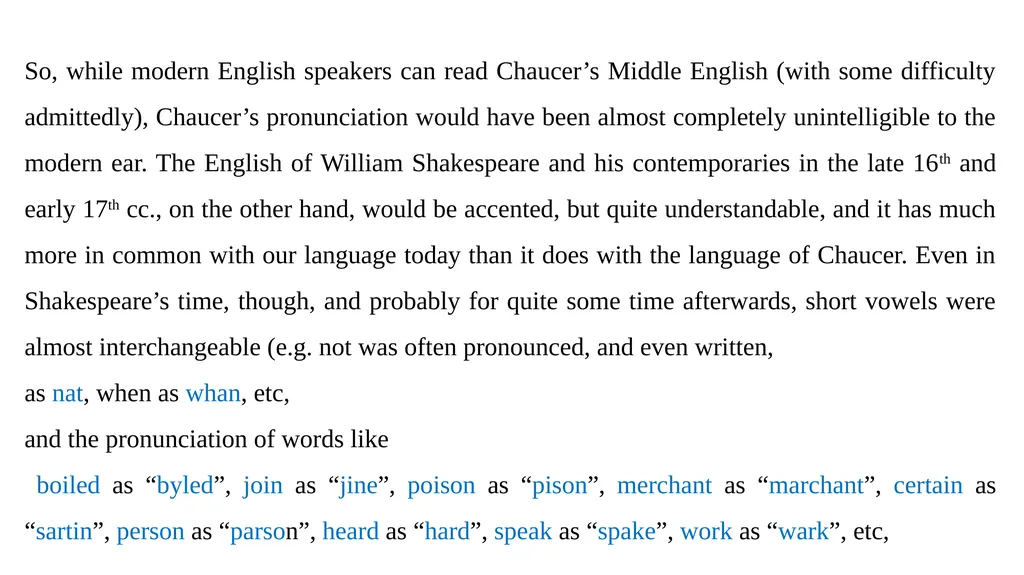
So, while modern English speakers can read Chaucer’s Middle English (with some difficulty admittedly), Chaucer’s pronunciation would have been almost completely unintelligible to the modern ear. The English of William Shakespeare and his contemporaries in the late 16th and early 17th cc., on the other hand, would be accented, but quite understandable, and it has much more in common with our language today than it does with the language of Chaucer. Even in Shakespeare’s time, though, and probably for quite some time afterwards, short vowels were almost interchangeable (e.g. not was often pronounced, and even written,
as nat, when as whan, etc,
and the pronunciation of words like
boiled as “byled”, join as “jine”, poison as “pison”, merchant as “marchant”, certain as “sartin”, person as “parson”, heard as “hard”, speak as “spake”, work as “wark”, etc,<br>
10
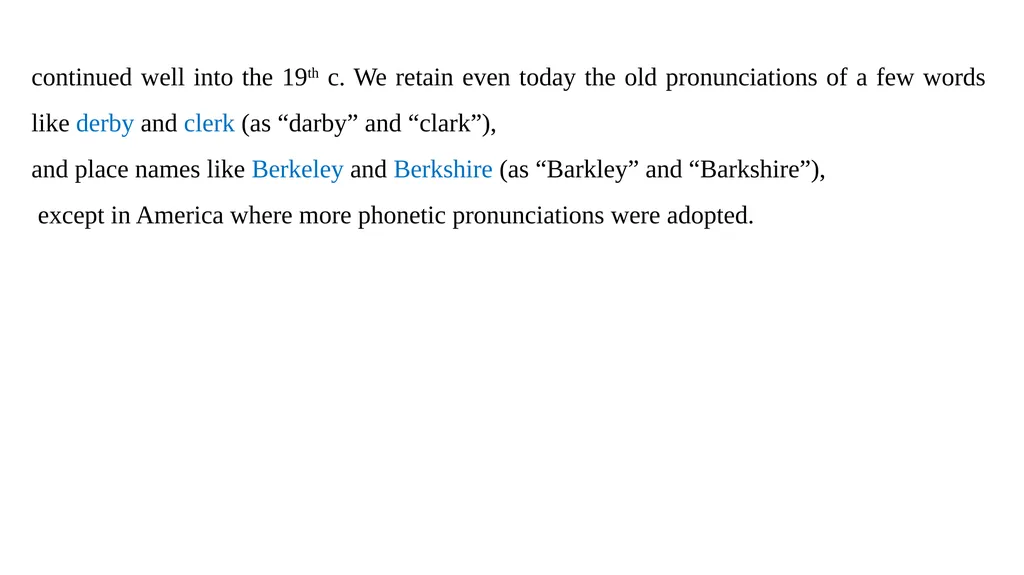
continued well into the 19th c. We retain even today the old pronunciations of a few words like derby and clerk (as “darby” and “clark”),
and place names like Berkeley and Berkshire (as “Barkley” and “Barkshire”),
except in America where more phonetic pronunciations were adopted.<br>
11
Busy has kept its old West Midlands spelling, but an East Midlands/London pronunciation; bury has a West Midlands spelling but a Kentish pronunciation
It is also due to irregularities and regional variations in the vowel shift that we have ended up with inconsistencies in pronunciation such as food (as compared to good, stood, blood, etc) and roof (which still has variable pronunciation), and the different pronunciations of the “o” in shove, move, hove, etc.
The Old English consonant X - technically a “voiceless velar fricative”, pronounced as in the “ch” of loch or Bach - disappeared from English, and the OE word burX (place), for example, was replaced with “-burgh”, “-borough”, “-brough” or “-bury” in many place names. In some cases, voiceless fricatives began to be pronounced like an “f” (e.g. laugh, cough).<br>