
Green Industrial/Innovation Policy Making in
MY
Published · 13 slides · 0 views

1 / 1




Description
Green IndustrialInnovation Policy Making in Europe REINHILDE VEUGELERS Prof at KULeuven Senior Fellow at Bruegel (Brussels) PIIE (Washington DC) Shifting economies from brown to green represents one of the major socio-economic
Related Topics
Share
Embed code
Download this presentation From Below
"Green Industrial/Innovation Policy Making in" is the property of its rightful owner. Permission is granted to download and print the materials on this website for personal, non-commercial use only, and to display it on your personal computer provided you do not modify the materials and that you retain all copyright notices contained in the materials. By downloading content from our website, you accept the terms of this agreement.
Presentation Transcript
01
Green Industrial/Innovation Policy Making in Europe
REINHILDE VEUGELERS
Prof at KULeuven
Senior Fellow at Bruegel (Brussels) & PIIE (Washington DC)<br>
02
Shifting economies from brown to green represents one of the major socio-economic transformations ever seen in history.
Countries are still figuring out how to reconcile the multi-dimensional objectives of a green industrial policy, particularly when these dimensions counteract each other: How to combine
decarbonization with
economic growth and jobs and world competitiveness,
and all this with resilience and sovereignty/autonomy/security of supply?<br>
Countries are still figuring out how to reconcile the multi-dimensional objectives of a green industrial policy, particularly when these dimensions counteract each other: How to combine
decarbonization with
economic growth and jobs and world competitiveness,
and all this with resilience and sovereignty/autonomy/security of supply?<br>
03
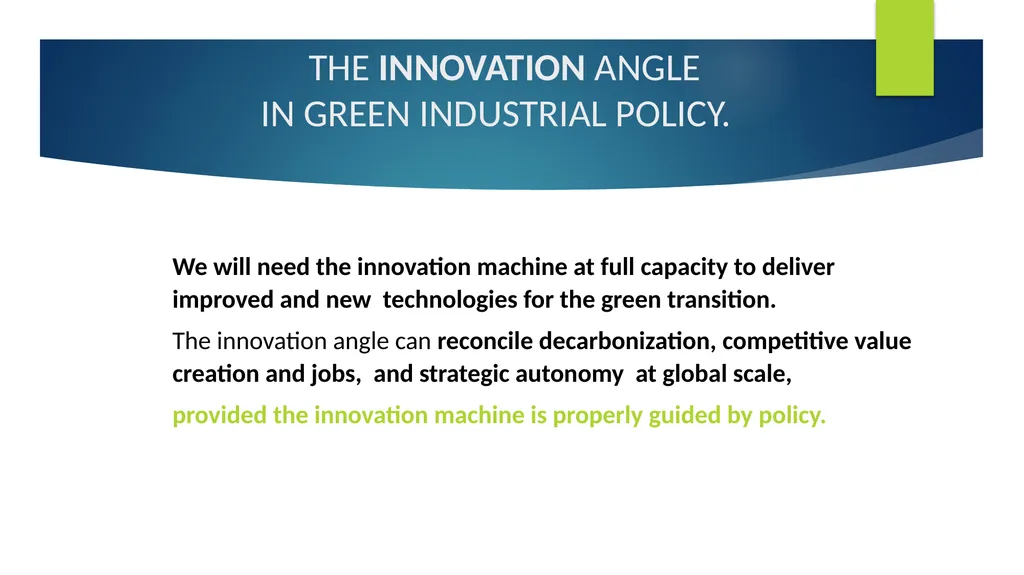
We will need the innovation machine at full capacity to deliver improved and new technologies for the green transition.
The innovation angle can reconcile decarbonization, competitive value creation and jobs, and strategic autonomy at global scale,
provided the innovation machine is properly guided by policy. THE INNOVATION ANGLE IN GREEN INDUSTRIAL POLICY.<br>
The innovation angle can reconcile decarbonization, competitive value creation and jobs, and strategic autonomy at global scale,
provided the innovation machine is properly guided by policy. THE INNOVATION ANGLE IN GREEN INDUSTRIAL POLICY.<br>
04
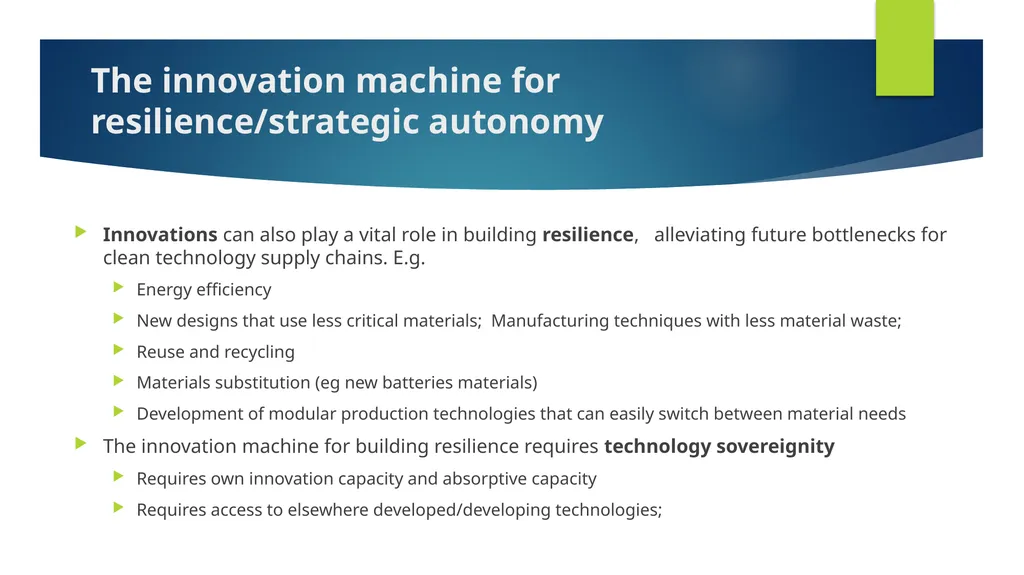
The innovation machine for
resilience/strategic autonomy Innovations can also play a vital role in building resilience, alleviating future bottlenecks for clean technology supply chains. E.g.
Energy efficiency
New designs that use less critical materials; Manufacturing techniques with less material waste;
Reuse and recycling
Materials substitution (eg new batteries materials)
Development of modular production technologies that can easily switch between material needs
The innovation machine for building resilience requires technology sovereignity
Requires own innovation capacity and absorptive capacity
Requires access to elsewhere developed/developing technologies;<br>
Energy efficiency
New designs that use less critical materials; Manufacturing techniques with less material waste;
Reuse and recycling
Materials substitution (eg new batteries materials)
Development of modular production technologies that can easily switch between material needs
The innovation machine for building resilience requires technology sovereignity
Requires own innovation capacity and absorptive capacity
Requires access to elsewhere developed/developing technologies;<br>
05
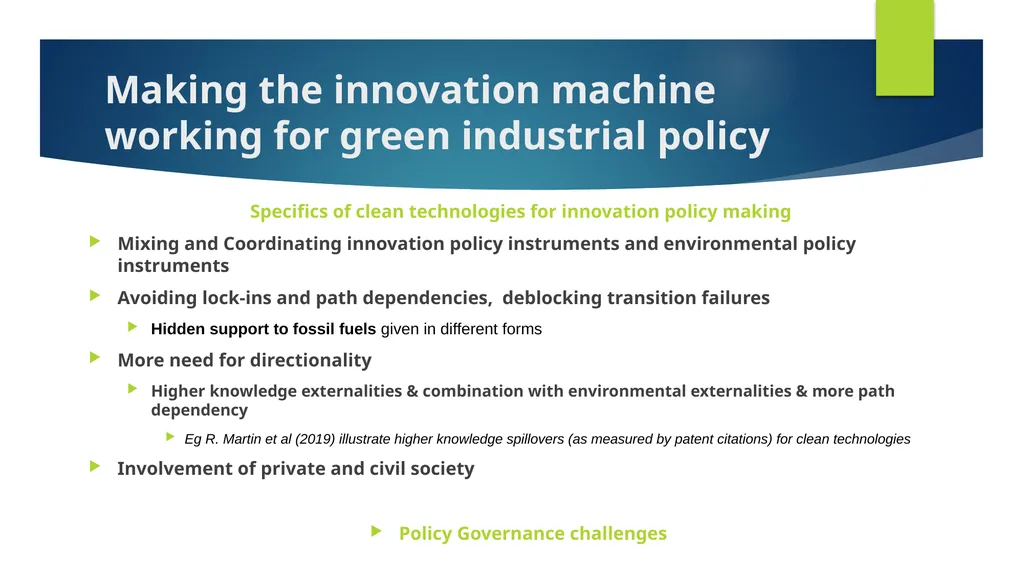
Making the innovation machine working for green industrial policy Specifics of clean technologies for innovation policy making
Mixing and Coordinating innovation policy instruments and environmental policy instruments
Avoiding lock-ins and path dependencies, deblocking transition failures
Hidden support to fossil fuels given in different forms
More need for directionality
Higher knowledge externalities & combination with environmental externalities & more path dependency
Eg R. Martin et al (2019) illustrate higher knowledge spillovers (as measured by patent citations) for clean technologies
Involvement of private and civil society
Policy Governance challenges<br>
Mixing and Coordinating innovation policy instruments and environmental policy instruments
Avoiding lock-ins and path dependencies, deblocking transition failures
Hidden support to fossil fuels given in different forms
More need for directionality
Higher knowledge externalities & combination with environmental externalities & more path dependency
Eg R. Martin et al (2019) illustrate higher knowledge spillovers (as measured by patent citations) for clean technologies
Involvement of private and civil society
Policy Governance challenges<br>
06
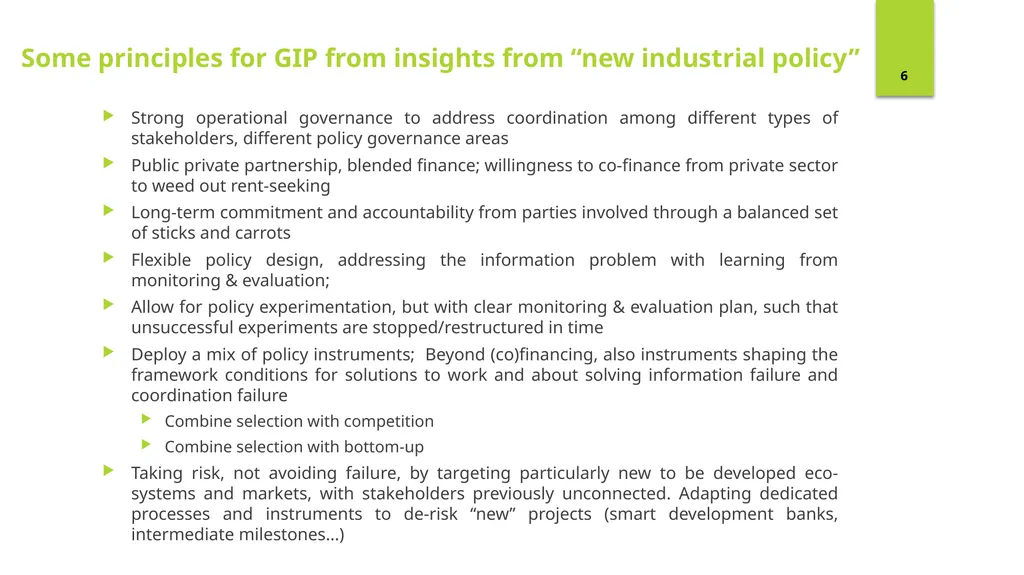
6 Strong operational governance to address coordination among different types of stakeholders, different policy governance areas
Public private partnership, blended finance; willingness to co-finance from private sector to weed out rent-seeking
Long-term commitment and accountability from parties involved through a balanced set of sticks and carrots
Flexible policy design, addressing the information problem with learning from monitoring & evaluation;
Allow for policy experimentation, but with clear monitoring & evaluation plan, such that unsuccessful experiments are stopped/restructured in time
Deploy a mix of policy instruments; Beyond (co)financing, also instruments shaping the framework conditions for solutions to work and about solving information failure and coordination failure
Combine selection with competition
Combine selection with bottom-up
Taking risk, not avoiding failure, by targeting particularly new to be developed eco-systems and markets, with stakeholders previously unconnected. Adapting dedicated processes and instruments to de-risk “new” projects (smart development banks, intermediate milestones…) Some principles for GIP from insights from “new industrial policy”<br>
Public private partnership, blended finance; willingness to co-finance from private sector to weed out rent-seeking
Long-term commitment and accountability from parties involved through a balanced set of sticks and carrots
Flexible policy design, addressing the information problem with learning from monitoring & evaluation;
Allow for policy experimentation, but with clear monitoring & evaluation plan, such that unsuccessful experiments are stopped/restructured in time
Deploy a mix of policy instruments; Beyond (co)financing, also instruments shaping the framework conditions for solutions to work and about solving information failure and coordination failure
Combine selection with competition
Combine selection with bottom-up
Taking risk, not avoiding failure, by targeting particularly new to be developed eco-systems and markets, with stakeholders previously unconnected. Adapting dedicated processes and instruments to de-risk “new” projects (smart development banks, intermediate milestones…) Some principles for GIP from insights from “new industrial policy”<br>
07
EU public funding for green innovation >90% of the public funding for R&D in the EU runs through Member States.
EU-DG COMP State Aid Control
EU level funding programs for clean tech
Its 2021-2027 Framework Programme, Horizon Europe, around EUR 15 billion is earmarked for climate, energy and mobility projects.
Science, early stage, low technology readiness levels
Bottom up: ERC, EIT
Directed & PPPs at EU scale
Alliances (Battery Alliance), IPCEI (Hydrogen), EIC, Missions
Innovation Fund (from ETS) for demonstration The EU and its Member States deploy a mix of green innovation policy instruments, combining carbon pricing, targets, regulations with public support for R&D and early deployment,
Trend towards PPPs encompassing all players operating in a value chain
Yet, appears more as a collection of policy initiatives – than as a truly coherent green industrial policy framework.
Missing is a convincing strong policy governance.<br>
EU-DG COMP State Aid Control
EU level funding programs for clean tech
Its 2021-2027 Framework Programme, Horizon Europe, around EUR 15 billion is earmarked for climate, energy and mobility projects.
Science, early stage, low technology readiness levels
Bottom up: ERC, EIT
Directed & PPPs at EU scale
Alliances (Battery Alliance), IPCEI (Hydrogen), EIC, Missions
Innovation Fund (from ETS) for demonstration The EU and its Member States deploy a mix of green innovation policy instruments, combining carbon pricing, targets, regulations with public support for R&D and early deployment,
Trend towards PPPs encompassing all players operating in a value chain
Yet, appears more as a collection of policy initiatives – than as a truly coherent green industrial policy framework.
Missing is a convincing strong policy governance.<br>
08
EU reaction to IRA: NZIA, (CRM), TCTF, (STEP) Net Zero Industry Act (reaction to IRA)
List of net-zero technologies considered to be “strategic”; Close to market: TRL 8
Adoption of a 40% target for EU domestic clean tech manufacturing over deployment in 2030
MS select Net-Zero Strategic Projects (NZSPs)
NZSPs to get priority status at national level, and fast-track in permitting procedures
“Sustainability and resilience” criteria included in public procurement and auctions (15-30% award criteria weighting) + disadvantage bids using tech from country with >65% supply share No new EU-funding in NZIA, has to come from MS: Importance of State Aid Control:
Temporary Crisis & Transition Framework Revision
Allows to provide higher support to SMEs and companies in disadvantaged regions
Allows to also cover OPEX, up to the identified funding gap
Allows to do “matching aid” in exceptional cases and respecting several safeguards<br>
List of net-zero technologies considered to be “strategic”; Close to market: TRL 8
Adoption of a 40% target for EU domestic clean tech manufacturing over deployment in 2030
MS select Net-Zero Strategic Projects (NZSPs)
NZSPs to get priority status at national level, and fast-track in permitting procedures
“Sustainability and resilience” criteria included in public procurement and auctions (15-30% award criteria weighting) + disadvantage bids using tech from country with >65% supply share No new EU-funding in NZIA, has to come from MS: Importance of State Aid Control:
Temporary Crisis & Transition Framework Revision
Allows to provide higher support to SMEs and companies in disadvantaged regions
Allows to also cover OPEX, up to the identified funding gap
Allows to do “matching aid” in exceptional cases and respecting several safeguards<br>
09
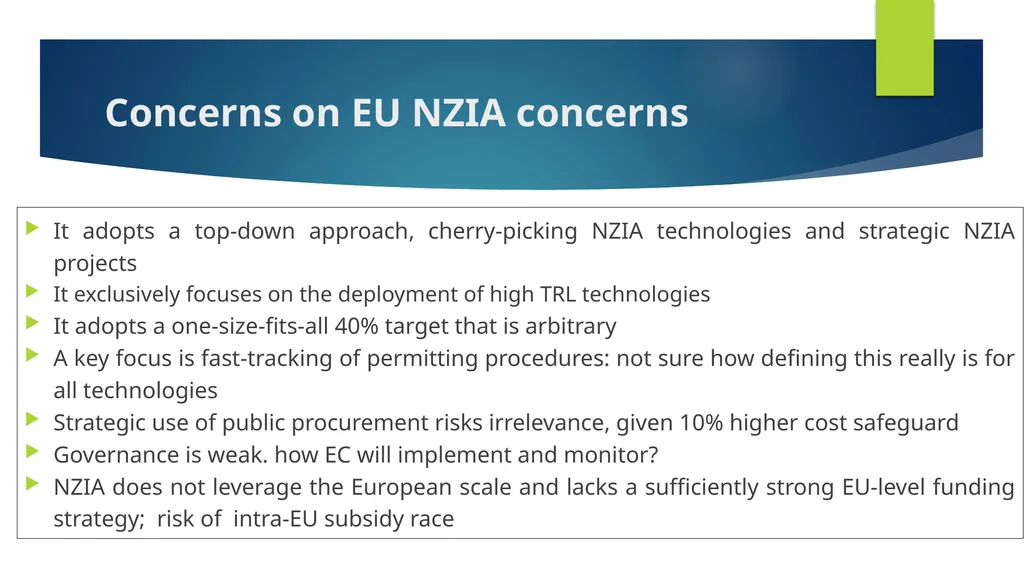
Concerns on EU NZIA concerns It adopts a top-down approach, cherry-picking NZIA technologies and strategic NZIA projects
It exclusively focuses on the deployment of high TRL technologies
It adopts a one-size-fits-all 40% target that is arbitrary
A key focus is fast-tracking of permitting procedures: not sure how defining this really is for all technologies
Strategic use of public procurement risks irrelevance, given 10% higher cost safeguard
Governance is weak. how EC will implement and monitor?
NZIA does not leverage the European scale and lacks a sufficiently strong EU-level funding strategy; risk of intra-EU subsidy race<br>
It exclusively focuses on the deployment of high TRL technologies
It adopts a one-size-fits-all 40% target that is arbitrary
A key focus is fast-tracking of permitting procedures: not sure how defining this really is for all technologies
Strategic use of public procurement risks irrelevance, given 10% higher cost safeguard
Governance is weak. how EC will implement and monitor?
NZIA does not leverage the European scale and lacks a sufficiently strong EU-level funding strategy; risk of intra-EU subsidy race<br>
10
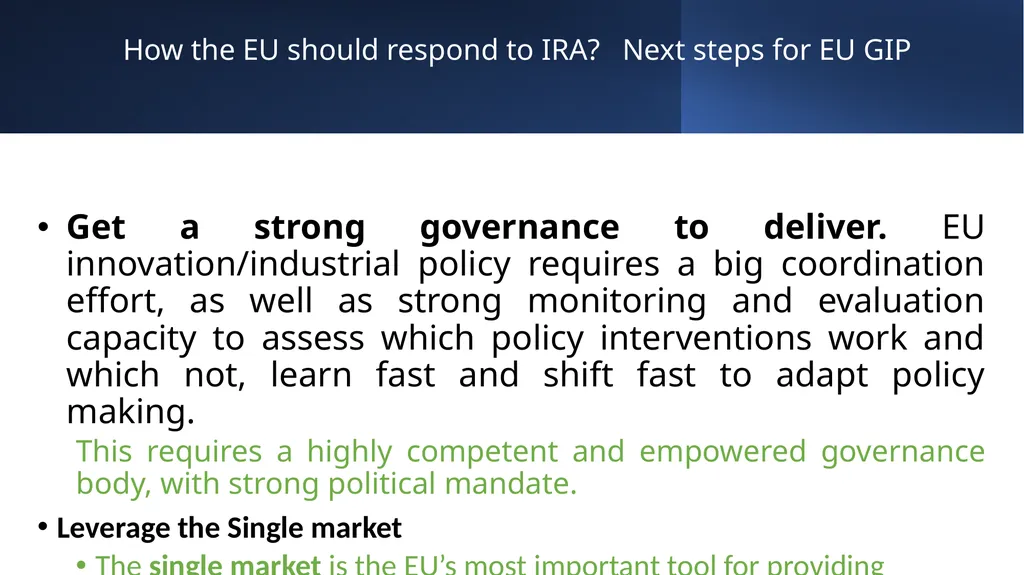
How the EU should respond to IRA? Next steps for EU GIP Get a strong governance to deliver. EU innovation/industrial policy requires a big coordination effort, as well as strong monitoring and evaluation capacity to assess which policy interventions work and which not, learn fast and shift fast to adapt policy making.
This requires a highly competent and empowered governance body, with strong political mandate.
Leverage the Single market
The single market is the EU’s most important tool for providing incentives for private clean-tech investment.<br>
This requires a highly competent and empowered governance body, with strong political mandate.
Leverage the Single market
The single market is the EU’s most important tool for providing incentives for private clean-tech investment.<br>
11
How the EU should respond to IRA? Next steps for EU GIP
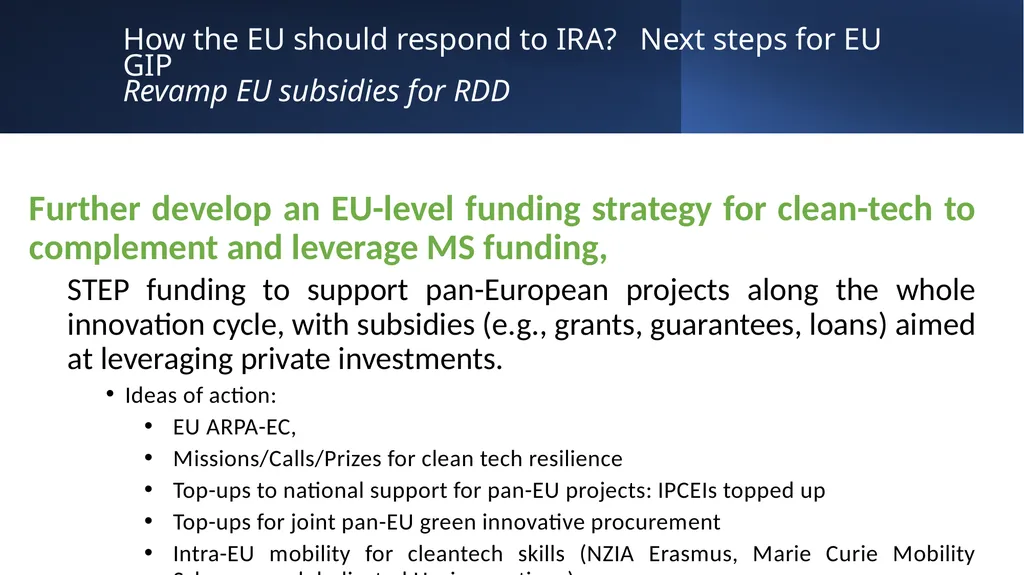
Revamp EU subsidies for RDD Further develop an EU-level funding strategy for clean-tech to complement and leverage MS funding,
STEP funding to support pan-European projects along the whole innovation cycle, with subsidies (e.g., grants, guarantees, loans) aimed at leveraging private investments.
Ideas of action:
EU ARPA-EC,
Missions/Calls/Prizes for clean tech resilience
Top-ups to national support for pan-EU projects: IPCEIs topped up
Top-ups for joint pan-EU green innovative procurement
Intra-EU mobility for cleantech skills (NZIA Erasmus, Marie Curie Mobility Schemes and dedicated Horizon actions).<br>
STEP funding to support pan-European projects along the whole innovation cycle, with subsidies (e.g., grants, guarantees, loans) aimed at leveraging private investments.
Ideas of action:
EU ARPA-EC,
Missions/Calls/Prizes for clean tech resilience
Top-ups to national support for pan-EU projects: IPCEIs topped up
Top-ups for joint pan-EU green innovative procurement
Intra-EU mobility for cleantech skills (NZIA Erasmus, Marie Curie Mobility Schemes and dedicated Horizon actions).<br>
12
How the EU should respond to IRA?
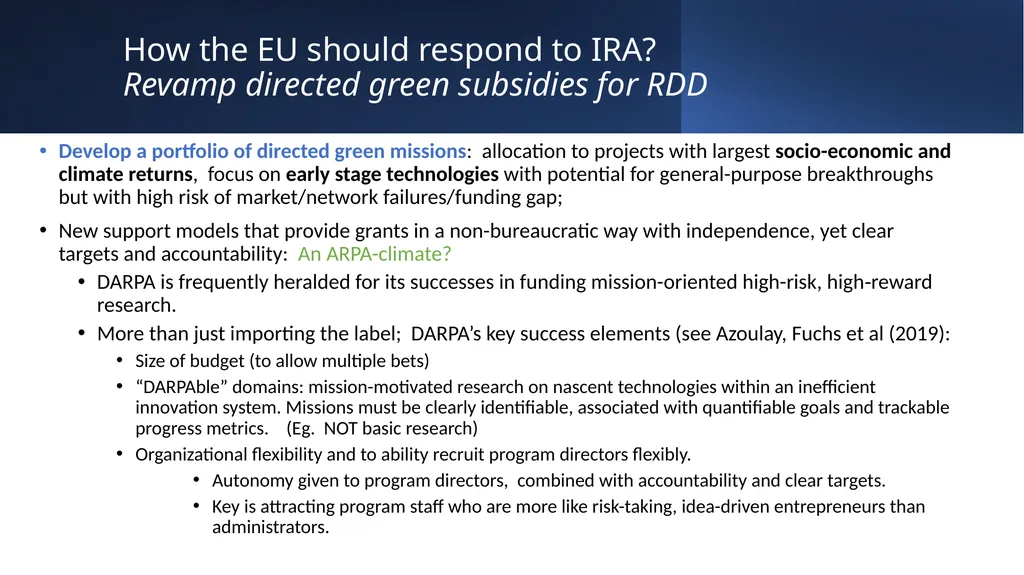
Revamp directed green subsidies for RDD Develop a portfolio of directed green missions: allocation to projects with largest socio-economic and climate returns, focus on early stage technologies with potential for general-purpose breakthroughs but with high risk of market/network failures/funding gap;
New support models that provide grants in a non-bureaucratic way with independence, yet clear targets and accountability: An ARPA-climate?
DARPA is frequently heralded for its successes in funding mission-oriented high-risk, high‑reward research.
More than just importing the label; DARPA’s key success elements (see Azoulay, Fuchs et al (2019):
Size of budget (to allow multiple bets)
“DARPAble” domains: mission-motivated research on nascent technologies within an inefficient innovation system. Missions must be clearly identifiable, associated with quantifiable goals and trackable progress metrics. (Eg. NOT basic research)
Organizational flexibility and to ability recruit program directors flexibly.
Autonomy given to program directors, combined with accountability and clear targets.
Key is attracting program staff who are more like risk-taking, idea-driven entrepreneurs than administrators.<br>
New support models that provide grants in a non-bureaucratic way with independence, yet clear targets and accountability: An ARPA-climate?
DARPA is frequently heralded for its successes in funding mission-oriented high-risk, high‑reward research.
More than just importing the label; DARPA’s key success elements (see Azoulay, Fuchs et al (2019):
Size of budget (to allow multiple bets)
“DARPAble” domains: mission-motivated research on nascent technologies within an inefficient innovation system. Missions must be clearly identifiable, associated with quantifiable goals and trackable progress metrics. (Eg. NOT basic research)
Organizational flexibility and to ability recruit program directors flexibly.
Autonomy given to program directors, combined with accountability and clear targets.
Key is attracting program staff who are more like risk-taking, idea-driven entrepreneurs than administrators.<br>
13
Reinhilde.veugelers@kuleuven.be Tagliapietra, S., Veugelers, R (2023) (Eds), Sparking Europe’s New Industrial Revolution: A policy for net zero growth and resilience, Bruegel Blueprint.
Kleimann, D., Poitiers, N., Sapir, A., Tagliapietra, S., Véron, N., Veugelers, R., & Zettelmeyer, J., 2023, Green tech race? The US Inflation Reduction Act and the EU Net Zero Industry Act. The World Economy
Veugelers, R., S. Tagliapietra, C. Trasi, 2024, Green Industrial Policy In Europe: Past, Present and Prospects, Journal of Industry, Competition and Trade, forthcoming.
Veugelers, R (2024) Powering the Clean Energy Innovation System, PIIE Working Paper 24-5. https://www.bruegel.org/people/reinhilde-veugelers<br>
Kleimann, D., Poitiers, N., Sapir, A., Tagliapietra, S., Véron, N., Veugelers, R., & Zettelmeyer, J., 2023, Green tech race? The US Inflation Reduction Act and the EU Net Zero Industry Act. The World Economy
Veugelers, R., S. Tagliapietra, C. Trasi, 2024, Green Industrial Policy In Europe: Past, Present and Prospects, Journal of Industry, Competition and Trade, forthcoming.
Veugelers, R (2024) Powering the Clean Energy Innovation System, PIIE Working Paper 24-5. https://www.bruegel.org/people/reinhilde-veugelers<br>