GREEN-NG, new version of GREEN, based on re-analysis databases A. Sicard, N. Dahmen, A. Brunet Plan Objectives of the project Reminders of the GREEN model New approach What remains to be done Conclusion Preliminary results 2 Objectives of
"GREEN-NG, new version of GREEN, based on" is the property of its rightful owner. Permission is granted to
download and print the materials on this website for personal, non-commercial use only, and to display it
on your personal computer provided you do not modify the materials and that you retain all copyright
notices contained in the materials. By downloading content from our website, you accept the terms of this
agreement.
Presentation Transcript
01
GREEN-NG, new version of GREEN, based on re-analysis databases A. Sicard, N. Dahmen, A. Brunet<br>
02
Plan Objectives of the project Reminders of the GREEN model New approach What remains to be done Conclusion Preliminary results 2<br>
03
Objectives of the project 3 The goal is to develop a new version of the GREEN model : GREEN-NG.
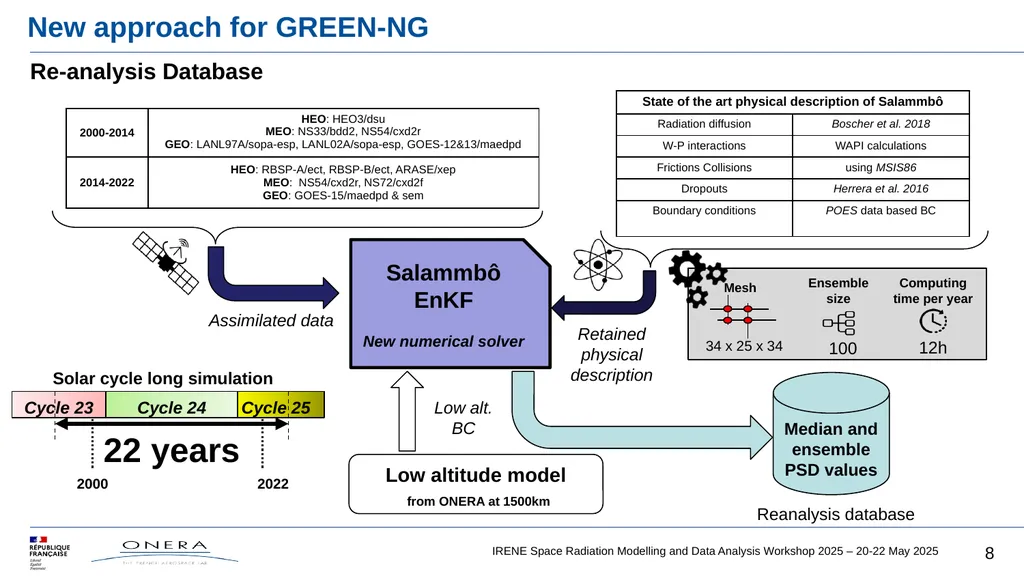
GREEN-NG will be based on a re-analysis database derived from Salammbô + Data assimilation using the climate reanalysis approach.
GREEN-NG will be a mean model (yearly average) with a solar cycle dependency like GREEN
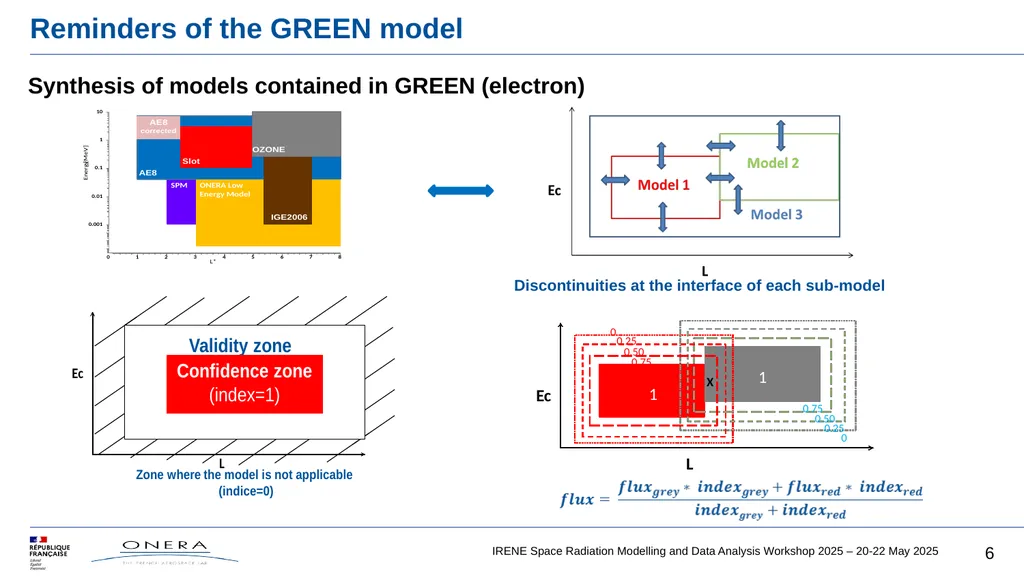
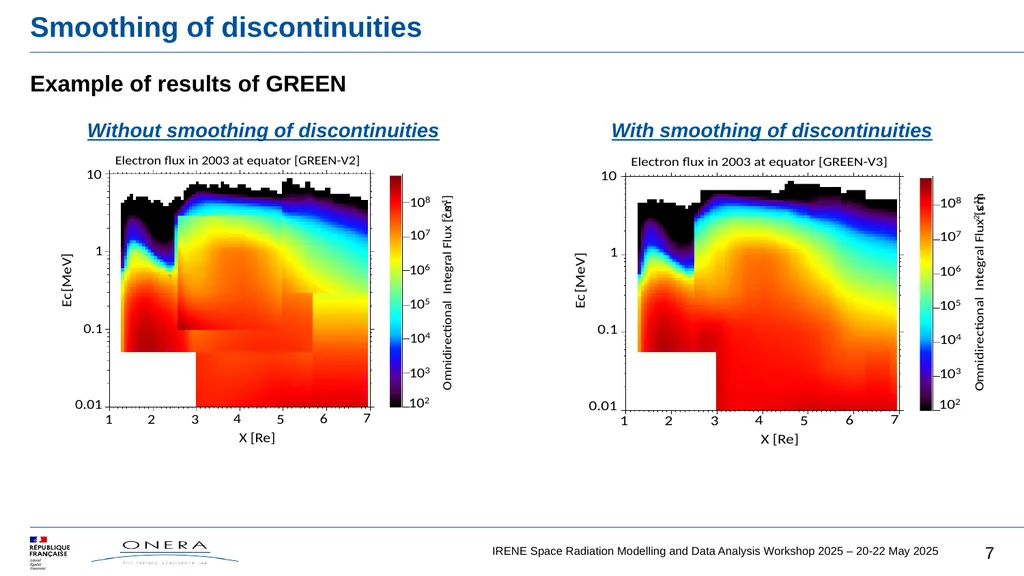
The objective is that GREEN-NG will not be a patchwork of several local models in order to avoid discontinuities at the interfaces of those models thanks to the spatial and temporal continuity of the reanalysis database distributions.
Only GREEN-NG for electrons will be presented here<br>
04
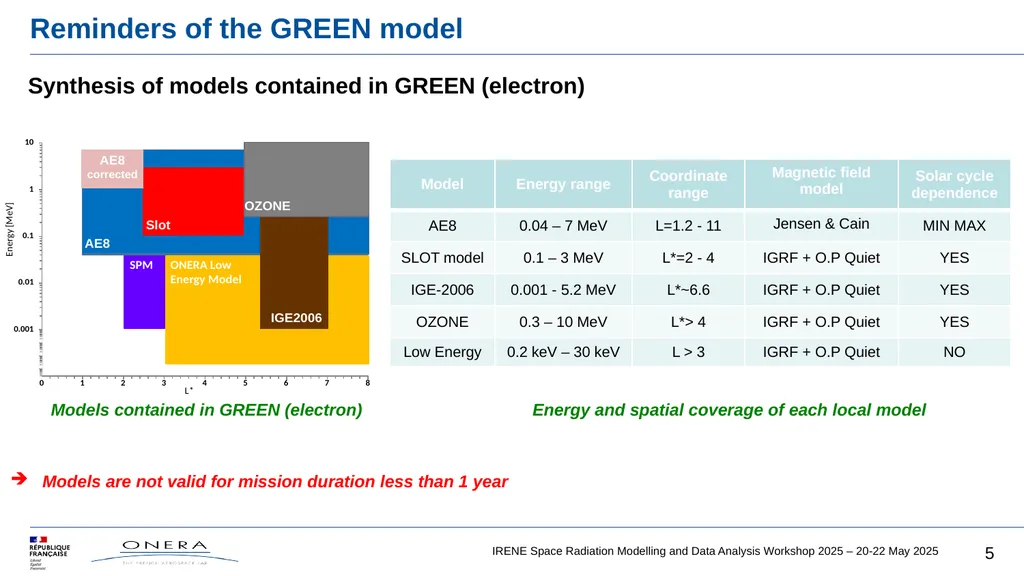
Reminders of the GREEN model 4 ONERA has developed many local models since many years (IGE-2006, MEO-V2, OZONE, Slot model, OPAL,…) Those local models are considered more accurate than the reference global models AE8 and AP8 GREEN is a global model of electrons and protons in the Earth radiation belts. It is based on AE8 and AP8 by default and all the local models developed by ONERA when they are available. GREEN is a mean model and depends on the year of the solar cycle . The main goal of GREEN was to meet the space industry’s needs for the design of their spacecraft<br>
05
Reminders of the GREEN model 5 Synthesis of models contained in GREEN (electron) Models contained in GREEN (electron) Energy and spatial coverage of each local model Models are not valid for mission duration less than 1 year<br>
06
Reminders of the GREEN model 6 Synthesis of models contained in GREEN (electron) Discontinuities at the interface of each sub-model<br>
07
Smoothing of discontinuities Without smoothing of discontinuities With smoothing of discontinuities Example of results of GREEN 7<br>
08
Re-analysis Database Cycle 25 Cycle 23 Solar cycle long simulation 22 years 2000 2022 Salammbô EnKF
New numerical solver Assimilated data Retained physical description 12h Computing time per year Ensemble size 100 Mesh 34 x 25 x 34 Reanalysis database Median and ensemble PSD values Low altitude model
from ONERA at 1500km Low alt.
BC Cycle 24 New approach for GREEN-NG 8<br>
09
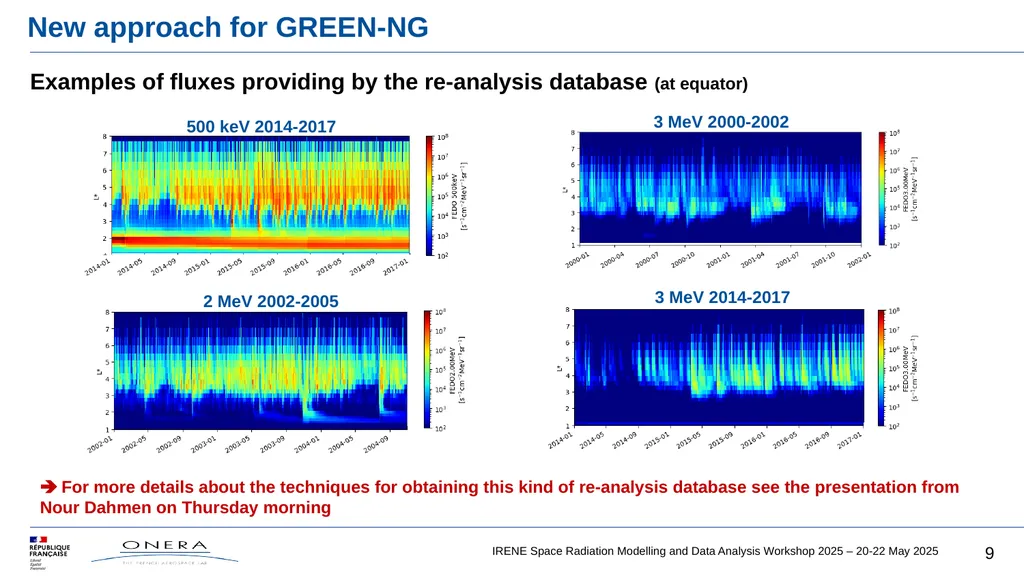
2 MeV 2002-2005 500 keV 2014-2017 3 MeV 2000-2002 Examples of fluxes providing by the re-analysis database (at equator) 3 MeV 2014-2017 For more details about the techniques for obtaining this kind of re-analysis database see the presentation from Nour Dahmen on Thursday morning New approach for GREEN-NG 9<br>
10
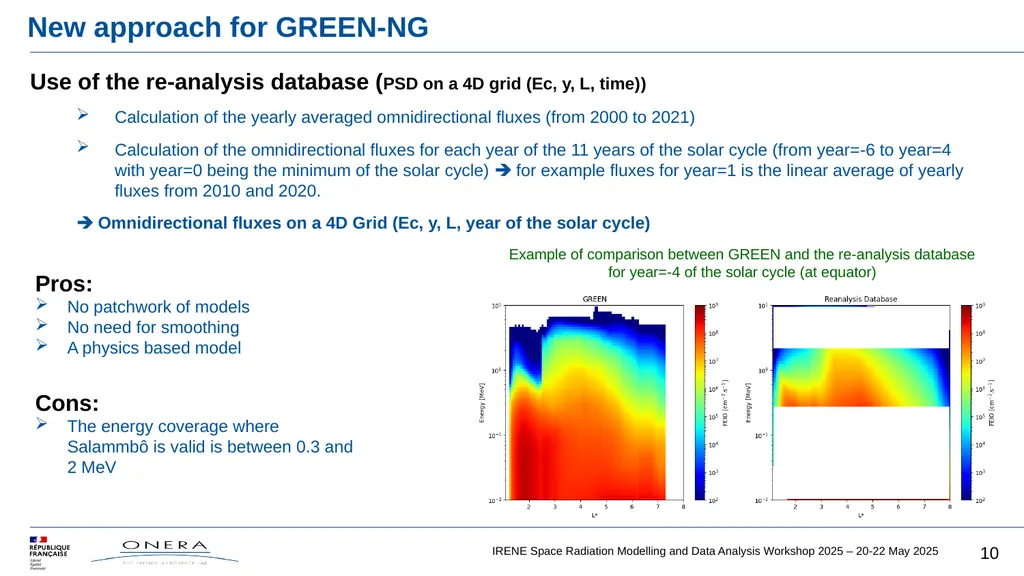
Use of the re-analysis database (PSD on a 4D grid (Ec, y, L, time)) Calculation of the yearly averaged omnidirectional fluxes (from 2000 to 2021)
Calculation of the omnidirectional fluxes for each year of the 11 years of the solar cycle (from year=-6 to year=4 with year=0 being the minimum of the solar cycle) for example fluxes for year=1 is the linear average of yearly fluxes from 2010 and 2020.
Omnidirectional fluxes on a 4D Grid (Ec, y, L, year of the solar cycle) Pros:
No patchwork of models
No need for smoothing
A physics based model
Cons:
The energy coverage where Salammbô is valid is between 0.3 and 2 MeV Example of comparison between GREEN and the re-analysis database for year=-4 of the solar cycle (at equator) New approach for GREEN-NG 10<br>
11
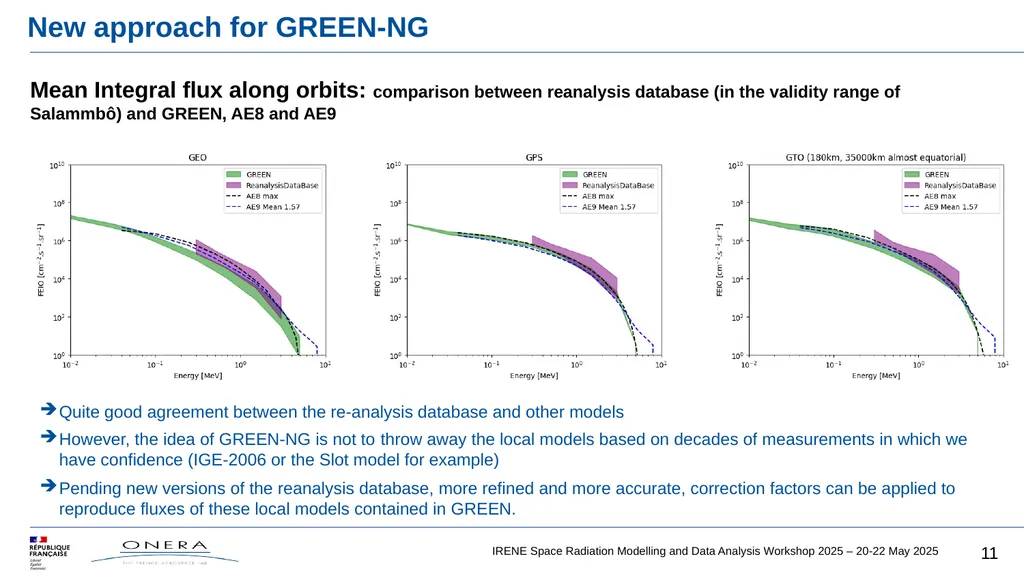
Mean Integral flux along orbits: comparison between reanalysis database (in the validity range of Salammbô) and GREEN, AE8 and AE9 Quite good agreement between the re-analysis database and other models
However, the idea of GREEN-NG is not to throw away the local models based on decades of measurements in which we have confidence (IGE-2006 or the Slot model for example)
Pending new versions of the reanalysis database, more refined and more accurate, correction factors can be applied to reproduce fluxes of these local models contained in GREEN. New approach for GREEN-NG 11<br>
12
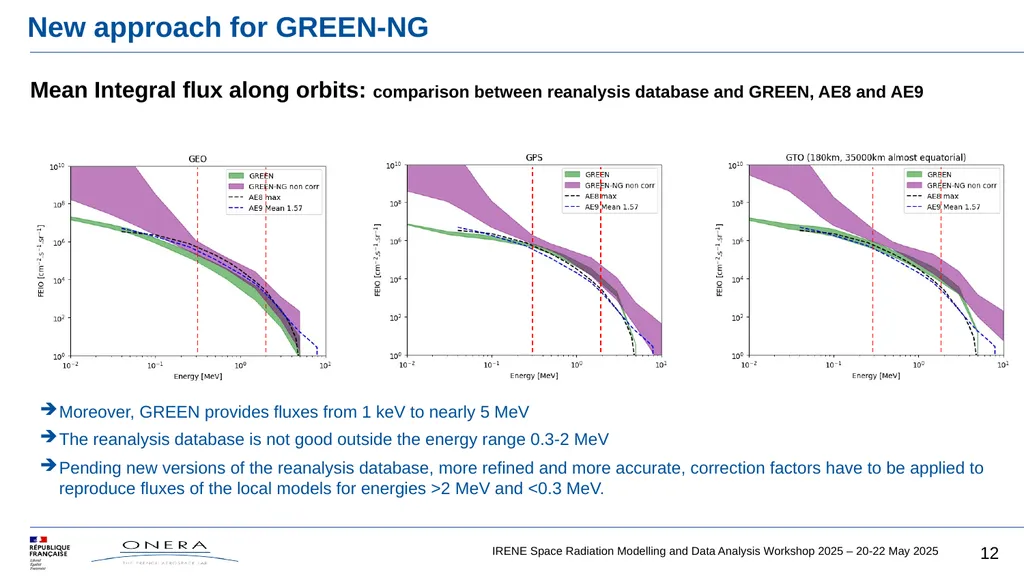
Mean Integral flux along orbits: comparison between reanalysis database and GREEN, AE8 and AE9 Moreover, GREEN provides fluxes from 1 keV to nearly 5 MeV
The reanalysis database is not good outside the energy range 0.3-2 MeV
Pending new versions of the reanalysis database, more refined and more accurate, correction factors have to be applied to reproduce fluxes of the local models for energies >2 MeV and <0.3 MeV. New approach for GREEN-NG 12<br>
13
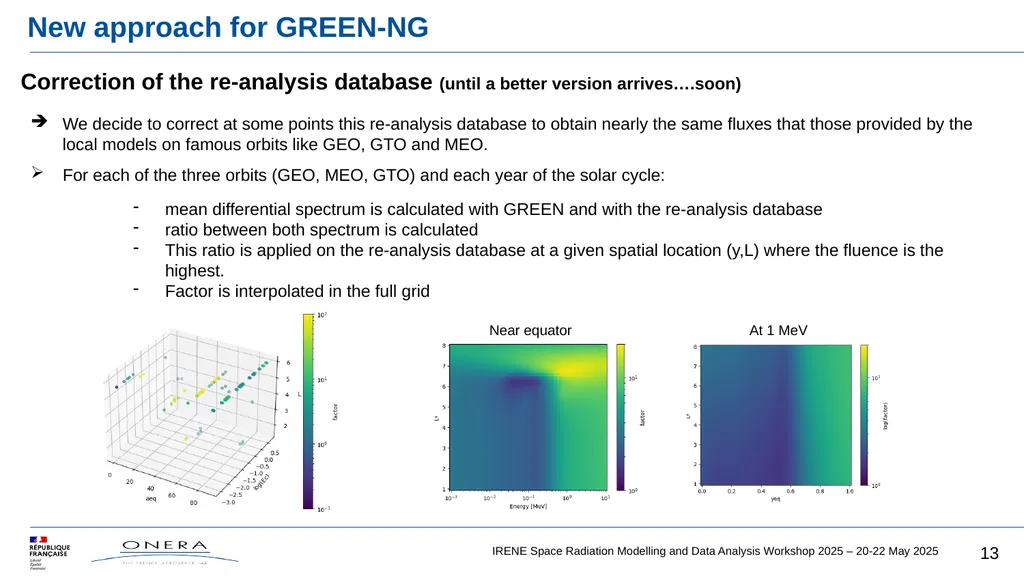
New approach for GREEN-NG Correction of the re-analysis database (until a better version arrives….soon) We decide to correct at some points this re-analysis database to obtain nearly the same fluxes that those provided by the local models on famous orbits like GEO, GTO and MEO. For each of the three orbits (GEO, MEO, GTO) and each year of the solar cycle:
mean differential spectrum is calculated with GREEN and with the re-analysis database
ratio between both spectrum is calculated
This ratio is applied on the re-analysis database at a given spatial location (y,L) where the fluence is the highest.
Factor is interpolated in the full grid Near equator At 1 MeV 13<br>
14
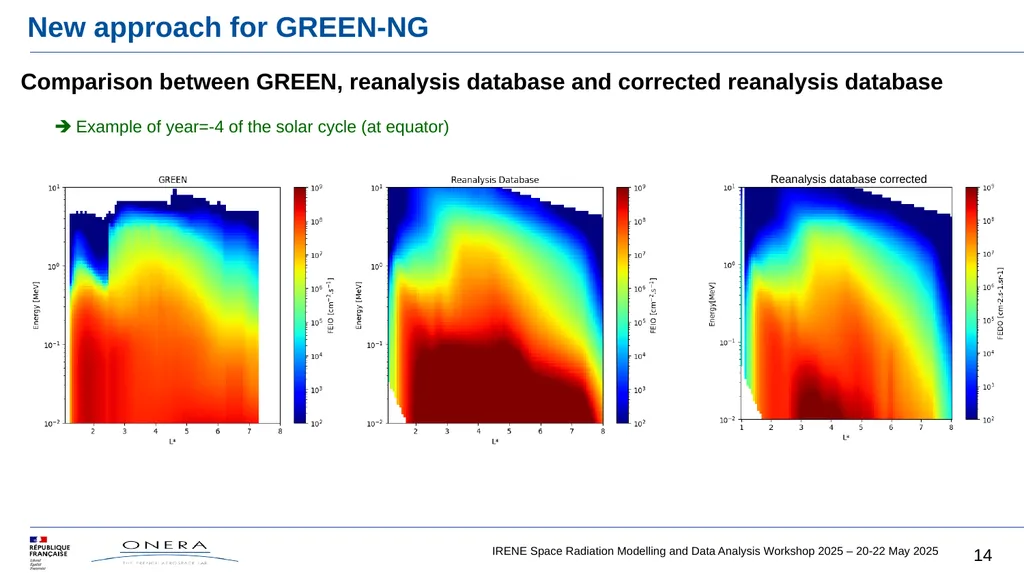
14 New approach for GREEN-NG Comparison between GREEN, reanalysis database and corrected reanalysis database Example of year=-4 of the solar cycle (at equator) Reanalysis database corrected<br>
15
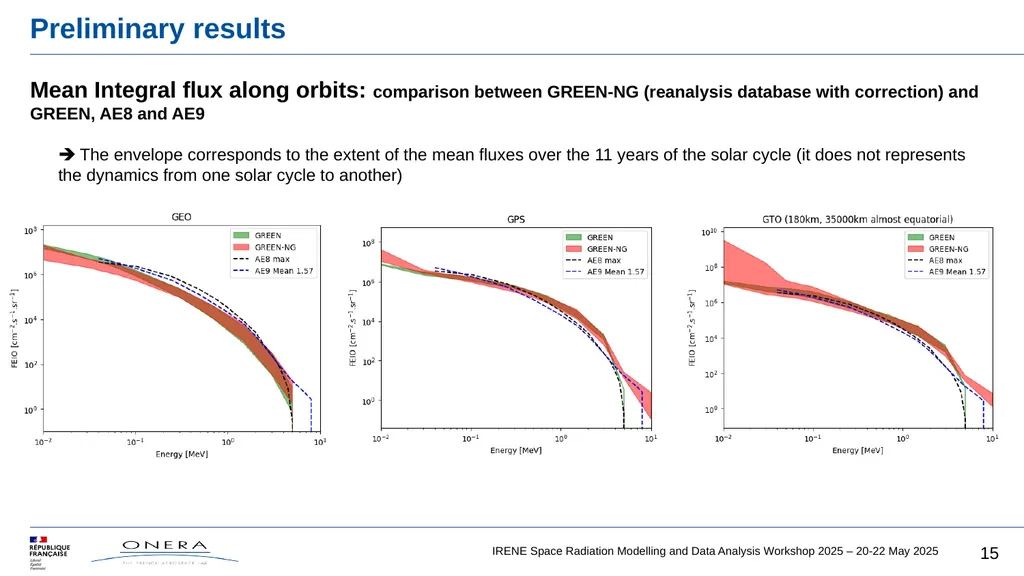
Preliminary results Mean Integral flux along orbits: comparison between GREEN-NG (reanalysis database with correction) and GREEN, AE8 and AE9 The envelope corresponds to the extent of the mean fluxes over the 11 years of the solar cycle (it does not represents the dynamics from one solar cycle to another) 15<br>
16
Conclusion Work still to be done:
Improve the re-analysis database (a new version will be used very soon, see Nour Dahmen) in order to remove in the end the correction factors
Develop a re-analysis database for protons
Improve the GREEN-NG tool so that it can be easily integrated into OMERE Conclusion: GREEN-NG is a mean global model valid for mission longer than one year
Like GREEN, GREEN-NG depends on the year of the solar cycle
GREEN-NG is based on the physical model Salammbô + data assimilation and is corrected to reproduce reference models as IGE-2006 in GEO.
GREEN-NG's greatest advantage is that it is not a patchwork of models and therefore has no discontinuities 16<br>