Green taxation and renewable energy technologies adoption: A global evidence Tii N. Nchofoung E-mail: ntii12yahoo.com Ministry of Trade, Cameroon 2022 GLOBAL DEVELOPMENT CONFERENCE: Tax Policy for Sustainable Development November 2-4, 2022
"Green taxation and renewable energy technologies" is the property of its rightful owner. Permission is granted to
download and print the materials on this website for personal, non-commercial use only, and to display it
on your personal computer provided you do not modify the materials and that you retain all copyright
notices contained in the materials. By downloading content from our website, you accept the terms of this
agreement.
Presentation Transcript
01
Green taxation and renewable energy technologies adoption: A global evidence Tii N. Nchofoung E-mail: ntii12@yahoo.com Ministry of Trade, Cameroon 2022 GLOBAL DEVELOPMENT CONFERENCE: Tax Policy for Sustainable Development
November 2-4, 2022 at Clermont-Ferrand, France.<br>
02
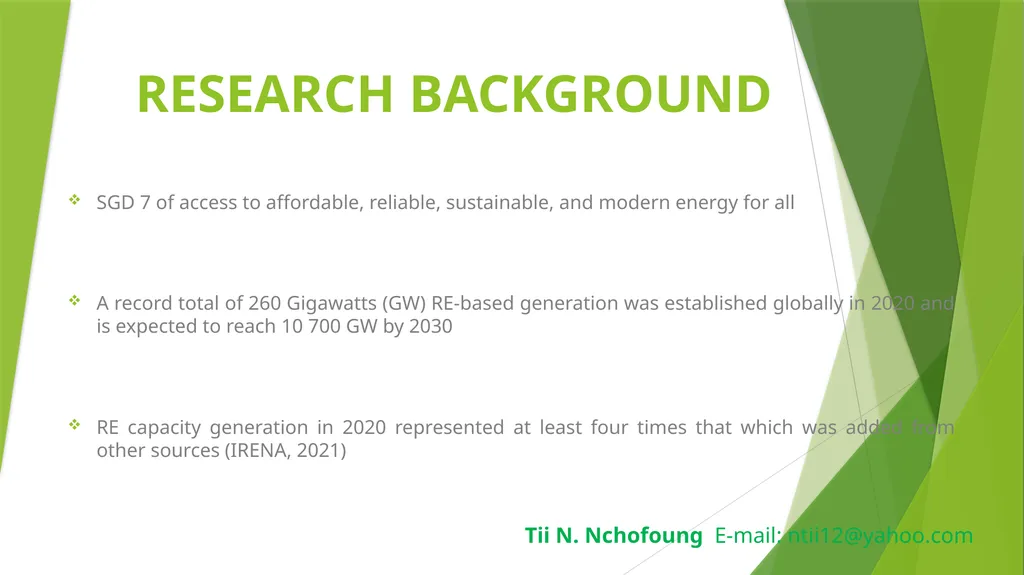
RESEARCH BACKGROUND SGD 7 of access to affordable, reliable, sustainable, and modern energy for all
A record total of 260 Gigawatts (GW) RE-based generation was established globally in 2020 and is expected to reach 10 700 GW by 2030
RE capacity generation in 2020 represented at least four times that which was added from other sources (IRENA, 2021) Tii N. Nchofoung E-mail: ntii12@yahoo.com<br>
03
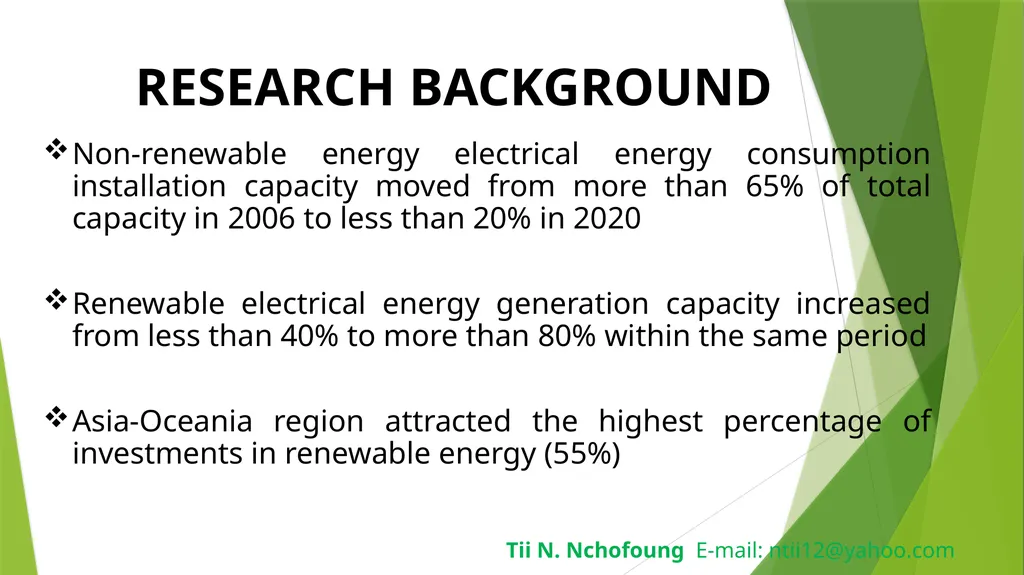
RESEARCH BACKGROUND Non-renewable energy electrical energy consumption installation capacity moved from more than 65% of total capacity in 2006 to less than 20% in 2020
Renewable electrical energy generation capacity increased from less than 40% to more than 80% within the same period
Asia-Oceania region attracted the highest percentage of investments in renewable energy (55%) Tii N. Nchofoung E-mail: ntii12@yahoo.com<br>
04
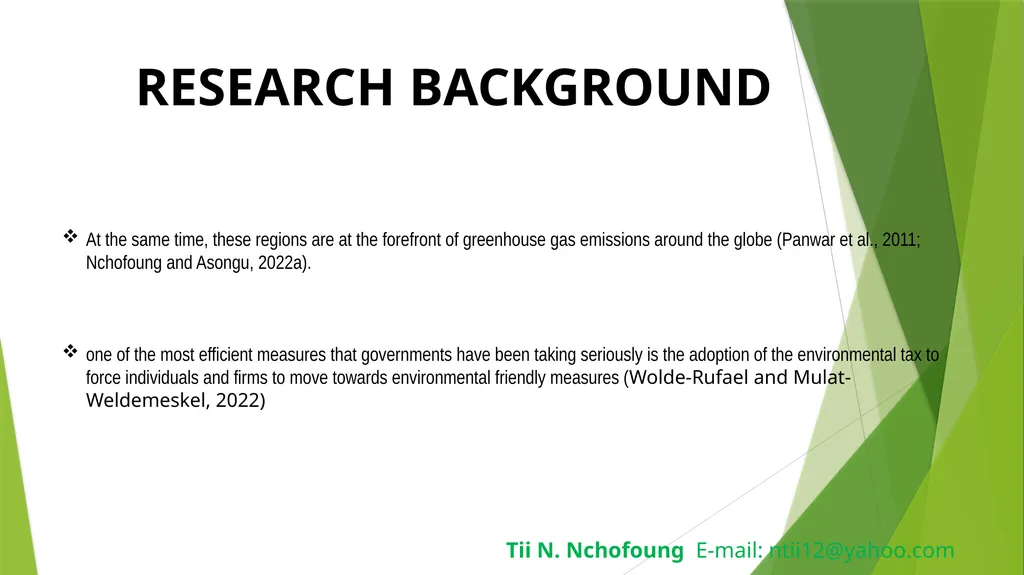
RESEARCH BACKGROUND At the same time, these regions are at the forefront of greenhouse gas emissions around the globe (Panwar et al., 2011; Nchofoung and Asongu, 2022a).
one of the most efficient measures that governments have been taking seriously is the adoption of the environmental tax to force individuals and firms to move towards environmental friendly measures (Wolde-Rufael and Mulat-Weldemeskel, 2022) Tii N. Nchofoung E-mail: ntii12@yahoo.com<br>
05
Controversies in literature the polluter should always bear the cost of externalities, and this cost should be levied as taxes (environmental tax) (Pigou, 1920)
polluter could always make a negotiation with the victim (Kapp,1960)
Environmental tax curb environmental pollution (Ghazouani et al., 2020; Wolde-Rufael and Mulat-Weldemeskel, 2022; Agostini et al., 1992; Doğan et al., 2022).
Lin and Li (2011) argue about some of the inconveniences of environmental taxation. RESEARCH BACKGROUND Tii N. Nchofoung E-mail: ntii12@yahoo.com<br>
06
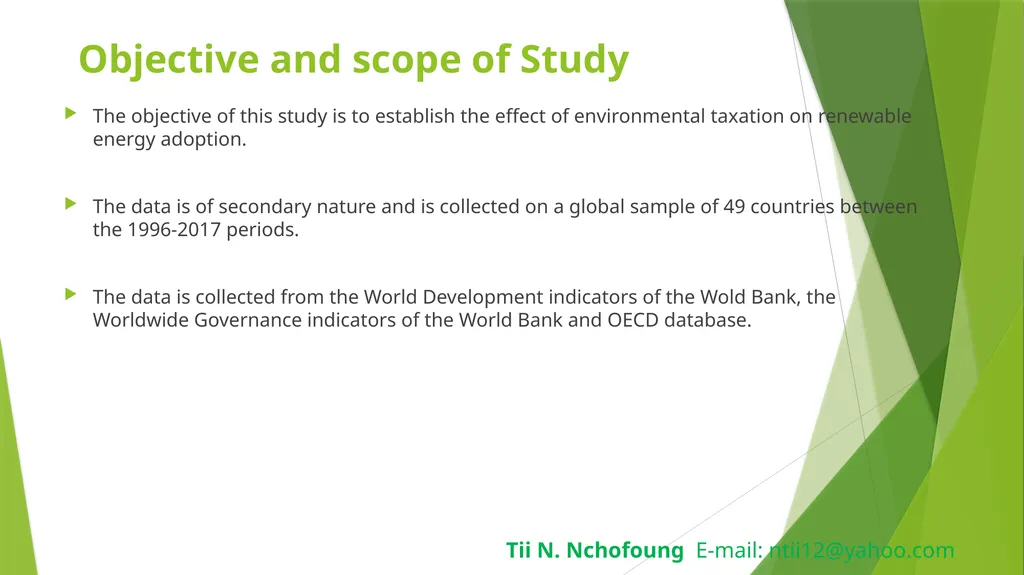
Objective and scope of Study The objective of this study is to establish the effect of environmental taxation on renewable energy adoption.
The data is of secondary nature and is collected on a global sample of 49 countries between the 1996-2017 periods.
The data is collected from the World Development indicators of the Wold Bank, the Worldwide Governance indicators of the World Bank and OECD database. Tii N. Nchofoung E-mail: ntii12@yahoo.com<br>
07
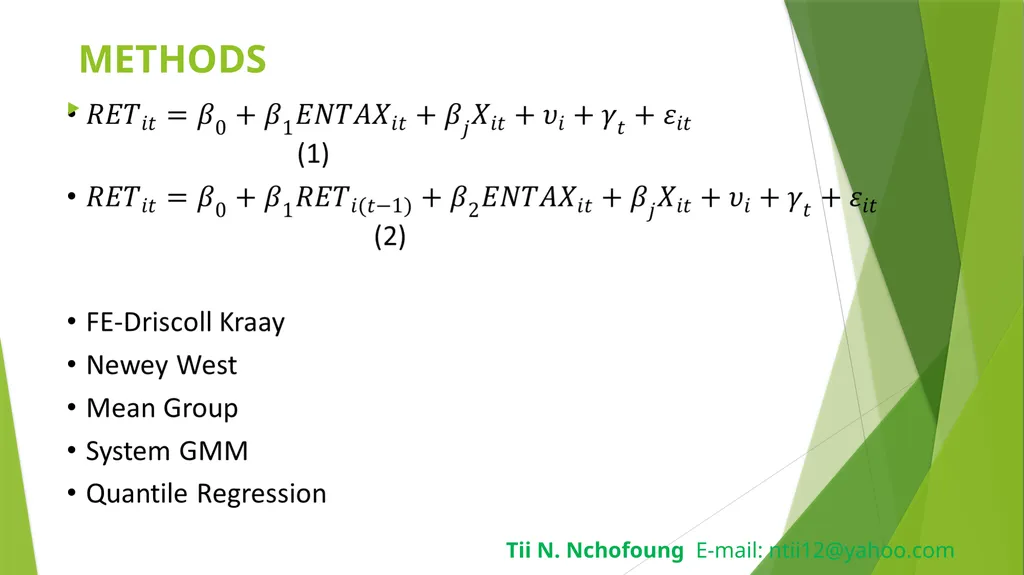
METHODS Tii N. Nchofoung E-mail: ntii12@yahoo.com<br>
08
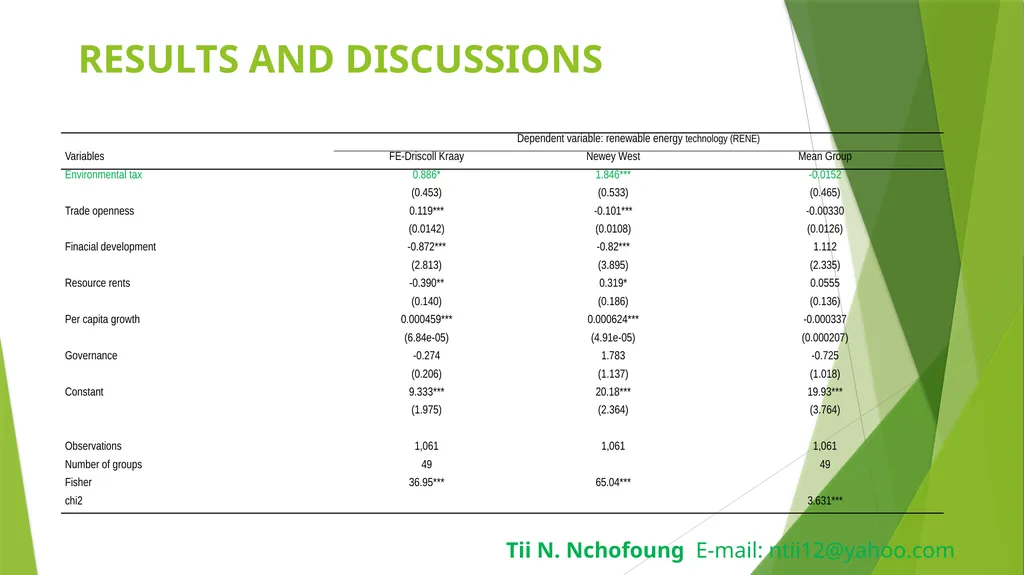
RESULTS AND DISCUSSIONS Tii N. Nchofoung E-mail: ntii12@yahoo.com<br>
09
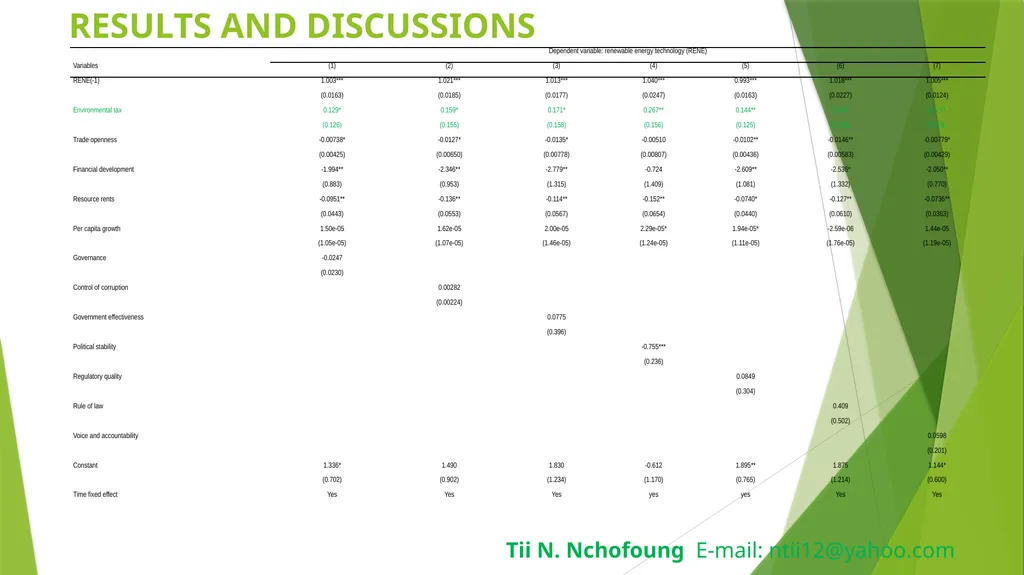
RESULTS AND DISCUSSIONS Tii N. Nchofoung E-mail: ntii12@yahoo.com<br>
10
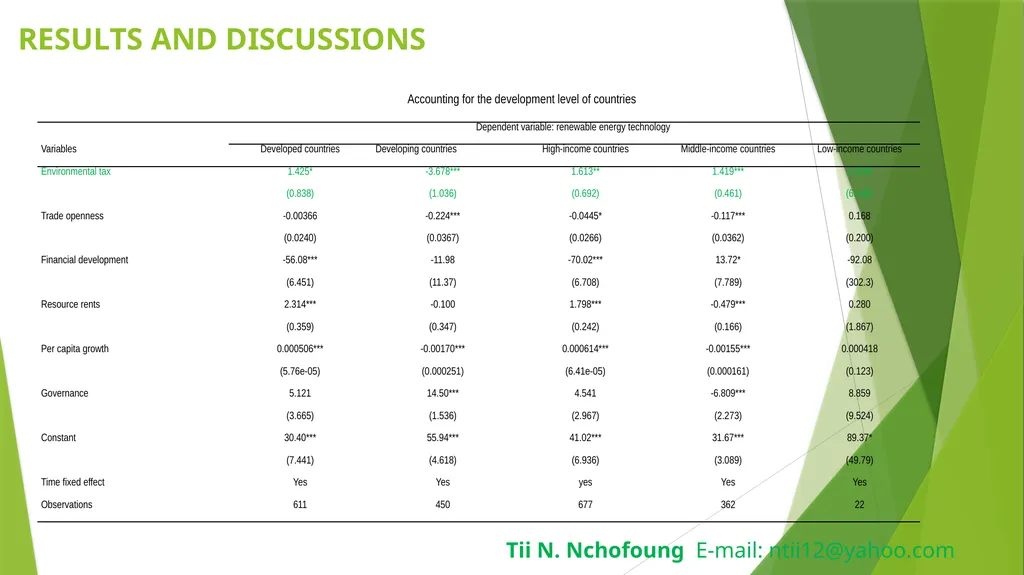
RESULTS AND DISCUSSIONS Accounting for the development level of countries Tii N. Nchofoung E-mail: ntii12@yahoo.com<br>
11
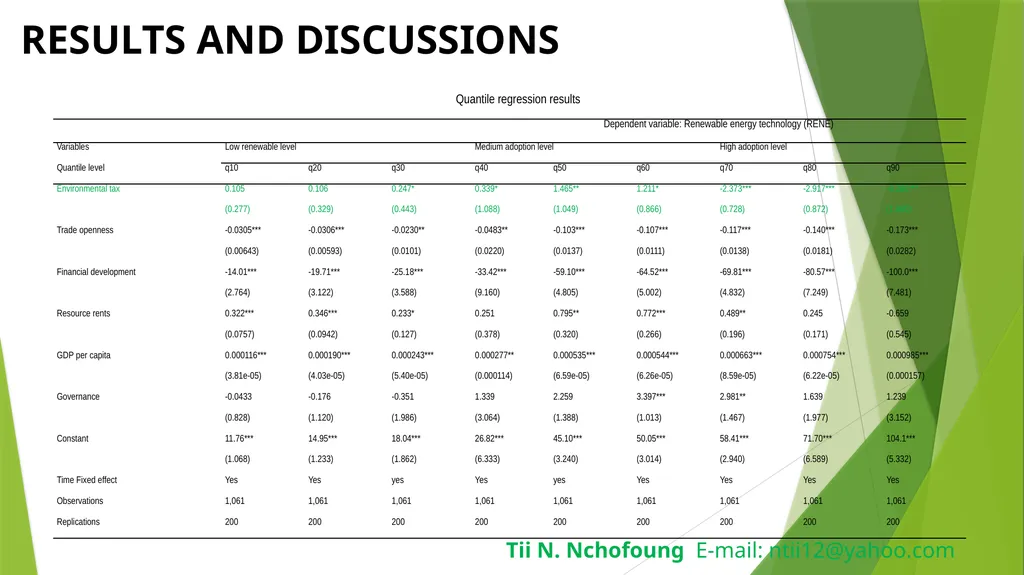
RESULTS AND DISCUSSIONS Quantile regression results Tii N. Nchofoung E-mail: ntii12@yahoo.com<br>
12
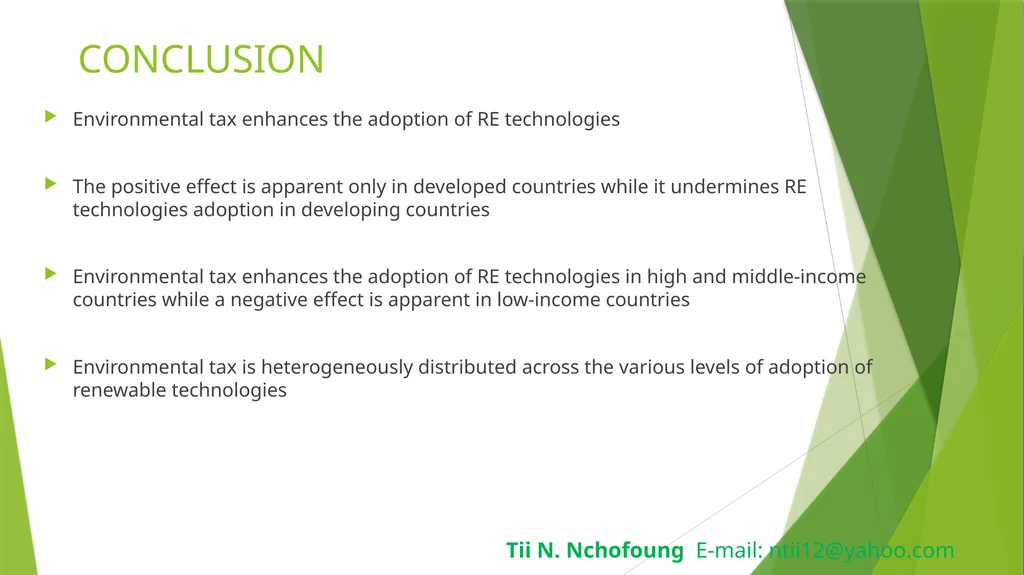
CONCLUSION Environmental tax enhances the adoption of RE technologies
The positive effect is apparent only in developed countries while it undermines RE technologies adoption in developing countries
Environmental tax enhances the adoption of RE technologies in high and middle-income countries while a negative effect is apparent in low-income countries
Environmental tax is heterogeneously distributed across the various levels of adoption of renewable technologies Tii N. Nchofoung E-mail: ntii12@yahoo.com<br>
13
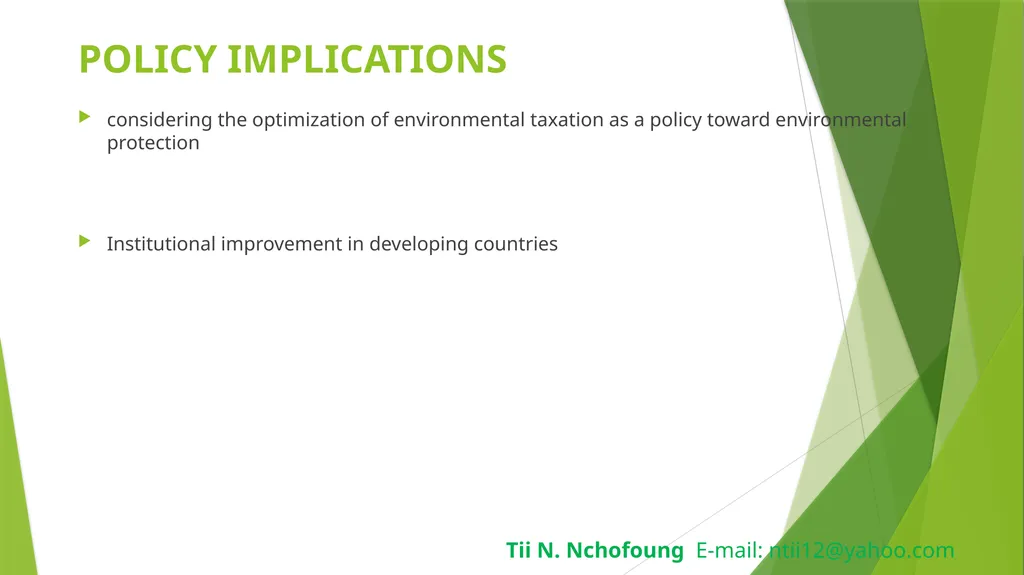
POLICY IMPLICATIONS considering the optimization of environmental taxation as a policy toward environmental protection
Institutional improvement in developing countries Tii N. Nchofoung E-mail: ntii12@yahoo.com<br>