Grid Information Systems: Past, Present and Future Markus Schulz, Laurence Field and Maria Alandes 1 20 Years Of Grid Computing CHEP 2000 Discussions on the emerging field of Grid computing Two matching fundamental concepts: The integration
"Grid Information Systems: Past, Present and Future" is the property of its rightful owner. Permission is granted to
download and print the materials on this website for personal, non-commercial use only, and to display it
on your personal computer provided you do not modify the materials and that you retain all copyright
notices contained in the materials. By downloading content from our website, you accept the terms of this
agreement.
Presentation Transcript
01
Grid Information Systems: Past, Present and Future Markus Schulz, Laurence Field and Maria Alandes 1<br>
02
20 Years Of Grid Computing CHEP 2000
Discussions on the emerging field of Grid computing
Two matching fundamental concepts:
The integration of distributed computing resources
The provision of authentication and authorization
Enabling access resources in different administrative domains
The Globus Tool Kit
Grid Resource Information Protocol (GRIP)
Grid Resource Registration Protocol (GRRP)
Grid Resource Access and Management (GRAM)
Grid File Transfer Protocol (GridFTP)
Grid Security Infrastructure (GSI) 2<br>
03
Grid Information Systems Support coordinated resource-sharing and problem-solving
VOs need to obtain information about the structure and state of Grid services
which are widely distributed geographically.
Information describing a Grid service is provided by the service itself
hence the Grid service is the primary information source
The information provided conforms to an information model
More details later
Assumption that the information source is up-to-date
that is the values represent the real state of the Grid service
Queries may consider thousands of information sources
in order to enable efficient Grid functions that may utilize multiple cooperating services
The goal is to efficiently execute:
many queries
from many clients
for many information sources 3<br>
04
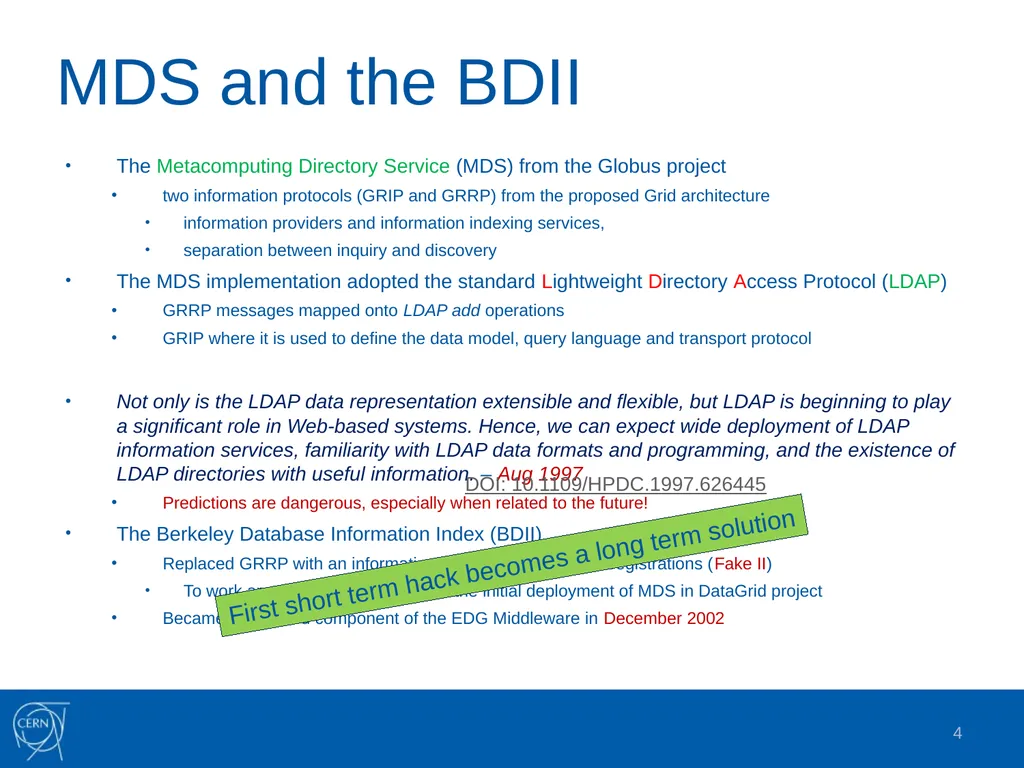
MDS and the BDII The Metacomputing Directory Service (MDS) from the Globus project
two information protocols (GRIP and GRRP) from the proposed Grid architecture
information providers and information indexing services,
separation between inquiry and discovery
The MDS implementation adopted the standard Lightweight Directory Access Protocol (LDAP)
GRRP messages mapped onto LDAP add operations
GRIP where it is used to define the data model, query language and transport protocol
Not only is the LDAP data representation extensible and flexible, but LDAP is beginning to play a significant role in Web-based systems. Hence, we can expect wide deployment of LDAP information services, familiarity with LDAP data formats and programming, and the existence of LDAP directories with useful information. – Aug 1997
Predictions are dangerous, especially when related to the future!
The Berkeley Database Information Index (BDII)
Replaced GRRP with an information cache based on static registrations (Fake II)
To work around stability issues with the initial deployment of MDS in DataGrid project
Became a standard component of the EDG Middleware in December 2002 4 DOI: 10.1109/HPDC.1997.626445 First short term hack becomes a long term solution<br>
05
Information Models Ensure agreement on the meaning of information
They describe:
The real entities
The relationships between those entities
Their semantics
A data model
Defines the syntax by which information is exchanged
The MDS information model described
the physical and logical components of a compute resource
The EDG described the Compute (CE) and Storage Elements (SE) 5<br>
06
GLUE Information Model Grid Laboratory Uniform Environment
Defines a uniform representation of Grid resources
An information model
and LDAP data model
A collaborative effort between:
DataTAG, US-iVDGL, Globus and EDG
Enabled transatlantic Grid interoperability
GLUE 1.3
OSG/EGEE interoperability
Put the W in WLCG (thanks to Ruth!) 6<br>
07
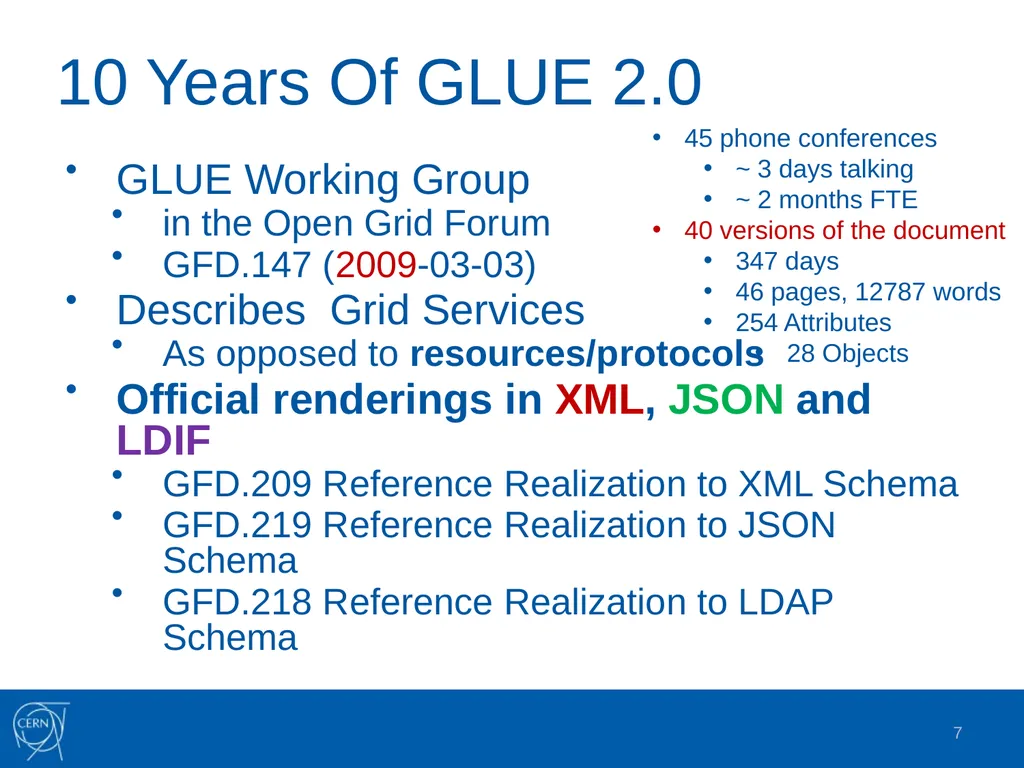
10 Years Of GLUE 2.0 GLUE Working Group
in the Open Grid Forum
GFD.147 (2009-03-03)
Describes Grid Services
As opposed to resources/protocols
Official renderings in XML, JSON and LDIF
GFD.209 Reference Realization to XML Schema
GFD.219 Reference Realization to JSON Schema
GFD.218 Reference Realization to LDAP Schema 7 45 phone conferences
~ 3 days talking
~ 2 months FTE
40 versions of the document
347 days
46 pages, 12787 words
254 Attributes
28 Objects<br>
08
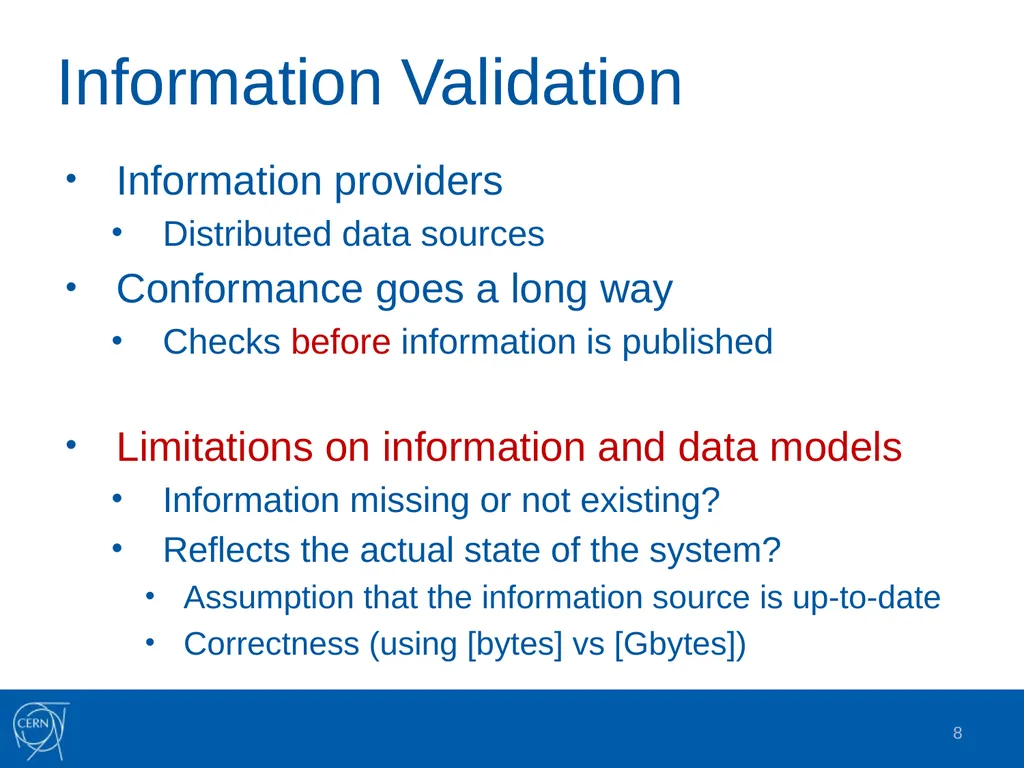
Information Validation Information providers
Distributed data sources
Conformance goes a long way
Checks before information is published
Limitations on information and data models
Information missing or not existing?
Reflects the actual state of the system?
Assumption that the information source is up-to-date
Correctness (using [bytes] vs [Gbytes]) 8<br>
09
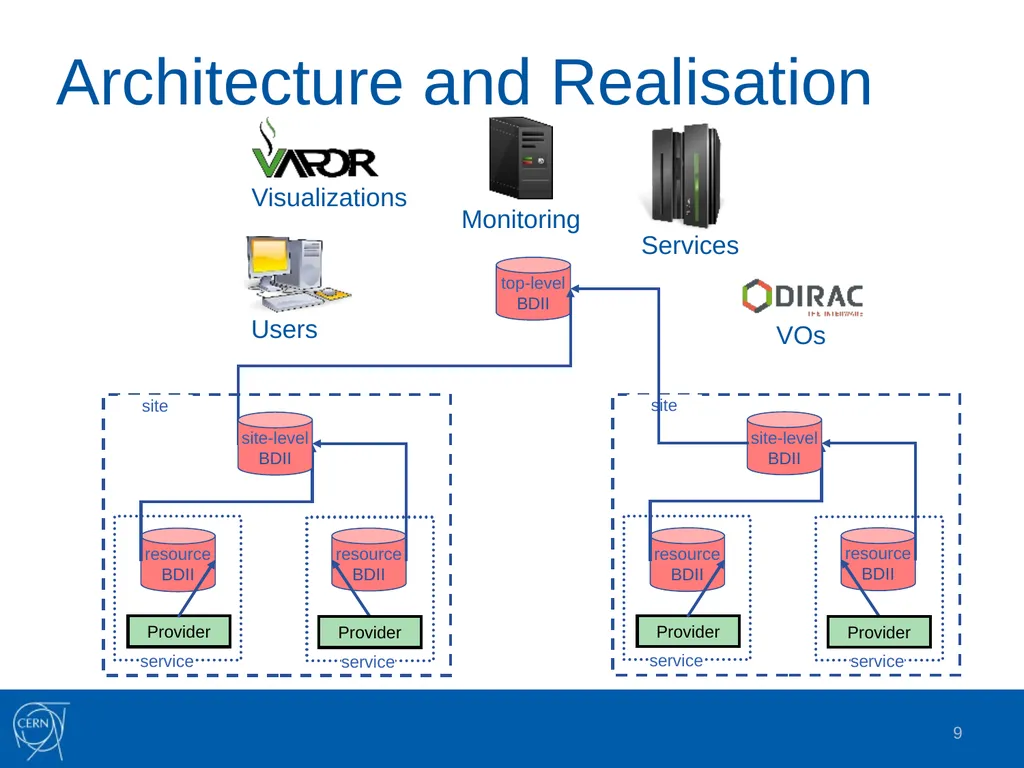
Architecture and Realisation 9 Provider resource
BDII top-level
BDII service resource
BDII service Provider site-level
BDII site Provider resource
BDII service resource
BDII service Provider site-level
BDII site VOs Services Monitoring Users Visualizations<br>
10
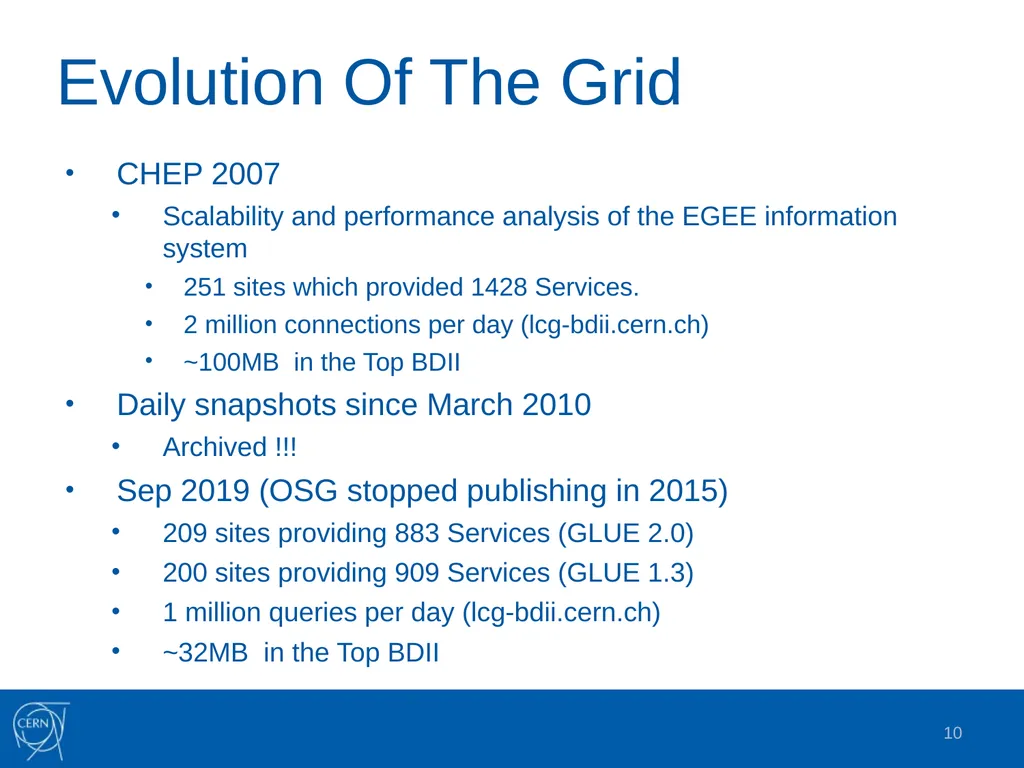
Evolution Of The Grid CHEP 2007
Scalability and performance analysis of the EGEE information system
251 sites which provided 1428 Services.
2 million connections per day (lcg-bdii.cern.ch)
~100MB in the Top BDII
Daily snapshots since March 2010
Archived !!!
Sep 2019 (OSG stopped publishing in 2015)
209 sites providing 883 Services (GLUE 2.0)
200 sites providing 909 Services (GLUE 1.3)
1 million queries per day (lcg-bdii.cern.ch)
~32MB in the Top BDII 10<br>
11
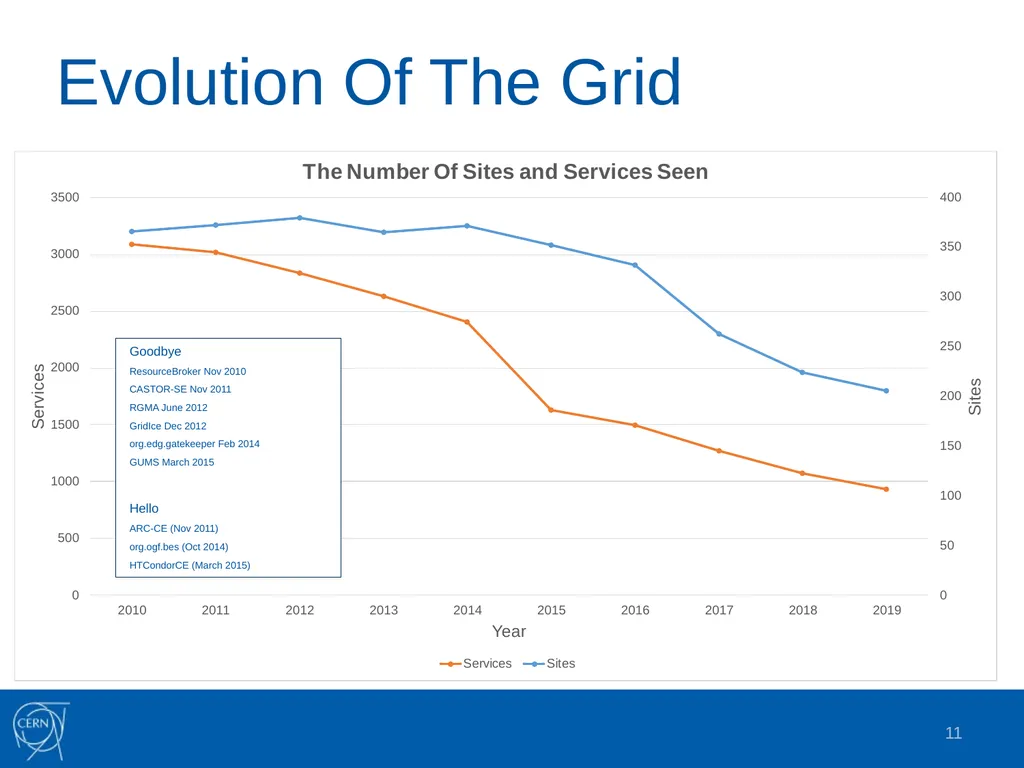
Evolution Of The Grid 11 Goodbye
ResourceBroker Nov 2010
CASTOR-SE Nov 2011
RGMA June 2012
GridIce Dec 2012
org.edg.gatekeeper Feb 2014
GUMS March 2015
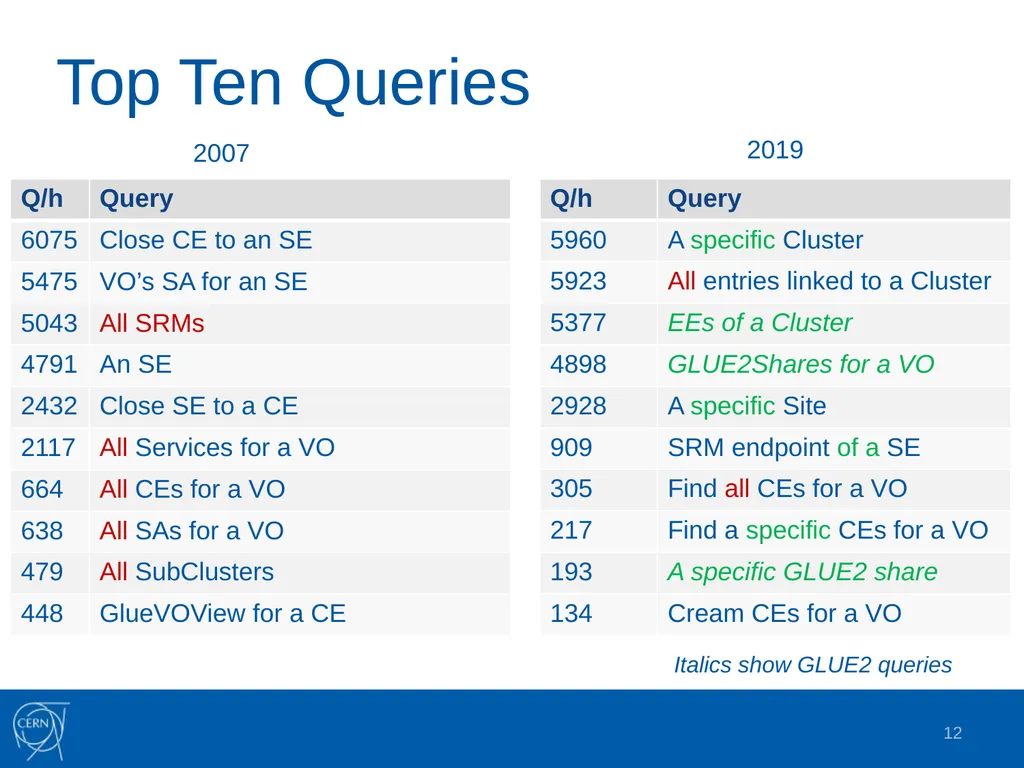
Top Ten Queries 12 2007 2019 Italics show GLUE2 queries<br>
13
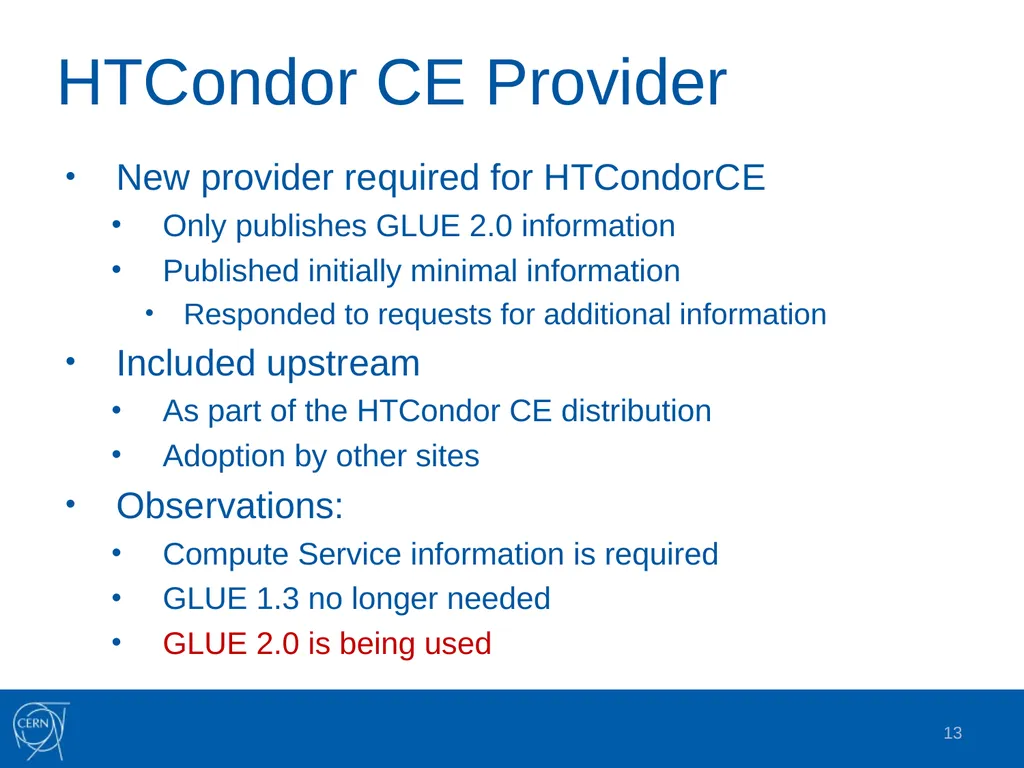
HTCondor CE Provider New provider required for HTCondorCE
Only publishes GLUE 2.0 information
Published initially minimal information
Responded to requests for additional information
Included upstream
As part of the HTCondor CE distribution
Adoption by other sites
Observations:
Compute Service information is required
GLUE 1.3 no longer needed
GLUE 2.0 is being used 13<br>
14
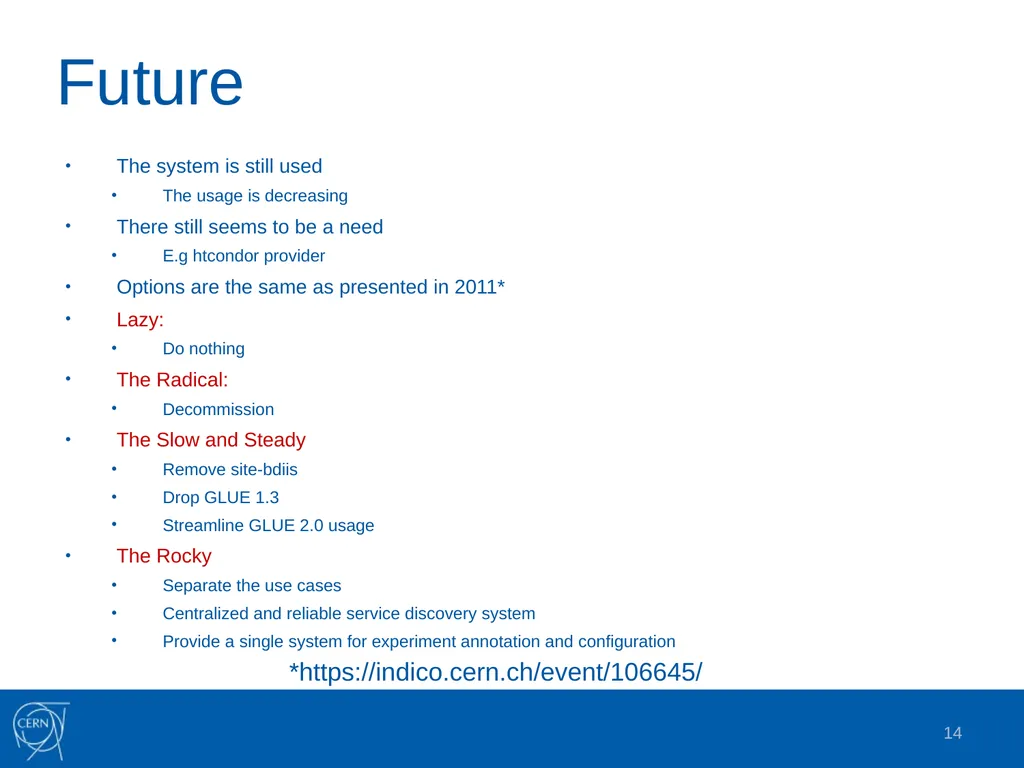
Future The system is still used
The usage is decreasing
There still seems to be a need
E.g htcondor provider
Options are the same as presented in 2011*
Lazy:
Do nothing
The Radical:
Decommission
The Slow and Steady
Remove site-bdiis
Drop GLUE 1.3
Streamline GLUE 2.0 usage
The Rocky
Separate the use cases
Centralized and reliable service discovery system
Provide a single system for experiment annotation and configuration 14 *https://indico.cern.ch/event/106645/<br>
15
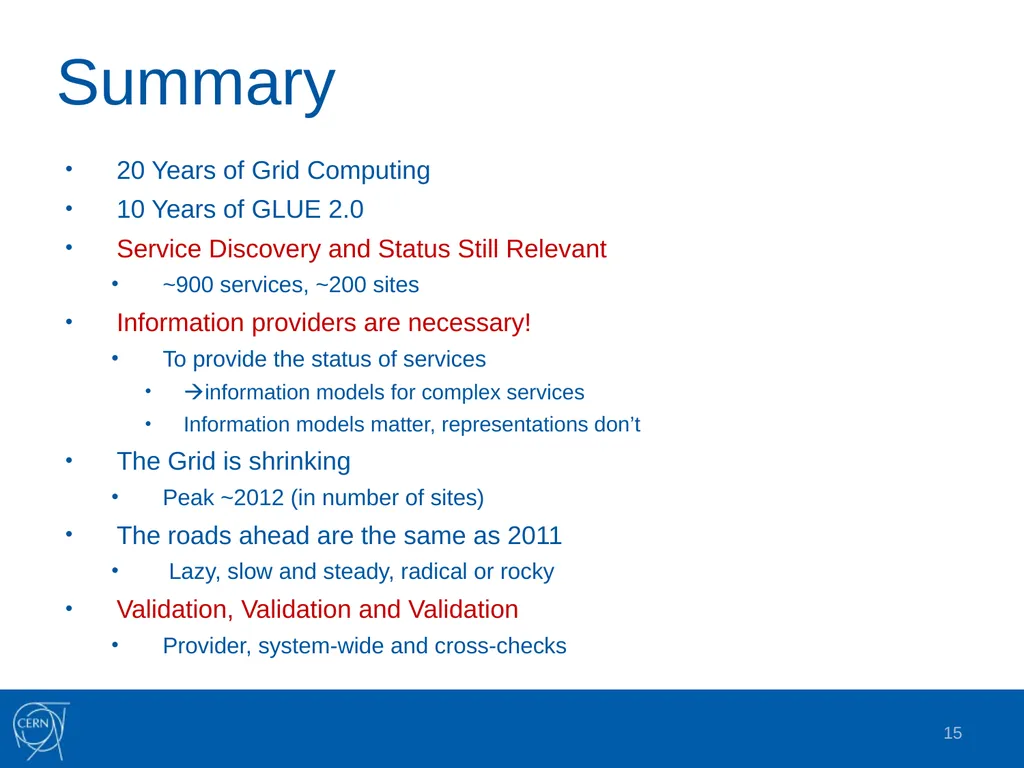
Summary 20 Years of Grid Computing
10 Years of GLUE 2.0
Service Discovery and Status Still Relevant
~900 services, ~200 sites
Information providers are necessary!
To provide the status of services
information models for complex services
Information models matter, representations don’t
The Grid is shrinking
Peak ~2012 (in number of sites)
The roads ahead are the same as 2011
Lazy, slow and steady, radical or rocky
Validation, Validation and Validation
Provider, system-wide and cross-checks 15<br>