
GRIEVANCES AND DISCIPLINARY PROCEDURES Prepared by



Description: GRIEVANCES AND DISCIPLINARY PROCEDURES Prepared by mr d.j. Moring Industrial relations office 1.. What is a grievance A grievance may be defined as a feeling of dissatisfaction or injustice about conditions of work which is felt by an
Related Topics
Download Presentation
"GRIEVANCES AND DISCIPLINARY PROCEDURES Prepared by" is the property of its rightful owner. Permission is granted to download and print the materials on this website for personal, non-commercial use only, and to display it on your personal computer provided you do not modify the materials and that you retain all copyright notices contained in the materials. By downloading content from our website, you accept the terms of this agreement.
Presentation Transcript
slide1. GRIEVANCES AND DISCIPLINARY PROCEDURES Prepared by mr d.j. Moring
Industrial relations office
1…..<br>
slide2. What is a grievance A grievance may be defined as a feeling of dissatisfaction or injustice about conditions of work which is felt by an employee or a group of employees and communicated to management
Types of Grievances
a) Individual grievance
b) Collective grievance
C) Policy grievance
D) Union grievance
2.<br>
slide3. GRIEVANCE PROCEDURE General:
109.1 The main purpose of the grievance procedure is to provide guidance in the resolution of grievances in the workplace.
109.2 The grievance procedure is basically the same irrespective of whether an employee is a member of a trade union or not. The only difference is that an employee who is a member of a trade union shall take the grievance up either with or through his/her trade union representative.
109.3 Grievances should be resolved as near the point of origin as possible. An employee shall normally be entitled to use this procedure within a responsible period of the cause of the grievance having occurred. 3….<br>
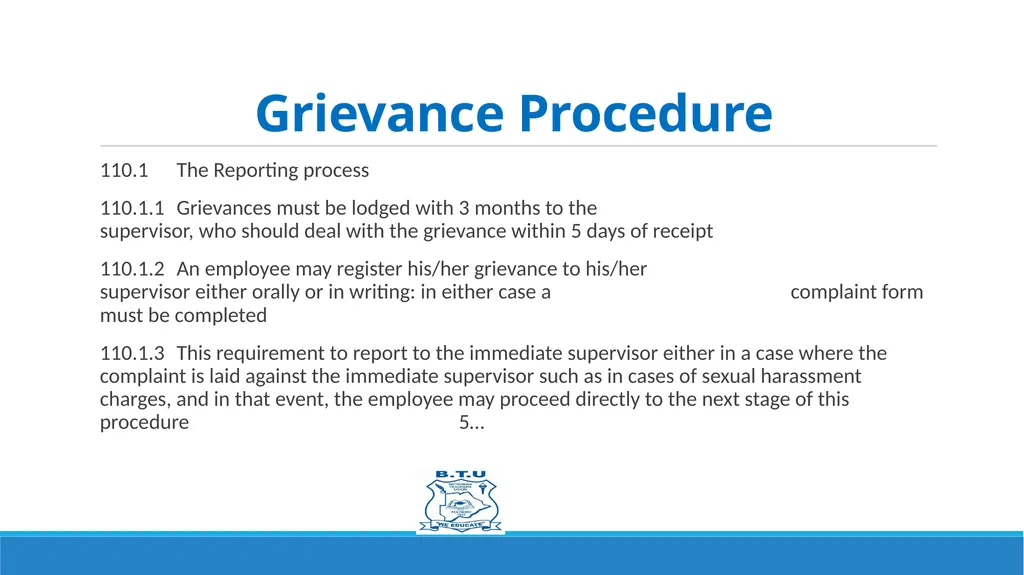
slide4. Grievance Procedure 110.1 The Reporting process
110.1.1 Grievances must be lodged with 3 months to the supervisor, who should deal with the grievance within 5 days of receipt
110.1.2 An employee may register his/her grievance to his/her supervisor either orally or in writing: in either case a complaint form must be completed
110.1.3 This requirement to report to the immediate supervisor either in a case where the complaint is laid against the immediate supervisor such as in cases of sexual harassment charges, and in that event, the employee may proceed directly to the next stage of this procedure 5…<br>
slide5. Grievance Procedure 110.4 The grievance must be lodged with the employee designated to facilitate grievances in the work place, who shall liaise with the relevant structure of the department and ensure compliance with procedures.
6…<br>
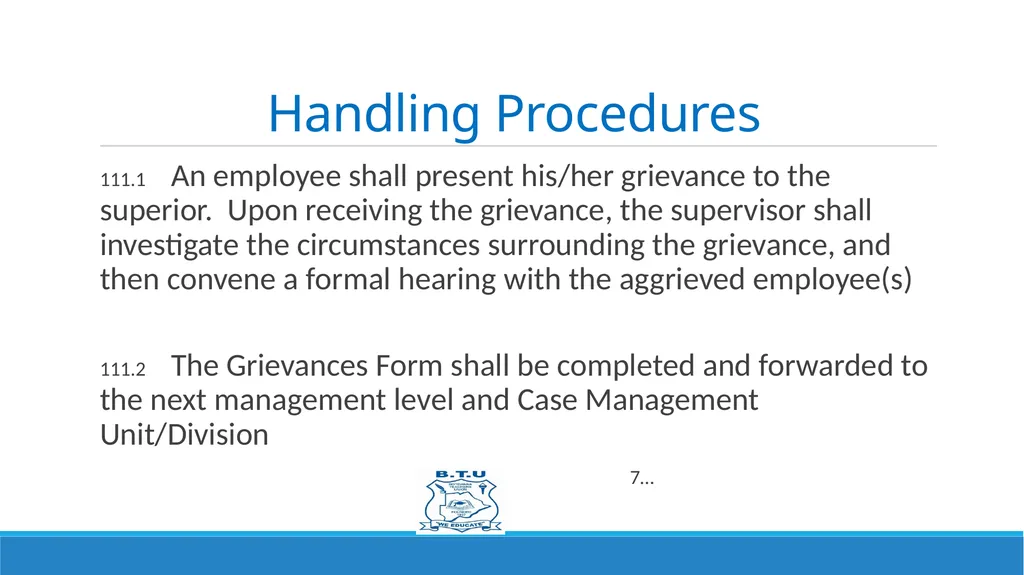
slide6. Handling Procedures 111.1 An employee shall present his/her grievance to the superior. Upon receiving the grievance, the supervisor shall investigate the circumstances surrounding the grievance, and then convene a formal hearing with the aggrieved employee(s)
111.2 The Grievances Form shall be completed and forwarded to the next management level and Case Management Unit/Division
7…<br>
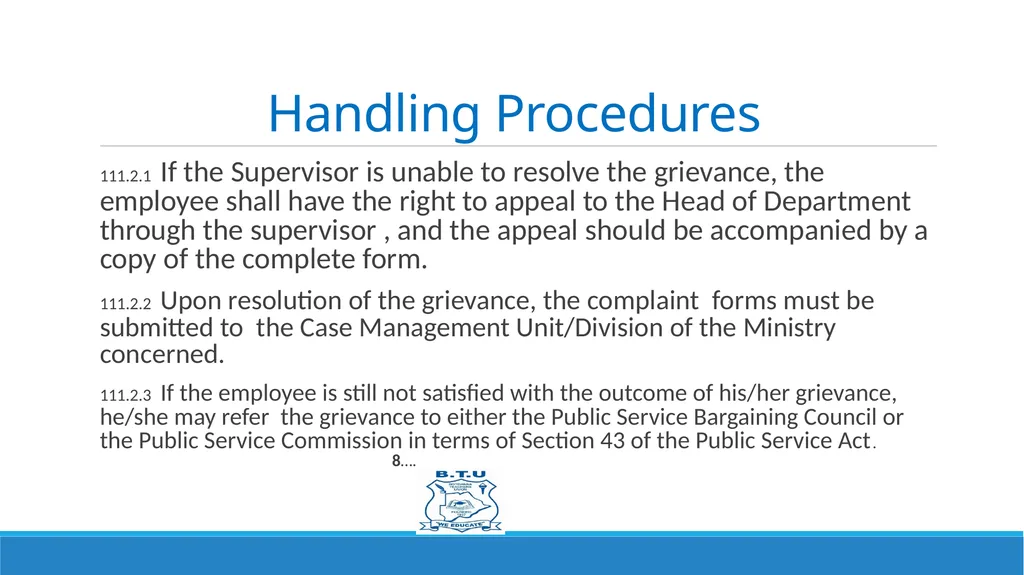
slide7. Handling Procedures 111.2.1 If the Supervisor is unable to resolve the grievance, the employee shall have the right to appeal to the Head of Department through the supervisor , and the appeal should be accompanied by a copy of the complete form.
111.2.2 Upon resolution of the grievance, the complaint forms must be submitted to the Case Management Unit/Division of the Ministry concerned.
111.2.3 If the employee is still not satisfied with the outcome of his/her grievance, he/she may refer the grievance to either the Public Service Bargaining Council or the Public Service Commission in terms of Section 43 of the Public Service Act. 8….<br>
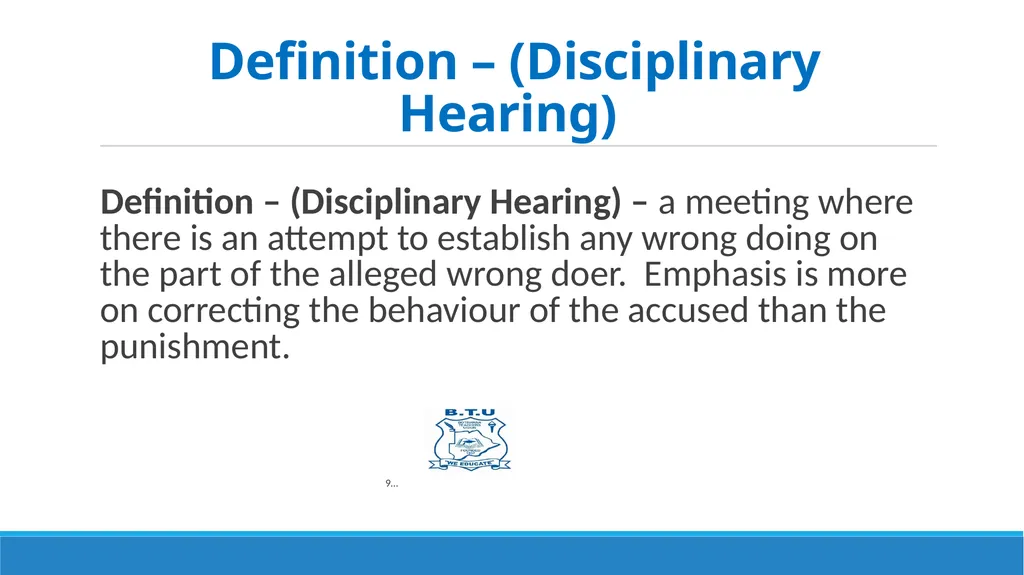
slide8. Definition – (Disciplinary Hearing) Definition – (Disciplinary Hearing) – a meeting where there is an attempt to establish any wrong doing on the part of the alleged wrong doer. Emphasis is more on correcting the behaviour of the accused than the punishment.
9…<br>
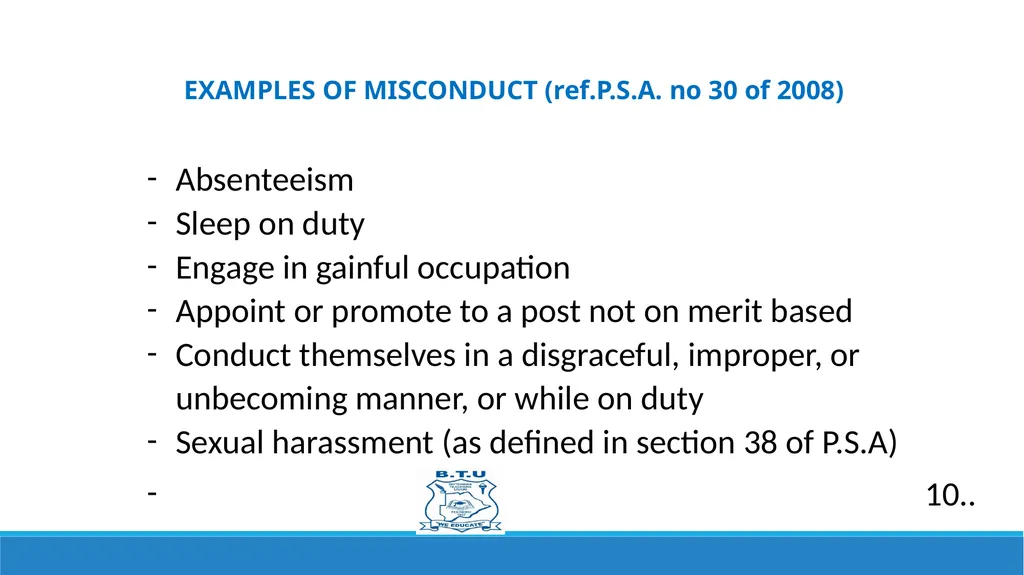
slide9. Absenteeism
Sleep on duty
Engage in gainful occupation
Appoint or promote to a post not on merit based
Conduct themselves in a disgraceful, improper, or unbecoming manner, or while on duty
Sexual harassment (as defined in section 38 of P.S.A)
10.. EXAMPLES OF MISCONDUCT (ref.P.S.A. no 30 of 2008)<br>
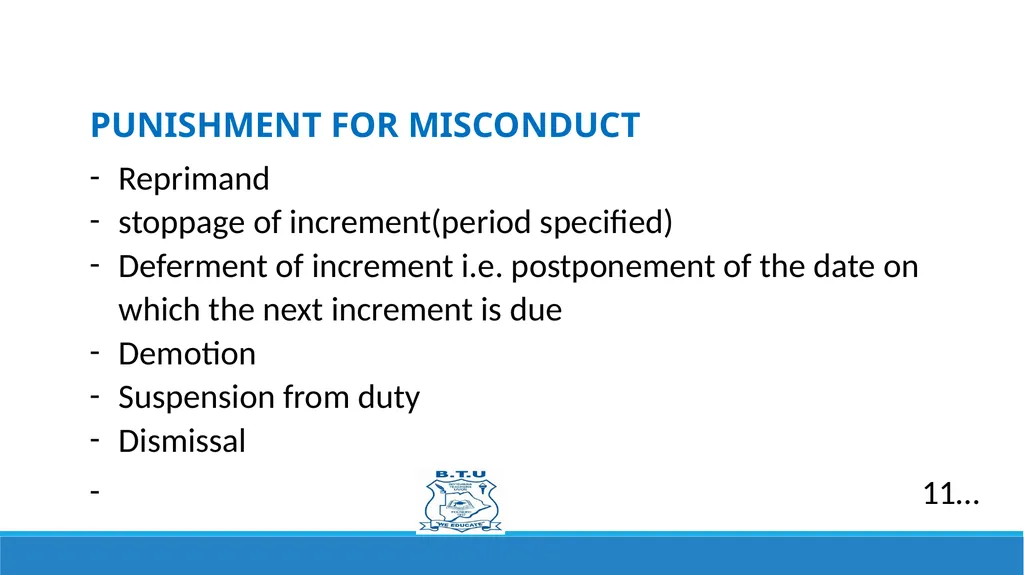
slide10. PUNISHMENT FOR MISCONDUCT
Reprimand
stoppage of increment(period specified)
Deferment of increment i.e. postponement of the date on which the next increment is due
Demotion
Suspension from duty
Dismissal
11…<br>
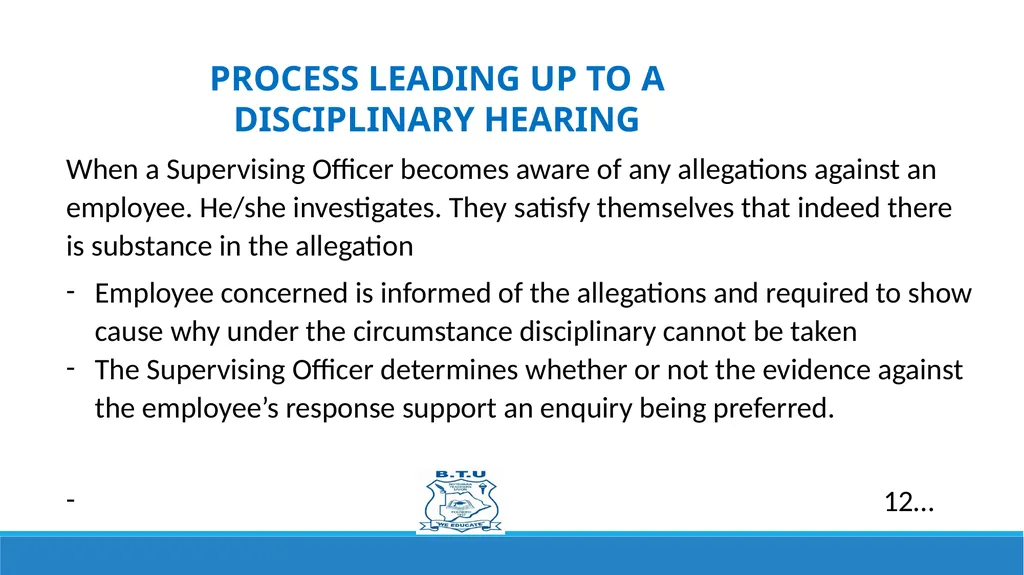
slide11. When a Supervising Officer becomes aware of any allegations against an employee. He/she investigates. They satisfy themselves that indeed there is substance in the allegation
Employee concerned is informed of the allegations and required to show cause why under the circumstance disciplinary cannot be taken
The Supervising Officer determines whether or not the evidence against the employee’s response support an enquiry being preferred.
12… PROCESS LEADING UP TO A DISCIPLINARY HEARING<br>
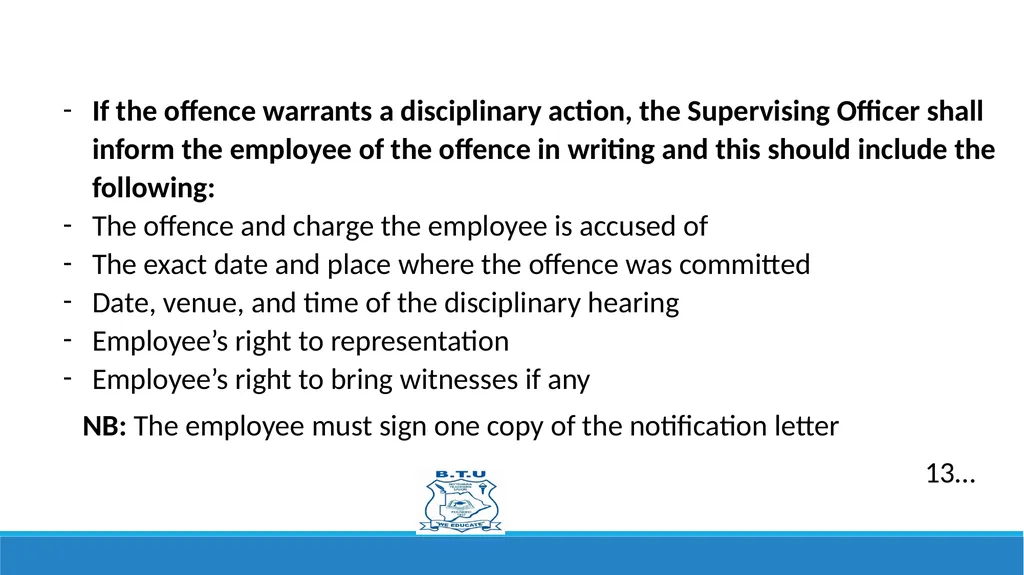
slide12. If the offence warrants a disciplinary action, the Supervising Officer shall inform the employee of the offence in writing and this should include the following:
The offence and charge the employee is accused of
The exact date and place where the offence was committed
Date, venue, and time of the disciplinary hearing
Employee’s right to representation
Employee’s right to bring witnesses if any
NB: The employee must sign one copy of the notification letter
13…<br>
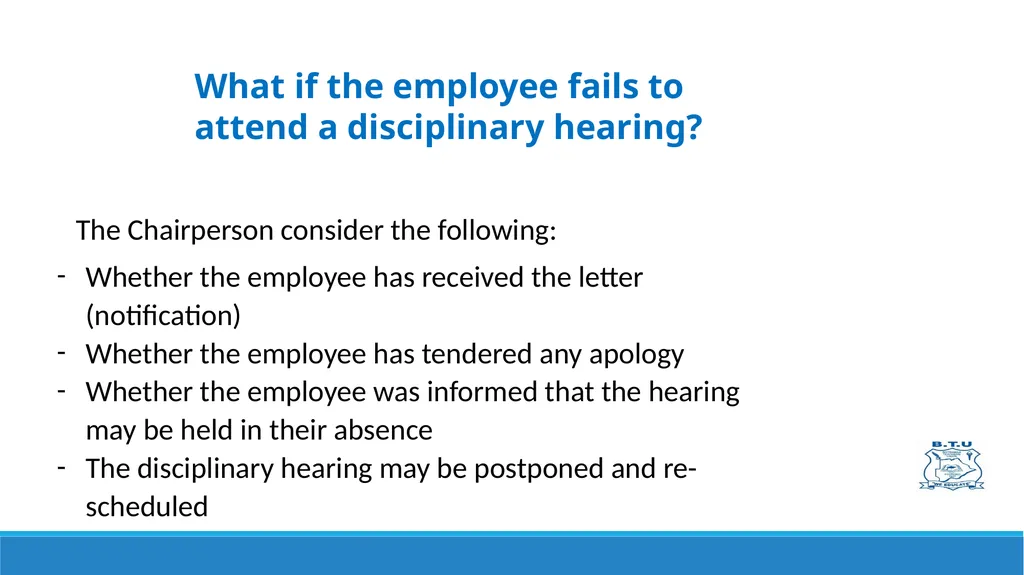
slide13. The Chairperson consider the following:
Whether the employee has received the letter (notification)
Whether the employee has tendered any apology
Whether the employee was informed that the hearing may be held in their absence
The disciplinary hearing may be postponed and re-scheduled
14… What if the employee fails to attend a disciplinary hearing?<br>
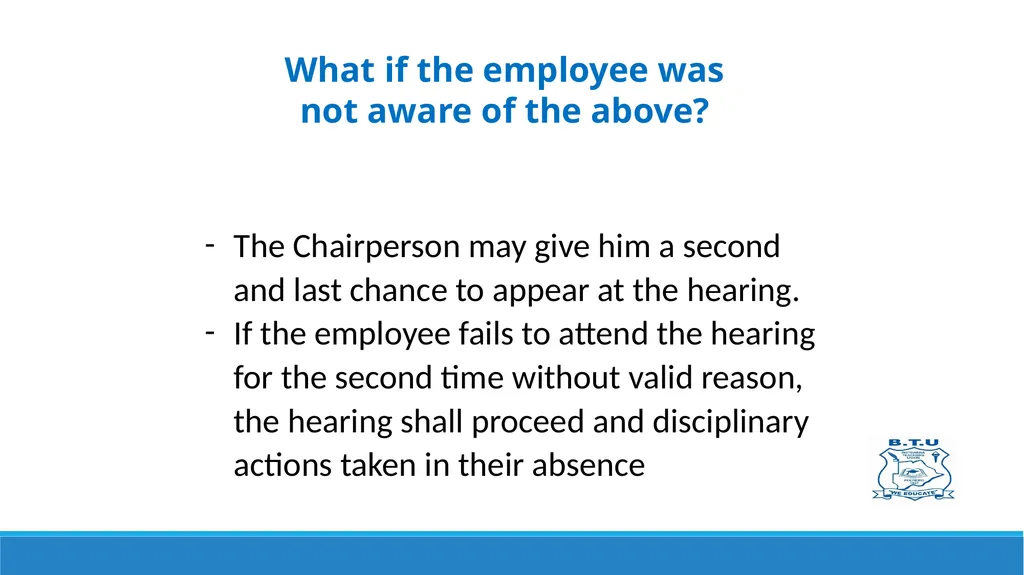
slide14. The Chairperson may give him a second and last chance to appear at the hearing.
If the employee fails to attend the hearing for the second time without valid reason, the hearing shall proceed and disciplinary actions taken in their absence
15… What if the employee was not aware of the above?<br>
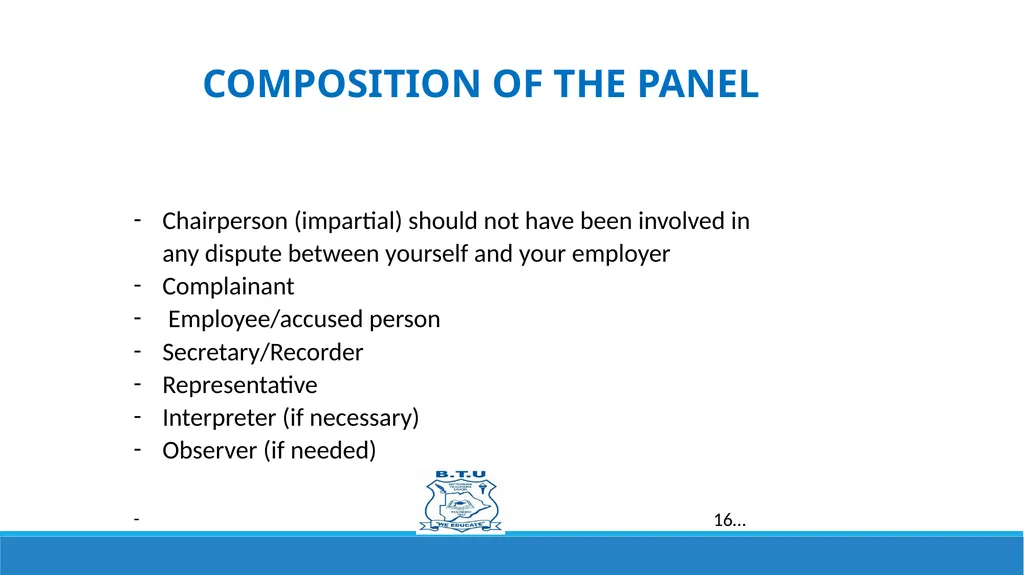
slide15. Chairperson (impartial) should not have been involved in any dispute between yourself and your employer
Complainant
Employee/accused person
Secretary/Recorder
Representative
Interpreter (if necessary)
Observer (if needed)
16… COMPOSITION OF THE PANEL<br>
slide16. It is of great importance to have a pre-conference in which the following are established/observed.
Studies the nature of the offence (Substantives of the charge and procedural)
Find out if the procedures have been followed
Study the statutes indicated and the sections contravened
Meet the witnesses if any etc.
17… EMPLOYEE PREPARES FOR THE HEARING<br>
slide17. Chairperson welcomes and introduces everyone present and explains the purpose of the hearing
The Chairperson confirms the right of the employee to representation and the right to call witnesses
The Chairperson reads the statement of the alleged offence(s) as captured in the notification letter and asks the employee whether or not they plead guilty to the offence
18… THE HEARING STARTS/CONDUCTING A DISCIPLINARY HEARING<br>
slide18. Where the employee pleads guilty, the chairperson shall ask the employee to mitigate i.e. bringing in factors that could be considered for lighter sanction
The chairperson adjourns the hearing , considers mitigation and makes a decision
Where the employee does not plead guilty, the complainant states their case
The employee cross examines the witnesses
Employee witnesses are called. (one after the other)
The complainant cross examines them
19…<br>
slide19. The hearing reconvenes and a verdict is announced. (Reasons for such findings are also stated.)
Where the employee has been found guilty
They are given the opportunity to mitigate
The hearing adjourns to allow chairperson to pronounce the sanction/penalty
The employee is informed of his right to appeal
Signing of Minutes
20…<br>
slide20. Teachers have lost cases that they could have not. This is simply because they did not prepare well for the hearing. The main purpose for preparing for the hearing is to collect facts and prepare defence.
21…. CONCLUSION<br>
slide21. THANK YOU<br>
Industrial relations office
1…..<br>
slide2. What is a grievance A grievance may be defined as a feeling of dissatisfaction or injustice about conditions of work which is felt by an employee or a group of employees and communicated to management
Types of Grievances
a) Individual grievance
b) Collective grievance
C) Policy grievance
D) Union grievance
2.<br>
slide3. GRIEVANCE PROCEDURE General:
109.1 The main purpose of the grievance procedure is to provide guidance in the resolution of grievances in the workplace.
109.2 The grievance procedure is basically the same irrespective of whether an employee is a member of a trade union or not. The only difference is that an employee who is a member of a trade union shall take the grievance up either with or through his/her trade union representative.
109.3 Grievances should be resolved as near the point of origin as possible. An employee shall normally be entitled to use this procedure within a responsible period of the cause of the grievance having occurred. 3….<br>
slide4. Grievance Procedure 110.1 The Reporting process
110.1.1 Grievances must be lodged with 3 months to the supervisor, who should deal with the grievance within 5 days of receipt
110.1.2 An employee may register his/her grievance to his/her supervisor either orally or in writing: in either case a complaint form must be completed
110.1.3 This requirement to report to the immediate supervisor either in a case where the complaint is laid against the immediate supervisor such as in cases of sexual harassment charges, and in that event, the employee may proceed directly to the next stage of this procedure 5…<br>
slide5. Grievance Procedure 110.4 The grievance must be lodged with the employee designated to facilitate grievances in the work place, who shall liaise with the relevant structure of the department and ensure compliance with procedures.
6…<br>
slide6. Handling Procedures 111.1 An employee shall present his/her grievance to the superior. Upon receiving the grievance, the supervisor shall investigate the circumstances surrounding the grievance, and then convene a formal hearing with the aggrieved employee(s)
111.2 The Grievances Form shall be completed and forwarded to the next management level and Case Management Unit/Division
7…<br>
slide7. Handling Procedures 111.2.1 If the Supervisor is unable to resolve the grievance, the employee shall have the right to appeal to the Head of Department through the supervisor , and the appeal should be accompanied by a copy of the complete form.
111.2.2 Upon resolution of the grievance, the complaint forms must be submitted to the Case Management Unit/Division of the Ministry concerned.
111.2.3 If the employee is still not satisfied with the outcome of his/her grievance, he/she may refer the grievance to either the Public Service Bargaining Council or the Public Service Commission in terms of Section 43 of the Public Service Act. 8….<br>
slide8. Definition – (Disciplinary Hearing) Definition – (Disciplinary Hearing) – a meeting where there is an attempt to establish any wrong doing on the part of the alleged wrong doer. Emphasis is more on correcting the behaviour of the accused than the punishment.
9…<br>
slide9. Absenteeism
Sleep on duty
Engage in gainful occupation
Appoint or promote to a post not on merit based
Conduct themselves in a disgraceful, improper, or unbecoming manner, or while on duty
Sexual harassment (as defined in section 38 of P.S.A)
10.. EXAMPLES OF MISCONDUCT (ref.P.S.A. no 30 of 2008)<br>
slide10. PUNISHMENT FOR MISCONDUCT
Reprimand
stoppage of increment(period specified)
Deferment of increment i.e. postponement of the date on which the next increment is due
Demotion
Suspension from duty
Dismissal
11…<br>
slide11. When a Supervising Officer becomes aware of any allegations against an employee. He/she investigates. They satisfy themselves that indeed there is substance in the allegation
Employee concerned is informed of the allegations and required to show cause why under the circumstance disciplinary cannot be taken
The Supervising Officer determines whether or not the evidence against the employee’s response support an enquiry being preferred.
12… PROCESS LEADING UP TO A DISCIPLINARY HEARING<br>
slide12. If the offence warrants a disciplinary action, the Supervising Officer shall inform the employee of the offence in writing and this should include the following:
The offence and charge the employee is accused of
The exact date and place where the offence was committed
Date, venue, and time of the disciplinary hearing
Employee’s right to representation
Employee’s right to bring witnesses if any
NB: The employee must sign one copy of the notification letter
13…<br>
slide13. The Chairperson consider the following:
Whether the employee has received the letter (notification)
Whether the employee has tendered any apology
Whether the employee was informed that the hearing may be held in their absence
The disciplinary hearing may be postponed and re-scheduled
14… What if the employee fails to attend a disciplinary hearing?<br>
slide14. The Chairperson may give him a second and last chance to appear at the hearing.
If the employee fails to attend the hearing for the second time without valid reason, the hearing shall proceed and disciplinary actions taken in their absence
15… What if the employee was not aware of the above?<br>
slide15. Chairperson (impartial) should not have been involved in any dispute between yourself and your employer
Complainant
Employee/accused person
Secretary/Recorder
Representative
Interpreter (if necessary)
Observer (if needed)
16… COMPOSITION OF THE PANEL<br>
slide16. It is of great importance to have a pre-conference in which the following are established/observed.
Studies the nature of the offence (Substantives of the charge and procedural)
Find out if the procedures have been followed
Study the statutes indicated and the sections contravened
Meet the witnesses if any etc.
17… EMPLOYEE PREPARES FOR THE HEARING<br>
slide17. Chairperson welcomes and introduces everyone present and explains the purpose of the hearing
The Chairperson confirms the right of the employee to representation and the right to call witnesses
The Chairperson reads the statement of the alleged offence(s) as captured in the notification letter and asks the employee whether or not they plead guilty to the offence
18… THE HEARING STARTS/CONDUCTING A DISCIPLINARY HEARING<br>
slide18. Where the employee pleads guilty, the chairperson shall ask the employee to mitigate i.e. bringing in factors that could be considered for lighter sanction
The chairperson adjourns the hearing , considers mitigation and makes a decision
Where the employee does not plead guilty, the complainant states their case
The employee cross examines the witnesses
Employee witnesses are called. (one after the other)
The complainant cross examines them
19…<br>
slide19. The hearing reconvenes and a verdict is announced. (Reasons for such findings are also stated.)
Where the employee has been found guilty
They are given the opportunity to mitigate
The hearing adjourns to allow chairperson to pronounce the sanction/penalty
The employee is informed of his right to appeal
Signing of Minutes
20…<br>
slide20. Teachers have lost cases that they could have not. This is simply because they did not prepare well for the hearing. The main purpose for preparing for the hearing is to collect facts and prepare defence.
21…. CONCLUSION<br>
slide21. THANK YOU<br>