Group 17 The Halogens Electron configurations ns2np5 (n is the period number) In its elemental state, all halogens atoms combine to form diatomic molecules (ex F2,I2,...) With the exception of F, the halogens can also lose valence electrons
"Group 17 The Halogens Electron configurations" is the property of its rightful owner. Permission is granted to
download and print the materials on this website for personal, non-commercial use only, and to display it
on your personal computer provided you do not modify the materials and that you retain all copyright
notices contained in the materials. By downloading content from our website, you accept the terms of this
agreement.
Presentation Transcript
01
Group 17
The Halogens<br>
02
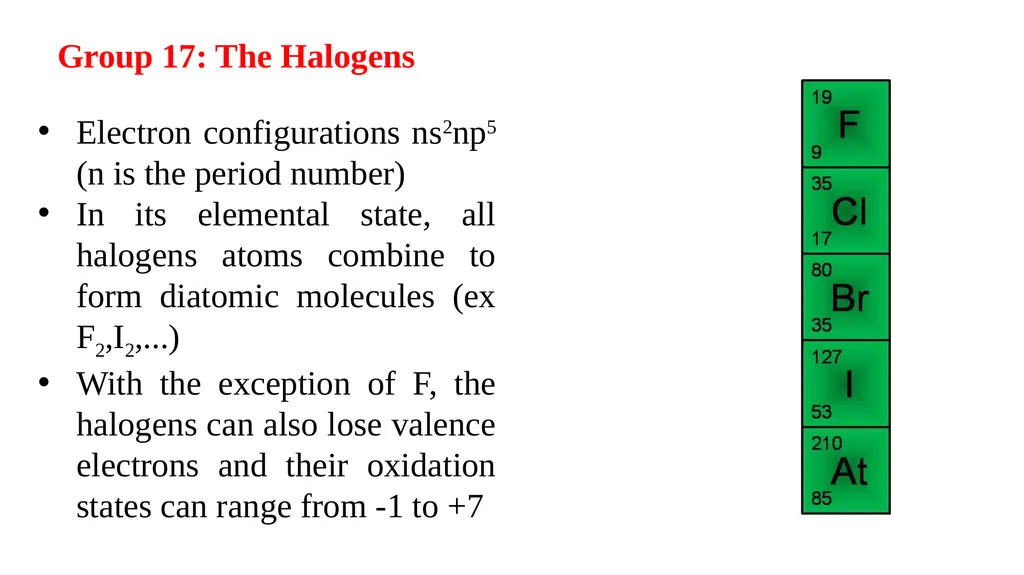
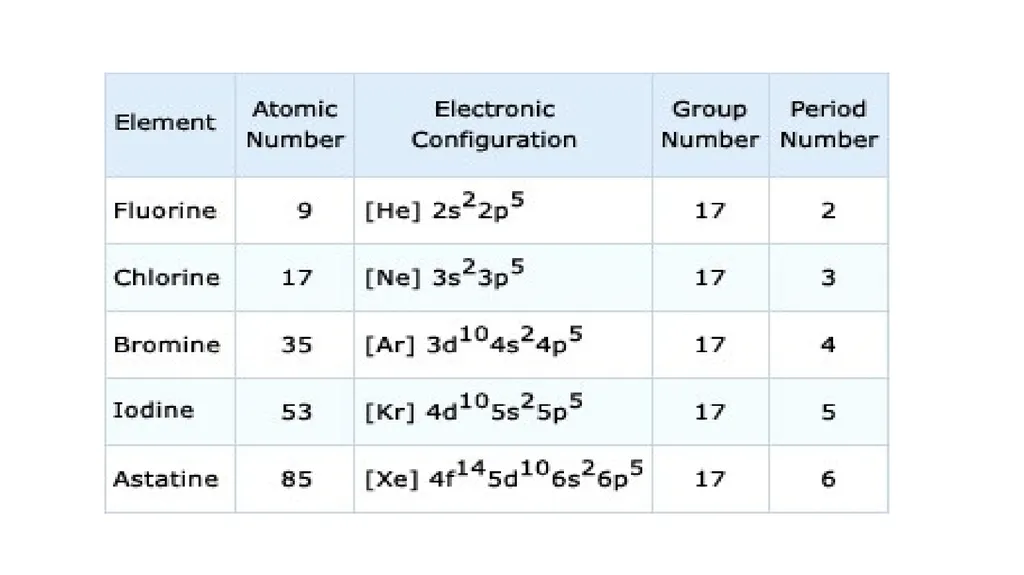
Electron configurations ns2np5 (n is the period number)
In its elemental state, all halogens atoms combine to form diatomic molecules (ex F2,I2,...)
With the exception of F, the halogens can also lose valence electrons and their oxidation states can range from -1 to +7 Group 17: The Halogens<br>
03
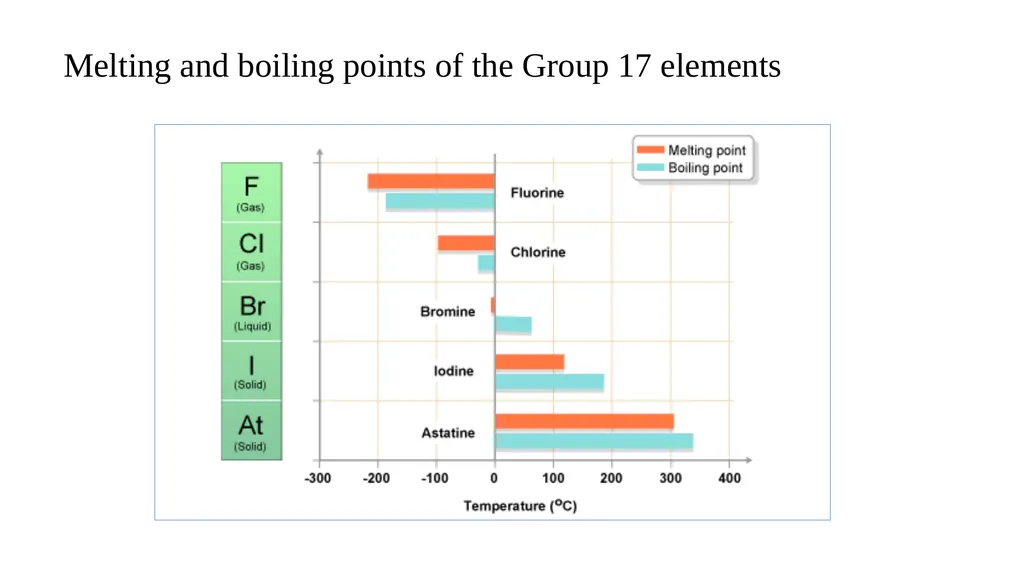
Melting and boiling points of the Group 17 elements<br>
04
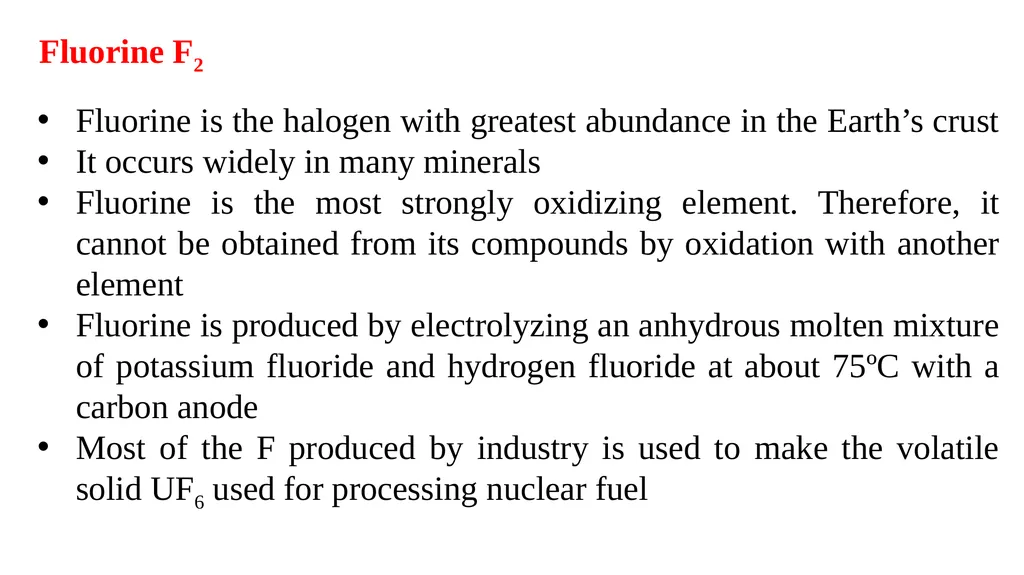
Fluorine F2 Fluorine is the halogen with greatest abundance in the Earth’s crust
It occurs widely in many minerals
Fluorine is the most strongly oxidizing element. Therefore, it cannot be obtained from its compounds by oxidation with another element
Fluorine is produced by electrolyzing an anhydrous molten mixture of potassium fluoride and hydrogen fluoride at about 75ºC with a carbon anode
Most of the F produced by industry is used to make the volatile solid UF6 used for processing nuclear fuel<br>
05
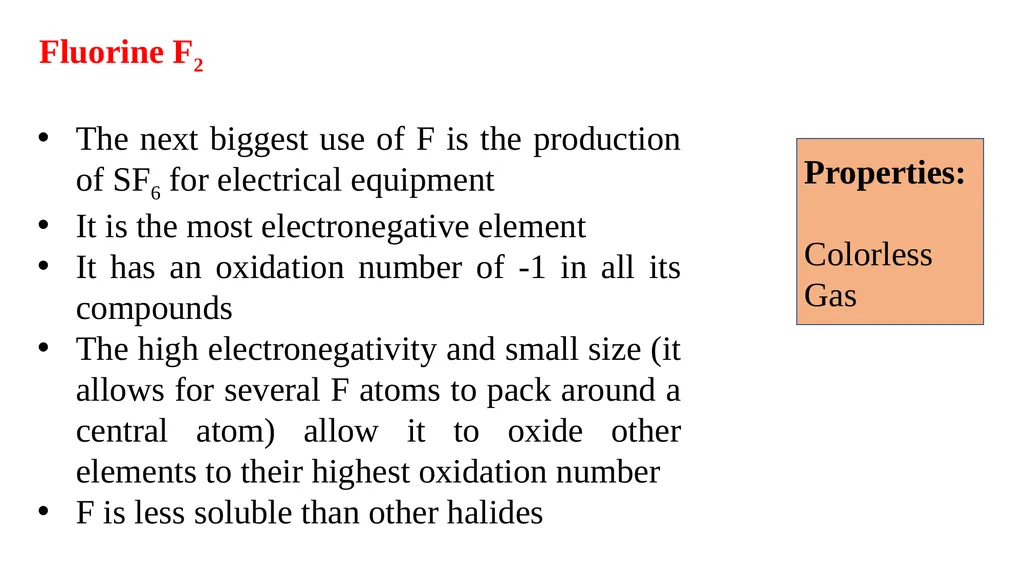
The next biggest use of F is the production of SF6 for electrical equipment
It is the most electronegative element
It has an oxidation number of -1 in all its compounds
The high electronegativity and small size (it allows for several F atoms to pack around a central atom) allow it to oxide other elements to their highest oxidation number
F is less soluble than other halides Fluorine F2 Properties:
Colorless Gas<br>
06
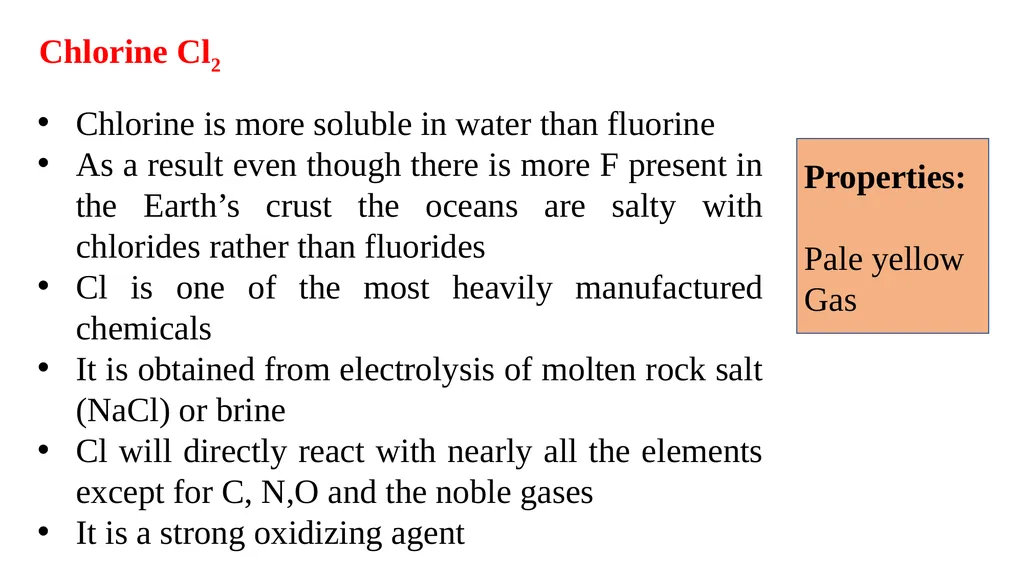
Chlorine Cl2 Chlorine is more soluble in water than fluorine
As a result even though there is more F present in the Earth’s crust the oceans are salty with chlorides rather than fluorides
Cl is one of the most heavily manufactured chemicals
It is obtained from electrolysis of molten rock salt (NaCl) or brine
Cl will directly react with nearly all the elements except for C, N,O and the noble gases
It is a strong oxidizing agent Properties:
Pale yellow Gas<br>
07
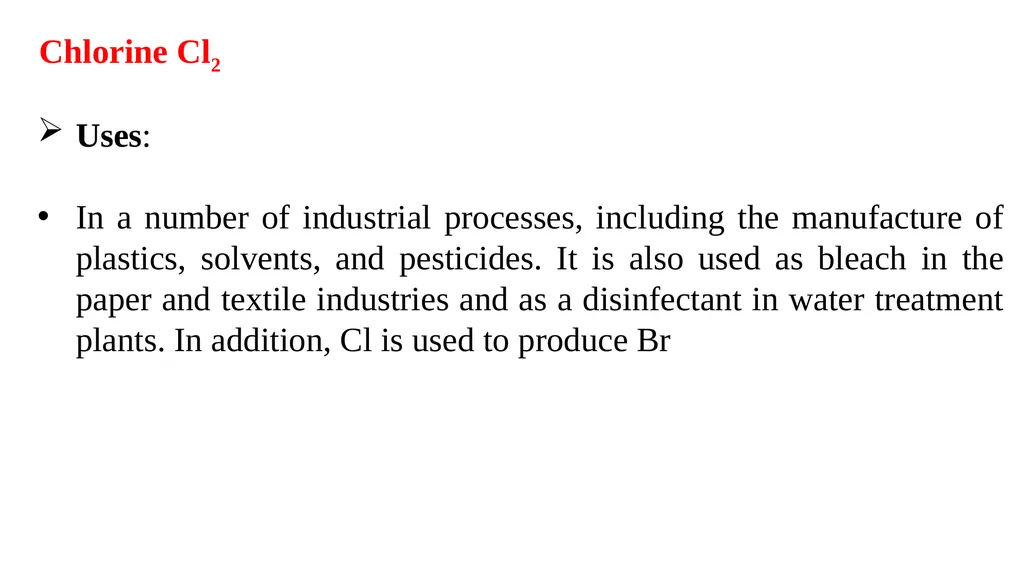
Chlorine Cl2 Uses:
In a number of industrial processes, including the manufacture of plastics, solvents, and pesticides. It is also used as bleach in the paper and textile industries and as a disinfectant in water treatment plants. In addition, Cl is used to produce Br<br>
08
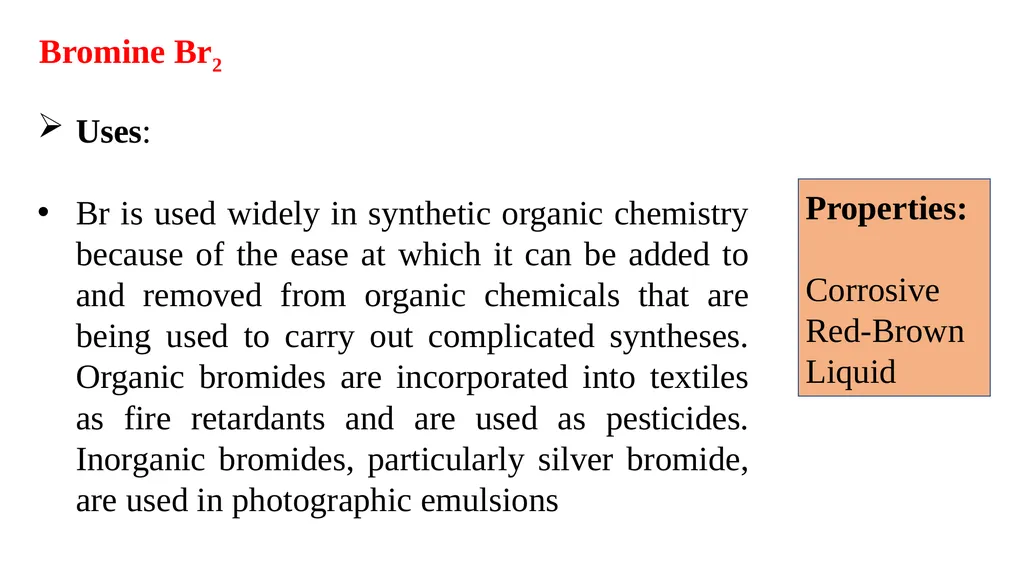
Bromine Br2 Uses:
Br is used widely in synthetic organic chemistry because of the ease at which it can be added to and removed from organic chemicals that are being used to carry out complicated syntheses. Organic bromides are incorporated into textiles as fire retardants and are used as pesticides. Inorganic bromides, particularly silver bromide, are used in photographic emulsions Properties:
Corrosive Red-Brown Liquid<br>
09
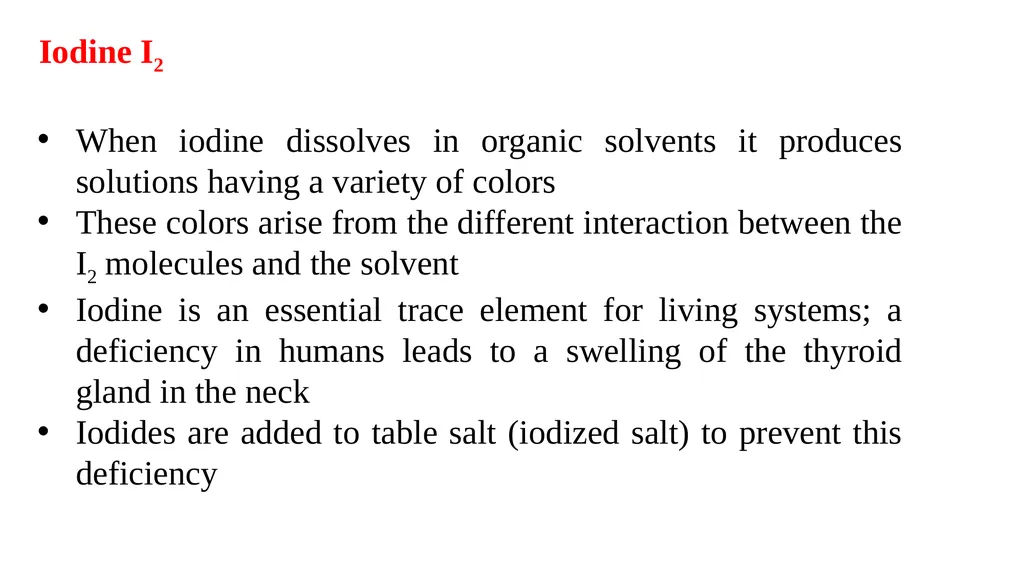
Iodine I2 When iodine dissolves in organic solvents it produces solutions having a variety of colors
These colors arise from the different interaction between the I2 molecules and the solvent
Iodine is an essential trace element for living systems; a deficiency in humans leads to a swelling of the thyroid gland in the neck
Iodides are added to table salt (iodized salt) to prevent this deficiency<br>
10
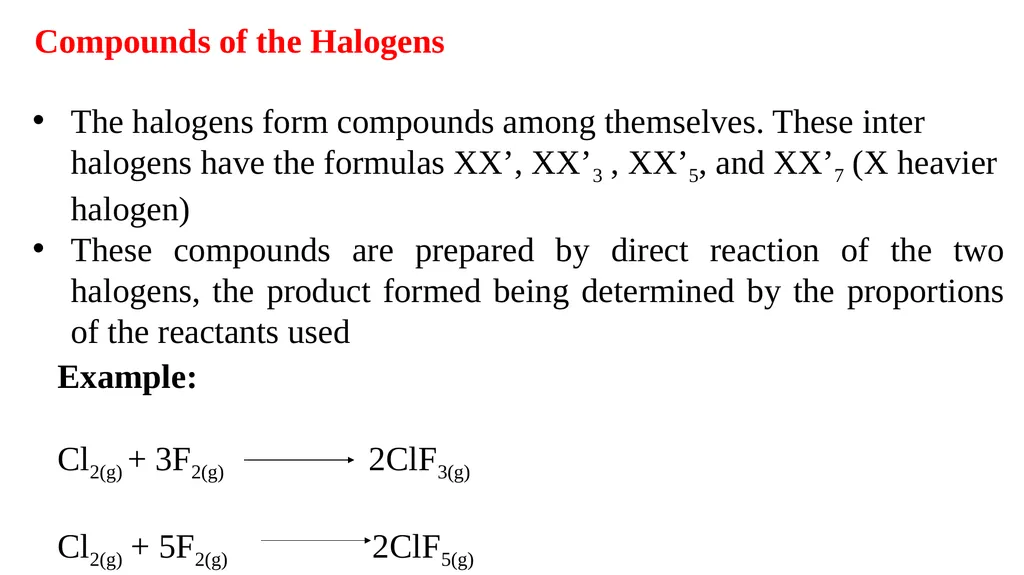
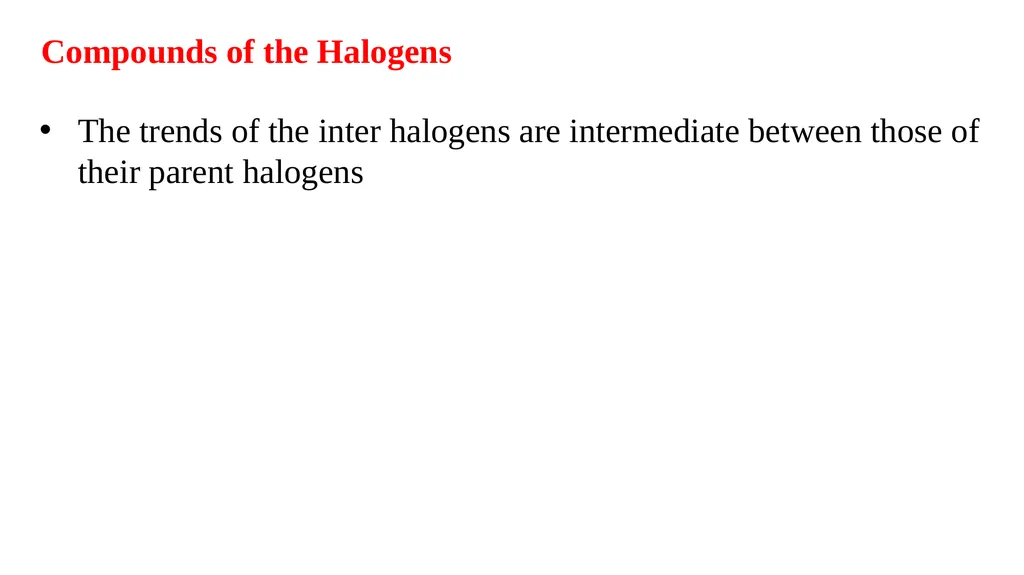
Compounds of the Halogens The halogens form compounds among themselves. These inter halogens have the formulas XX’, XX’3 , XX’5, and XX’7 (X heavier halogen)
These compounds are prepared by direct reaction of the two halogens, the product formed being determined by the proportions of the reactants used Example:
Cl2(g) + 3F2(g) 2ClF3(g)
Cl2(g) + 5F2(g) 2ClF5(g)<br>
11
The trends of the inter halogens are intermediate between those of their parent halogens Compounds of the Halogens<br>
12
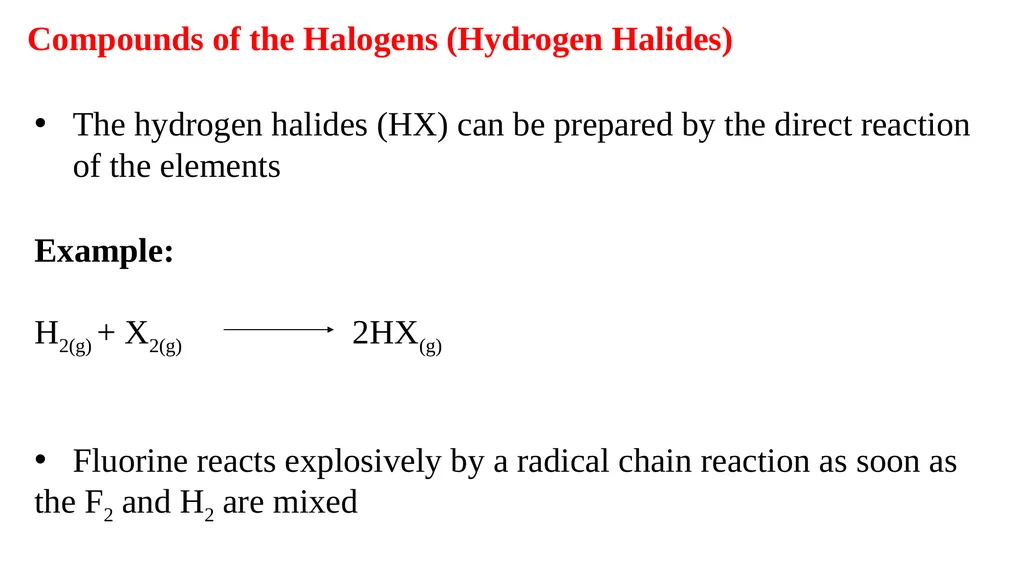
Compounds of the Halogens (Hydrogen Halides) The hydrogen halides (HX) can be prepared by the direct reaction of the elements Example:
H2(g) + X2(g) 2HX(g) Fluorine reacts explosively by a radical chain reaction as soon as
the F2 and H2 are mixed<br>
13
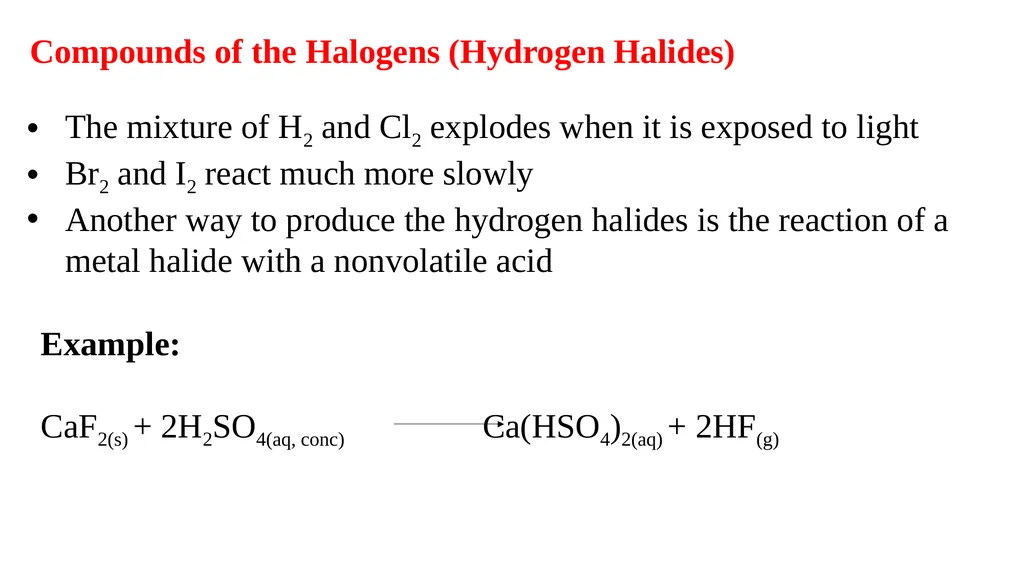
The mixture of H2 and Cl2 explodes when it is exposed to light
Br2 and I2 react much more slowly
Another way to produce the hydrogen halides is the reaction of a metal halide with a nonvolatile acid Compounds of the Halogens (Hydrogen Halides) Example:
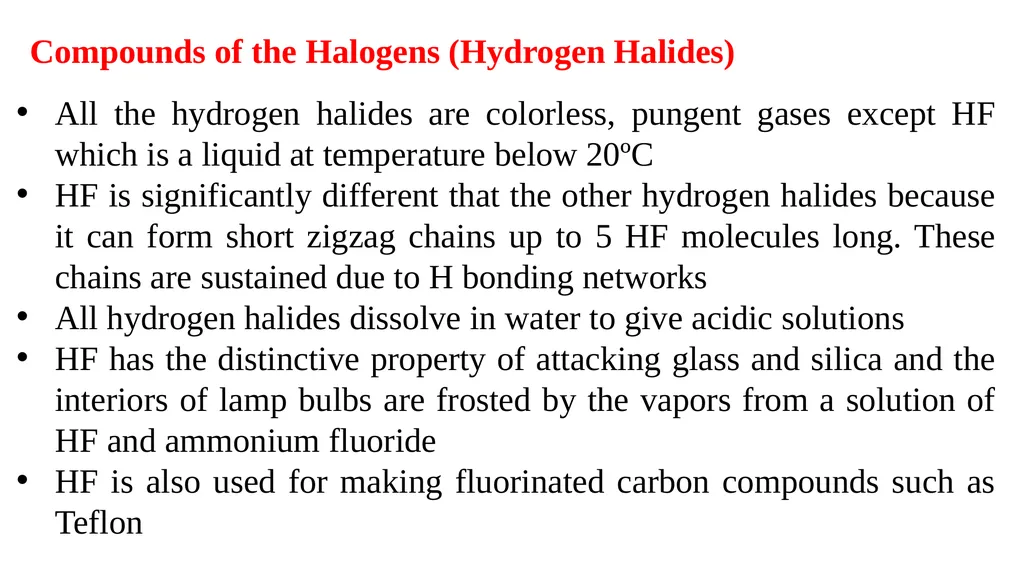
Compounds of the Halogens (Hydrogen Halides) All the hydrogen halides are colorless, pungent gases except HF which is a liquid at temperature below 20ºC
HF is significantly different that the other hydrogen halides because it can form short zigzag chains up to 5 HF molecules long. These chains are sustained due to H bonding networks
All hydrogen halides dissolve in water to give acidic solutions
HF has the distinctive property of attacking glass and silica and the interiors of lamp bulbs are frosted by the vapors from a solution of HF and ammonium fluoride
HF is also used for making fluorinated carbon compounds such as Teflon<br>
15
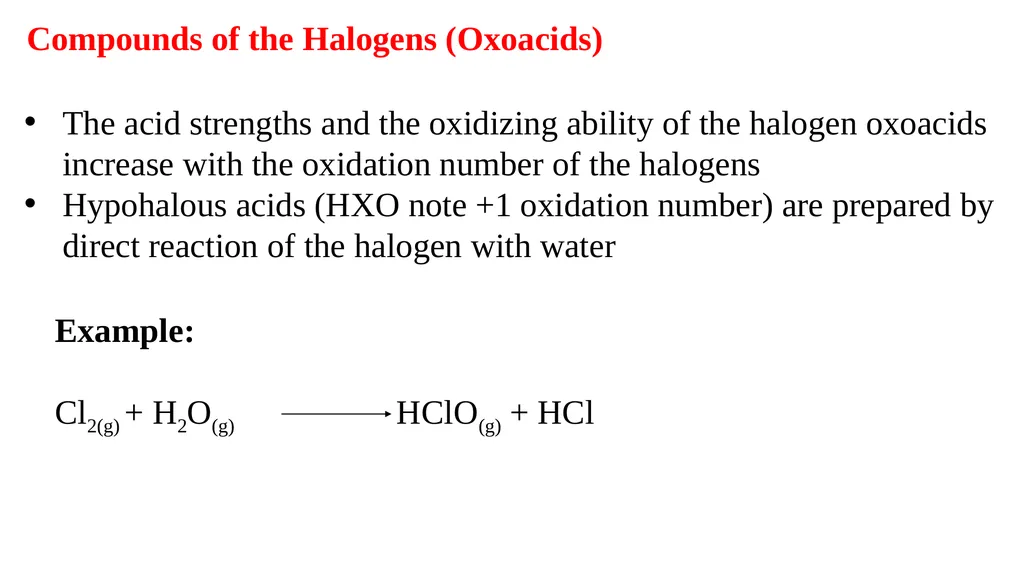
Compounds of the Halogens (Oxoacids) The acid strengths and the oxidizing ability of the halogen oxoacids increase with the oxidation number of the halogens
Hypohalous acids (HXO note +1 oxidation number) are prepared by direct reaction of the halogen with water Example:
Cl2(g) + H2O(g) HClO(g) + HCl<br>
16
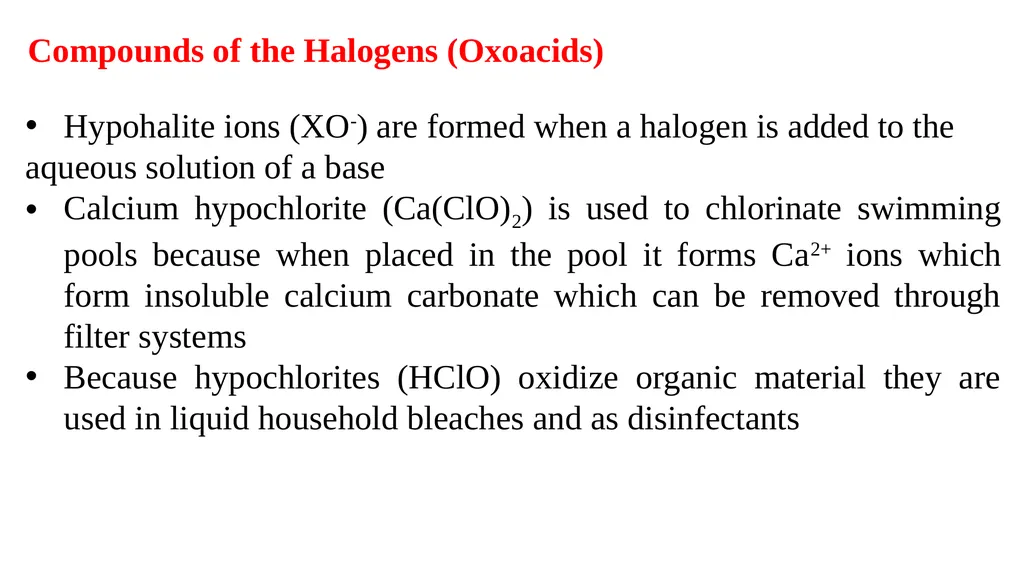
Compounds of the Halogens (Oxoacids) Hypohalite ions (XO-) are formed when a halogen is added to the
aqueous solution of a base
Calcium hypochlorite (Ca(ClO)2) is used to chlorinate swimming pools because when placed in the pool it forms Ca2+ ions which form insoluble calcium carbonate which can be removed through filter systems
Because hypochlorites (HClO) oxidize organic material they are used in liquid household bleaches and as disinfectants<br>