Guidelines for Reporting on the Implementation of the New Urban Agenda 2 carry out a periodic follow-up to and review of the New Urban Agenda in order to track progress, assess impact and ensure the Agendas effective and timely
"Guidelines for Reporting on the Implementation of" is the property of its rightful owner. Permission is granted to
download and print the materials on this website for personal, non-commercial use only, and to display it
on your personal computer provided you do not modify the materials and that you retain all copyright
notices contained in the materials. By downloading content from our website, you accept the terms of this
agreement.
Presentation Transcript
01
Guidelines for Reporting on the Implementation of the New Urban Agenda<br>
02
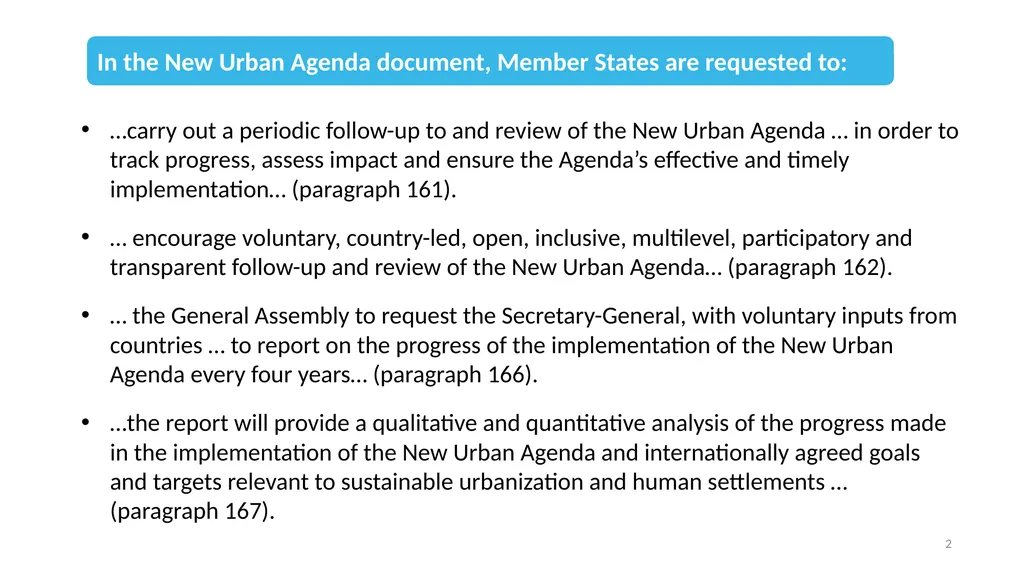
2 …carry out a periodic follow-up to and review of the New Urban Agenda … in order to track progress, assess impact and ensure the Agenda’s effective and timely implementation… (paragraph 161).
… encourage voluntary, country-led, open, inclusive, multilevel, participatory and transparent follow-up and review of the New Urban Agenda… (paragraph 162).
… the General Assembly to request the Secretary-General, with voluntary inputs from countries … to report on the progress of the implementation of the New Urban Agenda every four years… (paragraph 166).
…the report will provide a qualitative and quantitative analysis of the progress made in the implementation of the New Urban Agenda and internationally agreed goals and targets relevant to sustainable urbanization and human settlements … (paragraph 167). In the New Urban Agenda document, Member States are requested to:<br>
03
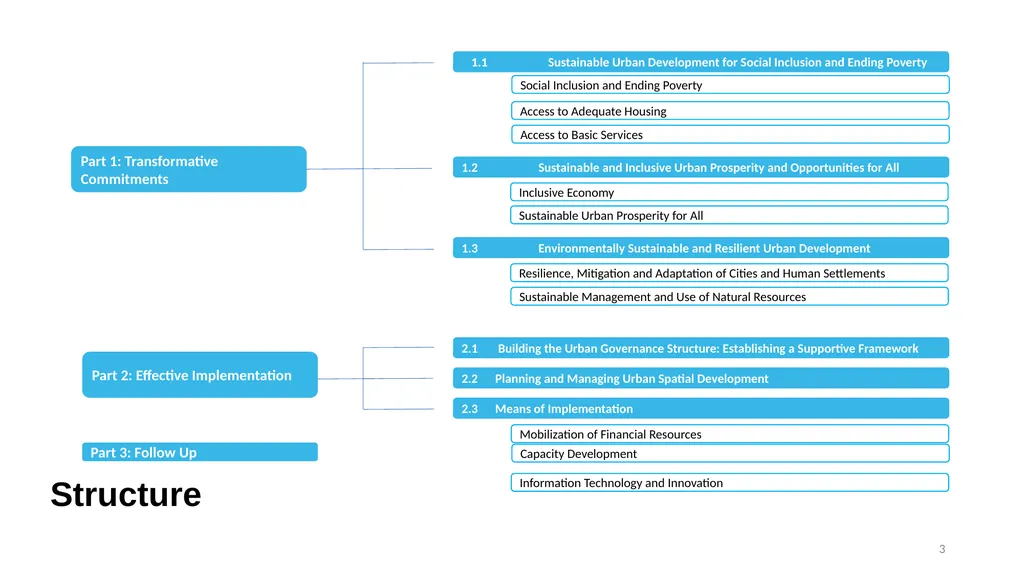
Structure 3 Part 1: Transformative Commitments Part 2: Effective Implementation Part 3: Follow Up 1.1 Sustainable Urban Development for Social Inclusion and Ending Poverty 1.2 Sustainable and Inclusive Urban Prosperity and Opportunities for All 1.3 Environmentally Sustainable and Resilient Urban Development 2.1 Building the Urban Governance Structure: Establishing a Supportive Framework 2.2 Planning and Managing Urban Spatial Development 2.3 Means of Implementation Social Inclusion and Ending Poverty Access to Adequate Housing Access to Basic Services Inclusive Economy Sustainable Urban Prosperity for All Resilience, Mitigation and Adaptation of Cities and Human Settlements Sustainable Management and Use of Natural Resources Mobilization of Financial Resources Capacity Development Information Technology and Innovation<br>
04
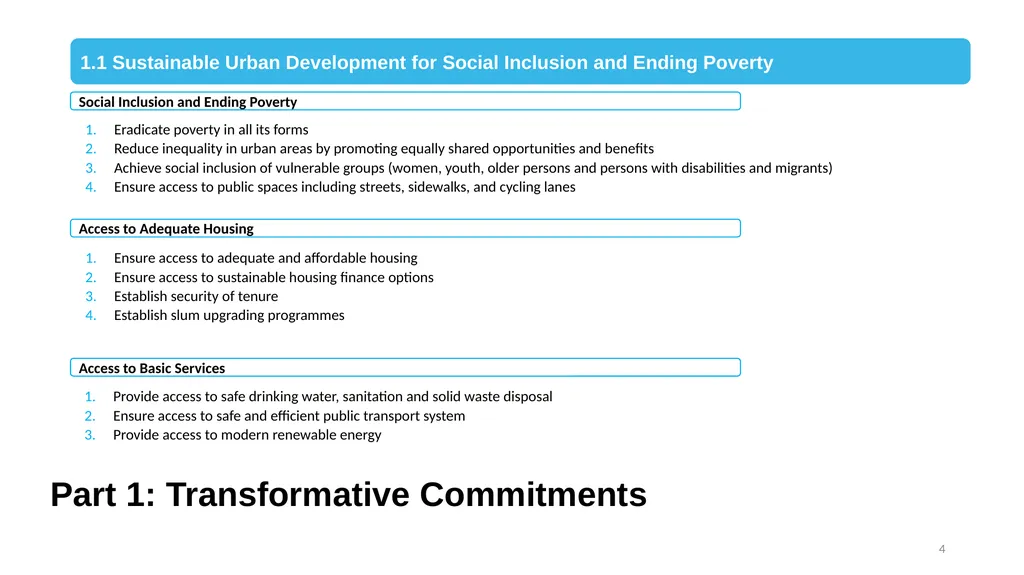
4 1.1 Sustainable Urban Development for Social Inclusion and Ending Poverty Part 1: Transformative Commitments<br>
05
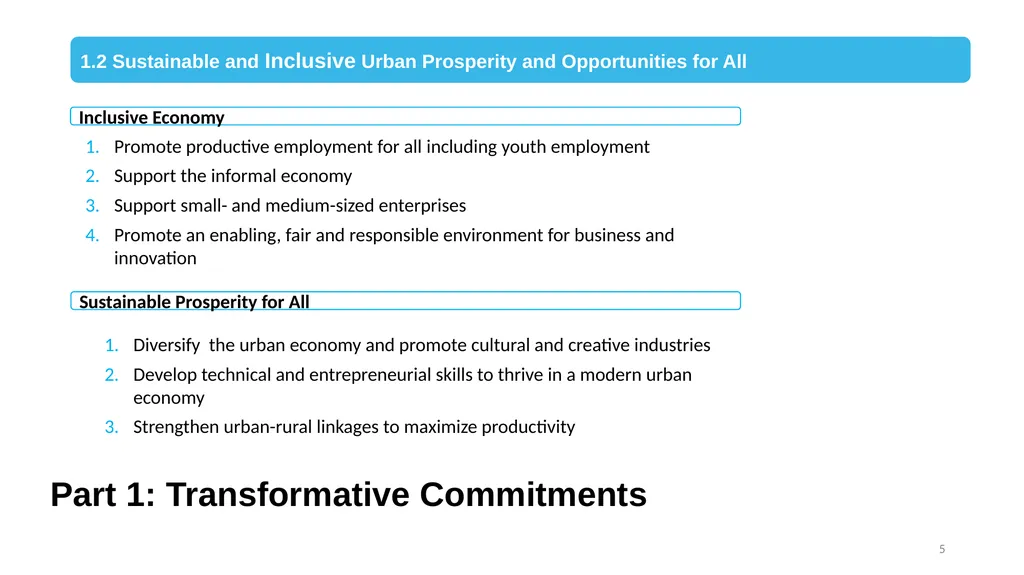
Sustainable Prosperity for All Inclusive Economy 5 1.2 Sustainable and Inclusive Urban Prosperity and Opportunities for All Promote productive employment for all including youth employment
Support the informal economy
Support small- and medium-sized enterprises
Promote an enabling, fair and responsible environment for business and innovation Diversify the urban economy and promote cultural and creative industries
Develop technical and entrepreneurial skills to thrive in a modern urban economy
Strengthen urban-rural linkages to maximize productivity Part 1: Transformative Commitments<br>
06
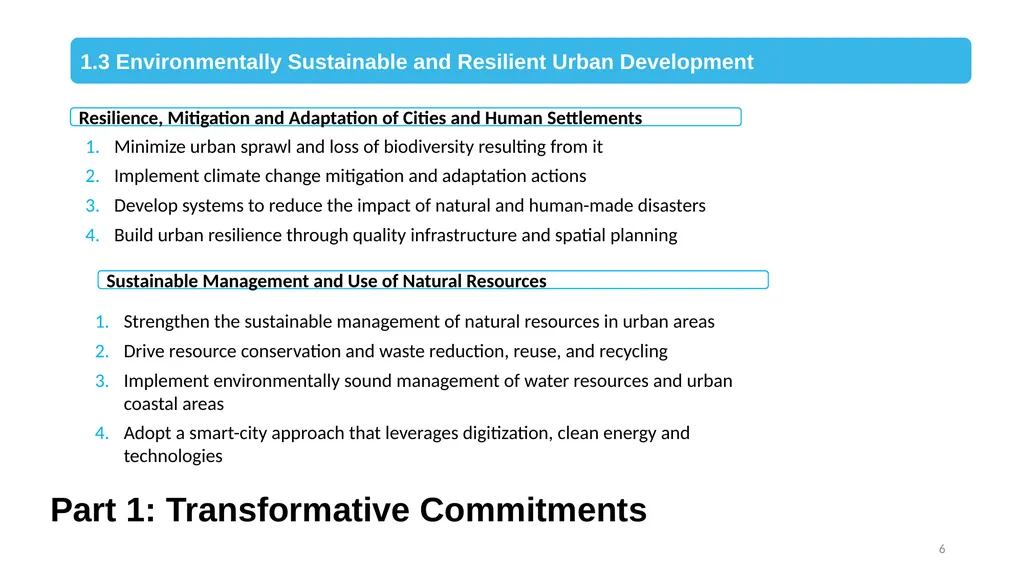
Sustainable Management and Use of Natural Resources Resilience, Mitigation and Adaptation of Cities and Human Settlements 6 1.3 Environmentally Sustainable and Resilient Urban Development Minimize urban sprawl and loss of biodiversity resulting from it
Implement climate change mitigation and adaptation actions
Develop systems to reduce the impact of natural and human-made disasters
Build urban resilience through quality infrastructure and spatial planning Strengthen the sustainable management of natural resources in urban areas
Drive resource conservation and waste reduction, reuse, and recycling
Implement environmentally sound management of water resources and urban coastal areas
Adopt a smart-city approach that leverages digitization, clean energy and technologies Part 1: Transformative Commitments<br>
07
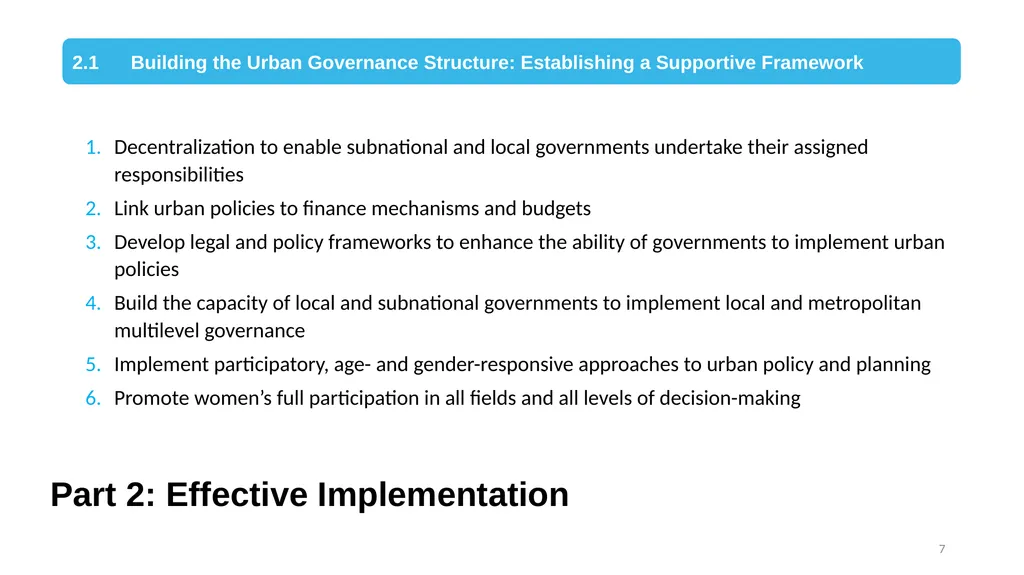
7 Decentralization to enable subnational and local governments undertake their assigned responsibilities
Link urban policies to finance mechanisms and budgets
Develop legal and policy frameworks to enhance the ability of governments to implement urban policies
Build the capacity of local and subnational governments to implement local and metropolitan multilevel governance
Implement participatory, age- and gender-responsive approaches to urban policy and planning
Promote women’s full participation in all fields and all levels of decision-making Part 2: Effective Implementation 2.1 Building the Urban Governance Structure: Establishing a Supportive Framework<br>
08
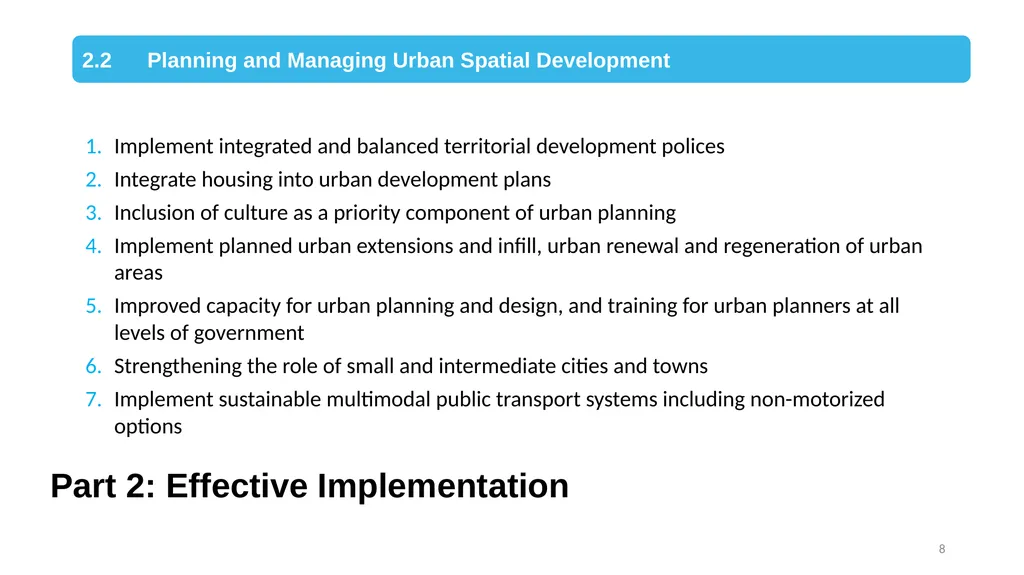
8 Implement integrated and balanced territorial development polices
Integrate housing into urban development plans
Inclusion of culture as a priority component of urban planning
Implement planned urban extensions and infill, urban renewal and regeneration of urban areas
Improved capacity for urban planning and design, and training for urban planners at all levels of government
Strengthening the role of small and intermediate cities and towns
Implement sustainable multimodal public transport systems including non-motorized options Part 2: Effective Implementation 2.2 Planning and Managing Urban Spatial Development<br>
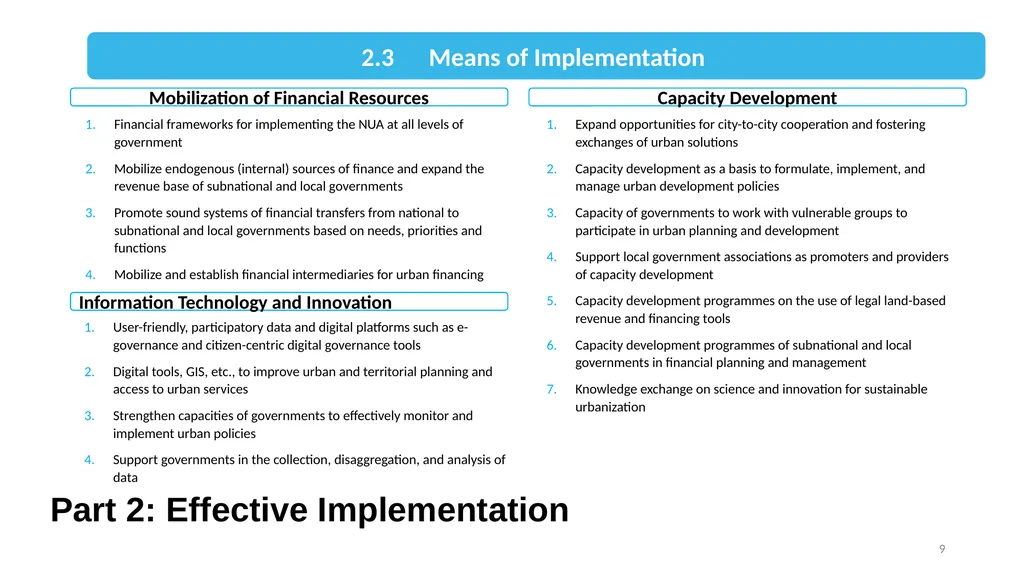
09
Information Technology and Innovation Capacity Development Mobilization of Financial Resources 9 Financial frameworks for implementing the NUA at all levels of government
Mobilize endogenous (internal) sources of finance and expand the revenue base of subnational and local governments
Promote sound systems of financial transfers from national to subnational and local governments based on needs, priorities and functions
Mobilize and establish financial intermediaries for urban financing Expand opportunities for city-to-city cooperation and fostering exchanges of urban solutions
Capacity development as a basis to formulate, implement, and manage urban development policies
Capacity of governments to work with vulnerable groups to participate in urban planning and development
Support local government associations as promoters and providers of capacity development
Capacity development programmes on the use of legal land-based revenue and financing tools
Capacity development programmes of subnational and local governments in financial planning and management
Knowledge exchange on science and innovation for sustainable urbanization User-friendly, participatory data and digital platforms such as e-governance and citizen-centric digital governance tools
Digital tools, GIS, etc., to improve urban and territorial planning and access to urban services
Strengthen capacities of governments to effectively monitor and implement urban policies
Support governments in the collection, disaggregation, and analysis of data Part 2: Effective Implementation 2.3 Means of Implementation<br>
10
10 Methodologies/mechanisms that have been developed to monitor and report on the implementation of the New Urban Agenda Part 3: Follow Up + Review Part 3: Follow Up + Review<br>
11
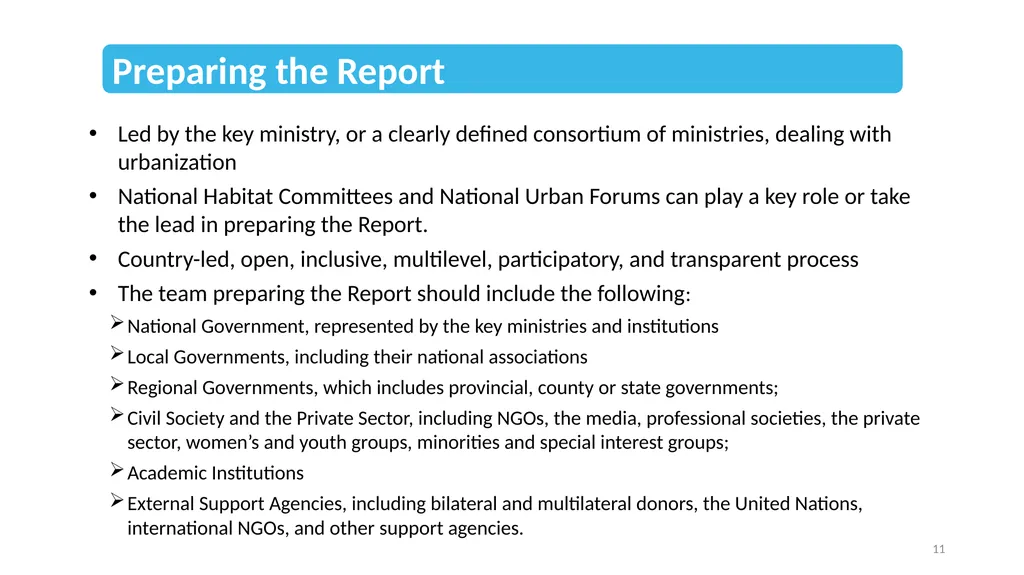
11 Led by the key ministry, or a clearly defined consortium of ministries, dealing with urbanization
National Habitat Committees and National Urban Forums can play a key role or take the lead in preparing the Report.
Country-led, open, inclusive, multilevel, participatory, and transparent process
The team preparing the Report should include the following:
National Government, represented by the key ministries and institutions
Local Governments, including their national associations
Regional Governments, which includes provincial, county or state governments;
Civil Society and the Private Sector, including NGOs, the media, professional societies, the private sector, women’s and youth groups, minorities and special interest groups;
Academic Institutions
External Support Agencies, including bilateral and multilateral donors, the United Nations, international NGOs, and other support agencies. Preparing the Report<br>