
Gynecologic Emergencies CHAPTER 25: Focused
TA
Published · 51 slides · 0 views
1 / 1





Description
Gynecologic Emergencies CHAPTER 25: Focused Lecture National EMS Education Standard Competencies (1 of 3) Medicine Applies fundamental knowledge to provide basic and selected advanced emergency care and transportation based on assessment
Related Topics
Share
Embed code
Download this presentation From Below
"Gynecologic Emergencies CHAPTER 25: Focused" is the property of its rightful owner. Permission is granted to download and print the materials on this website for personal, non-commercial use only, and to display it on your personal computer provided you do not modify the materials and that you retain all copyright notices contained in the materials. By downloading content from our website, you accept the terms of this agreement.
Presentation Transcript
01
Gynecologic Emergencies CHAPTER 25: Focused Lecture<br>
02
National EMS Education Standard Competencies (1 of 3) Medicine
Applies fundamental knowledge to provide basic and selected advanced emergency care and transportation based on assessment findings for an acutely ill patient.<br>
Applies fundamental knowledge to provide basic and selected advanced emergency care and transportation based on assessment findings for an acutely ill patient.<br>
03
National EMS Education Standard Competencies (2 of 3) Gynecology
Recognition and management of shock associated with
Vaginal bleeding<br>
Recognition and management of shock associated with
Vaginal bleeding<br>
04
National EMS Education Standard Competencies (3 of 3) Anatomy, physiology, assessment findings, and management of
Vaginal bleeding
Sexual assault
Infections<br>
Vaginal bleeding
Sexual assault
Infections<br>
05
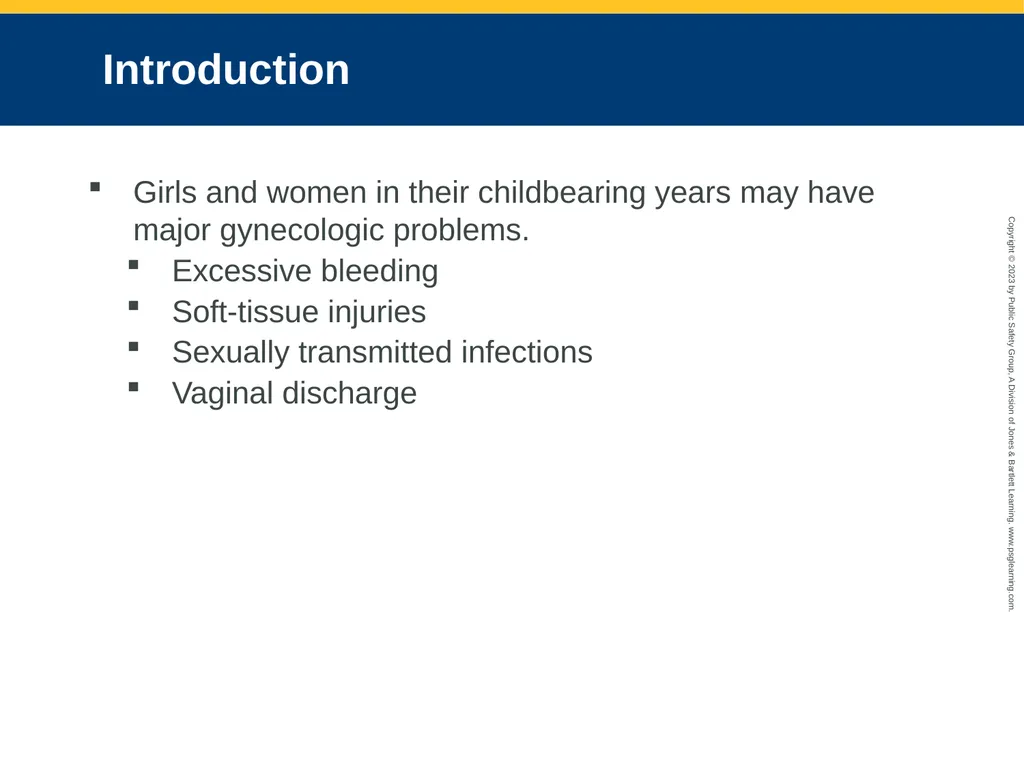
Introduction Girls and women in their childbearing years may have major gynecologic problems.
Excessive bleeding
Soft-tissue injuries
Sexually transmitted infections
Vaginal discharge<br>
Excessive bleeding
Soft-tissue injuries
Sexually transmitted infections
Vaginal discharge<br>
06
Anatomy and Physiology Review (1 of 8) Ovaries
Produce ova
Produce estrogen and progesterone © Jones & Bartlett Learning.<br>
Produce ova
Produce estrogen and progesterone © Jones & Bartlett Learning.<br>
07
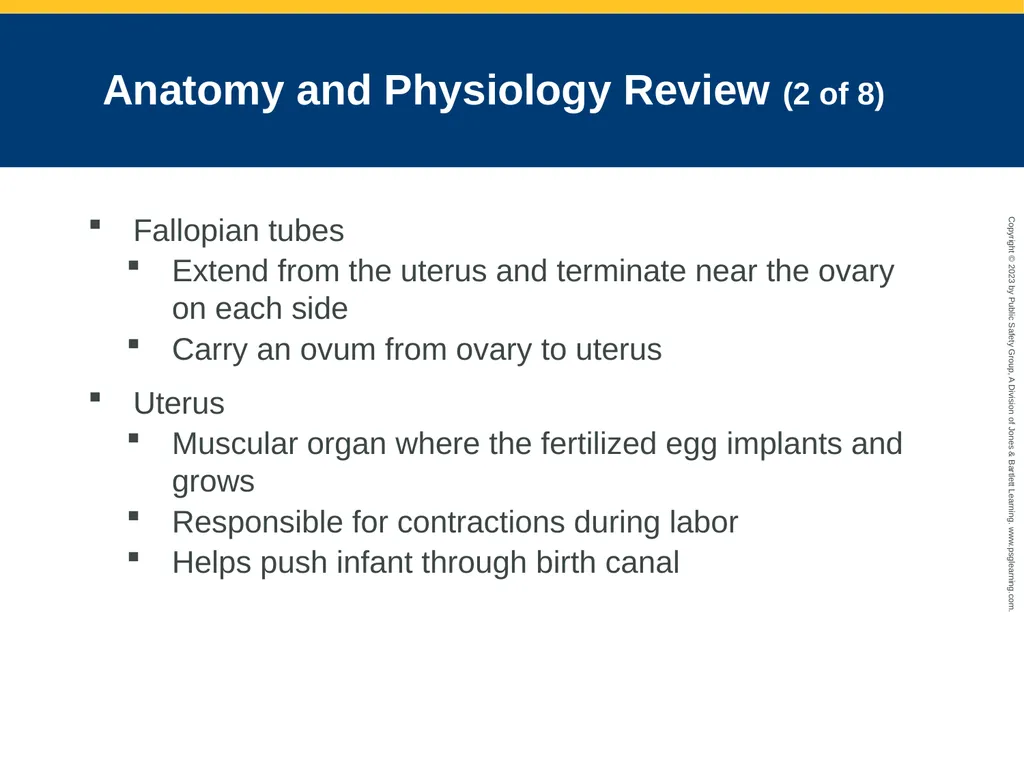
Anatomy and Physiology Review (2 of 8) Fallopian tubes
Extend from the uterus and terminate near the ovary on each side
Carry an ovum from ovary to uterus
Uterus
Muscular organ where the fertilized egg implants and grows
Responsible for contractions during labor
Helps push infant through birth canal<br>
Extend from the uterus and terminate near the ovary on each side
Carry an ovum from ovary to uterus
Uterus
Muscular organ where the fertilized egg implants and grows
Responsible for contractions during labor
Helps push infant through birth canal<br>
08
Anatomy and Physiology Review (3 of 8) Vagina
Forms the lower part of the birth canal
Begins at the cervix
Cervical canal is the passageway from uterus to opening into the vagina.<br>
Forms the lower part of the birth canal
Begins at the cervix
Cervical canal is the passageway from uterus to opening into the vagina.<br>
09
Anatomy and Physiology Review (4 of 8) The external female genitalia (vulva)
Mons pubis
Clitoris
Prepuce or foreskin
Vestibule
Opening of urethra © Jones & Bartlett Learning.<br>
Mons pubis
Clitoris
Prepuce or foreskin
Vestibule
Opening of urethra © Jones & Bartlett Learning.<br>
10
Anatomy and Physiology Review (5 of 8) Each month, level of hormones increases and characteristic changes take place.
Menstruation
Cyclic shedding of the uterine lining that occurs approximately every 28 days
Menarche: Initial onset of menstruation
Menopause
Cessation of menstruation and ovarian function<br>
Menstruation
Cyclic shedding of the uterine lining that occurs approximately every 28 days
Menarche: Initial onset of menstruation
Menopause
Cessation of menstruation and ovarian function<br>
11
Anatomy and Physiology Review (6 of 8) Premenstrual syndrome (PMS)
Symptoms that normally occurs 7 to 14 days before the onset of the menstrual flow
Subsides once the flow begins
Stress, diet, alcohol consumption, and prescription or nonprescription drug use may exacerbate symptoms.<br>
Symptoms that normally occurs 7 to 14 days before the onset of the menstrual flow
Subsides once the flow begins
Stress, diet, alcohol consumption, and prescription or nonprescription drug use may exacerbate symptoms.<br>
12
Anatomy and Physiology Review (7 of 8) Mittelschmerz
Abdominal pain and cramping in 2 weeks before the beginning of menses
Pain and symptoms result from the ovulatory process.
Signs and symptoms include sharp, cramping pain in the lower abdomen, often localized to one side.<br>
Abdominal pain and cramping in 2 weeks before the beginning of menses
Pain and symptoms result from the ovulatory process.
Signs and symptoms include sharp, cramping pain in the lower abdomen, often localized to one side.<br>
13
Anatomy and Physiology Review (8 of 8) Amenorrhea
Absence or cessation of menses
Most common cause is pregnancy.
Exercise-induced amenorrhea is common in female athletes.
Caused by emotional problems or extreme stress<br>
Absence or cessation of menses
Most common cause is pregnancy.
Exercise-induced amenorrhea is common in female athletes.
Caused by emotional problems or extreme stress<br>
14
Pathophysiology Disorders in the female reproductive system can lead to gynecologic emergencies.
Acute or chronic infection
Hemorrhage
Rupture of a cyst
Rupture of an ectopic pregnancy<br>
Acute or chronic infection
Hemorrhage
Rupture of a cyst
Rupture of an ectopic pregnancy<br>
15
Pelvic Inflammatory Disease (PID) Acute or chronic infection of upper female reproductive organs
Chief symptoms are pelvic pain and fever.
Complications include sepsis, abscess formation, generalized peritonitis, and infertility.<br>
Chief symptoms are pelvic pain and fever.
Complications include sepsis, abscess formation, generalized peritonitis, and infertility.<br>
16
Sexually Transmitted Infections (1 of 8) Treatment involves placing the patient in a position of comfort and providing supportive care.
Bacterial vaginosis
Normal bacteria in the vagina are replaced by an overgrowth of other bacterial forms.
Symptoms may include itching, burning, or pain and may be accompanied by smelly discharge.<br>
Bacterial vaginosis
Normal bacteria in the vagina are replaced by an overgrowth of other bacterial forms.
Symptoms may include itching, burning, or pain and may be accompanied by smelly discharge.<br>
17
Sexually Transmitted Infections (2 of 8) Chancroid
Caused by infection by the bacterium Haemophilus ducreyi
Causes painful sores (ulcers), usually of the genitals
Chlamydia
Caused by the bacterium Chlamydia trachomatis
Symptoms are usually mild or absent symptoms<br>
Caused by infection by the bacterium Haemophilus ducreyi
Causes painful sores (ulcers), usually of the genitals
Chlamydia
Caused by the bacterium Chlamydia trachomatis
Symptoms are usually mild or absent symptoms<br>
18
Sexually Transmitted Infections (3 of 8) Cytomegalovirus (CMV)
A member of herpes virus family
Common viral infection has no known cure
Can cause prolonged high fever, chills, headache, malaise, extreme fatigue, enlarged spleen<br>
A member of herpes virus family
Common viral infection has no known cure
Can cause prolonged high fever, chills, headache, malaise, extreme fatigue, enlarged spleen<br>
19
Sexually Transmitted Infections (4 of 8) Genital herpes
Infection of genitals, buttocks, or anal area
Caused by herpes simplex virus
Type 1 is most common form.
Type 2 is more serious.<br>
Infection of genitals, buttocks, or anal area
Caused by herpes simplex virus
Type 1 is most common form.
Type 2 is more serious.<br>
20
Sexually Transmitted Infections (5 of 8) Gonorrhea
Caused by Neisseria gonorrhoeae
Can also grow in mouth, throat, eyes, and anus
If the infection is not treated, bacterium may enter the bloodstream and spread to other parts of the body.<br>
Caused by Neisseria gonorrhoeae
Can also grow in mouth, throat, eyes, and anus
If the infection is not treated, bacterium may enter the bloodstream and spread to other parts of the body.<br>
21
Sexually Transmitted Infections (6 of 8) Genital warts
Caused by the human papillomavirus (HPV)
Some infected people have no symptoms.
If the virus is passed to the fetus, laryngeal papillomatosis may develop.<br>
Caused by the human papillomavirus (HPV)
Some infected people have no symptoms.
If the virus is passed to the fetus, laryngeal papillomatosis may develop.<br>
22
Sexually Transmitted Infections (7 of 8) Syphilis
Caused by the bacterium Treponema pallidum
Signs and symptoms mimic other diseases.
A person may remain asymptomatic for years.
Primary stage
Secondary stage
Tertiary stage<br>
Caused by the bacterium Treponema pallidum
Signs and symptoms mimic other diseases.
A person may remain asymptomatic for years.
Primary stage
Secondary stage
Tertiary stage<br>
23
Sexually Transmitted Infections (8 of 8) Trichomoniasis
Caused by Trichomonas vaginalis
Symptoms
Frothy, yellow-green vaginal discharge with strong odor
Irritation and itching of female genital area
Dysuria, lower abdominal pain
Can lead to low birth weight or premature birth, increased susceptibility to HIV infection<br>
Caused by Trichomonas vaginalis
Symptoms
Frothy, yellow-green vaginal discharge with strong odor
Irritation and itching of female genital area
Dysuria, lower abdominal pain
Can lead to low birth weight or premature birth, increased susceptibility to HIV infection<br>
24
Vaginal Yeast Infections Caused by the Candida albicans fungus
If vagina becomes less acidic, the yeast population may increase dramatically and result in infection.
Symptoms include itching, burning, soreness in the vagina and around the vulva, vulvar swelling, white vaginal discharge, pain during sexual intercourse, and burning on urination.<br>
If vagina becomes less acidic, the yeast population may increase dramatically and result in infection.
Symptoms include itching, burning, soreness in the vagina and around the vulva, vulvar swelling, white vaginal discharge, pain during sexual intercourse, and burning on urination.<br>
25
Ruptured Ovarian Cyst Fluid-filled sac attached to the ovary
Can contain an enormous amount of fluid
May need surgical removal
Internal bleeding is a rare complication.<br>
Can contain an enormous amount of fluid
May need surgical removal
Internal bleeding is a rare complication.<br>
26
Ectopic Pregnancy (1 of 2) Pregnancy develops outside the uterus, most often in a fallopian tube.
Vaginal bleeding may be the only sign.
Leading cause of maternal death during the first trimester is internal hemorrhage into the abdomen following rupture of an ectopic pregnancy.<br>
Vaginal bleeding may be the only sign.
Leading cause of maternal death during the first trimester is internal hemorrhage into the abdomen following rupture of an ectopic pregnancy.<br>
27
Ectopic Pregnancy (2 of 2) Causes affecting normal pathway of the ovum:
Previous surgical adhesions
PID
Tubal litigation
Intrauterine device<br>
Previous surgical adhesions
PID
Tubal litigation
Intrauterine device<br>
28
Vaginal Bleeding (1 of 2) Never assume an emergency call for vaginal hemorrhage from normal menstruation.
Any vaginal bleeding during the third trimester is a serious emergency.
Placenta previa
Abruptio placentae<br>
Any vaginal bleeding during the third trimester is a serious emergency.
Placenta previa
Abruptio placentae<br>
29
Vaginal Bleeding (2 of 2) Causes of vaginal bleeding:
Onset of labor
Ruptured ectopic pregnancy
PID and other infections
Trauma
Lesions from previous surgeries or disease processes<br>
Onset of labor
Ruptured ectopic pregnancy
PID and other infections
Trauma
Lesions from previous surgeries or disease processes<br>
30
Endometritis Inflammation or irritation of endometrium
Most commonly caused by an infection, frequently by an STI
Predominantly gonorrhea and chlamydia
Treated with antibiotics
Left untreated, may lead to septic shock or cause spontaneous abortion<br>
Most commonly caused by an infection, frequently by an STI
Predominantly gonorrhea and chlamydia
Treated with antibiotics
Left untreated, may lead to septic shock or cause spontaneous abortion<br>
31
Endometriosis Endometrial tissue grows outside the uterus.
One of the leading causes of infertility in women
30% to 50% of infertile women have this condition.
Most common complaint is pain, generally localized in the lower back, pelvic, and abdominal regions<br>
One of the leading causes of infertility in women
30% to 50% of infertile women have this condition.
Most common complaint is pain, generally localized in the lower back, pelvic, and abdominal regions<br>
32
Postpartum Eclampsia After a baby is born, the mother is at risk for eclampsia for several weeks after the birth.
Seizures and hypertension in women who recently delivered a baby is a sign of postpartum eclampsia.
Paramedic backup is required.<br>
Seizures and hypertension in women who recently delivered a baby is a sign of postpartum eclampsia.
Paramedic backup is required.<br>
33
Sexual Assault Most victims are women.
Can also be men or children
Provide compassion and transport.
Some patients will have multiple-system trauma and need treatment for shock.<br>
Can also be men or children
Provide compassion and transport.
Some patients will have multiple-system trauma and need treatment for shock.<br>
34
Patient Assessment Obtaining an accurate and detailed assessment.
A thorough patient assessment will help determine:
How sick the patient is
Whether life-saving measures should be initiated<br>
A thorough patient assessment will help determine:
How sick the patient is
Whether life-saving measures should be initiated<br>
35
Scene Size-Up Gynecologic emergencies can involve large amounts of blood and body fluids contaminated with communicable diseases.
All information you obtain will contribute to your assessment of the:
Patient’s overall health
Safety of the scene
Mechanism of injury/nature of illness<br>
All information you obtain will contribute to your assessment of the:
Patient’s overall health
Safety of the scene
Mechanism of injury/nature of illness<br>
36
Primary Survey Form a general impression.
If patient has a weak or rapid pulse or has pale, cool, or diaphoretic skin, place her in a supine position.
Cover patient to keep her warm and provide rapid transport.<br>
If patient has a weak or rapid pulse or has pale, cool, or diaphoretic skin, place her in a supine position.
Cover patient to keep her warm and provide rapid transport.<br>
37
History Taking (1 of 2) Investigate chief complaint.
Gynecologic emergencies often have the same signs and symptoms as emergencies involving other abdominal organs.
Determine the nature and extent of the problem.
Ask the patient about previous episodes.<br>
Gynecologic emergencies often have the same signs and symptoms as emergencies involving other abdominal organs.
Determine the nature and extent of the problem.
Ask the patient about previous episodes.<br>
38
History Taking (2 of 2) Ask about a history of gynecologic conditions.
Inquire about the use of contraceptives.
Consider the possibility of pregnancy in any woman of childbearing age even if contraception has been used.
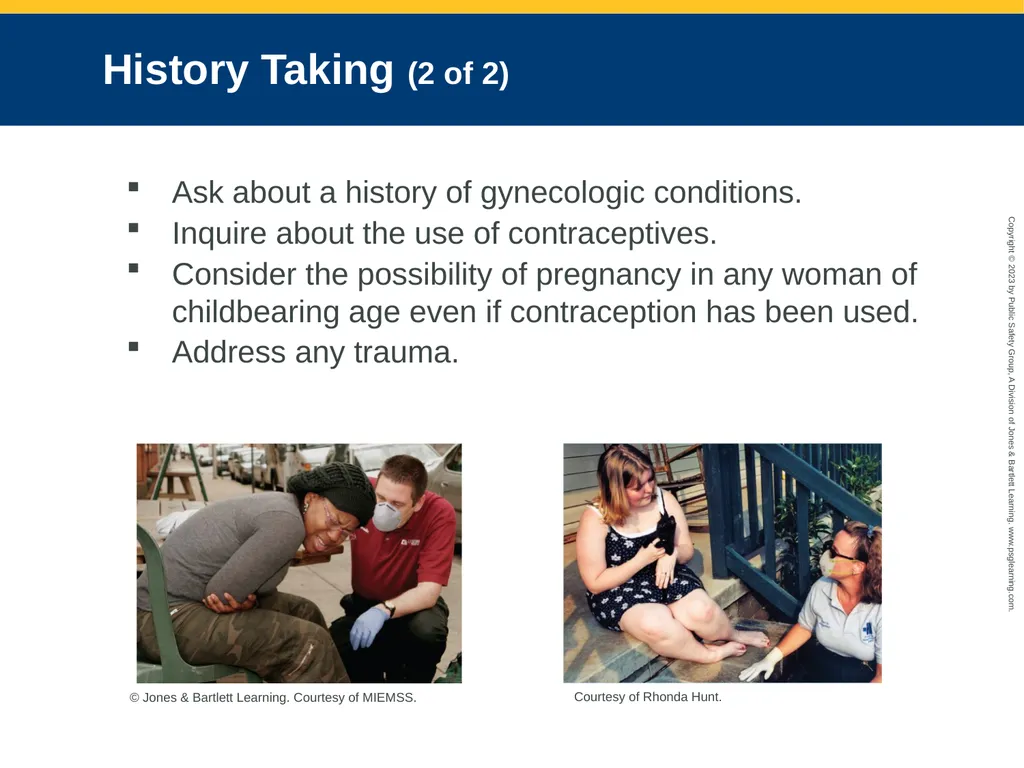
Address any trauma. © Jones & Bartlett Learning. Courtesy of MIEMSS. Courtesy of Rhonda Hunt.<br>
Inquire about the use of contraceptives.
Consider the possibility of pregnancy in any woman of childbearing age even if contraception has been used.
Address any trauma. © Jones & Bartlett Learning. Courtesy of MIEMSS. Courtesy of Rhonda Hunt.<br>
39
Secondary Assessment (1 of 2) May be performed on scene, en route to the emergency department, or not at all
Physical examinations
Approach the patient with a comforting attitude.
Maintain privacy.
Focus on the NOI and the patient’s chief complaint.<br>
Physical examinations
Approach the patient with a comforting attitude.
Maintain privacy.
Focus on the NOI and the patient’s chief complaint.<br>
40
Secondary Assessment (2 of 2) Vital signs
Assess the patient’s vital signs.
Tachycardia and respiratory changes may signal shock.
Note color and amount of bleeding or discharge.
Use monitoring devices if available.<br>
Assess the patient’s vital signs.
Tachycardia and respiratory changes may signal shock.
Note color and amount of bleeding or discharge.
Use monitoring devices if available.<br>
41
Reassessment (1 of 2) Interventions
Very few interventions can or should be done.
For vaginal bleeding:
Treat for hypoperfusion or shock.
Keep the patient warm
Place patient in a supine position.
Provide supplemental oxygen.
Transport promptly.<br>
Very few interventions can or should be done.
For vaginal bleeding:
Treat for hypoperfusion or shock.
Keep the patient warm
Place patient in a supine position.
Provide supplemental oxygen.
Transport promptly.<br>
42
Reassessment (2 of 2) En route to hospital, recheck your primary interventions.
Communicate all relevant information to the receiving hospital.
Carefully document everything, especially in cases of sexual assault.<br>
Communicate all relevant information to the receiving hospital.
Carefully document everything, especially in cases of sexual assault.<br>
43
Emergency Medical Care (1 of 2) Maintain the patient’s privacy and modesty as much as possible.
Gain the patient’s confidence by communicating appropriately and answering questions honestly.
Use sanitary pads on the external genitalia to absorb the blood.
Place the patient on the left side.<br>
Gain the patient’s confidence by communicating appropriately and answering questions honestly.
Use sanitary pads on the external genitalia to absorb the blood.
Place the patient on the left side.<br>
44
Emergency Medical Care (2 of 2) Treat any external lacerations, abrasions, and tears with sterile compresses.
Under no circumstances should you pack or place dressings inside the vagina.
Consider the possibility of pregnancy.
Be prepared for a possible miscarriage.<br>
Under no circumstances should you pack or place dressings inside the vagina.
Consider the possibility of pregnancy.
Be prepared for a possible miscarriage.<br>
45
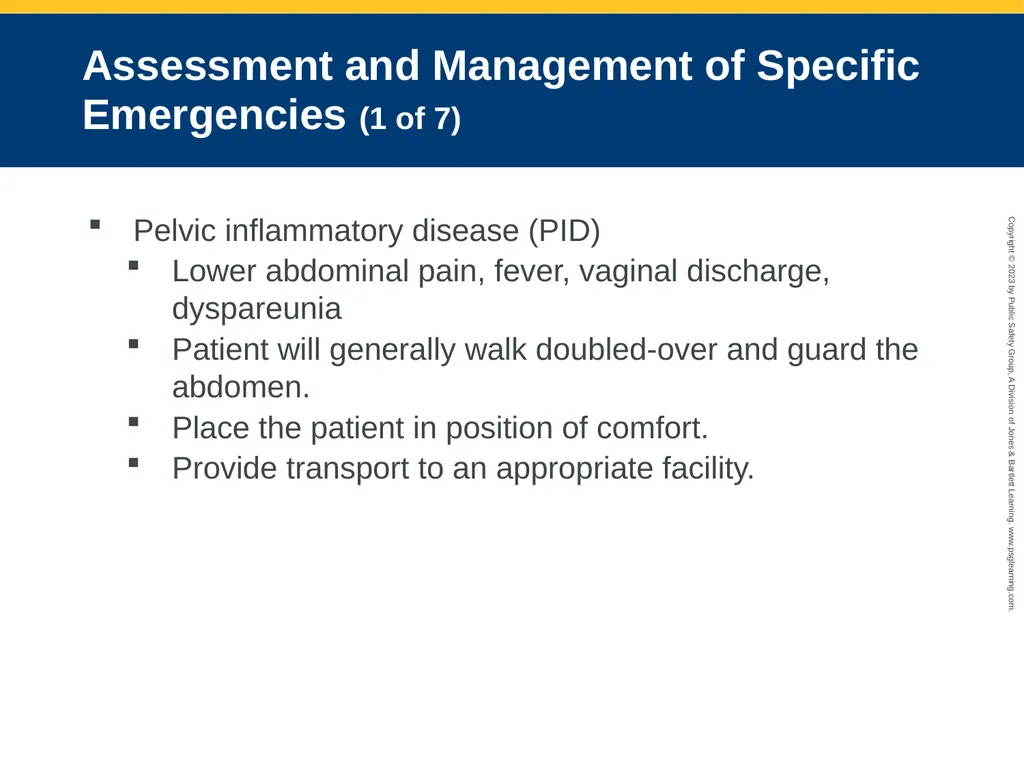
Assessment and Management of Specific Emergencies (1 of 7) Pelvic inflammatory disease (PID)
Lower abdominal pain, fever, vaginal discharge, dyspareunia
Patient will generally walk doubled-over and guard the abdomen.
Place the patient in position of comfort.
Provide transport to an appropriate facility.<br>
Lower abdominal pain, fever, vaginal discharge, dyspareunia
Patient will generally walk doubled-over and guard the abdomen.
Place the patient in position of comfort.
Provide transport to an appropriate facility.<br>
46
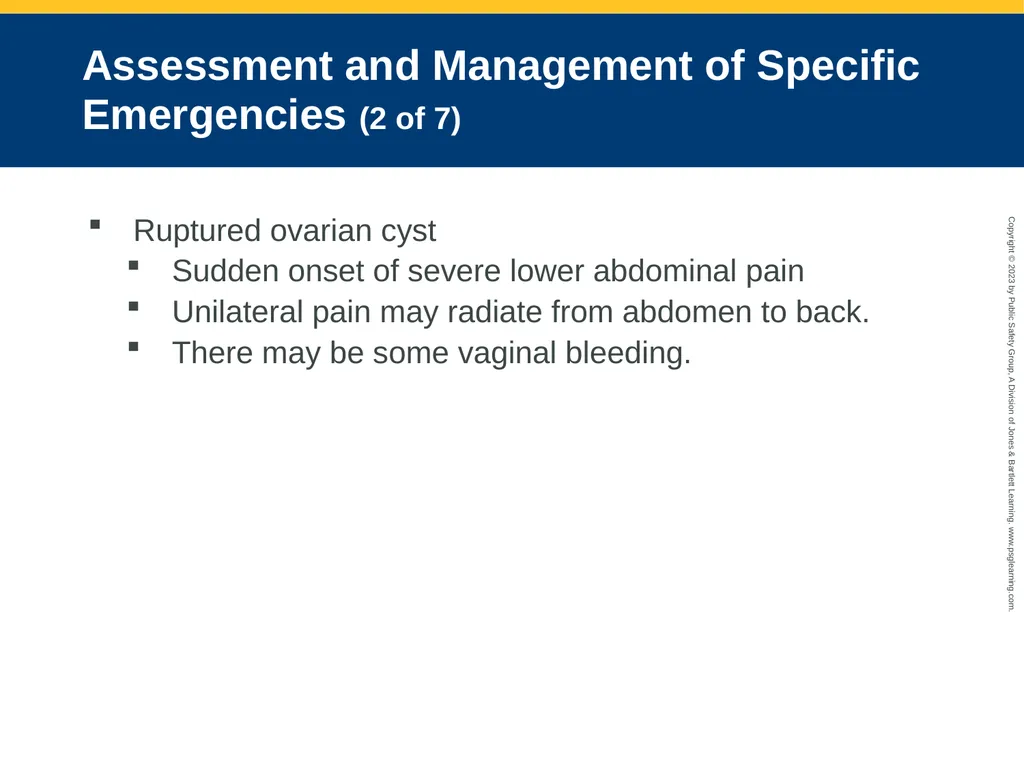
Assessment and Management of Specific Emergencies (2 of 7) Ruptured ovarian cyst
Sudden onset of severe lower abdominal pain
Unilateral pain may radiate from abdomen to back.
There may be some vaginal bleeding.<br>
Sudden onset of severe lower abdominal pain
Unilateral pain may radiate from abdomen to back.
There may be some vaginal bleeding.<br>
47
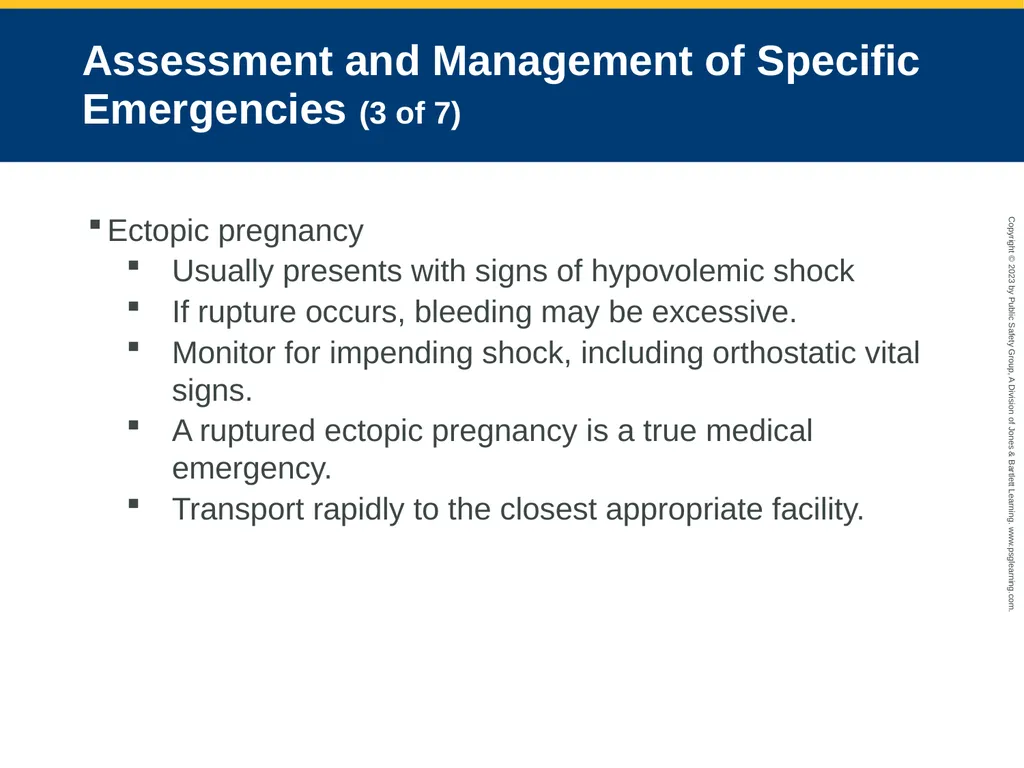
Assessment and Management of Specific Emergencies (3 of 7) Ectopic pregnancy
Usually presents with signs of hypovolemic shock
If rupture occurs, bleeding may be excessive.
Monitor for impending shock, including orthostatic vital signs.
A ruptured ectopic pregnancy is a true medical emergency.
Transport rapidly to the closest appropriate facility.<br>
Usually presents with signs of hypovolemic shock
If rupture occurs, bleeding may be excessive.
Monitor for impending shock, including orthostatic vital signs.
A ruptured ectopic pregnancy is a true medical emergency.
Transport rapidly to the closest appropriate facility.<br>
48
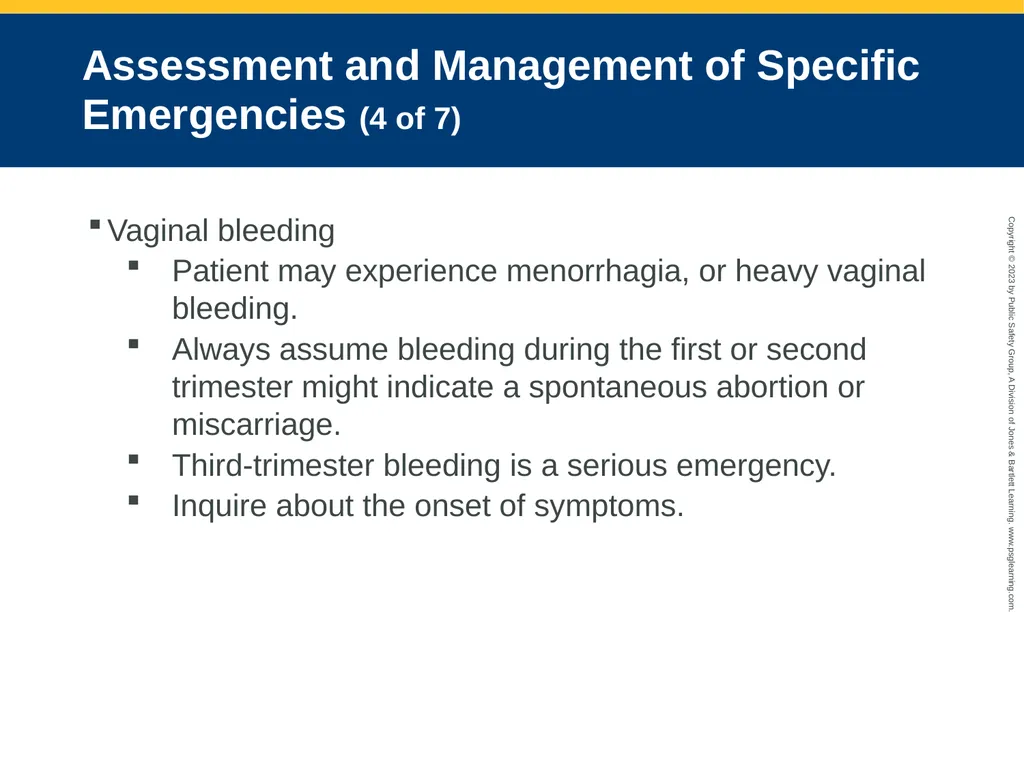
Assessment and Management of Specific Emergencies (4 of 7) Vaginal bleeding
Patient may experience menorrhagia, or heavy vaginal bleeding.
Always assume bleeding during the first or second trimester might indicate a spontaneous abortion or miscarriage.
Third-trimester bleeding is a serious emergency.
Inquire about the onset of symptoms.<br>
Patient may experience menorrhagia, or heavy vaginal bleeding.
Always assume bleeding during the first or second trimester might indicate a spontaneous abortion or miscarriage.
Third-trimester bleeding is a serious emergency.
Inquire about the onset of symptoms.<br>
49
Assessment and Management of Specific Emergencies (5 of 7) Sexual assault
Can take many forms, but most common is rape
Whenever possible, a female rape victim should be given the option of being treated by a female AEMT.
Professionalism, tact, kindness, and sensitivity are of paramount importance.
Limit any physical exam to a brief survey for life-threatening injuries.<br>
Can take many forms, but most common is rape
Whenever possible, a female rape victim should be given the option of being treated by a female AEMT.
Professionalism, tact, kindness, and sensitivity are of paramount importance.
Limit any physical exam to a brief survey for life-threatening injuries.<br>
50
Assessment and Management of Specific Emergencies (6 of 7) First issue is the medical treatment of the patient.
Second issue is your psychological care of the patient.
Have a responsibility to preserve evidence
Follow protocol if patients refuse transport.<br>
Second issue is your psychological care of the patient.
Have a responsibility to preserve evidence
Follow protocol if patients refuse transport.<br>
51
Assessment and Management of Specific Emergencies (7 of 7) Drugs used to facilitate rape
If drugs are still in patient’s system during your assessment, hypotension, bradycardia, difficulty breathing, seizures, coma, and death may occur.
Sexual practices and vaginal foreign bodies
“Fisting”
Organ rupture is possible.
Peritonitis may result.
Insertion of live animals<br>
If drugs are still in patient’s system during your assessment, hypotension, bradycardia, difficulty breathing, seizures, coma, and death may occur.
Sexual practices and vaginal foreign bodies
“Fisting”
Organ rupture is possible.
Peritonitis may result.
Insertion of live animals<br>