
Handwriting analysis Handwriting analysis
Description: Handwriting analysis Handwriting analysis Handwriting analysis Handwriting analysis Handwriting analysis Handwriting analysis Handwriting analysis Handwriting analysis Graphology One of the many character reading practices. Character
Related Topics
Download Presentation
"Handwriting analysis Handwriting analysis" is the property of its rightful owner. Permission is granted to download and print the materials on this website for personal, non-commercial use only, and to display it on your personal computer provided you do not modify the materials and that you retain all copyright notices contained in the materials. By downloading content from our website, you accept the terms of this agreement.
Presentation Transcript
slide1. Handwriting analysis Handwriting analysis Handwriting analysis Handwriting analysis Handwriting analysis Handwriting analysis Handwriting analysis Handwriting analysis<br>
slide3. Graphology One of the many “character reading” practices.
Character reading: techniques that supposedly acquire a window on our psychological make-up by interpreting physiological features.<br>
slide4. I bet you didn’t know these… interpreting the features of the face (physiognomy),
Creases on the hand (palmistry),
bumps on the head (phrenology),
features of the belly button (omphalomancy),
patterns of forehead wrinkles (metoposcopy),
patterns on tea leaves (tasseography),
directions of light rays reflected from fingernails (onychomancy),
the appearance of barley cakes (critomancy)<br>
slide5. International Graphoanalysis Society Membership of about 10,000
Based in Chicago
http://www.igas.com/<br>
slide6. What are graphologists used for? Identify actual and potential sexual molesters
Personnel matters by organisations (e.g., leadership qualities).
Credit trustworthiness of borrowers by banks<br>
slide7. History 17th century Italian physician, Camillo Baldi
Other prominent drivers: Abbé Jean-Hippolyte Michon, Crepieux-Jamin, etc.
Many schools of thought emerged. This is not surprising because many schools of graphology can’t even agree on which signs are indicators of which traits.
t
t<br>
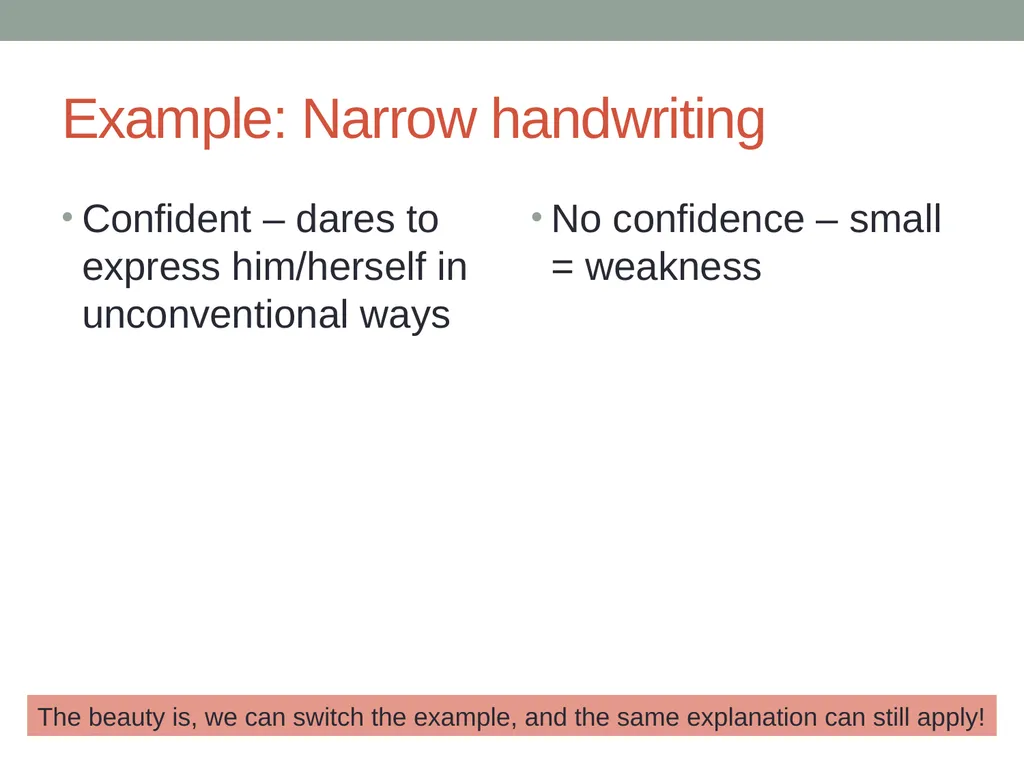
slide8. Example: Narrow handwriting Confident – dares to express him/herself in unconventional ways No confidence – small = weakness The beauty is, we can switch the example, and the same explanation can still apply!<br>
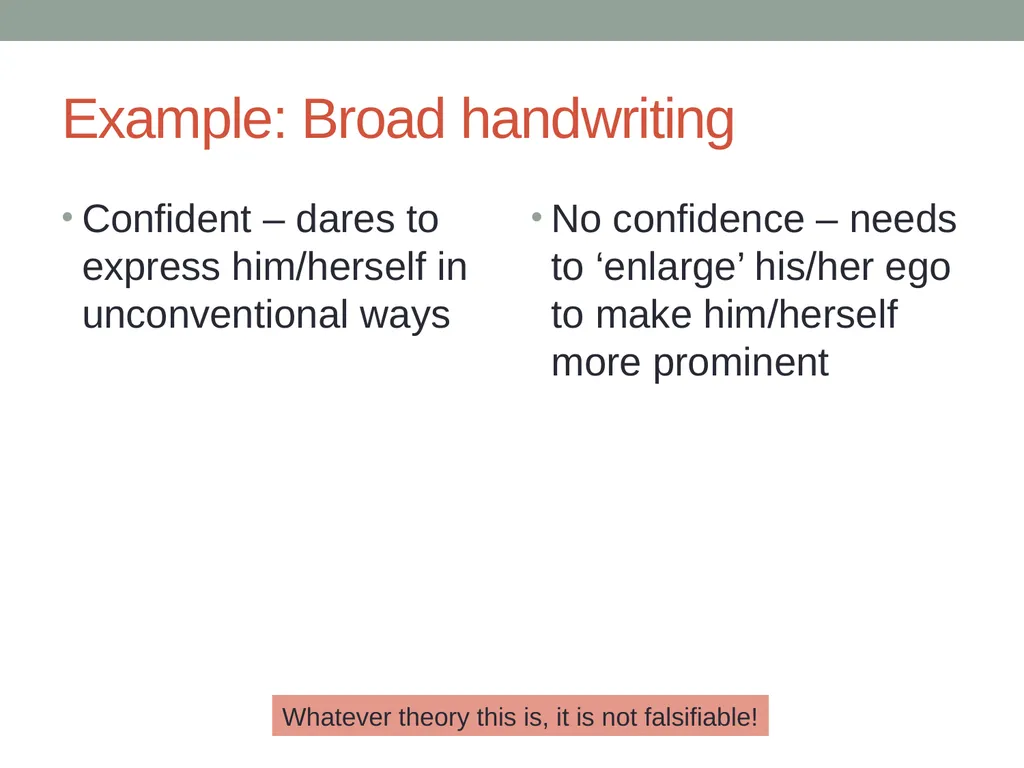
slide9. Example: Broad handwriting Confident – dares to express him/herself in unconventional ways No confidence – needs to ‘enlarge’ his/her ego to make him/herself more prominent Whatever theory this is, it is not falsifiable!<br>
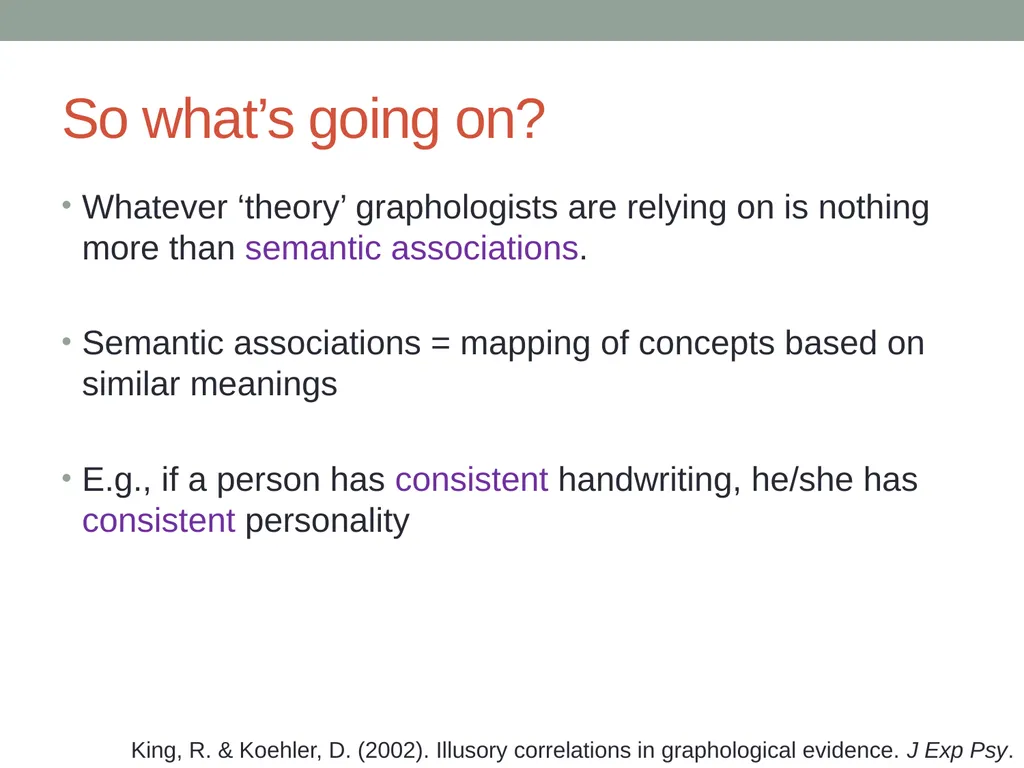
slide10. So what’s going on? Whatever ‘theory’ graphologists are relying on is nothing more than semantic associations.
Semantic associations = mapping of concepts based on similar meanings
E.g., if a person has consistent handwriting, he/she has consistent personality King, R. & Koehler, D. (2002). Illusory correlations in graphological evidence. J Exp Psy.<br>
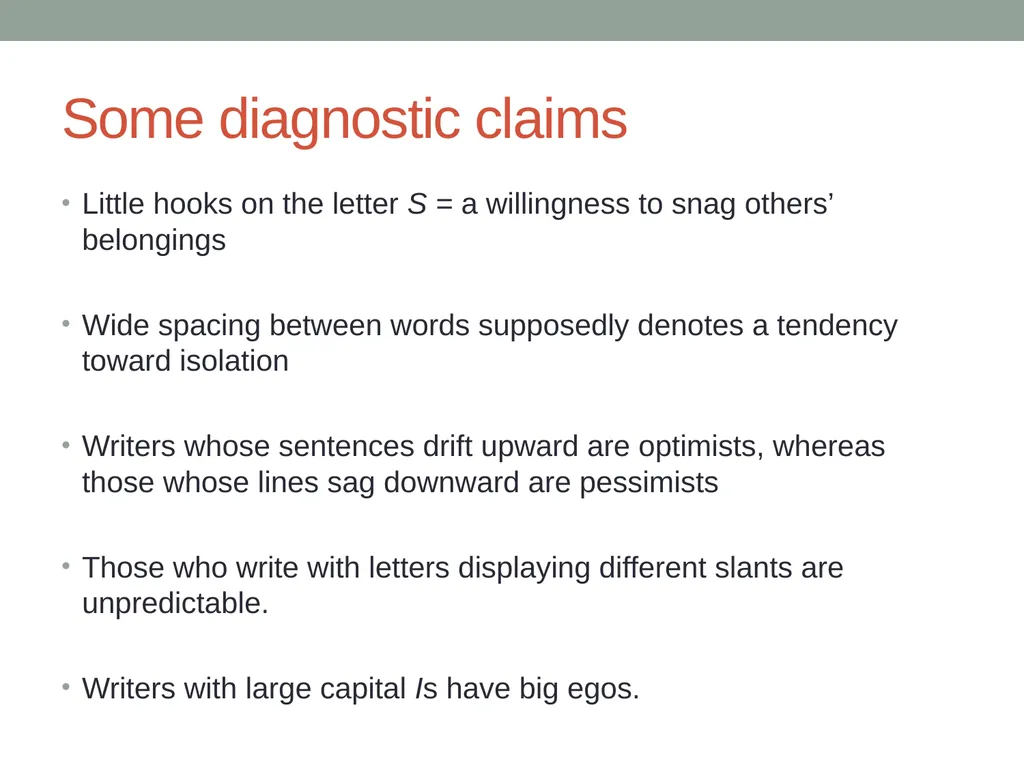
slide11. Some diagnostic claims Little hooks on the letter S = a willingness to snag others’ belongings
Wide spacing between words supposedly denotes a tendency toward isolation
Writers whose sentences drift upward are optimists, whereas those whose lines sag downward are pessimists
Those who write with letters displaying different slants are unpredictable.
Writers with large capital Is have big egos.<br>
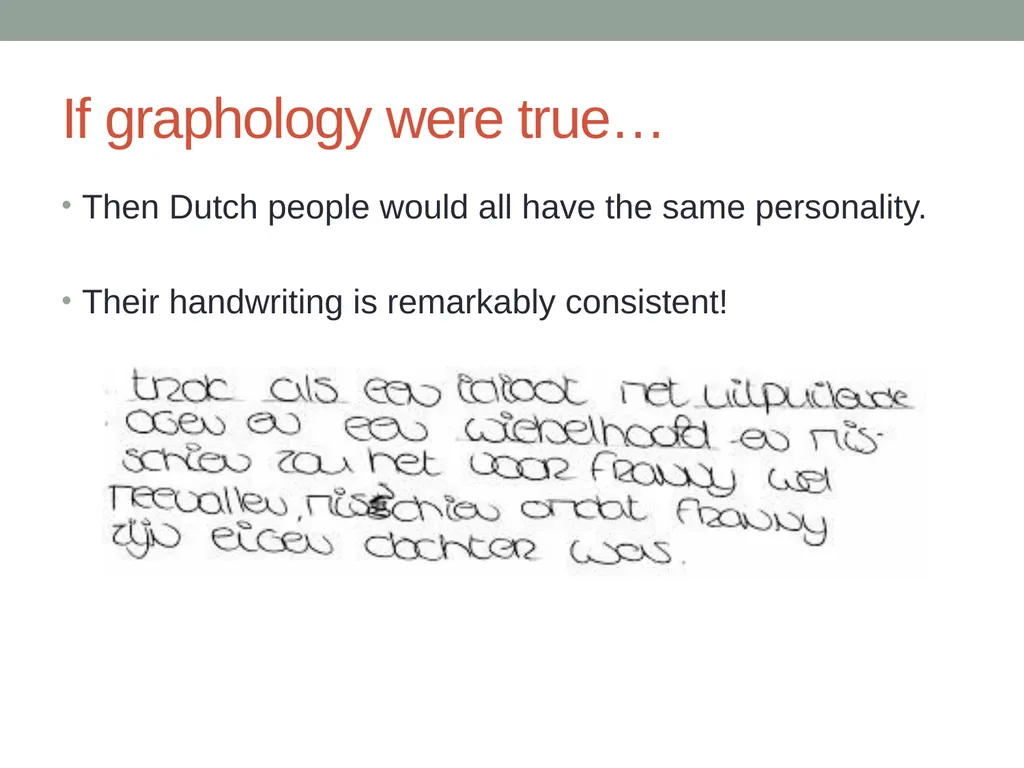
slide12. If graphology were true… Then Dutch people would all have the same personality.
Their handwriting is remarkably consistent!<br>
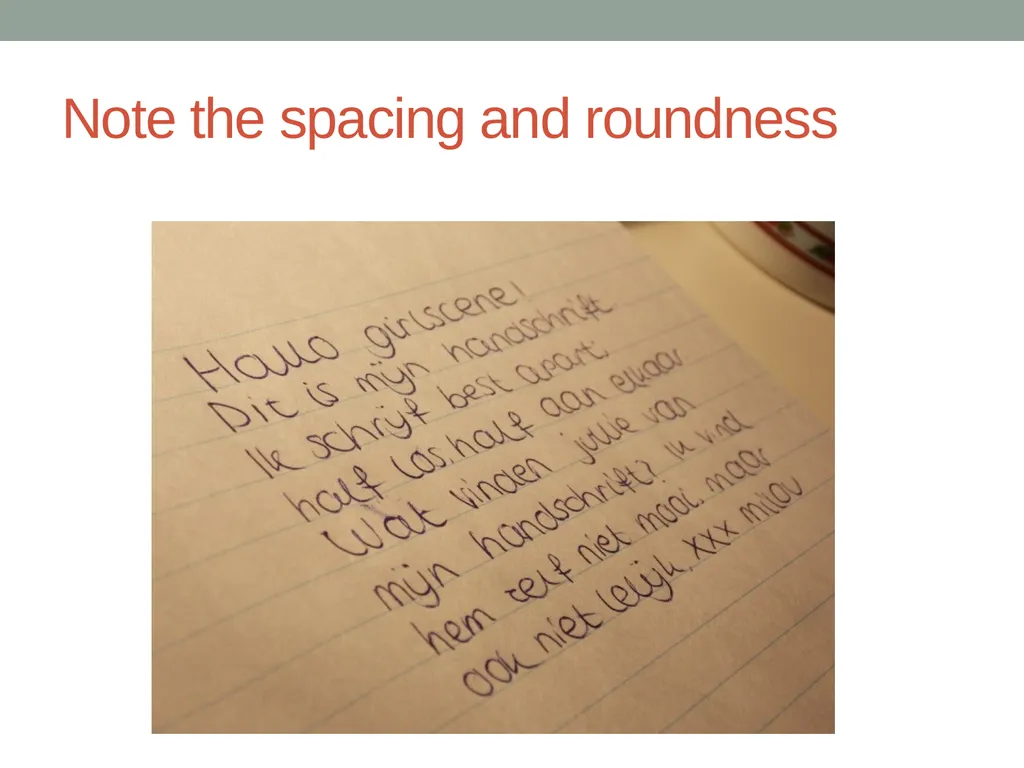
slide13. Note the spacing and roundness<br>
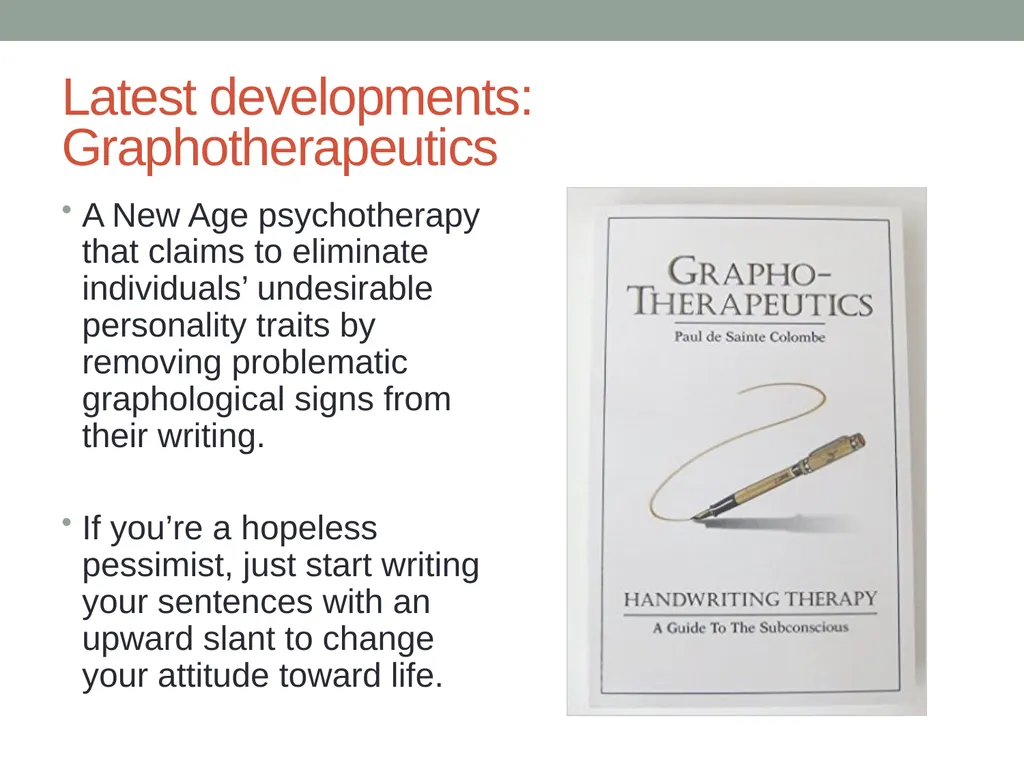
slide14. Latest developments: Graphotherapeutics A New Age psychotherapy that claims to eliminate individuals’ undesirable personality traits by removing problematic graphological signs from their writing.
If you’re a hopeless pessimist, just start writing your sentences with an upward slant to change your attitude toward life.<br>
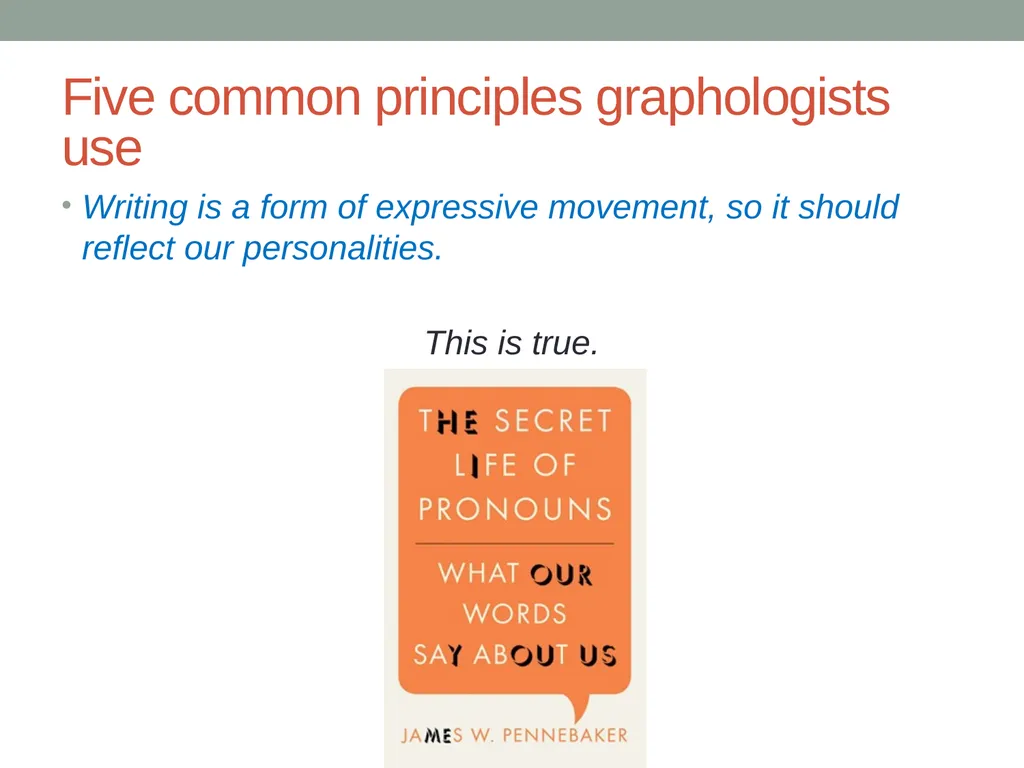
slide15. Five common principles graphologists use Writing is a form of expressive movement, so it should reflect our personalities.
This is true.<br>
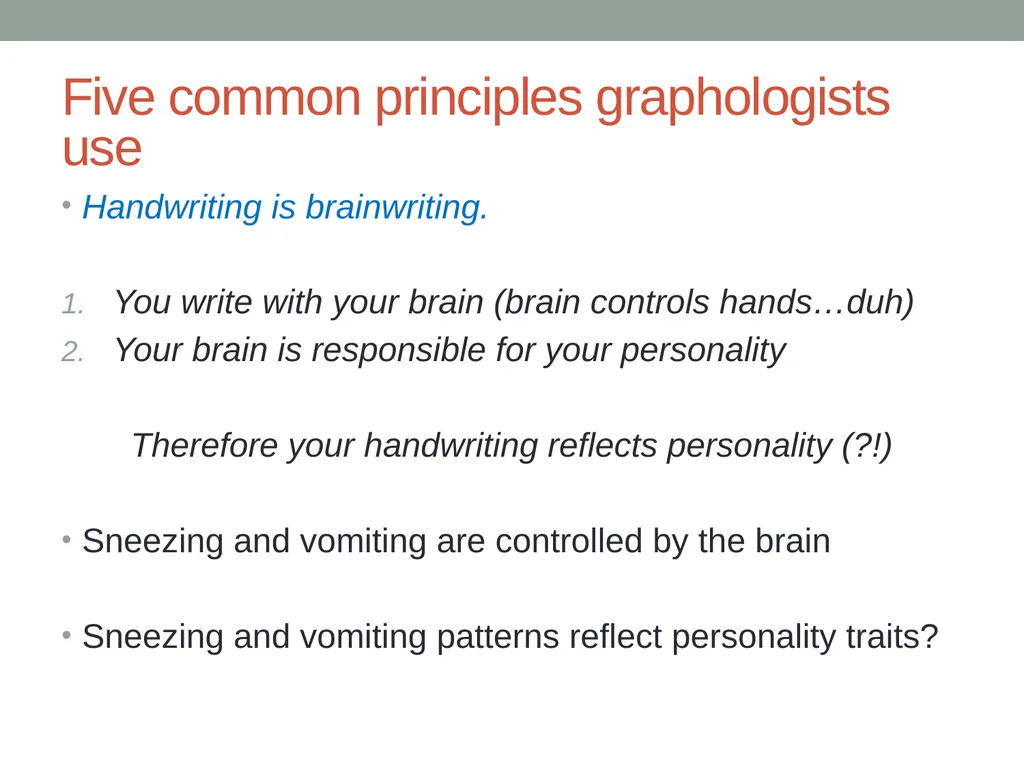
slide16. Five common principles graphologists use Handwriting is brainwriting.
You write with your brain (brain controls hands…duh)
Your brain is responsible for your personality
Therefore your handwriting reflects personality (?!)
Sneezing and vomiting are controlled by the brain
Sneezing and vomiting patterns reflect personality traits?<br>
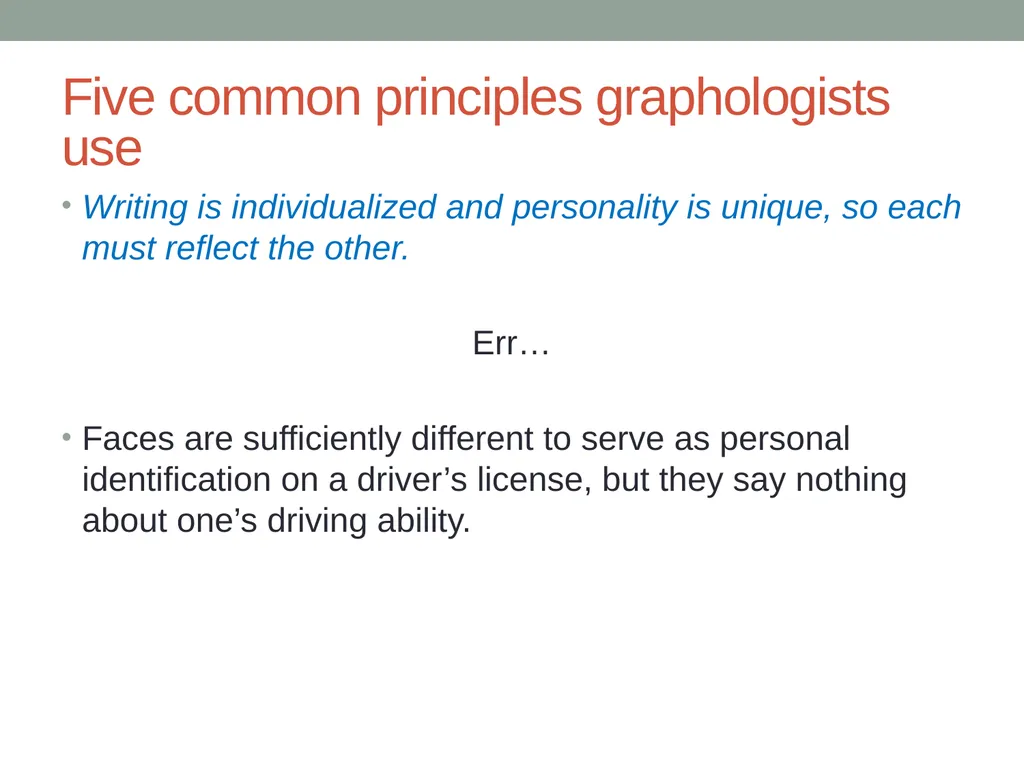
slide17. Five common principles graphologists use Writing is individualized and personality is unique, so each must reflect the other.
Err…
Faces are sufficiently different to serve as personal identification on a driver’s license, but they say nothing about one’s driving ability.<br>
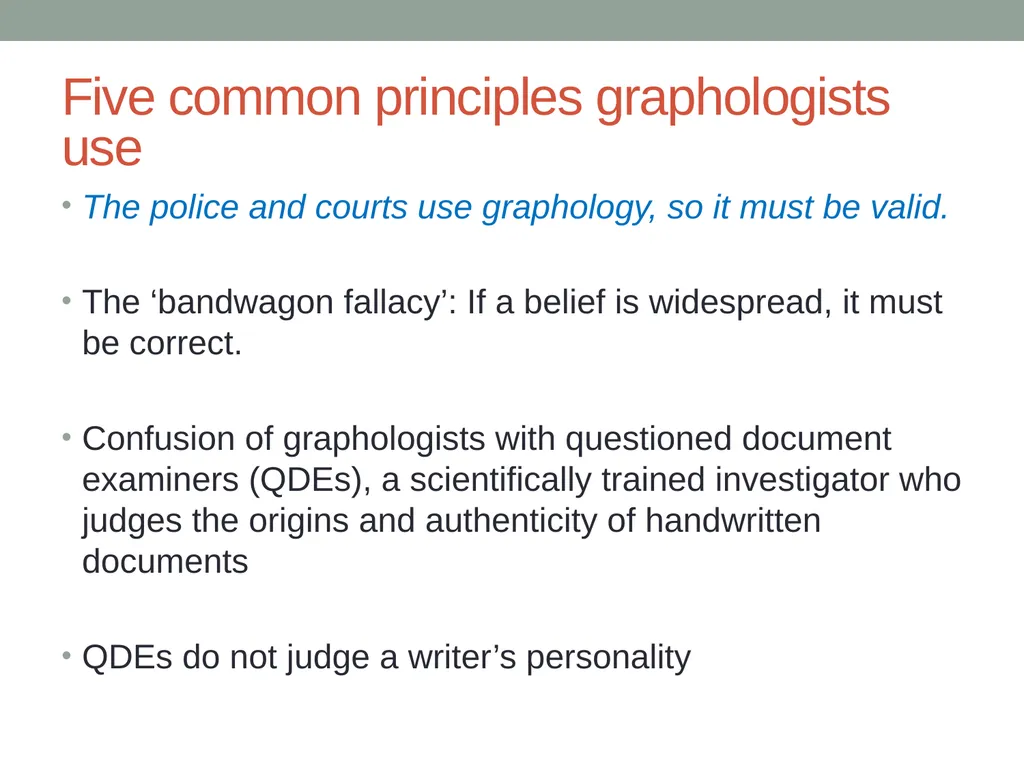
slide18. Five common principles graphologists use The police and courts use graphology, so it must be valid.
The ‘bandwagon fallacy’: If a belief is widespread, it must be correct.
Confusion of graphologists with questioned document examiners (QDEs), a scientifically trained investigator who judges the origins and authenticity of handwritten documents
QDEs do not judge a writer’s personality<br>
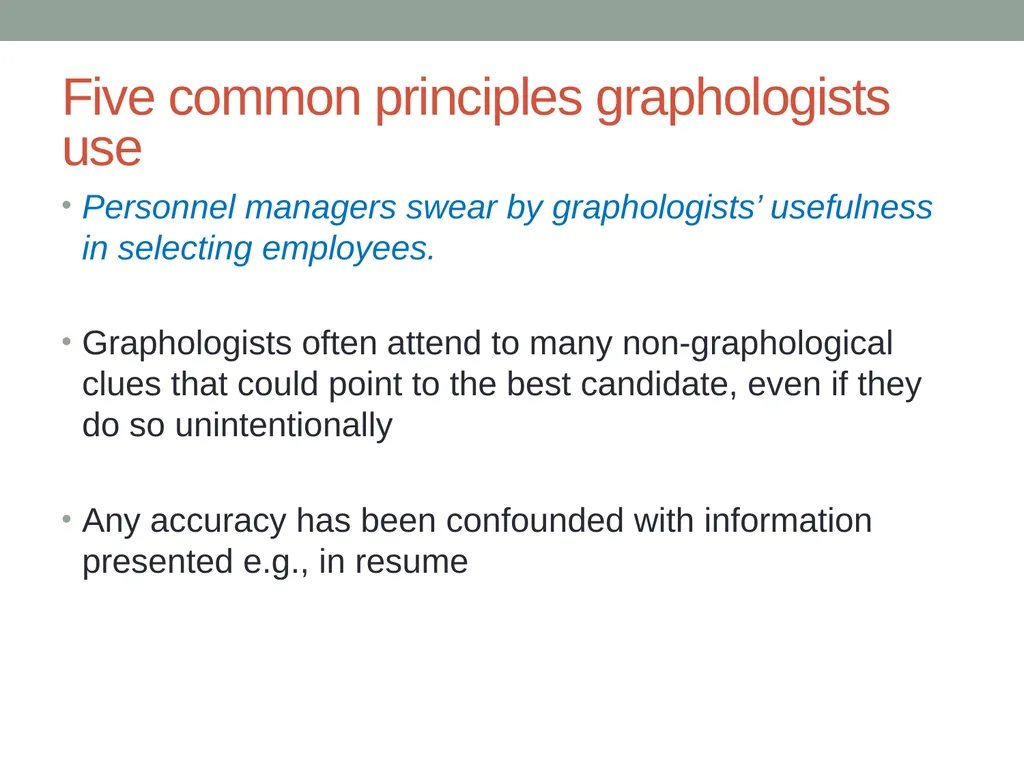
slide19. Five common principles graphologists use Personnel managers swear by graphologists’ usefulness in selecting employees.
Graphologists often attend to many non-graphological clues that could point to the best candidate, even if they do so unintentionally
Any accuracy has been confounded with information presented e.g., in resume<br>
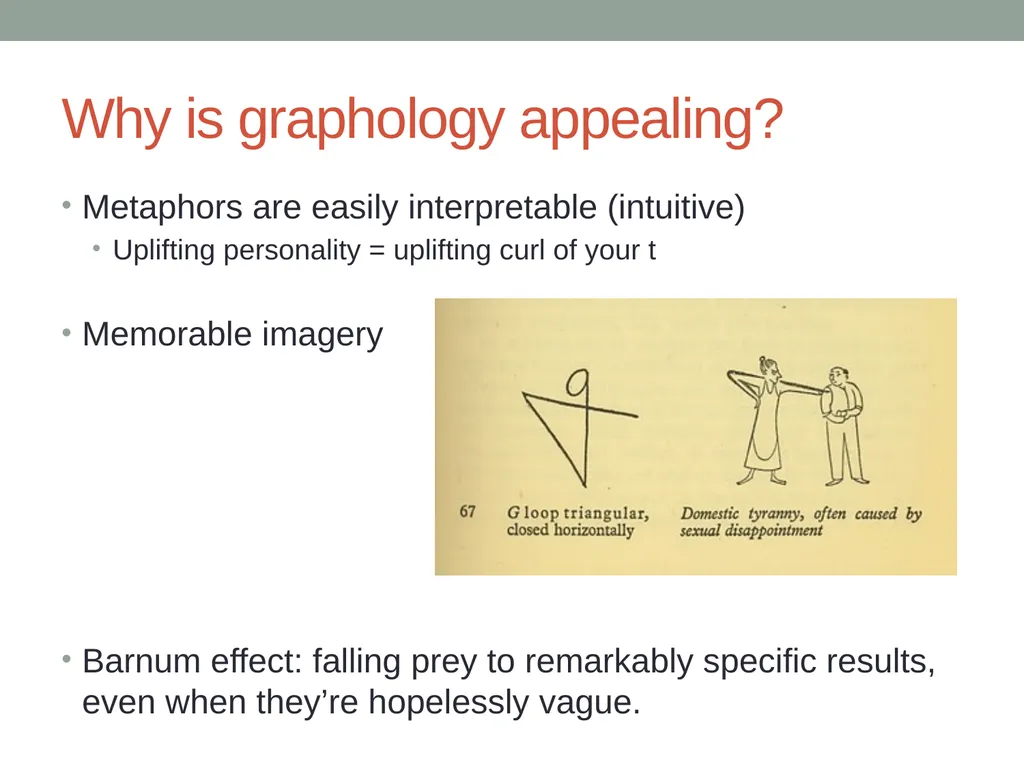
slide20. Why is graphology appealing? Metaphors are easily interpretable (intuitive)
Uplifting personality = uplifting curl of your t
Memorable imagery
Barnum effect: falling prey to remarkably specific results, even when they’re hopelessly vague.<br>
slide21. France: Graphologist in action http://www.bbc.com/news/magazine-22198554
Watch out for the last sentence in the video!<br>
slide3. Graphology One of the many “character reading” practices.
Character reading: techniques that supposedly acquire a window on our psychological make-up by interpreting physiological features.<br>
slide4. I bet you didn’t know these… interpreting the features of the face (physiognomy),
Creases on the hand (palmistry),
bumps on the head (phrenology),
features of the belly button (omphalomancy),
patterns of forehead wrinkles (metoposcopy),
patterns on tea leaves (tasseography),
directions of light rays reflected from fingernails (onychomancy),
the appearance of barley cakes (critomancy)<br>
slide5. International Graphoanalysis Society Membership of about 10,000
Based in Chicago
http://www.igas.com/<br>
slide6. What are graphologists used for? Identify actual and potential sexual molesters
Personnel matters by organisations (e.g., leadership qualities).
Credit trustworthiness of borrowers by banks<br>
slide7. History 17th century Italian physician, Camillo Baldi
Other prominent drivers: Abbé Jean-Hippolyte Michon, Crepieux-Jamin, etc.
Many schools of thought emerged. This is not surprising because many schools of graphology can’t even agree on which signs are indicators of which traits.
t
t<br>
slide8. Example: Narrow handwriting Confident – dares to express him/herself in unconventional ways No confidence – small = weakness The beauty is, we can switch the example, and the same explanation can still apply!<br>
slide9. Example: Broad handwriting Confident – dares to express him/herself in unconventional ways No confidence – needs to ‘enlarge’ his/her ego to make him/herself more prominent Whatever theory this is, it is not falsifiable!<br>
slide10. So what’s going on? Whatever ‘theory’ graphologists are relying on is nothing more than semantic associations.
Semantic associations = mapping of concepts based on similar meanings
E.g., if a person has consistent handwriting, he/she has consistent personality King, R. & Koehler, D. (2002). Illusory correlations in graphological evidence. J Exp Psy.<br>
slide11. Some diagnostic claims Little hooks on the letter S = a willingness to snag others’ belongings
Wide spacing between words supposedly denotes a tendency toward isolation
Writers whose sentences drift upward are optimists, whereas those whose lines sag downward are pessimists
Those who write with letters displaying different slants are unpredictable.
Writers with large capital Is have big egos.<br>
slide12. If graphology were true… Then Dutch people would all have the same personality.
Their handwriting is remarkably consistent!<br>
slide13. Note the spacing and roundness<br>
slide14. Latest developments: Graphotherapeutics A New Age psychotherapy that claims to eliminate individuals’ undesirable personality traits by removing problematic graphological signs from their writing.
If you’re a hopeless pessimist, just start writing your sentences with an upward slant to change your attitude toward life.<br>
slide15. Five common principles graphologists use Writing is a form of expressive movement, so it should reflect our personalities.
This is true.<br>
slide16. Five common principles graphologists use Handwriting is brainwriting.
You write with your brain (brain controls hands…duh)
Your brain is responsible for your personality
Therefore your handwriting reflects personality (?!)
Sneezing and vomiting are controlled by the brain
Sneezing and vomiting patterns reflect personality traits?<br>
slide17. Five common principles graphologists use Writing is individualized and personality is unique, so each must reflect the other.
Err…
Faces are sufficiently different to serve as personal identification on a driver’s license, but they say nothing about one’s driving ability.<br>
slide18. Five common principles graphologists use The police and courts use graphology, so it must be valid.
The ‘bandwagon fallacy’: If a belief is widespread, it must be correct.
Confusion of graphologists with questioned document examiners (QDEs), a scientifically trained investigator who judges the origins and authenticity of handwritten documents
QDEs do not judge a writer’s personality<br>
slide19. Five common principles graphologists use Personnel managers swear by graphologists’ usefulness in selecting employees.
Graphologists often attend to many non-graphological clues that could point to the best candidate, even if they do so unintentionally
Any accuracy has been confounded with information presented e.g., in resume<br>
slide20. Why is graphology appealing? Metaphors are easily interpretable (intuitive)
Uplifting personality = uplifting curl of your t
Memorable imagery
Barnum effect: falling prey to remarkably specific results, even when they’re hopelessly vague.<br>
slide21. France: Graphologist in action http://www.bbc.com/news/magazine-22198554
Watch out for the last sentence in the video!<br>