
Harmonized System – What’s New in 2022 Luis
LV
Published · 60 slides · 0 views

1 / 1








Description
Harmonized System Whats New in 2022 Luis Arandia, Jr., Barnes Thornburg, LLP Kim Campbell, MKMarin Trade Service Larry Friedman, BarnesRichardson Agenda Who sets forth the changes? Highlights of the 2022 updates Canadian Nuances
Related Topics
Share
Embed code
Download this presentation From Below
"Harmonized System – What’s New in 2022 Luis" is the property of its rightful owner. Permission is granted to download and print the materials on this website for personal, non-commercial use only, and to display it on your personal computer provided you do not modify the materials and that you retain all copyright notices contained in the materials. By downloading content from our website, you accept the terms of this agreement.
Presentation Transcript
01
Harmonized System – What’s New in 2022 Luis Arandia, Jr., Barnes & Thornburg, LLP
Kim Campbell, MKMarin Trade Service
Larry Friedman, Barnes/Richardson<br>
Kim Campbell, MKMarin Trade Service
Larry Friedman, Barnes/Richardson<br>
02
Agenda Who sets forth the changes?
Highlights of the 2022 updates
Canadian Nuances
Operational considerations to manage for the 2022 tariff
Resources
Q&A<br>
Highlights of the 2022 updates
Canadian Nuances
Operational considerations to manage for the 2022 tariff
Resources
Q&A<br>
03
Where it all began 1947: European Customs Union Study Group (ECUSG)
1953: Convention establishing the Customs Co-Operation Council (CCC)
1994: World Customs Organization (WCO)<br>
1953: Convention establishing the Customs Co-Operation Council (CCC)
1994: World Customs Organization (WCO)<br>
04
Why the changes? Enhance efficiency and effectiveness of its members’ customs administrations:
National development goals
Revenue collection
National security
Trade facilitation
Community protection
Collection of trade statistics<br>
National development goals
Revenue collection
National security
Trade facilitation
Community protection
Collection of trade statistics<br>
05
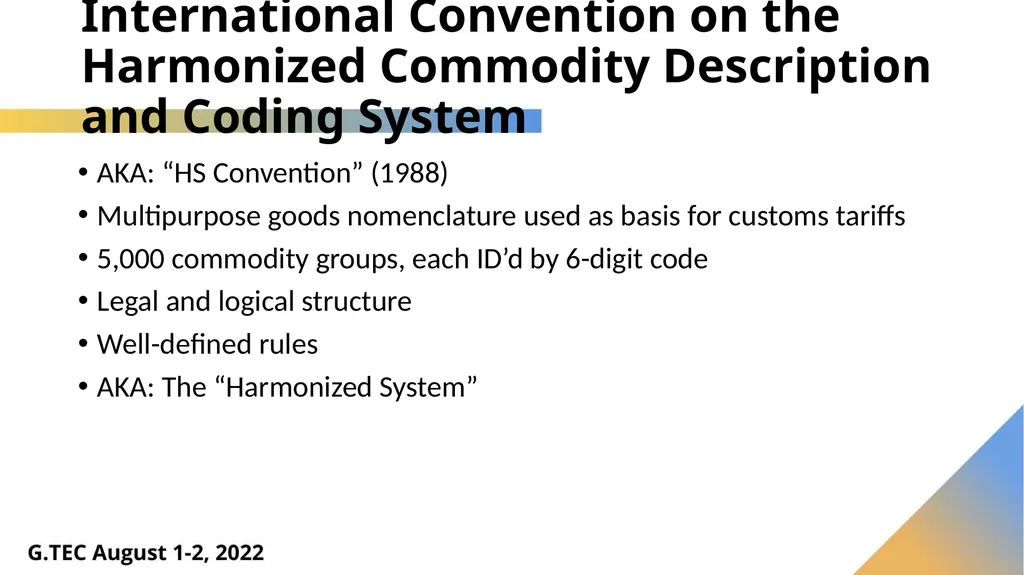
International Convention on the Harmonized Commodity Description and Coding System AKA: “HS Convention” (1988)
Multipurpose goods nomenclature used as basis for customs tariffs
5,000 commodity groups, each ID’d by 6-digit code
Legal and logical structure
Well-defined rules
AKA: The “Harmonized System”<br>
Multipurpose goods nomenclature used as basis for customs tariffs
5,000 commodity groups, each ID’d by 6-digit code
Legal and logical structure
Well-defined rules
AKA: The “Harmonized System”<br>
06
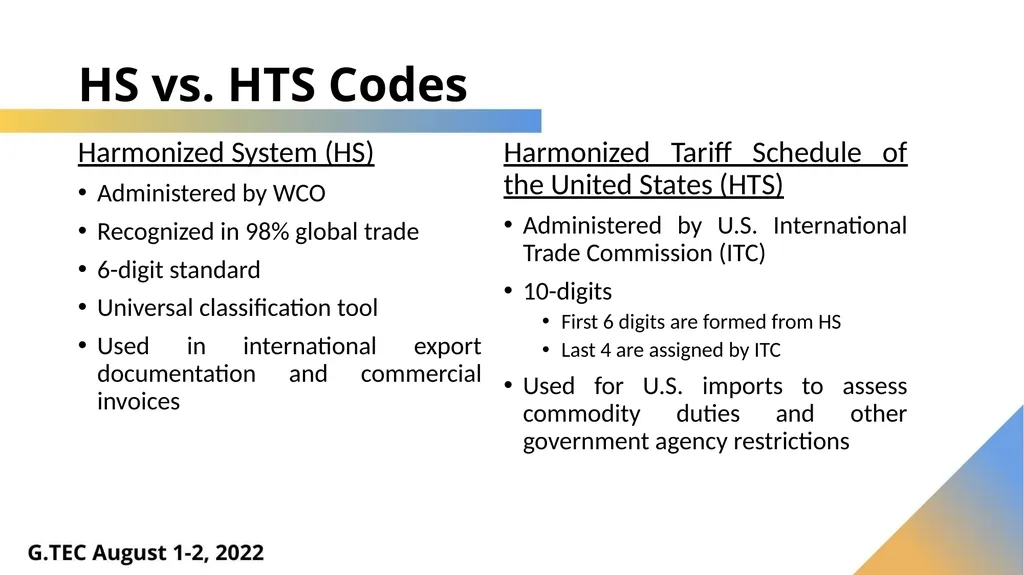
HS vs. HTS Codes Harmonized System (HS)
Administered by WCO
Recognized in 98% global trade
6-digit standard
Universal classification tool
Used in international export documentation and commercial invoices Harmonized Tariff Schedule of the United States (HTS)
Administered by U.S. International Trade Commission (ITC)
10-digits
First 6 digits are formed from HS
Last 4 are assigned by ITC
Used for U.S. imports to assess commodity duties and other government agency restrictions<br>
Administered by WCO
Recognized in 98% global trade
6-digit standard
Universal classification tool
Used in international export documentation and commercial invoices Harmonized Tariff Schedule of the United States (HTS)
Administered by U.S. International Trade Commission (ITC)
10-digits
First 6 digits are formed from HS
Last 4 are assigned by ITC
Used for U.S. imports to assess commodity duties and other government agency restrictions<br>
07
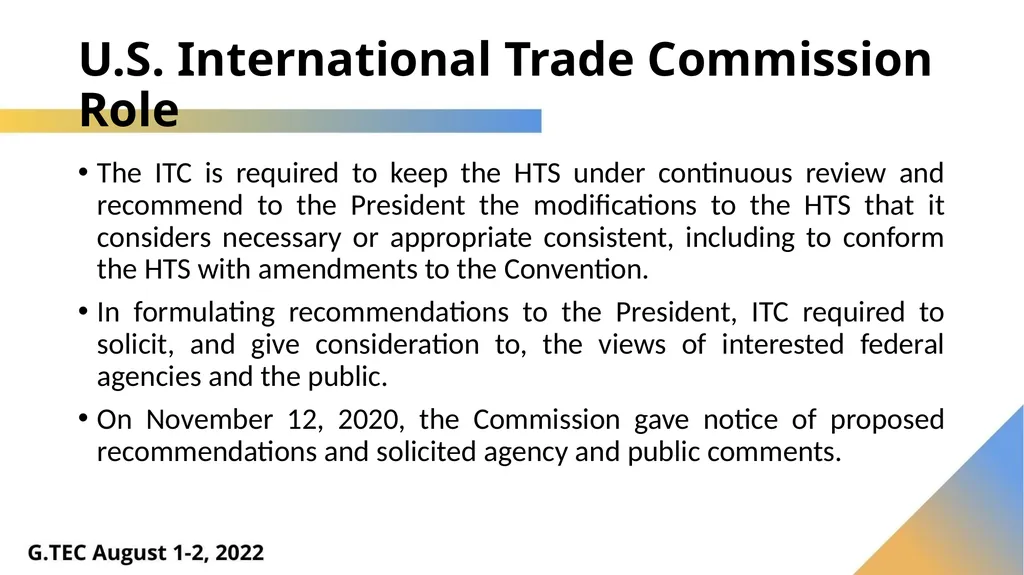
U.S. International Trade Commission Role The ITC is required to keep the HTS under continuous review and recommend to the President the modifications to the HTS that it considers necessary or appropriate consistent, including to conform the HTS with amendments to the Convention.
In formulating recommendations to the President, ITC required to solicit, and give consideration to, the views of interested federal agencies and the public.
On November 12, 2020, the Commission gave notice of proposed recommendations and solicited agency and public comments.<br>
In formulating recommendations to the President, ITC required to solicit, and give consideration to, the views of interested federal agencies and the public.
On November 12, 2020, the Commission gave notice of proposed recommendations and solicited agency and public comments.<br>
08
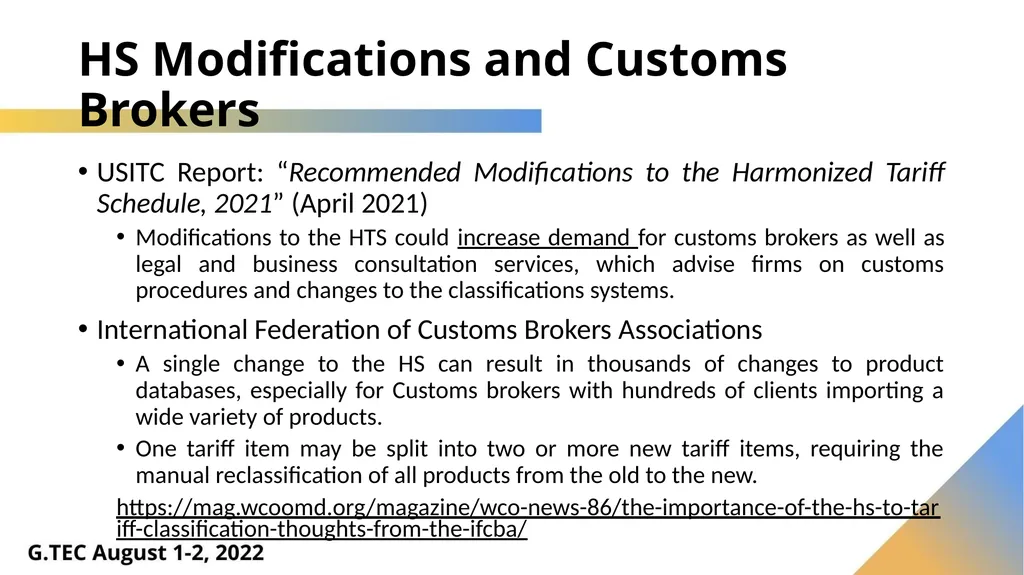
HS Modifications and Customs Brokers USITC Report: “Recommended Modifications to the Harmonized Tariff Schedule, 2021” (April 2021)
Modifications to the HTS could increase demand for customs brokers as well as legal and business consultation services, which advise firms on customs procedures and changes to the classifications systems.
International Federation of Customs Brokers Associations
A single change to the HS can result in thousands of changes to product databases, especially for Customs brokers with hundreds of clients importing a wide variety of products.
One tariff item may be split into two or more new tariff items, requiring the manual reclassification of all products from the old to the new.
https://mag.wcoomd.org/magazine/wco-news-86/the-importance-of-the-hs-to-tariff-classification-thoughts-from-the-ifcba/<br>
Modifications to the HTS could increase demand for customs brokers as well as legal and business consultation services, which advise firms on customs procedures and changes to the classifications systems.
International Federation of Customs Brokers Associations
A single change to the HS can result in thousands of changes to product databases, especially for Customs brokers with hundreds of clients importing a wide variety of products.
One tariff item may be split into two or more new tariff items, requiring the manual reclassification of all products from the old to the new.
https://mag.wcoomd.org/magazine/wco-news-86/the-importance-of-the-hs-to-tariff-classification-thoughts-from-the-ifcba/<br>
09
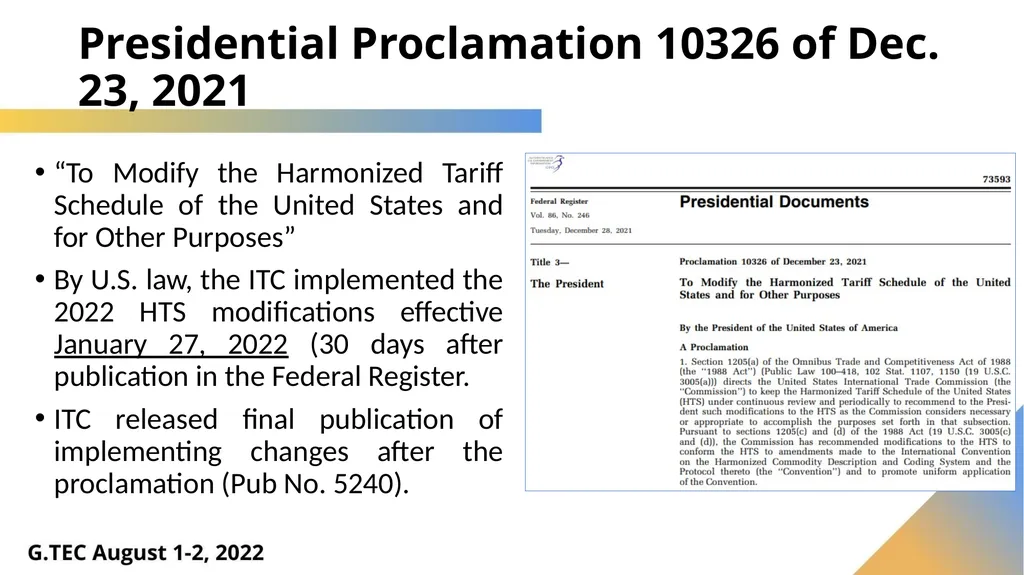
Presidential Proclamation 10326 of Dec. 23, 2021 “To Modify the Harmonized Tariff Schedule of the United States and for Other Purposes”
By U.S. law, the ITC implemented the 2022 HTS modifications effective January 27, 2022 (30 days after publication in the Federal Register.
ITC released final publication of implementing changes after the proclamation (Pub No. 5240).<br>
By U.S. law, the ITC implemented the 2022 HTS modifications effective January 27, 2022 (30 days after publication in the Federal Register.
ITC released final publication of implementing changes after the proclamation (Pub No. 5240).<br>
10
2022 HS Highlights Exploring some critical new changes within the 2022 HS amendments<br>
11
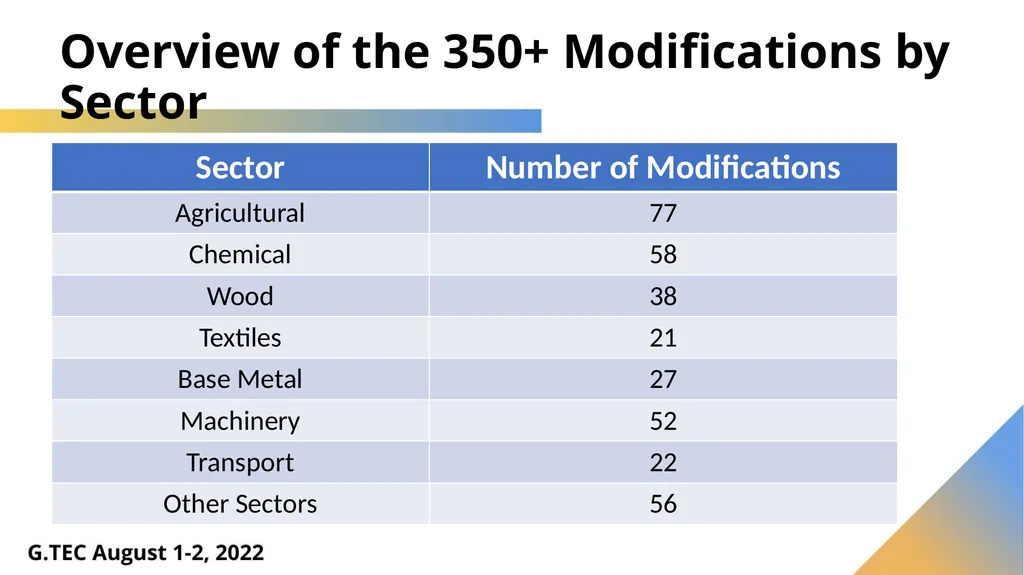
Overview of the 350+ Modifications by Sector<br>
12
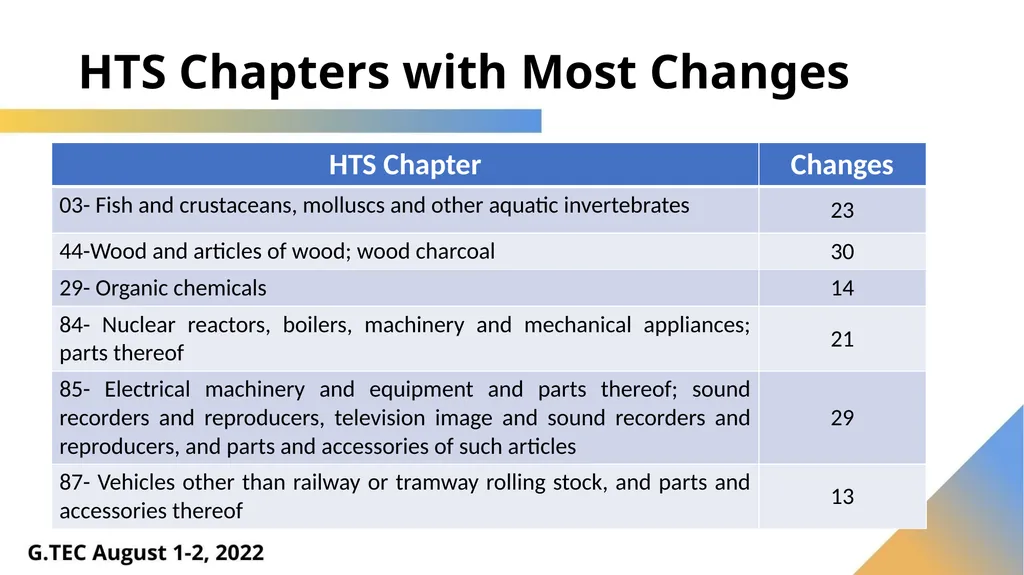
HTS Chapters with Most Changes<br>
13
Blanched Peanuts- HTS 1202.42 (new) 2018 WCO classification opinion to classify blanched peanuts in heading 1202, HS, as a product that had not been roasted or otherwise cooked.
WCO concluded that blanching peanuts to remove their skin did not constitute roasting or otherwise cooking.
Blanched peanuts are more properly classifiable as raw or natural peanuts in heading 1202 and not prepared or preserved peanuts in heading 2008.
Prior to WCO decision, CBP classified blanched peanuts in heading 2008.
Subheading 1202.42.10, 1202.42.15, 1202.42.20 are added.
Subheadings 2008.11.22, 2008.11.25, 2008.11.35 and superior subheading (“Blanched peanuts”) to subheading 2008.11.22 are deleted.<br>
WCO concluded that blanching peanuts to remove their skin did not constitute roasting or otherwise cooking.
Blanched peanuts are more properly classifiable as raw or natural peanuts in heading 1202 and not prepared or preserved peanuts in heading 2008.
Prior to WCO decision, CBP classified blanched peanuts in heading 2008.
Subheading 1202.42.10, 1202.42.15, 1202.42.20 are added.
Subheadings 2008.11.22, 2008.11.25, 2008.11.35 and superior subheading (“Blanched peanuts”) to subheading 2008.11.22 are deleted.<br>
14
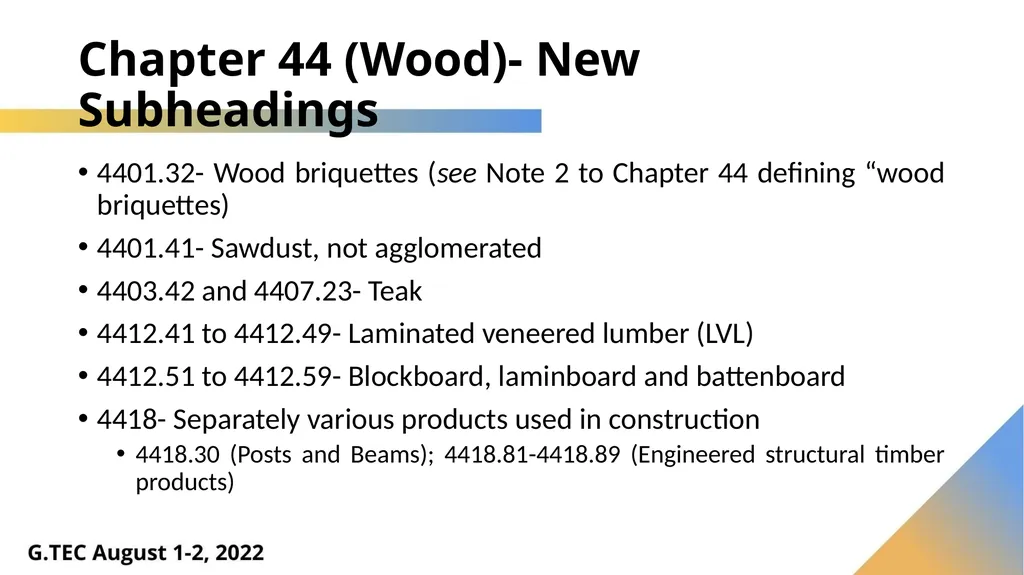
Chapter 44 (Wood)- New Subheadings 4401.32- Wood briquettes (see Note 2 to Chapter 44 defining “wood briquettes)
4401.41- Sawdust, not agglomerated
4403.42 and 4407.23- Teak
4412.41 to 4412.49- Laminated veneered lumber (LVL)
4412.51 to 4412.59- Blockboard, laminboard and battenboard
4418- Separately various products used in construction
4418.30 (Posts and Beams); 4418.81-4418.89 (Engineered structural timber products)<br>
4401.41- Sawdust, not agglomerated
4403.42 and 4407.23- Teak
4412.41 to 4412.49- Laminated veneered lumber (LVL)
4412.51 to 4412.59- Blockboard, laminboard and battenboard
4418- Separately various products used in construction
4418.30 (Posts and Beams); 4418.81-4418.89 (Engineered structural timber products)<br>
15
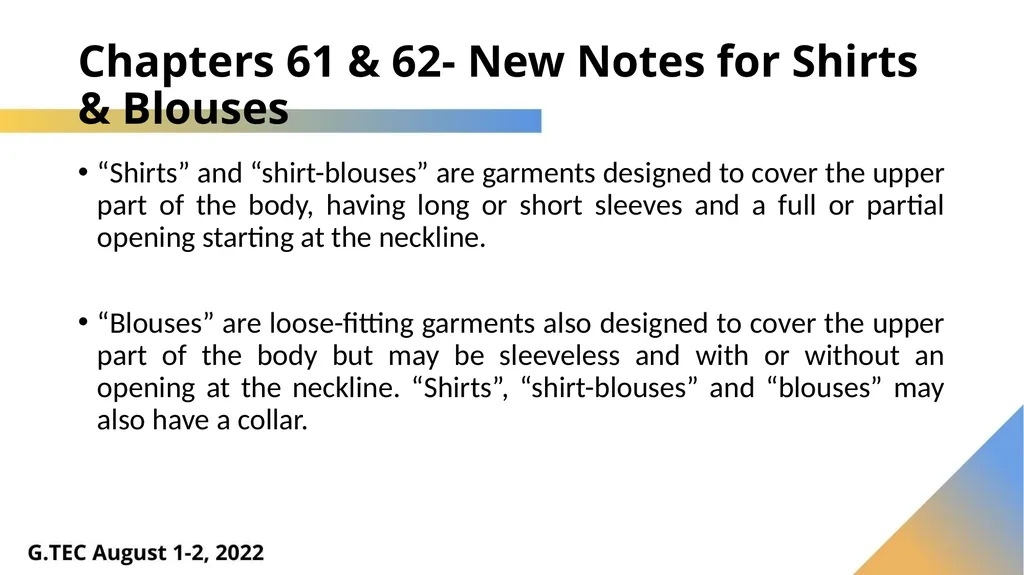
Chapters 61 & 62- New Notes for Shirts & Blouses “Shirts” and “shirt-blouses” are garments designed to cover the upper part of the body, having long or short sleeves and a full or partial opening starting at the neckline.
“Blouses” are loose-fitting garments also designed to cover the upper part of the body but may be sleeveless and with or without an opening at the neckline. “Shirts”, “shirt-blouses” and “blouses” may also have a collar.<br>
“Blouses” are loose-fitting garments also designed to cover the upper part of the body but may be sleeveless and with or without an opening at the neckline. “Shirts”, “shirt-blouses” and “blouses” may also have a collar.<br>
16
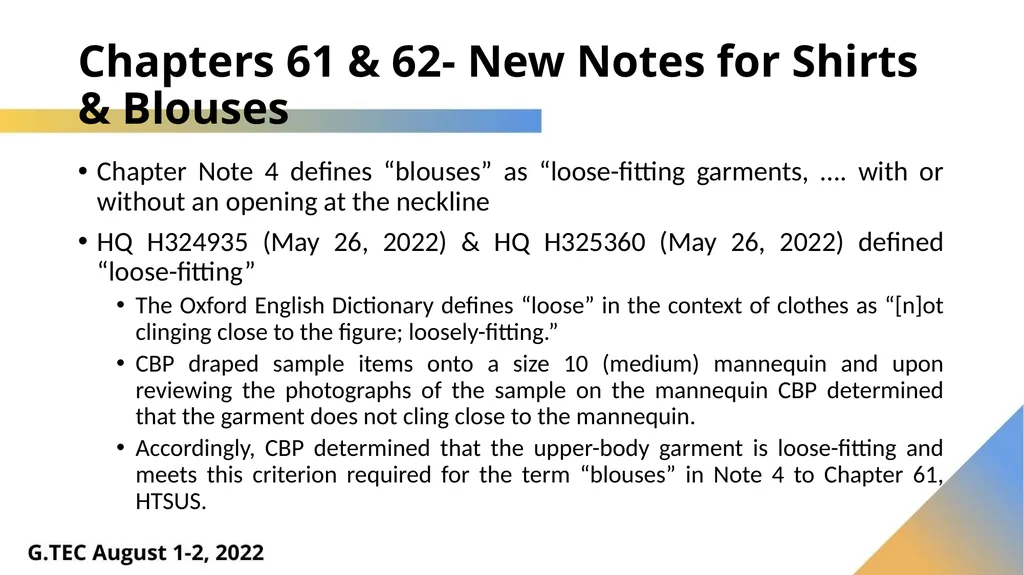
Chapter Note 4 defines “blouses” as “loose-fitting garments, …. with or without an opening at the neckline
HQ H324935 (May 26, 2022) & HQ H325360 (May 26, 2022) defined “loose-fitting”
The Oxford English Dictionary defines “loose” in the context of clothes as “[n]ot clinging close to the figure; loosely-fitting.”
CBP draped sample items onto a size 10 (medium) mannequin and upon reviewing the photographs of the sample on the mannequin CBP determined that the garment does not cling close to the mannequin.
Accordingly, CBP determined that the upper-body garment is loose-fitting and meets this criterion required for the term “blouses” in Note 4 to Chapter 61, HTSUS. Chapters 61 & 62- New Notes for Shirts & Blouses<br>
HQ H324935 (May 26, 2022) & HQ H325360 (May 26, 2022) defined “loose-fitting”
The Oxford English Dictionary defines “loose” in the context of clothes as “[n]ot clinging close to the figure; loosely-fitting.”
CBP draped sample items onto a size 10 (medium) mannequin and upon reviewing the photographs of the sample on the mannequin CBP determined that the garment does not cling close to the mannequin.
Accordingly, CBP determined that the upper-body garment is loose-fitting and meets this criterion required for the term “blouses” in Note 4 to Chapter 61, HTSUS. Chapters 61 & 62- New Notes for Shirts & Blouses<br>
17
Tobacco- HTS 2404 (new) Chapter 24 title revised
Previous: “Tobacco and Manufactured Tobacco Substitutes”
New: “Tobacco and Manufactured Tobacco Substitutes; Products, Whether Or Not Containing Nicotine, Intended for Inhalation Without Combustion; Other Nicotine Containing Products Intended for the Intake of Nicotine Into the Human Body.”
New Chapter Legal Notes 2 and 3
New Heading 2404:
“Products containing tobacco, reconstituted tobacco, nicotine, or tobacco or nicotine substitutes, intended for inhalation without combustion; other nicotine containing products intended for the intake of nicotine into the human body.”<br>
Previous: “Tobacco and Manufactured Tobacco Substitutes”
New: “Tobacco and Manufactured Tobacco Substitutes; Products, Whether Or Not Containing Nicotine, Intended for Inhalation Without Combustion; Other Nicotine Containing Products Intended for the Intake of Nicotine Into the Human Body.”
New Chapter Legal Notes 2 and 3
New Heading 2404:
“Products containing tobacco, reconstituted tobacco, nicotine, or tobacco or nicotine substitutes, intended for inhalation without combustion; other nicotine containing products intended for the intake of nicotine into the human body.”<br>
18
Tobacco- HTS 2404 (new) Products intended for inhalation without combustion (subheadings 2404.11.00 to 2404.19.90)
Containing tobacco or reconstituted tobacco (2404.11)
Other products intended for inhalation without combustion, containing nicotine: Mixtures for personal electric or electronic vaporizing devices (2404.12.02 to 2404.12.10)
Other products intended for inhalation without combustion, not containing nicotine: Mixtures for personal electric or electronic vaporizing devices (2404.19.05 to 2404.19.10)
Other nicotine containing products intended for the intake of nicotine into the human body (subheadings 2404.91 to 2404.99)
For oral application (2404.91.0000)
For transdermal application (2404.92.0000)<br>
Containing tobacco or reconstituted tobacco (2404.11)
Other products intended for inhalation without combustion, containing nicotine: Mixtures for personal electric or electronic vaporizing devices (2404.12.02 to 2404.12.10)
Other products intended for inhalation without combustion, not containing nicotine: Mixtures for personal electric or electronic vaporizing devices (2404.19.05 to 2404.19.10)
Other nicotine containing products intended for the intake of nicotine into the human body (subheadings 2404.91 to 2404.99)
For oral application (2404.91.0000)
For transdermal application (2404.92.0000)<br>
19
E-Cigarettes and Vaping Devices-
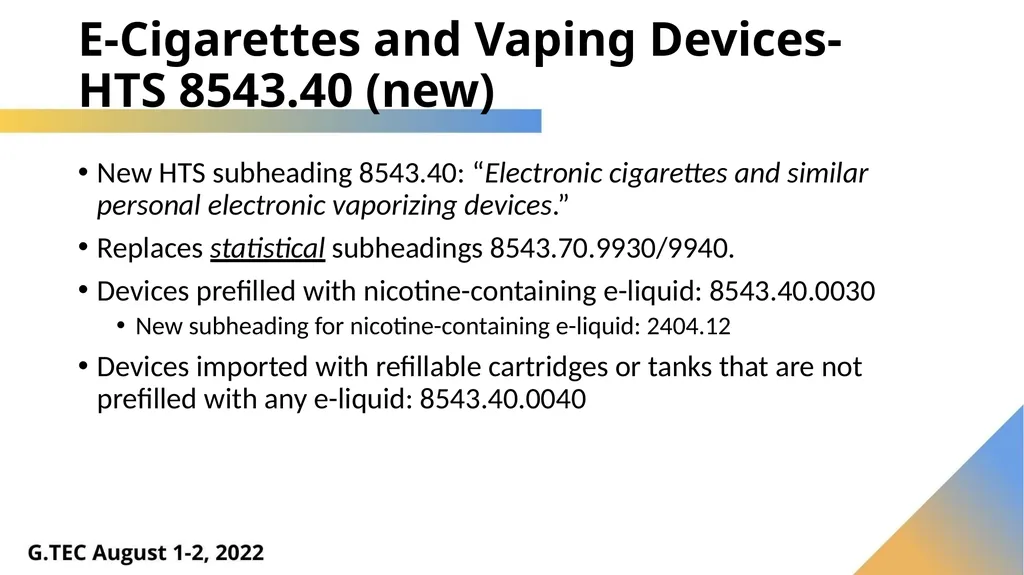
HTS 8543.40 (new) New HTS subheading 8543.40: “Electronic cigarettes and similar personal electronic vaporizing devices.”
Replaces statistical subheadings 8543.70.9930/9940.
Devices prefilled with nicotine-containing e-liquid: 8543.40.0030
New subheading for nicotine-containing e-liquid: 2404.12
Devices imported with refillable cartridges or tanks that are not prefilled with any e-liquid: 8543.40.0040<br>
Replaces statistical subheadings 8543.70.9930/9940.
Devices prefilled with nicotine-containing e-liquid: 8543.40.0030
New subheading for nicotine-containing e-liquid: 2404.12
Devices imported with refillable cartridges or tanks that are not prefilled with any e-liquid: 8543.40.0040<br>
20
E-Cigarettes and Vaping Devices-
HTS 8543.40 (new) Explanatory Notes- Heading 8543 (11)
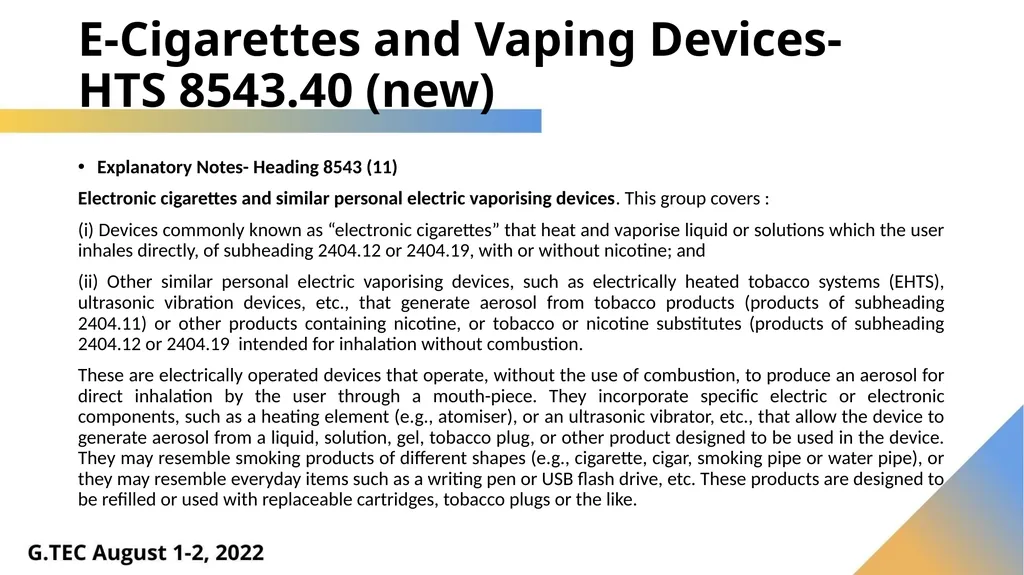
Electronic cigarettes and similar personal electric vaporising devices. This group covers :
(i) Devices commonly known as “electronic cigarettes” that heat and vaporise liquid or solutions which the user inhales directly, of subheading 2404.12 or 2404.19, with or without nicotine; and
(ii) Other similar personal electric vaporising devices, such as electrically heated tobacco systems (EHTS), ultrasonic vibration devices, etc., that generate aerosol from tobacco products (products of subheading 2404.11) or other products containing nicotine, or tobacco or nicotine substitutes (products of subheading 2404.12 or 2404.19 intended for inhalation without combustion.
These are electrically operated devices that operate, without the use of combustion, to produce an aerosol for direct inhalation by the user through a mouth-piece. They incorporate specific electric or electronic components, such as a heating element (e.g., atomiser), or an ultrasonic vibrator, etc., that allow the device to generate aerosol from a liquid, solution, gel, tobacco plug, or other product designed to be used in the device. They may resemble smoking products of different shapes (e.g., cigarette, cigar, smoking pipe or water pipe), or they may resemble everyday items such as a writing pen or USB flash drive, etc. These products are designed to be refilled or used with replaceable cartridges, tobacco plugs or the like.<br>
Electronic cigarettes and similar personal electric vaporising devices. This group covers :
(i) Devices commonly known as “electronic cigarettes” that heat and vaporise liquid or solutions which the user inhales directly, of subheading 2404.12 or 2404.19, with or without nicotine; and
(ii) Other similar personal electric vaporising devices, such as electrically heated tobacco systems (EHTS), ultrasonic vibration devices, etc., that generate aerosol from tobacco products (products of subheading 2404.11) or other products containing nicotine, or tobacco or nicotine substitutes (products of subheading 2404.12 or 2404.19 intended for inhalation without combustion.
These are electrically operated devices that operate, without the use of combustion, to produce an aerosol for direct inhalation by the user through a mouth-piece. They incorporate specific electric or electronic components, such as a heating element (e.g., atomiser), or an ultrasonic vibrator, etc., that allow the device to generate aerosol from a liquid, solution, gel, tobacco plug, or other product designed to be used in the device. They may resemble smoking products of different shapes (e.g., cigarette, cigar, smoking pipe or water pipe), or they may resemble everyday items such as a writing pen or USB flash drive, etc. These products are designed to be refilled or used with replaceable cartridges, tobacco plugs or the like.<br>
21
3D Printers- HTS 8485 (new) New heading 8485: “Machines for additive manufacturing.”
New Legal Note 10 to Chapter 84:
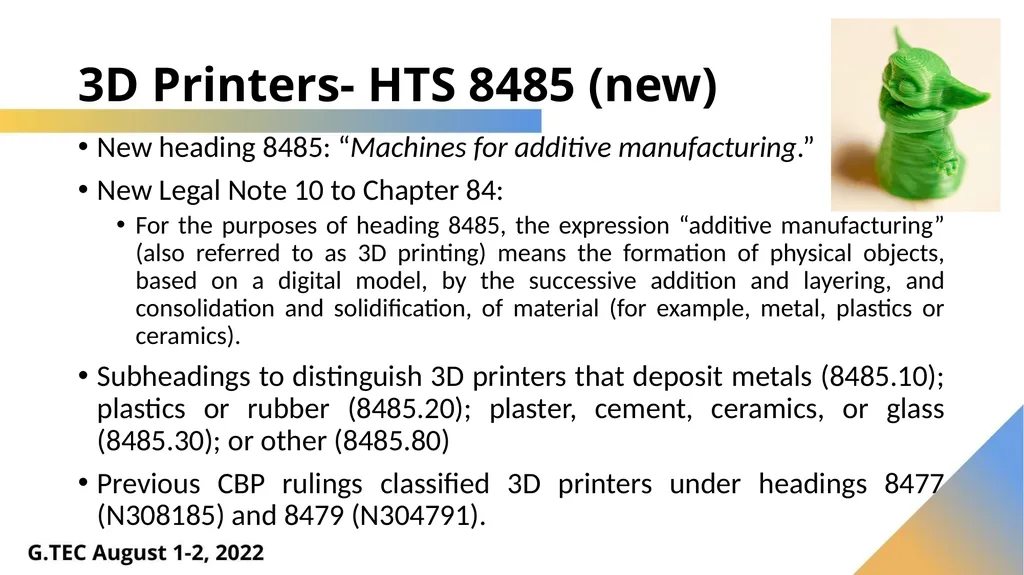
For the purposes of heading 8485, the expression “additive manufacturing” (also referred to as 3D printing) means the formation of physical objects, based on a digital model, by the successive addition and layering, and consolidation and solidification, of material (for example, metal, plastics or ceramics).
Subheadings to distinguish 3D printers that deposit metals (8485.10); plastics or rubber (8485.20); plaster, cement, ceramics, or glass (8485.30); or other (8485.80)
Previous CBP rulings classified 3D printers under headings 8477 (N308185) and 8479 (N304791).<br>
New Legal Note 10 to Chapter 84:
For the purposes of heading 8485, the expression “additive manufacturing” (also referred to as 3D printing) means the formation of physical objects, based on a digital model, by the successive addition and layering, and consolidation and solidification, of material (for example, metal, plastics or ceramics).
Subheadings to distinguish 3D printers that deposit metals (8485.10); plastics or rubber (8485.20); plaster, cement, ceramics, or glass (8485.30); or other (8485.80)
Previous CBP rulings classified 3D printers under headings 8477 (N308185) and 8479 (N304791).<br>
22
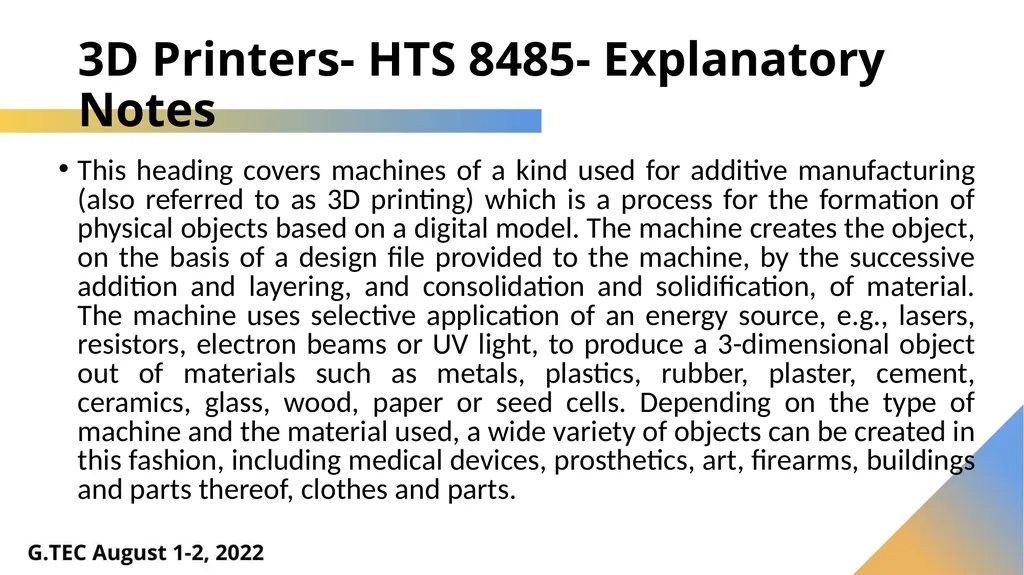
3D Printers- HTS 8485- Explanatory Notes This heading covers machines of a kind used for additive manufacturing (also referred to as 3D printing) which is a process for the formation of physical objects based on a digital model. The machine creates the object, on the basis of a design file provided to the machine, by the successive addition and layering, and consolidation and solidification, of material. The machine uses selective application of an energy source, e.g., lasers, resistors, electron beams or UV light, to produce a 3-dimensional object out of materials such as metals, plastics, rubber, plaster, cement, ceramics, glass, wood, paper or seed cells. Depending on the type of machine and the material used, a wide variety of objects can be created in this fashion, including medical devices, prosthetics, art, firearms, buildings and parts thereof, clothes and parts.<br>
23
Light Emitting Diode (LED) Light Sources-
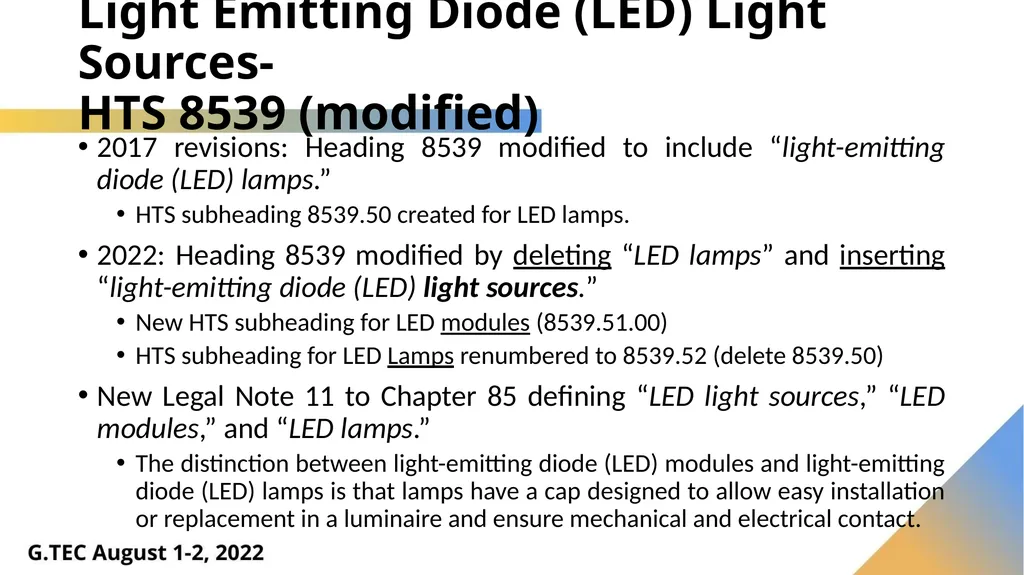
HTS 8539 (modified) 2017 revisions: Heading 8539 modified to include “light-emitting diode (LED) lamps.”
HTS subheading 8539.50 created for LED lamps.
2022: Heading 8539 modified by deleting “LED lamps” and inserting “light-emitting diode (LED) light sources.”
New HTS subheading for LED modules (8539.51.00)
HTS subheading for LED Lamps renumbered to 8539.52 (delete 8539.50)
New Legal Note 11 to Chapter 85 defining “LED light sources,” “LED modules,” and “LED lamps.”
The distinction between light-emitting diode (LED) modules and light-emitting diode (LED) lamps is that lamps have a cap designed to allow easy installation or replacement in a luminaire and ensure mechanical and electrical contact.<br>
HTS subheading 8539.50 created for LED lamps.
2022: Heading 8539 modified by deleting “LED lamps” and inserting “light-emitting diode (LED) light sources.”
New HTS subheading for LED modules (8539.51.00)
HTS subheading for LED Lamps renumbered to 8539.52 (delete 8539.50)
New Legal Note 11 to Chapter 85 defining “LED light sources,” “LED modules,” and “LED lamps.”
The distinction between light-emitting diode (LED) modules and light-emitting diode (LED) lamps is that lamps have a cap designed to allow easy installation or replacement in a luminaire and ensure mechanical and electrical contact.<br>
24
Light Emitting Diode (LED) Light Sources-
HTS 8539 (modified) Explanatory Notes- Heading 8539
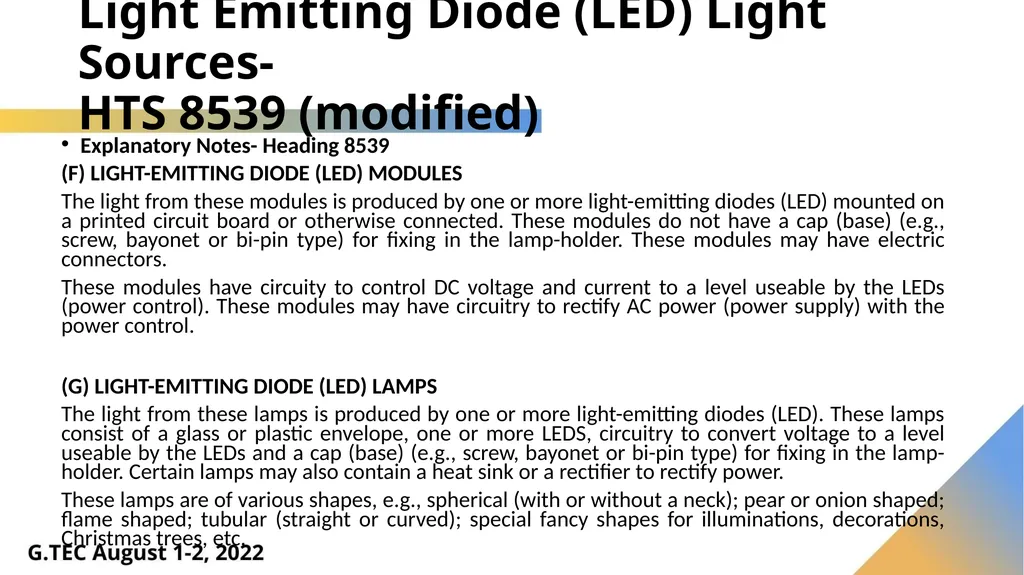
(F) LIGHT-EMITTING DIODE (LED) MODULES
The light from these modules is produced by one or more light-emitting diodes (LED) mounted on a printed circuit board or otherwise connected. These modules do not have a cap (base) (e.g., screw, bayonet or bi-pin type) for fixing in the lamp-holder. These modules may have electric connectors.
These modules have circuity to control DC voltage and current to a level useable by the LEDs (power control). These modules may have circuitry to rectify AC power (power supply) with the power control.
(G) LIGHT-EMITTING DIODE (LED) LAMPS
The light from these lamps is produced by one or more light-emitting diodes (LED). These lamps consist of a glass or plastic envelope, one or more LEDS, circuitry to convert voltage to a level useable by the LEDs and a cap (base) (e.g., screw, bayonet or bi-pin type) for fixing in the lamp-holder. Certain lamps may also contain a heat sink or a rectifier to rectify power.
These lamps are of various shapes, e.g., spherical (with or without a neck); pear or onion shaped; flame shaped; tubular (straight or curved); special fancy shapes for illuminations, decorations, Christmas trees, etc.<br>
(F) LIGHT-EMITTING DIODE (LED) MODULES
The light from these modules is produced by one or more light-emitting diodes (LED) mounted on a printed circuit board or otherwise connected. These modules do not have a cap (base) (e.g., screw, bayonet or bi-pin type) for fixing in the lamp-holder. These modules may have electric connectors.
These modules have circuity to control DC voltage and current to a level useable by the LEDs (power control). These modules may have circuitry to rectify AC power (power supply) with the power control.
(G) LIGHT-EMITTING DIODE (LED) LAMPS
The light from these lamps is produced by one or more light-emitting diodes (LED). These lamps consist of a glass or plastic envelope, one or more LEDS, circuitry to convert voltage to a level useable by the LEDs and a cap (base) (e.g., screw, bayonet or bi-pin type) for fixing in the lamp-holder. Certain lamps may also contain a heat sink or a rectifier to rectify power.
These lamps are of various shapes, e.g., spherical (with or without a neck); pear or onion shaped; flame shaped; tubular (straight or curved); special fancy shapes for illuminations, decorations, Christmas trees, etc.<br>
25
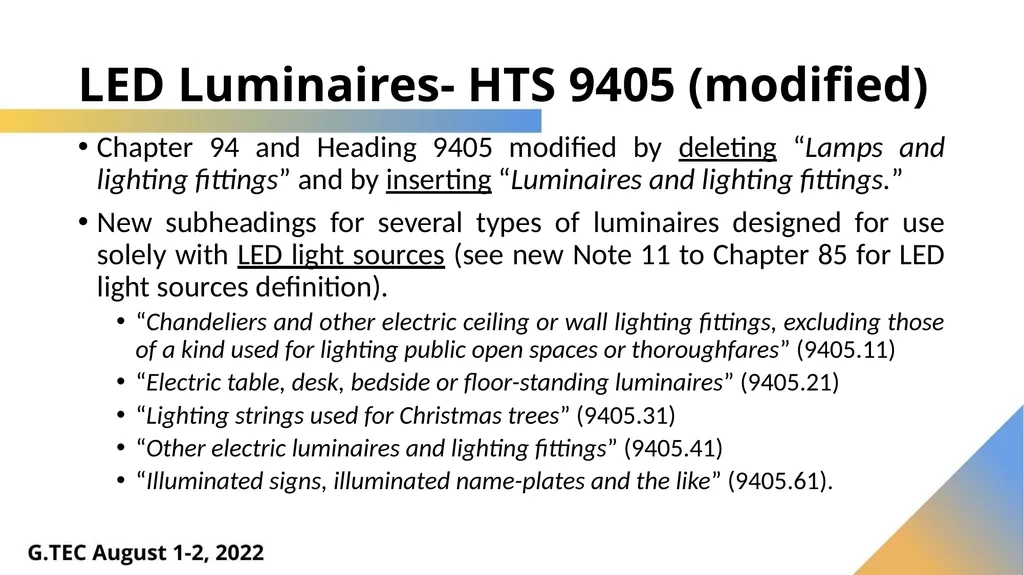
LED Luminaires- HTS 9405 (modified) Chapter 94 and Heading 9405 modified by deleting “Lamps and lighting fittings” and by inserting “Luminaires and lighting fittings.”
New subheadings for several types of luminaires designed for use solely with LED light sources (see new Note 11 to Chapter 85 for LED light sources definition).
“Chandeliers and other electric ceiling or wall lighting fittings, excluding those of a kind used for lighting public open spaces or thoroughfares” (9405.11)
“Electric table, desk, bedside or floor-standing luminaires” (9405.21)
“Lighting strings used for Christmas trees” (9405.31)
“Other electric luminaires and lighting fittings” (9405.41)
“Illuminated signs, illuminated name-plates and the like” (9405.61).<br>
New subheadings for several types of luminaires designed for use solely with LED light sources (see new Note 11 to Chapter 85 for LED light sources definition).
“Chandeliers and other electric ceiling or wall lighting fittings, excluding those of a kind used for lighting public open spaces or thoroughfares” (9405.11)
“Electric table, desk, bedside or floor-standing luminaires” (9405.21)
“Lighting strings used for Christmas trees” (9405.31)
“Other electric luminaires and lighting fittings” (9405.41)
“Illuminated signs, illuminated name-plates and the like” (9405.61).<br>
26
Smartphones – HTS 8517.13 (new) New subheading 8517.13 “Smartphones”
Replaces: 8517.12 (USHTS 8517.12.0050) “Other radio telephones designed for the Public Cellular Radiocommunication Service”
Note 5 to Chapter 85 defining “smartphones”
Previous CBP rulings classified smartphones under headings 8517.12 (N024266, N012863) assigned per GRI 3(c)
Viewed as composite machine (GPS, Digital Phone, Cellular Telephone, Media Player, Web Browser)
Essential character/principal function evaluation
ADP machine of heading 8471? Or Transmission Apparatus of 8517?
GRI 3(c) “Last in numerical order”<br>
Replaces: 8517.12 (USHTS 8517.12.0050) “Other radio telephones designed for the Public Cellular Radiocommunication Service”
Note 5 to Chapter 85 defining “smartphones”
Previous CBP rulings classified smartphones under headings 8517.12 (N024266, N012863) assigned per GRI 3(c)
Viewed as composite machine (GPS, Digital Phone, Cellular Telephone, Media Player, Web Browser)
Essential character/principal function evaluation
ADP machine of heading 8471? Or Transmission Apparatus of 8517?
GRI 3(c) “Last in numerical order”<br>
27
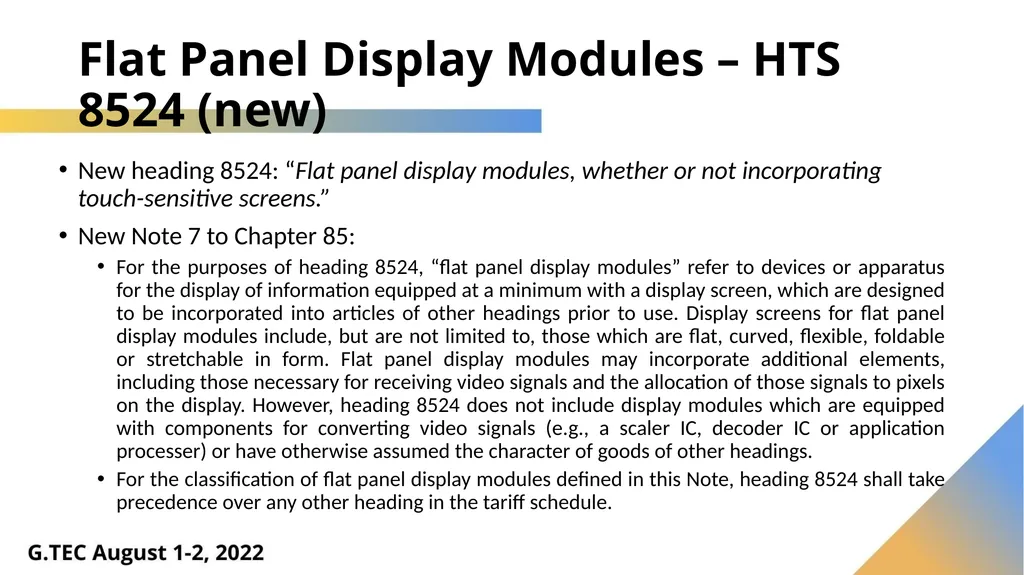
Flat Panel Display Modules – HTS 8524 (new) New heading 8524: “Flat panel display modules, whether or not incorporating touch-sensitive screens.”
New Note 7 to Chapter 85:
For the purposes of heading 8524, “flat panel display modules” refer to devices or apparatus for the display of information equipped at a minimum with a display screen, which are designed to be incorporated into articles of other headings prior to use. Display screens for flat panel display modules include, but are not limited to, those which are flat, curved, flexible, foldable or stretchable in form. Flat panel display modules may incorporate additional elements, including those necessary for receiving video signals and the allocation of those signals to pixels on the display. However, heading 8524 does not include display modules which are equipped with components for converting video signals (e.g., a scaler IC, decoder IC or application processer) or have otherwise assumed the character of goods of other headings.
For the classification of flat panel display modules defined in this Note, heading 8524 shall take precedence over any other heading in the tariff schedule.<br>
New Note 7 to Chapter 85:
For the purposes of heading 8524, “flat panel display modules” refer to devices or apparatus for the display of information equipped at a minimum with a display screen, which are designed to be incorporated into articles of other headings prior to use. Display screens for flat panel display modules include, but are not limited to, those which are flat, curved, flexible, foldable or stretchable in form. Flat panel display modules may incorporate additional elements, including those necessary for receiving video signals and the allocation of those signals to pixels on the display. However, heading 8524 does not include display modules which are equipped with components for converting video signals (e.g., a scaler IC, decoder IC or application processer) or have otherwise assumed the character of goods of other headings.
For the classification of flat panel display modules defined in this Note, heading 8524 shall take precedence over any other heading in the tariff schedule.<br>
28
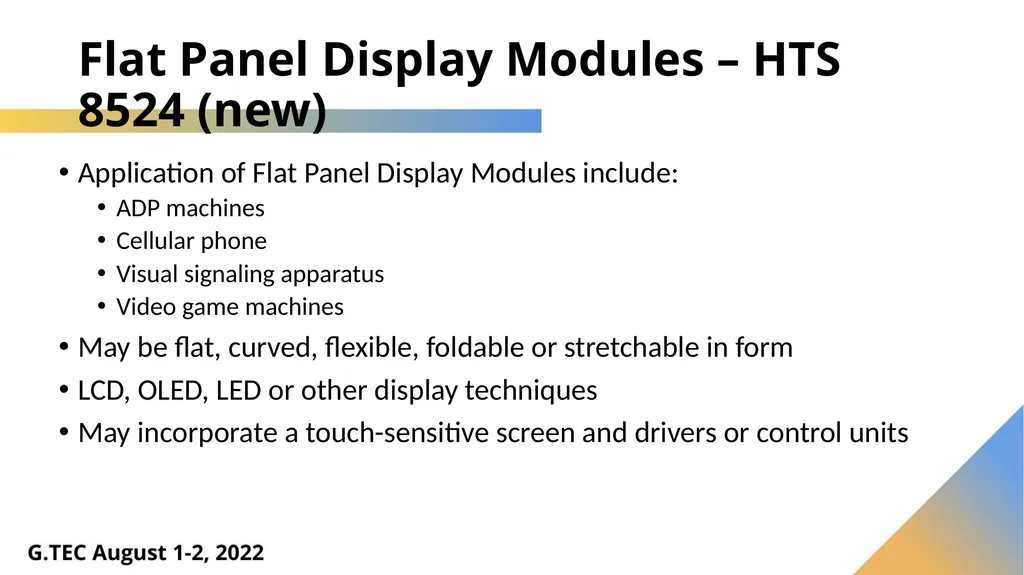
Flat Panel Display Modules – HTS 8524 (new) Application of Flat Panel Display Modules include:
ADP machines
Cellular phone
Visual signaling apparatus
Video game machines
May be flat, curved, flexible, foldable or stretchable in form
LCD, OLED, LED or other display techniques
May incorporate a touch-sensitive screen and drivers or control units<br>
ADP machines
Cellular phone
Visual signaling apparatus
Video game machines
May be flat, curved, flexible, foldable or stretchable in form
LCD, OLED, LED or other display techniques
May incorporate a touch-sensitive screen and drivers or control units<br>
29
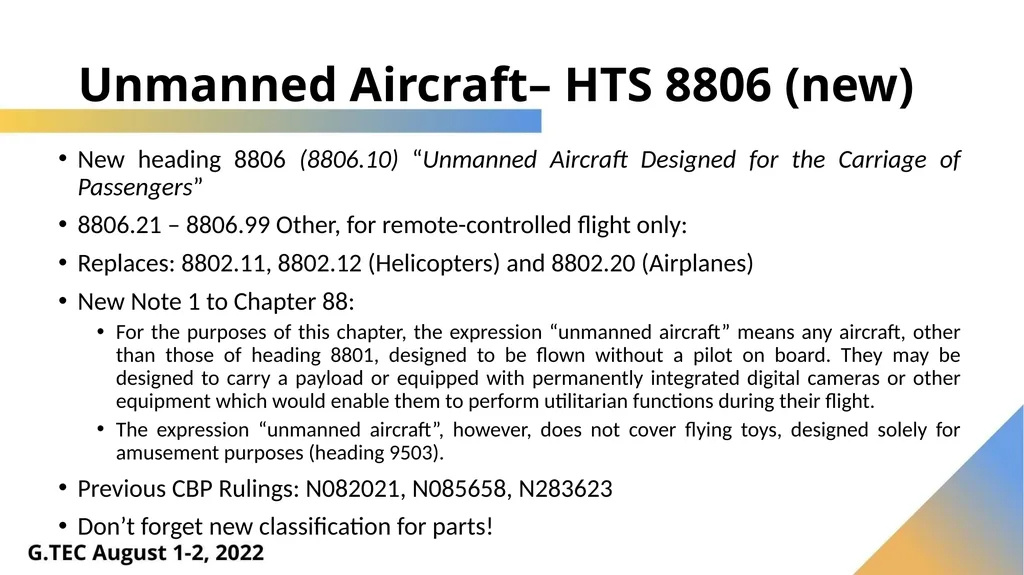
Unmanned Aircraft– HTS 8806 (new) New heading 8806 (8806.10) “Unmanned Aircraft Designed for the Carriage of Passengers”
8806.21 – 8806.99 Other, for remote-controlled flight only:
Replaces: 8802.11, 8802.12 (Helicopters) and 8802.20 (Airplanes)
New Note 1 to Chapter 88:
For the purposes of this chapter, the expression “unmanned aircraft” means any aircraft, other than those of heading 8801, designed to be flown without a pilot on board. They may be designed to carry a payload or equipped with permanently integrated digital cameras or other equipment which would enable them to perform utilitarian functions during their flight.
The expression “unmanned aircraft”, however, does not cover flying toys, designed solely for amusement purposes (heading 9503).
Previous CBP Rulings: N082021, N085658, N283623
Don’t forget new classification for parts!<br>
8806.21 – 8806.99 Other, for remote-controlled flight only:
Replaces: 8802.11, 8802.12 (Helicopters) and 8802.20 (Airplanes)
New Note 1 to Chapter 88:
For the purposes of this chapter, the expression “unmanned aircraft” means any aircraft, other than those of heading 8801, designed to be flown without a pilot on board. They may be designed to carry a payload or equipped with permanently integrated digital cameras or other equipment which would enable them to perform utilitarian functions during their flight.
The expression “unmanned aircraft”, however, does not cover flying toys, designed solely for amusement purposes (heading 9503).
Previous CBP Rulings: N082021, N085658, N283623
Don’t forget new classification for parts!<br>
30
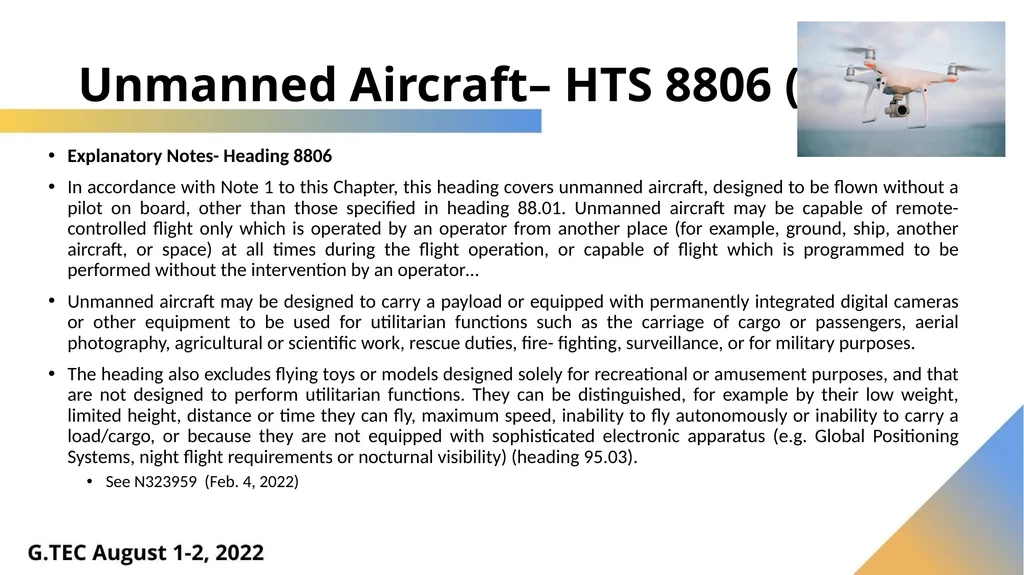
Unmanned Aircraft– HTS 8806 (new) Explanatory Notes- Heading 8806
In accordance with Note 1 to this Chapter, this heading covers unmanned aircraft, designed to be flown without a pilot on board, other than those specified in heading 88.01. Unmanned aircraft may be capable of remote-controlled flight only which is operated by an operator from another place (for example, ground, ship, another aircraft, or space) at all times during the flight operation, or capable of flight which is programmed to be performed without the intervention by an operator…
Unmanned aircraft may be designed to carry a payload or equipped with permanently integrated digital cameras or other equipment to be used for utilitarian functions such as the carriage of cargo or passengers, aerial photography, agricultural or scientific work, rescue duties, fire- fighting, surveillance, or for military purposes.
The heading also excludes flying toys or models designed solely for recreational or amusement purposes, and that are not designed to perform utilitarian functions. They can be distinguished, for example by their low weight, limited height, distance or time they can fly, maximum speed, inability to fly autonomously or inability to carry a load/cargo, or because they are not equipped with sophisticated electronic apparatus (e.g. Global Positioning Systems, night flight requirements or nocturnal visibility) (heading 95.03).
See N323959 (Feb. 4, 2022)<br>
In accordance with Note 1 to this Chapter, this heading covers unmanned aircraft, designed to be flown without a pilot on board, other than those specified in heading 88.01. Unmanned aircraft may be capable of remote-controlled flight only which is operated by an operator from another place (for example, ground, ship, another aircraft, or space) at all times during the flight operation, or capable of flight which is programmed to be performed without the intervention by an operator…
Unmanned aircraft may be designed to carry a payload or equipped with permanently integrated digital cameras or other equipment to be used for utilitarian functions such as the carriage of cargo or passengers, aerial photography, agricultural or scientific work, rescue duties, fire- fighting, surveillance, or for military purposes.
The heading also excludes flying toys or models designed solely for recreational or amusement purposes, and that are not designed to perform utilitarian functions. They can be distinguished, for example by their low weight, limited height, distance or time they can fly, maximum speed, inability to fly autonomously or inability to carry a load/cargo, or because they are not equipped with sophisticated electronic apparatus (e.g. Global Positioning Systems, night flight requirements or nocturnal visibility) (heading 95.03).
See N323959 (Feb. 4, 2022)<br>
31
Parts of Aircraft– HTS 8807 (new) New Heading 8807 “Parts of aircraft”
Subheadings address all parts of aircraft:
Parts for unmanned aircraft of new heading 8806 (8807.10)
Parts of helicopters of 8801 (8807.20)
Parts of aircraft of 8802 (8807.30) and 8807.90.
Removes: 8803
8803.10
8803.20
8803.30
8803.90<br>
Subheadings address all parts of aircraft:
Parts for unmanned aircraft of new heading 8806 (8807.10)
Parts of helicopters of 8801 (8807.20)
Parts of aircraft of 8802 (8807.30) and 8807.90.
Removes: 8803
8803.10
8803.20
8803.30
8803.90<br>
32
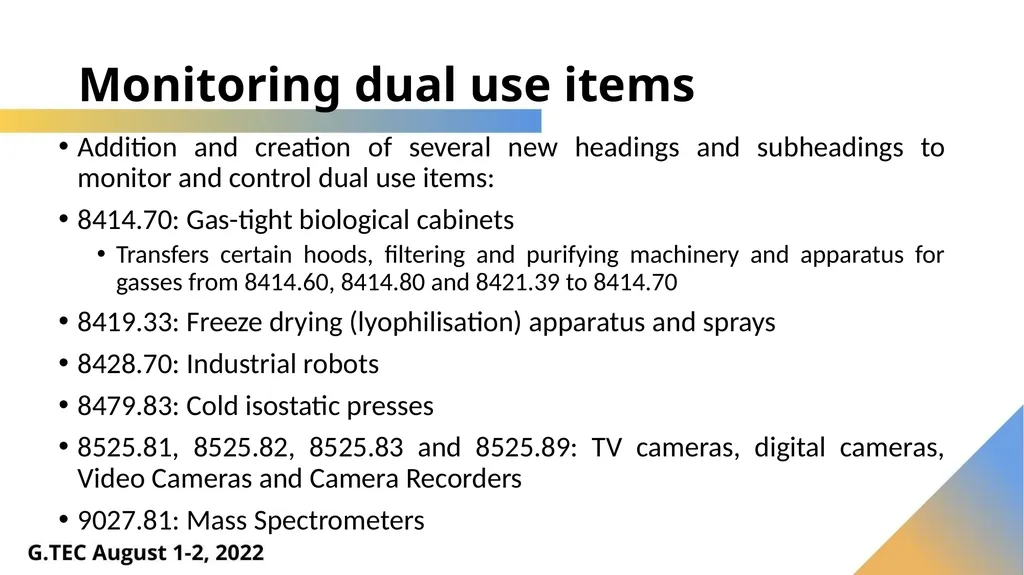
Monitoring dual use items Addition and creation of several new headings and subheadings to monitor and control dual use items:
8414.70: Gas-tight biological cabinets
Transfers certain hoods, filtering and purifying machinery and apparatus for gasses from 8414.60, 8414.80 and 8421.39 to 8414.70
8419.33: Freeze drying (lyophilisation) apparatus and sprays
8428.70: Industrial robots
8479.83: Cold isostatic presses
8525.81, 8525.82, 8525.83 and 8525.89: TV cameras, digital cameras, Video Cameras and Camera Recorders
9027.81: Mass Spectrometers<br>
8414.70: Gas-tight biological cabinets
Transfers certain hoods, filtering and purifying machinery and apparatus for gasses from 8414.60, 8414.80 and 8421.39 to 8414.70
8419.33: Freeze drying (lyophilisation) apparatus and sprays
8428.70: Industrial robots
8479.83: Cold isostatic presses
8525.81, 8525.82, 8525.83 and 8525.89: TV cameras, digital cameras, Video Cameras and Camera Recorders
9027.81: Mass Spectrometers<br>
33
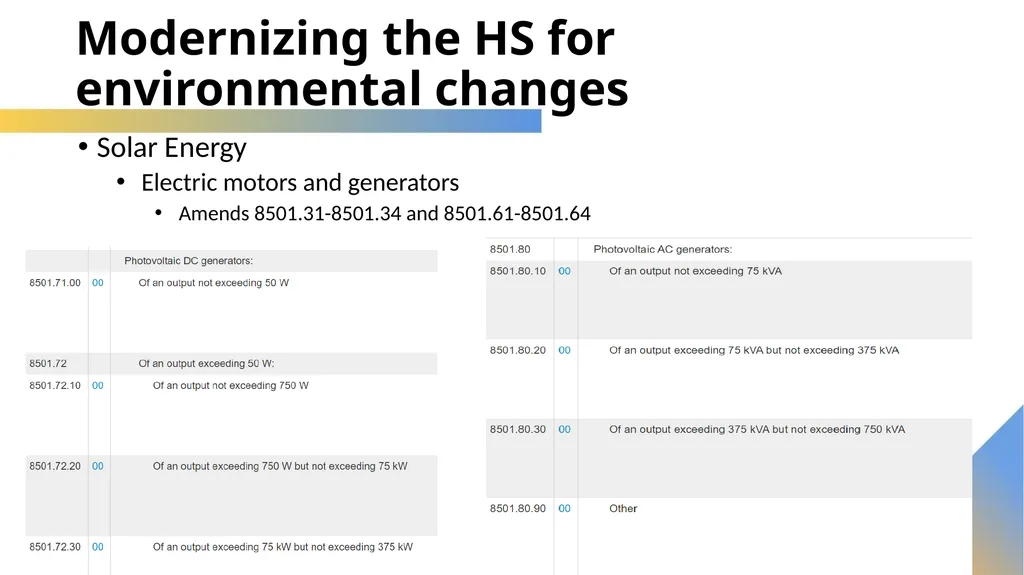
Modernizing the HS for environmental changes Solar Energy
Electric motors and generators
Amends 8501.31-8501.34 and 8501.61-8501.64<br>
Electric motors and generators
Amends 8501.31-8501.34 and 8501.61-8501.64<br>
34
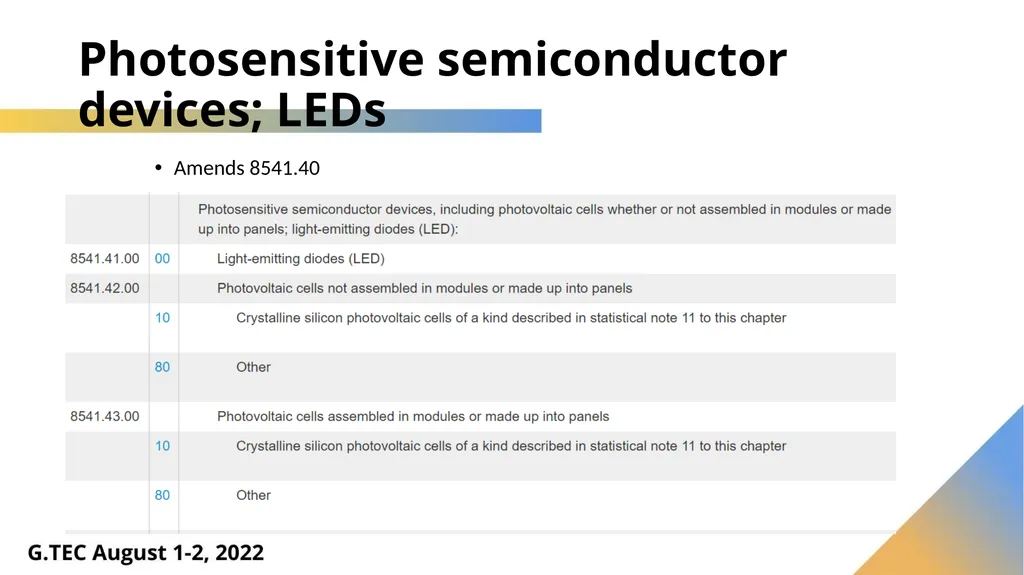
Photosensitive semiconductor devices; LEDs Amends 8541.40<br>
35
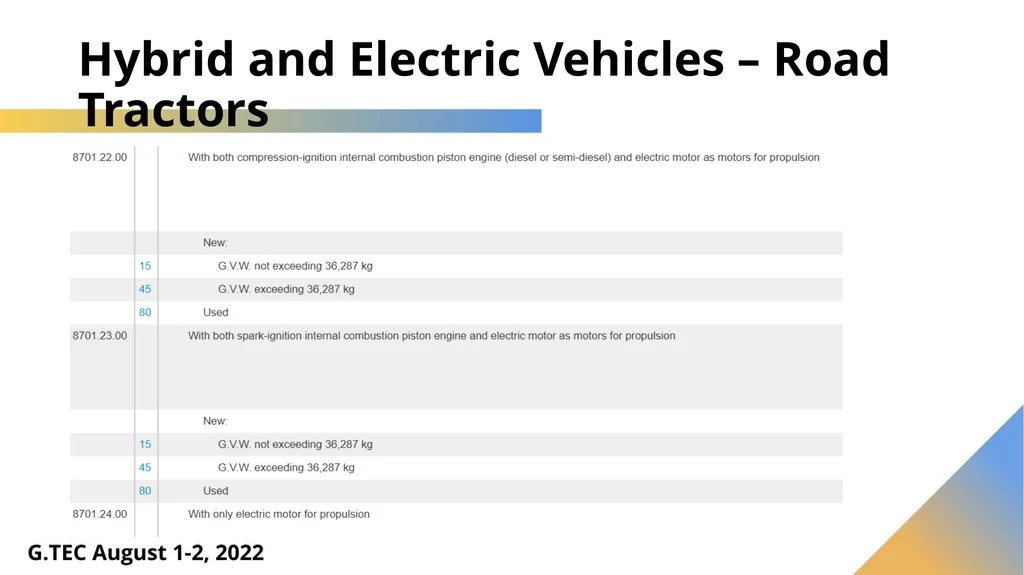
Hybrid and Electric Vehicles – Road Tractors<br>
36
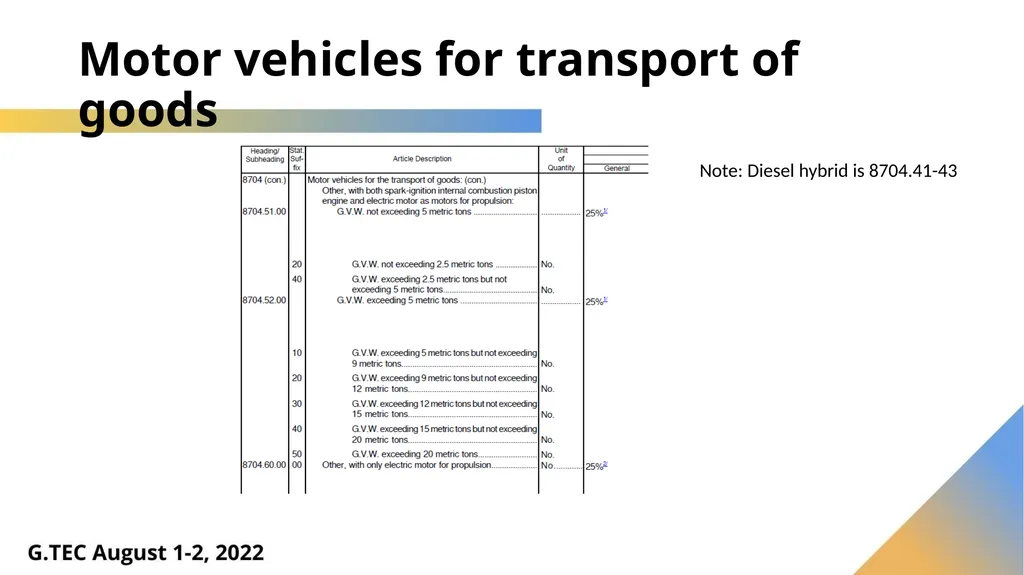
Motor vehicles for transport of goods Note: Diesel hybrid is 8704.41-43<br>
37
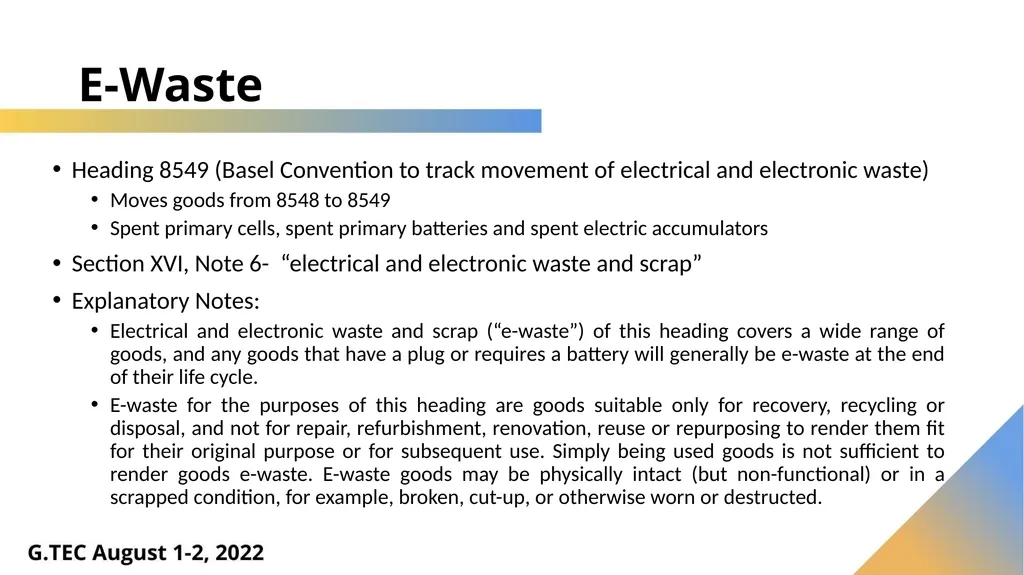
E-Waste Heading 8549 (Basel Convention to track movement of electrical and electronic waste)
Moves goods from 8548 to 8549
Spent primary cells, spent primary batteries and spent electric accumulators
Section XVI, Note 6- “electrical and electronic waste and scrap”
Explanatory Notes:
Electrical and electronic waste and scrap (“e-waste”) of this heading covers a wide range of goods, and any goods that have a plug or requires a battery will generally be e-waste at the end of their life cycle.
E-waste for the purposes of this heading are goods suitable only for recovery, recycling or disposal, and not for repair, refurbishment, renovation, reuse or repurposing to render them fit for their original purpose or for subsequent use. Simply being used goods is not sufficient to render goods e-waste. E-waste goods may be physically intact (but non-functional) or in a scrapped condition, for example, broken, cut-up, or otherwise worn or destructed.<br>
Moves goods from 8548 to 8549
Spent primary cells, spent primary batteries and spent electric accumulators
Section XVI, Note 6- “electrical and electronic waste and scrap”
Explanatory Notes:
Electrical and electronic waste and scrap (“e-waste”) of this heading covers a wide range of goods, and any goods that have a plug or requires a battery will generally be e-waste at the end of their life cycle.
E-waste for the purposes of this heading are goods suitable only for recovery, recycling or disposal, and not for repair, refurbishment, renovation, reuse or repurposing to render them fit for their original purpose or for subsequent use. Simply being used goods is not sufficient to render goods e-waste. E-waste goods may be physically intact (but non-functional) or in a scrapped condition, for example, broken, cut-up, or otherwise worn or destructed.<br>
38
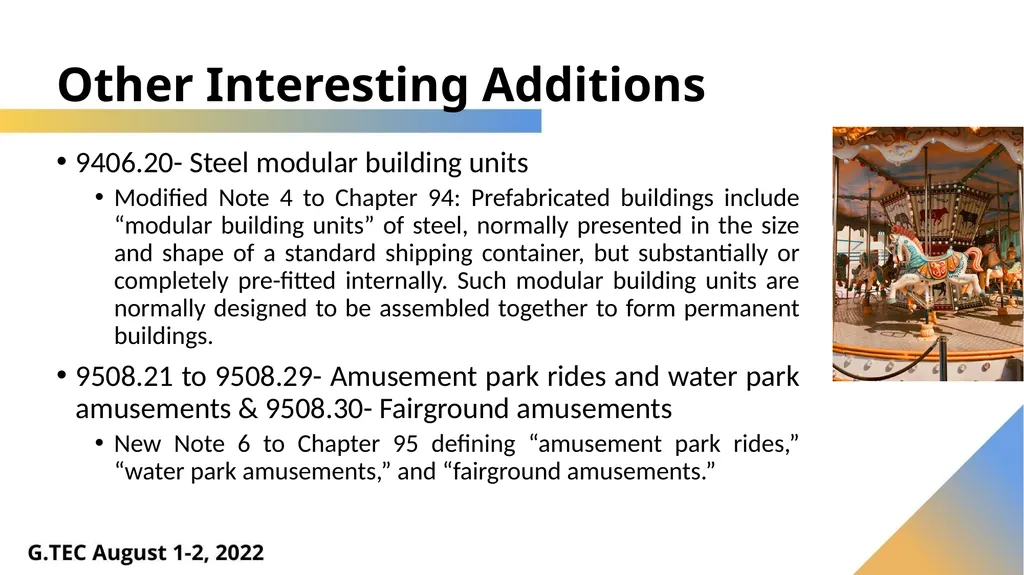
Other Interesting Additions 9406.20- Steel modular building units
Modified Note 4 to Chapter 94: Prefabricated buildings include “modular building units” of steel, normally presented in the size and shape of a standard shipping container, but substantially or completely pre-fitted internally. Such modular building units are normally designed to be assembled together to form permanent buildings.
9508.21 to 9508.29- Amusement park rides and water park amusements & 9508.30- Fairground amusements
New Note 6 to Chapter 95 defining “amusement park rides,” “water park amusements,” and “fairground amusements.”<br>
Modified Note 4 to Chapter 94: Prefabricated buildings include “modular building units” of steel, normally presented in the size and shape of a standard shipping container, but substantially or completely pre-fitted internally. Such modular building units are normally designed to be assembled together to form permanent buildings.
9508.21 to 9508.29- Amusement park rides and water park amusements & 9508.30- Fairground amusements
New Note 6 to Chapter 95 defining “amusement park rides,” “water park amusements,” and “fairground amusements.”<br>
39
Other Interesting Additions- Cultural Objects New Note 2 to Chapter 97:
Heading 9701 does not apply to mosaics that are mass-produced reproductions, casts or works of conventional craftsmanship of a commercial character, even if these articles are designed or created by artists.
Restructuring headings 9702 (Original engravings, prints and lithographs) and 9703 (Original sculptures and statuary, in any material)
New subheadings for items “Of an age exceeding 100 years.”
Restructured heading 9705 (Collections and collectors’ pieces of archaeological, ethnographic, historical, zoological, botanical, mineralogical, anatomical, paleontological or numismatic interest).<br>
Heading 9701 does not apply to mosaics that are mass-produced reproductions, casts or works of conventional craftsmanship of a commercial character, even if these articles are designed or created by artists.
Restructuring headings 9702 (Original engravings, prints and lithographs) and 9703 (Original sculptures and statuary, in any material)
New subheadings for items “Of an age exceeding 100 years.”
Restructured heading 9705 (Collections and collectors’ pieces of archaeological, ethnographic, historical, zoological, botanical, mineralogical, anatomical, paleontological or numismatic interest).<br>
40
Canadian Nuances<br>
41
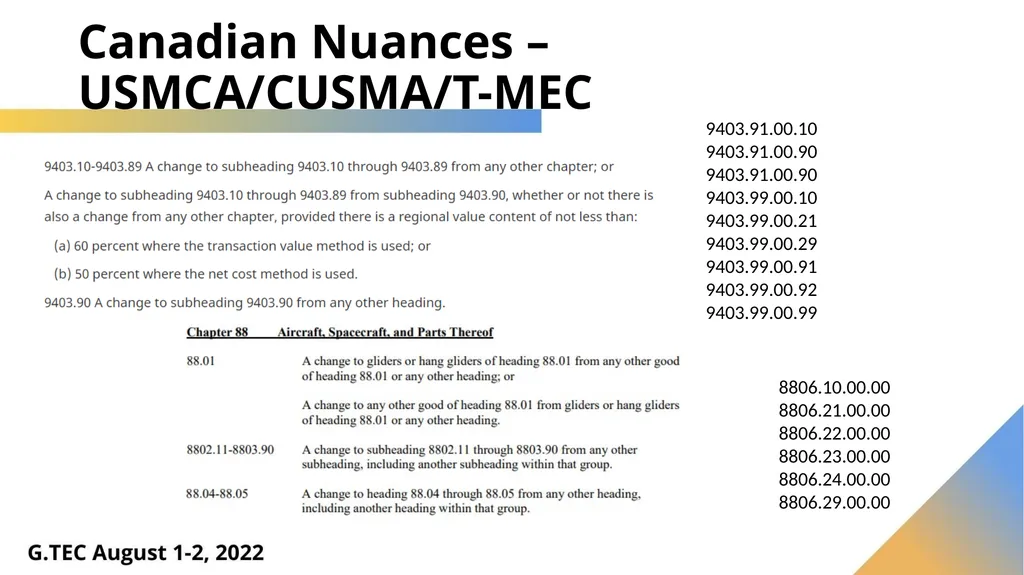
Canadian Nuances – USMCA/CUSMA/T-MEC 9403.91.00.10
9403.91.00.90
9403.91.00.90
9403.99.00.10
9403.99.00.21
9403.99.00.29
9403.99.00.91
9403.99.00.92
9403.99.00.99 8806.10.00.00
8806.21.00.00
8806.22.00.00
8806.23.00.00
8806.24.00.00
8806.29.00.00<br>
9403.91.00.90
9403.91.00.90
9403.99.00.10
9403.99.00.21
9403.99.00.29
9403.99.00.91
9403.99.00.92
9403.99.00.99 8806.10.00.00
8806.21.00.00
8806.22.00.00
8806.23.00.00
8806.24.00.00
8806.29.00.00<br>
42
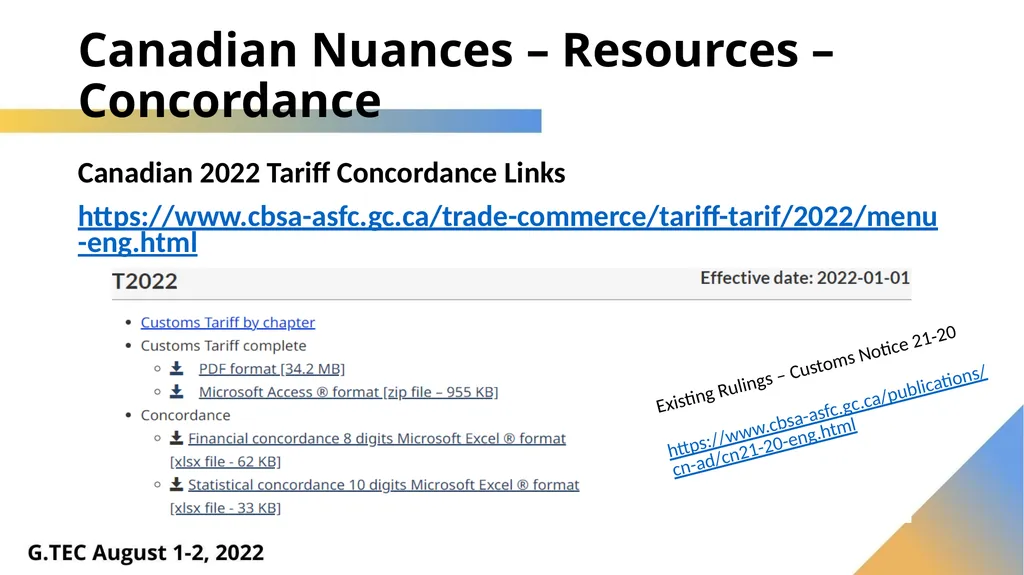
Canadian Nuances – Resources – Concordance Canadian 2022 Tariff Concordance Links
https://www.cbsa-asfc.gc.ca/trade-commerce/tariff-tarif/2022/menu-eng.html Existing Rulings – Customs Notice 21-20
https://www.cbsa-asfc.gc.ca/publications/cn-ad/cn21-20-eng.html<br>
https://www.cbsa-asfc.gc.ca/trade-commerce/tariff-tarif/2022/menu-eng.html Existing Rulings – Customs Notice 21-20
https://www.cbsa-asfc.gc.ca/publications/cn-ad/cn21-20-eng.html<br>
43
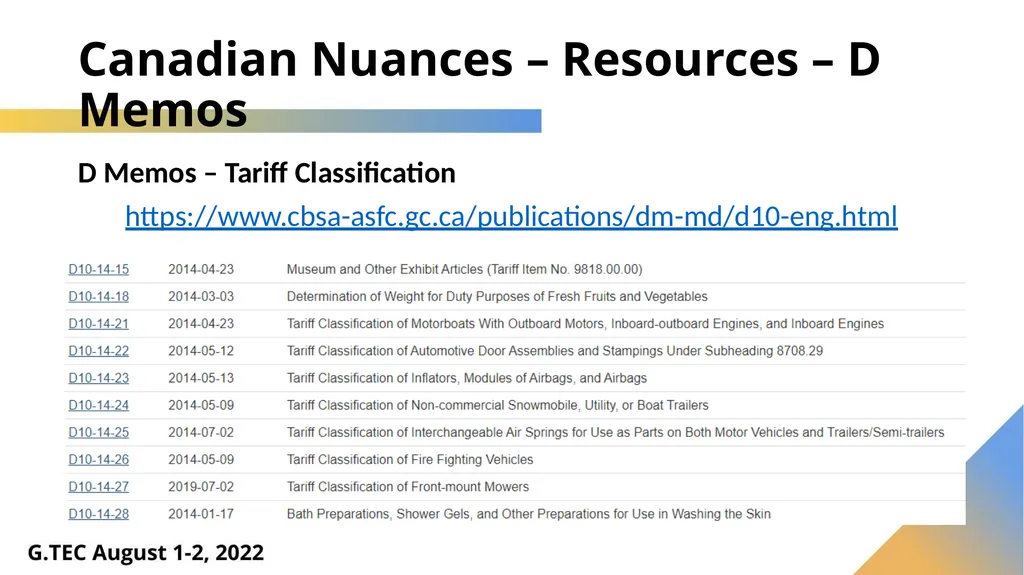
Canadian Nuances – Resources – D Memos D Memos – Tariff Classification
https://www.cbsa-asfc.gc.ca/publications/dm-md/d10-eng.html<br>
https://www.cbsa-asfc.gc.ca/publications/dm-md/d10-eng.html<br>
44
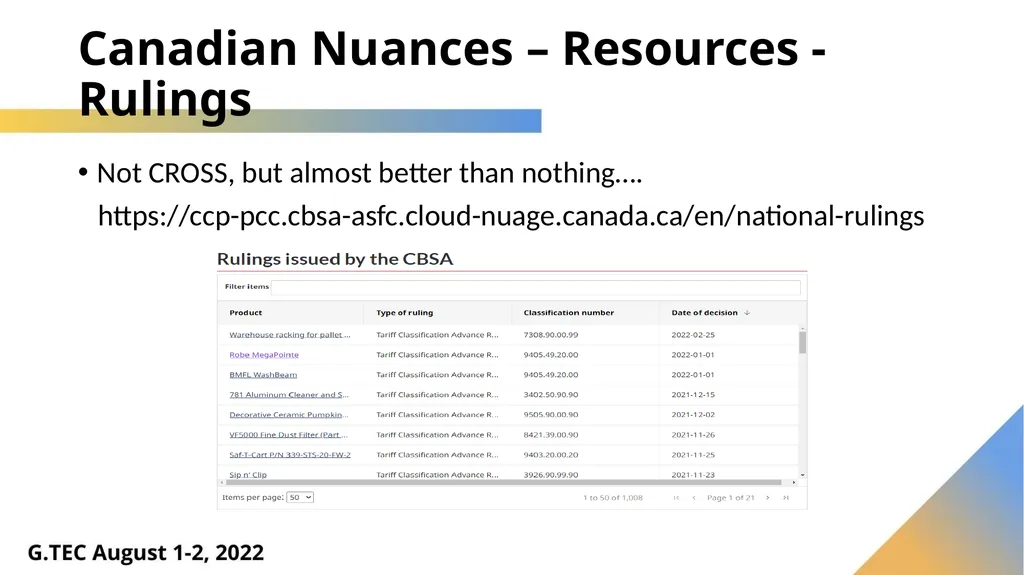
Canadian Nuances – Resources - Rulings Not CROSS, but almost better than nothing….
https://ccp-pcc.cbsa-asfc.cloud-nuage.canada.ca/en/national-rulings<br>
https://ccp-pcc.cbsa-asfc.cloud-nuage.canada.ca/en/national-rulings<br>
45
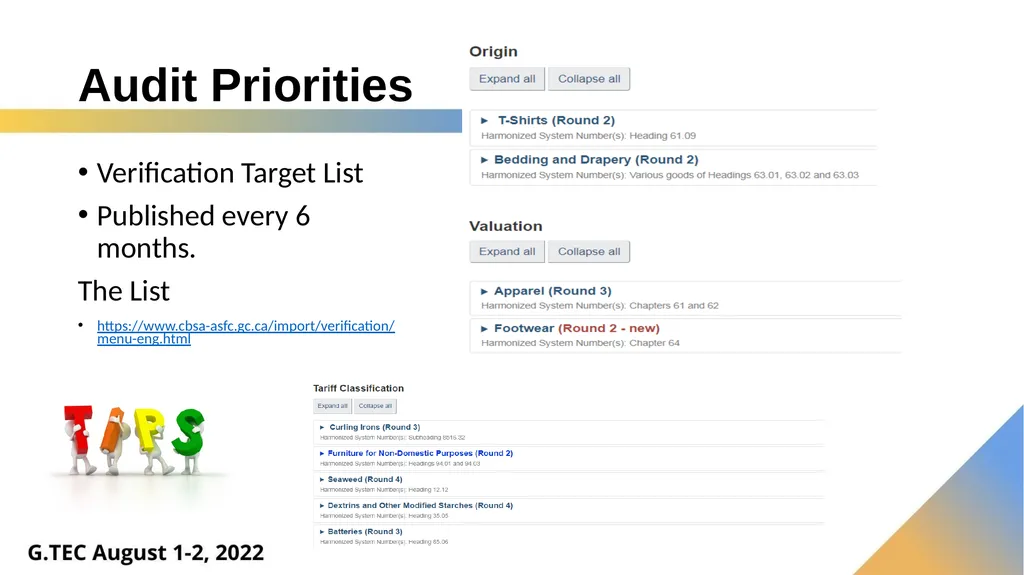
Audit Priorities Verification Target List
Published every 6 months.
The List
https://www.cbsa-asfc.gc.ca/import/verification/menu-eng.html<br>
Published every 6 months.
The List
https://www.cbsa-asfc.gc.ca/import/verification/menu-eng.html<br>
46
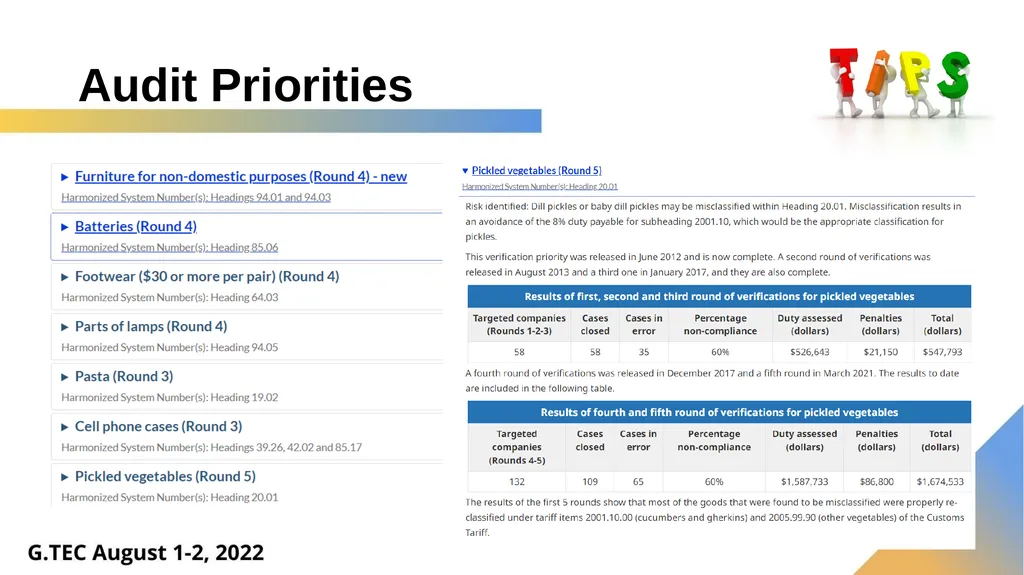
Audit Priorities<br>
47
Operational Recommendations Tips & Tricks to bring to the organization<br>
48
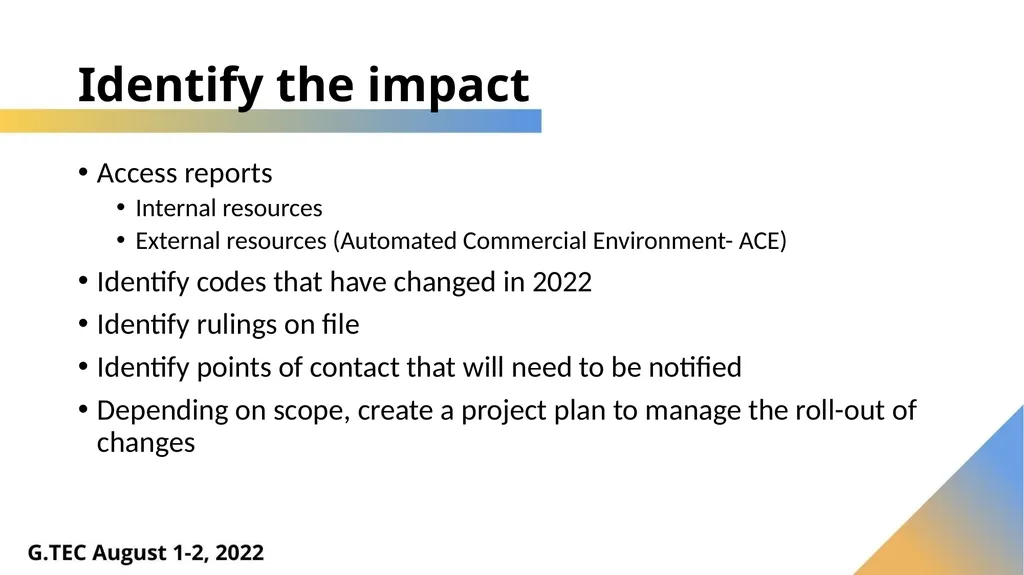
Identify the impact Access reports
Internal resources
External resources (Automated Commercial Environment- ACE)
Identify codes that have changed in 2022
Identify rulings on file
Identify points of contact that will need to be notified
Depending on scope, create a project plan to manage the roll-out of changes<br>
Internal resources
External resources (Automated Commercial Environment- ACE)
Identify codes that have changed in 2022
Identify rulings on file
Identify points of contact that will need to be notified
Depending on scope, create a project plan to manage the roll-out of changes<br>
49
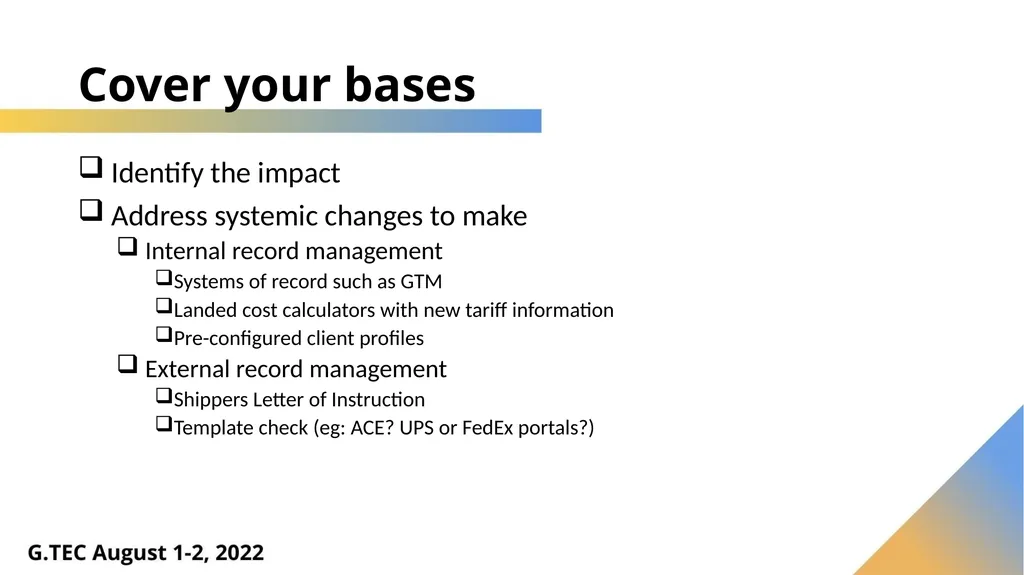
Cover your bases Identify the impact
Address systemic changes to make
Internal record management
Systems of record such as GTM
Landed cost calculators with new tariff information
Pre-configured client profiles
External record management
Shippers Letter of Instruction
Template check (eg: ACE? UPS or FedEx portals?)<br>
Address systemic changes to make
Internal record management
Systems of record such as GTM
Landed cost calculators with new tariff information
Pre-configured client profiles
External record management
Shippers Letter of Instruction
Template check (eg: ACE? UPS or FedEx portals?)<br>
50
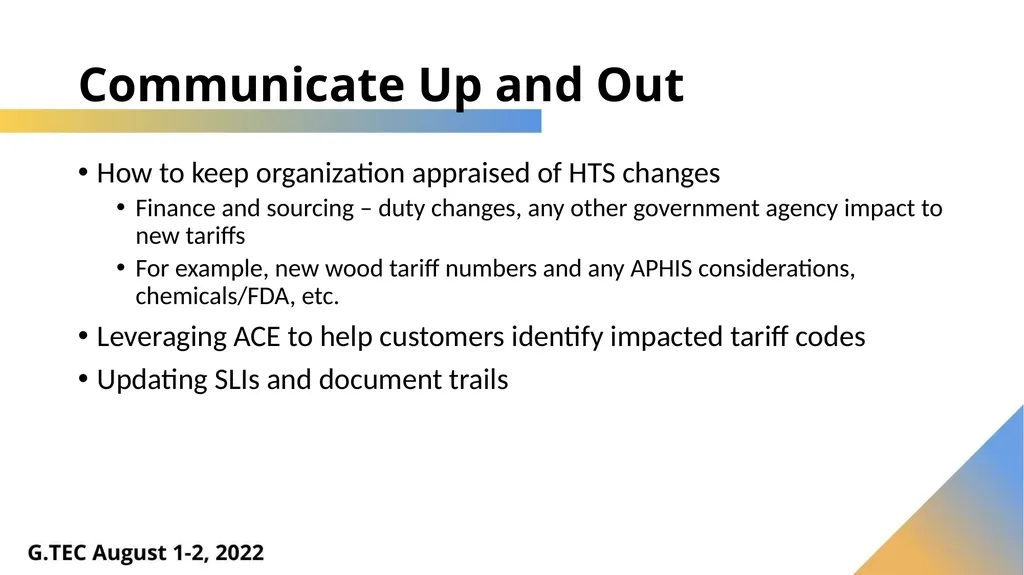
Communicate Up and Out How to keep organization appraised of HTS changes
Finance and sourcing – duty changes, any other government agency impact to new tariffs
For example, new wood tariff numbers and any APHIS considerations, chemicals/FDA, etc.
Leveraging ACE to help customers identify impacted tariff codes
Updating SLIs and document trails<br>
Finance and sourcing – duty changes, any other government agency impact to new tariffs
For example, new wood tariff numbers and any APHIS considerations, chemicals/FDA, etc.
Leveraging ACE to help customers identify impacted tariff codes
Updating SLIs and document trails<br>
51
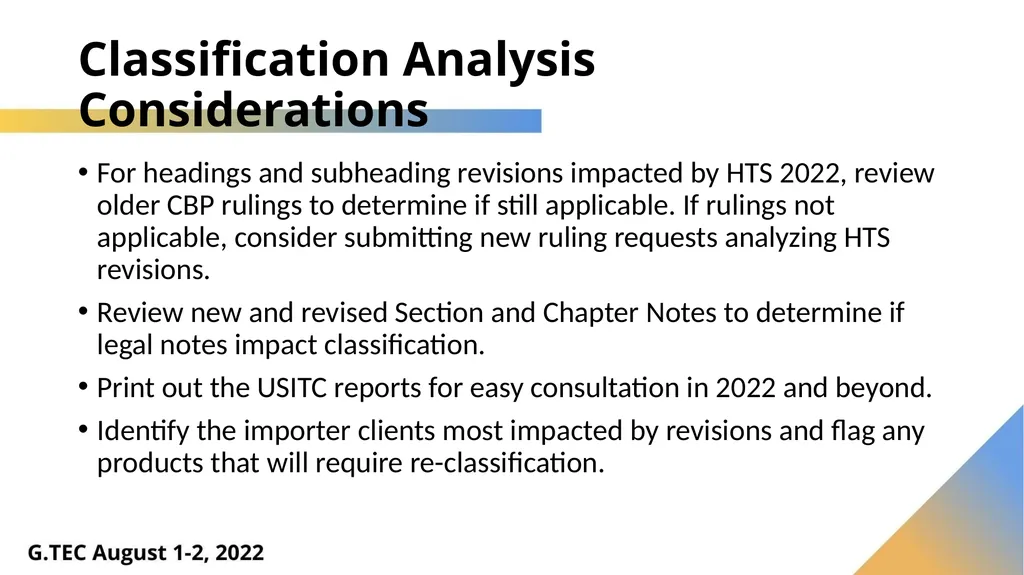
Classification Analysis Considerations For headings and subheading revisions impacted by HTS 2022, review older CBP rulings to determine if still applicable. If rulings not applicable, consider submitting new ruling requests analyzing HTS revisions.
Review new and revised Section and Chapter Notes to determine if legal notes impact classification.
Print out the USITC reports for easy consultation in 2022 and beyond.
Identify the importer clients most impacted by revisions and flag any products that will require re-classification.<br>
Review new and revised Section and Chapter Notes to determine if legal notes impact classification.
Print out the USITC reports for easy consultation in 2022 and beyond.
Identify the importer clients most impacted by revisions and flag any products that will require re-classification.<br>
52
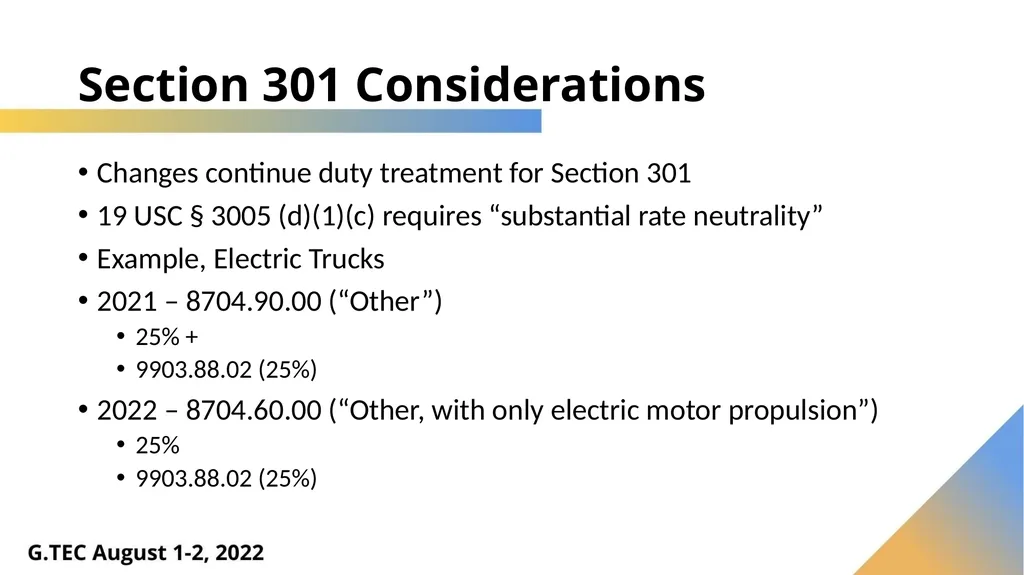
Section 301 Considerations Changes continue duty treatment for Section 301
19 USC § 3005 (d)(1)(c) requires “substantial rate neutrality”
Example, Electric Trucks
2021 – 8704.90.00 (“Other”)
25% +
9903.88.02 (25%)
2022 – 8704.60.00 (“Other, with only electric motor propulsion”)
25%
9903.88.02 (25%)<br>
19 USC § 3005 (d)(1)(c) requires “substantial rate neutrality”
Example, Electric Trucks
2021 – 8704.90.00 (“Other”)
25% +
9903.88.02 (25%)
2022 – 8704.60.00 (“Other, with only electric motor propulsion”)
25%
9903.88.02 (25%)<br>
53
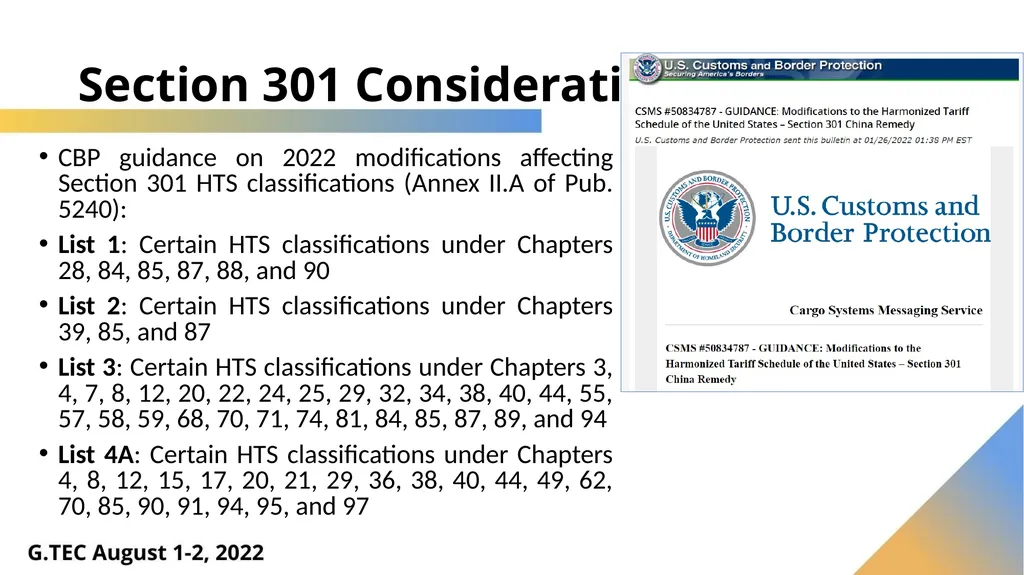
Section 301 Considerations CBP guidance on 2022 modifications affecting Section 301 HTS classifications (Annex II.A of Pub. 5240):
List 1: Certain HTS classifications under Chapters 28, 84, 85, 87, 88, and 90
List 2: Certain HTS classifications under Chapters 39, 85, and 87
List 3: Certain HTS classifications under Chapters 3, 4, 7, 8, 12, 20, 22, 24, 25, 29, 32, 34, 38, 40, 44, 55, 57, 58, 59, 68, 70, 71, 74, 81, 84, 85, 87, 89, and 94
List 4A: Certain HTS classifications under Chapters 4, 8, 12, 15, 17, 20, 21, 29, 36, 38, 40, 44, 49, 62, 70, 85, 90, 91, 94, 95, and 97<br>
List 1: Certain HTS classifications under Chapters 28, 84, 85, 87, 88, and 90
List 2: Certain HTS classifications under Chapters 39, 85, and 87
List 3: Certain HTS classifications under Chapters 3, 4, 7, 8, 12, 20, 22, 24, 25, 29, 32, 34, 38, 40, 44, 55, 57, 58, 59, 68, 70, 71, 74, 81, 84, 85, 87, 89, and 94
List 4A: Certain HTS classifications under Chapters 4, 8, 12, 15, 17, 20, 21, 29, 36, 38, 40, 44, 49, 62, 70, 85, 90, 91, 94, 95, and 97<br>
54
Resources Online resources to prepare for 2022<br>
55
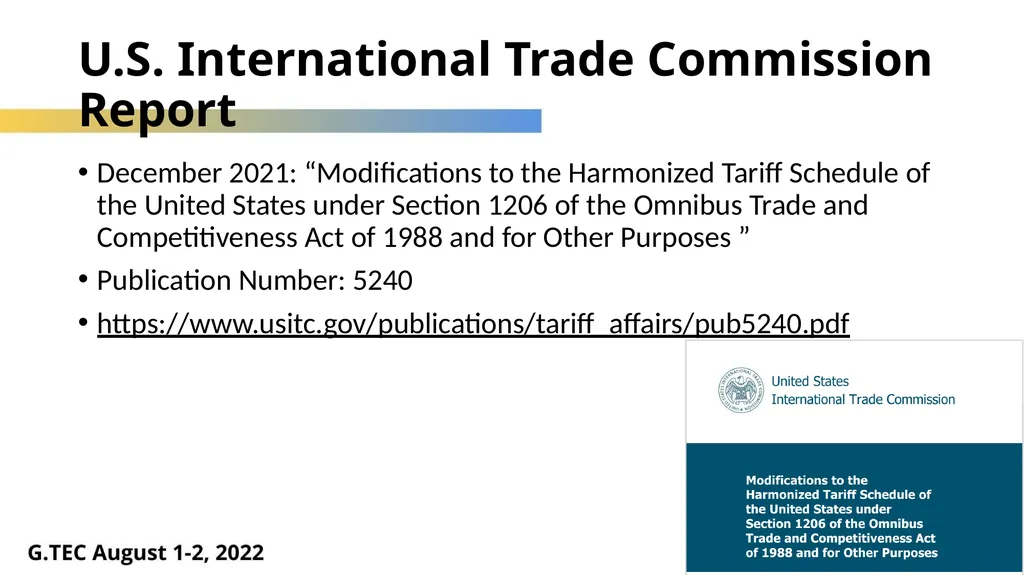
U.S. International Trade Commission Report December 2021: “Modifications to the Harmonized Tariff Schedule of the United States under Section 1206 of the Omnibus Trade and Competitiveness Act of 1988 and for Other Purposes ”
Publication Number: 5240
https://www.usitc.gov/publications/tariff_affairs/pub5240.pdf<br>
Publication Number: 5240
https://www.usitc.gov/publications/tariff_affairs/pub5240.pdf<br>
56
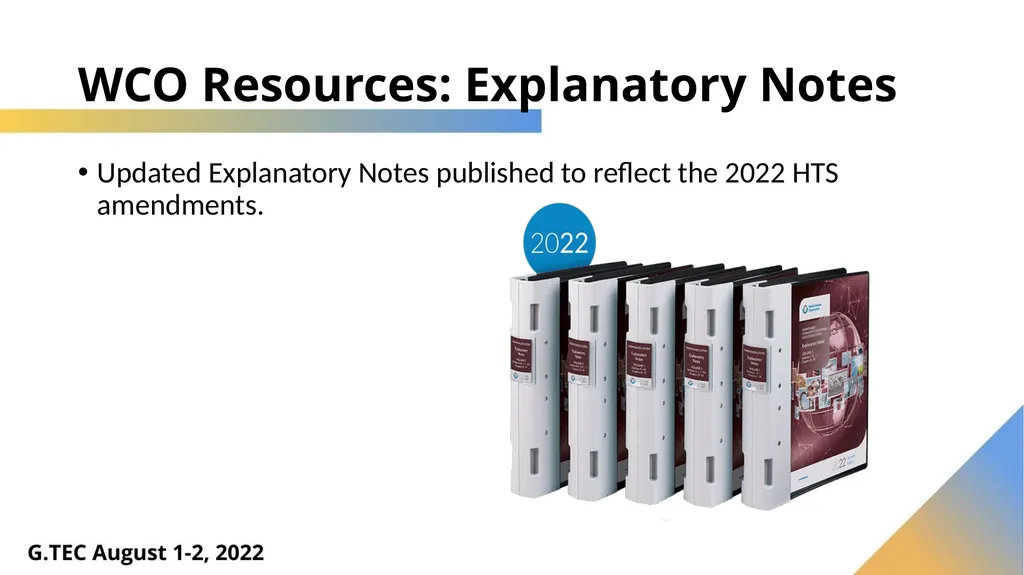
WCO Resources: Explanatory Notes Updated Explanatory Notes published to reflect the 2022 HTS amendments.<br>
57
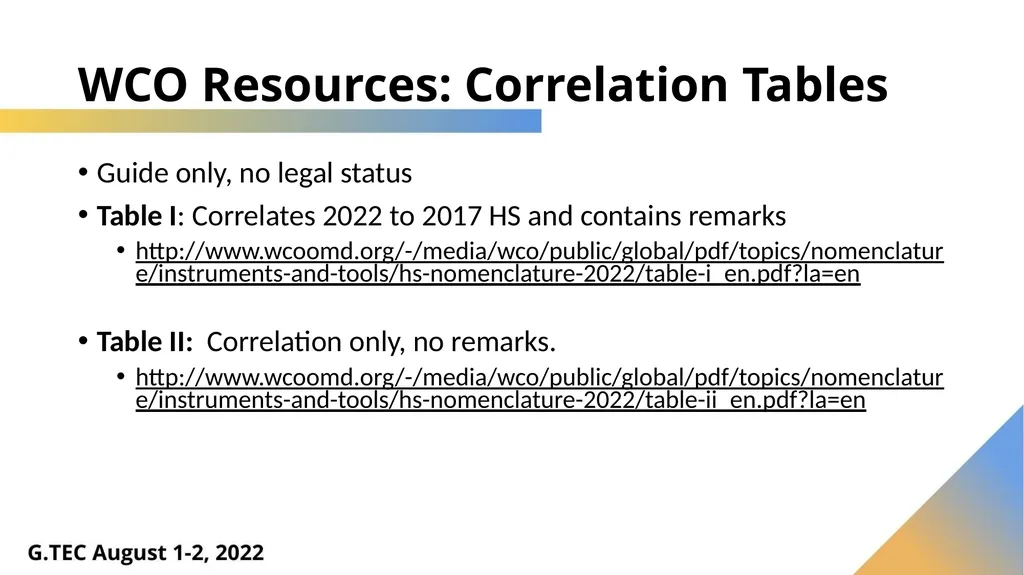
WCO Resources: Correlation Tables Guide only, no legal status
Table I: Correlates 2022 to 2017 HS and contains remarks
http://www.wcoomd.org/-/media/wco/public/global/pdf/topics/nomenclature/instruments-and-tools/hs-nomenclature-2022/table-i_en.pdf?la=en
Table II: Correlation only, no remarks.
http://www.wcoomd.org/-/media/wco/public/global/pdf/topics/nomenclature/instruments-and-tools/hs-nomenclature-2022/table-ii_en.pdf?la=en<br>
Table I: Correlates 2022 to 2017 HS and contains remarks
http://www.wcoomd.org/-/media/wco/public/global/pdf/topics/nomenclature/instruments-and-tools/hs-nomenclature-2022/table-i_en.pdf?la=en
Table II: Correlation only, no remarks.
http://www.wcoomd.org/-/media/wco/public/global/pdf/topics/nomenclature/instruments-and-tools/hs-nomenclature-2022/table-ii_en.pdf?la=en<br>
58
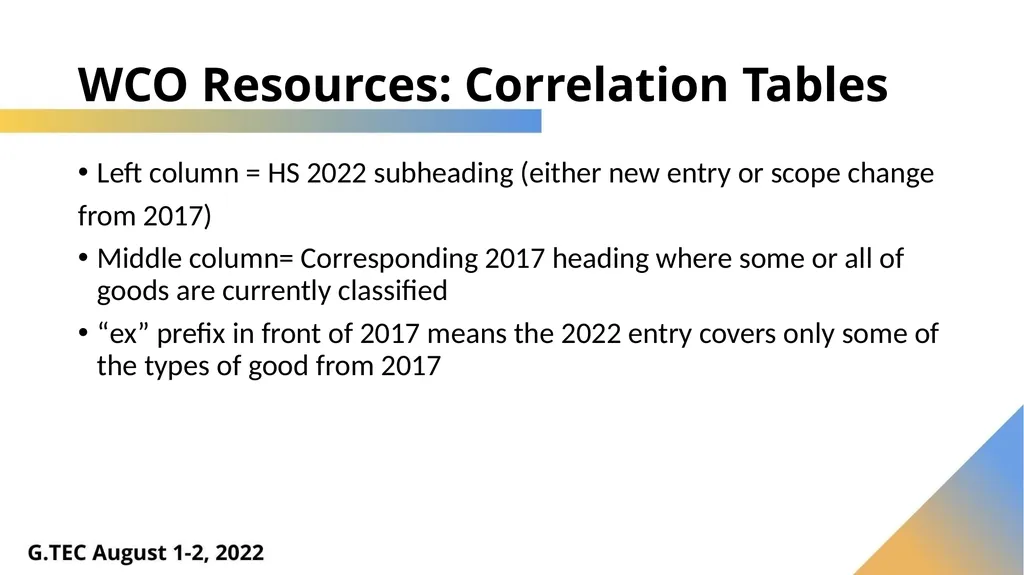
WCO Resources: Correlation Tables Left column = HS 2022 subheading (either new entry or scope change
from 2017)
Middle column= Corresponding 2017 heading where some or all of goods are currently classified
“ex” prefix in front of 2017 means the 2022 entry covers only some of the types of good from 2017<br>
from 2017)
Middle column= Corresponding 2017 heading where some or all of goods are currently classified
“ex” prefix in front of 2017 means the 2022 entry covers only some of the types of good from 2017<br>
59
Questions? Luis Arandia, Jr.
Associate Barnes & Thornburg, LLP
Luis.Arandia@btlaw.com
Kim Campbell
Founder MKMarin Trade Services, Inc.
KCampbell@mkmarin.com
Larry Friedman
Partner Barnes, Richardson & Colburn
Lfriedman@barnesrichardson.com<br>
Associate Barnes & Thornburg, LLP
Luis.Arandia@btlaw.com
Kim Campbell
Founder MKMarin Trade Services, Inc.
KCampbell@mkmarin.com
Larry Friedman
Partner Barnes, Richardson & Colburn
Lfriedman@barnesrichardson.com<br>
60
THANK YOU<br>