
Have you checked into Jayhawks Give a Flock via
SB
Published · 50 slides · 0 views

1 / 1



Description
Have you checked into Jayhawks Give a Flock via the Corq app? BYSTANDER INTERVENTION WORKSHOP FOR THE UNIVERSITY OF KANSAS DEVELOPED BY THE SEXUAL ASSAULT PREVENTION EDUCATION CENTER JAYHAWKS GIVE A FLOCK! Updated Version Spring 2023 1
Related Topics
Share
Embed code
Download this presentation From Below
"Have you checked into Jayhawks Give a Flock via" is the property of its rightful owner. Permission is granted to download and print the materials on this website for personal, non-commercial use only, and to display it on your personal computer provided you do not modify the materials and that you retain all copyright notices contained in the materials. By downloading content from our website, you accept the terms of this agreement.
Presentation Transcript
01
Have you checked into Jayhawks Give a Flock via the Corq app?<br>
02
BYSTANDER INTERVENTION WORKSHOP
FOR THE UNIVERSITY OF KANSAS DEVELOPED BY THE SEXUAL ASSAULT PREVENTION & EDUCATION CENTER JAYHAWKS GIVE A FLOCK! Updated Version Spring 2023 1<br>
03
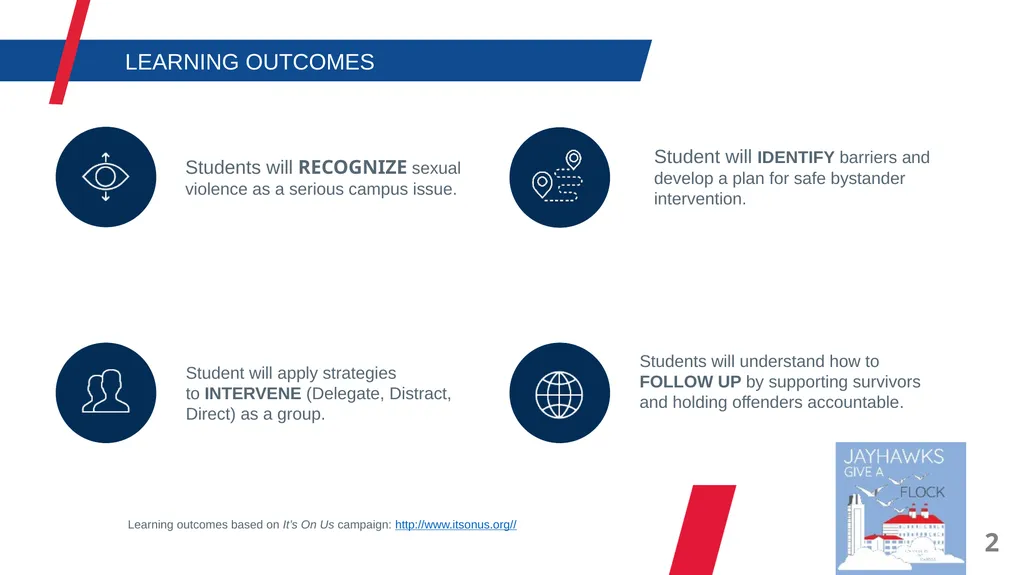
LEARNING OUTCOMES Students will RECOGNIZE sexual violence as a serious campus issue. Student will IDENTIFY barriers and develop a plan for safe bystander intervention. Student will apply strategies to INTERVENE (Delegate, Distract, Direct) as a group. Students will understand how to FOLLOW UP by supporting survivors and holding offenders accountable. Learning outcomes based on It’s On Us campaign: http://www.itsonus.org// 2<br>
04
A FEW DISCLAIMERS.
Jayhawks Give a Flock uses situations and topics that can be difficult for some students affected by sexual violence. If you are unable to participate, confidential advocates are on site for any students who would like to talk to someone and hold space for their feelings.
Most incidents of sexual violence feature women as survivors and men as offenders. However, it is important to note sexual violence is experienced by people of all gender identities and sexual orientations.
Students are encouraged to share their experiences as bystanders. That stated, almost all of our facilitators are mandatory reporters to the University, meaning they have an obligation to report instances of sexual violence to the Office of Civil Rights & Title IX.
Campus and community resources for survivors will be provided at the end of the workshop. 3<br>
Jayhawks Give a Flock uses situations and topics that can be difficult for some students affected by sexual violence. If you are unable to participate, confidential advocates are on site for any students who would like to talk to someone and hold space for their feelings.
Most incidents of sexual violence feature women as survivors and men as offenders. However, it is important to note sexual violence is experienced by people of all gender identities and sexual orientations.
Students are encouraged to share their experiences as bystanders. That stated, almost all of our facilitators are mandatory reporters to the University, meaning they have an obligation to report instances of sexual violence to the Office of Civil Rights & Title IX.
Campus and community resources for survivors will be provided at the end of the workshop. 3<br>
05
LET’S SET A Group Agreement 4<br>
06
GROUP AGREEMENT
CHALLENGE YOURSELF
SELF-CARE
RESPECT 5<br>
CHALLENGE YOURSELF
SELF-CARE
RESPECT 5<br>
07
WHAT IS A BYSTANDER? 6<br>
08
Individuals who witness concerning behaviors, problematic events, or emergencies and by their presence have the opportunity to provide assistance, do nothing, or help facilitate the negative behavior.
In the context of this workshop, the term active bystander will be used to refer to an individual who intervenes in a way that impacts the outcome positively.
Being an active bystander means assessing how we can best support the person experiencing harm, while also limiting any additional harm from occurring in the process. by·stand·er
/ˈbīˌstandər/
(noun): 7 Bystander: Sotieria Solutions<br>
In the context of this workshop, the term active bystander will be used to refer to an individual who intervenes in a way that impacts the outcome positively.
Being an active bystander means assessing how we can best support the person experiencing harm, while also limiting any additional harm from occurring in the process. by·stand·er
/ˈbīˌstandər/
(noun): 7 Bystander: Sotieria Solutions<br>
09
WHEN HAVE YOU BEEN AN
ACTIVE BYSTANDER? 8<br>
10
WHY SHOULD JAYHAWKS GIVE A FLOCK? JAYHAWK VALUES
As Jayhawks, we are committed to a set of core values:
We will actively foster UNITY. A community based in tradition and continually growing through healthy relationships and effective communication.
We will strive for INNOVATION, using our education to find new and creative solutions to the problems facing our campus, our community, and the world.
We will advocate for INCLUSION, respecting all Jayhawks are unique and have their own personal stories while cultivating a safe community rooted in equity and justice.
We will value ENGAGEMENT, taking responsibility inside and outside of the classroom to be active members of the global community. Jayhawk Values: https://studentaffairs.ku.edu/values 9<br>
As Jayhawks, we are committed to a set of core values:
We will actively foster UNITY. A community based in tradition and continually growing through healthy relationships and effective communication.
We will strive for INNOVATION, using our education to find new and creative solutions to the problems facing our campus, our community, and the world.
We will advocate for INCLUSION, respecting all Jayhawks are unique and have their own personal stories while cultivating a safe community rooted in equity and justice.
We will value ENGAGEMENT, taking responsibility inside and outside of the classroom to be active members of the global community. Jayhawk Values: https://studentaffairs.ku.edu/values 9<br>
11
STEP ONE: RECOGNIZE that something is happening or has happened 10<br>
12
RECOGNIZING SEXUAL VIOLENCE SEXUAL VIOLENCE:
any sexual act that is imposed on another person without their consent and is perpetrated through use of incapacitation, deception, coercion, fear, or force. 11<br>
13
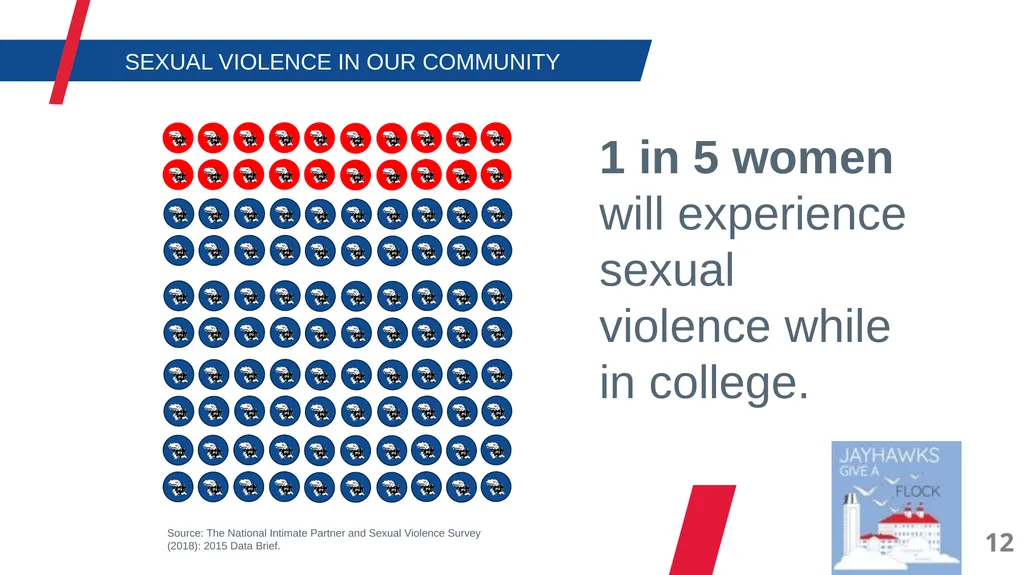
SEXUAL VIOLENCE IN OUR COMMUNITY 1 in 5 women will experience sexual violence while in college. Source: The National Intimate Partner and Sexual Violence Survey (2018): 2015 Data Brief. 12<br>
14
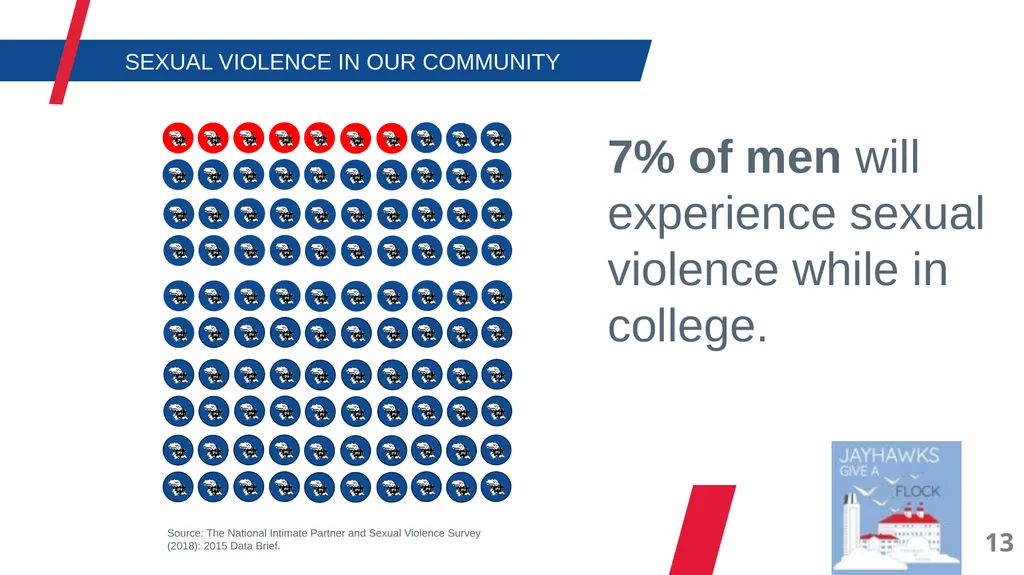
SEXUAL VIOLENCE IN OUR COMMUNITY 7% of men will experience sexual violence while in college. Source: The National Intimate Partner and Sexual Violence Survey (2018): 2015 Data Brief. 13<br>
15
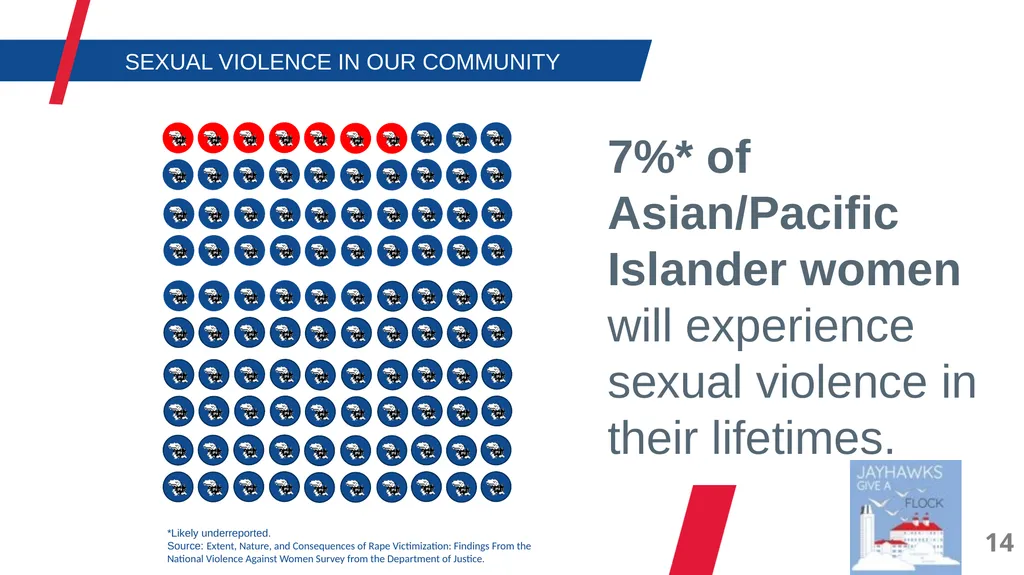
SEXUAL VIOLENCE IN OUR COMMUNITY 7%* of Asian/Pacific Islander women will experience sexual violence in their lifetimes. *Likely underreported.
Source: Extent, Nature, and Consequences of Rape Victimization: Findings From the National Violence Against Women Survey from the Department of Justice. 14<br>
Source: Extent, Nature, and Consequences of Rape Victimization: Findings From the National Violence Against Women Survey from the Department of Justice. 14<br>
16
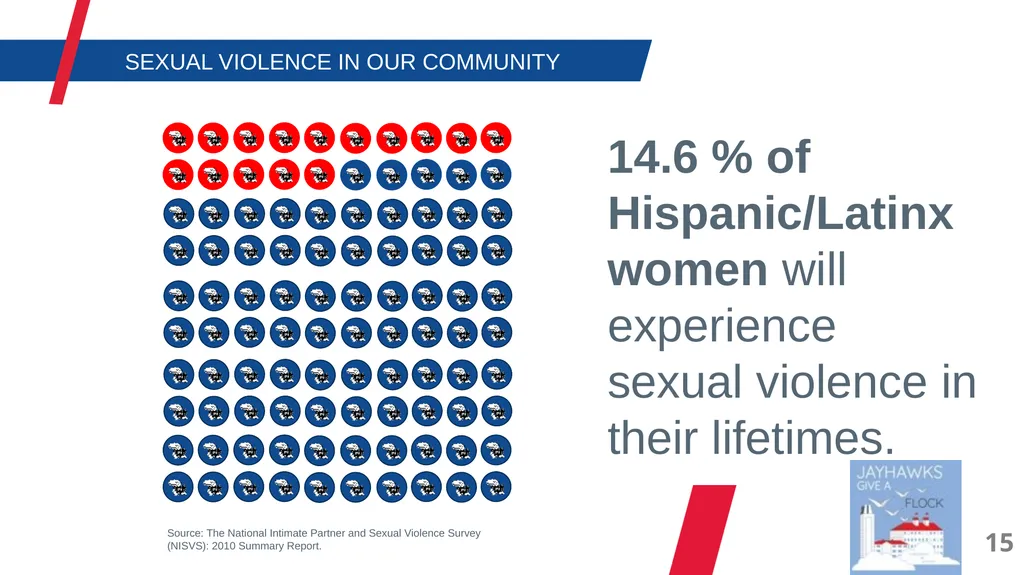
SEXUAL VIOLENCE IN OUR COMMUNITY 14.6 % of Hispanic/Latinx women will experience sexual violence in their lifetimes. Source: The National Intimate Partner and Sexual Violence Survey (NISVS): 2010 Summary Report. 15<br>
17
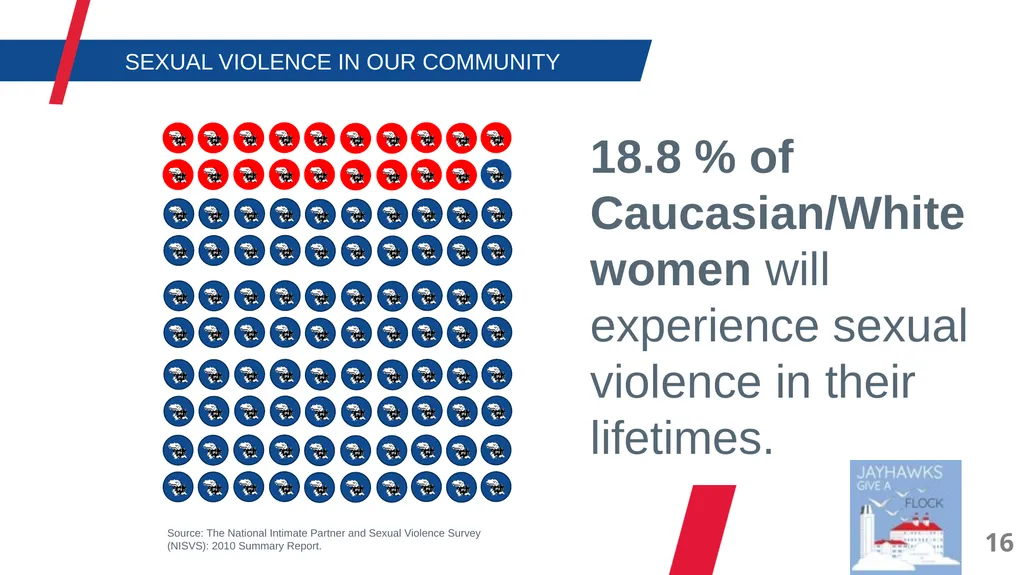
SEXUAL VIOLENCE IN OUR COMMUNITY 18.8 % of Caucasian/White women will experience sexual violence in their lifetimes. Source: The National Intimate Partner and Sexual Violence Survey (NISVS): 2010 Summary Report. 16<br>
18
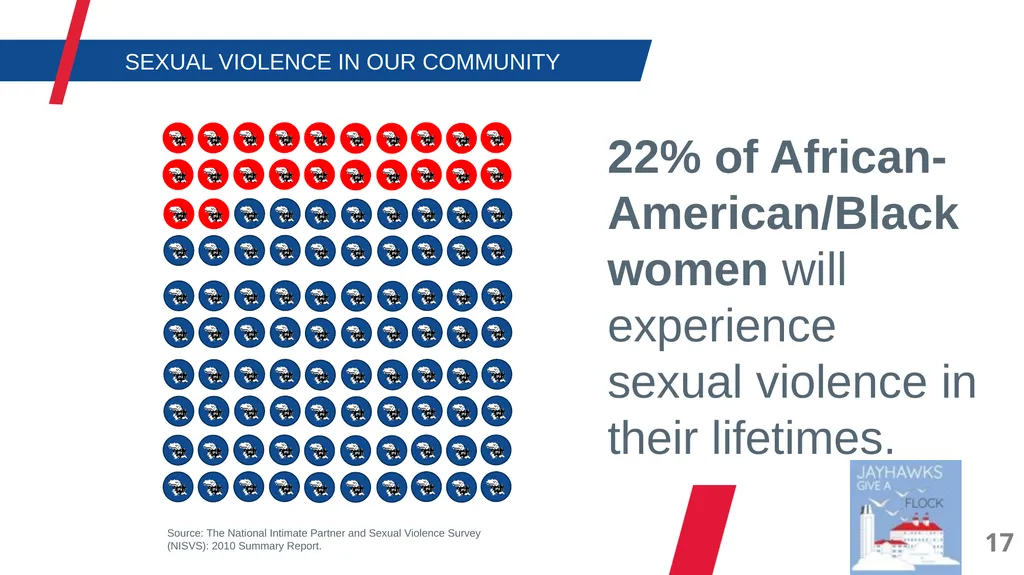
SEXUAL VIOLENCE IN OUR COMMUNITY 22% of African-American/Black women will experience sexual violence in their lifetimes. Source: The National Intimate Partner and Sexual Violence Survey (NISVS): 2010 Summary Report. 17<br>
19
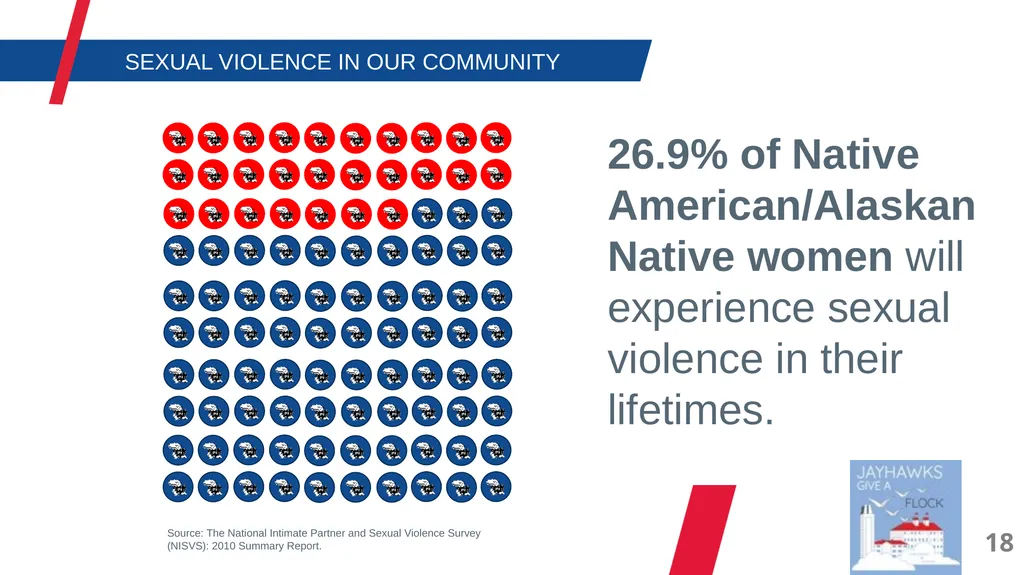
SEXUAL VIOLENCE IN OUR COMMUNITY 26.9% of Native American/Alaskan Native women will experience sexual violence in their lifetimes. Source: The National Intimate Partner and Sexual Violence Survey (NISVS): 2010 Summary Report. 18<br>
20
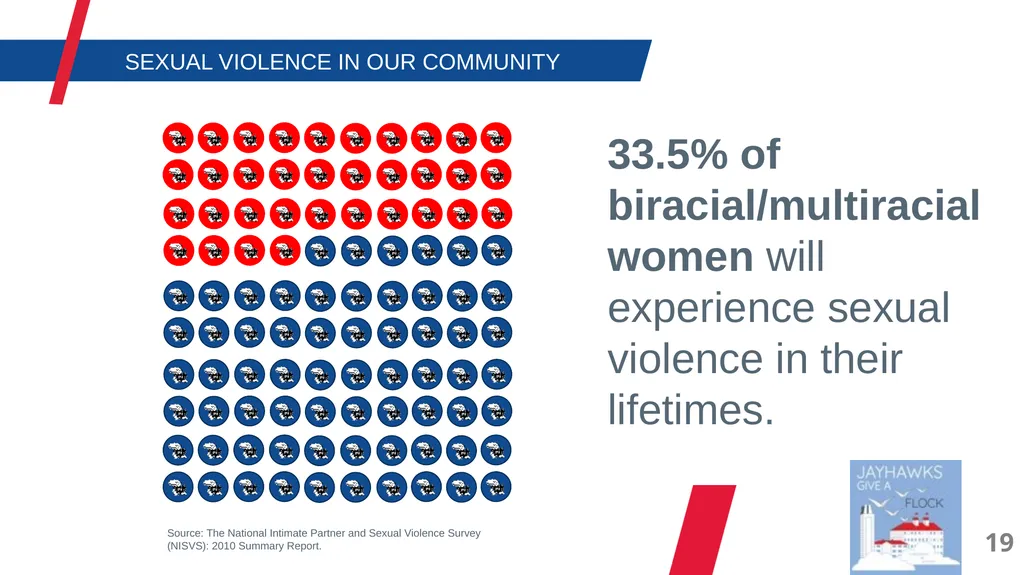
SEXUAL VIOLENCE IN OUR COMMUNITY 33.5% of biracial/multiracial women will experience sexual violence in their lifetimes. Source: The National Intimate Partner and Sexual Violence Survey (NISVS): 2010 Summary Report. 19<br>
21
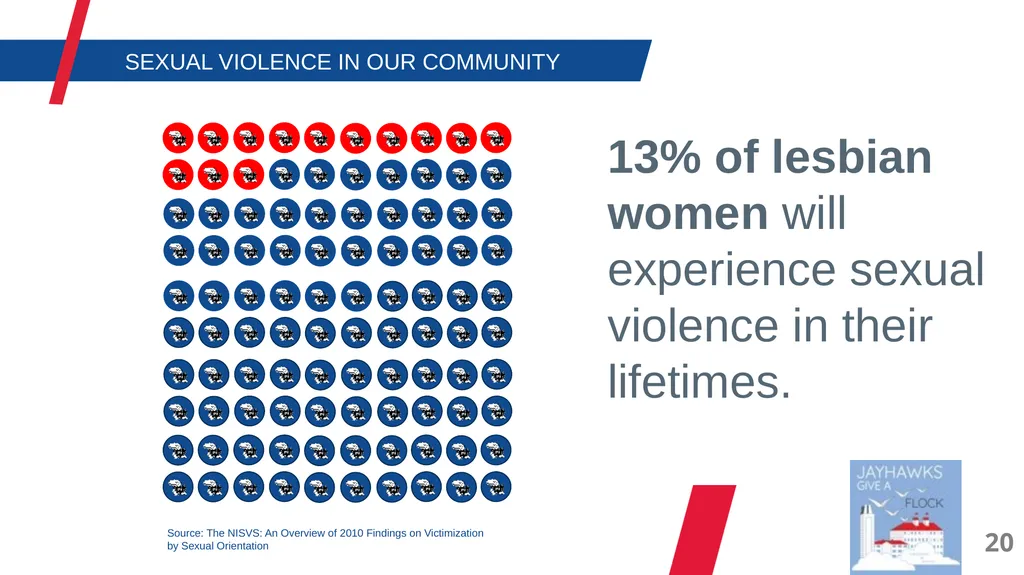
SEXUAL VIOLENCE IN OUR COMMUNITY 13% of lesbian women will experience sexual violence in their lifetimes. Source: The NISVS: An Overview of 2010 Findings on Victimization by Sexual Orientation 20<br>
22
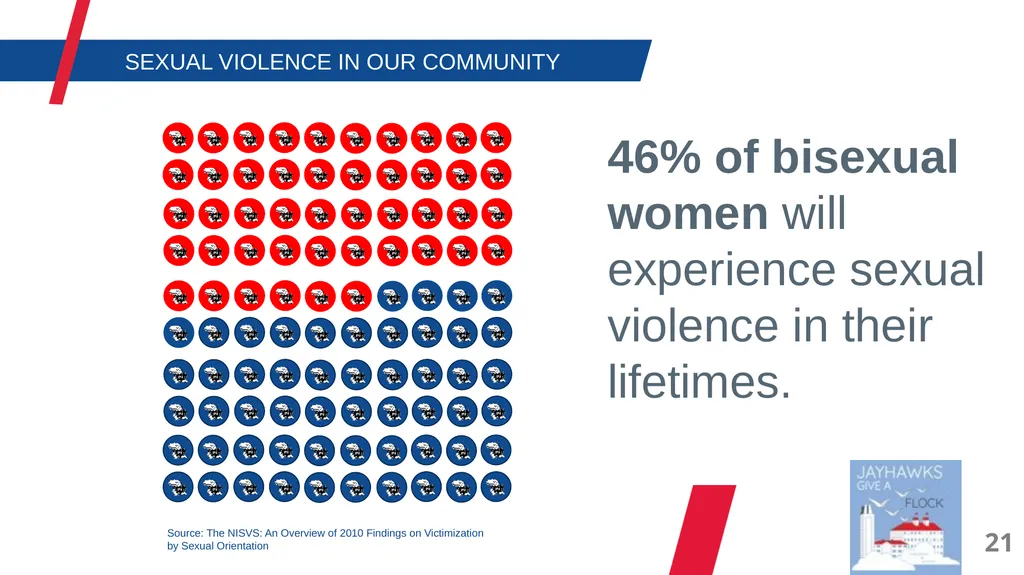
SEXUAL VIOLENCE IN OUR COMMUNITY 46% of bisexual women will experience sexual violence in their lifetimes. Source: The NISVS: An Overview of 2010 Findings on Victimization by Sexual Orientation 21<br>
23
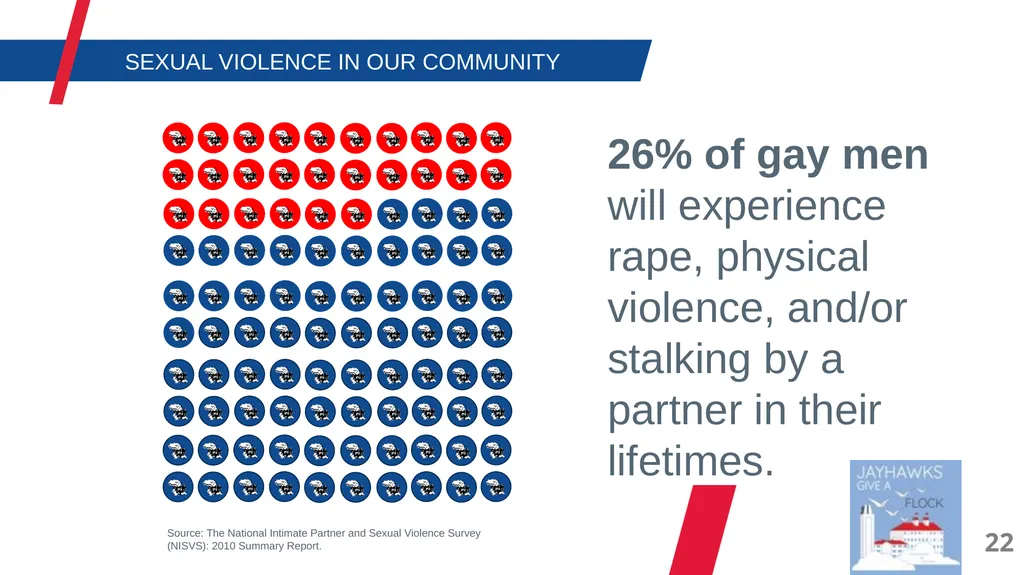
SEXUAL VIOLENCE IN OUR COMMUNITY 26% of gay men will experience rape, physical violence, and/or stalking by a partner in their lifetimes. Source: The National Intimate Partner and Sexual Violence Survey (NISVS): 2010 Summary Report. 22<br>
24
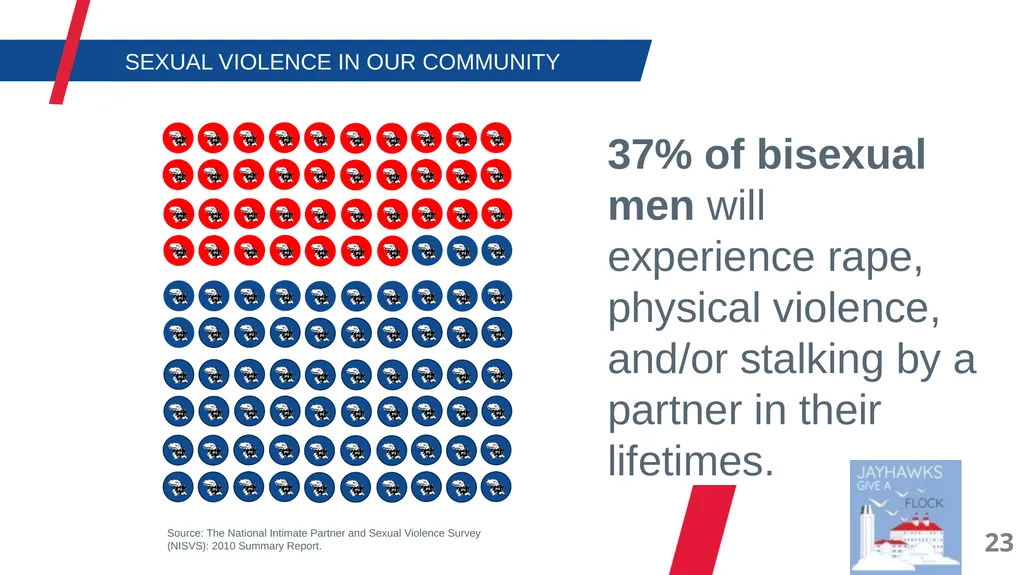
SEXUAL VIOLENCE IN OUR COMMUNITY 37% of bisexual men will experience rape, physical violence, and/or stalking by a partner in their lifetimes. Source: The National Intimate Partner and Sexual Violence Survey (NISVS): 2010 Summary Report. 23<br>
25
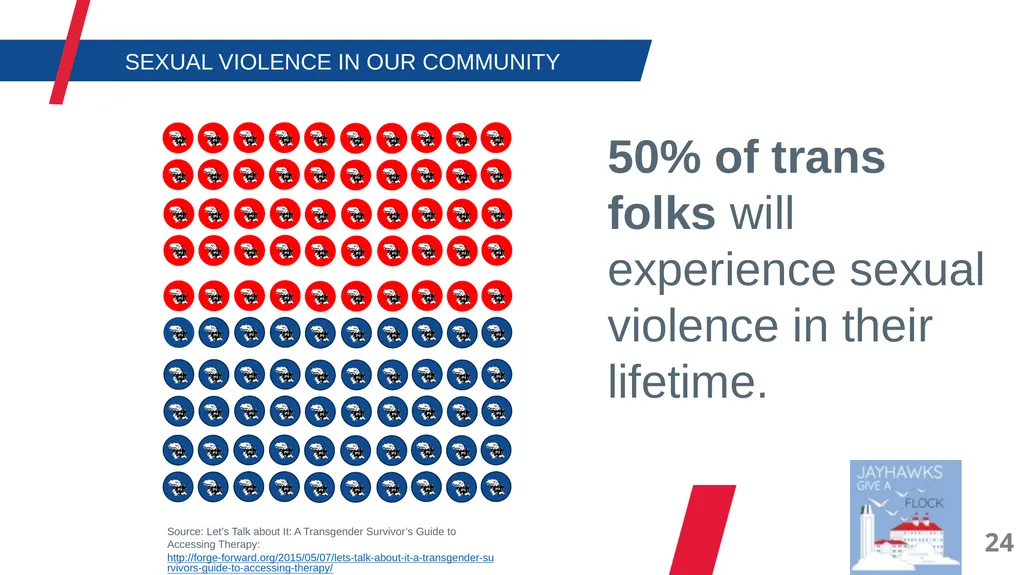
SEXUAL VIOLENCE IN OUR COMMUNITY 50% of trans folks will experience sexual violence in their lifetime. Source: Let’s Talk about It: A Transgender Survivor’s Guide to Accessing Therapy: http://forge-forward.org/2015/05/07/lets-talk-about-it-a-transgender-survivors-guide-to-accessing-therapy/ 24<br>
26
RAPE CULTURE IN SOCIETY RAPE CULTURE:
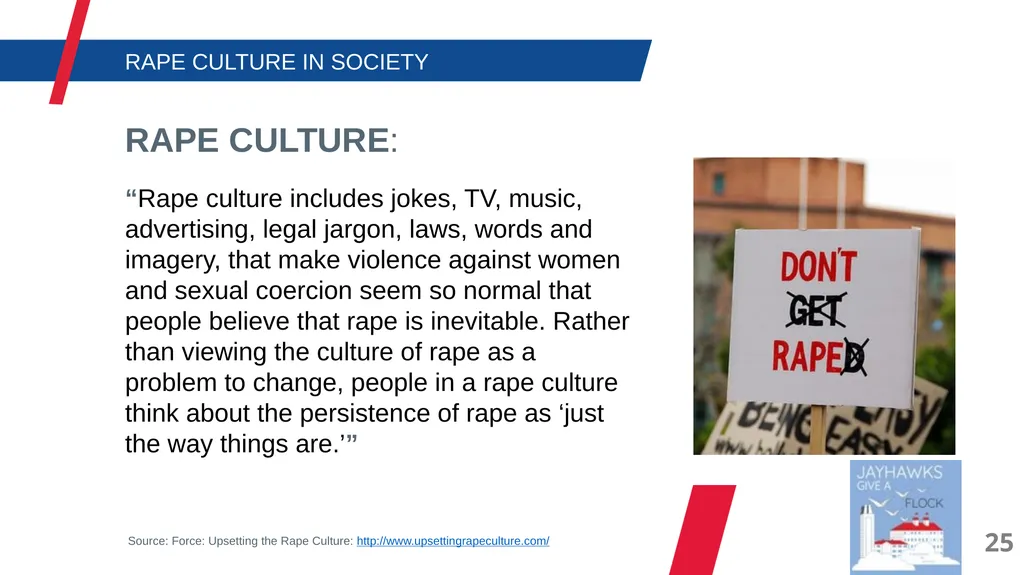
“Rape culture includes jokes, TV, music, advertising, legal jargon, laws, words and imagery, that make violence against women and sexual coercion seem so normal that people believe that rape is inevitable. Rather than viewing the culture of rape as a problem to change, people in a rape culture think about the persistence of rape as ‘just the way things are.’” Source: Force: Upsetting the Rape Culture: http://www.upsettingrapeculture.com/ 25<br>
“Rape culture includes jokes, TV, music, advertising, legal jargon, laws, words and imagery, that make violence against women and sexual coercion seem so normal that people believe that rape is inevitable. Rather than viewing the culture of rape as a problem to change, people in a rape culture think about the persistence of rape as ‘just the way things are.’” Source: Force: Upsetting the Rape Culture: http://www.upsettingrapeculture.com/ 25<br>
27
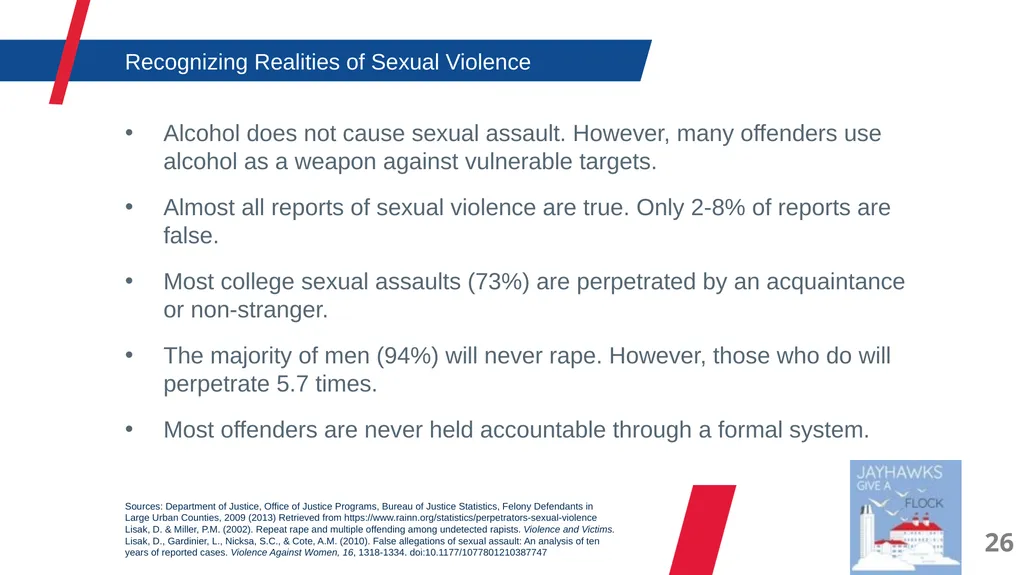
Recognizing Realities of Sexual Violence Alcohol does not cause sexual assault. However, many offenders use alcohol as a weapon against vulnerable targets.
Almost all reports of sexual violence are true. Only 2-8% of reports are false.
Most college sexual assaults (73%) are perpetrated by an acquaintance or non-stranger.
The majority of men (94%) will never rape. However, those who do will perpetrate 5.7 times.
Most offenders are never held accountable through a formal system.
Sources: Department of Justice, Office of Justice Programs, Bureau of Justice Statistics, Felony Defendants in Large Urban Counties, 2009 (2013) Retrieved from https://www.rainn.org/statistics/perpetrators-sexual-violence
Lisak, D. & Miller, P.M. (2002). Repeat rape and multiple offending among undetected rapists. Violence and Victims. Lisak, D., Gardinier, L., Nicksa, S.C., & Cote, A.M. (2010). False allegations of sexual assault: An analysis of ten years of reported cases. Violence Against Women, 16, 1318-1334. doi:10.1177/1077801210387747 26<br>
Almost all reports of sexual violence are true. Only 2-8% of reports are false.
Most college sexual assaults (73%) are perpetrated by an acquaintance or non-stranger.
The majority of men (94%) will never rape. However, those who do will perpetrate 5.7 times.
Most offenders are never held accountable through a formal system.
Sources: Department of Justice, Office of Justice Programs, Bureau of Justice Statistics, Felony Defendants in Large Urban Counties, 2009 (2013) Retrieved from https://www.rainn.org/statistics/perpetrators-sexual-violence
Lisak, D. & Miller, P.M. (2002). Repeat rape and multiple offending among undetected rapists. Violence and Victims. Lisak, D., Gardinier, L., Nicksa, S.C., & Cote, A.M. (2010). False allegations of sexual assault: An analysis of ten years of reported cases. Violence Against Women, 16, 1318-1334. doi:10.1177/1077801210387747 26<br>
28
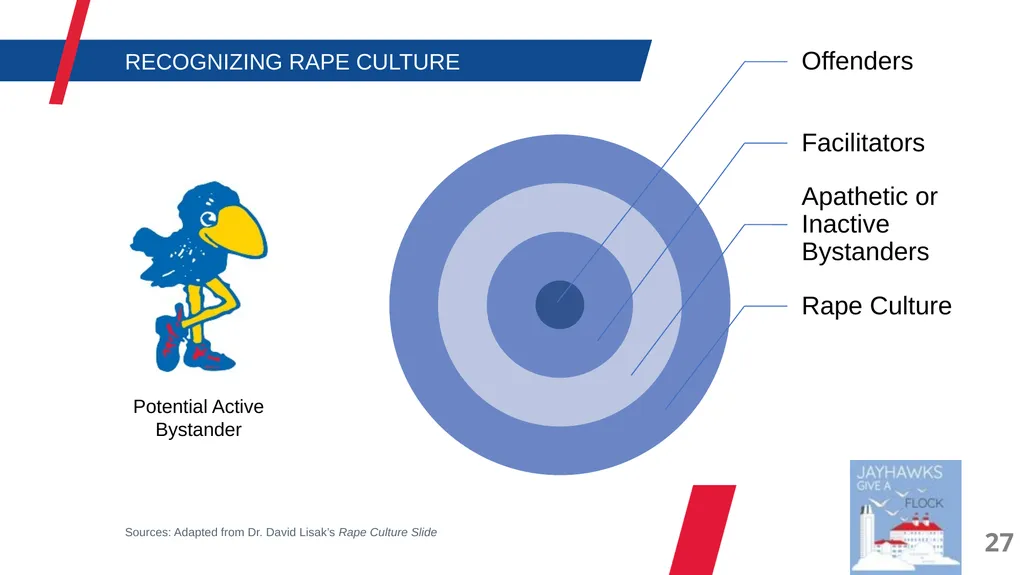
RECOGNIZING RAPE CULTURE Sources: Adapted from Dr. David Lisak’s Rape Culture Slide Potential Active
Bystander 27<br>
Bystander 27<br>
29
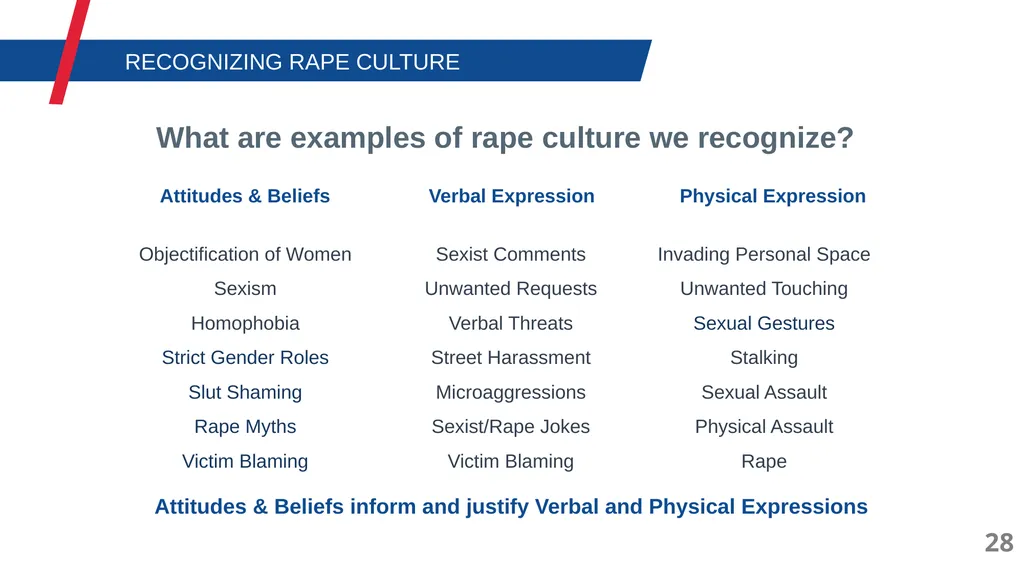
RECOGNIZING RAPE CULTURE What are examples of rape culture we recognize? Objectification of Women
Sexism
Homophobia
Strict Gender Roles
Slut Shaming
Rape Myths
Victim Blaming Sexist Comments
Unwanted Requests
Verbal Threats
Street Harassment
Microaggressions
Sexist/Rape Jokes
Victim Blaming Invading Personal Space
Unwanted Touching
Sexual Gestures
Stalking
Sexual Assault
Physical Assault
Rape Attitudes & Beliefs Verbal Expression Physical Expression Attitudes & Beliefs inform and justify Verbal and Physical Expressions 28<br>
Sexism
Homophobia
Strict Gender Roles
Slut Shaming
Rape Myths
Victim Blaming Sexist Comments
Unwanted Requests
Verbal Threats
Street Harassment
Microaggressions
Sexist/Rape Jokes
Victim Blaming Invading Personal Space
Unwanted Touching
Sexual Gestures
Stalking
Sexual Assault
Physical Assault
Rape Attitudes & Beliefs Verbal Expression Physical Expression Attitudes & Beliefs inform and justify Verbal and Physical Expressions 28<br>
30
STEP TWO: IDENTIFY the barriers and determine how to intervene safely 29<br>
31
What Prevents People from Intervening? 30<br>
32
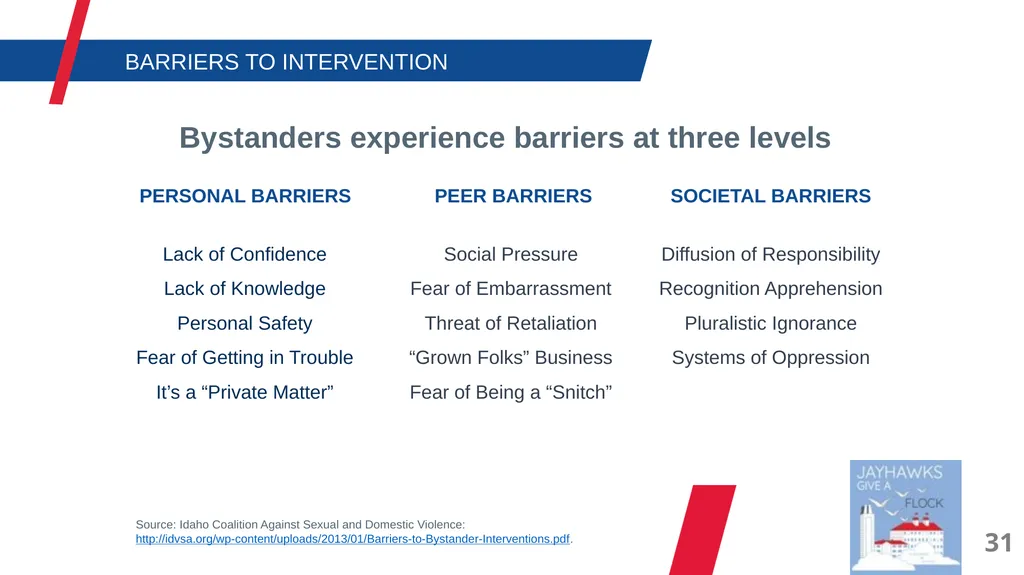
BARRIERS TO INTERVENTION Bystanders experience barriers at three levels Lack of Confidence
Lack of Knowledge
Personal Safety
Fear of Getting in Trouble
It’s a “Private Matter” Social Pressure
Fear of Embarrassment
Threat of Retaliation
“Grown Folks” Business
Fear of Being a “Snitch” Diffusion of Responsibility
Recognition Apprehension
Pluralistic Ignorance
Systems of Oppression PERSONAL BARRIERS PEER BARRIERS SOCIETAL BARRIERS Source: Idaho Coalition Against Sexual and Domestic Violence: http://idvsa.org/wp-content/uploads/2013/01/Barriers-to-Bystander-Interventions.pdf. 31<br>
Lack of Knowledge
Personal Safety
Fear of Getting in Trouble
It’s a “Private Matter” Social Pressure
Fear of Embarrassment
Threat of Retaliation
“Grown Folks” Business
Fear of Being a “Snitch” Diffusion of Responsibility
Recognition Apprehension
Pluralistic Ignorance
Systems of Oppression PERSONAL BARRIERS PEER BARRIERS SOCIETAL BARRIERS Source: Idaho Coalition Against Sexual and Domestic Violence: http://idvsa.org/wp-content/uploads/2013/01/Barriers-to-Bystander-Interventions.pdf. 31<br>
33
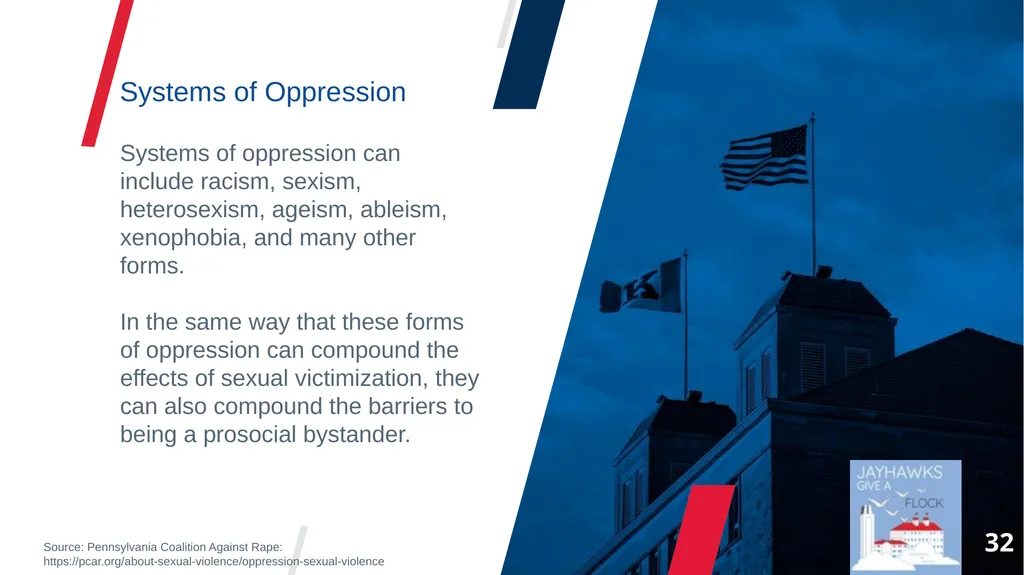
Systems of Oppression
Systems of oppression can include racism, sexism, heterosexism, ageism, ableism, xenophobia, and many other forms.
In the same way that these forms of oppression can compound the effects of sexual victimization, they can also compound the barriers to being a prosocial bystander. 32 Source: Pennsylvania Coalition Against Rape: https://pcar.org/about-sexual-violence/oppression-sexual-violence<br>
Systems of oppression can include racism, sexism, heterosexism, ageism, ableism, xenophobia, and many other forms.
In the same way that these forms of oppression can compound the effects of sexual victimization, they can also compound the barriers to being a prosocial bystander. 32 Source: Pennsylvania Coalition Against Rape: https://pcar.org/about-sexual-violence/oppression-sexual-violence<br>
34
How does identity affect how we intervene? 33<br>
35
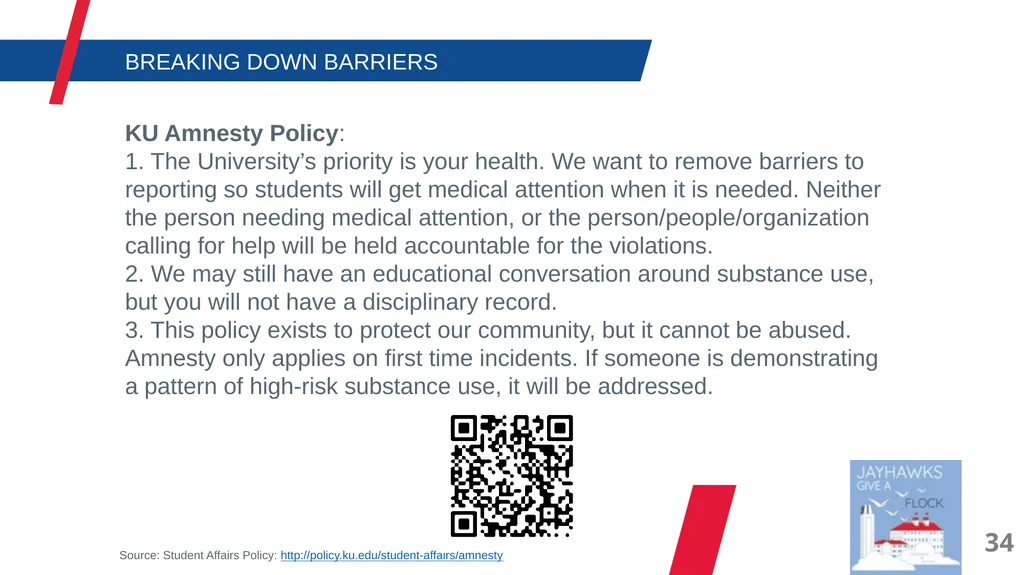
BREAKING DOWN BARRIERS KU Amnesty Policy:
1. The University’s priority is your health. We want to remove barriers to reporting so students will get medical attention when it is needed. Neither the person needing medical attention, or the person/people/organization calling for help will be held accountable for the violations.
2. We may still have an educational conversation around substance use, but you will not have a disciplinary record.
3. This policy exists to protect our community, but it cannot be abused. Amnesty only applies on first time incidents. If someone is demonstrating a pattern of high-risk substance use, it will be addressed. Source: Student Affairs Policy: http://policy.ku.edu/student-affairs/amnesty 34<br>
1. The University’s priority is your health. We want to remove barriers to reporting so students will get medical attention when it is needed. Neither the person needing medical attention, or the person/people/organization calling for help will be held accountable for the violations.
2. We may still have an educational conversation around substance use, but you will not have a disciplinary record.
3. This policy exists to protect our community, but it cannot be abused. Amnesty only applies on first time incidents. If someone is demonstrating a pattern of high-risk substance use, it will be addressed. Source: Student Affairs Policy: http://policy.ku.edu/student-affairs/amnesty 34<br>
36
WHO’S IN YOUR FLOCK?
Often, we can intervene more effectively when we work together.
Thinking about the people with whom you surround yourself, who can you turn to for help with a situation?
Are you that person for others? How so? 35<br>
Often, we can intervene more effectively when we work together.
Thinking about the people with whom you surround yourself, who can you turn to for help with a situation?
Are you that person for others? How so? 35<br>
37
STEP THREE: INTERVENE with others and take action 36<br>
38
STRATEGIES FOR INTERVENTION:
DELEGATE
DISTRACT
DIRECT
DOCUMENTATION+ 37 Source: Vector Solutions<br>
DELEGATE
DISTRACT
DIRECT
DOCUMENTATION+ 37 Source: Vector Solutions<br>
39
DELEGATE
Asking for help from another individual or individuals and developing a plan where some or all play a role in intervening.
This can include:
Find friends to intervene together.
Alert a friend of the potential victim and assist in intervening.
Seek someone you don’t know but who is authorized to represent others or address issues. 38 Source: Vector Solutions<br>
Asking for help from another individual or individuals and developing a plan where some or all play a role in intervening.
This can include:
Find friends to intervene together.
Alert a friend of the potential victim and assist in intervening.
Seek someone you don’t know but who is authorized to represent others or address issues. 38 Source: Vector Solutions<br>
40
DISTRACT
Interrupting the situation without directly confronting the offender by creating a distraction.
This can include:
Establishing a relationship with someone
Making something up
Suggesting an alternate activity 39 Source: Vector Solutions<br>
Interrupting the situation without directly confronting the offender by creating a distraction.
This can include:
Establishing a relationship with someone
Making something up
Suggesting an alternate activity 39 Source: Vector Solutions<br>
41
DIRECT
Talk to directly, in the moment, to prevent a problem situation from happening.
This can include:
Create a space or a timeout.
Check in regularly with potential victim or offender.
Give them different options to remove them from the situation. 40 Source: Vector Solutions<br>
Talk to directly, in the moment, to prevent a problem situation from happening.
This can include:
Create a space or a timeout.
Check in regularly with potential victim or offender.
Give them different options to remove them from the situation. 40 Source: Vector Solutions<br>
42
DOCUMENT
Record and/or take notes during an incident
This can include:
Video recording
Screenshots
Items to remember:
You should seek consent from the victim/survivor before you begin documenting.
Document is an and not an only.
Keep your attention on the person experiencing harm and make sure the documentation is focused on supporting them. Source: Think About it online training: https://sapec.ku.edu/ThinkAboutIt 41<br>
Record and/or take notes during an incident
This can include:
Video recording
Screenshots
Items to remember:
You should seek consent from the victim/survivor before you begin documenting.
Document is an and not an only.
Keep your attention on the person experiencing harm and make sure the documentation is focused on supporting them. Source: Think About it online training: https://sapec.ku.edu/ThinkAboutIt 41<br>
43
STEP FOUR: FOLLOW UP and determine what support and/
or accountability is needed 42<br>
44
Three things you should say to a survivor of sexual assault:
I believe you.
It’s not your fault.
How can I be helpful right now? SUPPORTING SURVIVORS 43<br>
I believe you.
It’s not your fault.
How can I be helpful right now? SUPPORTING SURVIVORS 43<br>
45
Reporting: Confidential Support: CAMPUS AND COMMUNITY RESOURCES 44 TAKE A PIC OF THIS SLIDE! Free Late-Night Rides Home: KU SafeRide
Download the ‘KU SafeRide’ App Office of Civil Rights & Title IX
785-864-6414 • civilrights.ku.edu
KU Report It
785-864-3710 • reportit.ku.edu KU Care Services
785-864-9255 • careservices.ku.edu KU Counseling and Psychological Services (CAPS) 785-864-2277 • caps.ku.edu The Sexual Trauma & Abuse Care Center
785-843-8985 (24/7) • stacarecenter.org<br>
KU Report It
785-864-3710 • reportit.ku.edu KU Care Services
785-864-9255 • careservices.ku.edu KU Counseling and Psychological Services (CAPS) 785-864-2277 • caps.ku.edu The Sexual Trauma & Abuse Care Center
785-843-8985 (24/7) • stacarecenter.org<br>
46
What issue or issues do you RECOGNIZE in this situation?
What barriers can you IDENTIFY and how can you safely intervene with others?
How would you and your group members INTERVENE in this situation? (Hint: Delegate, Distract, or Direct, and Document)
How would you FOLLOW-UP with both individuals involved? GROUP QUESTIONS 45<br>
What barriers can you IDENTIFY and how can you safely intervene with others?
How would you and your group members INTERVENE in this situation? (Hint: Delegate, Distract, or Direct, and Document)
How would you FOLLOW-UP with both individuals involved? GROUP QUESTIONS 45<br>
47
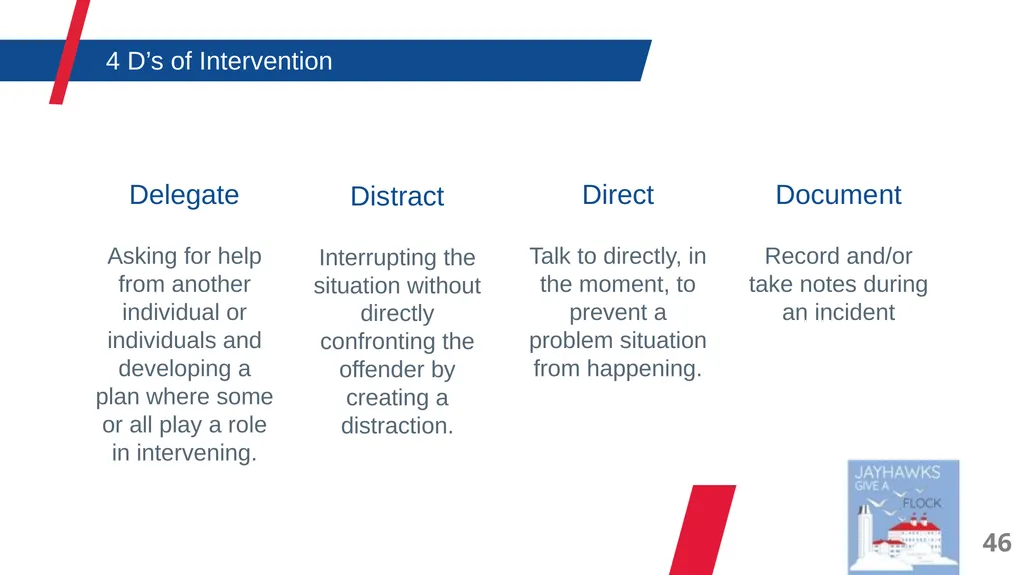
4 D’s of Intervention Delegate
Asking for help from another individual or individuals and developing a plan where some or all play a role in intervening. Distract
Interrupting the situation without directly confronting the offender by creating a distraction. Direct
Talk to directly, in the moment, to prevent a problem situation from happening. Document
Record and/or take notes during an incident 46<br>
Asking for help from another individual or individuals and developing a plan where some or all play a role in intervening. Distract
Interrupting the situation without directly confronting the offender by creating a distraction. Direct
Talk to directly, in the moment, to prevent a problem situation from happening. Document
Record and/or take notes during an incident 46<br>
48
What issue or issues do you RECOGNIZE in this situation?
What barriers can you IDENTIFY and how can you safely intervene with others?
How would you and your group members INTERVENE in this situation? (Hint: Delegate, Distract, or Direct, and Document)
How would you FOLLOW-UP with both individuals involved? GROUP DEBRIEF 47<br>
What barriers can you IDENTIFY and how can you safely intervene with others?
How would you and your group members INTERVENE in this situation? (Hint: Delegate, Distract, or Direct, and Document)
How would you FOLLOW-UP with both individuals involved? GROUP DEBRIEF 47<br>
49
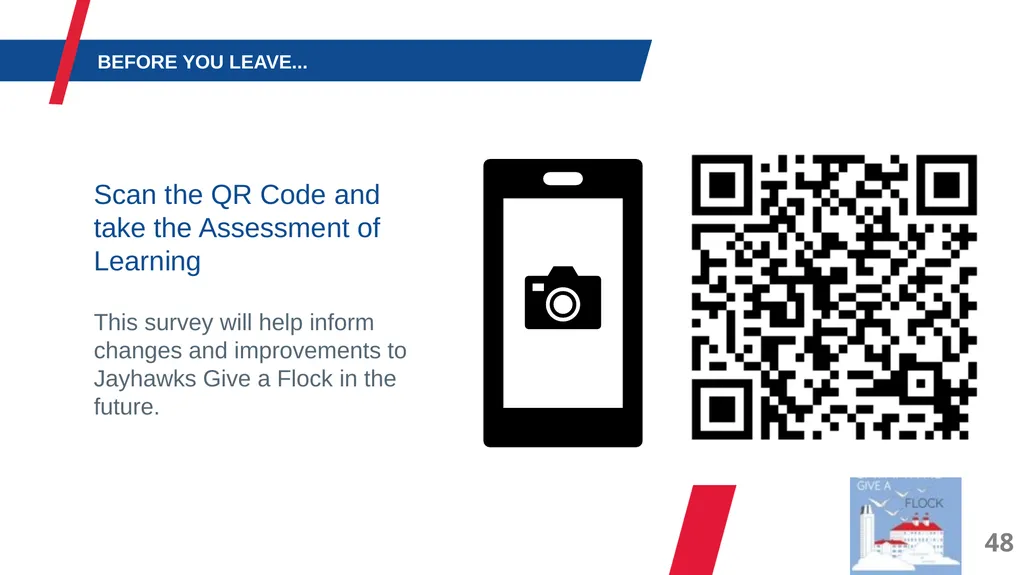
BEFORE YOU LEAVE... Scan the QR Code and take the Assessment of Learning
This survey will help inform changes and improvements to Jayhawks Give a Flock in the future. 48<br>
This survey will help inform changes and improvements to Jayhawks Give a Flock in the future. 48<br>