
Hazardous Materials Business Plan Training Program
Description: Hazardous Materials Business Plan Training Program Introduction All facilities subject to the Hazardous Materials Business Plan (HMBP) Program must have a training program and a written employee training plan for hazardous materials safety
Related Topics
Download Presentation
"Hazardous Materials Business Plan Training Program" is the property of its rightful owner. Permission is granted to download and print the materials on this website for personal, non-commercial use only, and to display it on your personal computer provided you do not modify the materials and that you retain all copyright notices contained in the materials. By downloading content from our website, you accept the terms of this agreement.
Presentation Transcript
slide1. Hazardous Materials Business Plan Training Program<br>
slide2. Introduction All facilities subject to the Hazardous Materials Business Plan (HMBP) Program must have a training program and a written employee training plan for hazardous materials safety and emergency response. Initial training is required for new employees within 30 days from date of hire followed by annual refresher training. Training to include:
Procedures for safe handling of hazardous materials/waste
Use of emergency response equipment and materials
Emergency response procedures<br>
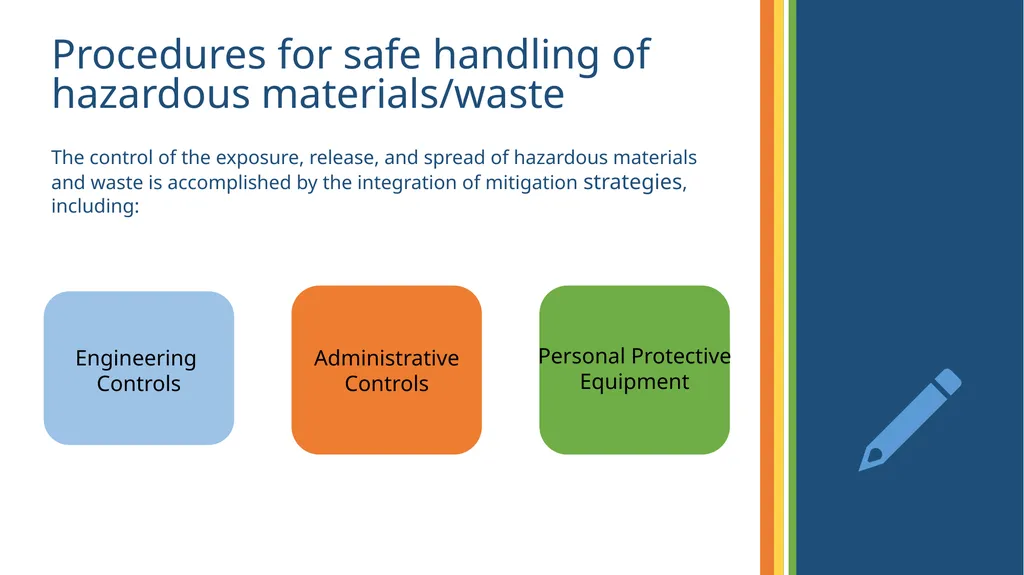
slide3. Procedures for safe handling of hazardous materials/waste The control of the exposure, release, and spread of hazardous materials and waste is accomplished by the integration of mitigation strategies, including: Engineering
Controls Administrative Controls Personal Protective Equipment<br>
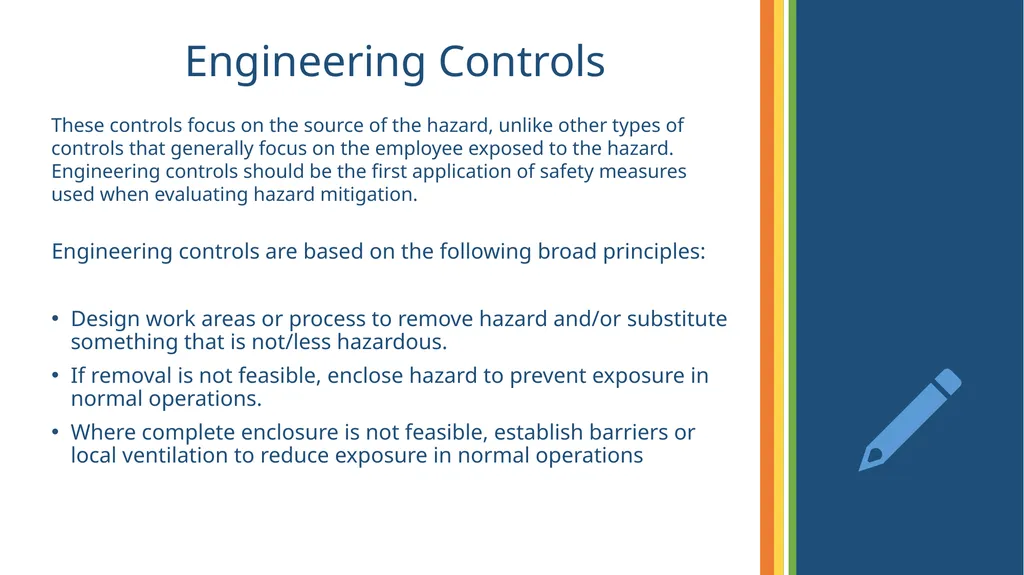
slide4. Engineering Controls Engineering controls are based on the following broad principles:
Design work areas or process to remove hazard and/or substitute something that is not/less hazardous.
If removal is not feasible, enclose hazard to prevent exposure in normal operations.
Where complete enclosure is not feasible, establish barriers or local ventilation to reduce exposure in normal operations These controls focus on the source of the hazard, unlike other types of controls that generally focus on the employee exposed to the hazard. Engineering controls should be the first application of safety measures used when evaluating hazard mitigation.<br>
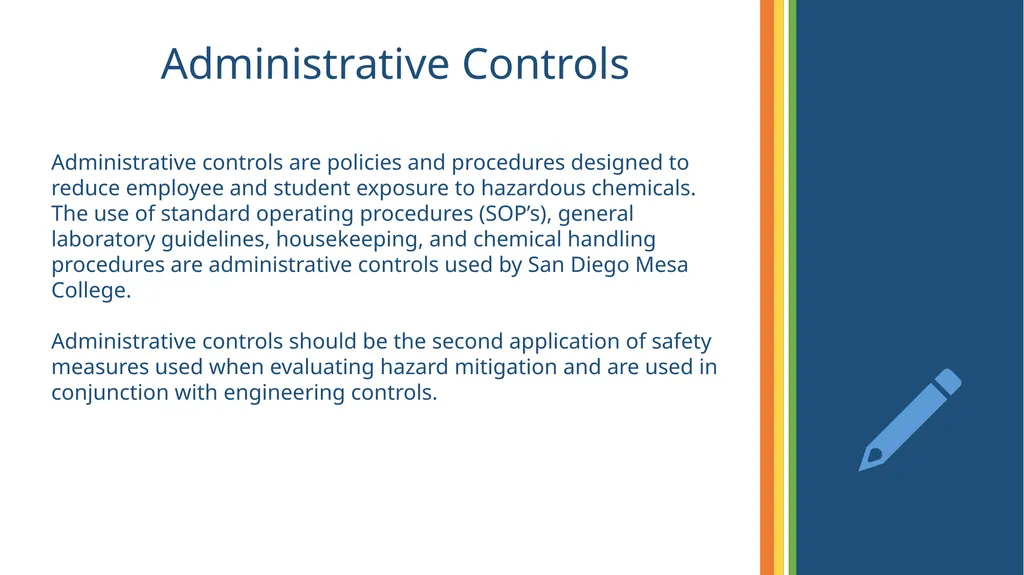
slide5. Administrative Controls Administrative controls are policies and procedures designed to reduce employee and student exposure to hazardous chemicals. The use of standard operating procedures (SOP’s), general laboratory guidelines, housekeeping, and chemical handling procedures are administrative controls used by San Diego Mesa College.
Administrative controls should be the second application of safety measures used when evaluating hazard mitigation and are used in conjunction with engineering controls.<br>
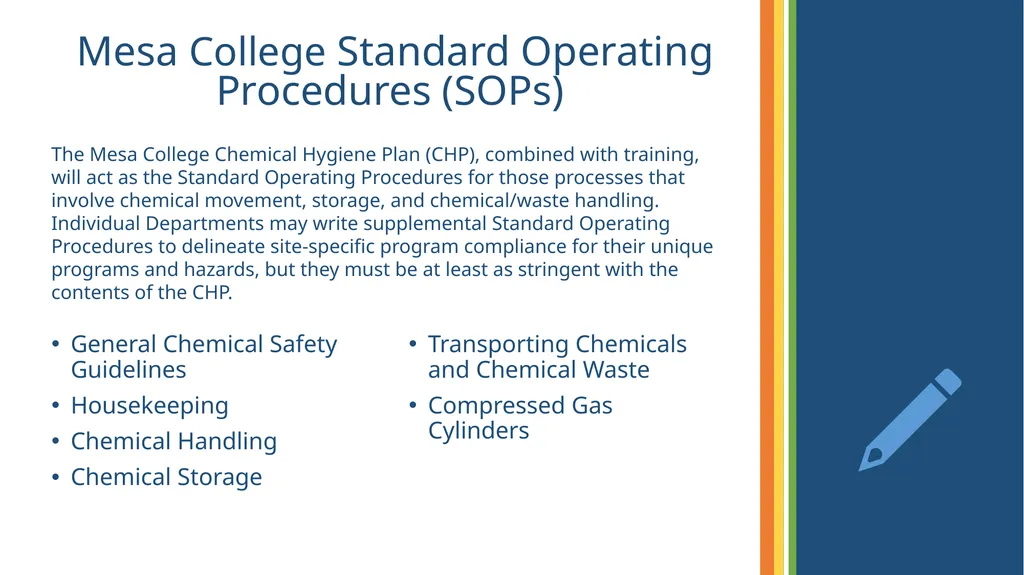
slide6. Mesa College Standard Operating Procedures (SOPs) The Mesa College Chemical Hygiene Plan (CHP), combined with training, will act as the Standard Operating Procedures for those processes that involve chemical movement, storage, and chemical/waste handling. Individual Departments may write supplemental Standard Operating Procedures to delineate site-specific program compliance for their unique programs and hazards, but they must be at least as stringent with the contents of the CHP. General Chemical Safety Guidelines
Housekeeping
Chemical Handling
Chemical Storage Transporting Chemicals and Chemical Waste
Compressed Gas Cylinders<br>
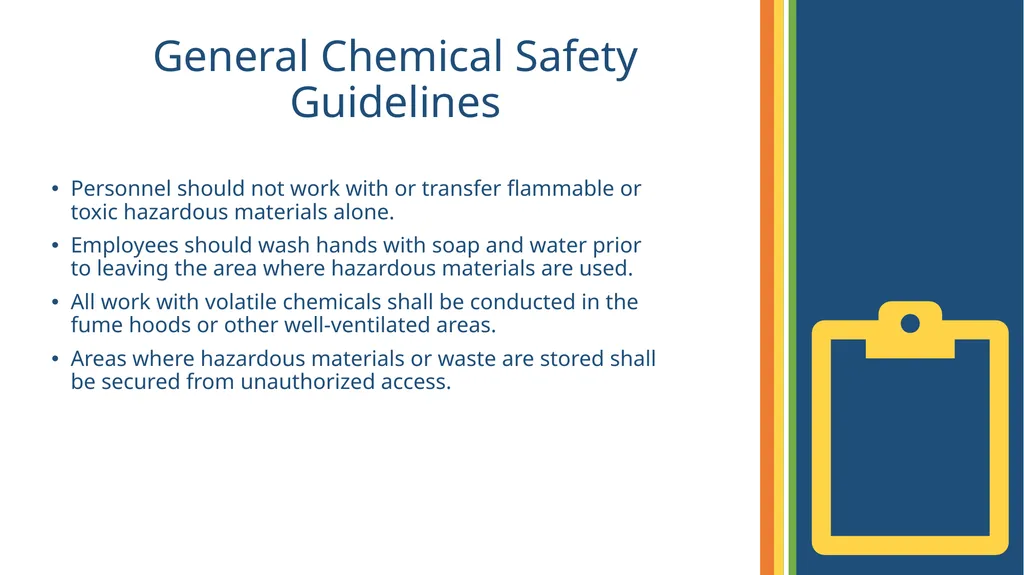
slide7. General Chemical Safety Guidelines Personnel should not work with or transfer flammable or toxic hazardous materials alone.
Employees should wash hands with soap and water prior to leaving the area where hazardous materials are used.
All work with volatile chemicals shall be conducted in the fume hoods or other well-ventilated areas.
Areas where hazardous materials or waste are stored shall be secured from unauthorized access.<br>
slide8. Housekeeping All doorways, walkways and staircases are to remain clear and free from obstructions, chemicals, or hazardous waste.
The area around eyewashes and safety showers shall always remain clear of obstructions to a distance of at least twenty-four (24) inches.
Areas shall be kept clean and neat.
Small drips or spills of chemicals shall be wiped up immediately using appropriate PPE and proper materials for the chemical.
Materials used for cleaning spills shall be disposed of as hazardous waste.<br>
slide9. Chemical Handling Chemical handling is the application of best practices to minimize the risk in using, moving, or transferring chemicals. The basis of safe chemical handling is being aware of what chemicals are present in the workplace and their associated hazards.<br>
slide10. Chemical Inventory The Hazardous Communication Standard requires a current chemical inventory in areas that use or store hazardous materials. Each department will update its Chemical inventory, have a hard copy available in the area the chemicals are stored, and submit a copy to the OEHS Coordinator no later than January 31 of each calendar year.
Mesa College’s chemical inventory format has been standardized and each department must use the standardized format when creating a chemical inventory. If there are any questions or concerns about the format or process, contact the campus OEHS Coordinator.
Every hazardous chemical that is used on the Mesa campus must have a corresponding SDS.<br>
slide11. Receiving Chemicals No “outside” donations of chemicals, either new or partially consumed can be excepted
All chemicals shall have the date received, person receiving, and the date they were opened written on the label.
As applicable, expiration dates shall be written on the container label.<br>
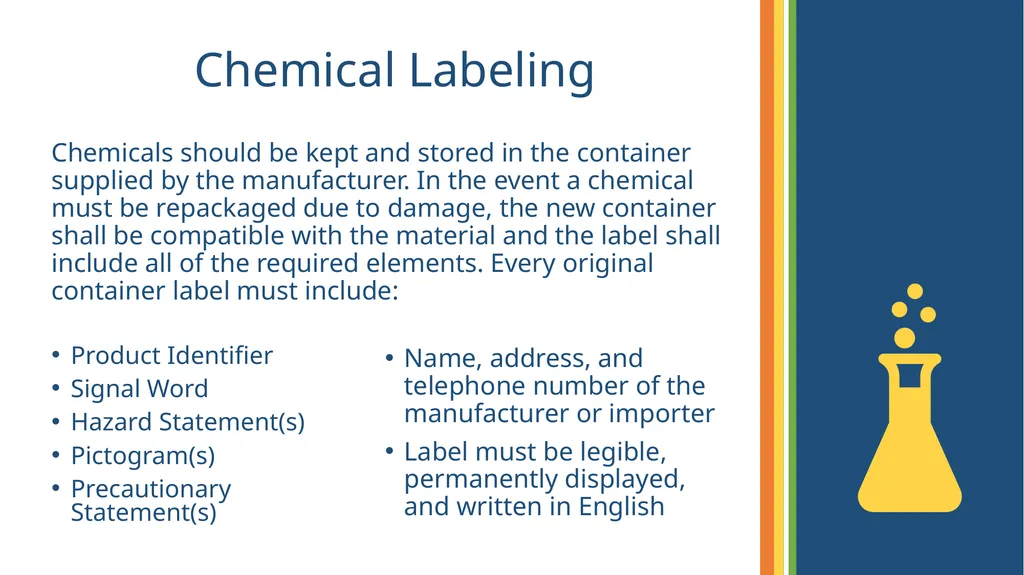
slide12. Chemical Labeling Chemicals should be kept and stored in the container supplied by the manufacturer. In the event a chemical must be repackaged due to damage, the new container shall be compatible with the material and the label shall include all of the required elements. Every original container label must include: Product Identifier
Signal Word
Hazard Statement(s)
Pictogram(s)
Precautionary Statement(s) Name, address, and telephone number of the manufacturer or importer
Label must be legible, permanently displayed, and written in English<br>
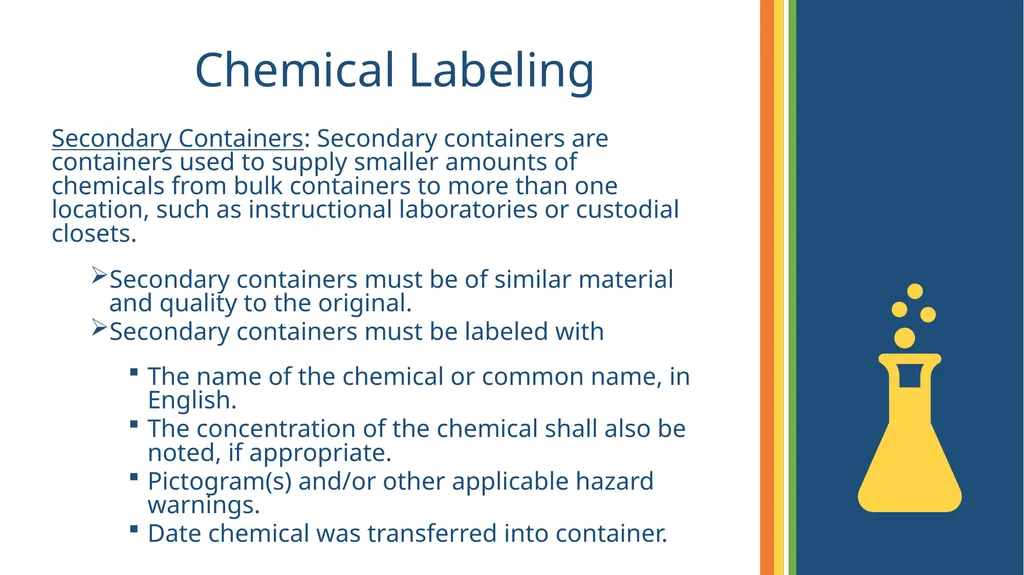
slide13. Chemical Labeling Secondary Containers: Secondary containers are containers used to supply smaller amounts of chemicals from bulk containers to more than one location, such as instructional laboratories or custodial closets.
Secondary containers must be of similar material and quality to the original.
Secondary containers must be labeled with
The name of the chemical or common name, in English.
The concentration of the chemical shall also be noted, if appropriate.
Pictogram(s) and/or other applicable hazard warnings.
Date chemical was transferred into container.<br>
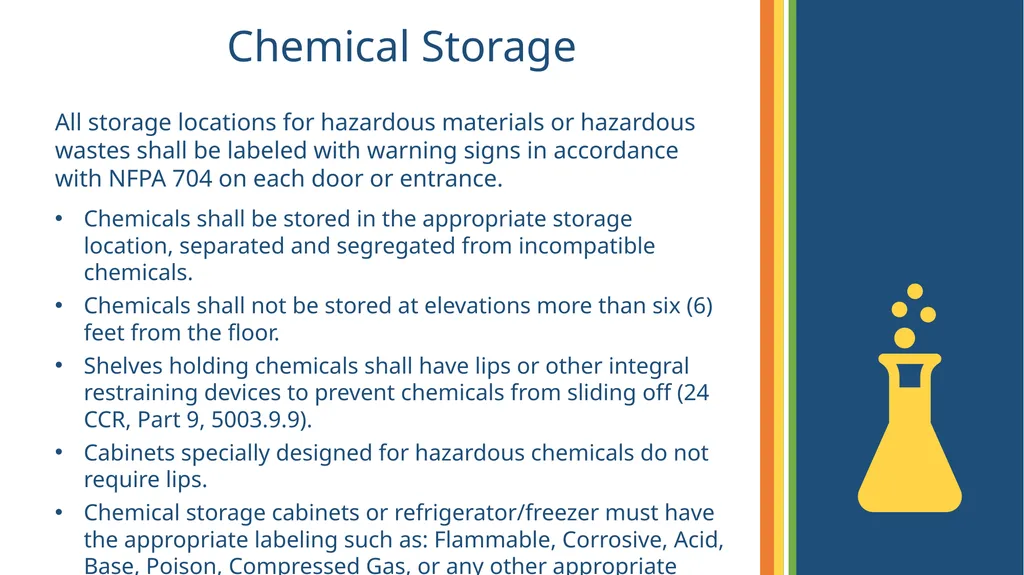
slide14. Chemical Storage All storage locations for hazardous materials or hazardous wastes shall be labeled with warning signs in accordance with NFPA 704 on each door or entrance.
Chemicals shall be stored in the appropriate storage location, separated and segregated from incompatible chemicals.
Chemicals shall not be stored at elevations more than six (6) feet from the floor.
Shelves holding chemicals shall have lips or other integral restraining devices to prevent chemicals from sliding off (24 CCR, Part 9, 5003.9.9).
Cabinets specially designed for hazardous chemicals do not require lips.
Chemical storage cabinets or refrigerator/freezer must have the appropriate labeling such as: Flammable, Corrosive, Acid, Base, Poison, Compressed Gas, or any other appropriate identifier<br>
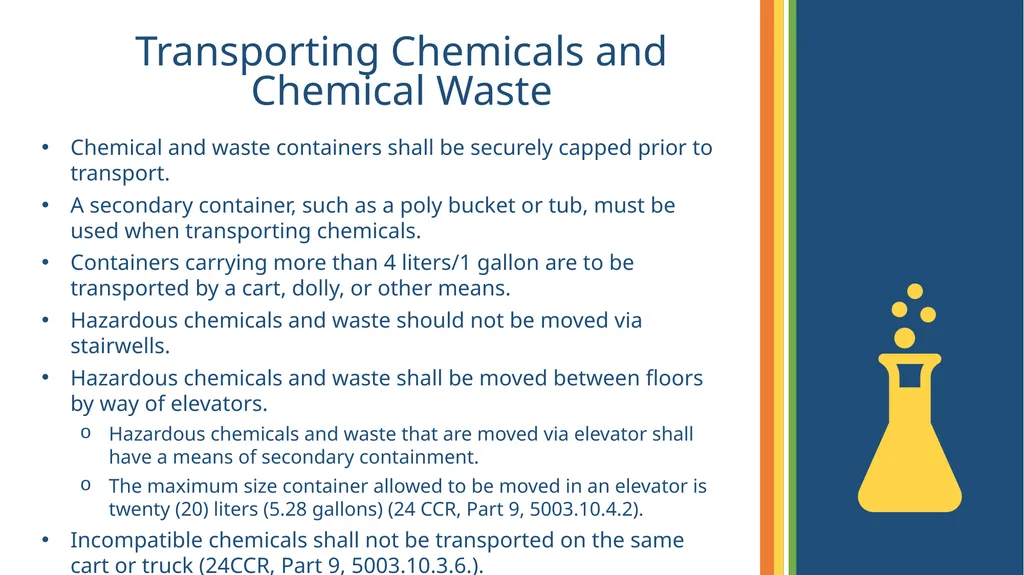
slide15. Transporting Chemicals and Chemical Waste Chemical and waste containers shall be securely capped prior to transport.
A secondary container, such as a poly bucket or tub, must be used when transporting chemicals.
Containers carrying more than 4 liters/1 gallon are to be transported by a cart, dolly, or other means.
Hazardous chemicals and waste should not be moved via stairwells.
Hazardous chemicals and waste shall be moved between floors by way of elevators.
Hazardous chemicals and waste that are moved via elevator shall have a means of secondary containment.
The maximum size container allowed to be moved in an elevator is twenty (20) liters (5.28 gallons) (24 CCR, Part 9, 5003.10.4.2).
Incompatible chemicals shall not be transported on the same cart or truck (24CCR, Part 9, 5003.10.3.6.).<br>
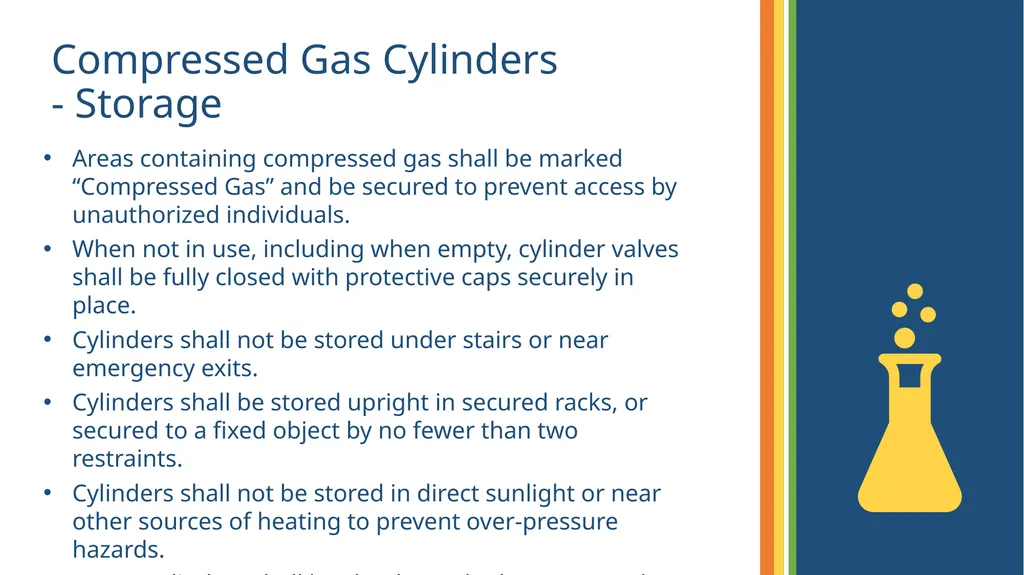
slide16. Compressed Gas Cylinders - Storage Areas containing compressed gas shall be marked “Compressed Gas” and be secured to prevent access by unauthorized individuals.
When not in use, including when empty, cylinder valves shall be fully closed with protective caps securely in place.
Cylinders shall not be stored under stairs or near emergency exits.
Cylinders shall be stored upright in secured racks, or secured to a fixed object by no fewer than two restraints.
Cylinders shall not be stored in direct sunlight or near other sources of heating to prevent over-pressure hazards.
Empty cylinders shall be clearly marked “Empty” and stored separately from full or in-use cylinders.<br>
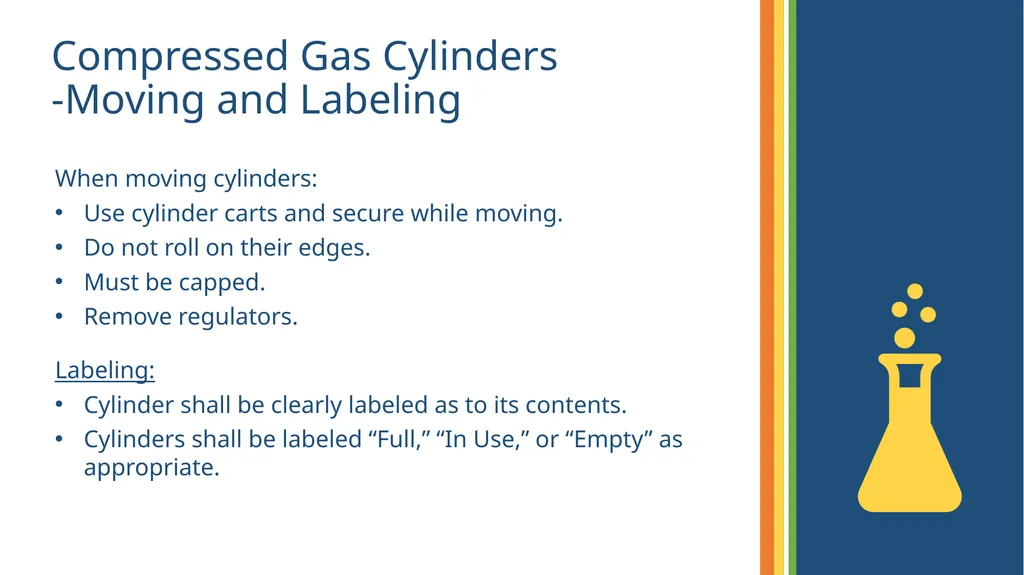
slide17. Compressed Gas Cylinders -Moving and Labeling When moving cylinders:
Use cylinder carts and secure while moving.
Do not roll on their edges.
Must be capped.
Remove regulators.
Labeling:
Cylinder shall be clearly labeled as to its contents.
Cylinders shall be labeled “Full,” “In Use,” or “Empty” as appropriate.<br>
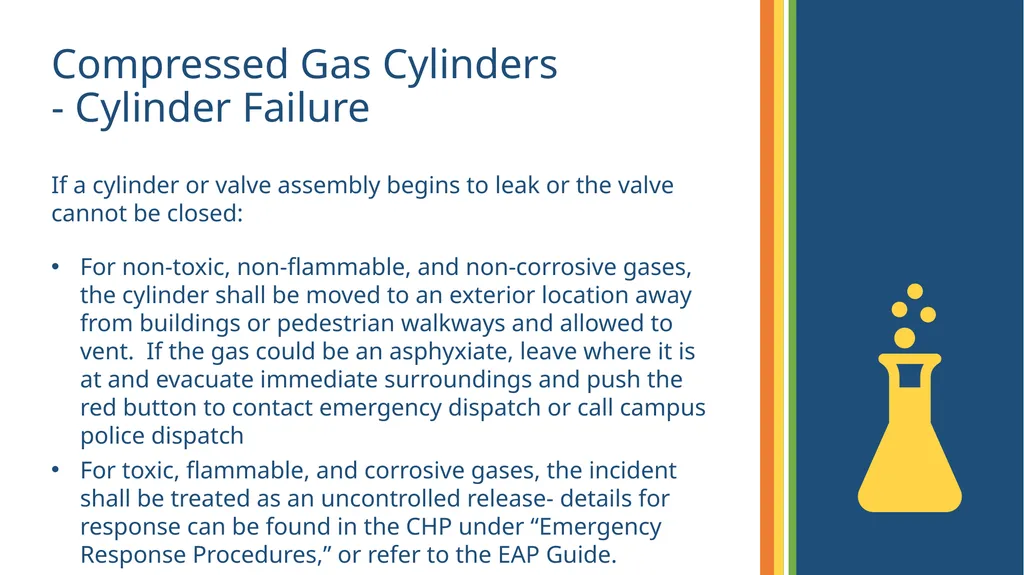
slide18. Compressed Gas Cylinders - Cylinder Failure If a cylinder or valve assembly begins to leak or the valve cannot be closed:
For non-toxic, non-flammable, and non-corrosive gases, the cylinder shall be moved to an exterior location away from buildings or pedestrian walkways and allowed to vent. If the gas could be an asphyxiate, leave where it is at and evacuate immediate surroundings and push the red button to contact emergency dispatch or call campus police dispatch
For toxic, flammable, and corrosive gases, the incident shall be treated as an uncontrolled release- details for response can be found in the CHP under “Emergency Response Procedures,” or refer to the EAP Guide.<br>
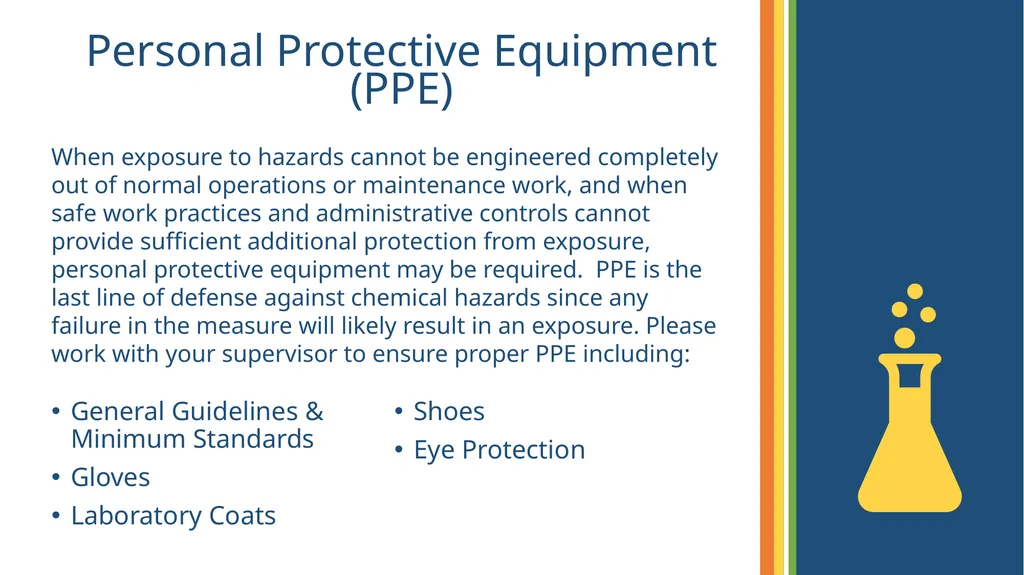
slide19. Personal Protective Equipment (PPE) General Guidelines & Minimum Standards
Gloves
Laboratory Coats When exposure to hazards cannot be engineered completely out of normal operations or maintenance work, and when safe work practices and administrative controls cannot provide sufficient additional protection from exposure, personal protective equipment may be required. PPE is the last line of defense against chemical hazards since any failure in the measure will likely result in an exposure. Please work with your supervisor to ensure proper PPE including: Shoes
Eye Protection<br>
slide20. PPE – General Guidelines and Minimum Standards Shorts, pants that expose any skin, and skirts or dresses that come above the ankle may not be worn in laboratory areas were chemicals are present. The area of skin between the pants and the shoe should not be exposed.
Tank tops, sleeveless shirts, or shirts that expose the chest shall not be worn when working with chemicals unless covered by a laboratory coat or other protective apparel.<br>
slide21. PPE – Gloves Gloves are required to be worn by any employee who opens, handles, transfers, pours, or otherwise uses hazardous chemicals of any amount, including toxic, corrosive, and refrigerant gases.
Each Department is responsible for providing employees with gloves.
Gloves should be inspected for defects prior to donning, if a defect is found, the glove is to be discarded and replaced.<br>
slide22. PPE – Laboratory Coats Laboratory coats shall be at least knee length.
Lab coats shall be worn by employees whenever they are working with hazardous chemicals or hazardous waste.
Laboratory coats shall be inspected prior to each use for defects. Damaged or defective laboratory coats shall not be worn.
When working with chemicals, laboratory coats shall be worn with the sleeves long enough to protect exposed skin and under clothing. Lab coats should be properly buttoned.
Laboratory coats shall not be worn outside the laboratory or areas where chemicals are not present unless chemicals are being transported.
Laboratory coats shall be laundered on a regular basis.
Chemical resistant aprons should be worn over laboratory coats for specific tasks that have a high probability for splashing.<br>
slide23. PPE – Shoes & Eye Protection All employees, students, and visitors shall wear close-toed and close-heeled shoes that cover their entire foot whenever they are handling or transferring chemicals or waste.
Flip flops, clogs, or other sandal-type shoes shall not be worn when working with chemicals.
Chemical safety splash-resistant goggles shall be worn at all times by faculty, employees, and students when hazardous chemicals are being used or when handling hazardous waste and there is a possible risk of a chemical splash.<br>
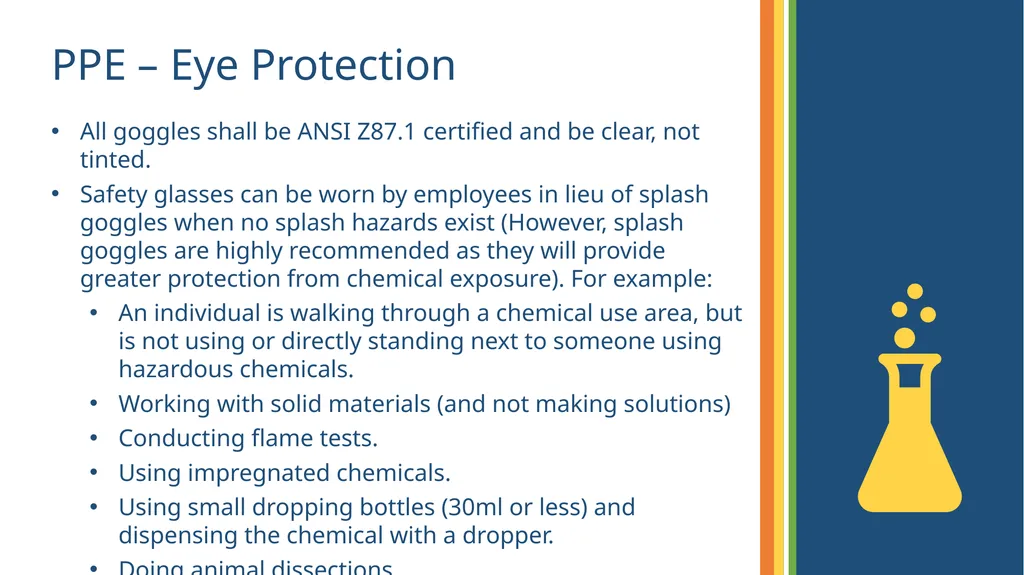
slide24. PPE – Eye Protection All goggles shall be ANSI Z87.1 certified and be clear, not tinted.
Safety glasses can be worn by employees in lieu of splash goggles when no splash hazards exist (However, splash goggles are highly recommended as they will provide greater protection from chemical exposure). For example:
An individual is walking through a chemical use area, but is not using or directly standing next to someone using hazardous chemicals.
Working with solid materials (and not making solutions)
Conducting flame tests.
Using impregnated chemicals.
Using small dropping bottles (30ml or less) and dispensing the chemical with a dropper.
Doing animal dissections.<br>
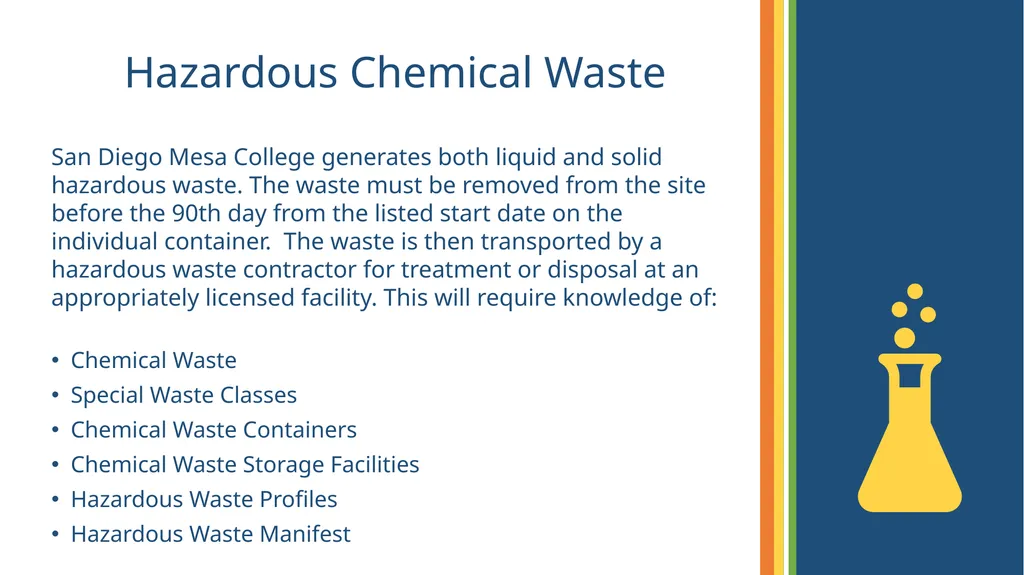
slide25. Hazardous Chemical Waste Chemical Waste
Special Waste Classes
Chemical Waste Containers
Chemical Waste Storage Facilities
Hazardous Waste Profiles
Hazardous Waste Manifest San Diego Mesa College generates both liquid and solid hazardous waste. The waste must be removed from the site before the 90th day from the listed start date on the individual container. The waste is then transported by a hazardous waste contractor for treatment or disposal at an appropriately licensed facility. This will require knowledge of:<br>
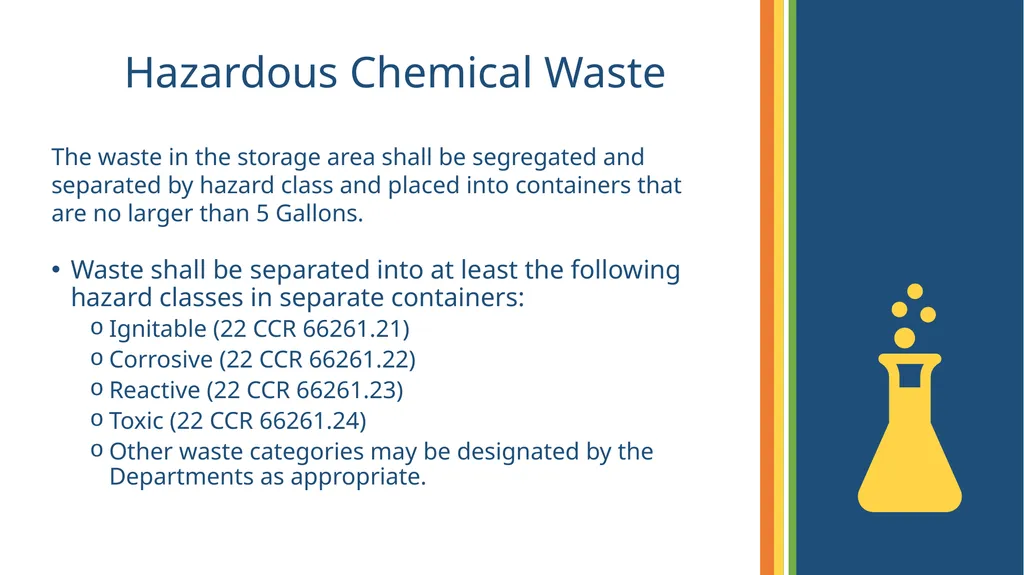
slide26. Hazardous Chemical Waste Waste shall be separated into at least the following hazard classes in separate containers:
Ignitable (22 CCR 66261.21)
Corrosive (22 CCR 66261.22)
Reactive (22 CCR 66261.23)
Toxic (22 CCR 66261.24)
Other waste categories may be designated by the Departments as appropriate. The waste in the storage area shall be segregated and separated by hazard class and placed into containers that are no larger than 5 Gallons.<br>
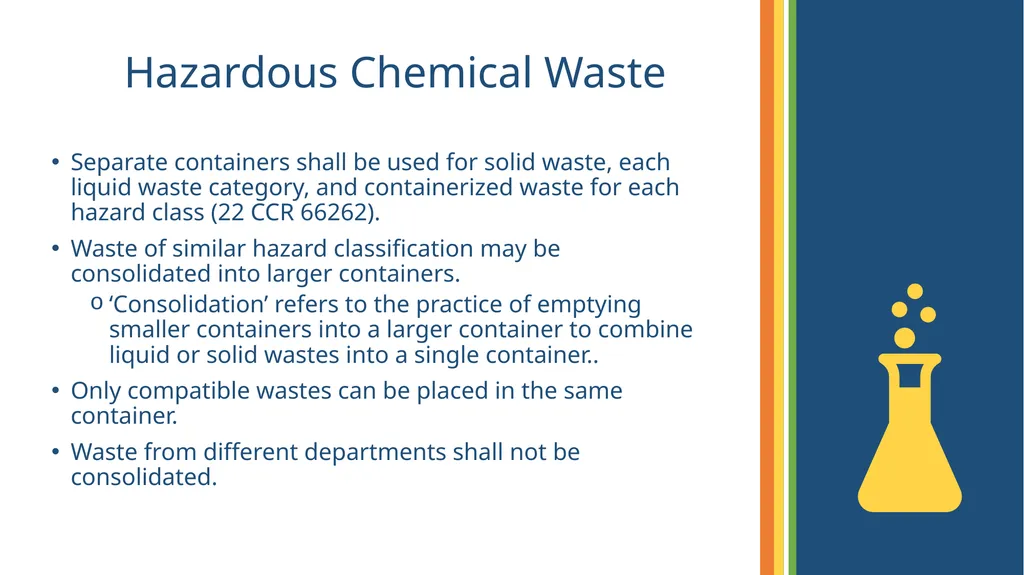
slide27. Hazardous Chemical Waste Separate containers shall be used for solid waste, each liquid waste category, and containerized waste for each hazard class (22 CCR 66262).
Waste of similar hazard classification may be consolidated into larger containers.
‘Consolidation’ refers to the practice of emptying smaller containers into a larger container to combine liquid or solid wastes into a single container..
Only compatible wastes can be placed in the same container.
Waste from different departments shall not be consolidated.<br>
slide28. Special Waste Classes Liquid paint.
Dry paint
Used oil
Used oil filters
Empty chemical or hazardous waste containers
Aerosol cans
Pesticides There are specific classes or types of hazardous waste that have additional labeling, packaging, handling, or storage requirements. See Appendix A in the CHP for additional details<br>
slide29. Chemical Waste Containers Containers shall be compatible with the material they are designated to contain (22 CCR 66265.172).
Containers that are to be disposed of with the waste (‘lab packed’) must be (49 CFR 173.12(b)(2)(i)):
One (1) gallon or smaller for glass containers
Less than 5.3 gallons for plastic (20 L)
Have secure, tight-fitting lids, preferably threaded, that do not react or degrade with the waste class within.
Containers shall prevent the leakage of liquid, solid materials, or vapors. The following requirements apply to all waste containers:<br>
slide30. Chemical Waste Containers All containers shall have appropriate lids that close securely.
Lids are to remain in place unless waste is actively being added or removed from the container.
Funnels can be used to facilitate adding waste to the containers.
Funnels shall either have self-closing lids or be removed when waste is not being added. Container must be closed when funnel is removed.<br>
slide31. Chemical Waste Containers: Labeling Containers shall be clearly, visibly, and legibly labeled “Hazardous Waste.” Unused portions of chemicals can be disposed of in their original containers as long as the container is properly labeled as hazardous waste.
Labels shall be durably affixed to the container.
The following information shall be clearly and legibly entered on the label in blue/black ink:
List of chemical(s) being placed in container.
EPA ID number
San Diego Mesa College HAS only one (1) unique EPA identification number, obtained by the State, to be used for tracking all generated waste.
Street address of Mesa College: 7250 Mesa College Dr., San Diego, CA. 92111
Contact phone number from the area/Department generating the waste.
Hazard class of waste.
Physical form of waste
Date the first waste was placed into the container<br>
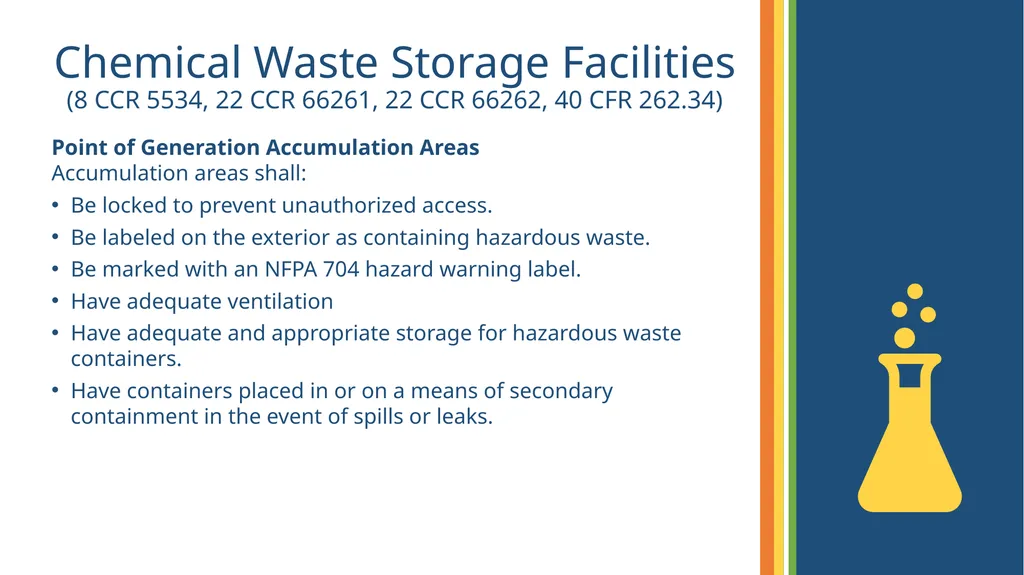
slide32. Chemical Waste Storage Facilities (8 CCR 5534, 22 CCR 66261, 22 CCR 66262, 40 CFR 262.34) Point of Generation Accumulation Areas
Accumulation areas shall:
Be locked to prevent unauthorized access.
Be labeled on the exterior as containing hazardous waste.
Be marked with an NFPA 704 hazard warning label.
Have adequate ventilation
Have adequate and appropriate storage for hazardous waste containers.
Have containers placed in or on a means of secondary containment in the event of spills or leaks.<br>
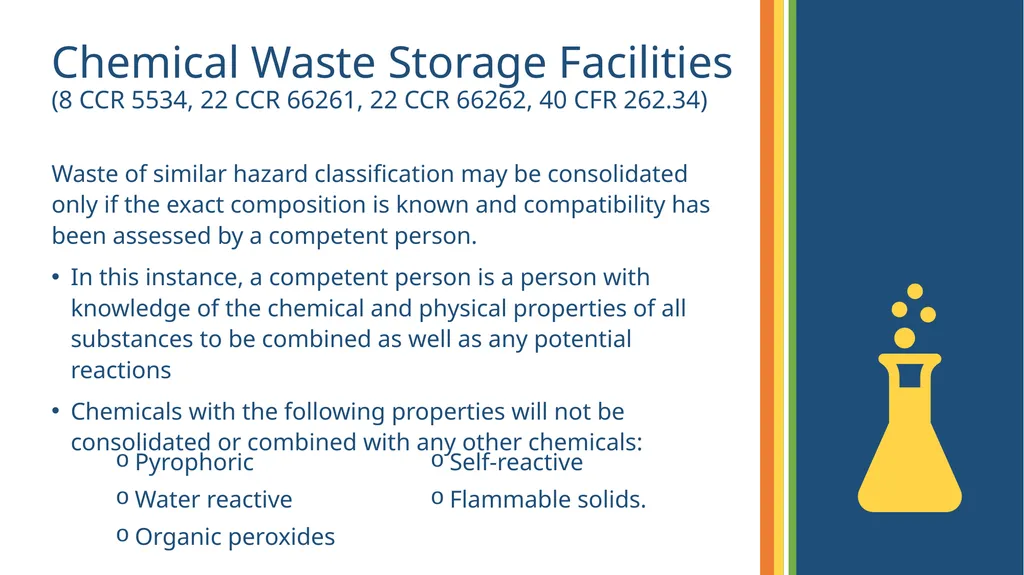
slide33. Chemical Waste Storage Facilities (8 CCR 5534, 22 CCR 66261, 22 CCR 66262, 40 CFR 262.34) Waste of similar hazard classification may be consolidated only if the exact composition is known and compatibility has been assessed by a competent person.
In this instance, a competent person is a person with knowledge of the chemical and physical properties of all substances to be combined as well as any potential reactions
Chemicals with the following properties will not be consolidated or combined with any other chemicals: Pyrophoric
Water reactive
Organic peroxides Self-reactive
Flammable solids.<br>
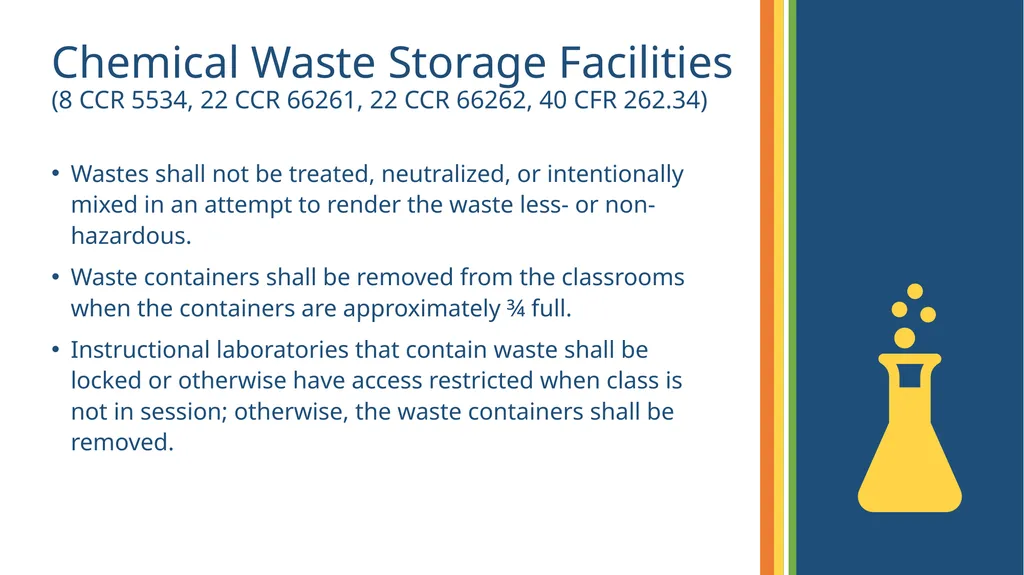
slide34. Chemical Waste Storage Facilities (8 CCR 5534, 22 CCR 66261, 22 CCR 66262, 40 CFR 262.34) Wastes shall not be treated, neutralized, or intentionally mixed in an attempt to render the waste less- or non-hazardous.
Waste containers shall be removed from the classrooms when the containers are approximately ¾ full.
Instructional laboratories that contain waste shall be locked or otherwise have access restricted when class is not in session; otherwise, the waste containers shall be removed.<br>
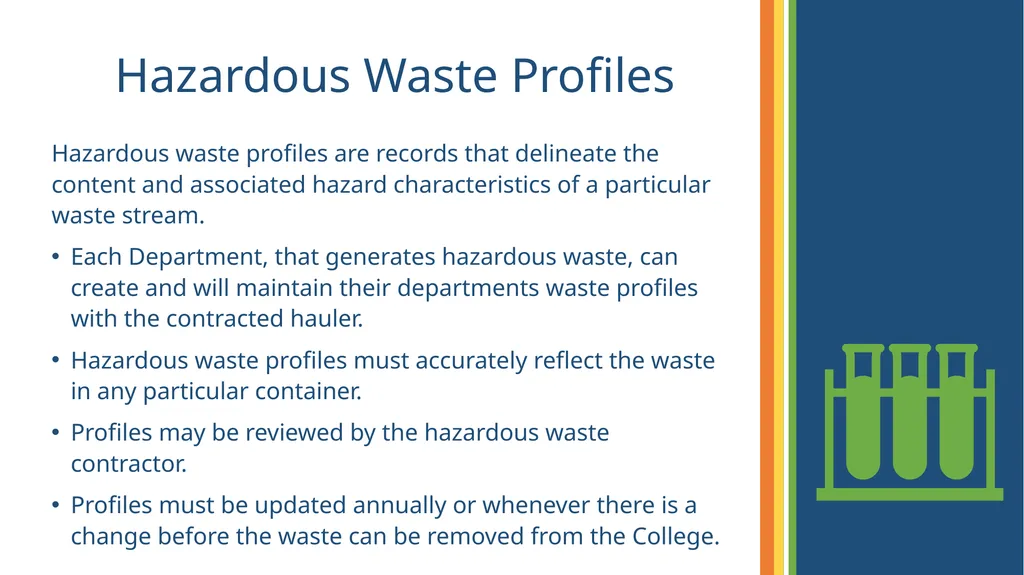
slide35. Hazardous Waste Profiles Hazardous waste profiles are records that delineate the content and associated hazard characteristics of a particular waste stream.
Each Department, that generates hazardous waste, can create and will maintain their departments waste profiles with the contracted hauler.
Hazardous waste profiles must accurately reflect the waste in any particular container.
Profiles may be reviewed by the hazardous waste contractor.
Profiles must be updated annually or whenever there is a change before the waste can be removed from the College.<br>
slide36. Hazardous Waste Manifest A manifest is a tracking document that is used to identify the owner of hazardous wastes throughout the generation, transportation and disposal process (49 CFR 172.204).
For Mesa College the Hazardous Waste Manifest is filled out by the waste hauler Clean Harbors.
The Manifest should be signed by a San Diego Mesa College representative, preferably the appointed department hazardous waste lead, or by the OEHS Coordinator or the Campus Chemical Hygiene Officer
The campus representative must receive US Department of Transportation or Title 22 training before they can sign a manifest (49 CFR 172.704).
Refresher training must be completed every three (3) years.
The campus representative will receive a copy of the manifest by the hauler.<br>
slide37. Hazardous Waste Manifest A copy of this manifest must be sent, by the appointed department hazardous waste lead, within thirty (30) days of shipment to:
Department of Toxic Substances Control, P.O. Box 400, Sacramento, CA 95812-0400.
An additional copy must be forwarded to the Campus OEHS Coordinator.
A final copy will be sent or available to San Diego Mesa College upon receipt at the final waste handling destination.
The manifests signed by the TSDF must be kept for three (3) years.
The Campus OEHS Coordinator or their designee is responsible for retaining all copies of the final manifests.<br>
slide38. Universal Waste Batteries
Electronic Devices
Mercury-containing equipment (such as thermostats, switches, pressure gauges, thermometers, and gas flow regulators)
Light bulbs
Cathode ray tubes and tube class from older monitors/televisions
Non-empty aerosol cans Universal wastes (UW) are hazardous wastes of specific categories that are exempt from hazardous waste management requirements; however, as they do pose some hazard to health and the environment, they must be disposed of properly. The following are classes of universal waste (22 CCR 66261.9):<br>
slide39. Universal Waste General Requirements: San Diego Mesa College will not accept UW from households or other businesses.
Containers for UW shall:
Be constructed of materials to prevent the breakage or damage to the UW contained within.
Have lids that:
Are appropriate for the container
Remain in place unless waste is actively being added or removed
Protect the contents from rainwater or other contaminating material.
Be of a different color than hazardous waste labels used at the Facility or College, clearly and legibly marked “Universal Waste” and identify the waste they contain (e.g, ‘fluorescent bulbs,’ ‘batteries,’ ‘Ballasts,’ etc.).
Be clearly and legibly marked with the accumulation start date.<br>
slide40. Universal Waste UW must be removed from San Diego Mesa College within one (1) year of the accumulation start date by:
A licensed Universal Waste Hauler/Handler
A recycling facility
District personnel transporting UW to an appropriate recycle or disposal facility
A hazardous waste contractor.
Records:
Records of UW may be in the form of a Manifest, a Bill of Lading, an invoice, or a receipt.
UW records must be retained by the OEHS Coordinator or Chemical Hygiene Officer for at least three (3) years.<br>
slide41. Specific Universal Waste Requirements Batteries:
Batteries must be removed from electronic devices as they are separate waste streams.
Containers holding used batteries shall be clearly and legibly labeled “Batteries.”
Light Bulbs:
Containers for used light bulbs must provide adequate protection to prevent damage to the bulbs.
Containers holding used light bulbs shall be clearly and legibly labeled “Waste Bulbs.”
Particularly for fluorescent bulbs, containers must be sized appropriately to ensure the lid can be affixed properly to protect the used bulbs.
To dispose of light bulbs contact the facilities department.<br>
slide42. Specific Universal Waste Requirements Aerosol Cans:
Aerosol cans are handled as Universal Waste when:
The can is partially full but cannot be used due to defective spray mechanisms
The propellant has been spent, but product still remains
The product is no longer needed.
San Diego Mesa College will not process (meaning; puncture, drain, or crush) aerosol cans (Health and Safety Code 25201.16(2)).
Empty aerosol cans, devoid of product and propellant, can be recycled.
Intentionally discharging an aerosol, piercing, or otherwise compromising the can solely for the purposes of rendering it non-hazardous is strictly forbidden.<br>
slide43. Specific Universal Waste Requirements Aerosol Cans (Continued):
Containers holding used or waste aerosol cans shall be clearly and legibly labeled “Waste Aerosol Cans.”
If not covered after cans are added, the lid must be secured at the end of each workday.
The container must be stored in an area with adequate ventilation, away from any heat source including direct sunlight.
To dispose of aerosol cans contact the OEHS Coordinator or the facilities department.<br>
slide44. Specific Universal Waste Requirements Electronic Devices:
Electronic devices to be disposed of do not need to be placed in a container.
Waste devices can be disposed of by contacting the stockroom.<br>
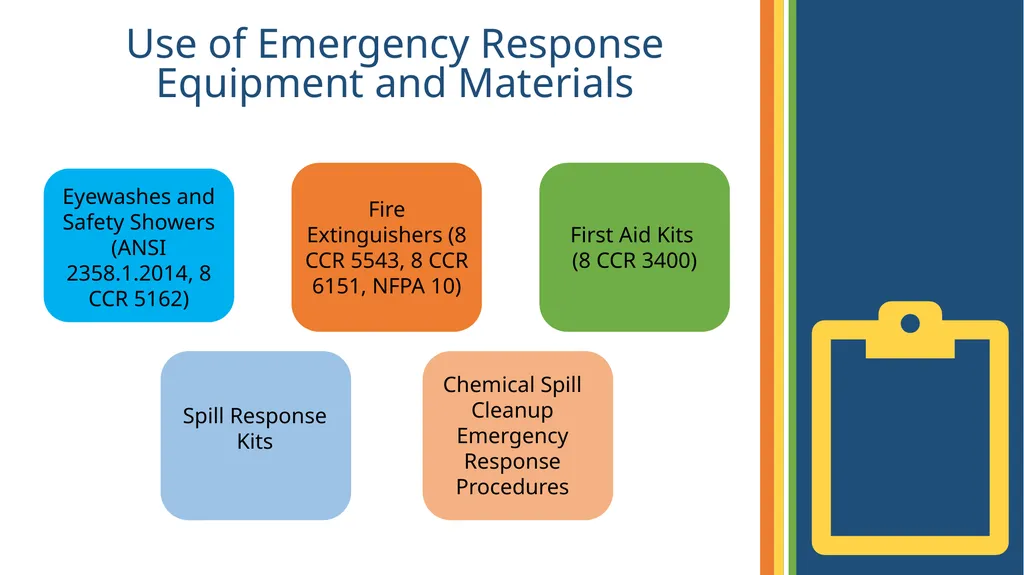
slide45. Use of Emergency Response Equipment and Materials Eyewashes and Safety Showers (ANSI 2358.1.2014, 8 CCR 5162) Fire Extinguishers (8 CCR 5543, 8 CCR 6151, NFPA 10) First Aid Kits
(8 CCR 3400) Spill Response Kits Chemical Spill Cleanup Emergency Response Procedures<br>
slide46. Use of Emergency Response Equipment and Materials Eyewashes & Safety Showers (ANSI 2358.1.2014.8 CCR 5162):
Emergency eyewashes and safety showers are required in areas where employees routinely use hazardous chemicals.
Eyewashes and safety showers shall be clearly identified with signage visible from twenty (20) feet away and be accessible within ten (10) seconds or 50 feet of any area where hazardous chemicals or waste are used or stored.
The use of chemicals by employees or students is forbidden in instructional laboratories or any area if nearby safety showers and eyewashes are non-functional.
Eyewashes must have protective caps over the spouts to prevent contamination.
The caps must remain in place except during testing and use.<br>
slide47. Use of Emergency Response Equipment and Materials Eyewashes & Safety Showers (continued):
The areas around eyewashes and safety showers must be clear of objects and obstructions in a radius of at least twenty-four (24) inches from the center of the shower head.
Eyewash and safety shower stations shall be tested monthly and flushed for at least ten (10) seconds to clear the line of any debris.
If there are any issues notify the Dean or supervisor and the Facilities Department immediately.
Tests may be performed by any employee; but it is the responsibility of the Department which the unit services to ensure the check is performed.
Records of this test (initial and date) shall be durably attached to the shower or eyewash.<br>
slide48. Use of Emergency Response Equipment and Materials Eyewashes & Safety Showers (continued):
If flow rates are not part of the Department’s monthly checks it must be performed annually. To perform a flow rate check you can follow the procedure below:
Use a five-gallon container (with a mark at the three gallon level) and a curtain to channel the flow into the container. After activation, the level on the container should be reached within 9 seconds or less
Safety showers must be capable of emitting twenty (20) gallons per minute.
Records shall be kept for at least three (3) years.<br>
slide49. Use of Emergency Response Equipment and Materials Fire Extinguishers (8 CCR 5543, 8 CCR 6151, NFPA 10):
Locations
Fire extinguishers must be located within thirty (30) feet of each instructional laboratory.
Chemical storage locations that contain flammable liquids must have a fire extinguisher located outside of the door but within ten (10) feet of the storage location.
At least twenty-four (24) inches of space must remain clear around each fire extinguisher.
Fire extinguishers must be stored in cabinets or on hangars to prevent damage.
Extinguishers may not be stored on the floor.<br>
slide50. Use of Emergency Response Equipment and Materials Fire Extinguishers (Continued):
Fire extinguishers shall be available for the appropriate class of fire hazards (A, B, C, or D)
Fire extinguishers shall be checked monthly. Records of monthly inspections and annual service should be attached to the fire extinguisher.
Inspections may be performed by any employee; but it is the responsibility of the Department where the extinguisher is installed to ensure the check is performed.
The gauge on the extinguisher must read ‘full’ and be in the green portion of the gauge.
The pull pin must be in place in the handle assembly.
A tamper seal must be in place indicating the extinguisher has not been discharged.<br>
slide51. Use of Emergency Response Equipment and Materials Fire Extinguishers (continued)
A tag recording the inspection must be attached to the extinguisher or the mounting assembly.
If any of the above conditions are deficient, the individual conducting the check shall immediately notify Facilities to address the extinguisher.
Fire extinguishers are serviced annually by an external contractor.
The Facilities Services Department is responsible for coordinating the annual service.
Tags are marked with the month and year of the annual service.
During annual servicing, replacement or temporary fire extinguishers must be made available.
Instruction may not take place and employees may not work in any area containing flammable or combustible materials that does not have appropriately located and fully-functional fire extinguishers.<br>
slide52. Use of Emergency Response Equipment and Materials First Aid Kits (8 CCR 3400):
A first aid kit should be located in each area where hazardous chemicals or waste are used or stored.
The kit shall be inspected monthly by any employee; but it is the responsibility of the Department where the kit is installed to ensure the inspection is performed.
A record of this inspection shall be maintained with the first aid kit.
The kit shall be restocked as necessary or during the monthly inspection.<br>
slide53. Use of Emergency Response Equipment and Materials Chemical Spill Cleanup and Response Procedures – Incidental Spills:
An incidental spill is the release of a hazardous substance which does not pose a significant safety or health hazard to employees in the immediate vicinity or to the employee cleaning it up, nor does it have the potential to become an emergency within a short time frame.
Incidental spills are limited in quantity, exposure potential, or toxicity and present minor safety or health hazards to employees in the immediate work area or those
Each spill must be evaluated prior to responding. Consult the SDS for guidelines on proper spill clean-up.
A guideline for Incidental spills quantity:
would be less than 2 L of low hazard materials, including volatiles and irritants (depending on the chemical)
less than 50 mL of highly hazardous materials.<br>
slide54. Use of Emergency Response Equipment and Materials Incidental Spills (Continued):
The properties of hazardous substances as well as the particular circumstances of the release itself will have an impact on what employees can handle safely and what procedures should be followed.
Take the following actions for proper spill cleanup:
If the spill is of a volatile material, the evacuation of the immediate area is at the discretion of the supervisor and will be based on the nature of the material.
If the spill is moderate in size but is not large enough to trigger an emergency response action, the immediate area should be evacuated of all employees and students until the spill is properly cleaned up.
The area of the spill shall be cordoned off by way of caution tape or closing laboratory doors.<br>
slide55. Use of Emergency Response Equipment and Materials Incidental Spills (Continued):
Protective equipment must be worn (goggles, gloves, shoe covers).
Any sorbent material (pillows, pads, absorbent solids) or other disposable material used shall be packaged in a plastic bag, sealed, and disposed of as hazardous waste.
If the chemical touches bare earth, surface water, or enters a public sewer, the Chemical Hygiene Officer in consultation with Risk Management will properly notify the San Diego County Hazardous Materials Division of the release for proper reporting and further required actions.<br>
slide56. Use of Emergency Response Equipment and Materials Emergency Response Spills:
An emergency spill would constitute that a clean-up response effort would be needed by employees from outside the immediate release area or by other designated responders (i.e. Hazardous waste hauler, mutual-aid groups, local fire departments, etc.) The release or situation must pose an emergency. Examples are:
It may cause high levels of exposures to toxic substances
It is life or injury threatening
It poses IDLH conditions
It poses a fire and explosion hazard (exceeds or has potential to exceed 25% of the LEL)
It requires immediate attention because of danger, or presents an oxygen deficient condition<br>
slide57. Use of Emergency Response Equipment and Materials Emergency Response Spills (Continued):
Nuisance spills, minor releases, etc., which do not require immediate attention (due to danger to employees) are not considered emergencies.
A guideline for emergency spill response would be:
Liquid spills of more than two liters (2 L), depending on type of chemical
More than fifty milliliters (50 mL) of highly hazardous materials,
Uncontrolled off-gassing of chemical reactions
Leaking cylinders<br>
slide58. Use of Emergency Response Equipment and Materials Emergency Response Spills (Continued):
Staff and Faculty will not use respirators during clean-up, if respirators are needed then the procedures below need to be followed:
Contact College Police Dispatch (619-388-6405) to request assistance from the hazardous waste contractor or local Hazardous Materials Response team.
The Dean or supervisor shall be notified.
The Vice President of Administrative Services, College Events and Operations Administrator, and the OEHS Coordinator shall be notified of the spill as soon as possible.
The Regional Facilities Officer (RFO) shall be contacted if assistance is needed.<br>
slide59. Use of Emergency Response Equipment and Materials Emergency Response Spills (Continued):
Depending on the amount, areas impacted, and the type of chemical, the Emergency Action Plan may be initiated.
The Supervisor or Dean will determine if the Emergency Action Plan needs to be initiated.
Injured persons shall be assisted and addressed as applicable and contaminated persons, even if injured, shall be isolated.
The area around the spill/release shall be cordoned off at a safe distance, determined by the amount, scope, and chemical involved.
For flammable chemical spills or gas releases, all sources of ignition need to be immediately extinguished, including open flames, heating mantles, vacuum pump motors, and powered equipment.
The Chemical Hygiene Officer or any staff member shall provide the SDS to first responders.<br>
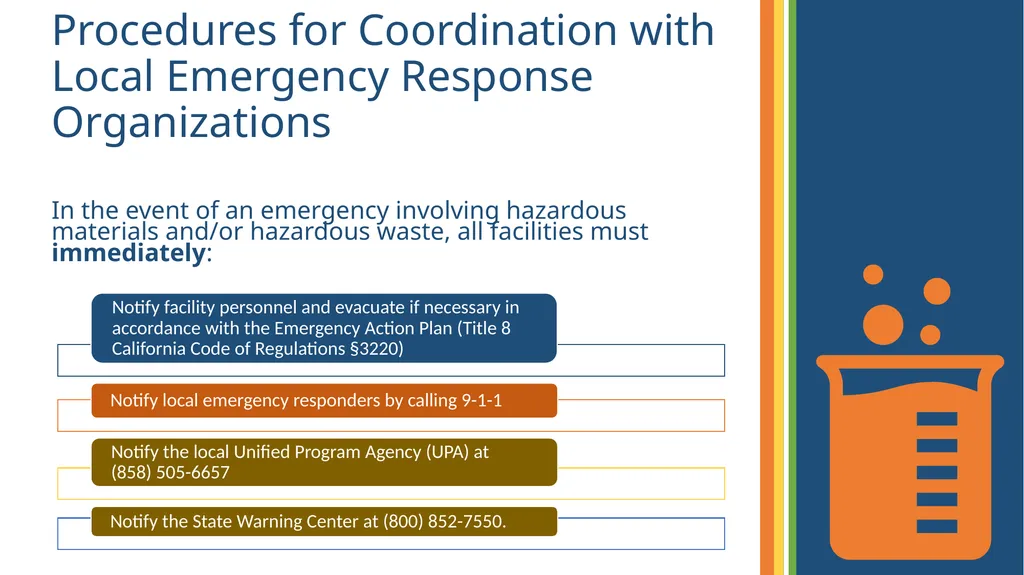
slide60. Procedures for Coordination with Local Emergency Response Organizations In the event of an emergency involving hazardous materials and/or hazardous waste, all facilities must immediately:<br>
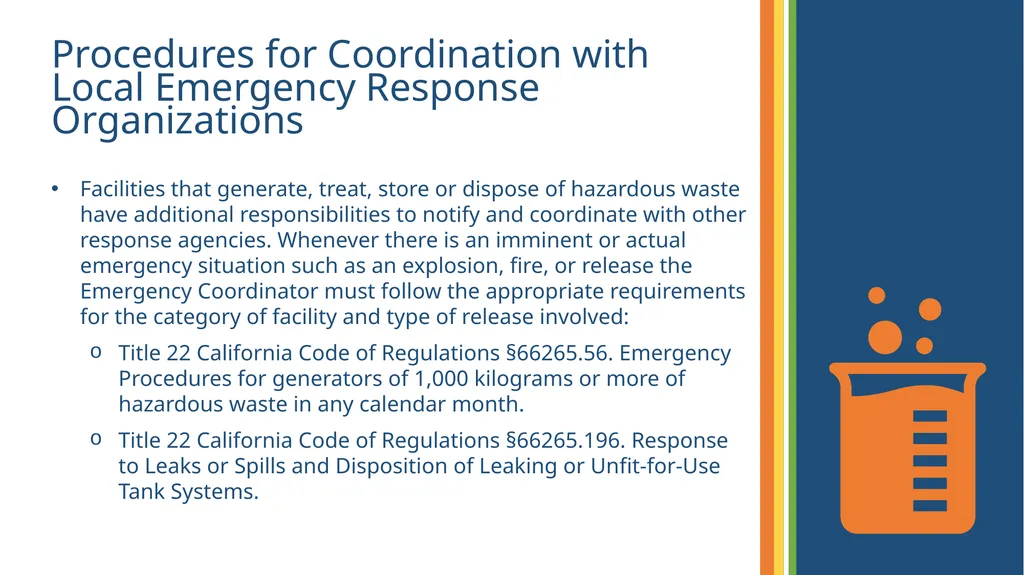
slide61. Procedures for Coordination with Local Emergency Response Organizations Facilities that generate, treat, store or dispose of hazardous waste have additional responsibilities to notify and coordinate with other response agencies. Whenever there is an imminent or actual emergency situation such as an explosion, fire, or release the Emergency Coordinator must follow the appropriate requirements for the category of facility and type of release involved:
Title 22 California Code of Regulations §66265.56. Emergency Procedures for generators of 1,000 kilograms or more of hazardous waste in any calendar month.
Title 22 California Code of Regulations §66265.196. Response to Leaks or Spills and Disposition of Leaking or Unfit-for-Use Tank Systems.<br>
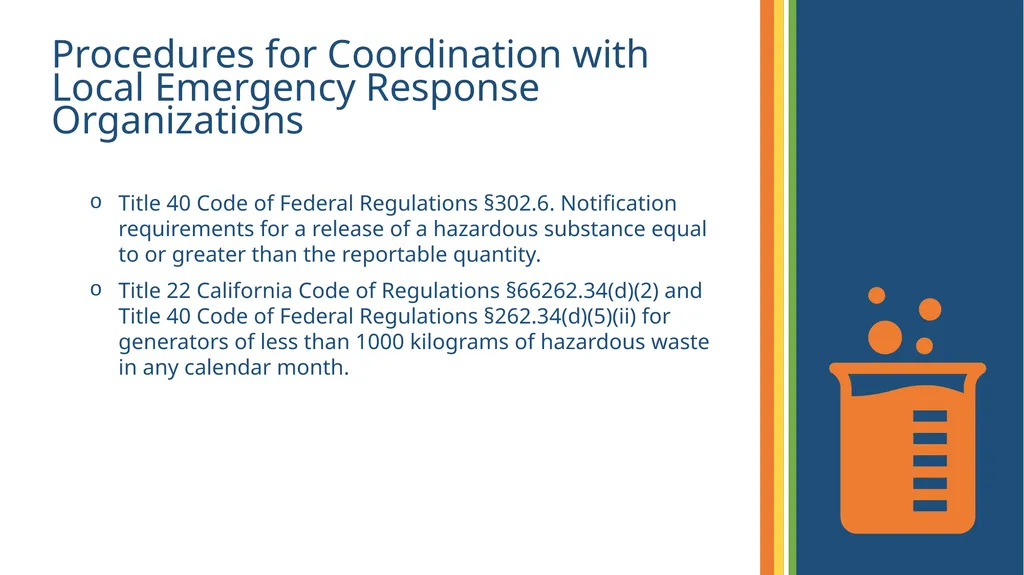
slide62. Procedures for Coordination with Local Emergency Response Organizations Title 40 Code of Federal Regulations §302.6. Notification requirements for a release of a hazardous substance equal to or greater than the reportable quantity.
Title 22 California Code of Regulations §66262.34(d)(2) and Title 40 Code of Federal Regulations §262.34(d)(5)(ii) for generators of less than 1000 kilograms of hazardous waste in any calendar month.<br>
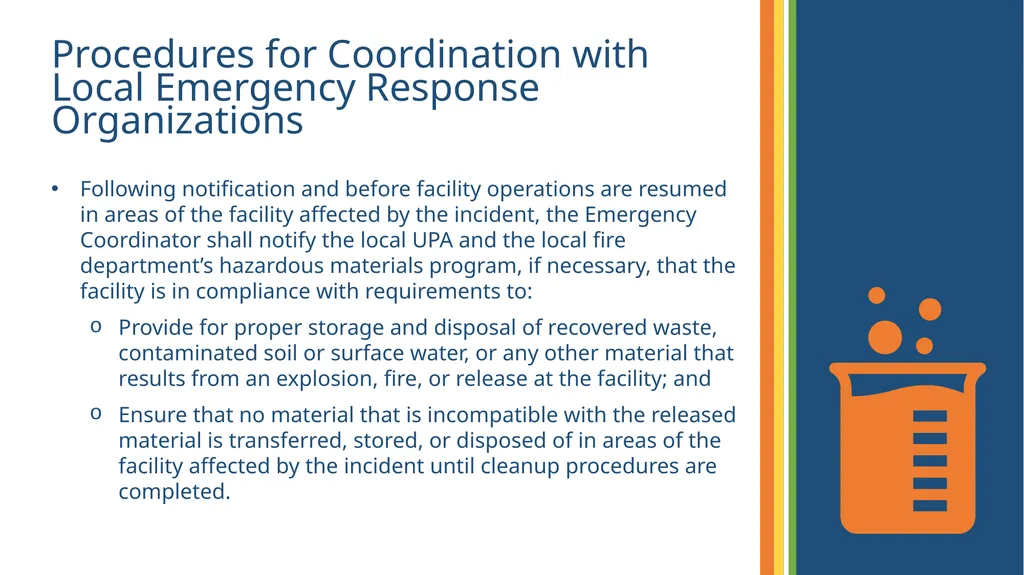
slide63. Procedures for Coordination with Local Emergency Response Organizations Following notification and before facility operations are resumed in areas of the facility affected by the incident, the Emergency Coordinator shall notify the local UPA and the local fire department’s hazardous materials program, if necessary, that the facility is in compliance with requirements to:
Provide for proper storage and disposal of recovered waste, contaminated soil or surface water, or any other material that results from an explosion, fire, or release at the facility; and
Ensure that no material that is incompatible with the released material is transferred, stored, or disposed of in areas of the facility affected by the incident until cleanup procedures are completed.<br>
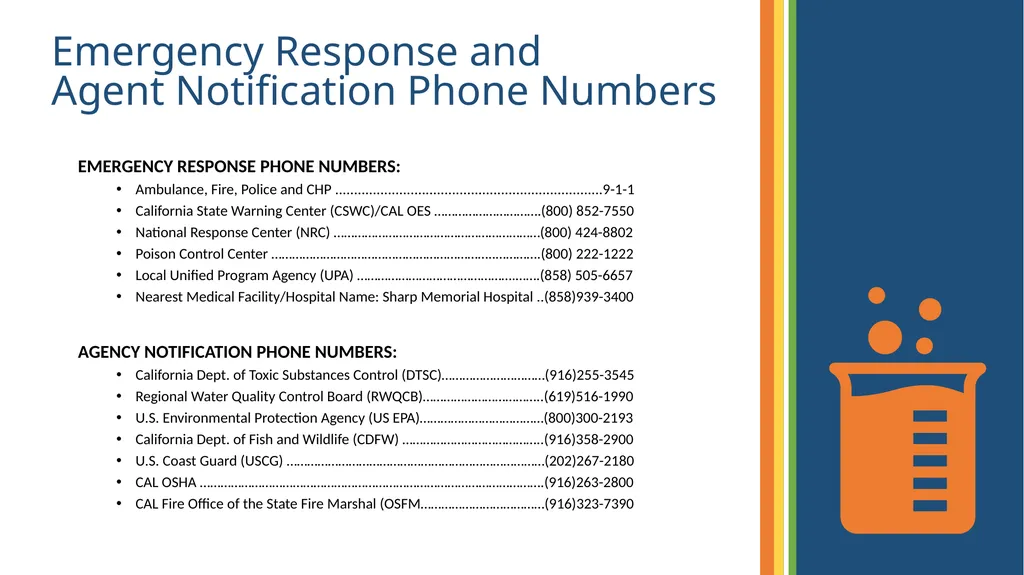
slide64. Emergency Response and Agent Notification Phone Numbers EMERGENCY RESPONSE PHONE NUMBERS:
Ambulance, Fire, Police and CHP .......................................................................9-1-1
California State Warning Center (CSWC)/CAL OES ………………………….(800) 852-7550
National Response Center (NRC) ……………………………………………………(800) 424-8802
Poison Control Center ………………………………………………………..………….(800) 222-1222
Local Unified Program Agency (UPA) ……………………………………….…….(858) 505-6657
Nearest Medical Facility/Hospital Name: Sharp Memorial Hospital ..(858)939-3400
AGENCY NOTIFICATION PHONE NUMBERS:
California Dept. of Toxic Substances Control (DTSC)…………………………(916)255-3545
Regional Water Quality Control Board (RWQCB)……………………………..(619)516-1990
U.S. Environmental Protection Agency (US EPA)………………………………(800)300-2193
California Dept. of Fish and Wildlife (CDFW) …………………………………..(916)358-2900
U.S. Coast Guard (USCG) …………………………………………………………………(202)267-2180
CAL OSHA ……………………………………………………………………………………….(916)263-2800
CAL Fire Office of the State Fire Marshal (OSFM………………………………(916)323-7390<br>
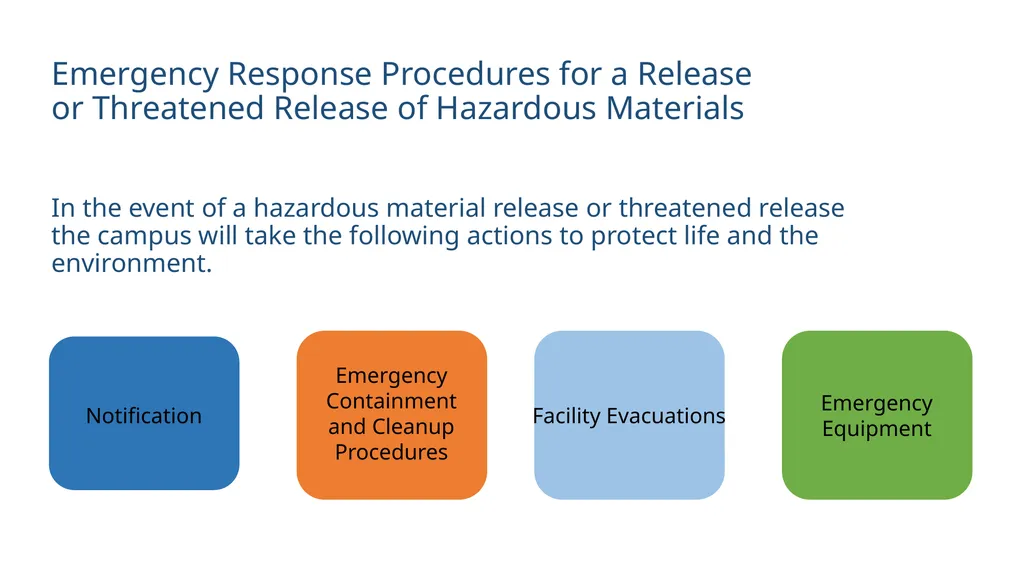
slide65. Emergency Response Procedures for a Release or Threatened Release of Hazardous Materials Notification Facility Evacuations Emergency Containment and Cleanup Procedures Emergency Equipment In the event of a hazardous material release or threatened release the campus will take the following actions to protect life and the environment.<br>
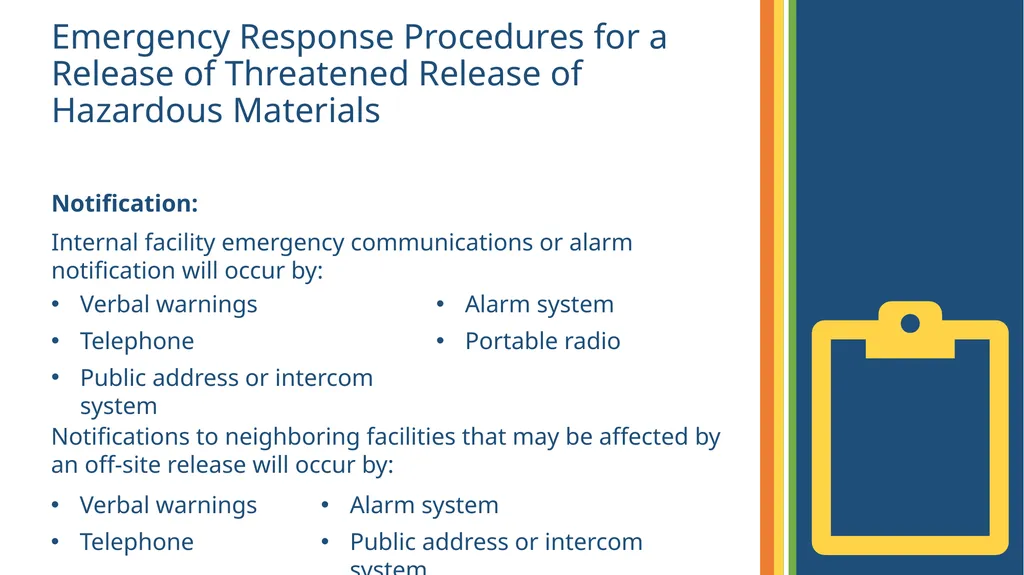
slide66. Emergency Response Procedures for a Release of Threatened Release of Hazardous Materials Notification:
Internal facility emergency communications or alarm notification will occur by: Verbal warnings
Telephone
Public address or intercom system Alarm system
Portable radio Notifications to neighboring facilities that may be affected by an off-site release will occur by: Verbal warnings
Telephone Alarm system
Public address or intercom system<br>
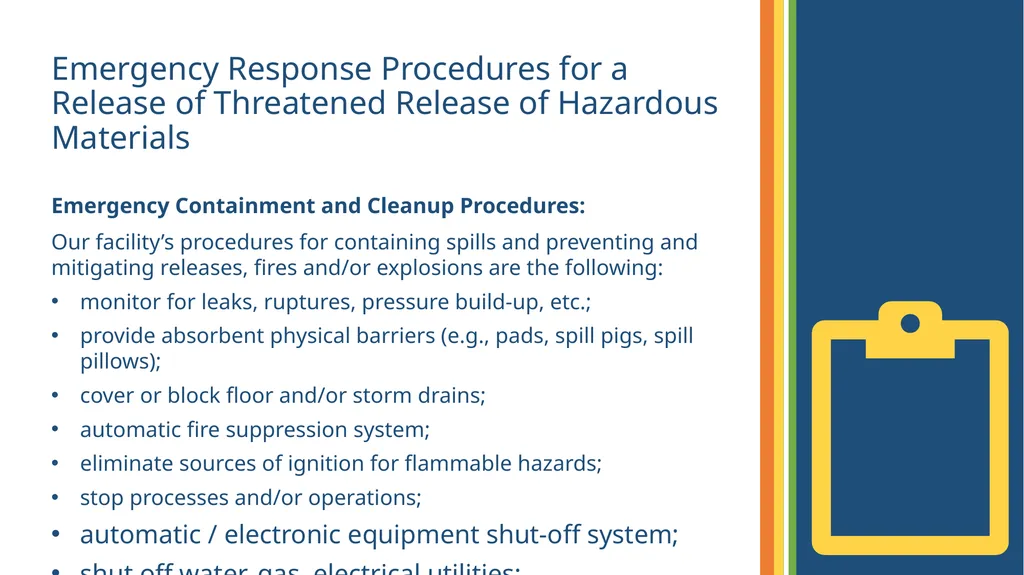
slide67. Emergency Response Procedures for a Release of Threatened Release of Hazardous Materials Emergency Containment and Cleanup Procedures:
Our facility’s procedures for containing spills and preventing and mitigating releases, fires and/or explosions are the following:
monitor for leaks, ruptures, pressure build-up, etc.;
provide absorbent physical barriers (e.g., pads, spill pigs, spill pillows);
cover or block floor and/or storm drains;
automatic fire suppression system;
eliminate sources of ignition for flammable hazards;
stop processes and/or operations;
automatic / electronic equipment shut-off system;
shut off water, gas, electrical utilities;<br>
slide68. Emergency Response Procedures for a Release of Threatened Release of Hazardous Materials Emergency Containment and Cleanup Procedures (Continued):
call 9-1-1 for public emergency responder assistance and/or medical aid;
notify and evacuate persons in all threatened and/or impacted areas;
account for evacuated persons immediately after evacuation;
provide protective equipment for on-site emergency response team;
remove containers and/or isolate areas;
hire licensed hazardous waste contractor;
use absorbent material for spill containment;
provide safe temporary storage of hazardous waste generated during emergency actions;<br>
slide69. Emergency Response Procedures for a Release of Threatened Release of Hazardous Materials Facility Evacuations
The following alarm signal(s) will be used to begin evacuation of the facility:
Bells
Horns/Sirens
Verbal (i.e., Shouting)
For emergency assembly areas please view the evacuation maps that are posted in the individual buildings: Also see the Mesa College Emergency Plan or the building evacuation plan for more details on evacuations and ICS<br>
slide70. Emergency Response Procedures for a Release of Threatened Release of Hazardous Materials Emergency Equipment:
Safety and First Aid
Chemical protective suits, aprons, and/or vests
Chemical protective gloves
Safety glasses, goggles, and face shields
Hard hats
Air-purifying respirators
First aid kits
Plumbed eyewash fountain and/or shower
Portable eyewash kits and/or station<br>
slide71. Emergency Response Procedures for a Release of Threatened Release of Hazardous Materials Emergency Equipment:
Fire Fighting
Portable fire extinguishers
Fixed fire systems/sprinklers/fire hoses
Fire alarm boxes or stations
Communication and alarm system
Telephones
Intercom/PA system
Portable radios<br>
slide72. Emergency Response Procedures for a Release of Threatened Release of Hazardous Materials Emergency Equipment:
Spill Control and Cleanup
All in one spill kit
Absorbent material
Container for used absorbent
Broom
Shovel
Shop vac
Exhaust hood
Chemical neutralizers<br>
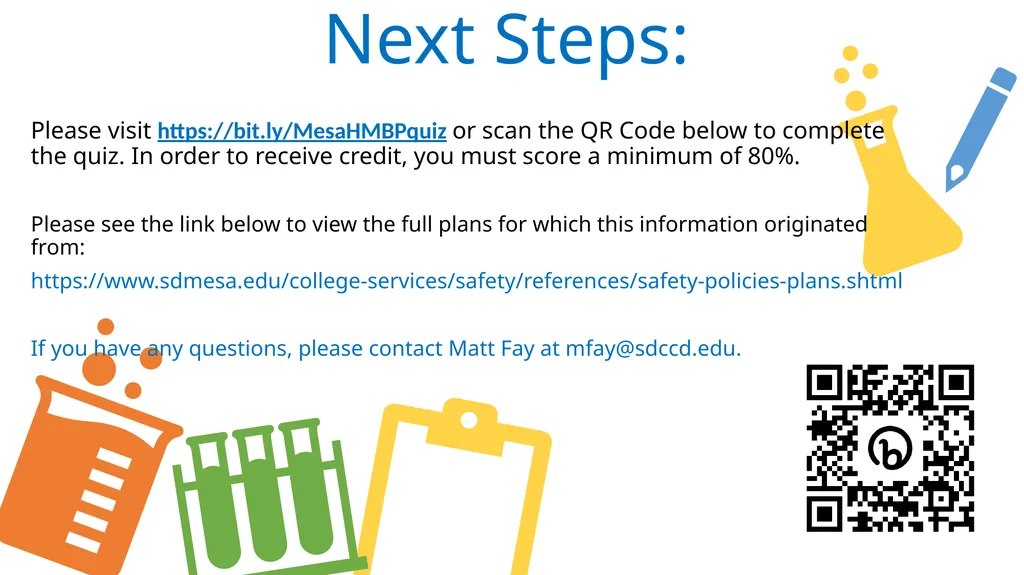
slide73. Next Steps: Please visit https://bit.ly/MesaHMBPquiz or scan the QR Code below to complete the quiz. In order to receive credit, you must score a minimum of 80%.
Please see the link below to view the full plans for which this information originated from:
https://www.sdmesa.edu/college-services/safety/references/safety-policies-plans.shtml
If you have any questions, please contact Matt Fay at mfay@sdccd.edu.<br>
slide2. Introduction All facilities subject to the Hazardous Materials Business Plan (HMBP) Program must have a training program and a written employee training plan for hazardous materials safety and emergency response. Initial training is required for new employees within 30 days from date of hire followed by annual refresher training. Training to include:
Procedures for safe handling of hazardous materials/waste
Use of emergency response equipment and materials
Emergency response procedures<br>
slide3. Procedures for safe handling of hazardous materials/waste The control of the exposure, release, and spread of hazardous materials and waste is accomplished by the integration of mitigation strategies, including: Engineering
Controls Administrative Controls Personal Protective Equipment<br>
slide4. Engineering Controls Engineering controls are based on the following broad principles:
Design work areas or process to remove hazard and/or substitute something that is not/less hazardous.
If removal is not feasible, enclose hazard to prevent exposure in normal operations.
Where complete enclosure is not feasible, establish barriers or local ventilation to reduce exposure in normal operations These controls focus on the source of the hazard, unlike other types of controls that generally focus on the employee exposed to the hazard. Engineering controls should be the first application of safety measures used when evaluating hazard mitigation.<br>
slide5. Administrative Controls Administrative controls are policies and procedures designed to reduce employee and student exposure to hazardous chemicals. The use of standard operating procedures (SOP’s), general laboratory guidelines, housekeeping, and chemical handling procedures are administrative controls used by San Diego Mesa College.
Administrative controls should be the second application of safety measures used when evaluating hazard mitigation and are used in conjunction with engineering controls.<br>
slide6. Mesa College Standard Operating Procedures (SOPs) The Mesa College Chemical Hygiene Plan (CHP), combined with training, will act as the Standard Operating Procedures for those processes that involve chemical movement, storage, and chemical/waste handling. Individual Departments may write supplemental Standard Operating Procedures to delineate site-specific program compliance for their unique programs and hazards, but they must be at least as stringent with the contents of the CHP. General Chemical Safety Guidelines
Housekeeping
Chemical Handling
Chemical Storage Transporting Chemicals and Chemical Waste
Compressed Gas Cylinders<br>
slide7. General Chemical Safety Guidelines Personnel should not work with or transfer flammable or toxic hazardous materials alone.
Employees should wash hands with soap and water prior to leaving the area where hazardous materials are used.
All work with volatile chemicals shall be conducted in the fume hoods or other well-ventilated areas.
Areas where hazardous materials or waste are stored shall be secured from unauthorized access.<br>
slide8. Housekeeping All doorways, walkways and staircases are to remain clear and free from obstructions, chemicals, or hazardous waste.
The area around eyewashes and safety showers shall always remain clear of obstructions to a distance of at least twenty-four (24) inches.
Areas shall be kept clean and neat.
Small drips or spills of chemicals shall be wiped up immediately using appropriate PPE and proper materials for the chemical.
Materials used for cleaning spills shall be disposed of as hazardous waste.<br>
slide9. Chemical Handling Chemical handling is the application of best practices to minimize the risk in using, moving, or transferring chemicals. The basis of safe chemical handling is being aware of what chemicals are present in the workplace and their associated hazards.<br>
slide10. Chemical Inventory The Hazardous Communication Standard requires a current chemical inventory in areas that use or store hazardous materials. Each department will update its Chemical inventory, have a hard copy available in the area the chemicals are stored, and submit a copy to the OEHS Coordinator no later than January 31 of each calendar year.
Mesa College’s chemical inventory format has been standardized and each department must use the standardized format when creating a chemical inventory. If there are any questions or concerns about the format or process, contact the campus OEHS Coordinator.
Every hazardous chemical that is used on the Mesa campus must have a corresponding SDS.<br>
slide11. Receiving Chemicals No “outside” donations of chemicals, either new or partially consumed can be excepted
All chemicals shall have the date received, person receiving, and the date they were opened written on the label.
As applicable, expiration dates shall be written on the container label.<br>
slide12. Chemical Labeling Chemicals should be kept and stored in the container supplied by the manufacturer. In the event a chemical must be repackaged due to damage, the new container shall be compatible with the material and the label shall include all of the required elements. Every original container label must include: Product Identifier
Signal Word
Hazard Statement(s)
Pictogram(s)
Precautionary Statement(s) Name, address, and telephone number of the manufacturer or importer
Label must be legible, permanently displayed, and written in English<br>
slide13. Chemical Labeling Secondary Containers: Secondary containers are containers used to supply smaller amounts of chemicals from bulk containers to more than one location, such as instructional laboratories or custodial closets.
Secondary containers must be of similar material and quality to the original.
Secondary containers must be labeled with
The name of the chemical or common name, in English.
The concentration of the chemical shall also be noted, if appropriate.
Pictogram(s) and/or other applicable hazard warnings.
Date chemical was transferred into container.<br>
slide14. Chemical Storage All storage locations for hazardous materials or hazardous wastes shall be labeled with warning signs in accordance with NFPA 704 on each door or entrance.
Chemicals shall be stored in the appropriate storage location, separated and segregated from incompatible chemicals.
Chemicals shall not be stored at elevations more than six (6) feet from the floor.
Shelves holding chemicals shall have lips or other integral restraining devices to prevent chemicals from sliding off (24 CCR, Part 9, 5003.9.9).
Cabinets specially designed for hazardous chemicals do not require lips.
Chemical storage cabinets or refrigerator/freezer must have the appropriate labeling such as: Flammable, Corrosive, Acid, Base, Poison, Compressed Gas, or any other appropriate identifier<br>
slide15. Transporting Chemicals and Chemical Waste Chemical and waste containers shall be securely capped prior to transport.
A secondary container, such as a poly bucket or tub, must be used when transporting chemicals.
Containers carrying more than 4 liters/1 gallon are to be transported by a cart, dolly, or other means.
Hazardous chemicals and waste should not be moved via stairwells.
Hazardous chemicals and waste shall be moved between floors by way of elevators.
Hazardous chemicals and waste that are moved via elevator shall have a means of secondary containment.
The maximum size container allowed to be moved in an elevator is twenty (20) liters (5.28 gallons) (24 CCR, Part 9, 5003.10.4.2).
Incompatible chemicals shall not be transported on the same cart or truck (24CCR, Part 9, 5003.10.3.6.).<br>
slide16. Compressed Gas Cylinders - Storage Areas containing compressed gas shall be marked “Compressed Gas” and be secured to prevent access by unauthorized individuals.
When not in use, including when empty, cylinder valves shall be fully closed with protective caps securely in place.
Cylinders shall not be stored under stairs or near emergency exits.
Cylinders shall be stored upright in secured racks, or secured to a fixed object by no fewer than two restraints.
Cylinders shall not be stored in direct sunlight or near other sources of heating to prevent over-pressure hazards.
Empty cylinders shall be clearly marked “Empty” and stored separately from full or in-use cylinders.<br>
slide17. Compressed Gas Cylinders -Moving and Labeling When moving cylinders:
Use cylinder carts and secure while moving.
Do not roll on their edges.
Must be capped.
Remove regulators.
Labeling:
Cylinder shall be clearly labeled as to its contents.
Cylinders shall be labeled “Full,” “In Use,” or “Empty” as appropriate.<br>
slide18. Compressed Gas Cylinders - Cylinder Failure If a cylinder or valve assembly begins to leak or the valve cannot be closed:
For non-toxic, non-flammable, and non-corrosive gases, the cylinder shall be moved to an exterior location away from buildings or pedestrian walkways and allowed to vent. If the gas could be an asphyxiate, leave where it is at and evacuate immediate surroundings and push the red button to contact emergency dispatch or call campus police dispatch
For toxic, flammable, and corrosive gases, the incident shall be treated as an uncontrolled release- details for response can be found in the CHP under “Emergency Response Procedures,” or refer to the EAP Guide.<br>
slide19. Personal Protective Equipment (PPE) General Guidelines & Minimum Standards
Gloves
Laboratory Coats When exposure to hazards cannot be engineered completely out of normal operations or maintenance work, and when safe work practices and administrative controls cannot provide sufficient additional protection from exposure, personal protective equipment may be required. PPE is the last line of defense against chemical hazards since any failure in the measure will likely result in an exposure. Please work with your supervisor to ensure proper PPE including: Shoes
Eye Protection<br>
slide20. PPE – General Guidelines and Minimum Standards Shorts, pants that expose any skin, and skirts or dresses that come above the ankle may not be worn in laboratory areas were chemicals are present. The area of skin between the pants and the shoe should not be exposed.
Tank tops, sleeveless shirts, or shirts that expose the chest shall not be worn when working with chemicals unless covered by a laboratory coat or other protective apparel.<br>
slide21. PPE – Gloves Gloves are required to be worn by any employee who opens, handles, transfers, pours, or otherwise uses hazardous chemicals of any amount, including toxic, corrosive, and refrigerant gases.
Each Department is responsible for providing employees with gloves.
Gloves should be inspected for defects prior to donning, if a defect is found, the glove is to be discarded and replaced.<br>
slide22. PPE – Laboratory Coats Laboratory coats shall be at least knee length.
Lab coats shall be worn by employees whenever they are working with hazardous chemicals or hazardous waste.
Laboratory coats shall be inspected prior to each use for defects. Damaged or defective laboratory coats shall not be worn.
When working with chemicals, laboratory coats shall be worn with the sleeves long enough to protect exposed skin and under clothing. Lab coats should be properly buttoned.
Laboratory coats shall not be worn outside the laboratory or areas where chemicals are not present unless chemicals are being transported.
Laboratory coats shall be laundered on a regular basis.
Chemical resistant aprons should be worn over laboratory coats for specific tasks that have a high probability for splashing.<br>
slide23. PPE – Shoes & Eye Protection All employees, students, and visitors shall wear close-toed and close-heeled shoes that cover their entire foot whenever they are handling or transferring chemicals or waste.
Flip flops, clogs, or other sandal-type shoes shall not be worn when working with chemicals.
Chemical safety splash-resistant goggles shall be worn at all times by faculty, employees, and students when hazardous chemicals are being used or when handling hazardous waste and there is a possible risk of a chemical splash.<br>
slide24. PPE – Eye Protection All goggles shall be ANSI Z87.1 certified and be clear, not tinted.
Safety glasses can be worn by employees in lieu of splash goggles when no splash hazards exist (However, splash goggles are highly recommended as they will provide greater protection from chemical exposure). For example:
An individual is walking through a chemical use area, but is not using or directly standing next to someone using hazardous chemicals.
Working with solid materials (and not making solutions)
Conducting flame tests.
Using impregnated chemicals.
Using small dropping bottles (30ml or less) and dispensing the chemical with a dropper.
Doing animal dissections.<br>
slide25. Hazardous Chemical Waste Chemical Waste
Special Waste Classes
Chemical Waste Containers
Chemical Waste Storage Facilities
Hazardous Waste Profiles
Hazardous Waste Manifest San Diego Mesa College generates both liquid and solid hazardous waste. The waste must be removed from the site before the 90th day from the listed start date on the individual container. The waste is then transported by a hazardous waste contractor for treatment or disposal at an appropriately licensed facility. This will require knowledge of:<br>
slide26. Hazardous Chemical Waste Waste shall be separated into at least the following hazard classes in separate containers:
Ignitable (22 CCR 66261.21)
Corrosive (22 CCR 66261.22)
Reactive (22 CCR 66261.23)
Toxic (22 CCR 66261.24)
Other waste categories may be designated by the Departments as appropriate. The waste in the storage area shall be segregated and separated by hazard class and placed into containers that are no larger than 5 Gallons.<br>
slide27. Hazardous Chemical Waste Separate containers shall be used for solid waste, each liquid waste category, and containerized waste for each hazard class (22 CCR 66262).
Waste of similar hazard classification may be consolidated into larger containers.
‘Consolidation’ refers to the practice of emptying smaller containers into a larger container to combine liquid or solid wastes into a single container..
Only compatible wastes can be placed in the same container.
Waste from different departments shall not be consolidated.<br>
slide28. Special Waste Classes Liquid paint.
Dry paint
Used oil
Used oil filters
Empty chemical or hazardous waste containers
Aerosol cans
Pesticides There are specific classes or types of hazardous waste that have additional labeling, packaging, handling, or storage requirements. See Appendix A in the CHP for additional details<br>
slide29. Chemical Waste Containers Containers shall be compatible with the material they are designated to contain (22 CCR 66265.172).
Containers that are to be disposed of with the waste (‘lab packed’) must be (49 CFR 173.12(b)(2)(i)):
One (1) gallon or smaller for glass containers
Less than 5.3 gallons for plastic (20 L)
Have secure, tight-fitting lids, preferably threaded, that do not react or degrade with the waste class within.
Containers shall prevent the leakage of liquid, solid materials, or vapors. The following requirements apply to all waste containers:<br>
slide30. Chemical Waste Containers All containers shall have appropriate lids that close securely.
Lids are to remain in place unless waste is actively being added or removed from the container.
Funnels can be used to facilitate adding waste to the containers.
Funnels shall either have self-closing lids or be removed when waste is not being added. Container must be closed when funnel is removed.<br>
slide31. Chemical Waste Containers: Labeling Containers shall be clearly, visibly, and legibly labeled “Hazardous Waste.” Unused portions of chemicals can be disposed of in their original containers as long as the container is properly labeled as hazardous waste.
Labels shall be durably affixed to the container.
The following information shall be clearly and legibly entered on the label in blue/black ink:
List of chemical(s) being placed in container.
EPA ID number
San Diego Mesa College HAS only one (1) unique EPA identification number, obtained by the State, to be used for tracking all generated waste.
Street address of Mesa College: 7250 Mesa College Dr., San Diego, CA. 92111
Contact phone number from the area/Department generating the waste.
Hazard class of waste.
Physical form of waste
Date the first waste was placed into the container<br>
slide32. Chemical Waste Storage Facilities (8 CCR 5534, 22 CCR 66261, 22 CCR 66262, 40 CFR 262.34) Point of Generation Accumulation Areas
Accumulation areas shall:
Be locked to prevent unauthorized access.
Be labeled on the exterior as containing hazardous waste.
Be marked with an NFPA 704 hazard warning label.
Have adequate ventilation
Have adequate and appropriate storage for hazardous waste containers.
Have containers placed in or on a means of secondary containment in the event of spills or leaks.<br>
slide33. Chemical Waste Storage Facilities (8 CCR 5534, 22 CCR 66261, 22 CCR 66262, 40 CFR 262.34) Waste of similar hazard classification may be consolidated only if the exact composition is known and compatibility has been assessed by a competent person.
In this instance, a competent person is a person with knowledge of the chemical and physical properties of all substances to be combined as well as any potential reactions
Chemicals with the following properties will not be consolidated or combined with any other chemicals: Pyrophoric
Water reactive
Organic peroxides Self-reactive
Flammable solids.<br>
slide34. Chemical Waste Storage Facilities (8 CCR 5534, 22 CCR 66261, 22 CCR 66262, 40 CFR 262.34) Wastes shall not be treated, neutralized, or intentionally mixed in an attempt to render the waste less- or non-hazardous.
Waste containers shall be removed from the classrooms when the containers are approximately ¾ full.
Instructional laboratories that contain waste shall be locked or otherwise have access restricted when class is not in session; otherwise, the waste containers shall be removed.<br>
slide35. Hazardous Waste Profiles Hazardous waste profiles are records that delineate the content and associated hazard characteristics of a particular waste stream.
Each Department, that generates hazardous waste, can create and will maintain their departments waste profiles with the contracted hauler.
Hazardous waste profiles must accurately reflect the waste in any particular container.
Profiles may be reviewed by the hazardous waste contractor.
Profiles must be updated annually or whenever there is a change before the waste can be removed from the College.<br>
slide36. Hazardous Waste Manifest A manifest is a tracking document that is used to identify the owner of hazardous wastes throughout the generation, transportation and disposal process (49 CFR 172.204).
For Mesa College the Hazardous Waste Manifest is filled out by the waste hauler Clean Harbors.
The Manifest should be signed by a San Diego Mesa College representative, preferably the appointed department hazardous waste lead, or by the OEHS Coordinator or the Campus Chemical Hygiene Officer
The campus representative must receive US Department of Transportation or Title 22 training before they can sign a manifest (49 CFR 172.704).
Refresher training must be completed every three (3) years.
The campus representative will receive a copy of the manifest by the hauler.<br>
slide37. Hazardous Waste Manifest A copy of this manifest must be sent, by the appointed department hazardous waste lead, within thirty (30) days of shipment to:
Department of Toxic Substances Control, P.O. Box 400, Sacramento, CA 95812-0400.
An additional copy must be forwarded to the Campus OEHS Coordinator.
A final copy will be sent or available to San Diego Mesa College upon receipt at the final waste handling destination.
The manifests signed by the TSDF must be kept for three (3) years.
The Campus OEHS Coordinator or their designee is responsible for retaining all copies of the final manifests.<br>
slide38. Universal Waste Batteries
Electronic Devices
Mercury-containing equipment (such as thermostats, switches, pressure gauges, thermometers, and gas flow regulators)
Light bulbs
Cathode ray tubes and tube class from older monitors/televisions
Non-empty aerosol cans Universal wastes (UW) are hazardous wastes of specific categories that are exempt from hazardous waste management requirements; however, as they do pose some hazard to health and the environment, they must be disposed of properly. The following are classes of universal waste (22 CCR 66261.9):<br>
slide39. Universal Waste General Requirements: San Diego Mesa College will not accept UW from households or other businesses.
Containers for UW shall:
Be constructed of materials to prevent the breakage or damage to the UW contained within.
Have lids that:
Are appropriate for the container
Remain in place unless waste is actively being added or removed
Protect the contents from rainwater or other contaminating material.
Be of a different color than hazardous waste labels used at the Facility or College, clearly and legibly marked “Universal Waste” and identify the waste they contain (e.g, ‘fluorescent bulbs,’ ‘batteries,’ ‘Ballasts,’ etc.).
Be clearly and legibly marked with the accumulation start date.<br>
slide40. Universal Waste UW must be removed from San Diego Mesa College within one (1) year of the accumulation start date by:
A licensed Universal Waste Hauler/Handler
A recycling facility
District personnel transporting UW to an appropriate recycle or disposal facility
A hazardous waste contractor.
Records:
Records of UW may be in the form of a Manifest, a Bill of Lading, an invoice, or a receipt.
UW records must be retained by the OEHS Coordinator or Chemical Hygiene Officer for at least three (3) years.<br>
slide41. Specific Universal Waste Requirements Batteries:
Batteries must be removed from electronic devices as they are separate waste streams.
Containers holding used batteries shall be clearly and legibly labeled “Batteries.”
Light Bulbs:
Containers for used light bulbs must provide adequate protection to prevent damage to the bulbs.
Containers holding used light bulbs shall be clearly and legibly labeled “Waste Bulbs.”
Particularly for fluorescent bulbs, containers must be sized appropriately to ensure the lid can be affixed properly to protect the used bulbs.
To dispose of light bulbs contact the facilities department.<br>
slide42. Specific Universal Waste Requirements Aerosol Cans:
Aerosol cans are handled as Universal Waste when:
The can is partially full but cannot be used due to defective spray mechanisms
The propellant has been spent, but product still remains
The product is no longer needed.
San Diego Mesa College will not process (meaning; puncture, drain, or crush) aerosol cans (Health and Safety Code 25201.16(2)).
Empty aerosol cans, devoid of product and propellant, can be recycled.
Intentionally discharging an aerosol, piercing, or otherwise compromising the can solely for the purposes of rendering it non-hazardous is strictly forbidden.<br>
slide43. Specific Universal Waste Requirements Aerosol Cans (Continued):
Containers holding used or waste aerosol cans shall be clearly and legibly labeled “Waste Aerosol Cans.”
If not covered after cans are added, the lid must be secured at the end of each workday.
The container must be stored in an area with adequate ventilation, away from any heat source including direct sunlight.
To dispose of aerosol cans contact the OEHS Coordinator or the facilities department.<br>
slide44. Specific Universal Waste Requirements Electronic Devices:
Electronic devices to be disposed of do not need to be placed in a container.
Waste devices can be disposed of by contacting the stockroom.<br>
slide45. Use of Emergency Response Equipment and Materials Eyewashes and Safety Showers (ANSI 2358.1.2014, 8 CCR 5162) Fire Extinguishers (8 CCR 5543, 8 CCR 6151, NFPA 10) First Aid Kits
(8 CCR 3400) Spill Response Kits Chemical Spill Cleanup Emergency Response Procedures<br>
slide46. Use of Emergency Response Equipment and Materials Eyewashes & Safety Showers (ANSI 2358.1.2014.8 CCR 5162):
Emergency eyewashes and safety showers are required in areas where employees routinely use hazardous chemicals.
Eyewashes and safety showers shall be clearly identified with signage visible from twenty (20) feet away and be accessible within ten (10) seconds or 50 feet of any area where hazardous chemicals or waste are used or stored.
The use of chemicals by employees or students is forbidden in instructional laboratories or any area if nearby safety showers and eyewashes are non-functional.
Eyewashes must have protective caps over the spouts to prevent contamination.
The caps must remain in place except during testing and use.<br>
slide47. Use of Emergency Response Equipment and Materials Eyewashes & Safety Showers (continued):
The areas around eyewashes and safety showers must be clear of objects and obstructions in a radius of at least twenty-four (24) inches from the center of the shower head.
Eyewash and safety shower stations shall be tested monthly and flushed for at least ten (10) seconds to clear the line of any debris.
If there are any issues notify the Dean or supervisor and the Facilities Department immediately.
Tests may be performed by any employee; but it is the responsibility of the Department which the unit services to ensure the check is performed.
Records of this test (initial and date) shall be durably attached to the shower or eyewash.<br>
slide48. Use of Emergency Response Equipment and Materials Eyewashes & Safety Showers (continued):
If flow rates are not part of the Department’s monthly checks it must be performed annually. To perform a flow rate check you can follow the procedure below:
Use a five-gallon container (with a mark at the three gallon level) and a curtain to channel the flow into the container. After activation, the level on the container should be reached within 9 seconds or less
Safety showers must be capable of emitting twenty (20) gallons per minute.
Records shall be kept for at least three (3) years.<br>
slide49. Use of Emergency Response Equipment and Materials Fire Extinguishers (8 CCR 5543, 8 CCR 6151, NFPA 10):
Locations
Fire extinguishers must be located within thirty (30) feet of each instructional laboratory.
Chemical storage locations that contain flammable liquids must have a fire extinguisher located outside of the door but within ten (10) feet of the storage location.
At least twenty-four (24) inches of space must remain clear around each fire extinguisher.
Fire extinguishers must be stored in cabinets or on hangars to prevent damage.
Extinguishers may not be stored on the floor.<br>
slide50. Use of Emergency Response Equipment and Materials Fire Extinguishers (Continued):
Fire extinguishers shall be available for the appropriate class of fire hazards (A, B, C, or D)
Fire extinguishers shall be checked monthly. Records of monthly inspections and annual service should be attached to the fire extinguisher.
Inspections may be performed by any employee; but it is the responsibility of the Department where the extinguisher is installed to ensure the check is performed.
The gauge on the extinguisher must read ‘full’ and be in the green portion of the gauge.
The pull pin must be in place in the handle assembly.
A tamper seal must be in place indicating the extinguisher has not been discharged.<br>
slide51. Use of Emergency Response Equipment and Materials Fire Extinguishers (continued)
A tag recording the inspection must be attached to the extinguisher or the mounting assembly.
If any of the above conditions are deficient, the individual conducting the check shall immediately notify Facilities to address the extinguisher.
Fire extinguishers are serviced annually by an external contractor.
The Facilities Services Department is responsible for coordinating the annual service.
Tags are marked with the month and year of the annual service.
During annual servicing, replacement or temporary fire extinguishers must be made available.
Instruction may not take place and employees may not work in any area containing flammable or combustible materials that does not have appropriately located and fully-functional fire extinguishers.<br>
slide52. Use of Emergency Response Equipment and Materials First Aid Kits (8 CCR 3400):
A first aid kit should be located in each area where hazardous chemicals or waste are used or stored.
The kit shall be inspected monthly by any employee; but it is the responsibility of the Department where the kit is installed to ensure the inspection is performed.
A record of this inspection shall be maintained with the first aid kit.
The kit shall be restocked as necessary or during the monthly inspection.<br>
slide53. Use of Emergency Response Equipment and Materials Chemical Spill Cleanup and Response Procedures – Incidental Spills:
An incidental spill is the release of a hazardous substance which does not pose a significant safety or health hazard to employees in the immediate vicinity or to the employee cleaning it up, nor does it have the potential to become an emergency within a short time frame.
Incidental spills are limited in quantity, exposure potential, or toxicity and present minor safety or health hazards to employees in the immediate work area or those
Each spill must be evaluated prior to responding. Consult the SDS for guidelines on proper spill clean-up.
A guideline for Incidental spills quantity:
would be less than 2 L of low hazard materials, including volatiles and irritants (depending on the chemical)
less than 50 mL of highly hazardous materials.<br>
slide54. Use of Emergency Response Equipment and Materials Incidental Spills (Continued):
The properties of hazardous substances as well as the particular circumstances of the release itself will have an impact on what employees can handle safely and what procedures should be followed.
Take the following actions for proper spill cleanup:
If the spill is of a volatile material, the evacuation of the immediate area is at the discretion of the supervisor and will be based on the nature of the material.
If the spill is moderate in size but is not large enough to trigger an emergency response action, the immediate area should be evacuated of all employees and students until the spill is properly cleaned up.
The area of the spill shall be cordoned off by way of caution tape or closing laboratory doors.<br>
slide55. Use of Emergency Response Equipment and Materials Incidental Spills (Continued):
Protective equipment must be worn (goggles, gloves, shoe covers).
Any sorbent material (pillows, pads, absorbent solids) or other disposable material used shall be packaged in a plastic bag, sealed, and disposed of as hazardous waste.
If the chemical touches bare earth, surface water, or enters a public sewer, the Chemical Hygiene Officer in consultation with Risk Management will properly notify the San Diego County Hazardous Materials Division of the release for proper reporting and further required actions.<br>
slide56. Use of Emergency Response Equipment and Materials Emergency Response Spills:
An emergency spill would constitute that a clean-up response effort would be needed by employees from outside the immediate release area or by other designated responders (i.e. Hazardous waste hauler, mutual-aid groups, local fire departments, etc.) The release or situation must pose an emergency. Examples are:
It may cause high levels of exposures to toxic substances
It is life or injury threatening
It poses IDLH conditions
It poses a fire and explosion hazard (exceeds or has potential to exceed 25% of the LEL)
It requires immediate attention because of danger, or presents an oxygen deficient condition<br>
slide57. Use of Emergency Response Equipment and Materials Emergency Response Spills (Continued):
Nuisance spills, minor releases, etc., which do not require immediate attention (due to danger to employees) are not considered emergencies.
A guideline for emergency spill response would be:
Liquid spills of more than two liters (2 L), depending on type of chemical
More than fifty milliliters (50 mL) of highly hazardous materials,
Uncontrolled off-gassing of chemical reactions
Leaking cylinders<br>
slide58. Use of Emergency Response Equipment and Materials Emergency Response Spills (Continued):
Staff and Faculty will not use respirators during clean-up, if respirators are needed then the procedures below need to be followed:
Contact College Police Dispatch (619-388-6405) to request assistance from the hazardous waste contractor or local Hazardous Materials Response team.
The Dean or supervisor shall be notified.
The Vice President of Administrative Services, College Events and Operations Administrator, and the OEHS Coordinator shall be notified of the spill as soon as possible.
The Regional Facilities Officer (RFO) shall be contacted if assistance is needed.<br>
slide59. Use of Emergency Response Equipment and Materials Emergency Response Spills (Continued):
Depending on the amount, areas impacted, and the type of chemical, the Emergency Action Plan may be initiated.
The Supervisor or Dean will determine if the Emergency Action Plan needs to be initiated.
Injured persons shall be assisted and addressed as applicable and contaminated persons, even if injured, shall be isolated.
The area around the spill/release shall be cordoned off at a safe distance, determined by the amount, scope, and chemical involved.
For flammable chemical spills or gas releases, all sources of ignition need to be immediately extinguished, including open flames, heating mantles, vacuum pump motors, and powered equipment.
The Chemical Hygiene Officer or any staff member shall provide the SDS to first responders.<br>
slide60. Procedures for Coordination with Local Emergency Response Organizations In the event of an emergency involving hazardous materials and/or hazardous waste, all facilities must immediately:<br>
slide61. Procedures for Coordination with Local Emergency Response Organizations Facilities that generate, treat, store or dispose of hazardous waste have additional responsibilities to notify and coordinate with other response agencies. Whenever there is an imminent or actual emergency situation such as an explosion, fire, or release the Emergency Coordinator must follow the appropriate requirements for the category of facility and type of release involved:
Title 22 California Code of Regulations §66265.56. Emergency Procedures for generators of 1,000 kilograms or more of hazardous waste in any calendar month.
Title 22 California Code of Regulations §66265.196. Response to Leaks or Spills and Disposition of Leaking or Unfit-for-Use Tank Systems.<br>
slide62. Procedures for Coordination with Local Emergency Response Organizations Title 40 Code of Federal Regulations §302.6. Notification requirements for a release of a hazardous substance equal to or greater than the reportable quantity.
Title 22 California Code of Regulations §66262.34(d)(2) and Title 40 Code of Federal Regulations §262.34(d)(5)(ii) for generators of less than 1000 kilograms of hazardous waste in any calendar month.<br>
slide63. Procedures for Coordination with Local Emergency Response Organizations Following notification and before facility operations are resumed in areas of the facility affected by the incident, the Emergency Coordinator shall notify the local UPA and the local fire department’s hazardous materials program, if necessary, that the facility is in compliance with requirements to:
Provide for proper storage and disposal of recovered waste, contaminated soil or surface water, or any other material that results from an explosion, fire, or release at the facility; and
Ensure that no material that is incompatible with the released material is transferred, stored, or disposed of in areas of the facility affected by the incident until cleanup procedures are completed.<br>
slide64. Emergency Response and Agent Notification Phone Numbers EMERGENCY RESPONSE PHONE NUMBERS:
Ambulance, Fire, Police and CHP .......................................................................9-1-1
California State Warning Center (CSWC)/CAL OES ………………………….(800) 852-7550
National Response Center (NRC) ……………………………………………………(800) 424-8802
Poison Control Center ………………………………………………………..………….(800) 222-1222
Local Unified Program Agency (UPA) ……………………………………….…….(858) 505-6657
Nearest Medical Facility/Hospital Name: Sharp Memorial Hospital ..(858)939-3400
AGENCY NOTIFICATION PHONE NUMBERS:
California Dept. of Toxic Substances Control (DTSC)…………………………(916)255-3545
Regional Water Quality Control Board (RWQCB)……………………………..(619)516-1990
U.S. Environmental Protection Agency (US EPA)………………………………(800)300-2193
California Dept. of Fish and Wildlife (CDFW) …………………………………..(916)358-2900
U.S. Coast Guard (USCG) …………………………………………………………………(202)267-2180
CAL OSHA ……………………………………………………………………………………….(916)263-2800
CAL Fire Office of the State Fire Marshal (OSFM………………………………(916)323-7390<br>
slide65. Emergency Response Procedures for a Release or Threatened Release of Hazardous Materials Notification Facility Evacuations Emergency Containment and Cleanup Procedures Emergency Equipment In the event of a hazardous material release or threatened release the campus will take the following actions to protect life and the environment.<br>
slide66. Emergency Response Procedures for a Release of Threatened Release of Hazardous Materials Notification:
Internal facility emergency communications or alarm notification will occur by: Verbal warnings
Telephone
Public address or intercom system Alarm system
Portable radio Notifications to neighboring facilities that may be affected by an off-site release will occur by: Verbal warnings
Telephone Alarm system
Public address or intercom system<br>
slide67. Emergency Response Procedures for a Release of Threatened Release of Hazardous Materials Emergency Containment and Cleanup Procedures:
Our facility’s procedures for containing spills and preventing and mitigating releases, fires and/or explosions are the following:
monitor for leaks, ruptures, pressure build-up, etc.;
provide absorbent physical barriers (e.g., pads, spill pigs, spill pillows);
cover or block floor and/or storm drains;
automatic fire suppression system;
eliminate sources of ignition for flammable hazards;
stop processes and/or operations;
automatic / electronic equipment shut-off system;
shut off water, gas, electrical utilities;<br>
slide68. Emergency Response Procedures for a Release of Threatened Release of Hazardous Materials Emergency Containment and Cleanup Procedures (Continued):
call 9-1-1 for public emergency responder assistance and/or medical aid;
notify and evacuate persons in all threatened and/or impacted areas;
account for evacuated persons immediately after evacuation;
provide protective equipment for on-site emergency response team;
remove containers and/or isolate areas;
hire licensed hazardous waste contractor;
use absorbent material for spill containment;
provide safe temporary storage of hazardous waste generated during emergency actions;<br>
slide69. Emergency Response Procedures for a Release of Threatened Release of Hazardous Materials Facility Evacuations
The following alarm signal(s) will be used to begin evacuation of the facility:
Bells
Horns/Sirens
Verbal (i.e., Shouting)
For emergency assembly areas please view the evacuation maps that are posted in the individual buildings: Also see the Mesa College Emergency Plan or the building evacuation plan for more details on evacuations and ICS<br>
slide70. Emergency Response Procedures for a Release of Threatened Release of Hazardous Materials Emergency Equipment:
Safety and First Aid
Chemical protective suits, aprons, and/or vests
Chemical protective gloves
Safety glasses, goggles, and face shields
Hard hats
Air-purifying respirators
First aid kits
Plumbed eyewash fountain and/or shower
Portable eyewash kits and/or station<br>
slide71. Emergency Response Procedures for a Release of Threatened Release of Hazardous Materials Emergency Equipment:
Fire Fighting
Portable fire extinguishers
Fixed fire systems/sprinklers/fire hoses
Fire alarm boxes or stations
Communication and alarm system
Telephones
Intercom/PA system
Portable radios<br>
slide72. Emergency Response Procedures for a Release of Threatened Release of Hazardous Materials Emergency Equipment:
Spill Control and Cleanup
All in one spill kit
Absorbent material
Container for used absorbent
Broom
Shovel
Shop vac
Exhaust hood
Chemical neutralizers<br>
slide73. Next Steps: Please visit https://bit.ly/MesaHMBPquiz or scan the QR Code below to complete the quiz. In order to receive credit, you must score a minimum of 80%.
Please see the link below to view the full plans for which this information originated from:
https://www.sdmesa.edu/college-services/safety/references/safety-policies-plans.shtml
If you have any questions, please contact Matt Fay at mfay@sdccd.edu.<br>