
Hazardous Materials Safety & Security Awareness
KB
Published · 50 slides · 0 views
1 / 1
Description
Hazardous Materials Safety Security Awareness Training Section II Utilizing the 2016 Emergency Response Guide Funding Acknowledgement This material was produced under grant number SH-31200-SH7 from the Occupational Safety and Health
Related Topics
Share
Embed code
Download this presentation From Below
"Hazardous Materials Safety & Security Awareness" is the property of its rightful owner. Permission is granted to download and print the materials on this website for personal, non-commercial use only, and to display it on your personal computer provided you do not modify the materials and that you retain all copyright notices contained in the materials. By downloading content from our website, you accept the terms of this agreement.
Presentation Transcript
01
Hazardous Materials Safety & Security
Awareness Training
Section II Utilizing the 2016 Emergency Response Guide<br>
02
Funding Acknowledgement This material was produced under grant number SH-31200-SH7 from the Occupational Safety and Health Administration, U.S. Department of Labor. It does not necessarily reflect the views or policies of the U.S. Department of Labor, nor does mention of trade names, commercial products, or organizations imply endorsement by the U.S. Government. 2<br>
03
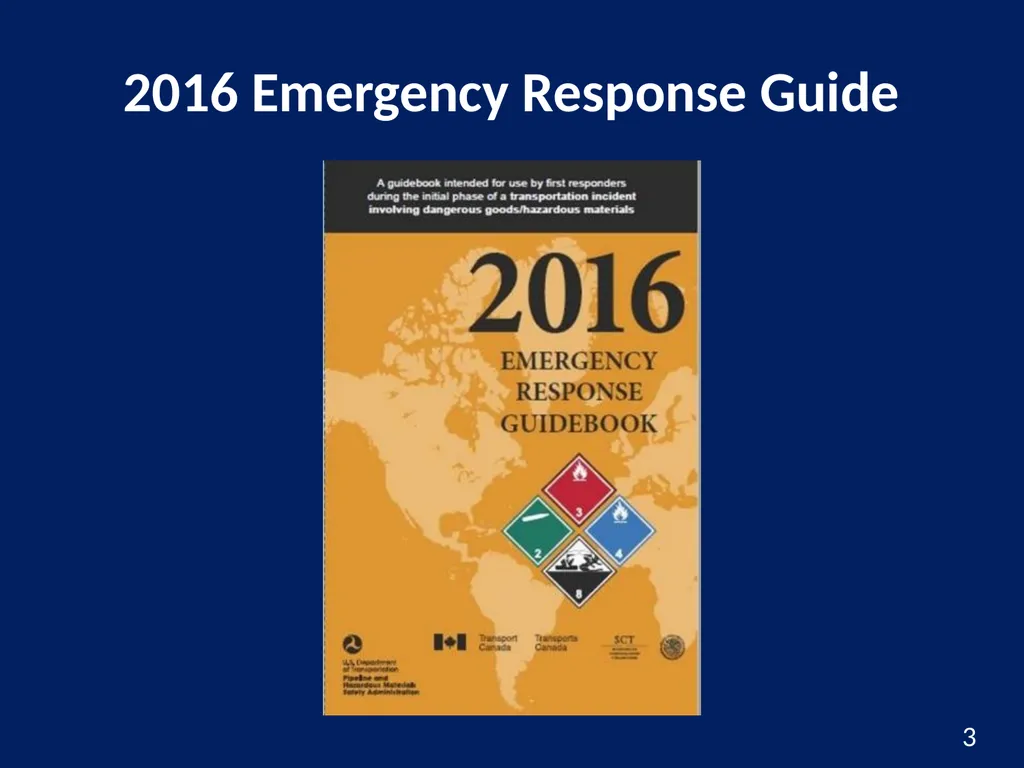
2016 Emergency Response Guide 3<br>
04
Section II Objective Demonstrate how to use the 2016 Emergency Response Guidebook (ERG) 4<br>
05
ERG History Developed jointly by Transport Canada, U.S. DOT and SCT of Mexico with collaboration of CIQUIME of Argentina
DOT Transportation incidents
Updated every Four Years 5<br>
DOT Transportation incidents
Updated every Four Years 5<br>
06
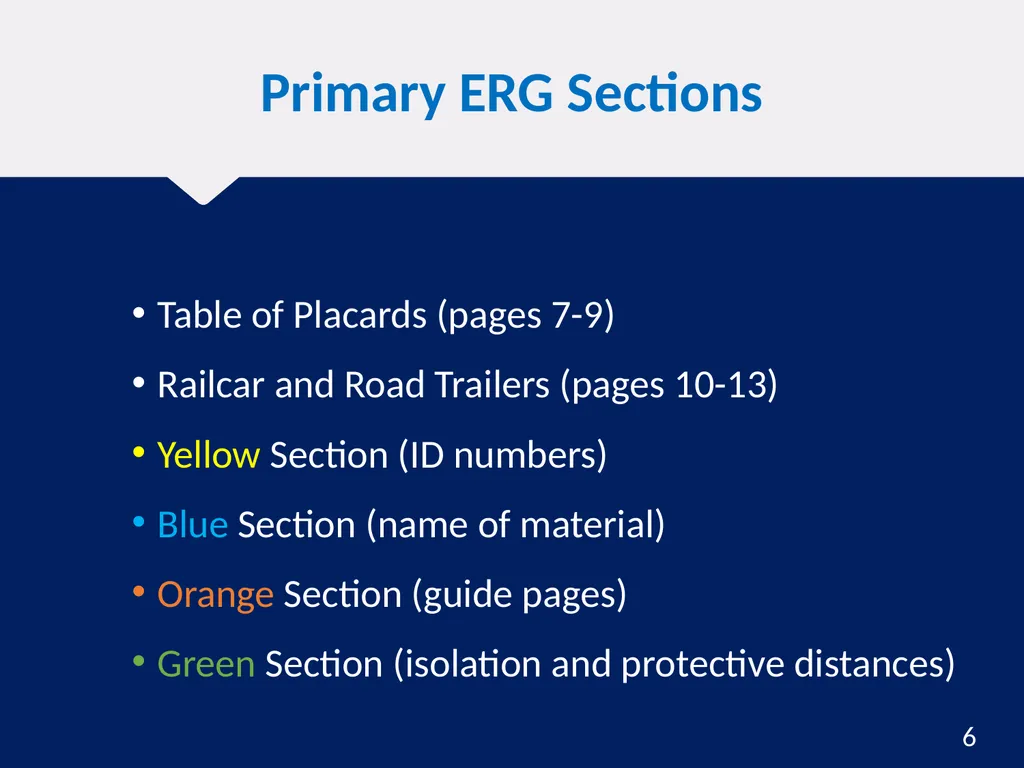
Primary ERG Sections Table of Placards (pages 7-9)
Railcar and Road Trailers (pages 10-13)
Yellow Section (ID numbers)
Blue Section (name of material)
Orange Section (guide pages)
Green Section (isolation and protective distances) 6<br>
Railcar and Road Trailers (pages 10-13)
Yellow Section (ID numbers)
Blue Section (name of material)
Orange Section (guide pages)
Green Section (isolation and protective distances) 6<br>
07
Using the ERG (page 1) Resist rushing in!
Approach Incident from upwind, uphill, or upstream
Stay clear of all spills, vapors, fumes, smoke, and potential hazards
Warning: Do not use the ERG flowchart if more than one hazardous material/dangerous good is involved. 7<br>
Approach Incident from upwind, uphill, or upstream
Stay clear of all spills, vapors, fumes, smoke, and potential hazards
Warning: Do not use the ERG flowchart if more than one hazardous material/dangerous good is involved. 7<br>
08
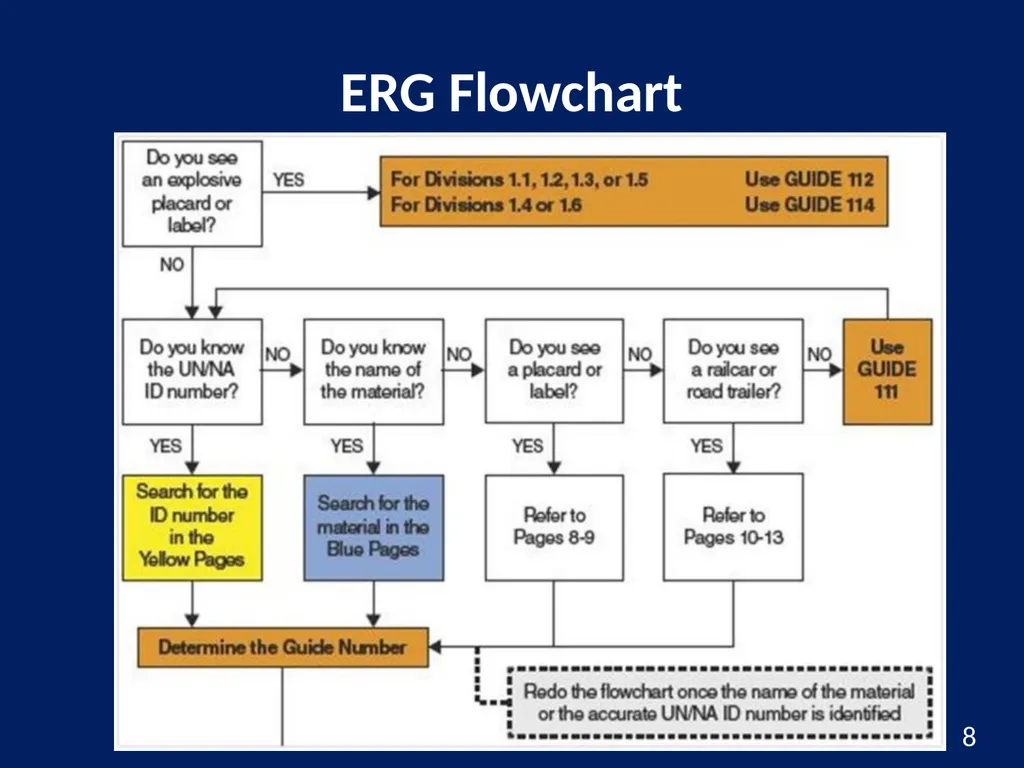
ERG Flowchart 8<br>
09
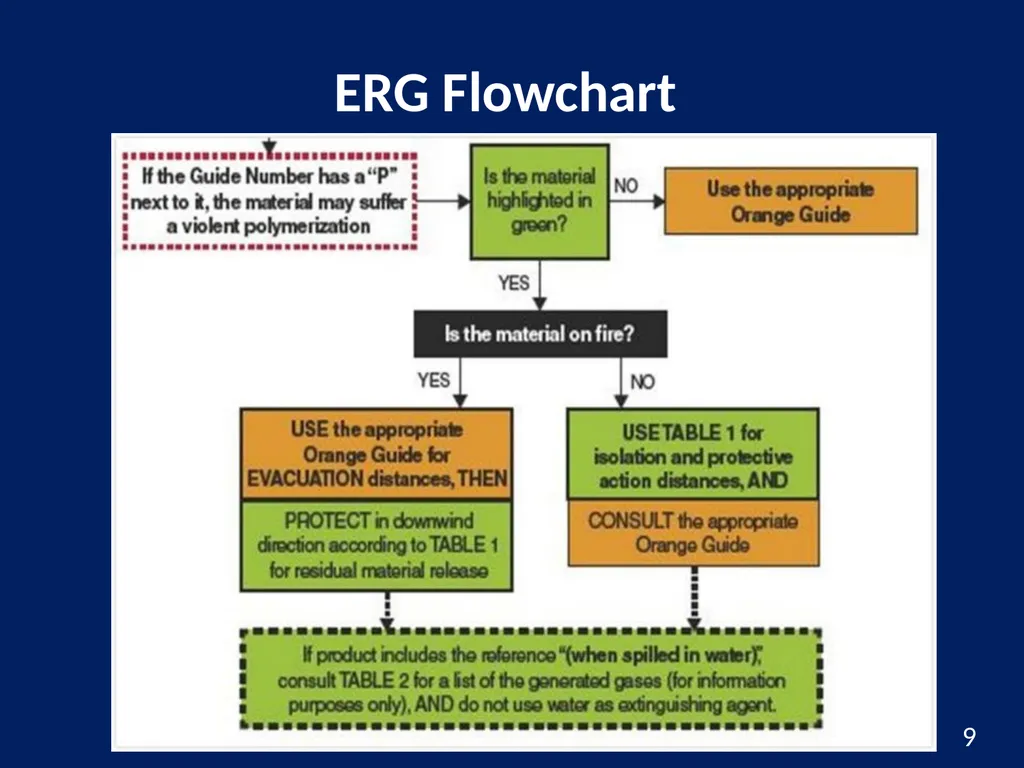
ERG Flowchart 9<br>
10
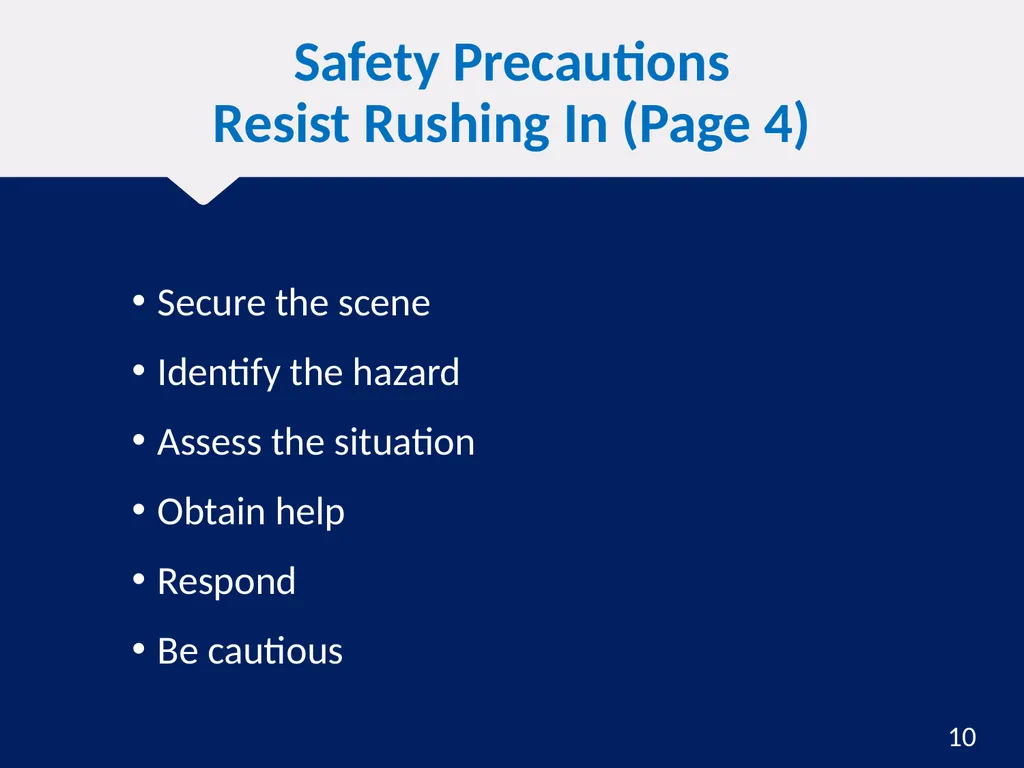
Safety Precautions
Resist Rushing In (Page 4) Secure the scene
Identify the hazard
Assess the situation
Obtain help
Respond
Be cautious 10<br>
Identify the hazard
Assess the situation
Obtain help
Respond
Be cautious 10<br>
11
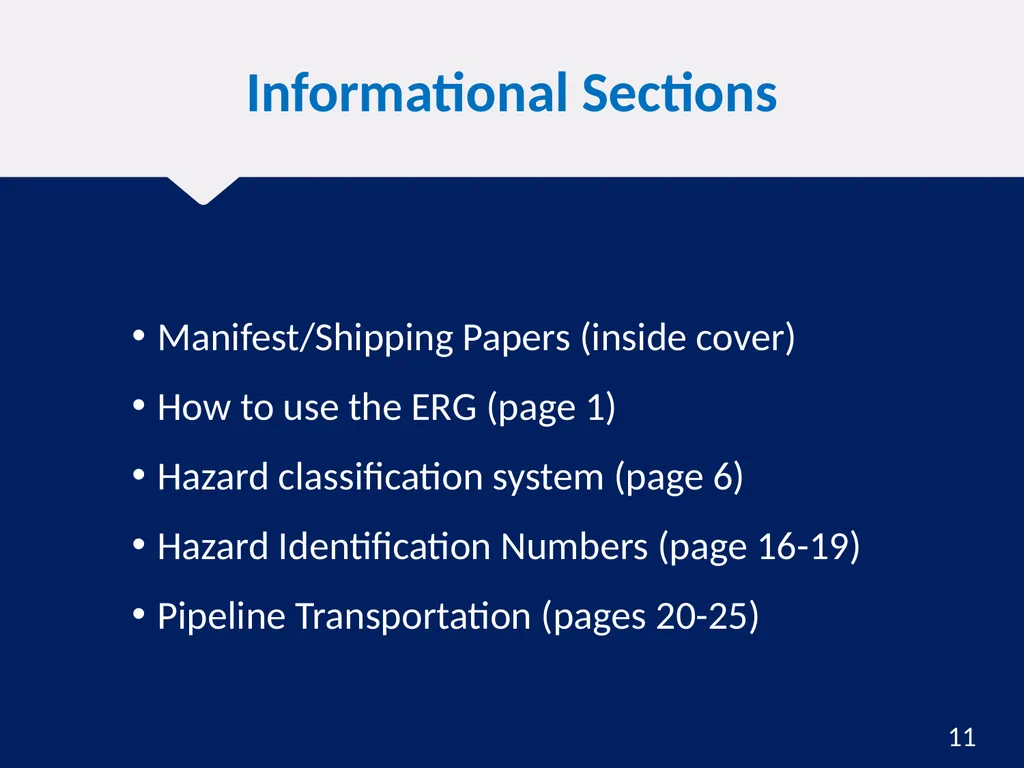
Informational Sections Manifest/Shipping Papers (inside cover)
How to use the ERG (page 1)
Hazard classification system (page 6)
Hazard Identification Numbers (page 16-19)
Pipeline Transportation (pages 20-25) 11<br>
How to use the ERG (page 1)
Hazard classification system (page 6)
Hazard Identification Numbers (page 16-19)
Pipeline Transportation (pages 20-25) 11<br>
12
Additional Information Protective Actions (pages 291-292)
Protective Clothing (pages 363-364)
Fire and Spill Control (pages 365-367)
Criminal / Terrorist Use of Chemical / Biological / Radiological Agents (pages 370-375)
Glossary (pages 376-389) 12<br>
Protective Clothing (pages 363-364)
Fire and Spill Control (pages 365-367)
Criminal / Terrorist Use of Chemical / Biological / Radiological Agents (pages 370-375)
Glossary (pages 376-389) 12<br>
13
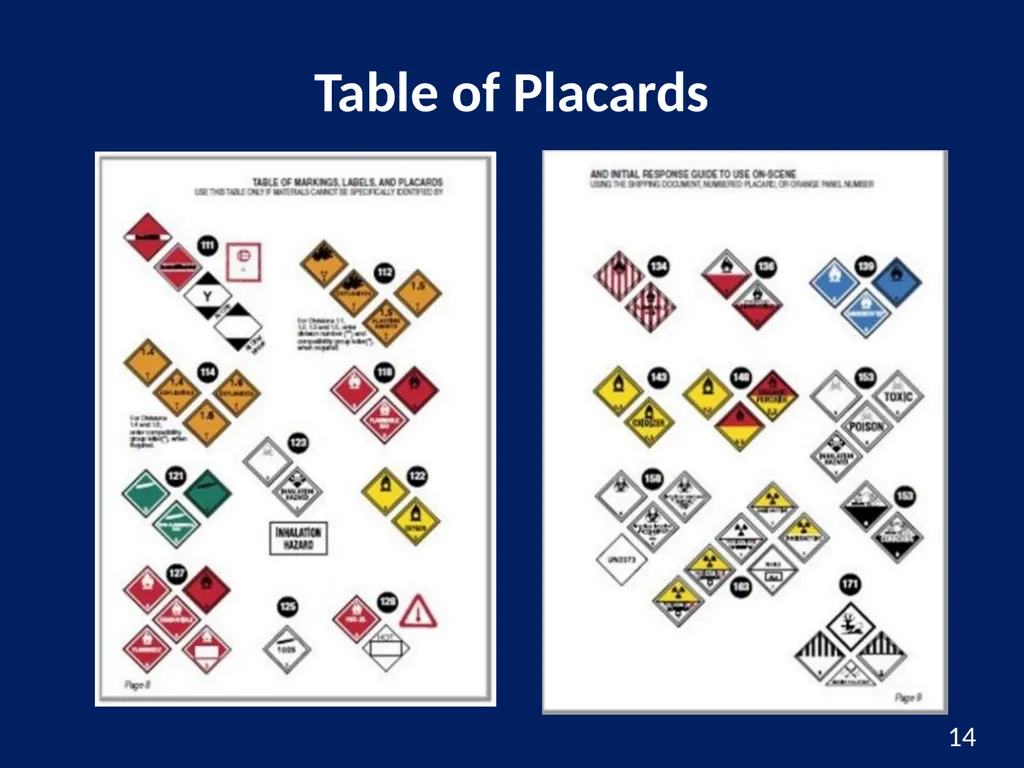
Table of Marking, Labels, and Placards Transportation Placards for dangerous are located on pages 8 and 9
Placards are grouped with a corresponding 3-digit Guide Page Number that can be referenced to the Orange section
Placards should only be used for identification if the UN/NA ID Number or the name of the material are unavailable 13<br>
Placards are grouped with a corresponding 3-digit Guide Page Number that can be referenced to the Orange section
Placards should only be used for identification if the UN/NA ID Number or the name of the material are unavailable 13<br>
14
Table of Placards 14<br>
15
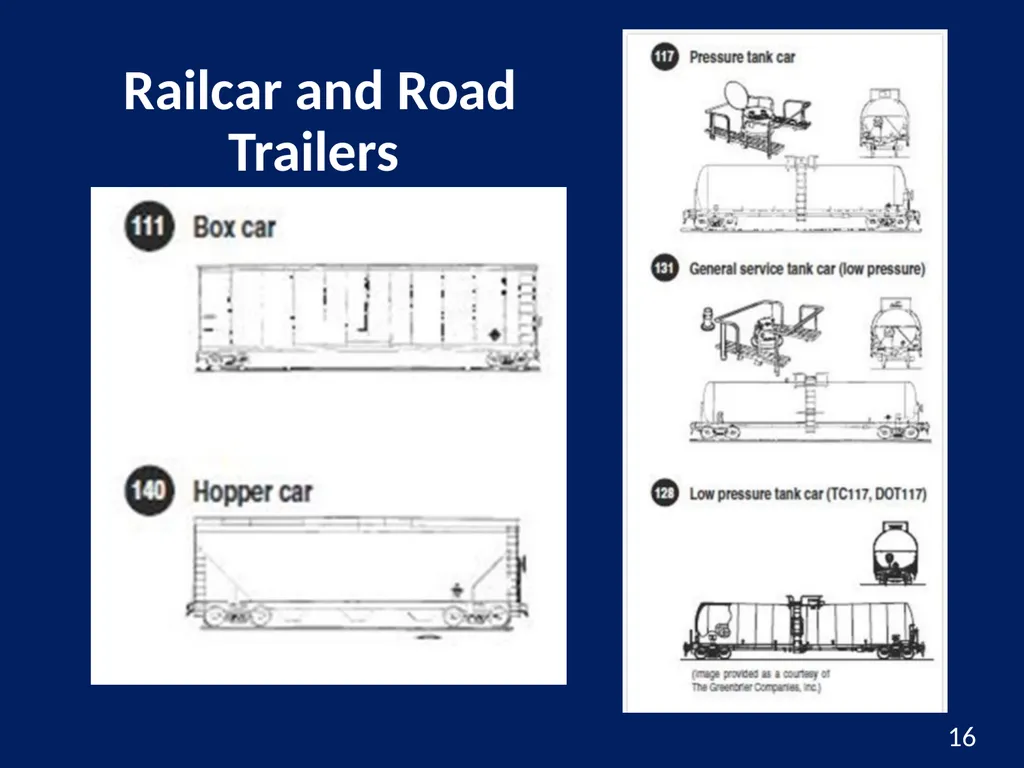
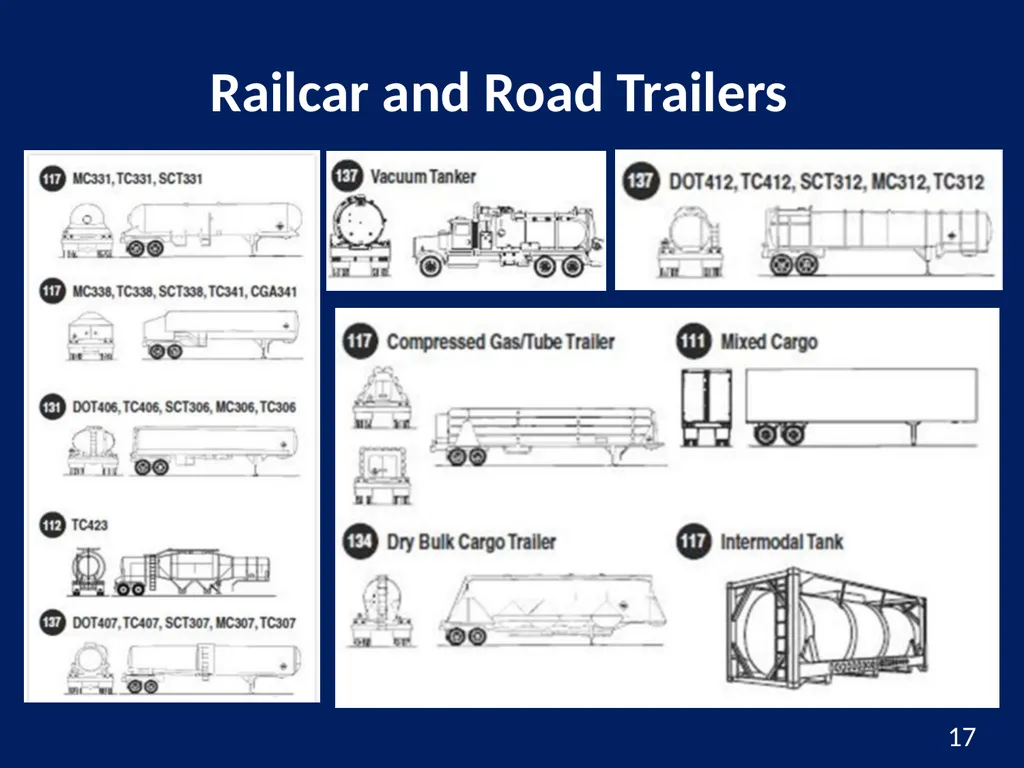
Railcar and Road Trailers Generalized shapes of railcars and road trailers used for transporting dangerous goods
Shapes are associated with a 3-digit guide number from the Orange section
Railcar and Road Trailer Shape Guide references should be used only if product name, UN/NA number, and transportation placards can not be identified 15<br>
Shapes are associated with a 3-digit guide number from the Orange section
Railcar and Road Trailer Shape Guide references should be used only if product name, UN/NA number, and transportation placards can not be identified 15<br>
16
Railcar and Road Trailers 16<br>
17
Railcar and Road Trailers 17<br>
18
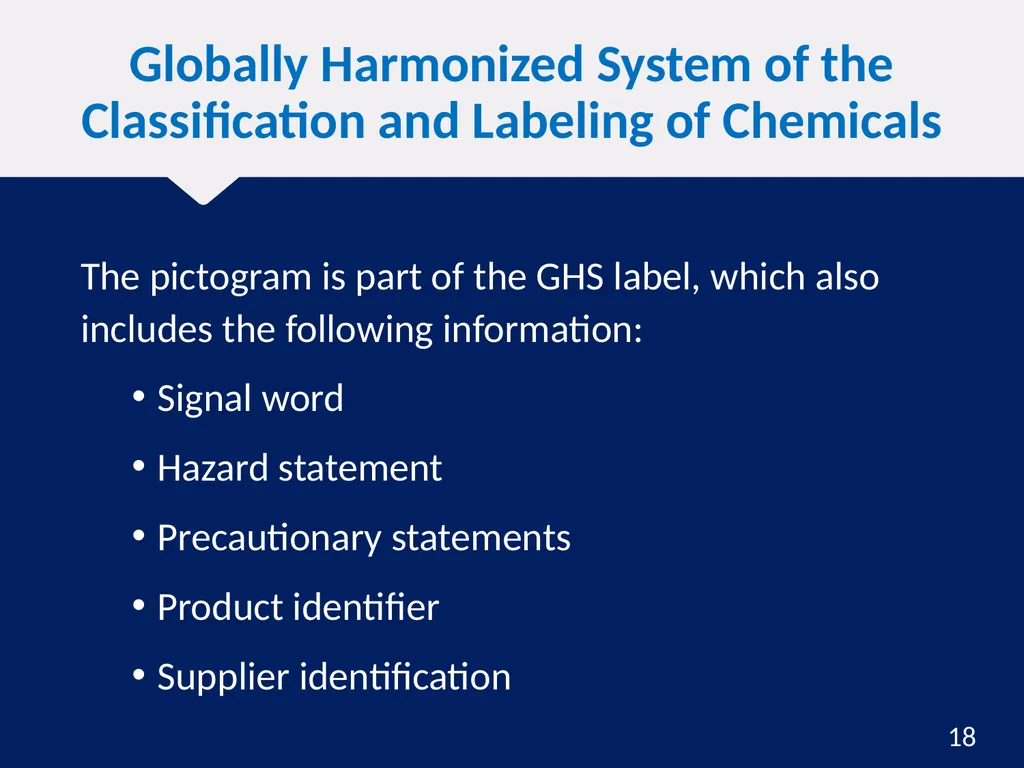
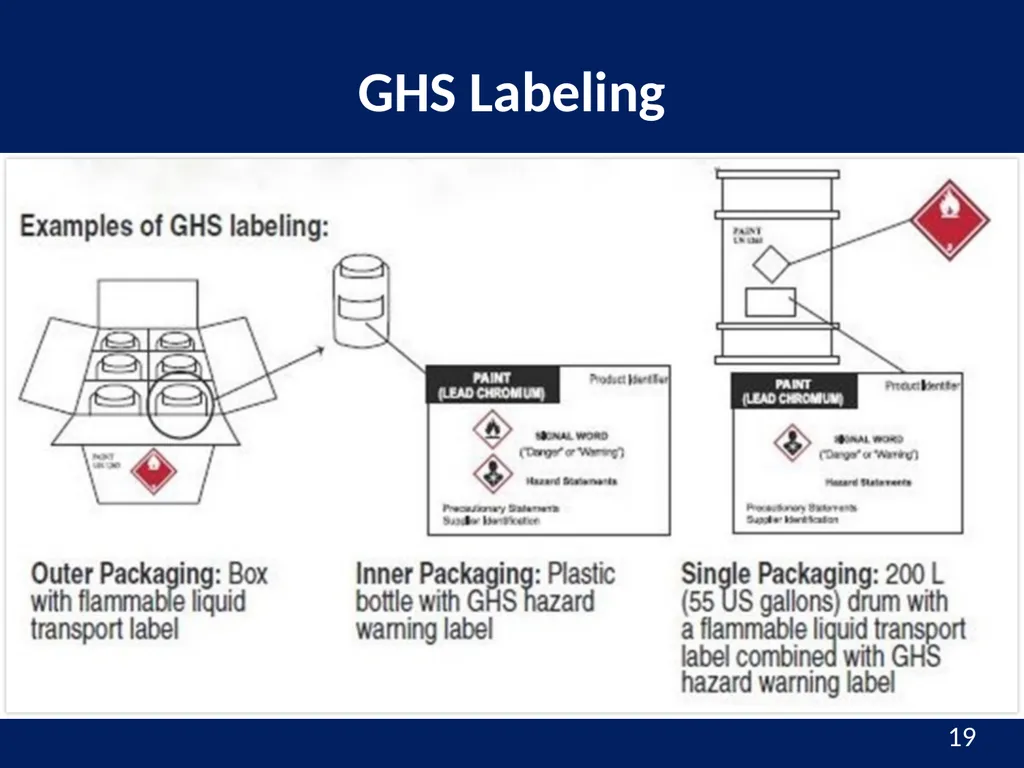
Globally Harmonized System of the Classification and Labeling of Chemicals The pictogram is part of the GHS label, which also includes the following information:
Signal word
Hazard statement
Precautionary statements
Product identifier
Supplier identification 18<br>
Signal word
Hazard statement
Precautionary statements
Product identifier
Supplier identification 18<br>
19
GHS Labeling 19<br>
20
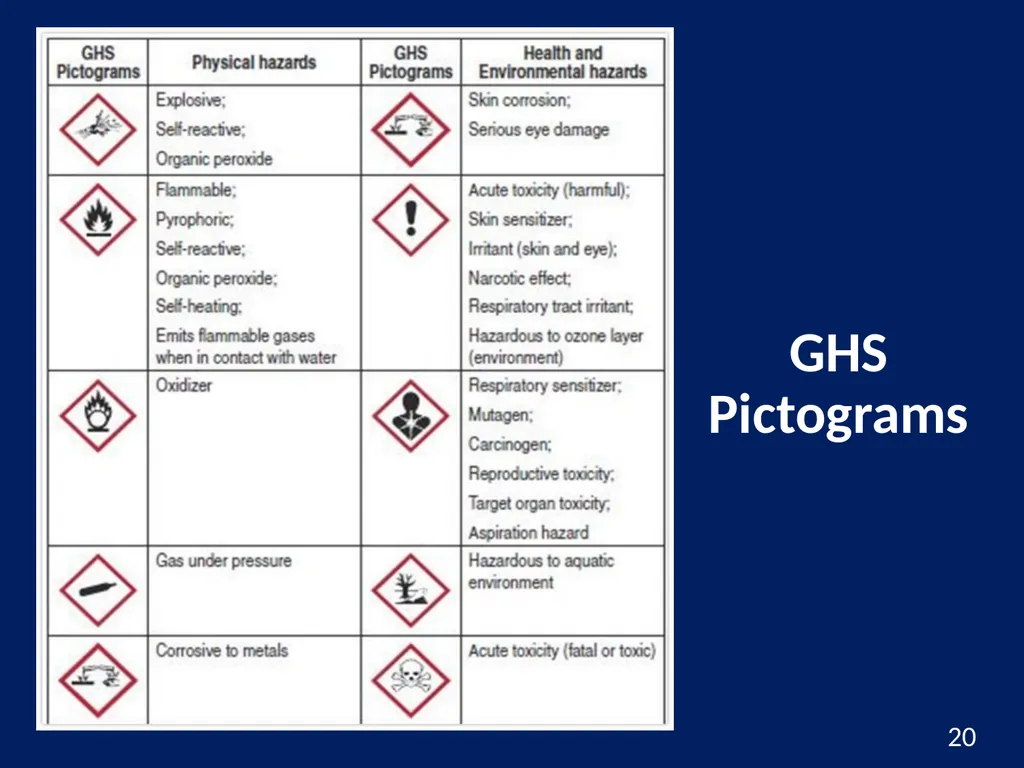
GHS Pictograms 20<br>
21
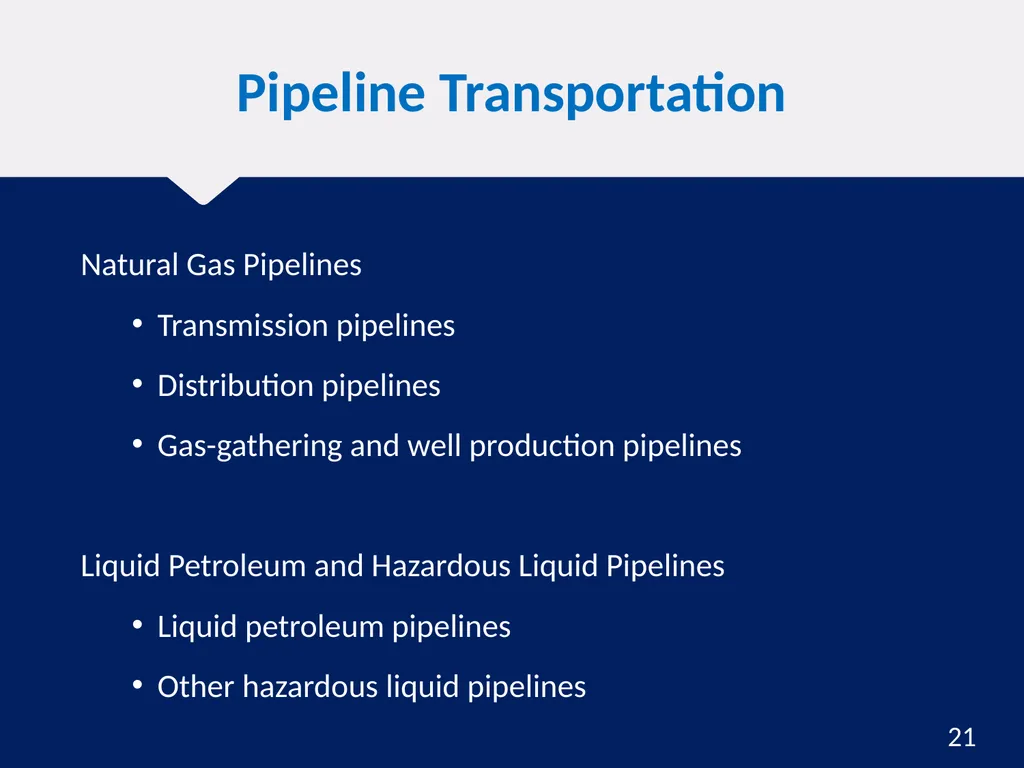
Pipeline Transportation Natural Gas Pipelines
Transmission pipelines
Distribution pipelines
Gas-gathering and well production pipelines
Liquid Petroleum and Hazardous Liquid Pipelines
Liquid petroleum pipelines
Other hazardous liquid pipelines 21<br>
Transmission pipelines
Distribution pipelines
Gas-gathering and well production pipelines
Liquid Petroleum and Hazardous Liquid Pipelines
Liquid petroleum pipelines
Other hazardous liquid pipelines 21<br>
22
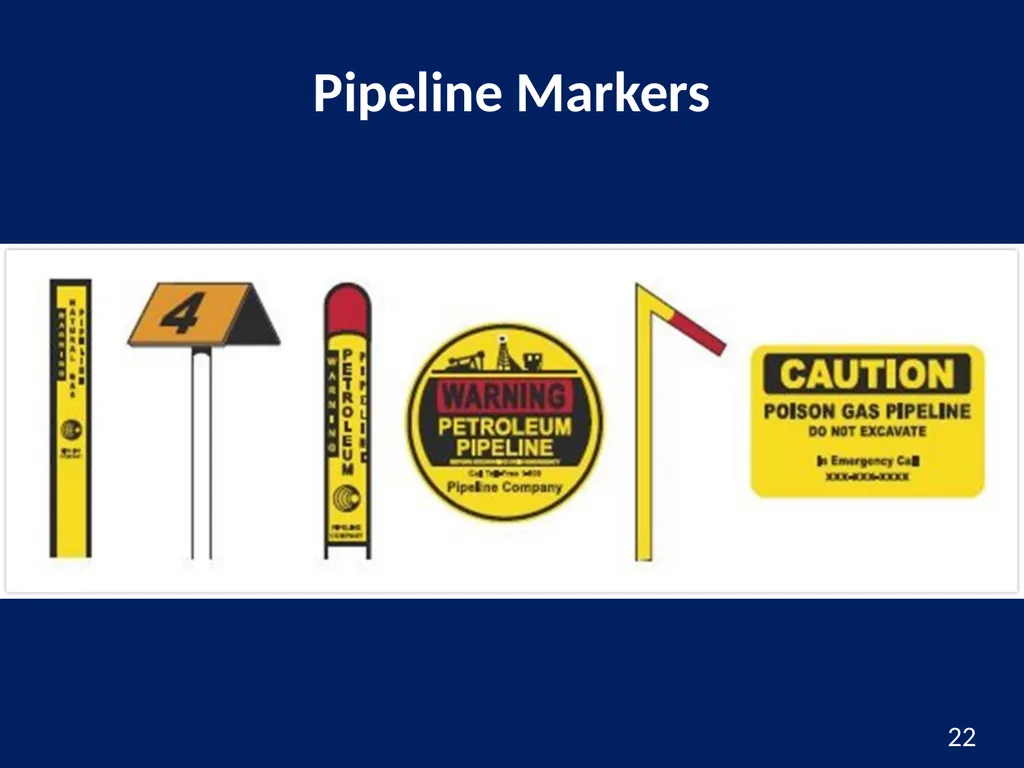
Pipeline Markers 22<br>
23
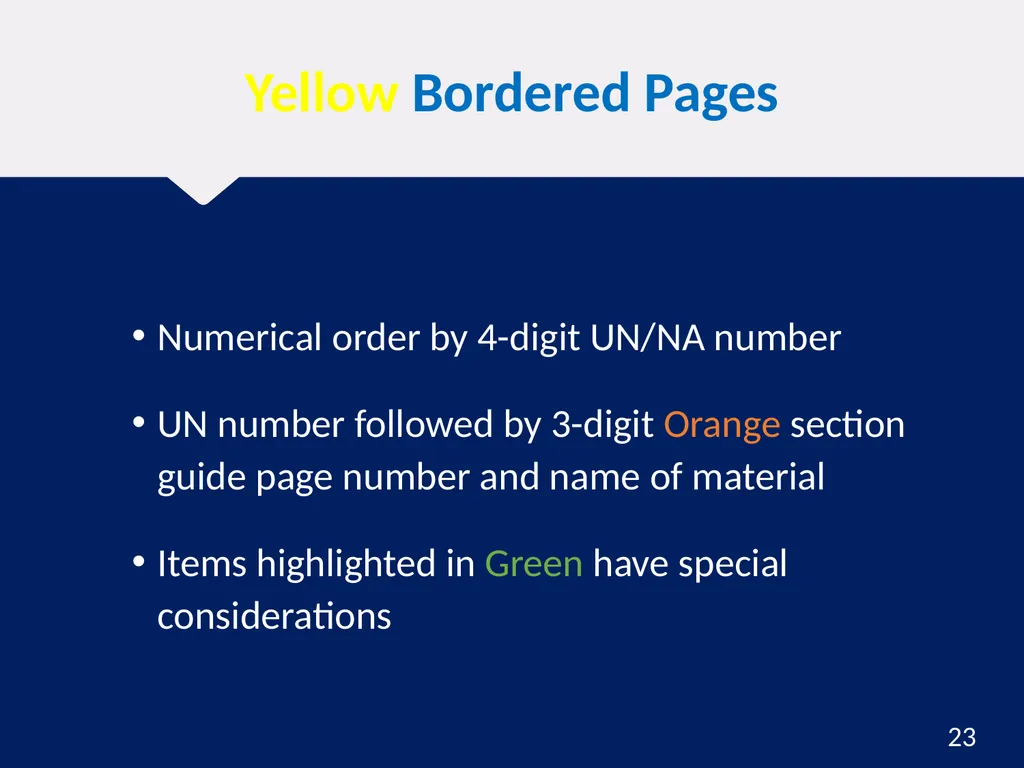
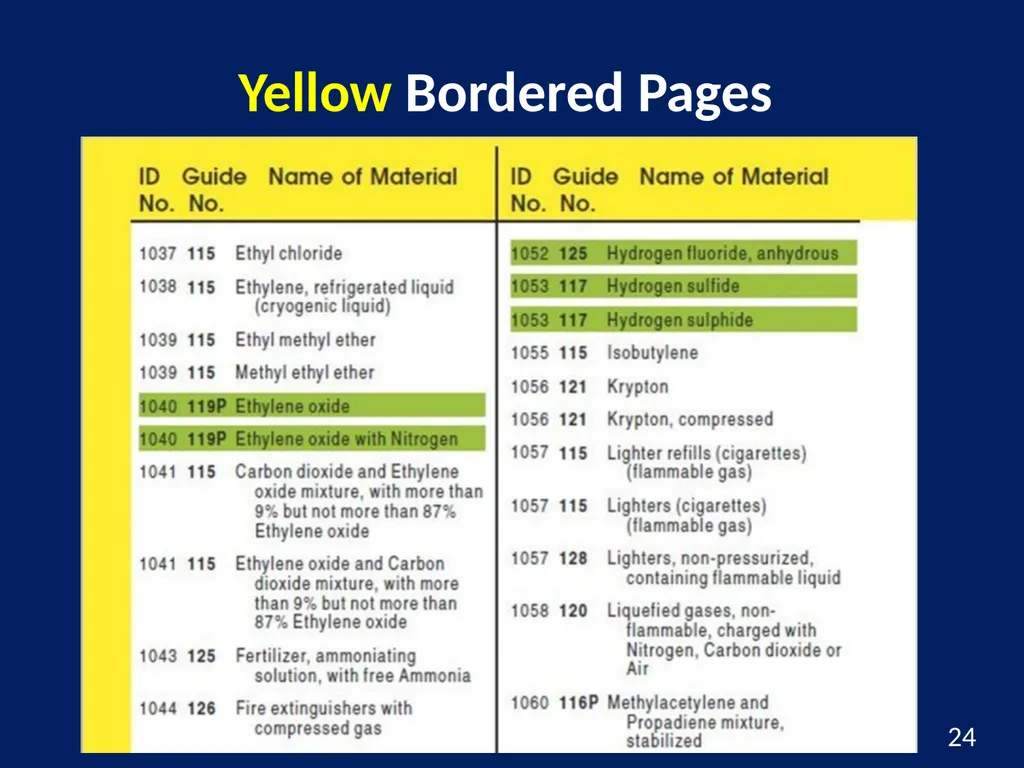
Yellow Bordered Pages Numerical order by 4-digit UN/NA number
UN number followed by 3-digit Orange section guide page number and name of material
Items highlighted in Green have special considerations 23<br>
UN number followed by 3-digit Orange section guide page number and name of material
Items highlighted in Green have special considerations 23<br>
24
Yellow Bordered Pages 24<br>
25
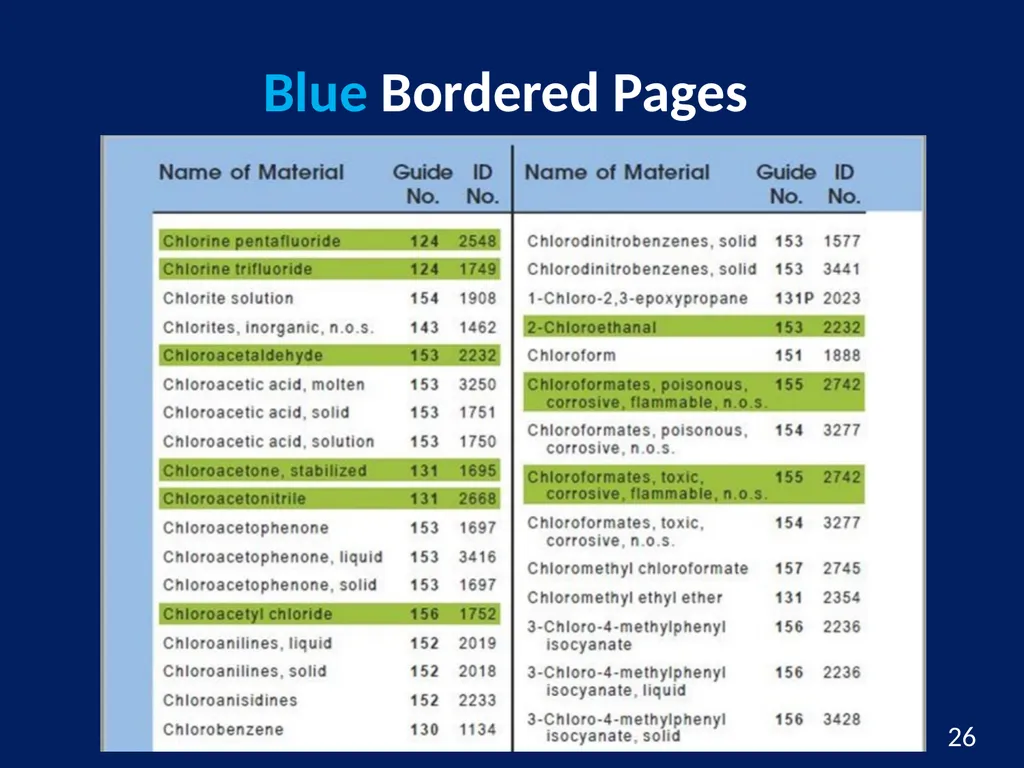
Blue Bordered Pages Alphabetical order of dangerous goods by shipping name
Shipping name followed by 3-digit Orange section guide page number and 4-digit UN/NA number
Items highlighted in Green have special considerations 25<br>
Shipping name followed by 3-digit Orange section guide page number and 4-digit UN/NA number
Items highlighted in Green have special considerations 25<br>
26
Blue Bordered Pages 26<br>
27
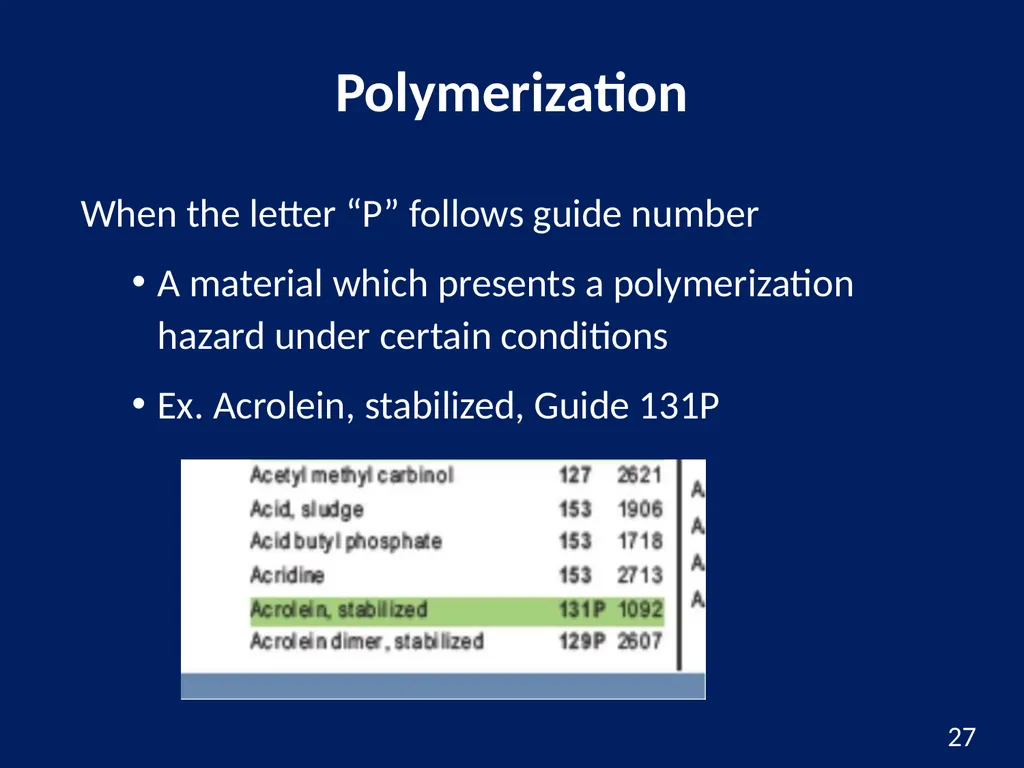
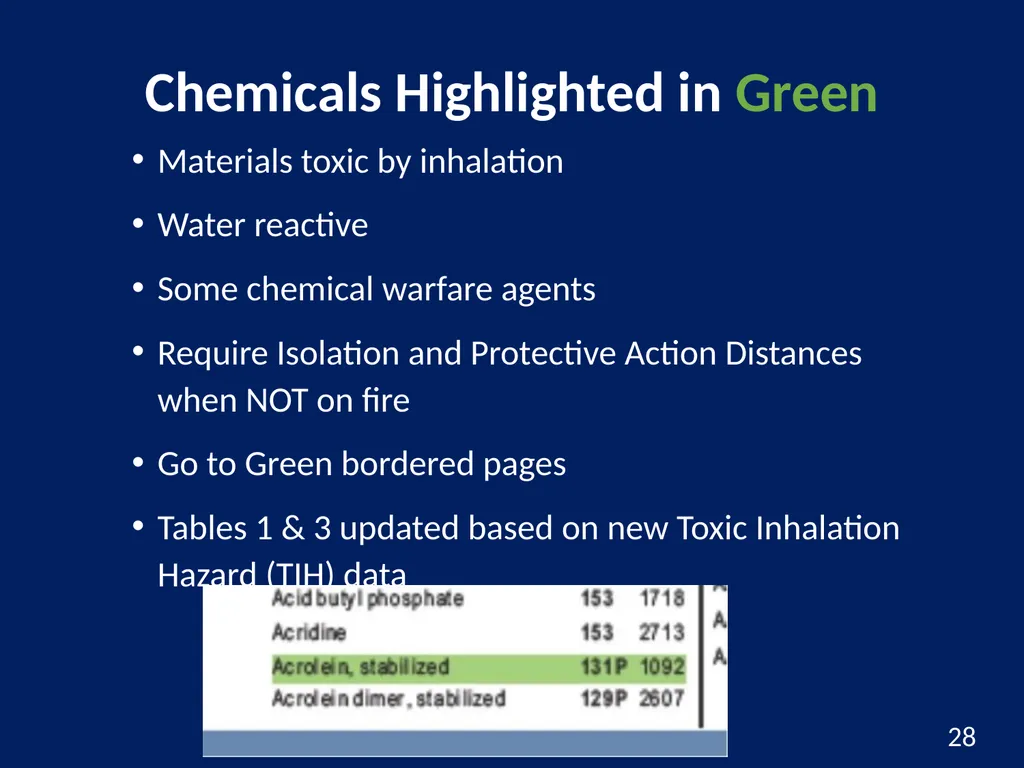
Polymerization When the letter “P” follows guide number
A material which presents a polymerization hazard under certain conditions
Ex. Acrolein, stabilized, Guide 131P 27<br>
A material which presents a polymerization hazard under certain conditions
Ex. Acrolein, stabilized, Guide 131P 27<br>
28
Chemicals Highlighted in Green Materials toxic by inhalation
Water reactive
Some chemical warfare agents
Require Isolation and Protective Action Distances when NOT on fire
Go to Green bordered pages
Tables 1 & 3 updated based on new Toxic Inhalation Hazard (TIH) data 28<br>
Water reactive
Some chemical warfare agents
Require Isolation and Protective Action Distances when NOT on fire
Go to Green bordered pages
Tables 1 & 3 updated based on new Toxic Inhalation Hazard (TIH) data 28<br>
29
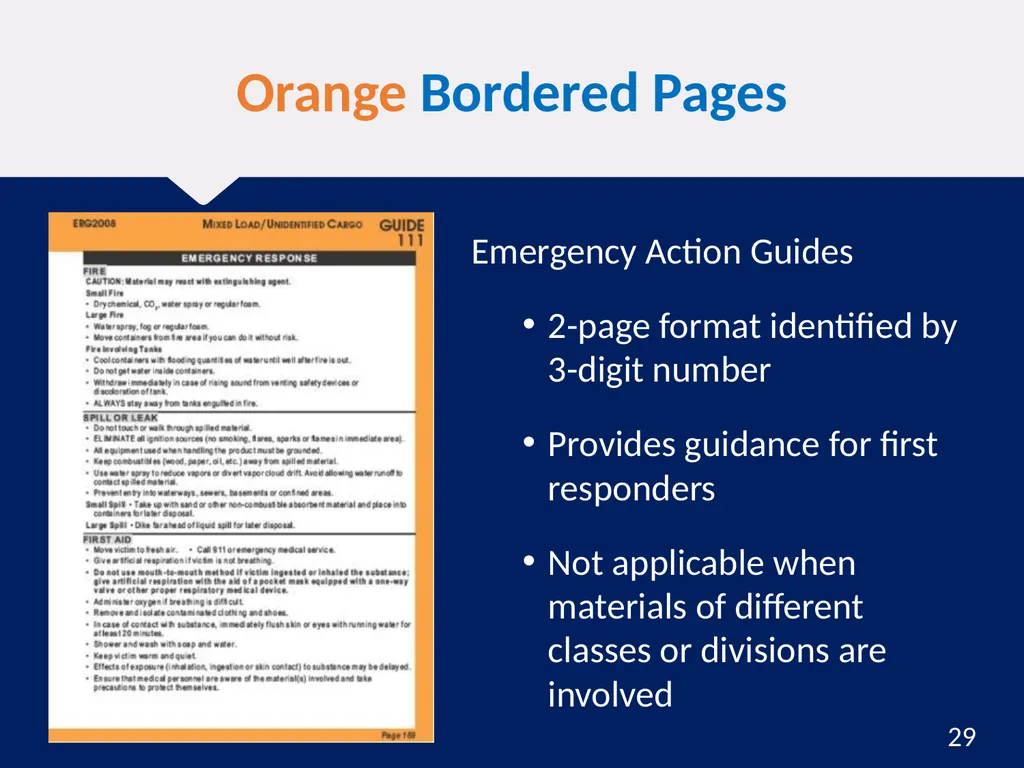
Orange Bordered Pages Emergency Action Guides
2-page format identified by 3-digit number
Provides guidance for first responders
Not applicable when materials of different classes or divisions are involved 29<br>
2-page format identified by 3-digit number
Provides guidance for first responders
Not applicable when materials of different classes or divisions are involved 29<br>
30
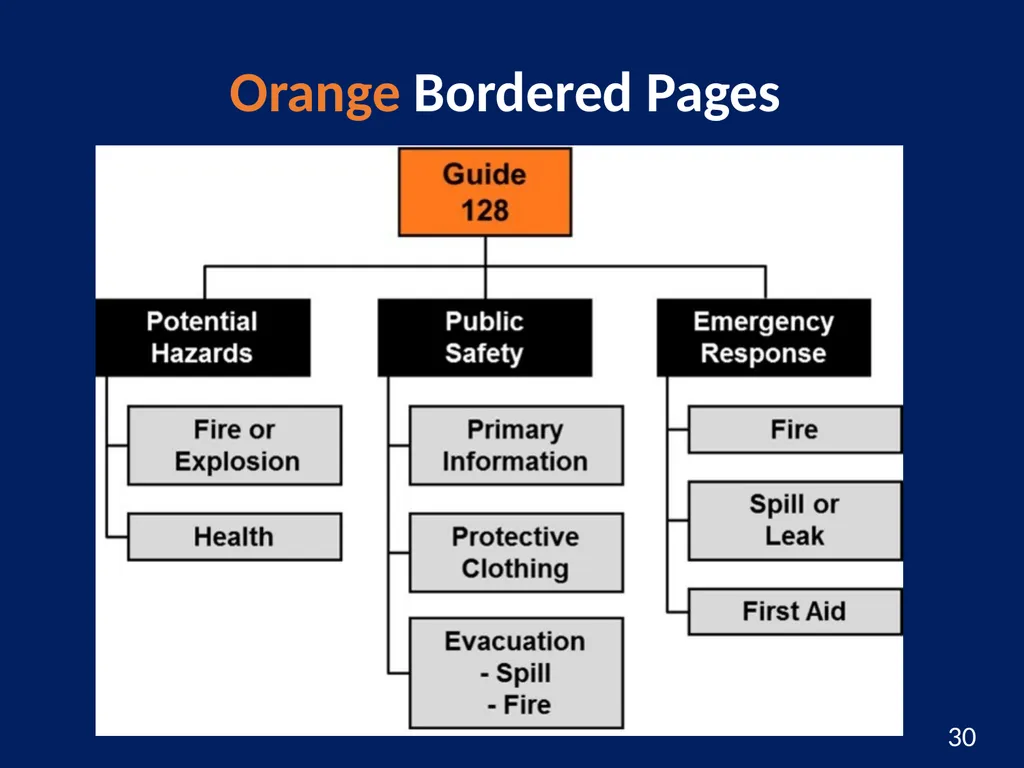
Orange Bordered Pages 30<br>
31
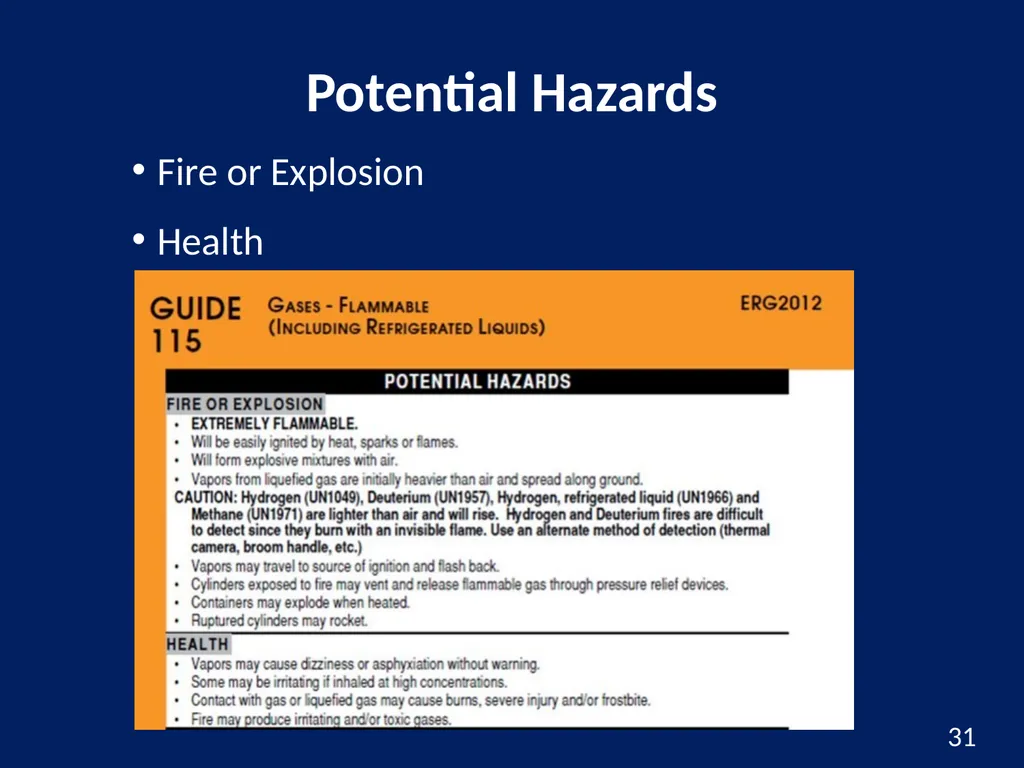
Potential Hazards Fire or Explosion
Health 31<br>
Health 31<br>
32
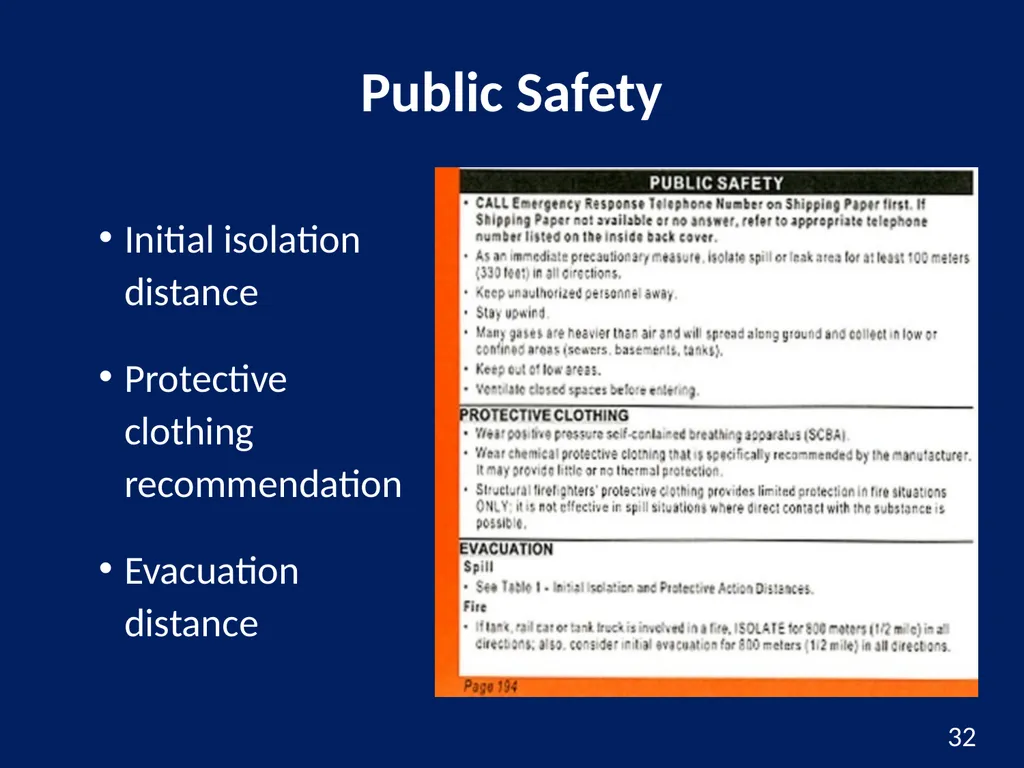
Public Safety Initial isolation distance
Protective clothing recommendation
Evacuation distance 32<br>
Protective clothing recommendation
Evacuation distance 32<br>
33
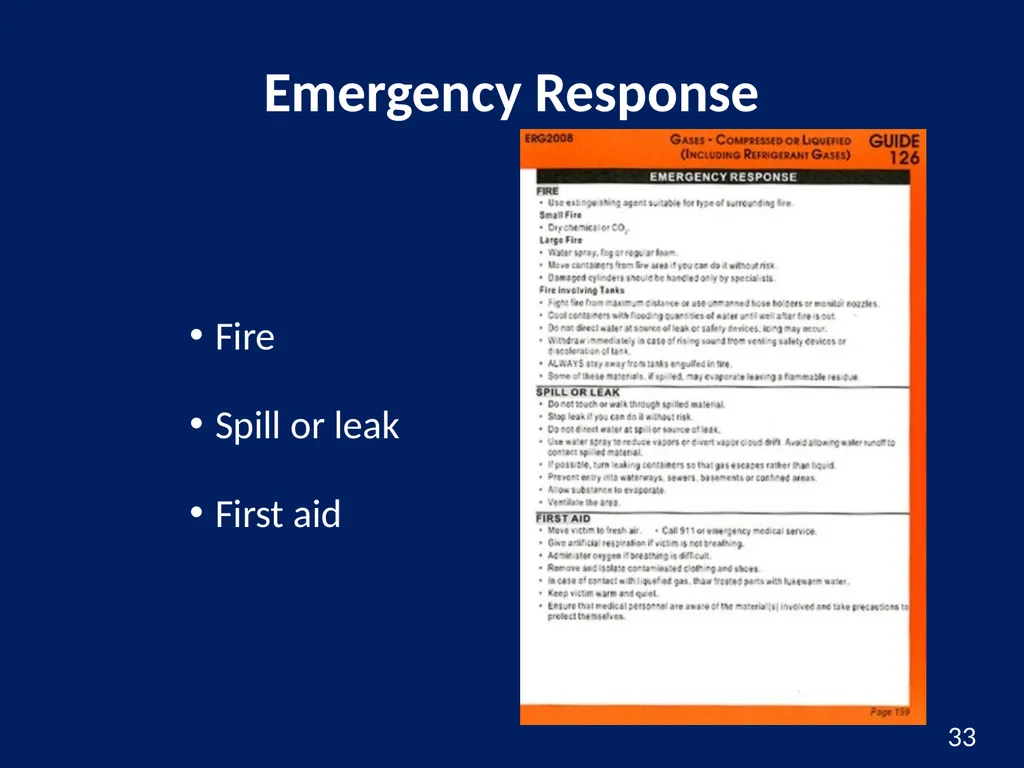
Emergency Response Fire
Spill or leak
First aid 33<br>
Spill or leak
First aid 33<br>
34
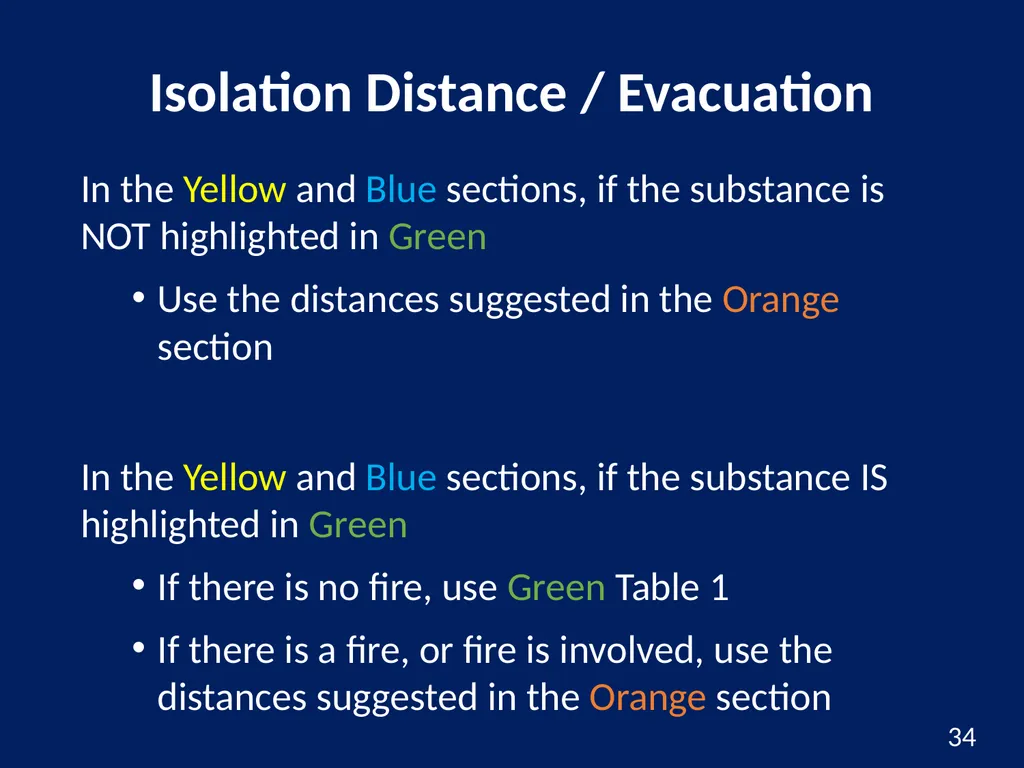
Isolation Distance / Evacuation In the Yellow and Blue sections, if the substance is NOT highlighted in Green
Use the distances suggested in the Orange section
In the Yellow and Blue sections, if the substance IS highlighted in Green
If there is no fire, use Green Table 1
If there is a fire, or fire is involved, use the distances suggested in the Orange section 34<br>
Use the distances suggested in the Orange section
In the Yellow and Blue sections, if the substance IS highlighted in Green
If there is no fire, use Green Table 1
If there is a fire, or fire is involved, use the distances suggested in the Orange section 34<br>
35
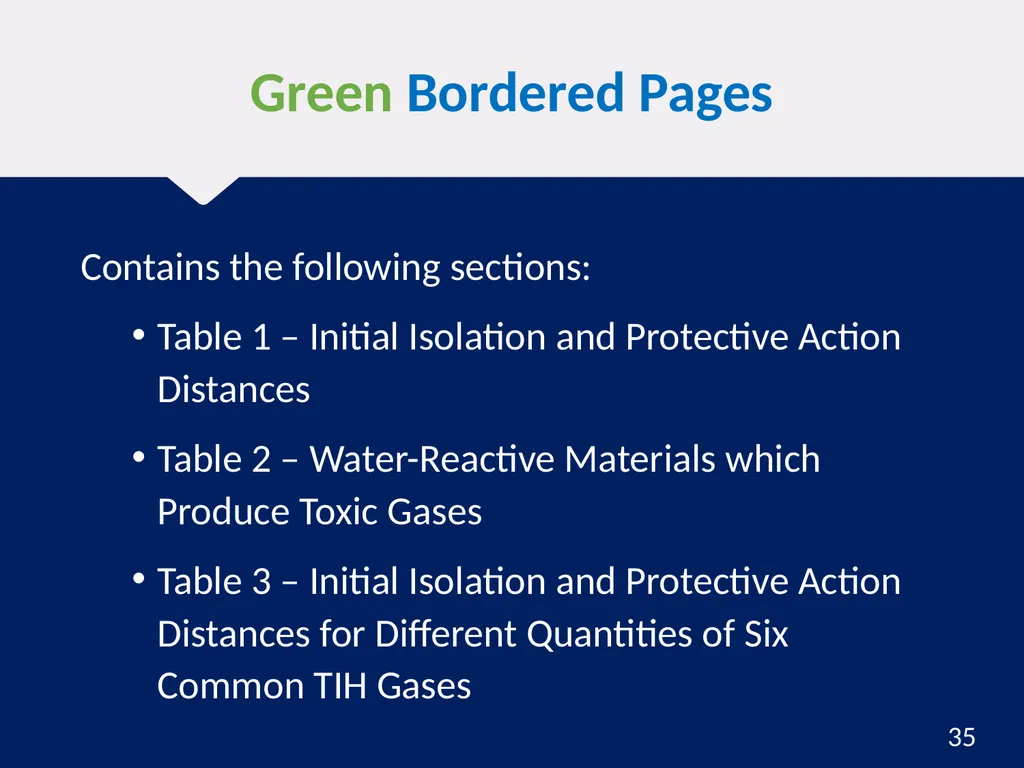
Green Bordered Pages Contains the following sections:
Table 1 – Initial Isolation and Protective Action Distances
Table 2 – Water-Reactive Materials which Produce Toxic Gases
Table 3 – Initial Isolation and Protective Action Distances for Different Quantities of Six Common TIH Gases 35<br>
Table 1 – Initial Isolation and Protective Action Distances
Table 2 – Water-Reactive Materials which Produce Toxic Gases
Table 3 – Initial Isolation and Protective Action Distances for Different Quantities of Six Common TIH Gases 35<br>
36
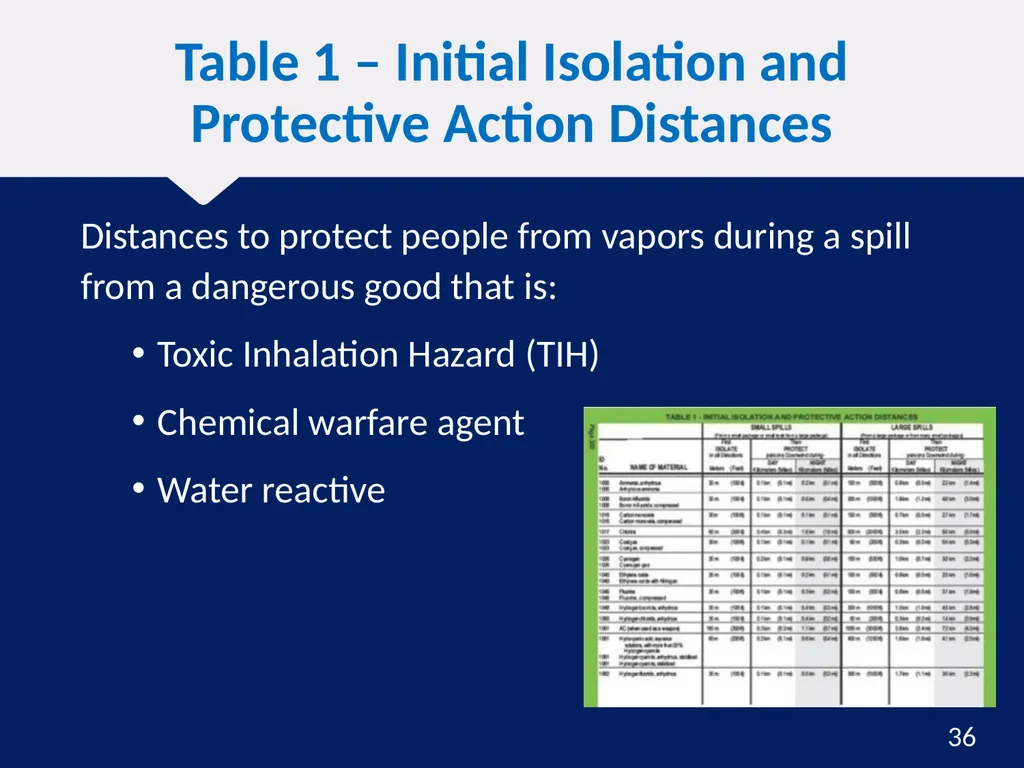
Table 1 – Initial Isolation and Protective Action Distances Distances to protect people from vapors during a spill from a dangerous good that is:
Toxic Inhalation Hazard (TIH)
Chemical warfare agent
Water reactive 36<br>
Toxic Inhalation Hazard (TIH)
Chemical warfare agent
Water reactive 36<br>
37
Table 1 – Initial Isolation and Protective Action Distances Table provides distances for:
Initial Isolation Zone
Protective Action Zone, downwind, for day and night
Distances show the areas likely to be affected during the first 30 minutes after the materials are spilled, and this distance could increase with time. 37<br>
Initial Isolation Zone
Protective Action Zone, downwind, for day and night
Distances show the areas likely to be affected during the first 30 minutes after the materials are spilled, and this distance could increase with time. 37<br>
38
Small and Large Spills Small Spill
Less than 208 liters (55 U.S. gallons) for liquids and less than 300 kilograms (660 pounds) for solids
Generally a single small package, a small cylinder, or a small leak from a large package
Large Spill
Greater than 208 liters (55 U.S. gallons) for liquids and greater than 300 kilograms (660 pounds) for solids
Generally a spill from a large package, or multiple spills from many small packages 38<br>
Less than 208 liters (55 U.S. gallons) for liquids and less than 300 kilograms (660 pounds) for solids
Generally a single small package, a small cylinder, or a small leak from a large package
Large Spill
Greater than 208 liters (55 U.S. gallons) for liquids and greater than 300 kilograms (660 pounds) for solids
Generally a spill from a large package, or multiple spills from many small packages 38<br>
39
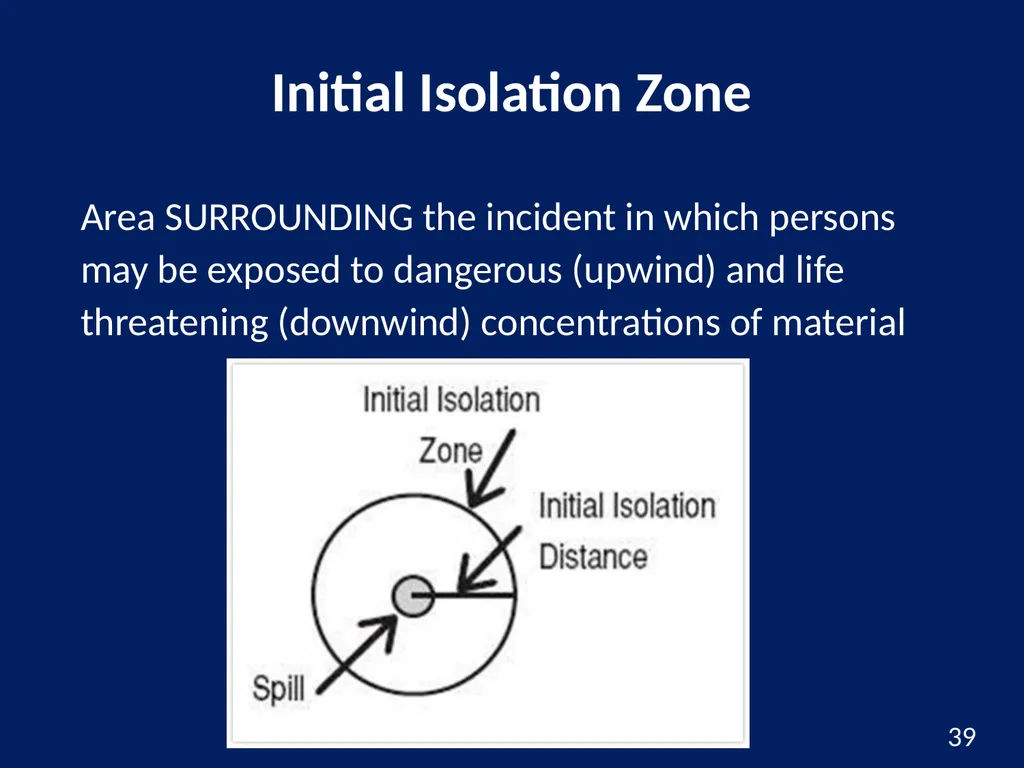
Initial Isolation Zone Area SURROUNDING the incident in which persons may be exposed to dangerous (upwind) and life threatening (downwind) concentrations of material 39<br>
40
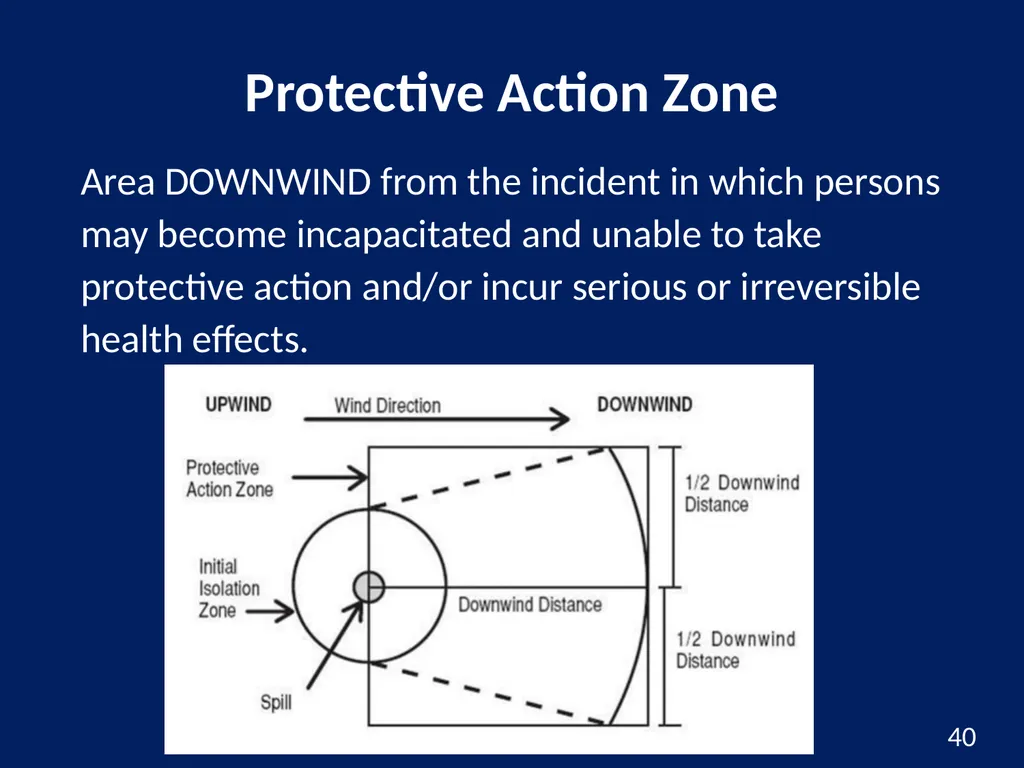
Protective Action Zone Area DOWNWIND from the incident in which persons may become incapacitated and unable to take protective action and/or incur serious or irreversible health effects. 40<br>
41
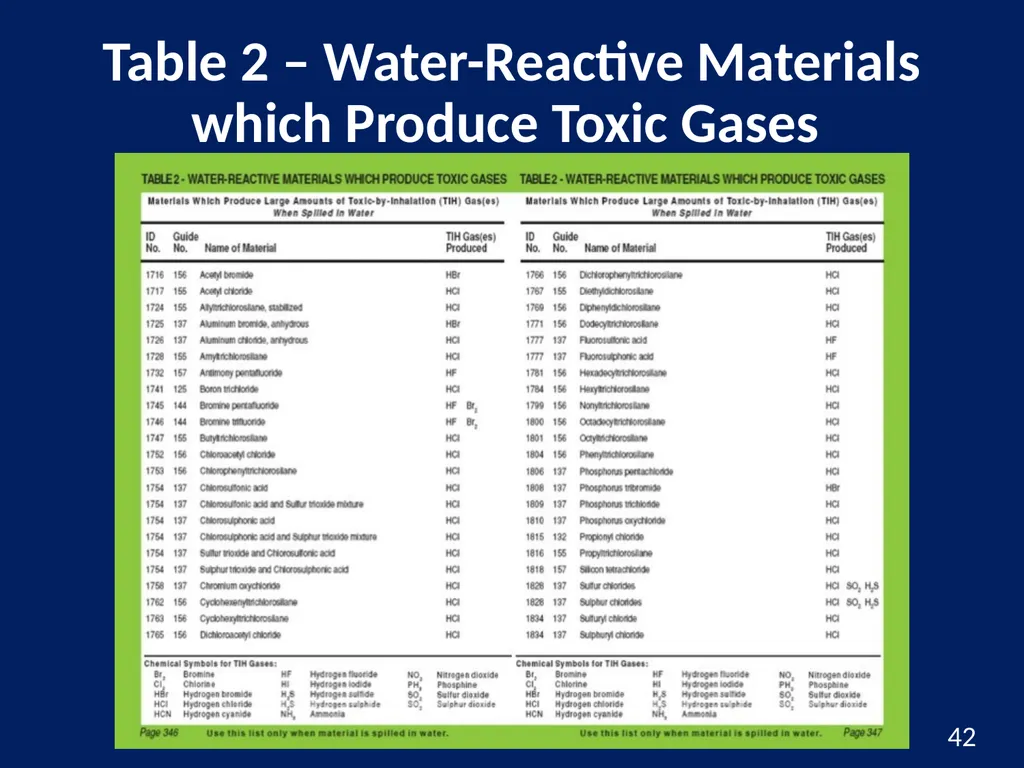
Table 2 – Water-Reactive Materials which Produce Toxic Gases List of materials which produce large amount of Toxic Inhalation Hazard (TIH) gases when spilled in water and identifies the TIH gases produced
Substances are presented in numerical order of their ID Numbers
Easily identified in Table 1 as their name is immediately followed by When Spilled in Water 41<br>
Substances are presented in numerical order of their ID Numbers
Easily identified in Table 1 as their name is immediately followed by When Spilled in Water 41<br>
42
Table 2 – Water-Reactive Materials which Produce Toxic Gases 42<br>
43
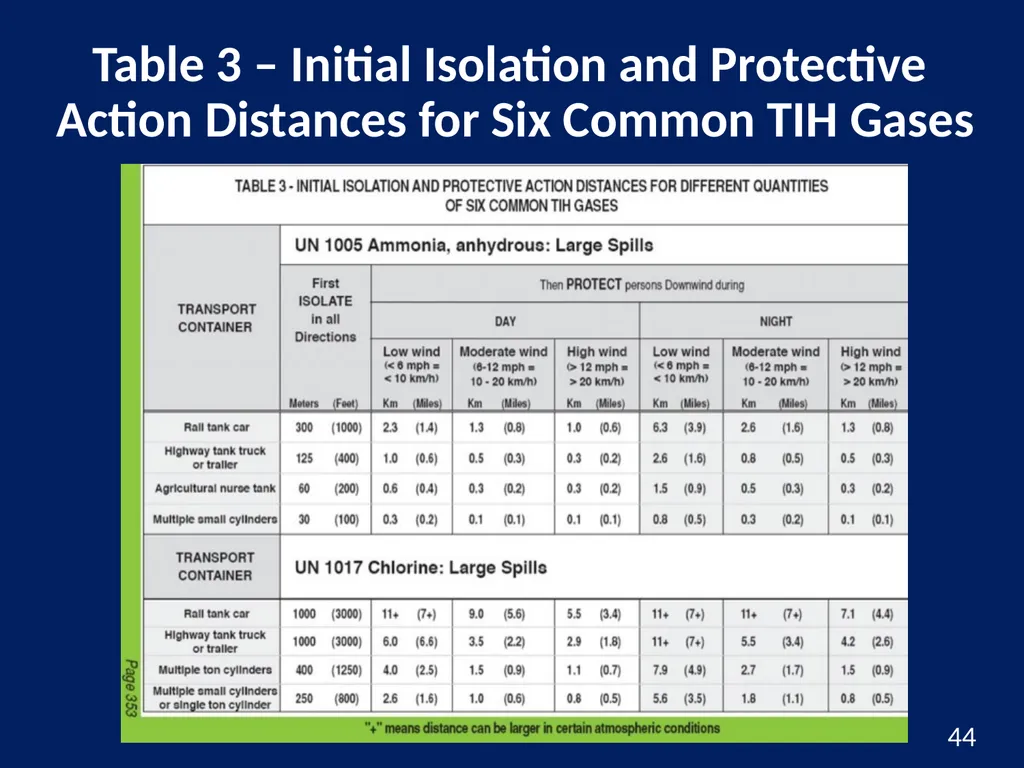
Table 3 – Initial Isolation and Protective Action Distances for Six Common TIH Gases Six Toxic Inhalation Hazard (TIH) gasses commonly encountered:
Ammonia, anhydrous (UN1005)
Chlorine (UN1017)
Ethylene oxide (UN1040)
Hydrogen chloride, anhydrous (UN1050) and Hydrogen chloride, refrigerated liquid (UN2186)
Hydrogen fluoride, anhydrous (UN1052)
Sulfur dioxide/Sulphur dioxide (UN1079) 43<br>
Ammonia, anhydrous (UN1005)
Chlorine (UN1017)
Ethylene oxide (UN1040)
Hydrogen chloride, anhydrous (UN1050) and Hydrogen chloride, refrigerated liquid (UN2186)
Hydrogen fluoride, anhydrous (UN1052)
Sulfur dioxide/Sulphur dioxide (UN1079) 43<br>
44
Table 3 – Initial Isolation and Protective Action Distances for Six Common TIH Gases 44<br>
45
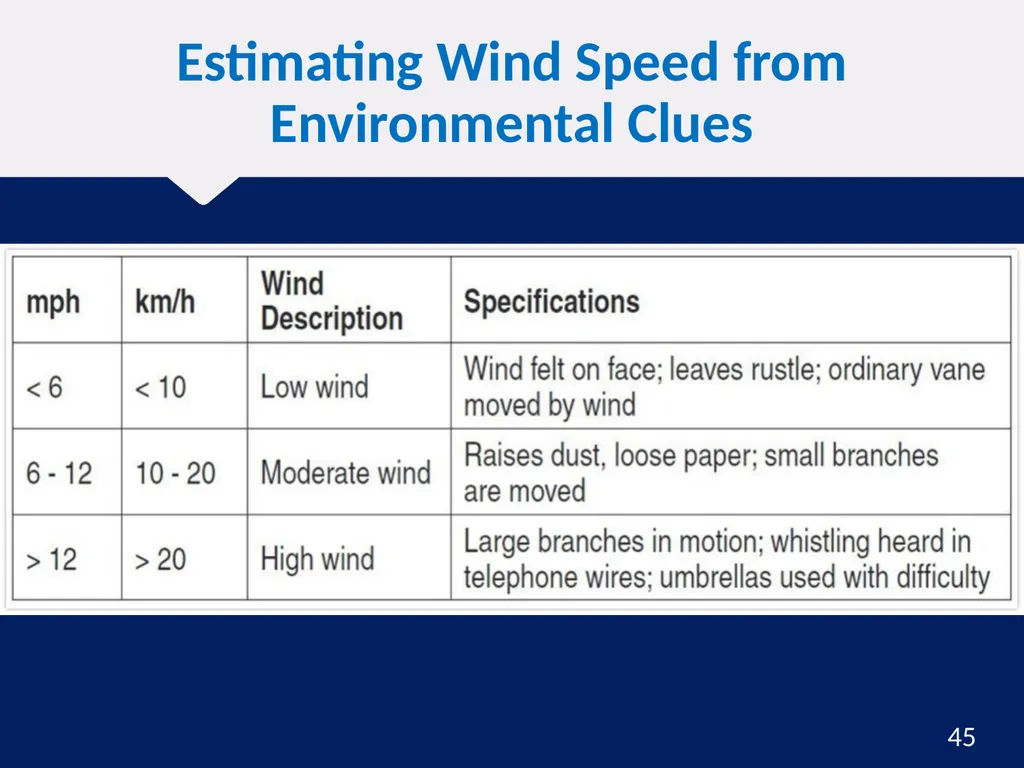
Estimating Wind Speed from Environmental Clues 45<br>
46
Boiling Liquid Expanding Vapor Explosion (BLEVE) Occurs when a container holding a pressurized liquefied gas fails catastrophically
Catastrophic failure of the vessel is followed by the explosive release of boiling liquid and expanding vapor
Note: A BLEVE can occur even if the material is non-flammable 46<br>
Catastrophic failure of the vessel is followed by the explosive release of boiling liquid and expanding vapor
Note: A BLEVE can occur even if the material is non-flammable 46<br>
47
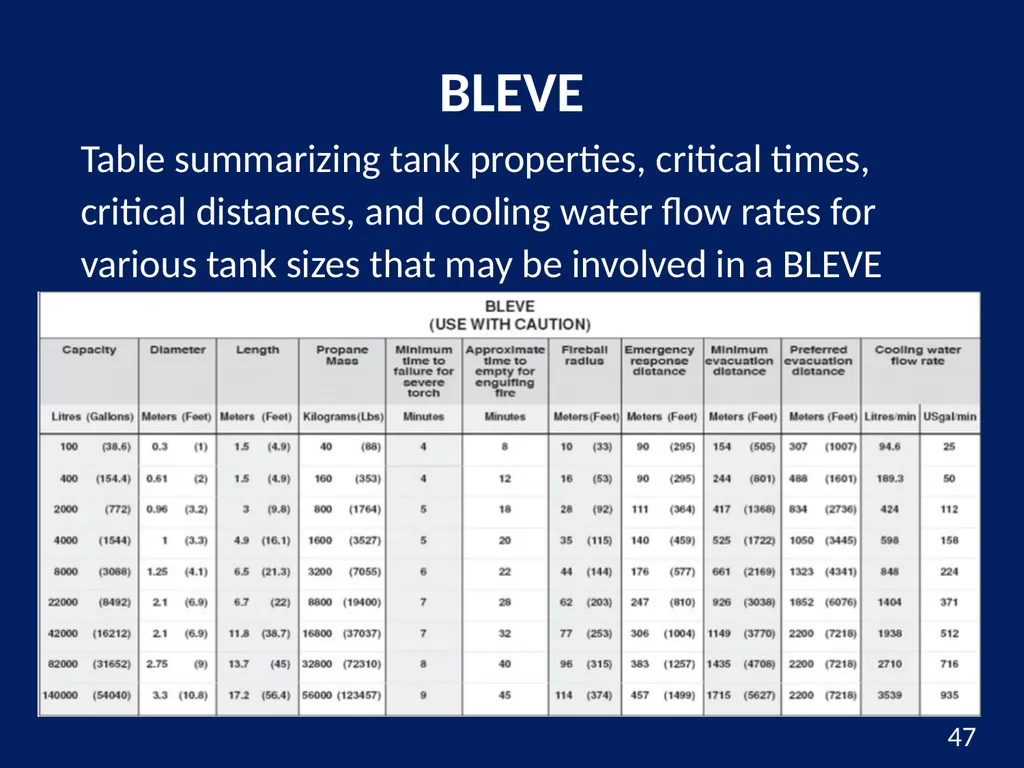
BLEVE Table summarizing tank properties, critical times, critical distances, and cooling water flow rates for various tank sizes that may be involved in a BLEVE 47<br>
48
Emergency Response Telephone Numbers CHEMTREC®, a 24-hour emergency response communication service: 1-800-424-9300
CHEMTEL, INC., a 24-hour emergency response communication service 1-888-255-3924
INFOTRAC, a 24-hour emergency response communication service: 1-800-535-5053
3E COMPANY, a 24-hour emergency response communication service: 1-800-451-8346
See ERG page 397 48<br>
CHEMTEL, INC., a 24-hour emergency response communication service 1-888-255-3924
INFOTRAC, a 24-hour emergency response communication service: 1-800-535-5053
3E COMPANY, a 24-hour emergency response communication service: 1-800-451-8346
See ERG page 397 48<br>
49
Activity 1.1 Worksheet Use the Emergency Response Guidebook
Work in pairs or small groups
20 minutes to complete
Review in class 49<br>
Work in pairs or small groups
20 minutes to complete
Review in class 49<br>
50
Summary Sections of the ERG
Table of Placards (pages 7-9)
Railcar and Road Trailers (pages 10-13)
Yellow Section (ID numbers)
Blue Section (name of material)
Orange Section (guide pages)
Green Section (isolation and protective distances)
How to use the ERG 50<br>
Table of Placards (pages 7-9)
Railcar and Road Trailers (pages 10-13)
Yellow Section (ID numbers)
Blue Section (name of material)
Orange Section (guide pages)
Green Section (isolation and protective distances)
How to use the ERG 50<br>