Health Checking Learning Objectives To be able to carry out a suitable health check using the correct terminology To understand the importance of health checking before a groom To determine the correct TPR values for the dogs in your care
"Health Checking Learning Objectives To be able to" is the property of its rightful owner. Permission is granted to
download and print the materials on this website for personal, non-commercial use only, and to display it
on your personal computer provided you do not modify the materials and that you retain all copyright
notices contained in the materials. By downloading content from our website, you accept the terms of this
agreement.
Presentation Transcript
01
Health Checking<br>
02
Learning Objectives To be able to carry out a suitable health check using the correct terminology
To understand the importance of health checking before a groom
To determine the correct TPR values for the dogs in your care<br>
03
Why do we health check? As a groomer, we can complete a thorough health check on each dog that visits us.
Owners will generally visually check their pets and give a more thorough check when petting their animals, but that’s normally in standard areas – behind the ears, belly rub etc.
A vet (hopefully) only sees a dog once a year for its vaccinations, meaning the rest of the year things could be missed.
Our check covers the whole of a dog on a regular basis.
We can then alert the owner to any problems found – following the strict guidance of the Veterinary Surgeons Act legislation.<br>
04
Why do we health check? Dogs can suffer from a number of things that groomers can identify:
Parasites
Overgrown Nails
Lumps and Bumps
Infections
Matting
All can become serious problems if not treated correctly<br>
05
Importance of Health Checking As a groomer, an initial health check can save you from a number of problems.
- It gives you a chance to highlight any problems you may find whilst the owner is present e.g. injuries.
- You can have face to face discussions that may be more difficult over the phone. You can show owners how the coat is matted, where nails are overgrown, and any potential temperament problems can be highlighted.
- Parasites can be found early on. This gives you the freedom to make the owner aware and you can decide whether to send the dog away for treatment or continue the groom as normal.<br>
06
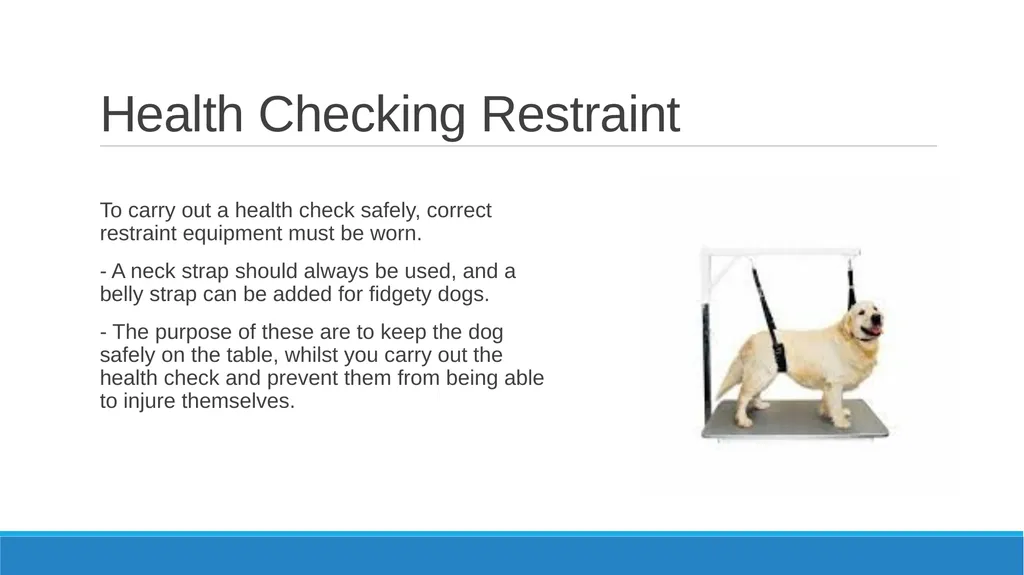
Health Checking Restraint To carry out a health check safely, correct restraint equipment must be worn.
- A neck strap should always be used, and a belly strap can be added for fidgety dogs.
- The purpose of these are to keep the dog safely on the table, whilst you carry out the health check and prevent them from being able to injure themselves.<br>
07
Health Checking Method When health checking we always start at the head before working our way down the bodies for hygiene purposes. (We have clean hands when we start a health check)
The ideal starting point is the eyes as they can be most susceptible to bacteria. You then complete the rest of the face before moving over the coat and finishing in the hygiene area.<br>
08
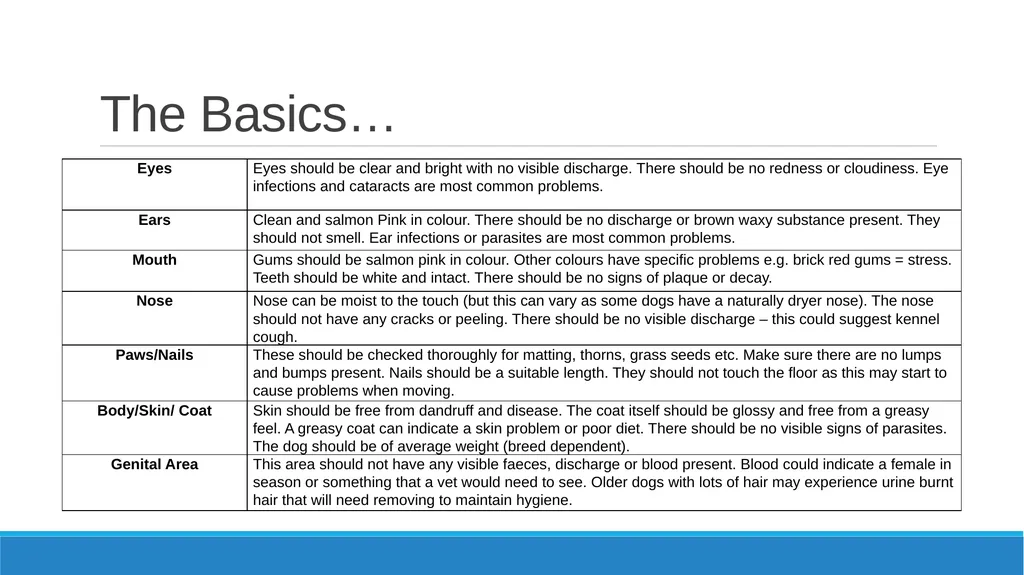
The Basics…<br>
09
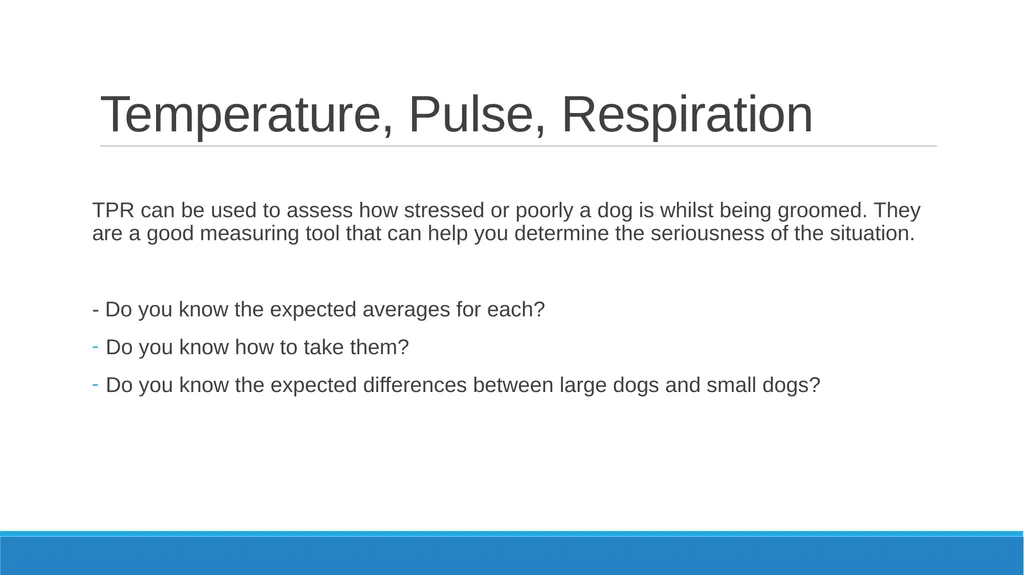
Temperature, Pulse, Respiration TPR can be used to assess how stressed or poorly a dog is whilst being groomed. They are a good measuring tool that can help you determine the seriousness of the situation.
- Do you know the expected averages for each?
Do you know how to take them?
Do you know the expected differences between large dogs and small dogs?<br>
10
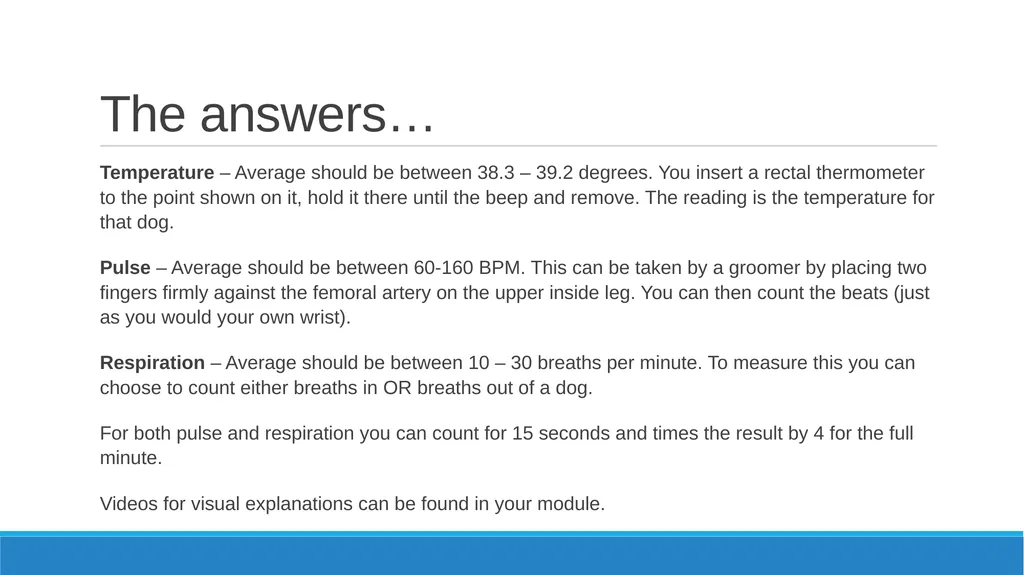
The answers… Temperature – Average should be between 38.3 – 39.2 degrees. You insert a rectal thermometer to the point shown on it, hold it there until the beep and remove. The reading is the temperature for that dog.
Pulse – Average should be between 60-160 BPM. This can be taken by a groomer by placing two fingers firmly against the femoral artery on the upper inside leg. You can then count the beats (just as you would your own wrist).
Respiration – Average should be between 10 – 30 breaths per minute. To measure this you can choose to count either breaths in OR breaths out of a dog.
For both pulse and respiration you can count for 15 seconds and times the result by 4 for the full minute.
Videos for visual explanations can be found in your module.<br>
11
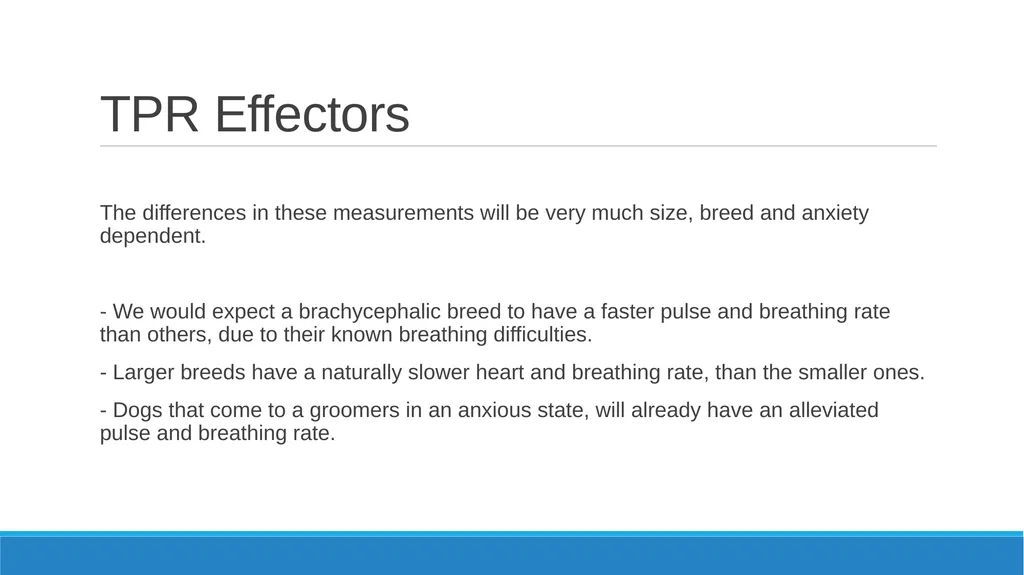
TPR Effectors The differences in these measurements will be very much size, breed and anxiety dependent.
- We would expect a brachycephalic breed to have a faster pulse and breathing rate than others, due to their known breathing difficulties.
- Larger breeds have a naturally slower heart and breathing rate, than the smaller ones.
- Dogs that come to a groomers in an anxious state, will already have an alleviated pulse and breathing rate.<br>
12
Capillary Refill Time Also known as CRT, this test can be performed on a dog to check its heart and lungs are in good working order.
To undertake the test, you simply press down firmly on a dogs gum (only ever if safe to do so) and then release. The time it takes for the capillaries to refill with colour is the result.
Ideally for a dog it should take 1.5 – 2 seconds for them to fill. Any longer may indicate a problem with the above organs.<br>
13
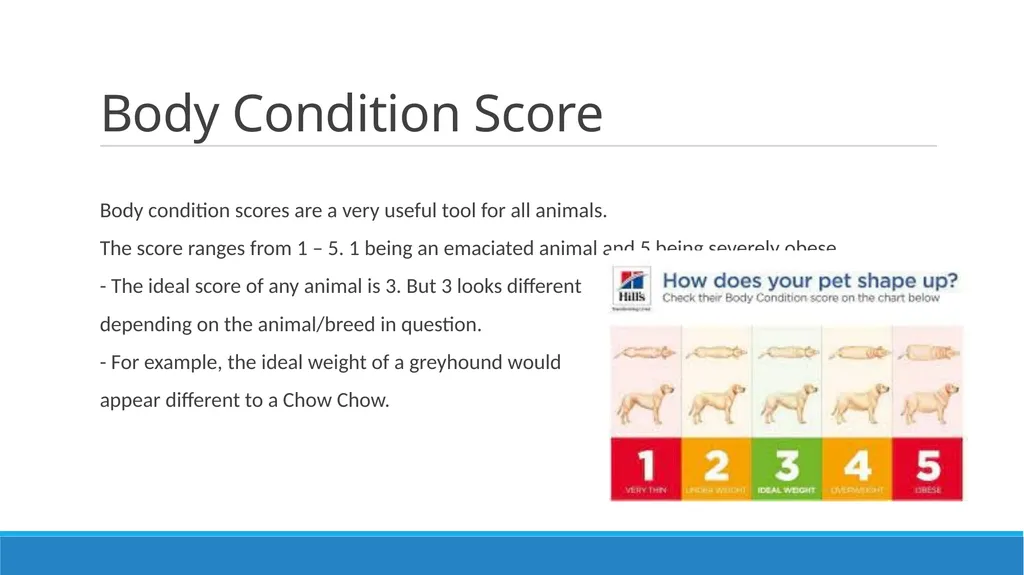
Body Condition Score Body condition scores are a very useful tool for all animals.
The score ranges from 1 – 5. 1 being an emaciated animal and 5 being severely obese.
- The ideal score of any animal is 3. But 3 looks different
depending on the animal/breed in question.
- For example, the ideal weight of a greyhound would
appear different to a Chow Chow.<br>