
Hedging Strategies Using Futures Chapter 3 3.1
KL
Published · 42 slides · 0 views
1 / 1


Description
Hedging Strategies Using Futures Chapter 3 3.1 Goals of Chapter 3 3.2 Basic principles and reasons of hedge (避險) using futures Discuss three types of basis risk (基差風險), which causes hedge imperfectly Derive optimal hedge ratio for cross
Related Topics
Share
Embed code
Download this presentation From Below
"Hedging Strategies Using Futures Chapter 3 3.1" is the property of its rightful owner. Permission is granted to download and print the materials on this website for personal, non-commercial use only, and to display it on your personal computer provided you do not modify the materials and that you retain all copyright notices contained in the materials. By downloading content from our website, you accept the terms of this agreement.
Presentation Transcript
01
Hedging Strategies Using Futures Chapter 3 3.1<br>
02
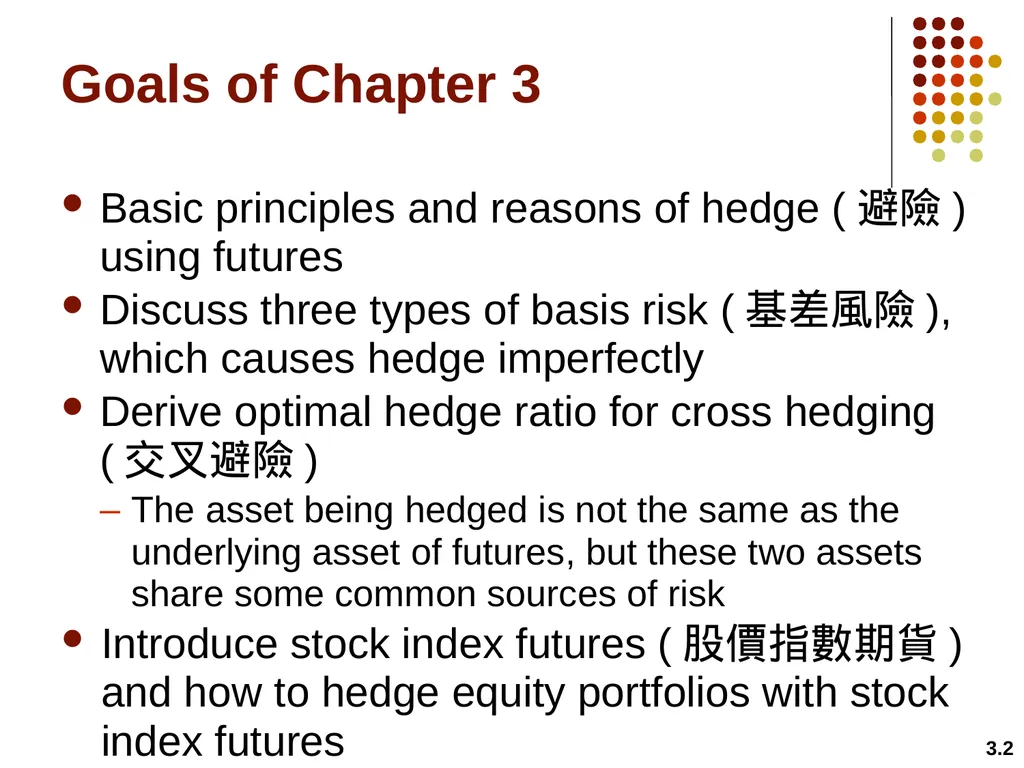
Goals of Chapter 3 3.2 Basic principles and reasons of hedge (避險) using futures
Discuss three types of basis risk (基差風險), which causes hedge imperfectly
Derive optimal hedge ratio for cross hedging (交叉避險)
The asset being hedged is not the same as the underlying asset of futures, but these two assets share some common sources of risk
Introduce stock index futures (股價指數期貨) and how to hedge equity portfolios with stock index futures<br>
Discuss three types of basis risk (基差風險), which causes hedge imperfectly
Derive optimal hedge ratio for cross hedging (交叉避險)
The asset being hedged is not the same as the underlying asset of futures, but these two assets share some common sources of risk
Introduce stock index futures (股價指數期貨) and how to hedge equity portfolios with stock index futures<br>
03
3.1 Basic Principles of and Reasons of Hedge Using Futures 3.3<br>
04
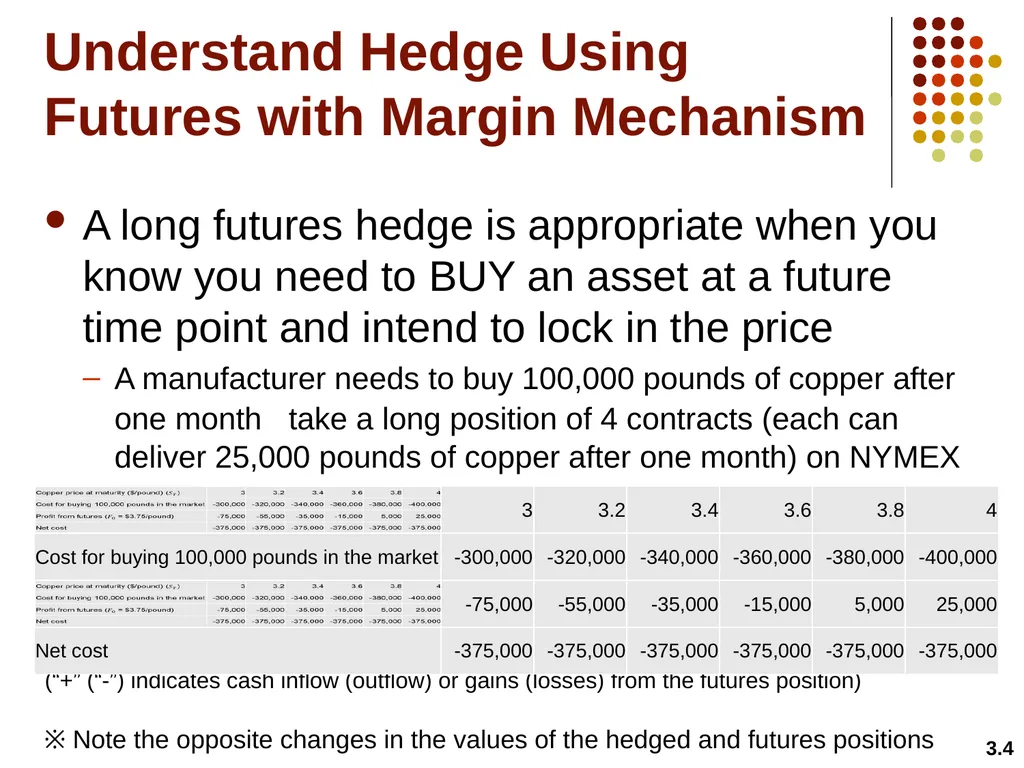
Understand Hedge Using Futures with Margin Mechanism A long futures hedge is appropriate when you know you need to BUY an asset at a future time point and intend to lock in the price
A manufacturer needs to buy 100,000 pounds of copper after one month take a long position of 4 contracts (each can deliver 25,000 pounds of copper after one month) on NYMEX
(“+” (“-”) indicates cash inflow (outflow) or gains (losses) from the futures position) 3.4 ※ Note the opposite changes in the values of the hedged and futures positions<br>
A manufacturer needs to buy 100,000 pounds of copper after one month take a long position of 4 contracts (each can deliver 25,000 pounds of copper after one month) on NYMEX
(“+” (“-”) indicates cash inflow (outflow) or gains (losses) from the futures position) 3.4 ※ Note the opposite changes in the values of the hedged and futures positions<br>
05
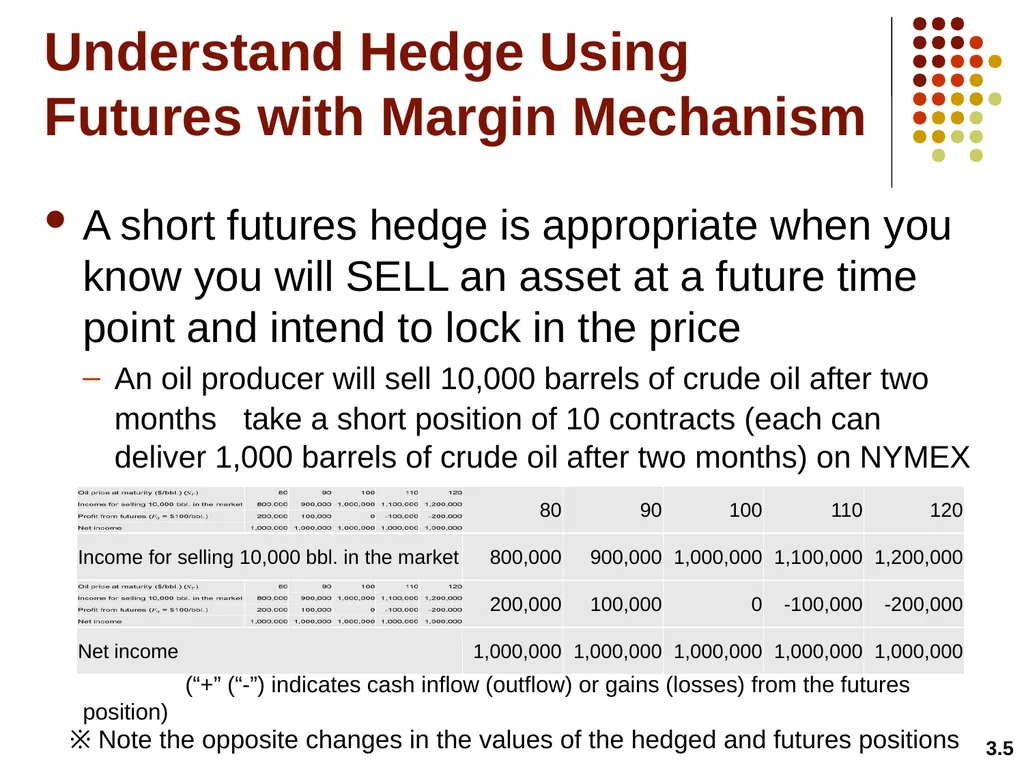
Understand Hedge Using Futures with Margin Mechanism A short futures hedge is appropriate when you know you will SELL an asset at a future time point and intend to lock in the price
An oil producer will sell 10,000 barrels of crude oil after two months take a short position of 10 contracts (each can deliver 1,000 barrels of crude oil after two months) on NYMEX
(“+” (“-”) indicates cash inflow (outflow) or gains (losses) from the futures position) 3.5 ※ Note the opposite changes in the values of the hedged and futures positions<br>
An oil producer will sell 10,000 barrels of crude oil after two months take a short position of 10 contracts (each can deliver 1,000 barrels of crude oil after two months) on NYMEX
(“+” (“-”) indicates cash inflow (outflow) or gains (losses) from the futures position) 3.5 ※ Note the opposite changes in the values of the hedged and futures positions<br>
06
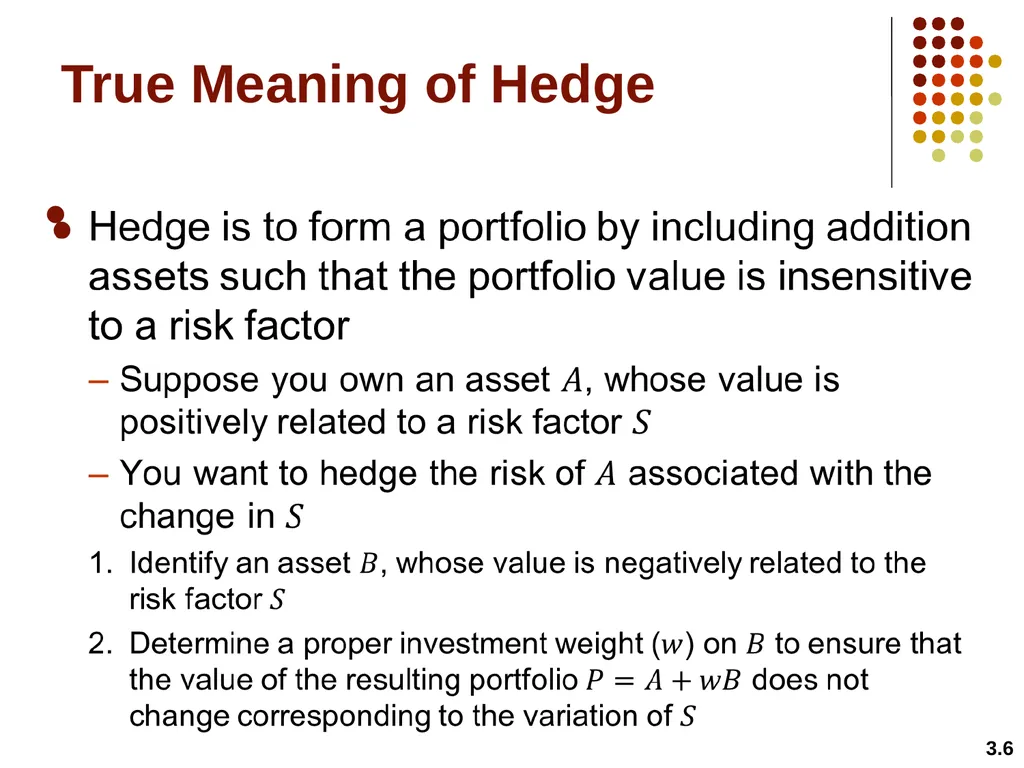
True Meaning of Hedge 3.6<br>
07
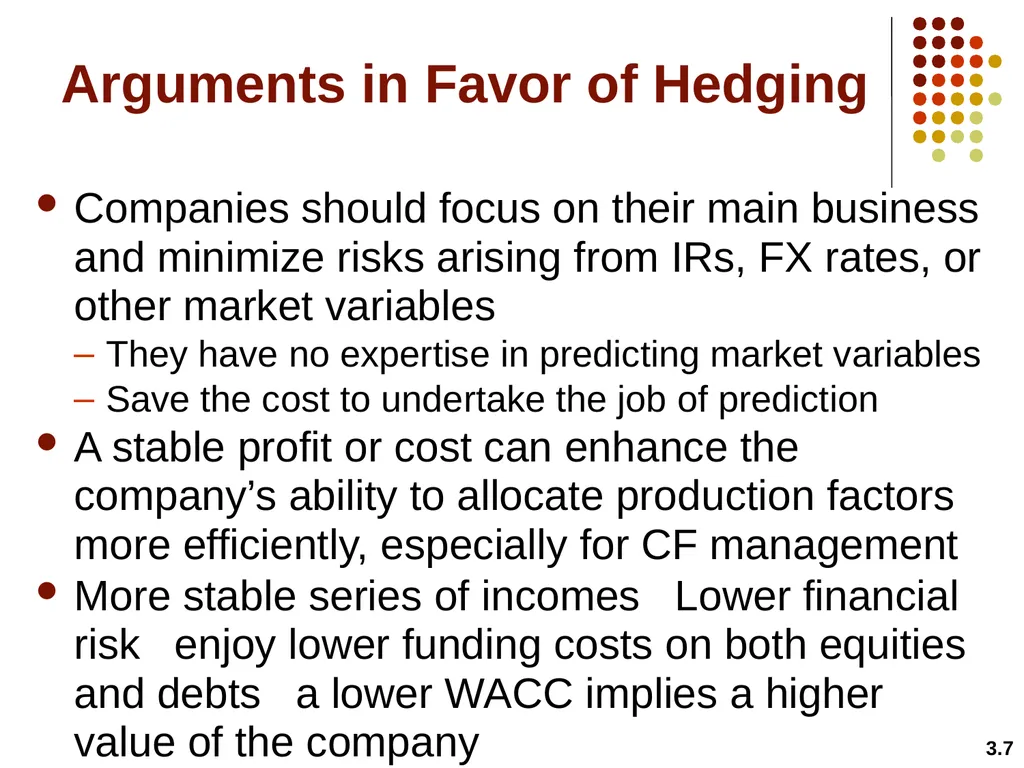
Arguments in Favor of Hedging Companies should focus on their main business and minimize risks arising from IRs, FX rates, or other market variables
They have no expertise in predicting market variables
Save the cost to undertake the job of prediction
A stable profit or cost can enhance the company’s ability to allocate production factors more efficiently, especially for CF management
More stable series of incomes Lower financial risk enjoy lower funding costs on both equities and debts a lower WACC implies a higher value of the company 3.7<br>
They have no expertise in predicting market variables
Save the cost to undertake the job of prediction
A stable profit or cost can enhance the company’s ability to allocate production factors more efficiently, especially for CF management
More stable series of incomes Lower financial risk enjoy lower funding costs on both equities and debts a lower WACC implies a higher value of the company 3.7<br>
08
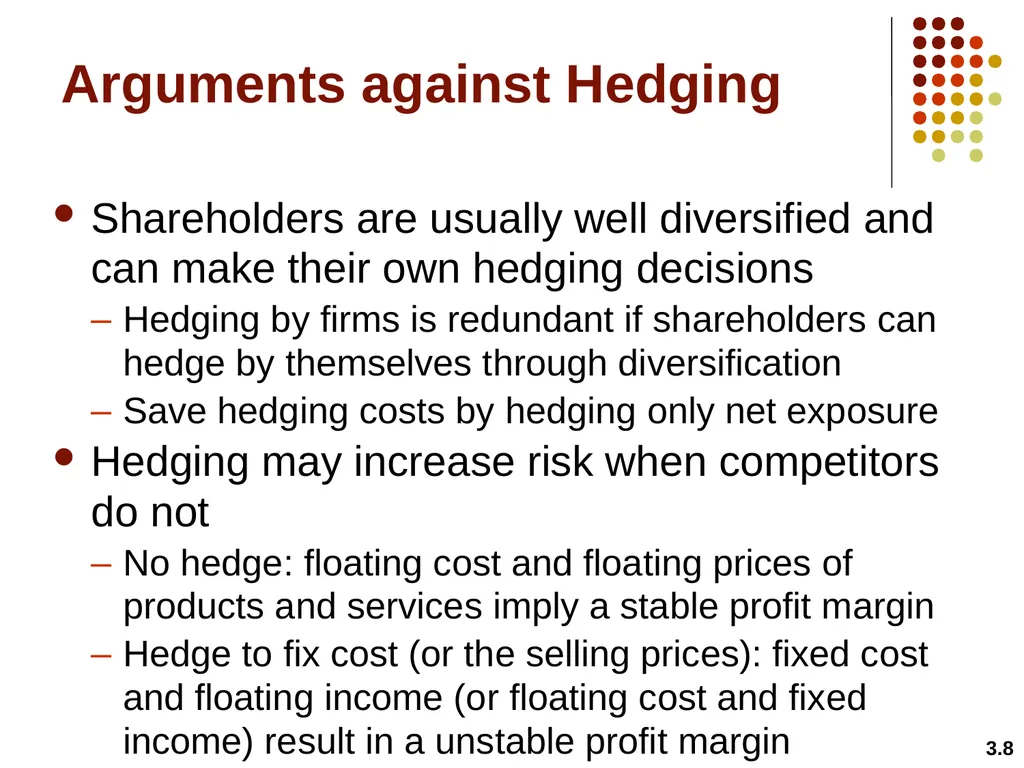
Arguments against Hedging Shareholders are usually well diversified and can make their own hedging decisions
Hedging by firms is redundant if shareholders can hedge by themselves through diversification
Save hedging costs by hedging only net exposure
Hedging may increase risk when competitors do not
No hedge: floating cost and floating prices of products and services imply a stable profit margin
Hedge to fix cost (or the selling prices): fixed cost and floating income (or floating cost and fixed income) result in a unstable profit margin 3.8<br>
Hedging by firms is redundant if shareholders can hedge by themselves through diversification
Save hedging costs by hedging only net exposure
Hedging may increase risk when competitors do not
No hedge: floating cost and floating prices of products and services imply a stable profit margin
Hedge to fix cost (or the selling prices): fixed cost and floating income (or floating cost and fixed income) result in a unstable profit margin 3.8<br>
09
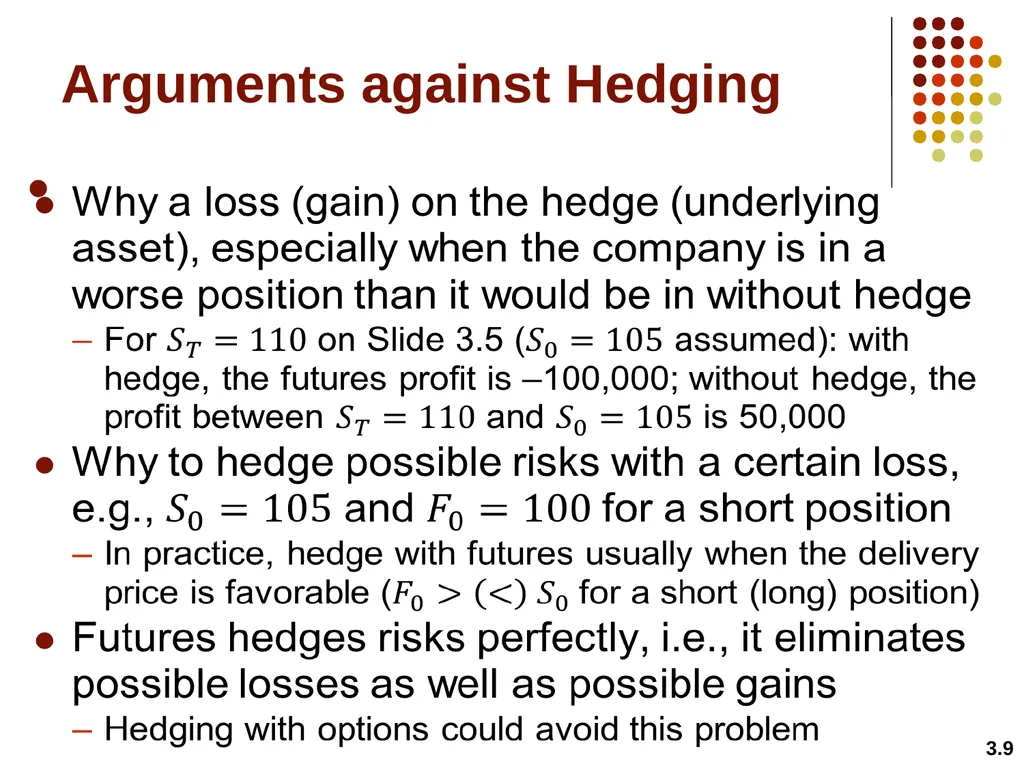
Arguments against Hedging 3.9<br>
10
3.2 Three Types of Basis Risk (基差風險) 3.10<br>
11
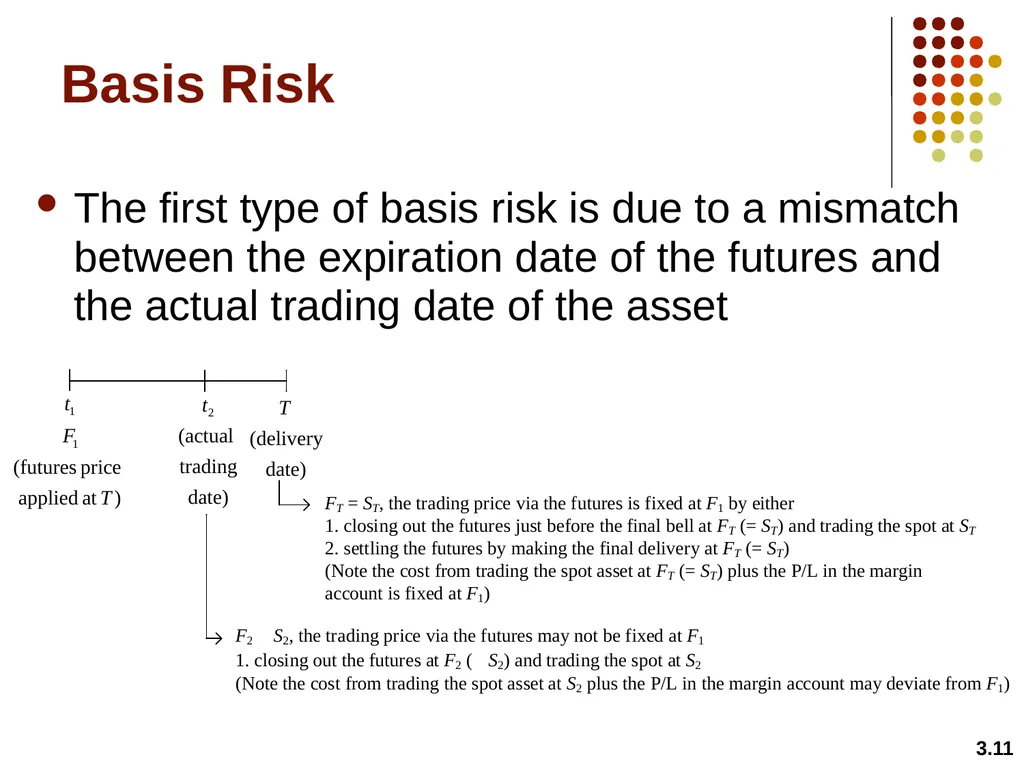
Basis Risk The first type of basis risk is due to a mismatch between the expiration date of the futures and the actual trading date of the asset 3.11<br>
12
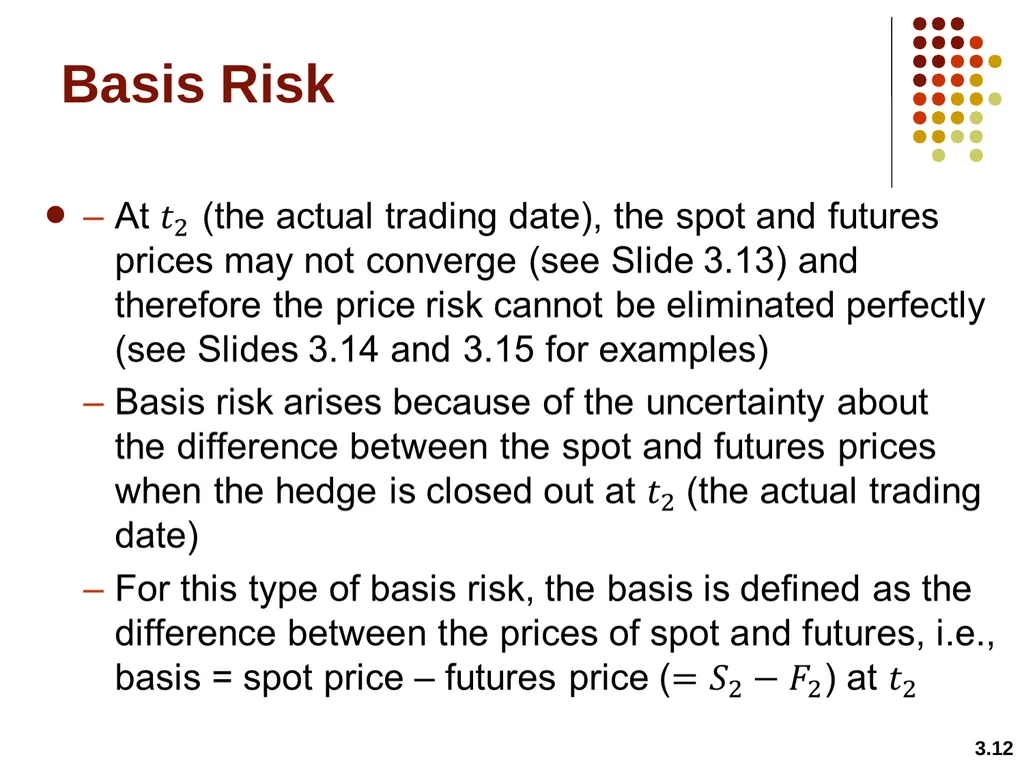
Basis Risk 3.12<br>
13
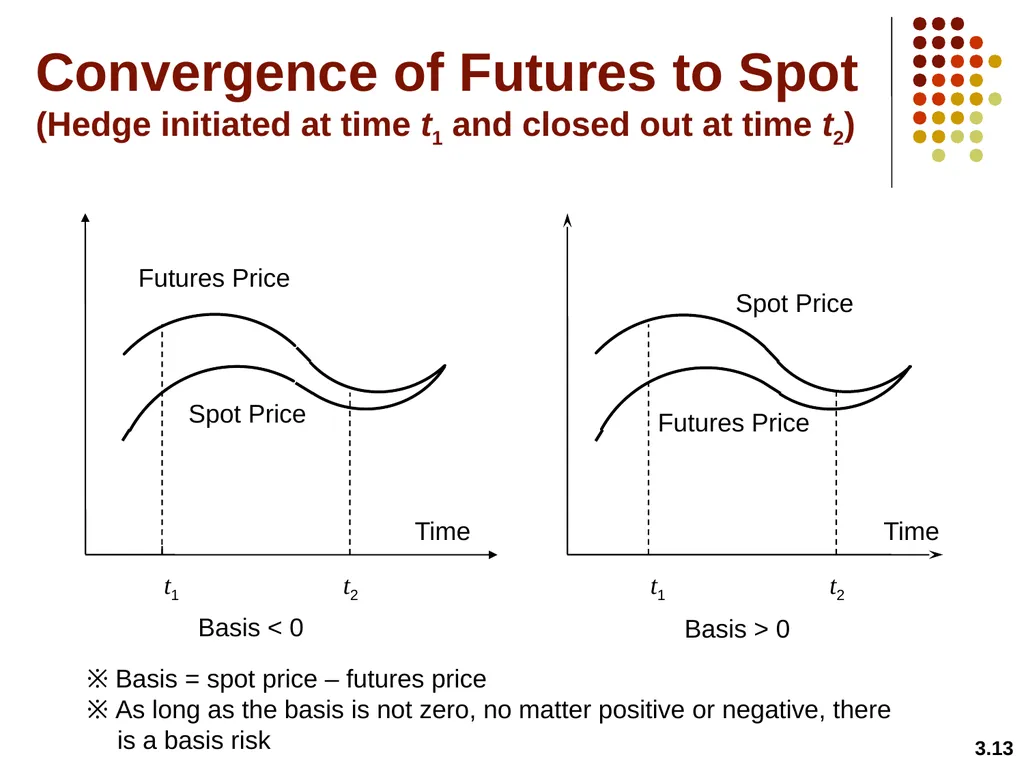
Convergence of Futures to Spot
(Hedge initiated at time t1 and closed out at time t2) 3.13 Time Spot Price Futures Price t1 t2 Time Futures Price Spot Price t1 t2 Basis < 0 Basis > 0 ※ Basis = spot price – futures price
※ As long as the basis is not zero, no matter positive or negative, there is a basis risk<br>
※ As long as the basis is not zero, no matter positive or negative, there is a basis risk<br>
14
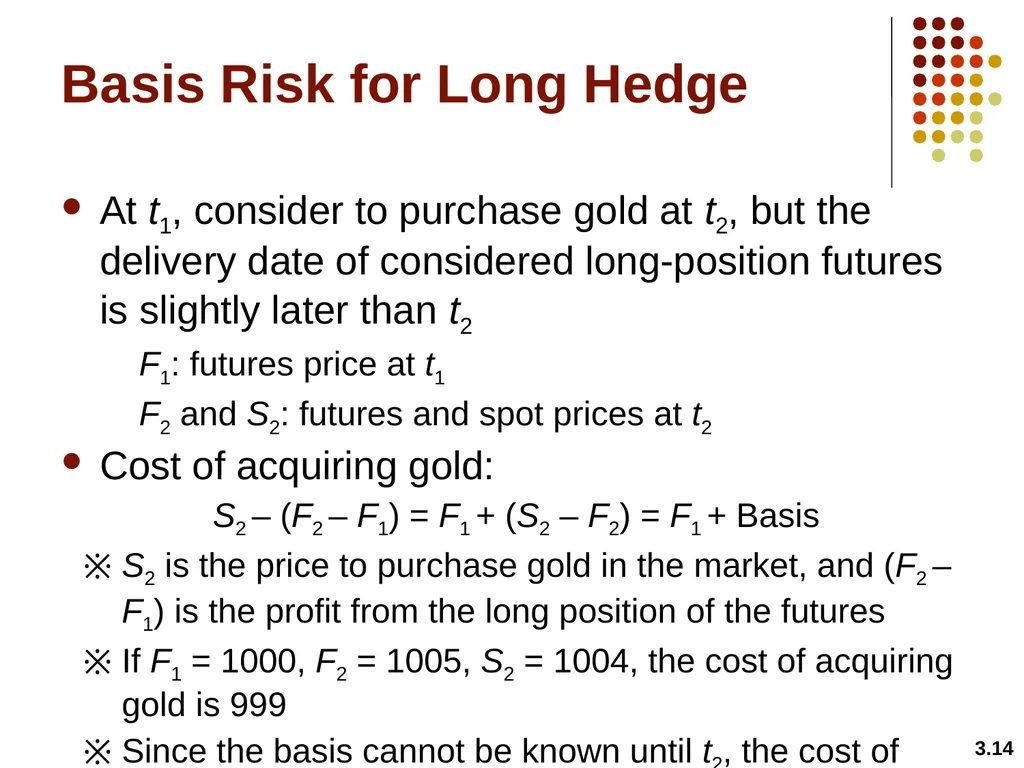
Basis Risk for Long Hedge At t1, consider to purchase gold at t2, but the delivery date of considered long-position futures is slightly later than t2
F1: futures price at t1
F2 and S2: futures and spot prices at t2
Cost of acquiring gold:
S2 – (F2 – F1) = F1 + (S2 – F2) = F1 + Basis
S2 is the price to purchase gold in the market, and (F2 – F1) is the profit from the long position of the futures
If F1 = 1000, F2 = 1005, S2 = 1004, the cost of acquiring gold is 999
Since the basis cannot be known until t2, the cost of acquiring gold is uncertain (not perfectly hedged) 3.14<br>
F1: futures price at t1
F2 and S2: futures and spot prices at t2
Cost of acquiring gold:
S2 – (F2 – F1) = F1 + (S2 – F2) = F1 + Basis
S2 is the price to purchase gold in the market, and (F2 – F1) is the profit from the long position of the futures
If F1 = 1000, F2 = 1005, S2 = 1004, the cost of acquiring gold is 999
Since the basis cannot be known until t2, the cost of acquiring gold is uncertain (not perfectly hedged) 3.14<br>
15
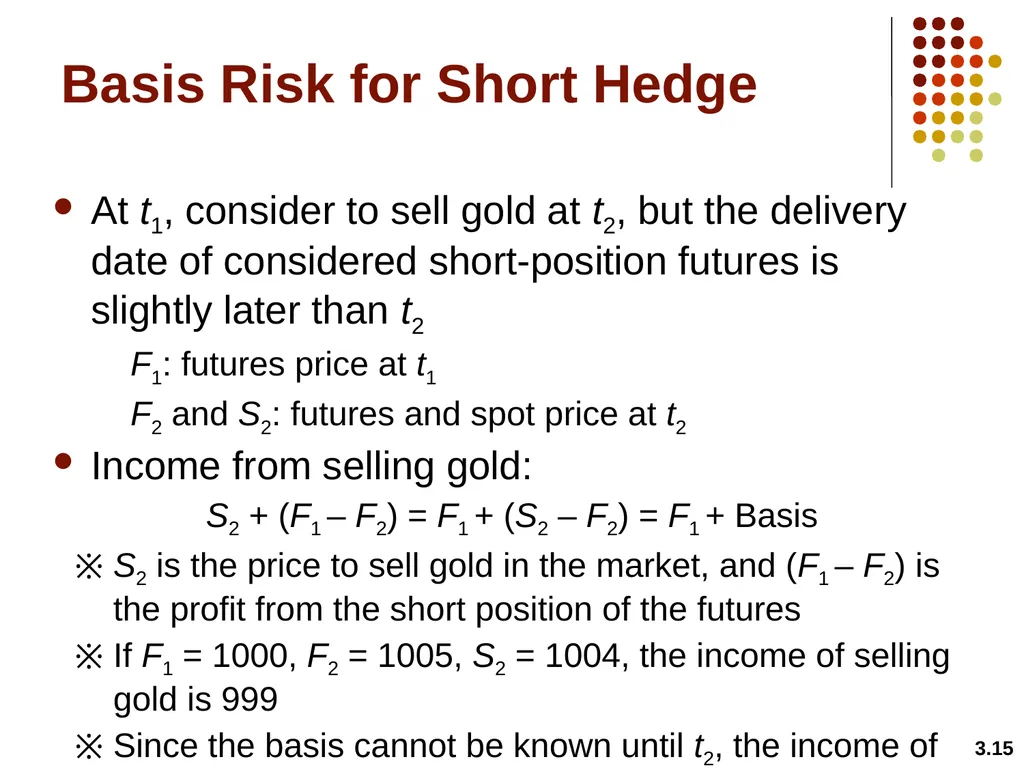
Basis Risk for Short Hedge At t1, consider to sell gold at t2, but the delivery date of considered short-position futures is slightly later than t2
F1: futures price at t1
F2 and S2: futures and spot price at t2
Income from selling gold:
S2 + (F1 – F2) = F1 + (S2 – F2) = F1 + Basis
S2 is the price to sell gold in the market, and (F1 – F2) is the profit from the short position of the futures
If F1 = 1000, F2 = 1005, S2 = 1004, the income of selling gold is 999
Since the basis cannot be known until t2, the income of selling gold is uncertain (not perfectly hedged) 3.15<br>
F1: futures price at t1
F2 and S2: futures and spot price at t2
Income from selling gold:
S2 + (F1 – F2) = F1 + (S2 – F2) = F1 + Basis
S2 is the price to sell gold in the market, and (F1 – F2) is the profit from the short position of the futures
If F1 = 1000, F2 = 1005, S2 = 1004, the income of selling gold is 999
Since the basis cannot be known until t2, the income of selling gold is uncertain (not perfectly hedged) 3.15<br>
16
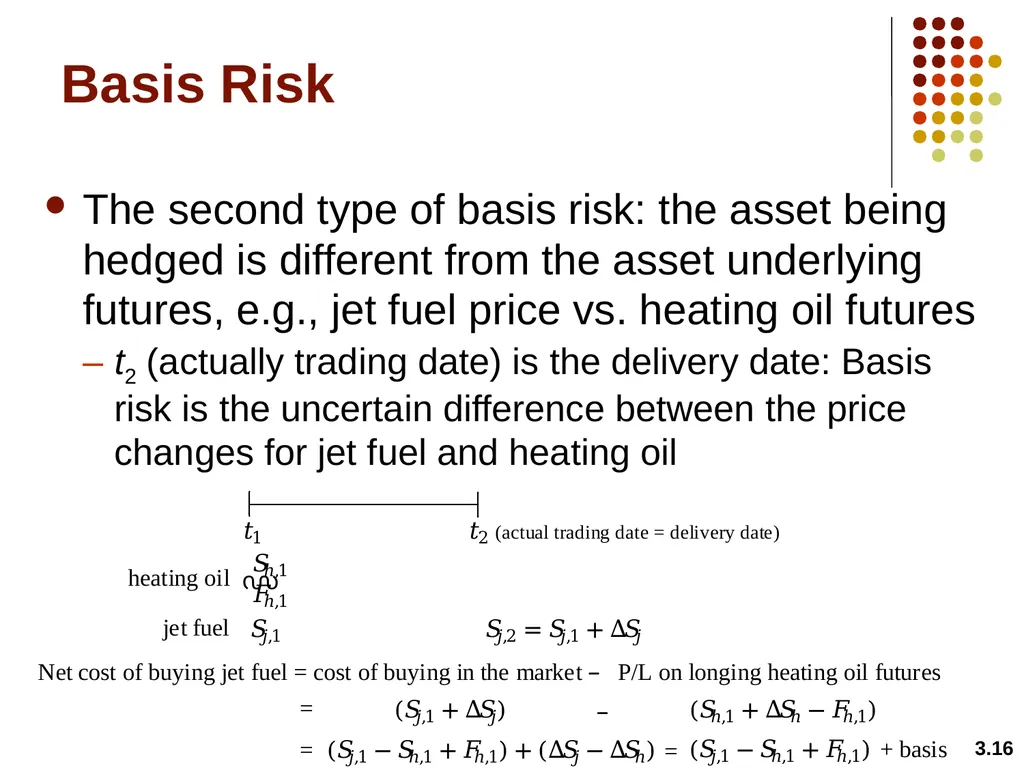
Basis Risk The second type of basis risk: the asset being hedged is different from the asset underlying futures, e.g., jet fuel price vs. heating oil futures
t2 (actually trading date) is the delivery date: Basis risk is the uncertain difference between the price changes for jet fuel and heating oil 3.16<br>
t2 (actually trading date) is the delivery date: Basis risk is the uncertain difference between the price changes for jet fuel and heating oil 3.16<br>
17
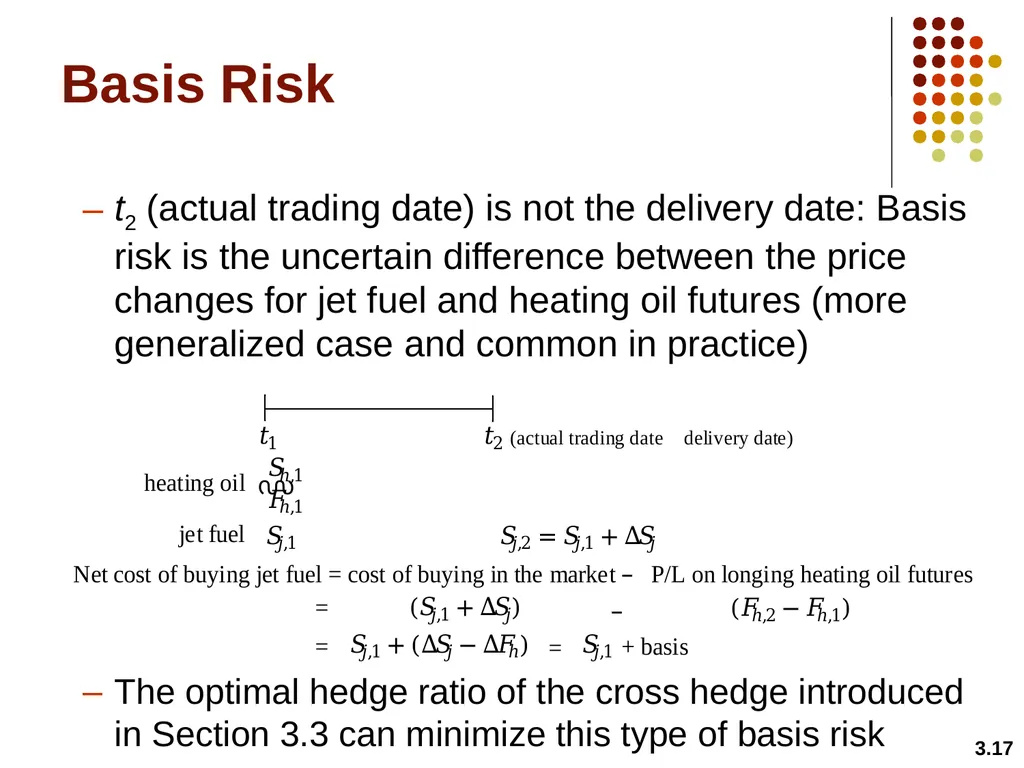
Basis Risk t2 (actual trading date) is not the delivery date: Basis risk is the uncertain difference between the price changes for jet fuel and heating oil futures (more generalized case and common in practice)
The optimal hedge ratio of the cross hedge introduced in Section 3.3 can minimize this type of basis risk 3.17<br>
The optimal hedge ratio of the cross hedge introduced in Section 3.3 can minimize this type of basis risk 3.17<br>
18
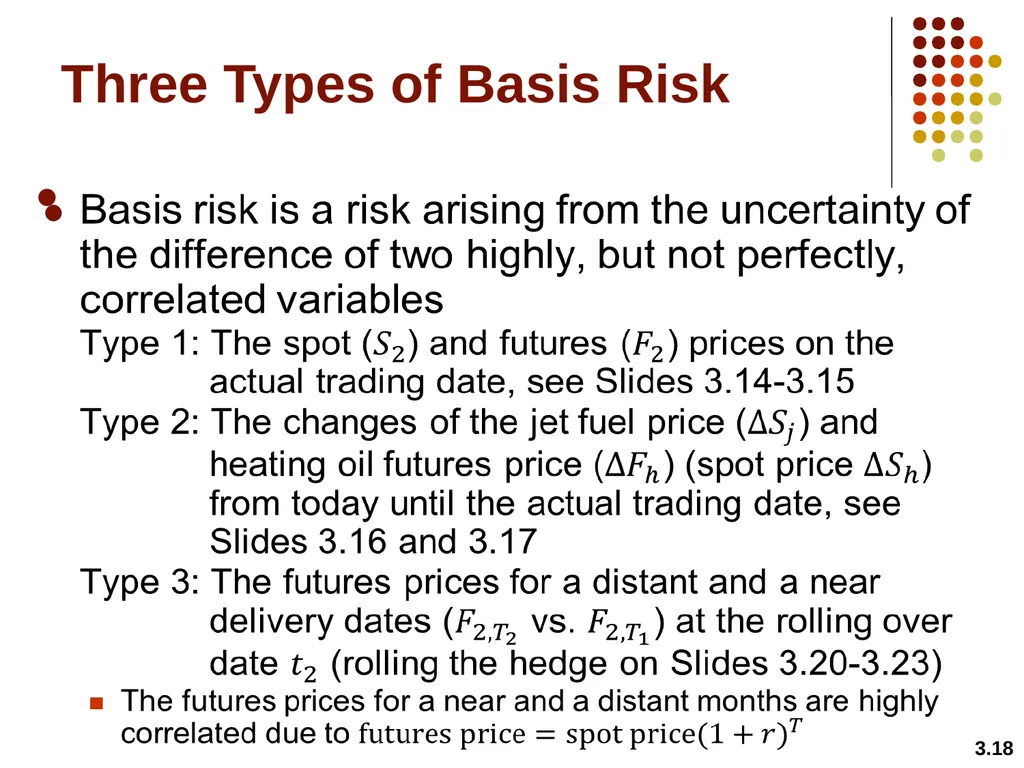
Three Types of Basis Risk 3.18<br>
19
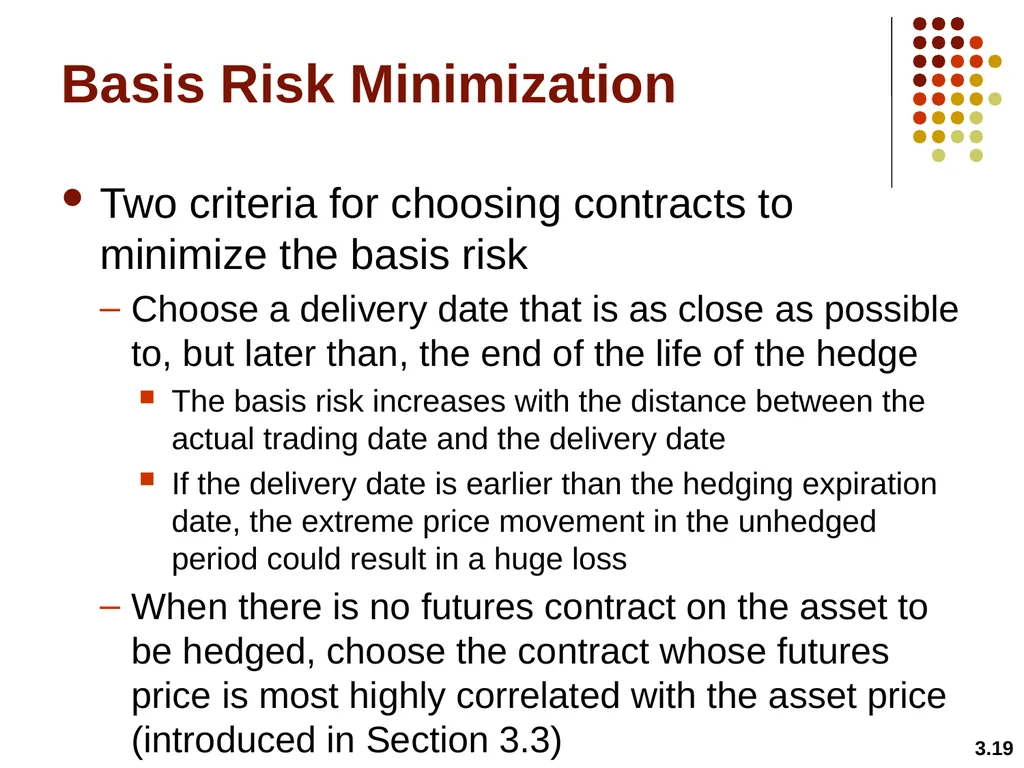
Basis Risk Minimization Two criteria for choosing contracts to minimize the basis risk
Choose a delivery date that is as close as possible to, but later than, the end of the life of the hedge
The basis risk increases with the distance between the actual trading date and the delivery date
If the delivery date is earlier than the hedging expiration date, the extreme price movement in the unhedged period could result in a huge loss
When there is no futures contract on the asset to be hedged, choose the contract whose futures price is most highly correlated with the asset price (introduced in Section 3.3) 3.19<br>
Choose a delivery date that is as close as possible to, but later than, the end of the life of the hedge
The basis risk increases with the distance between the actual trading date and the delivery date
If the delivery date is earlier than the hedging expiration date, the extreme price movement in the unhedged period could result in a huge loss
When there is no futures contract on the asset to be hedged, choose the contract whose futures price is most highly correlated with the asset price (introduced in Section 3.3) 3.19<br>
20
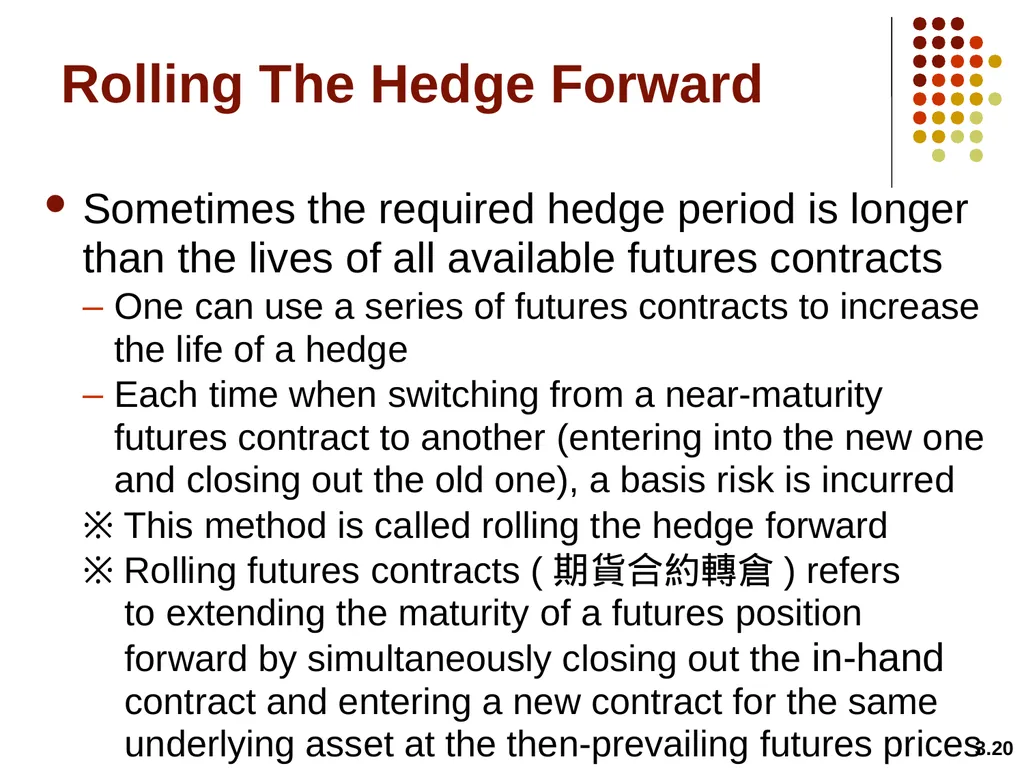
Rolling The Hedge Forward Sometimes the required hedge period is longer than the lives of all available futures contracts
One can use a series of futures contracts to increase the life of a hedge
Each time when switching from a near-maturity futures contract to another (entering into the new one and closing out the old one), a basis risk is incurred
※ This method is called rolling the hedge forward
※ Rolling futures contracts (期貨合約轉倉) refers to extending the maturity of a futures position forward by simultaneously closing out the in-hand contract and entering a new contract for the same underlying asset at the then-prevailing futures prices 3.20<br>
One can use a series of futures contracts to increase the life of a hedge
Each time when switching from a near-maturity futures contract to another (entering into the new one and closing out the old one), a basis risk is incurred
※ This method is called rolling the hedge forward
※ Rolling futures contracts (期貨合約轉倉) refers to extending the maturity of a futures position forward by simultaneously closing out the in-hand contract and entering a new contract for the same underlying asset at the then-prevailing futures prices 3.20<br>
21
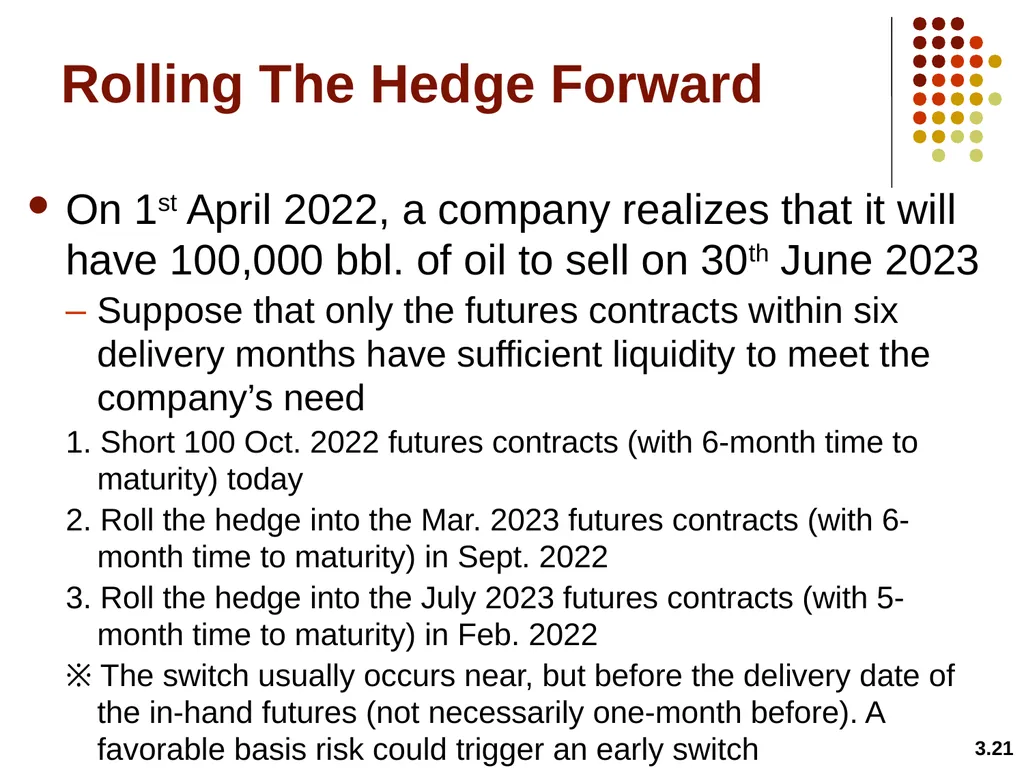
Rolling The Hedge Forward On 1st April 2022, a company realizes that it will have 100,000 bbl. of oil to sell on 30th June 2023
Suppose that only the futures contracts within six delivery months have sufficient liquidity to meet the company’s need
1. Short 100 Oct. 2022 futures contracts (with 6-month time to maturity) today
2. Roll the hedge into the Mar. 2023 futures contracts (with 6-month time to maturity) in Sept. 2022
3. Roll the hedge into the July 2023 futures contracts (with 5-month time to maturity) in Feb. 2022
※ The switch usually occurs near, but before the delivery date of the in-hand futures (not necessarily one-month before). A favorable basis risk could trigger an early switch 3.21<br>
Suppose that only the futures contracts within six delivery months have sufficient liquidity to meet the company’s need
1. Short 100 Oct. 2022 futures contracts (with 6-month time to maturity) today
2. Roll the hedge into the Mar. 2023 futures contracts (with 6-month time to maturity) in Sept. 2022
3. Roll the hedge into the July 2023 futures contracts (with 5-month time to maturity) in Feb. 2022
※ The switch usually occurs near, but before the delivery date of the in-hand futures (not necessarily one-month before). A favorable basis risk could trigger an early switch 3.21<br>
22
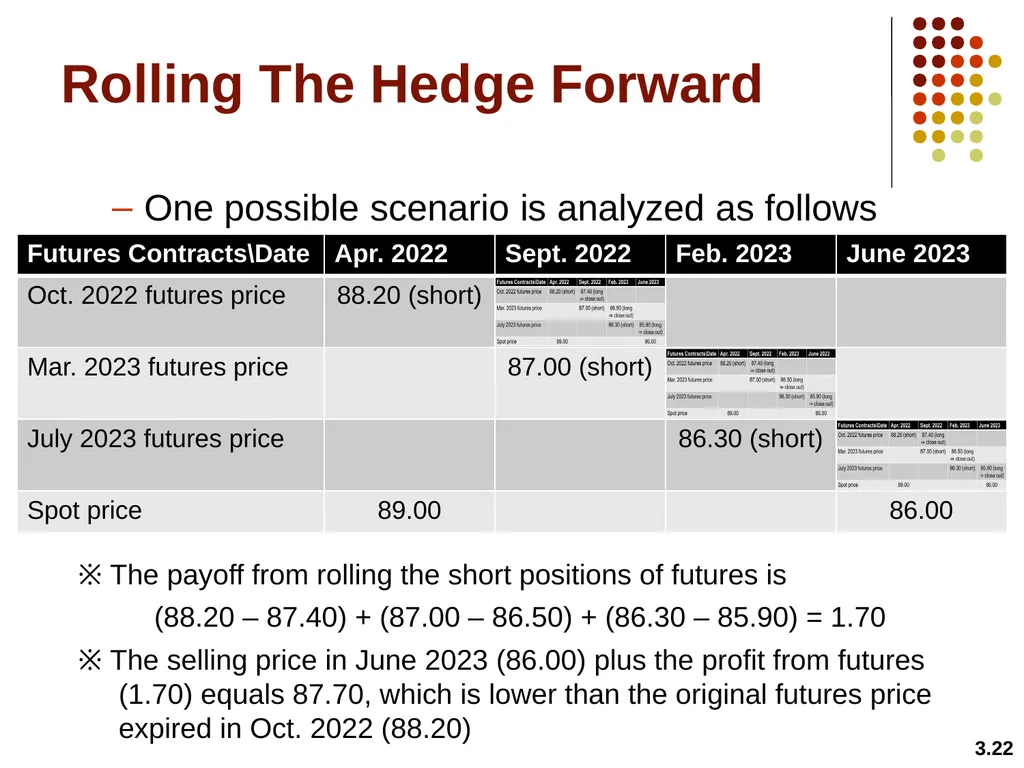
Rolling The Hedge Forward 3.22 ※ The payoff from rolling the short positions of futures is
(88.20 – 87.40) + (87.00 – 86.50) + (86.30 – 85.90) = 1.70
※ The selling price in June 2023 (86.00) plus the profit from futures (1.70) equals 87.70, which is lower than the original futures price expired in Oct. 2022 (88.20) One possible scenario is analyzed as follows<br>
(88.20 – 87.40) + (87.00 – 86.50) + (86.30 – 85.90) = 1.70
※ The selling price in June 2023 (86.00) plus the profit from futures (1.70) equals 87.70, which is lower than the original futures price expired in Oct. 2022 (88.20) One possible scenario is analyzed as follows<br>
23
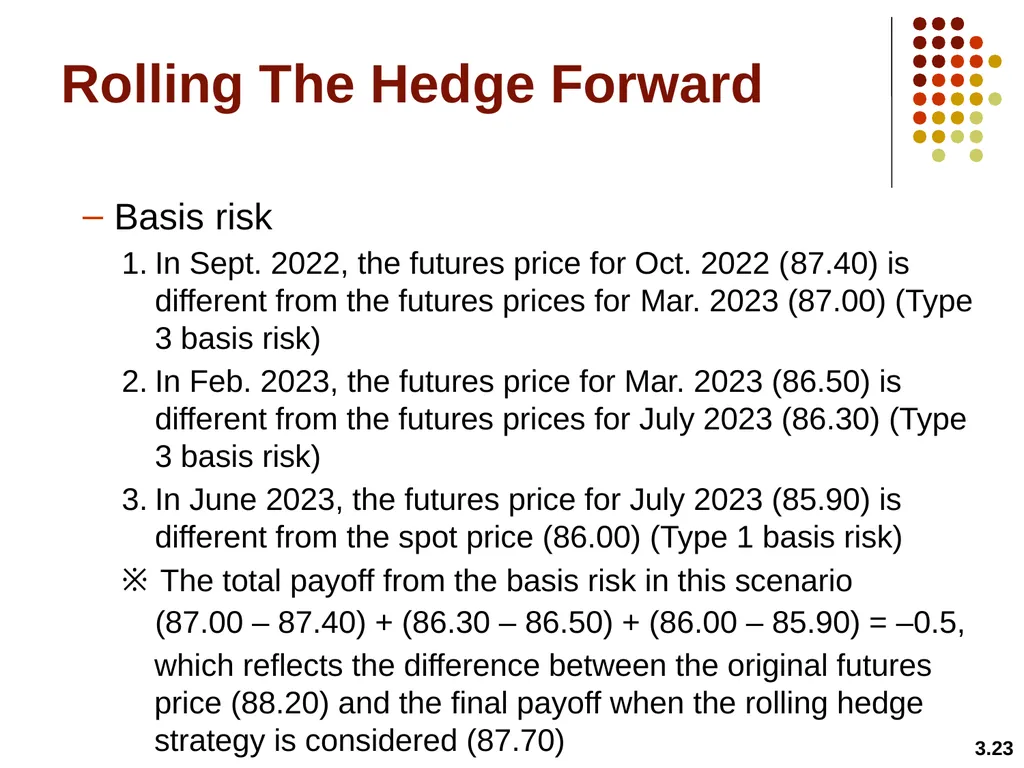
Rolling The Hedge Forward 3.23 Basis risk
In Sept. 2022, the futures price for Oct. 2022 (87.40) is different from the futures prices for Mar. 2023 (87.00) (Type 3 basis risk)
In Feb. 2023, the futures price for Mar. 2023 (86.50) is different from the futures prices for July 2023 (86.30) (Type 3 basis risk)
In June 2023, the futures price for July 2023 (85.90) is different from the spot price (86.00) (Type 1 basis risk)
The total payoff from the basis risk in this scenario
(87.00 – 87.40) + (86.30 – 86.50) + (86.00 – 85.90) = –0.5,
which reflects the difference between the original futures price (88.20) and the final payoff when the rolling hedge strategy is considered (87.70)<br>
In Sept. 2022, the futures price for Oct. 2022 (87.40) is different from the futures prices for Mar. 2023 (87.00) (Type 3 basis risk)
In Feb. 2023, the futures price for Mar. 2023 (86.50) is different from the futures prices for July 2023 (86.30) (Type 3 basis risk)
In June 2023, the futures price for July 2023 (85.90) is different from the spot price (86.00) (Type 1 basis risk)
The total payoff from the basis risk in this scenario
(87.00 – 87.40) + (86.30 – 86.50) + (86.00 – 85.90) = –0.5,
which reflects the difference between the original futures price (88.20) and the final payoff when the rolling hedge strategy is considered (87.70)<br>
24
3.3 Cross Hedge and Optimal Hedge Ratio 3.24<br>
25
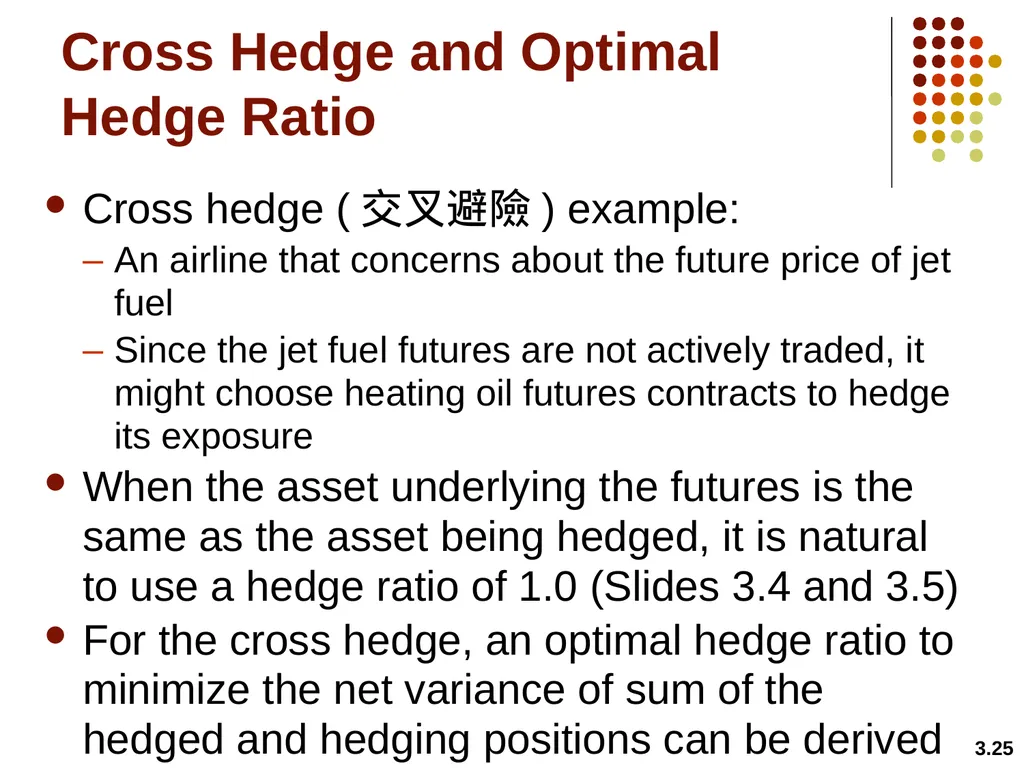
Cross Hedge and Optimal Hedge Ratio Cross hedge (交叉避險) example:
An airline that concerns about the future price of jet fuel
Since the jet fuel futures are not actively traded, it might choose heating oil futures contracts to hedge its exposure
When the asset underlying the futures is the same as the asset being hedged, it is natural to use a hedge ratio of 1.0 (Slides 3.4 and 3.5)
For the cross hedge, an optimal hedge ratio to minimize the net variance of sum of the hedged and hedging positions can be derived 3.25<br>
An airline that concerns about the future price of jet fuel
Since the jet fuel futures are not actively traded, it might choose heating oil futures contracts to hedge its exposure
When the asset underlying the futures is the same as the asset being hedged, it is natural to use a hedge ratio of 1.0 (Slides 3.4 and 3.5)
For the cross hedge, an optimal hedge ratio to minimize the net variance of sum of the hedged and hedging positions can be derived 3.25<br>
26
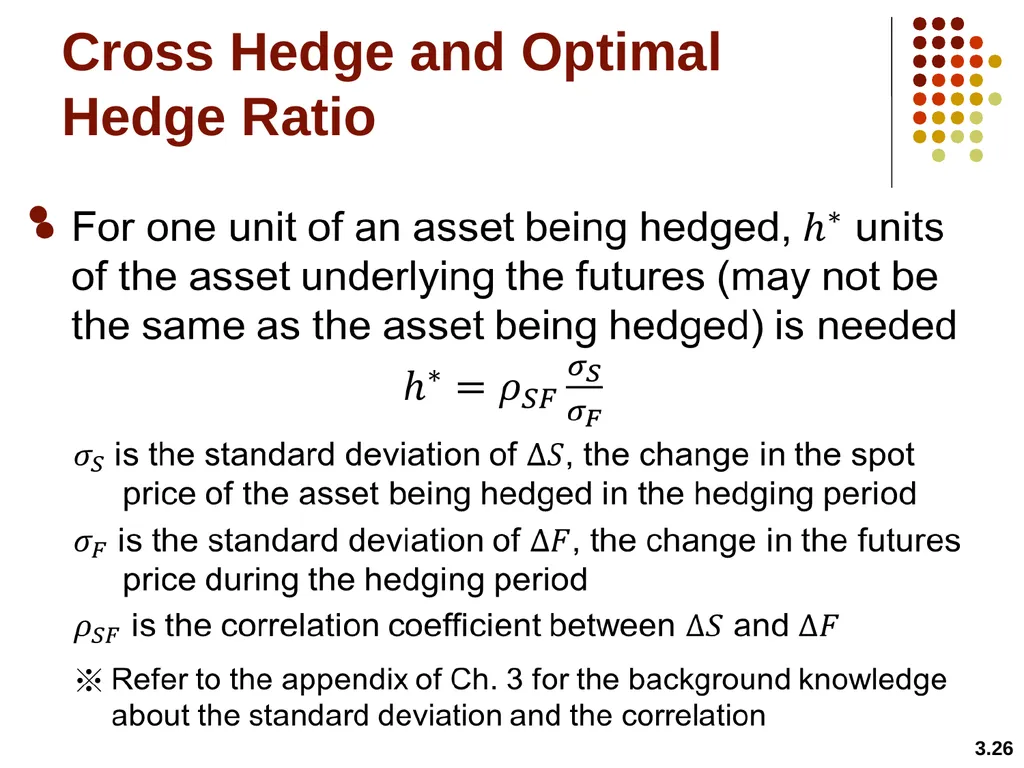
Cross Hedge and Optimal Hedge Ratio 3.26<br>
27
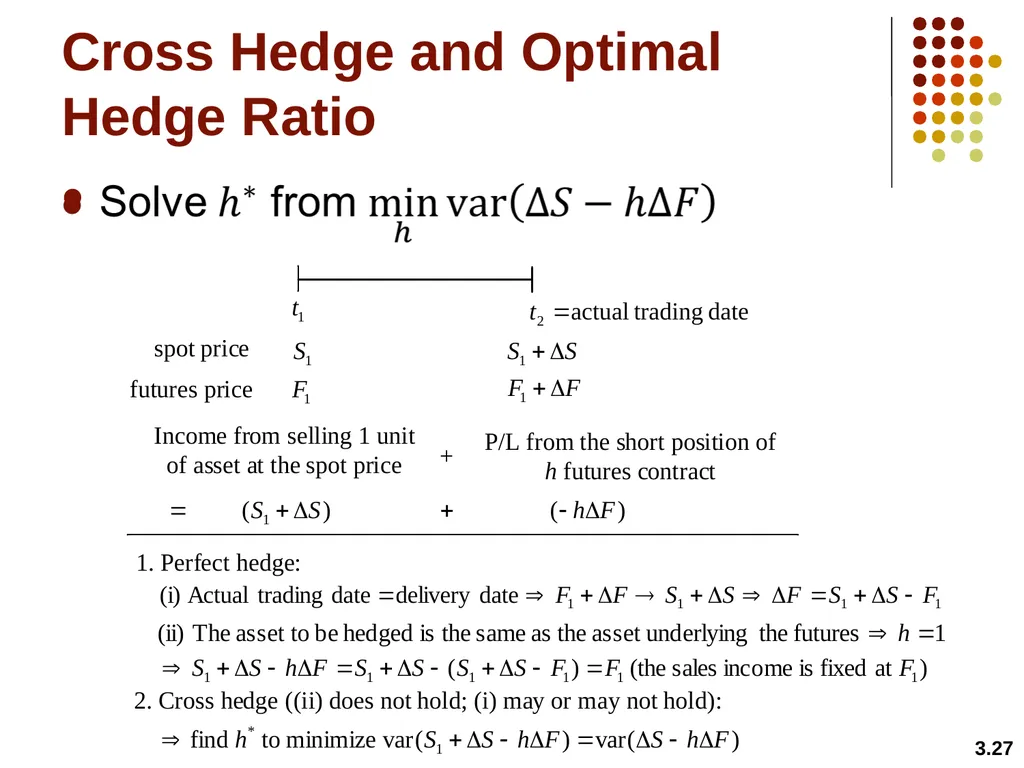
Cross Hedge and Optimal Hedge Ratio 3.27<br>
28
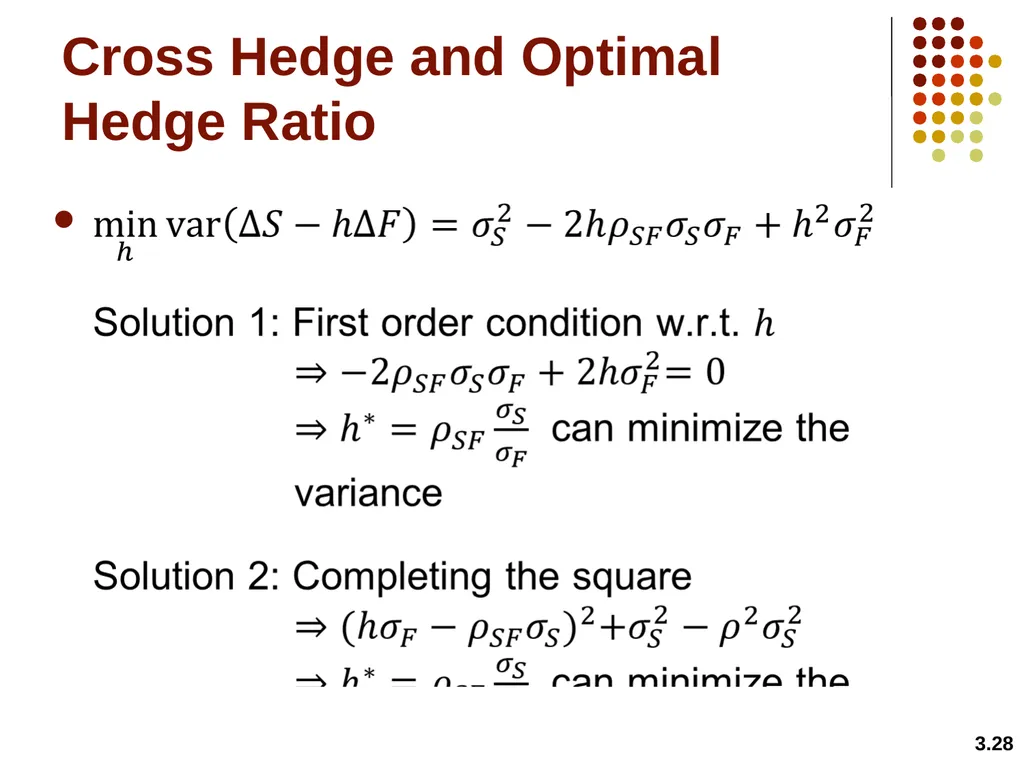
Cross Hedge and Optimal Hedge Ratio 3.28<br>
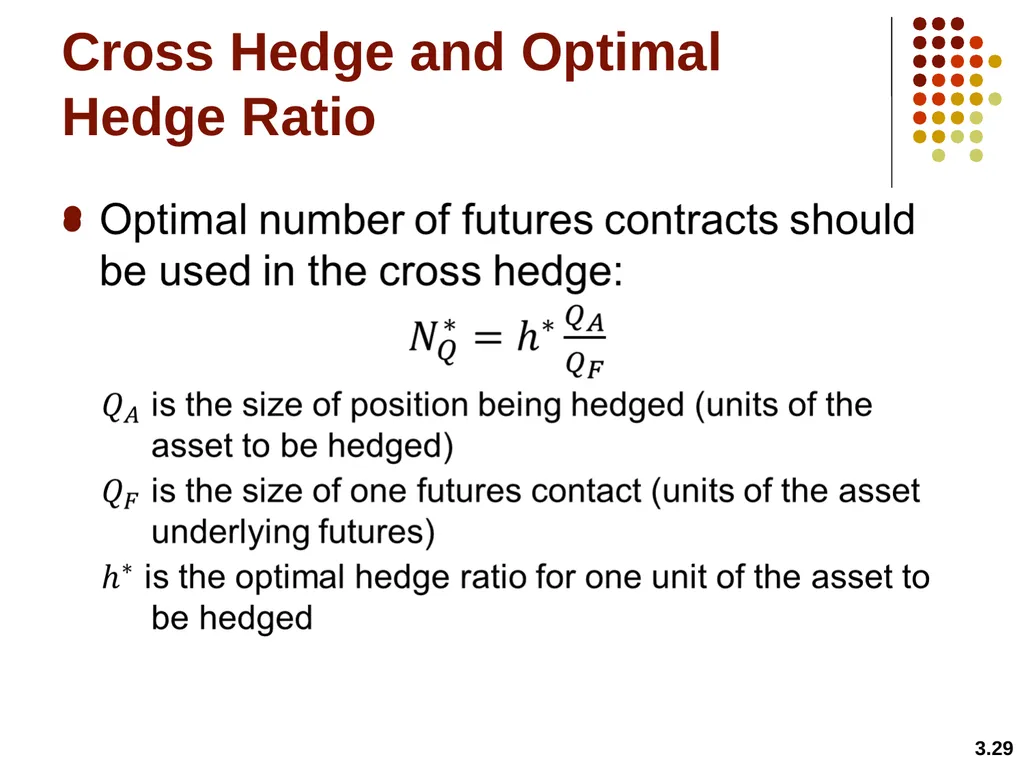
29
Cross Hedge and Optimal Hedge Ratio 3.29<br>
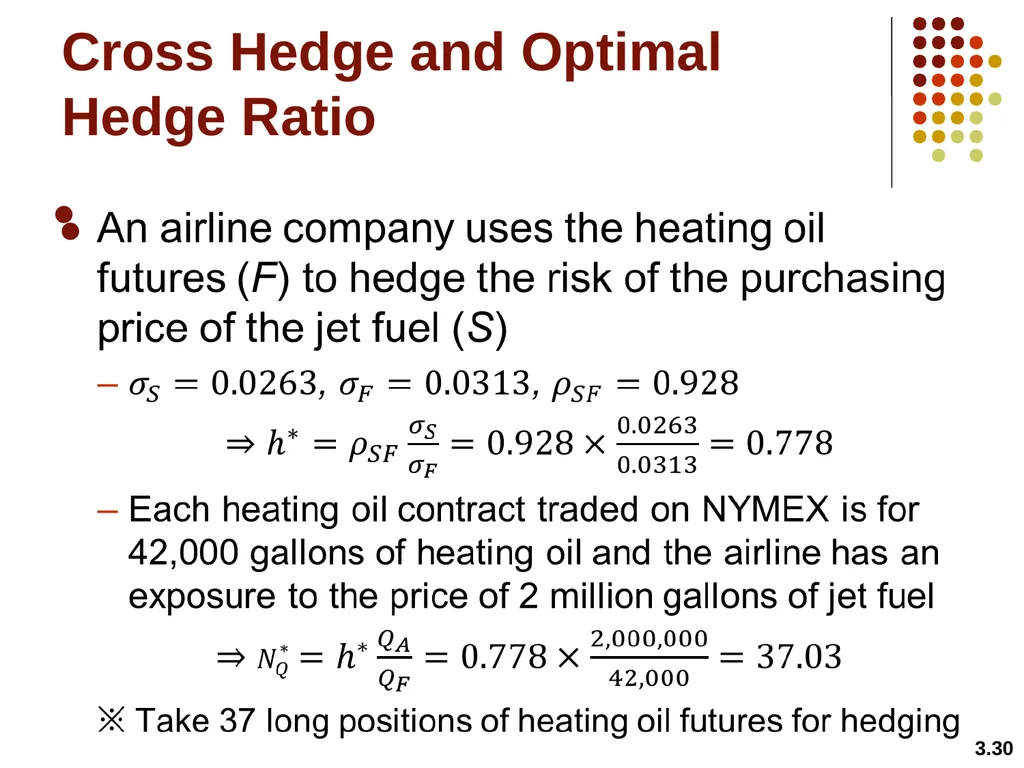
30
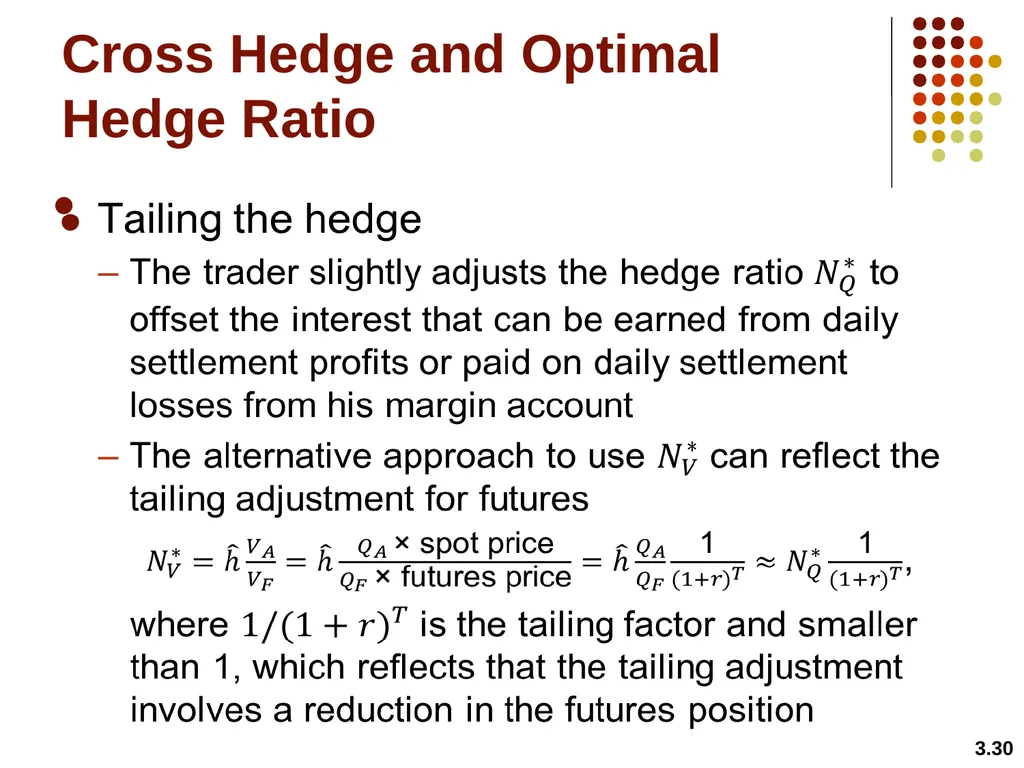
Cross Hedge and Optimal Hedge Ratio 3.30<br>
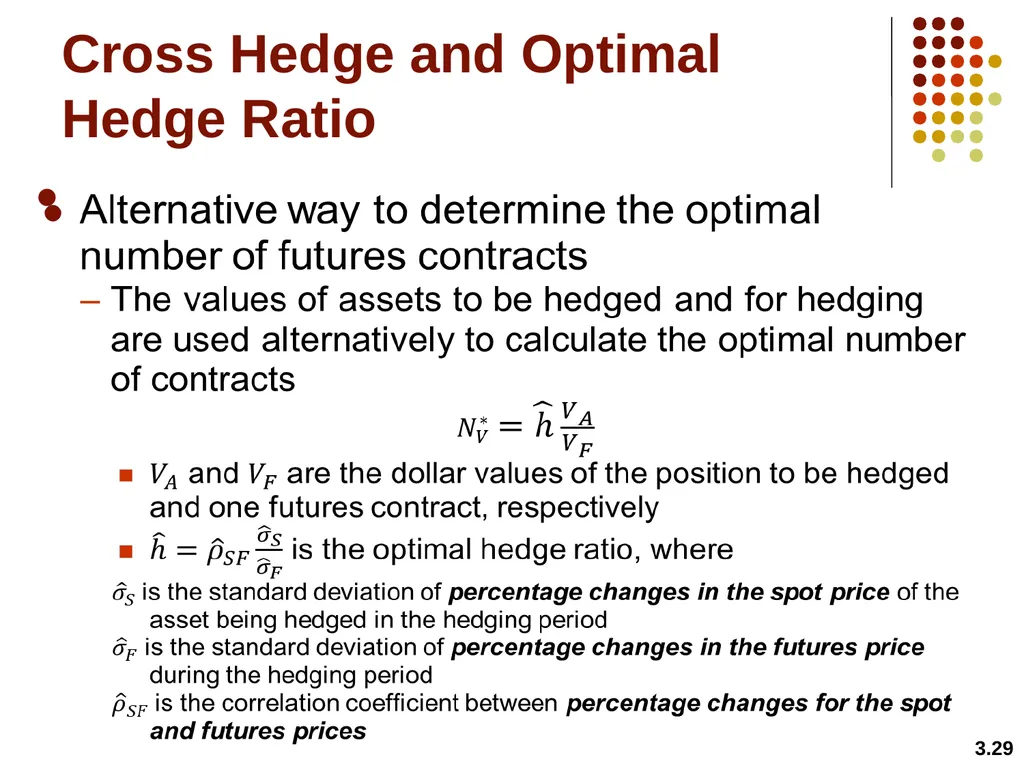
31
Cross Hedge and Optimal Hedge Ratio 3.29<br>
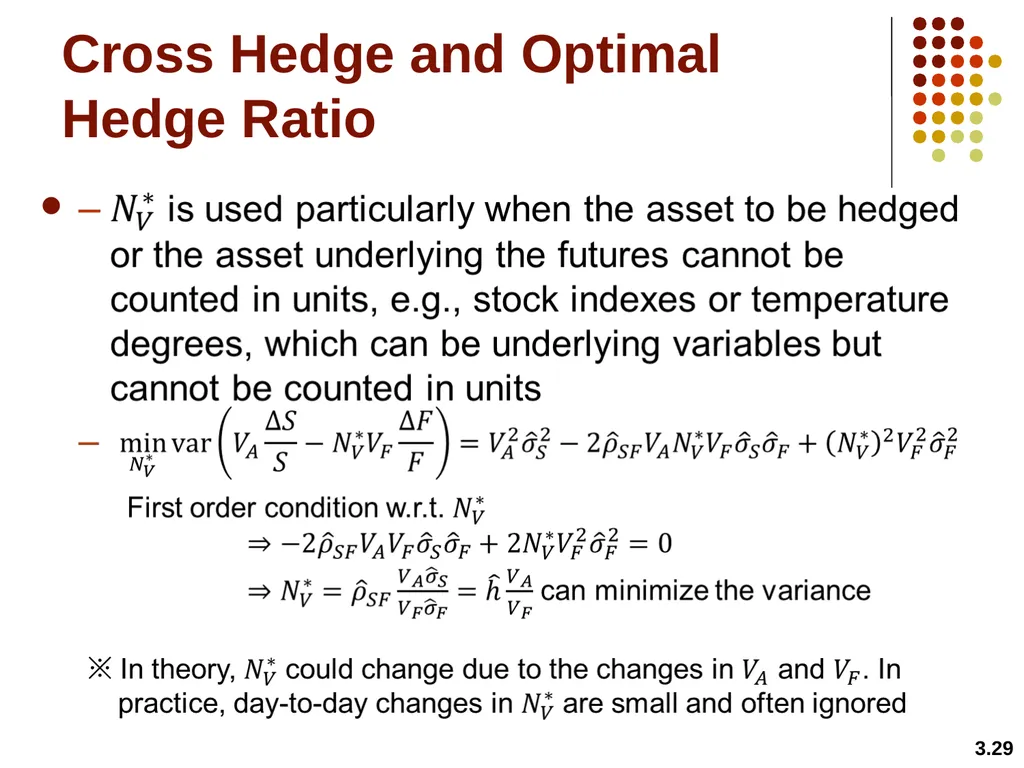
32
Cross Hedge and Optimal Hedge Ratio 3.29<br>
33
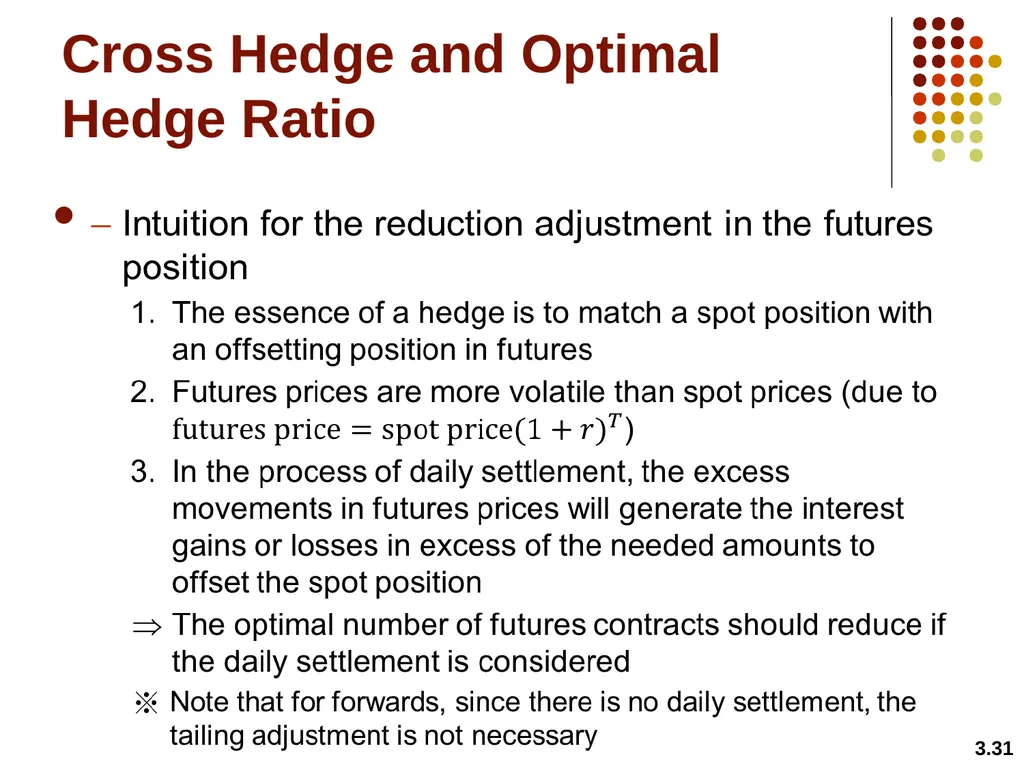
Cross Hedge and Optimal Hedge Ratio 3.30<br>
34
Cross Hedge and Optimal Hedge Ratio 3.31<br>
35
3.4 Stock Index Futures and Hedge Equity Portfolios 3.35<br>
36
Stock Index Futures (股票指數期貨) A stock index tracks percentage changes in the value of a virtual portfolio of stocks
S&P 500 index
Based on a virtual portfolio of 500 largest-cap stocks
The weights of individual stocks in the portfolio are proportional to their market capitalization (市值)
E-mini S&P 500 futures contract on CME is on $50 times the index
Standard-size S&P 500 index futures ($250 times the index) is delisted since Sept. 17, 2021
For a long position of S&P 500 index futures with F = 1300, if the S&P 500 index level on the settlement date is 1400, its payoff is (1400 – 1300) × $50
※ For Taiwan Weighted Stock Index futures listed on TAIFEX, one index point is worth NT$200 3.36<br>
S&P 500 index
Based on a virtual portfolio of 500 largest-cap stocks
The weights of individual stocks in the portfolio are proportional to their market capitalization (市值)
E-mini S&P 500 futures contract on CME is on $50 times the index
Standard-size S&P 500 index futures ($250 times the index) is delisted since Sept. 17, 2021
For a long position of S&P 500 index futures with F = 1300, if the S&P 500 index level on the settlement date is 1400, its payoff is (1400 – 1300) × $50
※ For Taiwan Weighted Stock Index futures listed on TAIFEX, one index point is worth NT$200 3.36<br>
37
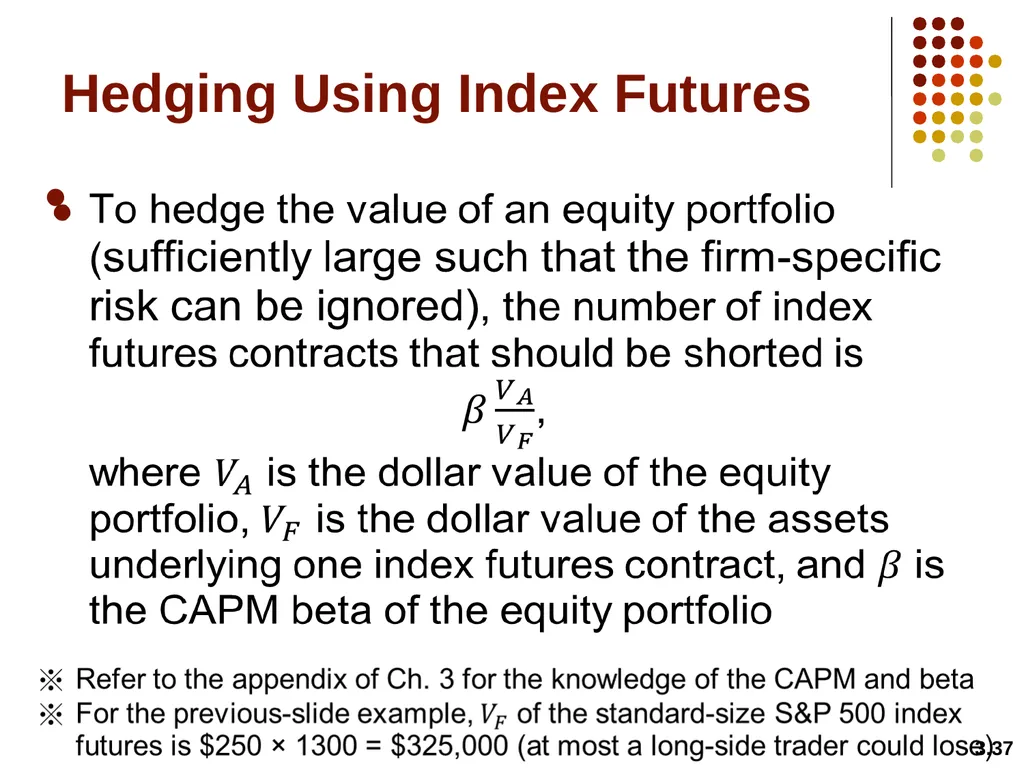
Hedging Using Index Futures 3.37<br>
38
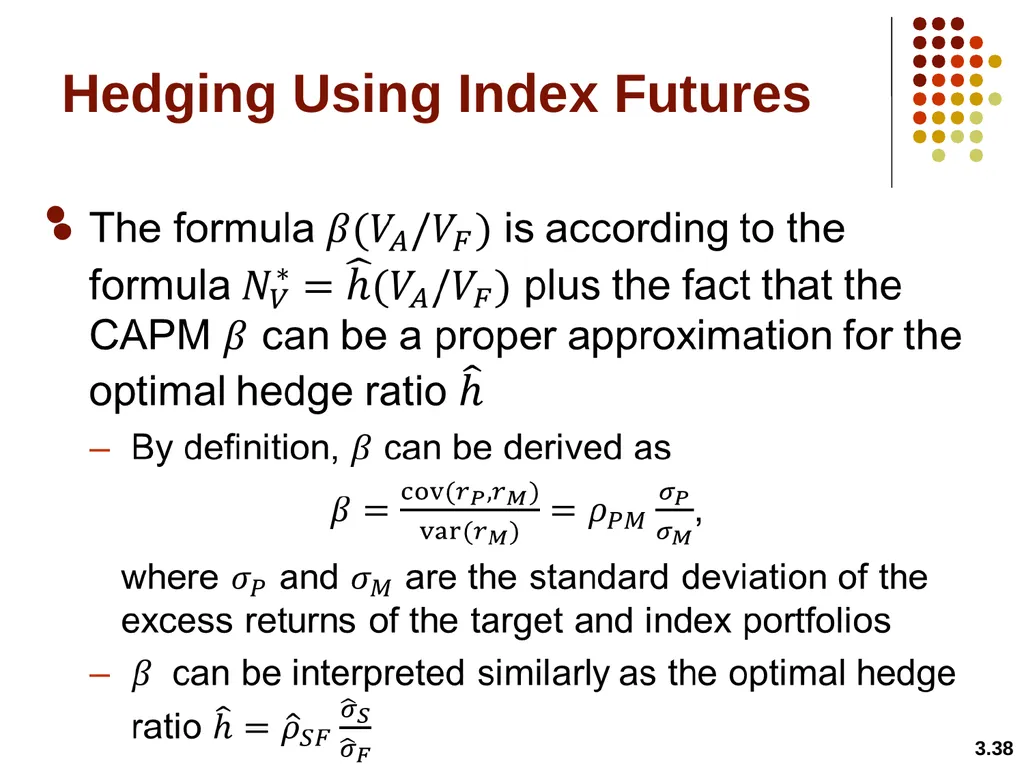
Hedging Using Index Futures 3.38<br>
39
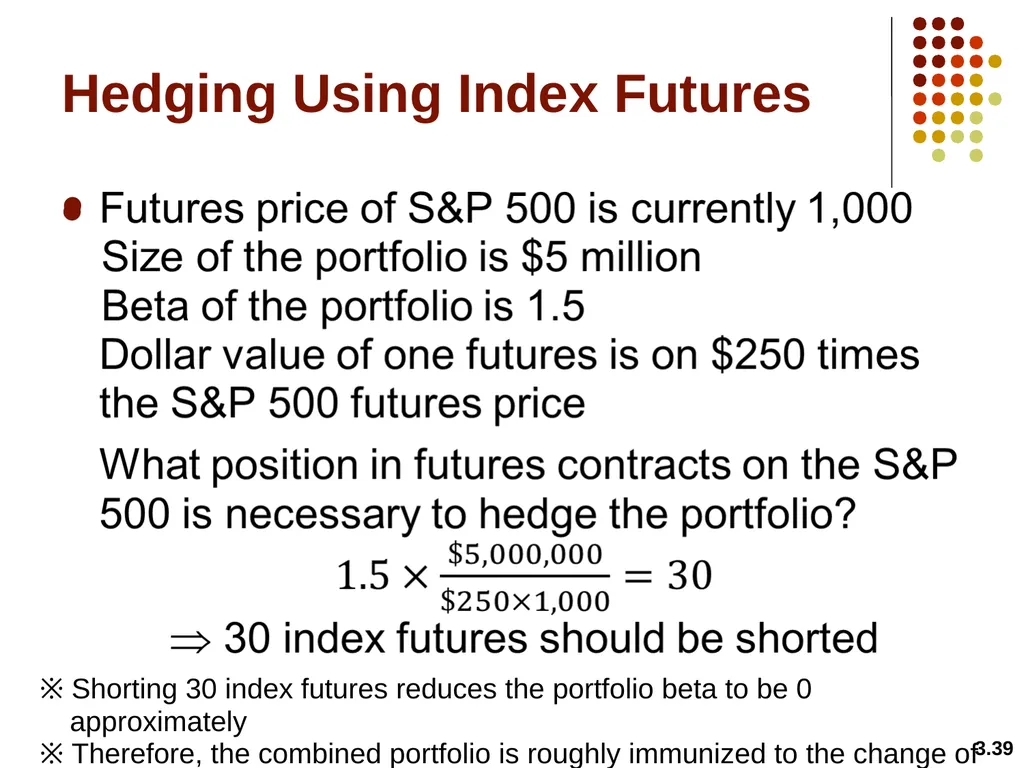
Hedging Using Index Futures 3.39 ※ Shorting 30 index futures reduces the portfolio beta to be 0 approximately
※ Therefore, the combined portfolio is roughly immunized to the change of S&P 500 index (or say the market risk)<br>
※ Therefore, the combined portfolio is roughly immunized to the change of S&P 500 index (or say the market risk)<br>
40
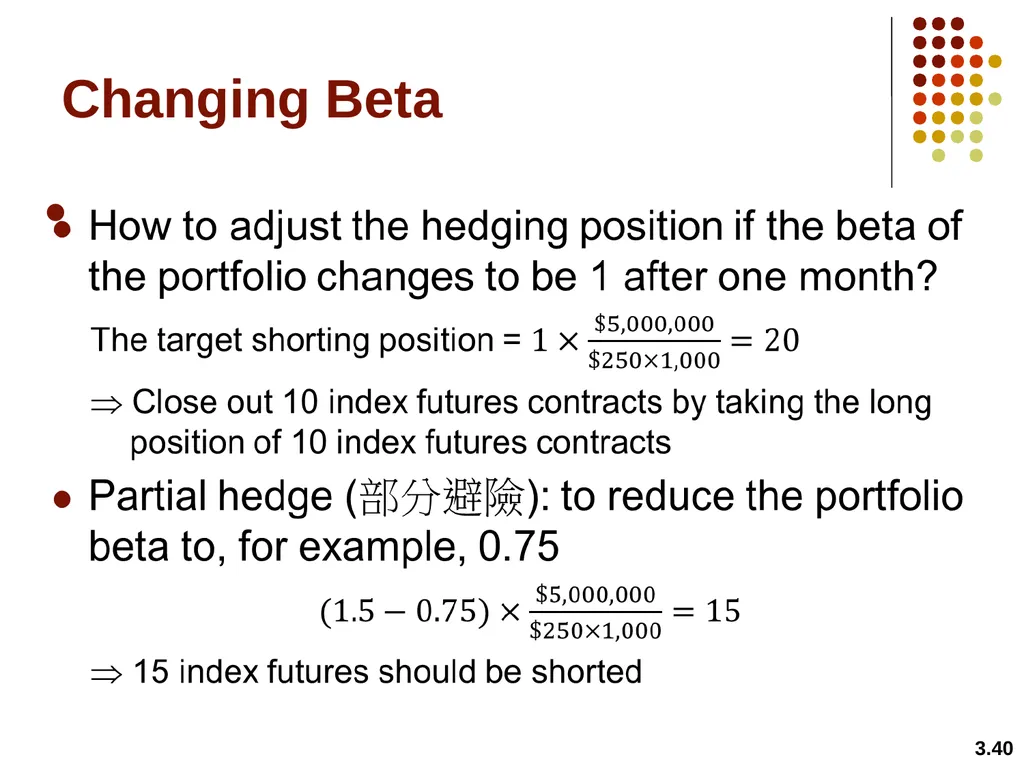
Changing Beta 3.40<br>
41
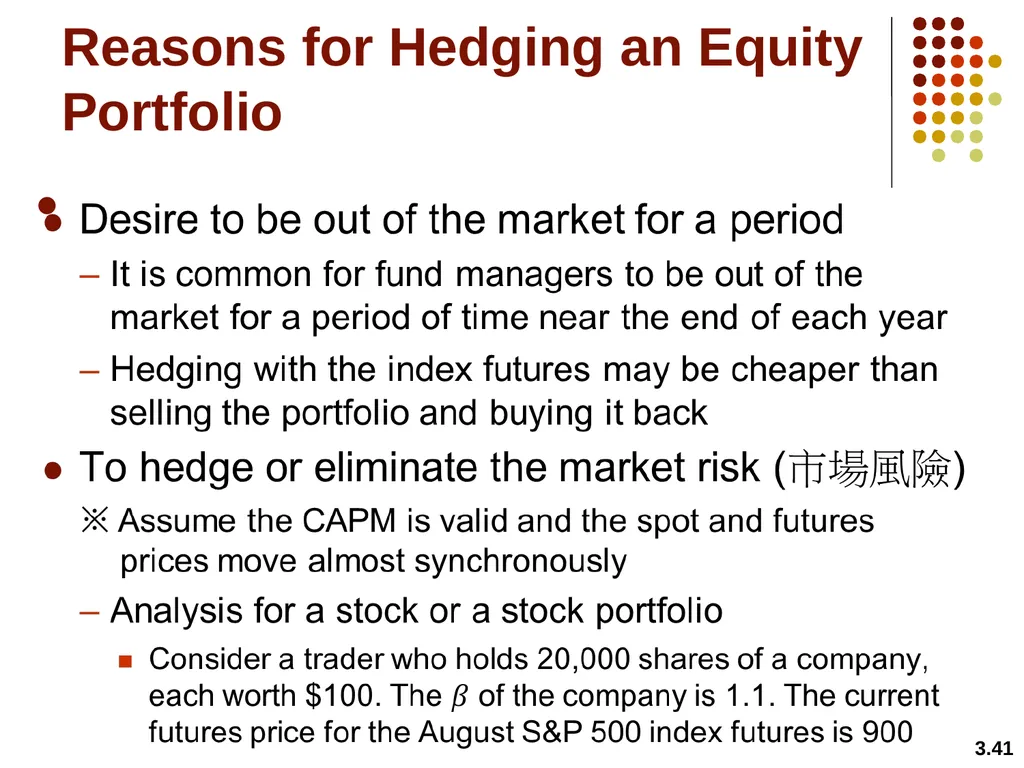
Reasons for Hedging an Equity Portfolio 3.41<br>
42
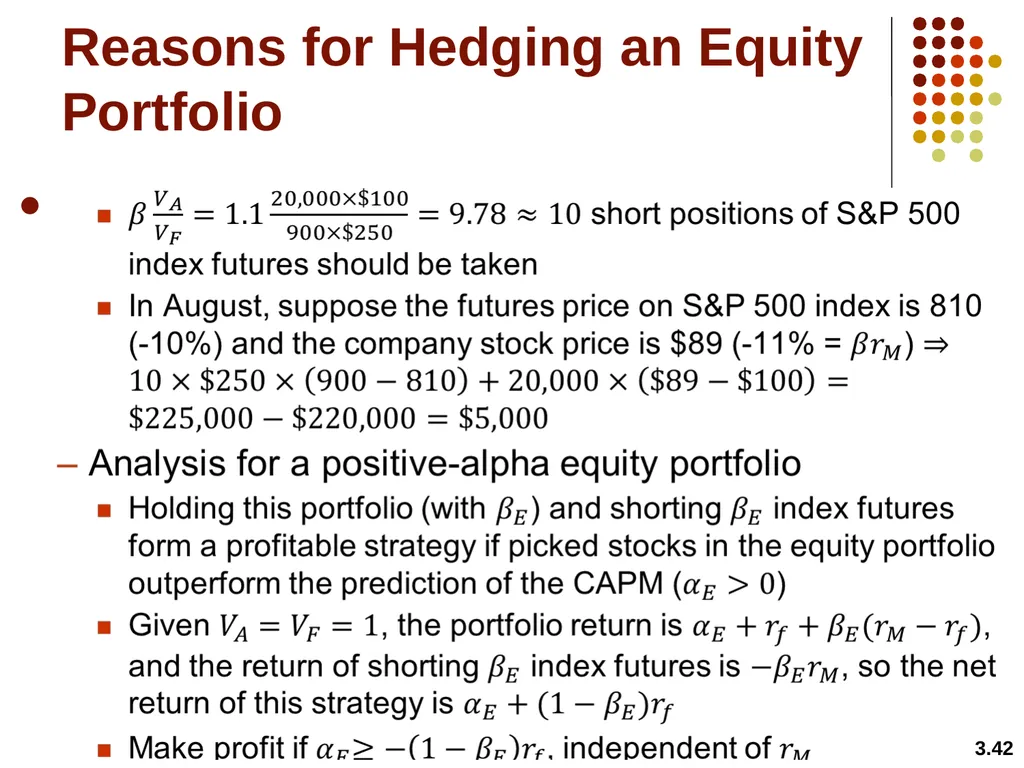
Reasons for Hedging an Equity Portfolio 3.42<br>