
Heli J. Roy, PhD, MBA, RD Pennington Biomedical
SB
Published · 50 slides · 0 views

1 / 1
Description
Heli J. Roy, PhD, MBA, RD Pennington Biomedical Research Center LSU AgCenter The DASH Diet Plan The DASH diet plan Hypertension prevalence What is blood pressure Why is high blood pressure important? How it affects the organ systems What
Related Topics
Share
Embed code
Download this presentation From Below
"Heli J. Roy, PhD, MBA, RD Pennington Biomedical" is the property of its rightful owner. Permission is granted to download and print the materials on this website for personal, non-commercial use only, and to display it on your personal computer provided you do not modify the materials and that you retain all copyright notices contained in the materials. By downloading content from our website, you accept the terms of this agreement.
Presentation Transcript
01
Heli J. Roy, PhD, MBA, RD
Pennington Biomedical Research Center
LSU AgCenter The DASH Diet Plan<br>
Pennington Biomedical Research Center
LSU AgCenter The DASH Diet Plan<br>
02
The DASH diet plan Hypertension prevalence
What is blood pressure
Why is high blood pressure important?
How it affects the organ systems
What causes it
Blood pressure goals
Risk factors
Weight Loss
The DASH Diet
Reducing sodium
Physical activity
No smoking
Little alcohol 7/29/2011 PBRC 2011 2<br>
What is blood pressure
Why is high blood pressure important?
How it affects the organ systems
What causes it
Blood pressure goals
Risk factors
Weight Loss
The DASH Diet
Reducing sodium
Physical activity
No smoking
Little alcohol 7/29/2011 PBRC 2011 2<br>
03
Hypertension Prevalence 72 million people in the US age 20 and older have high blood pressure, or 1 in 4.
One-third of people are unaware they have hypertension.
Less than half of American adults have optimal blood pressure.
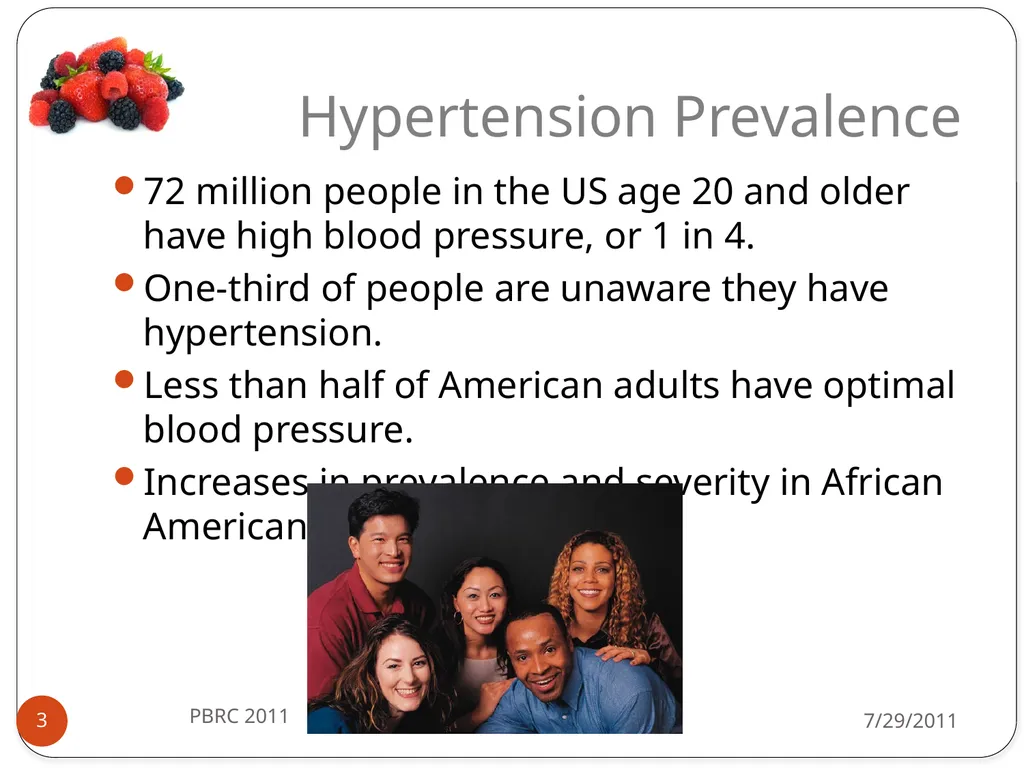
Increases in prevalence and severity in African Americans. 7/29/2011 PBRC 2011 3<br>
One-third of people are unaware they have hypertension.
Less than half of American adults have optimal blood pressure.
Increases in prevalence and severity in African Americans. 7/29/2011 PBRC 2011 3<br>
04
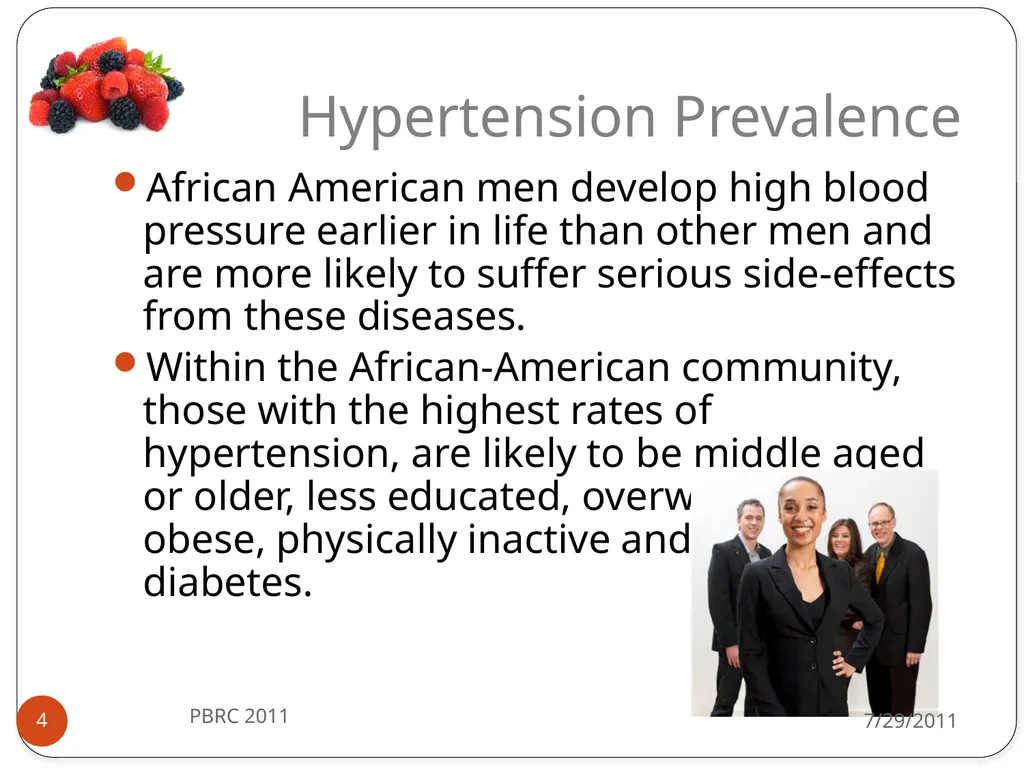
Hypertension Prevalence African American men develop high blood pressure earlier in life than other men and are more likely to suffer serious side-effects from these diseases.
Within the African-American community, those with the highest rates of hypertension, are likely to be middle aged or older, less educated, overweight or obese, physically inactive and to have diabetes. 7/29/2011 PBRC 2011 4<br>
Within the African-American community, those with the highest rates of hypertension, are likely to be middle aged or older, less educated, overweight or obese, physically inactive and to have diabetes. 7/29/2011 PBRC 2011 4<br>
05
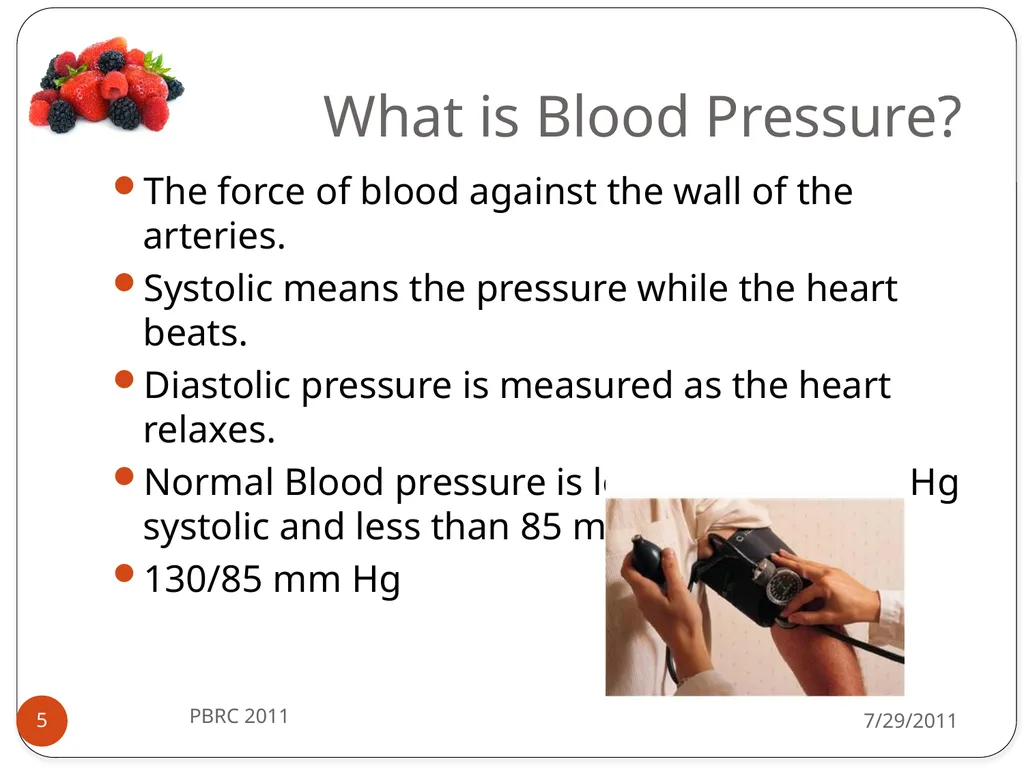
What is Blood Pressure? The force of blood against the wall of the arteries.
Systolic means the pressure while the heart beats.
Diastolic pressure is measured as the heart relaxes.
Normal Blood pressure is less than 130 mm Hg systolic and less than 85 mm Hg diastolic.
130/85 mm Hg 7/29/2011 PBRC 2011 5<br>
Systolic means the pressure while the heart beats.
Diastolic pressure is measured as the heart relaxes.
Normal Blood pressure is less than 130 mm Hg systolic and less than 85 mm Hg diastolic.
130/85 mm Hg 7/29/2011 PBRC 2011 5<br>
06
High Blood Pressure A consistent blood pressure of 140/90 mm Hg or higher is considered high blood pressure.
It increases chance for heart disease, kidney disease, and for having a stroke.
Has no warning signs or symptoms. 7/29/2011 PBRC 2011 6<br>
It increases chance for heart disease, kidney disease, and for having a stroke.
Has no warning signs or symptoms. 7/29/2011 PBRC 2011 6<br>
07
Why is High Blood Pressure Important? Makes the Heart work too hard.
Increases the pressure on the walls of arteries and can cause hardening of arteries.
If left untreated, can cause heart failure, kidney disease, and blindness.
Increases risk for heart disease and stroke. 7/29/2011 PBRC 2011 7<br>
Increases the pressure on the walls of arteries and can cause hardening of arteries.
If left untreated, can cause heart failure, kidney disease, and blindness.
Increases risk for heart disease and stroke. 7/29/2011 PBRC 2011 7<br>
08
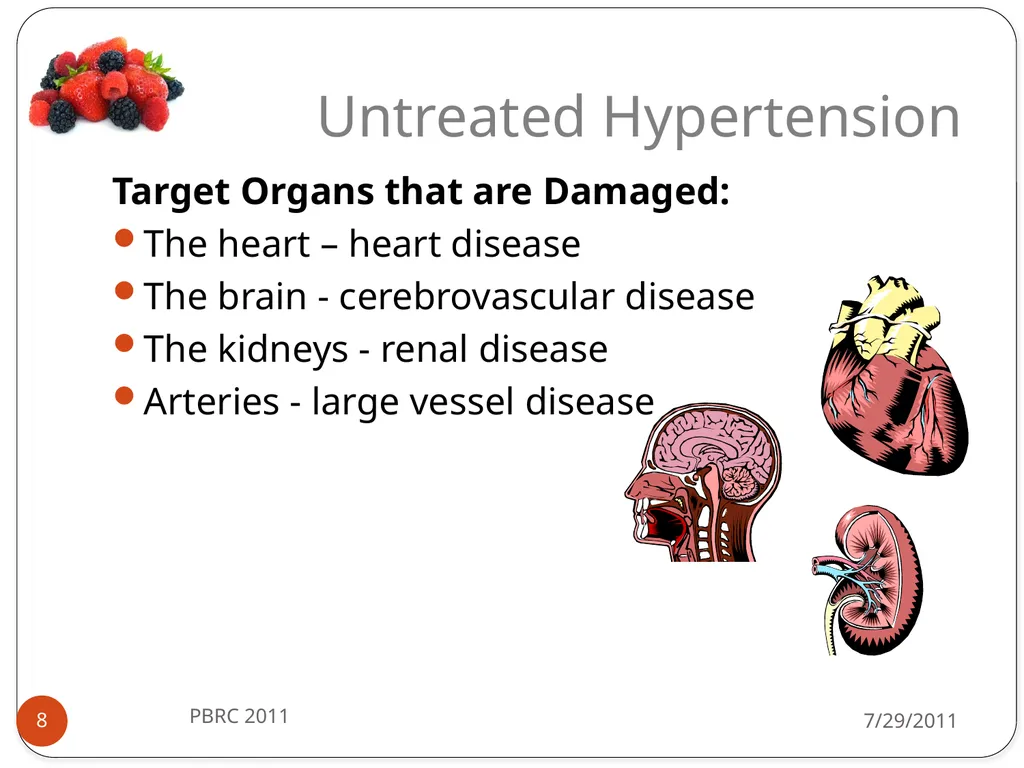
Untreated Hypertension Target Organs that are Damaged:
The heart – heart disease
The brain - cerebrovascular disease
The kidneys - renal disease
Arteries - large vessel disease 7/29/2011 PBRC 2011 8<br>
The heart – heart disease
The brain - cerebrovascular disease
The kidneys - renal disease
Arteries - large vessel disease 7/29/2011 PBRC 2011 8<br>
09
How Does It Effect the Body?
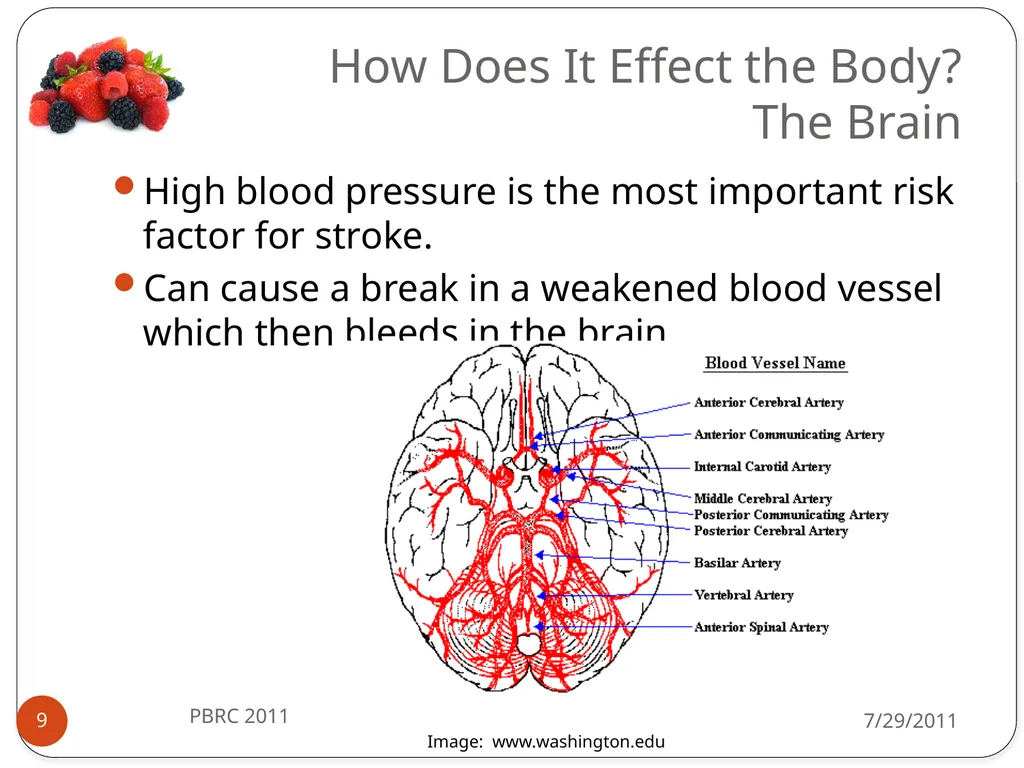
The Brain High blood pressure is the most important risk factor for stroke.
Can cause a break in a weakened blood vessel which then bleeds in the brain. Image: www.washington.edu 7/29/2011 PBRC 2011 9<br>
Can cause a break in a weakened blood vessel which then bleeds in the brain. Image: www.washington.edu 7/29/2011 PBRC 2011 9<br>
10
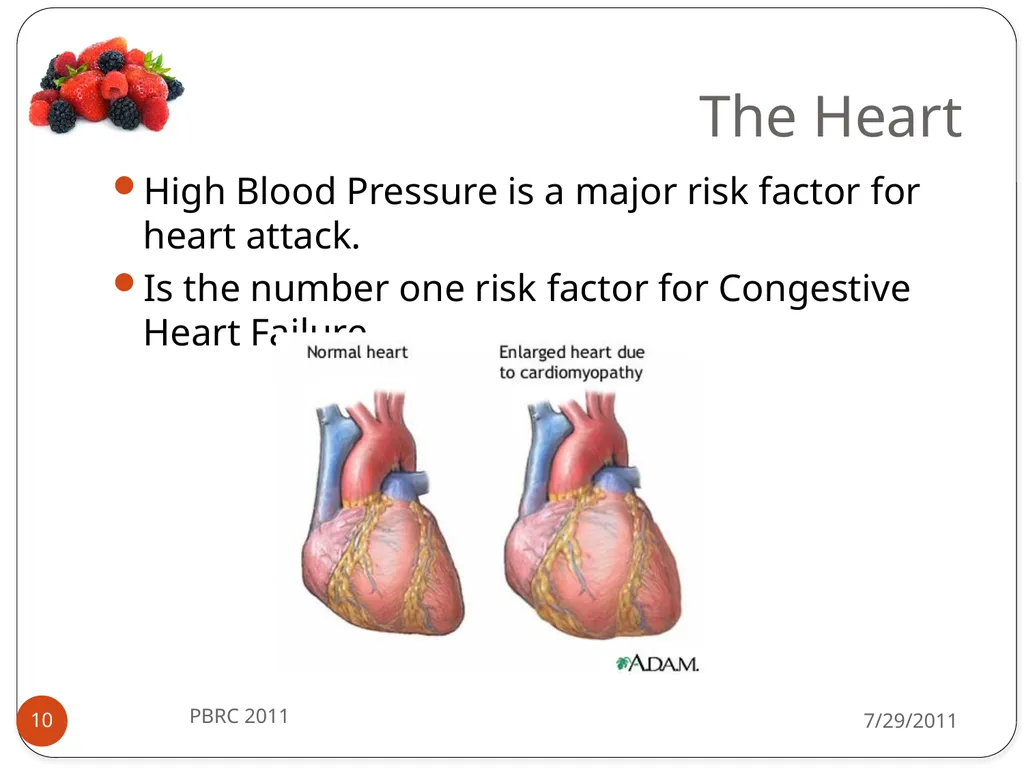
The Heart High Blood Pressure is a major risk factor for heart attack.
Is the number one risk factor for Congestive Heart Failure. 7/29/2011 PBRC 2011 10<br>
Is the number one risk factor for Congestive Heart Failure. 7/29/2011 PBRC 2011 10<br>
11
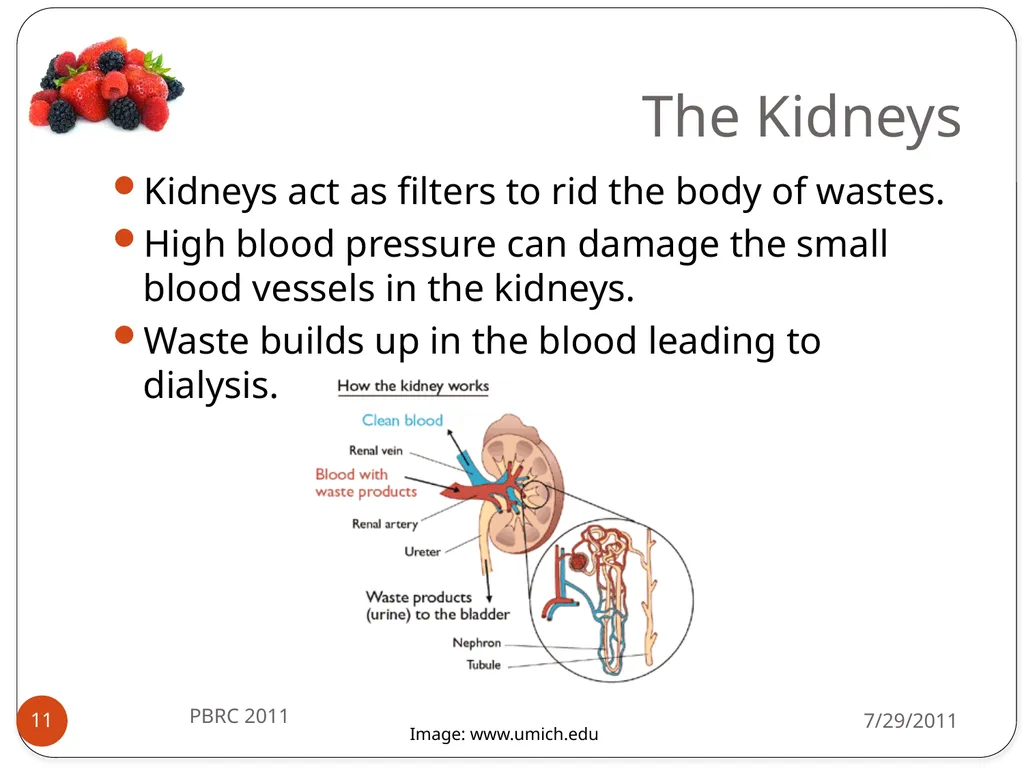
The Kidneys Kidneys act as filters to rid the body of wastes.
High blood pressure can damage the small blood vessels in the kidneys.
Waste builds up in the blood leading to dialysis. Image: www.umich.edu 7/29/2011 PBRC 2011 11<br>
High blood pressure can damage the small blood vessels in the kidneys.
Waste builds up in the blood leading to dialysis. Image: www.umich.edu 7/29/2011 PBRC 2011 11<br>
12
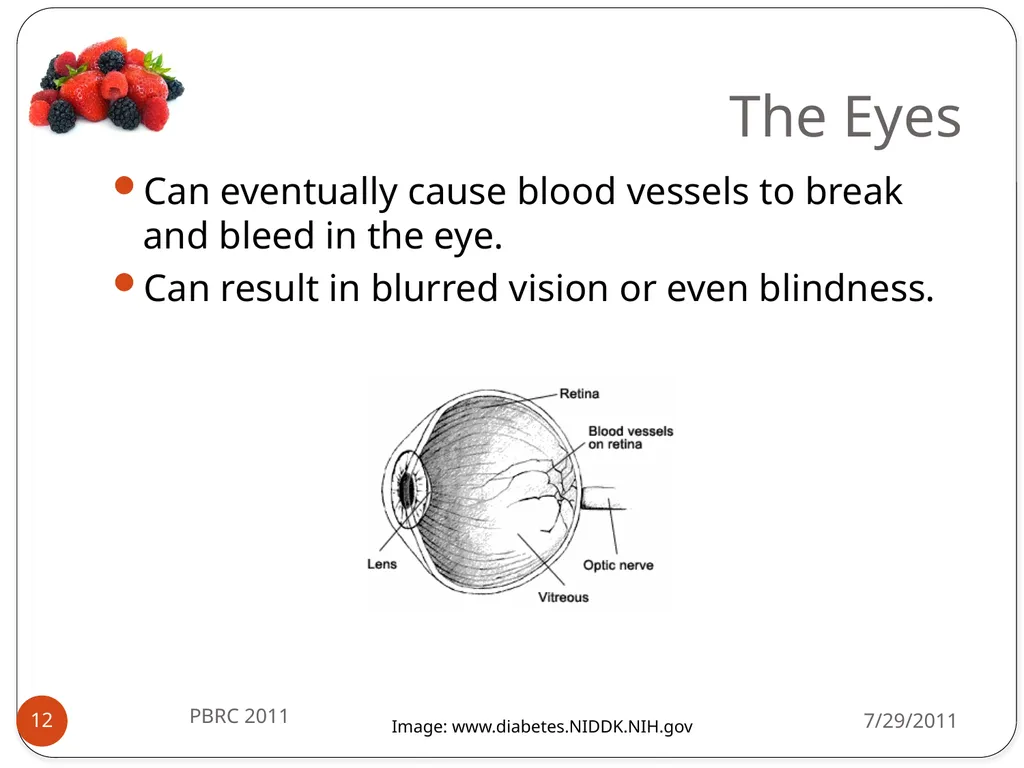
The Eyes Can eventually cause blood vessels to break and bleed in the eye.
Can result in blurred vision or even blindness. Image: www.diabetes.NIDDK.NIH.gov 7/29/2011 PBRC 2011 12<br>
Can result in blurred vision or even blindness. Image: www.diabetes.NIDDK.NIH.gov 7/29/2011 PBRC 2011 12<br>
13
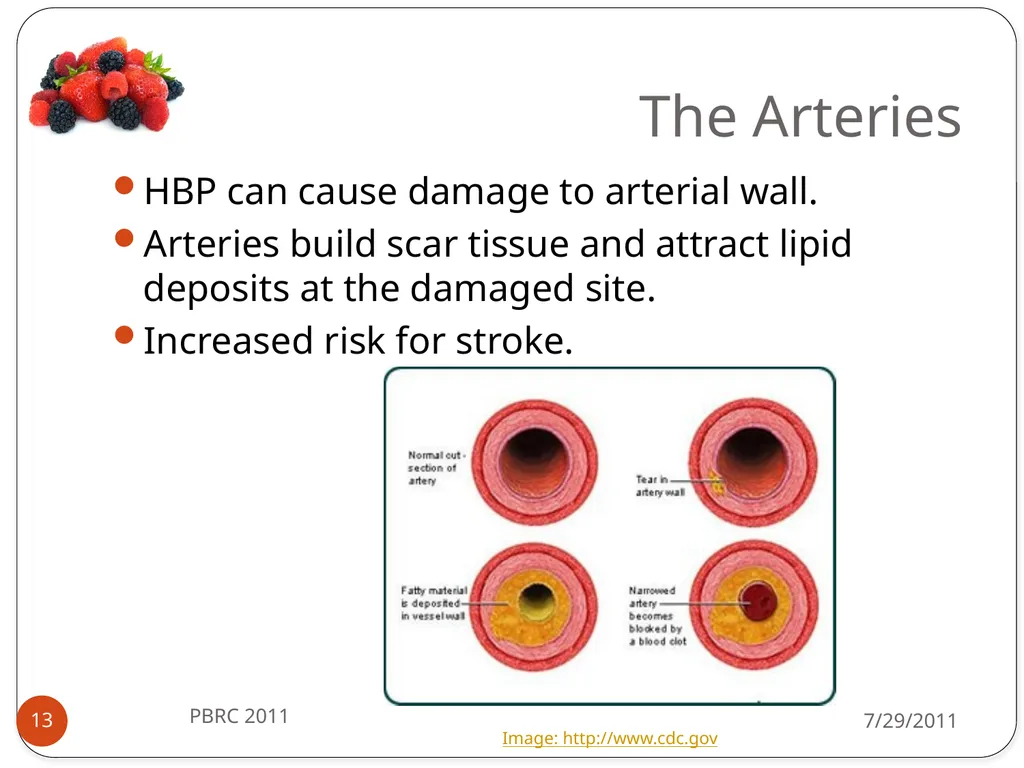
The Arteries HBP can cause damage to arterial wall.
Arteries build scar tissue and attract lipid deposits at the damaged site.
Increased risk for stroke. Image: http://www.cdc.gov 7/29/2011 PBRC 2011 13<br>
Arteries build scar tissue and attract lipid deposits at the damaged site.
Increased risk for stroke. Image: http://www.cdc.gov 7/29/2011 PBRC 2011 13<br>
14
What causes High Blood Pressure? Genetic factors
Being overweight or obese
High salt intake
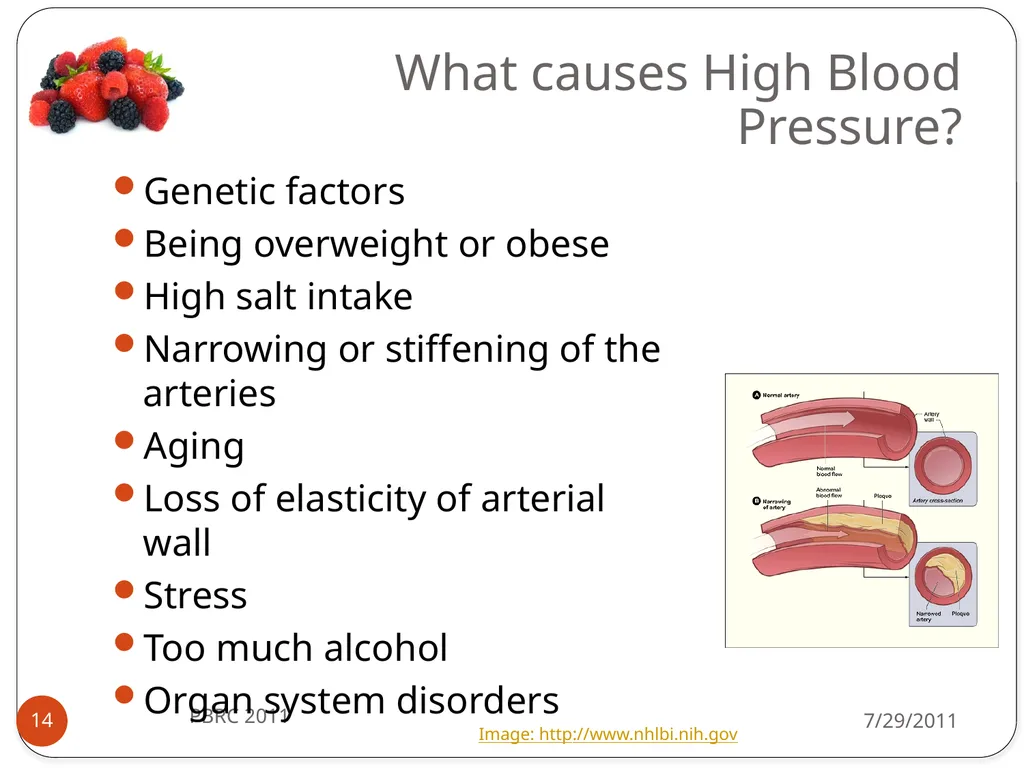
Narrowing or stiffening of the arteries
Aging
Loss of elasticity of arterial wall
Stress
Too much alcohol
Organ system disorders Image: http://www.nhlbi.nih.gov 7/29/2011 PBRC 2011 14<br>
Being overweight or obese
High salt intake
Narrowing or stiffening of the arteries
Aging
Loss of elasticity of arterial wall
Stress
Too much alcohol
Organ system disorders Image: http://www.nhlbi.nih.gov 7/29/2011 PBRC 2011 14<br>
15
Who can develop High Blood Pressure? Anyone, but it is more common in:
African Americans. They tend to get it earlier and more often then Caucasians.
Older individuals. 60% of Americans over 60 have hypertension.
The overweight and obese.
Those with family history. High normal bp:135-139/85-89 mm Hg. 7/29/2011 PBRC 2011 15<br>
African Americans. They tend to get it earlier and more often then Caucasians.
Older individuals. 60% of Americans over 60 have hypertension.
The overweight and obese.
Those with family history. High normal bp:135-139/85-89 mm Hg. 7/29/2011 PBRC 2011 15<br>
16
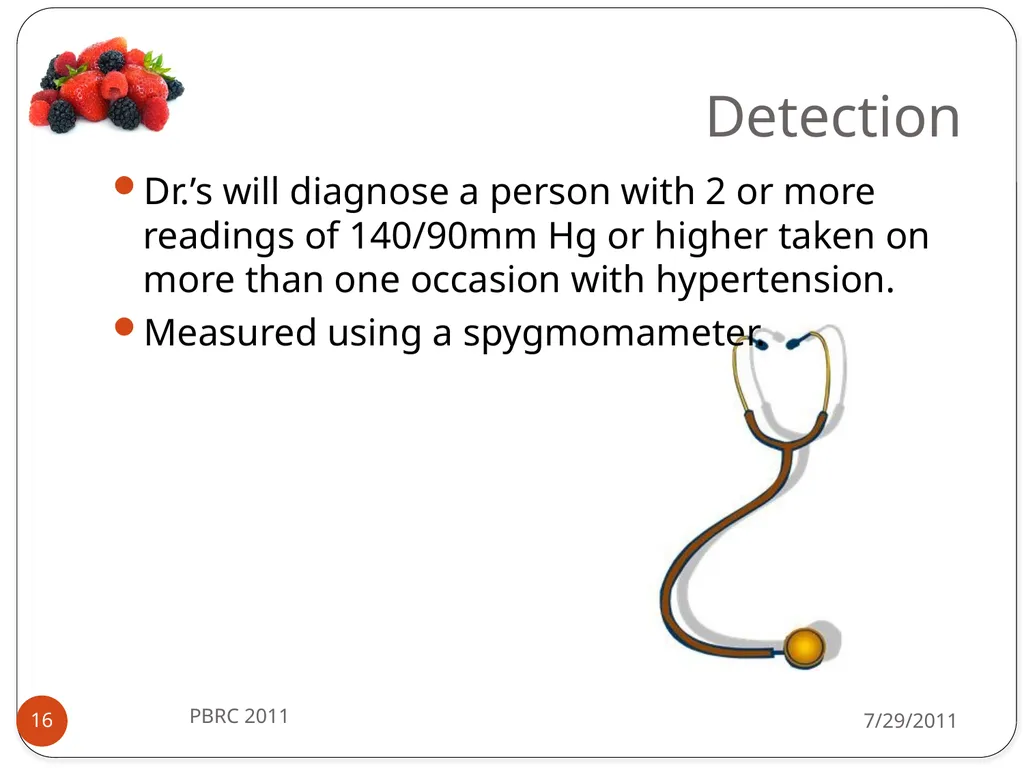
Detection Dr.’s will diagnose a person with 2 or more readings of 140/90mm Hg or higher taken on more than one occasion with hypertension.
Measured using a spygmomameter. 7/29/2011 PBRC 2011 16<br>
Measured using a spygmomameter. 7/29/2011 PBRC 2011 16<br>
17
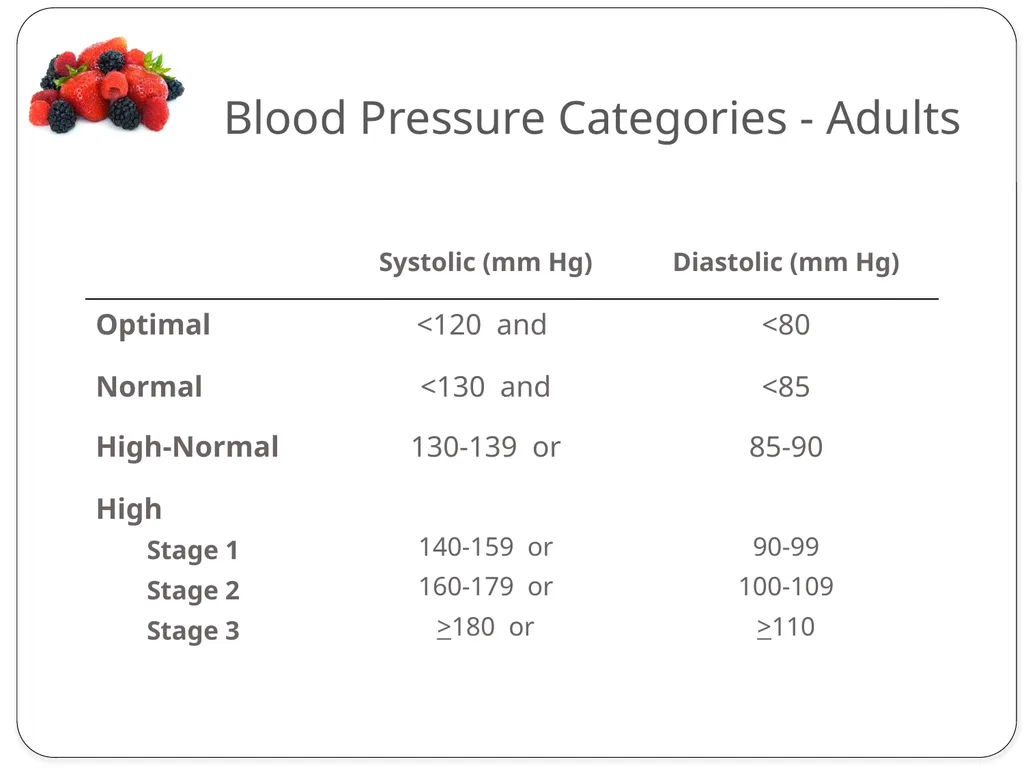
Blood Pressure Categories - Adults<br>
18
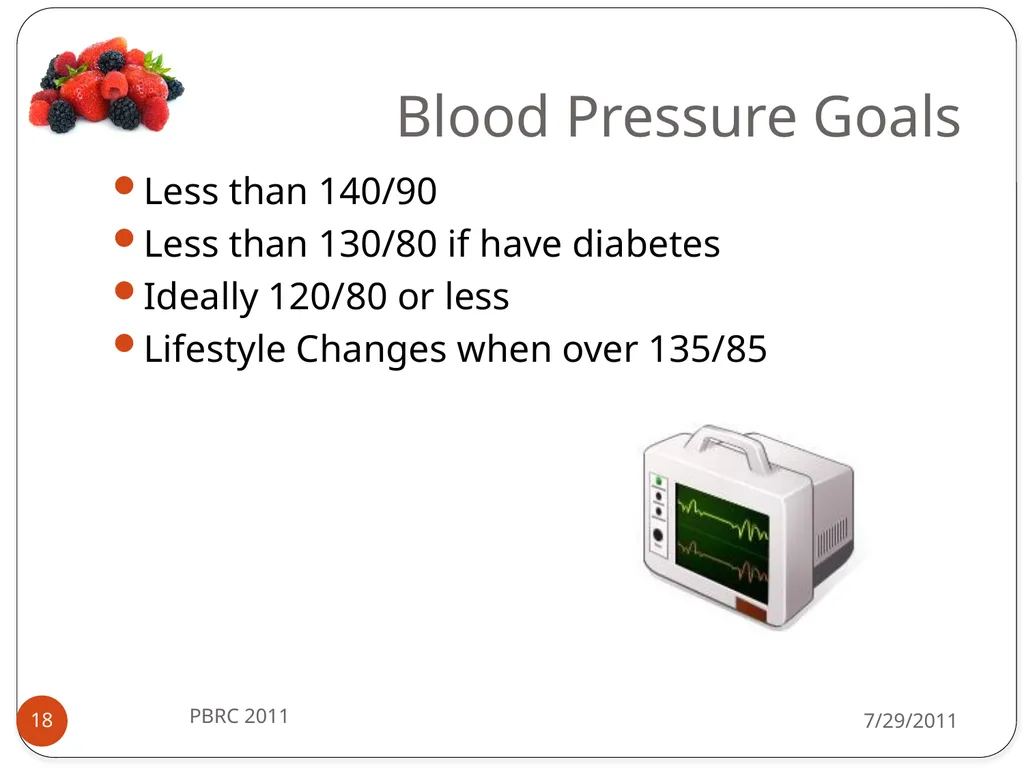
Less than 140/90
Less than 130/80 if have diabetes
Ideally 120/80 or less
Lifestyle Changes when over 135/85 Blood Pressure Goals 7/29/2011 PBRC 2011 18<br>
Less than 130/80 if have diabetes
Ideally 120/80 or less
Lifestyle Changes when over 135/85 Blood Pressure Goals 7/29/2011 PBRC 2011 18<br>
19
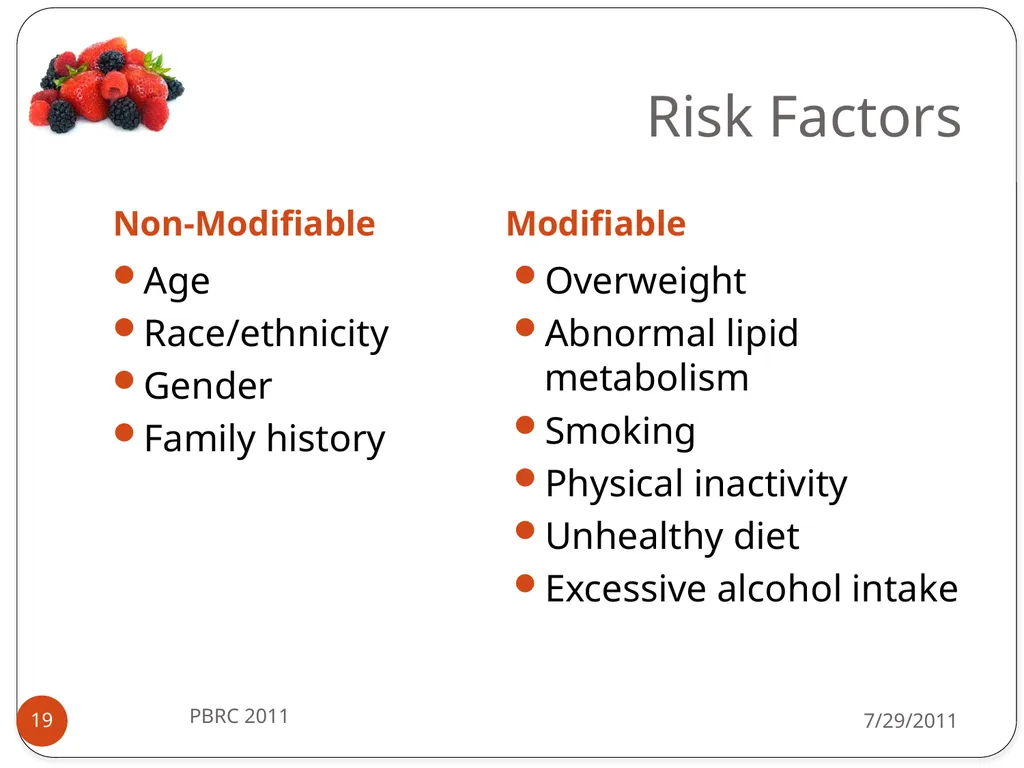
Risk Factors Non-Modifiable Modifiable Age
Race/ethnicity
Gender
Family history Overweight
Abnormal lipid metabolism
Smoking
Physical inactivity
Unhealthy diet
Excessive alcohol intake 7/29/2011 PBRC 2011 19<br>
Race/ethnicity
Gender
Family history Overweight
Abnormal lipid metabolism
Smoking
Physical inactivity
Unhealthy diet
Excessive alcohol intake 7/29/2011 PBRC 2011 19<br>
20
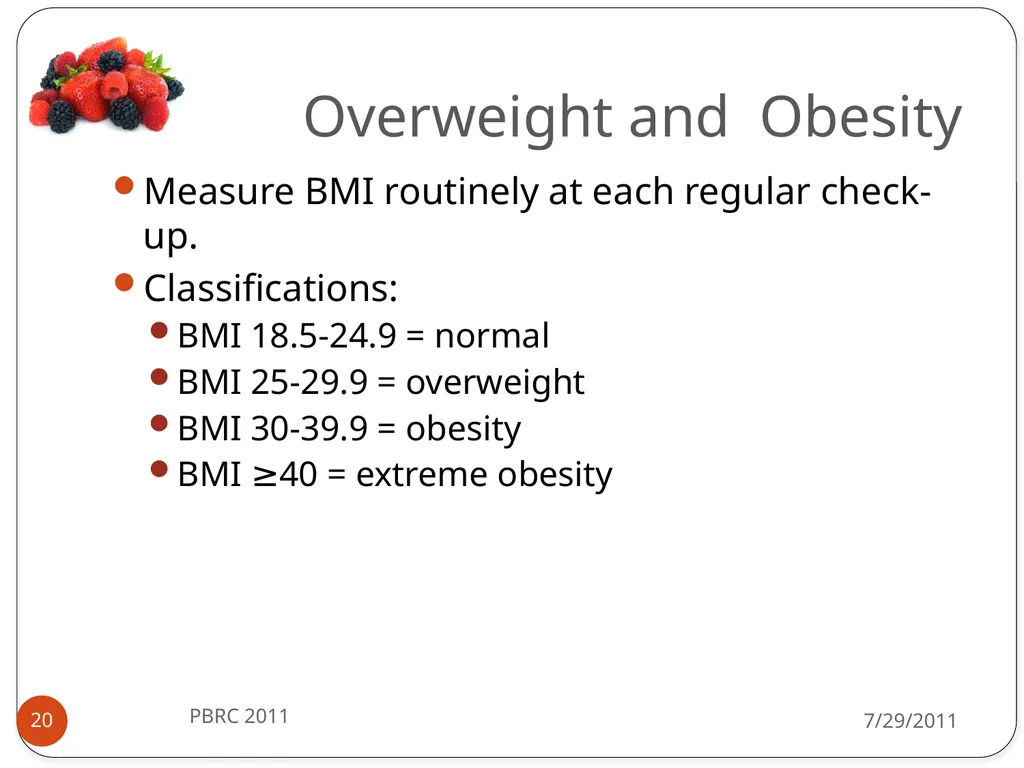
Overweight and Obesity Measure BMI routinely at each regular check-up.
Classifications:
BMI 18.5-24.9 = normal
BMI 25-29.9 = overweight
BMI 30-39.9 = obesity
BMI ≥40 = extreme obesity 7/29/2011 PBRC 2011 20<br>
Classifications:
BMI 18.5-24.9 = normal
BMI 25-29.9 = overweight
BMI 30-39.9 = obesity
BMI ≥40 = extreme obesity 7/29/2011 PBRC 2011 20<br>
21
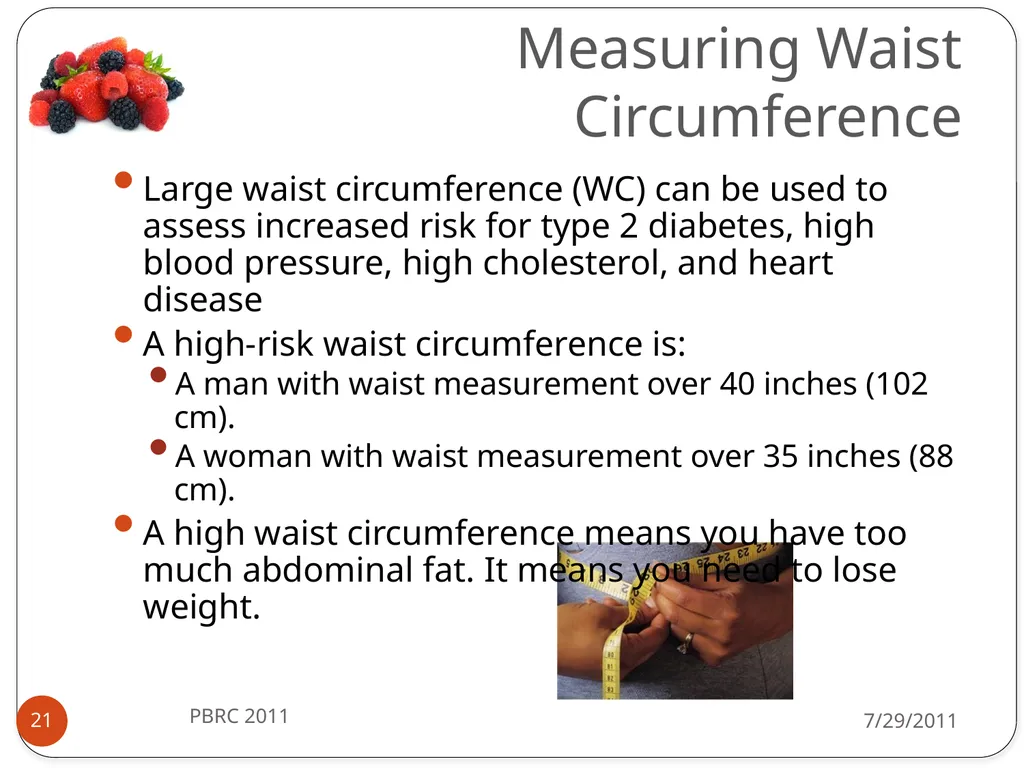
Measuring Waist Circumference Large waist circumference (WC) can be used to assess increased risk for type 2 diabetes, high blood pressure, high cholesterol, and heart disease
A high-risk waist circumference is:
A man with waist measurement over 40 inches (102 cm).
A woman with waist measurement over 35 inches (88 cm).
A high waist circumference means you have too much abdominal fat. It means you need to lose weight. 7/29/2011 PBRC 2011 21<br>
A high-risk waist circumference is:
A man with waist measurement over 40 inches (102 cm).
A woman with waist measurement over 35 inches (88 cm).
A high waist circumference means you have too much abdominal fat. It means you need to lose weight. 7/29/2011 PBRC 2011 21<br>
22
Lose Weight if Overweight If follow DASH diet and increase activity, weight loss should occur gradually
Even 10 pounds can make a big difference! 7/29/2011 PBRC 2011 22<br>
Even 10 pounds can make a big difference! 7/29/2011 PBRC 2011 22<br>
23
Reducing Overweight and Obesity Lifestyle modification:
Reduce caloric intake by 500-1000 kcal/day (depending on starting weight)
Target 1-2 pound/week weight loss
Increase physical activity
Healthy diet 7/29/2011 PBRC 2011 23<br>
Reduce caloric intake by 500-1000 kcal/day (depending on starting weight)
Target 1-2 pound/week weight loss
Increase physical activity
Healthy diet 7/29/2011 PBRC 2011 23<br>
24
Diet and Hypertension Non-pharmacologic way of treating hypertension
DASH diet
Dietary Approaches to Stop Hypertension
High in whole grains, fruits, vegetables, and low-fat dairy
Adequate Calcium, Potassium, Magnesium
Low in red meat, sweets and sugar beverages
Low in saturated and trans fat, cholesterol 7/29/2011 PBRC 2011 24<br>
DASH diet
Dietary Approaches to Stop Hypertension
High in whole grains, fruits, vegetables, and low-fat dairy
Adequate Calcium, Potassium, Magnesium
Low in red meat, sweets and sugar beverages
Low in saturated and trans fat, cholesterol 7/29/2011 PBRC 2011 24<br>
25
DASH is Unique Tested dietary pattern rather than single nutrients
Experimental diets used common foods that can be incorporated into recommendations for the public
Investigators planned the DASH diet to be fully compatible with dietary recommendations for reducing risk of CVD, osteoporosis and cancer 7/29/2011 PBRC 2011 25<br>
Experimental diets used common foods that can be incorporated into recommendations for the public
Investigators planned the DASH diet to be fully compatible with dietary recommendations for reducing risk of CVD, osteoporosis and cancer 7/29/2011 PBRC 2011 25<br>
26
Mineral Intake and Hypertension Potassium
Clinical trials and meta-analyses indicate potassium (K) supplementation lowers BP
Adequate K intake, preferably from food sources, should be maintained
Evidence is strong enough to support a health claim on high potassium foods
Best sources are fruits and vegetables 7/29/2011 PBRC 2011 26<br>
Clinical trials and meta-analyses indicate potassium (K) supplementation lowers BP
Adequate K intake, preferably from food sources, should be maintained
Evidence is strong enough to support a health claim on high potassium foods
Best sources are fruits and vegetables 7/29/2011 PBRC 2011 26<br>
27
Mineral Intake and Hypertension Magnesium
Evidence suggests an association between lower dietary magnesium intake and high blood pressure
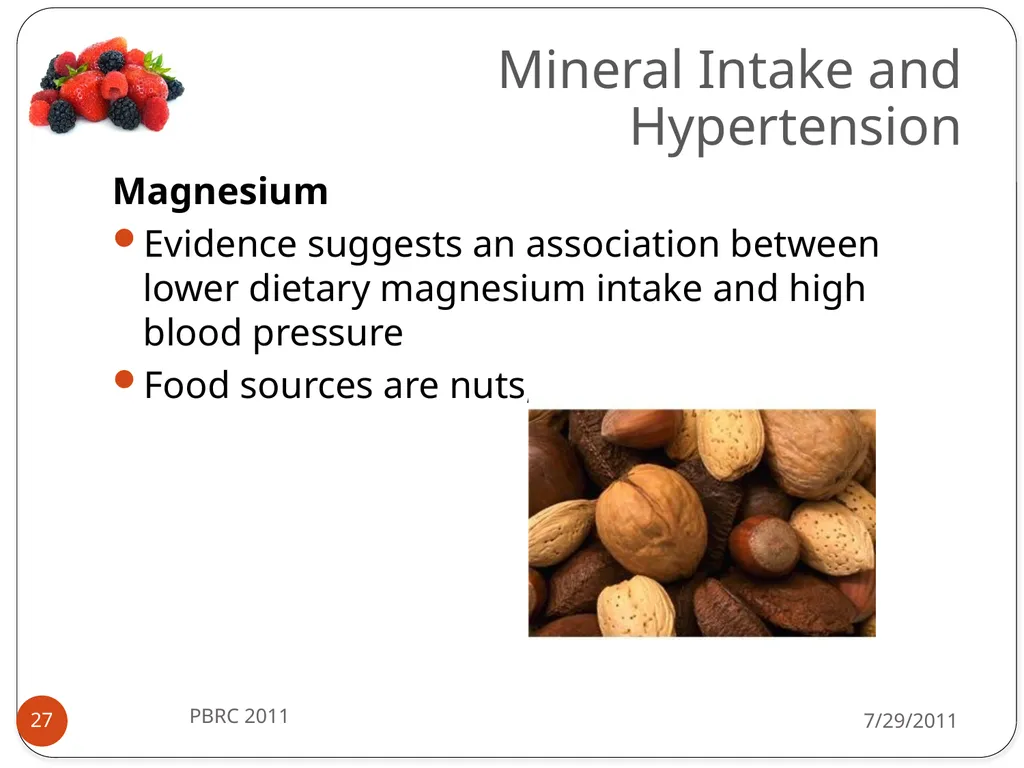
Food sources are nuts, beans, vegetables 7/29/2011 PBRC 2011 27<br>
Evidence suggests an association between lower dietary magnesium intake and high blood pressure
Food sources are nuts, beans, vegetables 7/29/2011 PBRC 2011 27<br>
28
Mineral Intake and Hypertension Calcium
American Heart Association Statement
Increasing calcium intake may preferentially lower blood pressure in salt-sensitive people
Benefits more evident with low initial calcium intakes
(300-600 mg/day)
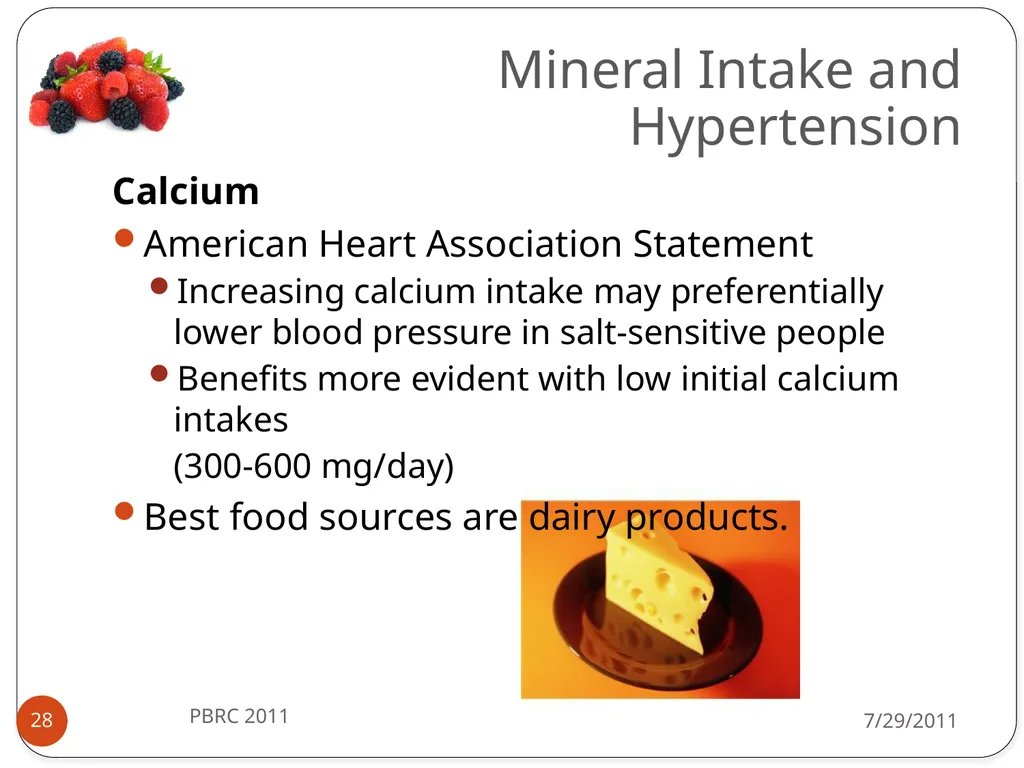
Best food sources are dairy products. 7/29/2011 PBRC 2011 28<br>
American Heart Association Statement
Increasing calcium intake may preferentially lower blood pressure in salt-sensitive people
Benefits more evident with low initial calcium intakes
(300-600 mg/day)
Best food sources are dairy products. 7/29/2011 PBRC 2011 28<br>
29
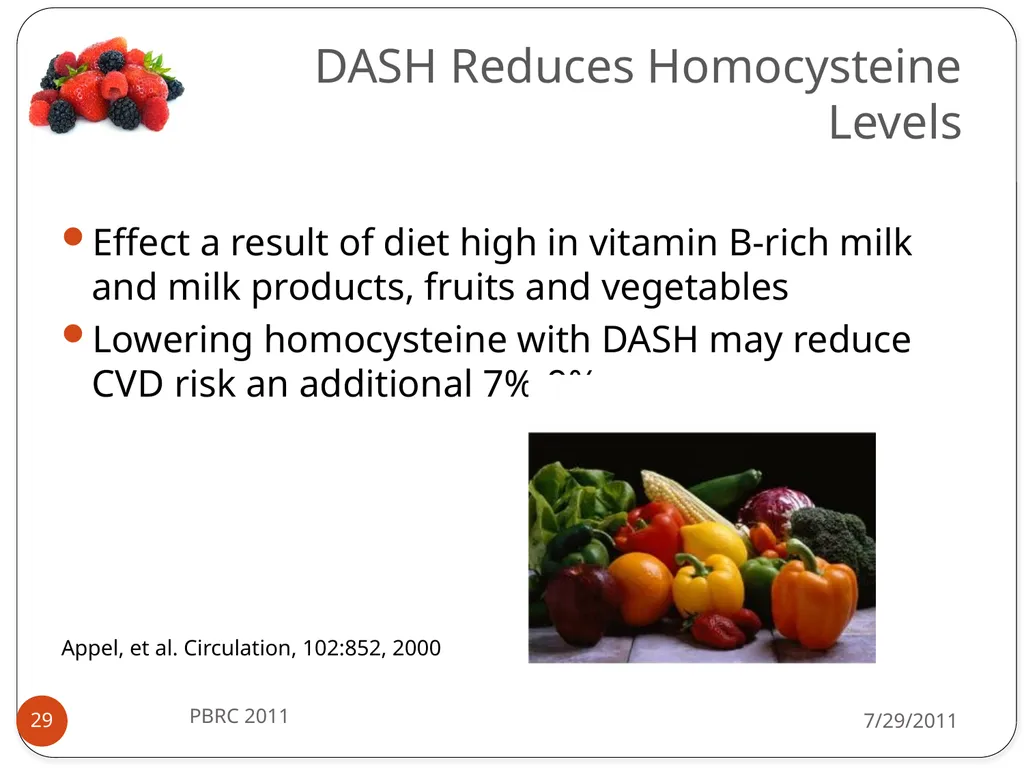
DASH Reduces Homocysteine Levels Effect a result of diet high in vitamin B-rich milk and milk products, fruits and vegetables
Lowering homocysteine with DASH may reduce CVD risk an additional 7%-9%
Appel, et al. Circulation, 102:852, 2000 7/29/2011 PBRC 2011 29<br>
Lowering homocysteine with DASH may reduce CVD risk an additional 7%-9%
Appel, et al. Circulation, 102:852, 2000 7/29/2011 PBRC 2011 29<br>
30
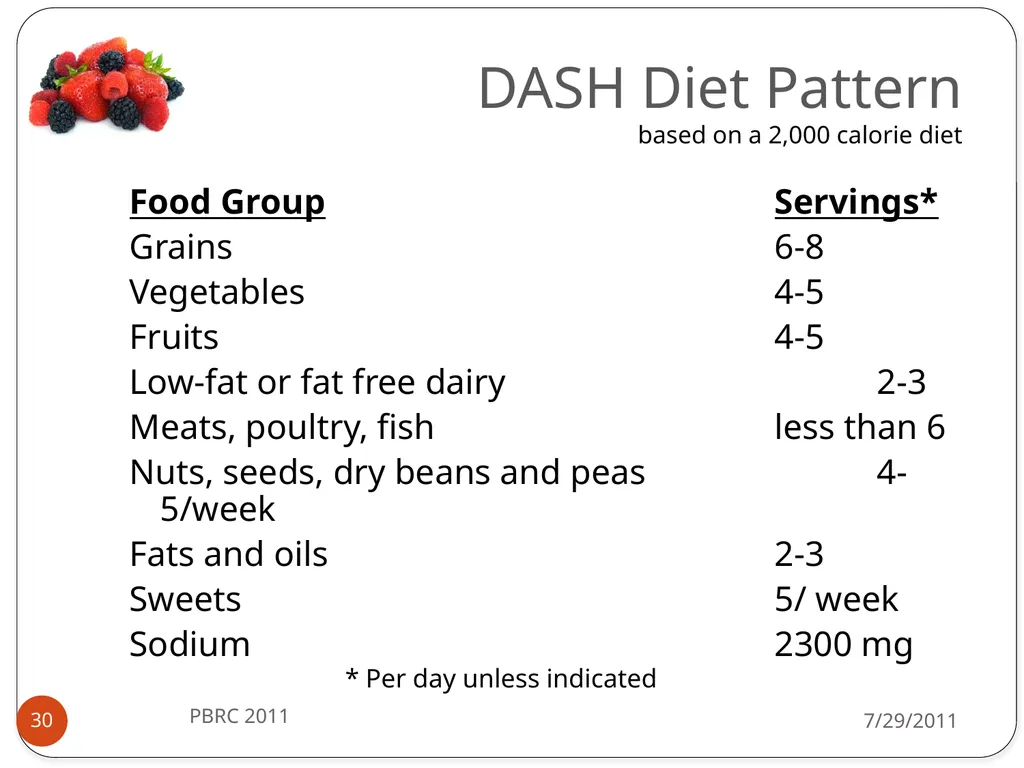
DASH Diet Pattern
based on a 2,000 calorie diet Food Group Servings*
Grains 6-8
Vegetables 4-5
Fruits 4-5
Low-fat or fat free dairy 2-3
Meats, poultry, fish less than 6
Nuts, seeds, dry beans and peas 4-5/week
Fats and oils 2-3
Sweets 5/ week
Sodium 2300 mg * Per day unless indicated 7/29/2011 PBRC 2011 30<br>
Grains 6-8
Vegetables 4-5
Fruits 4-5
Low-fat or fat free dairy 2-3
Meats, poultry, fish less than 6
Nuts, seeds, dry beans and peas 4-5/week
Fats and oils 2-3
Sweets 5/ week
Sodium 2300 mg * Per day unless indicated 7/29/2011 PBRC 2011 30<br>
31
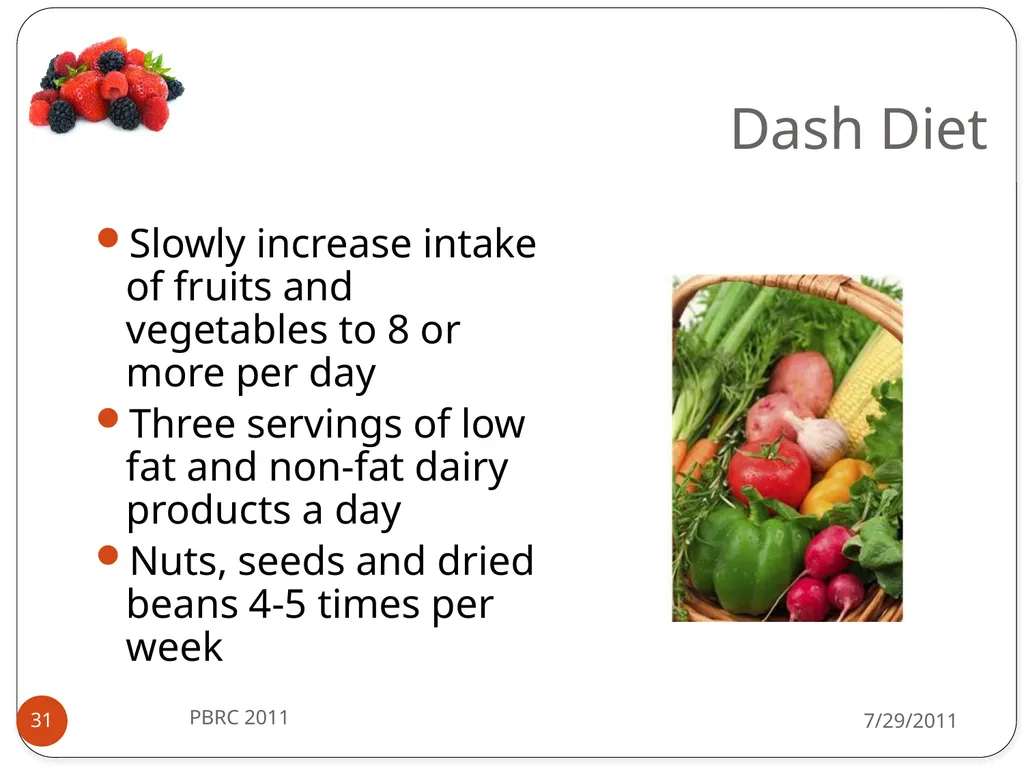
Slowly increase intake of fruits and vegetables to 8 or more per day
Three servings of low fat and non-fat dairy products a day
Nuts, seeds and dried beans 4-5 times per week Dash Diet 7/29/2011 PBRC 2011 31<br>
Three servings of low fat and non-fat dairy products a day
Nuts, seeds and dried beans 4-5 times per week Dash Diet 7/29/2011 PBRC 2011 31<br>
32
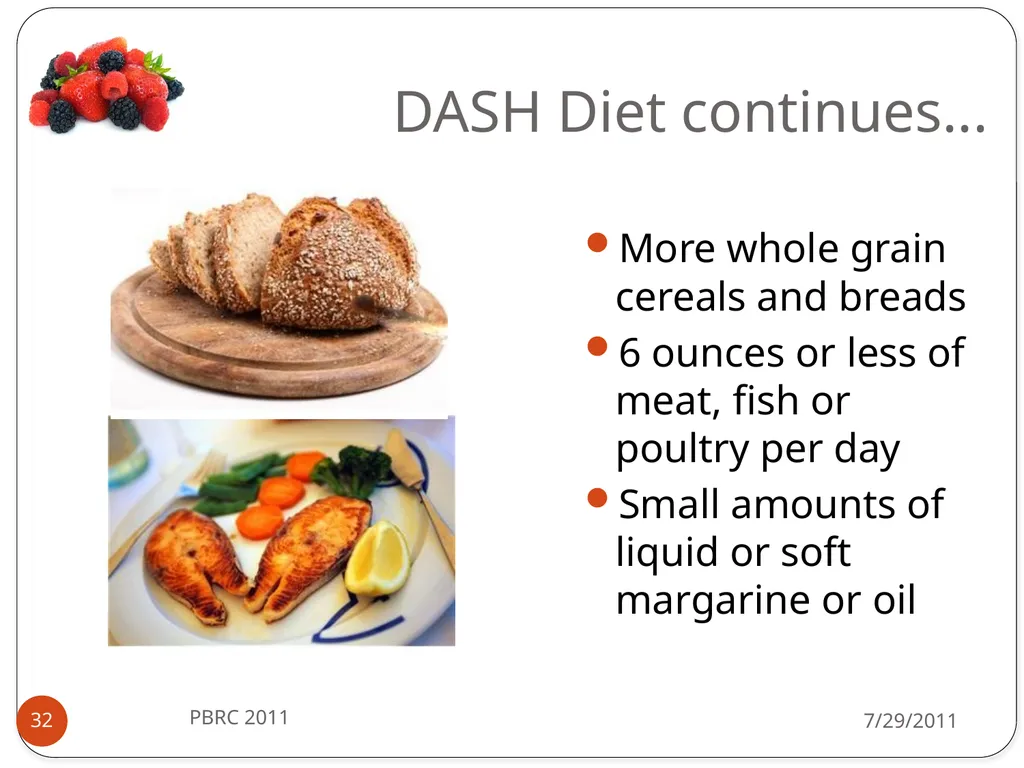
DASH Diet continues... More whole grain cereals and breads
6 ounces or less of meat, fish or poultry per day
Small amounts of liquid or soft margarine or oil 7/29/2011 PBRC 2011 32<br>
6 ounces or less of meat, fish or poultry per day
Small amounts of liquid or soft margarine or oil 7/29/2011 PBRC 2011 32<br>
33
Eat Less Sodium DASH is more effective if also reduce sodium
Less than 2400 milligrams per day
Reduce slowly in 2-3 weeks so that taste buds will get use to less salt 7/29/2011 PBRC 2011 33<br>
Less than 2400 milligrams per day
Reduce slowly in 2-3 weeks so that taste buds will get use to less salt 7/29/2011 PBRC 2011 33<br>
34
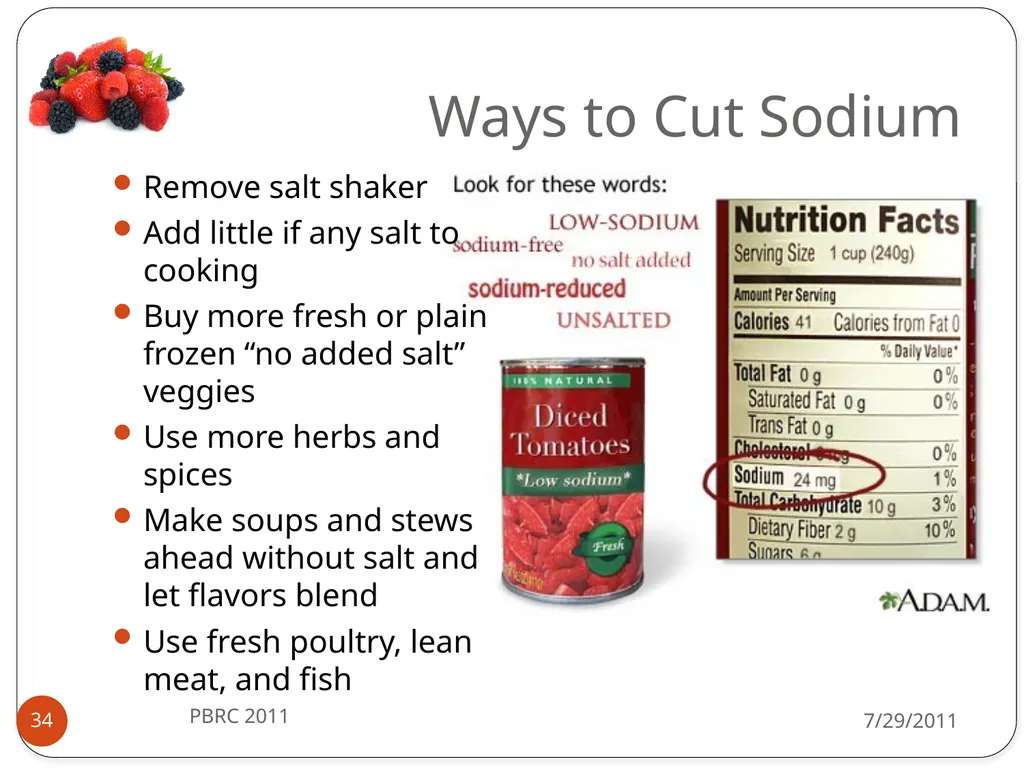
Ways to Cut Sodium Remove salt shaker
Add little if any salt to cooking
Buy more fresh or plain frozen “no added salt” veggies
Use more herbs and spices
Make soups and stews ahead without salt and let flavors blend
Use fresh poultry, lean meat, and fish 7/29/2011 PBRC 2011 34<br>
Add little if any salt to cooking
Buy more fresh or plain frozen “no added salt” veggies
Use more herbs and spices
Make soups and stews ahead without salt and let flavors blend
Use fresh poultry, lean meat, and fish 7/29/2011 PBRC 2011 34<br>
35
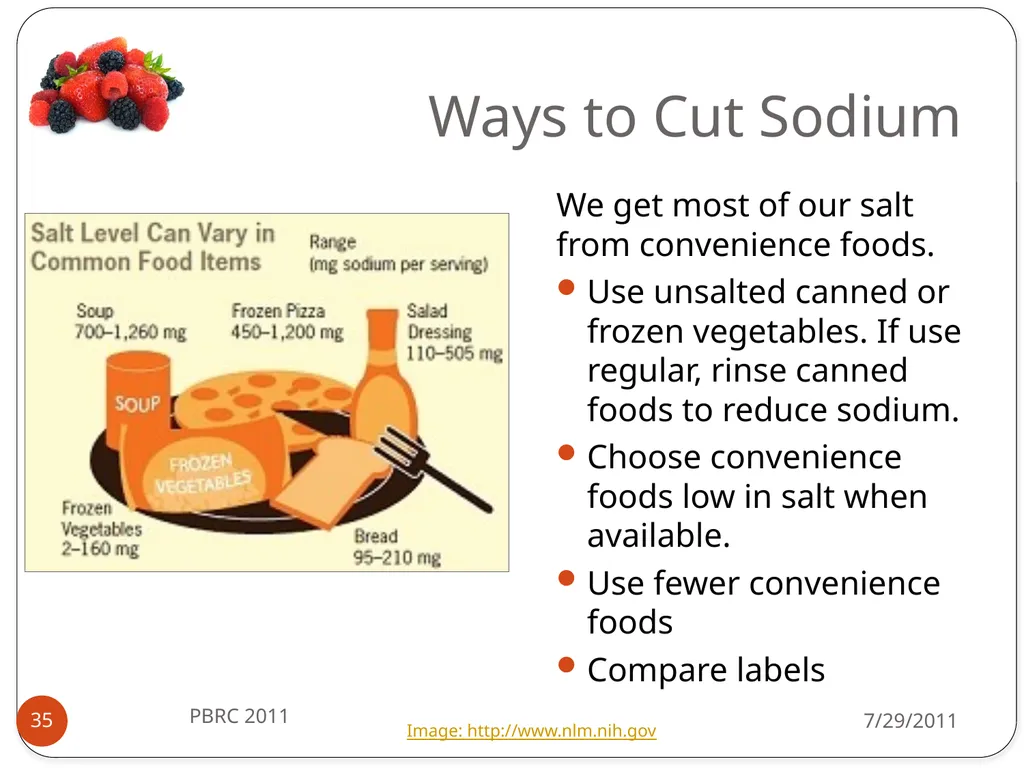
Ways to Cut Sodium We get most of our salt from convenience foods.
Use unsalted canned or frozen vegetables. If use regular, rinse canned foods to reduce sodium.
Choose convenience foods low in salt when available.
Use fewer convenience foods
Compare labels Image: http://www.nlm.nih.gov 7/29/2011 PBRC 2011 35<br>
Use unsalted canned or frozen vegetables. If use regular, rinse canned foods to reduce sodium.
Choose convenience foods low in salt when available.
Use fewer convenience foods
Compare labels Image: http://www.nlm.nih.gov 7/29/2011 PBRC 2011 35<br>
36
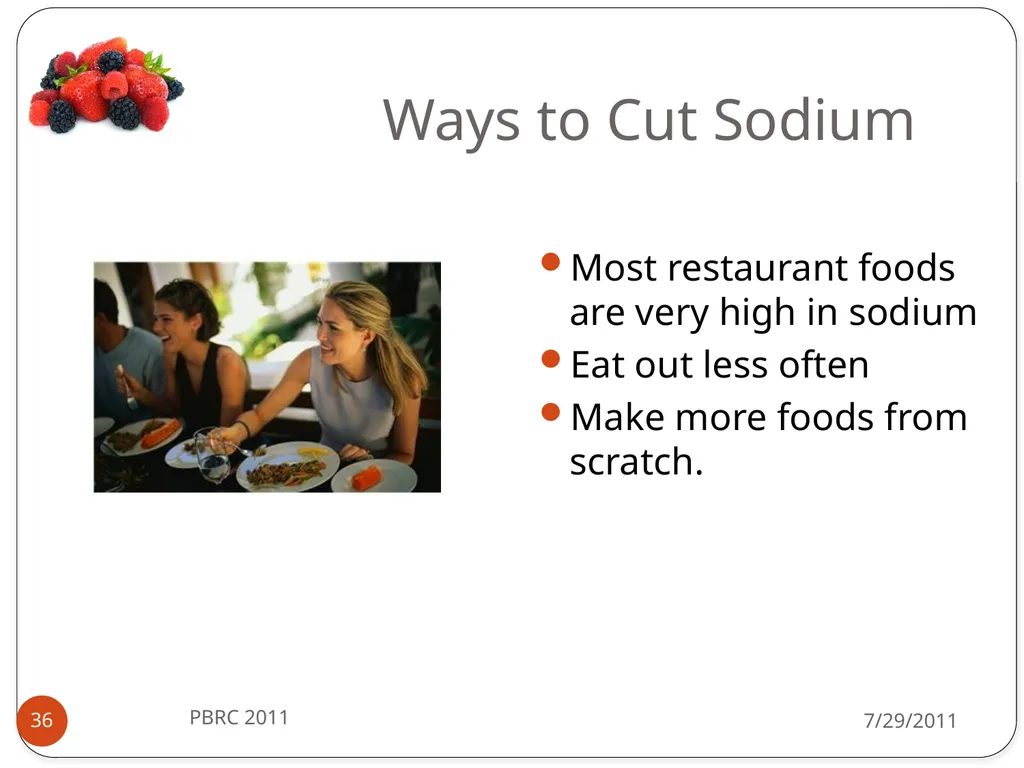
Ways to Cut Sodium Most restaurant foods are very high in sodium
Eat out less often
Make more foods from scratch. 7/29/2011 PBRC 2011 36<br>
Eat out less often
Make more foods from scratch. 7/29/2011 PBRC 2011 36<br>
37
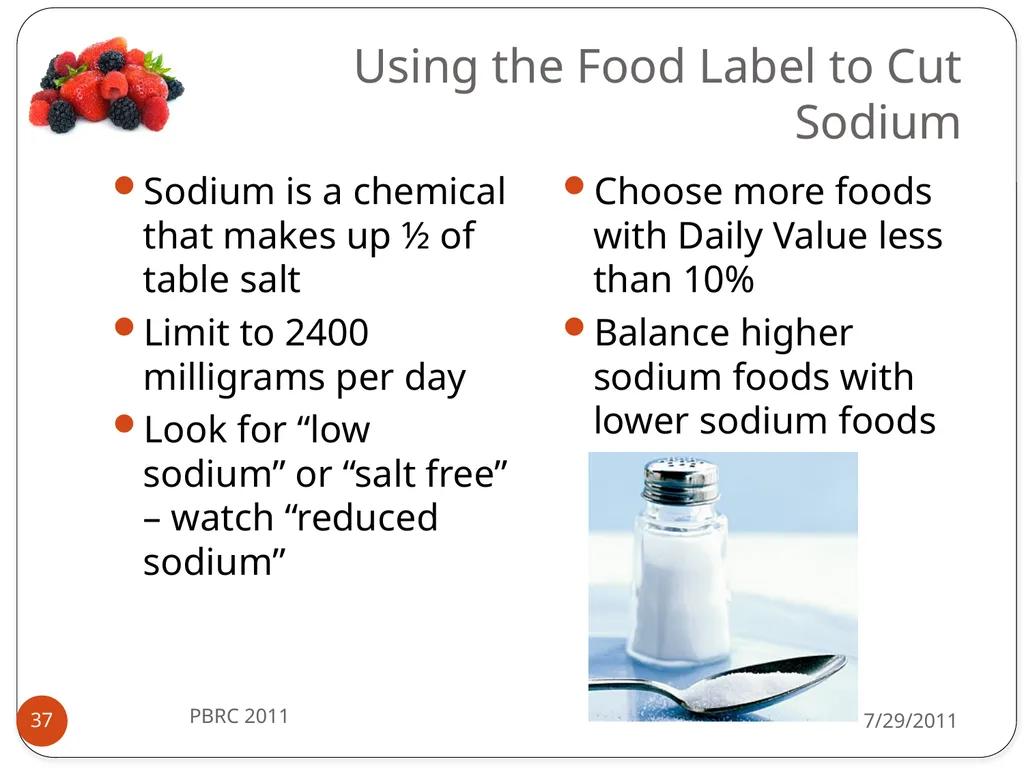
Using the Food Label to Cut Sodium Sodium is a chemical that makes up ½ of table salt
Limit to 2400 milligrams per day
Look for “low sodium” or “salt free” – watch “reduced sodium” Choose more foods with Daily Value less than 10%
Balance higher sodium foods with lower sodium foods 7/29/2011 PBRC 2011 37<br>
Limit to 2400 milligrams per day
Look for “low sodium” or “salt free” – watch “reduced sodium” Choose more foods with Daily Value less than 10%
Balance higher sodium foods with lower sodium foods 7/29/2011 PBRC 2011 37<br>
38
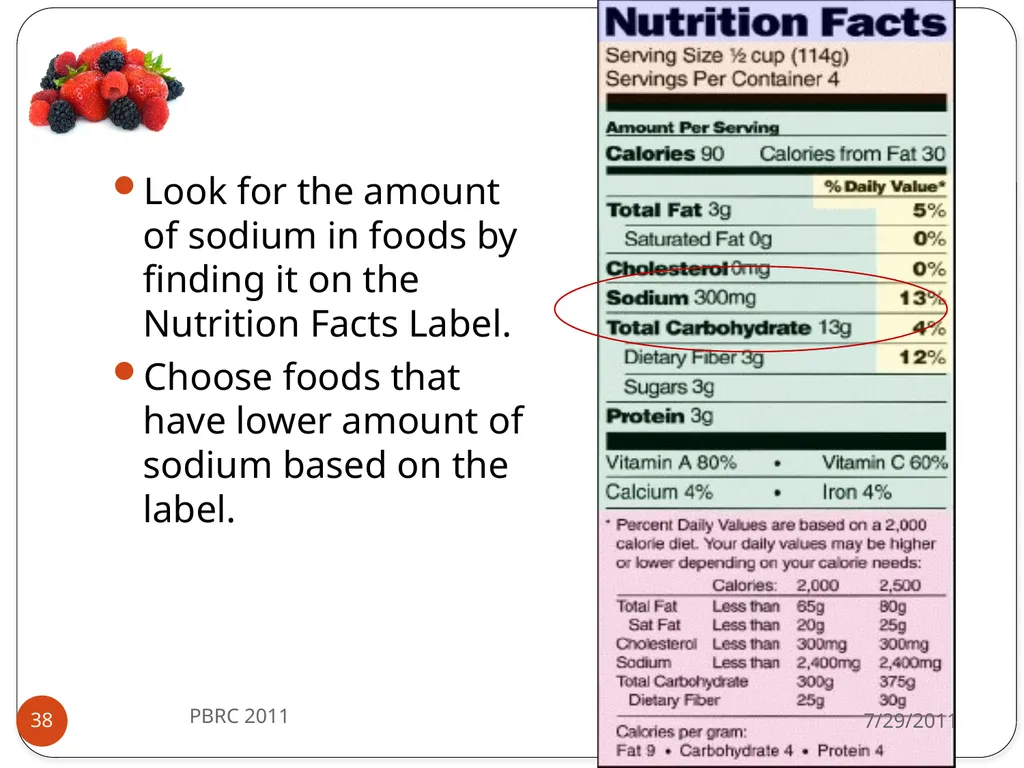
Look for the amount of sodium in foods by finding it on the Nutrition Facts Label.
Choose foods that have lower amount of sodium based on the label. 7/29/2011 PBRC 2011 38<br>
Choose foods that have lower amount of sodium based on the label. 7/29/2011 PBRC 2011 38<br>
39
Be Physically Active Helps lower blood pressure and lose/ maintain weight.
30 minutes of moderate level activity on most days of week. Can even break it up into 10 minute sessions.
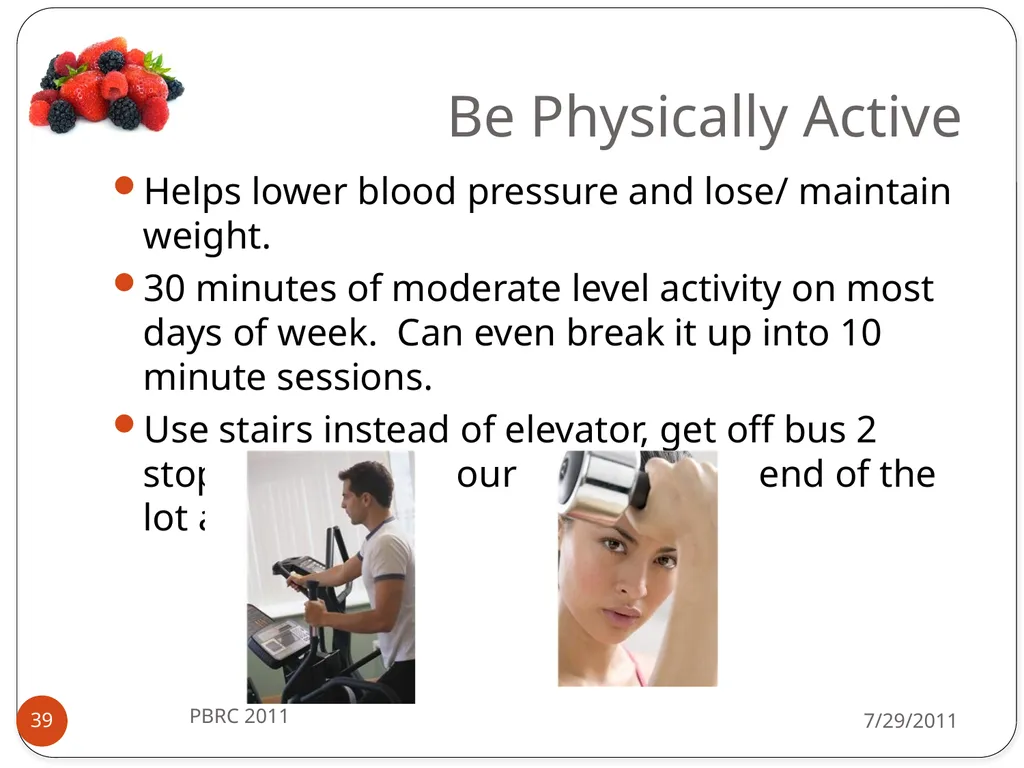
Use stairs instead of elevator, get off bus 2 stops early, Park your car at the far end of the lot and walk! 7/29/2011 PBRC 2011 39<br>
30 minutes of moderate level activity on most days of week. Can even break it up into 10 minute sessions.
Use stairs instead of elevator, get off bus 2 stops early, Park your car at the far end of the lot and walk! 7/29/2011 PBRC 2011 39<br>
40
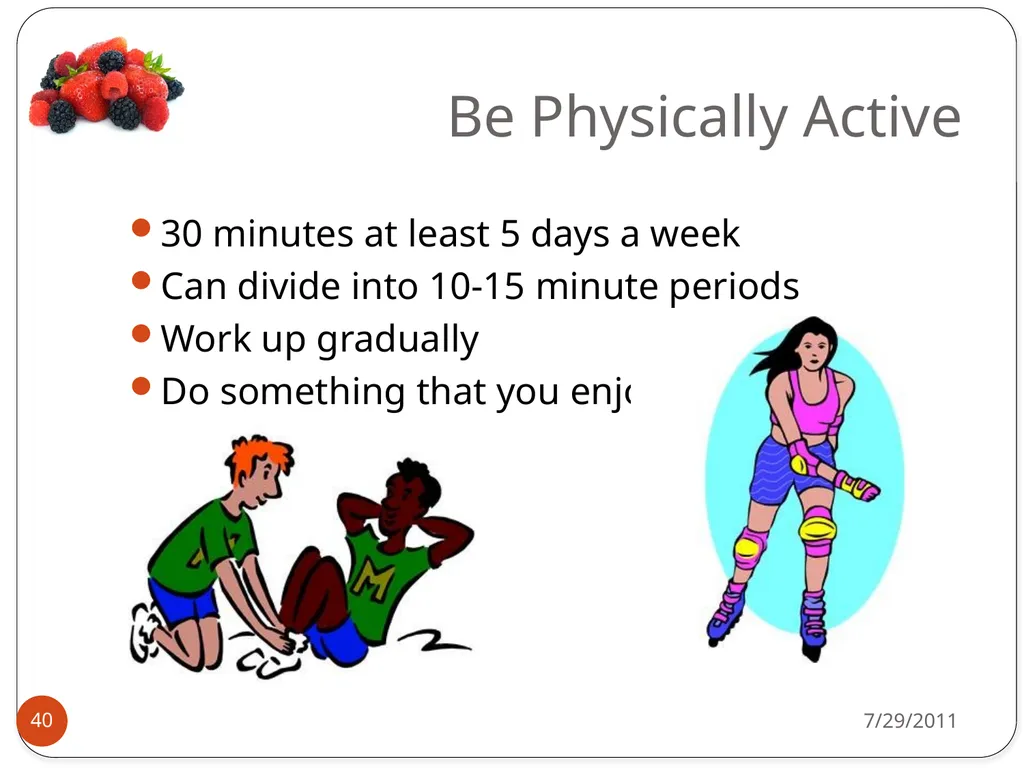
Be Physically Active 30 minutes at least 5 days a week
Can divide into 10-15 minute periods
Work up gradually
Do something that you enjoy 7/29/2011 PBRC 2011 40<br>
Can divide into 10-15 minute periods
Work up gradually
Do something that you enjoy 7/29/2011 PBRC 2011 40<br>
41
Physical Activity Guidelines
Fit into daily routine
Aim for at least 150 minutes/week of moderate aerobic exercise
Start slowly and gradually build intensity
Wear a pedometer (10,000 steps)
Take stairs, park further away or walk to another bus stop, etc. 7/29/2011 PBRC 2011 41<br>
Fit into daily routine
Aim for at least 150 minutes/week of moderate aerobic exercise
Start slowly and gradually build intensity
Wear a pedometer (10,000 steps)
Take stairs, park further away or walk to another bus stop, etc. 7/29/2011 PBRC 2011 41<br>
42
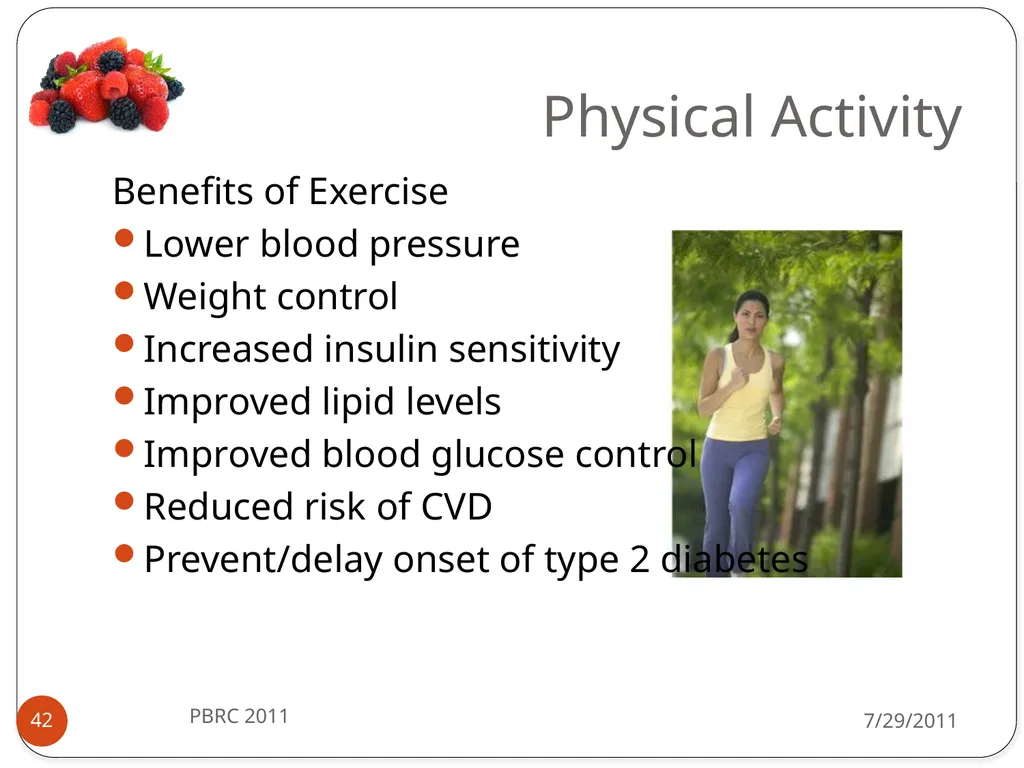
Physical Activity Benefits of Exercise
Lower blood pressure
Weight control
Increased insulin sensitivity
Improved lipid levels
Improved blood glucose control
Reduced risk of CVD
Prevent/delay onset of type 2 diabetes 7/29/2011 PBRC 2011 42<br>
Lower blood pressure
Weight control
Increased insulin sensitivity
Improved lipid levels
Improved blood glucose control
Reduced risk of CVD
Prevent/delay onset of type 2 diabetes 7/29/2011 PBRC 2011 42<br>
43
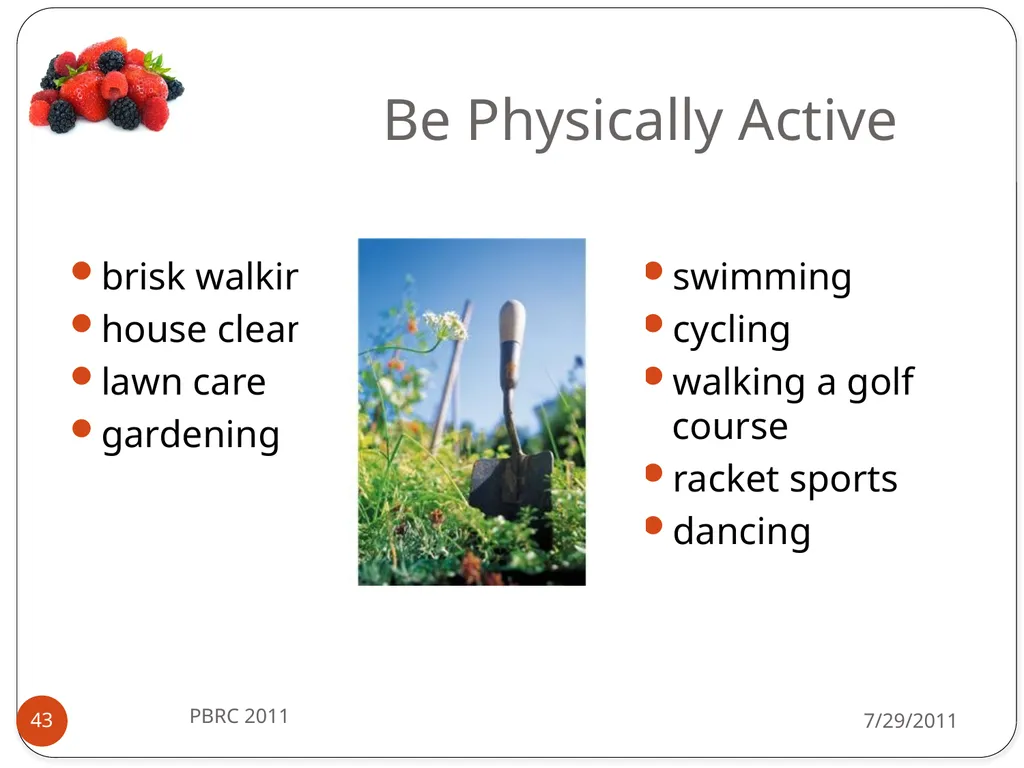
Be Physically Active brisk walking
house cleaning
lawn care
gardening swimming
cycling
walking a golf course
racket sports
dancing 7/29/2011 PBRC 2011 43<br>
house cleaning
lawn care
gardening swimming
cycling
walking a golf course
racket sports
dancing 7/29/2011 PBRC 2011 43<br>
44
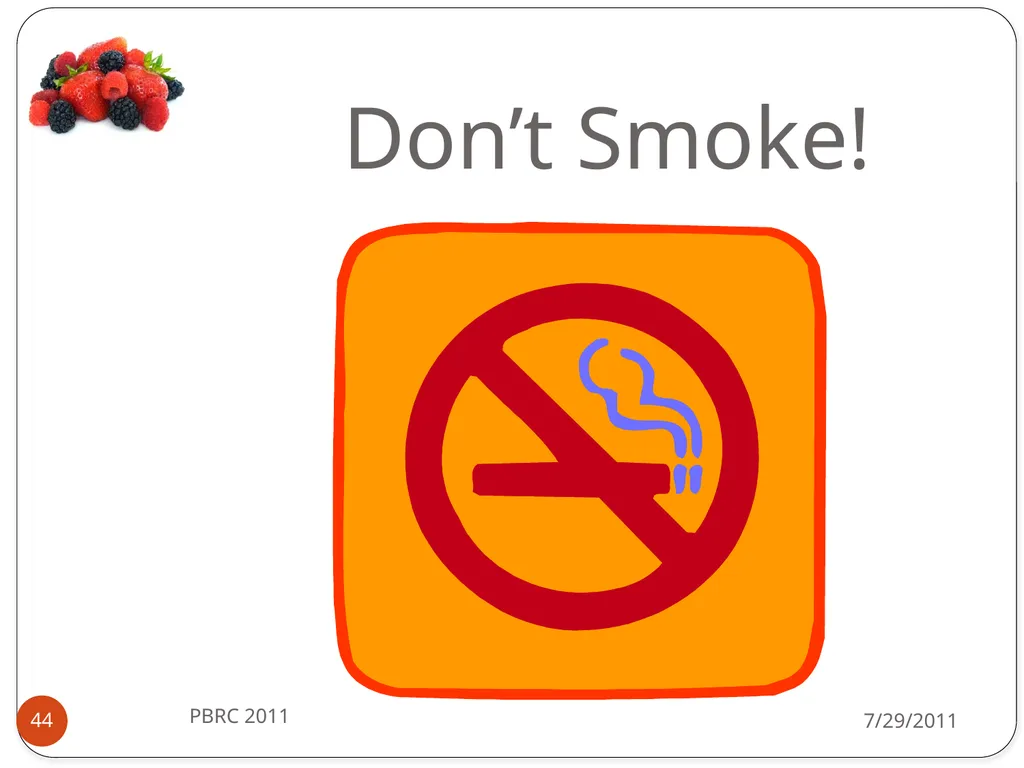
Don’t Smoke! 7/29/2011 PBRC 2011 44<br>
45
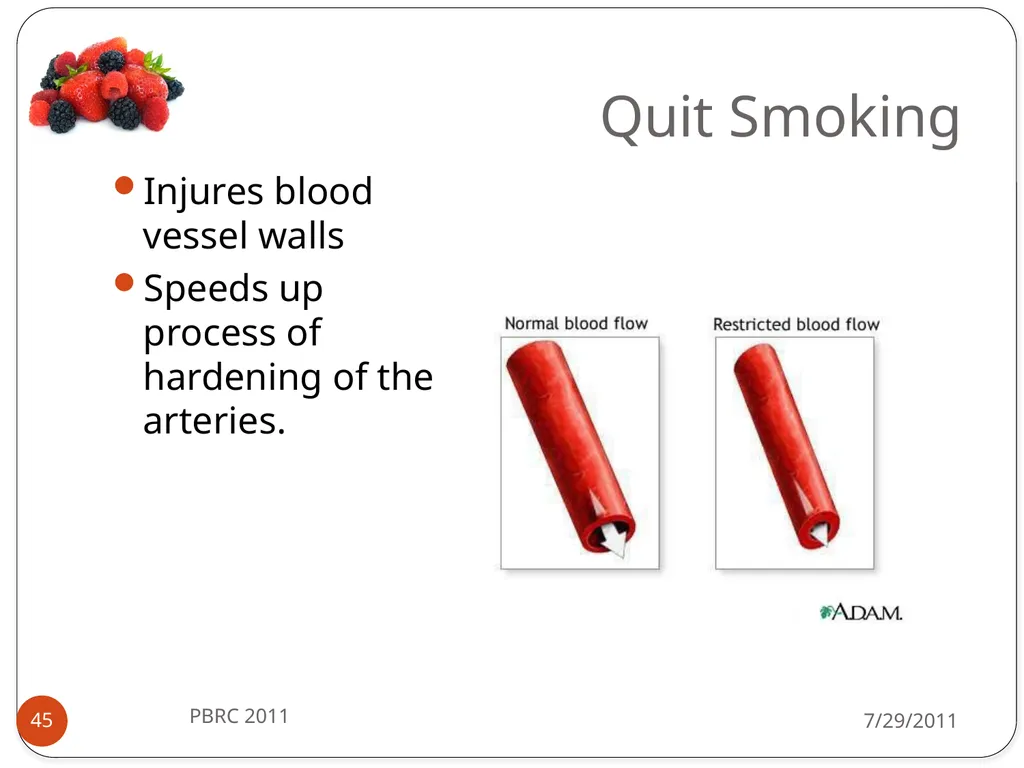
Quit Smoking Injures blood vessel walls
Speeds up process of hardening of the arteries. 7/29/2011 PBRC 2011 45<br>
Speeds up process of hardening of the arteries. 7/29/2011 PBRC 2011 45<br>
46
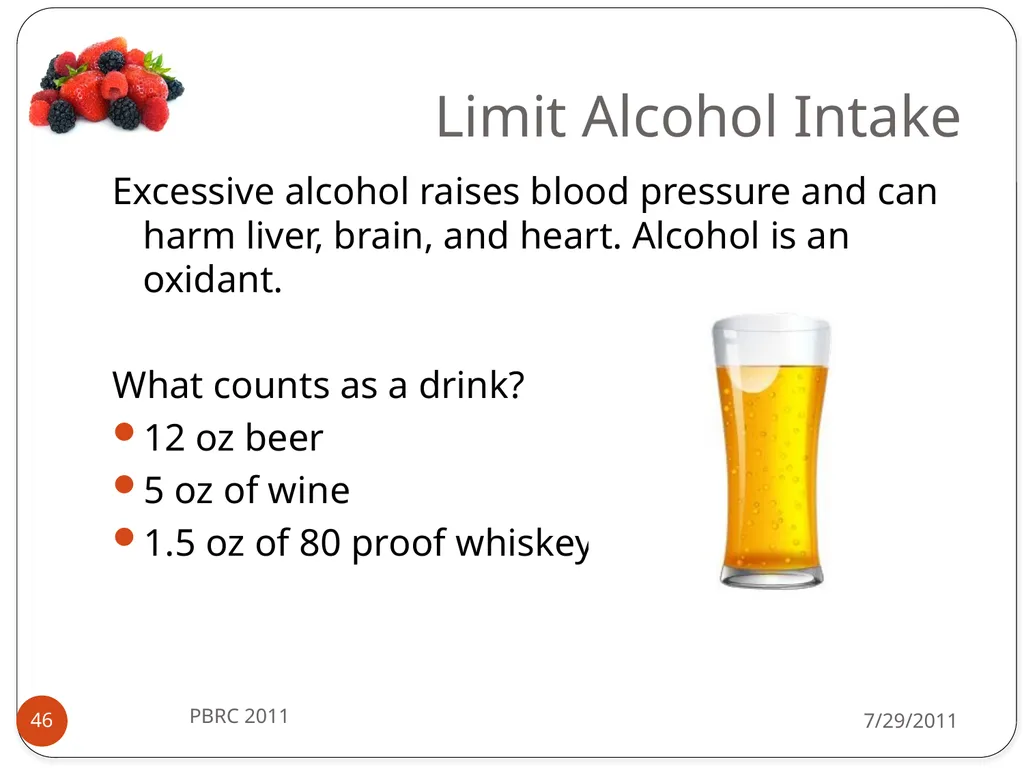
Limit Alcohol Intake Excessive alcohol raises blood pressure and can harm liver, brain, and heart. Alcohol is an oxidant.
What counts as a drink?
12 oz beer
5 oz of wine
1.5 oz of 80 proof whiskey 7/29/2011 PBRC 2011 46<br>
What counts as a drink?
12 oz beer
5 oz of wine
1.5 oz of 80 proof whiskey 7/29/2011 PBRC 2011 46<br>
47
Try to - Follow a healthy eating pattern.
Be Active
Not Smoke
Control Your Weight
Take Your Medicine 7/29/2011 PBRC 2011 47<br>
Be Active
Not Smoke
Control Your Weight
Take Your Medicine 7/29/2011 PBRC 2011 47<br>
48
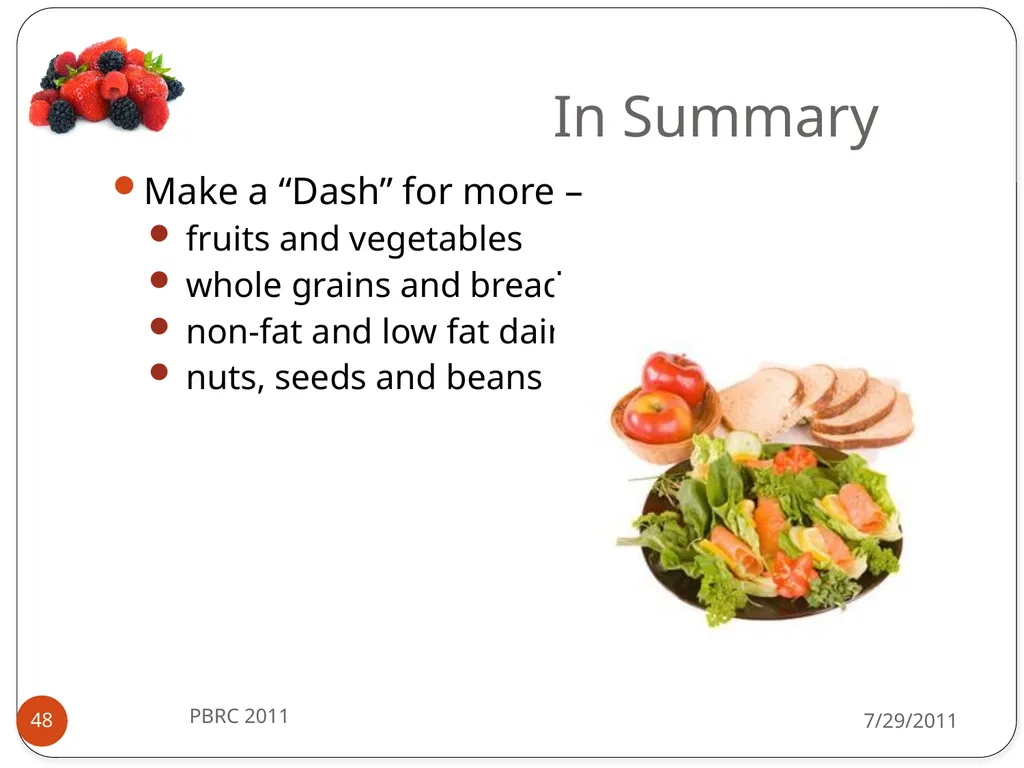
In Summary Make a “Dash” for more –
fruits and vegetables
whole grains and breads
non-fat and low fat dairy foods
nuts, seeds and beans 7/29/2011 PBRC 2011 48<br>
fruits and vegetables
whole grains and breads
non-fat and low fat dairy foods
nuts, seeds and beans 7/29/2011 PBRC 2011 48<br>
49
Conclusion Hypertension is a very controllable disease, with drastic consequences if left uncontrolled.
Hypertension can be treated by diet and lifestyle measures that are as, or more effective than medication. 7/29/2011 PBRC 2011 49<br>
Hypertension can be treated by diet and lifestyle measures that are as, or more effective than medication. 7/29/2011 PBRC 2011 49<br>
50
Resources www.nhlbi.nih.gov
http://www.nhlbi.nih.gov/health/public/heart/hbp/dash/new_dash.pdf
http://emall.nhlbihin.net/hbpSubLink.asp?p=2&h=3&g=27&r=1
http://dashdiet.org 7/29/2011 PBRC 2011 50<br>
http://www.nhlbi.nih.gov/health/public/heart/hbp/dash/new_dash.pdf
http://emall.nhlbihin.net/hbpSubLink.asp?p=2&h=3&g=27&r=1
http://dashdiet.org 7/29/2011 PBRC 2011 50<br>