Henry Swales Ole Kils THE AQUANTIS OCEAN-CURRENT TURBINE RENEWABLE ENERGY FROM MARINE CURRENTS Passive Depth Control Pitch Stability April 4th, 2013 Company Confidential and Proprietary DCAB Analysis 3212013 Indicates higher than
"Henry Swales Ole Kils THE AQUANTIS OCEAN-CURRENT" is the property of its rightful owner. Permission is granted to
download and print the materials on this website for personal, non-commercial use only, and to display it
on your personal computer provided you do not modify the materials and that you retain all copyright
notices contained in the materials. By downloading content from our website, you accept the terms of this
agreement.
Presentation Transcript
01
Henry Swales
Ole Kils THE AQUANTIS OCEAN-CURRENT TURBINE
RENEWABLE ENERGY FROM MARINE CURRENTS
Passive Depth Control & Pitch Stability
April 4th, 2013 Company Confidential and Proprietary<br>
02
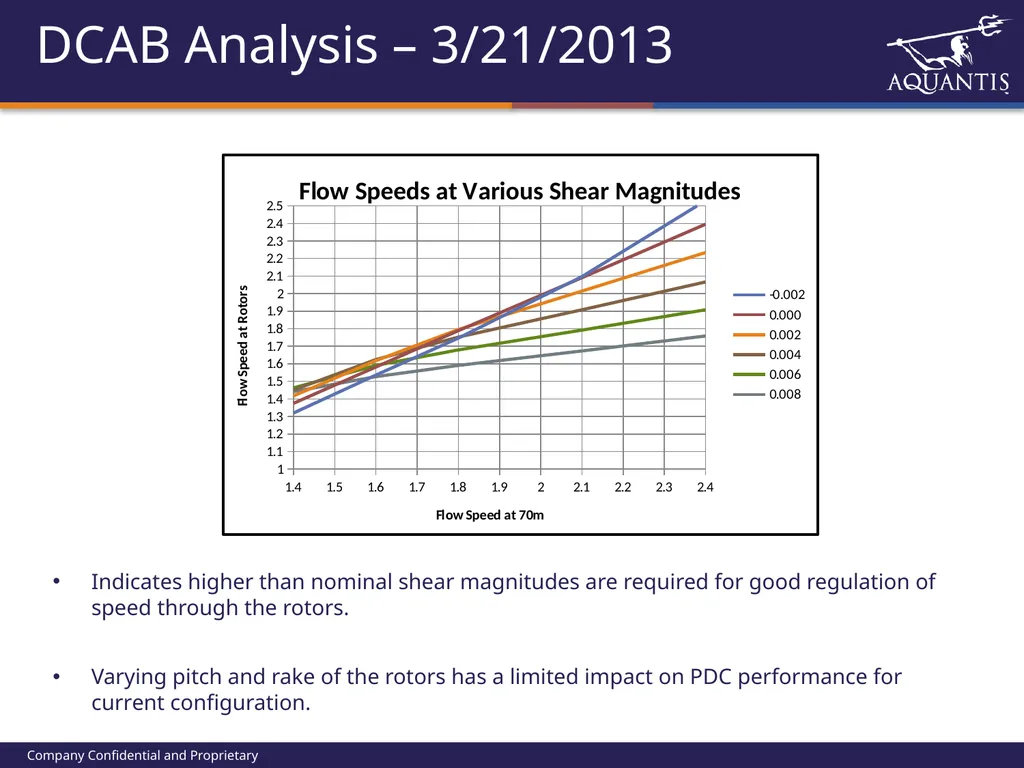
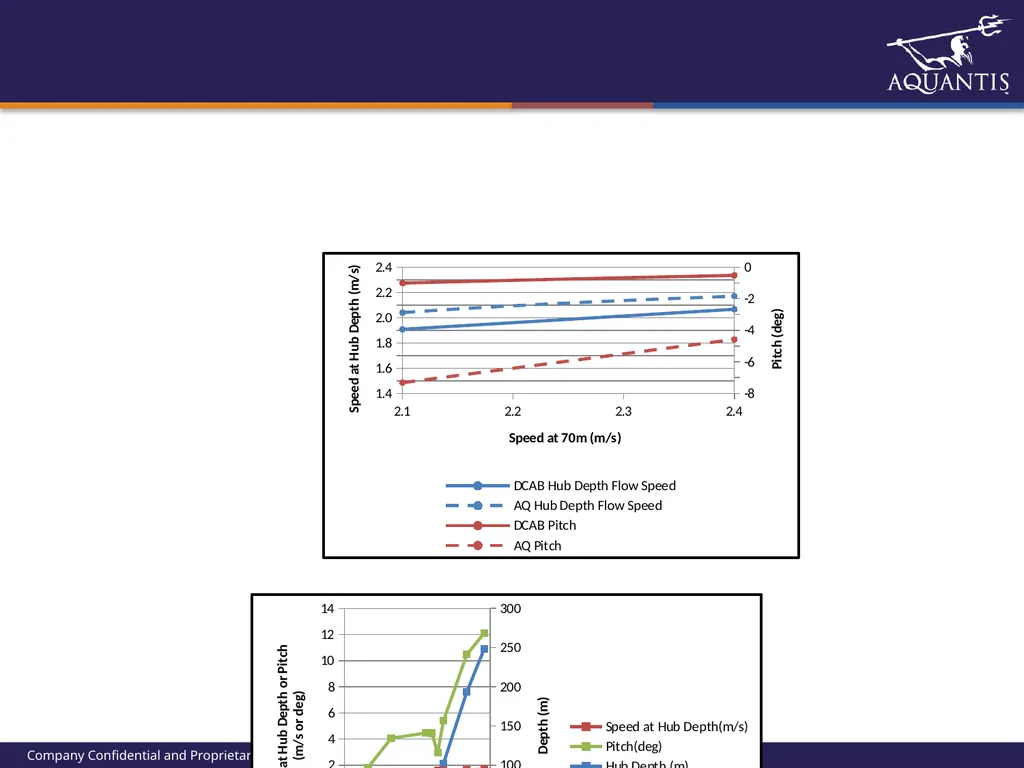
DCAB Analysis – 3/21/2013 Indicates higher than nominal shear magnitudes are required for good regulation of speed through the rotors.
Varying pitch and rake of the rotors has a limited impact on PDC performance for current configuration.<br>
03
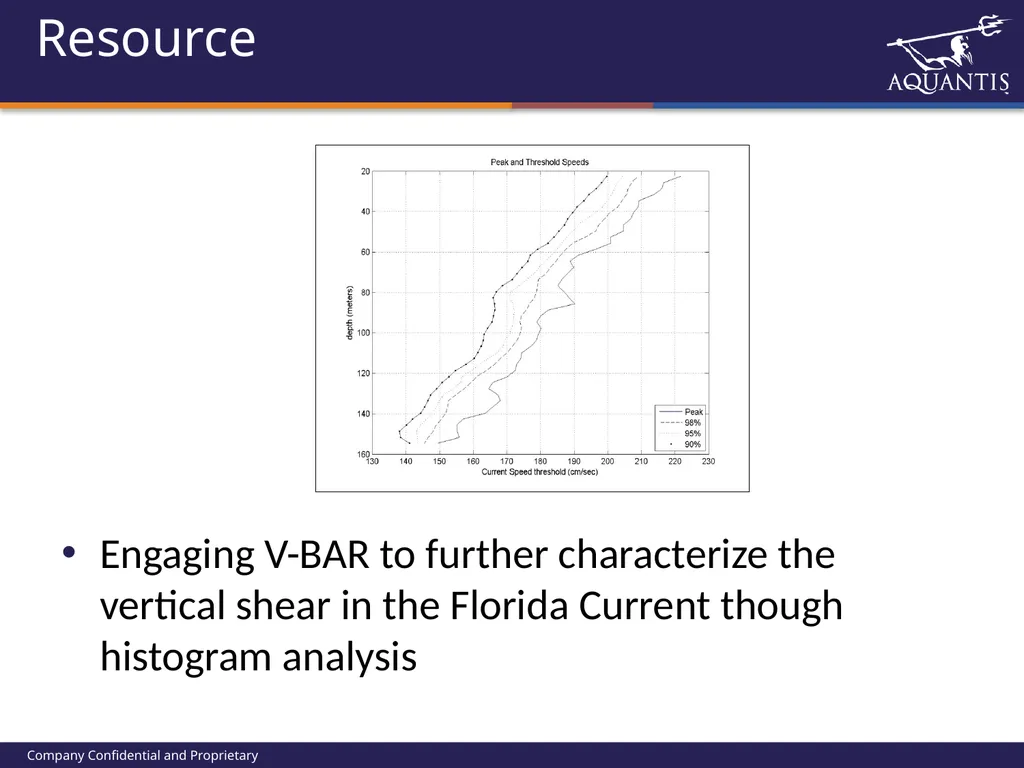
Engaging V-BAR to further characterize the vertical shear in the Florida Current though histogram analysis Resource<br>
04
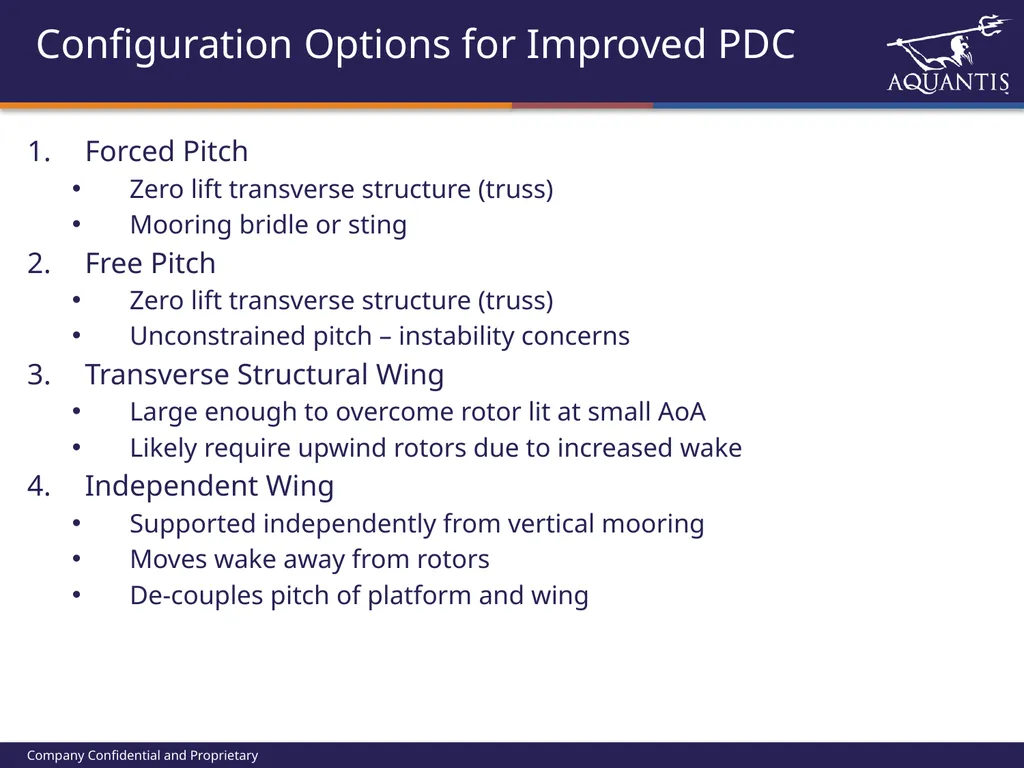
Configuration Options for Improved PDC Forced Pitch
Zero lift transverse structure (truss)
Mooring bridle or sting
Free Pitch
Zero lift transverse structure (truss)
Unconstrained pitch – instability concerns
Transverse Structural Wing
Large enough to overcome rotor lit at small AoA
Likely require upwind rotors due to increased wake
Independent Wing
Supported independently from vertical mooring
Moves wake away from rotors
De-couples pitch of platform and wing<br>
05
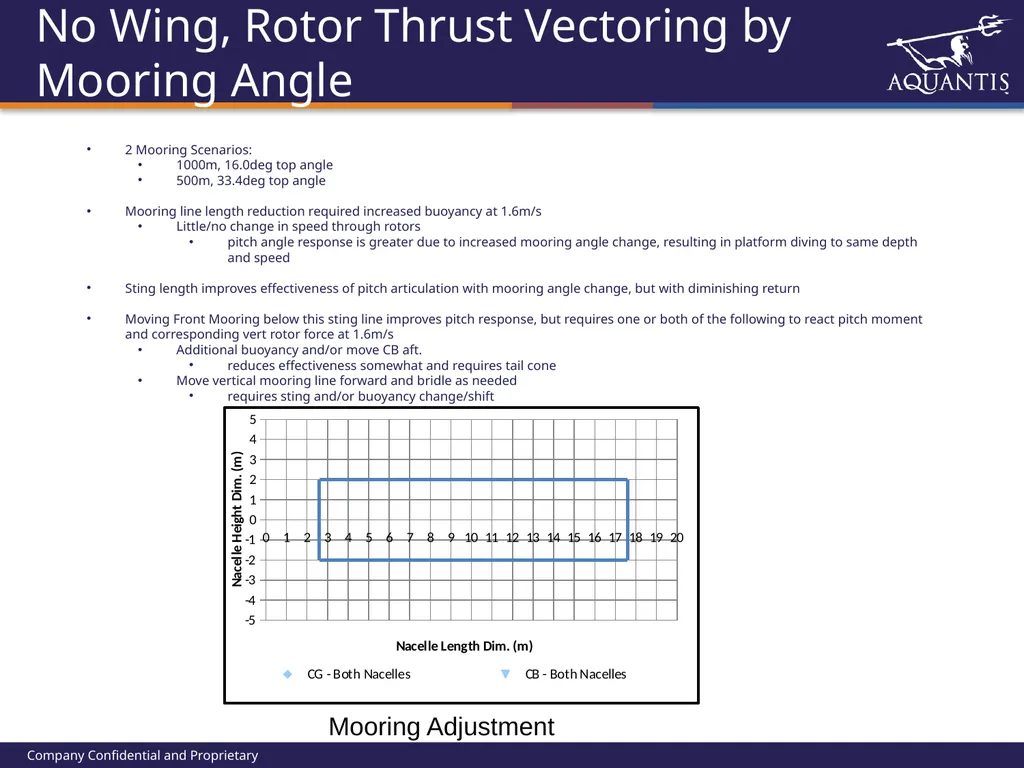
No Wing, Rotor Thrust Vectoring by Mooring Angle 2 Mooring Scenarios:
1000m, 16.0deg top angle
500m, 33.4deg top angle
Mooring line length reduction required increased buoyancy at 1.6m/s
Little/no change in speed through rotors
pitch angle response is greater due to increased mooring angle change, resulting in platform diving to same depth and speed
Sting length improves effectiveness of pitch articulation with mooring angle change, but with diminishing return
Moving Front Mooring below this sting line improves pitch response, but requires one or both of the following to react pitch moment and corresponding vert rotor force at 1.6m/s
Additional buoyancy and/or move CB aft.
reduces effectiveness somewhat and requires tail cone
Move vertical mooring line forward and bridle as needed
requires sting and/or buoyancy change/shift Mooring Adjustment<br>
06
Bridled Front Mooring By vertically bridling the front mooring line and fixing platform pitch to mooring line angle, the rotor thrust vectoring counters the changing direction of the mooring line tension.
Equivalent to very long sting
Requires very still mooring bridle
Engaging PCCI to investigate feasibility bridled moorings
Stability, creep, redundancy, etc.<br>
07
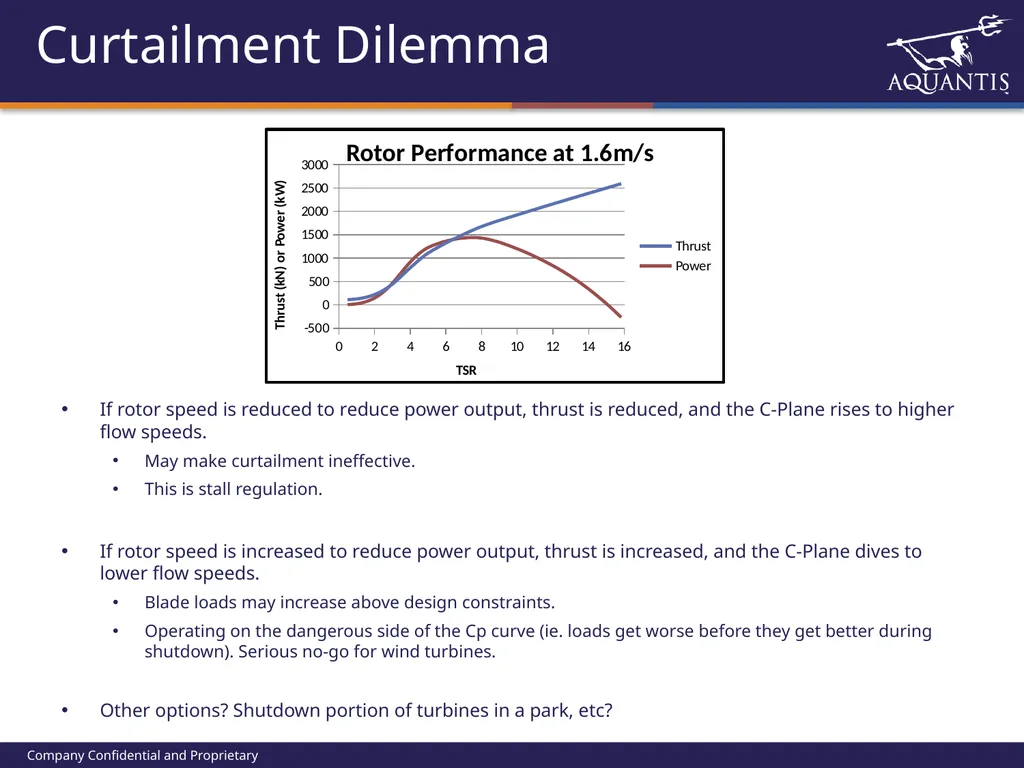
Curtailment Dilemma If rotor speed is reduced to reduce power output, thrust is reduced, and the C-Plane rises to higher flow speeds.
May make curtailment ineffective.
This is stall regulation.
If rotor speed is increased to reduce power output, thrust is increased, and the C-Plane dives to lower flow speeds.
Blade loads may increase above design constraints.
Operating on the dangerous side of the Cp curve (ie. loads get worse before they get better during shutdown). Serious no-go for wind turbines.
Other options? Shutdown portion of turbines in a park, etc?<br>