Heraclitus Parmenides Heraclitus task Unity of opposites Ethical implications Parmenides: thinking nothing Way of Truth: 2 premises Heraclitus Task At the level of relativism and flux, we each have a private understanding But we
"Heraclitus & Parmenides Heraclitus’ task Unity of" is the property of its rightful owner. Permission is granted to
download and print the materials on this website for personal, non-commercial use only, and to display it
on your personal computer provided you do not modify the materials and that you retain all copyright
notices contained in the materials. By downloading content from our website, you accept the terms of this
agreement.
Presentation Transcript
01
Heraclitus & Parmenides Heraclitus’ task
Unity of opposites
Ethical implications
Parmenides: thinking nothing
Way of Truth: 2 premises<br>
02
Heraclitus’ Task At the level of relativism and flux, we each have a private understanding
But we shouldn’t live like this
Because there is a shared logos common to all (a shared metaphysical space and a shared epistemological understanding)
Heraclitus’ task is to get us to this deeper level<br>
03
Heraclitus’ Task Questioning language:
We need language to overcome relativism and constant flux
Language maps out boundaries of sameness and difference
It may not describe what is there (i.e. it may not map onto the cosmos), but we need it
One of the ways we progress is by paying attention to language and using it more precisely (cf. use of paradoxes)<br>
04
Heraclitus’ Task Rational fire:
Stoic interpretation (3rd century BC)
Our human reason is a little spark of the cosmic logos
We therefore have some connection (though not a perfection connection) with the cosmic logos
The cosmos can only be known at a divine level<br>
05
Cosmic Vision Only For God “to God all things are fair and just but men have supposed some things to be unjust and others just.” [B 102]
“God is day and dusk, winter and summer, war and peace, satiety and famine (all the contraries – that is his meaning)” [B 67]<br>
06
Unity of Opposites “You should know that war is comprehensive, that justice is strife, that all things come about in accordance with strife and with what must be.” [B 80]
“They do not comprehend how, in differing, it [the cosmos] agrees with itself – a back-turning harmony, like that of a bow and a lyre.” [B 51]
“Nature likes to hide itself” [B 123]<br>
07
Unity of Opposites The diversity in the world comes from one thing: Logos
The Logos itself is constituted by this diversity
There is a stable unity, but even though we have stability, there is always movement. Unity is maintained by opposites in tension with each other<br>
08
Explaining Evil in the World (Early Christianity) “to God all things are fair and just but men have supposed some things to be unjust and others just.” [B 102]
“Combinations – wholes and not wholes, concurring differing, concordant discordant, from all things one and from one all things.” [B 10]<br>
09
Conclusion World of flux and relativism is only part of the story
We need to search within ourselves to uncover the spark of divine fire
Fire as energy is what matters most for Heraclitus
The paradox form reflects how Heraclitus sees the cosmos
Paradoxes enable Heraclitus to speak, but not as an authority<br>
10
Ethical Implications “The sun is new each day.” [B 6]
“If you do not expect the unexpected you will not discover it; for it is hard to track down and difficult to approach.” [B 18]<br>
11
Parmenides<br>
12
Nothing exists<br>
13
Nothing exists
Nothing does not exist<br>
14
“You must learn all things, both the unwavering heart of persuasive truth and the opinions of mortals in which there is no true warranty.” (B 1)
“But nevertheless you will learn these things too – how what they believe would really have to be, forever traversing everything.” (B 1)<br>
15
“But come, I will tell you – preserve the account when you hear it - the only roads of enquiry there are to think of one, that it is and that it cannot not be, is the path of persuasion (for truth accompanies it) another, that it is not and that it must not be - this I say to you is a trail of utter ignorance.” (B 2.1-6)
“For you could not recognise that which is not (for that is not to be done), nor could you mention it,” (B 2.7-8)<br>
16
“Thus it must either altogether be or not be.”
“Decision in these matters lies in this: it is or it is not.” (B 8)<br>
17
Two Premises You think
“it is or it is not”
Putting them together:
You think being or you think nothing<br>
18
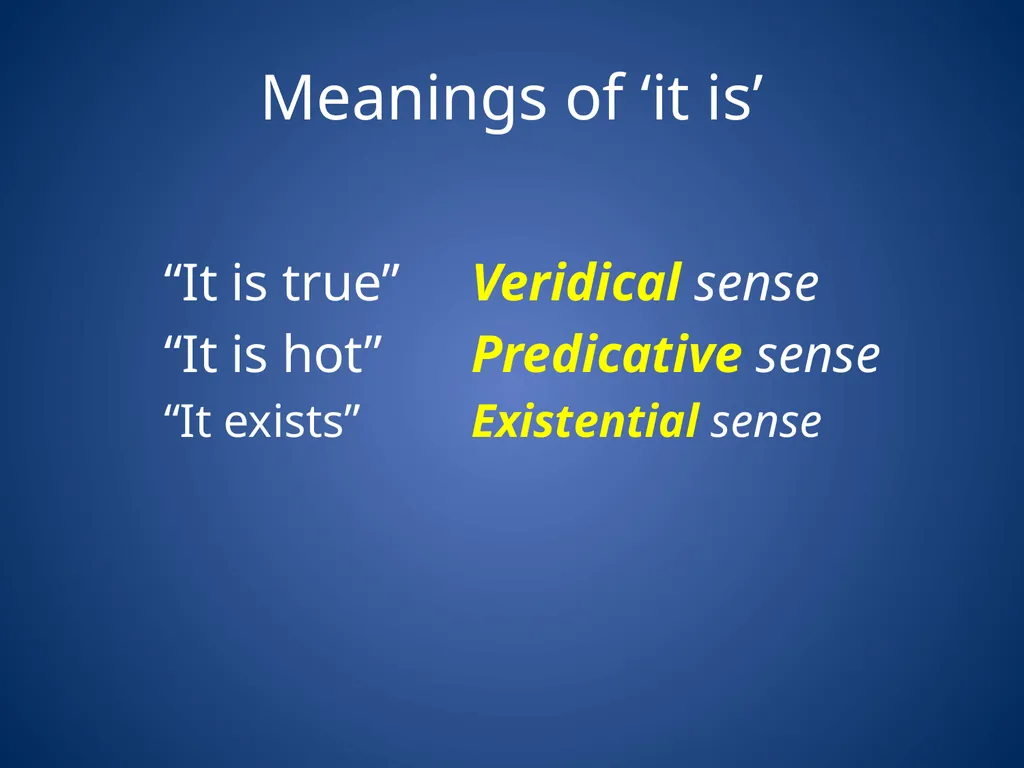
Meanings of ‘it is’ “It is true” Veridical sense
“It is hot” Predicative sense
“It exists” Existential sense<br>
19
Parmenides had already touched on this doctrine inasmuch as he identified being and thought and did not locate being in sensible objects. He said:
“…for the same things can be thought of and can be.” (B 3)<br>
20
Parmenides had already touched on this doctrine inasmuch as he identified being and thought and did not locate being in sensible objects. He said:
“…for the same things can be thought of and can be.” (B 3)
“the same things exist in thinking and being.” (literal translation)<br>
21
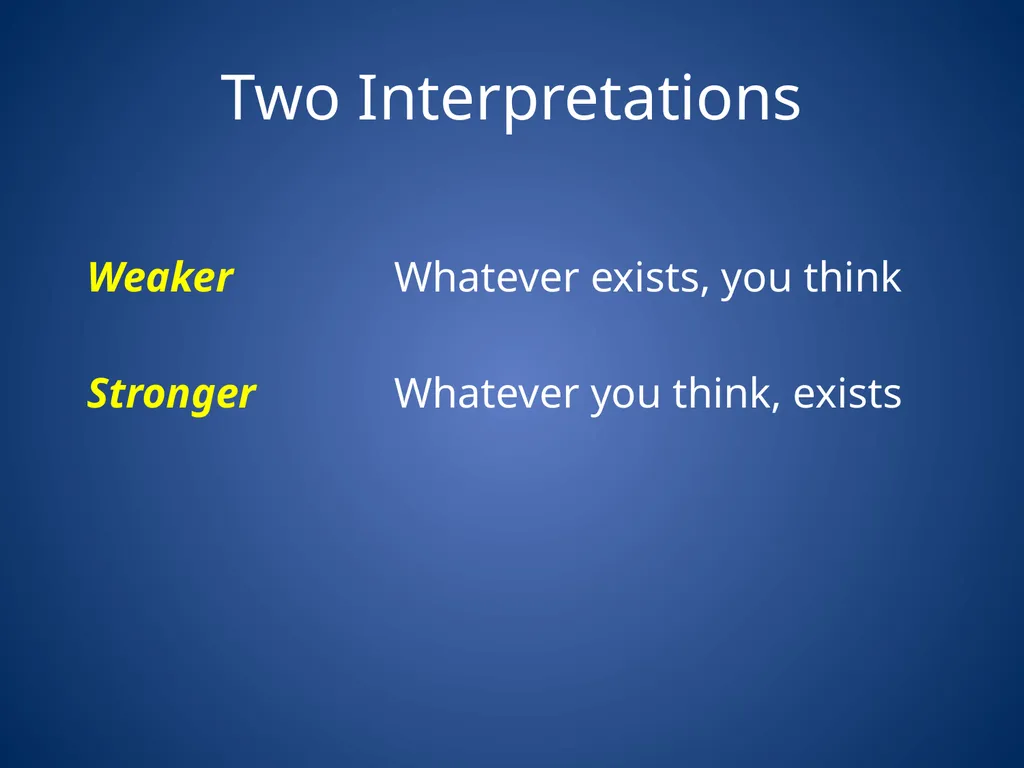
Two Interpretations Weaker Whatever exists, you think
Stronger Whatever you think, exists<br>
22
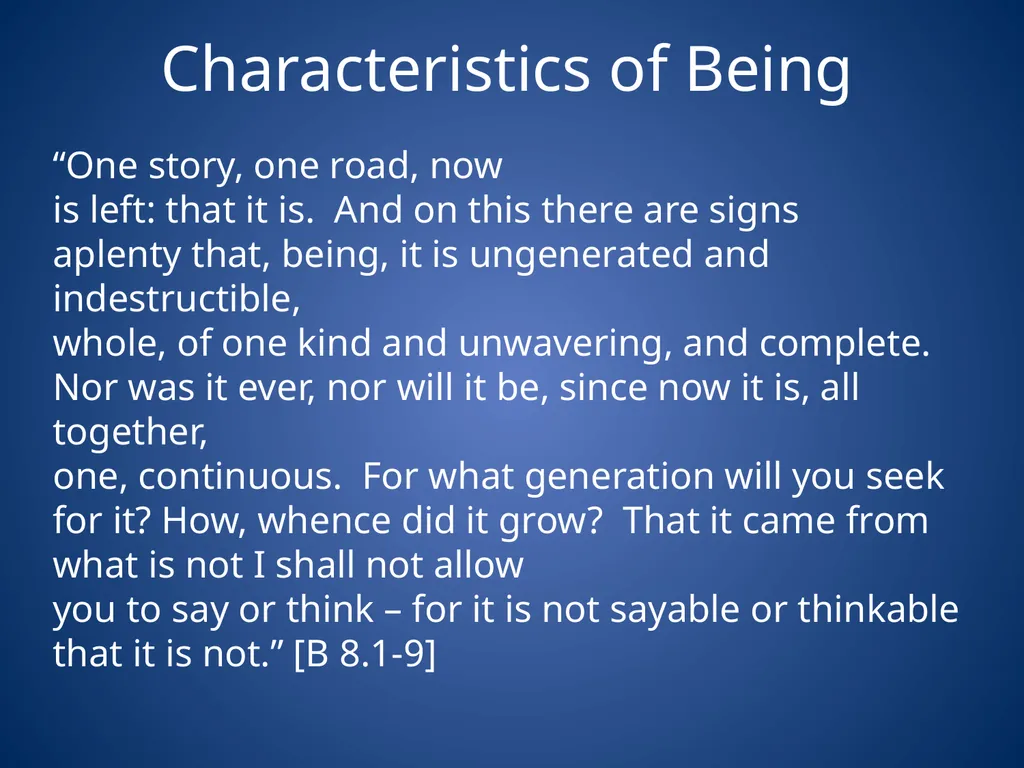
Characteristics of Being “One story, one road, now is left: that it is. And on this there are signs aplenty that, being, it is ungenerated and indestructible, whole, of one kind and unwavering, and complete. Nor was it ever, nor will it be, since now it is, all together, one, continuous. For what generation will you seek for it? How, whence did it grow? That it came from what is not I shall not allow you to say or think – for it is not sayable or thinkable that it is not.” [B 8.1-9]<br>
23
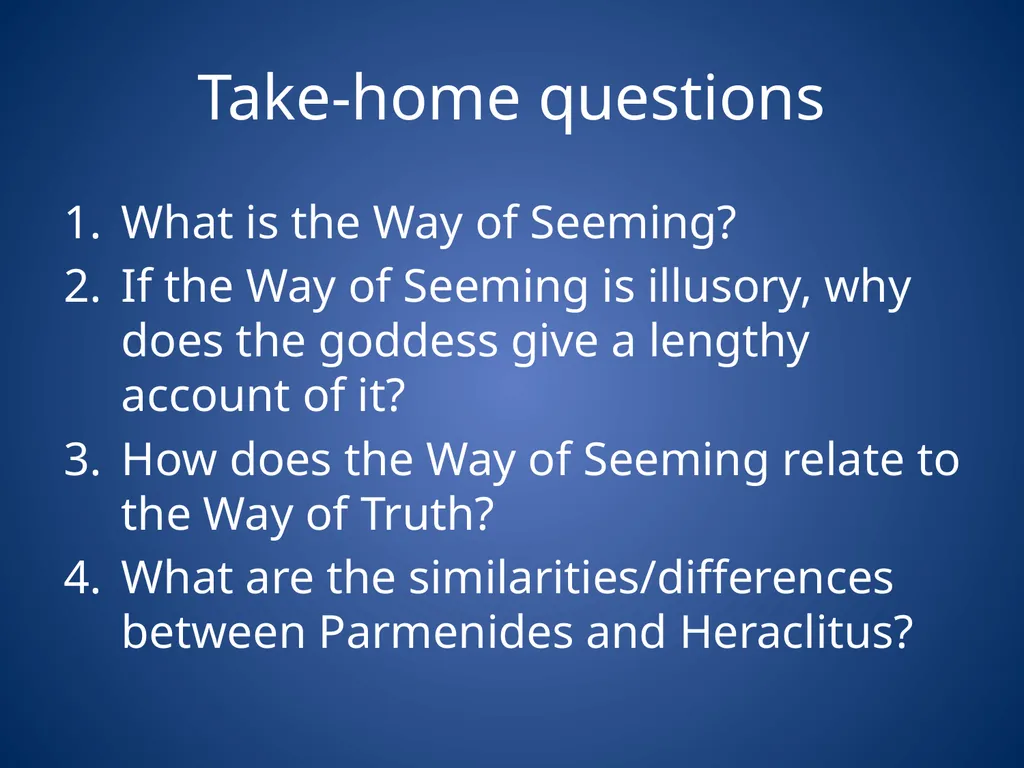
Take-home questions What is the Way of Seeming?
If the Way of Seeming is illusory, why does the goddess give a lengthy account of it?
How does the Way of Seeming relate to the Way of Truth?
What are the similarities/differences between Parmenides and Heraclitus?<br>