
Heterogeneous community Research computing at CSU
Description: Heterogeneous community Research computing at CSU There is HPC Activities in all 8 colleges Computing being done by Professional staff as well as grad students post-docs Users need fast processing, or large memory, or large disk (or 2 out
Related Topics
Download Presentation
"Heterogeneous community Research computing at CSU" is the property of its rightful owner. Permission is granted to download and print the materials on this website for personal, non-commercial use only, and to display it on your personal computer provided you do not modify the materials and that you retain all copyright notices contained in the materials. By downloading content from our website, you accept the terms of this agreement.
Presentation Transcript
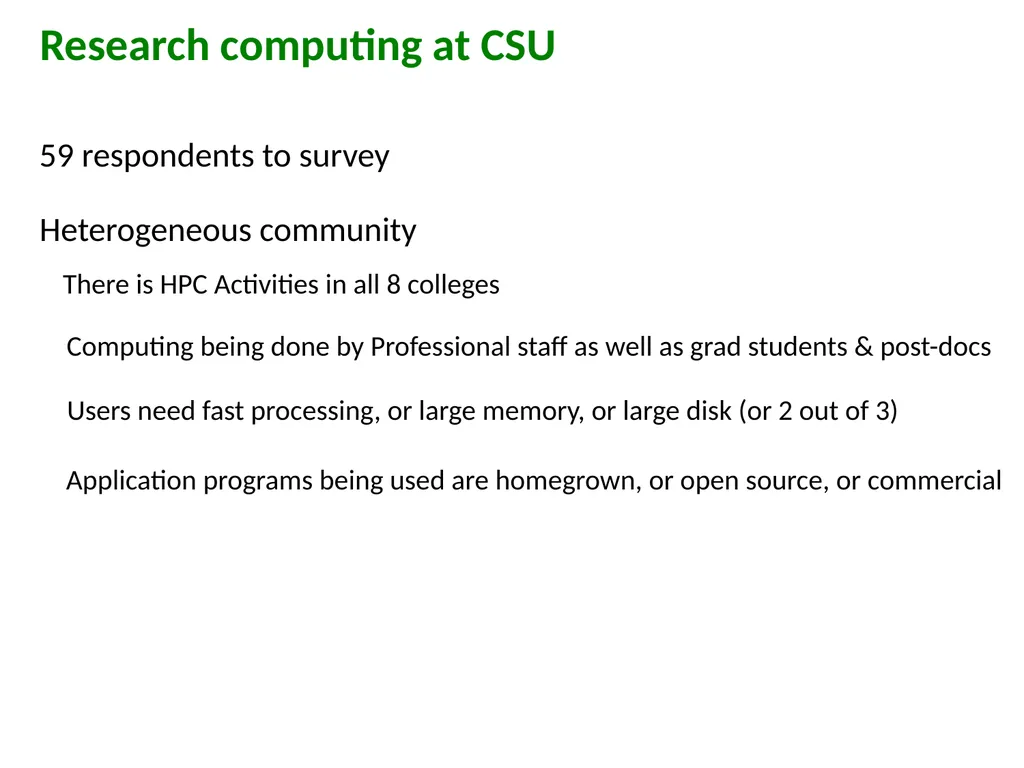
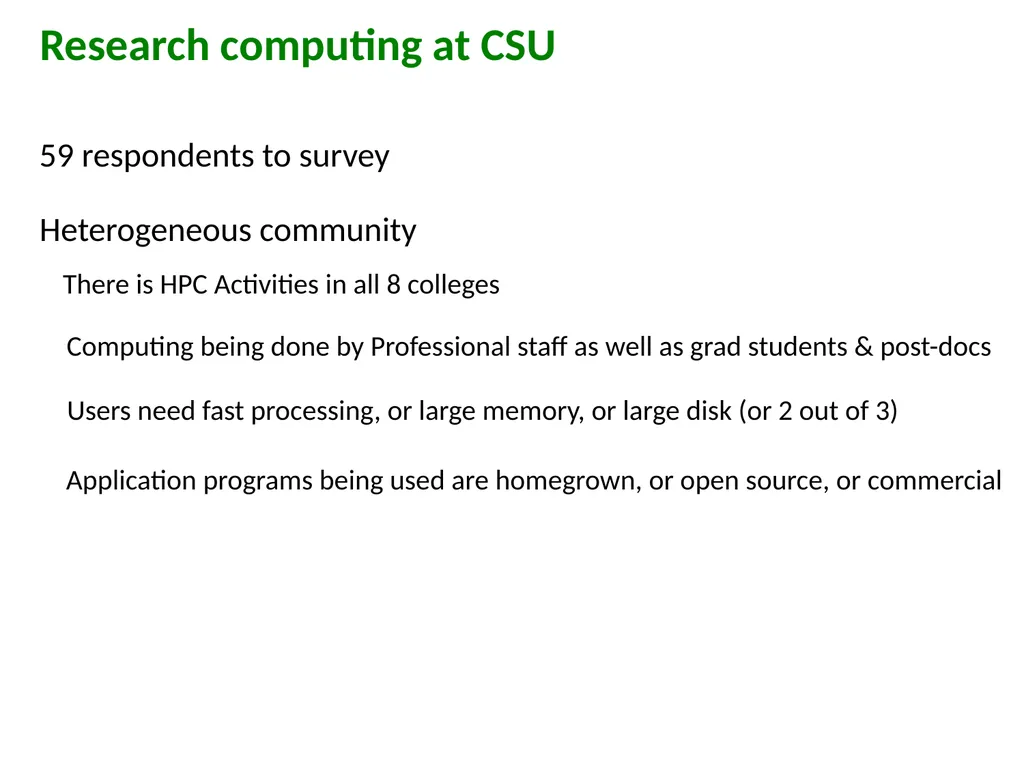
slide1. Heterogeneous community Research computing at CSU There is HPC Activities in all 8 colleges Computing being done by Professional staff as well as grad students & post-docs Users need fast processing, or large memory, or large disk (or 2 out of 3) Application programs being used are homegrown, or open source, or commercial 59 respondents to survey<br>
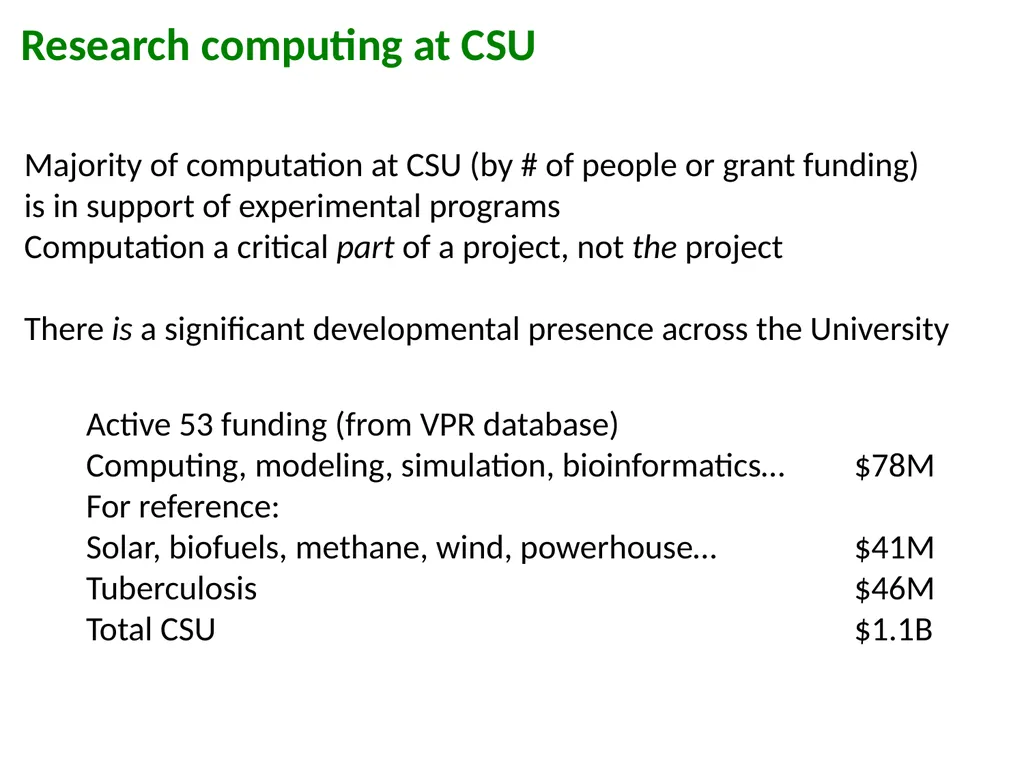
slide2. Majority of computation at CSU (by # of people or grant funding)
is in support of experimental programs
Computation a critical part of a project, not the project
There is a significant developmental presence across the University Research computing at CSU Active 53 funding (from VPR database)
Computing, modeling, simulation, bioinformatics… $78M
For reference:
Solar, biofuels, methane, wind, powerhouse… $41M
Tuberculosis $46M
Total CSU $1.1B<br>
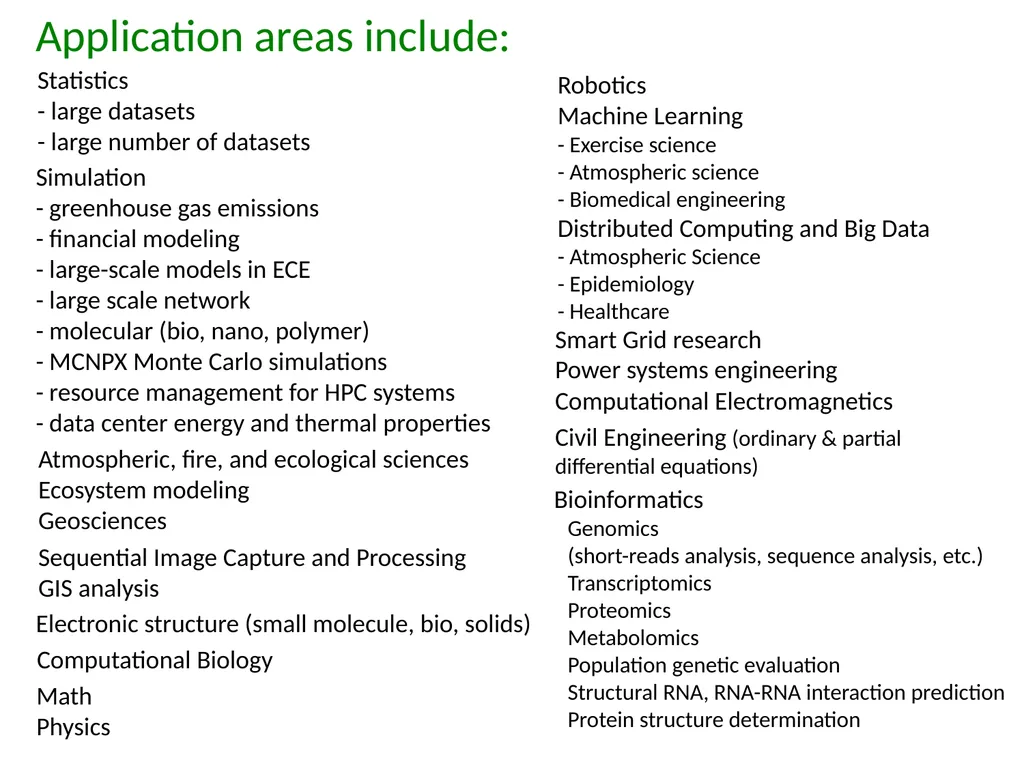
slide3. Application areas include: Atmospheric, fire, and ecological sciences
Ecosystem modeling
Geosciences Robotics
Machine Learning
- Exercise science
- Atmospheric science
- Biomedical engineering
Distributed Computing and Big Data
- Atmospheric Science
- Epidemiology
- Healthcare Civil Engineering (ordinary & partial differential equations) Simulation
- greenhouse gas emissions
- financial modeling
- large-scale models in ECE
- large scale network
- molecular (bio, nano, polymer)
- MCNPX Monte Carlo simulations
- resource management for HPC systems
- data center energy and thermal properties Statistics
- large datasets
- large number of datasets Smart Grid research
Power systems engineering
Computational Electromagnetics Electronic structure (small molecule, bio, solids) Sequential Image Capture and Processing
GIS analysis Bioinformatics Math
Physics Computational Biology Genomics
(short-reads analysis, sequence analysis, etc.)
Transcriptomics
Proteomics
Metabolomics
Population genetic evaluation
Structural RNA, RNA-RNA interaction prediction
Protein structure determination<br>
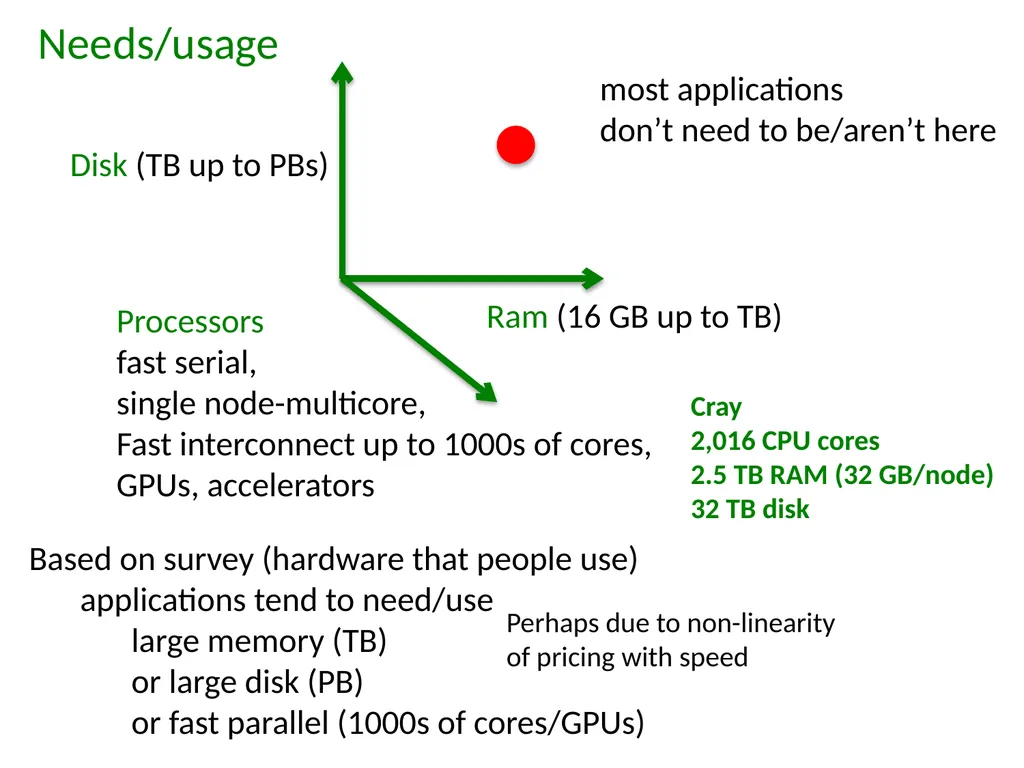
slide4. Needs/usage Ram (16 GB up to TB) Disk (TB up to PBs) Processors
fast serial,
single node-multicore,
Fast interconnect up to 1000s of cores,
GPUs, accelerators most applications
don’t need to be/aren’t here Cray
2,016 CPU cores
2.5 TB RAM (32 GB/node)
32 TB disk Based on survey (hardware that people use)
applications tend to need/use
large memory (TB)
or large disk (PB)
or fast parallel (1000s of cores/GPUs) Perhaps due to non-linearity
of pricing with speed<br>
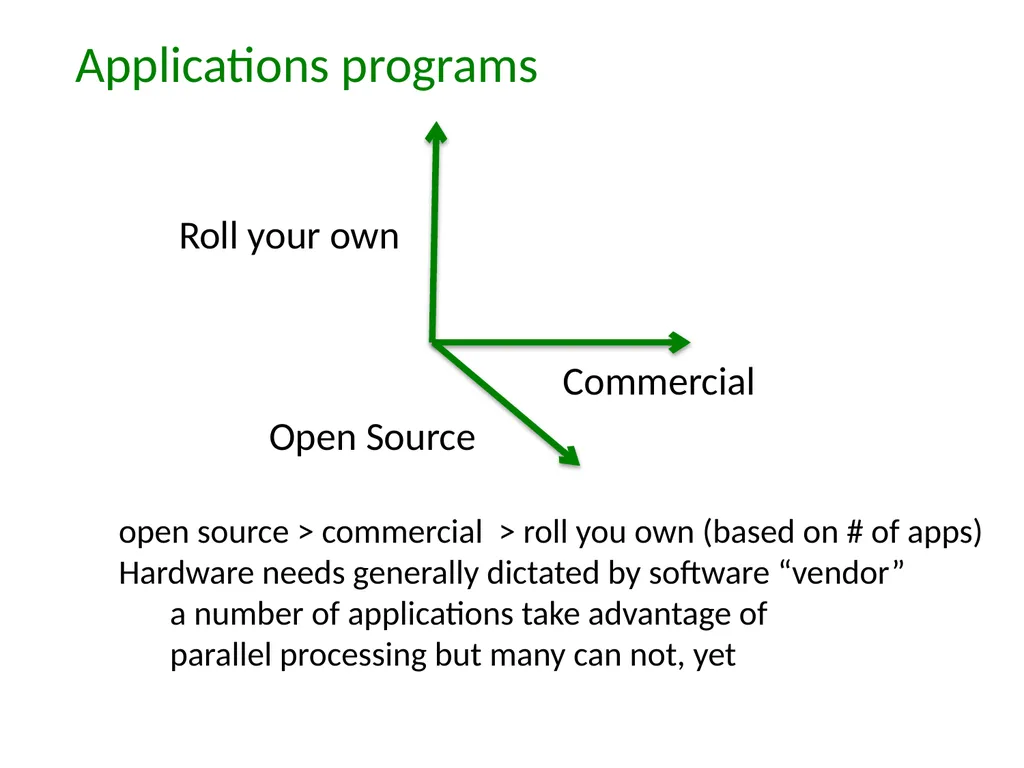
slide5. Applications programs Open Source Roll your own Commercial open source > commercial > roll you own (based on # of apps)
Hardware needs generally dictated by software “vendor”
a number of applications take advantage of
parallel processing but many can not, yet<br>
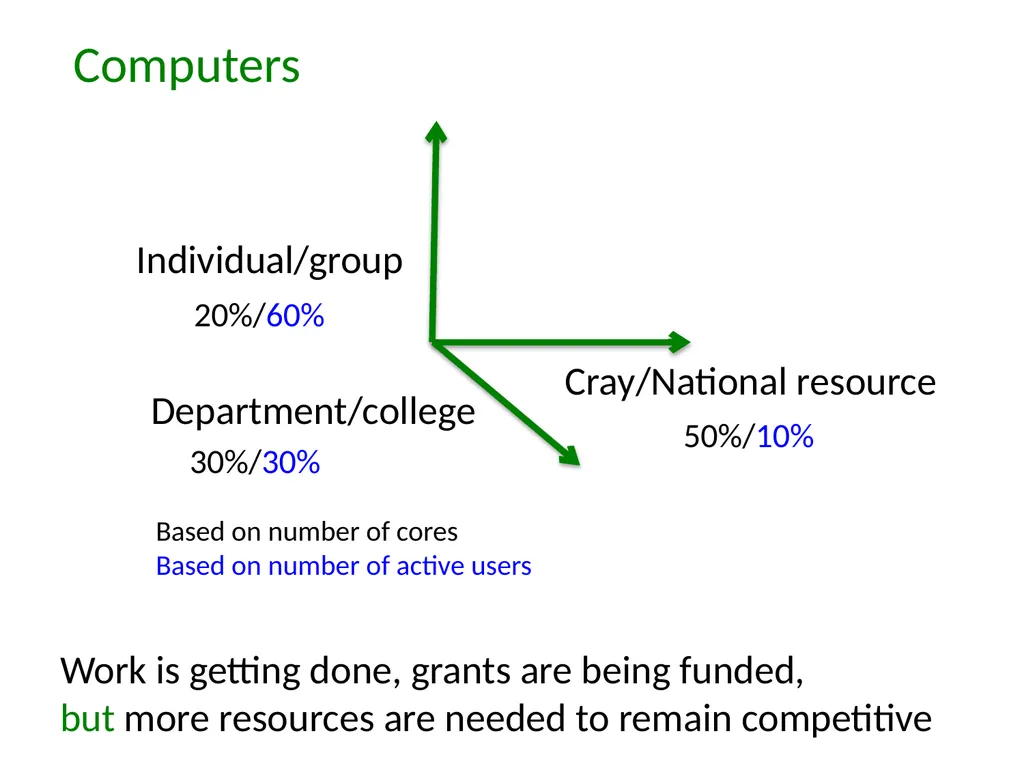
slide6. Computers Department/college Individual/group Cray/National resource Work is getting done, grants are being funded,
but more resources are needed to remain competitive 50%/10% 30%/30% 20%/60% Based on number of cores
Based on number of active users<br>
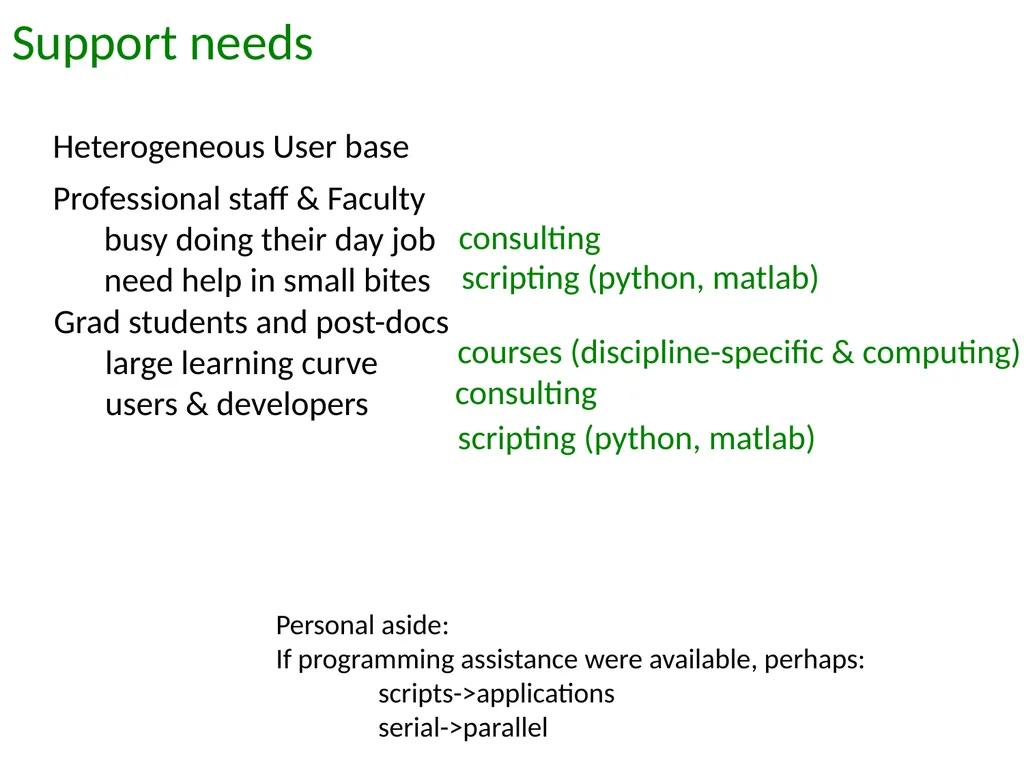
slide7. Heterogeneous User base Professional staff & Faculty
busy doing their day job
need help in small bites Grad students and post-docs
large learning curve
users & developers Support needs consulting scripting (python, matlab) courses (discipline-specific & computing) consulting scripting (python, matlab) Personal aside:
If programming assistance were available, perhaps:
scripts->applications
serial->parallel<br>
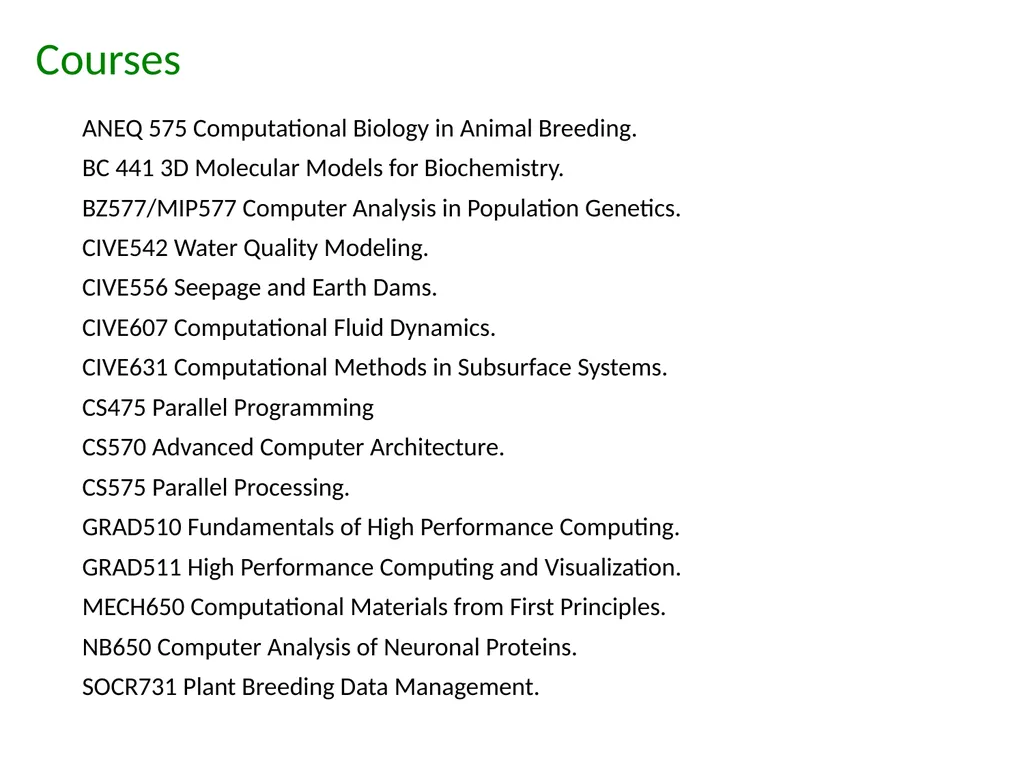
slide8. Courses ANEQ 575 Computational Biology in Animal Breeding.
BC 441 3D Molecular Models for Biochemistry.
BZ577/MIP577 Computer Analysis in Population Genetics.
CIVE542 Water Quality Modeling.
CIVE556 Seepage and Earth Dams.
CIVE607 Computational Fluid Dynamics.
CIVE631 Computational Methods in Subsurface Systems.
CS475 Parallel Programming
CS570 Advanced Computer Architecture.
CS575 Parallel Processing.
GRAD510 Fundamentals of High Performance Computing.
GRAD511 High Performance Computing and Visualization.
MECH650 Computational Materials from First Principles.
NB650 Computer Analysis of Neuronal Proteins.
SOCR731 Plant Breeding Data Management.<br>
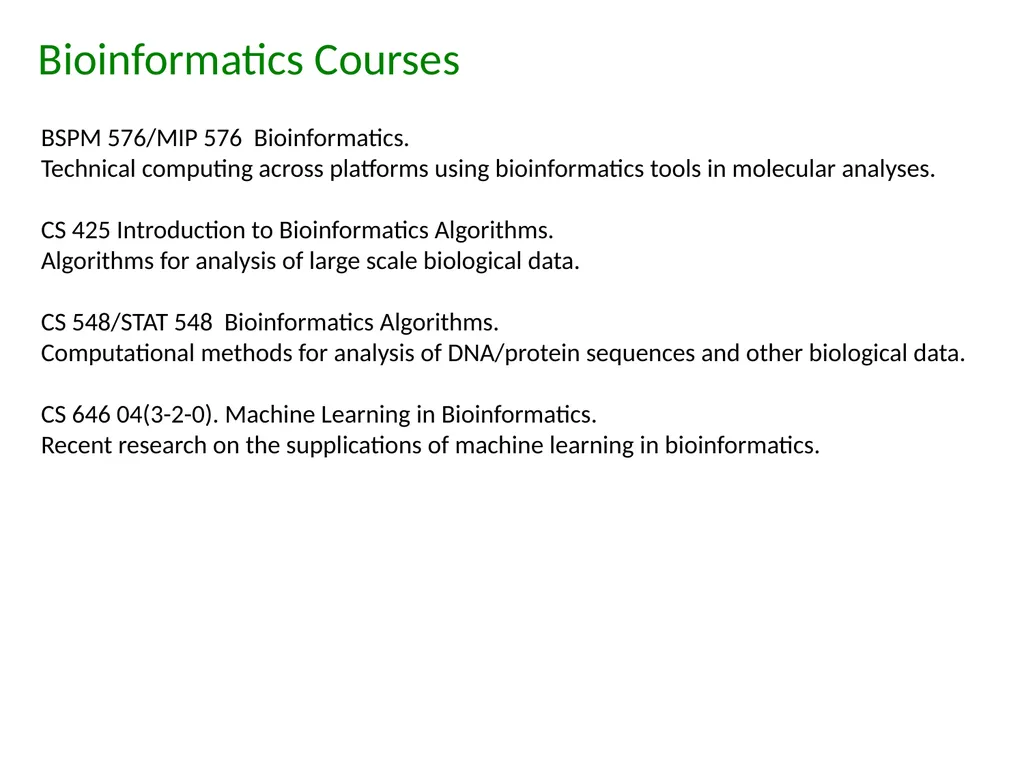
slide9. Bioinformatics Courses BSPM 576/MIP 576 Bioinformatics.
Technical computing across platforms using bioinformatics tools in molecular analyses.
CS 425 Introduction to Bioinformatics Algorithms.
Algorithms for analysis of large scale biological data.
CS 548/STAT 548 Bioinformatics Algorithms.
Computational methods for analysis of DNA/protein sequences and other biological data.
CS 646 04(3-2-0). Machine Learning in Bioinformatics.
Recent research on the supplications of machine learning in bioinformatics.<br>
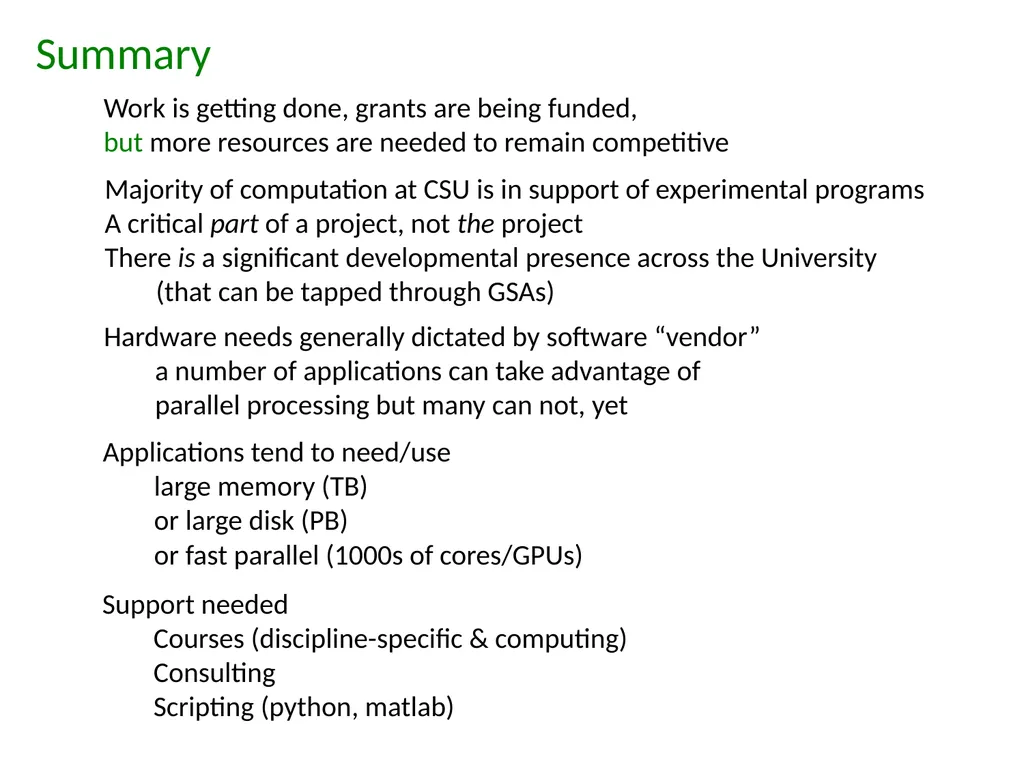
slide10. Work is getting done, grants are being funded,
but more resources are needed to remain competitive Hardware needs generally dictated by software “vendor”
a number of applications can take advantage of
parallel processing but many can not, yet Majority of computation at CSU is in support of experimental programs
A critical part of a project, not the project
There is a significant developmental presence across the University
(that can be tapped through GSAs) Applications tend to need/use
large memory (TB)
or large disk (PB)
or fast parallel (1000s of cores/GPUs) Support needed
Courses (discipline-specific & computing)
Consulting
Scripting (python, matlab) Summary<br>
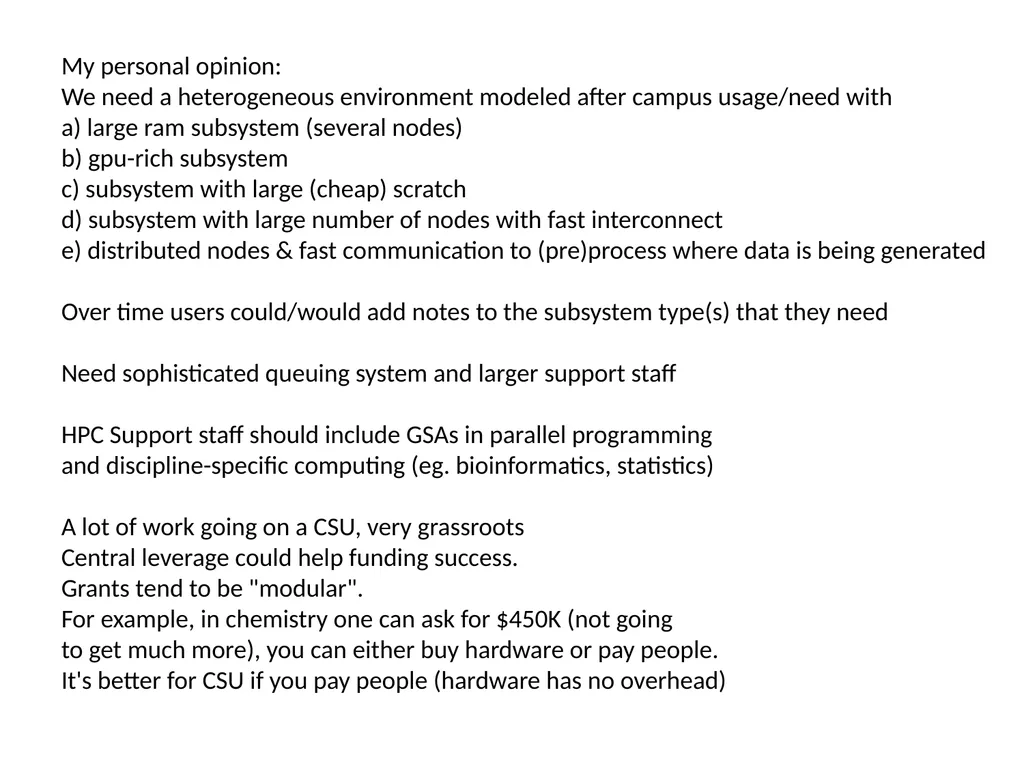
slide11. My personal opinion:
We need a heterogeneous environment modeled after campus usage/need with
a) large ram subsystem (several nodes)
b) gpu-rich subsystem
c) subsystem with large (cheap) scratch
d) subsystem with large number of nodes with fast interconnect
e) distributed nodes & fast communication to (pre)process where data is being generated
Over time users could/would add notes to the subsystem type(s) that they need
Need sophisticated queuing system and larger support staff
HPC Support staff should include GSAs in parallel programming
and discipline-specific computing (eg. bioinformatics, statistics)
A lot of work going on a CSU, very grassroots
Central leverage could help funding success.
Grants tend to be "modular".
For example, in chemistry one can ask for $450K (not going
to get much more), you can either buy hardware or pay people.
It's better for CSU if you pay people (hardware has no overhead)<br>
slide12. What do you think we need/what will help your research? What should be in central infrastructure? Software site licenses? Support infrastructure?<br>
slide2. Majority of computation at CSU (by # of people or grant funding)
is in support of experimental programs
Computation a critical part of a project, not the project
There is a significant developmental presence across the University Research computing at CSU Active 53 funding (from VPR database)
Computing, modeling, simulation, bioinformatics… $78M
For reference:
Solar, biofuels, methane, wind, powerhouse… $41M
Tuberculosis $46M
Total CSU $1.1B<br>
slide3. Application areas include: Atmospheric, fire, and ecological sciences
Ecosystem modeling
Geosciences Robotics
Machine Learning
- Exercise science
- Atmospheric science
- Biomedical engineering
Distributed Computing and Big Data
- Atmospheric Science
- Epidemiology
- Healthcare Civil Engineering (ordinary & partial differential equations) Simulation
- greenhouse gas emissions
- financial modeling
- large-scale models in ECE
- large scale network
- molecular (bio, nano, polymer)
- MCNPX Monte Carlo simulations
- resource management for HPC systems
- data center energy and thermal properties Statistics
- large datasets
- large number of datasets Smart Grid research
Power systems engineering
Computational Electromagnetics Electronic structure (small molecule, bio, solids) Sequential Image Capture and Processing
GIS analysis Bioinformatics Math
Physics Computational Biology Genomics
(short-reads analysis, sequence analysis, etc.)
Transcriptomics
Proteomics
Metabolomics
Population genetic evaluation
Structural RNA, RNA-RNA interaction prediction
Protein structure determination<br>
slide4. Needs/usage Ram (16 GB up to TB) Disk (TB up to PBs) Processors
fast serial,
single node-multicore,
Fast interconnect up to 1000s of cores,
GPUs, accelerators most applications
don’t need to be/aren’t here Cray
2,016 CPU cores
2.5 TB RAM (32 GB/node)
32 TB disk Based on survey (hardware that people use)
applications tend to need/use
large memory (TB)
or large disk (PB)
or fast parallel (1000s of cores/GPUs) Perhaps due to non-linearity
of pricing with speed<br>
slide5. Applications programs Open Source Roll your own Commercial open source > commercial > roll you own (based on # of apps)
Hardware needs generally dictated by software “vendor”
a number of applications take advantage of
parallel processing but many can not, yet<br>
slide6. Computers Department/college Individual/group Cray/National resource Work is getting done, grants are being funded,
but more resources are needed to remain competitive 50%/10% 30%/30% 20%/60% Based on number of cores
Based on number of active users<br>
slide7. Heterogeneous User base Professional staff & Faculty
busy doing their day job
need help in small bites Grad students and post-docs
large learning curve
users & developers Support needs consulting scripting (python, matlab) courses (discipline-specific & computing) consulting scripting (python, matlab) Personal aside:
If programming assistance were available, perhaps:
scripts->applications
serial->parallel<br>
slide8. Courses ANEQ 575 Computational Biology in Animal Breeding.
BC 441 3D Molecular Models for Biochemistry.
BZ577/MIP577 Computer Analysis in Population Genetics.
CIVE542 Water Quality Modeling.
CIVE556 Seepage and Earth Dams.
CIVE607 Computational Fluid Dynamics.
CIVE631 Computational Methods in Subsurface Systems.
CS475 Parallel Programming
CS570 Advanced Computer Architecture.
CS575 Parallel Processing.
GRAD510 Fundamentals of High Performance Computing.
GRAD511 High Performance Computing and Visualization.
MECH650 Computational Materials from First Principles.
NB650 Computer Analysis of Neuronal Proteins.
SOCR731 Plant Breeding Data Management.<br>
slide9. Bioinformatics Courses BSPM 576/MIP 576 Bioinformatics.
Technical computing across platforms using bioinformatics tools in molecular analyses.
CS 425 Introduction to Bioinformatics Algorithms.
Algorithms for analysis of large scale biological data.
CS 548/STAT 548 Bioinformatics Algorithms.
Computational methods for analysis of DNA/protein sequences and other biological data.
CS 646 04(3-2-0). Machine Learning in Bioinformatics.
Recent research on the supplications of machine learning in bioinformatics.<br>
slide10. Work is getting done, grants are being funded,
but more resources are needed to remain competitive Hardware needs generally dictated by software “vendor”
a number of applications can take advantage of
parallel processing but many can not, yet Majority of computation at CSU is in support of experimental programs
A critical part of a project, not the project
There is a significant developmental presence across the University
(that can be tapped through GSAs) Applications tend to need/use
large memory (TB)
or large disk (PB)
or fast parallel (1000s of cores/GPUs) Support needed
Courses (discipline-specific & computing)
Consulting
Scripting (python, matlab) Summary<br>
slide11. My personal opinion:
We need a heterogeneous environment modeled after campus usage/need with
a) large ram subsystem (several nodes)
b) gpu-rich subsystem
c) subsystem with large (cheap) scratch
d) subsystem with large number of nodes with fast interconnect
e) distributed nodes & fast communication to (pre)process where data is being generated
Over time users could/would add notes to the subsystem type(s) that they need
Need sophisticated queuing system and larger support staff
HPC Support staff should include GSAs in parallel programming
and discipline-specific computing (eg. bioinformatics, statistics)
A lot of work going on a CSU, very grassroots
Central leverage could help funding success.
Grants tend to be "modular".
For example, in chemistry one can ask for $450K (not going
to get much more), you can either buy hardware or pay people.
It's better for CSU if you pay people (hardware has no overhead)<br>
slide12. What do you think we need/what will help your research? What should be in central infrastructure? Software site licenses? Support infrastructure?<br>