
Hide and Seek by Vernon Scannell ‘How does



Description: Hide and Seek by Vernon Scannell How does Scannell present the power relationship between friends? Vernon Scannell and Hide and Seek Scannell was born in Lincolnshire to a poor family who moved around the country a lot to find work.
Related Topics
Download Presentation
"Hide and Seek by Vernon Scannell ‘How does" is the property of its rightful owner. Permission is granted to download and print the materials on this website for personal, non-commercial use only, and to display it on your personal computer provided you do not modify the materials and that you retain all copyright notices contained in the materials. By downloading content from our website, you accept the terms of this agreement.
Presentation Transcript
slide1. Hide and Seek by Vernon Scannell
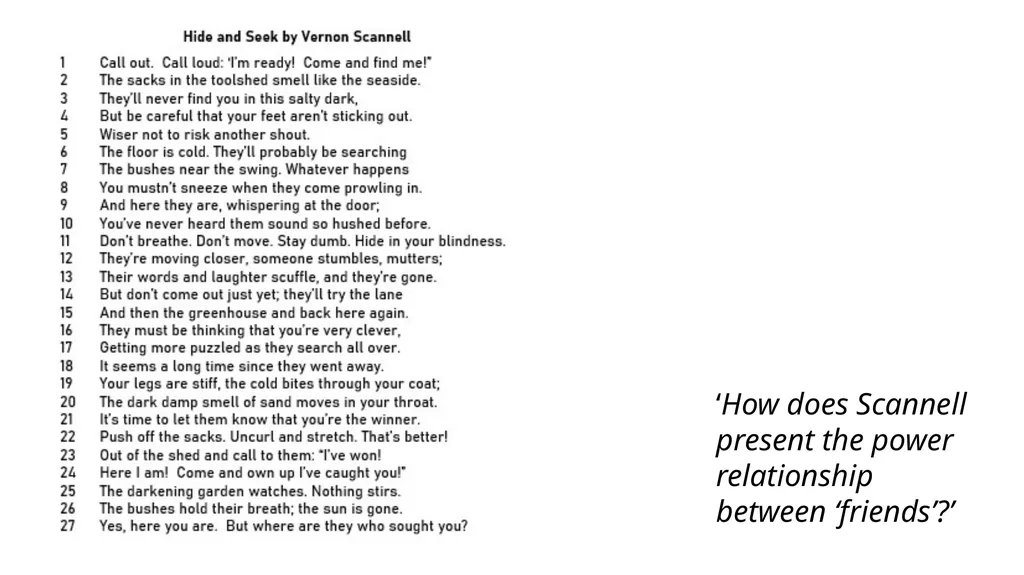
‘How does Scannell present the power relationship between ‘friends’?’<br>
slide2. Vernon Scannell and ‘Hide and Seek’ Scannell was born in Lincolnshire to a poor family who moved around the country a lot to find work. He left school at fourteen to take a job in an insurance office. In 1940, he enlisted in the army. He fought in the North African desert. However, he was court-martialled for desertion after walking away from his fellow soldiers when they looted and abused the dead after a key battle. He was sentenced to three years’ imprisonment in a military prison; he served six months and was released to fight in the Normandy landings. Following the end of the war in Europe, he deserted again and spent two years on the run. He was eventually arrested in 1947 and sent to a military hospital. On his release, Scannell went to London where he supported himself through teaching and boxing professionally. This gave him time to write poetry.
The poem describes a children’s game of hide and seek. The boy thinks he is clever to hide in the shed. The searchers laugh outside the door, but do not find him. After a very long time, the boy emerges, thinking he is the winner, only to discover his friends have abandoned him as part of a cruel trick.<br>
slide3. ‘How does Scannell present the power relationship between ‘friends’?’<br>
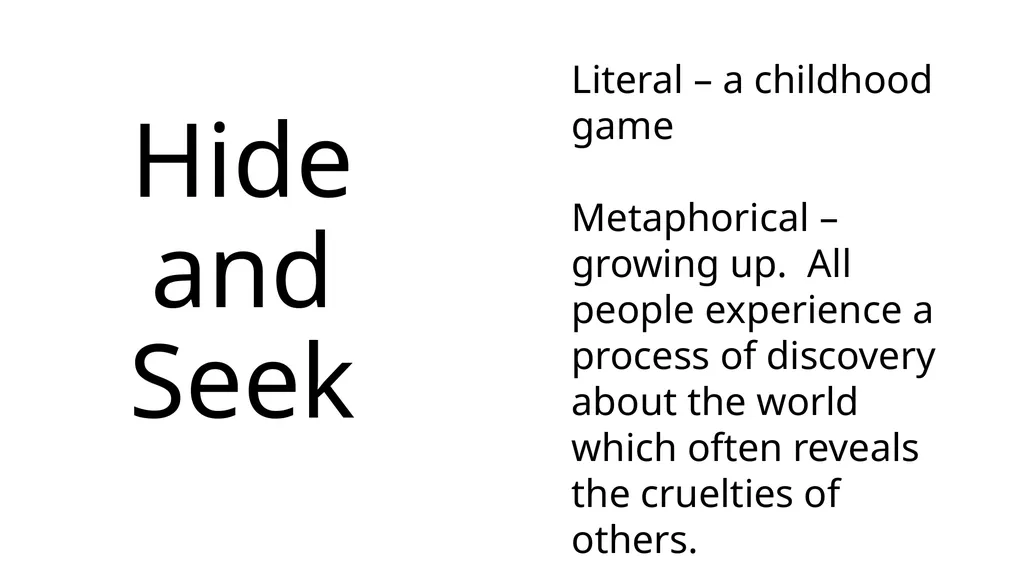
slide4. Hide and Seek Literal – a childhood game
Metaphorical – growing up. All people experience a process of discovery about the world which often reveals the cruelties of others.<br>
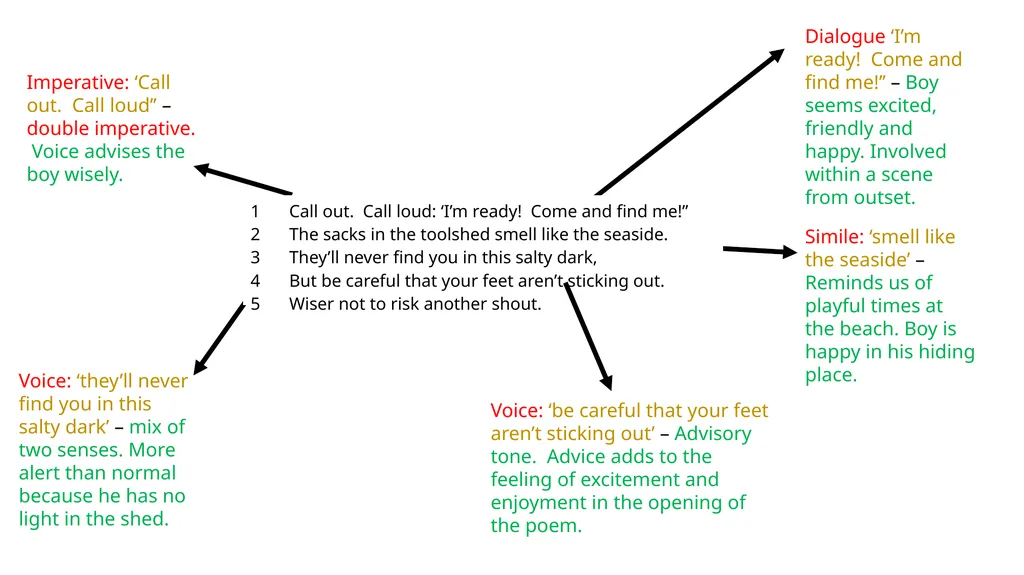
slide5. Imperative: ‘Call out. Call loud’’ – double imperative. Voice advises the boy wisely. Dialogue ‘I’m ready! Come and find me!’’ – Boy seems excited, friendly and happy. Involved within a scene from outset. Simile: ‘smell like the seaside’ – Reminds us of playful times at the beach. Boy is happy in his hiding place. Voice: ‘they’ll never find you in this salty dark’ – mix of two senses. More alert than normal because he has no light in the shed. Voice: ‘be careful that your feet aren’t sticking out’ – Advisory tone. Advice adds to the feeling of excitement and enjoyment in the opening of the poem.<br>
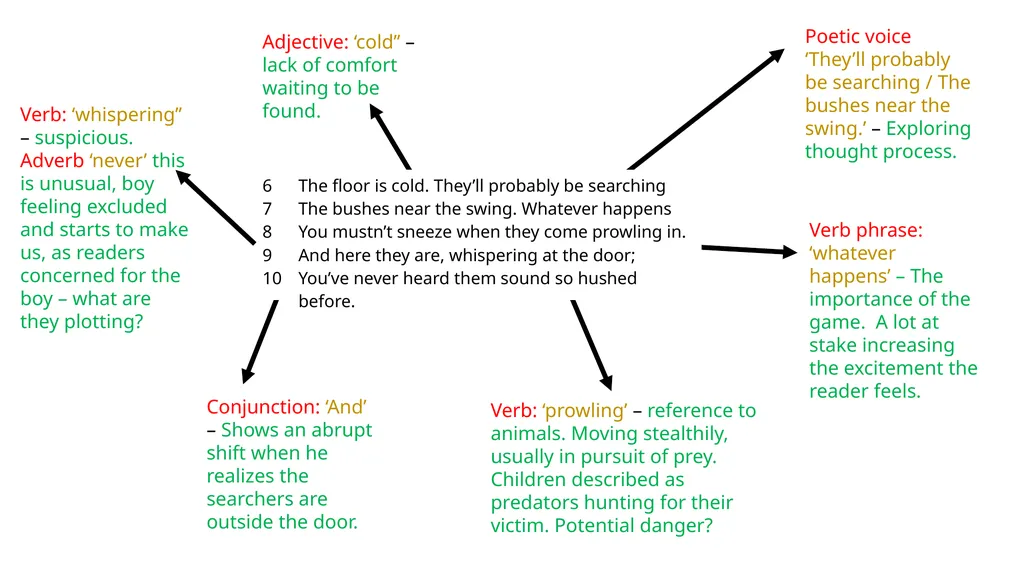
slide6. Adjective: ‘cold’’ – lack of comfort waiting to be found. Poetic voice ‘They’ll probably be searching / The bushes near the swing.’ – Exploring thought process. Verb phrase: ‘whatever happens’ – The importance of the game. A lot at stake increasing the excitement the reader feels. Conjunction: ‘And’ – Shows an abrupt shift when he realizes the searchers are outside the door. Verb: ‘prowling’ – reference to animals. Moving stealthily, usually in pursuit of prey. Children described as predators hunting for their victim. Potential danger? Verb: ‘whispering’’ – suspicious. Adverb ‘never’ this is unusual, boy feeling excluded and starts to make us, as readers concerned for the boy – what are they plotting?<br>
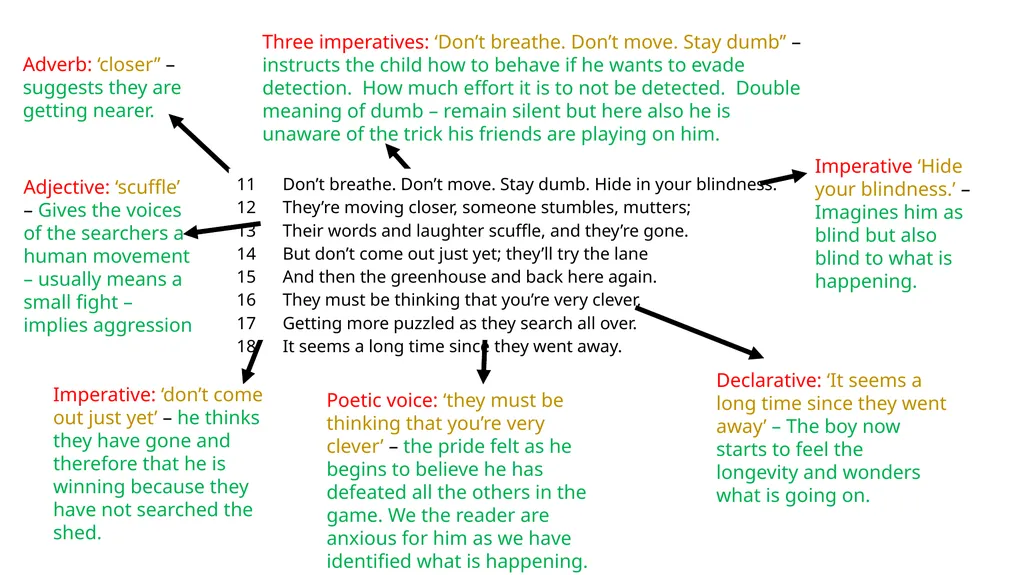
slide7. Three imperatives: ‘Don’t breathe. Don’t move. Stay dumb’’ – instructs the child how to behave if he wants to evade detection. How much effort it is to not be detected. Double meaning of dumb – remain silent but here also he is unaware of the trick his friends are playing on him. Imperative ‘Hide your blindness.’ – Imagines him as blind but also blind to what is happening. Declarative: ‘It seems a long time since they went away’ – The boy now starts to feel the longevity and wonders what is going on. Adjective: ‘scuffle’ – Gives the voices of the searchers a human movement – usually means a small fight – implies aggression Imperative: ‘don’t come out just yet’ – he thinks they have gone and therefore that he is winning because they have not searched the shed. Adverb: ‘closer’’ – suggests they are getting nearer. Poetic voice: ‘they must be thinking that you’re very clever’ – the pride felt as he begins to believe he has defeated all the others in the game. We the reader are anxious for him as we have identified what is happening.<br>
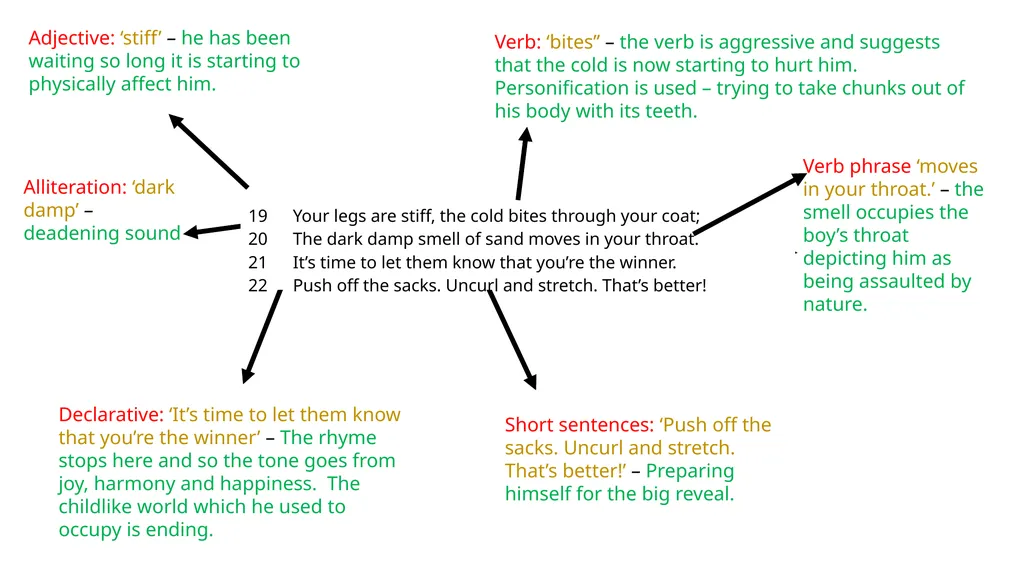
slide8. Verb: ‘bites’’ – the verb is aggressive and suggests that the cold is now starting to hurt him. Personification is used – trying to take chunks out of his body with its teeth. Verb phrase ‘moves in your throat.’ – the smell occupies the boy’s throat depicting him as being assaulted by nature. Alliteration: ‘dark damp’ – deadening sound Declarative: ‘It’s time to let them know that you’re the winner’ – The rhyme stops here and so the tone goes from joy, harmony and happiness. The childlike world which he used to occupy is ending. Adjective: ‘stiff’ – he has been waiting so long it is starting to physically affect him. Short sentences: ‘Push off the sacks. Uncurl and stretch. That’s better!’ – Preparing himself for the big reveal.<br>
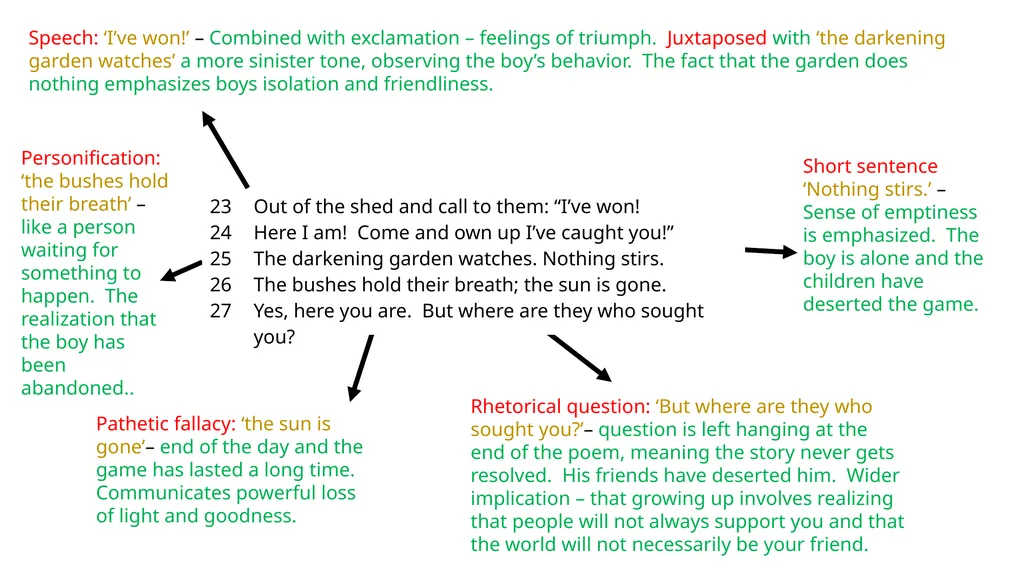
slide9. Short sentence ‘Nothing stirs.’ – Sense of emptiness is emphasized. The boy is alone and the children have deserted the game. Personification: ‘the bushes hold their breath’ – like a person waiting for something to happen. The realization that the boy has been abandoned.. Speech: ‘I’ve won!’ – Combined with exclamation – feelings of triumph. Juxtaposed with ‘the darkening garden watches’ a more sinister tone, observing the boy’s behavior. The fact that the garden does nothing emphasizes boys isolation and friendliness. Pathetic fallacy: ‘the sun is gone’– end of the day and the game has lasted a long time. Communicates powerful loss of light and goodness. Rhetorical question: ‘But where are they who sought you?’– question is left hanging at the end of the poem, meaning the story never gets resolved. His friends have deserted him. Wider implication – that growing up involves realizing that people will not always support you and that the world will not necessarily be your friend.<br>
slide10. Hide and Seek by Vernon Scannell
‘How does Scannell present the power dynamic between ‘friends’?’<br>
‘How does Scannell present the power relationship between ‘friends’?’<br>
slide2. Vernon Scannell and ‘Hide and Seek’ Scannell was born in Lincolnshire to a poor family who moved around the country a lot to find work. He left school at fourteen to take a job in an insurance office. In 1940, he enlisted in the army. He fought in the North African desert. However, he was court-martialled for desertion after walking away from his fellow soldiers when they looted and abused the dead after a key battle. He was sentenced to three years’ imprisonment in a military prison; he served six months and was released to fight in the Normandy landings. Following the end of the war in Europe, he deserted again and spent two years on the run. He was eventually arrested in 1947 and sent to a military hospital. On his release, Scannell went to London where he supported himself through teaching and boxing professionally. This gave him time to write poetry.
The poem describes a children’s game of hide and seek. The boy thinks he is clever to hide in the shed. The searchers laugh outside the door, but do not find him. After a very long time, the boy emerges, thinking he is the winner, only to discover his friends have abandoned him as part of a cruel trick.<br>
slide3. ‘How does Scannell present the power relationship between ‘friends’?’<br>
slide4. Hide and Seek Literal – a childhood game
Metaphorical – growing up. All people experience a process of discovery about the world which often reveals the cruelties of others.<br>
slide5. Imperative: ‘Call out. Call loud’’ – double imperative. Voice advises the boy wisely. Dialogue ‘I’m ready! Come and find me!’’ – Boy seems excited, friendly and happy. Involved within a scene from outset. Simile: ‘smell like the seaside’ – Reminds us of playful times at the beach. Boy is happy in his hiding place. Voice: ‘they’ll never find you in this salty dark’ – mix of two senses. More alert than normal because he has no light in the shed. Voice: ‘be careful that your feet aren’t sticking out’ – Advisory tone. Advice adds to the feeling of excitement and enjoyment in the opening of the poem.<br>
slide6. Adjective: ‘cold’’ – lack of comfort waiting to be found. Poetic voice ‘They’ll probably be searching / The bushes near the swing.’ – Exploring thought process. Verb phrase: ‘whatever happens’ – The importance of the game. A lot at stake increasing the excitement the reader feels. Conjunction: ‘And’ – Shows an abrupt shift when he realizes the searchers are outside the door. Verb: ‘prowling’ – reference to animals. Moving stealthily, usually in pursuit of prey. Children described as predators hunting for their victim. Potential danger? Verb: ‘whispering’’ – suspicious. Adverb ‘never’ this is unusual, boy feeling excluded and starts to make us, as readers concerned for the boy – what are they plotting?<br>
slide7. Three imperatives: ‘Don’t breathe. Don’t move. Stay dumb’’ – instructs the child how to behave if he wants to evade detection. How much effort it is to not be detected. Double meaning of dumb – remain silent but here also he is unaware of the trick his friends are playing on him. Imperative ‘Hide your blindness.’ – Imagines him as blind but also blind to what is happening. Declarative: ‘It seems a long time since they went away’ – The boy now starts to feel the longevity and wonders what is going on. Adjective: ‘scuffle’ – Gives the voices of the searchers a human movement – usually means a small fight – implies aggression Imperative: ‘don’t come out just yet’ – he thinks they have gone and therefore that he is winning because they have not searched the shed. Adverb: ‘closer’’ – suggests they are getting nearer. Poetic voice: ‘they must be thinking that you’re very clever’ – the pride felt as he begins to believe he has defeated all the others in the game. We the reader are anxious for him as we have identified what is happening.<br>
slide8. Verb: ‘bites’’ – the verb is aggressive and suggests that the cold is now starting to hurt him. Personification is used – trying to take chunks out of his body with its teeth. Verb phrase ‘moves in your throat.’ – the smell occupies the boy’s throat depicting him as being assaulted by nature. Alliteration: ‘dark damp’ – deadening sound Declarative: ‘It’s time to let them know that you’re the winner’ – The rhyme stops here and so the tone goes from joy, harmony and happiness. The childlike world which he used to occupy is ending. Adjective: ‘stiff’ – he has been waiting so long it is starting to physically affect him. Short sentences: ‘Push off the sacks. Uncurl and stretch. That’s better!’ – Preparing himself for the big reveal.<br>
slide9. Short sentence ‘Nothing stirs.’ – Sense of emptiness is emphasized. The boy is alone and the children have deserted the game. Personification: ‘the bushes hold their breath’ – like a person waiting for something to happen. The realization that the boy has been abandoned.. Speech: ‘I’ve won!’ – Combined with exclamation – feelings of triumph. Juxtaposed with ‘the darkening garden watches’ a more sinister tone, observing the boy’s behavior. The fact that the garden does nothing emphasizes boys isolation and friendliness. Pathetic fallacy: ‘the sun is gone’– end of the day and the game has lasted a long time. Communicates powerful loss of light and goodness. Rhetorical question: ‘But where are they who sought you?’– question is left hanging at the end of the poem, meaning the story never gets resolved. His friends have deserted him. Wider implication – that growing up involves realizing that people will not always support you and that the world will not necessarily be your friend.<br>
slide10. Hide and Seek by Vernon Scannell
‘How does Scannell present the power dynamic between ‘friends’?’<br>