High-throughput Pairwise Alignment with the Wavefront Algorithm using Processing-in-Memory Safaa Diab1, Amir Nassereldine1, Mohammed Alser2, Juan Gómez Luna2, Onur Mutlu2, Izzat El Hajj1 1American University of Beirut, Lebanon 2ETH Zürich,
"High-throughput Pairwise Alignment with the" is the property of its rightful owner. Permission is granted to
download and print the materials on this website for personal, non-commercial use only, and to display it
on your personal computer provided you do not modify the materials and that you retain all copyright
notices contained in the materials. By downloading content from our website, you accept the terms of this
agreement.
Presentation Transcript
01
High-throughput Pairwise Alignment with the Wavefront Algorithm using Processing-in-Memory Safaa Diab1, Amir Nassereldine1, Mohammed Alser2, Juan Gómez Luna2, Onur Mutlu2, Izzat El Hajj1
1American University of Beirut, Lebanon 2ETH Zürich, Switzerland HiCOMB 2022
May 30, 2022<br>
02
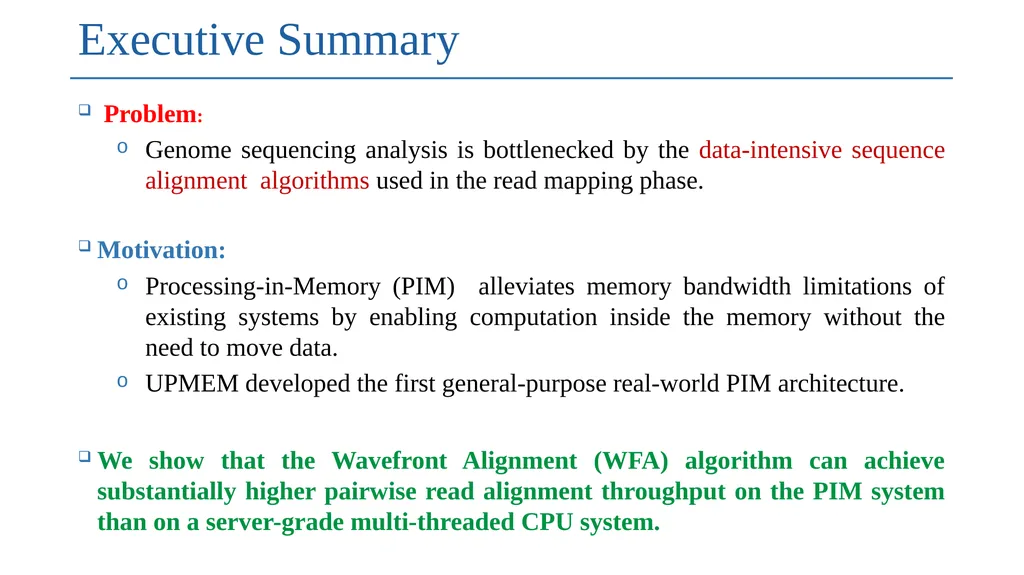
Executive Summary Problem:
Genome sequencing analysis is bottlenecked by the data-intensive sequence alignment algorithms used in the read mapping phase.
Motivation:
Processing-in-Memory (PIM) alleviates memory bandwidth limitations of existing systems by enabling computation inside the memory without the need to move data.
UPMEM developed the first general-purpose real-world PIM architecture.
We show that the Wavefront Alignment (WFA) algorithm can achieve substantially higher pairwise read alignment throughput on the PIM system than on a server-grade multi-threaded CPU system.<br>
03
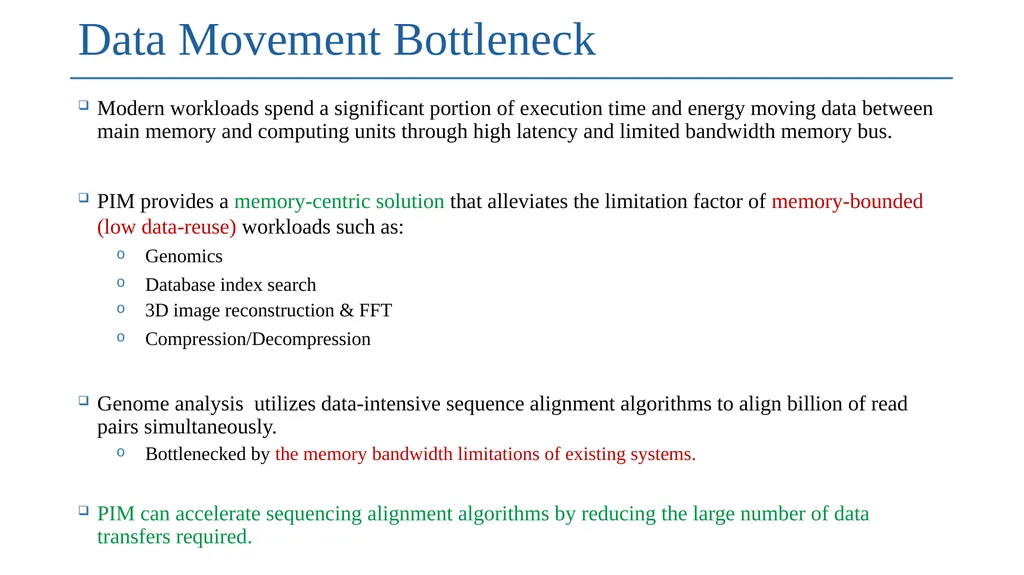
Data Movement Bottleneck Modern workloads spend a significant portion of execution time and energy moving data between main memory and computing units through high latency and limited bandwidth memory bus.
PIM provides a memory-centric solution that alleviates the limitation factor of memory-bounded (low data-reuse) workloads such as:
Genomics
Database index search
3D image reconstruction & FFT
Compression/Decompression
Genome analysis utilizes data-intensive sequence alignment algorithms to align billion of read pairs simultaneously.
Bottlenecked by the memory bandwidth limitations of existing systems.
PIM can accelerate sequencing alignment algorithms by reducing the large number of data transfers required.<br>
04
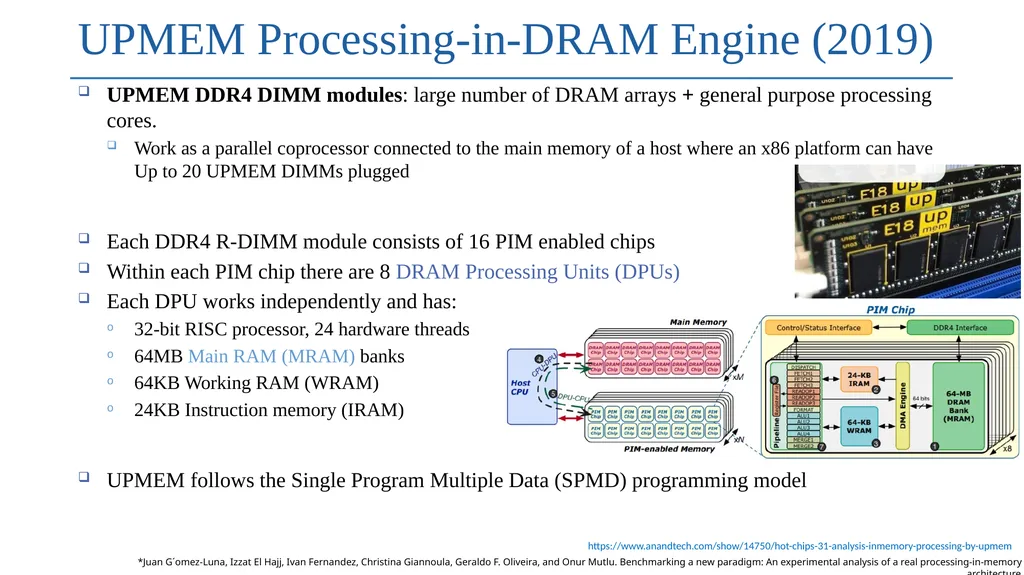
UPMEM Processing-in-DRAM Engine (2019) UPMEM DDR4 DIMM modules: large number of DRAM arrays + general purpose processing cores.
Work as a parallel coprocessor connected to the main memory of a host where an x86 platform can have Up to 20 UPMEM DIMMs plugged
Each DDR4 R-DIMM module consists of 16 PIM enabled chips
Within each PIM chip there are 8 DRAM Processing Units (DPUs)
Each DPU works independently and has:
32-bit RISC processor, 24 hardware threads
64MB Main RAM (MRAM) banks
64KB Working RAM (WRAM)
24KB Instruction memory (IRAM)
UPMEM follows the Single Program Multiple Data (SPMD) programming model https://www.anandtech.com/show/14750/hot-chips-31-analysis-inmemory-processing-by-upmem *Juan G´omez-Luna, Izzat El Hajj, Ivan Fernandez, Christina Giannoula, Geraldo F. Oliveira, and Onur Mutlu. Benchmarking a new paradigm: An experimental analysis of a real processing-in-memory architecture<br>
05
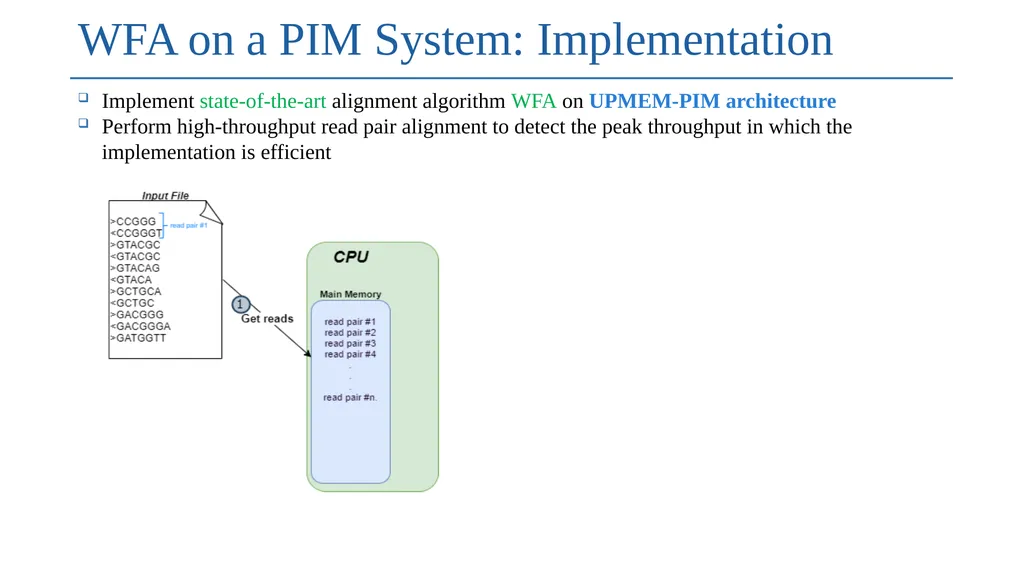
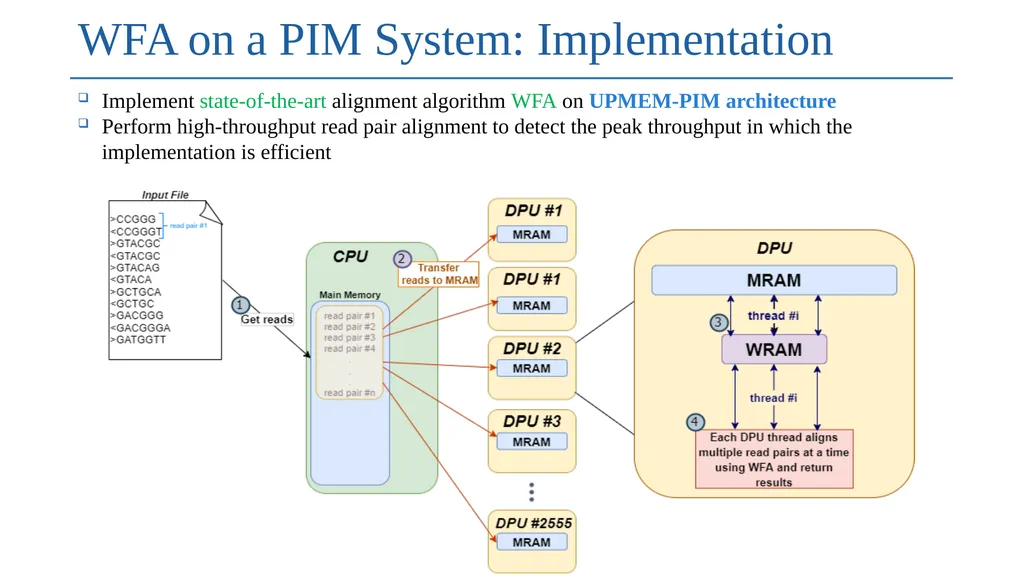
WFA on a PIM System: Implementation Implement state-of-the-art alignment algorithm WFA on UPMEM-PIM architecture
Perform high-throughput read pair alignment to detect the peak throughput in which the implementation is efficient<br>
06
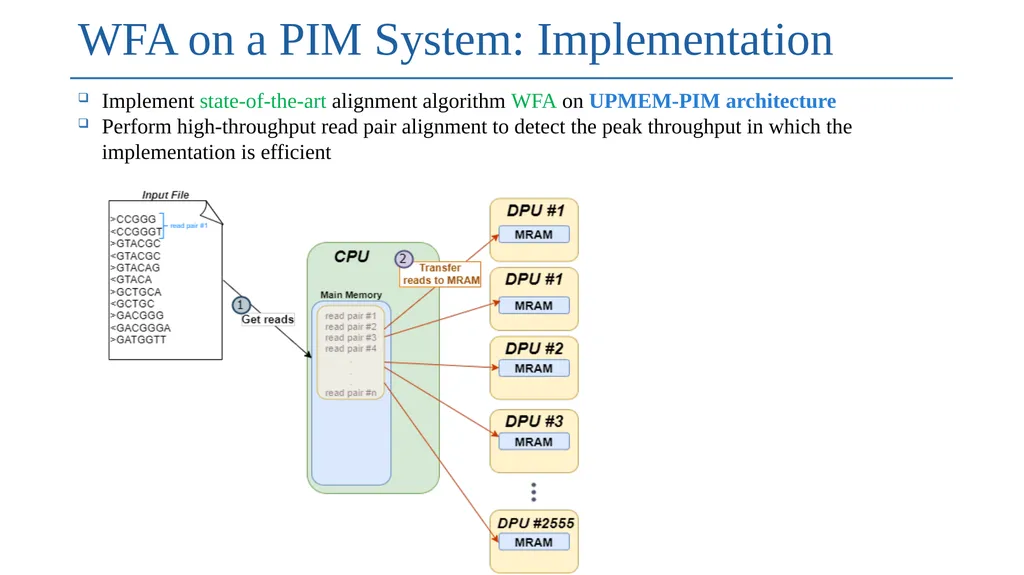
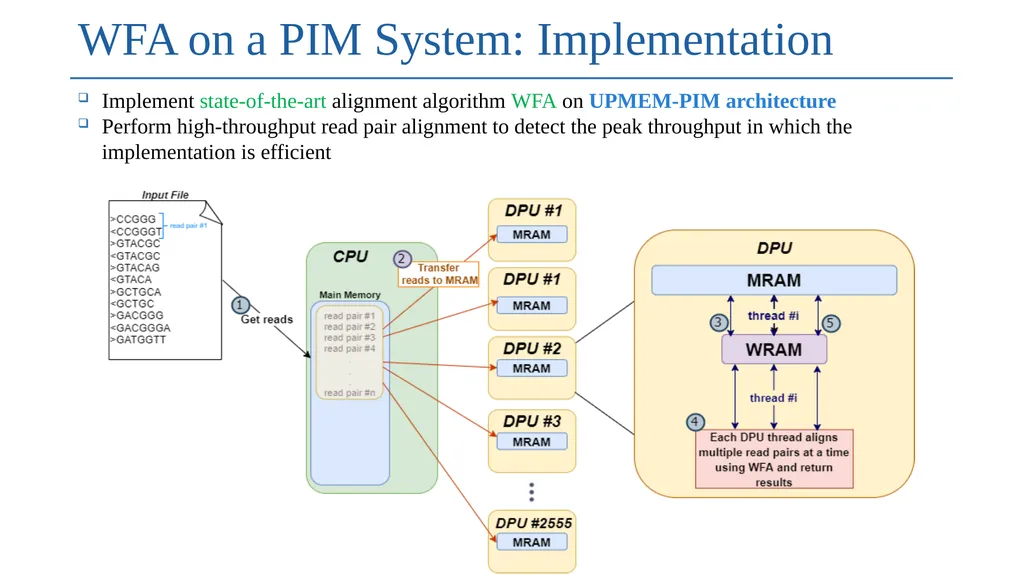
WFA on a PIM System: Implementation Implement state-of-the-art alignment algorithm WFA on UPMEM-PIM architecture
Perform high-throughput read pair alignment to detect the peak throughput in which the implementation is efficient<br>
07
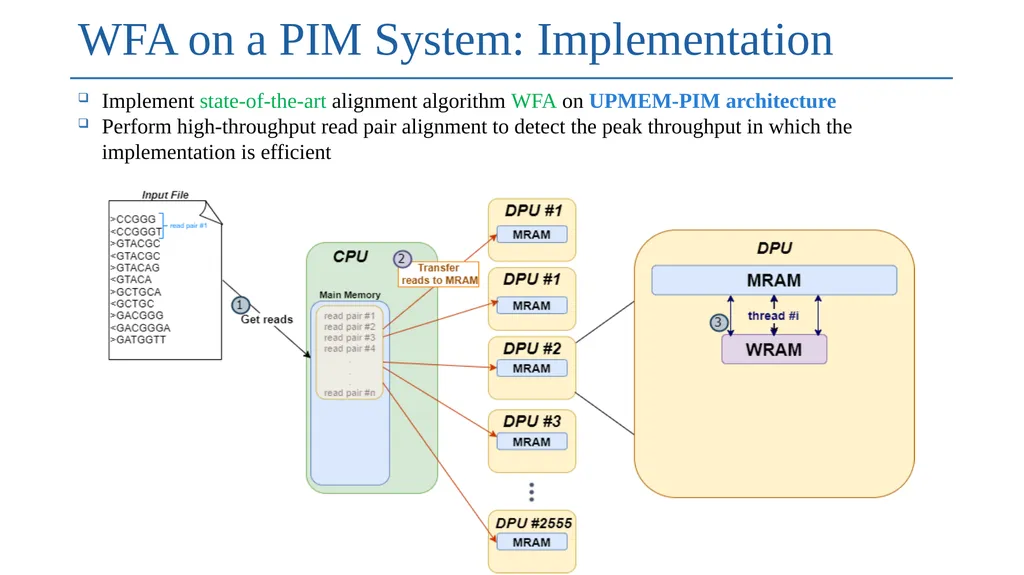
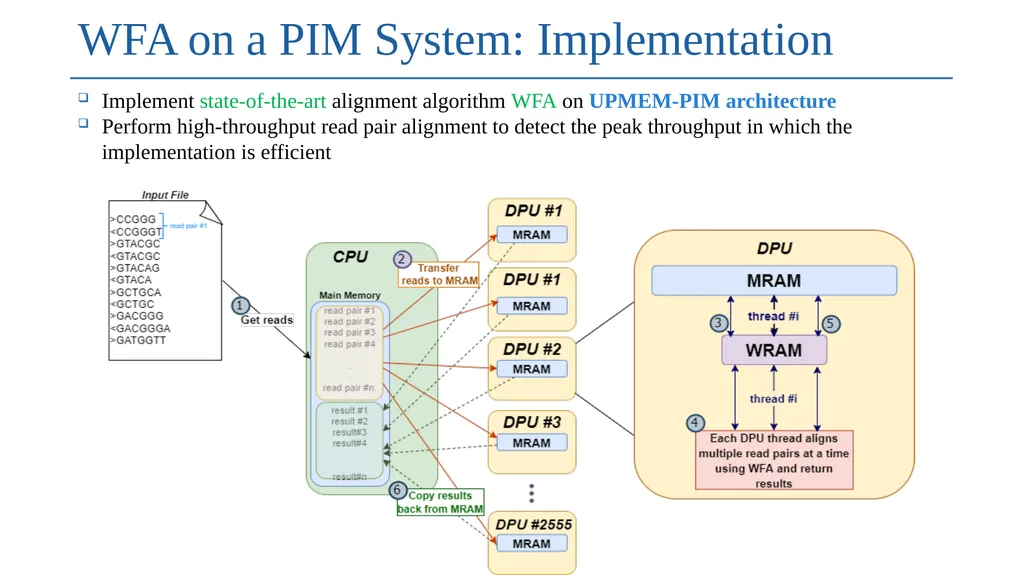
WFA on a PIM System: Implementation Implement state-of-the-art alignment algorithm WFA on UPMEM-PIM architecture
Perform high-throughput read pair alignment to detect the peak throughput in which the implementation is efficient<br>
08
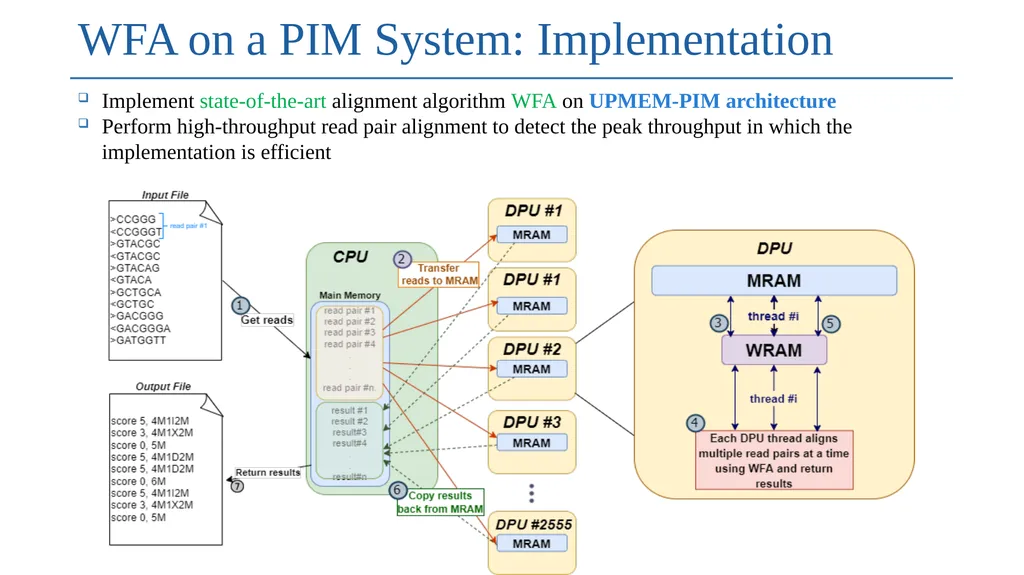
WFA on a PIM System: Implementation Implement state-of-the-art alignment algorithm WFA on UPMEM-PIM architecture
Perform high-throughput read pair alignment to detect the peak throughput in which the implementation is efficient<br>
09
WFA on a PIM System: Implementation Implement state-of-the-art alignment algorithm WFA on UPMEM-PIM architecture
Perform high-throughput read pair alignment to detect the peak throughput in which the implementation is efficient<br>
10
WFA on a PIM System: Implementation Implement state-of-the-art alignment algorithm WFA on UPMEM-PIM architecture
Perform high-throughput read pair alignment to detect the peak throughput in which the implementation is efficient<br>
11
WFA on a PIM System: Implementation Implement state-of-the-art alignment algorithm WFA on UPMEM-PIM architecture
Perform high-throughput read pair alignment to detect the peak throughput in which the implementation is efficient<br>
12
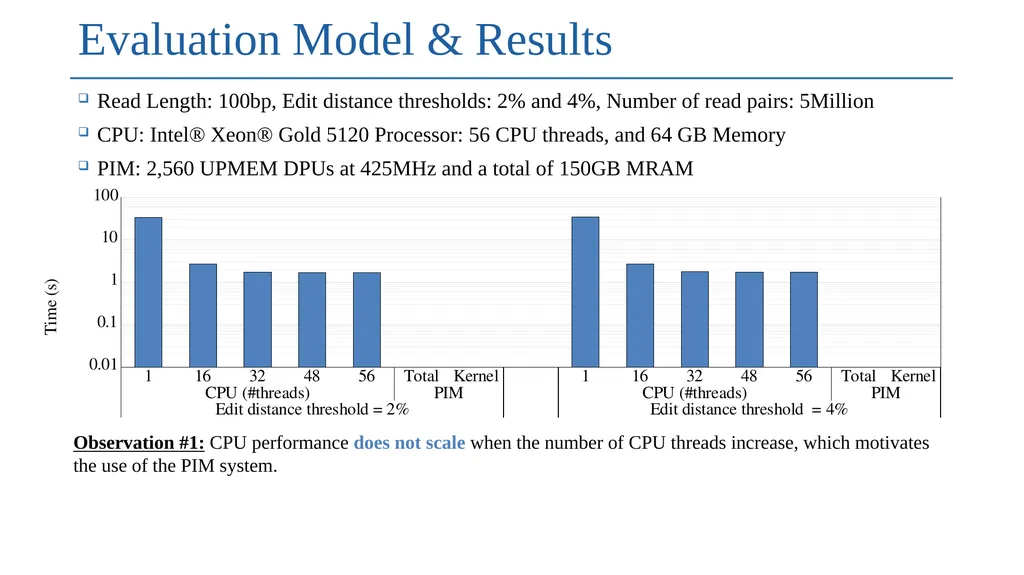
Evaluation Model & Results Observation #1: CPU performance does not scale when the number of CPU threads increase, which motivates the use of the PIM system. Read Length: 100bp, Edit distance thresholds: 2% and 4%, Number of read pairs: 5Million
CPU: Intel® Xeon® Gold 5120 Processor: 56 CPU threads, and 64 GB Memory
PIM: 2,560 UPMEM DPUs at 425MHz and a total of 150GB MRAM<br>
13
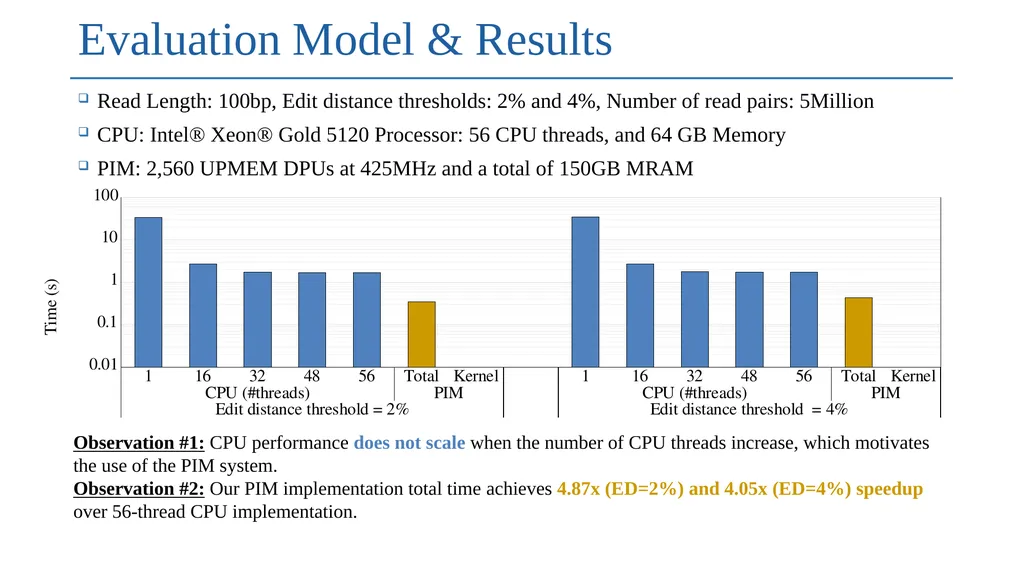
Evaluation Model & Results Observation #1: CPU performance does not scale when the number of CPU threads increase, which motivates the use of the PIM system.
Observation #2: Our PIM implementation total time achieves 4.87x (ED=2%) and 4.05x (ED=4%) speedup over 56-thread CPU implementation. Read Length: 100bp, Edit distance thresholds: 2% and 4%, Number of read pairs: 5Million
CPU: Intel® Xeon® Gold 5120 Processor: 56 CPU threads, and 64 GB Memory
PIM: 2,560 UPMEM DPUs at 425MHz and a total of 150GB MRAM<br>
14
Evaluation Model & Results Observation #1: CPU performance does not scale when the number of CPU threads increase, which motivates the use of the PIM system.
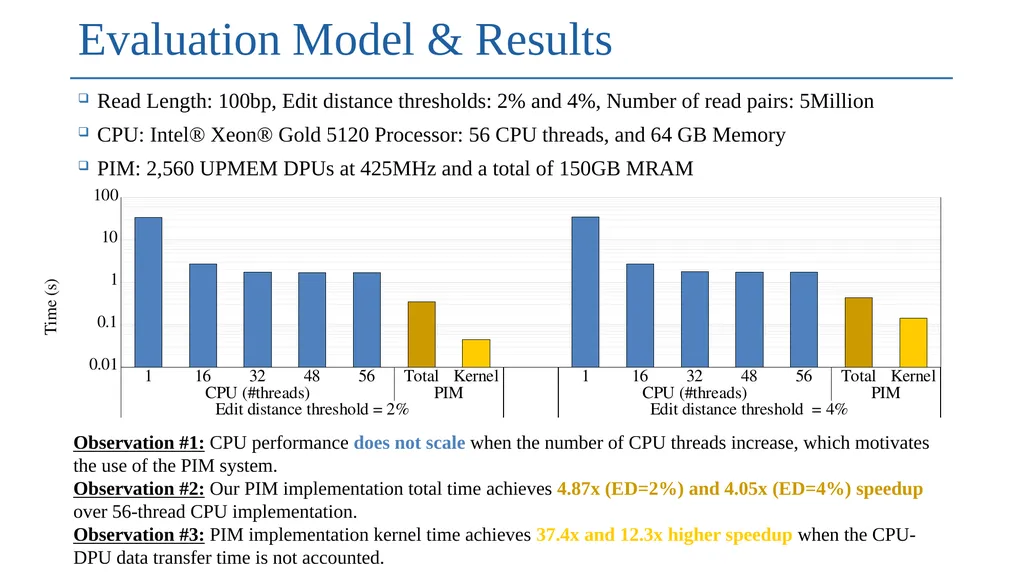
Observation #2: Our PIM implementation total time achieves 4.87x (ED=2%) and 4.05x (ED=4%) speedup over 56-thread CPU implementation.
Observation #3: PIM implementation kernel time achieves 37.4x and 12.3x higher speedup when the CPU-DPU data transfer time is not accounted. Read Length: 100bp, Edit distance thresholds: 2% and 4%, Number of read pairs: 5Million
CPU: Intel® Xeon® Gold 5120 Processor: 56 CPU threads, and 64 GB Memory
PIM: 2,560 UPMEM DPUs at 425MHz and a total of 150GB MRAM<br>
15
Conclusion Problem:
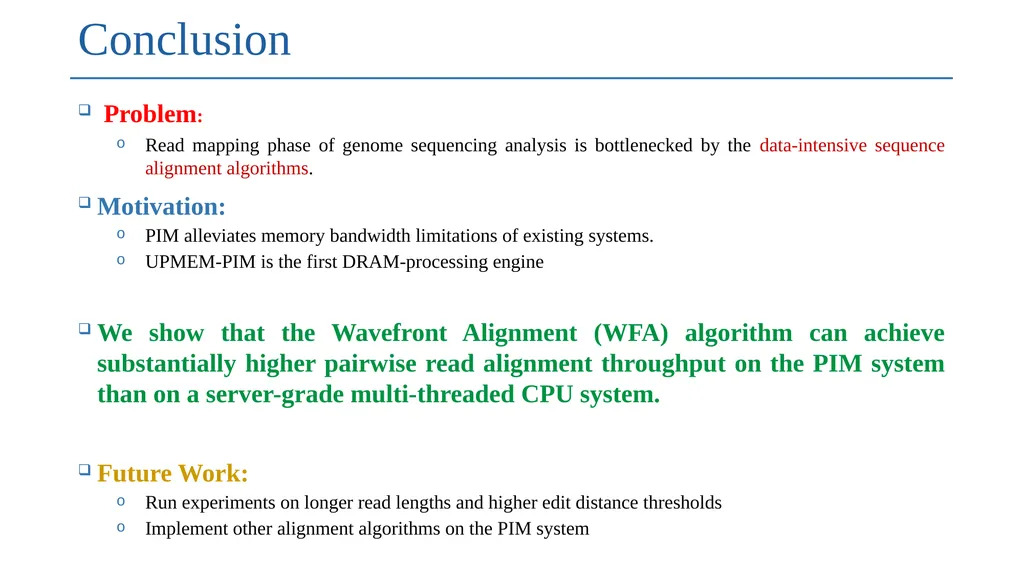
Read mapping phase of genome sequencing analysis is bottlenecked by the data-intensive sequence alignment algorithms.
Motivation:
PIM alleviates memory bandwidth limitations of existing systems.
UPMEM-PIM is the first DRAM-processing engine
We show that the Wavefront Alignment (WFA) algorithm can achieve substantially higher pairwise read alignment throughput on the PIM system than on a server-grade multi-threaded CPU system.
Future Work:
Run experiments on longer read lengths and higher edit distance thresholds
Implement other alignment algorithms on the PIM system<br>
16
High-throughput Pairwise Alignment with the Wavefront Algorithm using Processing-in-Memory Safaa Diab1, Amir Nassereldine1, Mohammed Alser2, Juan Gómez Luna2, Onur Mutlu2, Izzat El Hajj1
1American University of Beirut, Lebanon 2ETH Zürich, Switzerland Thank you!<br>