
Higher Administration & IT Administrative Services
JO
Published · 47 slides · 0 views
1 / 1
Description
Higher Administration IT Administrative Services Outcome 1.3 1 Legislation You need to know about the following: Health and Safety at Work etc Act 1974 Health and Safety (Display Screen Equipment) Regulations 1992 Data Protection Act 1998
Related Topics
Share
Embed code
Download this presentation From Below
"Higher Administration & IT Administrative Services" is the property of its rightful owner. Permission is granted to download and print the materials on this website for personal, non-commercial use only, and to display it on your personal computer provided you do not modify the materials and that you retain all copyright notices contained in the materials. By downloading content from our website, you accept the terms of this agreement.
Presentation Transcript
01
Higher Administration & IT Administrative Services
Outcome 1.3 1<br>
Outcome 1.3 1<br>
02
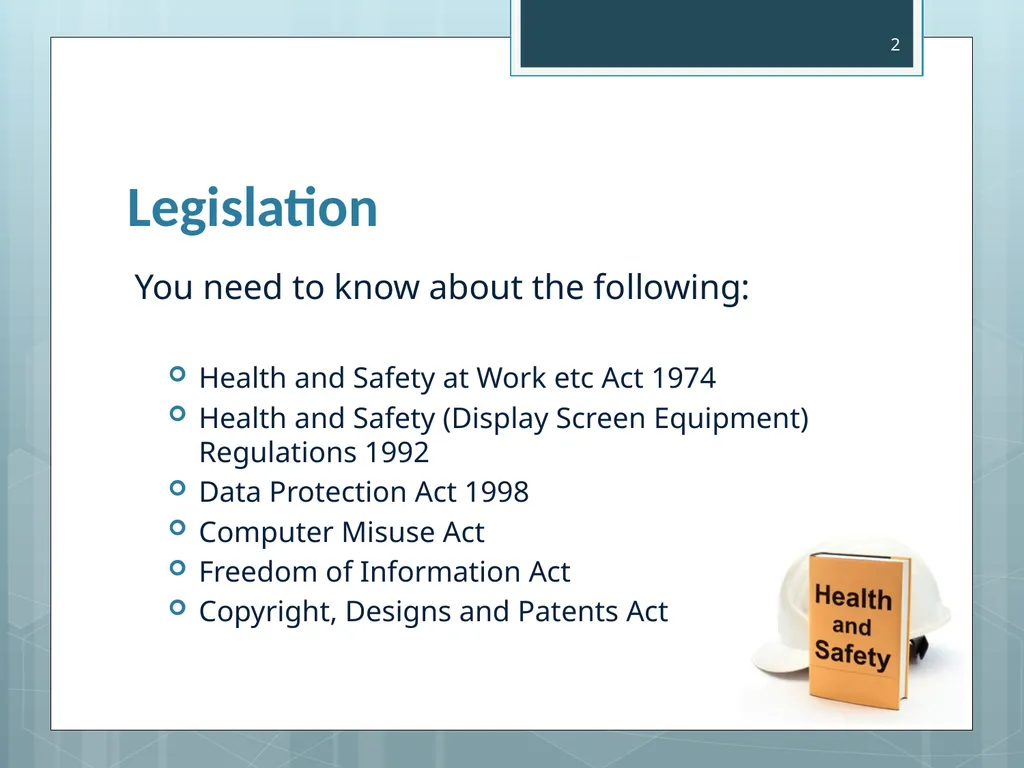
Legislation You need to know about the following:
Health and Safety at Work etc Act 1974
Health and Safety (Display Screen Equipment) Regulations 1992
Data Protection Act 1998
Computer Misuse Act
Freedom of Information Act
Copyright, Designs and Patents Act 2<br>
Health and Safety at Work etc Act 1974
Health and Safety (Display Screen Equipment) Regulations 1992
Data Protection Act 1998
Computer Misuse Act
Freedom of Information Act
Copyright, Designs and Patents Act 2<br>
03
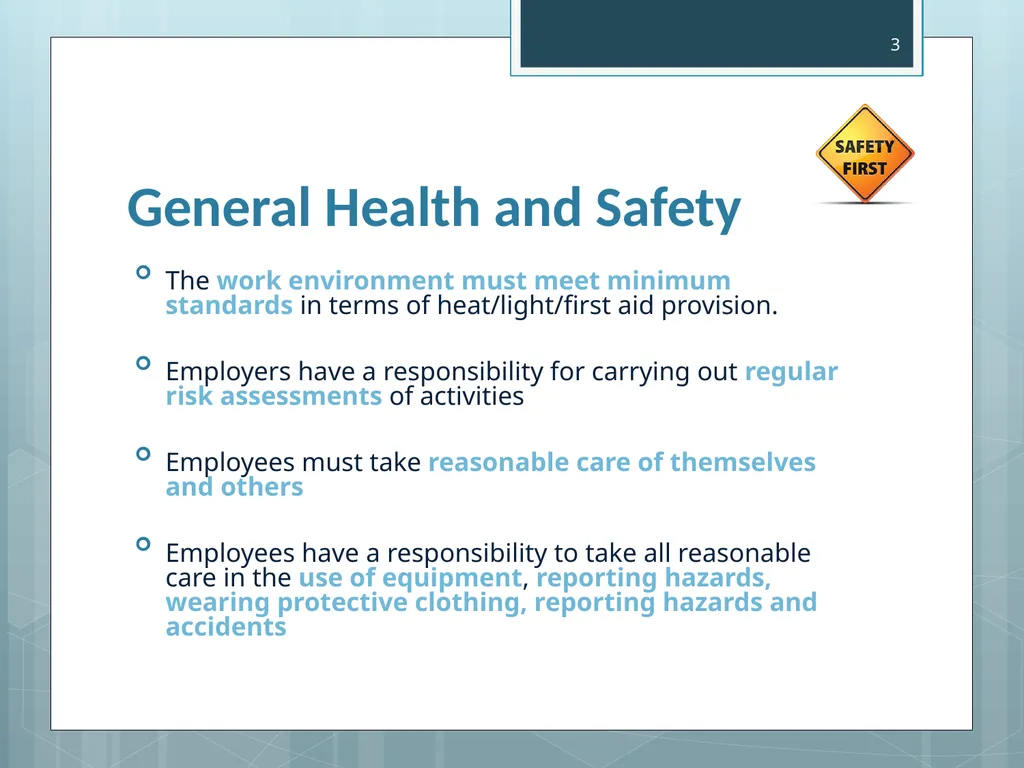
General Health and Safety The work environment must meet minimum standards in terms of heat/light/first aid provision.
Employers have a responsibility for carrying out regular risk assessments of activities
Employees must take reasonable care of themselves and others
Employees have a responsibility to take all reasonable care in the use of equipment, reporting hazards, wearing protective clothing, reporting hazards and accidents 3<br>
Employers have a responsibility for carrying out regular risk assessments of activities
Employees must take reasonable care of themselves and others
Employees have a responsibility to take all reasonable care in the use of equipment, reporting hazards, wearing protective clothing, reporting hazards and accidents 3<br>
04
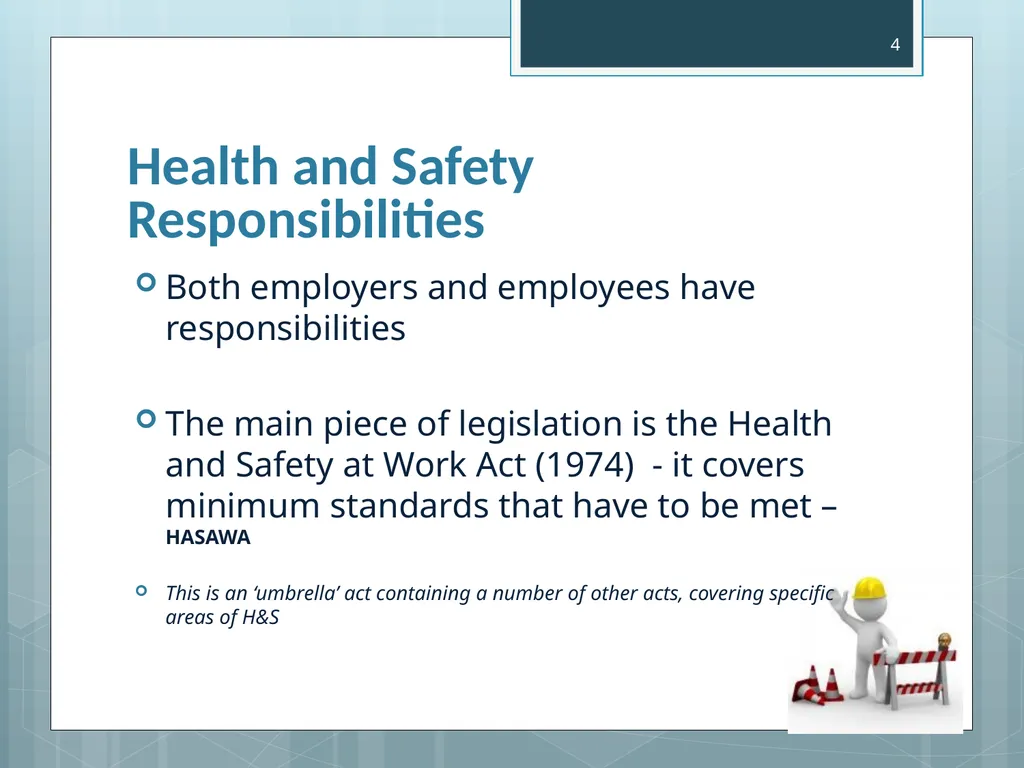
Health and Safety Responsibilities Both employers and employees have responsibilities
The main piece of legislation is the Health and Safety at Work Act (1974) - it covers minimum standards that have to be met – HASAWA
This is an ‘umbrella’ act containing a number of other acts, covering specific areas of H&S 4<br>
The main piece of legislation is the Health and Safety at Work Act (1974) - it covers minimum standards that have to be met – HASAWA
This is an ‘umbrella’ act containing a number of other acts, covering specific areas of H&S 4<br>
05
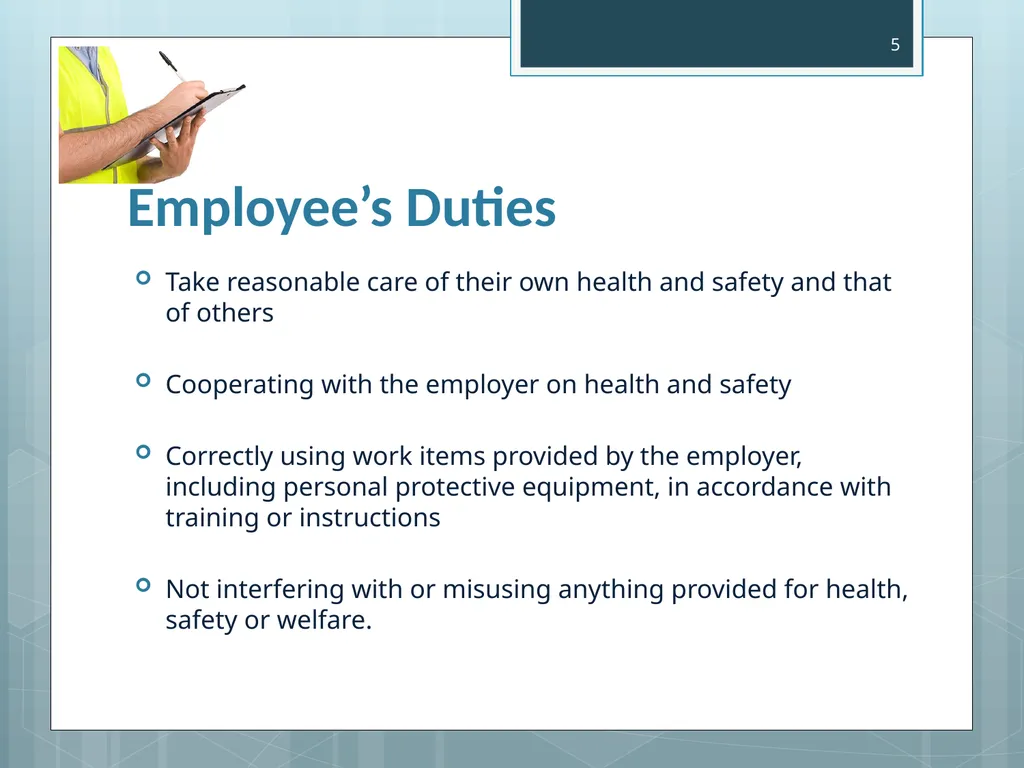
Employee’s Duties Take reasonable care of their own health and safety and that of others
Cooperating with the employer on health and safety
Correctly using work items provided by the employer, including personal protective equipment, in accordance with training or instructions
Not interfering with or misusing anything provided for health, safety or welfare. 5<br>
Cooperating with the employer on health and safety
Correctly using work items provided by the employer, including personal protective equipment, in accordance with training or instructions
Not interfering with or misusing anything provided for health, safety or welfare. 5<br>
06
Employer’s Duties Making the workplace safe and without risks to health for everyone including regular maintenance of equipment
Establish safe methods of working and carry out regular risk assessments
Ensuring ‘articles’ and substances are moved, stored and used safely
Providing adequate welfare facilities eg toilet facilities
Give the information, instruction, training and supervision necessary for employee health and safety. (including induction training)
If there are 5 or more employees - a health and safety policy statement is required 6<br>
Establish safe methods of working and carry out regular risk assessments
Ensuring ‘articles’ and substances are moved, stored and used safely
Providing adequate welfare facilities eg toilet facilities
Give the information, instruction, training and supervision necessary for employee health and safety. (including induction training)
If there are 5 or more employees - a health and safety policy statement is required 6<br>
07
Internet Research Visit the Health and Safety Executive.
This website has lots of very useful information and is an excellent way of keeping up to date with the changes in legislation.
Follow the links to find out what procedures need to be followed to report an incident at work. What does RIDDOR stand for? Also follow the link to find out what your rights and responsibilities as a worker are. Produce a display to communicate your findings 7<br>
This website has lots of very useful information and is an excellent way of keeping up to date with the changes in legislation.
Follow the links to find out what procedures need to be followed to report an incident at work. What does RIDDOR stand for? Also follow the link to find out what your rights and responsibilities as a worker are. Produce a display to communicate your findings 7<br>
08
Other HASAWA Legislation Reporting of Injuries, Diseases and Dangerous Occurrences Regulations (RIDDOR) 1995
Health and Safety (Display Screen Equipment) Regulations 1992
Control of Substances Hazardous to Health (COSHH) 2002
In addition in 1993 six European Health and Safety directives were enforced in the UK – the six-pack
Research these pieces of legislation and produce a short paragraph on each – covering some of the main points 8<br>
Health and Safety (Display Screen Equipment) Regulations 1992
Control of Substances Hazardous to Health (COSHH) 2002
In addition in 1993 six European Health and Safety directives were enforced in the UK – the six-pack
Research these pieces of legislation and produce a short paragraph on each – covering some of the main points 8<br>
09
Informing Employees
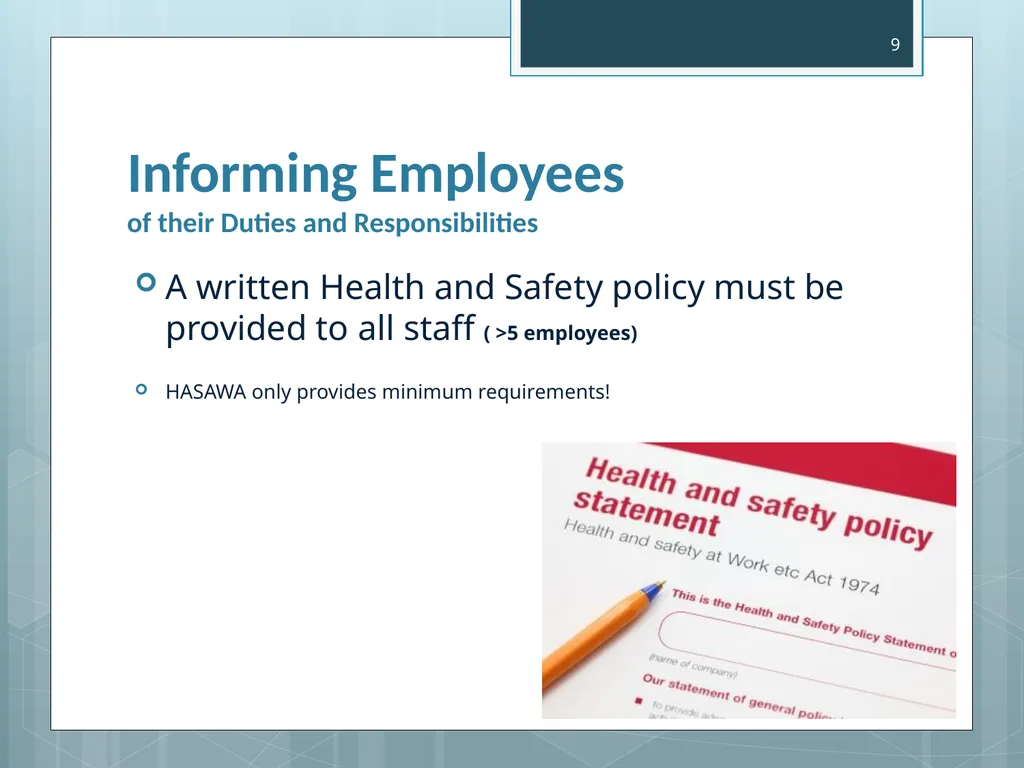
of their Duties and Responsibilities A written Health and Safety policy must be provided to all staff ( >5 employees)
HASAWA only provides minimum requirements! 9<br>
HASAWA only provides minimum requirements! 9<br>
10
Informing Employees
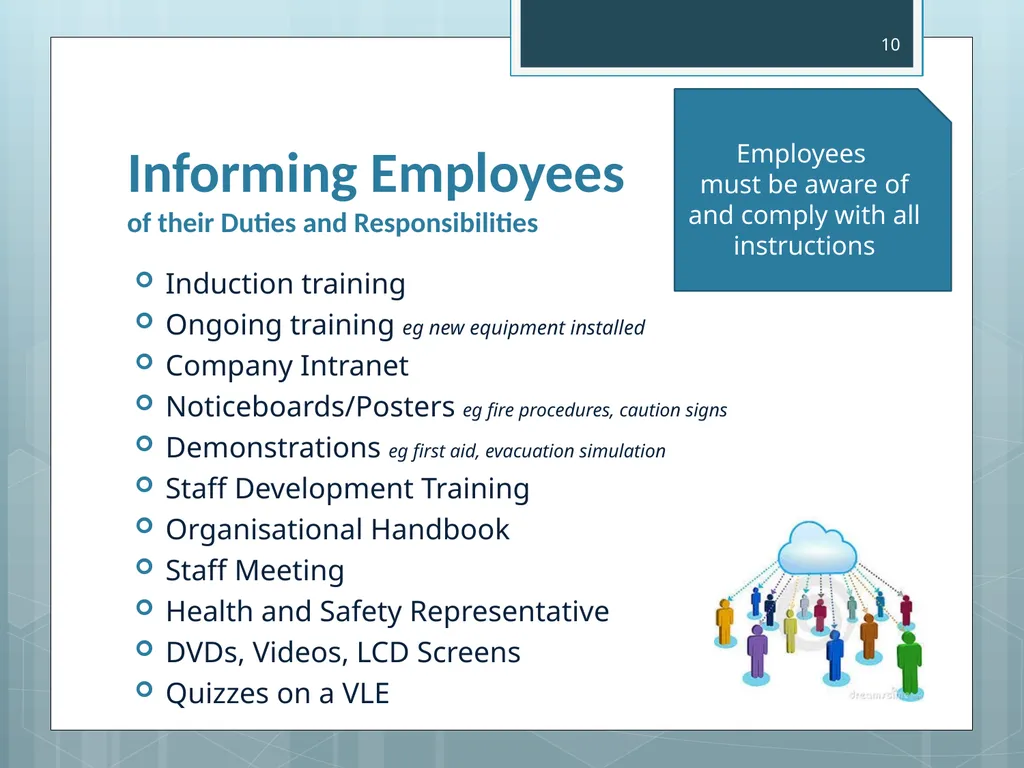
of their Duties and Responsibilities Induction training
Ongoing training eg new equipment installed
Company Intranet
Noticeboards/Posters eg fire procedures, caution signs
Demonstrations eg first aid, evacuation simulation
Staff Development Training
Organisational Handbook
Staff Meeting
Health and Safety Representative
DVDs, Videos, LCD Screens
Quizzes on a VLE Employees
must be aware of and comply with all instructions 10<br>
Ongoing training eg new equipment installed
Company Intranet
Noticeboards/Posters eg fire procedures, caution signs
Demonstrations eg first aid, evacuation simulation
Staff Development Training
Organisational Handbook
Staff Meeting
Health and Safety Representative
DVDs, Videos, LCD Screens
Quizzes on a VLE Employees
must be aware of and comply with all instructions 10<br>
11
The Health and Safety Executive
including local Environmental Health Departments Enter and inspect premises – sometimes unannounced.
Issue improvement notices and provide advice.
Question and interview people and give warnings.
Shut down premises.
Fine or prosecute when necessary. 11<br>
Issue improvement notices and provide advice.
Question and interview people and give warnings.
Shut down premises.
Fine or prosecute when necessary. 11<br>
12
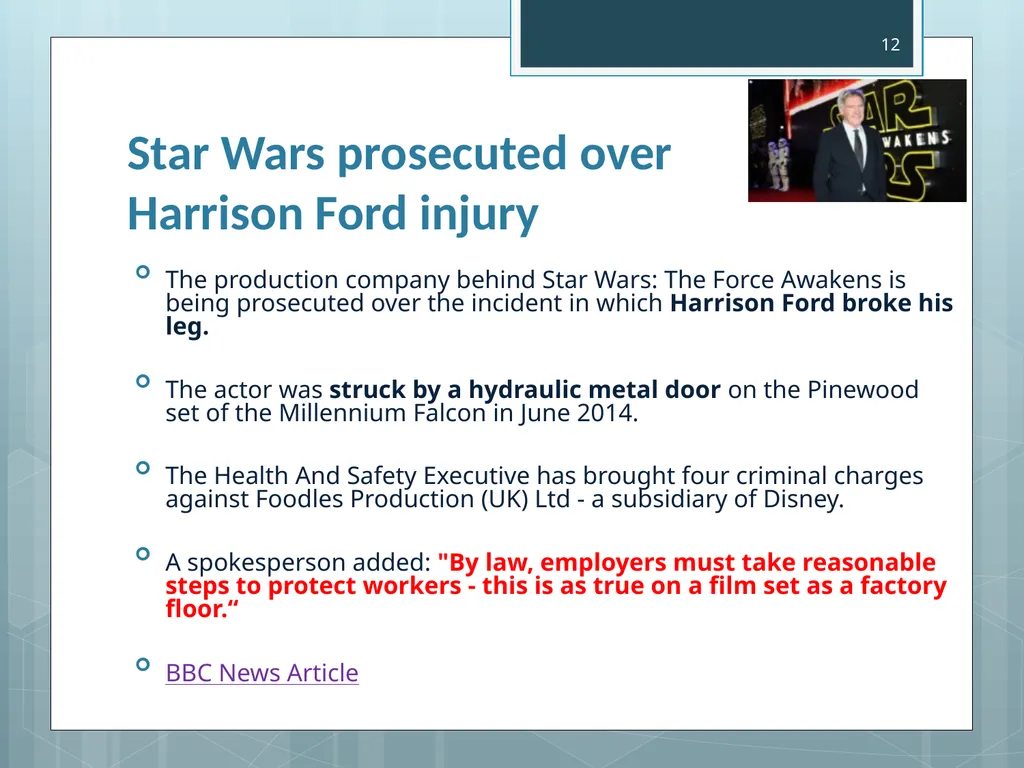
Star Wars prosecuted over Harrison Ford injury The production company behind Star Wars: The Force Awakens is being prosecuted over the incident in which Harrison Ford broke his leg.
The actor was struck by a hydraulic metal door on the Pinewood set of the Millennium Falcon in June 2014.
The Health And Safety Executive has brought four criminal charges against Foodles Production (UK) Ltd - a subsidiary of Disney.
A spokesperson added: "By law, employers must take reasonable steps to protect workers - this is as true on a film set as a factory floor.“
BBC News Article 12<br>
The actor was struck by a hydraulic metal door on the Pinewood set of the Millennium Falcon in June 2014.
The Health And Safety Executive has brought four criminal charges against Foodles Production (UK) Ltd - a subsidiary of Disney.
A spokesperson added: "By law, employers must take reasonable steps to protect workers - this is as true on a film set as a factory floor.“
BBC News Article 12<br>
13
Industrial Tribunals Employees can take an organisation to an Industrial Tribunal if they believe the organisation has breached the legislation designed to protect them eg
Non-provision of safety equipment
Failure to remedy a hazard – injury occurred 13<br>
Non-provision of safety equipment
Failure to remedy a hazard – injury occurred 13<br>
14
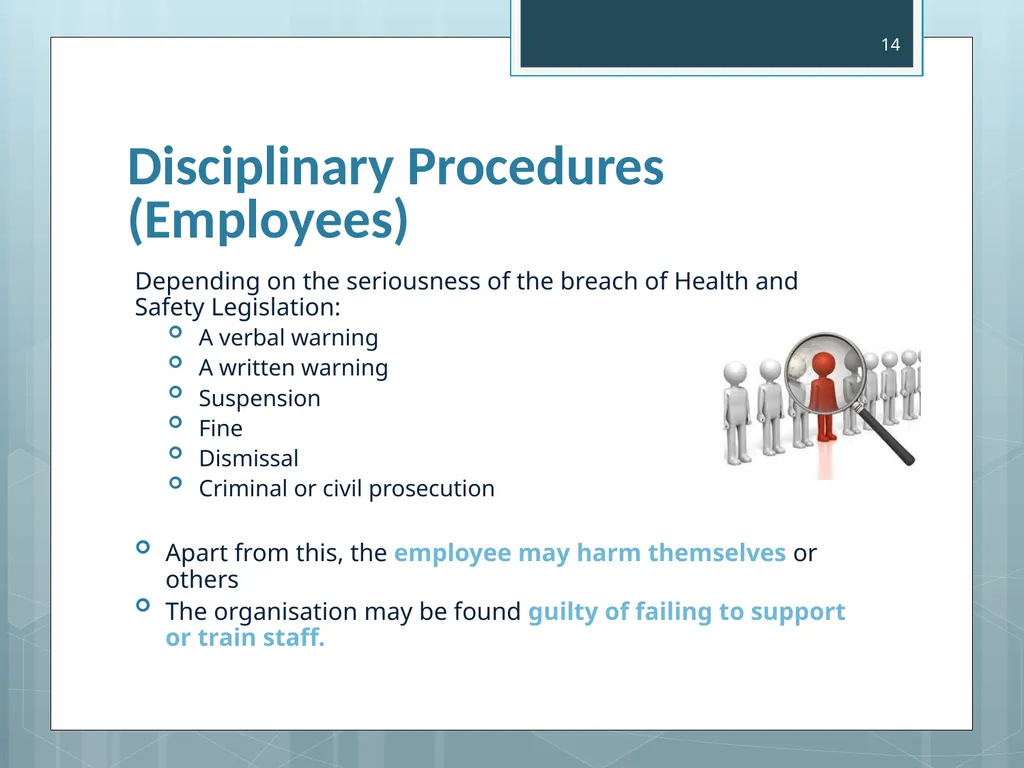
Disciplinary Procedures (Employees) Depending on the seriousness of the breach of Health and Safety Legislation:
A verbal warning
A written warning
Suspension
Fine
Dismissal
Criminal or civil prosecution
Apart from this, the employee may harm themselves or others
The organisation may be found guilty of failing to support or train staff. 14<br>
A verbal warning
A written warning
Suspension
Fine
Dismissal
Criminal or civil prosecution
Apart from this, the employee may harm themselves or others
The organisation may be found guilty of failing to support or train staff. 14<br>
15
Further Consequences (Employee) Employment terminated
Poor job reference
Lack of income – financial hardship
Demoted
May harm customer indirectly by misusing information – stress/guilt/demotivation 15<br>
Poor job reference
Lack of income – financial hardship
Demoted
May harm customer indirectly by misusing information – stress/guilt/demotivation 15<br>
16
Further Consequences (Employer) Unwanted media attention
Company reputation damaged
Loss of new customers/sales/profits
Existing customers switch to rival
Difficult to attract high quality candidates in the recruitment process
Legal action (costly) -
Fines/sanctions/compensation payments
May be forced to close down business 16<br>
Company reputation damaged
Loss of new customers/sales/profits
Existing customers switch to rival
Difficult to attract high quality candidates in the recruitment process
Legal action (costly) -
Fines/sanctions/compensation payments
May be forced to close down business 16<br>
17
Health and Safety (Display Screen Equipment) Regulations 1992 If you had written this legislation what would you include? 17<br>
18
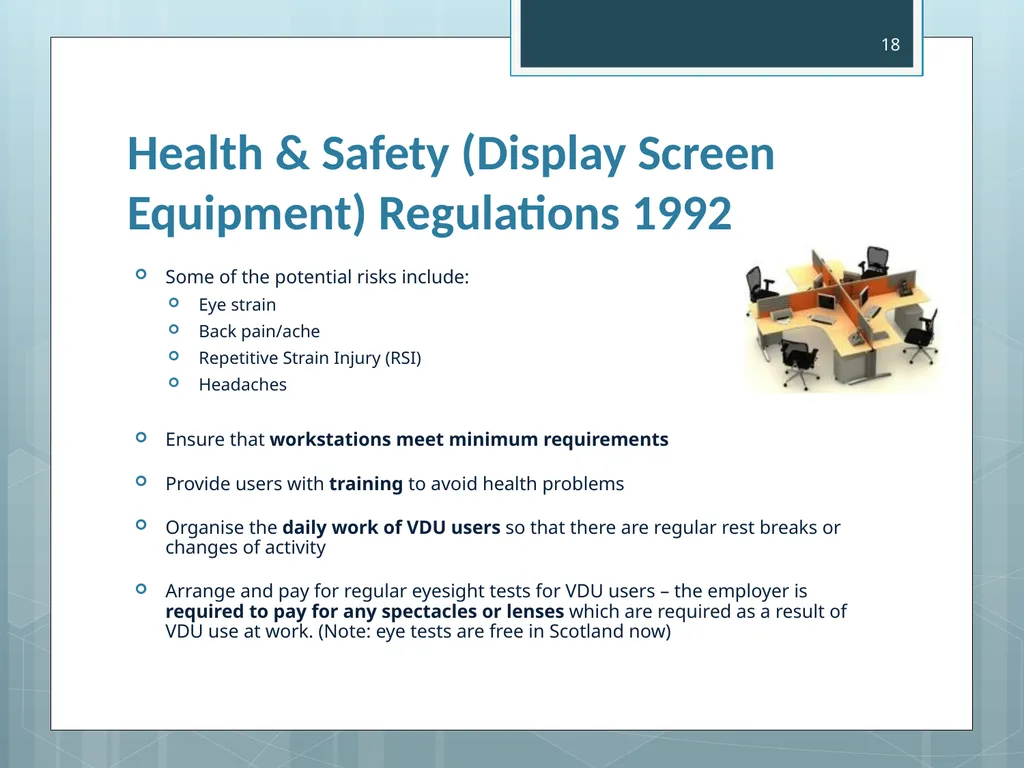
Health & Safety (Display Screen Equipment) Regulations 1992 Some of the potential risks include:
Eye strain
Back pain/ache
Repetitive Strain Injury (RSI)
Headaches
Ensure that workstations meet minimum requirements
Provide users with training to avoid health problems
Organise the daily work of VDU users so that there are regular rest breaks or changes of activity
Arrange and pay for regular eyesight tests for VDU users – the employer is required to pay for any spectacles or lenses which are required as a result of VDU use at work. (Note: eye tests are free in Scotland now) 18<br>
Eye strain
Back pain/ache
Repetitive Strain Injury (RSI)
Headaches
Ensure that workstations meet minimum requirements
Provide users with training to avoid health problems
Organise the daily work of VDU users so that there are regular rest breaks or changes of activity
Arrange and pay for regular eyesight tests for VDU users – the employer is required to pay for any spectacles or lenses which are required as a result of VDU use at work. (Note: eye tests are free in Scotland now) 18<br>
19
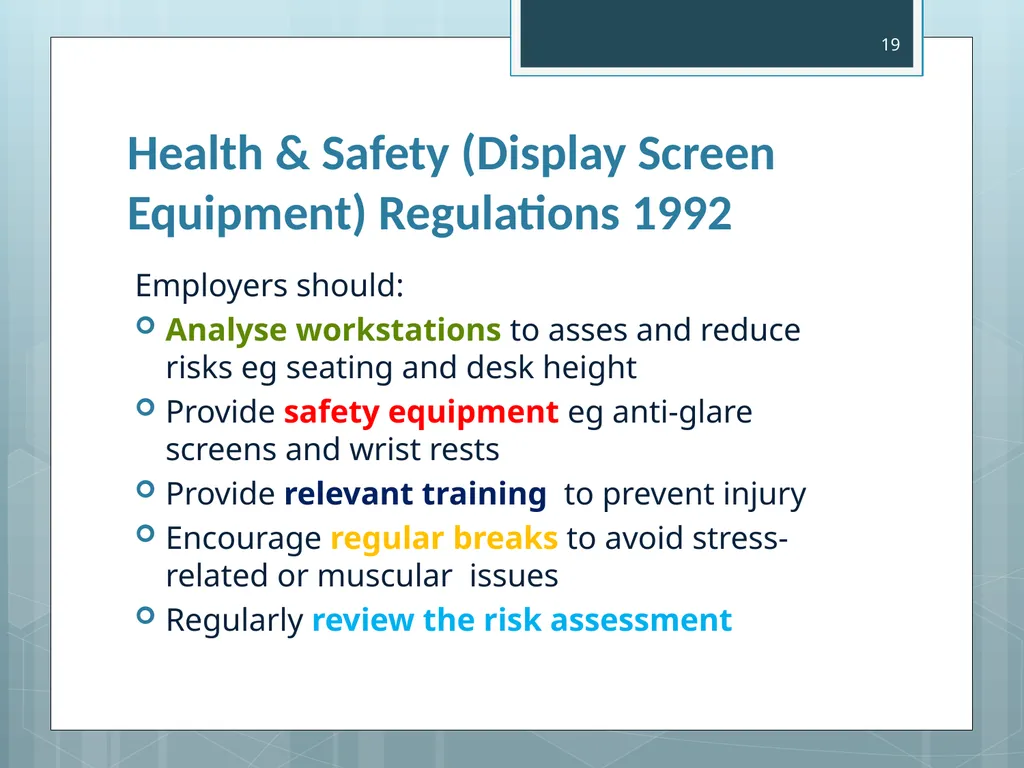
Health & Safety (Display Screen Equipment) Regulations 1992 Employers should:
Analyse workstations to asses and reduce risks eg seating and desk height
Provide safety equipment eg anti-glare screens and wrist rests
Provide relevant training to prevent injury
Encourage regular breaks to avoid stress-related or muscular issues
Regularly review the risk assessment 19<br>
Analyse workstations to asses and reduce risks eg seating and desk height
Provide safety equipment eg anti-glare screens and wrist rests
Provide relevant training to prevent injury
Encourage regular breaks to avoid stress-related or muscular issues
Regularly review the risk assessment 19<br>
20
Fire Precautions (Places of Work) Regulations 1995 If you had written this legislation what would you include? 20<br>
21
Fire Precautions (Places of Work) Regulations 1995 Under this legislation employers should:
Assess fire risks in the workplace
Check fire detection time and warning system
Check evacuation routes
Provide reasonable fire fighting equipment
Check employee knowledge of fire procedures
Check and maintain fire safety equipment 21<br>
Assess fire risks in the workplace
Check fire detection time and warning system
Check evacuation routes
Provide reasonable fire fighting equipment
Check employee knowledge of fire procedures
Check and maintain fire safety equipment 21<br>
22
Health and Safety (First Aid) Regulations 1981 If you had written this legislation what would you include? 22<br>
23
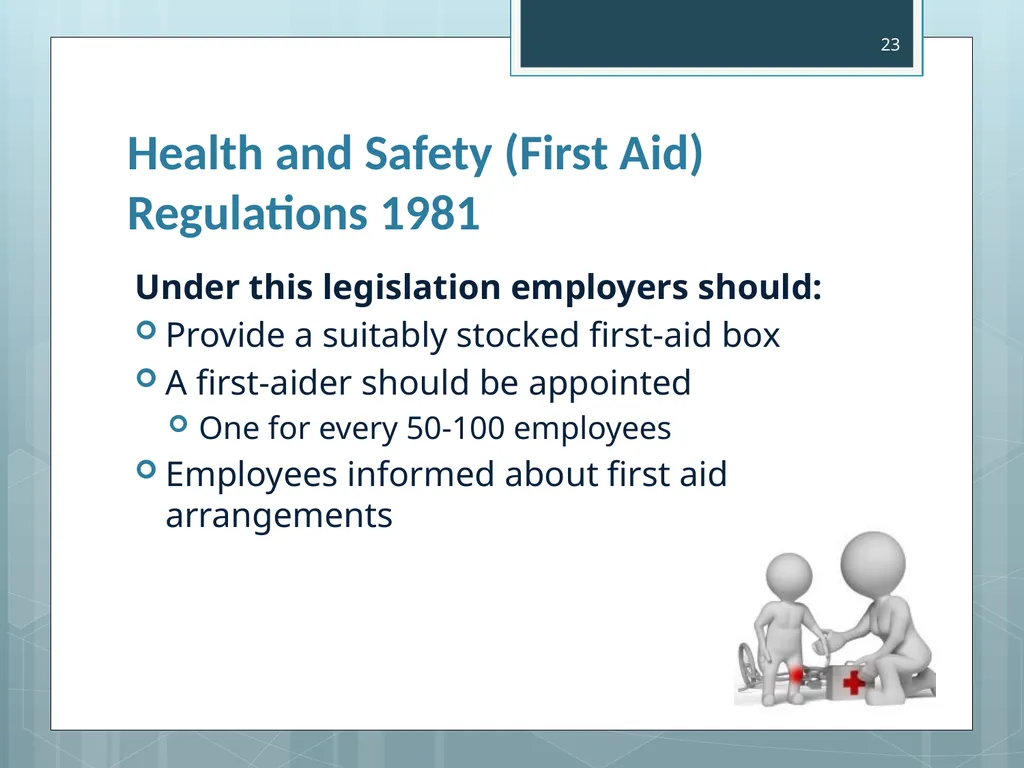
Health and Safety (First Aid) Regulations 1981 Under this legislation employers should:
Provide a suitably stocked first-aid box
A first-aider should be appointed
One for every 50-100 employees
Employees informed about first aid arrangements 23<br>
Provide a suitably stocked first-aid box
A first-aider should be appointed
One for every 50-100 employees
Employees informed about first aid arrangements 23<br>
24
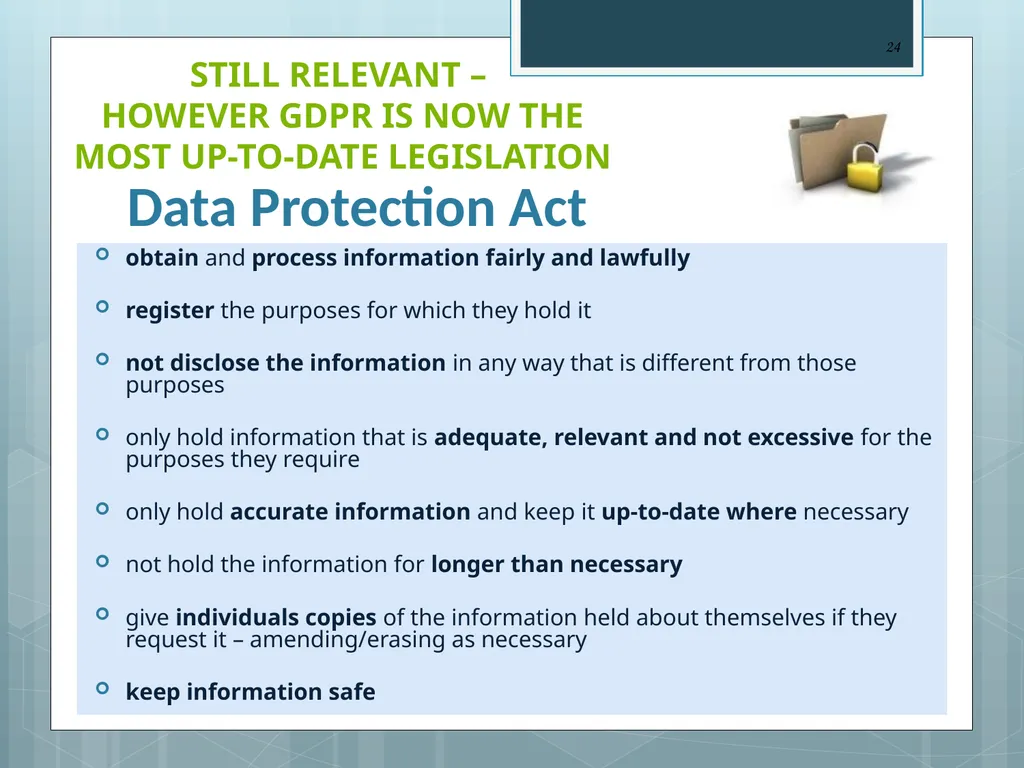
24 Data Protection Act obtain and process information fairly and lawfully
register the purposes for which they hold it
not disclose the information in any way that is different from those purposes
only hold information that is adequate, relevant and not excessive for the purposes they require
only hold accurate information and keep it up-to-date where necessary
not hold the information for longer than necessary
give individuals copies of the information held about themselves if they request it – amending/erasing as necessary
keep information safe STILL RELEVANT –
HOWEVER GDPR IS NOW THE MOST UP-TO-DATE LEGISLATION<br>
register the purposes for which they hold it
not disclose the information in any way that is different from those purposes
only hold information that is adequate, relevant and not excessive for the purposes they require
only hold accurate information and keep it up-to-date where necessary
not hold the information for longer than necessary
give individuals copies of the information held about themselves if they request it – amending/erasing as necessary
keep information safe STILL RELEVANT –
HOWEVER GDPR IS NOW THE MOST UP-TO-DATE LEGISLATION<br>
25
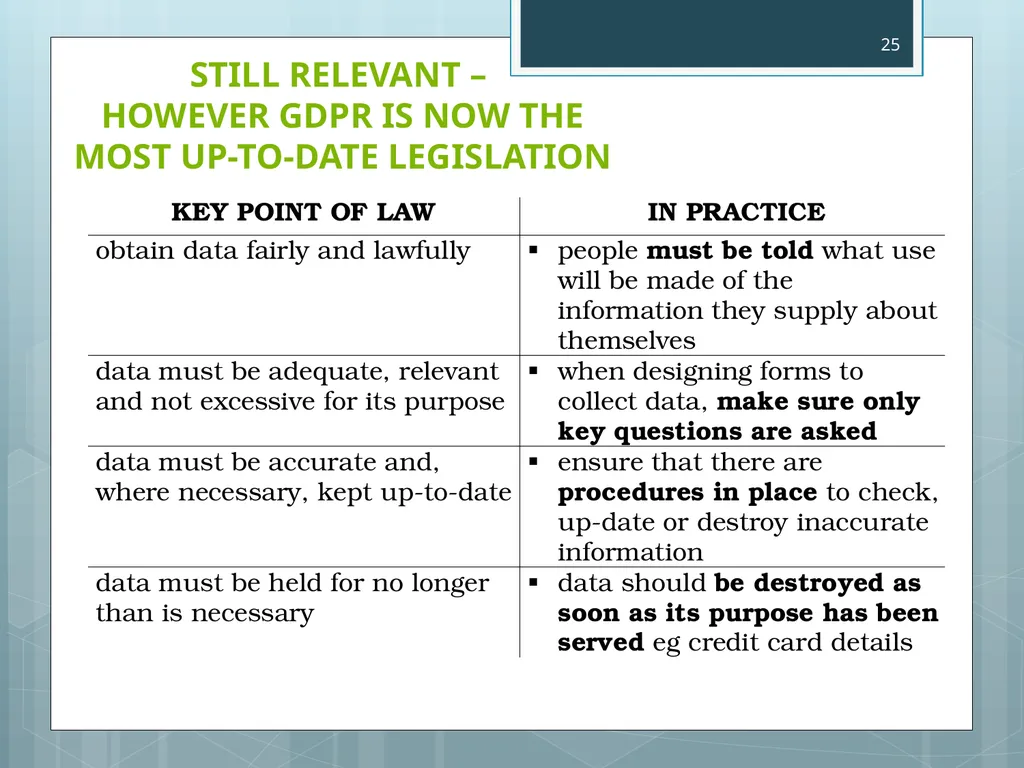
25 STILL RELEVANT –
HOWEVER GDPR IS NOW THE MOST UP-TO-DATE LEGISLATION<br>
HOWEVER GDPR IS NOW THE MOST UP-TO-DATE LEGISLATION<br>
26
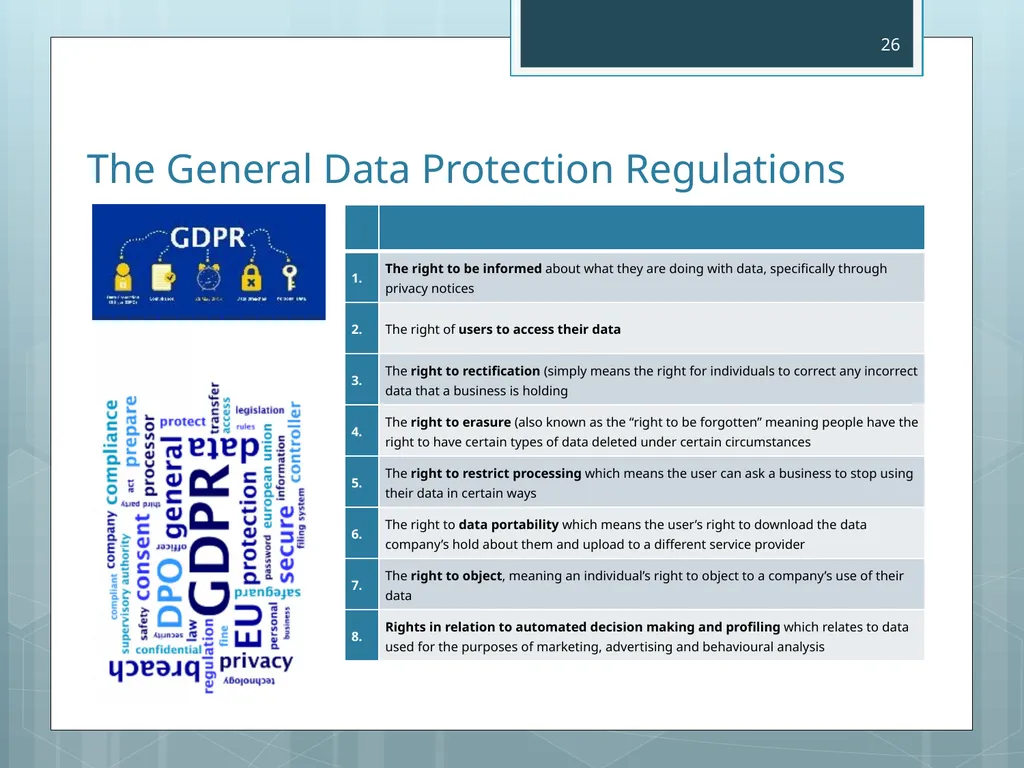
The General Data Protection Regulations 26<br>
27
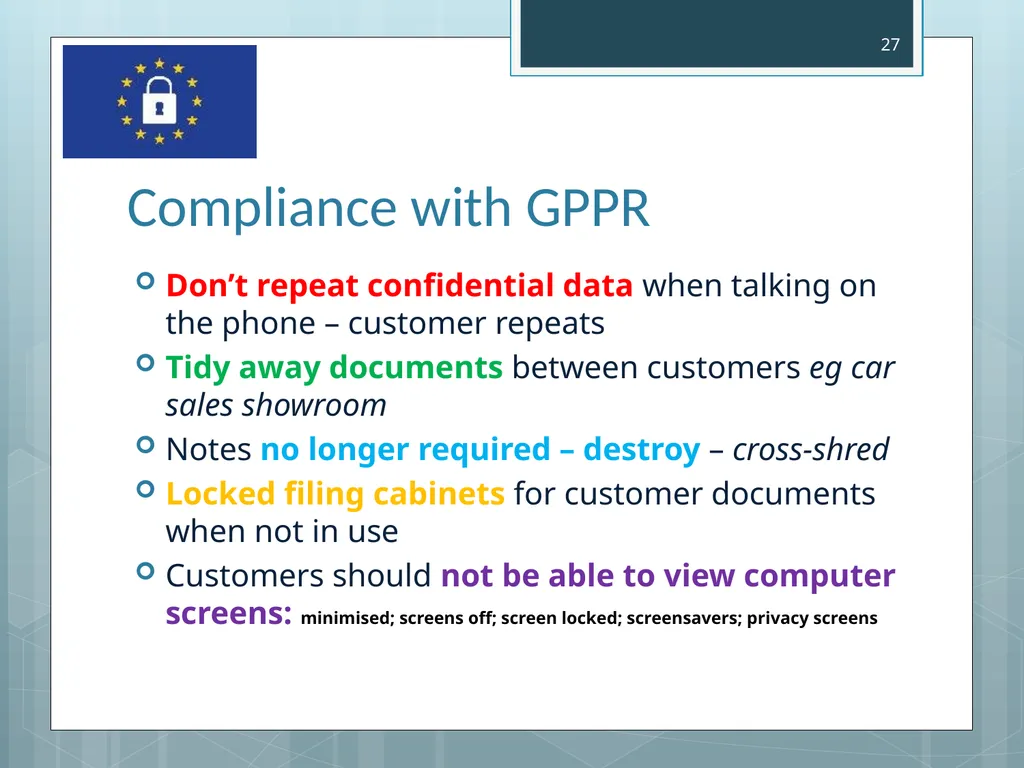
Compliance with GPPR Don’t repeat confidential data when talking on the phone – customer repeats
Tidy away documents between customers eg car sales showroom
Notes no longer required – destroy – cross-shred
Locked filing cabinets for customer documents when not in use
Customers should not be able to view computer screens: minimised; screens off; screen locked; screensavers; privacy screens 27<br>
Tidy away documents between customers eg car sales showroom
Notes no longer required – destroy – cross-shred
Locked filing cabinets for customer documents when not in use
Customers should not be able to view computer screens: minimised; screens off; screen locked; screensavers; privacy screens 27<br>
28
Compliance with GPPR Organisation should be registered with Government as a Data User
Staff should question people they do not recognise
Limit access to physical/electronic data as required – location of filing cabinets?
Keep a record of who accesses documents
Regularly check with data subject that information is accurate
Regularly destroy information no longer relevant 28<br>
Staff should question people they do not recognise
Limit access to physical/electronic data as required – location of filing cabinets?
Keep a record of who accesses documents
Regularly check with data subject that information is accurate
Regularly destroy information no longer relevant 28<br>
29
Good Information Handling Backup Data Regularly off-site
Backups should be encrypted
Passwords (complex) used to access IT Systems – changed regularly
File Management procedures and naming conventions
Hard-copies stored securely in locked filing cabinets. 29<br>
Backups should be encrypted
Passwords (complex) used to access IT Systems – changed regularly
File Management procedures and naming conventions
Hard-copies stored securely in locked filing cabinets. 29<br>
30
Internet Research Using your research skills find some examples of how Data Protection has been breached in recent years. 30<br>
31
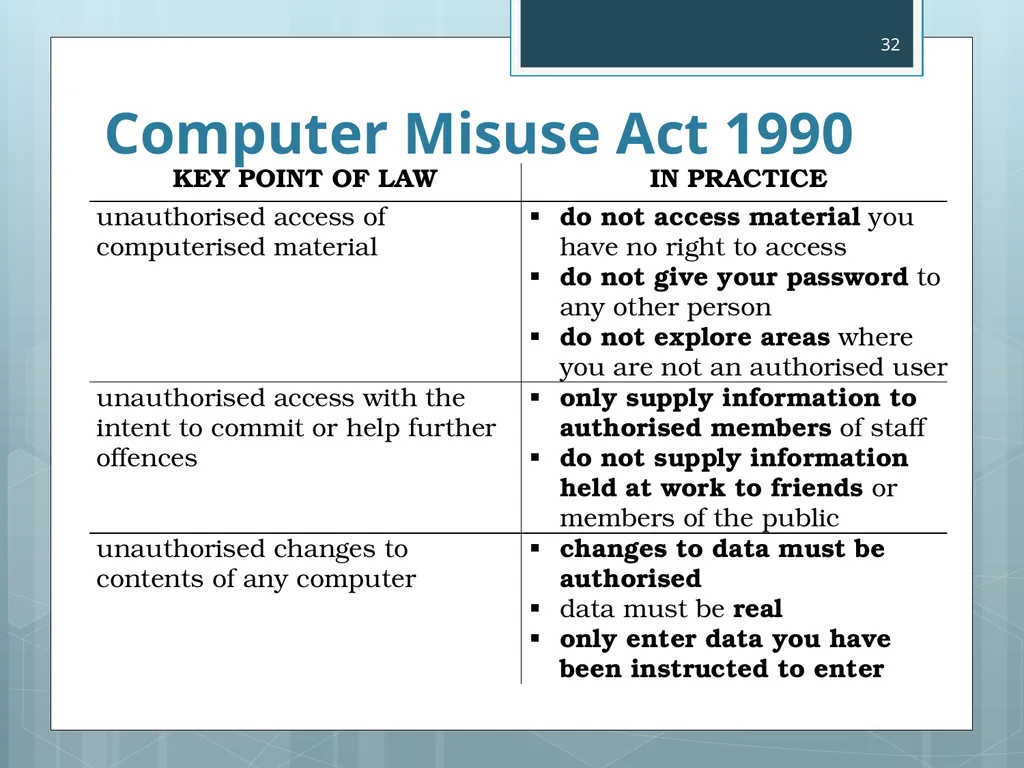
31 Computer Misuse Act 1990 accessing computer material without permission e.g. looking at someone else's files
accessing computer material without permission with intent to commit further criminal offences e.g. hacking into the bank's computer and increasing the amount in your account
altering computer material without permission e.g. writing a virus to destroy someone else's data
writing a virus or deliberately spreading one is illegal.<br>
accessing computer material without permission with intent to commit further criminal offences e.g. hacking into the bank's computer and increasing the amount in your account
altering computer material without permission e.g. writing a virus to destroy someone else's data
writing a virus or deliberately spreading one is illegal.<br>
32
Computer Misuse Act 1990 32<br>
33
Internet Research Using your research skills find some examples of how the Computer Misuse Act has been breached in recent years. 33<br>
34
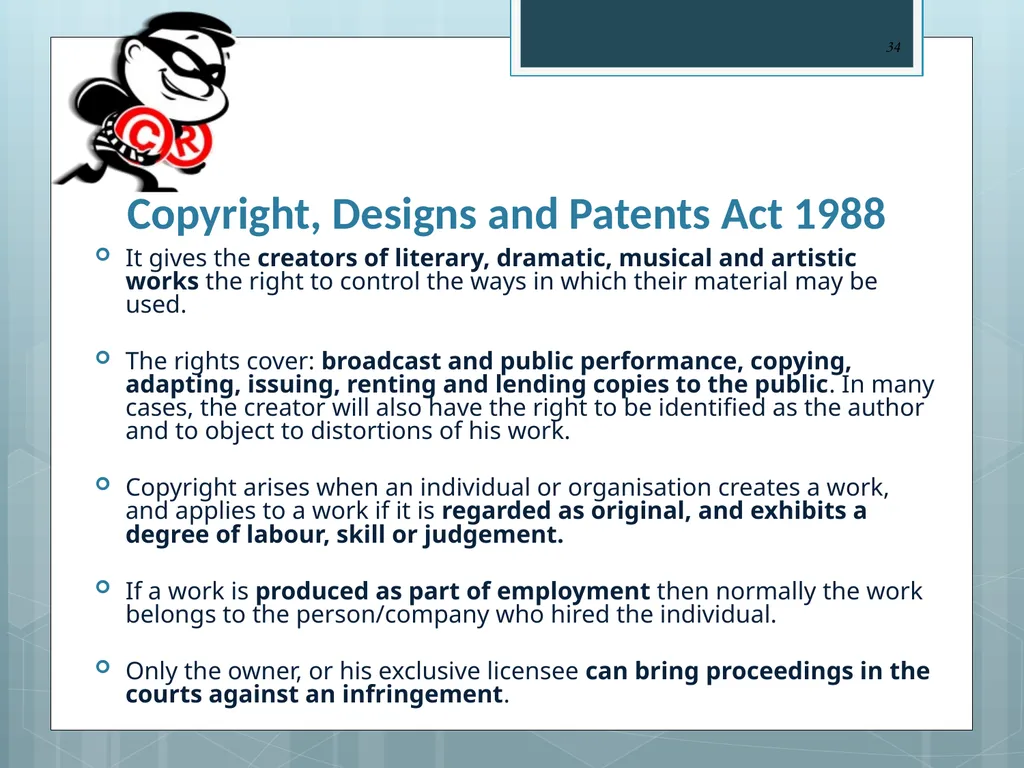
34 Copyright, Designs and Patents Act 1988 It gives the creators of literary, dramatic, musical and artistic works the right to control the ways in which their material may be used.
The rights cover: broadcast and public performance, copying, adapting, issuing, renting and lending copies to the public. In many cases, the creator will also have the right to be identified as the author and to object to distortions of his work.
Copyright arises when an individual or organisation creates a work, and applies to a work if it is regarded as original, and exhibits a degree of labour, skill or judgement.
If a work is produced as part of employment then normally the work belongs to the person/company who hired the individual.
Only the owner, or his exclusive licensee can bring proceedings in the courts against an infringement.<br>
The rights cover: broadcast and public performance, copying, adapting, issuing, renting and lending copies to the public. In many cases, the creator will also have the right to be identified as the author and to object to distortions of his work.
Copyright arises when an individual or organisation creates a work, and applies to a work if it is regarded as original, and exhibits a degree of labour, skill or judgement.
If a work is produced as part of employment then normally the work belongs to the person/company who hired the individual.
Only the owner, or his exclusive licensee can bring proceedings in the courts against an infringement.<br>
35
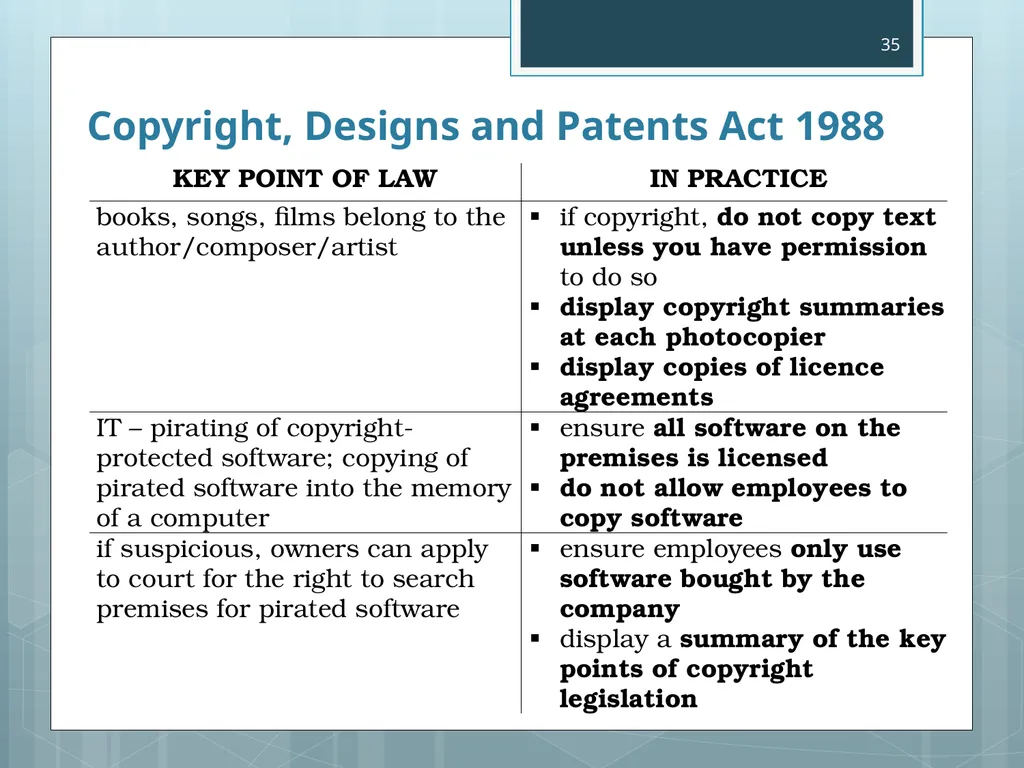
Copyright, Designs and Patents Act 1988 35<br>
36
Internet Research Using your research skills look at some Myths and Misconceptions surrounding the Copyright, Designs and Patents Act.
Myths and Misconceptions 36<br>
Myths and Misconceptions 36<br>
37
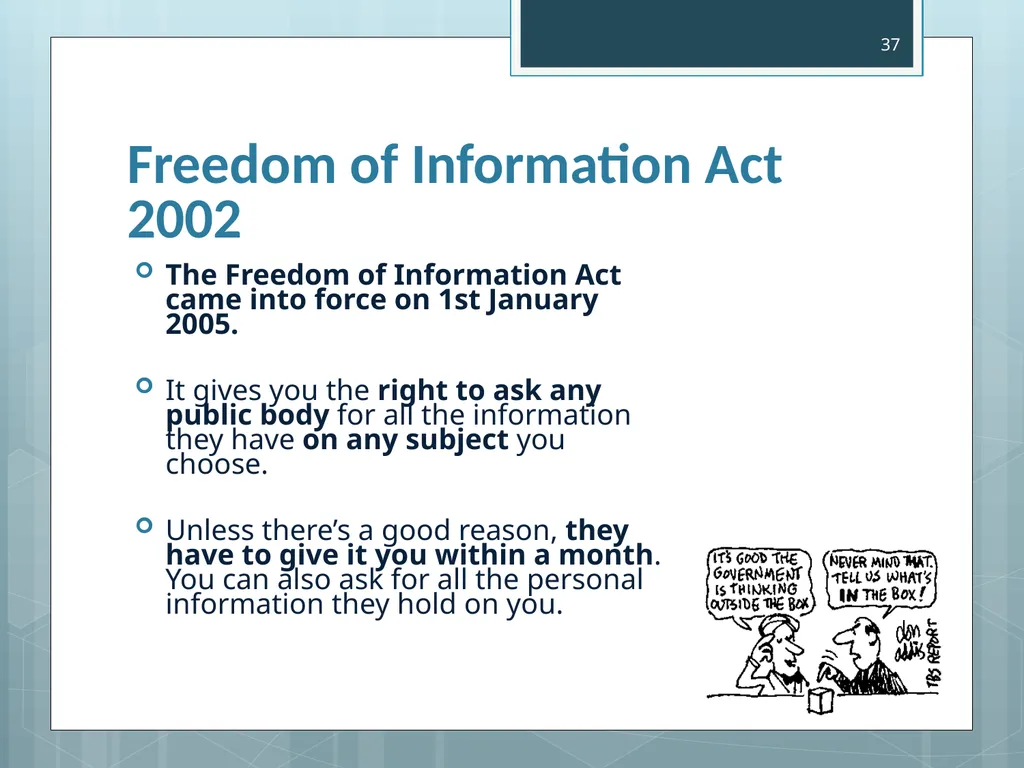
Freedom of Information Act 2002 The Freedom of Information Act came into force on 1st January 2005.
It gives you the right to ask any public body for all the information they have on any subject you choose.
Unless there’s a good reason, they have to give it you within a month. You can also ask for all the personal information they hold on you. 37<br>
It gives you the right to ask any public body for all the information they have on any subject you choose.
Unless there’s a good reason, they have to give it you within a month. You can also ask for all the personal information they hold on you. 37<br>
38
Freedom of Information Act 2002 Everyone has the right of access to official information
No reason required for asking for data
All requests must be treated equally
Only information that can be released to everybody can be disclosed. 38 Look at WhatDoTheyKnow.com<br>
No reason required for asking for data
All requests must be treated equally
Only information that can be released to everybody can be disclosed. 38 Look at WhatDoTheyKnow.com<br>
39
Internet Research Using your research skills find some examples of what has been found as a result of the Freedom of Information Act.
BBC News Article – 10 things 39<br>
BBC News Article – 10 things 39<br>
40
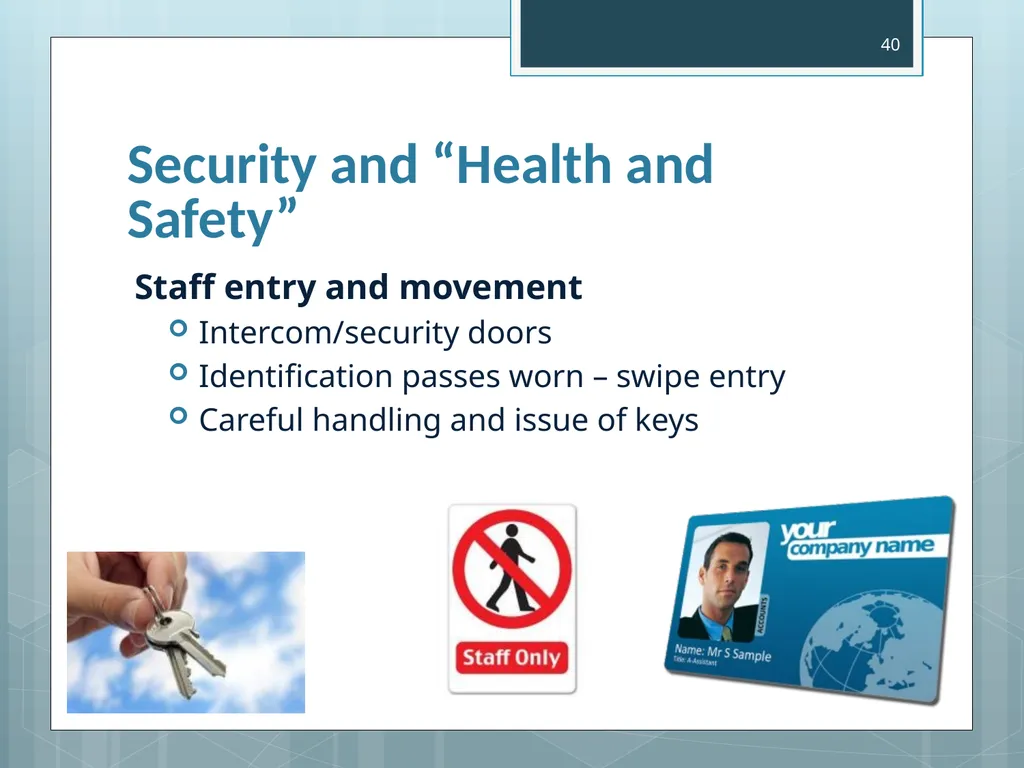
Security and “Health and Safety” Staff entry and movement
Intercom/security doors
Identification passes worn – swipe entry
Careful handling and issue of keys 40<br>
Intercom/security doors
Identification passes worn – swipe entry
Careful handling and issue of keys 40<br>
41
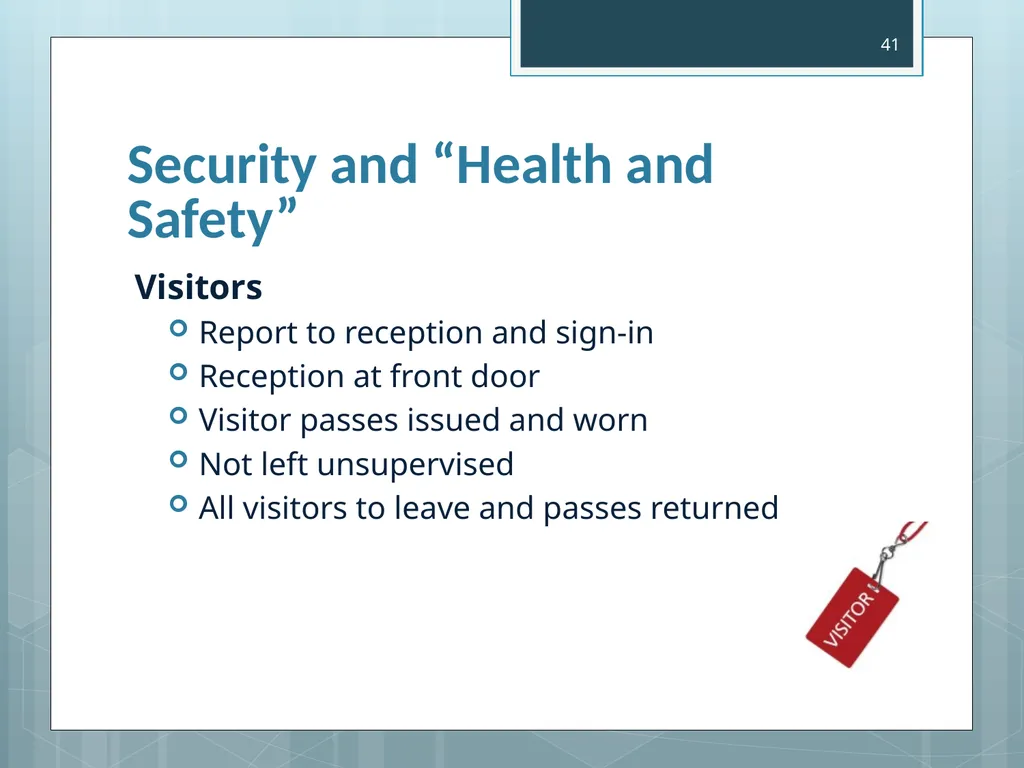
Security and “Health and Safety” Visitors
Report to reception and sign-in
Reception at front door
Visitor passes issued and worn
Not left unsupervised
All visitors to leave and passes returned 41<br>
Report to reception and sign-in
Reception at front door
Visitor passes issued and worn
Not left unsupervised
All visitors to leave and passes returned 41<br>
42
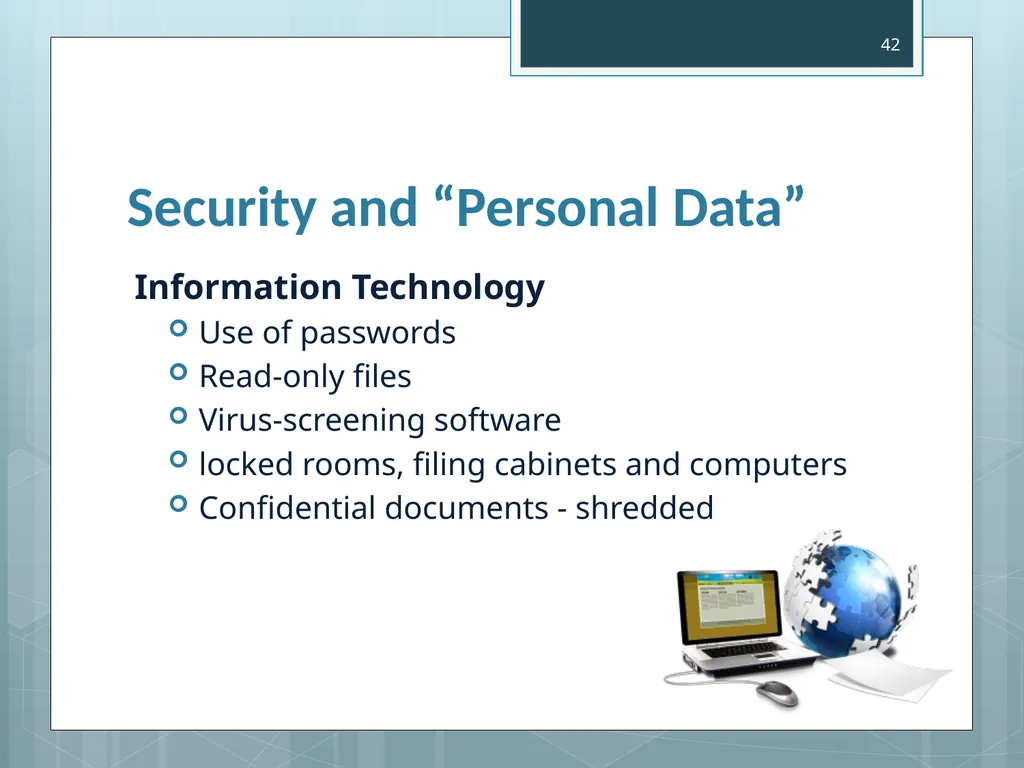
Security and “Personal Data” Information Technology
Use of passwords
Read-only files
Virus-screening software
locked rooms, filing cabinets and computers
Confidential documents - shredded 42<br>
Use of passwords
Read-only files
Virus-screening software
locked rooms, filing cabinets and computers
Confidential documents - shredded 42<br>
43
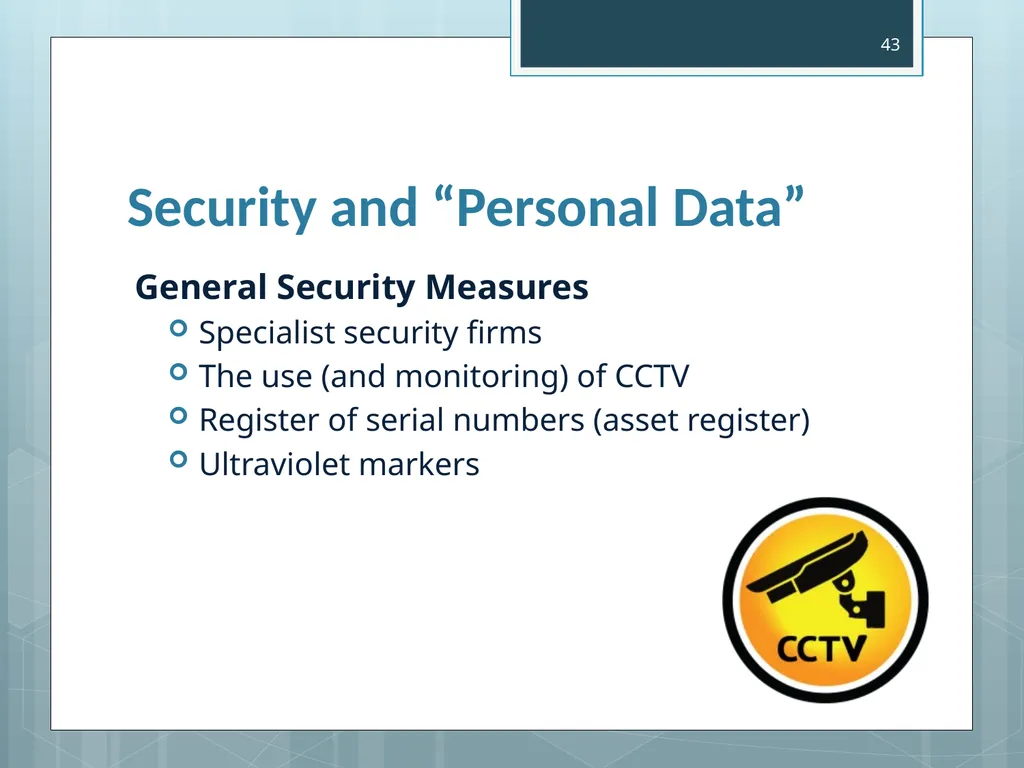
Security and “Personal Data” General Security Measures
Specialist security firms
The use (and monitoring) of CCTV
Register of serial numbers (asset register)
Ultraviolet markers 43<br>
Specialist security firms
The use (and monitoring) of CCTV
Register of serial numbers (asset register)
Ultraviolet markers 43<br>
44
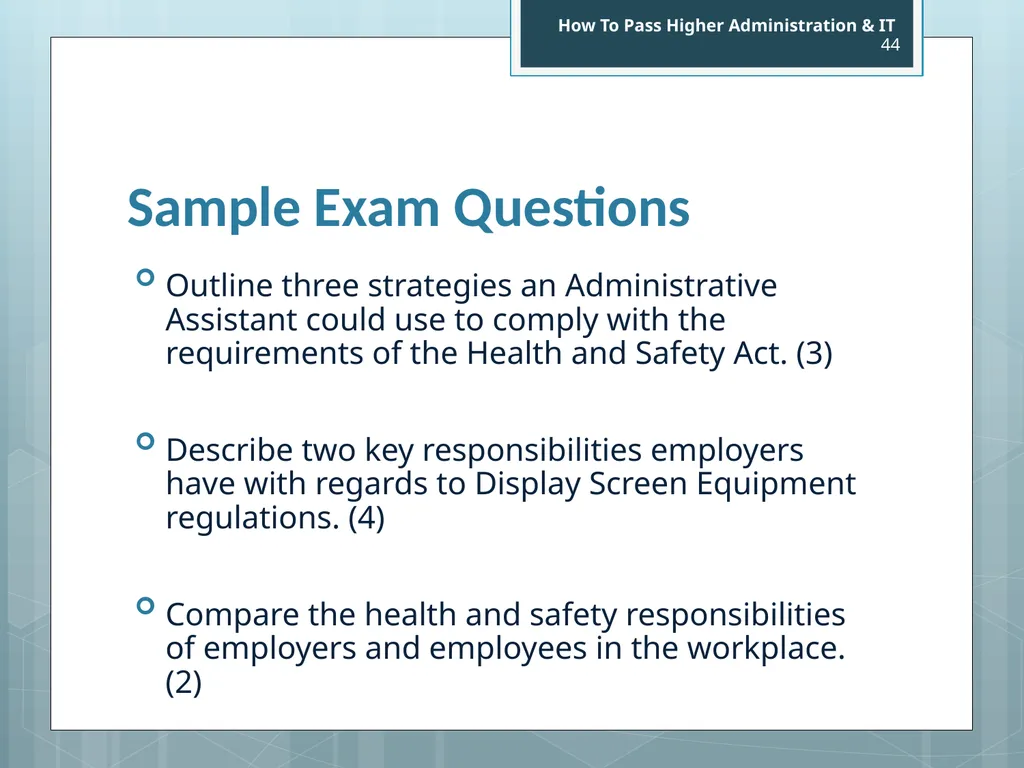
Sample Exam Questions Outline three strategies an Administrative Assistant could use to comply with the requirements of the Health and Safety Act. (3)
Describe two key responsibilities employers have with regards to Display Screen Equipment regulations. (4)
Compare the health and safety responsibilities of employers and employees in the workplace. (2) How To Pass Higher Administration & IT 44<br>
Describe two key responsibilities employers have with regards to Display Screen Equipment regulations. (4)
Compare the health and safety responsibilities of employers and employees in the workplace. (2) How To Pass Higher Administration & IT 44<br>
45
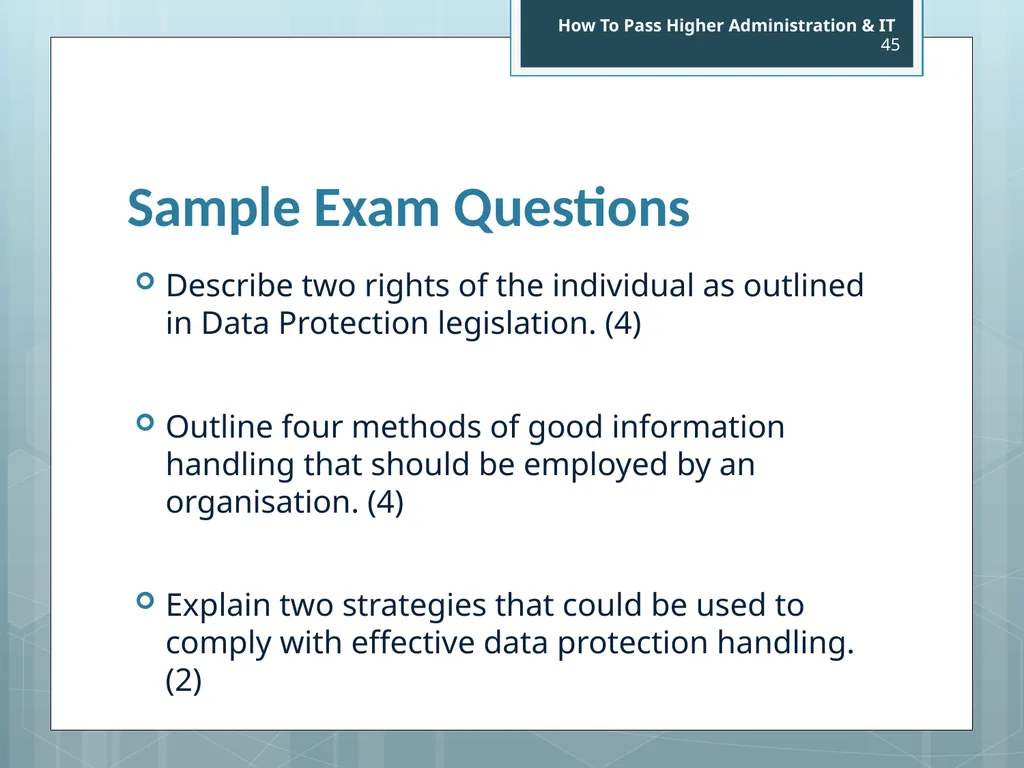
Sample Exam Questions Describe two rights of the individual as outlined in Data Protection legislation. (4)
Outline four methods of good information handling that should be employed by an organisation. (4)
Explain two strategies that could be used to comply with effective data protection handling. (2) How To Pass Higher Administration & IT 45<br>
Outline four methods of good information handling that should be employed by an organisation. (4)
Explain two strategies that could be used to comply with effective data protection handling. (2) How To Pass Higher Administration & IT 45<br>
46
Actual Examination Questions 46<br>
47
Higher Administration & IT Administrative Services
Outcome 1.3 47<br>
Outcome 1.3 47<br>