Higher education in Sweden Presentation to delegation from Institut des Hautes Etudes dAménagement des Territoires May 9, 2022 Anders Söderholm, director general Johan Gribbe, analyst Universities and university colleges by number of
"Higher education in Sweden Presentation to" is the property of its rightful owner. Permission is granted to
download and print the materials on this website for personal, non-commercial use only, and to display it
on your personal computer provided you do not modify the materials and that you retain all copyright
notices contained in the materials. By downloading content from our website, you accept the terms of this
agreement.
Presentation Transcript
01
Higher education in Sweden Presentation to delegation from
Institut des Hautes Etudes d'Aménagement des Territoires
May 9, 2022
Anders Söderholm, director general
Johan Gribbe, analyst<br>
02
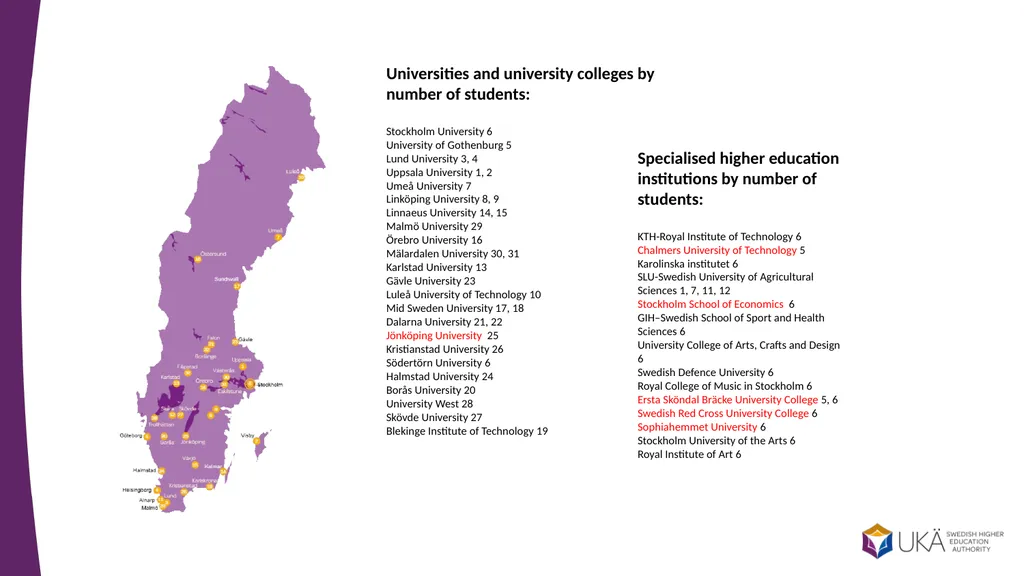
Universities and university colleges by number of students:
Stockholm University 6
University of Gothenburg 5
Lund University 3, 4
Uppsala University 1, 2
Umeå University 7
Linköping University 8, 9
Linnaeus University 14, 15
Malmö University 29
Örebro University 16
Mälardalen University 30, 31
Karlstad University 13
Gävle University 23
Luleå University of Technology 10
Mid Sweden University 17, 18
Dalarna University 21, 22
Jönköping University 25
Kristianstad University 26
Södertörn University 6
Halmstad University 24
Borås University 20
University West 28
Skövde University 27
Blekinge Institute of Technology 19 Specialised higher education institutions by number of students:
KTH-Royal Institute of Technology 6
Chalmers University of Technology 5
Karolinska institutet 6
SLU-Swedish University of Agricultural Sciences 1, 7, 11, 12
Stockholm School of Economics 6
GIH–Swedish School of Sport and Health Sciences 6
University College of Arts, Crafts and Design 6
Swedish Defence University 6
Royal College of Music in Stockholm 6
Ersta Sköndal Bräcke University College 5, 6
Swedish Red Cross University College 6
Sophiahemmet University 6
Stockholm University of the Arts 6
Royal Institute of Art 6<br>
03
Uniform system of higher education Sweden has a uniform system of higher education with the same legislation for all higher education institutions.
Both universities and university colleges conduct research and provide higher education at various levels, but they vary in how much focus is given to research.
The older universities have more extensive research than university colleges and the newer universities.<br>
04
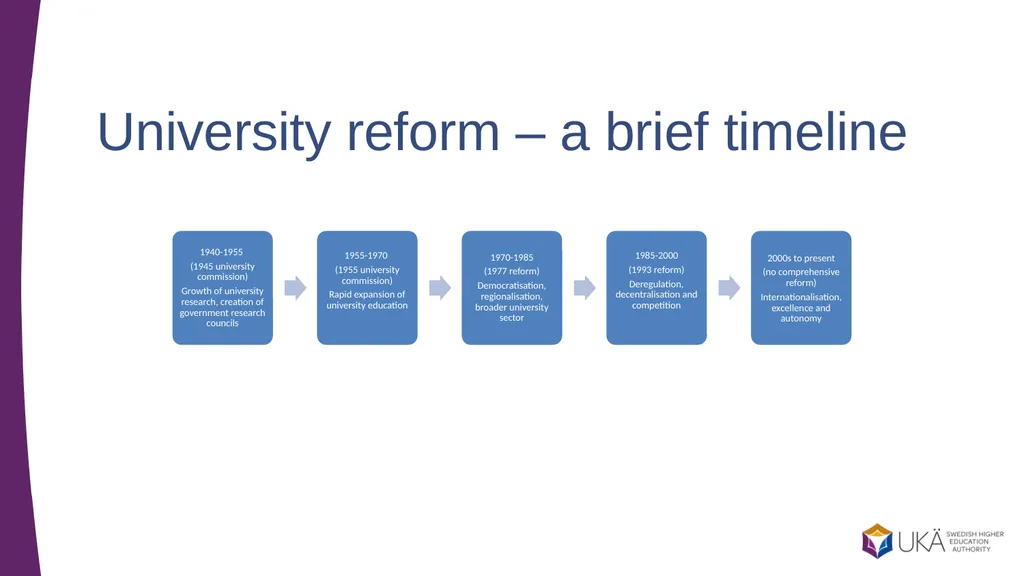
University reform – a brief timeline<br>
05
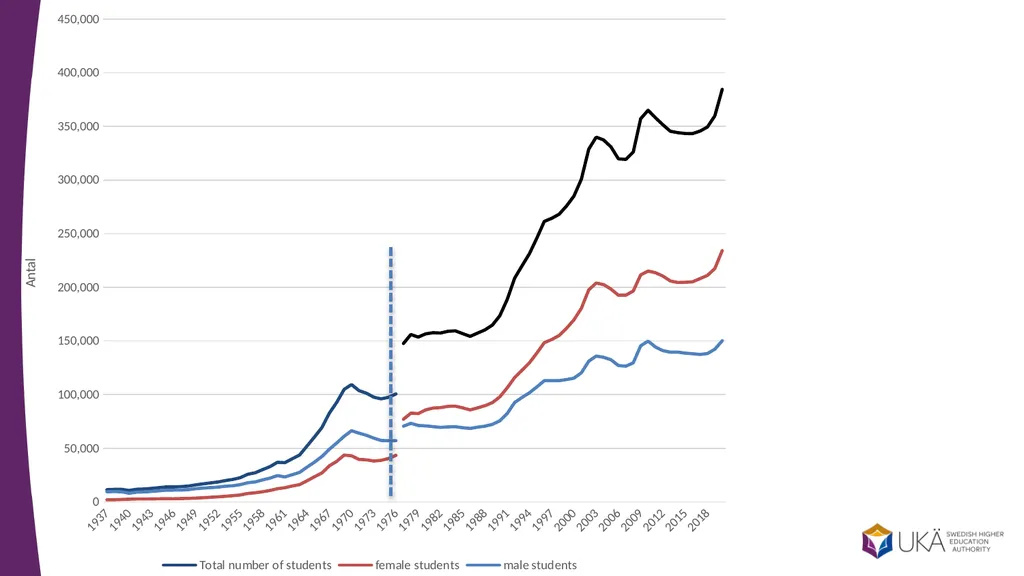
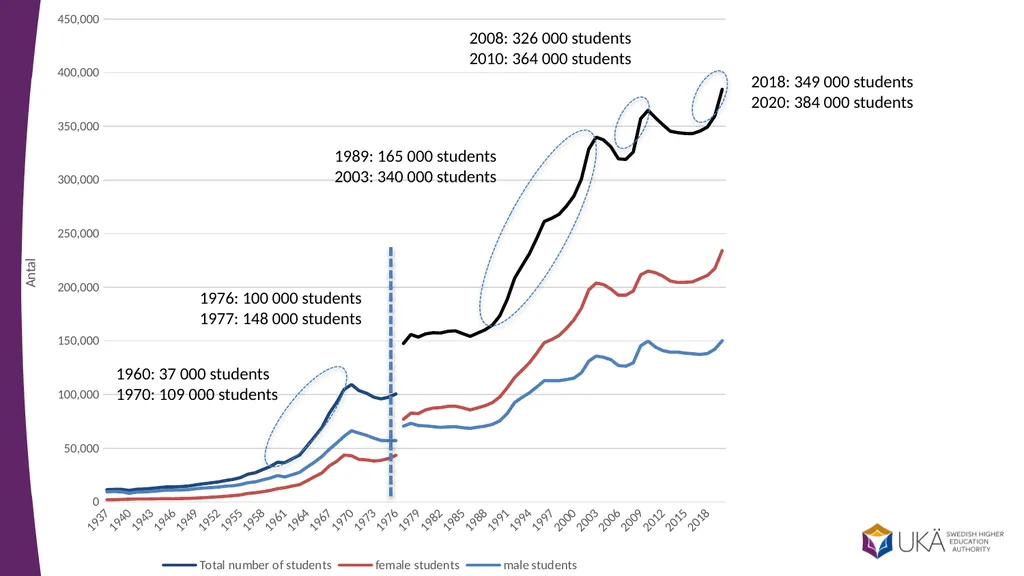
1960: 37 000 students
1970: 109 000 students 1976: 100 000 students
1977: 148 000 students 1989: 165 000 students
2003: 340 000 students 2008: 326 000 students
2010: 364 000 students 2018: 349 000 students
2020: 384 000 students<br>
06
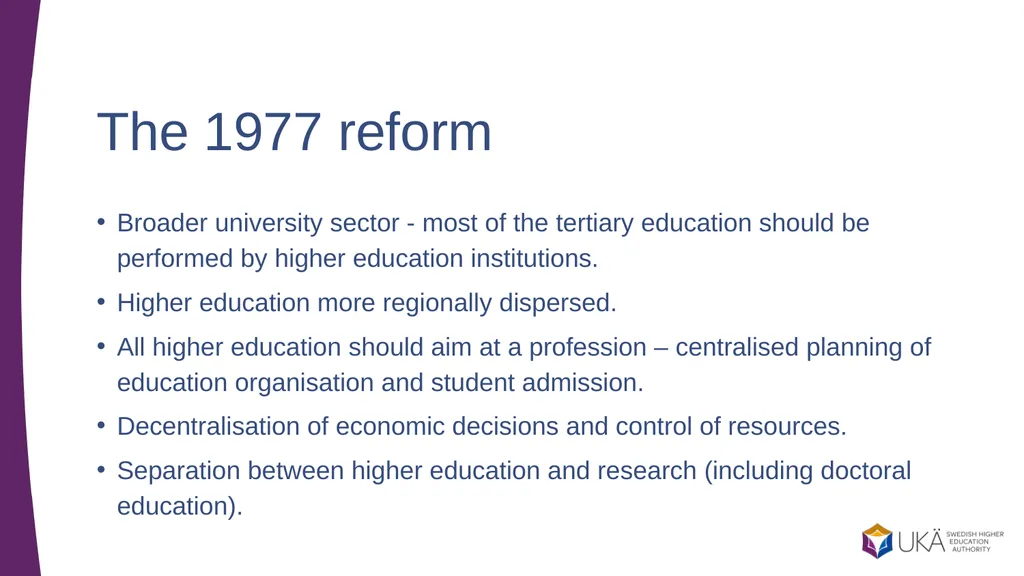
The 1977 reform Broader university sector - most of the tertiary education should be performed by higher education institutions.
Higher education more regionally dispersed.
All higher education should aim at a profession – centralised planning of education organisation and student admission.
Decentralisation of economic decisions and control of resources.
Separation between higher education and research (including doctoral education).<br>
07
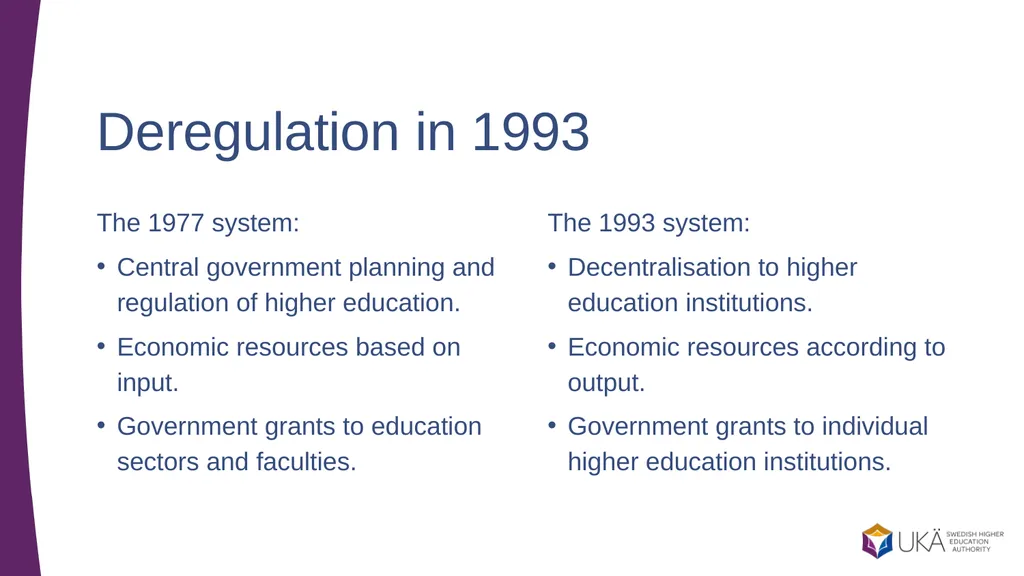
Deregulation in 1993 The 1977 system:
Central government planning and regulation of higher education.
Economic resources based on input.
Government grants to education sectors and faculties. The 1993 system:
Decentralisation to higher education institutions.
Economic resources according to output.
Government grants to individual higher education institutions.<br>
08
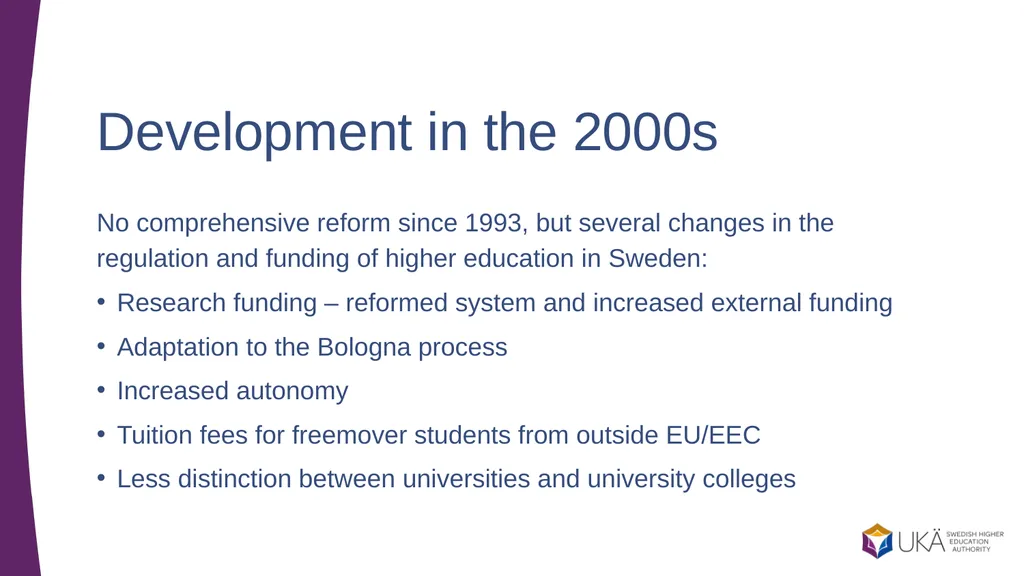
Development in the 2000s No comprehensive reform since 1993, but several changes in the regulation and funding of higher education in Sweden:
Research funding – reformed system and increased external funding
Adaptation to the Bologna process
Increased autonomy
Tuition fees for freemover students from outside EU/EEC
Less distinction between universities and university colleges<br>
09
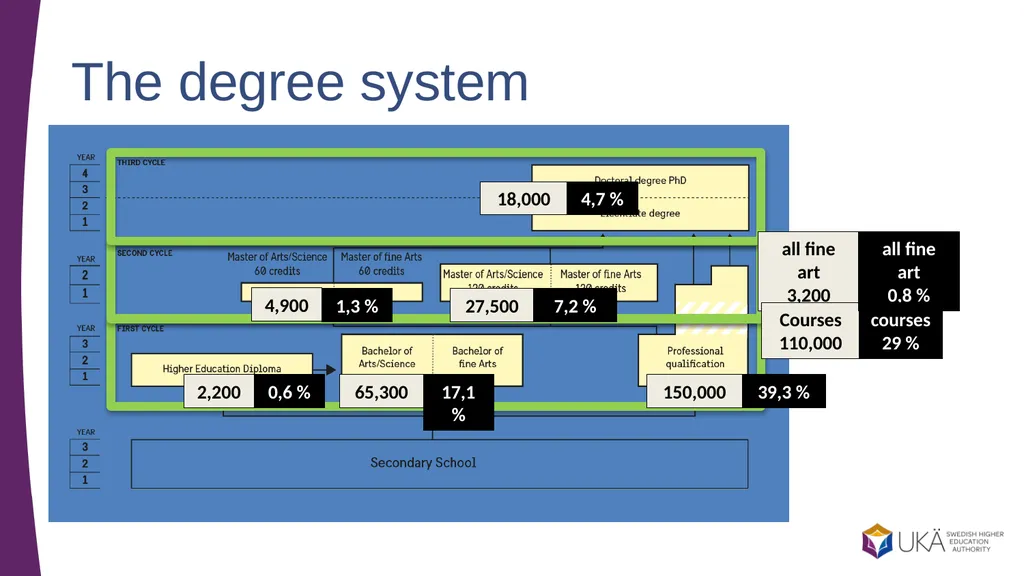
The degree system<br>
10
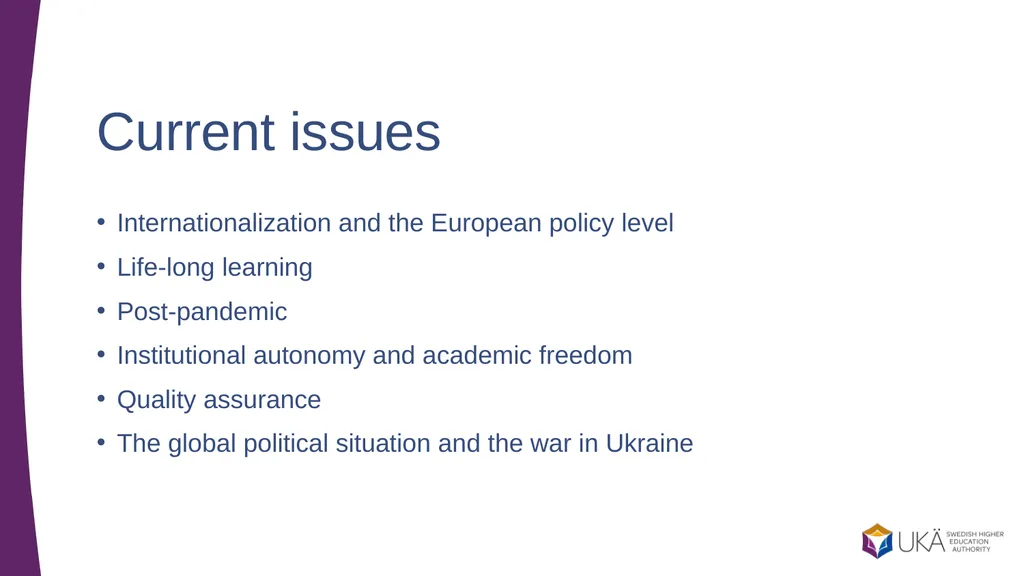
Current issues Internationalization and the European policy level
Life-long learning
Post-pandemic
Institutional autonomy and academic freedom
Quality assurance
The global political situation and the war in Ukraine<br>